Monday, August 10, 2020


UPDATE
Belarusians Clashed With Riot Police After Their “Dictator” President Claimed Victory

President Alexander Lukashenko has claimed a sixth election victory. But his incumbent challenger, a former English teacher, said she won’t recognize the results.

Christopher Miller BuzzFeed News Contributor

Posted on August 10, 2020, at 6:38 a.m. E

Vasily Fedosenko / Reuters
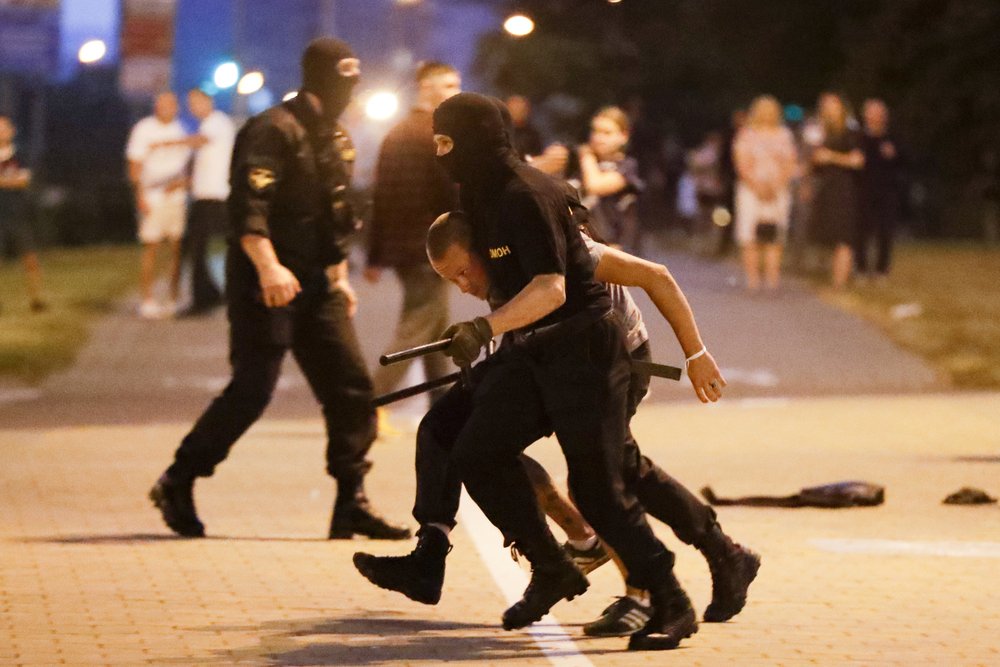
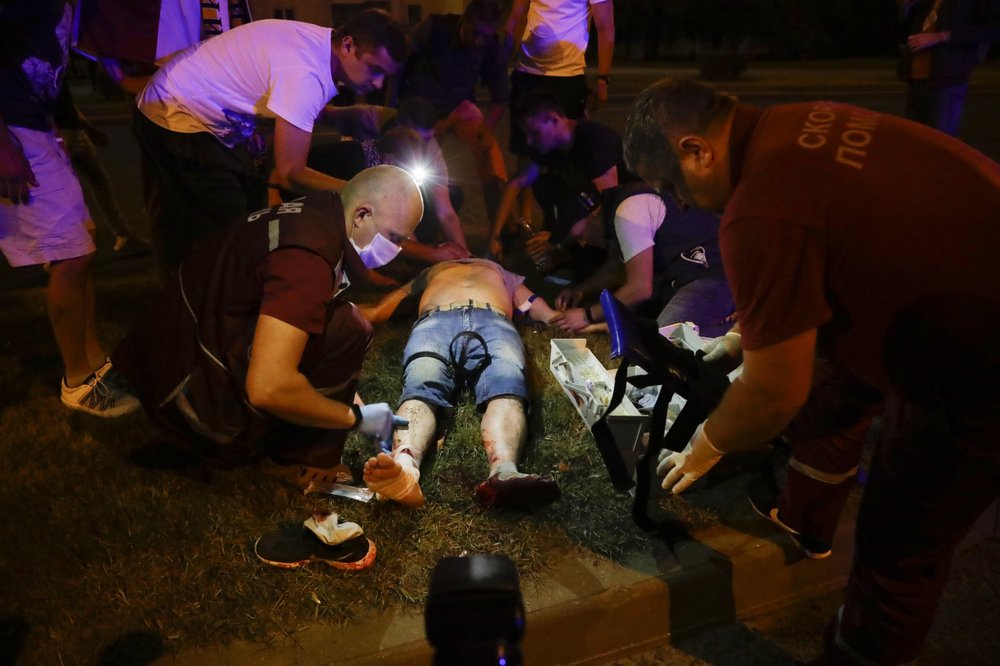
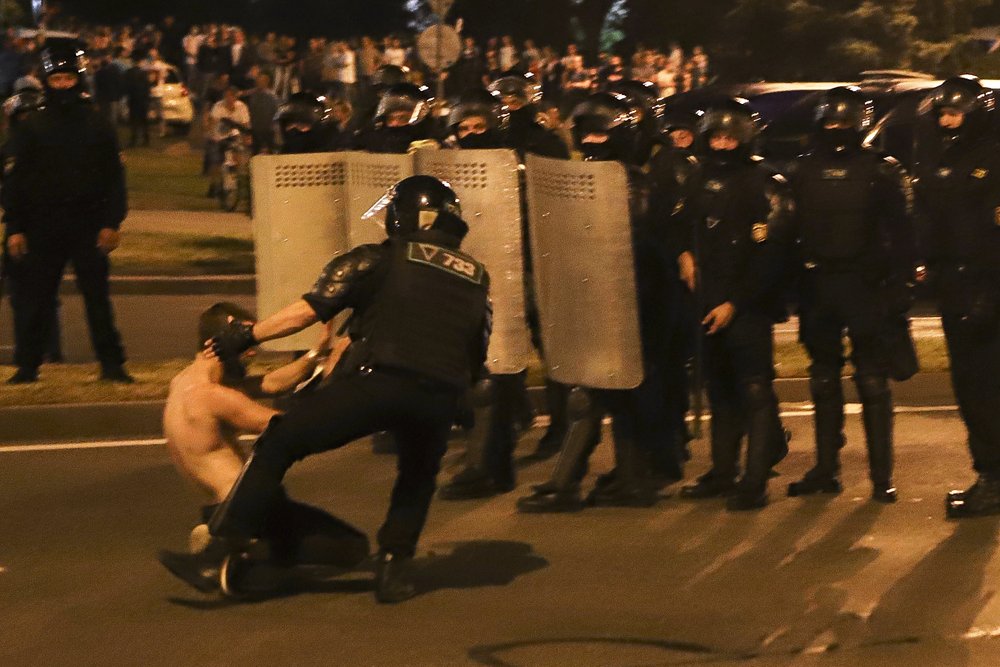
A law enforcement officer gestures next to a man laying on the ground during clashes with opposition supporters in Minsk, Belarus, on Sunday.

KYIV — Riot police violently suppressed thousands of protesters who poured into the streets of the Belarusian capital, Minsk, to challenge the results of Sunday’s hotly contested presidential election.

President Alexander Lukashenko, who has ruled Belarus with an iron first for 26 years, claimed a landslide victory in the election, which was marred by accusations of vote-rigging. The Belarusian Central Election Commission said preliminary results indicated that he won 80% of the vote while his surprise challenger, Svetlana Tikhanovskaya, finished second with just 9%. Authorities did not allow any independent observers to monitor the vote.

But on Monday, Tikhanovskaya claimed victory for herself. “We do not recognize the election results. We saw real ballots,” she was quoted by local media as saying. “We urge those who believe that his vote was stolen not to remain silent.”

She also said she was prepared to sit down with Lukashenko to discuss the situation. But Lukashenko, who was busy touring an agricultural facility and getting back to business, did not respond to the request on Monday.

Tikhanovskaya, a 37-year-old former English teacher and homemaker, rose from obscurity after the jailing of her would-be candidate husband, a popular vlogger, to gather the largest political rallies in Belarus since the fall of the Soviet Union. According to her and to independent local media reports that published documents with the tallies, several precincts in Minsk showed her with 70% to 80% of the vote. In one video from a polling station, an election commission member is seen climbing down a ladder from a second-story window and being handed a bag presumably full of ballots.

Early Monday morning, Tikhanovskaya announced that she would not concede to Lukashenko or recognize the votes.


Vasily Fedosenko / Reuters
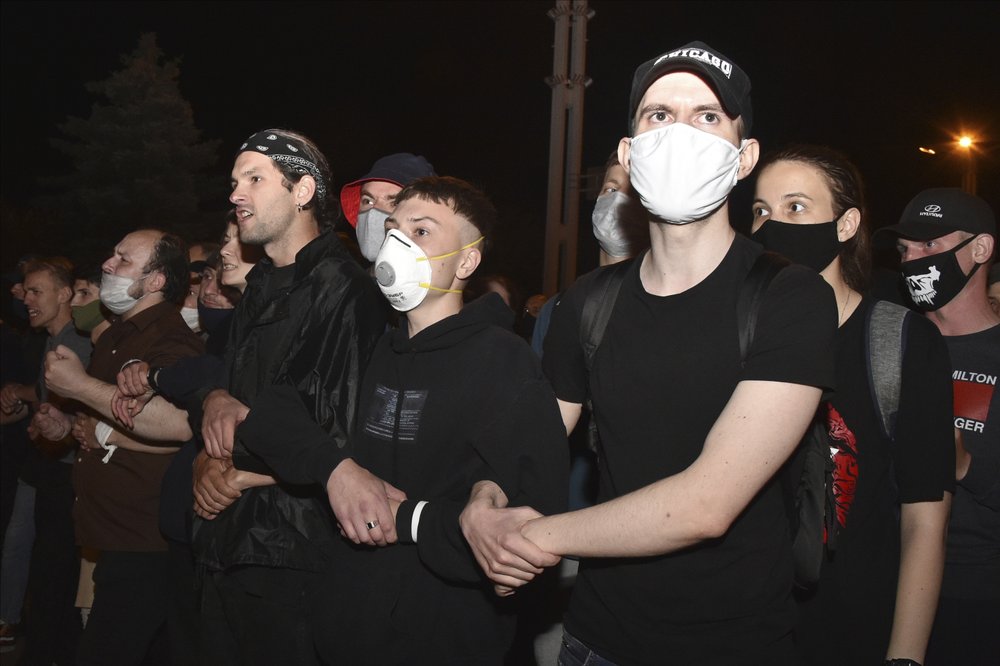
Protesters lock arms in the streets of Minsk.

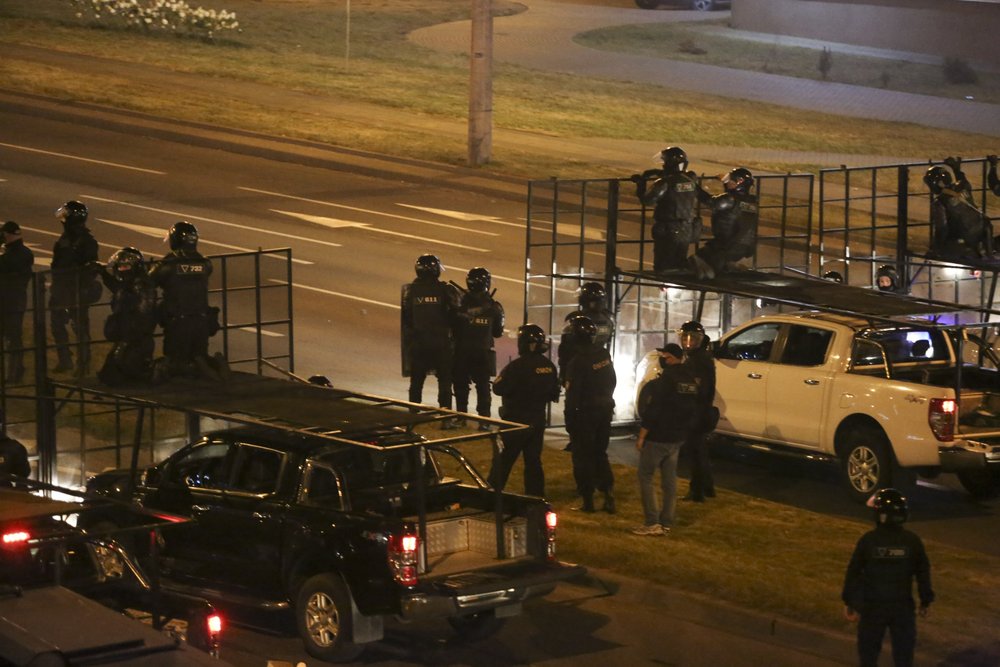
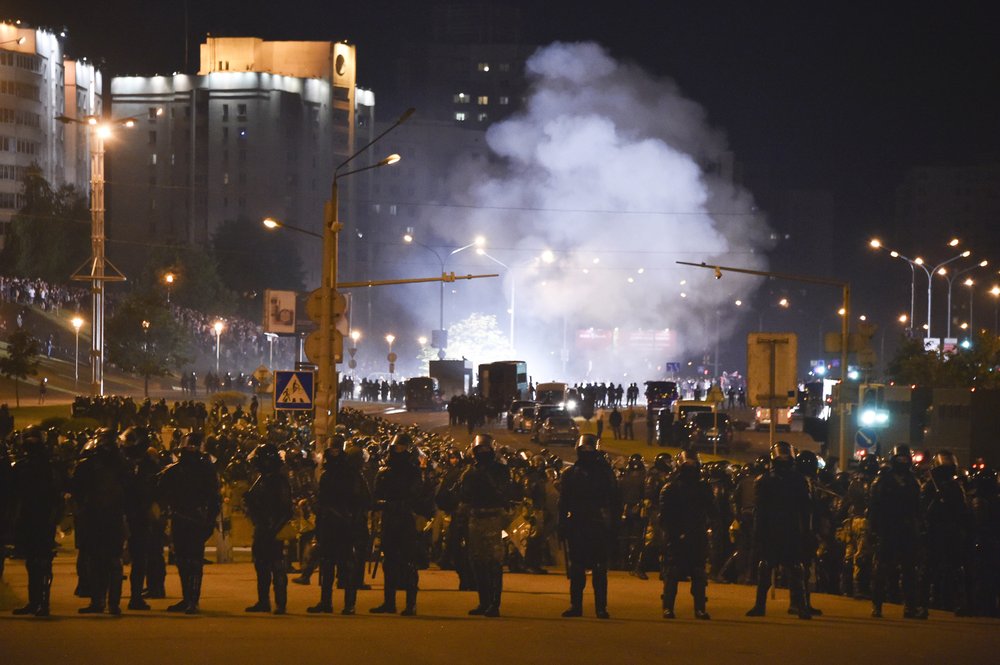
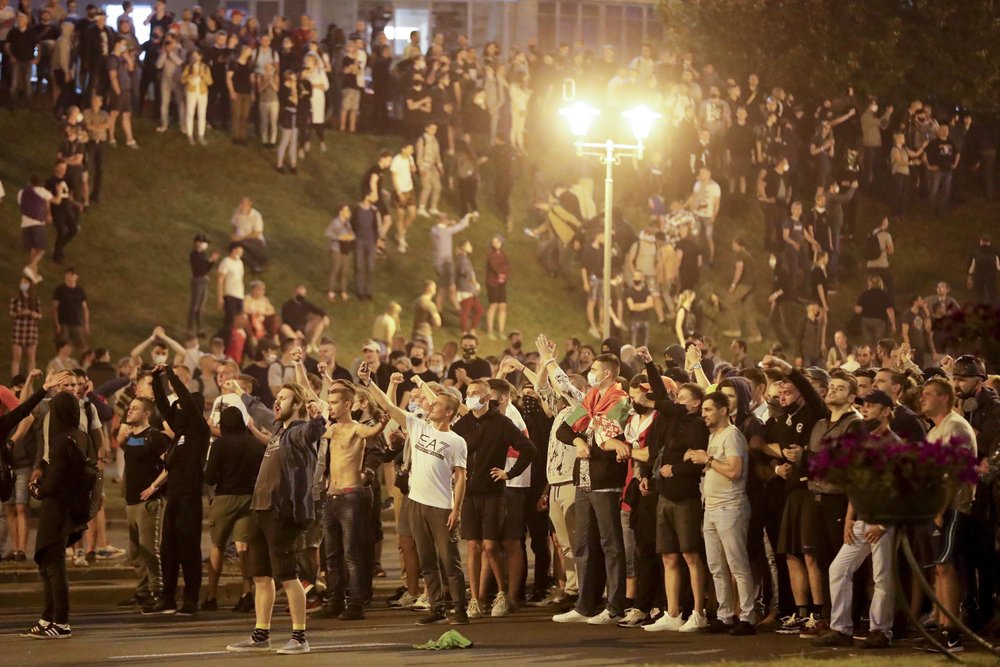
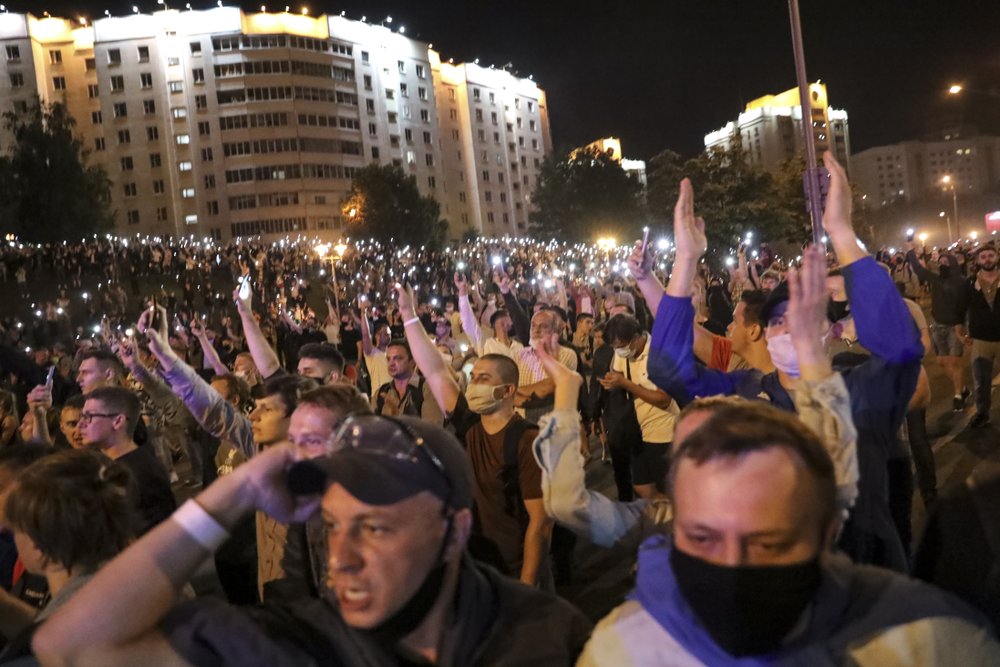
Many thousands of her supporters spilled into the streets of Minsk and several other cities across the country after polls closed Sunday night. The protesters marched through Minsk with their cellphones illuminated in the night sky before hundreds of armed security forces — many of whom had been bussed into the capital earlier in the day — began dispersing them.

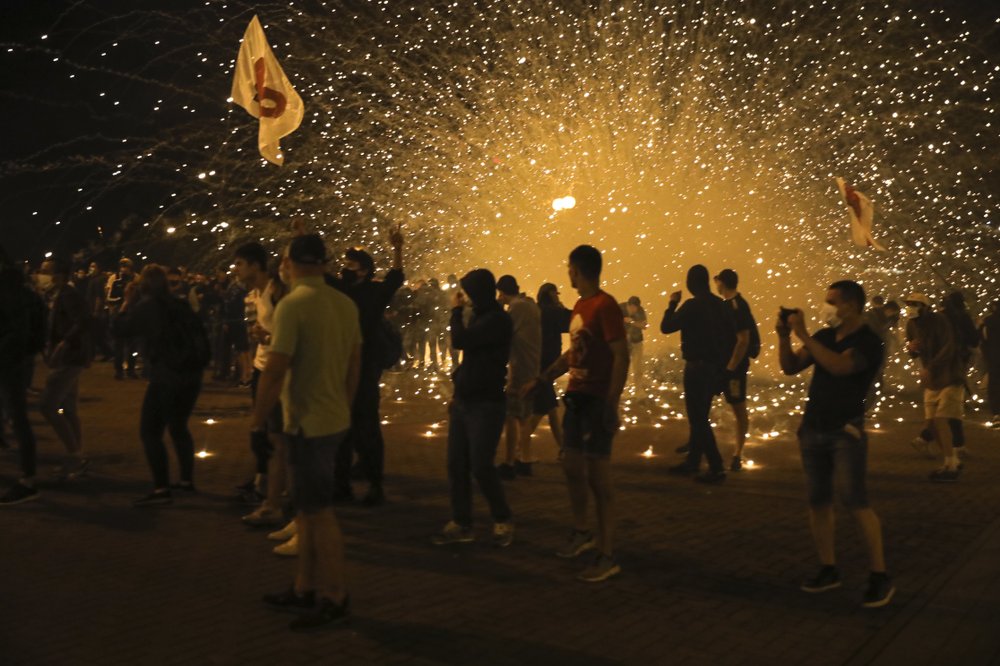
Videos and photographs shared by independent Belarusian news outlets showed police officers hurling stun grenades and tear gas canisters into the crowds while people chanted “Long live Belarus!” and “Go away!” and “This is our country!”


Белсат TV@Belsat_TV
Стэла. Менск. Абстрэл пратэстуючых. Відэа калегаў з Радыё Свабода @svaboda10:05 PM - 09 Aug 2020
Reply Retweet Favorite


Police were also seen firing rubber bullets at demonstrators and deploying water cannons and anti-riot vehicles to push the crowds back. Officers were seen on video chasing down protesters and clubbing them with batons before dragging some into vans and hauling them away. In some cases, officers were briefly overrun by groups of protesters.


TUT.BY@tutby
Минск сегодня вечером: ряды ОМОНа со щитами, водометы, светошумовые гранаты.10:05 PM - 09 Aug 2020
Reply Retweet Favorite

Meanwhile, authorities managed to limit internet access and cellphone service, and to take down independent news websites, making it difficult for anyone to find information about the events and to communicate.

As night turned to early morning, the streets of Minsk were covered in blood, and tear gas hung in the air. Reports said more than 3,000 protesters had been detained by police and jailed. The human rights group Viasna reported that at least one protester died after sustaining brain injuries when a police truck ran him over. Several others were being treated for a variety of wounds inflicted by police. An Associated Press photographer was reportedly detained and beaten unconscious in the back of a police van.


Siarhei Leskiec / Getty Images
Riot police disperse protesters.

Belarus’s Ministry of Internal Affairs reported that 39 law enforcement officers and more than 50 protesters had been wounded in all.

Clashes were also reported in some 20 other cities, including Grodno and Brest in the country’s west. But in some of the smaller cities, riot police were reported to have refused to crack down on protesters. Videos shared online showed one group retreating and another putting down their shields. A protester is seen in one video approaching an officer and hugging him.

Overnight, Tikhanovskaya called on police forces to immediately halt attacks on demonstrators and for her supporters to stop any provocative actions. “I want to ask the militia and troops to remember that they are part of the people,” she said. “Please, stop the violence.”


Sergei Gapon / Getty Images
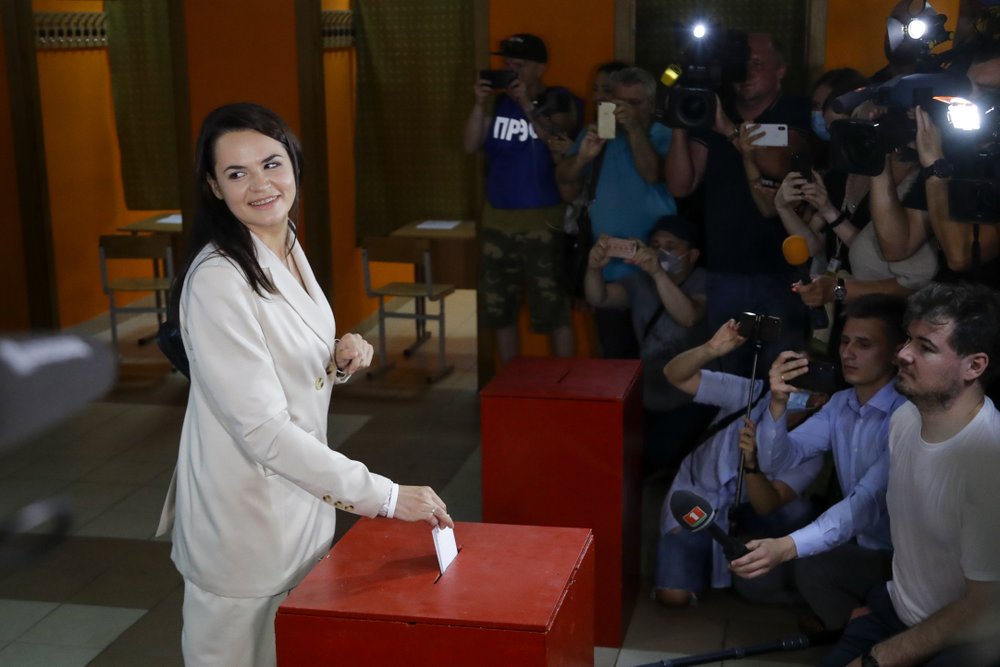
Presidential candidate Svetlana Tikhanovskaya holds a press conference on Monday, the day after Belarus' presidential election.


Tikhanovskaya was part of an all-woman trio of political novices who managed to capture Belarusians’ imagination with a promise of change and three simple hand gestures that have become symbols of hope for people tired of Lukashenko: ✌️✊❤️. The women did so after several male candidates were barred from running and Lukashenko allowed Tikhanovskaya to register — something that now appears to have been a big political miscalculation.

Veronika Tsepkalo, one of the trio and a campaign advisor for Tikhanovskaya, told BuzzFeed News that she believed Lukashenko underestimated the potential of a female candidate.

Famously known as “Europe’s Last Dictator,” Lukashenko has won five previous elections, although only the first one in 1994 was ruled free and fair by independent observers. He enjoyed strong support from Belarusians for years, mainly thanks to economic stability. But that support seemed to come to an end in recent months due to egregious human rights abuses, a stagnant economy, and his failure to properly handle the coronavirus pandemic, which has ripped through the population of 9.5 million.

While Lukashenko looks to move on, Tikhanovskaya’s chief of staff, Maria Kolesnikova, said on Monday that their team was ready for a long protest. And the candidate herself said she would do everything possible to overturn the results.

MORE ON THIS
Massive Crowds Are Rallying Around This 37-Year-Old Woman Trying To Oust “Europe’s Last Dictator”
Christopher Miller · Aug. 7, 2020


Christopher Miller is a Kyiv-based American journalist and editor.


Police, protesters clash in Belarus as election poll says Lukashenko wins 6th term

A demonstrator stands in front of riot police during a protest after polling stations closed in the presidential elections, in Minsk, Belarus, on Sunday. Photo by Tatyana Zenkovich/EPA-EFE

Aug. 10 (UPI) -- Protesters and riot police clashed in Belarus as demonstrators took to the streets in opposition to early exit polls that indicate incumbent President Aleksandr Lukashenko would handily win a sixth term at the country's helm.

Election officials late Sunday released exit poll data showing that the authoritarian president had secured nearly 80% of the vote to main opposition Svetlana Tikhanovskaya's 6.8%


The opposition has previously expressed worries the election would be rigged, and Tikhanovskaya told reporters during a press conference after the poll was released that she does not accept the tally.

"I believe my eyes, and I see that the majority is with us," she said.


Lidia Yermoshina, chairwoman of the Central Election Commission, said based on preliminary estimates from Sunday's vote that nearly 5.8 million people, or 84.23% of eligible voters, cast a ballot in the election, state-run Belta news agency reported.

The tally, she said, will be double-checked but "I don't think that they will change dramatically."

In the capital of Minsk, riot police used tear gas, rubber bullets and water cannons Sunday night to disperse protesters, some of who were injured, Viasna, a human rights organization in Belarus, said in a statement, adding at least 70 protesters were arrested


In the weeks before the election, human rights organizations warned of ongoing arbitrary arrests of peaceful protesters, journalists and bloggers.

"Belarusian authorities are using flimsy pretexts to silence journalists and critics, which should never happen, but that has even more damning consequences for citizens' rights in an election period," Hugh Williamson, Europe and Central Asia director at Human Rights Watch, said in a late July statement. "The international community should not ignore such serious flouting of human rights obligations."

Since May, Viasna has reported that more than 1,000 people have been arbitrarily arrested, including Tikhanovskaya's husband, Sergey Tikhanovskaya, a YouTube blogger and former presidential candidate.

Following his arrest, Tikhanovskaya, 37, took her husband's place on the ballot, the BBC reported.

A day before the election, Viasna reported that Tikhanovskaya's campaign manager, Maryia Maroz, was also detained though the charges had yet to be announced.

Lukashenko was first elected to the country's highest office in 1994.

Belarus’ leader wins sixth term with over 80% of votes


1 of 27 
https://apnews.com/9a9a4324a3c6a913ac6cc0abaedcc342


Protesters carry a wounded man during clashes with police after the presidential election in Minsk, Belarus, early Monday, Aug. 10, 2020. Police and protesters clashed in Belarus' capital and the major city of Brest on Sunday after the presidential election in which the authoritarian leader who has ruled for a quarter-century sought a sixth term in office. (AP Photo)
MINSK, Belarus (AP) — Election officials in Belarus said Monday that President Alexander Lukashenko has won his sixth consecutive term, taking over 80% of the vote amid protests fueled by frustration with the country’s deteriorating economy, years of political repression and the authoritarian incumbent’s cavalier brushoff of the coronavirus threat.

Human rights groups said one person was killed — which the authorities denied — and dozens were injured in a police crackdown on protests that followed Sunday’s presidential election.

The country’s central election commission said that with all ballots counted, Lukashenko, who has led Belarus for 26 years, took 80.23% of the vote and his main opposition challenger, Sviatlana Tsikhanouskaya, had only 9.9%.

Opposition supporters believe the election results were rigged and plan to gather in Minsk for more protests on Monday evening.

“We don’t recognize these results,” Tsikhanouskaya, a former English teacher and political novice, told reporters Monday.

“According to the data we receive from precincts, we won, and this corresponds with what we saw at polling stations,” she said. “People stood in lines at polling stations in order to vote for Tsikhanouskaya. I believe my own eyes rather than the data of the central election commission.”

Thousands of people took to the streets in a number of Belarusian cities and towns on Sunday night, protesting the early count suggesting Lukashenko’s landslide victory. They faced rows of riot police in black uniforms who moved quickly to disperse the demonstrators, firing flash-bang grenades and beating them with truncheons.

The brutal crackdown followed a tense campaign that saw massive rallies against Lukashenko, who has ruled the ex-Soviet nation with an iron fist for 26 years. Lukashenko has not yet commented on the results or the protests, only saying on Monday that “the people” should be the cornerstone of any politics, according to the state news agency Belta.

According to the Viasna human rights group, more than 200 protesters were detained, dozens sustained injuries and one died as the result of the clashes with police.

The Interior Ministry said Monday no one was killed during the protests and called reports about a fatality “an absolute fake.” According to officials, 89 people were injured during the protests, including 39 law enforcement officers, and some 3,000 people were detained.

On Monday morning, Belarus’ Investigative Committee opened a criminal probe into mass riots and violence toward police officers. 
BLAMING THE PROTESTERS DEFENDING POLICE BRUTALITY


“What has happened is awful,” Tsikhanouskaya told reporters Sunday.

An AP journalist was beaten by police and treated at a hospital.

At Minsk’s Hospital No. 10, an AP reporter saw a dozen ambulances delivering protesters with fragmentation wounds and cuts from stun grenades and other injuries.

European officials urged Belarusian authorities to adhere to standards of democracy and respect the people’s civil rights on Sunday.

Lithuanian Foreign Minister Linas Linkevicius told the BNS news agency on Monday that “it’s difficult to call this election transparent, democratic and free, regrettably.” Poland’s Foreign Ministry issued a statement on Monday morning saying that “the harsh reaction of the law enforcement forces, the use of force against peaceful protesters, and arbitrary arrests are unacceptable.”

Russian President Vladimir Putin, in the meantime, congratulated Lukashenko on his win on Monday, and so did the president of Kazakhstan, Kassym-Jomart Tokayev. The results of the vote “indicate the popular support” of Lukashenko’s rule, Tokayev said.

Ukraine’s President Volodymyr Zelenskiy said in a Facebook post Monday it was “obvious that not everyone in the country agrees with the announced preliminary election results. And, as we know, any legitimacy arises solely from public trust,” urging Minsk to refrain from violence and calling for dialogue with the opposition.

Two prominent opposition challengers were denied places on the ballot, but Tsikhanouskaya, the wife of a jailed opposition blogger, managed to unite opposition groups and draw tens of thousands to her campaign rallies, tapping growing anger over a stagnant economy and fatigue with Lukashenko’s autocratic rule.

Lukashenko was defiant as he voted earlier in the day, warning that the opposition will meet a tough response.

“If you provoke, you will get the same answer,” he said. “Do you want to try to overthrow the government, break something, wound, offend, and expect me or someone to kneel in front of you and kiss them and the sand onto which you wandered? This will not happen.”

The Organization for Security and Cooperation in Europe, whose assessments of elections are widely regarded as authoritative, was not invited to send observers.


Tsikhanouskaya had crisscrossed the country, tapping into public frustration with a worsening economy and Lukashenko’s swaggering response to the pandemic.

Belarus, a country of 9.5 million people, has reported more than 68,500 coronavirus cases and 580 deaths but critics have accused authorities of manipulating the figures to downplay the death toll.

Lukashenko has dismissed the virus as “psychosis” and declined to apply measures to stop its spread, saying a lockdown would have doomed the already weak economy. He announced last month that he had been infected but had no symptoms and recovered quickly, allegedly thanks to playing sports.

___

Associated Press journalists Jim Heintz, Vladimir Isachenkov and Daria Litvinova in Moscow contributed to this story.
UPDATE
Police break up protests after Belarus presidential vote
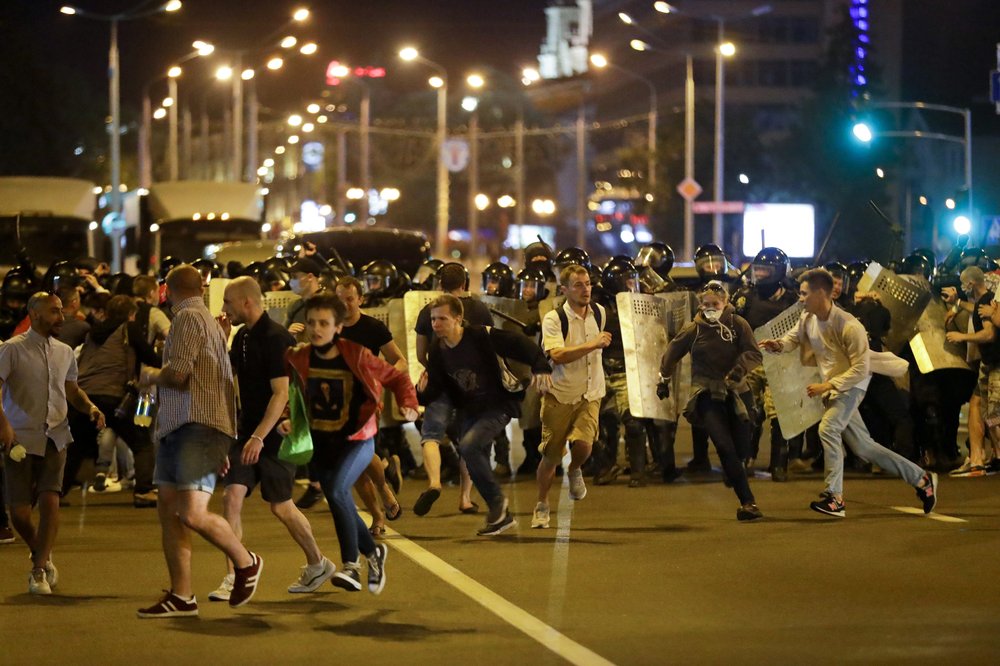
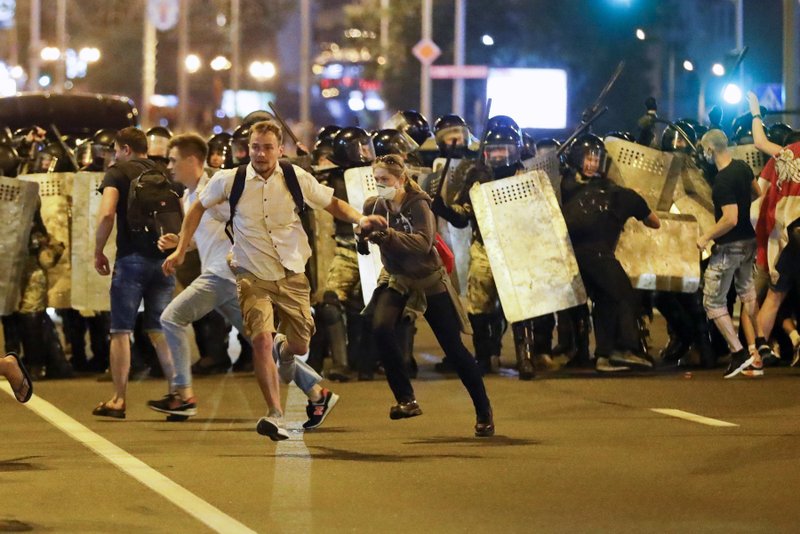
Demonstrators run away from police as they gather to protest against a result of the Belarusian presidential election in Minsk, Belarus, Sunday, Aug. 9, 2020. Police and protesters clashed in Belarus' capital and the major city of Brest on Sunday after the presidential election in which the authoritarian leader who has ruled for a quarter-century sought a sixth term in office. (AP Photo/Sergei Grits)


MINSK, Belarus (AP) — Phalanxes of Belarusian police in full riot gear violently dispersed thousands of demonstrators who poured into the streets to challenge the early count from Sunday’s presidential election indicating the longtime authoritarian leader won a sixth term by a landslide.

Hundreds of people were detained, according to a leading rights group.

The brutal crackdown that began late Sunday and lasted through the night followed a tense campaign that saw massive rallies against President Alexander Lukashenko, who has ruled the ex-Soviet nation with an iron hand for 26 years.

Election officials declared that early returns show 65-year-old Lukashenko winning with more than 80% of the vote while the main challenger, Sviatlana Tsikhanouskaya, a former English teacher and political novice, had about 8%.

Tsikhanouskaya rejected the official claims, saying “I will believe my own eyes — the majority was for us.”

Thousands of her supporters quickly took to the streets of the capital to protest what they saw as official manipulations of the vote. They faced rows of riot police in black uniforms who moved quickly to disperse the demonstrators, firing flash-bang grenades and beating them with truncheons.

After breaking up the big crowds, police relentlessly chased smaller groups of protesters across downtown Minsk for the next several hours.

Several other cities across the country saw similar crackdowns on protesters.

Interior Ministry spokeswoman Olga Chemodanova said that police efforts to restore order were continuing overnight, but wouldn’t say how many people were detained.

Ales Bilyatsky of the Viasna human rights group told The Associated Press several hundred were detained and hundreds injured in the police crackdown.

“What has happened is awful,” Tsikhanouskaya told reporters Sunday.

An AP journalist was beaten by police and treated at a hospital.


At Minsk’ Hospital No. 10, an AP reporter saw a dozen ambulances delivering protesters with fragmentation wounds and cuts from stun grenades and other injuries.

“It was a peaceful protest, we weren’t using force,” said 23-year-old protester, Pavel Konoplyanik, who was accompanying his friend who had a plastic grenade fragment stuck in his neck. “No one will believe in the official results of the vote, they have stolen our victory.”

Konoplyanik, whose legs were also cut by fragments of police grenades, said he doesn’t want to leave the country but fears that he might have no other choice.

Two prominent opposition challengers were denied places on the ballot, but Tsikhanouskaya, the wife of a jailed opposition blogger, managed to unite opposition groups and draw tens of thousands to her campaign rallies, tapping growing anger over a stagnant economy and fatigue with Lukashenko’s autocratic rule.

Lukashenko was defiant as he voted earlier in the day, warning that the opposition will meet a tough response.


“If you provoke, you will get the same answer,” he said. “Do you want to try to overthrow the government, break something, wound, offend, and expect me or someone to kneel in front of you and kiss them and the sand onto which you wandered? This will not happen.”


Mindful of Belarus’ long history of violent crackdowns on dissent — protesters were beaten after the 2010 election and six rival candidates arrested, three of whom were imprisoned for years — Tsikhanouskaya called for calm earlier Sunday.

“I hope that everything will be peaceful and that the police will not use force,” she said after voting.

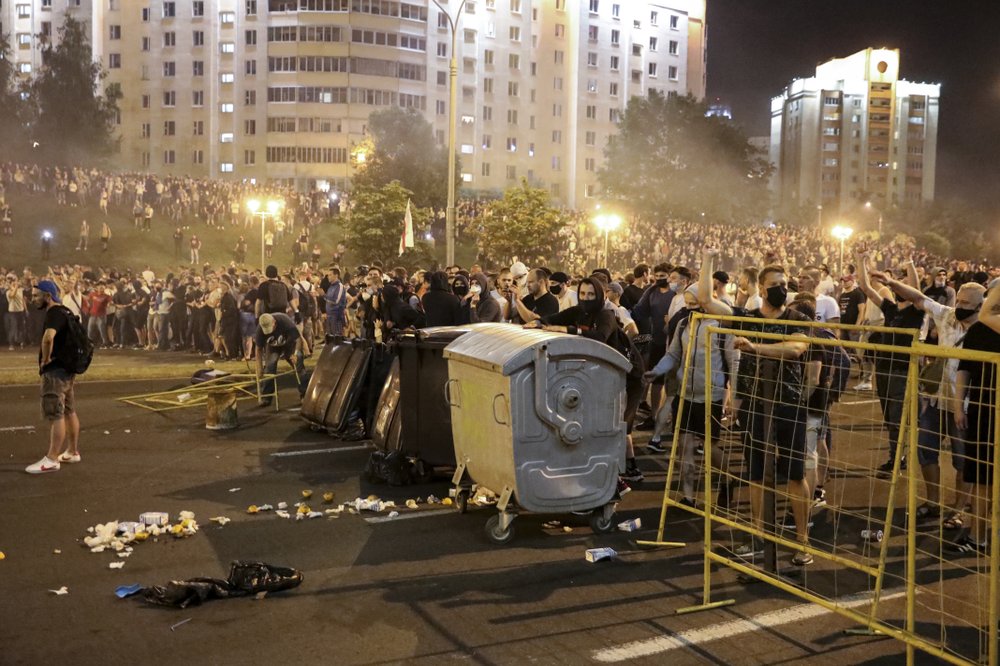
After the polls closed, about 1,000 protesters gathered near the obelisk honoring Minsk as a World War II “hero city,” where police harshly clashed with them, beating some with truncheons and later using flash-bang grenades to try to disperse them. Some of the protesters later tried to build barricades with trash containers, but police quickly broke them up.

Three journalists from the independent Russian TV station Dozhd were detained after interviewing an opposition figure and were deported.


Tsikhanouskaya emerged as Lukashenko’s main opponent after two other aspirants were denied places on the ballot. Viktor Babariko, head of a major Russia-owned bank, was jailed for charges he called political, and Valery Tsepkalo, entrepreneur and former ambassador to the United States, fled to Russia with his children after warnings that he would be arrested and his children taken away.

Tsepkalo’s wife Veronika became a top member of Tsikhanouskaya’s campaign, but she left the country too early Sunday, fearing for her safety, said campaign spokeswoman Anna Krasulina. Over the weekend, eight members of Tsikhanouskaya’s campaign staff were arrested.


Many voters were defiant in the face of Lukashenko’s vow not to tolerate any protests.

“There is no more fear. Belarusians will not be silent and will protest loudly,” 24-year-old Tatiana Protasevich said at a Minsk polling place.


As polls opened, the country’s central elections commission said more than 40% of the electorate had cast ballots in five days of early voting, a process the opposition saw as offering fertile ground for manipulation.

“For five nights nobody has guarded the ballot boxes, which gives the authorities a wide field for maneuverings,” Veronika Tsepkalo told AP before leaving Belarus.

The Organization for Security and Cooperation in Europe, whose assessments of elections are widely regarded as authoritative, was not invited to send observers.

Tsikhanouskaya had crisscrossed the country, tapping into public frustration with a worsening economy and Lukashenko’s swaggering response to the pandemic.


Belarus, a country of 9.5 million people, has reported more than 68,500 coronavirus cases and 580 deaths but critics have accused authorities of manipulating the figures to downplay the death toll.

Lukashenko has dismissed the virus as “psychosis” and declined to apply measures to stop its spread, saying a lockdown would have doomed the already weak economy. He announced last month that he had been infected but had no symptoms and recovered quickly, allegedly thanks to playing sports.

Yet for some voters, Lukashenko’s long, hardline rule was a plus.

“He is an experienced politician, not a housewife who appeared out of nowhere and muddied the waters,” retiree Igor Rozhov said Sunday. “We need a strong hand that will not allow riots.”

—-

Associated Press journalists Jim Heintz and Vladimir Isachenkov in Moscow contributed to this story.


MORE 21 PHOTOS AND TEXT
https://apnews.com/d310c4f9811b31e44fa5536bb826cc5e


Blast destroyed landmark 19th century palace in Beirut

Broken glass and window frames lay on the floor of the Sursock Palace, heavily damaged after the explosion in the seaport of Beirut, Lebanon, Friday, Aug. 7, 2020. The level of destruction from the massive explosion at Beirut's port last week is ten times worse than what 15 years of civil war did. (AP Photo/Felipe Dana)


BEIRUT (AP) — The 160-year-old palace withstood two world wars, the fall of the Ottoman Empire, the French mandate and Lebanese independence. After the country’s 1975-1990 civil war, it took 20 years of careful restoration for the family to bring the palace back to its former glory.

“In a split second, everything was destroyed again,” says Roderick Sursock, owner of Beirut’s landmark Sursock Palace, one of the most storied buildings in the Lebanese capital.

He steps carefully over the collapsed ceilings, walking through rooms covered in dust, broken marble and crooked portraits of his ancestors hanging on the cracked walls. The ceilings of the top floor are all gone, and some of the walls have collapsed. The level of destruction from the massive explosion at Beirut’s port last week is 10 times worse than what 15 years of civil war did, he says.

A painting hangs on the wall of a heavily damaged room in the Sursock Palace after the explosion in the seaport of Beirut, Lebanon, Saturday, Aug. 8, 2020. The level of destruction from the massive explosion at Beirut's port last week is ten times worse than what 15 years of civil war did. (AP Photo/Felipe Dana)


More than 160 people were killed in the blast, around 6,000 were injured and thousands of residential buildings and offices were damaged. Several heritage buildings, traditional Lebanese homes, museums and art galleries have also sustained various degrees of damage.

The Sursock palace, built in 1860 in the heart of historical Beirut on a hill overlooking the now-obliterated port, is home to beautiful works of arts, Ottoman-era furniture, marble and paintings from Italy — collected by three long-lasting generations of the Sursock family.

The Greek Orthodox family, originally from the Byzantine capital, Constantinople — now Istanbul — settled in Beirut in 1714.

The three-story mansion has been a landmark in Beirut. With its spacious garden, it’s been the venue for countless weddings, cocktail parties and receptions over the years, and has been admired by tourists who visit the nearby Sursock museum.

The house in Beirut’s Christian quarter of Achrafieh is listed as a cultural heritage site, but Sursock said only the army has come to assess the damage in the neighborhood. So far, he’s had no luck reaching the Culture Ministry.

The palace is so damaged that it will require a long, expensive and delicate restoration, “as if rebuilding the house from scratch,” Sursock says.

Roderick Sursock stands in a heavily damaged room of the Sursock Palace, affected by the explosion in the seaport of Beirut, Lebanon, Saturday, Aug. 8, 2020. "In a split second, everything was destroyed again," said Sursock, owner of the charming Sursock Palace, one of the most prominent and well-known buildings in the Lebanese capital. (AP Photo/Felipe Dana)
A broken statue from the 19th century lays on the floor of the Sursock Palace, heavily damaged after the explosion in the seaport of Beirut, Lebanon, Saturday, Aug. 8, 2020. The Sursock palace, built in 1860 in the heart of historical Beirut on top of a hill overlooking the now-obliterated port, is home to beautiful works of arts, Ottoman-era furniture, marble and paintings from Italy — the result of more than three long-lasting generations of the Sursock family. (AP Photo/Felipe Dana)

Sursock has moved to a nearby pavilion in the palace gardens, but this has been his home for many years alongside his American wife, his 18-year-old daughter and his mother, Yvonne. He says the 98-year-old Lady Cochrane (born Sursock) had courageously stayed in Beirut during the 15 years of the civil war to defend the palace. His wife was just dismissed from hospital, as the blast was so powerful that the wave affected her lungs.

Sursock says there is no point in restoring the house now — at least not until the country fixes its political problems.

“We need a total change, the country is run by a gang of corrupt people,” he said angrily.

Despite his pain and the damage from last week’s blast, Sursock, who was born in Ireland, says he will stay in Lebanon, where he has lived his whole life and which he calls home.

But he desperately hopes for change.

“I hope there is going to be violence and revolution because something needs to break, we need to move on, we cannot stay as we are.”


STATEHOOD OR INDEPENDENCE
Puerto Rico halts primary voting in centers lacking ballots


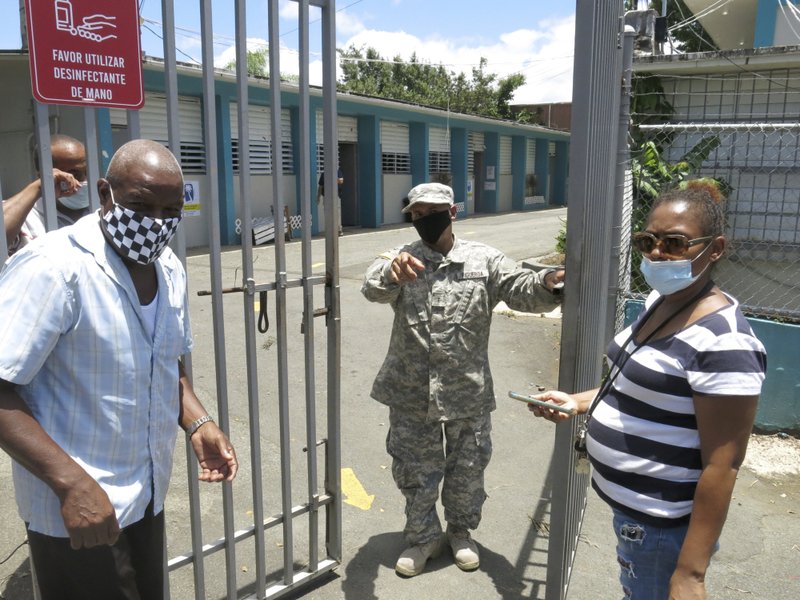
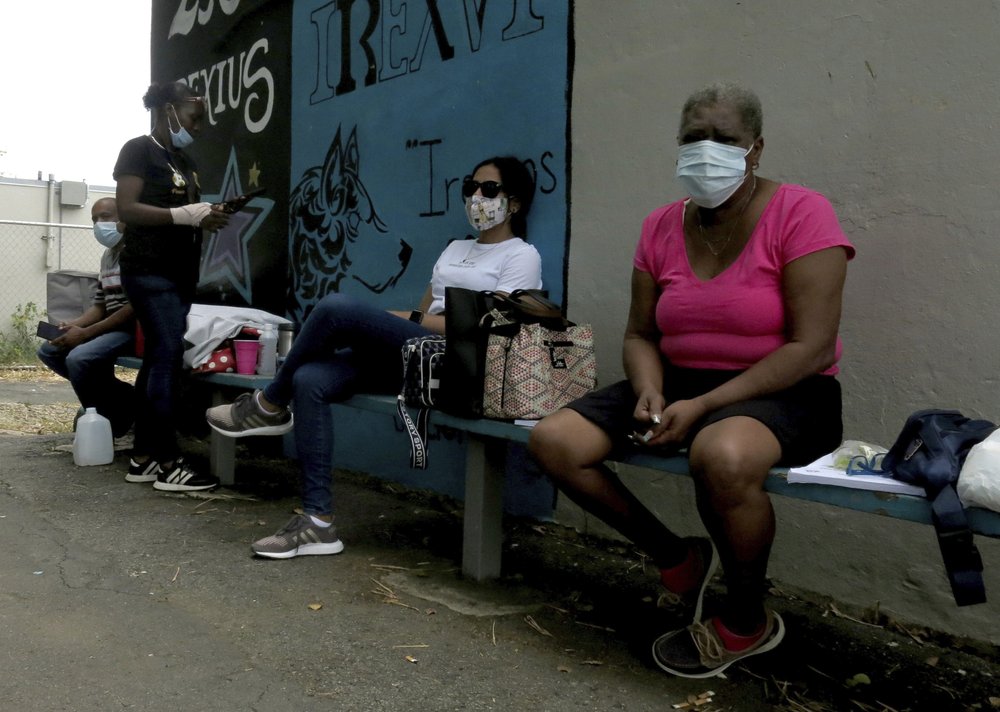
An official turns away two voters at a voting center lacking ballots in Carolina, Puerto Rico, Sunday, Aug. 9, 2020. Puerto Rico's primaries were marred on Sunday by a lack of ballots in a majority of centers across the U.S. territory, forcing frustrated voters who braved a spike in COVID-19 cases to turn around and go back home. (AP Photo/Danica Coto)

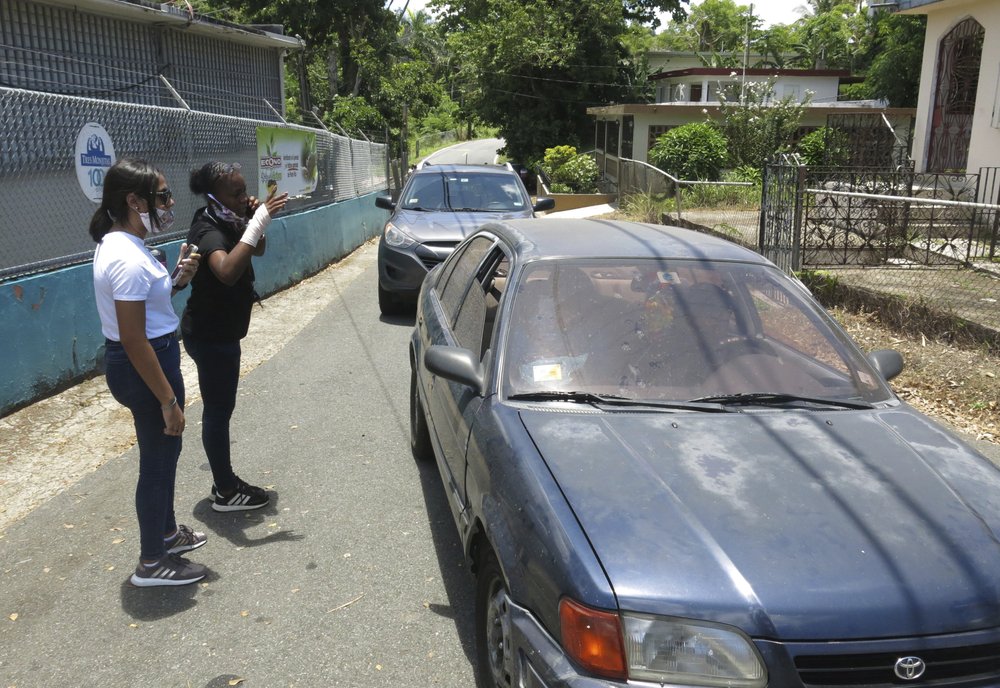
SAN JUAN, Puerto Rico (AP) — Puerto Rico on Sunday was forced to partially suspend voting for primaries marred by a lack of ballots as officials called on the president of the U.S. territory’s elections commission to resign.

The primaries for voting centers that had not received ballots by early afternoon are expected to be rescheduled, while voting would continue elsewhere, the commission said.

“I have never seen on American soil something like what has just been done here in Puerto Rico. It’s an embarrassment to our government and our people,” said Pedro Pierluisi, who is running against Gov. Wanda Vázquez, to become the nominee for the pro-statehood New

Meanwhile, Vázquez called the situation “a disaster” and demanded the resignation of the president of the elections commission.

“They made the people of Puerto Rico, not the candidates, believe that they were prepared,” she said. “Today the opposite was evident. They lied.”

A federal control board that oversees Puerto Rico’s finances issued a statement saying the “dysfunctional” voting process was unacceptable and blamed it on what it said was inefficiency by the elections commission.

The unprecedented situation comes as voters ventured out amid a spike in COVID-19 cases across Puerto Rico, an island of 3.2 million people that has reported more than 12,800 probable cases, more than 8,500 confirmed cases and at least 274 deaths.

Gireliz Zambrana, a 31-year-old federal employee, worried about the number of people gathered at a voting center in Río Grande as they huddled together while waiting for it to open.

“They were trying to get away from the sun,” he said, adding that he never got to cast his vote.

The president of the governor’s party, Thomas Rivera Schatz, along with the president of the main opposition Popular Democratic Party, held an unusual joint press conference and said they agreed the remaining primaries should be held on Aug. 16, a move that Vázquez said she supported. The two parties are both holding their primary elections with the winning nominees among six gubernatorial candidates in November’s general election.


FILES - This combo of two file photos shows Pedro Pierluisi, left and Wanda Vazquez in San Juan, Puerto Rico. At left, Secretary of State Pedro Pierluisi attends his confirmation hearing at the House of Representatives on Aug. 2, 2019, and at right, Puerto Rico Gov. Wanda Vazquez gives an interview at La Fortaleza governor residence on Aug. 16, 2019. Both served as replacement governors in the wake of a Puerto Rican political crisis and are competing against each other for a chance to win the job in their own right as the disaster-struck U.S. territory holds primary elections on Sunday, Aug. 9, 2020. (AP Photo/Dennis M. Rivera Pichardo, Files)


Other politicians argued that the entire primary be scrapped and held at another date.

An incredulous Schatz noted that there were still trucks with ballots inside parked at the commission’s headquarters as they spoke there on Sunday afternoon.

“The question is, why haven’t they left?” he said.

It was not immediately clear how many voters were turned away or how many centers received delayed ballots. A commission spokeswoman said the president was not granting interviews.

To further complicate things, Edgardo Román, president of the Bar Association of Puerto Rico, told The Associated Press that it’s unclear what alternatives are legally viable because the island’s electoral law is not clear.

“It doesn’t contemplate this scenario,” he said.


Electoral officials inform arriving voters that the ballots haven't arrived at a voting center in Carolina, Puerto Rico, Sunday, Aug. 9, 2020. Puerto Rico's primaries were marred on Sunday by a lack of ballots in a majority of centers across the U.S. territory, forcing frustrated voters who braved a spike in COVID-19 cases to turn around and go back home. (AP Photo/Danica Coto)

An electoral official, right, tells a voter that the ballots haven't arrived at a voting center in Carolina, Puerto Rico, Sunday, Aug. 9, 2020. Puerto Rico's primaries were marred on Sunday by a lack of ballots in a majority of centers across the U.S. territory, forcing frustrated voters who braved a spike in COVID-19 cases to turn around and go back home. (AP Photo/Danica Coto)

Electoral officials wait for ballots to arrive at a voting center in Carolina, Puerto Rico, Sunday, Aug. 9, 2020. Puerto Rico's primaries were marred by a lack of ballots in a majority of centers across the U.S. territory, forcing frustrated voters who braved a spike in COVID-19 cases to turn around and go back home. (AP Photo/Danica Coto)

At least one voter filed a lawsuit against the commission and the electoral officials of the two main parties late Sunday via the American Civil Liberties Union.


The situation infuriated voters and politicians of all stripes as they blamed Puerto Rico’s elections commission and demanded an explanation for ballots reaching only a handful of voting centers by the afternoon.

“This is indignant, abusive and an attempt against the democracy of our country,” said Marcos Cruz, mayor of the northern town of Vega Baja that was still awaiting ballots.

Meanwhile, officials from the island’s two main parties scrambled to find solutions as they urged voters to still show up at centers that remained open late into the night.

Yadira Pizarro, a 44-year-old teacher, ran out of patience at a shuttered voting center in Carolina where she had waited more than four hours under a blistering sun.

“I cannot believe this. This is some serious negligence,” she said.

One of the most closely watched races on Sunday is that of the pro-statehood Progressive New Party, which pits two candidates who served as replacement governors following last year’s political turmoil. Vázquez faces Pierluisi, who represented Puerto Rico in Congress from 2009 to 2017.

Pierluisi briefly served as governor after Gov. Ricardo Rosselló resigned in August 2019 following widespread street protests over a profanity-laced chat that was leaked and government corruption. But Puerto Rico’s Supreme Court ruled that Vázquez, then the justice secretary, was constitutionally next in line because there was no secretary of state.

Meanwhile, the main opposition Popular Democratic Party, which supports Puerto Rico’s current political status as a U.S. territory, is holding a primary for the first time in its 82-year history. Three people are vying to become governor — San Juan Mayor Carmen Yulín Cruz, known for her public spats with U.S. President Donald Trump following the devastation of Hurricane Maria; Puerto Rico Sen. Eduardo Bhatia; and Carlos Delgado, mayor of the northwest coastal town of Isabela.


UPDATE
Beirut explosion bares pitfalls of sending aid to Lebanon


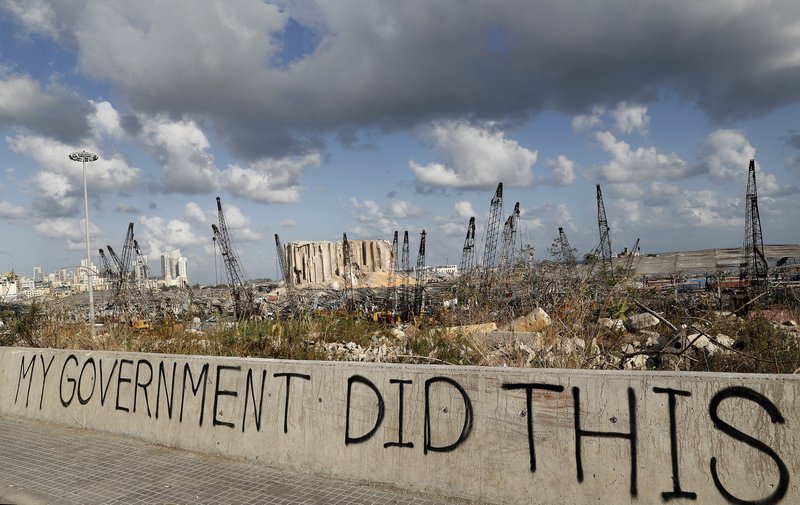
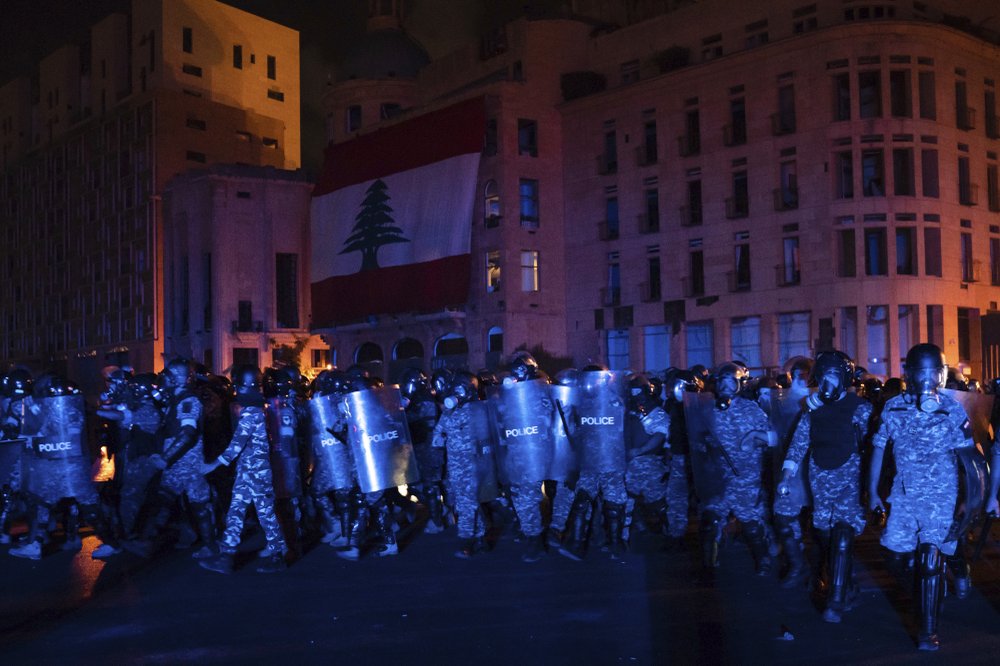
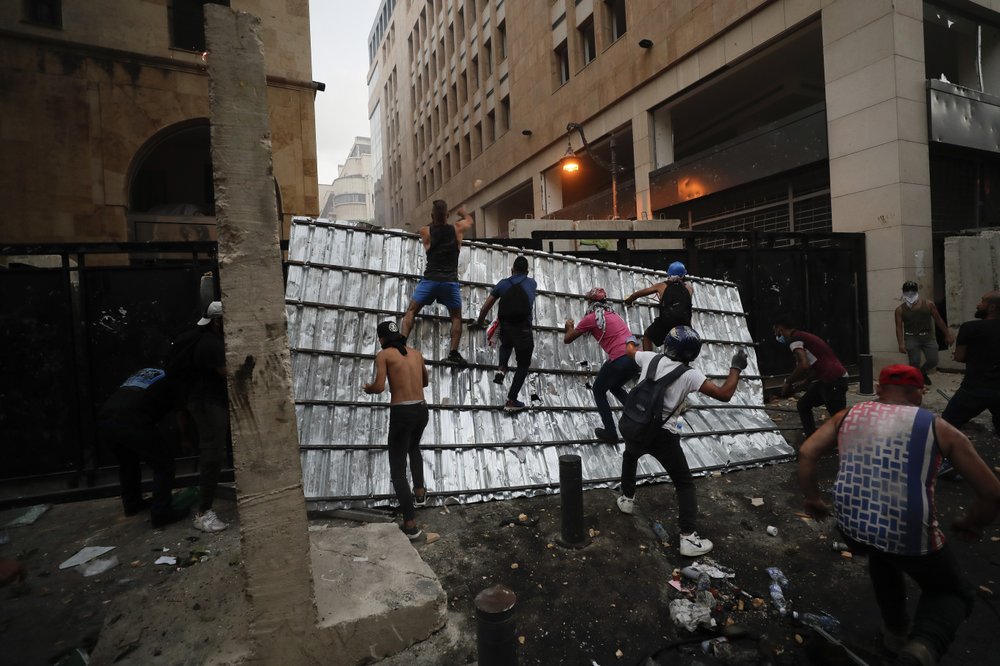
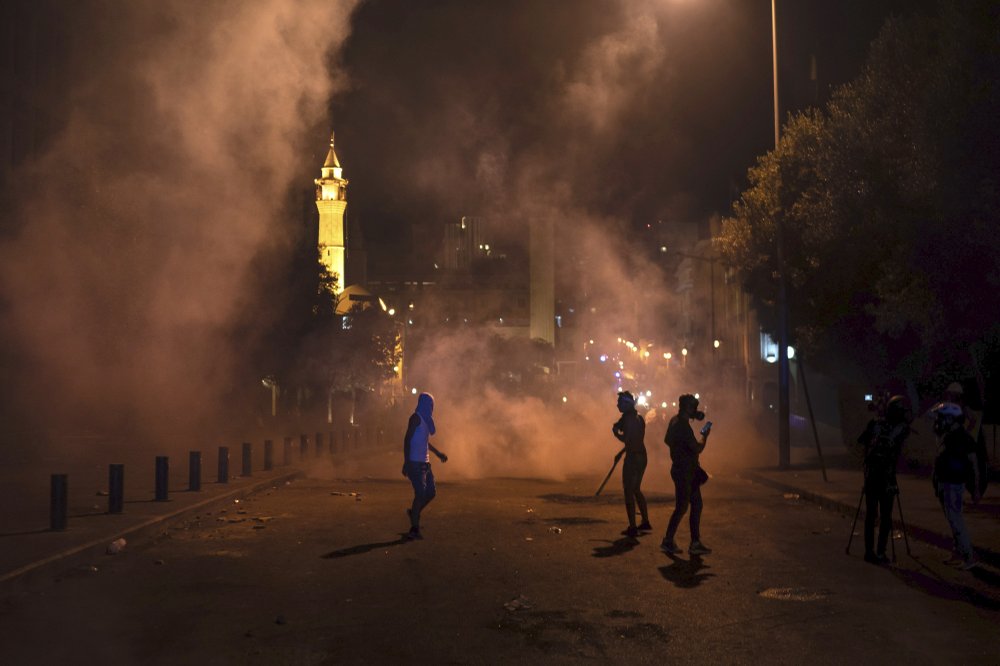
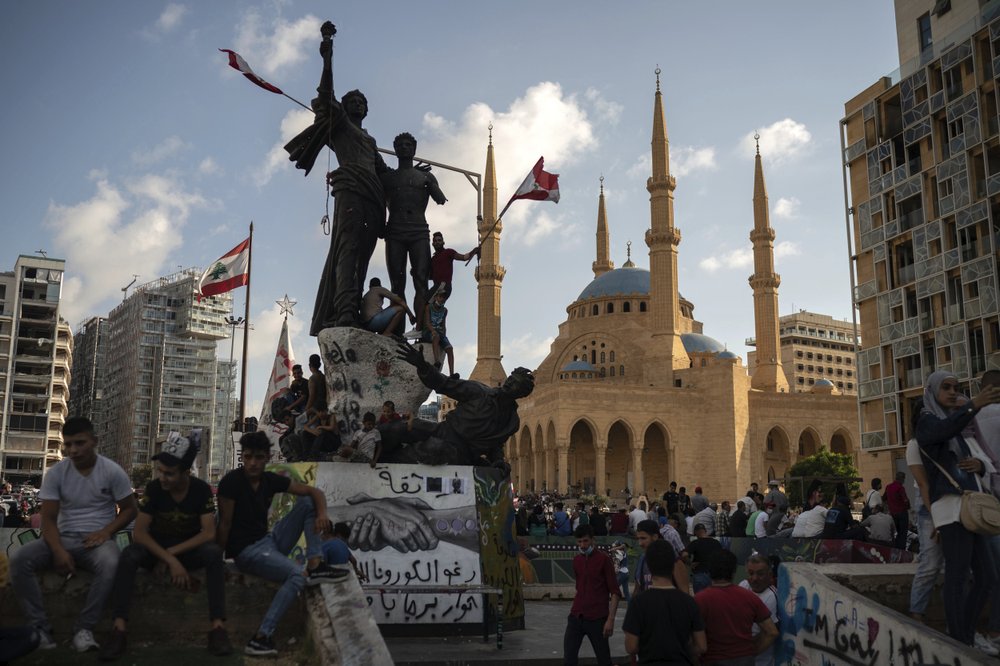
Words are written by Lebanese citizens in front of the scene of Tuesday's explosion that hit the seaport of Beirut, Lebanon, Sunday, Aug. 9, 2020. Public fury over the massive explosion in Beirut took a new turn Saturday night as protesters stormed government institutions and clashed for hours with security forces, who responded with heavy volleys of tear gas and rubber bullets. (AP Photo/Hussein Malla)

BEIRUT (AP) — Hospitals and schools, then shattered and bent water pipes, then the crater that once was Lebanon’s port.

The rebuilding needs of Lebanon are immense, but so is the question of how to ensure the millions of dollars promised in international aid is not diverted in a country notorious for missing money, invisible infrastructure projects and its refusal to open the books.

And the port — the epicenter of the explosion that shattered Beirut, the center of Lebanon’s import-based economy, and a source of graft so lucrative that Lebanon’s political factions were willing to divide its control so everyone could get a piece — sits at the heart of the fears.

Sunday’s international donor teleconference raised a total of 252.7 million euro ($298 million) in emergency aid, organizers said.

The conference was hosted by French President Emmanuel Macron, who was mobbed last week by tearful victims of the Beirut ammonium nitrate explosion begging him to ensure the corruption they blame for the blast that devastated the capital does not profit from its destruction. The French presidency said France contributed 30 million euros ($35 million).

The head of the International Monetary Fund, which wants an audit of the national bank before handing over any money, was clear: No money without changes to ensure ordinary Lebanese aren’t crushed by debt whose benefits they never see.

“Current and future generations of Lebanese must not be saddled with more debts than they can ever repay,” IMF head Kristalina Georgieva said during the conference. “Commitment to these reforms will unlock billions of dollars for the benefit of the Lebanese people.”

International leaders, government officials and international organization participated Sunday in the teleconference co-organized by France and the United Nations to bring emergency aid to Lebanon, including President Donald Trump.

International diplomacy usually calls for careful language. Rigged votes are “irregular.” The response to furious protests should be “measured.” Disappearing funds require “transparency.”

But Macron’s response to the crowd in Beirut and in a later speech there was unusually blunt: The aid “will not fall into corrupt hands” and Lebanon’s discredited government must change.

In the short-term, the aid streaming into Lebanon is purely for humanitarian emergencies and relatively easy to monitor. The U.S., France, Britain, Canada and Australia, among others, have been clear that it is going directly to trusted local aid groups like the Lebanese Red Cross or U.N. agencies.

“Our aid is absolutely not going to the government. Our aid is going to the people of Lebanon,” said John Barsa of USAID.

But actual rebuilding requires massive imports of supplies and equipment. The contracts and subcontracts have given Lebanon’s ruling elite its wealth and power, while leaving the country with crumbling roads, regular electricity cuts, trash that piles on the streets and intermittent water supplies.

“The level of infrastructure in Lebanon is directly linked today to the level of corruption,” said Neemat Frem, a prominent Lebanese businessman and independent member of parliament. “We badly need more dollars but I understand that the Lebanese state and its agencies are not competent.”


Lebanon has an accumulated debt of about $100 billion, for a population of just under 7 million people — 5 million Lebanese and 2 million Syrians and Palestinians, most of them refugees. Its electricity company, controlled like the port by multiple factions, posts losses of $1.5 billion a year, although Frem said most factories pay for their own generators because power is off more than it’s on.

“There’s grand theft Lebanon and there’s petty theft Lebanon. Petty theft Lebanon exists but that’s not what got the country in the hole we’re in,” said Nadim Houry, executive director of the Arab Reform Initiative.
Prior aid, Houry said, ended up as a tool in the hands of the political leaders, who kept their slice and doled out jobs and money to supporters.

Protesters, tired of the small indignities they endure to get through a day — 37% of people report needing to pay bribes, compared with 4% in neighboring Jordan, according to Transparency International — and the larger issue of a collapsing state, are going after both.

“The public is going to be incredibly distrustful of the way this is done, and I think rightly so,” said Frank Vogl, a co-founder of Transparency International and chairman for the Partnership for transparency Fund.

On Saturday, they seized offices of the Economy Ministry, hauling away files they said would show corruption around the sale and distribution of wheat. Lebanon’s wheat stockpile, stored next to the warehouse filled with ammonium nitrate, was destroyed in the explosion.

“We restored the economy ministry to the Lebanese people,” one man called out as they rifled through the desks.

Julien Courson, head of the Lebanon Transparency Association, said the country’s non-profits are forming a coalition to monitor how relief and aid money is spent. He estimated Lebanon loses $2 billion to corruption each year.

“The decision-makers and the public servants who are in charge of these files are still in their positions. Until now, we didn’t see any solution to the problem,” he said.

A first step would be an online clearinghouse for every contract linked to reconstruction, Courson said. And the first project has to be highly visible and spread the benefits widely, said Christiaan Poortman, board chairman of Infrastructure Transparency Initiative.

“That will help keeping some of the political stuff at a distance,” Poortman said. “Donors will have to be on top of this. The issue of procurement is always where lots of corruption takes place ... it needs to be done quickly, and there is always the temptation to not follow the rules and go ahead and do something where a lot of people are going to make a lot of money.”

Speaking at a news conference in which he conspicuously did not appear alongside Lebanese President Michel Aoun, Macron said he was approaching Lebanon with “the requirements of a friend who rushes to help, when times are hard, but not to give a blank check to systems that no longer have the trust of their people.”

___

Hinnant reported from Paris. AP writers Sarah El-Deeb in Beirut and Sylvie Corbet in Paris contributed.
ETHIOPIA
Extreme poverty rises; a generation sees a future slip away


Mother of two Amsale Hailemariam, a domestic worker who lost work because of the coronavirus, stands in her small tent in the capital Addis Ababa, Ethiopia on Friday, June 26, 2020. Decades of progress in one of modern history's greatest achievements, the fight against extreme poverty, are now in danger of slipping away due to the coronavirus and the world could see the first global increase in extreme poverty in 22 years, further sharpening inequality. (AP Photo/Mulugeta Ayene)


ADDIS ABABA, Ethiopia (AP) — As a domestic worker, Amsale Hailemariam knew from the inside out the luxury villas that had grown up around her simple shelter of raw metal and plastic sheeting. And in them, she saw how her country, Ethiopia, had transformed.


The single mother told herself, “Oh God, a day will come when my life will be changed, too.” The key lay in her daughter, just months from a career in public health, who studied how to battle the illnesses of want and hunger.

Then a virus mentioned in none of her textbooks arrived, and dreams faded for families, and entire countries, like theirs. Decades of progress in one of modern history’s greatest achievements, the fight against extreme poverty, are in danger of slipping away because of the COVID-19 pandemic. The world could see its first increase in extreme poverty in 22 years, further sharpening social inequities.


“We are living in a state where we are above the dead and below the living,” Amsale said, near tears. “This is not life.”

With the virus and its restrictions, up to 100 million more people globally could fall into the bitter existence of living on just $1.90 a day, according to the World Bank. That’s “well below any reasonable conception of a life with dignity,” the United Nations special rapporteur on extreme poverty wrote this year. And it comes on top of the 736 million people already there, half of them in just five countries: Ethiopia, India, Nigeria, Congo and Bangladesh.

_____

This story was produced with the support of the Pulitzer Center on Crisis Reporting.

______

India is struggling with one of the world’s largest virus caseloads and the effects of a lockdown so abrupt and punishing that Prime Minister Narendra Modi asked the poor to forgive him. Nigeria, Africa’s most populous nation, has surpassed India with the most people in extreme poverty — roughly half its citizens. And Congo remains one of the world’s most crisis-ridden countries, with outbreaks of Ebola and measles smoldering.

Even China, Indonesia and South Africa are expected to have more than 1 million people each fall into extreme poverty, the World Bank says.

“It’s a huge, huge setback for the entire world,” Gayle Smith, president of the ONE Campaign to end extreme poverty, told The Associated Press. Smith, a former administrator for the U.S. Agency for International Development, called the global response to the crisis “stunningly meager.”

Most of the millions newly at risk are in sub-Saharan Africa, a region that against countless odds had some of the world’s fastest growing economies in recent years. The World Bank shared with the AP the earliest data out of Ethiopia as it takes a global measure of the pandemic’s direct effects over several months, showing that the pain is already widespread. Similar efforts are under way in more than 100 countries.

Back in 1991, when Ethiopia began its transformation, the country was exhausted by war. A new leader, Meles Zenawi, was shaking off years of Marxist dictatorship and terrifying drought whose images of withered children left the world aghast. The former rebel had a vision that became his legacy, one of bringing millions of countrymen out of grinding poverty.

Amsale was newly arrived in the capital, Addis Ababa, from what is now neighboring Eritrea, her baby daughter in her arms. For her the child, Bethlehem Jafar, became a tiny symbol of the city’s rise.

Bethlehem benefited from the welfare of the state and the charity of those who saw in her a better future. Her mother scraped by through manual labor, vowing her girl would never do the same.

Fellow Ethiopians were moving up in the world, as the government looked to emulate China’s astonishing lifting of more than 800 million people from poverty. Some embraced new manufacturing jobs. Others left subsistence farms for the growing sectors of hospitality, services and aviation that catered to the changing times, hoping to join Africa’s expanding middle class.

The number of people in extreme poverty dropped dramatically, from nearly half of Ethiopia’s population in the mid-1990s to 23% two decades later. “Impressive,” the World Bank said.

The high-altitude city of Addis Ababa, Africa’s diplomatic capital, became an aviation hub, and a magnet for millions of citizens seeking better lives. Some grasped the first rung of upward mobility in the hustle of the untaxed informal sector, dodging the growing number of cars in the streets that signaled the middle class.

Under the country’s Nobel Peace Prize-winning prime minister, Abiy Ahmed, the capital in the past two years has seen a wave of new construction, including malls and luxury apartments. And a source of national pride is a massive dam near completion on the Nile, funded completely by Ethiopia and its citizens in a bid to pull millions more from poverty.

Now Ethiopians of all kinds are hurting in the pandemic. The country, along with Congo, Kenya, Nigeria, and South Africa, is expected to see half of sub-Saharan Africa’s new extreme poor.

As the huge economic toll ahead became clearer, Ethiopia’s prime minister took the global lead in appealing to rich countries to cancel the debt of poorer ones, saying his own country spends twice as much on paying off external debt as it does on health.

In trying to grasp the impact of a global slide into extreme poverty, even some experts feel at a loss. From his home in Addis Ababa, Fitsum Dagmawi has heard his countrymen’s fear. As part of the World Bank survey, he is calling people across the country and asking how their lives have changed since the virus arrived.

“We might interview five to 10 people a day, and this pandemic is affecting everyone,” he said. “We are feeling this stress every day.”

Some people begin weeping, recounting family member’s deaths, asking bewildered questions: What will we do now?

Jobs are gone. Families wonder how to feed their children. The gatherings that played a stabilizing role — church services, weddings, funerals — have been limited or lost.

“I will have to struggle,” one head of a household said.

The first round of calls to 3,200 households in Ethiopia found a 61% drop in employment, with many job losses in sectors closely tied to the country’s growth: construction, hospitality, restaurants, big hotels.

The second round of calls saw some rebound, but employment could mean anything in a country where most work remains informal. Now some people with degrees find themselves seeking manual labor.

“Small shocks in income can have devastating effects,” World Bank senior economist Christina Wieser said.

It shows. In Ethiopia, 55% of households blamed a drop in regular income for the inability to buy items like medicine or staple foods. Nearly 40% had lost all earnings from remittances from the large diaspora, a crucial way to stay afloat.

For many Ethiopians, there is still little cushion between getting by and destitution. Just over 20% of households were relying on savings, and 19% were already eating less. A quarter had run out of food in the last 30 days, and just over 5% of households received support of any kind.

“I have not paid my rent for two months, and I’m not sure my landlord will give me more time,” a 32-year-old father of two told the AP. “Just imagine, out of work and living with COVID. It’s very stressful.”

He was fired in May from a Chinese-owned company in one of the industrial parks that have sprung up in recent years as a government-backed engine of development.

“We were told business is slow due to the virus,” the man said, speaking on condition of anonymity because he hoped to be rehired.

So much depends on how long the pandemic lasts. The African Development Bank once assumed that COVID-19 would subside by June, country director Abdul Kamara said. Now, he said, “decades of poverty reduction in Ethiopia could be lost.”

Before the pandemic, the bank estimated the country’s economy would grow by more than 7% this year. The current worst-case scenario shows just 2.6%.

Ethiopia’s revenue losses are estimated at $1.2 billion, at a time when the government needs more money to expand social safety nets, Kamara said. And some 2.5 million jobs are threatened, roughly the same number of Ethiopians who enter the workforce every year.

For a young woman like Bethlehem, the way forward seems in shambles. She was forced home from her studies as school closed and now shelters with her mother.

Their home is just steps away from a public toilet that overflows with the rainy season. “Even if we protect ourselves from infection, the area we are living in makes us vulnerable,” Amsale said. “And that worries us to death.”

The better-off neighbors who once welcomed her into their homes to cook and clean now turn her away, fearing the virus.

“They told me we should avoid contact,” she said. “There was no help I received from them since.”

She and her daughter make do with the equivalent of $34 a month that Amsale receives from local authorities for helping with projects like beautifying public spaces and sweeping the streets. But she doesn’t like to go out, fearing infection.

Bethlehem did not want to be photographed, anxious that images of her in the humble surroundings could further challenge her suddenly difficult future. She sat in their home, going over her books and lingering over a former teacher’s scribbled message of hope: “Bethi, we love you so much & wish you success in your education.”

Her knowledge of public health makes her keenly aware how poverty compounds the risks of a deadly pandemic.

“I think Ethiopia’s peak (virus) season is yet to come, and I really hope some vaccines will be available soon,” Bethlehem said. “For now, we are waiting for a miracle that can change our lives.”

___

Anna reported from Johannesburg.

___

Follow AP pandemic coverage at


Pandemic wrecks global Class of 2020′s hopes for first job

Fashion school graduate Phoebe St. Leger poses for a photo in Florence, Italy, Jan. 25, 2018. Around the world, young people armed with new degrees, diplomas and professional qualifications are struggling to enter the workforce as the pandemic pushes the global economy into recession. British fashion school graduate Phoebe St. Leger’s dream of landing a job at a design label is on hold. The coronavirus forced the cancellation of her university graduating class's final-year fashion show, which removing the chance to show her knitwear collection to people in the industry, some of whom might have liked her work enough to offer her a job. (Shannon Davidson via AP)


LONDON (AP) — British fashion school graduate Phoebe St. Leger’s dream of landing a job at a design label is on hold. Like many others in the global Class of 2020, the pandemic is clouding her career ambitions.

The coronavirus forced the cancellation of her university graduating class’s final-year fashion show, removing the chance to show her knitwear collection to people in the industry, some of whom might have liked her work enough to offer her a job.

Instead, St. Leger, 22, returned to her family home in Winchester, southern England, and submitted her classwork online. She has applied for about 40 jobs and received only rejections.
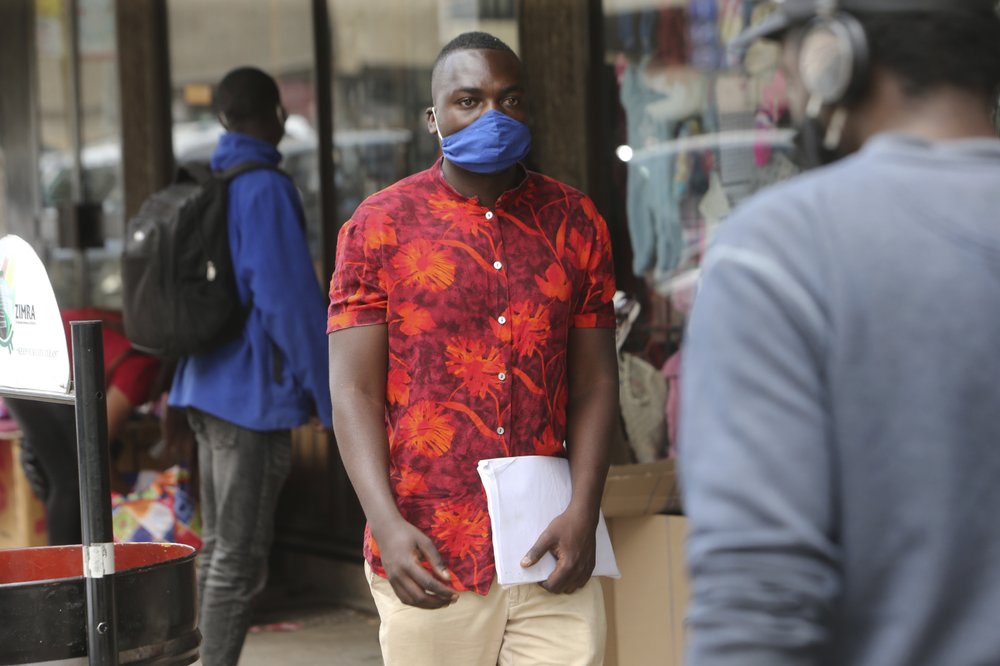
Emmanuel Reyai walks on the streets of Harare while looking for a job, Wednesday, Aug, 5, 2020. Around the world, young people armed with new degrees, diplomas and professional qualifications are struggling to enter the workforce as the pandemic pushes the global economy into recession. Two years after graduating with from Zimbabwe’s Midlands State University, 24-year old Emmanuel Reyai is no closer to his goal of getting a job related to his degree in local governance. His search is stymied by both the African country’s economic collapse and the coronavirus outbreak. (AP Photo/Tsvangirayi Mukwazhi)

“All the jobs have all dried up - everywhere,” she said. She knows graduates from previous years who have been fired or furloughed and is prepared to get a job at a bar. “It’s still hard to be hopeful when you’re not seeing anyone doing well at the moment.”

Around the world, young people armed with new degrees, diplomas and professional qualifications are struggling to enter the workforce as the pandemic pushes the global economy into recession. COVID-19 has thwarted hopes of landing first jobs - important for jumpstarting careers - as employers cut back graduate recruiting plans or even revoke job offers.

The latest U.S. job numbers Friday underscored the murky outlook: 1.8 million jobs were added in July, a sharp slowdown in employment growth from the month before. It means the world’s biggest economy has regained just 42% of jobs lost to the coronavirus.

U.S. careers website Glassdoor says the number of jobs advertised as “entry level” or “new grad” was down 68% in May from a year ago. In Britain, companies plan to cut student recruitment by 23% this year, according to a survey of 179 businesses by the Institute of Student Employers.

The wave of delayed employment will ripple out through the economy, says Brian Kropp, chief of HR research at consultancy Gartner.

Many grads will have student loan debts they won’t be able to start paying off until they find a job, he said.

“If you can’t get an entry level job today, that means that you don’t move out of your parent’s house, you don’t develop real work experience, you don’t buy your first home until later, and you don’t get married until later.”

Michael Welch, 22, has been scouring LinkedIn, Monster and Indeed for postings and connections after earning a University of Connecticut engineering degree. He hadn’t planned to start his job search until after graduation.

Dr. Maria Jose Casco adjusts her hair as she walks near her home in Quito, Ecuador, Wednesday, Aug. 5, 2020. Around the world, young people armed with new degrees, diplomas and professional qualifications are struggling to enter the workforce as the pandemic pushes the global economy into recession. Maria Jose Casco, a newly qualified doctor, hasn’t found work after graduating in Ecuador in April. Casco, 24, said she’s been searching for health-related jobs as well as work in other industries. (AP Photo/Dolores Ochoa)


“That plan was disrupted because I was planning to go into a good job market,” he said. “Suddenly I was in one of the worst job markets in recent history.”

Welch, who moved back home with his parents, worries about online interviews and starting a job remotely.

“Remote jobs are great for someone who doesn’t have to commute and already has a job,” he said. But “for someone entering the job market it is a scary prospect. It’s difficult to learn technical skills when you’re in a remote setting.”

Noah Isaak, a 2019 grad and newly certified teacher, has been applying for jobs in the Chicago public school system and has done a few interviews but they didn’t lead anywhere. Most of the people he knows from his program are having trouble, too.

Now he’s considering applying for minimum wage jobs at Target, Costco, coffee shops and Amazon.

“I’m stressed,” said Isaak, 23. “Nothing is really going how we expected it to go. It’s comforting that it’s not a personal flaw and other people are going through the same struggle. But it is difficult not knowing.”

One important long-term effect for young graduates who take longer to find good first jobs is lower pay over the course of their careers, experts said.

Someone who takes a year or more to find their first job lags behind their peers when it comes to promotions and also competes with younger people who come on to the job market later.

The problem, like the pandemic, is global.

Graduate job vacancies for July are down from the previous year in 10 countries, according to Adzuna, a job postings search engine. Britain, India and the Netherlands have seen the biggest declines, with postings down by more than half from a year ago, but other countries including Austria, Australia, Brazil, and France are also seeing double digit percentage drops.

Clara Karina poses for a photo as she waits to cross a road after a job interview at the main business district in Jakarta, Indonesia, Thursday, Aug. 6, 2020. Around the world, young people armed with new degrees, diplomas and professional qualifications are struggling to enter the workforce as the pandemic pushes the global economy into recession. In Indonesia, Clara Karina, 25, graduated in January with an accounting degree from a well-known business and finance school in Jakarta. She wanted to work as a civil servant but applied for jobs at private firms as the government froze recruitment. It's been far from the easy process she imagined. (AP Photo/Dita Alangkara)

Graduate jobs are expected to shrink in 21 countries, with most unlikely to recover next year, according to a separate report by Britain’s ISE.

Maria Jose Casco, a newly qualified doctor, hasn’t found work after graduating in Ecuador in April. Casco, 24, said she’s been searching for health-related jobs as well as work in other industries.

Even though the pandemic means more need for health services, she found employers aren’t hiring for full time jobs.

“They’re looking for temporary staff they can easily fire,” Casco said. She and her husband are living off savings and his $480 monthly salary and, like others, are considering emigrating. “Because there is no future, many of my colleagues are looking at the possibility of leaving Ecuador.”

The pandemic is compounding problems for young people in countries plagued by chronic economic instability.

Two years after graduating with from Zimbabwe’s Midlands State University, 24-year old Emmanuel Reyai is no closer to his goal of getting a job related to his degree in local governance. His search is stymied by both the African country’s economic collapse and the coronavirus outbreak.

“I have applied more than 40 times - nothing,” he said, clutching a plastic folder containing his academic certificates.

More than two thirds of Zimbabwe’s population, including university grads, get by on informal trade such as street hawking. Reyai initially resold cooking gas from a shack in his poor Harare neighborhood but the local council razed it after the outbreak. Now he makes and sells peanut butter around the city.

“There are no hopes of getting a job,” said Reyai. “I have tried all I can to apply for jobs but the situation is not getting any better. It is actually getting worse.”

In Indonesia, Clara Karina, 25, graduated in January with an accounting degree from a well-known business and finance school in Jakarta.

She wanted to work as a civil servant but applied for jobs at private firms as the government froze recruitment. Only three of 20 companies replied to her applications. Two turned her down and the third is in progress.

“Companies aren’t recruiting new employees, they’re reducing employees now,” Karina said. “I need to be more patient.”

For some, there are happy endings.

In China, 23-year-old Li Xin graduated this summer with a statistics degree but had started looking for a job in January - just as the pandemic forced many companies to suspend operations. She encountered apparent scams from companies hiring for finance and IT jobs that wanted hefty “training fees.”

Some classmates found banking jobs thanks to their connections. Others without ties ended up in industries unrelated to their degrees. Several are doing tutoring jobs, and Li found one herself but lasted just a week.

She felt hopeless but also realized everyone has it hard.

“I’d sit in the subway, seeing the people come and go around me, and I’d suddenly feel that it wasn’t easy for anyone,” Li said.

Eventually, Li landed a data analysis job in her hometown near Beijing that started this month. More than half her class, though, have yet to find jobs.

____

Gonzalo Solano in Quito, Ecuador, Mae Anderson in New York, Edna Tarigan in Jakarta, Indonesia and Farai Mutsaka in Harare, Zimbabwe contributed to this story.
___

Follow Kelvin Chan at t witter.com/chanman
USA
Amid pandemic, future of many Catholic schools is in doubt


THEY ARE CONSIDERED PRIVATE SCHOOLS


1 of 13
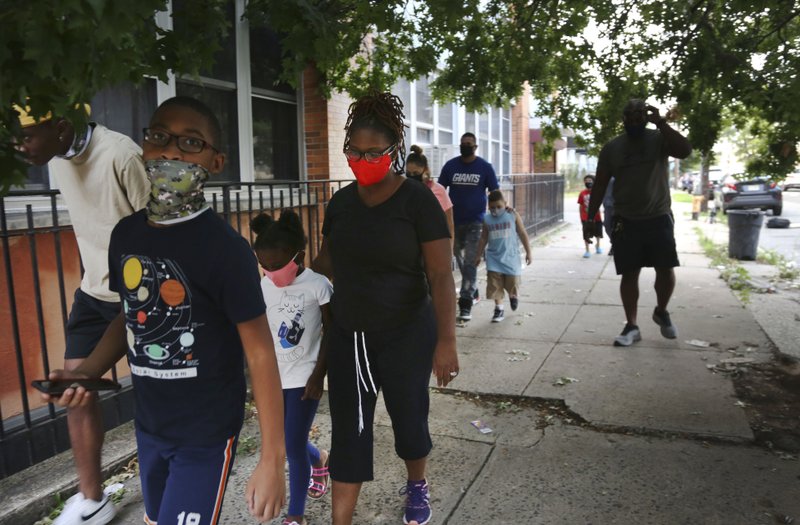
St. Francis Xavier School students and their families walk together in Newark, on Thursday, Aug. 6, 2020, after discussing the Catholic school's permanent closure announced the previous week by the Archdiocese of Newark. Nationwide, more than 140 Catholic schools will not reopen in the fall. (AP Photo/Jessie Wardarski)


NEW YORK (AP) — As the new academic year arrives, school systems across the United States are struggling to cope with the COVID-19 pandemic. Roman Catholic educators have an extra challenge — trying to forestall a relentless wave of closures of their schools that has no end in sight.

Already this year, financial and enrollment problems aggravated by the pandemic have forced the permanent closure of more than 140 Catholic schools nationwide, according to officials who oversee Catholic education in the country.
Three of the nation’s highest-ranking Catholic leaders, in a recent joint appeal, said Catholic schools “are presently facing their greatest financial crisis” and warned that hundreds more closures are likely without federal support.


“Because of economic loss and uncertainty, many families are confronting the wrenching decision to pull their children out of Catholic schools,” said New York Cardinal Timothy Dolan, Boston Cardinal Sean O’Malley and Los Angeles Archbishop José Gomez, president of the U.S. Conference of Catholic Bishops.

They urged Congress to include funding in the next pandemic relief bill for scholarship assistance for economically disadvantaged families to use at Catholic or other private schools.

Many Catholic schools already have received substantial federal aid from the U.S. Department of Education and from the Paycheck Protection Program, which was designed to pay wages at businesses or nonprofits impacted by the pandemic.


Facilities manager (AKA HEAD CUSTODIAN, HEAD CARETAKER, JANITOR)
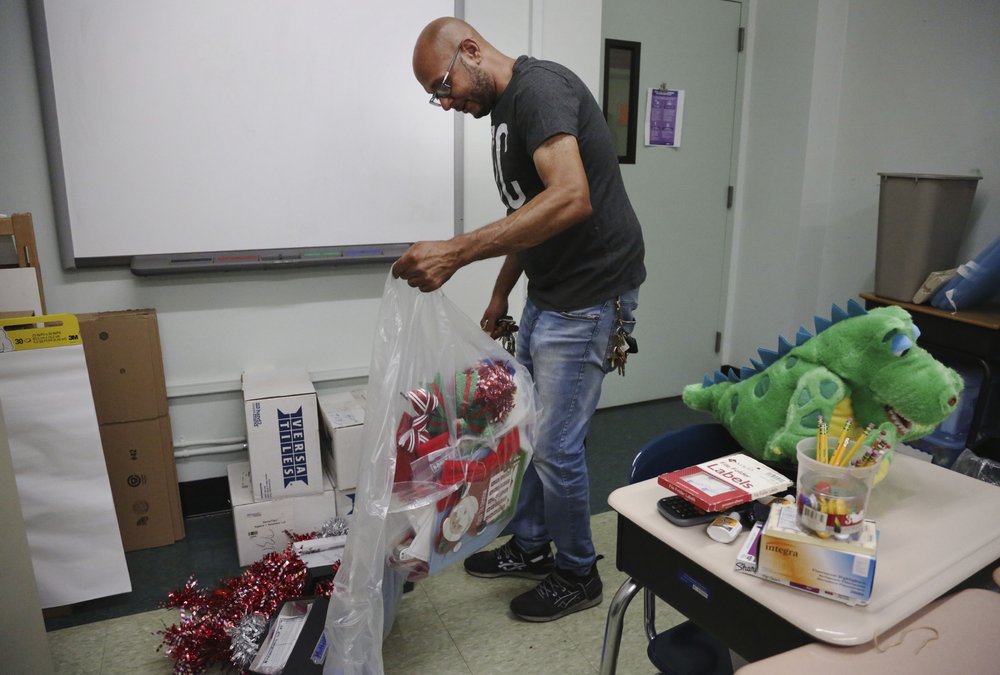
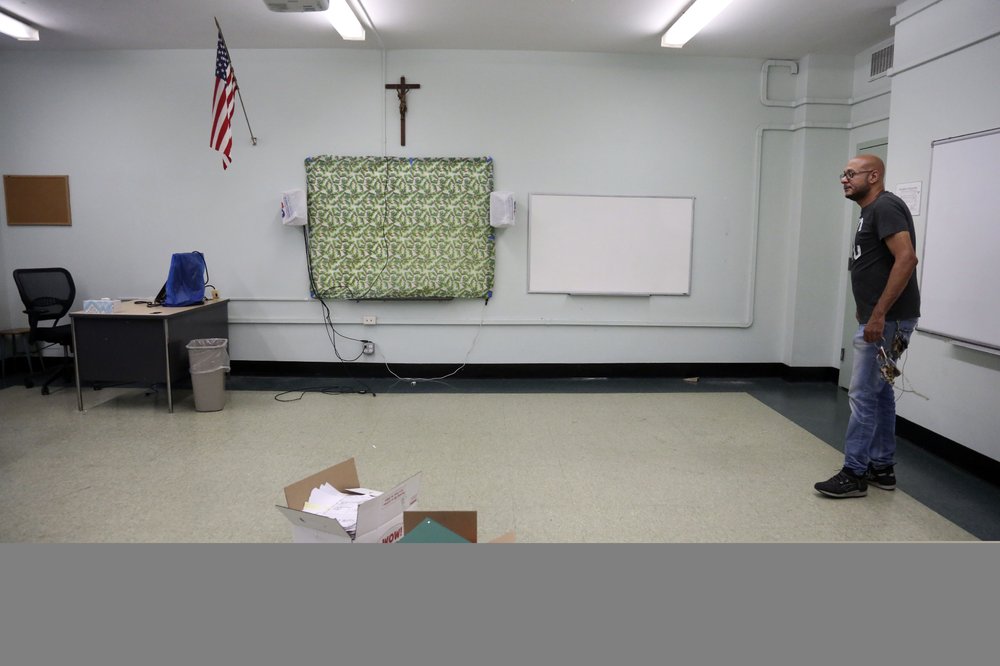
 Charles Fabian stands in an empty classroom at Queen of the Rosary Catholic Academy in Brooklyn borough of New York, Thursday, Aug. 6, 2020. In July the Archdiocese of Brooklyn and Queens announced that six Catholic schools in the two boroughs will close permanently at the end of August due to debt and low enrollment aggravated by the coronavirus pandemic. (AP Photo/Jessie Wardarski)

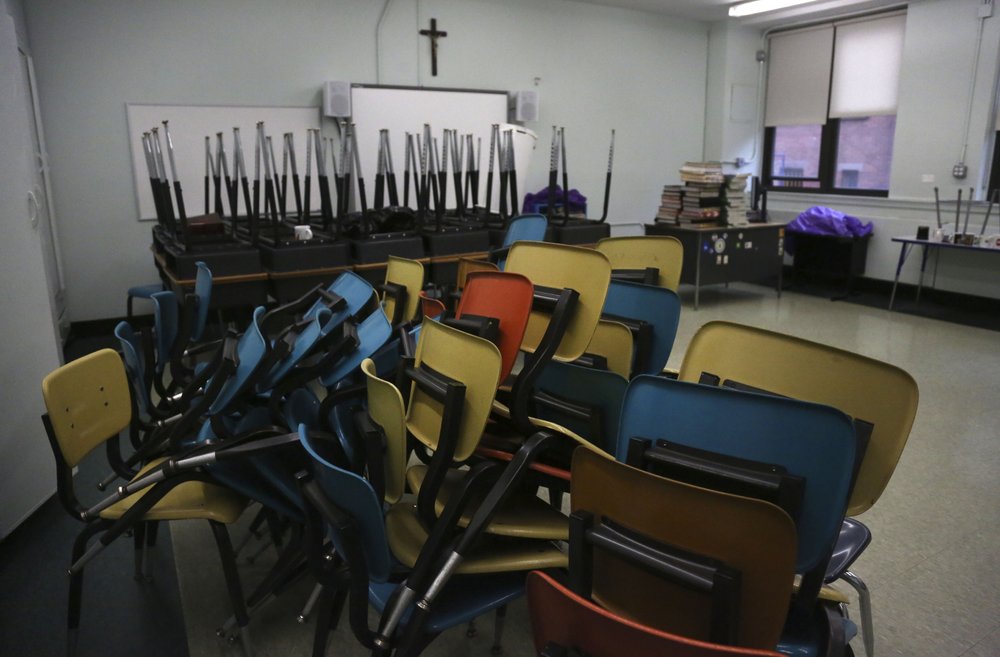
Desks are stacked in an empty classroom after the permanent closure of Queen of the Rosary Catholic Academy in Brooklyn borough of New York, Thursday, Aug. 6, 2020. (AP Photo/Jessie Wardarski)


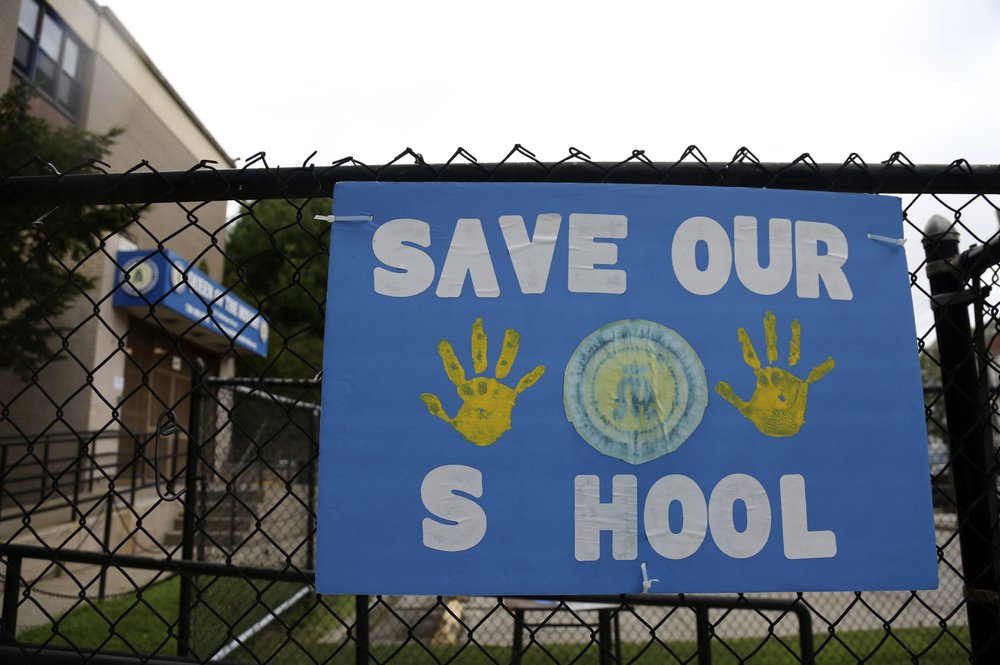
A sign made by parents and students of Queen of the Rosary Catholic Academy hangs on the fence outside the school in Brooklyn borough of New York, Tuesday, Aug. 4, 2020. Queen of the Rosary is one of six Catholic schools in Brooklyn and Queens that will permanently close at the end of August. Nationwide, more than 140 Catholic schools will not reopen in the fall. (AP Photo/Jessie Wardarski)

The pace of closures has been relentless since March. Within the past month, Catholic leaders have announced the shuttering of five schools in Newark, New Jersey, and 26 in the New York City area. Among the schools closed earlier was the Institute of Notre Dame in Baltimore, a 173-year-old girl’s high school that’s the alma mater of House Speaker Nancy Pelosi.

Several of the closures have promoted protests and petition campaigns by angry parents, and Catholic officials have been scrambling to help affected families.

The Diocese of Brooklyn’s school superintendent, Thomas Chadzutko, said the closures were unavoidable due to the pandemic’s “devastating effects” on enrollment and finances.

Parents were offered a $500 grant if their children enrolled in other Catholic schools, but many were bitter that the closures were announced with little time to make alternative school plans.

“It is a complete travesty how the Brooklyn Diocese can shut down schools within a pandemic and with less than two months’ notice,” parent Javier Cortes wrote in an online post about the closure of Queen of the Rosary Catholic Academy. “Treating children like this is NOT the Catholic thing to do!”

Also ordered closed was Nativity of Our Blessed Lady, an elementary school in the Bronx.
“I was part of the first graduating class and now I walked out of there hysterical in tears,” said Hope Wilson, who attended the school as a child and later taught there for 30 years.

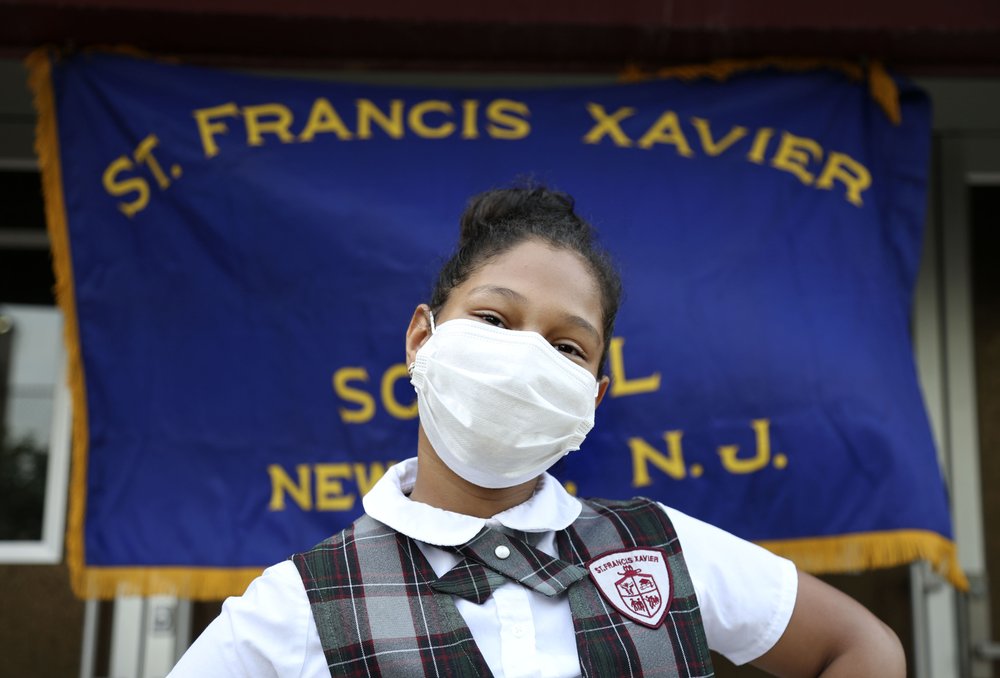
In Newark, Shante McGlone Burgess was devastated by the news that St. Francis Xavier School was closing. All three of her children attended the elementary school last year, though the family is not Catholic.


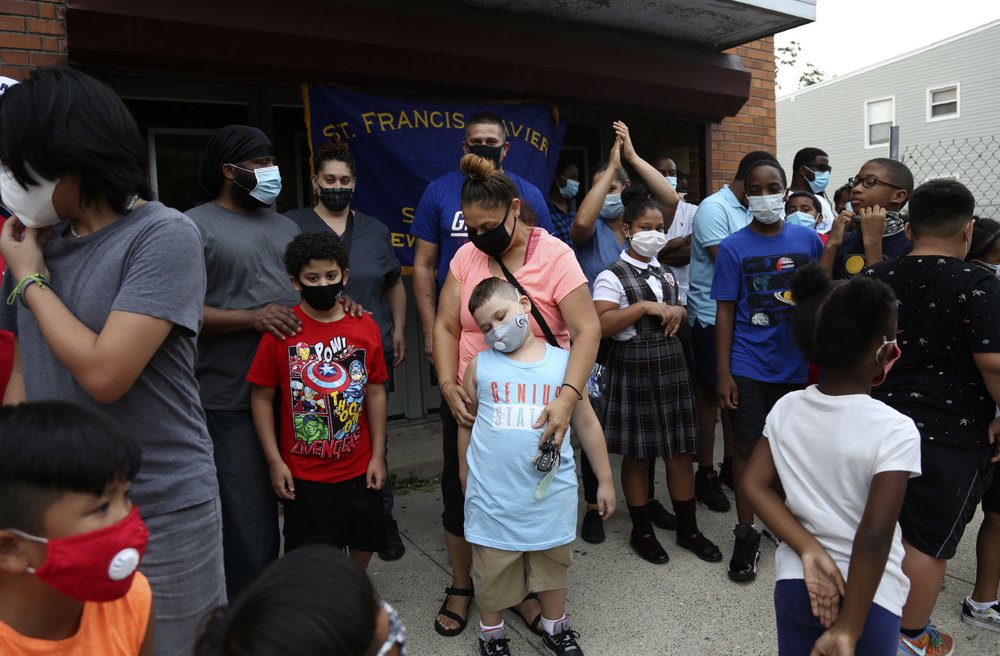
St. Francis Xavier students sit together for the first time in five months after their school was closed due to the coronavirus pandemic, Thursday, Aug. 6, 2020, in Newark. The students and their concerned families gathered at the school to discuss its permanent closure, announced by the Archdiocese of Newark the previous week. (AP Photo/Jessie Wardarski)

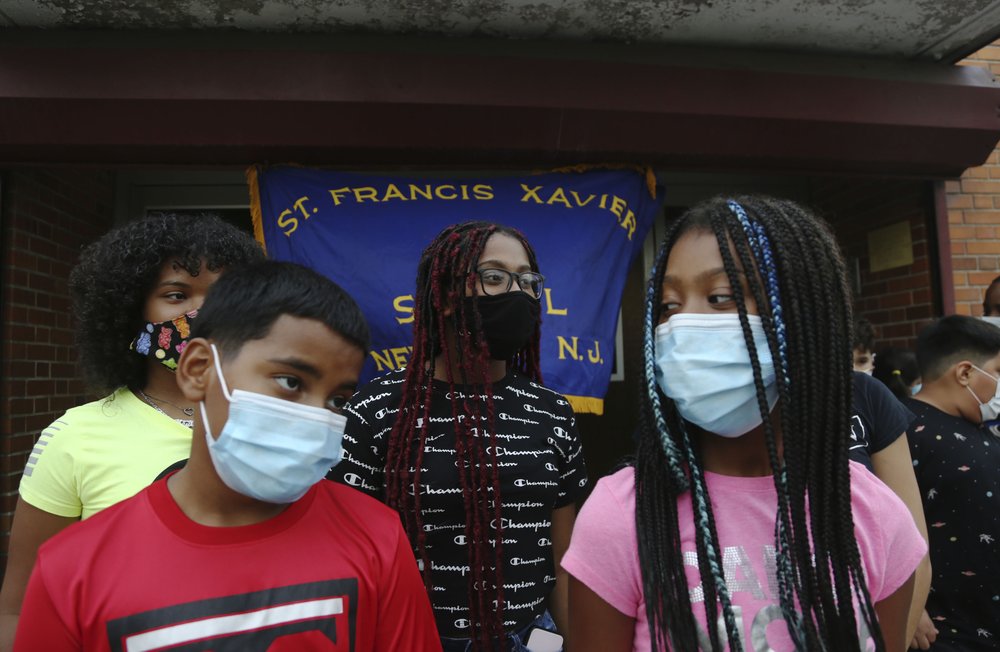
Dozens of students and their family members gather outside St. Francis Xavier School in Newark on Thursday, Aug. 6, 2020, a week after the Archdiocese of Newark announced its permanent closure. (AP Photo/Jessie Wardarski)

The Burgess family, from left, Jonathan Jr., 15, Jonathan Sr., Shante, Ava, 6, and Evan, 10, stand outside St. Francis Xavier in Newark, New Jersey, on Thursday, Aug. 6, 2020, as they meet with other parents to discuss the school's closure. "Closing an inner-city school during a pandemic is not the most godly thing to do," Shante Burgess said. (AP Photo/Jessie Wardarski)


Malik Bey, 11, left, stands with his sisters in front of St. Francis Xavier School in Newark, on Thursday, Aug. 6, 2020, as parents meet to fight the school's permanent closure. "Give them a shot," said Bey's father, Malik Bey Sr. "My son has been coming here since kindergarten and he's in sixth grade now. This is what he knows, and the kids are who he knows. Let's leave them together." (AP Photo/Jessie Wardarski)

“They were very welcoming there,” McGlone Burgess said. “At a public school, I don’t think my children would have gotten the same camaraderie, as well as the structure.”

St. Francis Xavier is one of many schools being closed that serve predominantly Black and Hispanic communities. Three bishops who oversee matters related to education and racial issues recently sent an appeal to U.S. Rep. Karen Bass, chairwoman of the Congressional Black Caucus, seeking support for families of color with students in Catholic schools.

“A Black or Latino child is 42% more likely to graduate from high school, and two-and-a-half times more likely to graduate from college if he or she attends a Catholic school,” wrote Bishops Michael Barber of Oakland, California, Joseph Perry of Chicago and Shelton Fabre of the Houma-Thibodaux Diocese in Louisiana.

At the National Catholic Educational Association, there’s acute concern about the closures’ consequences.

“Catholic schools have a very profound impact on young people of low-income backgrounds, students of color, kids from single-parent homes,” said the NCEA’s chief innovation officer, Kevin Baxter “That makes it all the more tragic if we lose the Catholic schools that serve those populations.”

One consequence of the turmoil: increased interest in Catholic-oriented homeschooling.

Chris Sebastian, a spokesman for the Mother of Divine Grace School, said it is preparing to serve about 6,000 students in the new school year, compared with 4,800 last year.

The school, based in California but serving families across the U.S. and overseas, offers a structured Catholic curriculum and assigns an educational consultant to work with each family that signs up.

“COVID is the primary motivator for people enrolling,” Sebastian said. “People are afraid of the pandemic and not wanting the stress of required masks.”

The Rev. Thomas Vassalotti, pastor of Queen of the Rosary Catholic Academy’s parish in New York, said numerous parents affected by that closure — and wary of switching to public schools — are expressing interest in homeschooling, perhaps in a cooperative with assistance from the parish.

For Catholic schools that are reopening, there is no national directive as to how they should handle the question of in-person classes. Decisions are being made diocese by diocese, often influenced by local and state rules.

In Los Angeles, archdiocese officials had hoped to open the new year with in-person classes. They now will have to start out with distance learning, due to an order from Gov. Gavin Newsom barring public and private schools from reopening campuses if their counties are on a monitoring list for high rates of new coronavirus cases.

The situation is different in Dallas, where the diocese plans to open schools Sept. 2, six days before the earliest date when secular schools can start in-person classes. The diocese chose that option after Texas Attorney General Ken Paxton said religious schools were exempt from local orders delaying in-person instruction.

And in Evansville, Indiana, Catholic schools reopened Aug. 5 with a full program of in-person instruction. Schools were told to spread out desks, place students in small groups and require face coverings.

Mary Pat Donoghue, who heads the education office of the national bishops’ conference, said she expects a wide variety of reopening plans, with a common aim of getting students back in the classroom as quickly as health conditions allow.

___

Associated Press video journalist Jessie Wardarski, in New York, and Justin Pritchard, in Los Angeles, contributed to his report.

___

Associated Press religion coverage receives support from the Lilly Endowment through the Religion News Foundation. The AP is solely responsible for this content.


IN CANADA PUBLIC EDUCATION IS A PROVINCIAL RESPONSIBILITY

IN ALBERTA AND ONTARIO CATHOLIC SCHOOLS ARE CONSIDERED PART OF THE PUBLIC EDUCATION SYSTEM

IN NEWFOUNDLAND THEY HAVE ONE PUBLIC SCHOOL SYSTEM FOR PROTESTANTS AND CATHOLICS 

IN MANY CASES OUTSIDE OF QUEBEC, AND NEW BRUNSWICK (FRANCO CANADIANS) THE CATHOLIC BOARDS EXIST NOT FOR RELIGIOUS REASONS BUT RATHER AS IS THE CASE WITH THE MANITOBA ACT FRENCH LANGUAGE RIGHTS ARE THE REASON FOR THESE 'SEPARATE' SCHOOLS SYSTEMS AS THEY ARE CALLED.