Thursday, January 06, 2022

Alberta parents, teachers' union question province's decision to resume in-person classes

Heading back to school during Omicron wave is like sending kids to a 'COVID soup,' Edmonton mom says

Alberta students are set to resume in-person learning next week. (Ryan Remiorz/The Canadian Press

Alberta parents are preparing to send their children back to in-person classes next week, some with reluctance and trepidation as the Omicron variant continues to spread quickly in community settings. 

Marie Watts, who has two teenagers in school in southeast Edmonton, one in Grade 9 and the other in Grade 11, believes sending kids back to the classroom isn't safe. 

With record-high cases and a high transmission rate of Omicron within the community, it's not appropriate to send children back to in-person learning next week, Watts said Wednesday.

"I'm pretty angry about it actually," Watts said. "I'm concerned that we're just going to be putting a bunch of kids in a COVID soup and hoping it all works out."

Watts said classes are lacking high-quality air filtration systems and the province should be handing out the more effective N95 masks, instead of medical masks. 

Many children are feeling anxious, she noted.

"The kids don't really want to go back but they need to finish school," Watts said. 

Eager to get back

Other families welcome the return in-person learning. 

Daynelis Brito's three children — aged eight, 10 and 12 — have been going to class since schools were allowed to reopen last spring.

She said she trusts the schools will do their best to keep students safe.

"So far, there has not been much issue with the kids getting sick," Brito said. "And the kids are eager to go back to school."

Brito also believes symptoms of Omicron infection are mild and it's just a matter of time before it becomes more common in the community.

"All you have to do is wish for the best, because it's everywhere, right?"

Alberta Teachers' Association president Jason Schilling said the province isn't doing enough to make sure the classrooms are safe. 

Schilling said the province needs to invest in KN95 masks, instead of the blue medical ones.

"I'm frustrated beyond words sometimes when I hear our government leaders saying, 'We are doing everything that we possibly can to ensure that our schools and our staff are safe,'" he said. "I don't buy it when we hear this from our leaders."

Watts said the province should keep learning online for another couple of weeks.

"It also buys time to do things like finally getting air purifiers in classrooms and maybe actually getting kids masks that protect from airborne viruses like the N95 type," she said. 

"Then once these things are in place, once the schools are safer, then let the kids go back. But don't put them back in now, wait for it all to fall apart and then send them back online class by class."

Semesters online

Edmonton Public Schools is offering online options to students for the second half of the school year from Feb. 1 to June 28, but families must choose by Jan. 11 and commit to the full semester. 

"After Jan. 11, 2022, students cannot move from in-person to online learning," the website says. "This deadline ensures schools have enough teaching staff assigned to both online and in-person classes."

Students wanting to switch to in-person learning need to consult the school to see if there's space in a specific grade or program.

Watts said some subjects are not offered widely in the online format, making it difficult for students to enrol in courses they need to graduate

Parents, doctors fear back to school will spike Omicron cases, clog hospitals

'I have 100 per cent certainty that when kids go back to school, cases will rise and hospitalizations will rise'

Author of the article: Eva Ferguson
Publishing date: Jan 05, 2022 •
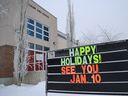
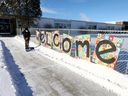
A sign outside Mount View School announces the postponement of return to classes on Monday, Jan. 3, 2022. Alberta has delayed the start date to help schools deal with COVID-19 precautions due the Omicron surge. 
PHOTO BY GAVIN YOUNG/POSTMEDIA

With the province confirming K-12 students will return to classrooms Monday, doctors and parents fear limited school protections will result in a further explosion of Omicron cases, hospital capacity crunches and an eventual shuttering of schools again.

Education Minister Adriana LaGrange announced Wednesday that schools will open to in-person learning Jan. 10, promising “a safe return” through the delivery of rapid test kits and new “medical grade” masks to schools by Jan. 14.

ONE IS A SUNDAY SCHOOL TEACHER THE OTHER IS A UCP SUPPORTER

LaGrange and chief medical officer of health Dr. Deena Hinshaw said the mental health and education benefits of in-person learning outweigh the risks of COVID infections in children, which rarely result in severe outcomes.

“There is high transmissibility in the community, and it will come into schools and into classrooms,” LaGrange said.

“But we need to mitigate that with the overall health of our children. It’s very important they return to in-person learning.”

Dr. Shazma Mithani, an emergency room physician who treats COVID patients at Edmonton’s Royal Alexandra and Stollery Children’s hospitals, says she, too, wants to see kids in schools.

But she fears that rapid tests and low-grade masks — not N95s — will not do enough to stop the spread of the highly transmissible Omicron variant.

“I have 100 per cent certainty that when kids go back to school, cases will rise and hospitalizations will rise,” Mithani said.

“It’s just simple math. And the province knows this, too. We’re just kicking the can down the road.”

Mithani said students and staff should be provided N95 respirator masks to prevent airborne transmission of Omicron, which is “seven times more transmissible” than the original strain.

She added that rapid tests only provide a brief window into whether someone is positive, and very often the test results are not accurate.

“I have heard from many, many people that their tests are false negatives . . . or they are testing negative while they are symptomatic.”

LaGrange announced late last Wednesday that K-12 schools would have an extended winter break to allow school districts to prepare for the ongoing spread of Omicron, which has resulted in record high case counts across the country.

But after confirming this Wednesday that kids will go back, in spite of even wider spread, LaGrange added that school districts have the flexibility to shut down individual classrooms or buildings temporarily, without affecting other jurisdictions that are controlling cases.

After a difficult academic year of back and forth learning from in-person to online in 2020-21, LaGrange said students cannot afford any further learning gaps. The province has also created an online tutoring resource, she added, which kicks in next week to help students catch up with literacy and numeracy learning.

“We are doing everything we can to help get students back on track.”
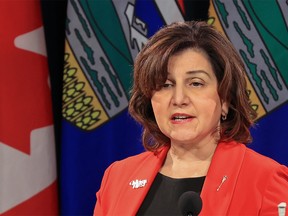
Education Minister Adriana LaGrange confirms Alberta’s schools will reopen on Jan. 10, 2022. PHOTO BY GAVIN YOUNG /Postmedia file

But Dr. Wing Li, spokeswoman for the Support Our Students advocacy group, said schools cannot open safely — or stay open — without several meaningful layers of mitigation, including better masks, better ventilation through HEPA filters and smaller class sizes.

“We have the tools, we have navigated many months of this pandemic,” Li said.

“Yet we lack the political will . . . and when we get one measure we have others taken away. Rapid tests are arriving, but we no longer have PCR tests.”

Albertans continue to have difficulty accessing COVID tests, with many pharmacies running out of rapid test kits. Hinshaw has also advised that only people with symptoms should book PCR tests, but even those are not immediately available.

Jen Allan, a mother of three special-needs students in Beiseker, just north of Calgary, is terrified about sending her kids back to school next week, torn over what is worse — learning loss by staying home or health risks by going back.

“I cannot call what my kids have received in this past year an education. I call it more of a deprivation,” said Allan, who has kids in grades 1, 3 and 5.

Her youngest son is on the autism spectrum and has severe difficulties learning online. And her eldest has medical issues, which put him at higher risk of severe illness with COVID.


Allan worries that even if her kids go back, her rural school will not get access to rapid tests or new masks.

“We get very little in rural areas. Our pharmacies have not even received vaccines for children yet, they are only for adults for now.”
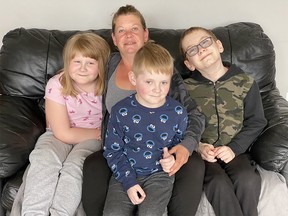
Mom Jen Allan and her three kids, from left to right: 
Makayla, Frankie and Rylan. PHOTO BY SUBMITTED

Dr. Joe Vipond, a Calgary doctor with the Protect Our Province advocacy group, said in his livestream Wednesday he, too, is concerned about schools opening amid rapidly increasing cases, including in pediatrics.

With Alberta Health Services confirming an additional 4,752 new cases of COVID on Wednesday, Vipond said “that’s nowhere near to what is actually happening in the community. It’s a poor, fuzzy picture of what’s really happening.”

Vipond added that among the 470 people now in hospital with COVID, 31 are pediatric admissions.

“Our government says COVID is airborne, but there is no mitigation acknowledging that. If you do not mitigate with the right form of transmission, you will fail.

“You can deep clean all you want, it won’t make a difference.”

Parents across Alberta have been advocating for HEPA filters for months, but the province and school officials are adamant that ventilation in schools is above standard.

DR.HINSHAW IS A UCP ENABLER

Alberta students will return to in-school learning Jan. 10, education minister says

Rapid tests and masks will be distributed to schools

Education Minister Adriana LaGrange and Dr. Deena Hinshaw, the province's chief medical officer of health, announced Wednesday that students will return to in-school learning on Jan. 10. ( Chris Schwarz/Government of Alberta)

Alberta students in kindergarten to Grade 12 will return to their classrooms on Jan. 10 after an extended holiday break, Education Minister Adriana LaGrange said Wednesday.

On Dec. 30, the province had announced it was delaying the post-holiday reopening of schools province-wide after boards requested more time to assess the impact of the new Omicron variant in the classroom. 

Winter break for K-12 students was extended to Jan. 10, but the government said it had not made decisions on whether students will be learning in class or at home.

LaGrange said Wednesday that all students will return to learning in their classrooms.

"Over the past several days my team and I have continued to work closely with school authorities," LaGrange told a news conference. "I am extremely grateful for their input and I am so pleased to confirm that ECS (early childhood services) and kindergarten to Grade 12 students will return to classrooms on Jan. 10.

"Children who learn in person belong in the classroom and they will be there with the added safety of rapid tests and medical-grade masks."

Alberta Education Minister Adriana LaGrange says kids will return safely to school as planned on Jan. 10, and explains why the province made the decision. 2:02

The rapid tests and masks will be distributed to schools as "an added layer of protection to lower the risk of transmission of the Omicron variant," LaGrange said.

The government will begin distributing shipments of rapid tests and masks later this week and all schools will have their initial shipments by the end of next week. LaGrange said the shipments to schools will be in phases.

Students should wear masks, Hinshaw says

Dr. Deena Hinshaw, Alberta's chief medical officer of health, said there are no "risk-free solutions" but that she believes the province's approach is prudent.

"There is a very high transmission risk right now and I continue to advise that people do everything they can to minimize the number of close contacts they have," Hinshaw said.

"However, I also believe that if we were to shut schools across the entire province, we would be imposing much greater harm on all of those students by not allowing them the opportunity for in-school learning at this time."

She said the use of rapid testing, medical masks and other measures will help to protect students and staff.

"Given the current situation, I also want to note that I strongly recommend that students in all grades wear masks, including kindergarten to Grade 3," she said. "To keep the risk in schools low it will be critical for all of us to stay home and keep our children home if any of us have symptoms."

School authorities will have flexibility to shift a class or an individual grade to short-term at-home learning if needed to address operational challenges at a school, the province said in a news release.

K-12 students will return to the classroom on Jan. 10, where they can expect medical-grade masks and more frequent rapid tests as Omicron continues to set new records across the country. 2:24

Decisions on shifting entire schools or school authorities to at-home learning will continue to be made by the Alberta government, with input from school authorities, it said.

Online tutoring coming

LaGrange said free online-tutoring resources will be available starting next week for students in grades 4 to 9 who need to catch up on skills after falling behind due to the pandemic.

The tutoring resource will be launched with pre-recorded video tutoring sessions to improve students' literacy and numeracy skills. The province plans to expand the service later in the year to cover more grades and subjects and add live tutoring.

As of Wednesday, there were 470 people with COVID-19 in hospital in Alberta, up from 436 on Tuesday, with 72 of those patients in intensive care, 11 more than on Tuesday.

Hinshaw reported 11 new deaths from COVID-19 on Wednesday, and a test positivity of 36.9 per cent.

Positivity rates across the province are the highest since the beginning of the pandemic.

 
K-12 students returning to classrooms next week as Alberta reports record-high cases, increasing hospitalizations

The decision comes as the Omicron variant is rapidly spreading across the country

Author of the article: Stephanie Babych
Publishing date: Jan 05, 2022 
A snowy playground at Le Roi Daniels School in the SE. Wednesday, December 29, 2021. PHOTO BY BRENDAN MILLER/POSTMEDIA

As Alberta reported another day of record-high COVID-19 cases, the province announced kindergarten to Grade 12 students will return to classrooms Monday.

Education Minister Adriana LaGrange said Wednesday the province will distribute medical-grade masks and rapid test kits to schools as an added precaution for students and staff heading back to school after an additional week of winter break

The decision comes as the Omicron variant is rapidly spreading across the country. In Alberta, there are 37,196 cases of COVID-19 confirmed by PCR test, which is only a portion of the actual number of cases since PCR testing is limited.

A record 4,752 new cases were reported Wednesday with the highest test positivity rate logged in the province at 36.9 per cent. The data doesn’t include positive results from the rapid antigen tests Albertans are using at home, which Premier Jason Kenney noted on Tuesday means numbers are actually much higher than what’s being reported.

The number of COVID patients in hospital jumped to 470 from 436 a day earlier. Of the 470 hospitalized patients, 72 are in intensive-care units — an increase of 11 in a single day.


Dr. Deena Hinshaw, the province’s chief medical officer of health, said another 11 deaths were reported to Alberta Health, bringing the COVID-19 death toll to 3,333.

Despite the widespread transmission of Omicron, Hinshaw said she believes restarting in-person instruction at schools is prudent.

“The community transmission risk right now is the highest it’s ever been. I want to be clear that out in the general community, no matter what the setting, there is a very high transmission rate right now. I continue to advise that people do everything they can to minimize the number of close contacts they have,” said Hinshaw.

“However, I also believe that if we were to shut schools across the entire province, we would be imposing much greater harm on all of those students by not allowing them the option for in-school learning at this time.”
UCP ENABLER
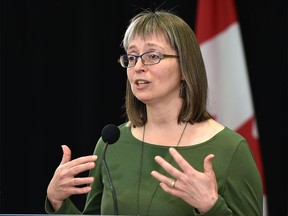
Alberta’s chief medical officer of health Dr. Deena Hinshaw provides an update on COVID-19 during a news conference in Edmonton, December 7, 2021. 
PHOTO BY ED KAISER/POSTMEDIA

Shipments of the rapid tests and masks for schools will start this week, and schools can expect to receive their first shipment by the end of next week. Students will receive their supplies from the school once shipments are received, said LaGrange.

“Alberta Education is continuing to work closely with school authorities to support shifts that may be required for operational reasons, such as student or staff absences,” she said.

School authorities will be able to transition individual classes or grades to at-home learning if it is necessary as a short-term solution.

“As I’ve said before, I’m always so impressed by the resilience shown by our students, our staff, our school boards and our families in the whole education system,” said LaGrange.

She said the additional safety measures are meant to supplement the physical distancing, cohorting and cleaning policies, and availability of vaccines for students and staff.
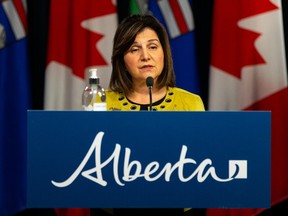
Education Minister Adriana LaGrange.
FORMER SUNDAY SCHOOL TEACHER 
 File photo. PHOTO BY IAN KUCERAK /Postmedia

Just over 37 per cent of children aged five to 11 have received their first dose of vaccine in Alberta, while 85.3 per cent of those aged 12 and over have gotten at least two doses.

Alberta has also administered 1,035,726 booster doses of vaccine.

Everyone has a role to play in keeping schools open and children safe by limiting community transmission, Hinshaw said.

“Next to getting vaccinated, the most critical thing we can do is stay home if we’re sick even with the mildest of symptoms. Wearing masks and keeping our distance at all times also reduces our risk of spreading the virus but they cannot eliminate all risks of exposure,” she said.

Parents and guardians must complete a health assessment of their children before sending them to school to see if there are any signs of illness and should do a rapid test a couple of times a week to screen for asymptomatic infection, Hinshaw said.

With the overwhelming volume of infections, Alberta Health Services no longer has the capacity to do full case investigations of non-high-risk cases and will only be further investigating cases linked to high-risk settings such as continuing care and health-care facilities. Other cases confirmed by PCR test will be notified of the result and informed about isolation requirements.

Alberta’s post-secondary institutions are opting to keep most students online for the first few weeks of classes as a new semester begins.

The University of Calgary has started classes online, with an exemption for courses where there is a requirement the students attend in person, at least until the end of the month.

With the semester starting this week at the Southern Alberta Institute of Technology, most classes are online until at least Jan. 21, according to a news release from SAIT. On-campus labs will run in-person starting Jan. 10.

When classes start up again at Mount Royal University on Monday, the majority of courses will be delivered virtually until Jan. 22. As well, Bow Valley College will be starting the new term on Monday with a temporary switch to online learning until at least Jan. 21.

Quebec to install 90,000 air quality monitors in classrooms, reserve rapid tests for students

A young girl walks in the hallway on the first day of school in Montreal, Tuesday, August 31, 2021, as the COVID-19 pandemic continues in Canada and around the world. Parents are divided on whether children should return to classes Jan. 10, 2022. 
THE CANADIAN PRESS/Graham Hughes


Selena Ross
CTVNewsMontreal.ca Digital Reporter
Published Wednesday, January 5, 2022

When Quebec schools reopen on Jan. 17, the youngest students will immediately get more at-home rapid tests, then get more in February.

It's part of a suite of measures meant to curb school outbreaks of Omicron, though Quebec Education Minister Jean-François Roberge also took heat over a press conference Wednesday from those saying the province isn't going nearly far enough, especially when it comes to classroom air quality.

"Our Plan A is reopening schools," said Roberge, saying the province is laying the necessary groundwork to stick to its goal of bringing kids back to class as soon as possible.

For the rapid tests, a box of five tests will be given out to each primary and preschool student in January, and then again in February, adding up to millions of tests reserved for this group.

In another measure meant to keep school outbreaks under control, teachers will be added to the list of prioritized Quebecers who will have access to PCR tests, starting on Jan. 15.

Some new equipment is also coming to help maintain air quality in schools and cut down on the infection rate, though critics said Quebec's work on this front lags far behind other provinces'.

Quebec is installing 50,000 air-quality detectors for classrooms imminently, with 40,000 more on the way, Roberge said.

It's also looking at adding more air exchangers, which bring fresh air into classrooms to maintain better air quality.

A few hundred air exchangers have been installed already and the province "will be providing more according to need," Roberge, calling it "excellent news."

That announcement comes, however, after a year of political battles around air quality in schools, and it wasn't enough to satisfy the government's opponents.

Many English-language boards buying their own air purifiers for classrooms about a year ago. The province refused to reimburse the cost and denied that it was necessary to do the same for most French-language classrooms, which are government-run through school "service centres" rather than boards.

On Wednesday, the political opposition immediately slammed the news, with the Quebec Liberal education critic writing on Twitter that adding monitors won't help, since they don't actually fix air quality.

"What do we do when the reading exceeds the [CO2] limit, other than open the window in the middle of winter?" wrote Liberal Marwah Rizqy.

The federal government has sent $432 million for school air quality measures, she wrote, asking what it's been spent on, with "zero in air purifiers."

Meanwhile, she added, "Ontario has over 70,000!"

When pressed by journalists about why the province won't install air purifiers, and whether it's an issue of expense, Roberge said it isn't.

"It's not a question of money. It's because those those tools are not recommended by our experts. It's as simple as that," said Roberge.

When asked if teachers will be given N-95 masks, Quebec Public Health Director Horacio Arruda said no, repeating a claim he's made several times when asked about a mask upgrade for health-care workers: he said Quebec experts don't believe N-95s work better overall than procedural masks and are not recommending their use, partly because people can't be relied upon to wear them correctly.

In another change, the isolation period will be reduced for fully vaccinated staff and students, meaning mostly students 12 and over. After an infection this group will need to isolate for only five days, not 10, as long as they don't show symptoms.
'PRETTY CONFIDENT' OF JAN. 17 RETURN

When asked what the chances are that school will be delayed yet again, Roberge said he thinks it's unlikely.

"I'm pretty confident that we will go back" on schedule, he said.

"I can't be sure at 100 per cent... of course, because COVID is COVID, and we have to take advice [from] our health authorities and we have to adapt," he said, but repeated that signs point towards staying with the current date.

Roberge said that until classes return, distance learning will happen according to plan. There are minimum weekly virtual teaching hours for elementary students, and secondary students will be virtually in class according to their normal schedules.

Exceptions are being made for specialized schools such as those for special-needs children, which are in person, and for apprenticeships and vocational training that must be done in workshops and in laboratories -- these must be done in person.

The same goes for practical evaluations that need to be done in person, Roberge said.

Despite reported shortages of computers for children without their own, Roberge said the province hasn't been aware of a need in this area and said it has sent computers to all who requested them.

"If [schools] have some shortage they should advise us and we'll help them provide computers to all kids who need computers," he said.

The government delayed the return to class for elementary and high school students until Jan. 17 as a result of rising infection rates.

Emergency daycare services are available to parents working in essential fields.

Similarly, universities in Montreal have moved to online education for the first few weeks of the winter semester as they examine the evolution of the virus.

Tuesday, Quebec reported 21 more deaths and 14,494 new recorded cases of COVID-19.

NASA features Edmonton photographer's 13-month moving-sunrise project
Part of a 13 month photo stack created by Edmonton skyscape photographer Luca Vanzella. (Source: Luca Vanzella)

Sean Amato
CTV News Edmonton
Published Jan. 5, 2022 

An Edmonton man who photographs the skies for fun had his work published by NASA on Wednesday.

Through snow and cold, a wicked heatwave and wildfire smoke, Luca Vanzella spent many of his 2021 mornings shooting the sunrise from the exact same place in west Edmonton.

He then stacked 13 of his best images from each month on top of each other, to show how the sunrise slowly dances across Edmonton's skyline throughout the year.


"The earth's tilt of its rotational axis compared to the plane of the solar system is what causes the movement of the sun along the horizon," Vanzella explained.

"It generally rises in the east and sets in the west, but it's not always due east. As we in Edmonton know well, in winter it rises southeast and in the middle of the summer it rises northeast."

Vanzella's work was featured as NASA's Astronomy Picture of the Day for Jan. 5, the fourth time one of his photos was shared by the space agency.

He said his projects are mostly for his own enjoyment, but he's happy to share it and inspire others to shoot their own skyscapes.

"It was nice to have projects like this to look forward to keep doing during the pandemic. It was really unaffected by the pandemic," Vanzella said.

"In fact, this morning I got a request from a planetarium in the Czech Republic that wants to use the photo for educational purposes. It is pretty cool."

Vanzella also created a video showing his progress.

Carmaking titans Volkswagon, Toyota plot to overthrow Elon Musk's Tesla

The world's two biggest automakers realize the age of the battery-powered vehicle is here and are gaming out how to stay on top


Author of the article:
Bloomberg News
River Davis and Craig Trudell
Publishing date: Jan 05, 2022 • 
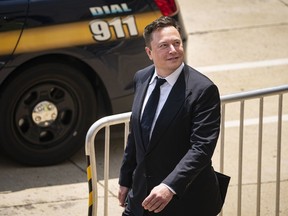
Elon Musk, chief executive officer of Tesla Inc., departs court in Wilmington, Delaware. PHOTO BY AL DRAGO/BLOOMBERG FILES

The epic fight over who controls the future of the car industry is about to get a whole lot more interesting.

Tesla Inc., the pioneer and pacesetter, has dominated the early rounds of the new-energy age, capturing investors’ imaginations with a vision for what the next generation of vehicles looks like and seizing the nascent market for fully electric cars.

In the other corner are giants of scale: Volkswagen AG and Toyota Motor Corp. The world’s two biggest automakers — each sold roughly 10 or 11 cars for every one Elon Musk did last year — realize the age of the battery-powered vehicle is here and are gaming out how to stay on top.

Within five days of one another last month, these masters of mass production laid out plans to splurge US$170 billion over the coming years to preserve their claim on an industry they’ve dominated for decades.

Executives at the very top of these incumbents are acutely aware the transition from the internal combustion engine won’t be orderly. It could get ugly — something akin to when Apple Inc. entered the mobile phone market and outclassed once-dominant Nokia Oyj.

After a year of standout growth during which Tesla became far and away the most valuable automaker ever, the trillion-dollar question is whether Musk’s advantages heading into the next generation of carmaking are as insurmountable as his company’s market capitalization suggests.

“When the two biggest car companies in the world decide to go all-in on electric, then there’s no longer a question of speculation — the mainstream is going electric,” said Andy Palmer, the former chief of Aston Martin and ex-Nissan Motor Co. executive often referred to as “the godfather of EVs” after being instrumental in developing the Japanese carmaker’s battery-powered Leaf. “I expect the shift to electric to be faster than everyone expects.”

The ways VW and Toyota have moved to defend their ground are as different as one would expect from proud German and Japanese titans of industry. One is coming out swinging, putting Tesla squarely in its sights, and the other is investing heavily in EVs while continuing to spread its bets, biding time as the early stages of the revolution shake out.

The behemoth doing the furious slugging to take on Musk is VW, which has grown over 84 years into a stable of a dozen brands, manufacturing in some 120 locations around the world and employing more people than the population of Detroit. VW Group generates roughly US$280 billion a year churning out models ranging from the Tiguan and Passat bearing its namesake badge, to Lamborghini supercars and Scania heavy trucks.

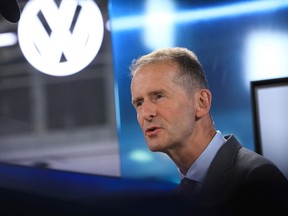
Herbert Diess, chief executive officer of Volkswagen AG, at the IAA Munich Motor Show in Munich, Germany. 
PHOTO BY KRISZTIAN BOCSI/BLOOMBERG FILES

Every year that Chief Executive Officer Herbert Diess has been at the helm, VW has announced unrivalled budgets for electrification. On Dec. 9, he delivered his largest plan yet, allocating 89 billion euros (US$100 billion) to EV and software development over the next half decade.

Diess constantly uses Musk as a measuring stick, so much so that he’s acknowledged annoying some within VW’s ranks. In October, he welcomed Musk as a surprise guest at an executive conference with 200 of the automaker’s top managers.

VW’s initial foray into EVs was with luxury models such as the Audi e-tron and Porsche Taycan. Last year, it sought to make a splash with more mainstream offerings — the ID.3 hatchback and ID.4 sport utility vehicle.

“Our transformation will be fast,” Diess said during a Tesla-style battery event in March, “bigger than anything the industry has seen in the past century.”

Ten months into 2021, VW had delivered around 322,000 fully electric vehicles, just over half of its 600,000 sales goal. Sanford C. Bernstein & Co. analysts have assumed VW would sell around 450,000 EVs for the year, which “isn’t the end of the world, but it’s also not quite a reason to celebrate.”

Diess is undeterred. The architecture that the ID.3 and ID.4 share will underpin a total of 27 EVs by the end of this year. VW will go from making these models at five factories — in Germany, China and the Czech Republic — to eight, starting up production from two more facilities in its home country and at its one U.S. assembly plant, in Chattanooga, Tennessee.

VW has also seen solid results with its high-value EV models within the group. The Taycan, for instance, is poised to outsell the iconic 911 sports car. More electric Porsches are on the way, with the brand expected to introduce a fully electric version of its popular Macan SUV next year.

Toyota’s long-standing positioning for the future was on display a couple months ago at a racetrack in the hills of western Japan. While the company brought along its battery-powered bZ4X electric SUV, the car Akio Toyoda took for spins around the circuit was a Corolla Sport H2 Concept vehicle equipped with a hydrogen-fuelled engine.

Toyota Motor Corporation President Akio Toyoda at a briefing on the company’s strategies on battery EVs in Tokyo. 
PHOTO BY REUTERS/KIM KYUNG-HOON FILES

“Heading into uncertainty, what we need are diverse solutions,” the grandson of Toyota’s founder said during a Nov. 13 news conference. “We don’t want to tie ourselves to just one option.”

Diversity is one thing; absence is another. The hybrid-powertrain trailblazer known for the Prius has acknowledged being “a little bit late” to fully electric models — and that was four years ago. Toyota’s first mass-market global EV isn’t set to debut until the middle of this year.

But weeks after taking hot laps in a hydrogen car, Toyoda traded his racing overalls for a suit and tie and gave outsiders an unprecedented look at a bevy of future products. When the first curtain was unveiled at a media briefing on a man-made island in Tokyo Bay, there were five EVs flanking him.

Toyoda delivered a brief sales pitch for each vehicle, then raised his palms to the skies before another curtain revealed 11 more battery-electric models. “Welcome to our showroom of the future,” he said, announcing plans to roll out 30 EVs by the end of the decade.

Of the 8 trillion yen (US$70 billion) Toyota dedicates to electrification in that span, half will go to fully electric models. The automaker is aiming to sell 3.5 million EVs annually by the end of the decade, almost double a target set just seven months earlier.

It took some prodding for Toyota to get to this point. With cautious comments from executives running against the industry’s general enthusiasm for EVs, some investors and environmental groups criticized the automaker for dragging its feet. Last summer, Anders Schelde, the chief investment officer of Danish pension firm AkademikerPension, which holds Toyota shares, said he didn’t see management’s attitudes toward EVs as a winning strategy for the long term.


Schelde said his fund was beginning to look more broadly at its investments to make sure they align with the goals of the Paris Agreement, which established a framework to limit global warming to well below 2 degrees Celsius. “Toyota has two or three years to clean up their act,” he said in an interview.

This sort of critique was a pain point for Toyota, with time during top management meetings consumed by debate over why its messaging around carbon neutrality wasn’t being well received. Last month’s EV event in Tokyo was the latest in a flurry of festivities the company has held around the globe to deliver its nuanced message of allegiance to hybrids and hope that the hydrogen-powered cars the carmaker has plowed years of research and investment into will gain traction alongside vehicles that run on just a battery.

In Brussels at the beginning of December, the company vowed to be ready to sell only zero-emission cars in Europe by 2035. In North Carolina a few days later, it hosted the governor and hundreds of other guests at a press conference to announce the state would be home to its first U.S. battery plant — a $1.29 billion investment.

While Toyota’s onslaught is to be taken seriously, the start VW has gotten off to with its EV push shows transitioning to electric won’t be a matter of flipping a switch.

And Tesla is doing some scaling of its own. As the company closed a year in which it delivered over 936,000 vehicles — up almost 90 per cent — it plotted out an investment of as much as 1.2 billion yuan (US$188 million) in its two-year-old Shanghai plant to upgrade equipment and take production beyond its stated capacity of 450,000 units a year. It’ll add another 4,000 workers at the facility, bringing the total to about 19,000.

Two new assembly plants — one outside Berlin and the other in Austin, Texas — are also gearing up to start making Model Ys. And there’s plenty of demand to meet all this additional output. Wait times on the Model 3 and Y have stretched to more than six months, Martin Viecha, Tesla’s investor relations chief, recently told a Deutsche Bank conference.

“With market demand for EVs clearly outstripping industry’s ability to produce, success in EVs is no longer about the order book, but rather about production capacity, ability to secure supply, and best cost, where Tesla feels it has considerable lead,” Deutsche Bank analyst Emmanuel Rosner said in a note.

Others see Tesla being toppled from the electric-car throne as new entrants muscle into the growing market. IHS Markit projects Tesla’s EV market share in the U.S. will fall to 20 per cent by 2025, from slightly more than 50 per cent today.

Heavy investment “will put Toyota and Volkswagen in a better position to compete with EV specialists,” said Anna-Marie Baisden, head of autos research at Fitch Solutions. “We have long held the view that the more traditional carmakers will have certain advantages over startups such as scale, manufacturing experience and brand loyalty.”

In addition to changing up their assembly lines and model offerings, VW and Toyota will have to chase Tesla on another front: software.

Early sales of the ID.3 were plagued by challenges VW had in getting certain tech functions to work. Initial cars were delivered to customers with missing features including the ability to connect smartphone apps with the vehicle’s display screen. Rather than beam a fix to its owners over the air — the way Apple does with iPhones, and Tesla does with its models — ID.3 drivers had to pay their dealer a visit to have their car serviced.

Joey Mandel’s experience is a case in point. The music festival industry worker in Los Angeles’ Woodland Hills neighbourhood was the first person at his local dealership to get an ID.4 electric SUV. He’s encountered his fair share of bugs — the audio cuts out periodically, and other times the vehicle won’t release from its charging plug.

Overall though, Mandel says he’s still happy with his purchase. He hasn’t had trouble traveling to events along the West Coast thanks to VW’s “solidly built-out” charging network.

“It’s not a Tesla in terms of technologies,” Mandel said, “but for people thinking they’re scared to make the shift to EVs, Volkswagen keeps things relatively like a normal car.”

Bloomberg.com

Weird and Wonderful: The psychedelic jelly is one of the most colorful residents of the deep sea


This jelly is one of the most colorful residents of the ocean’s midnight zone. The remarkable coloration of this jelly tipped off scientists that they had found a previously unknown species. It was named in honor of Claudia Mills for her dedication to studying the ocean’s delicate drifters. MBARI has observed several species of Crossota in Monterey Canyon. Unlike many jellies, we can see obvious differences between the males and females. The eggs in the females are large and globular, while the male gonads are shaped like sausages. The baby medusae stay attached under the mother’s bell until they are ready to launch. While brooding behavior is not unique to this jelly, it is always exciting to observe in the deep sea. MBARI’s robotic submersibles give us a peek at how animals thrive in the ocean’s dark depths. Video editor: Ted Blanco Script writer: Megan Bassett Production team: Kyra Schlining, Susan von Thun, Nancy Jacobsen Stout Follow MBARI on social media: Facebook: https://www.facebook.com/MBARInews/ Twitter: https://twitter.com/MBARI_News Instagram: https://www.instagram.com/mbari_news/ Tumblr: https://mbari-blog.tumblr.com LinkedIn: https://www.linkedin.com/company/mont...
SHOW LESS

Study reveals more hostile conditions on Earth as life evolved 

Study reveals more hostile conditions on Earth as life evolved 
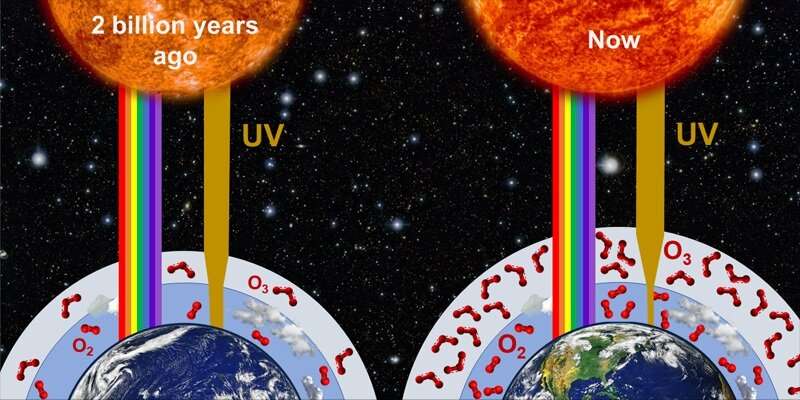
Graphic showing how UV radiation on Earth has changed over the last 2.4 billion years.
 Credit: Please credit: Gregory Cooke/ Royal Society Open Science

During long portions of the past 2.4 billion years, the Earth may have been more  inhospitable to life than scientists previously thought, according to new computer simulations.

Using a state-of-the-art climate model, researchers now believe the level of ultraviolet (UV)  reaching the Earth's surface could have been underestimated, with UV levels being up to ten times higher.

UV radiation is emitted by the sun and can damage and destroy biologically important molecules such as proteins.

The last 2.4 billion years represents an important chapter in the development of the biosphere. Oxygen levels rose from almost zero to significant amounts in the atmosphere, with concentrations fluctuating but eventually reaching modern day concentrations approximately 400 million years ago.

During this time, more complex multicellular organisms and animals began to colonize land.

Gregory Cooke, a Ph.D. researcher at the University of Leeds who led the study, said the findings raise new questions about the evolutionary impact of UV radiation as many forms of life are known to be negatively affected by intense doses of UV radiation.

He said: "We know that UV radiation can have disastrous effects if life is exposed to too much. For example, it can cause skin cancer in humans. Some organisms have effective defense mechanisms, and many can repair some of the damage UV radiation causes.

"Whilst elevated amounts of UV radiation would not prevent life's emergence or evolution, it could have acted as a selection pressure, with organisms better able to cope with greater amounts of UV radiation receiving an advantage."

The research "A revised lower estimate of ozone columns during Earth's oxygenated history" is published today in the scientific journal Royal Society Open Science.

Study reveals more hostile conditions on Earth as life evolved 
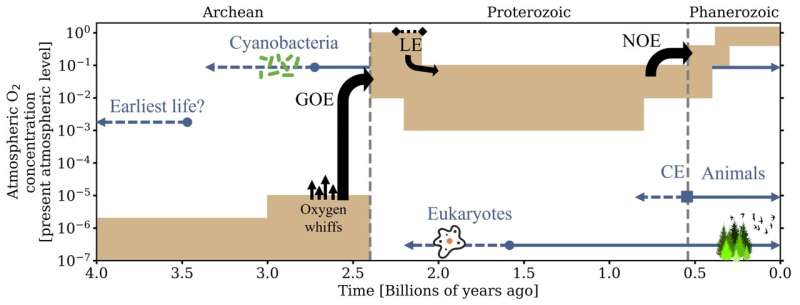
A rough outline of oxygen (O2) concentrations in Earth's atmosphere through time are
 illustrated in this figure. Brown blocks show the estimated range for O2 in terms of its
 present atmospheric level (which is 21% by volume). Grey-blue lines indicated various
 important events for the evolution of life, including the emergence of eukaryotes and
 animals. Black arrows refer to important events where atmospheric oxygen concentration 
changed. The Archean, Proterozoic, and Phanerozoic are geological eons. 
GOE = Great Oxidation Event; NOE = Neoproterozoic Oxidation Event; 
CE = Cambrian Explosion; LE = Lomagundi Excursion. 
Credit: Please credit: Gregory Cooke/ Royal Society Open Science

The amount of UV radiation reaching the Earth is limited by the ozone in the atmosphere, described by the researchers as "...one of the most important molecules for life" because of its role in absorbing UV radiation as it passes into the Earth's atmosphere.

Ozone forms as a result of sunlight and chemical reactions—and its concentration is dependent on the level of oxygen in the atmosphere.

For the last 40 years, scientists have believed that the  was able to shield life from harmful UV radiation when the level of oxygen in the atmosphere reached about one percent relative to the present atmospheric level.

The new modeling challenges that assumption. It suggests the level of oxygen needed may have been much higher, perhaps 5% to 10% of present atmospheric levels.

As a result, there were periods when UV radiation levels at the Earth's surface were much greater, and this could have been the case for most of the Earth's history.

Mr Cooke said: "If our modeling is indicative of atmospheric scenarios during Earth's oxygenated history, then for over a billion years the Earth could have been bathed in UV radiation that was much more intense than previously believed.

"This may have had fascinating consequences for life's evolution. It is not precisely known when animals emerged, or what conditions they encountered in the oceans or on land. However, depending on oxygen concentrations, animals and plants could have faced much harsher conditions than today's world. We hope that the full evolutionary impact of our results can be explored in the future."

The results will also lead to new predictions for exoplanet atmospheres. Exoplanets are planets that orbit other stars. The presence of certain gases, including oxygen and ozone, may indicate the possibility of extra-terrestrial life, and the results of this study will aid in the scientific understanding of surface conditions on other worldsOzone pollution has increased in Antarctica

More information: A revised lower estimate of ozone columns during Earth's oxygenated history, Royal Society Open Science (2022). DOI: 10.1098/rsos.211165. royalsocietypublishing.org/doi/10.1098/rsos.211165

Journal information: Royal Society Open Science 

Provided by University of Leeds