Thursday, January 06, 2022

UPDATED

Dozens of protesters killed, 12 police dead in Kazakhstan unrest

Central Asian country is experiencing the worst street

 protests since gaining independence 3 decades ago

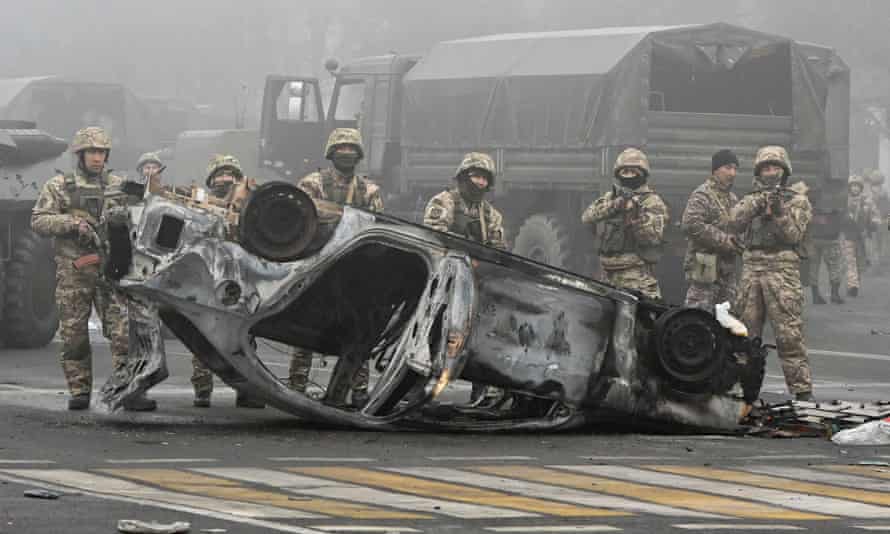
A burnt out vehicle which was set on fire during unrest is seen in Republic Square in Almaty, Kazakhstan on Thursday. (Valery Sharifulin/TASS/Getty Images)

Security forces killed dozens of protesters and 12 police died during extraordinarily violent demonstrations in Kazakhstan that saw government buildings stormed and set ablaze, authorities said Thursday. One police officer was found beheaded in escalating unrest that poses a growing challenge to authoritarian rule in the Central Asian nation.

Despite the severe response from authorities, protesters took to the streets again in the country's largest city, Almaty, a day after breaking into the presidential residence and the mayor's office there.

Police were out in force again, including in the capital of Nur-Sultan, which was reportedly quiet, and Russian troops were on their way. Russia's Sputnik news service reported that shots were fired as police surrounded one group of about 200 protesters in the city.

So far, 2,000 people have been arrested, the Interior Ministry said.

In the unrest on Wednesday, "dozens of attackers were liquidated," police spokeswoman Saltanat Azirbek told state news channel Khabar-24, using a term common to describe the killing of people thought to be extremists by law enforcement.

Twelve police officers were killed in the unrest and 353 injured, according to city officials cited by the channel.

Tens of thousands of demonstrators

Tens of thousands of people, some reportedly carrying clubs and shields, have taken to the streets in recent days in the worst protests the country has seen since gaining independence from the Soviet Union three decades ago.

Although the demonstrations began over a near-doubling of prices for a type of vehicle fuel, their size and rapid spread suggest wider discontent in a country that has been under the rule of the same party since independence.

The government on Thursday announced a 180-day price cap on vehicle fuel and a moratorium on raising utility rates — an attempt to address the economic issues that catalyzed the protests. It was unclear what, if any, effect the moves would have.

The president has vacillated between attempts at mollifying the protesters, including accepting the resignation of his government, and promising harsh measures to quell the unrest, which he blamed on "terrorist bands."

Worries that a broader crackdown could be on the horizon grew after Tokayev called on a Russia-led military alliance, the Collective Security Treaty Organization, for help. Severe interruptions to internet service also raised concern and made it difficult — sometimes impossible — for news of what was happening inside Kazakhstan to get out.

In other apparent attempts to seal the country off, the airports in Almaty and one other city have been shut.

The CSTO said early Thursday that it would send peacekeeper troops to Kazakhstan at Tokayev's request.

The operation is the first military action by the alliance — an indication that Kazakhstan's neighbours, particularly Russia, are concerned that the unrest could spread.

Russian peacekeepers board a military plane at an airfield outside Moscow to fly to Kazakhstan on Thursday. (Russian Defense Ministry Press Service/The Associated Press)

Peacekeeping forces deployed

Russia and Kazakhstan share close relations and a 7,600-kilometre border, much of it along open steppes. Russia's manned space-launch facility, the Baikonur Cosmodrome, is in Kazakhstan.

The size and duties of the peacekeeping force have not been specified. Russia has already begun sending forces, according to the CSTO, which includes Kazakhstan, Armenia, Belarus, Kyrgyzstan and Tajikistan. But Kyrgyzstan's presidential spokesman, Erbol Sutanbaev, said his country's contingent must be approved by parliament and said that the troops would not take actions involving demonstrators.

Tokayev has imposed a two-week state of emergency for all of Kazakhstan, including an overnight curfew and a ban on religious services. That is a blow to the country's sizeable Orthodox Christian population, who observe Christmas on Friday.

Troops are seen Thursday at the main square of Almaty, where hundreds of people have been protesting against the government. (Mariya Gordeyeva/Reuters)

Of the five Central Asian republics that gained independence following the dissolution of the Soviet Union, Kazakhstan is by far the largest and wealthiest, spanning a territory the size of Western Europe and sitting atop colossal reserves of oil, natural gas, uranium and precious metals.

In addition to Kazakhstan's long border with Russia, it also shares one with China, and its oil and mineral wealth make it strategically and economically important.

Protests reflect broad discontent

Despite Kazakhstan's natural riches and a solid middle class, financial hardship is widespread, and discontent over poor living conditions is strong in some parts of the country. Many Kazakhs also chafe at the dominance of the ruling party, which holds more than 80 per cent of the seats in parliament.

Smoke rises from the city hall building during a protest in Almaty on Wednesday. News outlets in Kazakhstan reported that demonstrators protesting rising fuel prices broke into the mayor's office and flames were seen coming from inside. (Yan Blagov/The Associated Press)

The protests appear to have no identifiable leader or demands. Much of the anger displayed in recent days was directed not at Tokayev, but at Nursultan Nazarbayev, the country's first president who continued to wield enormous influence after his 2019 resignation. Protesters shouted "Shal ket!" ("Old man go"), an apparent reference to Nazarbayev, who dominated Kazakhstan's politics and whose rule was marked by a moderate cult of personality.

After the demonstrations spread to Nur-Sultan and Almaty, the government announced its resignation, but Tokayev said the ministers would stay in their roles until a new Cabinet is formed, making it uncertain whether the resignations will have significant impact.

At the start of the year, prices for liquified gas fuel roughly doubled as the government moved away from price controls as part of efforts to move to a market economy.

Russian paratroopers arrive in Kazakhstan as unrest continues

Moscow-led ‘peacekeeping’ alliance enters country amid violent clashes between protesters, police and army


00:45 Gunfire heard during protests in Kazakhstan's biggest city – video

Shaun Walker and Naubet Bisenov in Aktobe province, and agencies
Thu 6 Jan 2022 

Russian paratroopers have arrived in Kazakhstan as part of a “peacekeeping” mission by a Moscow-led military alliance to help the president regain control of the country, according to Russian news agencies.

Kazakhstan’s president, Kassym-Jomart Tokayev, asked for the intervention from the Collective Security Treaty Organization (CSTO) – an alliance made up of Russia, Armenia, Belarus, Kazakhstan, Kyrgyzstan and Tajikistan – late on Wednesday and it was swiftly approved.

It comes as violent clashes continue between protesters and the police and army in Kazakhstan.

There is little reliable information on the number of casualties, but local news agencies quoted a spokesperson for police in Almaty, the country’s largest city, saying dozens of people were killed during attacks on government buildings.

Almaty city authorities said on Thursday that 353 police and security forces personnel had been injured, and 12 killed.

On Thursday morning, shots were fired as troops entered Almaty’s main square. Several armoured personnel carriers and dozens of troops moving on foot arrived on Thursday morning, with shots heard as they approached the crowd, Reuters witnesses said.
Kazakhstan protests: Protesters storm government buildings – video

State television reported on Thursday that the National Bank of Kazakhstan had suspended all financial institutions. The internet in the country is mostly down as well as mobile phone reception.

On Wednesday, there had been reports of violent clashes and shooting in Almaty and other cities, as well as unverified videos suggesting casualties among protesters.
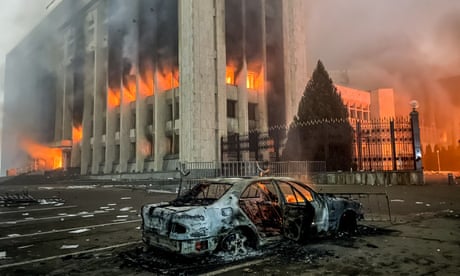

Violent clashes in Kazakhstan amid fuel protests – in pictures


On Wednesday night, Tokayev asked the CSTO to help him regain control. Armenia’s prime minister, Nikol Pashinyan, said the alliance would dispatch forces to “stabilise” the central Asian country.
Troops at the main square in Almaty, Kazakhstan. Photograph: Mariya Gordeyeva/Reuters

It is not clear how many troops the CSTO will send or how long they will stay in the country. Russian MP Leonid Kalashnikov told Interfax the troops would stay “for as long as the president of Kazakhstan believes it necessary”. He said they would mainly be engaged in protecting “infrastructure” in the country.

Tokayev had appealed to the bloc for help, decrying the actions of “terrorists” and alleging the country had been the victim of “attacks” by foreign-trained gangs after fuel price rises triggered widespread protests.

On Wednesday, demonstrators took over government buildings and reportedly stormed the airport in Almaty, the country’s commercial capital.

“Almaty was attacked, destroyed, vandalised, the residents of Almaty became victims of attacks by terrorists, bandits, therefore it is our duty … to take all possible actions to protect our state,” said Tokayev, in his second televised address in a matter of hours.


The Kazakh events come at a time when all eyes have been on a possible Russian intervention in Ukraine. Images of police being overpowered by protesters are likely to cause alarm in Moscow, as another country neighbouring Russia succumbs to political unrest. Kazakhstan is part of an economic union with Russia and the two countries share a long border.

The protests began in the west of the country at the weekend, after a sharp rise in fuel prices, but have spread quickly and taken Kazakhstan’s authorities and international observers by surprise.

The protests have swelled amid broader discontent with Tokayev, president since 2019, and Nursultan Nazarbayev, the former leader.

“Nazarbayev and his family have monopolised all sectors, from banking to roads to gas. These protests are about corruption,” said 55-year-old Zauresh Shekenova, who has been protesting in Zhanaozen since Sunday.
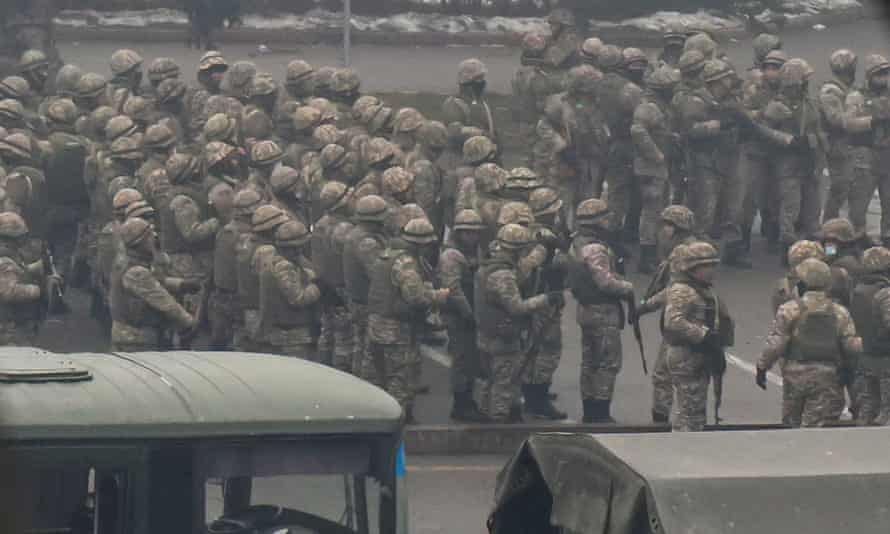
Security forces in Almaty. Photograph: Valery Sharifulin/Tass

“It all started with the increase in gas prices but the real cause of the protests is poor living conditions of people, high prices, joblessness, corruption.”

Darkhan Sharipov, an activist from the civil society movement Wake Up, Kazakhstan, said: “People are sick of corruption and nepotism, and the authorities don’t listen to people … We want President Tokayev to carry out real political reforms, or to go away and hold fair elections.”

The five former Soviet Central Asian republics have been largely without protest in their three decades of independence, with the exception of Kyrgyzstan, which has had several revolutions.

Kazakhstan has never held an election judged as free and fair by international observers. While it is clear there is widespread discontent, the cleansing of the political playing field over many years means there are no high-profile opposition figures around which a protest movement could unite, and the protests appear largely directionless.

Security forces kill 'dozens' in Kazakhstan unrest

PUBLISHED : 6 JAN 2022 
WRITER: AFP
Protests against rising fuel prices have turned into Kazakhstan's biggest crisis in decades

ALMATY (KAZAKHSTAN) - Security forces in Kazakhstan killed dozens of protesters trying to storm government buildings overnight, police said Thursday, after a Moscow-led military alliance agreed to send forces to help quell mounting unrest.

Long seen as one the most stable of the ex-Soviet republics of Central Asia, energy-rich Kazakhstan is facing its biggest crisis in decades after days of protests over rising fuel prices escalated into widespread unrest.

In the worst reported violence so far, police said dozens of people were killed in battles with security forces at government buildings in the country's largest city Almaty.

"Last night, extremist forces tried to assault administrative buildings, the Almaty city police department, as well as local police commissariats. Dozens of assailants were eliminated," police spokesman Saltanat Azirbek was quoted as saying by the Interfax-Kazakhstan, TASS and Ria Novosti news agencies.

Videos on social media on Thursday showed pillaged shops and burned buildings in Almaty, automatic gunfire in the streets and residents screaming in fear.

The growing unrest is presenting a major challenge to the authoritarian regime of President Kassym-Jomart Tokayev and has raised international concern, especially with key ally Moscow.

- 'Outside interference' -

With his repeated calls for calm ignored, Tokayev in an address to the nation early Thursday said he had appealed to the Russia-led Collective Security Treaty Organisation (CSTO), which includes five other ex-Soviet states, to combat what he called "terrorist groups" that had "received extensive training abroad".

The CSTO's chairman, Armenian Prime Minister Nikol Pashinyan, said the alliance would send "collective peacekeeping forces... for a limited period of time in order to stabilise and normalise the situation in this country" that was caused by "outside interference".

There were no immediate further details nor comment from Moscow, which dominates the alliance.

Tokayev said "terrorists" were seizing buildings, infrastructure and small arms, and fighting battles with security forces.

Protests spread across the nation of 19 million this week in outrage over a New Year increase in prices for liquid petroleum gas (LPG), which is widely used to fuel cars in the west of the country.

Thousands took to the streets in Almaty and in the western province of Mangystau, saying the price rise was unfair given oil and gas exporter Kazakhstan's vast energy reserves.

Protesters were reported to have stormed several government buildings on Wednesday, including the Almaty mayor's office and the presidential residence, with both said to be on fire.

As of late Wednesday, at least eight law enforcement officers had been killed and 317 wounded in the violence, according to the interior ministry quoted by local media.

The full picture of the chaos was unclear, with widespread disruptions to communications including mobile phone signals, the blocking of online messengers and hours-long internet shutdowns.

The protests are the biggest threat so far to the regime established by Kazakhstan's founding president Nursultan Nazarbayev, who stepped down in 2019 and hand-picked Tokayev as his successor.

Tokayev tried to head off further unrest by announcing the resignation of the government headed by Prime Minister Askar Mamin early on Wednesday, but protests continued.

- State of emergency -

Tokayev also announced he was taking over from Nazarbayev as head of the powerful security council, a surprise move given the ex-president's continued influence.

With protests escalating, the government late on Wednesday said a state of emergency declared in protest-hit areas would be extended nationwide and in effect until January 19.

It imposes an overnight curfew, restricts movements and bans mass gatherings.

Much of the anger appeared directed at Nazarbayev, who is 81 and had ruled Kazakhstan since 1989 before handing power to Tokayev.

Many protesters shouted "Old Man Out!" in reference to Nazarbayev and images posted on social media showed a statue of the ex-president being torn down.

The EU and the UN called for "restraint" on all sides, while Washington urged authorities to allow protesters to "express themselves peacefully."

Kazakhstan's government tolerates little real opposition and has been accused of silencing independent voices.

Spontaneous, unsanctioned protests are illegal despite a 2020 law that eased some restrictions on freedom of assembly.

Explainer-Why a niche fuel market reform triggered major Kazakh protests

Wed., January 5, 2022

Protests erupt after fuel price rise in Almaty

(Reuters) - Kazakhstan's slow-burning government reform of a niche market for car fuels brutally backfired this week, triggering the biggest public protests in years as demonstrators accused authorities of stealing from the poor.

Kazakhstan declared emergencies in the capital and elsewhere on Wednesday after demonstrators stormed and torched public buildings.

The protests were sparked by a fuel market reform first broached in 2015 that came into effect at the start of the month that sought to remove state price caps for butane and propane - often referred to as 'road fuels for the poor' due to their low cost - while making sure the local market was well supplied.

Previous subsidies had created a situation when Kazakhstan, a major oil producer, regularly faced shortages of butane and propane. Producers - including ventures of U.S. companies Chevron and Exxon - preferred to export to get a better price.

When prices were fully liberalised on Jan. 1 the government expectations were that supplies to the domestic market would rise and help address the chronic shortages.

But the measure backfired, as prices nearly doubled overnight to 120 tenge ($0.30) per litre.

Regions such as oil-rich Mangistau, where protests started, rely on butane and propane for refuelling as many as 90% of vehicles.

Alternative motor fuels such as gasoline and diesel are more costly at 180-240 tenge ($0.40-0.55) per litre.

Popular anger was already running high because of rising inflation which was closing in on 9% year-on-year - the highest in more than five years - leading the central bank to raise interest rates to 9.75%.

The resource-rich country of 19 million is estimated to have a million people living below the poverty line while also counting several dollar billionaires on the Forbes list.

The protests have yet to have an impact on Kazakhstan's oil production. President Kassym-Jomart Tokayev has ordered his acting Cabinet to reverse the fuel price rise.

(Reporting by Alla Afanasyeva and Dmitry Zhdannikov, Editing by Rosalba O'Brien)
 
Poverty, inequality and corruption: why Kazakhstan’s former leader is no longer untouchable

Analysis: Nursultan Nazarbayev, behind-the-scenes powerbroker, thought he found a way to step aside without risking retribution
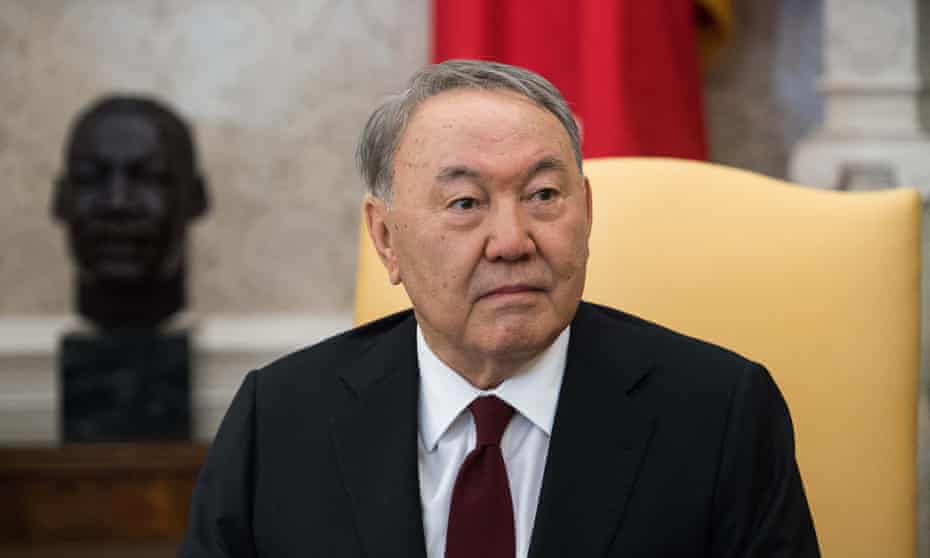

Nursultan Nazarbayev retained his official title of Elbasy, ‘leader of the nation’ 
Photograph: Nicholas Kamm/AFP/Getty Images

Shaun Walker
Wed 5 Jan 2022

For years, Nursultan Nazarbayev has been used to performative adoration from the citizens of Kazakhstan. The country’s leader for nearly three decades, he was showered with praise and adulation at showpiece events, and his image smiled down from billboards across the country.
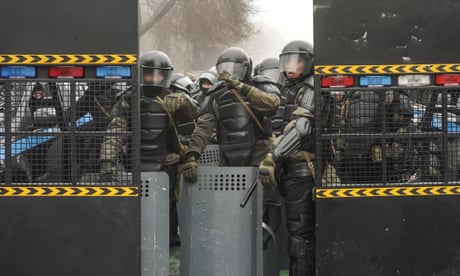

Kazakhstan protests: Moscow-led alliance sends ‘peacekeeping forces’

When he stepped down in 2019, he was able to choose his successor, Kassym-Jomart Tokayev, and kept significant power as head of the security council and general behind-the-scenes powerbroker. He retained his official title of Elbasy, or leader of the nation.

Astana, the capital city he ordered built in the heart of the Kazakh steppe, was even renamed in his honour.

To Nazarbayev, it must have seemed like he had found an answer to the problem vexing ageing autocrats across the region: how to step aside in old age without risking retribution. Vladimir Putin and others were doubtless watching with interest.

The events of the past few days might suggest that different lessons should be drawn. Statues of Nazarbayev, meant to be monuments to his legacy, have been torn down by protesters. Instead of chanting “Elbasy”, many angry Kazakh protesters are now chanting “Shal ket” – or “Old man, out!”

Discontent at poverty, inequality and corruption led to increasing unrest in the country in recent years, and much of the anger is directed at Nazarbayev himself, who for so long appeared untouchable.

Among Central Asia’s vicious and repressive autocrats, Nazarbayev always seemed the most nimble. Born in 1940, he rose through the ranks of the Communist party and became Kazakhstan’s first leader on independence.

He managed to hold the country together during the 1990s, and later to avoid the extreme repressive violence of his peers in Uzbekistan and Turkmenistan, while also avoiding the revolutionary sentiment of Kyrgyzstan. When 16 people were killed in 2011 protests, he solicited advice from Tony Blair about how best to spin the violence.

He charted a delicate geopolitical course in the years after Kazakh independence, remaining friendly towards Russia, while also courting western leaders and energy companies, who turned a blind eye to the lack of democracy and instead focused on securing lucrative contracts in the country.

Western lawyers, accountants and advisers helped the new Kazakh elite invest their fortunes in London mansions and Swiss villas. His daughter and grandson are believed to own £80m of London property. Nazarbayev also engaged a steady stream of western architects and urban planners to build his new capital city.

In 2010, Nazarbayev, perhaps with one eye on the clock, ordered scientists to investigate the creation of an “elixir” that could prolong human life. Eventually, it seems, he accepted the inevitability of the human ageing process and announced in 2019 he was stepping aside.

Last year, the director Oliver Stone made a hagiographic film portrait about Nazarbayev’s time in office, named Qazaq: History of the Golden Man, and numerous statues to the retired leader were erected across the country.

Now, his image has become a lightning rod for discontent. On Wednesday, Tokayev announced he was replacing Nazarbayev as chair of the security council, and there were rumours on Wednesday that Nazarbayev might leave the country for “medical treatment”.

It is not clear yet how the unrest in Kazakhstan will evolve, and what role Nazarbayev will play in them, but it seems certain that the events of the past few days will alter the historical legacy he had imagined he would leave.

Omicron could boost waning immunity, shown in blood: Gov't COVID-19 advisers

Omicron immunity boost?

Immunity against COVID-19 among vaccinated adult Canadians and those who have already contracted the virus has been waning throughout the population, tests on donated blood have found.

Tests on around 9,000 donated blood samples from across Canada show that antibodies in the blood which fight the virus declined in October among all age groups, with experts saying the waning immunity is likely to have continued in November and December.

But the head of the government’s COVID-19 Immunity Task Force says that the highly contagious Omicron variant may offer an “immune dividend” offering fresh protection against future infection.

Scientists on the task force are now analyzing the extent of immunity offered by Omicron, as well as “memory of immune protection” in the cells which can kick in with future COVID-19 infections.

With the task force studies of immunity levels informing government policy on booster shots, the findings are likely to influence when and how many booster shots people may have in future.

Dr. Tim Evans, executive director of the task force, which advises the government on its response to the pandemic, said in an interview that studying immunity due to Omicron is now a priority.

“There are large sections of the population that are now infected with Omicron and therefore this is one of the priorities for the task force, to understand what the immune dividend is from infection from Omicron," he told The Canadian Press.

"If it is strong and sustained in terms of immune memory it may have an impact on how we think about the need and timing of boosters."

Evans, added that Omicron is now so widespread that “our testing systems can’t keep pace.”

“So the number (with Omicron) is vastly underestimated. There are large sections of the population that are now infected with Omicron,” he said.

Canadian Blood Services is testing the presence of antibodies which fight COVID-19 in blood samples from donors over 17 years of age every month. It detected a big immunity boost last summer after Canadians got their second vaccine shot. But in September, it noticed that antibodies that could fight the virus were waning in people over the age of 70.

A Canadian Blood Services report completed this week, analyzing blood donated in October, shows that among all donors, from 17 year olds to pensioners, immunity had decreased.

Sheila O’Brien, associate director of epidemiology and surveillance at Canadian Blood Services said it was “uniquely positioned to provide information about the presence of COVID-19 antibodies in a large number of people across Canada relatively quickly.”

She said antibodies that could fight the virus were significantly higher in vaccinated than unvaccinated people.

“About 2 weeks after vaccination, antibody levels peak and then gradually decrease," she added.

Evans predicted that waning immunity, measured in the blood, would continue to show up in November and December data. But he said the task force would study if there has been a boost in immunity with more and more people contracting Omicron.

The task force’s findings on waning immunity influenced the government to offer vaccine booster shots to vulnerable groups such as transplant patients with weaker immunity and older people.

Dr. Bruce Mazer, an immunologist and associate scientific director of the COVID-19 Immunity Task Force, said that even with waning levels of antibodies in the blood, the body’s immune system has a cellular memory of a virus and can mobilize to fight it. He said people who have been vaccinated, have had the virus, or both, generate cellular immunity.

“Other parts of the immune system are waiting and act as sentries,” he said. “You have T-cell memory which helps fight the virus and B-cell memory that helps to make fresh groups of antibodies.”

The McGill professor said the task force is currently studying this backup immune response, as well as the immune response to the Omicron variant which he said has 50 mutations, compared to the original COVID-19 virus.

COVID-19: ALBERTA NDP propose new measures for child care against Omicron

The Alberta NDP question why Premier Jason Kenney wears an N95 mask in public, but young children and students are denied access to them.

Alberta parents, teachers' union question province's decision to resume in-person classes

Heading back to school during Omicron wave is like sending kids to a 'COVID soup,' Edmonton mom says

Alberta students are set to resume in-person learning next week. (Ryan Remiorz/The Canadian Press

Alberta parents are preparing to send their children back to in-person classes next week, some with reluctance and trepidation as the Omicron variant continues to spread quickly in community settings. 

Marie Watts, who has two teenagers in school in southeast Edmonton, one in Grade 9 and the other in Grade 11, believes sending kids back to the classroom isn't safe. 

With record-high cases and a high transmission rate of Omicron within the community, it's not appropriate to send children back to in-person learning next week, Watts said Wednesday.

"I'm pretty angry about it actually," Watts said. "I'm concerned that we're just going to be putting a bunch of kids in a COVID soup and hoping it all works out."

Watts said classes are lacking high-quality air filtration systems and the province should be handing out the more effective N95 masks, instead of medical masks. 

Many children are feeling anxious, she noted.

"The kids don't really want to go back but they need to finish school," Watts said. 

Eager to get back

Other families welcome the return in-person learning. 

Daynelis Brito's three children — aged eight, 10 and 12 — have been going to class since schools were allowed to reopen last spring.

She said she trusts the schools will do their best to keep students safe.

"So far, there has not been much issue with the kids getting sick," Brito said. "And the kids are eager to go back to school."

Brito also believes symptoms of Omicron infection are mild and it's just a matter of time before it becomes more common in the community.

"All you have to do is wish for the best, because it's everywhere, right?"

Alberta Teachers' Association president Jason Schilling said the province isn't doing enough to make sure the classrooms are safe. 

Schilling said the province needs to invest in KN95 masks, instead of the blue medical ones.

"I'm frustrated beyond words sometimes when I hear our government leaders saying, 'We are doing everything that we possibly can to ensure that our schools and our staff are safe,'" he said. "I don't buy it when we hear this from our leaders."

Watts said the province should keep learning online for another couple of weeks.

"It also buys time to do things like finally getting air purifiers in classrooms and maybe actually getting kids masks that protect from airborne viruses like the N95 type," she said. 

"Then once these things are in place, once the schools are safer, then let the kids go back. But don't put them back in now, wait for it all to fall apart and then send them back online class by class."

Semesters online

Edmonton Public Schools is offering online options to students for the second half of the school year from Feb. 1 to June 28, but families must choose by Jan. 11 and commit to the full semester. 

"After Jan. 11, 2022, students cannot move from in-person to online learning," the website says. "This deadline ensures schools have enough teaching staff assigned to both online and in-person classes."

Students wanting to switch to in-person learning need to consult the school to see if there's space in a specific grade or program.

Watts said some subjects are not offered widely in the online format, making it difficult for students to enrol in courses they need to graduate

Parents, doctors fear back to school will spike Omicron cases, clog hospitals

'I have 100 per cent certainty that when kids go back to school, cases will rise and hospitalizations will rise'

Author of the article: Eva Ferguson
Publishing date: Jan 05, 2022 •
A sign outside Mount View School announces the postponement of return to classes on Monday, Jan. 3, 2022. Alberta has delayed the start date to help schools deal with COVID-19 precautions due the Omicron surge. 
PHOTO BY GAVIN YOUNG/POSTMEDIA

With the province confirming K-12 students will return to classrooms Monday, doctors and parents fear limited school protections will result in a further explosion of Omicron cases, hospital capacity crunches and an eventual shuttering of schools again.

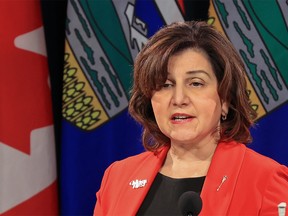
Education Minister Adriana LaGrange announced Wednesday that schools will open to in-person learning Jan. 10, promising “a safe return” through the delivery of rapid test kits and new “medical grade” masks to schools by Jan. 14.

ONE IS A SUNDAY SCHOOL TEACHER THE OTHER IS A UCP SUPPORTER

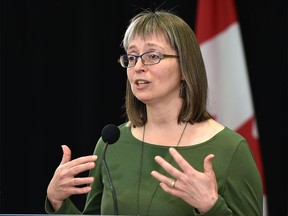
LaGrange and chief medical officer of health Dr. Deena Hinshaw said the mental health and education benefits of in-person learning outweigh the risks of COVID infections in children, which rarely result in severe outcomes.

“There is high transmissibility in the community, and it will come into schools and into classrooms,” LaGrange said.

“But we need to mitigate that with the overall health of our children. It’s very important they return to in-person learning.”

Dr. Shazma Mithani, an emergency room physician who treats COVID patients at Edmonton’s Royal Alexandra and Stollery Children’s hospitals, says she, too, wants to see kids in schools.

But she fears that rapid tests and low-grade masks — not N95s — will not do enough to stop the spread of the highly transmissible Omicron variant.

“I have 100 per cent certainty that when kids go back to school, cases will rise and hospitalizations will rise,” Mithani said.

“It’s just simple math. And the province knows this, too. We’re just kicking the can down the road.”

Mithani said students and staff should be provided N95 respirator masks to prevent airborne transmission of Omicron, which is “seven times more transmissible” than the original strain.

She added that rapid tests only provide a brief window into whether someone is positive, and very often the test results are not accurate.

“I have heard from many, many people that their tests are false negatives . . . or they are testing negative while they are symptomatic.”

LaGrange announced late last Wednesday that K-12 schools would have an extended winter break to allow school districts to prepare for the ongoing spread of Omicron, which has resulted in record high case counts across the country.

But after confirming this Wednesday that kids will go back, in spite of even wider spread, LaGrange added that school districts have the flexibility to shut down individual classrooms or buildings temporarily, without affecting other jurisdictions that are controlling cases.

After a difficult academic year of back and forth learning from in-person to online in 2020-21, LaGrange said students cannot afford any further learning gaps. The province has also created an online tutoring resource, she added, which kicks in next week to help students catch up with literacy and numeracy learning.

“We are doing everything we can to help get students back on track.”

Education Minister Adriana LaGrange confirms Alberta’s schools will reopen on Jan. 10, 2022. PHOTO BY GAVIN YOUNG /Postmedia file

But Dr. Wing Li, spokeswoman for the Support Our Students advocacy group, said schools cannot open safely — or stay open — without several meaningful layers of mitigation, including better masks, better ventilation through HEPA filters and smaller class sizes.

“We have the tools, we have navigated many months of this pandemic,” Li said.

“Yet we lack the political will . . . and when we get one measure we have others taken away. Rapid tests are arriving, but we no longer have PCR tests.”

Albertans continue to have difficulty accessing COVID tests, with many pharmacies running out of rapid test kits. Hinshaw has also advised that only people with symptoms should book PCR tests, but even those are not immediately available.

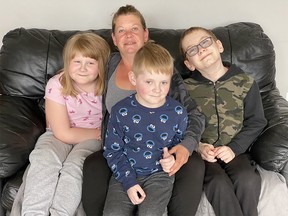
Jen Allan, a mother of three special-needs students in Beiseker, just north of Calgary, is terrified about sending her kids back to school next week, torn over what is worse — learning loss by staying home or health risks by going back.

“I cannot call what my kids have received in this past year an education. I call it more of a deprivation,” said Allan, who has kids in grades 1, 3 and 5.

Her youngest son is on the autism spectrum and has severe difficulties learning online. And her eldest has medical issues, which put him at higher risk of severe illness with COVID.


Allan worries that even if her kids go back, her rural school will not get access to rapid tests or new masks.

“We get very little in rural areas. Our pharmacies have not even received vaccines for children yet, they are only for adults for now.”

Mom Jen Allan and her three kids, from left to right: 
Makayla, Frankie and Rylan. PHOTO BY SUBMITTED

Dr. Joe Vipond, a Calgary doctor with the Protect Our Province advocacy group, said in his livestream Wednesday he, too, is concerned about schools opening amid rapidly increasing cases, including in pediatrics.

With Alberta Health Services confirming an additional 4,752 new cases of COVID on Wednesday, Vipond said “that’s nowhere near to what is actually happening in the community. It’s a poor, fuzzy picture of what’s really happening.”

Vipond added that among the 470 people now in hospital with COVID, 31 are pediatric admissions.

“Our government says COVID is airborne, but there is no mitigation acknowledging that. If you do not mitigate with the right form of transmission, you will fail.

“You can deep clean all you want, it won’t make a difference.”

Parents across Alberta have been advocating for HEPA filters for months, but the province and school officials are adamant that ventilation in schools is above standard.


DR.HINSHAW IS A UCP ENABLER

Alberta students will return to in-school learning Jan. 10, education minister says

Rapid tests and masks will be distributed to schools

Education Minister Adriana LaGrange and Dr. Deena Hinshaw, the province's chief medical officer of health, announced Wednesday that students will return to in-school learning on Jan. 10. ( Chris Schwarz/Government of Alberta)

Alberta students in kindergarten to Grade 12 will return to their classrooms on Jan. 10 after an extended holiday break, Education Minister Adriana LaGrange said Wednesday.

On Dec. 30, the province had announced it was delaying the post-holiday reopening of schools province-wide after boards requested more time to assess the impact of the new Omicron variant in the classroom. 

Winter break for K-12 students was extended to Jan. 10, but the government said it had not made decisions on whether students will be learning in class or at home.

LaGrange said Wednesday that all students will return to learning in their classrooms.

"Over the past several days my team and I have continued to work closely with school authorities," LaGrange told a news conference. "I am extremely grateful for their input and I am so pleased to confirm that ECS (early childhood services) and kindergarten to Grade 12 students will return to classrooms on Jan. 10.

"Children who learn in person belong in the classroom and they will be there with the added safety of rapid tests and medical-grade masks."

Alberta Education Minister Adriana LaGrange says kids will return safely to school as planned on Jan. 10, and explains why the province made the decision. 2:02

The rapid tests and masks will be distributed to schools as "an added layer of protection to lower the risk of transmission of the Omicron variant," LaGrange said.

The government will begin distributing shipments of rapid tests and masks later this week and all schools will have their initial shipments by the end of next week. LaGrange said the shipments to schools will be in phases.

Students should wear masks, Hinshaw says

Dr. Deena Hinshaw, Alberta's chief medical officer of health, said there are no "risk-free solutions" but that she believes the province's approach is prudent.

"There is a very high transmission risk right now and I continue to advise that people do everything they can to minimize the number of close contacts they have," Hinshaw said.

"However, I also believe that if we were to shut schools across the entire province, we would be imposing much greater harm on all of those students by not allowing them the opportunity for in-school learning at this time."

She said the use of rapid testing, medical masks and other measures will help to protect students and staff.

"Given the current situation, I also want to note that I strongly recommend that students in all grades wear masks, including kindergarten to Grade 3," she said. "To keep the risk in schools low it will be critical for all of us to stay home and keep our children home if any of us have symptoms."

School authorities will have flexibility to shift a class or an individual grade to short-term at-home learning if needed to address operational challenges at a school, the province said in a news release.

K-12 students will return to the classroom on Jan. 10, where they can expect medical-grade masks and more frequent rapid tests as Omicron continues to set new records across the country. 2:24

Decisions on shifting entire schools or school authorities to at-home learning will continue to be made by the Alberta government, with input from school authorities, it said.

Online tutoring coming

LaGrange said free online-tutoring resources will be available starting next week for students in grades 4 to 9 who need to catch up on skills after falling behind due to the pandemic.

The tutoring resource will be launched with pre-recorded video tutoring sessions to improve students' literacy and numeracy skills. The province plans to expand the service later in the year to cover more grades and subjects and add live tutoring.

As of Wednesday, there were 470 people with COVID-19 in hospital in Alberta, up from 436 on Tuesday, with 72 of those patients in intensive care, 11 more than on Tuesday.

Hinshaw reported 11 new deaths from COVID-19 on Wednesday, and a test positivity of 36.9 per cent.

Positivity rates across the province are the highest since the beginning of the pandemic.

 
K-12 students returning to classrooms next week as Alberta reports record-high cases, increasing hospitalizations

The decision comes as the Omicron variant is rapidly spreading across the country

Author of the article: Stephanie Babych
Publishing date: Jan 05, 2022 
A snowy playground at Le Roi Daniels School in the SE. Wednesday, December 29, 2021. PHOTO BY BRENDAN MILLER/POSTMEDIA

As Alberta reported another day of record-high COVID-19 cases, the province announced kindergarten to Grade 12 students will return to classrooms Monday.

Education Minister Adriana LaGrange said Wednesday the province will distribute medical-grade masks and rapid test kits to schools as an added precaution for students and staff heading back to school after an additional week of winter break

The decision comes as the Omicron variant is rapidly spreading across the country. In Alberta, there are 37,196 cases of COVID-19 confirmed by PCR test, which is only a portion of the actual number of cases since PCR testing is limited.

A record 4,752 new cases were reported Wednesday with the highest test positivity rate logged in the province at 36.9 per cent. The data doesn’t include positive results from the rapid antigen tests Albertans are using at home, which Premier Jason Kenney noted on Tuesday means numbers are actually much higher than what’s being reported.

The number of COVID patients in hospital jumped to 470 from 436 a day earlier. Of the 470 hospitalized patients, 72 are in intensive-care units — an increase of 11 in a single day.


Dr. Deena Hinshaw, the province’s chief medical officer of health, said another 11 deaths were reported to Alberta Health, bringing the COVID-19 death toll to 3,333.

Despite the widespread transmission of Omicron, Hinshaw said she believes restarting in-person instruction at schools is prudent.

“The community transmission risk right now is the highest it’s ever been. I want to be clear that out in the general community, no matter what the setting, there is a very high transmission rate right now. I continue to advise that people do everything they can to minimize the number of close contacts they have,” said Hinshaw.

“However, I also believe that if we were to shut schools across the entire province, we would be imposing much greater harm on all of those students by not allowing them the option for in-school learning at this time.”
UCP ENABLER
Alberta’s chief medical officer of health Dr. Deena Hinshaw provides an update on COVID-19 during a news conference in Edmonton, December 7, 2021. 
PHOTO BY ED KAISER/POSTMEDIA

Shipments of the rapid tests and masks for schools will start this week, and schools can expect to receive their first shipment by the end of next week. Students will receive their supplies from the school once shipments are received, said LaGrange.

“Alberta Education is continuing to work closely with school authorities to support shifts that may be required for operational reasons, such as student or staff absences,” she said.

School authorities will be able to transition individual classes or grades to at-home learning if it is necessary as a short-term solution.

“As I’ve said before, I’m always so impressed by the resilience shown by our students, our staff, our school boards and our families in the whole education system,” said LaGrange.

She said the additional safety measures are meant to supplement the physical distancing, cohorting and cleaning policies, and availability of vaccines for students and staff.

Education Minister Adriana LaGrange.
FORMER SUNDAY SCHOOL TEACHER 
 File photo. PHOTO BY IAN KUCERAK /Postmedia

Just over 37 per cent of children aged five to 11 have received their first dose of vaccine in Alberta, while 85.3 per cent of those aged 12 and over have gotten at least two doses.

Alberta has also administered 1,035,726 booster doses of vaccine.

Everyone has a role to play in keeping schools open and children safe by limiting community transmission, Hinshaw said.

“Next to getting vaccinated, the most critical thing we can do is stay home if we’re sick even with the mildest of symptoms. Wearing masks and keeping our distance at all times also reduces our risk of spreading the virus but they cannot eliminate all risks of exposure,” she said.

Parents and guardians must complete a health assessment of their children before sending them to school to see if there are any signs of illness and should do a rapid test a couple of times a week to screen for asymptomatic infection, Hinshaw said.

With the overwhelming volume of infections, Alberta Health Services no longer has the capacity to do full case investigations of non-high-risk cases and will only be further investigating cases linked to high-risk settings such as continuing care and health-care facilities. Other cases confirmed by PCR test will be notified of the result and informed about isolation requirements.

Alberta’s post-secondary institutions are opting to keep most students online for the first few weeks of classes as a new semester begins.

The University of Calgary has started classes online, with an exemption for courses where there is a requirement the students attend in person, at least until the end of the month.

With the semester starting this week at the Southern Alberta Institute of Technology, most classes are online until at least Jan. 21, according to a news release from SAIT. On-campus labs will run in-person starting Jan. 10.

When classes start up again at Mount Royal University on Monday, the majority of courses will be delivered virtually until Jan. 22. As well, Bow Valley College will be starting the new term on Monday with a temporary switch to online learning until at least Jan. 21.

Quebec to install 90,000 air quality monitors in classrooms, reserve rapid tests for students

A young girl walks in the hallway on the first day of school in Montreal, Tuesday, August 31, 2021, as the COVID-19 pandemic continues in Canada and around the world. Parents are divided on whether children should return to classes Jan. 10, 2022. 
THE CANADIAN PRESS/Graham Hughes


Selena Ross
CTVNewsMontreal.ca Digital Reporter
Published Wednesday, January 5, 2022

When Quebec schools reopen on Jan. 17, the youngest students will immediately get more at-home rapid tests, then get more in February.

It's part of a suite of measures meant to curb school outbreaks of Omicron, though Quebec Education Minister Jean-François Roberge also took heat over a press conference Wednesday from those saying the province isn't going nearly far enough, especially when it comes to classroom air quality.

"Our Plan A is reopening schools," said Roberge, saying the province is laying the necessary groundwork to stick to its goal of bringing kids back to class as soon as possible.

For the rapid tests, a box of five tests will be given out to each primary and preschool student in January, and then again in February, adding up to millions of tests reserved for this group.

In another measure meant to keep school outbreaks under control, teachers will be added to the list of prioritized Quebecers who will have access to PCR tests, starting on Jan. 15.

Some new equipment is also coming to help maintain air quality in schools and cut down on the infection rate, though critics said Quebec's work on this front lags far behind other provinces'.

Quebec is installing 50,000 air-quality detectors for classrooms imminently, with 40,000 more on the way, Roberge said.

It's also looking at adding more air exchangers, which bring fresh air into classrooms to maintain better air quality.

A few hundred air exchangers have been installed already and the province "will be providing more according to need," Roberge, calling it "excellent news."

That announcement comes, however, after a year of political battles around air quality in schools, and it wasn't enough to satisfy the government's opponents.

Many English-language boards buying their own air purifiers for classrooms about a year ago. The province refused to reimburse the cost and denied that it was necessary to do the same for most French-language classrooms, which are government-run through school "service centres" rather than boards.

On Wednesday, the political opposition immediately slammed the news, with the Quebec Liberal education critic writing on Twitter that adding monitors won't help, since they don't actually fix air quality.

"What do we do when the reading exceeds the [CO2] limit, other than open the window in the middle of winter?" wrote Liberal Marwah Rizqy.

The federal government has sent $432 million for school air quality measures, she wrote, asking what it's been spent on, with "zero in air purifiers."

Meanwhile, she added, "Ontario has over 70,000!"

When pressed by journalists about why the province won't install air purifiers, and whether it's an issue of expense, Roberge said it isn't.

"It's not a question of money. It's because those those tools are not recommended by our experts. It's as simple as that," said Roberge.

When asked if teachers will be given N-95 masks, Quebec Public Health Director Horacio Arruda said no, repeating a claim he's made several times when asked about a mask upgrade for health-care workers: he said Quebec experts don't believe N-95s work better overall than procedural masks and are not recommending their use, partly because people can't be relied upon to wear them correctly.

In another change, the isolation period will be reduced for fully vaccinated staff and students, meaning mostly students 12 and over. After an infection this group will need to isolate for only five days, not 10, as long as they don't show symptoms.
'PRETTY CONFIDENT' OF JAN. 17 RETURN

When asked what the chances are that school will be delayed yet again, Roberge said he thinks it's unlikely.

"I'm pretty confident that we will go back" on schedule, he said.

"I can't be sure at 100 per cent... of course, because COVID is COVID, and we have to take advice [from] our health authorities and we have to adapt," he said, but repeated that signs point towards staying with the current date.

Roberge said that until classes return, distance learning will happen according to plan. There are minimum weekly virtual teaching hours for elementary students, and secondary students will be virtually in class according to their normal schedules.

Exceptions are being made for specialized schools such as those for special-needs children, which are in person, and for apprenticeships and vocational training that must be done in workshops and in laboratories -- these must be done in person.

The same goes for practical evaluations that need to be done in person, Roberge said.

Despite reported shortages of computers for children without their own, Roberge said the province hasn't been aware of a need in this area and said it has sent computers to all who requested them.

"If [schools] have some shortage they should advise us and we'll help them provide computers to all kids who need computers," he said.

The government delayed the return to class for elementary and high school students until Jan. 17 as a result of rising infection rates.

Emergency daycare services are available to parents working in essential fields.

Similarly, universities in Montreal have moved to online education for the first few weeks of the winter semester as they examine the evolution of the virus.

Tuesday, Quebec reported 21 more deaths and 14,494 new recorded cases of COVID-19.

NASA features Edmonton photographer's 13-month moving-sunrise project
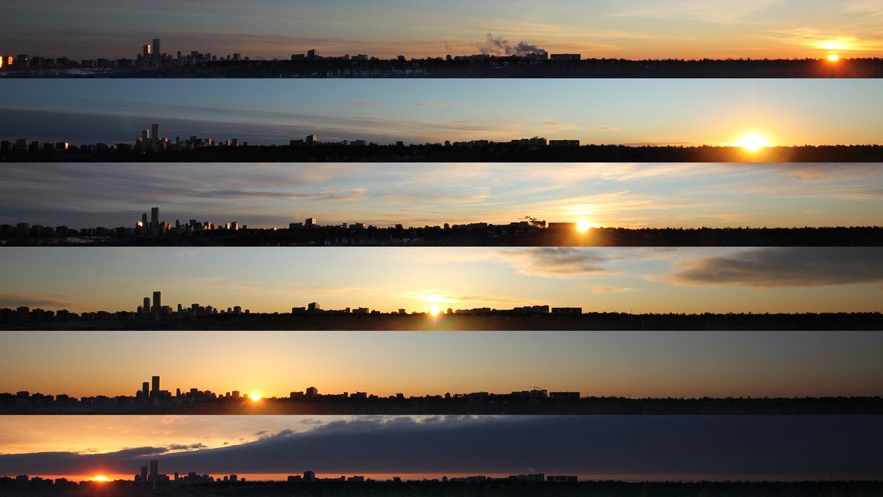
Part of a 13 month photo stack created by Edmonton skyscape photographer Luca Vanzella. (Source: Luca Vanzella)

Sean Amato
CTV News Edmonton
Published Jan. 5, 2022 

An Edmonton man who photographs the skies for fun had his work published by NASA on Wednesday.

Through snow and cold, a wicked heatwave and wildfire smoke, Luca Vanzella spent many of his 2021 mornings shooting the sunrise from the exact same place in west Edmonton.

He then stacked 13 of his best images from each month on top of each other, to show how the sunrise slowly dances across Edmonton's skyline throughout the year.


"The earth's tilt of its rotational axis compared to the plane of the solar system is what causes the movement of the sun along the horizon," Vanzella explained.

"It generally rises in the east and sets in the west, but it's not always due east. As we in Edmonton know well, in winter it rises southeast and in the middle of the summer it rises northeast."

Vanzella's work was featured as NASA's Astronomy Picture of the Day for Jan. 5, the fourth time one of his photos was shared by the space agency.

He said his projects are mostly for his own enjoyment, but he's happy to share it and inspire others to shoot their own skyscapes.

"It was nice to have projects like this to look forward to keep doing during the pandemic. It was really unaffected by the pandemic," Vanzella said.

"In fact, this morning I got a request from a planetarium in the Czech Republic that wants to use the photo for educational purposes. It is pretty cool."

Vanzella also created a video showing his progress.

Carmaking titans Volkswagon, Toyota plot to overthrow Elon Musk's Tesla

The world's two biggest automakers realize the age of the battery-powered vehicle is here and are gaming out how to stay on top


Author of the article:
Bloomberg News
River Davis and Craig Trudell
Publishing date: Jan 05, 2022 • 
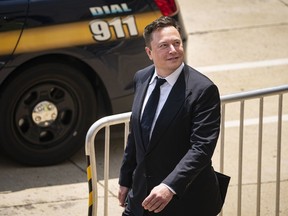
Elon Musk, chief executive officer of Tesla Inc., departs court in Wilmington, Delaware. PHOTO BY AL DRAGO/BLOOMBERG FILES

The epic fight over who controls the future of the car industry is about to get a whole lot more interesting.

Tesla Inc., the pioneer and pacesetter, has dominated the early rounds of the new-energy age, capturing investors’ imaginations with a vision for what the next generation of vehicles looks like and seizing the nascent market for fully electric cars.

In the other corner are giants of scale: Volkswagen AG and Toyota Motor Corp. The world’s two biggest automakers — each sold roughly 10 or 11 cars for every one Elon Musk did last year — realize the age of the battery-powered vehicle is here and are gaming out how to stay on top.

Within five days of one another last month, these masters of mass production laid out plans to splurge US$170 billion over the coming years to preserve their claim on an industry they’ve dominated for decades.

Executives at the very top of these incumbents are acutely aware the transition from the internal combustion engine won’t be orderly. It could get ugly — something akin to when Apple Inc. entered the mobile phone market and outclassed once-dominant Nokia Oyj.

After a year of standout growth during which Tesla became far and away the most valuable automaker ever, the trillion-dollar question is whether Musk’s advantages heading into the next generation of carmaking are as insurmountable as his company’s market capitalization suggests.

“When the two biggest car companies in the world decide to go all-in on electric, then there’s no longer a question of speculation — the mainstream is going electric,” said Andy Palmer, the former chief of Aston Martin and ex-Nissan Motor Co. executive often referred to as “the godfather of EVs” after being instrumental in developing the Japanese carmaker’s battery-powered Leaf. “I expect the shift to electric to be faster than everyone expects.”

The ways VW and Toyota have moved to defend their ground are as different as one would expect from proud German and Japanese titans of industry. One is coming out swinging, putting Tesla squarely in its sights, and the other is investing heavily in EVs while continuing to spread its bets, biding time as the early stages of the revolution shake out.

The behemoth doing the furious slugging to take on Musk is VW, which has grown over 84 years into a stable of a dozen brands, manufacturing in some 120 locations around the world and employing more people than the population of Detroit. VW Group generates roughly US$280 billion a year churning out models ranging from the Tiguan and Passat bearing its namesake badge, to Lamborghini supercars and Scania heavy trucks.

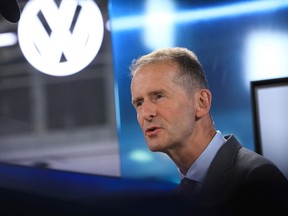
Herbert Diess, chief executive officer of Volkswagen AG, at the IAA Munich Motor Show in Munich, Germany. 
PHOTO BY KRISZTIAN BOCSI/BLOOMBERG FILES

Every year that Chief Executive Officer Herbert Diess has been at the helm, VW has announced unrivalled budgets for electrification. On Dec. 9, he delivered his largest plan yet, allocating 89 billion euros (US$100 billion) to EV and software development over the next half decade.

Diess constantly uses Musk as a measuring stick, so much so that he’s acknowledged annoying some within VW’s ranks. In October, he welcomed Musk as a surprise guest at an executive conference with 200 of the automaker’s top managers.

VW’s initial foray into EVs was with luxury models such as the Audi e-tron and Porsche Taycan. Last year, it sought to make a splash with more mainstream offerings — the ID.3 hatchback and ID.4 sport utility vehicle.

“Our transformation will be fast,” Diess said during a Tesla-style battery event in March, “bigger than anything the industry has seen in the past century.”

Ten months into 2021, VW had delivered around 322,000 fully electric vehicles, just over half of its 600,000 sales goal. Sanford C. Bernstein & Co. analysts have assumed VW would sell around 450,000 EVs for the year, which “isn’t the end of the world, but it’s also not quite a reason to celebrate.”

Diess is undeterred. The architecture that the ID.3 and ID.4 share will underpin a total of 27 EVs by the end of this year. VW will go from making these models at five factories — in Germany, China and the Czech Republic — to eight, starting up production from two more facilities in its home country and at its one U.S. assembly plant, in Chattanooga, Tennessee.

VW has also seen solid results with its high-value EV models within the group. The Taycan, for instance, is poised to outsell the iconic 911 sports car. More electric Porsches are on the way, with the brand expected to introduce a fully electric version of its popular Macan SUV next year.

Toyota’s long-standing positioning for the future was on display a couple months ago at a racetrack in the hills of western Japan. While the company brought along its battery-powered bZ4X electric SUV, the car Akio Toyoda took for spins around the circuit was a Corolla Sport H2 Concept vehicle equipped with a hydrogen-fuelled engine.

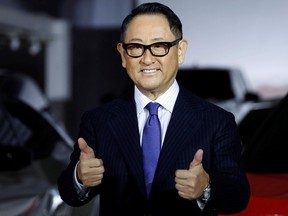
Toyota Motor Corporation President Akio Toyoda at a briefing on the company’s strategies on battery EVs in Tokyo. 
PHOTO BY REUTERS/KIM KYUNG-HOON FILES

“Heading into uncertainty, what we need are diverse solutions,” the grandson of Toyota’s founder said during a Nov. 13 news conference. “We don’t want to tie ourselves to just one option.”

Diversity is one thing; absence is another. The hybrid-powertrain trailblazer known for the Prius has acknowledged being “a little bit late” to fully electric models — and that was four years ago. Toyota’s first mass-market global EV isn’t set to debut until the middle of this year.

But weeks after taking hot laps in a hydrogen car, Toyoda traded his racing overalls for a suit and tie and gave outsiders an unprecedented look at a bevy of future products. When the first curtain was unveiled at a media briefing on a man-made island in Tokyo Bay, there were five EVs flanking him.

Toyoda delivered a brief sales pitch for each vehicle, then raised his palms to the skies before another curtain revealed 11 more battery-electric models. “Welcome to our showroom of the future,” he said, announcing plans to roll out 30 EVs by the end of the decade.

Of the 8 trillion yen (US$70 billion) Toyota dedicates to electrification in that span, half will go to fully electric models. The automaker is aiming to sell 3.5 million EVs annually by the end of the decade, almost double a target set just seven months earlier.

It took some prodding for Toyota to get to this point. With cautious comments from executives running against the industry’s general enthusiasm for EVs, some investors and environmental groups criticized the automaker for dragging its feet. Last summer, Anders Schelde, the chief investment officer of Danish pension firm AkademikerPension, which holds Toyota shares, said he didn’t see management’s attitudes toward EVs as a winning strategy for the long term.


Schelde said his fund was beginning to look more broadly at its investments to make sure they align with the goals of the Paris Agreement, which established a framework to limit global warming to well below 2 degrees Celsius. “Toyota has two or three years to clean up their act,” he said in an interview.

This sort of critique was a pain point for Toyota, with time during top management meetings consumed by debate over why its messaging around carbon neutrality wasn’t being well received. Last month’s EV event in Tokyo was the latest in a flurry of festivities the company has held around the globe to deliver its nuanced message of allegiance to hybrids and hope that the hydrogen-powered cars the carmaker has plowed years of research and investment into will gain traction alongside vehicles that run on just a battery.

In Brussels at the beginning of December, the company vowed to be ready to sell only zero-emission cars in Europe by 2035. In North Carolina a few days later, it hosted the governor and hundreds of other guests at a press conference to announce the state would be home to its first U.S. battery plant — a $1.29 billion investment.

While Toyota’s onslaught is to be taken seriously, the start VW has gotten off to with its EV push shows transitioning to electric won’t be a matter of flipping a switch.

And Tesla is doing some scaling of its own. As the company closed a year in which it delivered over 936,000 vehicles — up almost 90 per cent — it plotted out an investment of as much as 1.2 billion yuan (US$188 million) in its two-year-old Shanghai plant to upgrade equipment and take production beyond its stated capacity of 450,000 units a year. It’ll add another 4,000 workers at the facility, bringing the total to about 19,000.

Two new assembly plants — one outside Berlin and the other in Austin, Texas — are also gearing up to start making Model Ys. And there’s plenty of demand to meet all this additional output. Wait times on the Model 3 and Y have stretched to more than six months, Martin Viecha, Tesla’s investor relations chief, recently told a Deutsche Bank conference.

“With market demand for EVs clearly outstripping industry’s ability to produce, success in EVs is no longer about the order book, but rather about production capacity, ability to secure supply, and best cost, where Tesla feels it has considerable lead,” Deutsche Bank analyst Emmanuel Rosner said in a note.

Others see Tesla being toppled from the electric-car throne as new entrants muscle into the growing market. IHS Markit projects Tesla’s EV market share in the U.S. will fall to 20 per cent by 2025, from slightly more than 50 per cent today.

Heavy investment “will put Toyota and Volkswagen in a better position to compete with EV specialists,” said Anna-Marie Baisden, head of autos research at Fitch Solutions. “We have long held the view that the more traditional carmakers will have certain advantages over startups such as scale, manufacturing experience and brand loyalty.”

In addition to changing up their assembly lines and model offerings, VW and Toyota will have to chase Tesla on another front: software.

Early sales of the ID.3 were plagued by challenges VW had in getting certain tech functions to work. Initial cars were delivered to customers with missing features including the ability to connect smartphone apps with the vehicle’s display screen. Rather than beam a fix to its owners over the air — the way Apple does with iPhones, and Tesla does with its models — ID.3 drivers had to pay their dealer a visit to have their car serviced.

Joey Mandel’s experience is a case in point. The music festival industry worker in Los Angeles’ Woodland Hills neighbourhood was the first person at his local dealership to get an ID.4 electric SUV. He’s encountered his fair share of bugs — the audio cuts out periodically, and other times the vehicle won’t release from its charging plug.

Overall though, Mandel says he’s still happy with his purchase. He hasn’t had trouble traveling to events along the West Coast thanks to VW’s “solidly built-out” charging network.

“It’s not a Tesla in terms of technologies,” Mandel said, “but for people thinking they’re scared to make the shift to EVs, Volkswagen keeps things relatively like a normal car.”

Bloomberg.com