Thursday, May 05, 2022

Location, location: Why Edmonton is preferred by U.S. chains making their Canadian debut

Dickey's Barbecue Pit opened its first Canadian location in Edmonton 

Dickey's Barbecue Pit, a restaurant chain based in Dallas, opened its first Canadian location in Edmonton on Thursday. (Trevor Wilson/ CBC Edmonton)

Alberta's capital city is known for many things — a giant mall, a gorgeous river valley and a pretty successful NHL franchise.

You can add to that list Edmonton's appeal as a testing ground for U.S. chain stores and restaurants looking to expand into the Canadian market.

Dickey's Barbecue Pit, a popular Texas-based chain restaurant that opened its first Canadian location in Edmonton on Thursday, is one of a few major American chains that have eyed the Alberta city for expansion.

In December, American convenience store chain 7-Eleven opened a licenced location in north Edmonton that includes a dining area for liquor consumption on the premises.

California Pizza Kitchen, meanwhile, has said it will open its first Canadian location in south Edmonton sometime this year.

Industry experts say the city's population demographics, eating habits, affordability and even the presence of a giant mall are factors in attracting businesses keen to test the taste buds of Canadians. 

"Edmonton is a very good place to start because you limit your risk and you get a good market test," Ziad Kaddoura, a franchise consultant based in Edmonton, told CBC's Edmonton AM.

He said the city is a great place to figure out whether companies are up to the challenge of introducing a franchise in Canada with the least amount of damage in case their venture fails.

"And it's not as saturated as other markets," he said. "So I think it ticks all the right boxes."

Why restaurant chains look to Edmonton as a good place to launch in Canada. 9:00

Dickey's decided to come to Edmonton because of the similarities between Alberta and Texas, especially when it comes to oil and beef.

"Those two things are exactly how this brand started 81 years ago in my country," said Jim Perkins, the company's vice-president of international sales and support.

Market research showed people in Edmonton trend toward a higher consumption of white protein, chicken and turkey. "And that's certainly fine with us," he said.

Smaller, affordable market with a mall

Kaddoura said the province has the closest cultural population makeup to the U.S. Quebec, for example, would respond to something with a more French flair, he added. 

Toronto and Vancouver aren't suitable test markets in that they're too big for companies to figure out what works and what doesn't. 

Compared to the other cities, Edmonton has an affordable real estate market, Kaddoura said. 

He said a 3,500-square-foot space in a neighbourhood like Windermere could cost $12,000 a month in fees, leases and rent; a similarly sized space in a suburb of Toronto would cost between $20,000 to $25,000. 

He said Edmontonians are also food savvy.

"They're open to trying different things," he said . A couple of decades ago, that brought restaurant chains like Red Robin and Outback Steakhouse to the city. 

West Edmonton Mall, which opened in 1981 and was once North America's largest mall, also plays a role in attracting businesses to Edmonton, said Craig Patterson, a retail analyst at the University of Alberta. 

"It's a very unique centre. You don't get some stuff in Calgary that you'll get in Edmonton just because Edmonton has West Edmonton Mall. So it's pretty interesting how that works," he said. 

The mall is home to Canada's sole locations of Sarah Jessica Parker's SJP shoe store and the Bubba Gump Shrimp Co. restaurant.

Population size a problem

Although a single restaurant could find success in Edmonton, Kaddoura said Edmonton's small population could be a deterrent for some brands. 

Companies with a business model reliant on a high volume of product in several spots to serve a larger population may not work here. 

"There's not enough to serve," Kaddoura said.

But he said other brands will be watching the success of new openings to decide if they want to follow suit. "We'll see what happens in the future," he said.

'Once in a lifetime': Rare bird seen for first time in Canada in Thedford, Ont.

Published May 2, 2022 

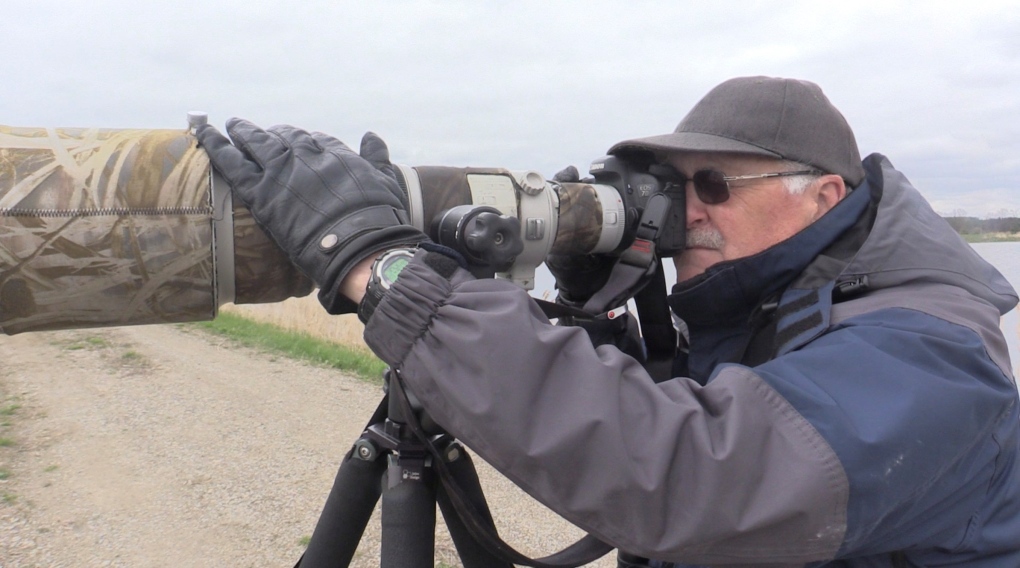
Over the past two days, hundreds of bird enthusiasts have flocked to a lagoon in Thedford, Ont. to catch a glimpse of a bird never before seen in Canada.

"I’m here for the marsh sandpiper,” says Sue Deadman, who travelled nearly 400 kilometres from Orillia, Ont. to see it.

A few metres away was Brian Morin, a bird enthusiast left his home in Cornwall, Ont. at 2 a.m. to get there. But the 700 kilometre trip was worth the wait.

“This is the first record for Canada,” says Morin.

“It's a shorebird which may not look that much different from the other birds that are around, but when you get something like this, it's a one of a kind. Most people have never seen this unless you've traveled the world,” Morin adds.

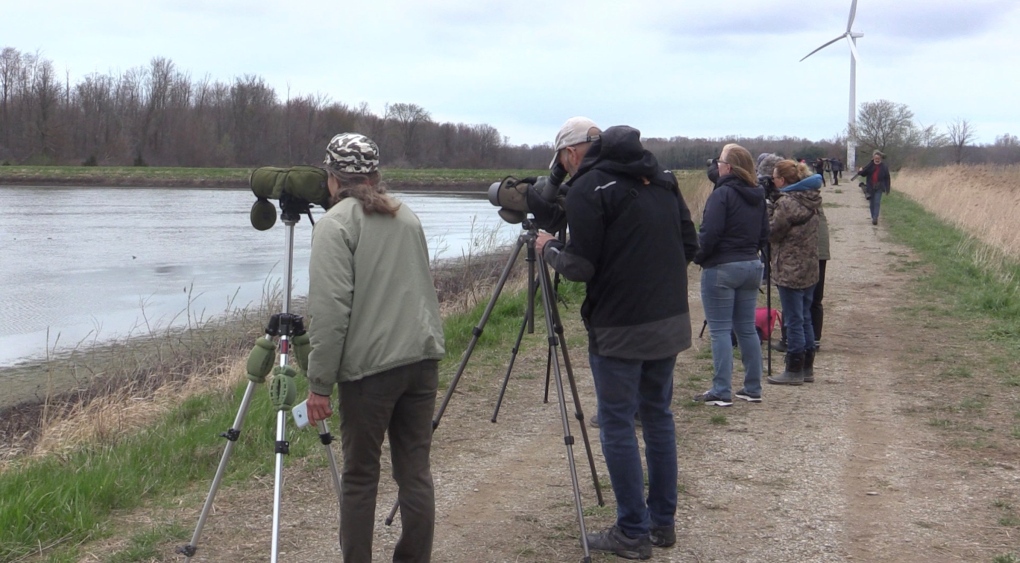
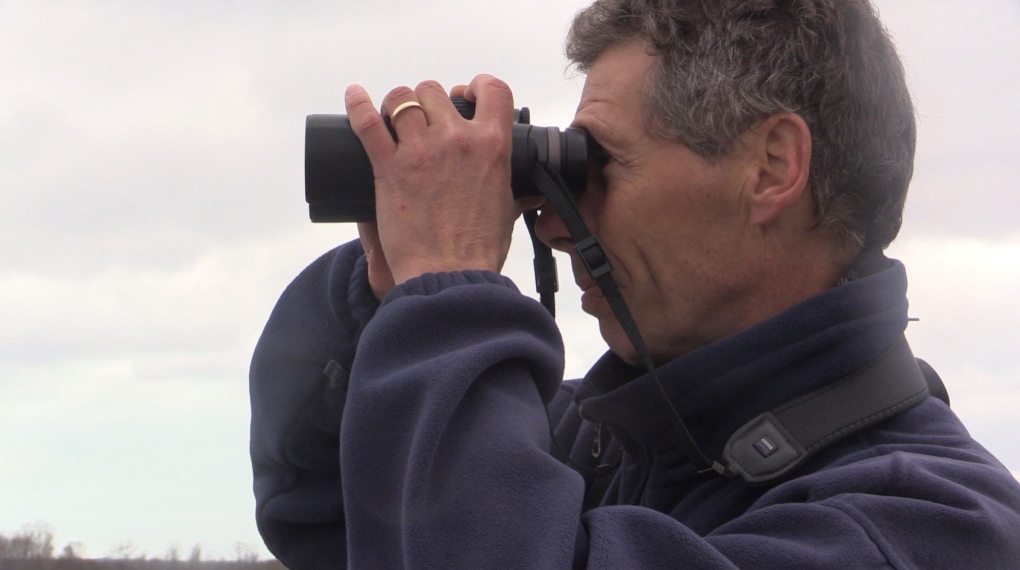
Brian Morin drove nearly 700 km from Cornwall, Ont. to Thedford, Ont. to catch a glimpse of the marsh sandpiper. It’s the first time the bird has been recorded in Canada.
 (Brent Lale / CTV News)

Local birder James Holdsworth was the first to spot the sandpiper from the road near the lagoons. He often stops in that spot, and couldn’t believe his eyes Saturday.

“It’s mind blowing rarity,” says Holdsworth. “I couldn't have picked anything rare if I tried terms of like a fantasy board.”

He says he knew right away it was something special as it looked similar to other yellowlegs in the area, but could tell by the pale colour in the head and neck that it was a sandpiper.

“When it flies it has a big V of white up the back which is very distinctive, and it's got long green legs, unlike anything in North America,” says Holdsworth.

The marsh sandpiper differs from lesser yellowlegs in that it has a very pale head and neck, long thin bill, long green legs and white wedge up the back. (Source: Matt Parsons)

“When I saw that, my heart was beating, hands shaking, and just disbelief that this was actually here. This Asiatic bird barely shows up on the west coast of North America and in Alaska occasionally, but it's even a rare bird on the Atlantic coast on the British side. It’s native to Central Asia,” he adds.

When word got out that Holdsworth had spotted the marsh sandpiper, bird watchers wanted their own sightings. Ontario Field Ornithologists (OFO) President Jeff Skevington immediately contacted Lambton Shores Mayor Bill Weber and arranged access to the Thedford Lagoons, which is private property owned by the municipality.

After they were given approval, more than 500 people have shown up on Sunday and Monday.

Hundreds of bird enthusiasts from across the province and Michigan have been flocking to Thedford, Ont. over the past two days to catch a glimpse of the marsh sandpiper. It’s the first time the bird has been recorded in Canada. (Brent Lale / CTV News)

“The OFO just launched the Ontario rare bird ambassador program,” says Susan Nagy, an OFO board director.

“It's for situations exactly like this where a rare bird comes to a private property or areas where we don't have access, and we work together with the landowners or with the municipalities to try and gain access. It’s to keep everything organized and safe for the birds and the people. This is the first one, and you couldn't get a better bird to start the program,” Nagy says.

Most of the birders could not get a good shot with their camera, as the sandpiper was located across the lagoon. But Bryan Puttock from Burlington and others were using a scope to observe.


“He's just he's a beautiful little bird," says Puttock. “I've seen him once before in Australia, so that's his normal habitat way over the other side of the world. So for him to come here, is amazing to think how he got here”.

Holdsworth, who was back again Monday for another brief look, has become a bit of a celebrity in the bird watching community this weekend.

James Holdsworth discovered a marsh sandpiper in Thedford, Ont. Holdsworth says it’s the first recorded sighting of the bird in Canada. (Brent Lale / CTV News)


Even two days after his first sighting, he’s still in shock that the marsh sandpiper has landed five minutes from his home.

“It’s a dream come true, and I don't think you could pick anything crazier,” says Holdsworth. “Birders always fantasize about what they want to see, and they look in European field guides or Asian field guides and think that would be a great thing to see. This is one of those birds where it'd be like hitting the Powerball lottery.”

For most of these birders, just like a lottery win, this is once in a lifetime.

Erect your own ‘Penis Satan’: Raunchy Vancouver devil statue pops up again

The big red devil is back with his big red...tail
arpenissatanblur
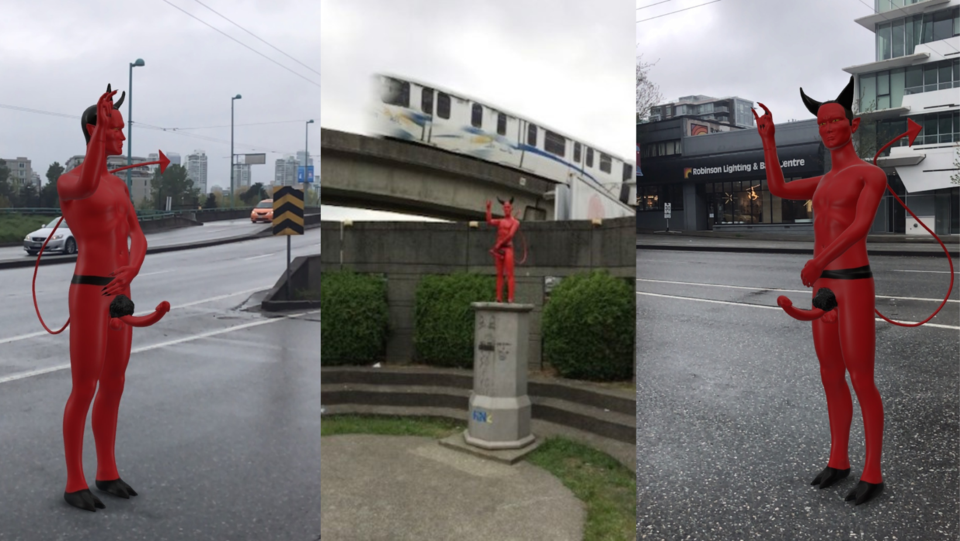
Penis Satan can be dropped into any location now, in Vancouver or around the world.

Warning: This story may contain material and images that are offensive to some audiences.

It's been years since Penis Satan, the famous (or infamous) sculpture, dropped into reality, taking its temporary place near Clark and Great Northern Way.

But the big red devil with a big red...tail (and an erection) is back, in a way, and can be where ever you need him. Obsidian, the anonymous artist who's claimed responsibility for the controversial piece has decided to release an augmented reality version.

"Penis Satan is my gift to the world that keeps on giving," the artist says in a video posted on social media.

To drop Penis Satan into any situation, people can go to the Penis Satan website and launch it from there (it'll open up the camera function on a phone and after a minute drop P.S. in place). Penis Satan shows up as standing about the same height as a human and stands in place with his signature...wave.

While the bright red naked devil only lasted a short time, it burrowed deep into Vancouver's collective memory. Last year it was resurrected as an NFT by Obsidian as well.

Penis Satan
Left and Right: Penis Satan dropped onto Cambie Street. Middle: The original Penis Satan statue. Contributed. Brendan Kergin / Vancouver Is Awesome

Boston violated free speech rights by refusing to fly Christian flag: U.S. Supreme Court

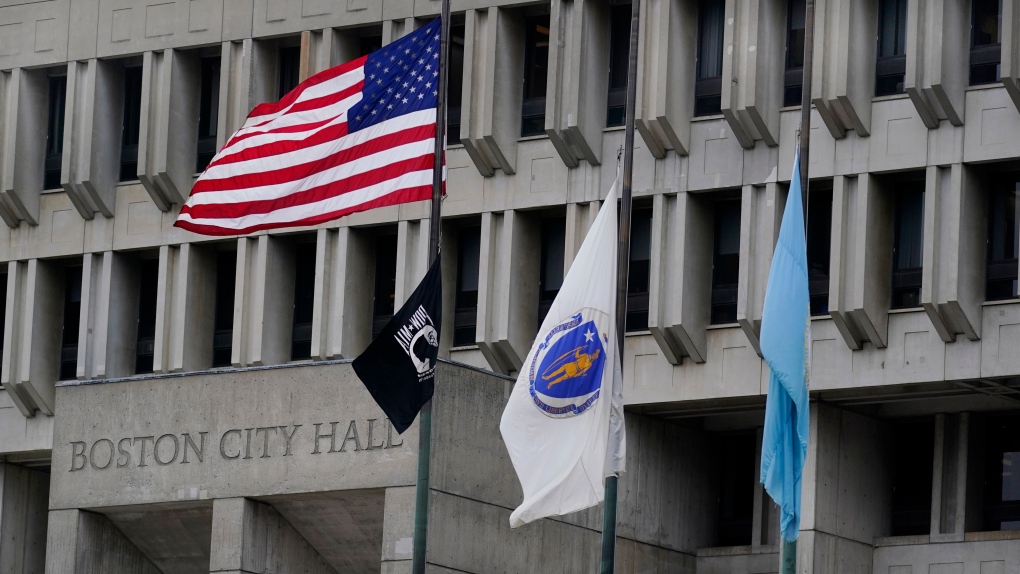
The American flag, the Commonwealth of Massachusetts flag, and the City of Boston flag, from left, fly outside Boston City Hall, Monday, May 2, 2022, in Boston.
 (AP Photo/Charles Krupa)

Mark Sherman
The Associated Press
Staff
Published May 2, 2022 1:52 p.m. MDT

WASHINGTON -

A unanimous U.S. Supreme Court ruled Monday that Boston violated the free speech rights of a conservative activist when it refused his request to fly a Christian flag on a flagpole outside City Hall.

Justice Stephen Breyer wrote for the court that the city discriminated against the activist, Harold Shurtleff, because of his "religious viewpoint," even though it had routinely approved applications for the use of one of the three flagpoles outside City Hall that fly the U.S., Massachusetts and Boston flags.

Occasionally, the city takes down its own pennant and temporarily hoists another flag.

Shurtleff and his Camp Constitution wanted to fly a white banner with a red cross on a blue background in the upper left corner, called the Christian flag, to mark Constitution Day, Sept. 17, in 2017.

The city had approved 284 consecutive applications to fly flags, usually those of other nations, before it rejected Shurtleff's because it was a Christian flag. The city said he could fly a different banner, but Shurtleff refused, and lower courts upheld the city's decision.

But the high court said the lower courts and the city were wrong. The case hinged on whether the flag-flying is an act of the government, in which case Boston can do whatever it wants, or private parties like Shurtleff, Breyer wrote.

"Finally, we look at the extent to which Boston actively controlled these flag raisings and shaped the messages the flags sent. The answer, it seems, is not at all. And that is the most salient feature of this case," Breyer wrote in an opinion that also riffed on the brutalist architectural style of Boston's City Hall and the Siena, Italy-inspired 7-acre plaza on which it sits.

Breyer wrote that "the city's lack of meaningful involvement in the selection of flags or the crafting of their messages leads us to classify the flag raisings as private, not government, speech--though nothing prevents Boston from changing its policies going forward."

The city has said that in the event of a loss at the Supreme Court it probably will change its policy to take more control of what flags can fly.

Shurtleff is a former organizer with the John Birch Society and has used his Camp Constitution website to question the Jan. 6 insurrection at the U.S. Capitol, the outcome of the 2020 election that put President Joe Biden in office, the efficacy of COVID-19 vaccines and even who was behind the Sept. 11 attacks.

None of that was at issue at the high court.

The case is Shurtleff v. Boston, 20-1800.
India and Pakistan heat wave is 'testing the limits of human survivability,' expert says
People cool themselves in a canal in Lahore, Pakistan, on April 29. 
(Arif Ali/AFP/Getty Images/CNN)

Rhea Mogul, Esha Mitra, Manveena Suri and Sophia Saifi
CNN
Published May 2, 2022 

Temperatures in parts of India and Pakistan have reached record levels, putting the lives of millions at risk as the effects of the climate crisis are felt across the subcontinent.

The average maximum temperature for northwest and central India in April was the highest since records began 122 years ago, reaching 35.9 and 37.78 degrees Celsius (96.62 and 100 degrees Fahrenheit) respectively, according to the Indian Meteorological Department (IMD).

Last month, New Delhi saw seven consecutive days over 40 degrees Celsius (104 Fahrenheit), three degrees above the average temperature for the month of April, according to CNN meteorologists. In some states, the heat closed schools, damaged crops and put pressure on energy supplies, as officials warned residents to remain indoors and keep hydrated.

The heat wave has also been felt by India's neighbour Pakistan, where the cities of Jacobabad and Sibi in the country's southeastern Sindh province recorded highs of 47 degrees Celsius (116.6 Fahrenheit) on Friday, according to data shared with CNN by Pakistan's Meteorological Department (PMD). According to the PMD, this was the highest temperature recorded in any city in the Northern Hemisphere on that day.

"This is the first time in decades that Pakistan is experiencing what many call a 'spring-less year," Pakistan's Minister of Climate Change, Sherry Rehman said in a statement.

Temperatures in India are expected to subside this week, the IMD said, but experts say the climate crisis will cause more frequent and longer heat waves, affecting more than a billion people across the two countries.

India is among the countries expected to be worst affected by the impacts of the climate crisis, according to the Intergovernmental Panel on Climate Change (IPCC).

"This heat wave is definitely unprecedented," said Dr. Chandni Singh, IPCC Lead Author and Senior Researcher at the Indian Institute for Human Settlements. "We have seen a change in its intensity, its arrival time, and duration. This is what climate experts predicted and it will have cascading impacts on health.
"


LOSS OF CROPS

India often experiences heatwaves during the summer months of May and June, but this year temperatures started rising in March and April.

In the northern state of Punjab, known as "India's bread basket," that's causing heat stress, not only for millions of agricultural workers, but for fields of wheat they rely on to feed their families and sell across the country.

Gurvinder Singh, director of agriculture in Punjab, said an average increase of up to 7 degrees Celsius (44.6 degrees Fahrenheit) in April had reduced wheat yields.

"Because of the heatwave we've had a loss of more than 5 quintal (500 kilograms) per hectare of our April yield," Singh told CNN Monday.


Chandni Singh, from the IPCC and no relation to Gurvinder Singh, said agricultural workers were more likely to suffer from the oppressive heat.

"People who work outdoors -- farmers, those in construction, manual labor -- will suffer more. They have less options to cool down and can't stay away from the heat," she said.

SCHOOL CLOSURES AND POWER CUTS


In some parts of India, demand for electricity has led to a coal shortage, leaving millions without power for up to nine hours a day.

Last week, coal stocks at three out of the five power plants Delhi relies on to supply its power reached critically low levels, dropping below 25%, according to Delhi's Power Ministry.

India cancelled more than 650 passenger trains through the end of May to clear tracks for more cargo trains as the country scrambles to replenish coal stocks at power plants, a senior official from the country's Railways Ministry told CNN.

Indian Railways is a key supplier of coal to power plants across the country.

Some Indian states, including West Bengal and Odisha, have announced school closures to deal with the rising temperatures.

"Children who have to traveled to school, many of them are getting nosebleeds, they can't tolerate this heat wave," West Bengal's Chief Minister Mamata Banerjee told reporters last week.

In recent years, both the federal and state governments have implemented a number of measures to mitigate the effects of heat waves, including shutting down schools and issuing health advisories for the public.

But according to Chandni Singh, more should be done to prepare for future heat waves.

"We don't have a heat action plan and there are gaps in planning," Singh said. "You can only adapt so much. This heat wave is testing the limits of human survivability."


‘We are living in hell’: Pakistan and India suffer extreme spring heatwaves


April temperatures at unprecedented levels have led to critical water and electricity shortages


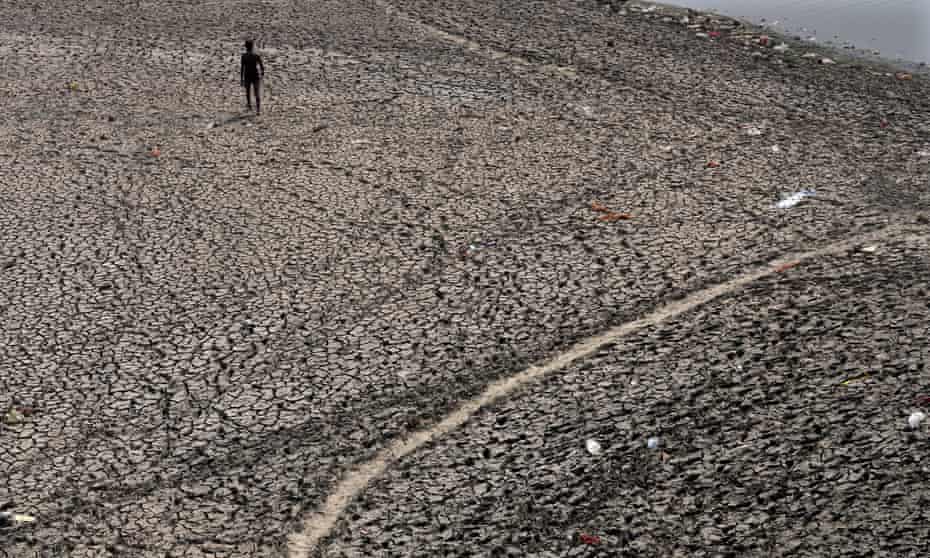
A man walks across a dried bed of the Yamuna River in New Delhi, India. 
Photograph: Manish Swarup/AP

Hannah Ellis-Petersen in Delhi and Shah Meer Baloch in Islamabad
Mon 2 May 2022

For the past few weeks, Nazeer Ahmed has been living in one of the hottest places on Earth. As a brutal heatwave has swept across India and Pakistan, his home in Turbat, in Pakistan’s Balochistan region, has been suffering through weeks of temperatures that have repeatedly hit almost 50C (122F), unprecedented for this time of year. Locals have been driven into their homes, unable to work except during the cooler night hours, and are facing critical shortages of water and power.

Ahmed fears that things are only about to get worse. It was here, in 2021, that the world’s highest temperature for May was recorded, a staggering 54C. This year, he said, feels even hotter. “Last week was insanely hot in Turbat. It did not feel like April,” he said.

As the heatwave has exacerbated massive energy shortages across India and Pakistan, Turbat, a city of about 200,000 residents, now barely receives any electricity, with up to nine hours of load shedding every day, meaning that air conditioners and refrigerators cannot function. “We are living in hell,” said Ahmed.
It has been a similar story across the subcontinent, where the realities of climate change are being felt by more than 1.5 billion people as the scorching summer temperatures have arrived two months early and the relief of the monsoons are months away. North-west and central India experienced the hottest April in 122 years, while Jacobabad, a city in Pakistan’s Sindh province, hit 49C on Saturday, one of the highest April temperatures ever recorded in the world.

The heatwave has already had a devastating impact on crops, including wheat and various fruits and vegetables. In India, the yield from wheat crops has dropped by up to 50% in some of the areas worst hit by the extreme temperatures, worsening fears of global shortages following Russia’s invasion of Ukraine, which has already had a devastating impact on supplies.

In Balochistan’s Mastung district, known for its apple and peach orchards, the harvests have been decimated. Haji Ghulam Sarwar Shahwani, a farmer, watched in anguish as his apple trees blossomed more than a month early, and then despair as the blossom sizzled and then died in the unseasonal dry heat, almost killing off his entire crop. Farmers in the area also spoke of a “drastic” impact on their wheat crops, while the area has also recently been subjected to 18-hour power cuts.

“This is the first time the weather has wreaked such havoc on our crops in this area,” Shahwani said. “We don’t know what to do and there is no government help. The cultivation has decreased; now very few fruits grow. Farmers have lost billions because of this weather. We are suffering and we can’t afford it.”
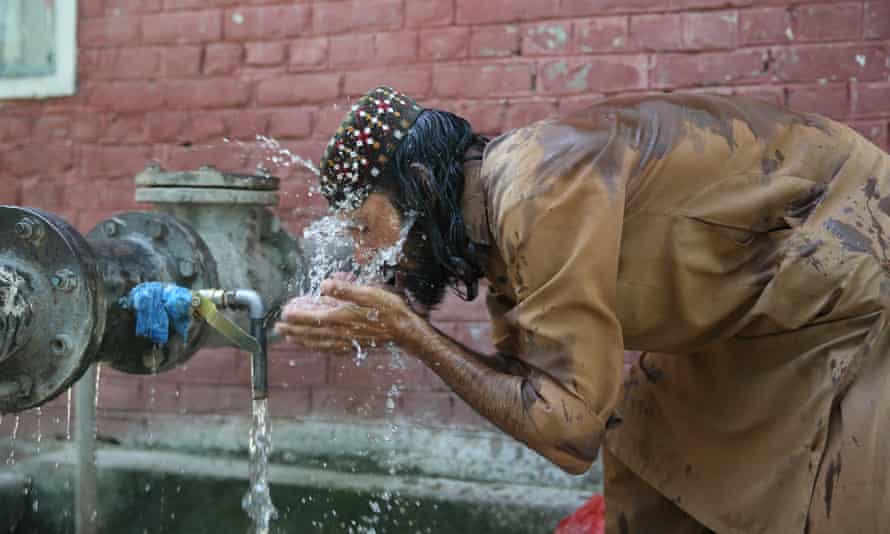
A man throws water on his face to cool off in Islamabad, Pakistan, last month. 
Photograph: Anadolu Agency/Getty Images

Sherry Rehman, Pakistan’s minister for climate, told the Guardian that the country was facing an “existential crisis” as climate emergencies were being felt from the north to south of the country.

Rehman warned that the heatwave was causing the glaciers in the north of the country to melt at an unprecedented rate, and that thousands were at risk of being caught in flood bursts. She also said that the sizzling temperatures were not only impacting crops but water supply as well. “The water reservoirs dry up. Our big dams are at dead level right now, and sources of water are scarce,” she said.

Rehman said the heatwave should be a wake-up call to the international community. “Climate and weather events are here to stay and will in fact only accelerate in their scale and intensity if global leaders don’t act now,” she said.

Experts said the scorching heat being felt across the subcontinent was likely a taste of things to come as global heating continues to accelerate. Abhiyant Tiwari, an assistant professorand programme manager at the Gujarat Institute of Disaster Management, said “the extreme, frequent, and long-lasting spells of heatwaves are no more a future risk. It is already here and is unavoidable.”

The World Meteorological Organisation said in a statement that the temperatures in India and Pakistan were “consistent with what we expect in a changing climate. Heatwaves are more frequent and more intense and starting earlier than in the past.”


A heatwave is declared when the maximum temperature is over 40C and at least 4.5C above normal.

Over the weekend in India, Bikaner was the hottest place in the country at 47.1C, according to the India Meteorological Department. However, in some parts of north-west India, images captured by satellites showed that surface land temperatures had exceeded 60C – unprecedented for this time of year when usual surface temperatures are between 45 and 55C.

“The hottest temperatures recorded are south-east and south-west of Ahmedabad, with maximum land-surface temperatures of around 65C,” the European Space Agency said on its website.

The high temperatures have put massive pressure on power demand in both India and Pakistan, where people have had to endure hours of power cuts amid the crippling heat. On Friday, the peak power demand in India touched an all-time high of 207,111MW, according to the government.

India is facing its worst electricity shortage in six decades. Power cuts lasting upwards of eight hours have been imposed in states including Jharkhand, Haryana, Bihar, Punjab and Maharashtra as domestic coal supplies have fallen to critical levels and the price of imported coal has soared. In a bid to speed up the transport of coal across the country, Indian Railways cancelled more than 600 passenger and postal train journeys to make way for transportation of coal to power plants.
Frank Stronach: Capitalists have a role to play in countering the rise of socialism

The business community has failed to turn workers into capitalists through profit and equity participation programs

Author of the article:
Frank Stronach, 
FOUNDER OWNER 
MAGNA INTERNATIONAL

National Post
Publishing date:May 03, 2022 • 
PHOTO BY JUSTIN TALLIS /AFP/Getty Images

Let’s be honest: capitalism is not working for many people. It’s one of the reasons why “capitalism” has become a dirty word in some circles.


I come from a working-class background, and I’ve lived under various socio-economic systems. I’ve always looked at these systems through the lens of what they could do to improve living standards, and whether or not they could reduce poverty.

Although capitalism is one of the greatest engines of wealth creation in human history, it has a fatal flaw: over time, more and more capital becomes concentrated in the hands of fewer and fewer people.

Consider this: in Canada, the top one per cent of the richest families own close to 25 per cent of the country’s wealth, according to statistics released last year from the Parliamentary Budget Office, while the bottom 40 per cent of Canadian families own barely more than one per cent. In the United States, the story is pretty much the same, with the top one per cent owning nearly one-third of the nation’s wealth, according to the Federal Reserve.

The end result is that the rich are getting richer, and the gap between the wealthy and the workers is growing wider. It’s not surprising, therefore, that more and more people are turning to socialist ideas.

The problem with socialism, however, is that it is based on the distribution of wealth, rather than the creation of wealth. What socialism fails to account for is that we must first create wealth before we can distribute it. This is why socialist systems, even though they may be noble in their intent, ultimately fail.

After the Second World War, Germany provided a fascinating living laboratory for studying the effect that economic systems can have on living standards. The country was split into two, with West Germany operating under a capitalist system and East Germany operating under a communist system.

Free-market West Germany became one of the world’s most productive and successful economies. But socialist East Germany experienced a drastic increase in poverty and was ultimately no longer able to feed its population. East Germany was a textbook example of the economic reality that we must first create wealth before we can distribute it.

Today, we’re seeing a growing appetite for socialistic policies, particularly among the young. And who can blame them? They often graduate from college or university saddled with large debts to pay for an education that in many cases does not lead to good-paying jobs. They end up disappointed, disillusioned and filled with a feeling that the current system is rigged for the benefit of the few.

In my view, business is largely to blame because it has failed to turn workers into capitalists through profit and equity participation programs. If workers don’t feel that they’re getting a fair slice of the economic pie, they will be tempted to support government wealth redistribution policies, and we as a society will drift further and further toward a socialistic system.

Our number 1 priority, therefore, should be to find ways in which workers can get some of the wealth they create — not from government taxation, but from the businesses they work for. One of the best ways for this to happen would be to give workers the opportunity to share in a portion of the profits they help make.

The creation and distribution of wealth is at the crux of any economic system. Every economic system must answer two fundamental questions: How do you create wealth? And who gets that wealth?

Capitalism is extremely effective at creating wealth, but the concentration of capital in the hands of relatively few people ultimately leads to increased taxation and social programs designed to redistribute wealth on a more even basis, as we are now witnessing in Europe and North America. Socialism, meanwhile, is effective at distributing wealth, but in the process, it stifles productivity and wealth creation. It kills the goose that lays the golden egg.

SOCIAL DEMOCRACY (SOCIALISM)) BY ANYOTHER NAME

There is another option. It’s the system I call “fair enterprise.” It’s an economic philosophy that recognizes that a successful business is driven by three forces: managers, workers and investors, and that all three driving forces have a moral right to share in the success of the business. Fair enterprise is designed to generate greater wealth, and then distribute that wealth in a way that is much fairer and more broadly based than any other system.


Bottom line: until businesses starts doing a better job of sharing the wealth they generate, we will have a problem. We will keep going down the road of socialism and wealth redistribution, and the day will come when there’s going to be no more wealth to spread around.

AUTHENTIC SOCIALISM IS WORKERS CONTROL OF PRODUCTION, SELF MANAGEMENT OF CAPITALISM  BY THE WORKERS; NO OWNERS, NO SHAREHOLDERS, ONLY STAKEHOLDERS SINCE WORKERS ARE ALSO CALLED CONSUMERS UNDER CAPITALISM


‘Hang on to your seats’: After over 800 protests in 2021, Vancouver’s top cop says more to come

By Kristen Robinson 
 Global News
Posted May 2, 2022 


The Vancouver Police Department says demonstrations in the city have steadily increased since 2020 - which saw Wet'suwet'en solidarity and Black Lives Matter protests followed by anti-mask rallies once the pandemic began. As Kristen Robinson reports, the VPD is warning the public to expect more protest disruptions this year, and a higher bill for taxpayers.


Vancouver police say demonstrations in the city have steadily increased since 2020 and the department’s top cop is warning the public to expect more protest disruptions this year, and a higher bill for taxpayers.

From anti-mandate convoys and counter-protests this past February to old-growth protesters now parking themselves on busy bridges and highways, Chief Const. Adam Palmer said Vancouver is the “epicentre for protests in British Columbia for sure, and in many cases, Western Canada.”

Speaking at a special council meeting on public safety on April 28, Palmer warned the city to buckle up in anticipation of what’s expected in the coming months.

“Hang on to your seats cause we’re in for a bit of a ride with protests here in Vancouver.”

READ MORE: Old-growth logging protesters dragged off road by frustrated drivers after blocking major bridge

That ride began in 2020 with Wet’suwet’en solidarity and Black Lives Matter protests followed by anti-mask rallies during the pandemic.

The dramatic increase in demonstrations cost the VPD about $2.5 million to staff.

In 2021, Palmer said Vancouver police spent well in excess of $3 million on more than 800 protests, and the final costs have yet to come in.


2:18
Old growth demonstrators force heightened security

READ MORE: Save Old Growth protesters arrested after blocking traffic in Vancouver Wednesday

Those numbers are expected to be even higher this year he said, as environmental protesters change their game.

“A lot of the fight now is coming from the rural areas back into the city because they feel like they get more bang for their buck,” Palmer told the Vancouver Police Board on April 21.
While police support the public’s right to peaceful, legal protest, Sgt. Steve Addison said those disrupting traffic by blocking city bridges and roadways will face arrest and potential mischief and/or obstruction charges.

“We recognize that it’s not lawful and that there’s a very limited public tolerance for this kind of behaviour,” Addison told Global News on Sunday.

Each protest also requires extra officers be deployed to police it he said – almost always on overtime.

“We just don’t have the resources available on duty to deal with everything else that’s happening in the city right now when we’re stretched as thin as we are,” said Addison.

READ MORE: Staffing protests cost Vancouver police more than $2.5M in 2020, chief says

If the first four months are any indication, 2022 may be even more taxing on VPD staffing and budgets.

“It will be a very challenging year staffing-wise and financially,” said Addison.

“If protests continue at the rate that we’ve seen so far.”
Crypto Stories: Ethan Lou shares experience of crypto conference in North Korea

A Canadian journalist recounts the story of when he went to North Korea to participate in a crypto conference that was full of surprises.


When North Korea announced a crypto conference back in 2018, Canadian journalist Ethan Lou jumped at the opportunity to see what the country’s crypto scene looked like. He encountered many surprises, including being introduced as a presenter to a North Korean audience.

According to Lou, he went there with eight other unsuspecting participants who simply wanted to attend the crypto conference. However, when the plane landed and the conference started, they realized that they were being announced to the audience as foreign experts who flew all the way to North Korea to teach them about crypto.

While Lou did not agree to present, he said that most of the others decided to give improvised talks. However, the Canadian journalist felt that there was no significant exchange of information at the conference:
“There were only eight of us. There were maybe like maybe 60 Korean people. They were basically the audience, and we did not get any meaningful interaction with them.”

The foreign crypto “experts” also encountered some expected security measures. One had his laptop confiscated because it had pictures of his girlfriend. The North Koreans classified the pictures as pornography and held on to the computer until they departed.

Lou also met Virgil Griffith, the only person who was an actual presenter for the event. Griffith explained that Americans need permission from their government when going to North Korea. “Before Virgil went on this trip, he asked his government whether he could go. The government told him no. He told us he decided to go anyway,” Lou mentioned.

While Griffith believed he was doing his country a favor, he was eventually arrested by the Federal Bureau of Investigation. This led to a trial where he pled guilty and was ultimately sentenced to over five years in prison.

Stronger Nuclear Fusion Materials May Be Possible Thanks to Photos of a Tiny Aluminum Crystal

Abstract Technology Graphene Material Concept

A laser compressing an aluminum crystal provides a clearer view of a material’s plastic deformation, potentially leading to the design of stronger nuclear fusion materials and spacecraft shields.

Imagine dropping a tennis ball onto a bedroom mattress. The tennis ball will bend the mattress a bit, but not permanently – pick the ball back up, and the mattress returns to its original position and strength. Scientists call this an elastic state.

On the other hand, if you drop something heavy – like a refrigerator – the force pushes the mattress into what scientists call a plastic state. The plastic state, in this sense, is not the same as the plastic milk jug in your refrigerator, but rather a permanent rearrangement of the atomic structure of a material. When you remove the refrigerator, the mattress will be compressed and, well, uncomfortable, to say the least.

But a material’s elastic-plastic shift concerns more than mattress comfort. Understanding what happens to a material at the atomic level when it transitions from elastic to plastic under high pressures could allow scientists to design stronger materials for spacecraft and nuclear fusion experiments.

Until now, scientists have failed to capture clear images of a material’s transformation into plasticity in the past, keeping them in the dark about what the microscopic atoms are doing when they decide to leave their cozy elastic state and journey into the plastic world.

Scientists at the Department of Energy’s SLAC National Accelerator Laboratory have captured high-resolution photographs of a tiny aluminum single-crystal sample as it transitioned from an elastic to a plastic state for the first time. The images will allow scientists to predict how a material behaves as it undergoes plastic transformation within five trillionths of a second of the phenomena occurring. The findings were recently published in the journal Nature Communications.

A crystal’s last gasp

Scientists needed to apply force on the aluminum crystal sample in order to take images, and a refrigerator was obviously too big. Instead, they utilized a high-energy laser to hammer the crystal hard enough to change its state from elastic to plastic.

Scientists used SLAC’s rapid “electron camera,” or Megaelectronvolt Ultrafast Electron Diffraction (MeV-UED) instrument to send a high-energy electron beam through the crystal as the laser produced shockwaves that compressed it. The scattering of this electron beam off aluminum nuclei and electrons in the crystal allowed scientists to precisely determine the atomic structure. As the laser proceeded to compress the sample, scientists took several snapshots, resulting in a sort of flip-book film — a stop-motion movie of the crystal’s dance into the plasticity.

More specifically, the high-resolution snapshots showed scientists when and how line defects appeared in the sample – the first sign that a material has been hit with a force too great to recover from.

Line defects are like broken strings on a tennis racket. For example, if you use your tennis racket to lightly hit a tennis ball, your racket’s strings will vibrate a bit, but return to their original position. However, if you hit a bowling ball with your racket, the strings will morph out of place, unable to bounce back. Similarly, as the high-energy laser struck the aluminum crystal sample, some rows of atoms in the crystal shifted out of place. Tracking these shifts – the line defects – using MeV-UED’s electron camera showed the crystal’s elastic-to-plastic journey.

Scientists now have high-resolution images of these line defects, revealing how fast defects grow and how they move once they appear, SLAC scientist Mianzhen Mo said.

“Understanding the dynamics of plastic deformation will allow scientists to add artificial defects to a material’s lattice structure,” Mo said. “These artificial defects can provide a protective barrier to keep materials from deforming at high pressures in extreme environments.”

UED’s moment to shine

Key to the experimenters’ rapid, clear images was MeV-UED’s high-energy electrons, which allowed the team to take sample images every half second.

“Most people are using relatively small electron energies in UED experiments, but we are using 100 times more energetic electrons in our experiment,” Xijie Wang, a distinguished scientist at SLAC, said. “At high energy, you get more particles in a shorter pulse, which provides 3-dimensional images of excellent quality and a more complete picture of the process.”

Researchers hope to apply their new understanding of plasticity to diverse scientific applications, such as strengthening materials that are used in high-temperature nuclear fusion experiments. A better understanding of material responses in extreme environments is urgently needed to predict their performance in a future fusion reactor, Siegfried Glenzer, the director for high energy density science, said.

“The success of this study will hopefully motivate implementing higher laser powers to test a larger variety of important materials,” Glenzer said.

The team is interested in testing materials for experiments that will be performed at the ITER Tokamak, a facility that hopes to be the first to produce sustained fusion energy.

MeV-UED is an instrument of the Linac Coherent Light Source (LCLS) user facility, operated by SLAC on behalf of the DOE Office of Science. Part of the research was performed at the Center for Integrated Nanotechnologies at Los Alamos National Laboratory, a DOE Office of Science user facility. Support was provided by the DOE Office of Science, in part through the Laboratory Directed Research and Development program at SLAC.

Reference: “Ultrafast visualization of incipient plasticity in dynamically compressed matter” by Mianzhen Mo, Minxue Tang, Zhijiang Chen, J. Ryan Peterson, Xiaozhe Shen, John Kevin Baldwin, Mungo Frost, Mike Kozina, Alexander Reid, Yongqiang Wang, Juncheng E, Adrien Descamps, Benjamin K. Ofori-Okai, Renkai Li, Sheng-Nian Luo, Xijie Wang and Siegfried Glenzer, 25 February 2022, Nature Communications.
DOI: 10.1038/s41467-022-28684-z

A WASTE OF FOOD

U.S. EPA sends biofuel blending mandate rule to White House for final review

Article content

NEW YORK — The U.S. Environmental Protection Agency has sent a rule on U.S. biofuel blending mandates to the White House for final review, according to a notice posted by the Office of Management and Budget.

The oil and biofuel industries, which have in the past been at odds over the requirements, have been eagerly waiting for the EPA to finalize the mandates. The EPA action comes as the United States faces high gas prices and as companies recover from the coronavirus pandemic.

The EPA, which administers the U.S. Renewable Fuel Standard (RFS), released a proposed rule in December on the blending volumes, which cover the years 2020, 2021 and 2022.

Advertisement 2

Article content

It is unclear whether the volumes sent are at the same levels as the proposal from December. The OMB received the rule on Friday, according to the notice.

In the proposed rule in December, the EPA would retroactively set total renewable fuel volumes at 17.13 billion gallons for 2020. That was down from a previously finalized rule for the year of 20.09 billion gallons, set before the onset of the pandemic.

It set volumes at 18.52 billion gallons for 2021 and 20.77 billion gallons for 2022.

Both the 2020 and 2021 figures mark a reduction from 2019, when the EPA had required refiners to blend 19.92 billion gallons of biofuels in the nation’s fuel mix, but the 2022 proposal marks an increase.

Reuters reported last week that the EPA was expected to send the rule to the White House for final review. (Reporting by Stephanie Kelly Editing by Paul Simao)