Thursday, May 05, 2022

US Ruling threatens US power as world's high-seas drug police

In this photo obtained from U.S. federal court records, Jeffri Dávila-Reyes, third from left, and two others hold their hands in the air as they are intercepted in the Caribbean Sea on Oct. 29, 2015. Dávila-Reyes says he’s still mystified how he ended up serving hard time in a U.S. federal prison. His cocaine bust at sea was closer to his homeland of Costa Rica than the United States, and the few kilos of drugs he was carrying were bound for Jamaica rather than American shores
(U.S. Coast Guard via AP)

JOSHUA GOODMAN
Thu, May 5, 2022, 

MIAMI (AP) — A little-noticed federal appeals court ruling this year threatens a key weapon in the United States’ war on drugs: A decades-old law that gives the U.S. broad authority to make high-seas arrests anywhere in the world, even if the drugs aren’t bound for American shores.

It’s a law that’s used to round up and imprison hundreds of foreigners every year, mostly poor, semi-literate fishermen from Central and South America who make up the drug trade’s lowest rungs.

“It is a waste of U.S. taxpayer dollars to have these costly misadventures as we play drug police to the world,” said Eric Vos, head of the public defender’s office in Puerto Rico that brought the court challenge.


At issue is the Maritime Drug Law Enforcement Act, which defines drug smuggling in international waters as a crime against the United States and gives the U.S. unique arrest powers anywhere on the seas — whenever it determines a vessel is “without nationality.”

But how a vessel is deemed stateless sometimes gets messy.


The was the case for the Costa Rican plaintiff Jeffri Dávila-Reyes, whose appeal prompted the ruling. The Coast Guard chased down his speedboat in the western Caribbean in 2015 as he and two cousins were allegedly transporting five to 15 kilos of cocaine.

They identified their vessel as hailing from Costa Rica, according to the FBI’s summary of the investigation, but they lacked any documentation. When the U.S. asked the Costa Rican government to confirm the vessel’s registry, it responded 12 weeks after the bust that it could neither confirm nor refute the claim.

A few weeks later the men were charged and eventually pleaded guilty to possessing narcotics “on board a vessel subject to the jurisdiction of the United States.”

But a three-judge panel of the First Circuit Court of Appeals in Boston ruled in January that one of the law’s provisions — disavowing a captain’s claim of nationality — were an unconstitutional extension of U.S. policing powers beyond America’s borders.

Tellingly, almost none of those arrested under the law had ever set foot in the U.S. nor were they charged with trying to import cocaine. In Dávila-Reyes’ case, the cocaine he was accused of transporting was purportedly headed to Jamaica.

Despite the ruling that threw out his conviction, Dávila-Reyes remains behind bars seven years into a 10-year sentence as the Justice Department seeks reconsideration by all of the First Circuit’s nine judges.

In a series of recent letters to The Associated Press from federal prison, Davila-Reyes reflected on how he only got involved in smuggling as a way to escape poverty in his homeland after years of hand-blistering construction work for $10 a day. He said taking a chance on smuggling offered him $6,000.

“Nobody can be blamed for being born poor,” he wrote.

From the moment President Richard Nixon declared “war on drugs” in 1971, the U.S. Coast Guard has been at the forefront of the campaign to stop illegal narcotics from entering the U.S. Today, it spends more than $2 billion annually as part of that effort.

But, almost from the start, that goal has proven elusive.

Cocaine prices, a gauge of supply, have been hovering at historical lows for more than a decade as cocaine production from Colombia has soared to record highs. In a good year, barely 10% of cocaine shipments in the waters off Central and South America — where the bulk of the world’s cocaine is trafficked — are actually seized or destroyed, according to the U.S. government’s own estimates.

Despite that poor record, U.S. officials continue to tout their success at sea. A 2020 Coast Guard report said at-sea interdictions are the most effective way to combat cartels and criminal networks. Since 2017, the amount of cocaine it has seized or destroyed exceeds 959 metric tons.

Prosecutions under the Maritime Drug Law Enforcement Act exploded last year to 296 — nearly five times the number a decade ago, according to Syracuse University’s Transactional Records Access Clearinghouse, which collects Justice Department data. But since each case involves multiple defendants, the actual number of foreigners detained at sea last year was 635 — the highest tally since 2017.

Critics of U.S. drug policy say most such smugglers fell into the job because of poverty and are hardly worth locking up for so long when legions of their poor compatriots stand ready to take their place.

“These are not masterminds like Pablo Escobar or Chapo Guzman,” said Kendra McSweeney, an Ohio State University geographer who has spent years researching U.S. drug policies.

Neither the Coast Guard nor Justice Department would comment on Dávila-Reyes’ appeal but experts say it’s too early to judge the fallout from the landmark ruling.

Currently Vos’ office in Puerto Rico is preparing 14 motions for dismissal in other boat cases on behalf of jailed defendants from Colombia, Venezuela and the Dominican Republic. The ruling has also been cited in at least five proceedings outside the First Circuit.

“It’s definitely a chink in the armor,” said Roger Cabrera, a court-appointed attorney in Miami seeking who has filed one of the appeals. “But like most chinks, I’m sure the federal government is already looking for a workaround.”

For now, U.S. law enforcement continues to conduct regular search and seizures on the high seas with little indication of concern.

In court filings, attorneys for the U.S. government have argued in part that holding up interdictions to wait for an unequivocal denial of registry from a foreign nation before declaring a vessel stateless would be impractical.

“Anyone involved with bringing dangerous drugs into the United States will be held accountable, no matter their position in the drug-distribution network,” said Justice Department spokeswoman Nicole Navas Oxman.

___

Contact AP’s global investigative team at Investigative@ap.org or https://www.ap.org/tips/
KILL A WORKER GO TO JAIL
18-year-old dies after he’s pulled into hot asphalt silo, feds say. Company faces fines


IN CANADA WE HAVE THE 'WESTRAY' LAW, WHICH HAS NOT BEEN ENFORCED SINCE IT WAS PASSED.

Kaitlyn Alanis
Wed, May 4, 2022

An 18-year-old construction worker had been on the job for about three months when he was pulled into a hot asphalt silo in Oklahoma City, officials say. He died from related injuries.

The fatal incident on Nov. 2 prompted the Occupational Safety and Health Administration to open an inspection at TJ Campbell Construction Co., according to a May 4 news release from the U.S. Department of Labor.

Now about six months later, the Oklahoma-based company is facing $370,347 in penalties.

Federal authorities say TJ Campbell Construction Co.’s “failure to prevent sudden start-up of a conveyor system” contributed to the man’s death as he tried removing debris from the conveyor.

The Edmond-based company did not immediately respond to a request for comment from McClatchy News on May 4.

“A young worker was barely three months on the job when his life was tragically cut short,” said OSHA Area Director Steven Kirby in a news release. “Had TJ Campbell Construction Company provided their workers with the required training on controlling hazardous energy and ensuring proper shutdown before any attempt to remove debris was made, this young man would have ended his workday safely.”

OSHA issued willful citations against the company, saying it failed to “develop and use procedures for controlling hazardous energy when servicing or cleaning the asphalt conveyor system.” The company also did not adequately train its workers on the requirements for controlling hazardous energy, according to the news release.

Willful citations are given when OSHA finds an employer “knowingly failed to comply with a legal requirement (purposeful disregard) or acted with plain indifference to employee safety,” according to the federal department.

Those willful citations are in addition to citations for:

Allowing unguarded pulleys, chain and sprockets in areas where people walk or work,


Not applying energy isolation devices,


Stairways with missing handrails, and


Uncovered holes in floor where people walk and work.


T.J. Campbell Construction is your premier asphalt and concrete paving contractor,” according to the company’s website. “Operating in central Oklahoma since 1978, we specialize in the turn-key construction of DOT Heavy Highway, street and site infrastructure for commercial developments as well as complete construction services for construction and reconstruction, from city streets to Interstate highways.”

The Duit Holdings subsidiary has 15 business days from when it was notified of the penalties to either comply, request a conference with the OSHA area director or contest the findings.

Trench collapse kills worker hours after Texas employees ordered back in, feds say

Worker killed in ‘substantial’ fall during partial collapse of Boston parking garage

Postal service blamed after worker’s arm amputated in NC safety incident, feds say
 

When does life begin? What different ABRAHAMIC religions SECTS say about abortion

NO REFERENCE TO BUDDHISM, HINDUISM, ANIMISM, JAINISM, PAGANISM, ETC.

Romina Ruiz-Goiriena, USA TODAY
Tue, May 3, 2022, 

When does life begin? That's the central disagreement fueling the half-century debate over abortion rights in the United States.

For many Americans, the answer is found in their faith.

The problem is that three of the biggest religions in America disagree. Because Christian teachings state that life begins at conception, different denominations such as Catholicism and Southern Baptists oppose abortion. Meanwhile, Judaism and Islam prioritize the life of the mother and support abortion.

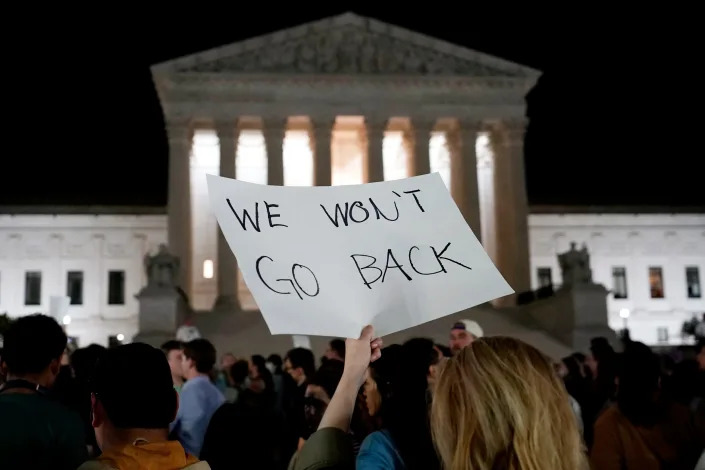
The back-and-forth over when life starts has never been more urgent with the release Monday night of a leaked Supreme Court draft opinion suggesting the high court is poised to overturn its landmark 1973. Roe v. Wade decision that gave pregnant people a constitutional right to abortion.

The Supreme Court is expected to release its official ruling on abortion rights this summer.

For decades, the anti-abortion movement has been fueled by Christian leaders.

Nearly twice as many evangelical Protestants (63%) oppose legal abortion compared to mainline Protestants (33%), according to the most recent survey of abortion views by faith performed by Pew Research Center. Three-quarter of Jehovah’s Witnesses and nearly as many Mormons (70%) say abortion should be illegal.

In contrast, 83% of American Jews and 55% of American Muslims say abortion should be legal.

American Catholics are largely split, with 56% supportive of legal abortion and 42% opposed, a 2019 Pew Research Center survey found.

Overall, about 49% of Americans said abortion should be "legal and accessible," according to a USA TODAY/Ipsos poll published in April.

A pro-abortion supporter holds a sign outside of the U.S. Supreme Court on May 02, 2022.
Christianity says life begins at conception

For many Christians, answers on abortion can be found in the Bible.

"God alone is the author of life and he alone numbers our days," states Job 14:5-7. Psalms provides further guidance for many Christian religions, defining life as: "From the moment of conception to natural death" and "You knit me in my mother's womb."

But until the 1970s, opposition to abortion was foremost a Catholic issue. According to Catholic Church doctrine, it is a grave sin that could result in excommunication.

An anti-abortion activist holds a model of a fetus during a protest in Washington, D.C., on May 7, 2015. Many Christians that oppose abortion believe life begins at conception.

Pope Francis has said because abortion is akin to murder, the Catholic Church cannot accept it. "Without beating about the bush, if you have an abortion, you kill," he said in 2021 when asked whether President Joe Biden, who is Catholic and supports abortion rights, should be denied Communion.

Francis added: "You take any embryology book that medical school students study, at the third week of conception, many times before the mother knows she is pregnant, there are already all the organs, all, even the DNA. Isn’t that a person? It is a human life, and this human life must be respected."

While the Catholic Church's stance on abortion has not wavered, in recent years, Pope Francis has said priests could grant forgiveness to people who have had abortions. Prior to 2016, priests had to consult with bishops on a case-by-case basis to do so.

For American protestants, opinions about abortion have changed throughout the past five decades.

Christian traditions such as the Evangelical Lutheran Church and Presbyterians have said it is difficult to determine when human life begins.

As such, they tend to support legal access to abortion, leaving the decision to each person.

The Southern Baptist Convention — the largest Protestant denomination — passed resolutions dating back to the 1970s supporting the idea that abortion access should be allowed under certain conditions, including damage to the emotional, mental and physical health of a mother, and that the government should play a limited role.

This "reflected a middle ground between the extreme of abortion on demand and the opposite extreme of all abortion as murder," a later resolution dated June 1, 1974, stated. "That resolution dealt responsibly from a Christian perspective with complexities of abortion problems in contemporary society."

Evangelicals' opposition to abortion began in 1978, according to Randall Balmer, a historian of American religion at Dartmouth College in Hanover, New Hampshire.

Balmer's research has found that after the 1960s civil rights era, white evangelicals comprising the "religious right" that had defended segregation needed a new issue to galvanize their political base and the Republican party.

"They had finally landed on a 'respectable' issue, opposition to abortion, that would energize white evangelicals — and, not incidentally, divert attention from the real origins of their movement," he wrote.

Historians trace many fetal personhood bills that gained steam in Republican-controlled legislatures back to this moment in history.

Since 2018, bills restricting abortion from the point that a heartbeat can be detected, or after roughly six weeks, have been signed into law in Ohio, Georgia, Louisiana, Missouri, Alabama, Kentucky, South Carolina, Texas and Oklahoma.

Each time, conservative politicians have emphasized they are protecting life, which they say begins at the moment of fertilization.

“I promised Oklahomans that I would sign every pro-life bill that hit my desk,” Oklahoma Gov. Kevin Stitt said in April when signing a bill into law making it a felony to perform an abortion. “And that's what we're doing."

Pope Francis on his popemobile drives through the crowd of faithful at the end of the Catholic Easter Sunday mass on April 17, 2022. Pope Francis has said the Catholic Church takes such a tough stance against abortion "because if you accept this, you accept homicide daily."
Judaism and Islam believe in protecting life of the mother

For many Jewish leaders, Christian biblical interpretations of when life begins are problematic.

In part, this is because Christians often cite Psalms as proof. Whereas in Judaism, Psalms is a book of poetry.

Jewish laws are derived from the first five books of the Hebrew Bible; Genesis, Exodus, Leviticus, Numbers and Deuteronomy. According to Genesis 2:7, life begins at the first breath, when "God breathed breath into him." As such, terminating a pregnancy is not a crime because fetuses do not have souls.

Rabbi Danya Ruttenberg, a scholar in residence at the National Council of Jewish Women in Evanston, Illinois, said this is further explained in a passage in Exodus 21:22-23, which reads: “When men fight, and one of them pushes a pregnant woman and a miscarriage results, but no other harm ensues, the one responsible shall be fined when the woman’s husband demands compensation... But if other harm ensues, the penalty shall be life for life.”

Ruttenberg said this makes clear the life of the mother takes precedent over the fetus. And that in Judaism, abortion is not only permitted but taking all necessary measures to save a pregnant person's life is required.

"Laws banning abortion access violate Jewish religious freedom," she said.

Recently, Torat Chayim, a rabbinical association of about 300 Orthodox rabbis, issued statements strongly condemning anti-abortion bans in Texas and Oklahoma.

Rabbi Dayna Ruttenberg takes issue with the conservative Christians pointing to Psalms as proof that abortion should be illegal.

"Under this bill, Oklahoman Jews are not able to protect a mother’s life in accordance with the ancient laws of our faith," the statement said.

In the Muslim faith, life begins at conception, but abortion is permitted for up to 120 days, including in cases of rape.

Muslim views on abortion are shaped by the Hadith, the recorded beliefs of the Islamic prophet Muhammad, which says that after the first four months, the fetus is "ensouled."

According to Abdulrahman Al-Matary, a neonatology professor at the King Fahad Medical City in Riyadh, Saudi Arabia, Islam's views on abortion take into account the threat of harm posed to mothers, the presence of abnormalities and the status of the pregnancy "before or after the ensoulment."

After this period, abortion is forbidden, he said.

This article originally appeared on USA TODAY: When does life begin: Abortion views differ among people of faith

'Abortion is a fundamental right': Canada reacts to leaked Roe v. Wade decision


WASHINGTON, UNITED STATES - MAY 3: Anti-abortion and abortion rights demonstrators during a protest outside the U.S. Supreme Court in Washington, D.C., U.S., on Tuesday, May 3, 2022. Abortion rights suddenly emerged as an issue that could reshape the battle between Democrats and Republicans for control of Congress,


When Politico obtained the leaked report that five Supreme Court justices are set to strike down the Roe v. Wade decision, uproar commenced with extensive concerns about abortion access if this ruling becomes final.

The 1973 ruling that established the constitutional right to abortion in the U.S., meaning that states could regulate thee procedure but could not ban abortion.

According to a recent Yahoo News/YouGov survey, about 30 per cent of respondents adults said Roe v. Wade should be overturned, with 27 pre cent indicating that that it should be adapted so “individual states” are “able to outlaw” abortion.

"Evidence shows that restricting access to abortion does not reduce the number of abortions that occur," a statement from the World Health Organization (WHO) reads. "Restrictions are however more likely to drive women and girls towards unsafe procedures."

Several individuals, including Canadians, have taken to social to respond to this leaked information from the U.S.

"Like so many Canadian women, I was both shocked and deeply worried by the news from the United States last night about abortion rights," a statement from Canada's Deputy Prime Minister and Minister of Finance, Chrystia Freeland reads. "Speaking here today as a woman, as a mother, and as Canada's Deputy Prime Minister, it's important for me to begin by underlying out government's clear and determined commitment to protect a woman's right to choose."

Abortion is a fundamental right. Feminists fought for decades to secure it, and here in Canada we will not let it be undermined in any way.

Chrystia Freeland, Canada's Deputy Prime Minister


 California Gov. Gavin Newsom on Roe v. Wade leak: 'If men could get pregnant...'


Bradford Betz
Wed, May 4, 2022,

California Governor Gavin Newsom on Wednesday derided abortion opponents as extremists who are more interested in control rather than family values.

The Democratic governor’s comments come just days after Politico published a leaked draft of a U.S. Supreme Court opinion that would effectively overturn the landmark 1973 case Roe v. Wade, which legalized abortion.

While the draft merely represents an opinion – and Supreme Court opinions are prone to change ahead of a final decision – the news has sparked nationwide protests, pitting advocates on either side of the issue against one another ahead of the November midterms.

Newsom argued that "if men could get pregnant, this wouldn’t even be a conversation."

DAVE PORTNOY VOWS TO VOTE DEMOCRAT IF ROE V. WADE IS OVERTURNED: ‘THIS IS LIKE GOING BACK IN TIME’

"This decision isn’t about strengthening families – it’s about extremism. It’s about control," the governor tweeted. "We will fight for the right to choose."

The governor spoke at Planned Parenthood in Los Angeles, to discuss his administration’s efforts to protect abortion rights in the Golden States.

"We will affirm the … constitutionally protected rights of women and girls and their reproductive rights and freedoms in California," the governor said, flanked by women wearing pink Planned Parenthood t-shirts.

Newsom blamed his own party for being too passive in the abortion issue, and urged a "counter-offensive" to protect what he called fundamental rights.

He alluded to recent battles across the country, including over a Texas law that bans abortions after a fetal heartbeat can be detected, and a Florida law that forbids classroom instruction on sexual orientation and gender identity in kindergarten through third grade."

"Where is the Democratic Party?" he asked. "Why aren't we standing up more firmly? More resolutely? Why aren't we calling this out?"

California is making plans to become an abortion "sanctuary," where reproductive rights would be expansively protected and patients could travel from other states for services. One proposal seeks to guarantee a right to an abortion in the state constitution.

If the Supreme Court overturns the Roe ruling, at least 26 states are likely to outlaw abortions, according to the Guttmacher Institute, an abortion rights advocacy group.

The Associated Press contributed to this report.

Scarborough: GOP believes ‘life begins at conception but ends at childbirth’


Dominick Mastrangelo
Thu, May 5, 2022,


MSNBC pundit Joe Scarborough tore into leading Republicans on Thursday for their rhetoric on abortion following the leak of a draft opinion showing the Supreme Court is poised to overturn Roe v. Wade.

“The Republicans say ‘oh we’re going to replace and reform.’ They haven’t done anything,” Scarborough said on his show, “Morning Joe.” “The fact is, they do support the death penalty, that is one thing they support. But more and more this seems to be a party that really believes that life begins at conception but ends at childbirth.”

The host blasted the GOP for messaging pledging support for the rights of an unborn child, “but the second they’re born, they’re on their own,” he said.

“This is not a party that gives a damn about those babies who are actually born and what happens to them after they are born,” Scarborough continued. “It’s so hypocritical.”

Several GOP senators and governors have cheered news of the draft opinion from the court, which currently has a conservative majority.

Democrats on Capitol Hill have accused several conservative justices of misleading lawmakers and the public about their views on the landmark decision granting the right to an abortion.

Leading Republicans and conservative media figures have spent the last several days fixated on the fact the draft opinion was leaked, suggesting it was done so by a liberal inside the court with the goal of intimidating the justices or changing votes on the issue.

On Wednesday, Mika Brzezinski, Scarborough’s co-host and wife, attacked Sen. Mitch McConnell (R-Ky.) for his comments this week suggesting the “story of the day” is the leak instead of the content of the draft opinion.

‘Ridiculous’: J.D. Vance’s Conspiracy Theory Is a Big Lie


Michael Daly
Tue, May 3, 2022, 

Photo Illustration by Kelly Caminero/The Daily Beast/Getty

After securing former President Donald Trump’s endorsement to become the Republican nominee for the U.S. Senate in Ohio, J.D. Vance went from chugging the Kool-Aid to spiking it with his very own conspiratorial falsehood.

Whatever the outcome from tonight’s election, it will be accompanied by a Vance lie so ridiculous that Trump himself might not have attempted it. Vance has actually suggested that President Joe Biden is allowing fentanyl to pour through the border so as to kill off MAGA voters.

“If you wanted to kill a bunch of MAGA voters in the middle of the heartland, how better than to target them and their kids with this deadly fentanyl?” Vance asked Jim Hoft of the far-right news site Gateway Pundit on Friday.

Vance conjured a vision of crisis at our southern border so dire as to demand priority over any humanitarian concerns presented by the war in Ukraine. He spoke of a “wide-open” realm where illegal immigrants—who he termed “Democrat voters” in a campaign ad—and drugs are allowed to pour through unimpeded. Never mind that the federal DEA estimates more than 90 percent of the drugs smuggled in from Mexico cross through established legal crossing points that would be unaffected by even the highest Trumpian wall.

“It’s really a border crisis that has gone all over the country,” Vance exclaimed. “It’s not just the southern border states that are affected by it. It’s everybody, and it does look intentional.”

Vance then said, “It’s like Joe Biden wants to punish the people who didn’t vote for him and opening up the floodgates to the border is one way to do it.”

Trump’s J.D. Vance Endorsement Looks Flimsier and Flimsier

Vance’s contention becomes all the more absurd when you consider that although fatal overdoses have reached record levels, rates are no longer higher among whites than among Blacks—who are considerably less likely to vote MAGA. And the demographic change has been particularly dramatic in Ohio, the state Vance seeks to represent on Capitol Hill.

“For many years, black overdose death rates were one-third to one-half lower than for whites,” the non-profit Harm Reduction Ohio noted in a report. “But in mid-2016, that started to change. Since then, the trend has moved in the opposite direction. In 2019, death crossed the racial divide. Black Ohioans died of accidental drug overdoses at a significantly faster rate than whites.”

The overdose death rate among Blacks is now nearly 20 percent higher than among whites. Blacks comprise 14 percent of the state’s population, but suffer 17 cent of the overdose deaths.

Harm Reduction Ohio and federal law enforcement sources agree on the cause of the shift: fentanyl, the same deadly new drug that Vance cites in his conspiracy theory.

“Today Blacks have dramatically higher overdose death rates than whites and the reason is fentanyl moved from the heroin supply—the opioid supply—into the cocaine supply,” Harm Reduction Ohio president Dennis Cauchon told The Daily Beast on Monday. “For decades, for whatever reason, whites have always had disproportionately high heroin overdose death rates, and blacks have had traditionally high cocaine overdose death rates. It's true in Ohio, and it's really true nationwide.”

He noted that cocaine itself has a relatively low overdose death rate. That started to change when dealers began to lace it with fentanyl as a low cost potency boost.

“It’s now an all-purpose adulterate,” Cauchon said. “When fentanyl moved into cocaine it caused a lot of black overdose deaths.”

Cauchon dismissed Vance’s conspiracy theory with a single word.

“Ridiculous.”

He added, “Fentanyl is apolitical.”


(L-R) Rep. Matt Gaetz (R-FL) and Rep. Marjorie Taylor Greene (R-GA) look on as J.D. Vance speaks during a campaign rally in Newark, Ohio.
Drew Angerer

Vance’s suggestion that Biden is using it as a diabolical anti-MAGA chemical weapon is apparently in part an effort to downplay the conflict in Ukraine, where chemical warfare is a real danger. Vance said on Steven Bannon’s War Room back in February that “I don't really care what happens to Ukraine one way or another." What is happening there has come to include executions and rape and the deliberate bombing of hospitals and a host of other horrors. Vance has sought to divert us from Putin’s crime against humanity with a fiction about Biden and a deadly drug that Trump also could not stop.

Three of the handful of people already in Congress who voted against sending aid to Ukrainians came to campaign for Vance following the Trump endorsement. Sen. Josh Hawley of Missouri, Rep. Matt Gaetz of Florida and Rep. Marjorie Taylor Greene of Georgia all describe themselves as champions of freedom as they join Vance in warning about the great crisis at the border.

J.D. Vance’s Former Roommate: He’s ‘the Most Dangerous Candidate’

One researcher who has been scientifically documenting actual facts regarding both overdoses and fentanyl was continuing his work at the border on Monday. Joseph Friedman of The Center for Social Medicine and Humanities and the Medical Scientist Training Program at UCLA spoke to The Daily Beast from Tijuana.

“I’m seeing this up close and personal,” he said. “For most of the pandemics, like two years, almost the only people who were allowed to cross the border were mostly U.S. citizens and U.S. permanent residents. And the fentanyl did not stop coming, which means it's being brought over by U.S. citizens,who cannot be denied entry to this country through legal ports of entry.”

He offered a conclusion.

“So the whole Republican talking point about a weak wall, it just empirically doesn’t make any sense. It’s just a flat out lie.”

Friedman has done considerable research into the changing overdose rates for Blacks and for whites. He agrees with Ohio Harm that fentanyl is a prime cause, but he ascribes the increase in the death rate among Blacks less to tainted cocaine than to an age difference in users.

“Among Black individuals, the highest death rates are actually in older folks, like in the fifties and sixties,” he said. “And that’s because these are people who initially started using heroin many decades ago and have been safely using heroin ever since. But all of a sudden, that heroin’s been replaced by something much more dangerous and those older Black folks are dying. Whereas with white overdoses… you see the highest rates are in slightly younger folks.”

He and fellow researcher Helena Hansen published some of their recent findings in the March issue of JAMA Psychiatry in a paper called Evaluation of Increases in Drug Overdose: Mortality Rates in the US by Race and Ethnicity Before and During the COVID-19 Pandemic. Their conclusion will stand as science-based fact no matter what Vance achieves at the polls with a bigger than big lie.

“Drug overdose mortality is increasingly becoming a racial justice issue in the US.”

Read more at The Daily Beast.

Get the Daily Beast's biggest scoops and scandals delivered right to your inbox. Sign up now.

Stay informed and gain unlimited access to the Daily Beast's unmatched reporting. Subscribe now.
As a veteran that went to Ukraine, here’s what I saw


Petros Giannakouris

Rachel Nostrant
Tue, May 3, 2022

KRAKOW, Poland — As someone who dreamt of growing up to be a journalist and spent their childhood watching their parents deploy to Africa and the Middle East and work with special forces at home in Virginia, being a war correspondent has been my goal for as long as I can remember. Adding to that, I also served for five years in the Marine Corps as a Middle Eastern Cryptologic Linguist, deploying once with the 15th Marine Expeditionary Unit in 2017.

Now that I’m a civilian again and have some time before starting a master’s program in the fall, I decided to chase that childhood dream. And, while I certainly don’t recommend anyone blindly enter Ukraine — or any war zone, for that matter — here’s what I saw when I did just that.

It was mid-April, and I was following a story about an American woman who travels alone, evacuating fleeing Ukrainians, bringing them into Poland. I tagged along, sitting in her blue evacuation van for 15 hours as we drove from Krakow, Poland, to Odesa, a port city in the southern portion of Ukraine.

Having briefly deployed to the Middle East and North Africa, Ukraine was not what I expected. The places we stopped during an air mission in 2017 were deserted, shelled-out ghost towns in the midst of endless desert. Ukraine was and is a very different kind of war zone.


Going in, essentially alone without the reassurance of the U.S. military’s support if anything hit the fan and no kit or weapons was a harrowing experience.

Driving in from Poland, there was nothing but empty villages and very few people save for the elderly and those racing back toward the safety of the border. We passed convoys of armed Ukrainians in civilian vehicles, presumably territorial defense soldiers, and only occasionally saw military vehicles — like Humvees — dotting the highways the further into Ukraine we went.

Now, imagine the forts you’d make as a kid, with a little flag tied to the end of a stick marking your territory. That is what some of these checkpoints, especially those found in the more western part of the country, look like. While the Ukrainians have set up quite the network of security checkpoints on country roads and major highways, I would never put an American servicemember behind one and feel like they’d be covered.

They’re all makeshift, usually some combination of sand bags and cement blocks, covered with mismatched netting. One of the nets used headed out of the country from Odesa to Moldova was blue, maroon and white. They’re using whatever they can find. And to top it all off, it was clear that a stiff wind would be all it took to knock some of the smaller ones down.

Like gate guards at U.S. military installations, the soldiers and police there search vehicles and check identification, although nowhere near as thoroughly. As Americans though, we were quickly waved through by flashing our passports or having our translator explain we were there on a humanitarian mission. Being women, sometimes all it took for us was to flash a smile, and we were sent on our way.

The closer we got to Odesa, the farther East we drove, we began witnessing more of the expected wounds of war: bombed out gas stations and buildings and blaring air raid sirens that made it clear we were no longer in a physically unaffected area.

Having lived for a while in Germany after my mother, an Army Signals Intelligence Officer, was recalled to active duty following the terrorist attacks of September 11, 2001, I consider that country my second home, especially now that my family lives there again. I’m incredibly familiar with how that part of Europe looks, so when I say that Ukraine looks like Germany, that’s because it does.

Swap out the Orthodox chrome church domes for classic European church steeples and ignore some of the remaining Soviet-era monuments and it might as well be Germany, which is partially what makes the conflict in Ukraine so surreal.

What sticks out to me is how minimal the degree of separation between ‘us’ and ‘them’ is. The country isn’t dissimilar to just Europe. Parts of it also resemble the United States. Driving into Ukraine on the M10 highway, I was struck by the worst case of deja-vu. I might as well have been driving from my hometown of Virginia Beach to Williamsburg, Virginia, on Interstate 95.

And in the bigger cities, their lives are remarkedly similar to our own. In Odesa, I walked by boardwalk carnival stalls like those in Santa Cruz, California, near the Defense Language Institute or Myrtle Beach, South Carolina. There was even a young couple on a date at a shoot gallery.

I ate at a combination hookah bar and restaurant while American music blasted from speakers while young Ukrainians walked around, dressed like any American Millennial or Zoomer would, heads down as they scrolled through social media on their iPhones. All of these scenes, of course, were marred by the Ukrainian soldiers with guns casually strolling the streets.

It’s a striking juxtaposition to the wars in the Middle East. There, not only were there decades-worth of physical trauma to mark the embattled countries as the war zones they are, but there is a sense of ‘otherness’ that helped those of us who served there separate our lives as Americans from theirs.

That’s not to say that servicemembers care any less about the conflicts in the Middle East — I know I continue to follow the news in Afghanistan, for example, and was devastated by the losses both our countries suffered with our withdrawal and nearly all of the Taliban’s actions since then.

But, the ability to come home and live in a completely separate environment, with differences in everything from the cultural and religious ideologies to the clothes worn and food eaten, helps with compartmentalization, personal traumas aside.

It’s that lack of ‘otherness’ I saw in Ukraine that continues to weigh on my mind in a way my time as a Marine focused on the Middle East never did.

Ukraine could easily be my home, and seeing it destroyed broke the part of my heart that views the concept of home as safe and sacred, especially after years of homesickness while serving elsewhere.

To summarize, Ukraine was a gut punch.

Just driving to Odesa doesn’t even begin to crack the surface on the destruction seen in Mariupol or Kharkiv. But by being in Ukraine at all, however, I could see their fighters as my fellow Marines in dangerous positions without enough gear or back up.

The young Ukrainian adults carrying on with their everyday activities looked like the Penn State students I walked past in college, completely unfazed by air raid sirens or shelled out buildings. I observed children play on a beachside playground as those warning sirens blared, watched their disappointment about being kept away from the shoreline because of the mines that might have washed up.

Being in Ukraine was like looking out my bedroom window and seeing my own neighborhood repeatedly battered and threatened, with nothing to do but watch, helpless.
Ex-Duval drug trafficker uses war in Ukraine to spotlight plight of woman in Thai prison

Steve Patterson, Florida Times-Union
Wed, May 4, 2022

Tristan Nettles, pictured in an ID card stamped with the insignia of Ukraine's Ministry of Defense, traveled to Poland to join Ukraine's international legion after Russia invaded in February.

The Ukrainian combat unit that former Beaches resident Tristan Nettles serves in only left Donbas last month so foreigners like him could complete enlisting and get military IDs before returning to fighting.

The 2015 University of North Florida graduate has joined soldiers resisting a Russian invasion and has seen devastation up close.

But when he reaches out to Jacksonville from the relative safety of Kiev, his attention seems far, far away.

Ashley Oosthuizen is an innocent 23-year-old South African who has been in a Thai prison for almost two years,” Nettles emails a Times-Union reporter. “She was given a death sentence commuted to life in prison. … She desperately needs her story reported.”

Nettles, a U.S. Marine Corps veteran, is working from a war zone to raise attention to the cause of a woman facing a frightening future on the other side of the planet.

He’s doing this because, by his account, he played a key part in her suffering.

The one-time St. Johns Town Center restaurant worker created a website this year detailing a secret life as a self-described “international dark web drug dealer” whose shipments to a restaurant he owned on a resort island in Thailand led to police arresting Oosthuizen, his girlfriend and employee, after she signed for a drug-filled package delivered by a postal worker.

After spending money on failed legal defenses, Nettles, 34, and his family in St. Johns County have been working to put a public spotlight on Oosthuizen’s cause.


Tristan Nettles, wearing gear with Ukraine's national symbol on his chest, kneels with other volunteers (faces obscured) during training to fight against Russia's invasion of Ukraine.

He’s hoping that going to war in Ukraine will help bring her story to a larger audience and raise pressure for Thai courts to revisit her case.

“My original plan was to go to D.C. and do a hunger strike there,” Nettles says by email, “but then the war started and the call went out for volunteers.

“… I felt I could kill multiple birds with a single stone and, by fighting for other people's freedom, I felt sure other people would help fight for hers when they found out the monstrous injustice she continues to suffer.”
Tristan Nettles appears to have joined Ukraine's International Legion

More than 3,000 Americans applied to join Ukraine's International Legion soon after Russia invaded in late February, Military Times reported. Nettles appears to have followed that path, traveling to Poland and then crossing Ukraine's border at the end of March. He emailed the Times-Union images an enlistment contract with Ukraine's Ministry of Defense and an ID stamped with the number of the military unit listed in the contract, and his family agrees he left to join the fighting. Ukraine's embassy didn't respond to questions about the enlistment paperwork, but photos published elsewhere of quarters and equipment used by Ukraine's international troops closely match items in photos Nettles has sent.

While he’s overseas, Nettles’ advocacy for Oosthuizen is getting a boost from his mother, who from her home near Fruit Cove has become a cheerleader for the young woman's freedom.

“I can’t help my son. … I can only try to help her,” says Olga Wring, who posts messages online about Oosthuizen to help generate awareness of her plight.

“FREE ASHLEY!!!!!,” Wring wrote in a recent Facebook post followed by hashtags — #freeashleyoosthuizen, #avoiceforashley, #FreeAshley — that have become part of a social media effort shared by people on three continents.


Imprisoned in Thailand on drug charges, South African Ashley Oosthuizen has been a subject of a social media campaign seeking her release.

The last tag, FreeAshley, is also the .org address for the website Nettles built to tell how his drug deals led to Oosthuizen’s imprisonment.

“Thai weed, Canadian chronic, Dutch MDMA crystals & XTC pills, S-Type ketamine, LSD from the UK, 2-CB, Cocaine from Bolivia — Tristan supplied it all,” says the website, which recounts drugs being shipped through the mail to the international school where Nettles started teaching high-school science in 2018 on the island of Koh Samui in the Gulf of Thailand.

Nettles is unapologetic about the deals, stressing that he didn’t sell to students or children.

“I have done nothing evil. I imported party drugs to a party island which consenting adults came to me to purchase, including teachers, villa and business owners, and even a politician,” he says by email.

He says he bought drugs online through the “dark web” and resold them at a markup that made drugs his main income, letting him save to enter medical school and then open an American-cuisine breakfast and lunch restaurant.

By June 2020, Nettles had been accepted to study medicine in Ukraine and left Thailand with a letter from his old employer calling him “a model professional.” But he says he kept ordering drugs online and having them sent to his restaurant on Koh Samui, addressed to a friend who used to own the business and agreed to collect the shipments.

When a postal worker delivered a box of LEGOs to the restaurant in October 2020, Oosthuizen — the restaurant’s manager — signed for them and put them in a storage room. Police who had been tracking the delivery arrived soon after that and found a little over nine ounces of MDMA, a party drug, packed inside the shipment of toys.


Tristan Nettles posted this photo of himself on Facebook.

“Ms. Ashley said that she knew that there were drugs inside but said they belonged to Mr. Tris Seth Nettles, and that he was the person who arranged for the drugs to be sent,” a Thai police investigator wrote in a translated version of an arrest report.

Nettles says he never told Oosthuizen he was shipping drugs to the business and that he has told police she’s innocent. Regardless, she was convicted of importing drugs while Nettles, thousands of miles away, has never been charged.

Lawyers for Oosthuizen have contended that “there is a history of threats, intimidation, rape, and murder of foreign women in this part of Thailand,” saying she was put under excessive duress by being surrounded by 15 plainclothes policemen inside a safe house and “forced and told what to write against her will” without counsel present.

Lawyers have been appealing her life sentence while separately petitioning Thailand’s king, Vajiralongkorn, for a pardon.

Tristan Nettles concerned for health, safety of woman in Thailand prison


Nettles says he’s worried about Oosthuizen’s health and safety, pointing out reports of Thai inmate deaths and news reporting about an inmate raped by a police officer in a jail where his one-time girlfriend was previously held. Oosthuizen has been moved to a prison in mainland Thailand, where he says communication is difficult.

“She really needs some help in these next few months. She’s been all alone for so long,” Nettles says by email. “She is sick and no one has heard from her.”

Oosthuizen’s case has been reported by news outlets in Thailand and Africa, including a South African TV newsmagazine that asked Nettles this year why he didn’t surrender himself to police in hopes of gaining her release.

“I’m not going to turn myself in to the same people that are responsible for keeping her there and for risking her death right now from sickness and ill-health. That’s not how good guys prevail,” Nettles told the program, Carte Blanche. “What I will do is live my life in a way to gain the power, influence and resources to hold those people directly accountable.”

In an email labeled “Fighting for Love in Ukraine,” Nettles says he’s hoping that getting news coverage about him in the United States, and maybe farther afield, will make a difference in what happens to Oosthuizen.

This building at a military facility near Lviv in western Ukraine was gutted by a Russian missile strike.

“I am here to fight for Ashley and to help fight for Ukraine. Ukraine is in a fight for survival, they need competent, trained and experienced soldiers,” he says, describing his unit’s role so far as “building clearing, combat recon and patrols, defensive and offensive operations.”

Nettles says he doesn’t tell other soldiers about his background in Thailand and hopes publicity about Oosthuizen and his past doesn’t get in the way of him serving.

“I work tremendously hard to be a useful asset here. I cause no issues and commit no crimes,” he says. “Perhaps my standing would be affected depending on how the situation was presented, but considering the Ukrainians are in a fight for their very existence, I hope it would not be a deal-breaker. Time will tell.

“As you and others start to report, I am sure it will reach the higher echelons,” he says. “I can only hope they see my willingness to fight and die for love and freedom to be an asset instead of a liability.”

This article originally appeared on Florida Times-Union: In Ukraine war, ex-Duval man spotlights woman’s plight in Thai prison
Mexico relocates migrant camp; Haitians appear at border


Migrants sleep under a gazebo at a park in Reynosa, Mexico, March 27, 2021. The camp of migrants mainly from Guatemala, El Salvador, Honduras and Haiti sprung up after U.S. officials. citing the pandemic, invoked a a health rule that denies migrants a chance to seek asylum
(AP Photo/Dario Lopez-Mills, File) (ASSOCIATED PRESS)

MARÍA VERZA
Tue, May 3, 2022, 

MEXICO CITY (AP) — Mexican authorities said Tuesday they have relocated a migrant camp that sprung up in a park in the border city of Reynosa, moving about 2,000 people from Central American and Haiti to a shelter in the city, across the border from McAllen, Texas.

The camp of migrants mainly from Guatemala, El Salvador, Honduras and Haiti sprung up after U.S. officials. citing the pandemic, invoked a a health rule that denies migrants a chance to seek asylum.

Mexico's National Immigration Institute said the migrants were taken near midnight Monday to the shelter, which it said will have better hygiene and food services.

But on Monday, people in another border city, Nuevo Laredo, said hundreds of migrants, mainly Haitians, have streamed into the city, which is across the border from Laredo, Texas

The rush apparently started after the U.S. began processing some asylum seekers there.

The Catholic bishop of Nuevo Laredo said Monday that migrant shelters there are already overcrowded, with some migrants sleeping outside in tents.

Bishop Enrique Sánchez Martínez said migrants started streaming into Nuevo Laredo in late April, though the city isn’t usually popular among migrants, in part because it is dominated by the violent Northeast drug cartel.

“It is new for us because this is the last place they come, due to the conditions of our border, of our city, which are sometimes adverse for migrants,” the bishop said. “But since they opened the door in the United States to asylum requests, a lot of them came in large groups.”

Marvin Ajic, the director of the Casa Nazareth shelter, said that around April 16, Mexican authorities notified the shelters that the United States would resume processing asylum claims for humanitarian reasons.

The U.S. had begun allowing more people in, especially Central American adults, to prepare for lifting Title 42 — a pandemic-era health rule that denies migrants a chance to enter the U.S. seek asylum — on May 23. But a federal judge in Louisiana ruled last week that the government could not unwind the rule before the end date.

“The (Mexican) immigration officials organized things with the shelters, and the plan was to send people who had been waiting a long time, without any checks, basically anyone,” Ajic.

That apparently drew the attention of other migrants, including Haitians.

In September, similar rumors sparked a rush by about 15,000 mostly Haitian refugees to the Texas border, where they camped under a bridge. U.S. officials began large scale deportations of Haitians while also allowing thousands to remain in the U.S.

Ajic warned migrants against coming to the border, noting the risks. On Monday, Mexico’s National Immigration Institute said that so far this year, it has hauled the bodies of 19 immigrants from the Rio Grande, also known as the Rio Bravo.
Ukrainian refugees at camp in Mexico City await US action


1/11

Mexico Ukrainian Refugees at a camp in Utopia Park, Iztapalapa, Mexico City, Monday, May 2, 2022. (AP Photo/Marco Ugarte)

CHRISTOPHER SHERMAN
Mon, May 2, 2022, 

MEXICO CITY (AP) — On a dusty field on the east side of Mexico’s sprawling capital, some 500 Ukrainian refugees are waiting in large tents under a searing sun for the United States government to tell them they can come.

The camp has only been open a week and 50 to 100 people are arriving every day. Some have already been to the U.S. border in Tijuana where they were told they would no longer be admitted. Others arrived at airports in Mexico City or Cancun, anywhere they could find a ticket from Europe.

“We are asking the U.S. government to process faster,” said Anastasiya Polo, co-founder of United with Ukraine, a nongovernmental organization, that collaborated with the Mexican government to establish the camp. She said that after a week’s time none of the refugees there “are even close to the end of the program.”

The program, Uniting for Ukraine, was announced by the U.S. government April 21. Four days later, Ukrainians showing up at the U.S.-Mexico border were no longer exempted from a pandemic-related rule that has been used to quickly expel migrants without an opportunity to seek asylum for the past two years.

Instead, they would have to apply from Europe or other countries such as Mexico. To qualify people must have been in Ukraine as of Feb. 11; have a sponsor, which could be family or an organization; meet vaccination and other public health requirements; and pass background checks.

Polo said U.S. government officials had told her it should take a week to process people, but it appeared like it was just beginning. Some of the first arrivals had received emails from the U.S. government acknowledging they received their documents and the documents of their sponsors, but she had heard of no sponsors being approved yet.

“These people cannot stay in this camp, because it is temporary,” Polo said. More than 100 of the camp's residents are children.

Nearly 5.5 million Ukrainians, mostly women and children, have fled Ukraine since Russia invaded its smaller neighbor on Feb. 24, according to the U.N. High Commissioner for Refugees.

Giorgi Mikaberidze, 19, is among the waiting. He arrived in Tijuana April 25 and found the U.S. border closed. He complained that the U.S. government had given so little notice, because many people like himself were already in transit. He went from being just yards from the United States to some 600 miles (966 kilometers) now.

When the U.S. government announced in late March that it would accept up to 100,000 Ukrainian refugees, hundreds entered Mexico daily as tourists in Mexico City or Cancun and flew to Tijuana to wait for a few days – eventually only a few hours – to be admitted to the U.S. at a San Diego border crossing on humanitarian parole. Appointments at U.S. consulates in Europe were scarce, and refugee resettlement takes time, making Mexico the best option.

Traveling through Mexico was circuitous, but a loose-knit group of volunteers, largely from Slavic churches in the western United States, greeted refugees at the Tijuana airport and shuttled them to a recreation center that the city of Tijuana made available for several thousand to wait. A wait of two to four days was eventually shortened to a few hours as U.S. border inspectors whisked Ukrainians in.

That special treatment ended the day Mikaberidze arrived in Tijuana.

“We want to go to America because (we’re) already here, some don’t have even money to go back,” he said.

Mikaberidze was visiting relatives in Georgia, south of Ukraine, when the Russian invasion occurred and was not able to return. His mother remains in their village near Kharkhov in eastern Ukraine, afraid to leave her home because Russian troops indiscriminately shoot up cars traveling in the area, he said.

“She said it’s a very dangerous situation,” said Mikaberidze, who traveled to Mexico alone.

The Mexico City camp provides a safe place to wait. It was erected inside a large sports complex, so Ukrainians could be seen pushing strollers with children along sidewalks, playing soccer and volleyball, even swimming.

However, the refugees have been warned that while they are free to leave the complex, no one is responsible for their safety. Iztapalapa, the capital’s most populated borough, is also one of its most dangerous.

The Mexican government was providing security at the camp with about 50 officers, Polo said. The Navy had also set up a mobile kitchen to provide meals.

She said they felt safe inside the camp, but were asking the government about the possibility of moving the camp to a safer area.

Mykhailo Pasternak and his girlfriend Maziana Hzyhozyshyn, waited at the entrance to the complex Monday afternoon. Both suffering from an apparent head cold, they planned to move to a hotel for a day or two to try to get some sleep and recover before returning to the camp.

Pasternak had left the U.S. to help Hzyhozyshyn get in. The two had spent several days in Tijuana before flying to Mexico City and arriving at the camp Sunday.

The couple stood out on the streets of Iztapalapa and appeared to be withering under the relentless sun. The couple had known each other for six years.

“She’s my love,” Pasternak said.

__

AP writer Elliot Spagat in San Diego contributed to this report.
Russia’s Propaganda Textbooks Go Up in Flames in Spate of Mystery Fires

Allison Quinn
Tue, May 3, 2022,

via Twitter

Anti-Ukrainian textbooks published by an educational company with ties to Vladimir Putin went up in flames early Tuesday, as a warehouse on the outskirts of Moscow became the latest site destroyed amid a spate of mysterious fires in the country.

Video released by Russia’s Emergency Situations Ministry shows the warehouse for the publisher Prosveshcheniye (“Enlightenment” in English) fully engulfed in flames.

More than 100 firefighters were required to get the 8-acre blaze under control, and even then, it took them four and a half hours, according to local media reports.

“By the time firefighters arrived, the whole area was on fire,” a witness was quoted telling Russia’s TASS news agency.

Citing a source in the emergency ministry, TASS said the fire started precisely in an area housing textbooks and other printed materials. The scorched premises were being rented out by Prosveshcheniye and another company called “Stock Trading” that stored appliances on the premises, according to REN TV.


The publishing company, whose board is reportedly chaired by Putin pal and former judo partner Arkady Rotenberg, made headlines recently for a decision to start erasing Ukraine from textbooks for schoolchildren immediately after Russia’s invasion on Feb. 24.

“We have a task before us, to make it as if there simply is no such thing as Ukraine,” one employee of the publishing company told independent news outlet MediaZona of the campaign.

The cause of the inferno at the warehouse was not immediately known, but it came on the heels of a string of fires on Russian territory close to the border with Ukraine.

Explosions were reported in the Russian city of Belgorod just hours before the warehouse fire, while a day earlier, a railway bridge was destroyed in the Kursk region. Fires also broke out at oil storage depots in Bryansk, where Russian troops in Ukraine were thought to be getting their supplies from.

In April, Russian authorities said 17 people were killed in a fire at a Russian military research institute northwest of Moscow.

Authorities said preliminary information suggested faulty wiring may have been to blame in that incident.

Russia has pinned the blame on Ukraine for many of the other blazes, but Ukrainian President Volodymyr Zelensky denied that Ukrainian forces were behind them.

His adviser, Mykhailo Podolyak, called it karma, describing it as an “absolutely natural process.”