Thursday, May 05, 2022

The Southwest is on fire, iconic deserts and towns are at risk and Biden has issued a disaster declaration


Molly Hunter, 
Associate Research Professor in Environment and Natural Resources, 
University of Arizona
THE CONVERSATION
Wed, May 4, 2022, 

Wind quickly spread a blaze that burned homes near Flagstaff, Ariz., in April 2022. 
Coconino National Forest via AP

New Mexico and Arizona are facing a dangerously early fire season. It has left neighborhoods in ashes and is having such devastating effects that President Joe Biden issued a disaster declaration for New Mexico. Over 600 fires had broken out in the two states by early May, and large wildfires had burned through hundreds of homes near Ruidoso and Las Vegas, New Mexico, and Flagstaff, Arizona.

We asked wildfire scientist Molly Hunter at the University of Arizona to explain what’s fueling the extreme fire conditions and why risky seasons like this are becoming more common.
Why is this year’s wildfire season in the Southwest so early and intense?

Historically, fire season in the Southwest didn’t ramp up until late May or June, because fuels that carry fires – primarily woody debris, leaf litter and dead grasses – didn’t fully dry out until then.

Now, the Southwest is seeing more fires start much earlier in the year. The earlier fire season is partly due to the warming climate. As temperatures rise, the snow melts more rapidly, more water evaporates into the atmosphere and the grasses and other fuels dry out earlier in the season.

Unfortunately, the earlier timing coincides with when the region commonly experiences strong winds that can drive rapid fire growth. Some of the fires we’re seeing this year, like the Tunnel Fire near Flagstaff and the fires in New Mexico, are being driven by these really intense wind events. They’re pretty typical winds for spring, but fuels are now really dry and ready to burn.

Fire crews dig at burning roots in the wake of a fire near Flagstaff, Ariz., in April 2022. 
Tom Story/Northern Arizona Type 3 Incident Management Team, via AP

This year we also have a lot of fuel to burn. Last summer, in 2021, the Southwest had an exceptional monsoon season that left green hillsides and lots of vegetation. By now the grasses and forbs that established during the monsoon have dried out, leaving a lot of biomass that can carry a fire. Often in the Southwest, our biggest fire years come when we have a wet period followed by a dry period, like the La Niña conditions we’re experiencing now.

What role does climate change play?


In the Southwest, climate change has meant warmer, drier conditions. One immediate effect is the lengthening of the fire season.

We now see fires starting in March and April. And if the Southwest doesn’t get a good summer monsoon – the region’s typical period of heavy rainstorms – fire season won’t really stop until we get significant rainfall or snowfall in fall and winter. That means more stress on firefighting resources, and more stress on communities facing fire, smoke and evacuations.

As fire season lengthens, states are also seeing more fires caused by human activities, such as fireworks, sparks from vehicles or equipment, and power lines. More people are moving out into areas that are fire-prone, creating more opportunities for human-caused ignitions.

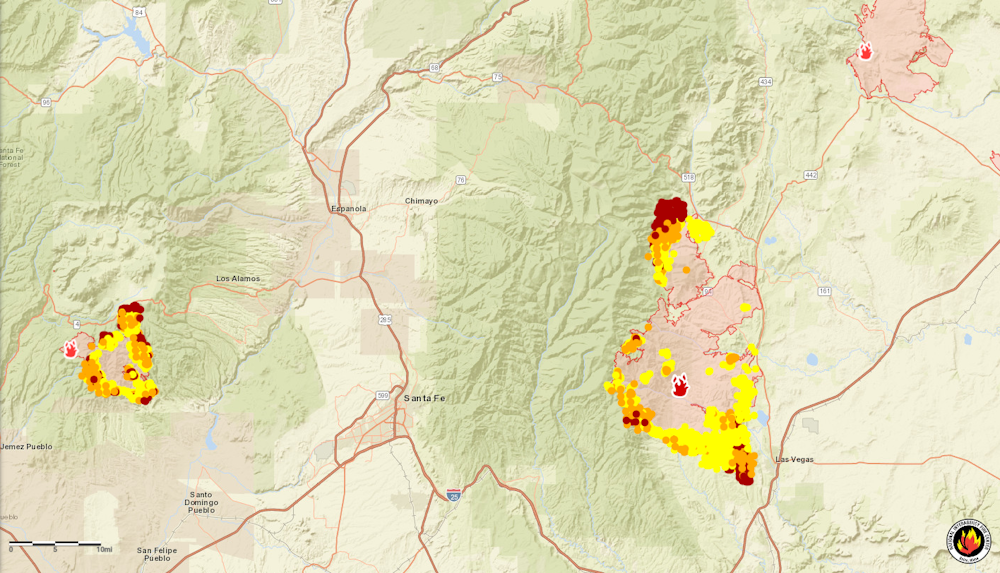
By May 4, nearly a quarter-million acres had burned in New Mexico, almost double the state’s 2021 total. Fires shown by satellite and on the map below are near Los Alamos and Las Vegas, N.M.
  NASA


What effect is the changing fire regime having on the Southwest’s ecosystems?

When fires burn in areas that didn’t see fire historically, they can transform ecosystems.


People generally don’t think of fire as being a natural part of desert ecosystems, but grasses are now fueling really big fires in the desert, like Arizona’s Telegraph Fire in 2021. These fires are also spreading farther, and into different ecosystems. The Telegraph Fire started in a desert system, then burned through chaparral and into the mountains, with pine and conifer forest.

Part of the problem is invasive grasses like buffelgrass and red brome that spread quickly and burn easily. A lot of grass is now growing in those desert systems, making them more prone to wildfire.


When a fire spreads in the desert, some plant species, like mesquite and other brushy plants, can survive. But the saguaro – the iconic cactuses that are so popular in tourist visions of the Southwest – are not well adapted to fire, and they often die when exposed to fire. Paloverde trees are also not well adapted to survive fires.

What does comes back quickly is the grasses, both native and invasive. So in some areas we’re seeing a transition from desert ecosystem to a grassland ecosystem that is very conducive to the spread of fire.

The Cave Creek Fire near Phoenix in 2005 is an example where you can see this transition. It burned over 240,000 acres, and if you drive around that area now, you don’t see lot of saguaros. It doesn’t look like desert. It looks like more like annual grassland.

This is an iconic landscape, so the loss affects tourism. It affects wildlife as well. A lot of species rely on saguaro for nesting and feeding. Bats rely on the flowers for nectar.
What can be done to avoid high fire risk in the future?

In some respects, people will have to recognize that fire is inevitable.

Fires quickly now surpass our capacity to control them. When winds are strong and the fuels are really dry, there’s only so much firefighters can do to prevent some of these big fires from spreading.


Conducting more prescribed fires to clear out potential fuel is one important way to lessen the probability of really big, destructive blazes.

Historically, far more money went into fighting fires than managing the fuels with tactics like thinning and prescribed fire, but the infrastructure bill signed in 2021 included a huge influx of funding for fuels management. There’s also a push to move some seasonal fire crew jobs to full-time, yearlong positions to conduct thinning and prescribed burns.

Homeowners can also be better prepared to live with fires. That means maintaining yards and homes by removing debris so they’re less likely to burn. It also means being prepared to evacuate.

This article was updated May 5 with Biden issuing the disaster declaration.

This article is republished from The Conversation, a nonprofit news site dedicated to sharing ideas from academic experts. It was written by: Molly Hunter, University of Arizona.

Read more:

6 wildfire terms to understand, from red flag warning to 100% containment

How years of fighting every wildfire helped fuel the Western megafires of today

Molly Hunter has received funding from the Bureau of Land Management, National Park Service, U.S. Geological Survey, and U.S. Forest Service.
Thousands refuse to evacuate largest U.S. wildfire in New Mexico


FILE PHOTO: Wildfires near Las Vegas, New Mexico

Thu, May 5, 2022
By Andrew Hay

TAOS, N.M. (Reuters) - Thousands of people told to flee the largest wildfire burning in the United States have chosen to stay and defend generational homes in the mountains of northern New Mexico, even as some run out of food and water, officials said.

In Mora County, population 4,500, around 60% of residents in evacuation areas have remained in centuries-old farming and ranching communities where electric power has been lost, said Undersheriff Americk Padilla.

"This is their livelihood, this is all they know, so these elderly people, and a lot of the people, our constituents are not leaving," Padilla said.


The forested mountains around 40 miles northeast of Santa Fe are known for tough, self-sufficient residents, many of whom can trace lineage to 18th century Spanish settlers and Native American tribes.

Local doctor Matthew Probst said residents had high “social vulnerability,” families possibly owning a $15,000 mobile home outright but having no home owner's insurance and few financial resources.

Keeping these "norteños" or northerners in their homes was a strong sense of "querencia," or belonging to the land, he said.


"It's more than just your place or your personal belongings and your material things. This is your land, your soul connected to it generationally," said Probst, who has evacuated his family and livestock from the village of Ojitos Frios.

New Mexico Governor Michelle Lujan Grisham said worried relatives were asking her to get family members out.

“I have no doubt that we have people without power who are on oxygen. I have no doubt we have individuals who are running out of food and water,” Lujan Grisham told a news briefing.

Padilla feared violent winds forecast for the weekend could push the fire into villages and even neighboring Taos County after it destroyed at least 166 homes, burning 165,276 acres (67,000 hectares) in Mora and San Miguel counties. He was distributing food and power generators to homes.

"I cannot neglect the people that decided to stay," he said.

(Reporting by Andrew Hay in Taos, New Mexico; Editing by Leslie Adler)
Texas Facing ‘Horrible’ Heat That Will Stoke Energy Demand


Brian K. Sullivan and Naureen S. Malik
Wed, May 4, 2022

(Bloomberg) -- Texas’s power-grid manager warned that demand will jump over the weekend as customers turn to air conditioners to get relief from searing record heat

The Electric Reliability Council of Texas said there could be “larger-than-normal” power consumption but the state’s grid should produce enough to meet demand. There is a chance many areas across Texas and neighboring Louisiana could set records for the date as temperatures push into the upper 90s Fahrenheit (30s Celsius) and even higher closer to the Mexican border.

“They may not get any relief for days and days and days,” said David Roth, a senior branch forecaster with the U.S. Weather Prediction Center. “This weekend is horrible, not that it is going to be all that better next week.”

Extreme weather has been putting more pressure on electricity grids -- particularly in Texas and California -- in recent years, which in turn has led to economic and political fallout. Both states have experienced power outages brought on by unusual cold or heat.

Temperatures will soar across the Lone Star state, reaching 94 degrees Fahrenheit in Dallas by Saturday, while Austin will touch 99 on Sunday, according to the National Weather Service. Similar heat will grip the border town of Laredo and the state’s biggest metropolis Houston.

A forecast high in Houston of 97 and 102 in Brownsville this weekend would certainly set new records for the date, said Roth.

In many places, temperatures will feel even hotter than the thermometer reads. The heat will also spill over into New Mexico as well, Roth said.

Normally at this time of year, a weather front would push through to ease the high temperatures and bring some mild air, but there’s little chance of that in the next few days, he said.

Equilibrium/Sustainability — Texas stares down the barrel of summer grid failure

Sharon Udasin
Tue, May 3, 2022, 5

AP Photo/David J. Phillip

Texas’s power grid may be courting collapse this weekend as temperatures soar across the state.

By Saturday, the state utility regulator expects just under 70 gigawatts of demand — more than any previous May, the Houston Chronicle reported.

Demand this weekend is expected to climb to just below the amount that crashed the grid during Winter Storm Uri in 2021, according to a study by the Texas Oil and Gas Association.

This means that the state’s “notoriously fickle power grid” is bracing for a squeeze, according to the Chronicle.

With 100-plus-degree temperatures forecast for South and West Texas this weekend, the state regulator is scrambling to restart idled power plants, the Chronicle reported.


Without these plants online, Texas “could be short” on energy — heightening the need for state-funded cooling centers for those “who can’t afford to stay cool,” according to energy consultant Doug Lewin.

Welcome to Equilibrium, a newsletter that tracks the growing global battle over the future of sustainability. We’re Saul Elbein and Sharon Udasin. Send us tips and feedback. A friend forward this newsletter to you? Subscribe here.

Today we’ll meet New Mexico residents who are forced to choose whether to flee or fight the nation’s largest current fire. Then we’ll look at how so-called forever chemicals can disrupt some teenagers’ bone growth.
Out-of-control fire gives hint of summer to come

The largest fire in the United States is blazing out of control through the pine forests of northern New Mexico, leading to evacuations, 172 burnt houses and the destruction of 228 square miles, The Associated Press reported on Tuesday.

The still-spreading combination of the Calf Canyon and Hermits Peak Fires — propelled by 50-mile-per-hour winds and months of drought conditions that dried trees to tinder — is a grim warning that the West is facing a long, hard fire season.

Big concerns: “We are very concerned about very significant fire growth today,” National Weather Service fire meteorologist David Craft told the AP on Tuesday.

Constantly shifting winds have helped the fire escape containment, incident commander Carl Schwope told The Daily Beast over the weekend.

“We’re at the weather’s mercy,” Joy Ansley, manager of San Miguel county told the Santa Fe New Mexican on Monday.

Running for cover: As the fire burned northwest of Las Vegas, N.M., in San Miguel County, some chose to flee, stripping grocery shelves bare as they went, the Santa Fe New Mexican reported.

“I’d rather take off now than hear a siren ringing,” Cathy Garcia told the New Mexican as she wrapped up porcelain figures.

Down the street, Ronnie Marquez loaded his wife and four kids into his truck and a flock of about 100 pet chickens and ducks into his trailer.

“I don’t have to take the furniture, that can all be replaced,” Marquez told the New Mexican. “You can’t replace the personal stuff, your family.”

Others choose to fight: Amid falling ash, Chris Castillo and his cousins moved trees and other fuel away from a relative’s Las Vegas home, the AP reported.

“We’re all family here. We’re trying to make a fire line,” Castillo said.

SIGNS OF A BIG FIRE SEASON STILL TO COME

The Calf Canyon and Hermits Peak fires came on the heels of federal National Interagency Fire Center (NIFC) estimates for July and August, which on Sunday predicted elevated fire danger across the West.

What does that mean in practice? According to NIFC predictions, fire risk is elevated in the following locations:

In western Florida in May


On the High Plains through August, particularly after the “green up” of summer grass dries out


In southern and western Colorado in May and June


In Oregon, Washington and Northern California through July


Across most of the Pacific Northwest by August

It’s already a big fire year: More than 1.1 million acres have already burned this year— twice as much as during the equivalent period in 2021 and four times as much as the same period in 2020.

That total burned acreage is still much less than the damage incurred during the 2016, 2017 or 2018 fire seasons, according to NIFC.

Nearby states are on alert: San Diego rang in the beginning of Wildfire Preparedness Week with a “very concerning” .02 inches of April precipitation, NBC San Diego reported.

With dry soil, diminishing snowpack and fire risk creeping north along the Wasatch Range east of Salt Lake City, state officials are urging citizens to “use good fire sense,”Salt Lake City’s KSL reported.

The state credits its Fire Sense educational program with cutting the number of human caused fires by nearly a thousand between 2020 and 2021, according to KSL.

And then there’s the Pacific Northwest — which is bracing for impact.

One local meteorologist, John Saltenberger, warned Portland-based NBC affiliated KGW Oregon that he foresees one of the worst seasons in his 38 years on the job.

“I can’t recall seeing such an ominous signal displayed over such a large swath [of] the continental United States,” Saltenberger said.
A 115-Degree Heat Wave Is Making India’s Power Crisis Worse


(Bloomberg) -- A power crisis in India that’s delivering hours-long blackouts, halting manufacturing lines and triggering street protests is forecast to continue for months, adding pressure on the nation’s economic rebound.

Electricity outages and curbs have spread across more than half of all states and the nation’s coal-dominated energy system is expected to come under further strain as power demand tops a recent record high in the coming weeks.

Even with a temporary reprieve from a blistering heat wave that’s delivered temperatures as high as 46 degrees Celsius (115 degrees Fahrenheit), households and businesses face ongoing disruptions as coal stockpiles shrink at power plants and fuel imports falter on prices that’ve surged since the war in Ukraine.

“It’s becoming a difficult situation,” Sumant Sinha, chairman of ReNew Energy Global Plc, a supplier of wind and solar power in India, said in an interview. “The whole summer will be a test.”

High coal and oil prices threaten to add to inflationary pressures that prompted India’s central bank to make a surprise move Wednesday to lift its key policy rate. Power curbs will also hit India’s already faltering rebound in industrial production.

Read more: Heat Waves Test the Limits of Human Survival: Pollard & Fickling

Production of coal, the fossil fuel that accounts for more than 70% of India’s electricity generation, has failed to keep pace with unprecedented energy demand from the heat wave and the country’s post-pandemic industrial revival. Logistics snarls, including a lack of railway carriages to transport the fuel from mines to power plants, are exacerbating the shortages.

“If power supply is curtailed to the industrial sector, it could delay the recovery in the manufacturing sector by at least one more quarter,” said Aditi Nayar, an economist with ICRA Ltd.

Stockpiles at coal-fired power stations have tumbled more than 14% since the start of April, leaving about 100 plants with critical supply levels, according to the Institute for Energy Economics and Financial Analysis. Reserves are forecast to shrink further on high demand, and that’ll be followed by a monsoon season from July.

Monsoon rains triggered a previous power crisis last year — which also caused widespread electricity curbs — when coal mines and roads were flooded, hampering production and shipments.

“If coal stockpiles continue to deplete at this rate, we’re going to see a full-blown power crisis across the country,” said Shailendra Dubey, chairman at the All India Power Engineers Federation, an advocacy body that produces energy policy suggestions.

Electricity demand hit a record 207.1 gigawatts on Friday and is expected to rise to 220 gigawatts within the next two months, according to India’s power ministry. Average spot power prices at Indian Energy Exchange have jumped to about 10 rupees (13 cents) a kilowatt hour, almost triple the average in January, and have been capped by the industry regulator.

At least 16 of India’s 28 states have been grappling with power outages of between two and 10 hours a day, Ashok Gehlot, chief minister of Rajasthan, said Monday in a Twitter message, before conditions eased in some areas.

The western desert state, a hub for metal smelters to textile factories, last week ordered power supplies to some industries cut by as much as half. Citizens should limit their use of appliances like air conditioners and coolers in homes and workplaces, Gehlot said.

Maharashtra, home to the nation’s financial capital Mumbai, is battling worsening blackouts, said S. Maheshkumar, general secretary at Maharashtra Industrial and Economic Development Association. “Industries are worried that they may have to cut production and turn down export and domestic orders,” he said by phone.

Anger over patchy electricity supplies prompted protests across the northern state of Punjab — India’s top grains producer — over the weekend, with farmers blockading roads as they appeal for a minimum of eight hours of power a day for agricultural use. Already there are concerns about electricity supply during a paddy sowing season from mid-June, Kamaljeet Singh Hayer, a farmer in the state’s Ferozepur district, said by phone.

In the coal mining states of Jharkhand and Chhattisgarh, many industries are cutting output or running back-up generators with expensive diesel. “If we have to operate like this, we’ll all soon be in the red,” said Philip Mathew, president of Jharkhand Small Industries Association.

Opposition party members marched Saturday through streets in Jammu, protesting against six-hour daily outages. Blackouts have struck key population centers including Uttar Pradesh, and even where supplies are slowly improving like in Karnataka and Kerala connections still aren’t guaranteed around-the-clock.

While Prime Minister Narendra Modi’s government isn’t yet facing major new dissent, India’s economy is under pressure from high energy prices, rising inflation and the impacts of the Covid pandemic, including low employment, said Shumita Deveshwar, senior director of India research at TS Lombard.

“These have the potential to become bigger political issues in the longer-term,” Deveshwar said. “If the coal crisis continues for an extended period, it will add to the pressure.”
Heatwave: India's poor bear the brunt of blistering temperatures

Thu, May 5, 2022,

A brutal heatwave has hit India, throwing life out of gear

As a blistering heatwave sweeps through India, the country's poor are once again the most vulnerable. The BBC's Ayushi Shah reports from Mumbai city.

Sulachna Yevale, a vegetable vendor, desperately sprinkles water over her produce - some lemons and spinach that she bought from a wholesale market - to keep it from drying.

But nothing seems to help.

The extreme heat has caused some of the produce to spoil, making them useless for selling.

Even though she has been selling vegetables at the same spot for decades, Ms Yevale says this is the first time she has lost so much of her produce - worth 70 rupees (around $1; £0.80) - a significant amount for someone whose daily income is 800 rupees.

As her profits plummet, she worries about her future. She depends on the stall to provide for a family that includes her widowed daughter-in-law and granddaughter.

"I feel helpless," she says, teary-eyed.

A brutal heatwave has upended lives of millions of people in India who are struggling to cope with the soaring temperatures - the highest in over 100 years.

India issues extreme heatwave warning

After record-breaking weeks, the country's weather department expects temperatures in northwest India to get slightly better, as maximum temperatures are expected to drop by 3-4C this week. But the respite is expected to be short-lived, with maximum temperatures shooting back up by 2-3C few days after that.

Sulachna Yevale has been a vegetable vendor for decades

Caught in the middle are India's poor - people like Ms Yevale who disproportionately bear the cost of such extreme weather events. With a limited income and little resources to adapt to the heat, they are now struggling to survive.

Prameela Walikar, a fisherwoman, wipes the sweat off her face and says that she can barely afford to keep her catch fresh in the stifling heat.

"Most of what I earn is just spent on ice trying to preserve these fish," she says. "I have never had so much spoilt fish in all these decades of selling. Now I am sometimes losing produce worth 2,000 rupees a day."

Even ice prices have risen - a twofold blow that she is struggling to adapt to.

"The government needs to provide equipment and ice to help the fishing community adapt to rising temperatures and the longer summers," she says.

Ice has become more expensive, shrinking the income of Prameela Walikar even more

The woes of the two women reflect those of millions employed in the country's vast unorganised sector, who have no choice but to work outdoors in the heat to make ends meet.

But as heatwaves become more frequent, expert say work such as construction and agriculture will become dangerous during the hottest hours of the day.

This is not just a matter of public health and safety, but also a grave economic issue for a country that is highly dependent on heat-exposed labour. India is already losing $101bn annually due to heat - the most in the world - a report by Nature Communications has found.

The lost labour hours due to increasing heat and humidity could put approximately 2.5-4.5% of GDP at risk by 2030, up to $250bn, according to a 2020 McKinsey report. The number of daylight hours - during which outdoor work is unsafe - will also increase approximately 15% by 2030, compared to a decade earlier, the report says.

Pandurang Girhe, 76, drags his hand cart uphill on a bridge during the hottest hours of the day.

The cart weighs 60kg and feels even heavier in the scorching heat. It is a hard climb for a meagre 200 rupees, but despite his aching knees, he has little choice.


Pandurang Girhe drags his 60 kilo hand cart in the blistering heat

The heatwave that has struck India this year has been particularly severe, but experts say it is not an isolated incident - they say it is a harbinger of the type of events that might become more common in the future as temperatures rise.

But poor street vendors like Mr Girhe do not understand what heatwave means or what may have caused it. All they know is that their daily lives and their earnings are being affected, and that they must continue to work - heatwave or not - to feed their families.

"It is especially hot this year. But if I don't work, how will I fill my stomach?" Mr Girhe shrugs.

Experts say that poor infrastructure in cities has made life harder for people. Free and clean drinking water is limited and there aren't enough shelters for him to escape the heat, even for a while.

Shruti Narayan, regional director of South and West Asia of C40 Cities, says cities need to urgently take action by developing data-driven climate action plans.

"This includes clear, tangible actions on mitigation and adaptation, as well as building resilience to events we are already experiencing such as heat plans."
India's Kashmir region gets redrawn constituencies ahead of elections

#KASHMIR IS #INDIA'S #GAZA

Tourists ride "Shikaras" or boats in the waters of Dal Lake during sunset in Srinagar


Thu, May 5, 2022, 
By Krishna N. Das and Fayaz Bukhari

NEW DELHI (Reuters) - India published on Thursday a new list of redrawn political constituencies for the former state of Jammu and Kashmir (J&K), giving greater representation to the Muslim-majority region's Hindu areas and paving the way for fresh elections.

Prime Minister Narendra Modi's government broke up J&K into two federal territories in 2019 as part of a move to tighten its grip over the region, which is at the heart of more than 70 years of hostility between India and Pakistan.


Anticipating protests in a region fighting Indian rule for decades, the government put many political leaders under house arrest and cut off internet connections when it announced the move to split the state.


J&K originally comprised the mainly Muslim Kashmir Valley - the bone of contention between nuclear-armed India and Pakistan - the Hindu-dominated Jammu region, and the remote Buddhist enclave of Ladakh.

The government said a delimitation commission had finalised 90 assembly constituencies for J&K, excluding Ladakh, with 43 seats for Jammu and 47 for Kashmir. Earlier, Jammu had 37 seats and the Kashmir valley 46.

The commission, whose report has been rejected by J&K's Peoples Democratic Party, said it had been difficult to accommodate competing claims from various sides, citing in a statement the region's "peculiar geo-cultural landscape".

Indian Home Minister Amit Shah said in January that elections would be held in J&K soon after the delimitation process was completed. He also promised to reinstate its statehood once its "situation became normal".

The Jammu Kashmir National Conference, which has governed the region, said it was studying the implications of the move that has been championed by Modi's Bharatiya Janata Party (BJP).

"No amount of gerrymandering will change the ground reality, which is that whenever elections are held the voter will punish the BJP and its proxies for what they have done to J&K over the last 4 years," the National Conference said on Twitter.

The BJP said on Twitter it would change J&K's image and future for the better if voted to power.

(Reporting by Krishna N. Das, Fayaz Bukhari and Nigam Prusty; Editing by Gareth Jones)
Elon Musk Will Fund His Twitter Deal With Money From Countries That Suppress Free Speech


Richard Nieva
BUZZFEED NEWS
Thu, May 5, 2022

When Elon Musk announced his bid to buy Twitter last month, he said he wanted to make the social network a beacon for free speech. But as Musk scrambles to pull together funding for the $44 billion deal, the billionaire is also planning to accept financing for the deal from two countries that have historically restricted freedom of speech: Saudi Arabia and Qatar.

On Thursday, an SEC filing revealed new financiers for Musk’s takeover plan, which include Saudi Prince Alwaleed bin Talal and Qatar’s sovereign wealth fund. Both countries impose harsh censorship to quash dissent: A Qatari law states that spreading “false or malicious news” can land you in prison for five years, while in Saudi Arabia, critics of the government have faced arrest and even murder. Saudi Arabia ranks number 166 out of 180 on the World Press Freedom Index, while Qatar ranks number 119, according to Reporters Without Borders.

Twitter didn’t immediately respond to a request for comment on the financing.

Prince Alwaleed wrote on Twitter that the Kingdom Holding Company, an investment firm he controls, would roll over its current $1.9 billion investment in Twitter to join Musk on “this exciting journey.” The move comes after Alwaleed spurned Musk’s plan in a tweet last month, saying the Tesla CEO’s offer didn’t come close to the “intrinsic value” of the company. KHC has been a Twitter stakeholder since 2011.


Musk responded by asking about the size of the Kingdom's stake in Twitter, as well as the country’s views on “journalistic freedom of speech.” Saudi Arabia has been frequently criticized for censorship and human rights abuses, including the 2018 murder of Washington Post journalist Jamal Khashoggi. The Saudi government has denied any involvement by its leaders.

The prince didn’t publicly answer Musk’s questions, but in his tweet Thursday called Musk a “‘new’ friend” and “excellent leader.”

The sovereign wealth fund of Qatar will also contribute $375 million to Musk’s takeover deal. In 2020, the country issued a law that threatens to imprison “anyone who broadcasts, publishes, or republishes false or biased rumors, statements, or news, or inflammatory propaganda, domestically or abroad, with the intent to harm national interests, stir up public opinion, or infringe on the social system or the public system of the state.

Last year, the government arrested seven people for using social media “to spread false news” during its elections. The country also has a history of suppressing free speech. In 2012, a Qatari poet was sentenced to 15 years in jail after reciting a poem critical of the government.

When the 2020 law was issued, Amnesty International called it “another bitter blow to freedom of expression in the country” and said it “is a blatant breach of international human rights law.” Musk has said he wants to ensure free speech on Twitter as long as it doesn't violate local law, so Qatar's financial involvement puts him in a potentially precarious position.

The financing and the conflicts of interest it creates underscore the difficulty Musk will face as he tries to implement his vision for Twitter. Musk said last month that he sees the platform as a digital town square. “My strong intuitive sense is that having a public platform that is maximally trusted and broadly inclusive is extremely important to the future of civilization,” he said.

Other backers announced Thursday include the billionaire Oracle cofounder Larry Ellison, who is investing $1 billion, and the cryptocurrency exchange Binance, which is putting in $500 million.

Exclusive-Musk seeks to put in less money in new Twitter deal financing -sources


Chibuike Oguh and Krystal Hu
Mon, May 2, 2022, 


By Chibuike Oguh and Krystal Hu

(Reuters) -Elon Musk is in talks with large investment firms and high net-worth individuals about taking on more financing for his $44 billion acquisition of Twitter Inc and tying up less of his wealth in the deal, people familiar with the matter said.

Musk is the world's richest person, with Forbes estimating his net worth at about $245 billion. Yet most of his wealth is tied up in the shares of Tesla Inc, the electric car maker he leads. Last week, Musk disclosed he sold $8.5 billion worth of Tesla stock following his agreement to buy Twitter.

The new financing, which could come in the form of preferred or common equity, could reduce the $21 billion cash contribution that Musk has committed to the deal as well as a margin loan he secured against his Tesla shares, the sources said.

The banks that agreed last month to provide $13 billion in loans based on Twitter's business balked at offering more debt for Musk's acquisition given the San Francisco-based company's limited cash flow, Reuters reported last month.

Musk has also pledged some of his Tesla shares to banks to arrange a $12.5 billion margin loan to help fund the deal. He may seek to trim the size of the margin loan based on the new investor interest in the deal financing, one of the sources said.

Major investors such as private equity firms, hedge funds and high net-worth individuals are in talks with Musk about providing preferred equity financing for the acquisition, the sources said. Preferred equity would pay a fixed dividend from Twitter, in the same way that a bond or a loan pays regular interest but would appreciate in line with the equity value of the company.

Apollo Global Management Inc and Ares Management Corp are among the private equity firms that have been in talks about providing the financing, the sources added.

Musk is still deciding whether he will have partners team up with him in writing the equity check needed for the deal, the sources said. Musk is not seeking to take on more debt for the Twitter deal currently, the sources added.

Musk has also been in talks with some of Twitter's major shareholders about the possibility of them rolling their stake into the deal rather than cashing out, one of the sources said. Former Twitter Chief Executive and current board member Jack Dorsey is examining whether he will roll his take, one source added.

Large institutional investors, such as Fidelity, are also in talks about rolling over their stake, according to the source.

Musk has tweeted that he would try to keep as many investors in Twitter as possible as he takes the company private.

The sources requested anonymity because the matter is confidential. Musk, Dorsey, Fidelity, Apollo and Ares did not respond to requests for comment.

TESLA SHARES RALLY

Tesla shares ended trading on Monday in New York up 3.7% at $902.94. Wedbush Securities managing director Dan Ives said the news helped ease investors' concerns that Musk was relying too much on his Tesla shares for the Twitter deal financing.

"This is big if it materializes as we believe the Twitter deal has been a $100+ per share overhang on Tesla’s stock due to the Musk financing concerns," Ives tweeted.

Investors have been fretting over whether Musk will complete the Twitter deal given that he has backtracked in the past. In April, he decided at the last minute not to take up a seat on Twitter's board. In 2018, Musk tweeted that there was "funding secured" for a $72 billion deal to take Tesla private but did not move ahead with an offer.

Twitter shares ended trading up 0.2% at $49.14 in New York on Monday, closer to the $54.20 per share acquisition price, as investors interpreted the news on the new financing discussions as making it slightly more likely that the deal will close.

Musk would have to pay a $1 billion termination fee to Twitter if he walked away, and the social media company could also sue him to complete the deal.

Musk, who calls himself a free speech absolutist, has criticized Twitter's moderation policies. He wants Twitter's algorithm for prioritizing tweets to be public and objects to giving too much power on the service to corporations that advertise.

(Reporting by Chibuike Oguh in Los Angeles and Krystal Hu in New YorkEditing by Greg Roumeliotis and Lisa Shumaker)


Sri Lankan tea pickers' dreams shattered by economic crisis


Wed, May 4, 2022,
By Alasdair Pal and Uditha Jayasinghe

BOGAWANTALAWA, Sri Lanka (Reuters) - On a lush plantation in Sri Lanka, Arulappan Ideijody deftly plucks the tips of each tea bush, throwing them over her shoulder into an open basket on her back.

After a month of picking more than 18 kg (40 lb) of such tea leaves each day, she and her husband, fellow picker Michael Colin, 48, receive about 30,000 rupees, worth about $80 after the island nation devalued its currency.

"It is not close to enough money," Arulappan, 42, said of their earnings, which must support the couple's three children and her elderly mother-in-law.

"Where we used to eat two vegetables, now we can only afford one."

She is one of millions of Sri Lankans reeling from the island's worst economic crisis in decades.

The COVID-19 pandemic severed the tourism lifeline of the Indian Ocean nation, already short of revenue in the wake of steep tax cuts by the government.

Left critically short of foreign currency to buy essential supplies of food, fuel and medicines, Sri Lanka has turned to the International Monetary Fund for an emergency bailout.

Rampant inflation and shortages sparked weeks of protests that have sometimes turned violent.

Plantation workers like Arulappan, who hail predominantly from the island's Tamil minority, are affected more than most, as they own no land to provide a cushion against soaring food prices.

Her family is one of 17 living in traditional "line homes", or box-like, single-storey terraces unchanged in design from the days of Britain's colonial rule, which ended in 1948.

Emerald-green hills stretch for miles around, while rising over the cottages is fragrant woodsmoke from burning tea branches the families use for their cooking fires.

Their fortunes mirror the rise and fall of an economy that emerged from a decades-long civil war in 2009.

Buoyed by a booming tourism industry and exports of items such as garments and plantation products like tea, rubber and cinnamon, Sri Lanka attained a GDP double almost that of neighbouring India in 2020.

Arulappan left school at 14 and worked in a garment factory before marrying and moving to the plantation in Bogawantalawa, a valley in the central highlands reputed for its fine teas and a drive about four hours east of Colombo, the commercial capital.

The job's flexible hours allowed her to care for her children and start a small business selling vegetables to other workers on credit.

But the pandemic was a setback for the family and the country, shuttering the economy for months and cutting off the tourism sector, a key earner of foreign exchange.

"There were days where we would only eat rice," Arulappan said.

INFLATION SPIRAL


The tea industry, which supports hundreds of thousands of people, also suffered from a controversial government decision last year to ban chemical fertilisers as a health measure. Though later reversed, the ban has left fertilisers in short supply.

First-quarter tea production fell 15% on the year to its lowest since 2009, with the Sri Lanka Tea Board saying dry weather had taken a toll of bushes that received insufficient fertiliser after the ban.

Coupled with lengthy power cuts, fuel shortages and soaring inflation, that helped push the industry to "near total breakdown", said Plantation Association spokesman Roshan Rajadurai.

The crisis has left Arulappan unable to make the last two months' repayments on a series of high-interest loans she took to start her business, defray the costs of a family wedding and pay off other debts.

Food inflation is approaching 50% on the year, with transport nearly 70% more expensive, official figures show, although in practice the figures are even higher.

The price of flour has doubled over the last year, putting out of reach for many plantation workers the coconut-infused flatbreads they nibble while plucking tea.

"We have had to switch to eating rice. But even that is very expensive now," Arulappan said.

The cost of the two-kilometre bus ride to school for her two younger children has also more than doubled in recent months, but the couple continue paying for private tuition to ensure them a better life.

"I never want to see my kids work in a plantation," Michael said.

However, the crisis has doomed plans for university education for their eldest son, Akshon Ray.

Arulappan saved up for two years for a laptop she promised the 22-year-old if he got good results on his final exams.

On top of the family's metal wardrobe lies a folder holding the brochure for the university where he planned to study. But the financial burden was too much.

"You have to support the family," Arulappan told her son just before he left to work in a broom factory in Colombo.

She does not yet know where he is staying.

(Reporting by Alasdair Pal and Uditha Jayasinghe in Bogawantalawa; Editing by Clarence Fernandez)
Sri Lanka police tear gas student protesters outside parliament


Police fired tear gas on students attempting to storm Sri Lanka's parliament 
(AFP/Ishara S. KODIKARA) (Ishara S. KODIKARA

Thu, May 5, 2022, 8:49 AM·2 min read

Police fired tear gas on students attempting to storm Sri Lanka's parliament Thursday as the protesters demanded the resignation of President Gotabaya Rajapaksa over the country's worst-ever economic crisis.

Protesters led by the Inter University Students' Federation were about to pull down the yellow-painted iron barricades on the main drive leading to the legislature when riot police unleashed a barrage of tear gas.

The students had marched from a nearby university and closed in on the parliament building located on a man-made lake island when police moved in.

Even as the crowds dispersed, police kept firing tear gas canisters that hit shops in the nearby Diyatha Uyana park, witnesses said.

Police had earlier set up barricades around the sprawling parliament complex where a vacancy for the deputy speaker was being filled unopposed.

Sri Lanka's 22-million population has been facing acute shortages of food, fuel and medicines for months, bringing tens of thousands onto the streets to demand the resignation of Rajapaksa and other members of his powerful ruling family.

The president and his family have made it clear that they will not step down despite escalating demonstrations across the island.

- Trade unions -

Sri Lanka's trade unions have announced a one-day work stoppage on Friday.

The organisers of the strike have asked temples and churches to ring their bells for an hour on Friday morning in a show of solidarity.

Finance minister Ali Sabry warned on Wednesday that the country will have to endure its unprecedented economic hardships for at least two more years.

Sabry said the country now has less than $50 million in usable foreign exchange reserves, needed to finance essential goods to keep Sri Lanka's import-dependent economy ticking over.

Official data shows reserves at $1.7 billion, but most of that figure includes a Chinese currency swap which cannot be used to pay for imports from other countries.

Sabry said the government faltered by delaying an approach to the International Monetary Fund for a bailout.

Sri Lanka's economic crisis took hold after the coronavirus pandemic hammered income from tourism and remittances.

Last month, Colombo announced it was defaulting on its $51 billion foreign debt.

aj/ssy
Bernie Sanders slams Amazon.com chairman at Senate hearing


U.S. Senate Budget Committee holds hearing on Amazon's labor practices, in Washington
CHRIS SMALLS ALU ORGANIZER AND PRESIDENT


Thu, May 5, 2022,

By David Shepardson and Nandita Bose

WASHINGTON (Reuters) -U.S. Senate Budget Committee Chairman Bernie Sanders on Thursday slammed Amazon.com Inc and its chairman at a hearing on the company's labor practices as he pushed the White House to end government contracts for the retailer.

"Amazon has done everything possible - legal and illegal - to defeat union organizing efforts," Sanders said.

But the company won bipartisan support at the hearing, including from Democratic Senator Tim Kaine of Virginia, a state with a large Amazon presence.

"I don't think Amazon is an organized criminal syndicate," Kaine said, adding he backs efforts to make it easier for workers to unionize. "Amazon employs a million Americans - not everybody hates their jobs at Amazon."

Sanders addressed Amazon Chairman Jeff Bezos, who had been invited to testify but did not appear.

"Given all your wealth, how much do you need? Why are you doing everything in your power, including breaking the law, to deny Amazon workers the right to join a union so that they can negotiate for better wages, better working conditions and better benefits?" Sanders asked. "How much do you need?"

Amazon did not immediately respond to a request for comment.

The committee heard testimony from several people including Christian Smalls, who heads the Amazon Labor Union.

"Imagine being a new hire at Amazon. Your second day, you don't even know your job assignment and the first thing they do is march them into an anti-union propaganda class," Smalls alleged.

Senator Lindsey Graham, the top Republican on the panel, criticized Sanders for singling out Amazon. "This is an effort to get an outcome you want using the United States Senate as your vehicle. This is very dangerous," he said. "You can have oversight hearings how you like but you determine Amazon is a piece of crap company. That's your political bias."

Graham said companies must be allowed to express their views about unions.

He noted that Boeing Co workers have not unionized in South Carolina, where they build the 787. "The idea that Boeing can't argue the merits of a right-to-work environment for their business is ridiculous and I think patently illegal."

Sean O'Brien, general president of the International Brotherhood of Teamsters, said one of the ways to hold Amazon accountable is for the government to take back contracts with companies "until they are a responsible employer."

Later in the day, U.S. Vice President Kamala Harris will host a White House meeting with Smalls and labor leaders seeking to represent workers at Amazon, Starbucks Corp and other employers. A White House official said the meeting aims to show that the administration "is supportive of their efforts to empower workers."

Last week, Sanders urged President Joe Biden to issue an executive order cutting off federal contracts to Amazon, saying the online retailer "has become the poster child for illegal anti-union behavior while raking in billions in federal contracts."

Workers at an Amazon warehouse in New York City recently voted to form the first union at the second-largest U.S. private employer and join the Amazon Labor Union under the leadership of Smalls, a former worker who has argued for higher pay and job security.

Amazon workers voted against unionizing a second warehouse in New York City, a ballot count on Monday showed, representing a defeat for labor organizers just weeks after they celebrated their first U.S. win at the online retailer.

(Reporting by David Shepardson and Nandita Bose in WashingtonEditing by Chris Sanders and Matthew Lewis)


O'BRIEN: AMAZON MUST BE BARRED FROM FEDERAL GOVERNMENT CONTRACTS

PR Newswire

WASHINGTON, May 5, 2022

Teamsters General President Sean M. O'Brien Testifies Before Senate Budget Committee, Calls Out Amazon's Anti-Worker Practices

WASHINGTON, May 5, 2022 /PRNewswire/ -- Teamsters General President Sean M. O'Brien called out Amazon during a Senate hearing today for its anti-worker, anti-union practices and demanded the federal government stop awarding the global behemoth lucrative government contracts.


International Brotherhood Of Teamsters. (PRNewsFoto/International Brotherhood of Teamsters)

Testifying before the Senate Budget Committee, O'Brien told lawmakers that lawbreaking companies like Amazon should not be allowed to profit at taxpayer expense while violating the rights of workers to collectively bargain. Noting President Biden made a campaign promise to only award contracts to employers who signed neutrality agreements committing to not run anti-union campaigns, O'Brien said it is time to drop the hammer on Amazon.

"To put it plainly, it is wrong for our government to be giving taxpayer dollars in the form of federal contracts to companies like Amazon," O'Brien said. "You are rewarding employers who repeatedly, knowingly and purposefully violate federal labor laws, drive down wages and standards in core Teamster industries and create dangerous working environments."

O'Brien noted the company was found guilty last year of illegally firing two workers after they advocated on behalf of their coworkers at an Amazon warehouse in Seattle. Additionally, Amazon broke labor law in Alabama when workers there tried to organize, forcing their election to be rerun this year. In December, the National Labor Relations Board cited Amazon for illegally threatening, surveilling and interrogating workers who were trying to start a union at its Staten Island facility. According to filings with the U.S. Department of Labor, Amazon spent $4.3 million on consultants last year alone to prevent its workers from organizing.

"These kinds of actions make something very clear — when workers try to organize, Amazon breaks the law. When workers raise their voices, Amazon does whatever it takes to shut them up because Amazon is terrified of the power workers have when they act collectively," O'Brien said.

O'Brien spoke about Amazon's exploitative business model and its direct impact on workers. As federal safety data shows, the company's punishing pace-of-work results in worker injury rates that are nearly twice as high as that of all other non-Amazon warehouse facilities. Its employees are seriously injured at rates that are nearly 80 percent higher than the rest of the entire warehouse industry. Amazon accounts for half of all warehouse worker injuries, yet the company only employs a third of all warehouse workers nationwide.

"To this committee and to the entire federal government, do your duty to protect American workers," O'Brien said. "We are watching, we are listening, and we are voting. Tell Amazon that enough is enough, and then show them you mean business. Don't give this company, or any employer, another penny until the labor laws of this land are truly upheld and workers' voices are finally heard."

Founded in 1903, the International Brotherhood of Teamsters represents 1.2 million hardworking men and women throughout the United States, Canada and Puerto Rico. Visit www.teamster.org for more information. Follow us on Twitter @Teamsters and "like" us on Facebook at www.facebook.com/teamsters.

View original content to download multimedia:https://www.prnewswire.com/news-releases/obrien-amazon-must-be-barred-from-federal-government-contracts-301541103.html

SOURCE International Brotherhood of Teamsters