Friday, July 22, 2022

Battered by climate change, Latin America must brace for worse: report
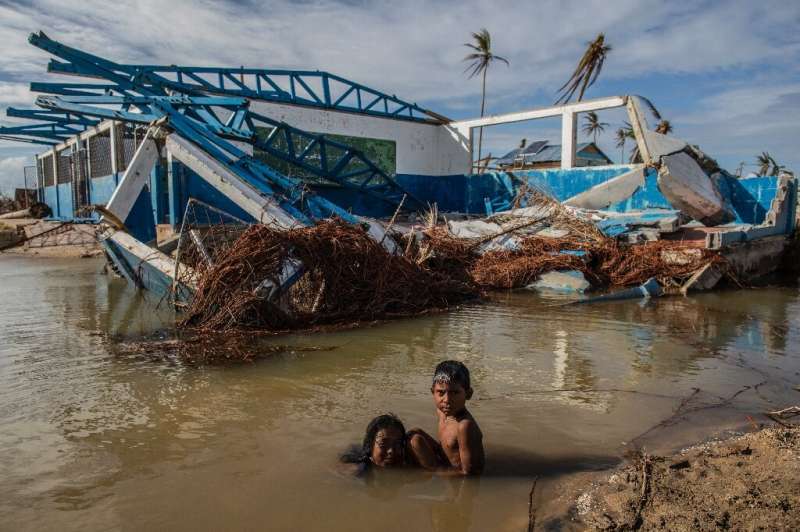
Hurricane Iota caused widespread devastation in Nicaragua in 2020
Hurricane Iota caused widespread devastation in Nicaragua in 2020.

Floods, heat waves and the longest drought in 1,000 years: Latin America is grappling with devastating climate change impacts that will only get worse, a World Meteorological Organization report warned Friday.

In its State of the Climate report for Latin America and the Caribbean (LAC) for 2021, the WMO said ecosystems, food and water,  and welfare were all taking a battering.

Glaciers in the tropical Andes have lost more than 30 percent of their area in less than 50 years, increasing the risk of water scarcity in many regions, it said.

Sea levels continued to rise at a faster rate than globally, and the so-called Central Chile Mega Drought—13 years and running—is the longest in at least 1,000 years.

Meanwhile, deforestation rates "were the highest since 2009, a blow for both the environment and ," said the report.

Brazilian Amazon deforestation doubled from the 2009-2018 average, with 22 percent more forest area lost in 2021 than the previous year.

The Amazon provides oxygen-producing and carbon-trapping functions that are crucial not only for the region but for the world.

'Decades of progress' stalled

The report also documented the third-highest number—21—of named storms on record for the 2021 Atlantic hurricane season, and extreme rainfall that caused hundreds of fatalities and destroyed or damaged tens of thousands of homes.
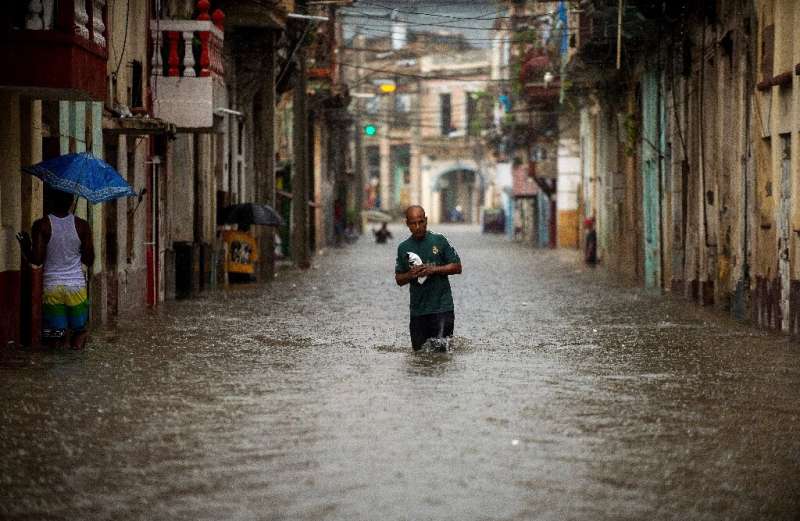
Floods in Cuba last month
Floods in Cuba last month.

"Increasing  and ocean warming are expected to continue to affect coastal livelihoods, tourism, health, food, energy, and water security, particularly in small islands and Central American countries," said WMO Secretary General Petteri Taalas.

"For many Andean cities, melting glaciers represent the loss of a significant source of freshwater... for domestic use, irrigation and hydroelectric power."

Worsening , compounded by the impacts of the coronavirus pandemic, have "stalled decades of progress against poverty, food insecurity and the reduction of inequality in the region," added Mario Cimoli of the Economic Commission for Latin America and the Caribbean.

In Guatemala, El Salvador and Nicaragua, 7.7 million people experienced high levels of  in 2021.

The LAC region had registered an average rate of temperature increase of about 0.2 degrees Celsius per decade between 1991 and 2021, said the report—double the 1961-1990 rate.

"Unfortunately, greater impact is in store for the region as both the atmosphere and ocean continue to rapidly change," said a WMO press release.

Chile is experiencing its longest drought in 1,000 years
Chile is experiencing its longest drought in 1,000 years.

"Food and water supplies will be disrupted. Towns and cities and the infrastructure required to sustain them will be increasingly at risk."

The region was in urgent need of early warning systems to help it adapt to climate extremes, said the WMO.Four climate change records broken in 2021: WMO State of the Climate Report

© 2022 AFP

Ancient Siberian dogs relied on humans for seafood diets

A new study has shed light on the dietary transitions that allowed early Siberian dog populations to increase as people put them
A new study has shed light on the dietary transitions that allowed early Siberian dog populations to
 increase as people put them to work in roles such as sledding.

As early as 7,400 years ago, Siberian dogs had evolved to be far smaller than wolves, making them more dependent on humans for food including sea mammals and fish trapped below the ice, a new study showed Friday.

Robert Losey of the University of Alberta, who led the research published in Science Advances, said the findings helped explain the growth in the early dog population, as people put them to work for hunting, herding and sledding.

"The long term changes in dog diet have really been oversimplified," he told AFP, explaining that prior work had focused only on two main ideas to explain how  transitioned from wolves, a process that began some 40,000 years ago.

The first of these was that friendlier wolves approached  camps during the Ice Age to scavenge for meat, eventually became isolated from their wild counterparts, and were then intentionally bred into dogs.

The second was that some dogs evolved a better capacity to digest starches following the , which is why some modern dog breeds have more copies of the AMY2B gene that creates pancreatic amylase.

To study ancient dog diets in more depth, Losey and colleagues analyzed the remains of around 200 ancient dogs from the past 11,000 years, and a similar number of ancient wolves.

"We had to go to collections all over Siberia, we analyzed those bones, took samples of the collagen, and analyzed the protein in labs," he said.

Based on the remains, the team made statistical estimates for body sizes.

They also used a technique called  to generate dietary estimates.

They discovered that dogs of 7,000-8,000 years ago "were already quite small, meaning that they just couldn't do the things that most wolves were doing," said Losey.

This in turn led to greater dependence on humans for food, and reliance on small prey and scavenging, rather than prey bigger than themselves, which  hunt.

"We see that dogs have marine diets, meaning they're eating fish, shellfish, seals and sea lions, which they can't easily get themselves," he said.

Ancient dogs were found to be eating fish "in areas of Siberia where the lakes and rivers are frozen over for seven to eight months of the year."

Wolves of the time, and today, were hunting in packs and mainly eating various species of deer.

Benefits and challenges

These new diets brought dogs both benefits and challenges.

"Beneficial because they could access stuff from humans, and those are oftentimes easy meals, but it came with the costs of all these new diseases and problems, like not enough nutrition," said Losey.

While the new bacteria and parasites they were exposed to could have helped some adapt, some dog populations might not have survived.

Most of the first dogs of the Americas died out, for unclear reasons, and were replaced by European dogs—though it's not thought colonization was to blame.

Those dogs that did survive acquired more diverse gut microbiomes, helping them further in digesting more carbohydrates associated with life with humansStudy shows how diet has transformed the ancient dog into a family pet

More information: Robert J. Losey et al, The evolution of dog diet and foraging: Insights from archaeological canids in Siberia, Science Advances (2022). DOI: 10.1126/sciadv.abo6493

Journal information: Science Advances 

© 2022 AFP

Don Braid: Is Danielle Smith's striking campaign a paper tiger?

Is this Smith steamroller a fact, or cultivated myth?

Author of the article:Don Braid • Calgary Herald
Publishing date:Jul 21, 2022 

Danielle Smith speaks at a leadership campaign event on July 14. 
Bailey Seymour/Special to Postmedia
Article content

Danielle Smith’s campaign has been spectacularly successful at amping up her profile as a UCP leadership candidate.

But is she really the runaway public hit that all the media attention suggests?

Maybe not. The counterattack on her plan for nullifying federal laws has begun. Candidate Travis Toews and Jason Nixon, the government house leader, have both called it reckless and dangerous for the province, especially economically.

Nixon even said he doubts that the legislature, with a UCP majority, would pass her Sovereignty Act.

It’s worth recalling that when seven leadership candidates debated this very question on June 23, five disagreed with Smith.

Most favoured some moves clearly within provincial authority — a police force, for instance — but they all thought it was halfway crazy to nullify federal laws on Alberta soil.

Are those people all wrong, while only Danielle Smith is right?

There’s another quiet player in this little Alberta drama: Prime Minister Justin Trudeau.


The current unilateral federal move on stricter emission targets seems deliberately provocative at a moment when traditional energy is precious, literally. Many Albertans will be angrier than ever, and perhaps more receptive to Smith’s pitch.

As premier, she would be a handy foil for Trudeau to rile up his progressive base in a federal campaign. There’s little for the Liberals to lose in Alberta, and a great deal to gain elsewhere.

Trudeau has found Premier Jason Kenney useful at times. Ontario Premier Doug Ford as well. Danielle Smith would be a gift.

Her stand might have won some limited national sympathy during our deep recession. But don’t imagine any love for ignoring national laws now that the province is soaring again, cash-rich beyond the dreams of any other province.


Prime Minister Justin Trudeau speaks during a news conference on Bowen Island, B.C., on Tuesday. 
PHOTO BY DARRYL DYCK /THE CANADIAN PRESS

Smith’s campaign also gives the impression that she is far outpacing other candidates in UCP membership sales.

Leela Aheer, for one, suspects it’s true. She called last week for moderates to buy memberships in droves, in order to head off a Smith victory that could be locked down by the time sales stop on Aug. 12.

But once again, is this Smith steamroller a fact, or cultivated myth?

It’s now possible to get a fix on sales because campaigns fully accepted by the party have been given the party membership lists. These lists show numbers of daily sales by all candidates.

Smith’s campaigners claimed last week, in a published article, that they had sold 7,000 memberships in a 10-day period.

But Brian Jean’s campaign says that’s simply false. The list they received, after Jean was accepted, shows that all aspiring candidates sold fewer than 6,000 memberships in the same 10-day period, according to Jean spokesperson Vitor Marciano.


The party discourages candidates from talking about current total list numbers.

“But we just had to speak out on this one,” says Marciano. “The sales they’re claiming just aren’t there. That’s untrue. There are steady sales of memberships by candidates, but no great burst of sales for her.”


MORE ON THIS TOPIC
Braid: Danielle Smith's campaign pokes a stick into the extremist bonfire


Braid: Does Danielle Smith already have a lock on the premier's office?


Smith and Toews have been in a spat about who favours a sales tax. The fact is, they’ve both suggested it.

Toews has said in the past a tax might be considered later. On Sept. 4, 2020, Smith said in a Herald column that the province needs $5 billion in new taxes, and then added: “Yes, a provincial sales tax. Let’s not kid ourselves about that.”

Now they’re faulting each other for something they both said. Ridiculous.

Smith’s striking Sovereignty Act promise has blurred far more important issues. She talks about them, too, but she has made herself the Ignore Laws candidate.

Jean, by contrast, focuses on bread-and-butter concerns that aren’t so dramatic but may reach crisis level by vote count day, Oct. 6.

On Thursday he called for legislation to cap retailer margins for gasoline sales. Five provinces already do this, which helps explain why their gasoline prices are similar to or lower than ours, even though Alberta stopped collecting the gasoline tax of 13 cents per lite.

Smith’s campaign stands out, that’s for sure. But maybe it’s not as strong as it seems.

Don Braid’s column appears regularly in the Herald.

Twitter: @DonBraid
Former finance minister questions whether Alberta sovereignty bill would pass


EDMONTON — Alberta's former finance minister — with a large portion of the United Conservative caucus supporting him for party leader – has added his voice to those questioning whether a rival’s promised bill rejecting federal law would pass in the legislature.


© Provided by The Canadian Press
Former finance minister questions whether Alberta sovereignty bill would pass

Travis Toews says he will pursue other levers to carry the fight to the federal government instead of resorting to what he characterized as self-aggrandizing recipes for legal and economic chaos.

“I think that would be pretty questionable,” Toews said when asked in an interview Thursday whether he believes fellow leadership candidate Danielle Smith’s proposed Alberta sovereignty act would gain enough votes to pass in the legislature.

“I’ve got really about half the (United Conservative) MLAs right now overtly supporting me. And I’ve certainly heard from many of them real concerns over the sovereignty act approach.”

Toews made the comments a day after UCP government house leader and Finance Minister Jason Nixon told reporters he, too, doubts the act would find enough support in the house.

Nixon, who said he believes Toews is the best candidate, called Smith’s proposal fundamentally illegal and unenforceable, bad for business and politically problematic for overpromising what can’t be accomplished.

Toews said he agrees and is particularly distressed over what the act would mean for business viability, investor confidence and jobs.

“An environment where you’re asking businesses and companies to ignore federal law is not an environment that attracts investment."

He said uncertainties and inequalities would compound if some businesses decided to follow the province’s lead and ignore certain laws and court rulings while other businesses decided to abide by them.

“It has the potential to create economic chaos in the province of Alberta,” he said.

“We need to be assertive when we deal with Ottawa in terms of Alberta’s place in Confederation – assertive and strategic,” he added.

“I’m not about all that tired political rhetoric all for personal political gain that ultimately results in disillusioned Albertans and angry Albertans.”

Toews pointed to his five-point plan on federal relations, which would see a provincial pension plan, a provincial police force and working with other provinces to create consensus to alter the equalization formula and shift taxing power from Ottawa to the regions.

He said his government would also pass legislation to levy tariffs on goods and services or imports from specific regions to counter rules and policies deemed unfair to Alberta.

“I’m a great believer in free trade … but Alberta needs a way to tangibly push back in a very specific way,” he said.

Toews stepped down as finance minister in late May to run for the leadership. He has close to 30 committed supporters among UCP caucus members, while Smith has two.

Smith, a former Wildrose Party leader, radio talk show host and businesswoman, is considered one of the front-runners in the race to replace Premier Jason Kenney as party leader and premier when voting takes place Oct. 6.

Last month, Smith announced that if she wins the leadership, she would immediately introduce the sovereignty act bill granting her government the discretion to refuse to enforce federal laws or court decisions it deems an intrusion on provincial rights or a threat to Alberta interests.

Smith has said it's critical Alberta draw a line in the sand immediately when it comes to federal intrusions in areas such as energy development and COVID-19 measures.

Her campaign declined an interview Thursday but pointed to her statement a day earlier that said the sovereignty act would be invoked on a case-by-case basis and only after gaining support of members in the house in a free vote.

Political scientist Duane Bratt said while Nixon’s assessment of the bill’s flaws is accurate, the UCP caucus signalling it may not support Smith’s signature legislation could galvanize her supporters.

“Nixon is right on this. It is illegal. It is unconstitutional,” said Bratt with Mount Royal University in Calgary.

“I’ve been wondering at what point there was going to be a clash between the current government and the leadership race. Well we saw that (with Nixon’s comments) yesterday.”

This report by The Canadian Press was first published July 21, 2022.

Dean Bennett, The Canadian Press
Smith takes UCP leadership campaign down a dark, Trumpian road

July 18, 2022

The danger now is that other candidates in the UCP leadership race, seeing the traction Danielle Smith has gained through these tactics, will join in with inflammatory conspiracy theories of their own.

UCP leadership candidate Danielle Smith’s been getting good crowds at her UCP leadership campaign events – the danger is she’ll draw other candidates into her Trumpian tactics.
 Credit: Danielle Smith / Facebook


The United Conservative Party leadership campaign took a dark Trumpian turn Monday, July 11 when candidate Danielle Smith got a big cheer from her supporters at a rally in Airdrie for accusing Alberta Health Services of deliberately sabotaging the Kenney Government during the pandemic by falsely claiming the system was near collapse to bully MLAs into accepting vaccine mandates and passports.

This is dangerous, paranoid stuff worthy of a QAnon meeting, but it seemed to work just fine for Smith – while flying almost completely under the radar of mainstream media.

But she set out her conspiracy theory quite clearly in an audio recording of the rally provided to AlbertaPolitics.ca

“Our health care system failed us,” she began. “I don’t think there’s any other way to describe it. And I think that we actually had an AHS, Alberta Health Services, that was either completely incompetent or they actively sabotaged our government.”

“Because there’s no other way to describe, when the premier gave direct orders to increase surge capacity by eleven hundred ICU beds, by the time they got around to the Delta wave, they had to admit they hadn’t. Not only had they not increased ICU beds, but they’d actually decreased them, to 173.

“And that was used as a pretext to scare the heck out of all the MLAs, to go, ‘Oh my gosh, if you don’t do something and shut people down, bring in vaccine mandates and vaccine passports, that we are going to have the health care system collapse.’ (Emphasis added, both times.)

“Well,” Smith said, “my view is that all of the senior managers who showed themselves incapable of doing this work, they need to go and find another line of work!”

This was followed by what sounds on the recording like a huge roar of approval.

Smith must have liked that response so much she repeated her claim on broadcaster Ryan Jespersen’s podcast, tossing in a defamatory slap at former AHS president and CEO Verna Yiu.

When Jespersen asked if she really believed her claim the near collapse of the health care system during the pandemic was a deliberate ploy by AHS, she responded: “All I do know is that Dr. Verna Yiu was let go a year before her contract extension was up, so somebody’s come to the same conclusion that I have, that she just wasn’t up for the job.”

It will be interesting to see how Yiu responds.

This is pure, undistilled Trumpism, heartlessly picking a victim to bully to justify unfounded, paranoid fantasies – and as we know from the ugly scenes in the United States throughout the Trump presidency, it stands a good chance of working pretty well for her.

It’s pretty rich for a former broadcaster who spent months during the pandemic promoting quack remedies for COVID-19 to say stuff like this. One wonders how much that contributed to the chaos in the health care system as COVID cases spiked. It’s hard to believe Ms. Smith, an intelligent woman, actually believes this nonsense, but I suppose we can’t rule out any explanation for her behaviour – which seems likely to continue.

The danger now, of course, is that other candidates in the UCP leadership race – seeing the traction she has gained through these tactics – will join in with inflammatory conspiracy theories of their own.

Brian Jean and Travis Toews are already halfway aboard the vaccine denial bandwagon – or, as Smith charmingly puts it, “vaccine choice.” Why not go all in?

So where is Danielle Smith going with this?

“I’m going to need your help,” she told her followers in Airdrie, “because what we need to do very quickly in the fall is that we need a facility audit of all 100 health facilities in the province, so when AHS says, ‘Oh my goodness, there’s nothing we can do, we can’t expand surgical capacity,’ we’ll have local people on the ground saying, ‘No, that’s not the case.’”

“There are whole wings of hospitals, whole floors, operating rooms that have been converted into storage spaces,” she claimed. “So, we need to get those back in action, so that when we get to the fall respiratory virus surge as we always do, every single year, we will not have Alberta Health Services saying this time there’s nothing we can do.”

As a remedy, she proposes a vaguely defined, completely un-costed health spending account scheme – which sounds a lot like a medical version of Ralph Klein’s 2005 prosperity bonuses.

“I’ve been told by nurses that a lot of the pressure on our hospital system are that we have chronic conditions that have been allowed to deteriorate so far, to the point, so far that person has to be to hospitalized,” she said. So, “let’s give the people the money they need to take care of themselves.

“All it would be is depositing in every Albertan’s account $300, and you can spend it on the health care that you need. Because when I look at all the different types of services we don’t cover, we don’t cover anything that’s going to keep you well, that will keep you from getting sick, and help you manage your conditions, whether it’s diabetes or obesity, or whether it’s a heart condition or COPD.


“There’s lots of people who are in the pro-, uh, in the vaccine-choice movement who would like to go to a naturopath or would like to go for acupuncture, or for chiropractic, or want to see a nutritionist, or want to see a counsellor.”

And that, she promised, would “take the power away from the bureaucracy that wants to be able to keep on with this model of just give us more money, and then every single year we just get worse and worse results.”

“So that’s what we’re gonna do. We’re gonna put the power back in the local community, and we’re gonna put the money back in your hands, so that you can hold everybody to account.”

“If it reduces money over here,” she blithely promised – again, without explanation or evidence – “then we’ll just feed back more money into your health spending account.”

Smith does have an agenda, of course, and it’s radical privatization of public health care.

She’s right about this much, though: Alberta does need to invest in more preventative medicine to reduce the burden of chronic disease.

But giving every Albertan $300, presumably once, isn’t going to cure any chronic conditions or eliminate any surgical backlogs. Nor will running the health care system like a ride sharing service


DAVID J. CLIMENHAGA
author of the AlbertaPolitics.ca blog, is a journalist and trade union communicator who has worked in senior writing and editing positions with the Globe and Mail and the Calgary Herald.... More by David J. Climenhaga

Appointment of Collin May as Alberta human rights chief is ‘a significant problem’

by David J. Climenhaga
AlbertaPolitics.ca blog
July 19, 2022

Despite the flaws in her argument, Rajan Sawhney is the first and only UCP leadership candidate to speak out against the appointment of the Calgary lawyer.

UCP leadership candidate Rajan Sawhney.


United Conservative Party leadership candidate Rajan Sawhney yesterday issued a statement saying “it is a significant problem” that the new chief of the Alberta Human Rights Commission made “pejorative comments about Islam” in a 2009 book review published by a right-wing website.

In her statement, Sawhney called for further investigation of the comments made by May, who the UPC appointed to the job on Thursday, despite news and commentary about his 2009 book review.

This hardly seems necessary since his review can still easily be found online at the C2C Journal website, and because May has publicly admitted that he wrote it.

Moreover, she seems to suggest the uproar about May’s appointment may indicate that media reports are not to be trusted. Whatever flaws Alberta’s media may exhibit, the few journalists and commentators who covered this story can plead not guilty to that charge for the simple reason that May has confirmed the accuracy of everything he is reported to have said.

Still, despite the flaws in her argument, this is an important development because Sawhney is the first and so far the only UCP leadership candidate to speak out against May’s appointment, even if she is a long shot to win the leadership race.

She has set the bar – albeit a rather low one – for the other candidates to lead the UCP to live up to. Or not to live up to, in which case no UCP supporter should complain if this remains an issue through the leadership race and into the election campaign that follows.

The former transportation minister said she had taken the time to read the review herself and found that the author largely accepted an interpretation of Islam “which takes a highly controversial and negative view of the faith of tens or even hundreds of thousands of Albertans.”

“These comments have created considerable and understandable hurt within the Muslim community, but also among all Albertans who value our pluralistic society,” she said, noting that “it is a significant problem when the person who expressed those unacceptable views is responsible for adjudicating human rights issues.”

This is an important point because even though May says he has changed his opinion of Islam since he wrote the review 13 years ago, that does not alter the natural perceptions of his views as bound to bring the proceedings of the commission into disrepute.

It would have behooved the UCP Government to remember, as Lord Chief Justice Hewart famously said in 1924, it “is of fundamental importance that justice should not only be done, but should manifestly and undoubtedly be seen to be done.”

As Sawhney observed yesterday, “no person of Muslim faith would have confidence that they are being treated neutrally by the Human Rights Commission if the Chair has pre-existing and negative views of that person’s faith.”

“This allegation of bias is also a reminder that the vetting of prospective candidates for sensitive and important jobs in government must be thorough,” she added, quite rightly.

Mind you, Sawhney was in cabinet when May was first appointed to the commission in a lesser role, so she should have some first-hand insight into how he was chosen the first time. Perhaps Cabinet simply accepted the minister’s recommendation without reflection or question.

Whatever vetting there was of May, it was disgracefully lax. It would almost be better if no checks had been made at all, which, while negligent would at least not have raised the additional possibility of malice in his selection.


DAVID J. CLIMENHAGA
author of the AlbertaPolitics.ca blog, is a journalist and trade union communicator who has worked in senior writing and editing positions with the Globe and Mail and the Calgary Herald.... More by David J. Climenhaga
'Authoritarianism 101': Trump Plot to Purge Civil Servants If Reelected Draws Alarm

"Schedule F, Do not underestimate the destruction this will cause," said one critic.

U.S. President Donald Trump looks on during an event at the White House on April 18, 2019 in Washington, D.C. (Photo: Drew Angerer/Getty Images)

JULIA CONLEY
COMMON DREAMS
July 22, 2022

Government watchdogs on Friday warned that a plan by former President Donald Trump to drastically remake the federal workforce should he win the presidency in 2024 would "utterly destroy" public service in the United States.

"This is truly the implementation of a fascist takeover of our government."

As Axios reported Friday, central to Trump's plans for a second term is the reinstatement of his executive order known as "Schedule F," which established a new category of federal employees.


Under the executive order, which Trump signed just days before losing the 2020 election, thousands of federal workers who have served under presidents from both major political parties could be reclassified as "Schedule F" employees, eliminating their employment protections.

Trump could purge as many as 50,000 members of the nonpartisan workforce who he deems to have influence over policy decisions, leaving them with no recourse, and fill their jobs with "loyalists to him and his 'America First' ideology," according to sources who spoke to Axios.

Max Berger of pro-labor media organization More Perfect Union suggested Florida Republican Gov. Ron DeSantis would also be likely to reinstate Schedule F—which was quickly rescinded by President Joe Biden in January 2021—if he runs for president and wins.

The executive order amounts to "authoritarianism 101," Berger tweeted.


Schedule F "would effectively upend the modern civil service, triggering a shock wave across the bureaucracy," wrote Jonathan Swan at Axios. "The next president might then move to gut those pro-Trump ranks—and face the question of whether to replace them with her or his own loyalists, or revert to a traditional bureaucracy. Such pendulum swings and politicization could threaten the continuity and quality of service to taxpayers, the regulatory protections, the checks on executive power, and other aspects of American democracy."

The plan would go "beyond 'deconstructing the administrative state,'" said the Coalition for Sensible Safeguards, which advocates for regulatory protections for the economic system, public health, and other sectors. "It's a plan to utterly destroy it."

While pushing to reinstate Schedule F should he take office again, Swan reported, "Trump has reduced his circle of advisers and expunged nearly every former aide who refused to embrace his view that the 2020 election was 'stolen'"—suggesting he is likely to seek out government employees who share that view.

Although Biden rescinded Trump's order, U.S. Rep. Gerry Connolly (D-Va.) has remained concerned that Schedule F will be reintroduced in 2025 under a Republican administration. He authored an amendment to the defense spending bill that would prevent "any position in the competitive service from being reclassified to an excepted service schedule that was created after September 30, 2020, and limits federal employee reclassifications."

The House passed Connolly's amendment on July 14 in a 215-201 vote, but Republicans in the Senate plan to block its passage, Axios reported.

"Congress [must] codify protections against this evil plan to place political allies of Trump throughout the government," said Fred Wellman, host of the podcast On Democracy. "Do not underestimate the destruction this will cause."


Walter Shaub, senior ethics fellow at the Project on Government Oversight, called on the White House to go beyond simply halting Trump's executive order and work with Congress to ensure legislation is passed protecting federal employees regardless of their political beliefs.

"Administration officials are aware of the issue," said Shaub. "But as with every other needed democracy reform, this administration has time and again proven it is not up to this crucial moment in history."


The reinstatement of Schedule F would result in a "reckless, lawless administration," said Georgetown University professor Don Moynihan.

"How bad could Schedule F be? The people planning to use it to take control of the executive branch have shown themselves comfortable with breaking the law in ways that undermine American democracy," said Moynihan, pointing to Trump ally Jeffrey Clark, an attorney who is being investigated by the FBI and Congress and who the former president wanted to install as attorney general.
Our work is licensed under Creative Commons (CC BY-NC-ND 3.0). Feel free to republish and share widely.
'A Beacon of Hope': UN Chief Lauds Deal to Export 20+ Million Tons of Ukrainian Grain

The agreement, said António Guterres, will "bring relief for developing countries on the edge of bankruptcy" and "help stabilize global food prices which were already at record levels even before the war."


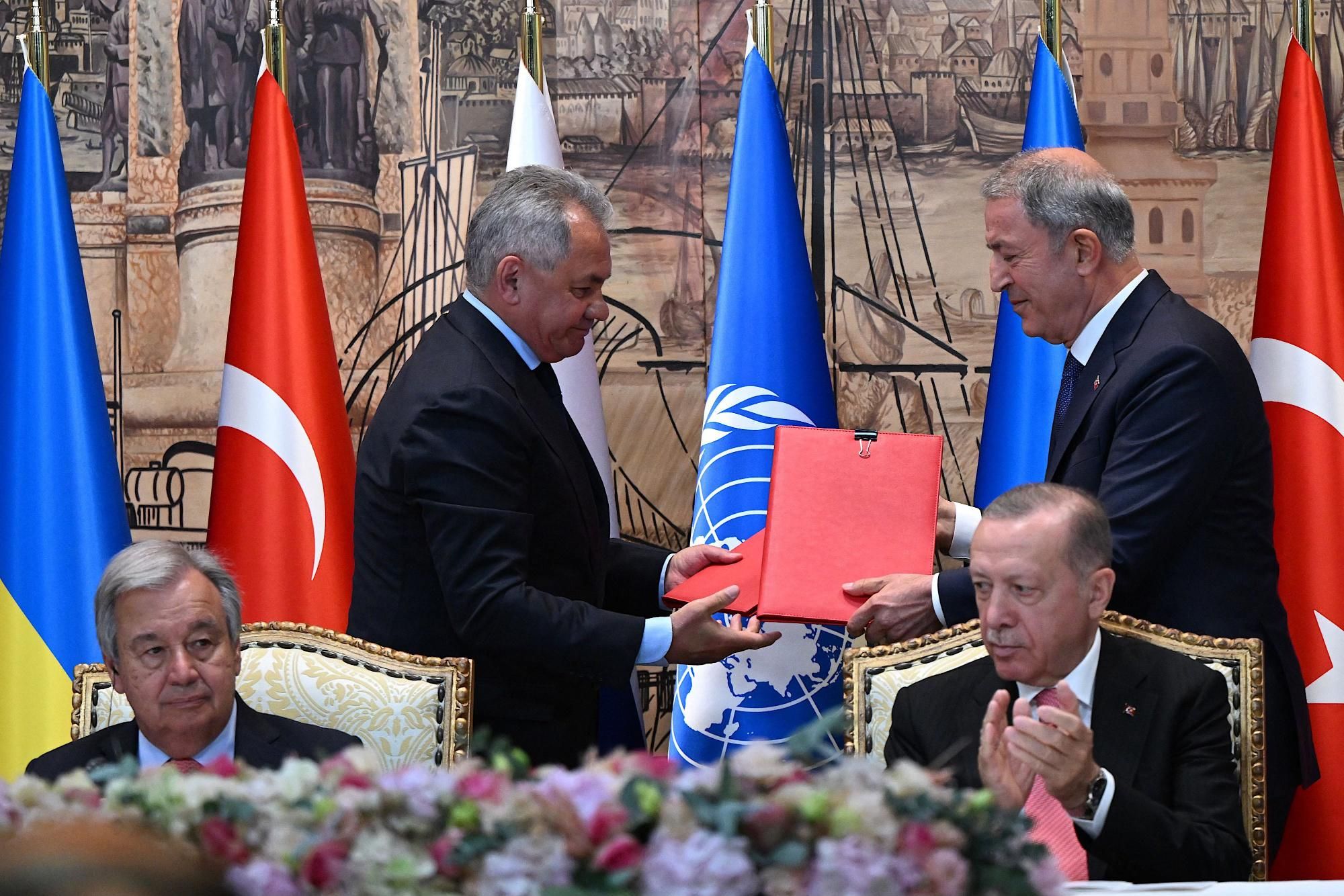
United Nations (Secretary-General Antonio Guterres, Russian Defense Minister Sergei Shoigu, Turkish Defense Minister Hulusi Akar, and Turkish President Recep Tayyip Erdogan attend a signature ceremony in Istanbul on July 22, 2022. (Photo: Ozan Kose/AFP via Getty Images)

JESSICA CORBETT
July 22, 2022


United Nations Secretary-General António Guterres on Friday celebrated an agreement by Russia and Ukraine to free up over 20 million tons of grain exports at blockaded Black Sea ports amid soaring food prices and fears of famine.

"Let there be no doubt—this is an agreement for the world."

Since Russia invaded Ukraine in late February, world leaders including Guterres have warned about the impact on the world's food chain. The Black Sea Grain Initiative was signed at a ceremony in Istanbul attended by the U.N. chief, Russian and Ukrainian ministers, and Turkish President Recep Tayyip ErdoÄŸan.

Guterres thanked Turkey's leader for facilitating the negotiations that produced the agreement, and told the Russian and Ukrainian representatives that "you have overcome obstacles and put aside differences to pave the way for an initiative that will serve the common interests of all."

"Today, there is a beacon on the Black Sea. A beacon of hope, a beacon of possibility, a beacon of relief—in a world that needs it more than ever," he said. "And let there be no doubt—this is an agreement for the world."

"It will bring relief for developing countries on the edge of bankruptcy and the most vulnerable people on the edge of famine," Guterres continued. "And it will help stabilize global food prices which were already at record levels even before the war—a true nightmare for developing countries.

Related Content

Surging Prices Amid Ukraine War Have Pushed 71 Million People Worldwide Into Poverty

"The initiative we just signed opens a path for significant volumes of commercial food exports from three key Ukrainian ports in the Black Sea," he explained. The warring parties also reached an agreement to get Russian food and fertilier to global markets.

The New York Times reported on how the export operation will work:

Ukrainian captains will steer vessels packed with grain out of the ports of Odesa, Yuzhne and Chornomorsk.

Using passages that are not mined, they will pilot the ships to Turkish ports to be unloaded, and the grain will then be shipped to buyers around the world.

The returning vessels will be inspected by a team of Turkish, U.N., Ukrainian and Russian officials to ensure that they are empty, and not carrying weapons to Ukraine, a key Russian demand.

A joint command center with officials from all four parties will be set up immediately in Istanbul to monitor every movement of the flotillas.

The newspaper also noted that "no broad cease-fire has been negotiated, so the ships will be traveling through a war zone," and attacks at the ports or inspection issues could imperil the 120-day deal, which officials hope will be renewed on a rolling basis.

Guterres, in his speech Friday, also acknowledged that in Ukraine, "conflict continues. People are dying every day. Fighting is raging every day."

"The beacon of hope on the Black Sea is shining bright today, thanks to the collective efforts of so many," he added. "In these trying and turbulent times for the region and our globe, let that beacon guide the way towards easing human suffering and securing peace."

Leaders at humanitarian groups cautiously welcomed the agreement.

"The lifting of these blockades will go some way in easing the extreme hunger that over 18 million people in East Africa are facing, with three million already facing catastrophic hunger conditions," said Shashwat Saraf, the International Rescue Committee's East Africa emergency director.

"Let's be clear—this will not end or significantly alter the trajectory of the worsening global food crisis."

"The next and significant step must be fully funding the humanitarian response in the region, to stave off the worst impacts of the drought and prevent a catastrophic, unprecedented famine from fully engulfing the region by the end of the summer," Saraf added.

Tjada D'Oyen McKenna, CEO of Mercy Corps, said that if the deal is respected, it "will help ease grain shortages, but let's be clear—this will not end or significantly alter the trajectory of the worsening global food crisis."

"Unblocking Ukraine's ports will not reverse the damage war has wreaked on crops, agricultural land, and agricultural transit routes in the country; it will not significantly change the price or availability of fuel, fertilizer, and other staple goods that are now beyond the reach of many, particularly in lower-income countries; and it will certainly not help the majority of the 50 million people around the world inching closer to famine stave off starvation," she said.

Highlighting conditions from Afghanistan, Colombia, and Guatemala to Somalia, Syria, and Yemen, McKenna argued that "we must recognize that our global food systems were already failing and record numbers of people were edging toward poverty and hunger due to the economic pummeling of the Covid-19 crisis and the impacts of climate change."

Along with providing emergency assistance, she said, "urgent action must be taken to strengthen agricultural food systems: Scale climate-resilient agricultural production and boost support for local agriculture by providing smallholder farmers the information, financial, and regulatory support they need to help their communities and countries reduce reliance on imports."

Our work is licensed under Creative Commons (CC BY-NC-ND 3.0). Feel free to republish and share widely.


Russia and Ukraine sign grain export deal: What you should know


Russia and Ukraine have signed a landmark deal with the United Nations and Turkey on resuming grain shipments in an attempt to ease a global food crisis in which millions face hunger.

Russian defence minister Sergei Shoigu and Ukrainian infrastructure minister Oleksandr Kubrakov each signed separate but identical agreements with UN and Turkish officials on reopening blocked Black Sea delivery routes.

Kyiv officials said they did not want to put their name on the same document as the Russians because of the five-month war that has killed thousands and displaced millions of Ukrainians.

Here is what you need to know:

What is the objective of the deal?

Russia’s invasion of Ukraine on February 24 led to a de-facto blockade of the Black Sea, resulting in Ukraine’s exports dropping to one-sixth of their pre-war level. Both Kyiv and Moscow are among the largest exporters of grain in the world, and the blockade has caused grain prices to rise dramatically.

The deal aims to help avert famine by injecting more wheat, sunflower oil, fertiliser and other products into world markets, including for humanitarian needs. It targets the pre-war level of five million metric tonnes of grain exported each month.

The UN World Food Programme says some 47 million people are now in a stage of “acute hunger” due to fallout from the war and experts have long warned of a looming global food crisis if Ukrainian grain exports remained blocked.

Ukraine also needs to empty its silos ahead of a coming harvest, while more exported fertiliser will avoid lower global yields for coming harvests.

Russia and the UN also signed a memorandum of understanding committing the latter to facilitate unimpeded access to global markets for Russian fertiliser and other products.


© Provided by Al Jazeera

When will grain exports resume?

According to Russia’s Shoigu, grain exports could restart in the “next few days”.

“Today we have all the prerequisites and all the solutions for this process to begin in the next few days,” Shoigu said after signing the deal.

Al Jazeera’s Diplomatic Editor James Bays, reporting from the UN headquarters, said it could be a “couple of weeks” before the first shipment of grain leaves Ukraine.

“There will be a test of implementation in the coming weeks,” Bays said, noting the backlog of millions of tonnes of Ukrainian grain in the country. “It is going to take some time to get all of that grain out – experts estimate probably about four months,” he added.

The deal is valid for four months or 120 days and will be automatically renewed unless the war ends.

Which ports are included?

UN Secretary-General Antonio Guterres said the accord would open the way to commercial food exports from three key Ukrainian ports – Odesa, Chernomorsk and Yuzhny.

A UN official told Reuters the deal included a “de facto ceasefire” for the ships and facilities covered.


A worker loads a truck with grain at a terminal during barley harvesting in Odesa 
[File: Igor Tkachenko/Reuters]

How will the deal be implemented?

Guterres said there will be a Joint Control Center (JCC) in Istanbul, which will schedule and monitor shipments.

According to one UN official, the JCC will be staffed by officials from the UN and probably military officials from the three countries involved, Reuters reported.

Though Ukraine has mined the waters near the ports as part of its war defences, there is no further need for de-mining. Rather, Ukrainian pilots will guide the ships along safe channels in its territorial waters, with a minesweeper vessel on hand as needed but no military escorts.

Monitored by the JCC, the ships then transit the Black Sea to Turkey’s Bosphorus Strait and off to world markets.

All sides have agreed there will be no attacks on these entities. If a prohibited activity is observed, it will be the task of the JCC to “resolve” it, the official said without elaborating.

In response to Russian concerns about ships delivering weapons to Ukraine, all returning ships will be inspected at a Turkish port by a team with representatives from all parties and overseen by the JCC. The teams will board vessels and assess their cargo before they can return to Ukraine.

‘A beacon of hope’: How the world reacted

Russia

Defence minister Shoigu has said Moscow will not take advantage of the fact that the ports will be demined and opened. “We have made this commitment,” he said.

Ukraine

Foreign minister Dmytro Kuleba said Kyiv trusts the UN, not Russia, to uphold the deal.

“Ukraine doesn’t trust Russia. I don’t think anyone has reasons to trust Russia. We invest our trust in the United Nations as the driving force of this agreement,” Kuleba said at an online press briefing.


United Nations


Guterres said there was now a “beacon on the Black Sea” after the “unprecedented” agreement was finalised.

“A beacon of hope … possibility … and relief in a world that needs it more than ever,” he added.
Turkey

President Recep Tayyip Erdogan said the pact will “renew hopes for peace”.

“With the ship traffic that will start in the coming days, we will open a new breathing tube from the Black Sea to many countries of the world,” he added after the deal signing.
European Union

EU foreign policy chief Josep Borrell says the deal was a “critical step” in helping reduce global food insecurity.

“EU remains committed to help Ukraine bring as much of its grain into global markets as possible,” he wrote on Twitter.

United States


The US called on Russia to allow Ukrainian grain to be exported quickly and voiced hope that the Turkish-brokered deal was well-structured enough to monitor compliance.

“We fully expect the implementation of today’s arrangement to commence swiftly to prevent the world’s most vulnerable from sliding into deeper insecurity and malnutrition,” White House spokesman John Kirby told reporters.

Ukraine-Russia grain deal to include control centre, inspections


Issued on: 22/07/2022 


01:24 Russian and Ukrainian delegations meeting along with UN and Turkish negotiators in Istanbul, Wednesday, July 13, 2022. © Turkish Defence Ministry via AP

Text by: FRANCE 24


Ukraine and Russia are set to sign a deal in Istanbul on Friday to reopen Ukraine's Black Sea ports and release Ukrainian grain exports, according to Turkey. Here are some details of the measures likely to be adopted in the agreement.

Following nearly two months of tough negotiations, Ukrainian and Russian officials are expected to sign the Black Sea ports deal at a ceremony in Istanbul’s Dolmabahçe Palace in the presence of UN Secretary General Antonio Guterres.

Some of the measures negotiated by the two sides:

Control centre based in Istanbul


A coordination and monitoring centre will be established in Istanbul, to be staffed by UN, Turkish, Russian and Ukrainian officials, which would run and coordinate the grain exports, officials have said.

Ships would be inspected to ensure that they are carrying grains and fertiliser rather than weapons. It also makes provision for the safe passage of the ships.

The control centre will be responsible for establishing ship rotation schedules in the Black Sea. Around three to four weeks are still needed to finalise details to make it operational, according to the experts involved in the negotiations.

Inspections on departures and arrivals in Turkey


The inspection of ships carrying grain was a Russian condition to ensure vessels would not simultaneously deliver weapons to Ukraine.

These inspections will not take place at sea as was once envisaged due to practical reasons, but will be carried out in Turkey, probably in Istanbul, which has two major commercial ports at the entrance to the Bosphorus (Haydarpasa) and on the Sea of Marmara (Ambarli).

Conducted by representatives of the four parties, the inspections will done upon the departure and arrival of ships.

Securing shipping lanes

Russians and Ukrainians are committed to respecting shipping lanes free of military activity in the Black Sea.

Under the agreement, if demining is required, it will have to be carried out by a "third country". Details of the third party have not yet been specified.

From Ukraine, the ships will be escorted by Ukrainian vessels (probably military) leading the way out of Ukrainian territorial waters.

Four-month duration, automatic renewal


The agreement would be signed for four months and automatically renewed. If 20 to 25 tonnes of grain are currently outstanding in silos in Ukrainian ports, and at a rate of eight tonnes evacuated per month, this four-month period should be enough to clear the stocks.

A condition related to Russian grain and fertilisers


A memorandum of understanding must accompany this agreement, signed by the UN and Russia, guaranteeing that Western sanctions against Moscow will not affect Russian grain and fertilisers, directly or indirectly.

This was a Russian prerequisite for signing the agreement.
What is the remedy against inflation?

by Mario Seccareccia
July 19, 2022

From the Monetary Policy Institute: Has the Bank of Canada already abandoned its new mandate a mere six months after its adoption?
Credit: Michelle Spollen / Unsplash


On July 13, the Bank of Canada raised its policy interest rate by an aggressive 100 basis points, making it the biggest hike in almost a quarter century. Given its 2 per cent inflation target and an inflation rate at 7.7 percent in May, it was hardly surprising to see another rate jump.

At the end of January, the Bank officially removed its so-called “exceptional” forward guidance — which kept its policy interest rate pegged for over two years at 0.25 percent since the beginning of the pandemic — and since, we have seen a subsequent revision of its forward guidance. Now, the target overnight/policy rate would have to reach its estimated non-inflationary “neutral” interest rate range of between 2–3 percent mid-point. This would ensure that Canada’s inflation returns to its 2 percent target by 2024.

Hence, given the official forewarnings, the upward path taken for its policy interest rate, which started in early March with an initial mild increase of 25 basis points, was certainly predictable. However, the speedy acceleration of the policy rate increases, which have been bringing its policy rate prematurely closer towards its “neutral” level in 2022, is a surprise. Its policy rate first went up by 50 basis points each time in April and again in early June, and now we observe what Governor Macklem refers to as a “front-end loading”: a 100 basis-point jump in July!

This essentially multiplies its overnight rate tenfold — to 2.5 percent within approximately five months. We are told by the Governor that the recent more aggressive measure was needed to prevent inflationary expectations from becoming entrenched in the price/wage setting process since the overall inflation has now become generalised with the Bank’s “core” measures of Canada’s inflation rate having recently jumped from 3.9 percent to 5.4 percent.

One can easily become entangled within the technical universe of the Bank of Canada. Indeed, many policy analysts in Canada have been swayed by the Bank’s repeated assertion that, as a modern inflation-fighting central bank, it can well plan and clinically engineer a programmed disinflation within the next two years. However, given the blunt instrument that it disposes, it may well face a credibility problem. The Bank recognizes that there are some extremely serious risks with the adoption of this hawkish interest-rate experiment, which, sadly, we have seen before with the “mother” of these interest-rate increases being the famous “Volcker shock” in the United States, over four decades ago.

Viewed superficially from its decision on July 13, it would seem that the Bank is currently betting that it can initiate a significant “shock” effect so as to prevent the increasing inflationary expectations from becoming “entrenched” and that it can manage a smooth disinflation or “soft landing” without significantly damaging the country’s fragile growth as the Canadian economy struggles to come out of the COVID-19 crisis.

Unfortunately for the Bank’s communication strategy, not everyone believes this — not even the financial community! A revealing example is the evolution of the Canadian dollar immediately following the announcement of the 100-basis points hike, which, instead of the expected currency appreciation (as the textbooks would predict with a large interest-rate increase), the loonie actually dropped to a 20-month low vis-à-vis the US dollar immediately following the rate increase!

Contrary to those who explain this decline in the Canadian dollar on the expected rise in the US Federal Funds Rate by 75 basis points later in July, I believe the principal reason is the fear that this hawkish Bank of Canada behaviour could generate yet another recession in Canada, especially after just having suffered the terrible damages from Covid-19 over the last two years.

Visibly, there are many who believe that the Bank will not manage this programmed disinflation in Canada particularly well. In fact, as recognized in a recent study by David Macdonald at the Canadian Centre for Policy Alternatives, there is no historical precedence over the last half century that our central bank can manage significant rate hikes of the magnitude that we have witnessed cumulatively over the last few months without causing a serious recession. While the Bank actually does predict slower growth for 2023 and 2024 because of the slow return towards increasing austerity, researchers at the Bank do not predict the negative growth that Macdonald’s historical evidence actually suggests.

In light of this, a few obvious questions all Canadians should be asking are: why is the Bank not considering such empirical evidence? And why is it willing to risk what predictably can be a “hard landing” with an expressed desire to return to higher unemployment levels after just a very short interval over the last few months of unusually low unemployment and high vacancy rates?

After all, this growing labour market tightness may well be merely a special feature of an economy recovering from the ongoing pandemic rather than a normal feature of an economy that is overheating. Some recent work would suggest that we are still far from the type of full-employment rates of unemployment that, for instance, had prevailed in the early postwar period in Canada.

Moreover, has Governor Macklem forgotten or deliberately overlooked the new mandate of the Bank of Canada that was adopted by the Trudeau government just a mere six months ago in December 2021? Is he ignoring the evidence that its discretionary interest-rate policy might create a significant recession accompanied by predictably much higher unemployment? While the priority for the Bank of Canada remains its 2 percent inflation target, it cannot officially disregard the potential impact that its interest rate policy can have on the unemployment rate — which after all does have an official mention in its new five-year monetary policy mandate. The risks of a hard landing have been completely ignored with its aggressive “front-end loading” of the Bank’s interest-rate increases.

Also, in its official statement, the Bank does correctly recognize that the principal drivers of the inflation rate in Canada are “global factors such as the war in Ukraine and ongoing supply disruptions”. Yet, in the same breath, it concludes that “domestic price pressures from excess demand are becoming more prominent.” But what precisely is the evidence that the demand-side factors are taking on a “more prominent” role in pushing upward the inflation rate?

As stated above, the historically-high job vacancy rate may merely be symptomatic of specific labour-market problems connected with our recovery from the pandemic and not an indicator of generalized excess-demand problems in the product markets. Much of the empirical evidence produced in the United States, which includes work done by some US Fed economists, would suggest that demand-side factors are not at all predominant in explaining product price increases and that the inflation rate has actually become somewhat unresponsive to demand-side indicators, such as the unemployment rate, thereby revealing a relatively flat Phillips Curve.

If the inflation rate is not very responsive to rising unemployment, and if most of the inflation is related to supply-side problems that the Bank cannot control, such as international oil price increases, then why inflict the pain of higher unemployment on the Canadian economy? Given the high sacrifice ratio of getting the inflation rate down even marginally, why should wage earners bear the burden of the Bank’s anti-inflation policy?

The only logical conclusion that one can derive from this hawkish policy is that the Bank is deliberately taking side against labour by preventing wages from rising and catching up with the inflation rate. To achieve that, it must increase the unemployment rate significantly so as to weaken the bargaining power especially of organised labour. Much of the evidence from the United States points to significant rises in profit markups of business enterprises throughout 2021 and early 2022. Labour has been very slow to redress that widening gap between prices and wages by demanding higher wage increases that have significantly lagged behind price increases.

Even in Canada, we have seen wage increases lagging significantly behind inflation. For instance, as late as in May, consumer prices grew by 7.7 percent while average hourly wages grew by 3.9 percent. Seeing that wage increases are beginning to accelerate with a jump to 5.2 percent in June, the Bank has decided to make full use of its interest-rate lever to prevent this wage catch-up. The potential effect of the interest rate hike is to slow down significantly the economy and generate higher unemployment. When looked at from the angle of labour, such a policy must raise a fundamental moral question of controlling inflation for whom?

In sum, what if the Bank succeeds in controlling wage growth but the inflation rate continues to be sustained by international factors over which the Bank actually has no control? Why would it de facto be taking side by imposing the burden of the inflation on workers? One must remind the Bank that during that whole era of “inflation first” monetary policy since the 1980s, workers saw their share of national income decline significantly even though, over the longer term during that era especially before the Global Financial Crisis, wages were actually growing more or less commensurate with consumer prices. As is well known, the reason why the share of labour declined over those decades was because real wages were flat while the economy’s productivity grew, thereby expanding the shares of profit and interest income earners at the expense of labour’s share.

On July 13, 2022, in its fight against inflation, the Bank is not only offering the prospect of a familiar decline in the share of labour, which working people in Canada had suffered already to a very great extent since the 1980s, but it is also offering a predictable decline in real wages over the coming years. When looked at through the looking glass of its incidence on ordinary working Canadians, there is a fundamental moral problem to which the Bank seems to be noticeably insensitive. In the current context, it is wrong to raise interest rates so quickly whose only predictable outcome is higher unemployment that will slow down wage growth so as to prevent a wage-price spiral that would otherwise become an inflationary “add-on” domestically to the imported international supply-side inflation over which admittedly the Bank of Canada has no control.

As raised elsewhere, surely one ought to consider a more equitable solution to this wage-price spiral than this biased “class war” outcome in which an important agency of the federal government has chosen to take side against labour.

Reference:
Seccareccia, Mario (2022), “Can the Pursuit of Fiscal and Monetary Policies Achieve a Meaningful Full-Employment Objective without Inflation? Learning from the Canadian Historical Experience, including the Recent COVID-19 Crisis”, Paper presented at the XXII Seminar of Fiscal and Financial Economics, Public and Private Credit: National and Global Experiences in the Current Crisis, National Autonomous University of Mexico, Mexico City (March 30).


This piece originally appeared in the Monetary Policy Institute.
Landlord-tenant relations reach a boiling point over A/C units

by Nick Seebruch
July 21, 2022

In a time of rising rental rates, reno-victions is a term that has quickly entered the vernacular, but now it seems to come in a new summer flavour: A/Cvictions.

Residents outside the building shortly after they received eviction notices.
 Credit: @BhutilaKarpoche / Twitter


As a humid heatwave hangs heavy in the air across much of Ontario, residents of one apartment building in Toronto must choose between air conditioning and affordability.

Last month, dozens of residents living at 130 Jameson Ave., a multi-residential high-rise apartment building in Toronto’s Parkdale neighbourhood, received notices of eviction. The reason given for these notices was that these residents had air conditioning units in their homes.

There were at least 50 residents who received such notices. Resident Shelly Dunphy has lived in the building her entire life, she says she was practically born there, and she told rabble.ca that this was the first time that air conditioning units caused an issue.

In an email obtained by rabble from Myriad Property Management, who manage the building, the company states that operating air conditioning units are not covered by the tenants lease agreement.

“We conduct annual inspections of all the units in 130 Jameson. During that time, we note any deviations to what is allowable under that tenant’s lease. This could include air conditioners and other additional appliances not included in the lease agreement,” the email reads.

Myriad goes on to state that tenants are then given two weeks to choose to either pay them a fee for the unit, or to enter into an agreement with the electricity company to pay for the costs of the air conditioner. If the tenant chooses neither of these options, then they are served with a notice of eviction, known as an N5.

“We are doing nothing that is not proscribed in the RTA and enforced by the LTB,” Myriad states, referring to the Residential Tenancies Act which is enforced by the Landlord Tenant Board. “It was not, has never been, and will never be our intent to evict someone without providing them the opportunity to remedy the situation in a reasonable manner and amount of time.”
A matter of gentrification

Dunphy said that this is an example of a landlord attempting to evict tenants in order to put properties back on the rental market at a higher rate.

“Local rents in the neighbourhood have doubled in the past 10 years,” Dunphy said. “Once this happens to us, other buildings in the neighbourhood will be next.”

Myriad’s tactic is a different flavour of a similar strategy that has been seen more frequently in different years, reno-victions.

Under the RTA, a landlord can only raise a tenant’s rent once a year, and only at a maximum rate of 1.2 per cent year-over-year.

However, a landlord can set the rent on a vacant property as high as the market can bear. In times when property values are rapidly rising and housing is at a premium, unscrupulous landlords have an incentive to evict tenants in order to get a bigger financial return from their rental units. One condition under which a landlord can evict a tenant is if the landlord states that renovations must be done to the unit in order for it to remain habitable.

If a tenant receives a notice of eviction from their landlord for the purpose of renovations, the tenant can still return to the property once the renovations are completed under their original rental rate as stated in the RTA. To do this, a tenant must inform their landlord of their intentions in writing and must also refuse any financial compensation offered by the landlord.

In the meantime, the tenant will still have to find other accommodations at their own expense until the renovations are completed. The tenant can also dispute the need for renovations entirely in front of the LTB, but it currently takes the LTB an average of 131 days in order to fully hear and rule on a case.

While the housing market continues to cool in Toronto, Torontorentals.com stated in their June report that the average rental price in the city in May was 16.5 per cent higher than it was just the year prior.

In May of 2019, the average two-bedroom apartment cost $2,204 a month to rent; by May of this year, that price rose to $2,584 a month.
Putting the brakes on a runaway rental market

Ontario NDP MPP Bhutila Karpoche represents the Parkdale neighbourhood in the Ontario Legislature. In October of 2021, she co-sponsored a bill to stop skyrocketing rents in the province.

The Rent Stabilization Act would have limited the amount a landlord could raise the rent on a vacant property to 1.2 per cent.

“People are being forced out of their neighborhoods, away from their support systems, because of rising rents,” said Karpoche’s fellow Toronto NDP MPP Jessica Bell, who also co-sponsored the bill. “They’re being reno-victed by landlords looking for an excuse to get them out because they’re allowed to hike rents as much as they like in between tenants.”

Karpoche told rabble that tenants receiving eviction notices for having air conditioning units was just another form of reno-viction.
Province should protect tenants from the heat

“I think the landlord should withdraw these eviction notices,” Karpoche said. “It is really important that tenants have ways to protect their health and safety during heat events.”

During the winter months, the RTA stipulates that it is a landlord’s responsibility to maintain a minimum temperature of 21 degrees in a rental unit. Karpoche is calling on the Ontario government to implement a maximum temperature regulation so that tenants are protected from extreme weather events in both the summer and in the winter.

In July of 2021 Kiri Vadivelu of ACORN (Association of Community Organizations for Reform Now) Scarborough called on the government of Ontario Progressive Conservative Premier Doug Ford to intervene, explaining that it was not unusual for landlords to block tenants from installing air conditioning units.

“Heat is a serious health issue, and tenants need to be able to stay cool,” said Vadivelu. “But many landlords are charging illegal fees and harassing tenants that have window air conditioning units, which is putting people’s health at risk.”

Dunphy said that she was organizing with some of her fellow tenants at 130 Jameson to fight the notices from Myriad and that they are getting help in doing so from the Parkdale Community Legal Services. She encouraged her fellow residents not to sign the new agreement with the landlord.

This article is part of rabble’s series “The Boiling Point.” The Boiling Point examines the ways increasingly high temperatures due to the climate crisis are affecting our summers in Canada on a social, institutional, and ecological level. The series also explains how Canadians can take action against climate change and make real differences in their communities. Follow more stories here.


NICK SEEBRUCH
Nick Seebruch has been the editor of rabble.ca since April 2022. He believes that fearless independent journalism is key for the survival of a healthy democracy. An OCNA award-winning journalist, for... More by Nick Seebruch