Tuesday, August 02, 2022

Africa sees some artifacts returned home but seeks far more
By RODNEY MUHUMUZA, FARAI MUTSAKA and CHINEDU ASADU
July 31, 2022
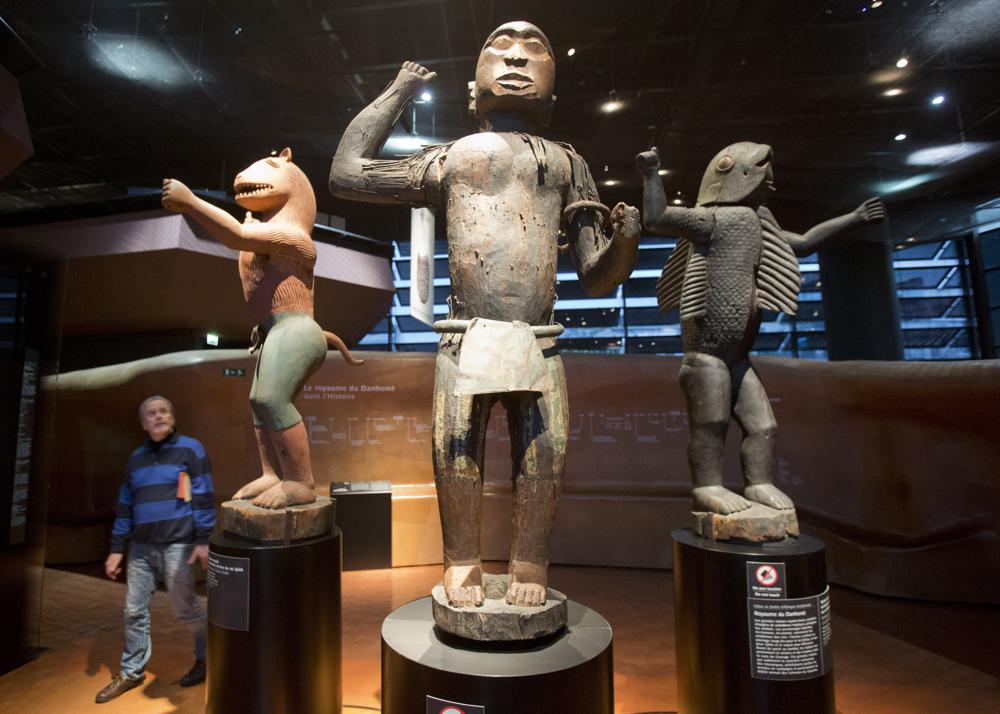
 A visitor looks at wooden royal statues of the Dahomey kingdom, dated 19th century, at the Quai Branly museum in Paris, France, Nov. 23, 2018. African countries’ efforts at restitution of artifacts from institutions in Europe are now blossoming with the return of pieces that once were thought unattainable. But many objects are still out of reach, and some officials worry they don't even know the true extent of what was taken abroad.
(AP Photo/Michel Euler, File)


KAMPALA, Uganda (AP) — Apollo John Rwamparo speaks forlornly of the eight-legged stool, a symbol of authority for his ancient kingdom in Uganda, now glimpsed through a glass barrier at a museum thousands of miles away in Britain.

The wooden stool is permanently exhibited at the University of Oxford, one of at least 279 objects there taken from Bunyoro-Kitara kingdom during the colonial era. Oxford has resisted attempts to have the stool repatriated, saying it was donated by a royal from a breakaway kingdom.

“It’s quite frustrating,” said Rwamparo, a deputy prime minister and minister for tourism for the kingdom. “The best is for them to swallow their pride, like the French and the Germans have done, and return the artifacts.”

African countries’ efforts at restitution, after long resistance from authorities in Europe, are now blossoming with the return of treasured pieces that once were thought unattainable.

Most recently, Nigeria and Germany signed a deal for the return of hundreds of artifacts known as the Benin Bronzes. The deal followed French President Emmanuel Macron’s decision last year to sign over 26 pieces known as the Abomey Treasures, priceless artworks of the 19th century Dahomey kingdom in present-day Benin.

African officials seek much more, from the exquisite to the macabre. Some are concerned that the British government in particular has been evasive, offering no commitments on restitution.

In Uganda, which won independence from Britain in 1962, antiquities officials are preparing for a November trip to the U.K., where they will negotiate with the University of Cambridge for an unknown number of artifacts there. Cambridge, which recently gave back to Nigeria an elaborate bronze cockerel, appears forthcoming, said Rose Mwanja Nkaale, Uganda’s commissioner for museums and monuments.

London’s British Museum by comparison “is difficult to penetrate,” said Nkaale. “We can start with those that are willing to cooperate. It is not useful to fight these people.”

The British Museum, which holds an extensive collection from across Africa, is protected by a 1963 law forbidding the trustees from repatriating items except under certain circumstances, including if an object is deemed unfit or useless. Some African officials believe that stand is increasingly weak as other institutions in Europe respond more positively.


Benin bronzes objects are displayed at the Linden Museum in Stuttgart, Germany, June 29, 2022 .African countries’ efforts at restitution of artifacts from institutions in Europe are now blossoming with the return of pieces that once were thought unattainable. But many objects are still out of reach, and some officials worry they don't even know the true extent of what was taken abroad. (Bernd Weissbrod/dpa via AP, File)

Nigeria is applying pressure so that laws in the U.K. and elsewhere are amended to allow for the repatriation of disputed collections, said Abba Isa Tijani, director-general of Nigeria’s National Commission for Museums and Monuments. But he expressed concern that while some countries are starting to open up, in Britain such efforts “have not even started.”

Many of the desirable artifacts from Africa can’t even be traced, leading an organization founded by the late Congolese art collector Sindika Dokolo to offer to buy looted African art from collections abroad. By 2020, when Dokolo died in a diving accident in Dubai, his campaign had successfully retrieved 15 items.

Restitution remains a struggle for African governments, and the African Union has put the return of looted cultural property on its agenda. The continental body aims to have a common policy on the issue.

Zimbabwe has pushed for the repatriation of about 3,000 artifacts from Britain. They include spears and swagger sticks as well as the skulls of fighters who resisted colonialism. They were decapitated and their heads shipped abroad as war trophies.

Talks between British and Zimbabwean authorities have produced no breakthrough, but the matter is so important for the southern African nation that President Emmerson Mnangagwa last year suggested an exchange: the remains of colonialist Cecil Rhodes, who’s buried in Zimbabwe, in return for the ancestral remains that mean so much to his people.

Some Zimbabwean activists have started an online campaign called #bringbackourbones, protesting last year outside the British High Commission in neighboring South Africa.

Items of funereal or ritualistic interest have no resonance outside Africa, said Raphael Chikukwa, who runs the National Gallery of Zimbabwe.

“Why should we allow those so-called museums, which in fact are crime scenes and houses of stolen goods, to dictate to us, telling us that we have to prove that the items belong to us?” he told The Associated Press. “As much as we celebrate the return of former Congolese Prime Minister Patrice Lumumba’s tooth (from Belgium), let’s not celebrate too much. Let’s remind ourselves that the work has just started.”

Similar efforts are underway in South Africa, where the Ifa Lethu Foundation seeks to repatriate a range of items taken during the apartheid era, often by diplomats or private collectors. The organization has repatriated more than 700 pieces including valuable works by South African artist Gerard Sekoto, who died in Paris in 1993.

In Rwanda, recent cooperation with former colonial master Belgium included the sharing of digital copies of over 4,000 songs and other recordings kept at the Royal Museum for Central Africa outside Brussels.

Items including royal regalia remain at large, and since the digital sound archives weren’t shared in the context of repatriation “you cannot say Belgium has already handed them back,” said Andre Ntagwabira, a specialist in archaeological research at Rwanda Cultural Heritage Academy.

“The heritage, both tangible and intangible items, are the footprints of our ancestors and we should own them,” he said.

The whereabouts of the remains of one of Rwanda’s last monarchs, Yuhi Musinga, is a sore issue in the East African country. Many Rwandans believe the body of Musinga, who resisted the Belgians, was deposed in 1931 and died in Congo in 1944, was sent to Belgium.

There must be accountability in that case, said Antoine Nyagahene, a professor of history at Rwanda’s Gitwe University.

“We were robbed of our cultural values and, as you know, a people without roots are a people without a soul,” he said.
___

Mutsaka reported from Harare, Zimbabwe, and Asadu from Abuja, Nigeria. Associated Press writers Ignatius Ssuuna in Kigali, Rwanda, and Mogomotsi Magome in Johannesburg, South Africa, contributed.
As species recover, some threaten others in more dire shape

By JOHN FLESHER, CHRISTINA LARSON and PATRICK WHITTLE
August 1, 2022

1 of 9
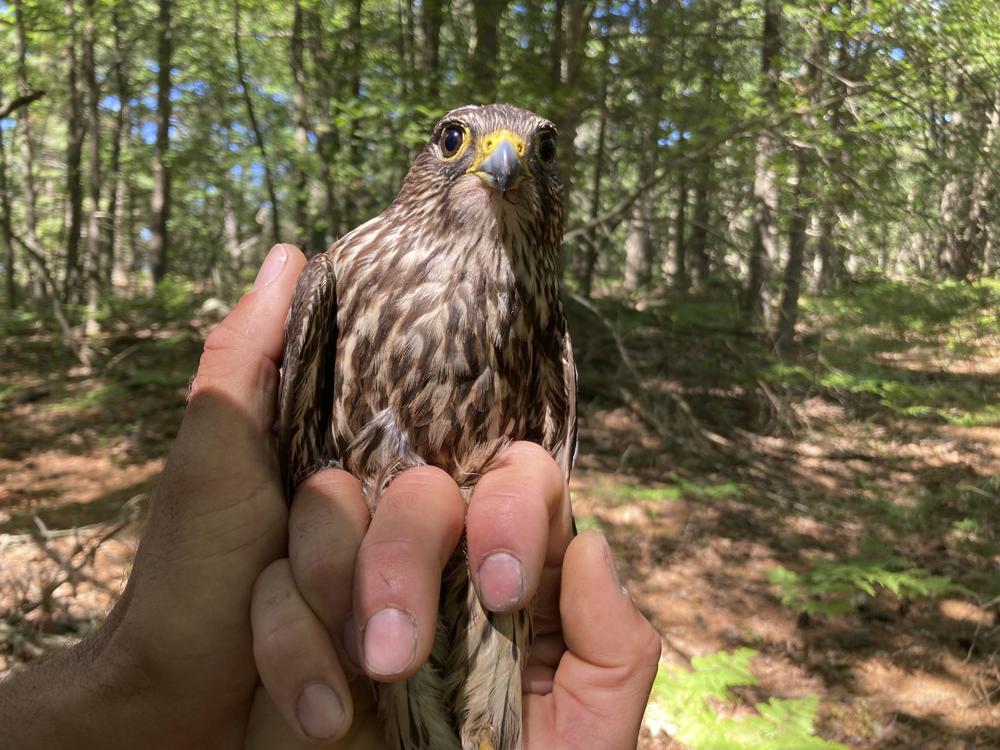
A captured merlin is held near Lake Michigan on June 27, 2022, near Glen Arbor, Mich., where it will be fitted with a leg band and tracking device. The mission will enhance knowledge of a species still recovering from a significant drop-off caused by pesticides and help wildlife managers determine how to prevent merlins from attacking endangered piping plovers at Sleeping Bear Dunes National Lakeshore. 
(AP Photo/John Flesher)

LONG READ

GLEN ARBOR, Mich. (AP) — In a forest near Lake Michigan, two scientists attached a backpack tracking device to a merlin they’d lured into a net. The mission: help prevent the predatory species from gobbling up piping plovers — highly endangered shorebirds that nest nearby.

Merlins themselves were going downhill decades ago but are recovering, thanks to bans on pesticides such as DDT. That’s good for them — but not for plovers in the Great Lakes region, where only 65 to 70 pairs remain. The small falcons are “are a big threat to their recovery,” said Nathan Cooper, a research ecologist with Smithsonian’s National Zoo and Conservation Biology Institute.

The situation is ironic. A troubled species rebounds thanks to restoration efforts, only to make things worse for others in peril by preying on them or outcompeting them for food and living space. Similar circumstances have turned up elsewhere, challenging wildlife experts who want them all to thrive in balanced, healthy environments.

For instance, the iconic bald eagle’s comeback has pressured rare water birds. Resurgent peregrine falcons menace endangered California least terns and Western snowy plovers that take refuge at naval bases near San Diego. And, off the California coast, attacks from protected white sharks hinder recovery of threatened sea otters.

Gray seals previously on the brink of extirpation in waters of New England now occupy some Massachusetts beaches by the hundreds. The 800-pound mammal’s return has raised worries about vulnerable fish stocks.

Such unintended consequences don’t necessarily reveal flaws in the U.S. Endangered Species Act or conservation programs, experts say. Rather, they illustrate nature’s complexity and the importance of protecting biological communities, not just individual species.

“Clearly there are occasions when we get these conflicts between species that we’re trying to protect,” said Stuart Pimm, a Duke University extinction specialist. “But is it a major worry in conservation? No.”

Species recoveries can produce tradeoffs, since some animals are more adaptable than others to changes in the climate or landscape, said Bruce Stein, chief scientist with the National Wildlife Federation.

(AP video/John Flesher, Mike Householder)


“A lot of ecosystems where these things are occurring are a little out of whack to begin with because we’ve altered them in some way,” Stein said. “With climate change, there are going to be winners and losers. The losers will tend to have specific habitat requirements, narrow ecological niches, and often will be the ones already declining.”

OUTSMARTING A MERLIN


Smithsonian interns Tim Baerwald and Zachary Bordner snared the merlin at Sleeping Bear Dunes National Lakeshore with help from its natural enemy: a great horned owl. This one was dead but fitted with remote-control devices to make it hoot and flap its wings.

The merlin darted overhead, sounding high-pitched, rapid-fire distress calls. It dove into a net stretched between steel poles. The scientists gently disentangled the brownish-speckled female, then attached the tracker and a leg band.

“As long as it’s fitted correctly, she’ll have a long and happy life,” Baerwald said before Bordner released the merlin, which zipped back to its nesting tree.

Merlin numbers in the region have jumped since the DDT ban in 1972. They’re suspected of killing at least 57 adult piping plovers in the past 10 to 15 years, said Cooper of Smithsonian.

The sandy-backed, ring-necked plovers skitter along beaches nibbling tiny marine animals and eggs. They’re among three remaining North American populations, their decline caused primarily by habitat loss and predation.

While officials have shot some merlins, they’re looking for non-lethal controls. Data from the transmitter backpacks might help determine whether capturing and relocating them is worth trying, said Vince Cavalieri, a biologist with the national lakeshore.

EAGLES THREATEN RARE BIRDS

Recovery of America’s national bird, the bald eagle, is a triumph. But in one area of coastal Maine, the big raptor poses a problem for the only U.S. breeding population of great cormorants.

“When they’re disturbed by eagles, the adult cormorants will flush and leave their nests,” said Don Lyons, a conservation scientist at the National Audubon Society’s Seabird Institute.

Then gulls, ravens and crows swoop in to gobble cormorant eggs and chicks. “If this happens repeatedly, an entire colony can fail,” Lyons said.

His team organizes volunteers to camp near cormorant gatherings to scare away eagles.

In Southern California, least terns and snowy plovers are no match for attacking peregrine falcons, which like eagles bounced back after the ban on DDT. Such pesticides are passed up food chains and cause large birds to produce eggs with thin shells, which females crush when trying to incubate them.

The San Diego Zoo and Wildlife Alliance tries to protect the endangered birds by hiring a falconer to capture problem peregrines, keeping them in a holding facility over winter or releasing them in Northern California. Some find a new territory, while others go back, said Nacho Vilchis, a conservation ecologist.

“If there’s a real problem bird that keeps returning, we may ask for permission for lethal removal, but that’s only rarely done,” Vilchis said.

Hunting and bounties devastated New England’s gray seals. Saved by the Marine Mammal Protection Act of 1972, the population has rebounded to tens of thousands.

Fishing groups contend the seals could threaten cod stocks that regulators are struggling to rebuild after decades of overfishing.

The Coastal Ecosystem Alliance, based in Fairhaven, Massachusetts, wants to weaken the protection act to allow hunting and slow the seals’ population growth, said board member Peter Krogh.

“Gray seals are certainly this case where recovery has both been cause for celebration and cause for concern,” said Kristina Cammen, a University of Maine marine mammal scientist who says they’re less of a hazard to fish populations than humans are.

SEALS, CORMORANTS BEDEVIL FISHERS


Like the clash over seals and cod, there are other cases where reviving species may be more a nuisance to people than a threat to other wildlife.

Fish farmers in the South and anglers in the Great Lakes region and Pacific Northwest have long complained about the double-crested cormorant, a dark-feathered diving bird that gorges on catfish, perch, salmon and other prized species.

Cormorants have done so well since the DDT ban that agencies have tried limiting them in some locations with egg oiling, nest destruction and even shooting — drawing lawsuits from environmentalists who say the birds are a scapegoat for human actions that harm fish.

“They’re a part of our avian community and our ecosystems, and there needs to be a place for them,” said Dave Fielder, a fisheries research biologist with the Michigan Department of Natural Resources. “But when their numbers are so high that they potentially decimate the recreational fishery, that’s a problem.”

Wild turkeys were spread across North America before European settlement but had dwindled to tens of thousands by the 1930s, disappearing from many states. Now they’re hunted in 49 states and are so common in New England that they often cause traffic tie-ups.

Some hunters say hungry turkeys are outcompeting ruffed grouse, which are decreasing in parts of their range, such as the Upper Midwest. But scientists point to habitat loss and climate change.

The National Wild Turkey Federation is helping move turkeys from states with plenty — such as North Carolina, Maine and West Virginia — to Texas and others that could use more, said Mark Hatfield, national director of conservation services.

“If you introduce hunting localized wild turkeys, you reduce the problem with overabundant turkeys right away,” Hatfield said.

NATURE AT WORK

Conflicts between recovering species and ones still in trouble don’t always mean something is wrong, scientists say. It could reflect a return to how things were before humans got in the way.

“When a population gets back to where it’s having the same interactions with other organisms as before it went down, that’s nature at work,” said John Fitzpatrick, emeritus director of Cornell University’s Laboratory of Ornithology.

The bald eagle is “challenging our preconceived notions about what’s normal” for prey such as great cormorants in New England and common murres on the West Coast, which might have been less abundant before eagles declined, said Lyons of the Audubon Society.

The eagle’s recovery “complicates the conservation of certain other species,” Lyons said. ”But their recovery is such a wonderful outcome ... that’s a welcome complication.”

Predator-prey relationships are complex and intervening can be tricky, said Stein of the wildlife federation. It’s often wiser, he said, to focus on protecting habitat and reconnecting fragmented landscapes to promote natural migration than “moving things around willy-nilly.”

But environmental scientist Ian Warkentin, a merlin specialist, said there can be ways to help struggling species without being heavy-handed. Larger falcons — such as peregrines sometimes used to chase birds from airports — might be deployed to shoo merlins from plover nesting areas.

“I fall on the side of the fence that says we should do whatever we can ... to aid the recovery of species for which we’ve caused such grief,” said Warkentin, from Memorial University of Newfoundland’s Grenfell Campus.

___

Larson reported from Washington, D.C., and Whittle reported from Portland, Maine.

___

On Twitter follow Flesher: @JohnFlesher; Larson @LarsonChristina and Whittle: @pxwhittle
Supreme Court certifies ruling ending Trump border policy
By ELLIOT SPAGAT
August 1, 2022

A Border Patrol agent watches as a group of migrants walk across the Rio Grande on their way to turn themselves in upon crossing the U.S.-Mexico border in Del Rio, Texas, on June 15, 2021. The Supreme Court has certified its month-old ruling allowing the Biden administration to end a cornerstone Trump-era border policy to make asylum-seekers wait in Mexico for hearings in U.S. immigration court. It was a pro forma act that has drawn attention amid near-total silence from the White House about when, how and even whether it will dismantle the policy. (AP Photo/Eric Gay, File)


SAN DIEGO (AP) — The Supreme Court on Monday certified its month-old ruling allowing the Biden administration to end a cornerstone Trump-era border policy to make asylum-seekers wait in Mexico for hearings in U.S. immigration court, a pro forma act that has drawn attention amid near-total silence from the White House about when, how and even whether it will dismantle the policy.

The two-word docket entry read “judgment issued” to record that justices voted 5-4 in a ruling issued June 30 that the administration could scrap the “Remain in Mexico” policy, overruling a lower court that forced the policy to be reinstated in December.

Homeland Security Secretary Alejandro Mayorkas said shortly after the Supreme Court victory that justices would need to communicate the decision to a lower court, which, in turn, should lift the order to keep the policy in place in a lawsuit filed by the state of Texas. Beyond that, administration officials have said little, including whether any of the thousands subject to the policy since December will be allowed to enter and remain in the United States while their cases are being considered in immigration court.

The White House and Homeland Security Department had no immediate comment on the Supreme Court certification; the Justice Department declined comment. Officials in Mexico had no immediate comment.

About 70,000 migrants were subject to the policy, known officially as “Migrant Protection Protocols,” or MPP, from when former President Donald Trump introduced it in January 2019 until President Joe Biden suspended it on his first day in office in January 2021, fulfilling a campaign promise. Many were allowed to return to the United States to pursue their cases during the early months of Biden’s presidency.

Nearly 5,800 people have been subject to the policy from December through June, according to figures released Friday, a modest number that would make any reluctance to end it seem less plausible. Nicaraguans account for the largest number, with others from Cuba, Colombia and Venezuela.

A sign posted last week at the entrance to the Salvation Army migrant shelter in Tijuana, Mexico, by the United Nations’ International Organization for Migration appeared to best capture the public understanding of the policy’s status: “Wait for official information! The Remain in Mexico (MPP) program remains in effect. The United States government will inform you of any changes.”

Critics of the policy have been increasingly outspoken about the Biden administration’s reticence on “Remain in Mexico,” and Monday’s certification renewed their calls for an immediate end to the policy.

“It’s a zombie policy,” said Karen Tumlin, founder of Justice Action Center, an immigration litigation organization.

The final move may rest with U.S. District Judge Matthew Kacsmaryk in Amarillo, Texas, a Trump appointee whose ruling last year brought “Remain in Mexico” back.
MONOPOLY CAPITALI$M
US begins court battle against publishing giants’ merger

By MARCY GORDON and HILLEL ITALIE
August 1, 2022

1 of 3
An outside view of the German media giant Bertelsmann in Guetersloh, Germany, is shown March 13, 2003. The government and publishing titan Penguin Random House, owned by Bertelsmann, are set to exchange opening salvos in a federal antitrust trial Monday, Aug. 1, 2022, as the U.S. seeks to block the biggest U.S. book publisher from absorbing rival Simon & Schuster. (AP Photo/Michael Sohn, File)


WASHINGTON (AP) — The government and publishing titan Penguin Random House exchanged opening salvos in a federal antitrust trial Monday as the U.S. seeks to block the biggest U.S. book publisher from absorbing rival Simon & Schuster. The case comes as a key test of the Biden administration’s antitrust policy.

The Justice Department has sued to block the $2.2 billion merger, which would reduce the Big Five U.S. publishers to four.

The government’s star witness, bestselling author Stephen King, is expected to testify at Tuesday’s session of the weekslong trial in U.S. District Court in Washington, D.C. King’s works are published by Simon & Schuster, but he has expressed unease with the merger.

At Monday’s opening session, attorneys for the two sides presented their cases before U.S. District Judge Florence Pan.

Justice Department attorneys charged that the merger would shrink competition and, inevitably, the vital public discourse that books help spark. Penguin Random House countered that the new company would enhance competition because the combined company could turn out books more efficiently.

The DOJ and the publisher are jousting over a central part of the government’s case: whether the merger will lower advances for the most popular authors, those receiving advances of $250,000 or more. Government attorney John Read said “competition results in authors being paid more” and outlined in depth how joining the two largest publishers would lead to fewer bidders for high-profile books.

But Penguin Random House attorney Daniel Petrocelli, who in 2018 successfully represented Time Warner and AT&T when the government attempted to block their merger, responded that the $250,000 benchmark was an artificial standard that does not reflect how the industry works. The publisher contends that the merger will have at worst a minimal downward effect on advances, for a tiny percentage of book deals.

“The government created an artificial market to create artificial concentration to create artificial harm,” Petrocelli said.

The government contends that it would hurt authors and, ultimately, readers if German media titan Bertelsmann, of which Penguin Random House is a division, is allowed to buy Simon & Schuster, the fourth-largest publisher, from U.S. media and entertainment company Paramount Global. It says the deal would thwart competition and give Penguin Random House gigantic influence over which books are published in the U.S., not just how much authors are paid, but giving consumers fewer books to choose from.

The publishers counter that the merger would strengthen competition among publishers to find and sell the hottest books, by enabling the combined company to offer bigger advance payments and marketing support to authors. It would benefit readers, booksellers and authors, they say.

The merger of Penguin Random House and Simon & Schuster would form by far the biggest publisher in U.S. and reduce by one publishing’s so-called Big Five, which includes HarperCollins Publishing, Hachette Book Group and Macmillan.

Hachette CEO Michael Pietsch was called by the government as its first witness. He expressed concern about the consequences of a “super dominant” publisher, one that could control half the overall market, with outcomes including the shutting down of imprints the new company deems redundant and outsize advantages in the terms it could offer booksellers.

At the same time, Pietsch acknowledged that he had hoped his parent company, the French publisher Hachette Livre, had bid for Simon & Schuster and would welcome acquiring it should the deal with Penguin Random House fall through.

“It is my belief that they (Hachette Livre) would” be open to buying Simon & Schuster, he said.

Penguin Random House and Simon & Schuster already have two of publishing’s most impressive lists of blockbuster authors. Penguin Random House’s includes Barack and Michelle Obama, whose package deal for their memoirs totaled an estimated $65 million; Bill Clinton, who received $15 million for his memoir; the late Nobel laureate Toni Morrison; John Grisham; and Dan Brown.

Simon & Schuster counts Hillary Clinton, who received $8 million for her memoir, Bob Woodward and Walter Isaacson. And King.

Bruce Springsteen splits the difference: His “Renegades: Born in the USA,” with Barack Obama, was published by Penguin Random House; his memoir, by Simon & Schuster.

The Justice Department contends that as things now stand, No. 1 Penguin Random House and No. 4 Simon & Schuster, by total sales, compete fiercely to acquire the rights to publish the anticipated hottest-selling books. If they are allowed to merge, the combined company would control nearly 50% of the market for those books, it says, hurting competition by reducing advances paid to authors and diminishing output, creativity and diversity.

The Big Five are the dominant presence in U.S. publishing, always on top of agents’ minds when submitting proposed works. They make up 90% of the market for anticipated top-selling books, the government says.

The Biden administration is staking out new ground on business concentration and competition, and the government’s case against the publishers’ merger is an important test.

President Joe Biden has made competition a pillar of his economic policy, denouncing what he calls the outsized market power of an array of industries and stressing the importance of robust competition to the economy, workers, consumers and small businesses. Biden, a Democrat, has called on federal regulators, notably the Justice Department and the Federal Trade Commission, to give greater scrutiny to big business combinations.
Boeing avoids labor strike at 3 plants; union members to vote on contract

The postponed walkout came just days after Boeing reported $16.7 billion in revenues during the second quarter, which is down 2% from the same quarter in 2021. 
File Photo by John Angelillo/UPI | License Photo

Aug. 1 (UPI) -- One of the largest industrial trade unions in the country postponed a planned labor strike on Monday to allow more time for members to vote on a revised contract offer from Boeing.

The strike was planned to begin on Monday and would have seen a walkout by about 2,500 workers represented by the the International Association of Machinists and Aerospace Workers District 837.

The employees work at three different Boeing locations in St. Louis, St. Charles, Mo., and Mascoutah, Ill.

Negotiations between union leadership and the aviation company over the weekend led to the decision to postpone the strike.

Next, union members will vote on Boeing's contract offer on Wednesday. The present labor agreement expires Thursday.

"Members will receive information on the modified offer soon," the union said in a statement on its website.


File Photo by Brian Kersey/UPI

The affected workers build weapons and military aircraft at the St. Louis-area plants -- including the F-15 Eagle, F/A-18 Hornet, T-7A trainer and MQ-25.

The postponed walkout came just days after Boeing reported $16.7 billion in revenues during the second quarter, which is down 2% from the same quarter in 2021.

Boeing President and CEO Dave Calhoun pointed to the company's positive cash flow and deliveries of new airplanes as signs that the company is bouncing back from its troubles associated with the 737 Max and the COVID-19 pandemic.

"Throughout our history, we have seen moments of triumph and moments of challenge," Calhoun said in a statement last week. "Through it all, our people have made the difference, and that could not ring truer today."
Some marijuana smokers seem to have fewer nasal problems
By Amy Norton,
 HealthDay News
August 1, 2022

Research has found that cannabinoids have anti-inflammatory effects, and they might reduce swelling in the mucus membranes -- which, in theory, could help thwart chronic nasal and sinus symptoms. Photo by elsaolofsson/Wikimedia Commons

Could smoking pot somehow help keep sinus problems at bay?

It's possible, suggests a new study that found people who use marijuana may experience fewer bouts of congestion, sneezing and sinus pain than their nonsmoking peers do, though the reasons why remain cloudy.

The study of nearly 2,300 U.S. adults found that while cigarette smokers were often plagued by such symptoms, the same did not hold true for regular marijuana users.

The findings, experts stressed, do not imply that people can chase away a runny nose by lighting up a joint: It's not clear that the drug is actually protective.

It could even be a case of reverse causation, said researcher Dr. Kevin Hur, an otolaryngologist at the University of Southern California's Keck School of Medicine.

That is, people who already have nasal or sinus symptoms might steer clear of marijuana, Hur explained.

At the same time, he and his team speculated, it's possible there are benefits from certain chemicals in the marijuana plant, known collectively as cannabinoids.

Other research has found that cannabinoids have anti-inflammatory effects, and they might reduce swelling in the mucus membranes -- which, in theory, could help thwart chronic nasal and sinus symptoms.

The only way to find out, Hur said, is with further research. Longer-term studies can help sort out the chicken-and-egg question, he noted.

The findings, published in JAMA Otolaryngology-Head & Neck Surgery, are based on 2,269 U.S. adults who took part in a government health study.

Most -- 75% -- said they'd never used marijuana, while 9% regularly used it, and 16% occasionally did. (The survey, conducted in 2013-2014, did not ask people whether they smoked the drug or took it other ways, Hur noted.)

Of regular marijuana users, 45% said they had symptoms like frequent nasal congestion, sneezing or sinus pain, or a dulled sense of smell in the past year. That compared with nearly 65% of people who'd never used marijuana.

Hur's team then looked at other factors, including whether people were cigarette smokers. And it turned out that smokers were twice as likely as nonsmokers to report nasal or sinus symptoms.

In contrast, people who regularly used marijuana were 78% less likely to report those problems, versus never-users -- after factors such as age, race, education and income level were taken into account.

However, there are many variables the study could not assess, according to an otolaryngologist who was not involved in the research.

With nasal and sinus symptoms, exposure to triggers is key, said Dr. Alfred Iloreta, of Mount Sinai's Icahn School of Medicine in New York City.

He explained that chronic rhinitis can have a range of triggers, including air pollution or certain chemicals or other irritants, like dust and mold, at work or at home. Many other people have seasonal symptoms -- better known as hay fever -- that flare when they are exposed to tree, grass or weed pollen.

People who regularly use marijuana may differ from nonusers in at least some of those exposures, Iloreta said.

"I would not want people to take this study as saying you can cure yourself by smoking marijuana," he said.

Smoking the drug, Iloreta noted, would be a particular concern, due to the tiny inhaled particles in the smoke -- which could end up impairing the natural "housekeeping system" in the nose.

Plus, Iloreta said, in someone with asthma, which commonly coexists with nasal symptoms, smoking anything might worsen the lung condition.

"This study does raise the question of whether there's some anti-inflammatory effect of cannabinoids," Iloreta said.

If that's proven to be the case, it could lead to new cannabinoid-based medications for chronic nasal and sinus symptoms, both doctors said.

But until then, they recommended that people with frequent symptoms talk to their doctor about established treatment options, such as medicated nasal sprays.

There are also non-drug remedies, Iloreta pointed out. If people can figure out and avoid their symptom triggers, that goes a long way. Then there's nasal irrigation -- rinsing the nostrils with a salt-water solution, to clear irritants and stimulate that natural housekeeping system in the nose.

"Nasal irrigation, with devices like a neti pot, can work incredibly well," Iloreta said.

More information

The Mayo Clinic has more on chronic nasal/sinus symptoms.

Copyright © 2022 HealthDay. All rights reserved.

Bipartisan senators introduce bill to guarantee abortion rights

A bipartisan group of senators has introduced a bill to codify abortion rights and contraception access after the Supreme Court overturned Roe vs. Wade giving states the right to restrict or ban abortion. File photo by Bonnie Cash/UPI | License Photo

Aug. 1 (UPI) -- A bipartisan group of senators has introduced legislation that would guarantee federal access to abortion, after the Supreme Court overturned Roe vs. Wade, despite a lack of Republican votes to pass the bill.

The Reproductive Freedom For All Act would codify abortion rights and contraception access. It was co-authored by Democratic Sens. Tim Kaine of Virginia and Kyrsten Sinema of Arizona and Republican Sens. Susan Collins of Maine and Lisa Murkowski of Alaska.

"After the Supreme Court gutted the right to choose, I've been working on a bipartisan compromise to restore that right," Kaine said in a tweet. "We just introduced the Reproductive Freedom For All Act -- which would codify Roe v. Wade and enshrine in federal law the right to reproductive freedom."


The new bill is a bipartisan attempt to find a middle ground after Democrats introduced the Women's Health Protection Act, which failed twice in the Senate this year. It would prevent states from enacting laws that put an "undue burden" on access to pre-viability abortions, while also allowing some limits on post-viability abortions except to protect the life or health of the mother. The bill does not define viability.

Seventeen states, including Indiana and West Virginia, have passed abortion ban legislation since Roe vs. Wade was overturned.

"Every American should have autonomy over their own health care decisions, and the Supreme Court's decision in Dobbs has made it imperative for Congress to restore women's reproductive rights," Murkowski said in a tweet. "I'm proud to introduce bipartisan legislation with my colleagues to write into law the protections provided through Roe and Casey as well as affirming access to contraception provided in Griswold and other cases."


The legislation also guarantees federal access to contraception to prevent states from trying to outlaw contraceptives such as Plan B and intrauterine devices.

"For five decades, reproductive health care decisions were centered with the individual," Murkowski said. "We cannot go back in time in limiting personal freedoms for women."
USDA declares salmonella an 'adulterant' in breaded chicken

The U.S. Agriculture Department declared salmonella an adulterant in breaded chicken. File photo by shutterdandan/Shutterstock.com

Aug. 1 (UPI) -- The U.S. Department of Agriculture is taking new steps to protect against salmonella in poultry by declaring the bacteria an adulterant in breaded and stuffed raw chicken products.

The agency's Food Safety and Inspection Service announced Monday breaded raw poultry products will be subject to regulation if they exceed a lower level of salmonella.

FSIS is planning to set the new limit at one colony forming unit of salmonella per gram for breaded raw chicken to significantly reduce the risk of illness. FSIS will also take public comment on whether it should drop the regulatory level down to zero tolerance to make sure contaminated products are never sold.

"Food safety is at the heart of everything FSIS does," said Agriculture Secretary Tom Vilsack. "That mission will guide us as this important first step launches a broader initiative to reduce salmonella illnesses associated with poultry in the U.S."


Since 1998, breaded and stuffed raw chicken products have been associated with as many as 14 outbreaks and approximately 20 illnesses, according to the USDA. Breaded chicken products, such as chicken cordon bleu or chicken Kiev, are usually found in the freezer section.

Many products appear to be cooked, but are only heat-treated to set the batter and breading. FSIS is working to improve product labeling which it says is not always effective at reducing consumer illnesses.

Monday's announcement about regulatory changes for breaded chicken is part of the USDA's larger effort to reduce salmonella illnesses linked to poultry. The USDA announced in October it is targeting a 25% reduction in salmonella poisonings.

Salmonella causes about 1.35 million infections and, according to the Centers for Disease Control and Prevention which blames raw chicken, eggs, fruit and peanut butter for most of the cases.

Last month, a new study found nearly one-third of ground chicken could contain salmonella.

"The USDA has pledged to reduce illness from salmonella contamination for more than a decade, but Consumer Reports' tests show that more progress is clearly needed to protect the public," James Rogers, director of food safety research and testing at Consumer Reports, said last month. "We need tougher action by the USDA to keep salmonella out of our kitchens and off of our plates."

The USDA plans to present its new strategy to reduce salmonella illnesses in poultry in October, with a public meeting scheduled for November.

"Today's announcement is an important moment in U.S. food safety because we are declaring salmonella an adulterant in a raw poultry product," said Sandra Eskin, USDA Deputy Under Secretary for Food Safety. "This is just the beginning of our efforts to improve public health."

82 companies support Harvard, UNC in affirmative action Supreme Court cases


More than 80 corporations on Monday offered their support to Harvard and the University of North Carolina in Supreme Court cases challenging their consideration of race in admissions. 
File Photo by Ken Cedeno/UPI | License Photo

Aug. 1 (UPI) -- A group of 82 corporations on Monday signed onto amicus briefs filed in the Supreme Court defending Harvard and the University of North Carolina's consideration of race in their admissions processes.

The companies, including Apple, Google, Meta Platforms, Starbucks and General Electric signed the briefs arguing that racial and ethnic diversity positively benefits the experience of students at the universities and leads to more diverse workplaces that "enhance business performance.

"Research and experience demonstrate that racial diversity improves decision-making by increasing creativity, communication and accuracy within teams," the companies wrote in one brief.

The briefs came in response to a pair of cases against the universities in the Supreme Court, both filed by Students for Fair Admission, or SFFA, -- a group founded by conservative Edward Blum.

In the Harvard case, SFFA argues that affirmative action rules discriminate against Asian American students while the North Carolina case alleges that Asian-American and White students are discriminated against in favor of Black and Latino applicants.

The group has filed similar lawsuits against affirmative action nationwide.

The companies cited "strong evidence" that supports the notion that university students who study with diverse peers "exhibit enhanced cognitive development" that is needed for a range of skills necessary in the current economy.

"Students of all racial backgrounds benefit from diverse university environments," the brief read. "Building a diverse classroom experience is how to turn out the most informed critical thinkers. Classroom diversity is crucial to producing employable, productive, value-adding citizens in business."

A second amicus brief filed by major science and technology companies argued that a racially diverse workforce helps science, technology, engineering and mathematics, or STEM, companies recruit and retain talent while also contributing to innovations and new technologies that are in line with the needs of their global customer base.

"Companies whose workforces are racially and otherwise diverse will be better equipped to identify and address any number of scientific and technological challenges," the companies wrote. "Tech companies work on unconventional questions that require creative solutions and diverse groups consistently outperform homogenous groups on exactly that type of problem solving."

IBM, Aeris Communications, the Massachusetts Institute of Technology and Stanford University signed a third brief that asserted diversity not only serves to "promote better outcomes for students in STEM" but also "contributes to better science."

"As such, American businesses at the forefront of innovation in STEM depend on the availability of a diverse cross-section of talented graduates from the nation's most rigorous and elite institutions."

The Supreme Court in 2016 ruled 4-3 that "considerable deference is owed to a university in defining those intangible characteristics, like student body diversity, that are central to its identity and educational mission" in a decision authored by Justice Anthony Kennedy.

Kennedy, however, was replaced by Justice Brett Kavanaugh in 2018, and the confirmation of Justice Amy Coney Barrett gave conservatives who have been more critical of affirmative action policies a 6-3 majority on the court.

Justice Samuel Alito in a dissent to the 2016 ruling asserted that affirmative action policies no longer serve the purpose of "helping the disadvantaged.'

"Now we are told that a program that tends to admit poor and disadvantaged minority students is inadequate because it does not work to the advantage of those who are more fortunate," he wrote. "This is affirmative action gone wild."
CRIMINAL CAPITALI$M
Conspiracy website InfoWars parent files for bankruptcy

By Mike Spector
and Dietrich Knauth


Alex Jones of Infowars talks to the media while visiting the U.S. Senate's Dirksen Senate office building as Twitter CEO Jack Dorsey testifies before a Senate Intelligence Committee hearing on Capitol Hill in Washington, U.S., September 5, 2018. Twitter permanently banned Jones and Infowars from its platforms September 6 over his actions seen on Twitter while visiting the building.
REUTERS/Jim Bourg

July 29 (Reuters) - The parent of far-right conspiracy website InfoWars filed for U.S. bankruptcy protection on Friday as the company and its founder Alex Jones face up to $150 million in damages in a trial over longstanding falsehoods he perpetuated about the Sandy Hook elementary school massacre.

The bankruptcy filing by the InfoWars parent, Free Speech Systems LLC, would normally result in the trial and related litigation being halted. But Free Speech plans to ask a bankruptcy judge to allow the trial currently underway in Texas to continue and is seeking an emergency hearing on Monday, according to a court filing.

Nevertheless, Jones and his company could later attempt to use the bankruptcy proceedings, commenced in another Texas court, to limit the size of any damages a jury awards.

A bankruptcy filing by three other InfoWars entities in April proposed $10 million to resolve the litigation, far less than what the Sandy Hook families are seeking. The proposal contemplated legal releases shielding Jones and his company from the lawsuits in exchange for the payment.

The entities that previously declared bankruptcy - InfoW, IW Health and Prison Planet - voluntarily ended their cases in June after the Sandy Hook families dropped them as defendants in the defamation litigation.

Jones was found liable last year in lawsuits Sandy Hook families filed after he falsely claimed that the 2012 school massacre was a hoax. read more

The unusual judgments occurred after Jones defied court orders to turn over documents in the litigation. The cases were then teed up for trials to determine damages, with the first one now underway in an Austin, Texas courtroom.

Jones claimed the shooting, in which 20 children and six school employees were shot dead at the school in Newtown, Connecticut, was fabricated by gun-control advocates and mainstream media. Jones has since acknowledged the shooting happened.

Free Speech Systems believes it is in its best interests to continue the current damages trial because substantial resources have been spent on both sides, and the Sandy Hook plaintiffs would likely fight to keep the trial going despite the bankruptcy filing, W. Marc Schwartz, the company's restructuring advisor, said in a court filing.

The Sandy Hook families had opposed the previous April bankruptcy filing as a "sinister" attempt by Jones to shield his assets from liability. read more

Explaining the current bankruptcy filing, Schwartz said the Sandy Hook litigation resulted in InfoWars being shunned by significant internet, social media and financial institutions. The company's business suffered as a result, he said.

Mark Bankston, a lawyer representing Sandy Hook families, said he looked forward to continuing to put on his case for jurors, which is expected to include testimony as soon as Monday from the parents of one of the children murdered at Sandy Hook Elementary.

"Our clients are pleased that despite the bankruptcy, their trial will continue and that the jury will return a verdict," Bankston told Reuters in a text message. "Now, InfoWars is heading directly for its long awaited, reckoning."

Reporting by Mike Spector, Dietrich Knauth, and Jack Queen; Editing by Chris Reese and Stephen Coates