Thursday, January 12, 2023

Full U.S. Energy Independence Could Have Huge Ramifications For The Middle East

  • In 2023, the U.S. could become a net exporter of crude oil for the first time since 1945.

  • Complete U.S. energy independence could change U.S. foreign policy vis-a-vis the Middle East.

  • U.S. disengagement in the Middle East leaves a massive hole in the global geopolitical architecture 

Although the U.S. marked an historic shift in 2020 by becoming a net exporter of petroleum, it has remained a net importer of crude oil since the end of the Second World War, according to Energy Information Administration (EIA) data. For the relatively uninitiated, which appears to include Saudi Arabia in its ‘oil output figures’ of anything above its true average crude oil production figure of 8.23 million barrels per day (bpd) from 1973 to the end of last week, petroleum and crude oil are not interchangeable words in global oil market terms. Basically, ‘crude oil’ is just crude oil, but petroleum includes crude oil, refined petroleum products, and other liquids (including gas condensates). This technical but important distinction aside, it is not beyond the realm of possibility that 2023 may see the U.S. finally become a net exporter of crude oil for the first time since 1945 and the ramifications of this for its policy towards the Middle East could be huge. To get the figures out of the way first: the EIA forecasts that the U.S.’s net crude oil imports will fall to 3.4 million bpd in 2023 as domestic crude oil production increases to an annual average close to the all-time monthly high of 13 million bpd in November, all other factors remaining equal. In the run-up from its historic shift in 2020 to become a net exporter of petroleum products, the U.S. was producing an average of just over 11 million bpd of crude oil from the beginning of 2020 to end of 2022. However, in the last few months of 2022, the U.S. produced over 12 million bpd, on a rising trajectory, with the EIA initially forecasting that its crude oil production in 2023 would average at least 12.44 million bpd. On the other side of the supply/demand equation, in recent years, the U.S. has steadily consumed around 20 million bpd of crude oil, leaving a net crude oil import figure of around 7 million bpd. However, according to the EIA, in 2021 the U.S. only imported 6.1 million bpd of crude oil, although this figure rose to 6.3 million bpd in the first half of 2022. Additionally, according to widely circulated U.S. government data, November 2022 saw the U.S. import just 1.1 million bpd of crude oil. 

Partly this was due to sanctions on Russian crude oil and gas exports but in larger part it was due to the rolling releases of crude oil from the U.S.’s Strategic Petroleum Reserve and to the above-mentioned production increases in U.S. crude oil production in the latter part of 2022. Short-term reductions in U.S. crude oil imports can continue to be affected every now and again by such SPR releases. However, the onus for sustained import reductions to allow the U.S. to become a net exporter of crude oil can come from policies announced by U.S. President Joe Biden’s team when oil prices were spiking around the time of Russia’s invasion of Ukraine in February 2022. 

Back in March, U.S. Energy Secretary Jennifer Granholm said that Biden’s administration had started taking steps that should result in a ‘significant increase’ in domestic energy supply by the end of 2022. Progress on those efforts has been slowed by the cascade of other events surrounding Russia’s ongoing war against Ukraine, but Granholm’s comments underlined that the green energy rhetoric of Biden’s early presidency was beginning to make way for action based on the cold hard fact that high oil and gas prices damage the U.S. economically and are catastrophic for the re-election chances of sitting presidents and their parties. According to Granholm in March, the U.S. was working to identify at least 3 million bpd of new global oil supply, with assurances from several high-level oil and gas executives that their companies were set to dramatically increase investments and bring online new rigs. 

Not being dependent on any country for its crude oil or, even more importantly, for its energy requirements as a whole has rightly been a key concern of the U.S.’s since the onset of the 1973 Oil Crisis during which OPEC members plus Egypt, Syria and Tunisia began to block oil exports to the U.S., the UK, Japan, Canada and the Netherlands. This was in response to the U.S. supplying arms to Israel in the Yom Kippur War it was fighting against a coalition of Arab states led by Egypt and Syria. The spiking effect in oil prices was exacerbated by incremental cuts to oil production by OPEC members over the period and by the end of the embargo in March 1974 the price of oil had risen from around US$3 pb to nearly US$11 pb and then it trended higher again. Saudi Arabia’s then-Minister of Oil and Mineral Reserves, Sheikh Ahmed Zaki Yamani – widely credited with formulating the Embargo strategy – highlighted that it marked: “A fundamental shift in the world balance of power between the developing nations that produced oil and the developed industrial nations that consumed it.” 

This shift in power had also been well-noted in the U.S., particularly by Henry Kissinger, the highly influential U.S. geopolitical strategist who served as National Security Advisor from January 1969 to November 1975 and as Secretary of State from September 1973 to January 1977. At that point in the 1970s, the US lacked the crude oil production capability that made its economy immune from the damaging effects of such future oil embargoes by Saudi Arabia, OPEC and the other big oil-producing countries that were mainly situated in the Middle East.

Economic power was the basis of all US power across the globe, as it remains today, so it was evident to Kissinger – and to the presidents he advised – that a strategy be devised urgently that would make it less likely that such embargoes would happen again. The strategy he used was a variant of the ‘triangular diplomacy’ that he advocated in formulating the dealings of the U.S. with the two other major powers of the time, Russia and China. This strategy was, in turn, a variant of the simple ‘divide and rule’ principle that undermines opponents over time by exploiting existing fault lines in individual countries and their relationships with each other. 

This division of Middle Eastern oil producing countries, Kissinger reasoned, could be done across nationalistic lines, as was highlighted by the U.S. sponsorship of the 1979 Egypt-Israel Peace Treaty, which caused chaos in the Arab world, as did the subsequent assassination in 1981 of the Egyptian President who signed the deal, Anwar Sadat. Or it could be done intra-nationally (and intra-regionally) through the stoking of religious sectarian tensions in key target countries, such as Iraq and Syria most notably in recent times. It is interesting to note that this same Kissinger policy of ‘constructive ambiguity’ is now being used by Russia and China with the twin aims of enhancing their hydrocarbons power (through greater access to supply and distribution, and therefore, pricing) and of turning the Middle East against the U.S. and the West. These efforts, particularly toward the latter objective, have been suffused with subtle anti-U.S. messaging connected to the strain of pan-Arabism that saw a previous resurgence across the region in the 1950s and 1960s. 

As the U.S. moves to becoming a net exporter of crude oil and of petroleum and towards complete energy independence it could be that Washington decides to fully commit to the sort of disengagement from the most troublesome spots in the Middle East that was seen under former President Donald Trump. The U.S.’s withdrawal from the Iran ‘nuclear deal’ in 2018, its withdrawal of troops from Syria (2019), its full withdrawal from Afghanistan (2021), and its end of combat mission in Iraq (2021) can all been seen as part of this move away from the sort of ‘world policeman’ role that Trump wanted to end when he spoke of disengaging the U.S. from fighting  ‘endless wars’ (2020). This, of course, leaves a massive hole in the global geopolitical architecture and one that China, with Russia now playing an eager supporting role to it, appears delighted to fill. 

In the Middle East, there remain two key targets for China – the two key power players in the region, Iran and Saudi Arabia – and it is doing very well in both. Iran, over and above the recent civil unrest, was secured as effectively a client state by China with the signing of the Iran-China 25-year Cooperation Program, exclusively broken by me in a feature article on 3 September 2019. Since China made a face-saving, and possibly life-saving offer, to Saudi Crown Prince Mohammed bin Salman in 2017 over his ill-conceived initial public offering plan for Saudi Aramco, as analysed in depth in my new book on the global oil markets, Beijing has been in prime position to decisively move that country into its sphere of influence as well.

By Simon Watkins for Oilprice.com

Mexico, Canada win trade ruling against U.S. on duty free cars

Mexico and Canada won a trade dispute with the U.S. over cars shipped across regional borders, providing automakers more incentive to make vehicles in those nations.

The decision was included in a final report released Wednesday by a five-member dispute-resolution panel set up under the 2020 U.S.-Mexico-Canada Agreement. The panel made its preliminary ruling in November, but it wasn’t released until this week, after the leaders of the three countries met in Mexico City.  

Arbitrators “concluded that the United States has breached” an article of the USMCA, the panel said.

U.S. Trade Representative Katherine Tai’s office called the ruling “disappointing,” arguing it “could result in less North American content in automobiles, less investment across the region and fewer American jobs.”

Spokesman Adam Hodge added by email that the U.S. is “reviewing the report and considering next steps,” vowing to “engage Mexico and Canada on a possible resolution to the dispute, including the implications of the panel’s findings for investment in the region.”

Mexico sought the panel’s help last January, with Canada joining days later, to resolve a dispute over how to determine the origin a vehicle that comes collectively from the three countries under the USMCA, which replaced the North American Free Trade Agreement, also known as Nafta.

Mexico and Canada argued USMCA stipulates that more regionally produced parts should count toward duty-free shipping than the U.S. wants to allow for motor vehicles, the top manufactured product traded between them.

“This is the understanding that Canada had all the way along,” Canadian Trade Minister Mary Ng told reporters in Mexico City. “It’s what we negotiated.”

The release of the ruling comes a day after the heads of the three nations gathered for the North American Leaders’ Summit, or more informally the “Three Amigos,” which resulted in agreement to cooperate on semiconductor development and climate change.

The countries still have points of friction, particularly energy. The U.S. and Canada have complained about aspects of Mexico’s electricity policy, which they say raises prices for factories that are key to the region’s competitiveness. The U.S. also has complained about Mexico’s plans to ban imports of American genetically modified corn, potentially shutting off the biggest market for America’s farmers.

In the autos dispute, the U.S. had insisted on a strict method to tally the origin of core parts, including engines, in the overall calculation of a car’s content. That U.S. interpretation would have made it harder for plants in Mexico and Canada to meet the new duty-free threshold of 75 per cent  regional content, up from 62.5 per cent  under Nafta.

For example, if a core part uses 75 per cent  regional content, Mexico and Canada argued that the USMCA allows them to round up to 100 per cent  for the purposes of meeting the second, broader requirement for a car’s regional content. The U.S., however, didn’t want to permit rounding up, which would have made it tougher to reach the duty-free threshold.

Flexible workplaces with work-life balance 'win-win' for workers, employers: study

A new study on work-life balance says flexible schedules and shorter work weeks can lead to more productive, healthy and loyal workers.

The report by the International Labour Organization says giving workers flexibility in terms of where and when they work can be win-win for both employees and businesses.

The United Nations agency says flexible work schedules can improve workers' job satisfaction, performance and commitment to an organization — reducing recruitment costs and increasing productivity.

Meanwhile, the study found that employers who enforce strict work arrangements or schedules such as a 9-to-5 office workweek, could see productivity and job performance drop, and turnover and absenteeism increase.

The report's lead author, Jon Messenger, says new work arrangements during the COVID-19 crisis and the ensuing so-called Great Resignation has placed work-life balance at the forefront of social and labour market issues.

He says lessons learned during the pandemic can improve both business performance and work-life balance.

"Better work-life balance is associated with a multitude of benefits for employees," the report said, noting that the benefits include improved psychological and physical health of employees, increased job satisfaction and greater feelings of job security.

"A healthy work-life balance among employees is also beneficial for employers and provides a number of positive effects for enterprises," the report said.

"Companies that implement work-life balance policies benefit from increased retention of current employees, improved recruitment, lower rates of absenteeism and higher productivity."

The International Labour Organization report echoes the findings of other recent studies and surveys.

While salary and benefits have historically topped the list of sought-after incentives, multiple post-pandemic polls have found workers prioritizing work-life balance.

A survey by recruitment firm Robert Half conducted in late November asked nearly 800 LinkedIn users about what topped their work goals for new year.

The No. 1 response was work-life balance, with 39 per cent of respondents saying it topped their work wish list, followed by 28 per cent who said remote work options were the most important.

This report by The Canadian Press was first published Jan. 5, 2023.


Uber public policy head wants Ontario to move 'faster and further' on gig economy

UBER TECHNOLOGIES INC (UBER:UN)

28.35 0.31 (1.11%)
As of: 01/12/23 7:14:44 am
(delayed at least 15 minutes)
Apr '22Jul '22Oct '22Jan '231020304050
Friday, Jan 28, 2022
 Close: UBER:UN: 35.21
Chart Type - 1year
See Full Stock Page »

Uber's vice-president and global head of public policy wants Ontario to speed up its efforts to deliver gig economy legislation and act on its pitch to boost gig worker benefits.

"We would like to go further and faster and more quickly than perhaps the government is ready to do," said Andrew Byrne in an interview with The Canadian Press during a visit to Toronto this week.

His comments come a year after Ontario's Working for Workers Act, known as Bill 88, received royal assent. Implementation of the legislation, which delivers minimum labour standards to gig workers, has been slow.

The bill requires digital platforms like Uber to offer minimum wage, provide information on how pay will be calculated, give workers being removed from the platform two weeks' notice and ensure there are mechanisms to resolve disputes that leave workers free from reprisals.

Byrne wants more.

"It's great to give drivers more transparency and I think a minimum earnings guarantee in Ontario is a really great first step, but to really deliver exactly what we think the future of the industry looks like, I do think you need portable benefits," he said.

Portable benefits are a cornerstone of legislation changes Uber has been seeking. The company wants to see a minimum earnings standard equivalent to at least 120 per cent of the minimum wage during engaged time, a benefits fund based on time spent on platforms, notice of account termination, accident coverage and access to workers' rights.

Some workers' groups, such as Gig Workers United, dislike the pitch because they see it as Uber's way of avoiding classifying workers as employees, who would be entitled to minimum wage, vacation pay and parental and medical leave. 

Uber drivers and couriers are considered to be independent contractors because they can choose when, where and how often they work, but in exchange, they have no job security, vacation pay or other benefits.

Uber maintains its research shows the bulk of drivers and couriers want more benefits but not to be classified as employees because that could take away their flexibility to work when and how often as they'd like.

Asked about Byrne's call for the government to move faster and further, provincial Labour Minister Monte McNaughton pointed out Ontario is the first to provide core rights to gig workers, including health and dental care.

"These foundational rights have no precedent or template in Canada to pull from. By providing drivers and couriers with these protections, we’re raising the floor, not setting the ceiling," McNaughton wrote in a statement.

"Nothing is preventing large corporations from providing their workers with higher pay, vacation time, or other protections tomorrow if they chose to do it."

By Byrne's count, there are more than 100,000 people earning money through Uber in Canada, including some who use the platform for as few as two hours a week and others closer to full-time work.

Data that Uber tabulated in December showed many joined the platform in the last six months, when the company detected a "significant" increase in sign-ups. The last three months have amounted to its busiest sign-up period ever, with 65 per cent of the new workers saying they joined to help deal with high inflation, unexpected expenses and to mitigate reduced hours or job losses.

About 75 per cent of them are working fewer than 15 hours per week for Uber and the same amount said flexibility was a key reason for signing up.

"They could be working part-time for someone else in the gig economy. They could also have a full-time job, but we don't necessarily know that and so that's why we feel so strongly that we need to build on the Ontario government's reform proposals and build in a portable benefits system," Byrne said. 

"These people who are working little hours in different places should be able to get the benefit of all of their hours across all the different things and the platforms that they're working on."

To bolster that push, Uber formed a partnership with United Food and Commercial Workers (UFCW) Canada nearly a year ago.

The partnership allows the union to provide representation to more than 100,000 Canadian drivers and couriers, if requested by the workers, when they are facing account deactivations and other disputes with Uber.

Workers are not charged for the representation, which is jointly covered by Uber and UFCW Canada.

But many workers and at least one union objected to the arrangement, accusing Uber of striking the partnership to quiet UFCW, which previously had concerns about driver compensation and rights.

"This is the illusion of a union. This is the illusion of workers' representation, but it is not,” Brice Sopher, a Toronto UberEats courier representing Gig Workers United, previously said.

“It is more so to give Uber the protection, the veneer of being progressive, while they will continue probably to push for the regressive rolling back of worker's rights.”

There was also opposition from the Canadian Union of Postal Workers (CUPW), which made a complaint to the Ontario Labour Relations Board.

CUPW claimed the UFCW agreement was formed without worker input, used its app and email list to promote the agreement to drivers and couriers and favoured one union over another while workers were organizing.

The matter is still before the board, but Byrne said, "UFCW doesn't speak for the whole progressive movement in Canada."

"We absolutely respect other people's right to take shots at us and criticize and give feedback about the work that we do with UFCW and more broadly."

This report by The Canadian Press was first published Jan. 10, 2023.

Ontario launches public consultations on budget, focused on transportation, jobs

Ontario is asking residents for their input on the upcoming budget, and questions in a public survey indicate major themes will be health-care staffing, transportation, jobs and the cost of living.

The provincial government plans to table its budget by March 31, and is now starting the process of public consultations, with a legislative committee travelling the province and an online survey that launched Wednesday.

The survey asks respondents what steps the government should take amid the current economic uncertainty, giving options such as infrastructure spending; tax incentives for small businesses; supporting families, workers and seniors through the increased cost of living; and eliminating the deficit.

In Ontario's most recent fiscal update in November, the province projected a deficit of $12.9 billion in this fiscal year, followed by $8.1 billion the following year and a deficit of just $700 million in 2024-25.

Premier Doug Ford, speaking after an unrelated health-care announcement Wednesday, said he will "continue finding ways to put money back into people's pockets," citing previous steps to eliminate licence plate renewal fees and temporarily cutting the gas tax.

"We'll continue making sure we have an economy that's thriving and prospering," Ford said. 

"That's the key area - if you have a strong economy, you're creating great-paying jobs, companies and people, they pay up to the provincial coffers. That allows us to reinvest into the $150 billion of infrastructure."

Finance Minister Peter Bethlenfalvy said in a statement that it is a critical time for the government to consider new ideas.

"Supporting people, workers and businesses in Ontario and setting up our economy to recover in the longer term will remain top priorities," he wrote.

Bethlenfalvy also wrote that he is glad the budget consultations will have an in-person element this year. The legislative committee started hearings in Kenora, Ont., on Monday and is set to travel through eight other communities, before holding a final day of in-person presentations in Toronto on Feb. 14.

One survey question says Ontario is looking for ways to build a stronger health-care system and workforce, and asks for thoughts on priorities, including building hospitals, hiring more staff, better home care supports and upgrading long-term care beds.

The survey also indicates that transportation will continue to be a priority of Ford's government, with a question asking what is most important, between areas such as "highways that cut down on commute time," improving congestion in urban areas and cycling infrastructure.

As well, one question says the government is working to address labour shortages, and asks what areas should be prioritized, including employer incentives, apprenticeship and skills training, improving child-care access and supporting skilled newcomers. 

On a question of how to keep costs down for people, the government wants to know if residents think the best way to do that is through increasing the affordability of essential goods, increasing options for rental and affordable housing, introducing or expanding tax credits, or keeping commuter costs down.

But the survey responses may not necessarily be taken into account.

Former Liberal cabinet minister John Milloy wrote in a recent column for iPolitics that the timing - these consultations go to mid-February with a budget expected in late March - leaves him skeptical that they will have much of an impact.

"Anyone who has spent any time in government understands that budgets are planned many months in advance," he wrote in the column.

"Although there is occasionally some last-minute tinkering, most of the heavy lifting has often been done before the consultations even begin."

This report by The Canadian Press was first published Jan. 11, 2023.

Teck Resources subsidiary fined $2.2M for spill into Columbia River

Environment and Climate Change Canada says Teck Metals Ltd., a subsidiary of Teck Resources Ltd., has been ordered to pay $2.2 million in federal and provincial fines for an effluent spill into the Columbia River.

The government department says in a release that Teck earlier pleaded guilty to two charges laid under the federal Fisheries Act and one charge under British Columbia's Environmental Management Act.

The charges stem from a February 2019 release of effluent into the Columbia River, which the government says was caused by a leak from the company's fertilizer operations in Warfield, B.C.

The government says the low-pH effluent was harmful to fish.

Environment and Climate Change Canada investigated the spill and found that the 2.5-million-litre discharge resulted from numerous operational errors.

They say that Teck will be added to the Environmental Offenders Registry and the federal fine of $2 million will go to the government's Environmental Damages Fund

World Bank warns of a global recession

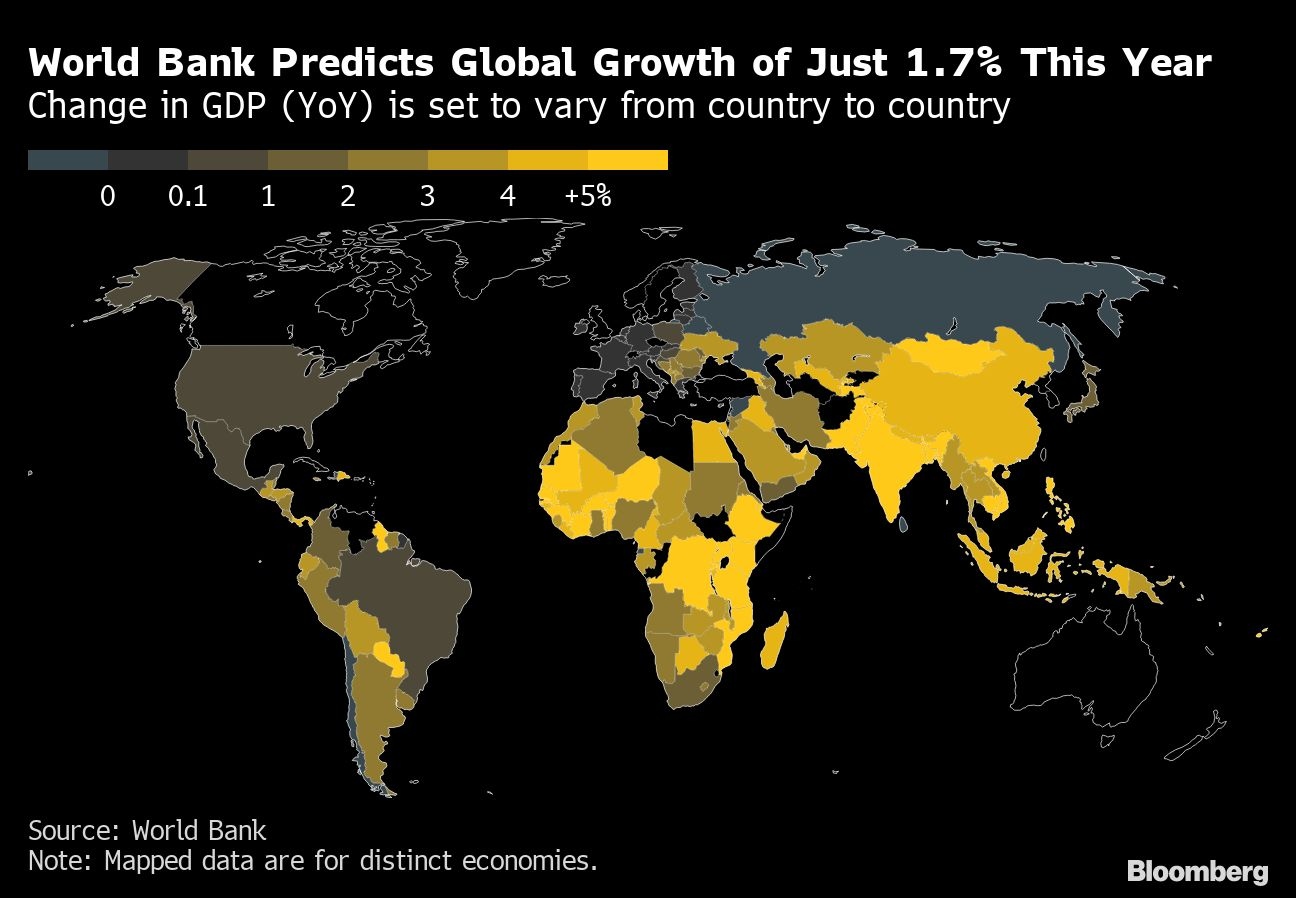
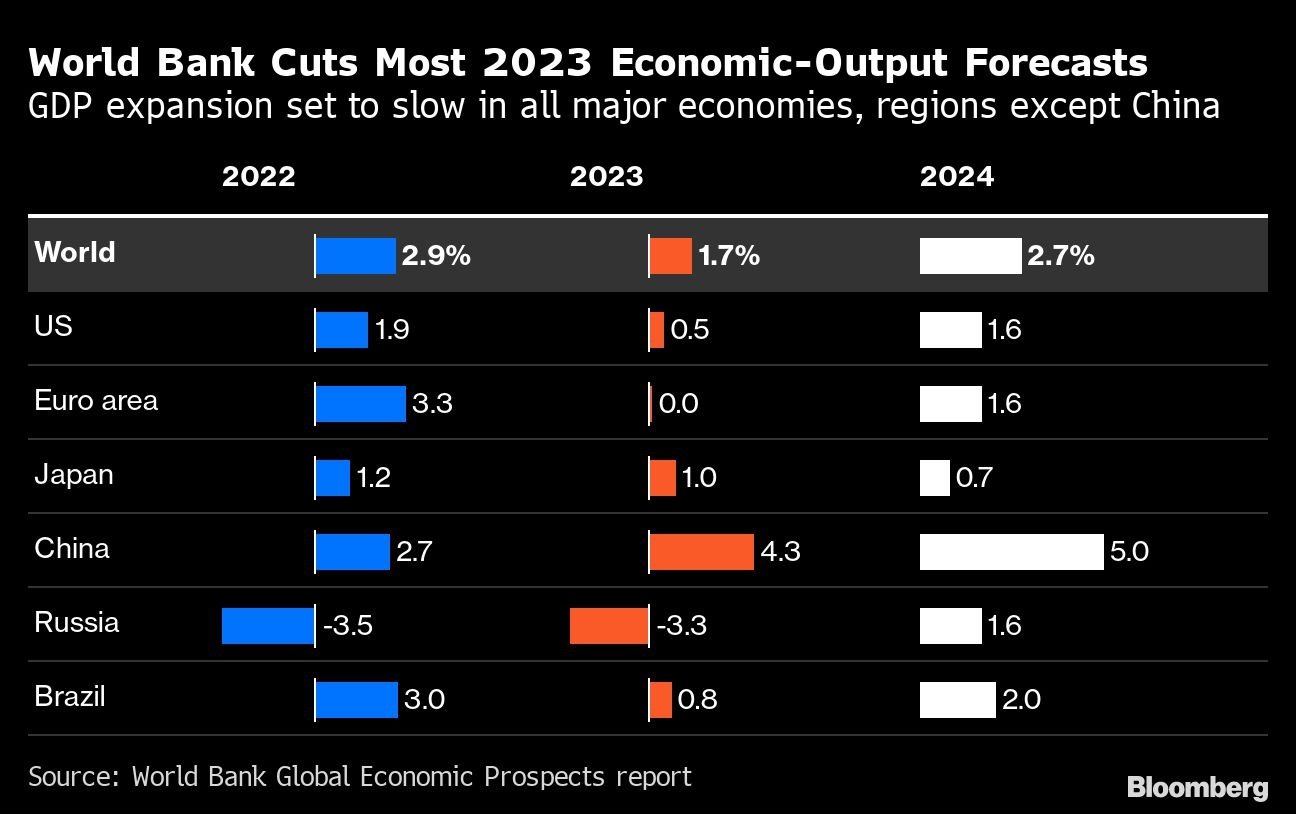
The World Bank slashed its growth forecasts for most countries and regions, and warned that new adverse shocks could tip the global economy into a recession. 

Global gross domestic product will probably increase 1.7 per cent this year, about half the pace forecast in June, the Washington-based lender said Tuesday. That would be the third-worst performance in the last three decades or so, after the contractions of 2009 and 2020. 

The bank, which also cut its growth estimates for 2024, said persistent inflation and higher interest rates are among the key reasons. It also cited the impact of Russia’s invasion of Ukraine, and a decline in investment. 

“The crisis facing development is intensifying” and the setbacks to global prosperity will likely persist, World Bank President David Malpass wrote in a foreword to the bank’s semi-annual Global Economic Prospects report. He said GDP in emerging-market and developing economies at the end of next year will be about 6 per cent below the level expected on the eve of the Covid-19 pandemic.

Spillovers from a period of pronounced weakness in the US, China and the European Union are exacerbating other headwinds faced by poorer nations, the lender said. While inflation is moderating, there are signs that pressures are becoming more persistent, with central banks having to raise interest rates faster than expected. 

“The combination of slow growth, tightening financial conditions, and heavy indebtedness is likely to weaken investment and trigger corporate defaults,” the World Bank said. “Urgent global action is needed to mitigate the risks of global recession and debt distress.”

The lender, which is reviewing its operational model, said a focus on the following areas is critical given limited policy space: 

  • National policymakers must ensure that any fiscal support is focused on vulnerable groups
  • Inflation expectations need to remain well anchored
  • Financial systems must continue to be resilient

The World Bank called for a “major increase” in investment for developing nations, including new financing from the international community and from the repurposing of existing spending, such as inefficient agricultural and fuel subsidies.

“Even though the world is now in a very tight spot, there should be no room for defeatism,” Malpass said. “There are significant reforms that could be undertaken now to strengthen the rule of law, improve the outlook and build stronger economies with more robust private sectors and better opportunities for people.”