Wednesday, May 03, 2023

Striking Hollywood writers prepared for lengthy battle with studios

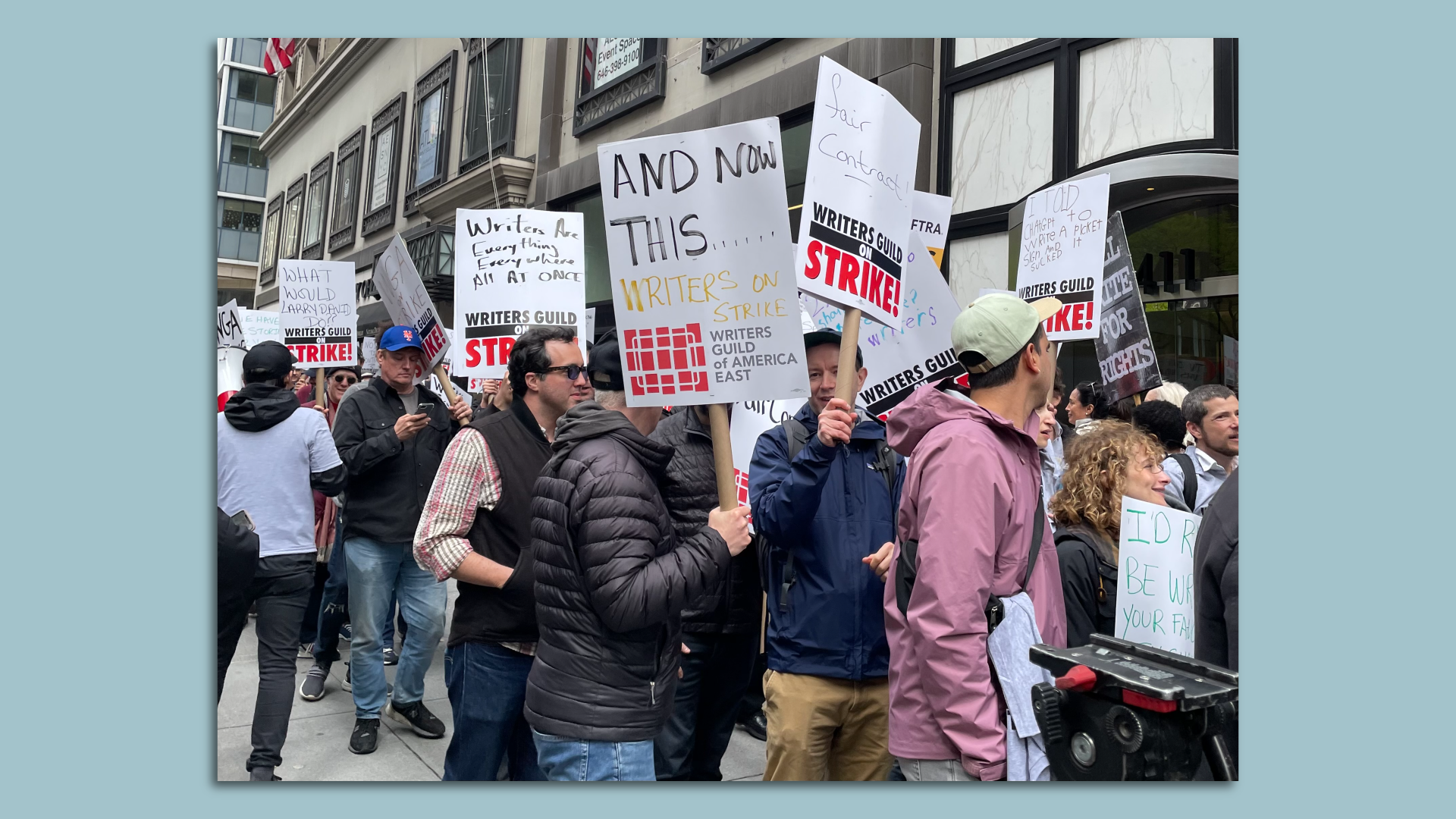
Writers Guild of America members holding picket signs outside of Peacock NewFront event in midtown Manhattan

WGA members picketing outside of Peacock's NewFront in Manhattan. Photo: Tim Baysinger/Axios

Writers were galvanized Tuesday across New York and Los Angeles on the first day of the Writers Guild of America's strike against Hollywood studios.

Why it matters: WGA members appear ready for the long labor fight ahead of them.

State of play: In New York, the WGA took up the entire block outside of Peacock's NewFront advertiser event in midtown Manhattan

  • Scored by chants, megaphones, drums and supportive horn honking from drivers, picketers forced advertisers — and journalists covering the NewFront — to walk around them as they entered Center415.

Context: This is Hollywood's first major work stoppage in 15 years, threatening to upend its comeback from pandemic-induced shutdowns.

What they're saying: "People are really energized. And it's not because they want to be on strike," Josh Gondelman, a longtime late-night TV writer whose credits include "Desus & Mero" and "Last Week Tonight," told Axios.

  • "Everybody knows this is a fight worth fighting for — the existential future of television, film and streaming writing as a career," he said.
  • Dave Sirus, a writer on "Bupkis" — one of Peacock's prized new shows that it was touting to advertisers on Tuesday — was also outside picketing.
  • "Everyone here wants to work," he said. "We all really wanted them to be able to negotiate, but what other choice do we have?"

Zoom out: The strike began Tuesday morning after the WGA's current labor deal with the studios expired. The two sides appear to be far apart on a new contract.

  • The streaming era has upended traditional Hollywood business practices, and writers feel they've been left out of the "peak TV" content boom.
  • Streaming services dominating the TV landscape are ordering fewer episodes per season and ending shows earlier than their broadcast and cable forefathers.
  • Additionally, residuals for streaming shows are far less than what writers would get from TV syndication deals.

Plus, the rapid growth of AI has writers concerned studios will look to replace some of their work with machines.

  • "There's been such a sea change in the way the work that we do is distributed," said Gondelman.
  • "And I think that corporations have seized upon that as a chance to take profits. They're trying to turn writing into an unstable gig economy type job."

The other side: The Alliance of Motion Picture and Television Producers, which represents the major studios and production companies, has argued its most recent proposal included "generous increases in compensation" and increases in streaming residuals.

  • The alliance added that it was prepared to improve that offer.
  • "The AMPTP member companies remain united in their desire to reach a deal that is mutually beneficial to writers and the health and longevity of the industry, and to avoid hardship to the thousands of employees who depend upon the industry for their livelihoods," the alliance said in a statement after talks broke down Monday night.

The intrigue: Compared to the 2007-2008 strike, which lasted for 100 days, the WGA has formed a more united front with fellow Hollywood guilds like the Director's Guild of America and SAG-AFTRA, which represents the actors.

  • Both guilds' labor deals with the studios expire at the end of June. In 2008, the DGA cut its own labor deal that may have undercut the WGA's stance.
  • Members of the DGA and SAG-AFTRA, as well as the International Alliance of Theatrical Stage Employees — representing 168,000-plus below-the-line industry crew members — joined in the picketing on Tuesday.
  • Sirus praised the support, noting: "We saw 15 years ago what happens when you try to work around writers. And I don't think anyone wants that."

What's next: WGA has picketing planned for at least the next two weeks in both cities, including outside of Netflix's New York offices Wednesday afternoon.

  • "Whatever it takes to keep the membership galvanized, keep the pressure on," says Lisa Kron, a longtime playwright and writer on HBO's "Somebody Somewhere."
  • As for how long the strike will last? "It's not up to us. It's up to the studios," she says.

Hollywood writers go on strike

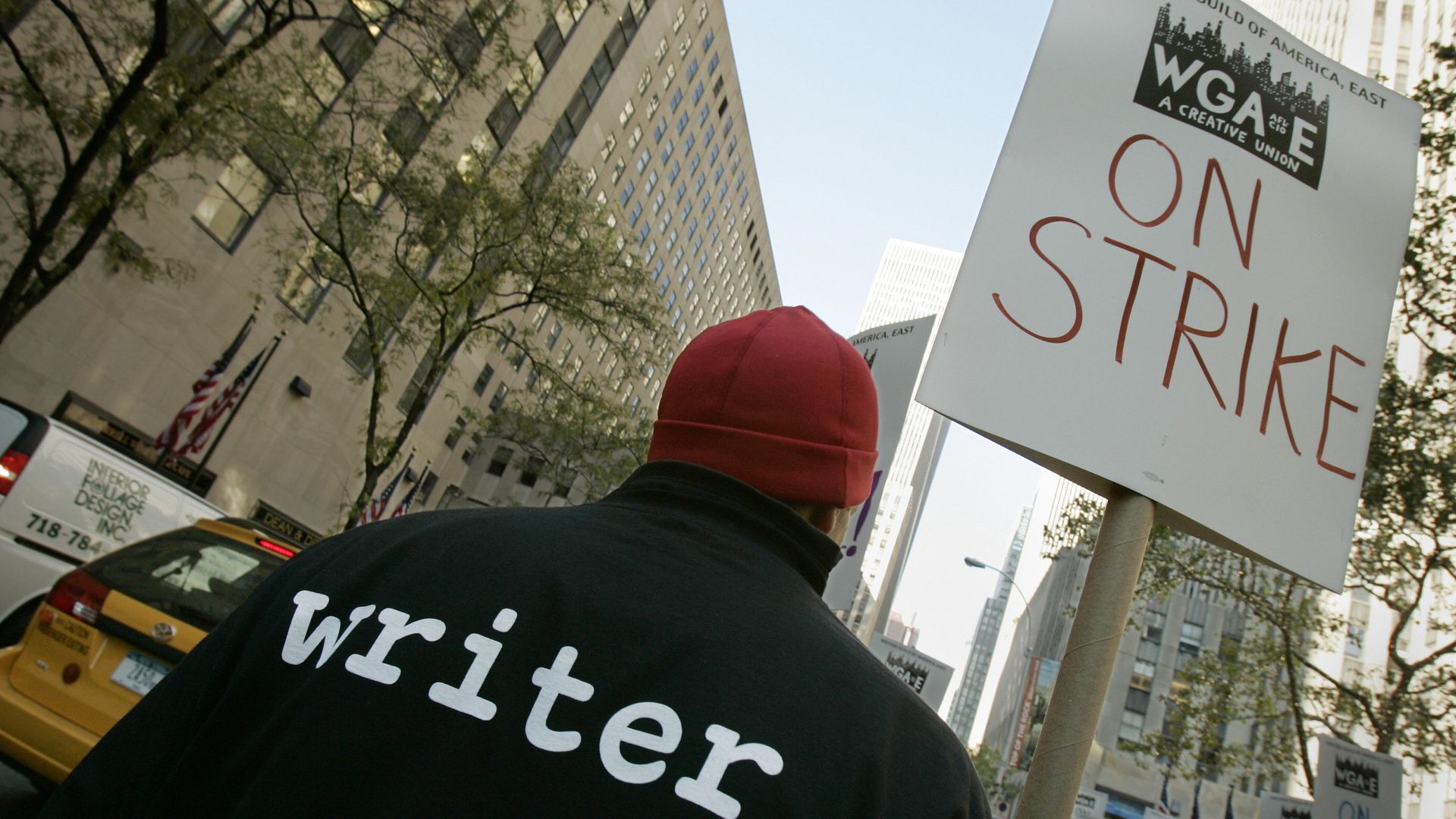
A WGA member during the writers' strike in 2007-08. Photo: Stan Honda/AFP via Getty Images

The Writers Guild of America is on strike for the first time in 15 years after negotiations for a labor deal with Hollywood studios broke down ahead of the current deal's expiration on Monday.

Why it matters: A work stoppage threatens to cripple Hollywood's already-messy transition to the streaming era.

Details: The strike began Tuesday morning, and writers will start picketing outside studios and media companies' offices later on Tuesday.

  • During the strike, all WGA members are barred from performing writing duties for any of the struck companies, though they may perform other work like producing or directing.
  • Given the time of year, most broadcast shows will be in-between seasons. But a strike going deep into the summer would lead to delays for the 2023-24 season.
  • Late-night shows such as NBC's "The Tonight Show" and CBS' "The Late Show" will immediately go dark. Daytime soap operas are expected to halt production as well.
  • Streaming services and film studios are less affected initially because they produce their content well in advance.

The big picture: The streaming era has upended traditional Hollywood business practices, and writers feel they've been left out of the "peak TV" content boom.

  • Streaming services that have dominated the TV landscape are ordering fewer episodes per season and ending shows earlier than their broadcast and cable TV forefathers. Additionally, residuals for streaming shows are far less than what writers would get from TV syndication deals.
  • The rapid growth of AI is causing concern among writers that studios will look to replace some of their work with machines.
  • "The companies' behavior has created a gig economy inside a union workforce, and their immovable stance in this negotiation has betrayed a commitment to further devaluing the profession of writing," the WGA said in a statement Monday night.

The other side: The Alliance of Motion Picture and Television Producers, which represents the major studios and production companies, argued that its latest proposal included "generous increases in compensation" and increases in streaming residuals — and added that it was prepared to improve that offer.

  • "The AMPTP member companies remain united in their desire to reach a deal that is mutually beneficial to writers and the health and longevity of the industry, and to avoid hardship to the thousands of employees who depend upon the industry for their livelihoods," the AMPTP said in its own statement.

Of note: The strike comes ahead of upfront presentations to advertisers for many of the top media companies like Comcast, Disney and Warner Bros. Discovery.

Flashback: The last WGA strike came in 2007-08 and lasted for 100 days.

What's next: This is just the beginning: The studios' labor contracts with the Directors Guild of America (DGA) and SAG-AFTRA, which represents the actors, both expire at the end of June.

  • Both the DGA and SAG-AFTRA have voiced support for the WGA, but will continue working during the WGA strike.
  • The DGA will begin negotiations on May 10, while SAG-AFTRA is slated to start its talks in early June.

Go deeper:


AI stars in Hollywood labor negotiations

Illustration of a director's chair with the word "director" spelled partially using binary.

Illustration: Gabriella Turrisi/Axios

AI has emerged as a key issue as screenwriters seek to iron out a new contract with Hollywood producers. As The New York Times reports, it's a concern also held by actors and others who worry that the work they do will get replaced by AI output.

The big picture: Artificial intelligence, particularly new generative technologies, present a range of opportunities and threats to the way that movies and TV shows are made, along with other creative works, such as audiobooks.

Driving the news: In its contract negotiations, the Writers Guild aims to limit the use of AI-generated dialogue or scenes. But there's a wide array of other ways that AI is likely to disrupt Hollywood.

  • AI could allow popular actors to "speak" any number of foreign languages, for example. That might be more appealing to global audiences, but also threatens the livelihoods of the actors who have made careers out of dubbing, say, American movies into German.
  • Similar technology is threatening to upend the audiobook industry as well, with AI narrators quickly improving — and sometimes being trained on the human book readers they stand to replace.
  • There's also the concern that the same technology that allows deepfakes could be used to erode actors' control over their own likeness, giving studios the ability to generate new performances from an actor, living or dead, potentially without full consent or compensation.
  • And the concerns don't end there. Generative AI threatens to upend the special effects industry, which has been dominated by the likes of Industrial Light & Magic. Even individual costumers could be at risk, as AI might be used to place digital outfits on actors — an option that could give studios both cost savings and added flexibility.

Dallas activists revive 1934 Teamsters tactic with ‘flying pickets’ at Starbucks store

May 3, 2023 
PEOPLES WORLD

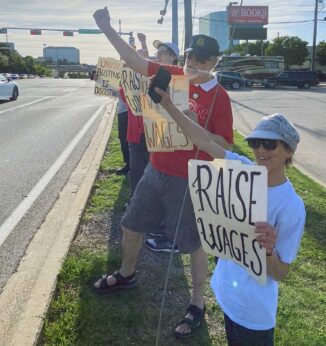
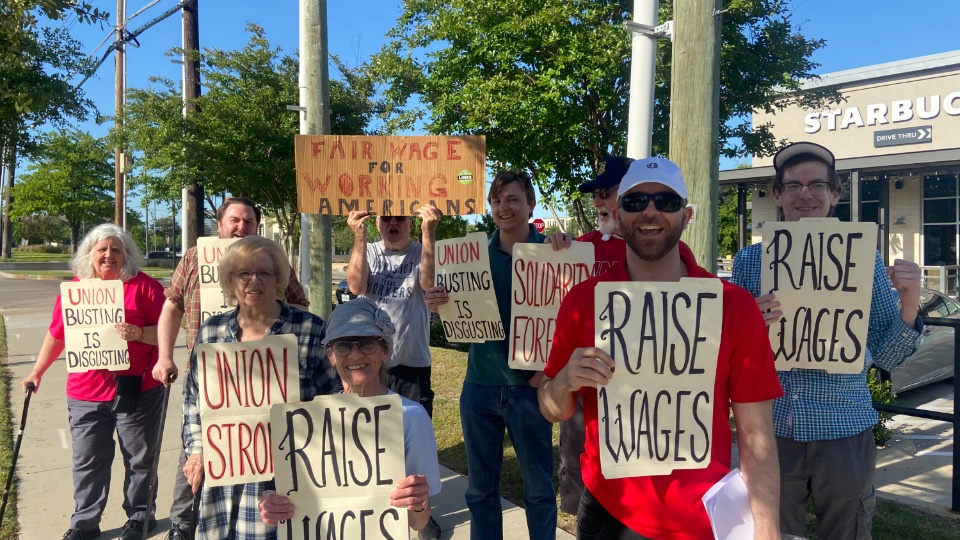
Flying picketers with their stealth protest signs rally outside a Dallas-area Starbucks on May Day. |
Photo by Stu Becker

May Day Worker’s Correspondence from Dallas, Texas:

On May Day 2023, activists in Dallas celebrated by helping to organize “flying pickets” at different Starbucks stores across the metro area. The group included members of the Texas Alliance for Retired Americans, and the Young Active Labor Leaders, and the Communist Party USA’s Dallas Fort Worth Club. We pioneered an old but new labor organizing tactic that, to our knowledge, has never been done before in history in the North Texas area.
Picketers received plenty of support from passing motorists.
 | Photo by Stu Becker

We leafletted the workers and customers inside Starbucks quietly and then moved to the sidewalk outside to hold our stealthy signs made from file folders with slogans on them: “Raise Wages,” “Union Strong,” “Union busting is disgusting,” “Solidarity Forever,” and more.

The signs are cleverly made because they can be folded and put under your arm, so no one can tell that they are a sign. Then they can be opened up to display their messages while picketing.

We picketed and chanted for about ten minutes in front of the Starbucks store. Then, the next Starbucks location was posted for participants in a Telegram message group. This directed labor activists to go to the next Starbucks store and repeat.

At each location, Gene Lantz, President of the Dallas AFL-CIO Central Labor Council and leader of the Texas Alliance for Retired Americans, got on Facebook Live to tell viewers about the next location.

Some people who were not able to start at the first Starbucks store were able to catch up by meeting us at the next one.

The Starbucks locations usually had about three employees each working inside and seemed to appreciate the expressions of solidarity. Lantz’s red AFL-CIO t-shirt with the word “Union” across the chest garnered several thumbs-up.

We handed the workers and customers in each store a folded leaflet reading: “Hide this! Read it in private. Please join the movement to raise wages. Everyone needs at least a 5% raise just to stay up with this year’s inflation. Last year, we needed at least 9%.”

It then laid out how workers could go about getting those raises:

“Organizing is the essential way to get a raise. The labor movement wants to help bring up your wages and help you win dignity on the job. Check us out and let’s work together.” Contact info for the Dallas AFL-CIO and the Young Active Labor Leaders was on the back.
Gene Lantz, President of the Dallas AFL-CIO Central Labor Council and leader of the Texas Alliance for Retired Americans, introduced the Dallas activists to the ‘flying picket’ tactic.
 | Photo by Stu Becker

At one location, a journalist stopped and asked us who we were and for details about the cause. We demonstrated near busy streets, and people drove by and honked to show that they supported us. I saw one woman in a car at a stoplight read our sign and mouthed the words “Raise Wages.” She smiled, said, “I support that!” and honked.

Lantz introduced the idea of flying pickets to Dallas activists after reading about how workers used the tactics in Minneapolis in 1934 in the book Teamster Power, by Farrell Dobbs. The strategy is to flyer and picket at several workplaces in a short period of time. The route is to be kept secret. Activists only get information about the next location right before it is time to move on.

This keeps employers scrambling and unsure where the next protest might appear.

We chose to go to Starbucks locations this time because Starbucks workers have been organizing unions throughout the country. We plan on continuing this tactic regularly, at fast food restaurants and grocery stores.

We had fun and a great time celebrating May Day by organizing workers and this was a great experience for activists to learn how to work together and how to organize themselves and other workers.

Young Active Labor Leaders

Dallas Central Labor Council

CONTRIBUTOR

Stu Becker is an activist and organizer in Dallas, Texas. He is a high school social studies teacher, and a member and organizer in the local chapter of the American Federation of Teachers.
Kurdistan PM Barzani, US Delegation Discuss Erbil-Baghdad Oil Agreement
Kurdistan 03/05/2023 - 20:07 BasNews


ERBIL — Kurdistan Region PM Masrour Barzani on Wednesday received a delegation led by Barbara Leaf, US Assistant Secretary of State for Near Eastern Affairs, highlighting the recent oil agreement between Erbil and Baghdad.

"Pleased to receive Barbara Leaf, US Assistant Secretary of State for Near Eastern Affairs, and her delegation. We discussed the latest developments in Iraq and the region and strengthened relations between the Kurdistan Region and the United States," PM Barzani said in a Facebook post.

"We focused on the importance of resolving the problems between the Kurdistan Region and the federal government. We stressed the need to implement the recent oil exports agreement to protect citizens of the Kurdistan Region and Iraq from economical harm."

The meeting emphasized the importance of holding parliamentary elections in Kurdistan as scheduled for this year, and the KRG has assured all sides that they will provide all the necessary support for this purpose.

The discussion also covered the need for reform in the Ministry of Peshmerga Affairs and the significance of implementing the Sinjar Agreement to bring stability to the region, remove militias, and enable the community to return to their homes.


Ex-Mastercard CEO Ajay Banga confirmed as World Bank leader


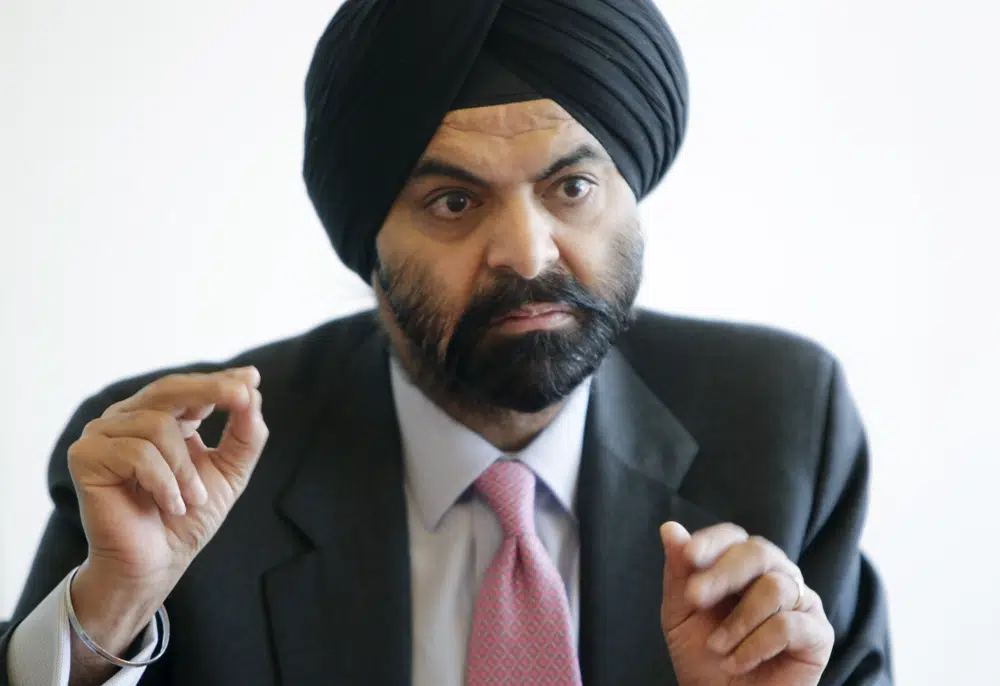
WASHINGTON (AP) — Former Mastercard CEO Ajay Banga, an Indian army officer’s son with decades of corporate experience, was confirmed Wednesday to lead the World Bank for a five-year term that starts next month.

The U.S.-nominated business veteran succeeds David Malpass, a Donald Trump pick who is ending his tenure early at the 189-nation global poverty-fighting institution after coming under pressure for declining to say whether he agreed with the scientific consensus on climate change.

The bank’s executive directors said in a statement after Banga’s confirmation as president that they looked forward to working with him and on all the bank’s “ambitions and efforts aimed at tackling the toughest development challenges facing developing countries.”

President Joe Biden chose Banga in February, after Malpass announced he would leave by June 30, and praised the nominee for his “critical experience” in tackling “the most urgent challenges of our time,″ such as climate change.

Biden said Wednesday that Banga “will help steer the institution as it evolves and expands to address global challenges that directly affect its core mission of poverty reduction — including climate change.”


The United States is the bank’s largest shareholder and traditionally has nominated the organization’s president. American leaders have said that taking on climate change will be a major factor in the bank’s lending decisions.

Treasury Secretary Janet Yellen said in February that Banga will be responsible for meeting “ambitious goals for climate adaptation and emissions reduction.” On Wednesday, she said “our ambitious goals will not be met overnight, and we remain committed to a staged adoption of reforms over the course of the year to build on the vision we have laid out.”

Malpass, whose term was to expire in April 2024, ran into criticism last year for comments at a conference that appeared to cast doubt on the science that says the burning of fossil fuels causes global warming. He later apologized and said he had misspoken, noting that the bank routinely relies on climate science.

Leaders and activists from poorer nations, especially those vulnerable to the extreme weather made worse by climate change, have called for massive changes in the entire multinational development bank system.

A plan known as the Bridgetown Initiative, put forward by Barbados Prime Minister Mia Mottley and embraced by French President Emmanuel Macron, would make it easier and faster for developing countries affected by weather disasters to get money with lower interest rates for both recovery and for building to become more resilient.

Banga, who was most recently vice chairman at the private equity firm General Atlantic, has more than 30 years of business experience and has served on the boards of the American Red Cross, Kraft Foods and Dow Inc.

He was born in 1959 and educated in some of India’s premier institutions. When India’s economy liberalized in the early 1990s, Banga was able to work and rise through the ranks of multinational corporations breaking into India.
Fast-growing fungus attacks on crops 'threaten the world's food supply', scientists warn, threatening 'global catastrophe'
Fungus attacks could threaten the global food supply. Picture: Getty/Alamy

By Kit Heren@yung_chuvak
3 May 2023

Rapidly spreading fungi attacks on crops and could threaten the world's food supply, leading to a potential "global catastrophe", scientists have warned.

The climate crisis and rising temperatures are worsening the impact of fungi on crops, as they have been able to move northwards at a rate of 7km per year since the 1990s, researchers claim

The wheat stem rust fungus, normally found in the tropics, has been reported as far north as England and Ireland.

Fungi are already the biggest destroyer of crops, and many have developed resistance to fungicide.

Farmers around the world already lose between 10% and 23% of their crops to fungi, according to the report, published in the journal Nature.
Fungus are already a prolific destroyer of crops. Picture: Getty

Professor Sarah Gurr of the University of Exeter, who is a co-author of the report, said the hit TV show The Last Of Us, in which fungi infect humans, had brought the issue more into the public eye, the Guardian reported.

"While that storyline is science fiction, we are warning that we could see a global health catastrophe caused by the rapid global spread of fungal infections," she said. "The imminent threat here is not about zombies, but about global starvation."

Researchers said global warming could even increase fungi's heat tolerance, meaning they might even be able to infect warm-blooded animals and humans in the future.

Professor Eva Stukenbrock, at the University of Kiel in Germany, a co-author, said: "As our global population is projected to soar, humanity is facing unprecedented challenges to food production.
Scientists compared the fungal threat to the hit TV show The Last of Us. Picture: Alamy

"We’re already seeing massive crop losses to fungal infection, which could sustain millions of people each year. This worrying trend may only worsen with a warming world.”

Across the five most important crops - potatoes, maize, wheat, rice and soya beans - infections destroy food that would fed hundreds of millions of people each year, researchers said.

Fungi are very resilient, and can remain viable in the soil for 40 years. They can also travel long distances - even between continents.

Prof Gurr said: "After tornadoes in America, you can see the spores have been sucked up and gone on long distance voyages".

Fungicides and the usual breeding methods to form disease resistance are no longer enough, the researchers said, because the fungi can get around them.

Political economist breaks down why food prices have soared

The authors said that planting seed mixtures that have a range of genes, rather than monocultures of a single strain, may provide some resistance to fungal attacks.

Read more: Hollywood star Keanu Reeves has newly-found fungus-killing compound named after him

Read more: What is Mucormycosis? How the 'black fungus' has affected Covid patients in India

The scientists are carrying out more research in a bid to tackle fungicide resistance, but are pushing for more funding to support their work.

Prof Gurr said: "If we don’t have enough to eat, malnutrition will kill us before we get anything like Covid-19.

"But our [research area] is absolutely penniless compared with every medical disease you could imagine.”

Aug 20, 2009 — It was just a colour out of space—a frightful messenger from unformed realms of infinity beyond all Nature as we know it; from realms whose mere ...

South China Sea drills conceal a secret war to control the internet

BY MAURIZIO GERI, OPINION CONTRIBUTOR - 05/03/23 

A suspected Chinese militia ship passes as members onboard the Philippine Coast Guard BRP Malabrigo drives them away from Philippine-occupied areas in the South China Sea on Friday, April 21, 2023.
(AP Photo/Aaron Favila)

With the U.S. and Philippines holding the largest ever military drills in the South China Sea, followed by China and Singapore planning drills of their own, tensions are heating up as the Phillippines has reported a “confrontation” between two of its vessels and the Chinese navy.

As one of the world’s most important shipping lanes for oil, minerals and food, whoever dominates the South China Sea will control over a fifth of global trade. But the biggest economic asset up for grabs in the region is Big Data — and the future of the entire internet depends on who wins the battle to dominate this strategic waterway.

Over 486 undersea cables carry more than 99 percent of all international internet traffic globally, according to the Washington-based research firm TeleGeography. The bulk of them are controlled by a handful of American technology giants, namely Google-owner Alphabet, Facebook-owner Meta, Amazon and Microsoft.

Southeast Asia’s internet economy is expected to reach $1 trillion in value by 2030. Whoever controls the Asia-Pacific’s subsea cabling infrastructure will not only dominate this booming economy but control the global internet. Internet data flows, carrying everything from emails and banking transactions to military secrets, are more valuable than oil. As such, the world’s subsea cabling infrastructure is increasingly vulnerable not only to sabotage, but also to espionage — spy agencies can easily tap into cables on their own territory.

That’s why the geopolitical rivalry between the U.S. and China has increasingly focused on controlling the world’s subsea cabling networks.

The New Great Game

China, which claims almost the entire South China Sea, is planning a $500 million undersea internet cable network to create a superfast connection linking up Asia with the Middle East and Europe. It is also impeding U.S.-backed internet cable projects through the South China Sea by delaying licensing approvals and creating stricter operating restrictions.

Meanwhile, the U.S. government has thwarted several Chinese subsea cabling projects over concerns about Beijing’s surveillance capabilities. At least six private undersea cable deals led by Google, Facebook and Amazon connecting the U.S. with Hong Kong were blocked by Washington to keep HMN Tech, a subsidiary of the sanctioned Chinese firm Huawei, at bay. HMN Tech has won praise from the Chinese government as a model of “civil-military integration,” and acknowledges that its activities “offer powerful support for the modernization of our country’s national defense.”

To bypass Chinese control, American tech giants Facebook and Google are building Apricot, the first intra-Asian subsea cable avoiding Hong Kong. The 12,000-kilometer cable will connect Japan, Taiwan, Guam, the Philippines, Indonesia and Singapore — but excludes Malaysia, which has fast become the linchpin of U.S. and Chinese competition to dominate the global internet.

Malaysia’s involvement in Apricot was scuppered due to a 2020 cabotage ban on foreign vessels in the autonomous Sabah region of eastern Malaysia to protect the local shipping industry from foreign competition.

In response, Facebook, Google, Microsoft and Amazon wrote to the Malaysian government complaining that the ban would obstruct the new cable venture and requesting an urgent meeting with the prime minister. The request was ignored. As a result, Malaysia has been excluded not only from the Apricot route but also from the Echo and Bifrost cable routes across the South China Sea, also backed by Facebook and Google.

Local frustration over Malaysia’s cabotage ban has revived demands in Sabah for greater autonomy from the federal government. This dovetails with an international legal case on behalf of heirs of a colonial-era sultanate in the remote Sulu archipelago of the Philippines. The sultanate purportedly leased the region of Sabah to British colonists in 1878 in return for an annual payment, which the petitioners have used to justify undermining Malaysian sovereignty in Sabah, claiming a percentage of oil and gas profits there.

The lawyers representing the Sulu heirs have what could be viewed by some as close ties with the same U.S. tech giants competing to dominate subsea internet cables in the South China Sea. Paul Cohen, a former speechwriter on the Clinton/Gore presidential campaign, currently serves as president of the Silicon Valley Arbitration and Mediation Center where he works in “dialog” with these U.S. tech firms. Cohen’s colleague, Elisabeth Mason, is a board member of the U.S. charity All Star Code alongside three senior Google executives and founded the Stanford Poverty and Technology Lab with support from both the Obama White House and Facebook founder Mark Zuckerberg.

The future of the global internet


Even the appearance of close proximity between the Sulu heirs’ lawyers to U.S. tech giants that bypassed Malaysia to pursue U.S.-backed subsea internet cable routes will exacerbate Malaysian perceptions of Western hostility to its national interests.

Indeed, Malaysia’s exclusion from the U.S.-backed subsea cabling projects has already accelerated the country’s alliance with China. In 2022, Malaysia joined the 5,000-kilometer China-backed South East Asia Hainan Hong Kong Express Cable System (SEA-H2X) linking Hong Kong, China, the Philippines and Thailand to eastern Malaysia and Singapore.How Indo-Pacific economic negotiations can support supply chain resilienceWe need regime change in Russia — but how?

The future of the global internet is at stake. If Malaysia falls under Chinese dominance, it will have major repercussions across the 10-member Association of Southeast Asian Nations (ASEAN), potentially triggering a domino effect.

Yet, the U.S. has a fresh opportunity for rapprochement under Malaysia’s new government led by long-time democracy activist Anwar Ibrahim. Given the latter’s first global trip to China securing $38 billion of investments, the U.S. should act fast to ensure Malaysia recognizes the benefits of digital cooperation with the West.

Maurizio Geri, Ph.D. (Twitter: @MauriGeri) is a former senior NATO analyst who has worked at the NATO Allied Command Transformation in the U.S., NATO Southern Hub in Italy and NATO HQ in Belgium, who previously served as an analyst in the Italian Defence General Staff. He is a recipient of the Marie Curie Global Fellowship for research on EU-NATO cooperation against Russian hybrid warfare in the context of the energy-resources-climate security nexus. He is also an associate fellow at South Asia Democratic Forum, at the Center for Media and Peace Initiatives and at the International Team for the Study of Security. He is the author of “Ethnic Minorities in Democratizing Muslim Countries: Turkey and Indonesia” Palgrave Macmillan, 2018.
Iowa lawmakers change bill to relax child labor laws

TOM BARTON Lee-Gazette Des Moines Bureau
1 hr ago

DES MOINES — Iowa lawmakers approved bipartisan changes to a controversial bill to relax some of Iowa’s child labor laws.

Teens could work more jobs and later hours, as well as serve alcohol in restaurants with parental permission and adult supervision, under changes made to Senate File 542.

House Republicans amended the bill, incorporating some recommendations proposed by Democrats, who filed more than 20 amendments to remove or alter what they saw as the most harmful provisions.

The measure passed the Republican-controlled House Tuesday on a party-line vote of 60-34, with all Democrats opposed. The amended bill now heads back to the GOP-controlled Senate for final approval.

Gov. Kim Reynolds told reporters last month she supports expanding youth employment, pointing to her own experiences babysitting, waiting tables and working at a department store when she was young.

Reynolds said parents and children should be allowed to make the decision on starting work at a younger age.

The proposal has sparked protests from labor unions and criticism from the U.S. Labor Department’s top lawyer.

Democrats argued the bill, opposed by groups including building trade unions and the United Way of Central Iowa, would weaken child labor protections and conflicts with federal law.

While Democrats and Republicans were able to find some common ground to remove the “most egregious” parts of the bill, House Minority Leader Jennifer Konfrst, D-Windsor Heights, said it still leaves a lot to be desired.

“I do feel the bill is better but think we could have gone a little further to keep kids safe,” Konfrst said.

House lawmakers stripped language that would have let state officials grant exceptions allowing 14- and 15-year-olds to work in jobs currently banned for minors, as long as they are part of an approved training program with adequate supervision and safety precautions

Sixteen- to 17-year-olds could participate in work-based learning programs in areas like manufacturing, if granted an exemption by state officials.

Lawmakers also added provisions that would:

Require employers to provide a copy of all training materials to the minor’s parents

Prohibit anyone determined to be a sexually violent predator or registered sex offender from employing minors

Prohibit minors from selling or serving alcohol in restaurants unless two adult
 employees are physically present in the area, and only while food is being served

Require employers to report a workplace harassment incident to the employee’s parents and Iowa Civil Rights Commission, and mandate restaurant employers require all employees to attend sexual harassment prevention training

Children under the age of 16 would be allowed to work up to six hours a day while school is in session, which is two more hours than currently allowed under law.

Federal rules prohibit 14- and 15-year-olds from working past 9 p.m. in the summer and 7 p.m. during the school year. The bill would extend that two hours to 11 p.m. and 9 p.m., respectively.

Sixteen- and 17-year-olds could also work the same hours as adults and serve alcoholic drinks at restaurants, provided the employer has written permission from the teenager’s parent or guardian. Lawmakers amended the bill to clarify that teens cannot work in bars or in strip clubs.

The bill also would create a committee to look into whether teenagers ages 14 and older can receive a special permit to drive themselves to work.

Republicans said the bill modernizes Iowa's outdated child labor regulations and provides more opportunities for young Iowans to earn a paycheck and learn valuable skills through workforce training programs.

The bill is backed by business groups including the Iowa Restaurant Association and the Iowa Association of Business and Industry, as well as conservative groups Americans For Prosperity and the Opportunity Solutions Project

Rep. Dave Deyoe, a Republican from Nevada and the bill’s floor manger, said opponents have misrepresented the legislation.

Dangerous industries like mining, logging and meatpacking could not employ minors under the amended bill, and parents have to give written permission for teens to work in controlled environments, like existing school-to-work programs for welding.

Such work-based learning programs would have to be approved by Iowa Workforce Development or the Iowa Department of Education, and employers would have to demonstrate work performed by those age 16 to 17 would be done under adequate supervision and training that includes proper safety precautions.

Deyoe said benefits of expanding youth employment opportunities include “less poverty, money for future education, less delinquent behavior, experience in the workplace and access to mentors and role models,” as well as exposure to promising careers in skilled trades.

The U.S. Department of Labor’s top lawyer, Seema Nanda, disagreed, saying in a statement it is “irresponsible for states to consider loosening child labor protections.”

Amid increasing child labor violations, states should be working to increase accountability and ramp up enforcement — “not make it easier to illegally hire children to do what are often dangerous jobs,” Nanda said.

House Democrats echoed the sentiment, saying the bill would increase the chance of workplace accidents and injuries among youth.

Both violations of child labor laws and proposals to roll back child labor protections are on the rise across the country, according to a March 2023 report from the Economic Policy Institute.

At least 10 states have introduced or passed laws rolling back child labor protections in the past two years. And the number of minors employed in violation of child labor laws increased 37 percent in the last year, according to the report.

A group of state lawmakers and public officials reported possible underage labor and safety hazards last month at the construction site of Cedar Rapids’ $49 million Banjo Block development.

Rep. Jeff Cooling, a Democrat from Cedar Rapids, proposed an amendment that failed that would have prohibited state agencies from contracting with companies that have a history of child labor law violations.

Rather than address Iowa’s workforce shortage by making employment in the state more attractive through better wages, comprehensive benefits and improved worker safety, Democrats argued the business lobby is proposing less restrictive child labor regulations so younger Iowans may fill the employment gap.

Cooling also proposed amending the bill to require employers demonstrate they have made a good-faith effort to hire additional employees or retain current employees prior to hiring minors. That amendment also failed.

“How are we protecting children from dangerous workplaces, and how are we making sure we’re enforcing existing labor laws?” asked Rep. Adam Zabner, a Democrat from Iowa City, who along with Cooling was among the group of lawmakers that toured the Cedar Rapids construction site.