Friday, July 28, 2023


DNA analysis offers new insights into diverse community at Machu Picchu


Peer-Reviewed Publication

YALE UNIVERSITY


New Haven, Conn. — A genetic analysis suggests that the servants and retainers who lived, worked, and died at Machu Picchu, the renowned 15th century Inca palace in southern Peru, were a diverse community representing many different ethnic groups from across the Inca empire.

The genomic data, described in a new study in Science Advances, is the first investigation of the genomic diversity of individuals buried at Machu Picchu and adjacent places around Cusco, the Inca capital. It builds upon previous archeological and bio-archaeological research, including a 2021 Yale-led study which found that Machu Picchu (AD 1420-1530) is older than was previously believed.

“The DNA analysis not only confirms the historical accounts that retainers were drawn from many different ethnic groups under Inca control, but it also demonstrates a much greater diversity of origins than had been suspected with individuals being brought from the entire empire,” said archaeologist Richard Burger, the Charles J. MacCurdy Professor of Anthropology in Yale’s Faculty of Arts and Sciences and lead researcher for the Machu Picchu project.

“Our analyses show that the population at Machu Picchu was highly heterogenous, with individuals exhibiting genetic ancestries associated with groups from regions throughout the Inca empire including the coast, highlands, and Amazonia,” Burger said.

Researchers from Yale, Universidad Nacional de San Antonio Abad del Cusco (UNSAAC), the University of California-Santa Cruz (UCSC), Tulane University, the Max Planck Institute for Evolutionary Anthropology, and other institutions conducted the study, under an agreement to return artifacts and human remains from the Hiram Bingham collection back to Cusco for exhibition, conservation, and study.

Machu Picchu is perhaps the most famous archeological site in the Western Hemisphere. Prior to the COVID-19 pandemic, more than a million visitors toured the site. Yet until quite recently, little was known about its inhabitants.

Scholars now believe Machu Picchu was a royal estate connected to the lineage of Pachacuti, the emperor credited with establishing the Inca empire. Royals resided at these estates seasonally, but a retinue of servants and retainers, known as yanacona, was left behind to take care of the facilities. Yanacona, who were brought to the estate from conquered lands, were believed to be privileged compared to the general population.

For the new study, researchers generated DNA data for 34 individuals buried at Machu Picchu who were believed to be retainers or attendants assigned to serve the Inca royal family, as well as 34 individuals from Cusco for comparative purposes.

“An unexpected result was the finding that many of the retainers were of Amazonian origin and about a third of them have DNA reflecting significant amounts of Amazonian ancestry,” said lead author Lucy Salazar, a research associate in Yale’s Department of Anthropology. “At least two zones within the Amazonian region are represented.”

Another unexpected result, the researchers said, was that many of the individuals had mixed ancestries, often from regions distant from each other. The researchers said this suggests individuals at Machu Picchu were selecting mates from other genetic groups, producing a diverse population unlike those found in agricultural villages.

“This study does not focus on the life of ‘royals’ or political elites, but on the life of those that were brought to Machu Picchu to serve the nobility that lived there and operated the place,” said co-corresponding author Lars Fehren-Schmitz, a professor at UC-SC and a former Yale post-doctoral researcher. “Thus, it gives us a unique insight into the life of a highly diverse community of individuals and their families who were subject to Inca forced relocation and resettlement policies, a group usually referred to as retainers or yanacona.”

Co-corresponding author Jason Nesbitt, a former Yale Ph.D. student who is now an associate professor at Tulane, noted that few of the individuals buried at Machu Picchu were from the Inca heartland of the Cuzco Valley or the adjacent Lake Titicaca region. He also said the four cemetery areas at Machu Picchu were not organized by genomic origin. Even the individuals buried in a single burial cave represented diverse genomic backgrounds.

“These results suggest that Machu Picchu was a cosmopolitan community in which people of different backgrounds lived, mated, and were interred together,” Burger said.

Researchers successfully train a machine learning model in outer space for the first time

Reports and Proceedings

UNIVERSITY OF OXFORD

Machine learning on a satellite 

IMAGE: CAPTION: ILLUSTRATION OF THE DATA USED FOR TRAINING THE TINY CLOUD CLASSIFICATION MODEL (LEFT), AND THE PREDICTIONS ON NEW SCENES (RIGHT). THE ENTIRE TRAINING PROCESS TOOK ABOUT 1.5 SECONDS, INCLUDING THE TIME FOR ENCODING THE ENTIRE TRAINING DATASET, AND 10 EPOCHS OF TRAINING A CLASSIFICATION MODEL. IMAGE CREDIT: SENTINEL-2 DATA (ESA) PROCESSED BY VÍT RŮŽIČKA view more 

CREDIT: CAPTION: ILLUSTRATION OF THE DATA USED FOR TRAINING THE TINY CLOUD CLASSIFICATION MODEL (LEFT), AND THE PREDICTIONS ON NEW SCENES (RIGHT). THE ENTIRE TRAINING PROCESS TOOK ABOUT 1.5 SECONDS, INCLUDING THE TIME FOR ENCODING THE ENTIRE TRAINING DATASET, AND 10 EPOCHS OF TRAINING A CLASSIFICATION MODEL. IMAGE CREDIT: SENTINEL-2 DATA (ESA) PROCESSED BY VÍT RŮŽIČKA


  • Researchers used an innovative machine learning approach to develop a tiny model capable of running on a satellite’s limited processing power;
  • The trained model successfully detected cloud cover in satellite images in around a tenth of a second;
  • The model could easily be adapted to enable automated decision making for a range of purposes, from disaster management to deforestation.

For the first time, a project led by the University of Oxford has trained a machine learning model in outer space, on board a satellite. This achievement could revolutionise the capabilities of remote-sensing satellites by enabling real-time monitoring and decision making for a range of applications.

Data collected by remote-sensing satellites is fundamental for many key activities, including aerial mapping, weather prediction, and monitoring deforestation. Currently, most satellites can only passively collect data, since they are not equipped to make decisions or detect changes. Instead, data has to be relayed to Earth to be processed, which typically takes several hours or even days. This limits the ability to identify and respond to rapidly emerging events, such as a natural disaster.

To overcome these restrictions, a group of researchers led by DPhil student Vít Růžička (Department of Computer Science, University of Oxford), took on the challenge of training the first machine learning program in outer space. During 2022, the team successfully pitched their idea to the Dashing through the Stars mission, which had issued an open call for project proposals to be carried out on board the ION SCV004 satellite, launched in January 2022. During the autumn of 2022, the team uplinked the code for the program to the satellite already in orbit.

The researchers trained a simple model to detect changes in cloud cover from aerial images directly onboard the satellite, in contrast to training on the ground. The model was based on an approach called few-shot learning, which enables a model to learn the most important features to look for when it has only a few samples to train from. A key advantage is that the data can be compressed into smaller representations, making the model faster and more efficient.

Vít Růžička explained: ‘The model we developed, called RaVAEn, first compresses the large image files into vectors of 128 numbers. During the training phase, the model learns to keep only the informative values in this vector; the ones that relate to the change it is trying to detect (in this case, whether there is a cloud present or not). This results in extremely fast training due to having only a very small classification model to train.’

Whilst the first part of the model, to compress the newly-seen images, was trained on the ground, the second part (which decided whether the image contained clouds or not) was trained directly on the satellite. 

Normally, developing a machine learning model would require several rounds of training, using the power of a cluster of linked computers. In contrast, the team’s tiny model completed the training phase (using over 1300 images) in around one and a half seconds.

When the team tested the model’s performance on novel data, it automatically detected whether a cloud was present or not in around a tenth of a second. This involved encoding and analysing a scene equivalent to an area of about 4.8x4.8 km2 area (equivalent to almost 450 football pitches).

According to the researchers, the model could easily be adapted to carry out different tasks, and to use other forms of data. Vít Růžička added: ‘Having achieved this demonstration, we now intend to develop more advanced models that can automatically differentiate between changes of interest (for instance flooding, fires, and deforestation) and natural changes (such as natural changes in leaf colour across the seasons). Another aim is to develop models for more complex data, including images from hyperspectral satellites. This could allow, for instance, the detection of methane leaks, and would have key implications for combatting climate change.’

Performing machine learning in outer space could also help overcome the problem of on-board satellite sensors being affected by the harsh environmental conditions, so that they require regular calibration. Vít Růžička said: ‘Our proposed system could be used in constellations of non-homogeneous satellites, where reliable information from one satellite can be applied to train the rest of the constellation. This could be used, for instance, to recalibrate sensors that have degraded over time or experienced rapid changes in the environment.’

Professor Andrew Markham, who supervised Vít’s DPhil research, said ‘Machine learning has a huge potential for improving remote sensing – the ability to push as much intelligence as possible into satellites will make space-based sensing increasingly autonomous. This would help to overcome the issues with the inherent delays between acquisition and action by allowing the satellite to learn from data on board. Vít’s work serves as an interesting proof-of-principle.’

This project was conducted in collaboration with the European Space Agency (ESA) Φ-lab via the Cognitive Cloud Computing in Space (3CS) campaign and the Trillium Technologies initiative Networked Intelligence in Space (NIO.space) and partners at D-Orbit and Unibap.

Notes for editors:

This work was presented at the International Geoscience and Remote Sensing Symposium (IGARSS) conference on Friday 21 July 2023.

For media enquiries and interview requests, contact Dr Caroline Wood, University of Oxford: caroline.wood@admin.ox.ac.uk 01865 280534 Images are available on request.

About the University of Oxford

Oxford University has been placed number 1 in the Times Higher Education World University Rankings for the seventh year running, and ​number 2 in the QS World Rankings 2022. At the heart of this success are the twin-pillars of our ground-breaking research and innovation and our distinctive educational offer.

Oxford is world-famous for research and teaching excellence and home to some of the most talented people from across the globe. Our work helps the lives of millions, solving real-world problems through a huge network of partnerships and collaborations. The breadth and interdisciplinary nature of our research alongside our personalised approach to teaching sparks imaginative and inventive insights and solutions.

Through its research commercialisation arm, Oxford University Innovation, Oxford is the highest university patent filer in the UK and is ranked first in the UK for university spinouts, having created more than 200 new companies since 1988. Over a third of these companies have been created in the past three years. The university is a catalyst for prosperity in Oxfordshire and the United Kingdom, contributing £15.7 billion to the UK economy in 2018/19, and supports more than 28,000 full time jobs.

About the European Space Agency

The European Space Agency (ESA) provides Europe’s gateway to space.

ESA is an intergovernmental organisation, created in 1975, with the mission to shape the development of Europe’s space capability and ensure that investment in space delivers benefits to the citizens of Europe and the world

ESA has 22 Member States: Austria, Belgium, the Czech Republic, Denmark, Estonia, Finland, France, Germany, Greece, Hungary, Ireland, Italy, Luxembourg, the Netherlands, Norway, Poland, Portugal, Romania, Spain, Sweden, Switzerland and the United Kingdom. Latvia, Lithuania, Slovakia and Slovenia are Associate Members.

ESA has established formal cooperation with four Member States of the EU. Canada takes part in some ESA programmes under a Cooperation Agreement.                            

By coordinating the financial and intellectual resources of its members, ESA can undertake programmes and activities far beyond the scope of any single European country. It is working in particular with the EU on implementing the Galileo and Copernicus programmes as well as with Eumetsat for the development of meteorological missions.

Learn more about ESA at www.esa.int

European Banks Unleash $5 Billion in Buybacks on Rates Boost


Steven Arons
Fri, July 28, 2023 

(Bloomberg) -- Europe’s biggest banks announced new share buybacks worth $5 billion this week as they continue to benefit from higher interest rates.

Spanish lender Banco Bilbao Vizcaya Argentaria SA unveiled a program of as much as €1 billion ($1.1 billion), with Standard Chartered Plc leading in the UK with a $1 billion buyback.

The wave of investor payouts from seven lenders across the region came after surging lending income boosted the profitability of banks. It was another sign of how much the European Central Bank and the Bank of England’s rapid hiking cycle had bolstered the sector.

Net interest income at UniCredit SpA, for example, surged 42% in the first half and jumped 39% at BBVA.

In the UK, at least, the buyback bonanza did little to assuage investor concern that the profitability boost from rates is tapering off. Barclays Plc and NatWest Group Plc both downgraded their guidance for how much more they earn on loans than they pay on deposits, known as net interest margin.

“Customers are seeking high yields for their savings, and we have changed our pricing in response,” Barclays Finance Director Anna Cross said on an earnings call Thursday.

Barclays’ stock dropped as much as 6.7% on the news.

The results “showed us that the market will not let you pay for a NIM downgrade with a better-than-expected buyback,” RBC analyst Benjamin Toms said in a note Friday.

Banks in continental Europe said the prices they’re paying for deposits continue to rise at a slower pace than previously thought.
A mysterious 2,000-year-old Iron Age warrior was female, a new study shows

Patrick Smith
Updated Fri, July 28, 2023

LONDON — Experts puzzling over the buried remains of an ancient warrior found in a 2,000-year-old grave off the coast of Britain have concluded the person was female.

Mystery has surrounded the Iron Age figure interred on Bryher, one of the Scilly Isles southwest of mainland Britain, since it was discovered in 1999. The grave contained a sword and a shield, items traditionally associated with male burials, as well as a mirror, which was typically buried alongside women.

Tooth enamel indicated with a 96% probability that the person was female, according to a study published Thursday in the Journal of Archaeological Science: Reports.

The grave, which is dated from 100 B.C. to 50 B.C., offers a rare glimpse into ancient British life and suggests that women may have taken an active part in military raids before the tribal warrior queen Boudicca led a fierce uprising against the Roman colonization of Britain in A.D. 60.

“Our findings offer an exciting opportunity to re-interpret this important burial. They provide evidence of a leading role for a woman in warfare on Iron Age Scilly," Sarah Stark, a human skeletal biologist at Historic England, which funded the study, said in a statement.

"Although we can never know completely about the symbolism of objects found in graves, the combination of a sword and a mirror suggests this woman had high status within her community and may have played a commanding role in local warfare, organizing or leading raids on rival groups."

An Iron Age sword and mirror found at the Bryher burial site. (Historic England Archive.)

The body was so decomposed that DNA testing was inconclusive — only a dark outline of the skeleton in the soil was visible during the excavation. The new analysis was possible only because of pioneering biomolecular analysis techniques at the University of California.

"Tooth enamel is the hardest and most durable substance in the human body," Glendon Parker, a professor of environmental toxicology at the University of California, Davis, said in a statement.

"It contains a protein with links to either the X or Y chromosome, which means it can be used to determine sex. This is useful because this protein survives well compared to DNA," Parker said.

Other graves could be re-examined using the same process, he added.

Little is known of the Celtic people who lived in Britain before the Roman occupation, but archaeologists believe the main form of warfare was surprise attacks on enemy settlements.

A bronze mirror. (Historic England Archive)

Mirrors had both symbolic and practical value to warriors: They were used to signal to allies and coordinate attacks, as well as to communicate to the supernatural world, Historic England said.

The Bryher grave is the only one in Western Europe to have both a mirror and a shield. The items are on display at the Isles of Scilly Museum on the island of St. Mary's.

This article was originally published on NBCNews.com
ECOCIDE
Inside efforts to avert environmental ‘catastrophe’ in the Red Sea


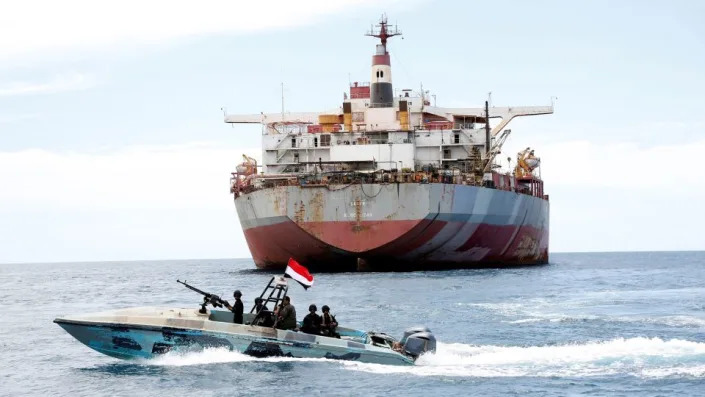
Mohammed Mohammed/Xinhua via Getty Images/FILE

Nadeen Ebrahim, Aimee Look and Zeena Saifi, CNN
Fri, July 28, 2023

Moored five miles off the coast of Yemen for more than 30 years, a decaying supertanker carrying a million barrels of oil is finally being offloaded by a United Nations-led mission, hoping to avert what threatened to be one of the world’s worst ecological disasters in decades.

Experts are now delicately handling the 47-year-old vessel – called the FSO Safer – working to remove the crude without the tanker falling apart, the oil exploding, or a massive spill taking place.

Sitting atop The Endeavor, the salvage UN ship supervising the offloading, UN Resident and Humanitarian Coordinator for Yemen David Gressly said that the operation is estimated to cost $141 million, and is using the expertise of SMIT, the dredging and offshore contractor that helped dislodge the Ever Given ship that blocked the Suez Canal for almost a week in 2021.

Twenty-three UN member states are funding the mission, with another $16 million coming from the private sector contributors. Donors include Yemen’s largest private company, HSA Group, which pledged $1.2 million in August 2022. The UN also engaged in a unique crowdfunding effort, contributing to the pool which took a year to raise, according to Gressly.

The team is pumping between 4,000 and 5,000 barrels of oil every hour, and has so far transferred more than 120,000 barrels to the replacement vessel carrying the offloaded oil, Gressly said. The full transfer is expected to take 19 days.

The tanker was carrying a million barrels of oil. That would be enough to power up to 83,333 cars or 50,000 US homes for an entire year. The crude on board is worth around $80 million, and who gets that remains a controversial matter.

Here’s what we know so far:

Why the UN has been sounding alarms about this ‘ticking time bomb’


The ship has been abandoned in the Red Sea since 2015 and the UN has regularly warned that the “ticking time bomb” could break apart given its age and condition, or the oil it holds could explode due to the highly flammable compounds in it.

The FSO Safer held four times the amount of oil spilled by the Exxon Valdez off Alaska in 1989 which resulted in a slick that covered 1,300 miles of coastline. A potential spill from this vessel would be enough to make it the fifth largest oil spill from a tanker in history, a UN website said. The cost of cleanup of such an incident is estimated at $20 billion.

The Red Sea is a vital strategic waterway for global trade. At its southern end lies the Bab el-Mandeb strait, where nearly 9% of total seaborne-traded petroleum passes. And at its north is the Suez Canal that separates Africa from Asia. The majority of petroleum and natural gas exports from the Persian Gulf that transit the Suez Canal pass through the Bab el-Mandeb, according to the US Energy Information Administration.

The sea is also a popular diving hotspot that boasts an impressive underwater eco-system. In places its banks are dotted with tourist resorts, and its eastern shore is the site of ambitious Saudi development projects worth hundreds of billions of dollars.

A complex and risky operation

The first step of the mission was to stabilize and secure the vessel to avoid it collapsing, Gressly said. That has already been achieved in the past few weeks.

“There are a number of things that had to be done to secure the oil from exploding,” Gressly told CNN, including pumping out gases in each of the 13 compartments holding the oil. Systems for pumping were rebuilt, and some lighting was repaired.

Booms, which are temporary floating barriers used to contain marine spills, were dispersed around the vessel to capture any potential leaks.

The second step is to transfer the oil onto the replacement vessel, which is now underway.

After The Safer is emptied, it must then be cleaned to ensure no oil residue is left, Gressly said. The team will then attach a giant buoy to the replacement vessel until a decision about what to do with the oil has been made.

“The transfer of the oil to (the replacement vessel) will prevent the worst-case scenario of a catastrophic spill in the Red Sea, but it is not the end of the operation,” Gressly said.

While the hardest part of the operation would then be over, a spill could still occur. And even after the transfer, the tanker will “continue to pose an environmental threat resulting from the sticky oil residue inside the tank, especially since the tanker remains vulnerable to collapse,” the UN said, stressing that to finish the job, an extra $22 million is urgently needed.

What if a spill does occur?

A spill would shut the Yemeni ports that its impoverished people rely on for food aid and fuel, impacting 17 million people during an ongoing humanitarian crisis caused by the country’s civil war and a Saudi-led military assault on the country. Oil could bleed all the way to the African coast, damaging fish stocks for 25 years and affect up to 200,000 jobs, according to the UN.

A potential spill would cause “catastrophic” public health ramifications in Yemen and surrounding countries, according to a study by researchers at Stanford University School of Medicine. Yemen, Saudi Arabia and Eritrea would bear the brunt.

Air pollution from a spill of this magnitude would increase the risk of hospitalization for cardiovascular or respiratory disease for those very directly exposed by 530%, according to the study, which said it could cause an array of other health problems, from psychiatric to neurological issues.

“Given the scarcity of water and food in this region, it could be one of the most disastrous oil spills ever known in terms of impacts on human life,” David Rehkopf, a professor at Stanford University and senior author of the study, told CNN.

Up to 10 million people would struggle to obtain clean water, and 8 million would have their access to food supplies threatened. The Red Sea fisheries in Yemen could be “almost completely wiped out,” Rehkopf added.

The tanker has been an issue for many people in Yemen over the past few years, Gressly said. Sentiment on social media surrounding the removal of oil is very positive, as many in Yemen feel like the tanker is a “threat that’s been over their heads,” he said.
Who gets the oil?

The tanker issue remains a point of dispute between the Houthi rebels that control the north of Yemen and the internationally recognized government, the two main warring sides in the country’s civil conflict.

While the war, which saw hundreds of thousands of people killed or injured, and Yemen left in ruins, has eased of late, it is far from resolved.

Ahmed Nagi, a senior analyst for Yemen at the International Crisis Group think tank in Brussels, sees the Safer tanker issue as “an embodiment of the conflict in Yemen as a whole.”

“The government sees the Houthi militias as an illegitimate group controlling the tanker, and the Houthis do not recognize (the government),” Nagi told CNN.

The vessel was abandoned after the outbreak of the Yemeni civil war in 2015. The majority of the oil is owned by Yemeni state firm SEPOC, experts say, and there are some reports that it may be sold.

“From a technical point of view, the owner of the tanker and the oil inside it is SEPOC,” Nagi said, adding that other energy companies working in Yemen may also share ownership of the oil.

The main issue, Nagi added, is that the Safer’s headquarters are in the government-controlled Marib city, while the tanker is in an area controlled by the Houthis. The Safer is moored off the coast of the western Hodeidah province.

Discussions to determine the ownership of the oil are underway, Gressly said. The rights to the oil are unclear and there are legal issues that need to be addressed.

The UN coordinator hopes that the days needed to offload the oil will buy some time for “political and legal discussions that need to take place before the oil can be sold.”

While the UN may manage to resolve half of the issue, Nagi said, there still needs to be an understanding of the oil’s status.

“It still poses a danger if we keep it near a conflict zone,” he said.

CNN’s Eoin McSweeney and Mostafa Salem contributed to this report.

For more CNN news and newsletters create an account at CNN.com
Bunkers, sniper rifles: Deepening sectarian war in India dents Modi's image

Krishn Kaushik
Fri, July 28, 2023 

Heavily armed rival groups firing at each other from bunkers

*

Nearly three months later, no sign of resolution to conflict

*

Embarrassment for Modi as he prepares for G20 summit

*

Government to face no-confidence motion over violence

*

State government, police accused of bias


KANGVAI, India, July 28 (Reuters) - A one-mile stretch of a highway in the lush green foothills of India's Manipur state has become the symbol of a vicious sectarian conflict that has killed over 180 people since May and severely dented the strongman image of Prime Minister Narendra Modi.

The bitter fighting between the Meitei community and the Kuki tribals is in the remote northeast of the country but it has lasted for almost three months, a deep embarrassment for Modi as he prepares to host a summit of G20 leaders in September and contest a general election next year.

There have been past tensions between the two groups, but violence erupted in early May after the state high court ordered the government to consider extending economic benefits reserved for the Kuki tribals to the Meiteis.

Street protests spiralled into armed conflict and now, rival gunmen have dug into bunkers and outposts along the highway and in other places in Manipur, and regularly fire at each other with assault weapons, sniper rifles and pistols.

Tens of thousands of people have fled their homes because of the fighting, villages have been set on fire and many women sexually assaulted, residents and media reports say. The Meitei-dominated state police are seen as partisan while army troops have been ordered to keep the peace but not to disarm fighters.

There is no sign of any early resolution.

Historian and author Ramachandra Guha described the situation as "a mixture of anarchy and civil war and a complete breakdown of the state administration".

"It is a failure of the prime minister at a time of grave national crisis," Guha added, speaking in a television interview. "Narendra Modi lives in a bubble of his own, he doesn't like to be associated with bad news and somehow hopes he will ride it out."

The prime minister's office and a state government spokesman did not respond to requests for comment.

The Kukis, who are a third of the Meitei population, have borne a disproportionate brunt of the violence and make up two-thirds of the victims, according to new government data reviewed by Reuters this week. They have mostly fled to the hills, leaving the capital Imphal and the surrounding valley, areas dominated by the majority Meiteis.

Much of the violence and killings have taken place in buffer zones near Manipur's foothills where intense gun battles erupt regularly, security officials said.

The stretch of the national highway where the Meitei-dominated Bishnupur district meets Kuki-controlled Churachandpur is one of the buffer zones that has seen some of the worst fighting.

MODI'S COMMENTS


This week, when a Reuters team visited the Kuki village of Kangvai, just off the highway, volleys of gunshots could be heard from both sides.

Jangminlun Touthang, 32, a Kuki fighter carrying a hunting rifle, was manning a post directly opposite the Meitei lines.

He said he was there to protect his village from the Meiteis "who are going to attack us, who are going to burn our houses".

"When they attack, we fire," he said.

Modi's first comments on the violence in Manipur came last week, over two months after the trouble started in early May. He promised tough action a day after videos that purported to show two Kuki women being paraded naked and assaulted by a crowd went viral and drew international condemnation.

"The law will take its strongest steps, with all its might. What happened to the daughters of Manipur can never be forgiven," he said.

Modi's Bharatiya Janata Party (BJP) also heads the state government in Manipur. In the federal parliament, Modi faces a no-confidence motion over the violence, the second time in over nine years in power that he has been put to the test.

Although there is no threat to his government, Modi is likely to have to address the issue in detail.

The opposition is likely to ask why he is persisting with support to Manipur Chief Minister Biren Singh, a Meitei who heads the BJP state government.

Manipur, which borders Myanmar, is one of India's smallest states with a population of 3.2 million. While Kukis are just 16% of the state's population, Meiteis make up 53% of the people.

The death toll of 181 killed includes 113 Kukis and 62 Meiteis, according to the data reviewed by Reuters that have not been reported earlier.

The data show that in the first week of the violence in early May, 77 Kukis were killed compared to 10 Meiteis.

“Resources available to both sides are not the same. It is not a fight among equals,” a federal security official based in Manipur told Reuters.

According to government estimates, 2,780 weapons stolen from the state armoury, including assault rifles, sniper guns and pistols, remain with the Meiteis, while the Kukis have 156.

Kae Haopu Gangte, general secretary of Kuki Inpi Manipur, an umbrella Kuki civil society group, blamed the conflict on what he said was the desire of the Meiteis to dominate Kuki land.

The Kukis now want a separate state within India, he said.

“Until and unless we achieve statehood we will not stop,” Gangte said. “We are fighting not only Meiteis, we are fighting the government.”

Pramot Singh, founder of Meitei Leepun, a prominent Meitei organization that has members on the frontlines, said all Meiteis supported the conflict.

Seated outside his home near Imphal, with a pistol in a holster, he said his group will fight the Kukis until they stop demanding a separate state be carved out of Manipur.

“The war will continue from the Meitei side. This is just the beginning,” he said.

(Reporting by Krishn Kaushik in Manipur; Editing by YP Rajesh and Raju Gopalakrishnan)


India's Parliament rocked by protests for a third day over ethnic violence in remote state


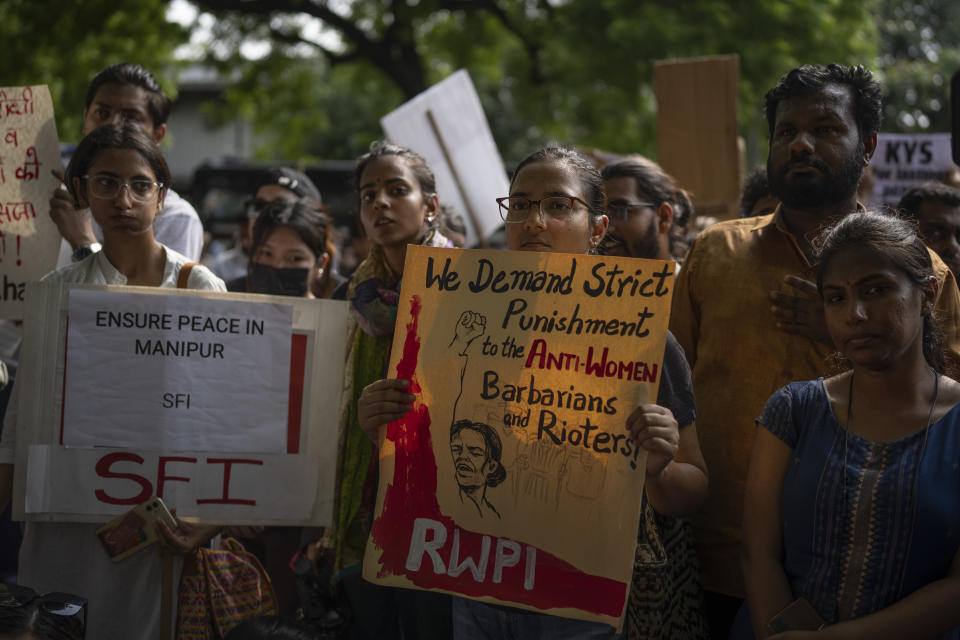
A woman holds placards during a protest demonstration against the violence in the northeastern state of Manipur, in New Delhi, India, Friday, July, 21, 2023. Deadly ethnic clashes in India's northeast rocked India's Parliament with the opposition blocking proceedings for a second straight day on Friday demanding the sacking of the top elected official of northeastern Manipur state where ethnic clashes have left more than 130 people dead since early May.


Policewomen stand guard during a protest demonstration against the violence in the northeastern state of Manipur, in New Delhi, India, Friday, July, 21, 2023. Deadly ethnic clashes in India's northeast rocked India's Parliament with the opposition blocking proceedings for a second straight day on Friday demanding the sacking of the top elected official of northeastern Manipur state where ethnic clashes have left more than 130 people dead since early May. 


Students and activists participate in a protest demonstration against the violence in the northeastern Indian state of Manipur, in New Delhi, India, Friday, July, 21, 2023. Deadly ethnic clashes in India's northeast rocked India's Parliament with the opposition blocking proceedings for a second straight day on Friday demanding the sacking of the top elected official of northeastern Manipur state where ethnic clashes have left more than 130 people dead since early May. 


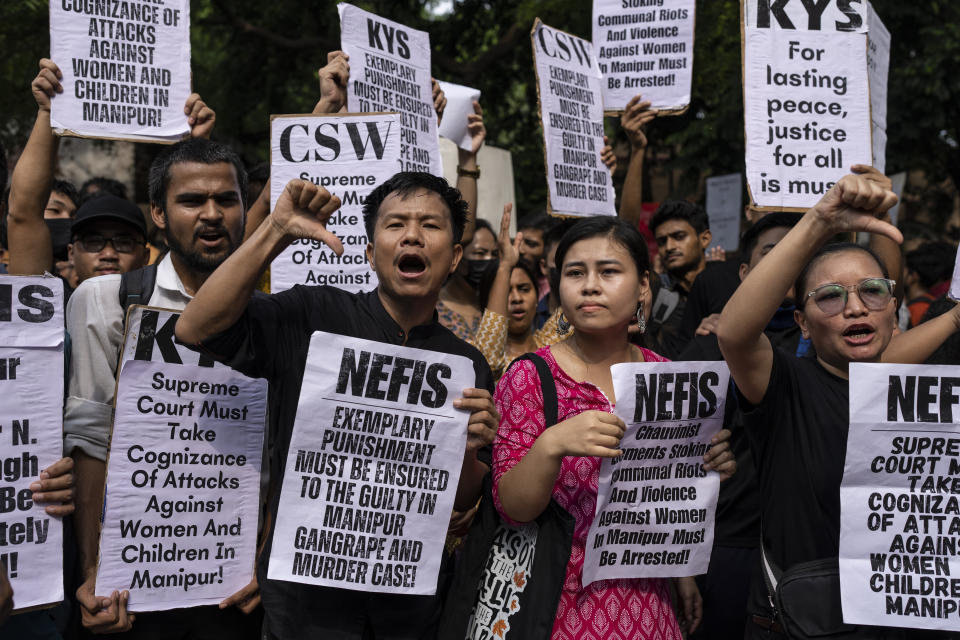
Students and activists shout slogans during a protest demonstration against the violence in the northeastern Indian state of Manipur, in New Delhi, India, Friday, July, 21, 2023. Deadly ethnic clashes in India's northeast rocked India's Parliament with the opposition blocking proceedings for a second straight day on Friday demanding the sacking of the top elected official of northeastern Manipur state where ethnic clashes have left more than 130 people dead since early May. 


Students and activists shout slogans during a protest demonstration against the violence in the northeastern Indian state of Manipur, in New Delhi, India, Friday, July, 21, 2023. Deadly ethnic clashes in India's northeast rocked India's Parliament with the opposition blocking proceedings for a second straight day on Friday demanding the sacking of the top elected official of northeastern Manipur state where ethnic clashes have left more than 130 people dead since early May. 

AP Photos/Altaf Qadri


Mon, July 24, 2023 

NEW DELHI (AP) — India's Parliament was disrupted for a third day Monday by opposition protests over ethnic clashes in a remote northeastern state in which more than 130 people have been killed since May.

Opposition lawmakers carried placards and chanted slogans outside the Parliament building as they demanded a statement from Prime Minister Narendra Modi on the violence in Manipur state before a debate on the issue.

Last week, Modi broke more than two months of public silence over the ethnic clashes, telling reporters that mob assaults on two women who were paraded naked were unforgivable, but he did not refer directly to the larger violence.

His comments came after a video showing the assaults sparked widespread outrage on social media despite the internet being largely blocked and journalists being locked out in the state. It shows two naked women surrounded by scores of young men who grope their genitals and drag them to a field.

The video was emblematic of the near-civil war in Manipur, where mobs have rampaged through villages and torched houses. The conflict was sparked by an affirmative action controversy in which Christian Kukis protested a demand by mostly Hindu Meiteis for a special status that would let them buy land in the hills populated by Kukis and other tribal groups and get a share of government jobs.

Indian Home Minister Amit Shah on Monday said the government is ready to discuss the situation in Manipur. "I request the opposition to let a discussion take place on this issue. It is important that the country gets to know the truth on this sensitive matter,” he said in the lower house of Parliament.

Both houses of Parliament were adjourned various times as the opposition stopped proceedings with their demand for a statement from Modi. Sessions were also disrupted on Thursday and Friday.

The main opposition Congress party's president, Mallikarjun Kharge, tweeted it was Modi's “duty to make a comprehensive statement inside the Parliament on Manipur violence.”

Violence in Manipur and the harrowing video have triggered protests across the country. On Monday, scores of people gathered in Indian-controlled Kashmir and protesters carrying placards took to the streets of the eastern city of Kolkata.

Over the weekend, nearly 15,000 people held a sit-in protest in Manipur to press for the immediate arrest of anyone involved in the assault, which occurred in May. They also called for the firing of Biren Singh, the top elected official in the state who also belongs to Modi's party.

The state government said last week that four suspects had been arrested and that police were carrying out raids to arrest other suspects.


The wind energy industry is struggling

Jeronimo Gonzalez
Thu, July 27, 2023

The News

The wind energy sector has been blighted by rising financing and materials costs, fierce competition, and expensive technical problems that have led to heavy losses despite demand for energy soaring. Plummeting prices for other forms of renewable energy have also piled on to the industry’s problems.

We’ve gathered reporting and analysis on why the industry is struggling and where it’s succeeding.
Insights

Soaring temperatures across Europe and the continent’s efforts to wean its economies from dependance on Russian oil and gas have underscored the need for wind energy. However the combination of plummeting prices for renewable energy coupled with soaring costs on debt have made large offshore wind projects inviable. “This means that price of renewable energy regrettably must come up temporarily after years of steep decline,” the head of Danish energy giant Ørsted said.

Wind turbine producers have struggled with rising steel prices, inflation, and low quality production. Shares of Siemens Energy plunged by close to 30% last month after the company announced technical faults in its turbine business, affecting some of the world’s biggest wind developers. “Turbine prices fell sharply in 2017, which was then followed by the industry introducing new technology and turning to emerging markets for suppliers to keep costs down,” an analyst at JPMorgan said. “Some of the quality and design issues in the industry now are the result of that.”

Earlier this year, the White House announced plans to deploy 30 gigawatts of offshore wind energy capacity by 2030, enough to power roughly 10 millions homes. Reaching the goal will be a tough task: As of July, there are just two operational wind projects in the U.S. which combined produce 0.14% of the government’s 2030 goal. Earlier this month, two major projects were scrapped because of a lack of bids and cost issues. Developers “look at projects and the agreed upon price and are not seeing a path to profitability,” an expert at the Centre for Strategic and International Studies said.


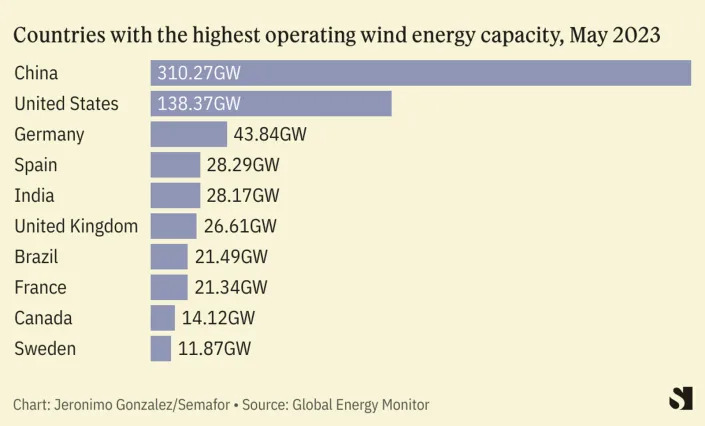
Meanwhile, China’s wind industry is buoyant. The country’s total wind capacity — both onshore and offshore — now surpasses 310 gigawatts, double its 2017 level and roughly equivalent to the next seven highest producing countries combined. Its capacity is set to double again before 2025 as it seeks to add another 371 GW by then. “This new data provides unrivalled granularity about China’s jaw-dropping surge” in wind capacity, Dorothy Mei, a project manager at Global Energy Monitor said, referring to data published last month.

Vattenfall Stops UK Offshore Wind Project Citing Costs and Lower Profits

Vattenfall UK wind farm
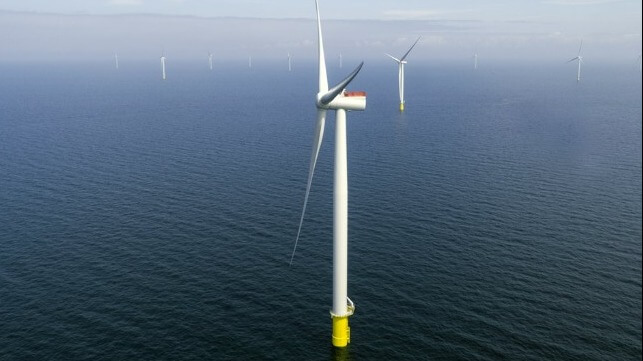
Vattenfall decided to stop a major UK wind farm development project due to rising costs (file photo)

PUBLISHED JUL 20, 2023 5:41 PM BY THE MARITIME EXECUTIVE


Vattenfall has become the latest developer of wind farms to report that rising costs are undermining the economics of offshore projects. The Swedish energy company announced that it has decided to shelve a late-stage development project in the UK saying the market for offshore wind power is “challenging.” The company’s decision also raised broader concerns for the UK’s offshore wind energy sector which is a key component of the government’s future energy plans.

“We have decided to stop the development of Norfolk Boreas in its current form,” Vattenfall President and CEO Anna Borg announced in the company’s mid-year financial report. “We will examine the best way forward for the entire Norfolk Zone, which in addition to Boreas also includes Vanguard East and West.”

The project was planned for an area about 30 miles off the south east coast of Britain. Boreas was to have an installed capacity of 1.4 GW and was due to deliver its first power in 2027. The zone with the three wind farms was to consist of between 180 and 312 turbines with a total capacity of 3.6 GW. 

“Higher inflation and capital costs are affecting the entire energy sector, but the geopolitical
situation has made offshore wind and its supply chain particularly vulnerable,” Borg said in explaining the decision to suspend the development project. She told investors that the company has seen cost increases of up to 40 percent, saying that this affects the future profitability of the project. They are citing soaring material and project costs along with the impact of inflation and interest rates on the projects’ economics.

The company, which has grown its wind portfolio in the past year from 4.2 GW to 5.6 GW, said it is still convinced that offshore wind power is “crucial for energy security.” Nonetheless, based on the changing economics, they are recording a more than $500 million impairment charge against earnings to stop the development of these UK projects. 

Vattenfall had previously said the Boreas project and its advancement was “great news” for the UK. They received planning consent for the project in December 2021 and won Contracts for Difference a year ago. The company reported the contract provided for a 15-year fixed revenue stream with Reuters estimating the guaranteed minimum price at nearly $58 per MW hour. The company signed grid contracts with Siemens Energy and Aker Solutions last October and was expected to make a final investment decision later this year for Boreas.

The decision to suspend the development is raising broader questions about the UK’s industry. The government has highlighted that it plans to have 50 GW of offshore wind energy as part of its energy plan. The UK currently has around 14 GW of installed capacity. The Boreas project was seen as among the most advanced of the UK’s future projects.

Addressing investors, Borg said that they now believe that the UK does not currently have the investment environment needed to meet its offshore wind targets. The company hopes that the contract prices might improve to make it possible to go forward with projects. They said the incentives currently available no longer reflect market conditions while noting that other developers including Ørsted have also called for target support of the industry.


'Oppenheimer' reignites debate: Was the U.S. justified in dropping atomic bombs on Japan?


Mike Bebernes
·Senior Editor
Updated Thu, July 27, 2023 


U.S. Army via Hiroshima Peace Memorial Museum via AP


What's happening

The new blockbuster film "Oppenheimer," which tells the story of how physicist J. Robert Oppenheimer became “the father of the atomic bomb,” has given new energy to a debate that has raged for nearly 80 years: Whether the U.S. made the right decision to drop nuclear weapons on Japan at the end of World War II.

An overwhelming majority of Americans at the time approved of the bombings, which killed as many as 200,000 Japanese citizens in the cities of Hiroshima and Nagasaki. But that sentiment has shifted over the decades. By 2015, the U.S. public was close to evenly split on whether the use of nuclear weapons was justified.

Oppenheimer himself was deeply conflicted about the weapons he helped create. He reportedly celebrated the news of the Hiroshima bombing, stating that his only regret was they hadn’t developed the bomb in time to use against the Nazis earlier in the war. But a few months later, he told then-President Harry Truman, “I feel I have blood on my hands.” In the years following the war, he was a vocal advocate for strict nuclear arms control and opposed the creation of even more powerful versions of the bomb.

Why there’s debate

Because of the extraordinary stakes of the decision — and the unknowable outcomes of not making it — the debate over dropping the bombs has been described by one historian as “the most controversial issue in American history.”

In 1945, the main argument in support of the bombings, which many affirm to this day, was that the use of nuclear weapons actually saved countless lives and that the alternatives would have been even more devastating. Proponents of this view say the only other way to convince Japan to surrender would have been a brutal invasion that would have caused massive losses on both sides and created a famine that could have led to starvation for millions of Japanese civilians.

Others say it’s likely there would have been other nuclear attacks had the world not been given a clear example of their incredible power.

But critics of the bombings say these justifications ignore what was really happening at the time. They argue that American leaders dropped the bombs because they wanted to do maximum damage to the Japanese people, not some sober calculus in search of the least-harmful way to end the war. Many also scoff at the idea that the attacks somehow served as a deterrent, since the world’s arsenal of nuclear weapons grew exponentially in the years that followed.

Perspectives

Americans are hiding behind a myth to justify doing the unforgivable

“Like many Americans, I was taught growing up that my grandfather was spared the burden of invading Japan and very likely dying because Harry Truman dropped a pair of atomic bombs on Hiroshima and Nagasaki and ended the war. The main function of such stories is to justify a terrible war crime.” — David Klion, The New Republic

The bombings ultimately spared countless lives

“The alternative to dropping the bombs was a full-scale land invasion of the islands. Conventional attacks, including regular bombing, would have resulted in widespread civilian casualties as well as the long-term destruction of Japanese infrastructure.” — Tiana Lowe Doescher, Washington Examiner

Japan may have surrendered regardless

“The bomb’s central role in the Japanese surrender has been hotly contested by many historians, complicating any claims it was a necessary act.” — Greg Mitchell, Los Angeles Times

Japan was nowhere near surrendering before the bombs were dropped

“The big [myth] was that the Japanese were ready to surrender and would have surrendered even if we had not dropped those bombs. I think that is a myth. … The Japanese were essentially defeated—that’s true. Their fleet had been sunk and their cities had been burned. But they were not ready to surrender.” — Evan Thomas, nuclear historian, to Time

The typical story gives U.S. leaders far too much credit

“The standard narrative that most people have about the use of the atomic bombs and World War II is wrong. … Just the idea that Harry Truman very carefully weighed whether to use the bomb or not. It was a question of, ‘Do you bomb? Or do you invade?’ And so with a heavy heart, he chose to bomb and that was the lesser of two evils. That is just 100 percent not what happened at the time.” — Alex Wellerstein, nuclear historian, to Vox

The most humane thing the U.S. could have done was end the war as quickly as possible

“We were fighting a merciless foe in a savage war where every day brought more suffering and devastation, to combatants and civilians alike and across Asia. The best thing that could happen was ending the war as soon as possible, and the atom bomb brought it to a swift and decisive conclusion.” — Rich Lowry, National Review

The bombings convinced the world that nuclear weapons should not be used again

“It was inevitable that such a destructive and horrific weapon would be developed. And the specter of that weapon is breathtaking and terrifying. But the sheer scale of the bomb often overshadows a much more optimistic fact of the story: Since 1945, mankind has had the choice to use the weapon and thus far have chosen not to.” — Hal Sundt, The Ringer

Using the bombs accelerated the nuclear arms race

“This is a pervasive myth, one that primarily benefits the companies that build nuclear weapons. It’s the myth that military power prevents conflict. … The real realists recognize that by perpetuating this system of valuing nuclear weapons, we are going to ensure that they’re used.” — Seth Shelden, United Nations liaison for the International Campaign to Abolish Nuclear Weapons, to Slate