It’s possible that I shall make an ass of myself. But in that case one can always get out of it with a little dialectic. I have, of course, so worded my proposition as to be right either way (K.Marx, Letter to F.Engels on the Indian Mutiny)
Saturday, August 26, 2023
Who are Canada’s farmers? New federal data provides a snapshot
It’s also becoming more common for farmers to diversify their income, as farming industries face significant challenges ranging from drought, fires and climate change to evolving consumer tastes, worker shortages and global price pressures.
Canada’s farmers are still mostly made up of older people and men, the report said. It defined “farm population” as farm operators — those who manage the farms — and their households.
In 2021, over half the farm population were men, at 52.5 per cent. Just under half of Canada’s population are men (49.4 per cent). Meanwhile, in 2021, more than four in 10 male farmers were 55 years old and older, compared with 31.2 per cent of the total population who were in that age bracket.
Similarly, 41 per cent of women farmers were in the same age category, compared to 33.5 per cent of Canadians.
Immigrants also make up a portion of Canada’s farmers in 2021, sitting at 6.9 per cent, up from 6.8 per cent in 2001. However, immigrants make up a much smaller proportion of the farm operator population than the general population.
Immigrants made up 23.1 per cent of Canada’s population in 2021, up from 18.7 per cent in 2001.
Government announces additional support for drought-plagued ranchers
Meanwhile, less than four per cent of the farm population in 2021, 3.7 per cent, were part of a racialized group, while the demographic made up 26.6 per cent of the general population.
Among those in the farm population who identified as from a racialized group, 53 per cent were South Asian, followed by Chinese at 15.8 per cent, Black at 5.9 per cent and Latin American at 5.9 per cent.
The report also notes that there are fewer farmers than in the past as farms have become automated and sophisticated in their operations.
In 1971, one in 14 Canadians was part of the farm population, but in 2021, that number decreased to one in 61 Canadians, a decline of 62.2 per cent.
The average size of a farm household also dropped to 2.8 people in 2021 compared to 4.3 people in 1971, in line with general population trends.
Finally, more of the farm population is living in urban areas, with 24.5 per cent doing so in 2021, up from 16.1 per cent in 2016 and 7.5 per cent in 1971.
The greatest proportion of the farm population living in urban areas was reported in Newfoundland at 42.2 per cent, followed by B.C. at 37.8 per cent and Alberta at 28.3 per cent.
Farms for dairy cattle, field crops and livestock grazing were still overwhelmingly located in rural areas, while just over 40 per cent of those with fruit, tree nut, vegetable and melon farms lived in urban areas.
Canadian ministers vow to accelerate action at global environment conference in B.C.
MINISTERS VOW TO ACCELERATE
The Canadian Press - Aug 25, 2023 /
Photo: The Canadian Press
Steven Guilbeault, Minister of Environment and Climate Change of Canada speaks to reporters at the COP15UN Biodiversity Conference in Montreal, Sunday, December 18, 2022. THE CANADIAN PRESS/Graham Hughes
Politicians and environmental leaders from more than 180 countries have been in Vancouver, B.C., this week, with many pledging to accelerate action on climate change and biodiversity loss at the assembly of the Global Environment Facility.
The organization manages a series of funds aimed at helping developing countries meet their climate goals, such as those established by the Paris Agreement, which sets a target of limiting global heating to "well below" 2 C from pre-industrial levels.
Facility CEO Carlos Manuel Rodriguez says the need to accelerate action is more urgent than ever, as disasters linked to global heating devastate communities worldwide, including wildfires ravaging British Columbia and the Northwest Territories.
"The climate and biodiversity crisis is not something that is going to happen later this century, in 25 years," Rodriguez said in an interview ahead of the assembly, the seventh since his organization launched in 1991.
"It'shappening right now. Look outside your window," he said.
Canada's minister of environment and climate change, Steven Guilbeault, likewise said the wildfires that have forced tens of thousands of people from their homes serve as an "unwanted reminder of the need to act together with urgency."
The minister made the remarks as he opened a meeting with several dozen of his counterparts from around the world gathering in Squamish, B.C., to discuss progress, challenges and opportunities in implementing the global biodiversity framework struck at the United Nations meeting in Montréal last December.
"The climate change we're seeing is with 1 degree Celsius," he said, referring to the level or warming that's already occurred since the Industrial Revolution.
"I don't want to see a world where we get to 2 degrees Celsius, what the impacts will be in Canada and around the world," Guilbeault said in an interview.
"Therefore, we need to continue, and even accelerate," he said.
Guilbeault along with Ahmed Hussen, the federal minister of international development, announced Thursday that Canada would be the first country to make a public pledge in support of a fund launched during this week's assembly.
Canada has earmarked $200 million for the new Global Biodiversity Framework Fund set up to help finance the implementation of the agreement struck in Montréal, which aims to put nature on path to recovery by the end of the decade.
"This is the start of a long climb," Guilbeault told the news conference.
"We will keep working with our international partners to mobilize $20 billion per year by 2025 and $30 billion by 2030 in financial resources for biodiversity," he said.
The United Kingdom has also pledged more than C$17 million.
Hussen noted the assembly has agreed for the first time to allocate 20 per cent of the new fund to Indigenous-led initiatives aimed at protecting biodiversity.
Canada is also adding $22.8 million to its earlier $219-million commitment to overall funding for the Global Environmental Facility, Hussen said.
Biodiversity and ecosystems underpin human health, well-being and economic growth, but biodiversity loss has reached "critical levels," he said.
Canada is among 40 states that have contributed money over the last 30 years, helping the organization provide $23 billion in fundingand facilitate more than five times that amount in co-financing for 5,000 projects in developing countries.
But Rodriguez said accelerating concrete action to address the crisis requires a "paradigm shift" in how decisions are made and how funding is distributed in order to empower civil society— especially youth, women, Indigenous Peoples and others often sidelined in international climate negotiations and domestic policy-making.
"There is a consensus that if we don't incorporatecivil society and (the) private sector, there won't be time to really be on track on climate and biodiversity," said Rodriguez, who previously served as Costa Rica's environment minister.
The Global Environment Facility has so far worked mainly with political executives whose approval is required for civil society groups to receive any funding, he said.
But addressing the triple crises of climate change, biodiversity loss and pollution demand a more inclusive, "whole of society" approach, Rodriguez said.
The assembly in Vancouver marks the starting point for that new model, he told an opening press conference on Wednesday, where he called on donors to "redouble" funding that's expected to flow directly to civil society groups for the first time.
"For the last 15 years we've been talking and talking about inclusion, about the relevance of non-state actors, about the role of civil society," he said in an interview.
"But we never put the money behind the talk."
NFNLND
Death of employee leads to nearly $100K in fines for C.B.S construction company
Social Shar
Facebook
IT'S THE LAW IN CANADA
IT'S THE LAW IN CANADA
Triple J Aggregates fined nearly 3 years after an employee died in a quarry near St. John’s
Chief Judge Robin Fowler handed down nearly $100,000 in fines over the 2020 death of an employee. (Terry Roberts/CBC)
Nearly three years after a Triple J Aggregates employee died in a workplace incident, the company and supervisor Bill Weir have been ordered to pay approximately $100,000 in fines by the Newfoundland and Labrador provincial court.
The construction company faced 11 occupational health and safety charges following the death of an employee in a quarry near St. John's in September of 2020.
Conception Bay South-based company Triple J Aggregates was convicted of two workplace offences. The fines total $80,000 and the company must pay the sum within a year.
Weir was found guilty over a failure to ensure the safety of a worker under his supervision. He has been ordered to pay approximately $4,000 within 90 days.
Chief Judge Robin Fowler handed down the sentence Thursday.
The remaining nine charges against the company were withdrawn.
Construction Company, Supervisor Fined $100,000 Following Death of Worker
Aug 24, 2023 | 12:26 PM
A company and supervisor have been fined just over $100,000 following the death of a worker almost three years ago.
Sixty-one-year-old John Rogers had been with Weir’s Construction and later Triple J Aggregates for 15 years.
But his work and life came to a brutally tragic end when he was hauled into the rock crusher he was operating.
It happened shortly after he got to the quarry off Fowler’s Road on a Friday morning, Sept. 18, 2020.
No one saw what happened, or how the Fortune Bay man got tangled in the conveyor belt that dragged him into the crusher.
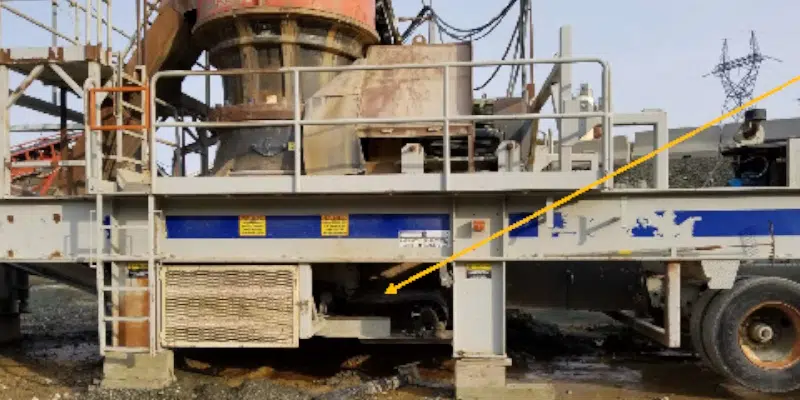
But it was determined that several guards around it were missing at the time of the incident.
The small yellow arrow points to where missing factory-installed guarding should be on the rock crusher. (Public court document.)
The first sign of trouble for other workers was the smoke suddenly and unusually coming from the massive machine.
In court this morning, Rogers’ employer, Triple J, the parent company of Weir’s, was convicted of three workplace offences while supervisor Bill Weir, a longtime friend of the victim, was found guilty of failing to ensure his health and safety.
The company was fined almost $100,000 while Weir must pay more than $3,000.
Heart-wrenching victim impact statements from the man’s brother, daughter and niece were filed with the court, but they could not bring themselves to be there.
These weren’t the first infractions linked to Weir’s Construction.
They were also fined for incidents in 2009 and 2012, and slapped with four stop-work orders between 2018 and 2020.
Shift work linked with negative effects on memory and cognition: Canadian study
The study found that night shift work was linked to impaired memory function, while rotating shift work was associated with impairment in executive function. (Photo: pexels) Hayatullah Amanat CTVNews.ca writer Published Aug. 25, 2023
Working the late-night or rotating shifts can be exhausting, but a recent study conducted from researchers at York University has found that shift work might also have a negative impact on the memory and thinking abilities of middle-aged and older adults.
The peer-reviewed study, published in the open-access journal PLOS ONE, involved nearly 50,000 adults who worked outside of the traditional 9 a.m. to 5 p.m. The dataset included self-reported details about employment and work schedules, along with the results of cognitive function tests.
The study also found that 21 per cent of participants had experienced some form of shift work during their careers. However, higher rates of cognitive impairment were observed in individuals who reported current exposure to night shift work or had worked night shifts in their longest job when compared to those who had only worked daytime shifts.
When examining specific areas of cognitive function, the study found that night shift work was linked to impaired memory function, while rotating shift work was associated with impairment in executive function.
According to the study authors, messing with our body's natural sleep patterns through shift work could hurt how our brains work as we get older.
“The study findings suggest a potential link between shift work exposure and cognitive function impairment,” the authors stated. “We speculate that disruptive circadian stimuli may play a role in neurodegeneration contributing to cognitive impairment; however, additional studies are needed to confirm the association between shiftwork and cognitive impairment as well as any physiological pathways that underlie the mechanism.” Reporting for this story was paid for through The Afghan Journalists in Residence Project funded by Meta.\
Take it from an ex-supermarket worker: This Metro strike is a reminder of what we’ve lost
When I worked at a grocery store, it was a retail job that could give you a career and stability. I’m cheering for the Metro workers.
By Bruce Arthur Columnist Saturday, August 26, 2023
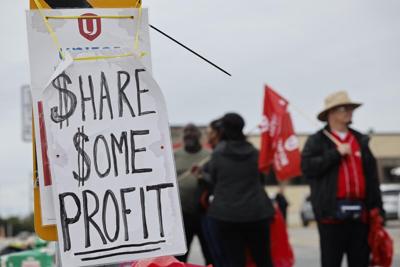
Metro workers picket a Metro warehouse at 5559 Dundas St. W. this past week, preventing the flow of goods to the distribution hub.R.J. Johnston / Toronto Star
At Safeway the men wore ties under our aprons as we stocked shelves, or collected shopping carts, or cleaned up the vomit from the four-year-old in the produce section who was asked what happened and said, staring at his shoes, “I pooked.” It was a professional operation, you see. We had timecards that rested in slots and everybody’s hourly wage peeked out at the top, so every time I clocked in, it was like staring at a possible future. Some cards whispered to me: if you wanted, you could stay here forever.
The memories resurfaced because of the Metro strike, which is nearly a month old. My third real job was in a supermarket at 12th and Cambie in Vancouver in the 1990s, after the doughnut shop and the fabric factory, and mostly I remember the people.
Chester worked in dairy: he had Hanson Brother glasses and a wispy moustache and a 40-year smoker’s rasp, which was about how long he’d been in the business. There were two cashiers named Noreen, but only one was a Jehovah’s Witness. Joy, the most serene cashier, was married to Willie from the realign crew, which would reorganize stores when head office wanted something changed; Willie was the definition of a lifer. Bianca worked in the deli: she was thin and birdlike and a little tremulous. She married Mark, a handsome grocery clerk who had a disconcerting wildness in his eyes. They had a kid, then divorced. They both kept working in the store.
They stayed because in the 1990s it was a retail job that was also a career. There were benefits and pensions and you could make $25 per hour, or about $46 an hour in today’s dollars. Rosella was a kind and wise travel agent living below the poverty line; she picked up a cashier’s job, was chosen to run the floral department, and all of a sudden she could afford her own apartment. She’s been a florist, in and out of Safeway, ever since.
Because they had been there so long, people had time to grow and mature into themselves, or not. Sometimes on night shifts the acting manager would ask a junior employee to fetch dinner off the shelves; ideally microwaveable, though one guy would actually cook food in the bakery oven. Years before that, when inventory was less formal, some clerks would apparently roll their car up to the loading dock and load it with groceries. When it was slow, we’d throw a banana or a bag of potato chips into a ceiling fan to see what happened. The result was about what you would think.
But employees were taxpaying members of society, able to afford a house and a car and vacations to someplace nice. Jackie, a wisecracking German cashier, once inexplicably lent me her newish Nissan Pathfinder when she vacationed in Europe for a month, because she didn’t want it to sit and considered me a responsible young man. I drove her Pathfinder to Whistler and nearly died while swimming in a glacier lake after putting shrooms into a strawberry margarita. In fairness to Jackie, my death in the lake, while regrettable and ridiculous, would not have damaged her car.
But the work got done, and workers were taken care of. Jason was albino and legally blind and held price checks right up to his face, and was also a Paralympian, a sprinter; as a bag boy he made $12-14 an hour, which was double the minimum wage at the time. Cashiers and clerks started closer to triple the minimum wage.
Which brings us to Metro, where the strike is nearly a month old. The 3,700 workers are fighting to restore the “hero pay” bump of $2 an hour from the pandemic on top of higher wages amid the past two years of record grocery profits and stagnating wages and inflation. An average full-time Metro employee makes $22.60 an hour, but 70 per cent of the union makes less than $20, because part-time jobs make less.
Minimum wage in Ontario will rise to $16.55 per hour in October of this year; according to the Ontario Living Wage Network, living wage in Toronto is $23.15 an hour and in the cheapest part of Ontario, London-Elgin-Oxford, it’s $18.15.
As Unifor president Lana Payne told the Star, “Who can support a family on $16-$17 an hour?” She also pointed out Metro made $922 million in profits in 2022 as part of a trend of rising grocery profits, as food prices have been the most visible sign of inflation for most people. Who has $10 for guacamole?
It’s not that a raise will let grocery workers afford a house; the housing crisis is a backdrop for this, along with a tighter labour market. But union membership in Canada has dropped from 38 per cent in 1981 to about 30 per cent now, and this may be a time of labour unrest. TVO is on strike, and good luck to them. We’ve seen public union sector strikes, from federal employees to port workers to education workers.
In the U.S., the Writers Guild of America and Screen Actors Guild and maybe the UAW in Detroit are all striking. The Teamsters just negotiated a contract for American UPS drivers that will see their wages hit $49 an hour (U.S.) in 2028. Inflation has hit a lot of workers hard; collective bargaining is the best way to claw it back.
And it reminded me there used to be a better deal for a lot of workers, and it allowed them to live the kind of lives you can hope for. We went on strike at my Safeway in 1997; the deal eventually grandfathered in the existing workers and started every new hire at bag-boy wages or less, to put B.C. workers more in line with Alberta. We lost, back before the record profits, and inflationary times, and the automated cashiers. I hope the Metro workers win.
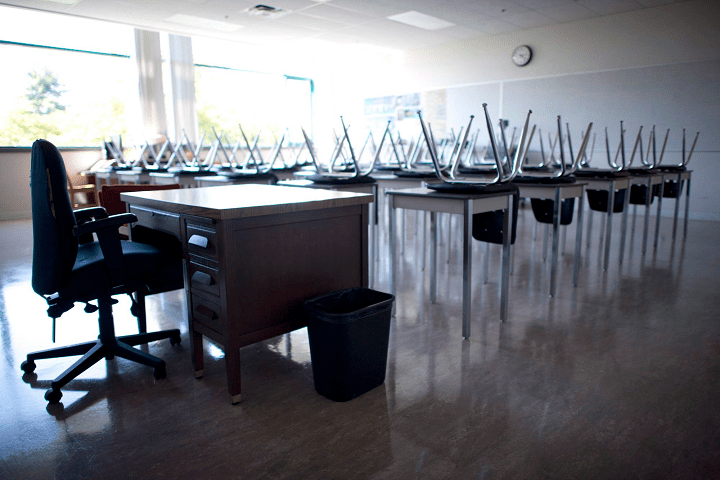
OSSTF teachers are set to hold a one-day walkout on Wednesday. THE CANADIAN PRESS/Jonathan Hayward
The Ontario Secondary School Teachers’ Federation (OSSTF/FEESO) says it will recommended to its union members that they enter into a proposal to “resolve bargaining” with the Ontario government.
The union said bargaining unit presidents and chief negotiators “voted overwhelmingly” in favour of the recommendation at a special meeting on Friday.
The process, according to the union, could including binding interest arbitration.
“The proposal is not a tentative agreement but establishes a clear pathway forward for this round of bargaining,” OSSTF/FEESO said in a press release Friday.
The union said it will now begin preparations for an internal membership vote that will take place through September.
Members — approximately 60,000 education workers and high school teachers — across the province will vote on whether they want to enter into the proposal, the union said.
OSSTF/FEESO President Karen Littlewood said Friday represented a “critical point in this round of bargaining.”
“Since beginning bargaining 13 months ago, OSSTF/FEESO has been fighting to improve the learning and working conditions in Ontario’s schools but the Ford government and school boards have refused to be a fair partner in these negotiation,” Littlewood said in a statement. “This process is not a tentative agreement but it does promise to break any impasse by bringing in a third party arbitrator to seek a fair and just resolution.”
The union said if OSSTF/FEESO members vote in favour of the proposal to resolve bargaining, central bargaining will continue until Oct. 27
“By which date any matters that have not yet been settled with go to arbitration,” the release read. “If the Membership votes no, the proposal will be dropped and bargaining will continue.”
According to the union, if it is accepted, the proposal means there will be no strikes or lockouts during this round of bargaining between OSSTF/FEESO.
“The proposal also guarantees that OSSTF/FEESO Members will receive a remedy for wages lost under Bill 124, the Ford government’s wage suppression legislation that unfairly targeted woman-dominated public sector workers,” the union said. “Members will receive the remedy without having to wait for the courts to decide on the constitutionality of Bill 124.”
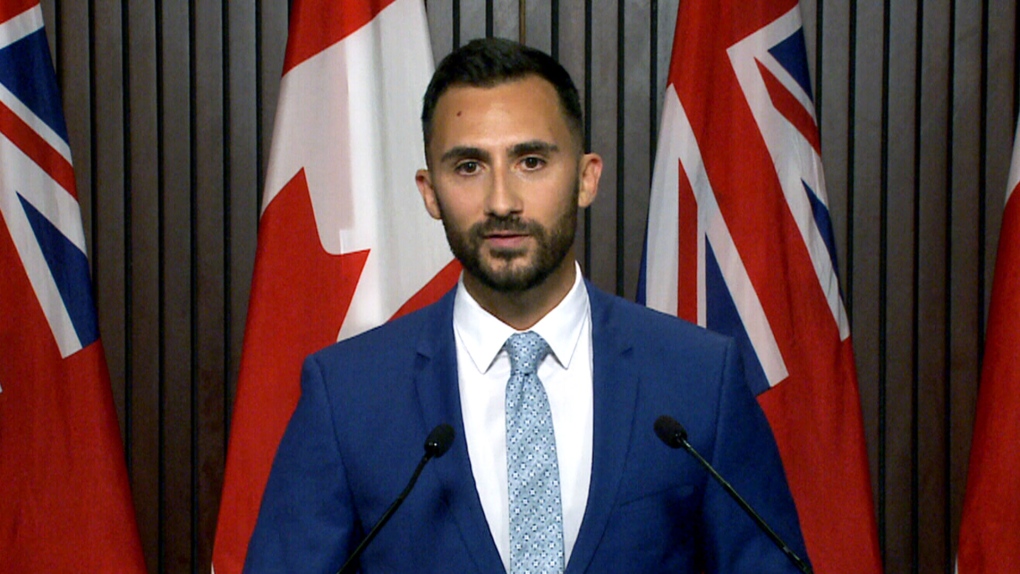
In a statement Friday, Ontario’s education minister, Stephen Lecce said he is “pleased” that the government has reached a “tentative four-year-agreement with the Ontario Secondary School Teachers’ Federation on a process that, if ratified by union members, will keep students in class where they belong.”
“My ongoing commitment to Ontario families is to use every available tool and pursue every path that keeps students in school. Doing so will mean students are in classrooms learning what matters most: reading, writing and math skills.”
Lecce said if approved, the tentative agreement “provides for bargaining to continue without the threat of strikes. If a collective agreement cannot be reached by October 27, 2023, the parties will enter binding interest arbitration to resolve any outstanding issues.”
The four major teachers’ unions have been in bargaining with the government for more than a year and all have complained about the slow pace.
The OSSTF had told members in a recent memo that it was also planning strike votes in the fall, saying the government had shown little interest in substantive negotiations and a strong strike mandate would demonstrate a determination to get a fair deal.
-With files from The Canadian Press.
Ontario government, secondary school teachers' union agree to process to avoid strike Ontario education minister on the tentative deal
Phil Tsekouras CTV News Toronto Multi-Platform Writer Updated Aug. 25, 2023
The Ontario government has announced it will enter a process with the province’s secondary school teachers’ union to avoid strikes and keep kids in school, pending a vote by members.
“This tentative agreement sets out a period of time to continue negotiating in good faith,” Ontario Education Minister Stephen Lecce said at a Friday news conference. “If a negotiated agreement can't be reached, the parties will enter into binding interest arbitration, which is a fair and reasonable approach to resolve all outstanding issues.”
In a news release issued prior to Lecce’s remarks, the Ontario Secondary School Teachers' Federation (OSSTF) said its bargaining unit presidents and chief negotiators voted “overwhelmingly” to enter the process on Friday.
“Today represents a critical point in this round of bargaining,” OSSTF President Karen Littlewood said in a news release.
The OSSTF said it will now begin preparations to hold a vote for its 60,000 members through September on entering the process.
Littlewood underscored while the process is not a tentative agreement, as described by Lecce, it could help to speed up negotiations which have been dragging on for 13 months.
OSSTF will have until Oct. 27 to continue bargaining without the threat of strikes under the terms of the proposal. After that, any items that can’t be agreed upon at the negotiating table will be sent to arbitration, the union said.
Lecce said that the Ontario government has extended its offer to the three other education sector unions in the province, all of which have also been bargaining for over a year.
In response, the Teachers' Federation of Ontario (ETFO), the Ontario English Catholic Teachers’ Association (OECTA), and Association of Franco-Ontarian Teachers (AEFO) said that the proposal is “not something” the boards can consider at this time
“Entering into binding arbitration at this juncture would not support the students we serve in elementary and secondary schools – as binding arbitration would all but guarantee that the key issues we have brought forward at our respective bargaining tables, which are critical to learning and working conditions in our schools, would not be addressed,” the boards said in a joint statement.
Last week, the OSSTF and ETFO both announced they were moving towards a strike in the fall and asked their members to vote in favour of walkouts.
On Monday, OECTA followed suit by announcing their plans to hold strike votes in the fall, citing the slow pace of negotiations with the government.
AEFO had also voiced concerns over their negotiations with the province, but has yet to announce plans to hold a strike vote.
"Now that we have a tentative agreement with OSSTF, we have now just invited all three teacher federations to meet with us as early as Monday so that we can lay out this proposed agreement and to ask them to agree to it as well," Lecce said. "This should not take those unions weeks, but rather days to agree to this incredibly fair, reasonable student-focused proposal that keeps kids in school.”
Littlewood said the government’s proposal also “guarantees” that OSSTF members will receive a remedy for "wages lost" due to Bill 124, a 2019 law that she described as a “wage suppression legislation that unfairly targeted woman-dominated public sector workers.”
Bill 124 was struck down as unconstitutional by an Ontario court last year, a decision the Progressive Conservative government has appealed.
With files from The Canadian Press
Jamaican workers expelled from Ontario farm after protesting poor conditions: advocates
Chris Ramsaroop is an organizer with the group Justice for Migrant Workers. (Jennifer La Grassa/CBC)
The Canadian and Jamaican governments are investigating allegations that an Ontario farm sent a group of Jamaican migrant workers home after they held a one-day strike to protest what they described as substandard living conditions.
Pearnel Charles Jr., Jamaica's minister of labour, says he met four of the five workers in question after a local newspaper reported they'd been expelled from Canada as "payback" for their work stoppage, and for blowing the whistle about their treatment to the media.
"They expressed to me that they were disappointed with being returned early, which I think is normal and understandable. And they had some questions as to exactly what the reasons were," Charles Jr. told As It Happens guest host Katie Simpson.
"One of the young men said he was going back to the same farm for six years and that in that time he had been told that he operated very efficiently. So he was shocked that he was sent back."
The men were in Canada as part of the federal government's Seasonal Agricultural Worker Program. Maja Stefanovska, a spokesperson for Employment and Social Development Canada, says the Canadian government is working with its Jamaican counterparts to investigate the allegations.
"We take our responsibility to protect the health and safety of temporary foreign workers and the integrity of the [temporary foreign worker program] very seriously," Stefanovska said in an emailed statement.
The farm in question, which is located in southwestern Ontario, has not responded to a request for comment from CBC.
Videos show overflowing toilets, flooded living quarters
The Jamaican Observer first reported the allegations in June. The newspaper quoted workers at the farm who said their boss had berated them for refusing to work after their already cramped living quarters flooded with wastewater from overflowing toilets.
The newspaper described cellphone videos, surreptitiously filmed by the workers, which showed a flooded bunkhouse and a man who describes himself as the farm's owner yelling at migrants who refused to work.
CBC has obtained the videos in question from an organization called Justice for Migrant Workers. Organizer Chris Ramsaroop says workers on the farm shot the footage in late May or early June, and shared it with the organization.
One video shows a row of clogged toilets in wooden stalls, with shower curtains as doors. Another shows water flooding into an adjacent room.
Screenshots from videos provided by Justice for Migrant Workers shows a worker bunkhouse flooding with wastewater from overflowing toilets. The centre image shows a toilet stall with a shower curtain as a door. (Justice for Migrant Workers)
A third video shows a man in a baseball cap who identifies himself as the property's owner. He is swearing at a group of workers, berating them for refusing to adhere to their schedule, and accusing them of clogging the drains themselves by pouring grease down them.
When the workers try to deny the accusations, he repeatedly interrupts them.
"That's bullshit," he can be heard yelling. "This is costing me a f--king fortune."
He later tells them: "If you choose not to work today, that will be a problem.… You don't pick and choose the day you want to work. Anyone have a problem with my schedule?"
WATCH | Migrant farm workers berated by boss:
This excerpt from a longer video provided by Justice for Migrant Workers shows a man berating Jamaican workers for refusing to work after their bunkhouse toilets overflowed and flooded their living quarters. Five of those workers have since been sent home early. The Canadian and Jamaican governments are investigating.
CBC is withholding the farm's name at Justice for Migrant Workers' request. Ramsaroop says the workers did not give the organization permission to name the farm, and doing so could expose the remaining workers to further repercussions.
Asked how he felt watching the videos, he said: "There's anger, just frustration [and there's] outrage, because this is pretty much the same story that I've been seeing for years now."
"A further kick to the gut, too, is that, you know, workers who did the right thing to try to assert their rights in the workplace have been sent home."
Labour minister meets with expelled workers
Charles Jr. says the workers he met told him they did not speak to the media, and that the issue with the toilets was later resolved.
He said the farm's owners told the ministry, through a liaison, that it sent the workers home because of "weather-related issues that might have contributed to them having lower production."
It's not just power, but it's power coupled with racism. We see the situation of Black and brown workers who feed us and that's that they're treated very differently than other groups of people in our society.- Chris Ramsaroop, Justice for Migrant Workers
This isn't the first time workers in the Seasonal Agricultural Worker Program have sounded the alarm about poor treatment and substandard living conditions.
The workers described being "treated like mules" by their Canadian employers, who force them to live in cramped, rat-infested quarters with no privacy and with cameras installed. They said that if they complain, their bosses threaten to send them home.
Stefanovska says the Liberal government made changes to the Seasonal Agricultural Worker Program in its 2022 federal budget "improving the quality of employer inspections and holding employers accountable for the treatment of workers."
According to federal guidelines, employers must provide temporary foreign workers with "adequate, suitable and affordable housing." If they fail to comply, they can face a $1 million fine, and a temporary or permanent ban from the program.
Stefanovska urged migrant workers who feel they are being mistreated to call the government's toll-free tip line at 1-866-602-9448.
Provincial and federal responsibility
Ramsaroop says that at the end of the day, the farm owners still wield all the power.
"The program is operated by the employer groups.... When the employers lobby the federal government, they get what they want," he said.
"It's not just power, but it's power coupled with racism. We see the situation of Black and brown workers who feed us, and that they're treated very differently than other groups of people in our society."
Pearnel Charles Jr. is Jamaica's minister of labour and social security. (Jamaican Ministry of Labour and Social Security)
The United Food and Commercial Workers International Union (UFCW) has urged the provincial government to step in and include migrant workers in the Ontario Labour Relations Act, which would guarantee them the right to freedom of association.
"If these workers were unionized, they would have been able to exercise their right to strike," Santiago Escobar, UFCW's national representative, said in a press release.
Ramsaroop agrees, and says migrant workers should also be given full protections under the provincial Occupational Health and Safety Act, Employment Standards Act, Residential Tenancies Act and workers compensation program.
"We've got to hold both levels of government, their feet to the fire," he said.
The Ontario government did not comment on the expelled Jamaican workers. But Connie Osborne, a spokesperson for Ontario's Ministry of Agriculture, Food and Rural Affairs, said migrant workers are guaranteed protections under the Agricultural Employees Protection Act (AEPA), which allows workers to join employees' associations.
Those associations, according to the AEPA, can "make representations respecting the terms and conditions of employment." Ramsaroop noted they are not the same as labour unions and cannot engage in collective bargaining.
"The AEPA protects the rights of agricultural employees while recognizing the unique characteristics of agriculture, including, but not limited to, its seasonal nature, sensitivity to time, the perishability of agricultural products and the need to protect animal and plant life," Osborne said in an emailed statement.
An official visit to Canada
Charles Jr., meanwhile, says he's planning an official visit to Canada to personally inspect the working conditions on the farms.
"If it is that we find conditions that are favourable and that are, you know, upholding the standards that we desire, then I will not be hesitant to congratulate those farm owners and farm managers and farm workers," he said.
"But if we find conditions that are not favourable and that do not meet the standards, we should also be equally as determined to make sure that those conditions are exposed."
Interview with Pearnel Charles Jr. produced by Chloe Shantz-Hilkes