Saturday, August 26, 2023

UPDATES

The science behind the Fukushima waste water release
  • Published
IMAGE SOURCE,GETTY IMAGES
Image caption,
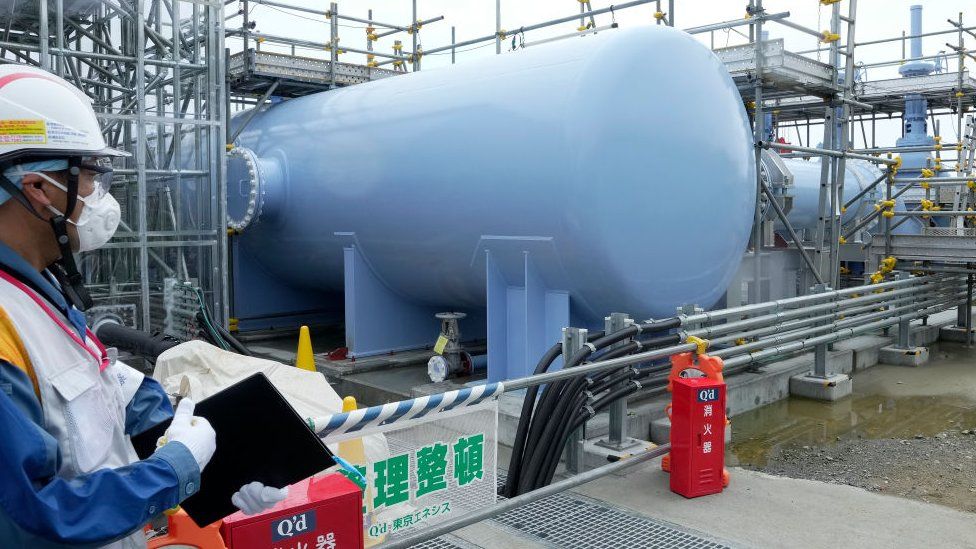
Japan is releasing waste water from the Fukushima nuclear plant into the ocean after
 receiving a green light from the IAEA

Japan has begun releasing treated radioactive water from its damaged Fukushima power plant into the Pacific Ocean - 12 years after a nuclear meltdown.

That's despite China slapping a ban on Japanese seafood and protests in Japan itself and South Korea.

The UN's atomic regulator says the water will have "negligible" radiological impact on people and the environment.

But is it safe?

An earthquake followed by a tsunami in 2011 wrecked the nuclear power plant, destroying its cooling system and causing reactor cores to overheat and contaminate water within the facility with highly radioactive material.

Since the disaster, power plant company Tepco has been pumping in water to cool down the reactors' fuel rods. This means every day the plant produces contaminated water, which is stored in more than 1,000 tanks, enough to fill more than 500 Olympic swimming pools.

Japan says it needs the land occupied by the tanks to build new facilities to safely decommission the plant. It has also raised concerns about the consequences if the tanks were to collapse in a natural disaster.

Japan is releasing the waste water into the ocean gradually, with a green light from the International Atomic Energy Agency (IAEA). The first release is one of four, scheduled between now and the end of March 2024. The entire process will take at least 30 years.

If Japan was able to remove all radioactive elements from the waste water before piping it into the ocean, perhaps it would not have been so controversial.

The problem is being caused by a radioactive element of hydrogen called tritium, which can't be removed from the contaminated water because there is no technology to do it. Instead, the water is diluted.
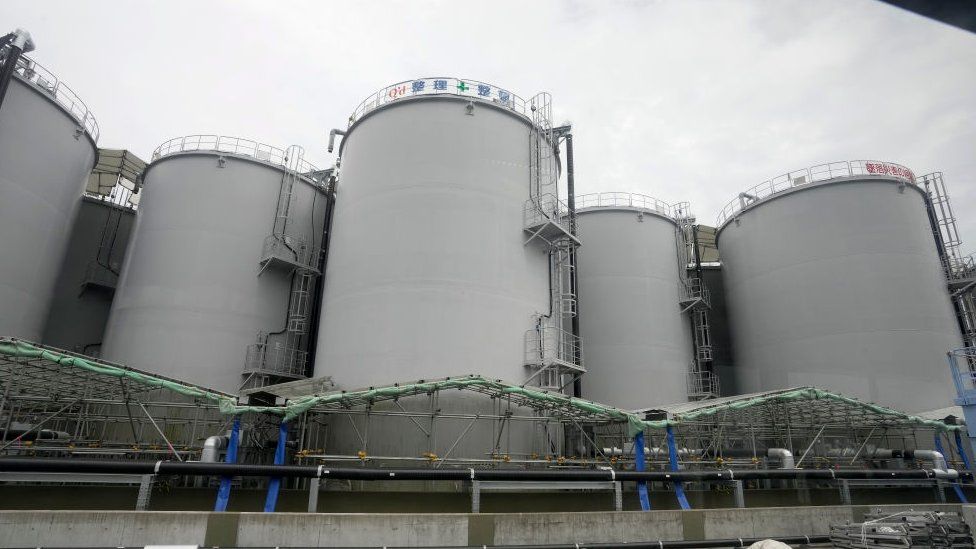
IMAGE SOURCE,GETTY IMAGES
Image caption,
The waste water from the wrecked Fukushima nuclear plant has been stored in tanks for years

The message from experts is, overwhelmingly, that the release is safe - but not all scientists agree on the impact it will have.

Tritium can be found in water all over the world. Many scientists argue if levels of tritium are low, the impact is minimal.

But critics say more studies on how it could affect the ocean bed, marine life and humans are required.

The IAEA, which has a permanent office at Fukushima, said an "independent, on-site analysis" had shown that the tritium concentration in the water discharged was "far below the operational limit of 1,500 becquerels per litre (Bg/L)".

That limit is six times less than the World Health Organization's limit for drinking water, which is at 10,000 Bg/L.

On Friday, Tepco said seawater samples taken on Thursday afternoon showed radioactivity levels were well within safe limits, with a tritium concentration below 1,500 bq/L.

Japan's environment ministry said it had also collected seawater samples from 11 different locations on Friday and would release the results on Sunday.

James Smith, professor of environment and geological sciences with Portsmouth University, said that "in theory, you could drink this water", because the waste water is already treated when it is stored and then diluted.

And physicist David Bailey, who runs a French laboratory measuring radioactivity, agreed, adding: "The key thing is how much tritium is there.

"At such levels, there is no issue with marine species, unless we see a severe decline in fish population, for instance," he said.

But some scientists say we cannot predict the impact of releasing the water.

American professor Emily Hammond, an expert in energy and environmental law with George Washington University, said: "The challenge with radionuclides (such as tritium) is that they present a question that science cannot fully answer; that is, at very low levels of exposure, what can be counted as 'safe'?

"One can have a lot of faith in the IAEA's work while still recognising that compliance with standards does not mean that there are 'zero' environmental or human consequences attributed to the decision."
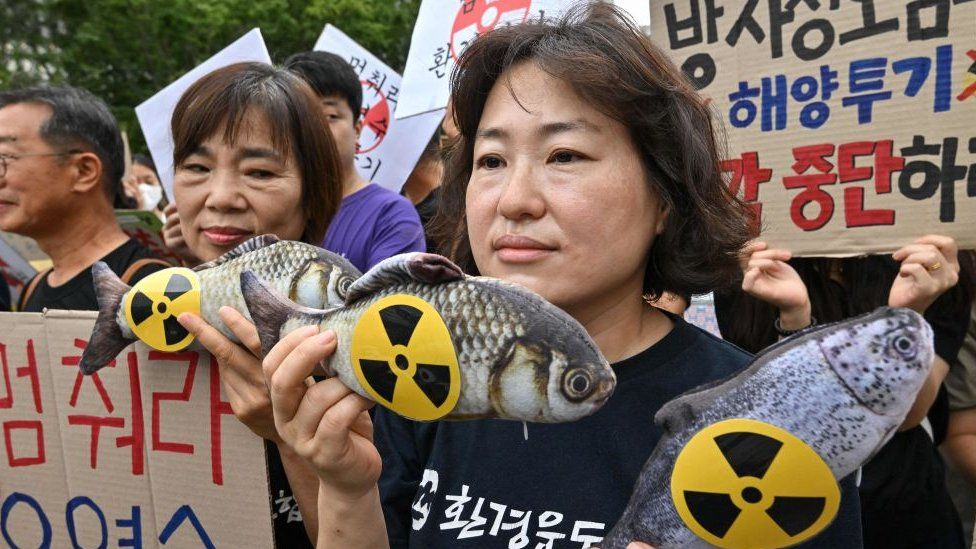
IMAGE SOURCE,GETTY IMAGES
Image caption,
Environmental activists have protested against Fukushima nuclear plant's
 waste water release into the ocean

The US National Association of Marine Laboratories released a statement in December 2022 saying it was not convinced by Japan's data.

And marine biologist Robert Richmond, from the University of Hawaii, told the BBC: "We've seen an inadequate radiological, ecological impact assessment that makes us very concerned that Japan would not only be unable to detect what's getting into the water, sediment and organisms, but if it does, there is no recourse to remove it... there's no way to get the genie back in the bottle."

Environmental groups such as Greenpeace go further, referring to a paper published by scientists at the University of South Carolina in April 2023.

Shaun Burnie, a senior nuclear specialist with Greenpeace East Asia, says tritium can have "direct negative effects" on plants and animals if ingested, including "reduced fertility" and "damage to cell structures, including DNA".

China has banned Japanese seafood as a result of the waste water release. Some media commentators believe this could be a political move, especially as experts say there is no scientific evidence backing concerns around seafood, as the radiation released is so low.

But many people who are exposed to the Pacific Ocean every day have concerns.

Traditional female divers in South Korea, known as "haenyeo", tell the BBC they are anxious.

"Now I feel it's unsafe to dive in," says Kim Eun-ah, who has been doing the job off Jeju Island for six years. "We consider ourselves as part of the sea because we immerse ourselves in the water with our own bodies," she explains.
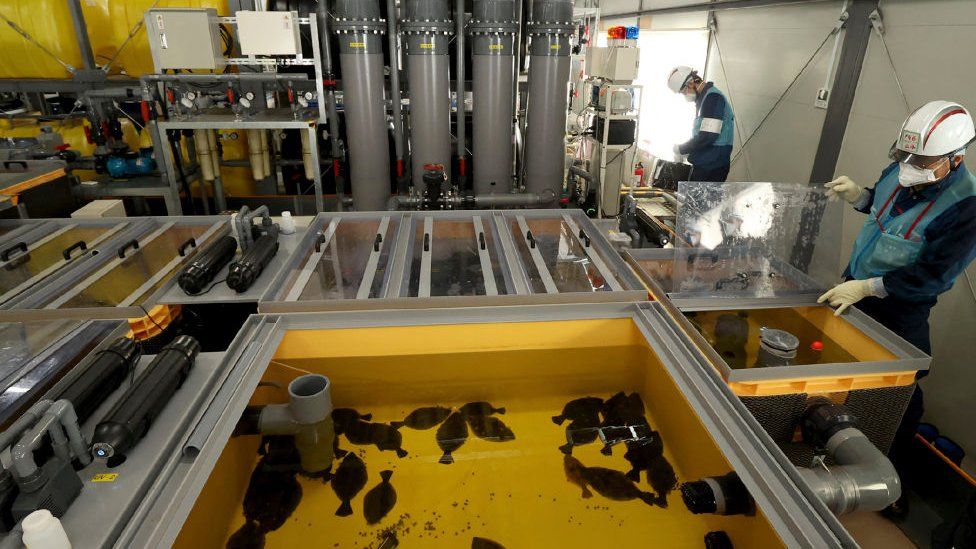
IMAGE SOURCE,GETTY IMAGES
Image caption,
Japanese authorities say tests were conducted on some sea species to make
 sure the treated waste water is not harmful

Experts say the waste water could be carried by ocean currents, particularly the cross-Pacific Kuroshio current.

And fishermen have told the BBC they fear their reputation has been permanently damaged and worry for their jobs.

The Pacific Islands Forum Chair and Cook Islands Prime Minister Mark Brown, like the IAEA, says he believes it "meets international safety standards".

He added all nations across the region may not agree on the "complex" issue, but urged them to "assess the science".


Japan starts discharging treated water into the sea

24 August 2023


Tokyo Electric Power Company (Tepco) announced it has begun releasing treated water currently stored at the damaged Fukushima Daiichi nuclear power plant into the ocean. The operation - expected to take up to 30 years to complete - is being closely monitored by the International Atomic Energy Agency (IAEA).

The process for releasing the ALPS-treated water (Image: Tepco)

At the Fukushima Daiichi site, contaminated water - in part used to cool melted nuclear fuel - is treated by the Advanced Liquid Processing System (ALPS), which removes most of the radioactive contamination, with the exception of tritium. This treated water is currently stored in more than 1000 tanks on site. The total tank storage capacity amounts to about 1.37 million cubic metres and all the tanks are expected to reach full capacity in late 2023 or early 2024.

Japan announced in April 2021 it planned to discharge treated water stored at the site into the sea over a period of about 30 years.

On 22 August, the government announced that it had decided to request Tepco begin preparations for the release of ALPS-treated water into the sea.

On the same day, the company transferred a very small amount of ALPS-treated water - about 1 cubic metre - to the dilution facility using the transfer facilities. This water was then diluted with about 1200 cubic metres of seawater and allowed to flow into the discharge vertical shaft (upstream water tank). The water stored in the discharge vertical shaft was then sampled.

"The results showed that the analysis value is approximately equal to the calculated concentration and below 1500 becquerels per litre," Tepco said today. "The sample of the water was also analysed by the Japan Atomic Energy Agency, who confirmed that the analysis value is below 1500 Bq/litre." In comparison, the World Health Organization guideline for drinking water is 10,000 Bq/litre.

Tepco therefore announced it has now moved to the second stage of the water release, the continuous discharge into the sea. At the same time, the company began transmitting data from various points in the process to the IAEA.

"Today at 1.00pm, the seawater transfer pumps will be started up and we will commence the discharge," Tepco said ahead of the process beginning. "During the discharge, one tank group-worth of ALPS-treated water from the measurement/confirmation facility, and the water already stored in the discharge vertical shaft (upper-stream storage) during Stage 1, will be continuously transferred/diluted and discharged into the sea.

"Furthermore, today, the intake/vertical shaft monitors will be put into operation in preparation for the discharge into the sea. We also started uploading real-time data pertaining to the discharge of ALPS-treated water into the sea to our website."

IAEA monitoring


When Japan announced the discharge plan in 2021, it asked the IAEA to review its plans against IAEA safety standards and monitor the release. Neighbouring countries have raised concerns and opposed the planned discharge. An IAEA Task Force was established to implement the assistance to Japan, which included advice from a group of internationally recognised experts from Member States, including members from the region, under the authority of the IAEA Secretariat. The IAEA opened an office at the Fukushima Daiichi plant last month.

"IAEA experts are there on the ground to serve as the eyes of the international community and ensure that the discharge is being carried out as planned consistent with IAEA safety standards," said IAEA Director General Rafael Mariano Grossi. "Through our presence, we contribute to generating the necessary confidence that the process is carried out in a safe and transparent way."

The agency, which confirmed that the discharge had begun, noted: "The IAEA's independent on-site analysis confirmed that the tritium concentration in the diluted water that is being discharged is far below the operational limit of 1500 becquerels per litre."

The IAEA said it will have a presence on site for as long as the treated water is released. It also announced the launch of a webpage to provide live data from Japan on the water discharge, including water flow rates, radiation monitoring data and the concentration of tritium after dilution. 

The IAEA experts will observe onsite activities related to the ALPS-treated water discharge, including samples and measurements, and will interface with Tepco and officials from Japan's Nuclear Regulation Authority. The IAEA will also organise review missions periodically to observe activities on site and to request updates and additional data from Japanese authorities. The IAEA said its independent corroboration activities will also continue during the entirety of the discharge and will involve IAEA laboratories and third-party laboratories.

"All of these activities will work together to provide a comprehensive picture of the activities taking place at the Fukushima Daiichi nuclear power plant related to the ALPS-treated water discharge and whether these activities are consistent with relevant international safety standards," said Gustavo Caruso, Director and Coordinator for the ALPS Safety Review at the IAEA and Chair of the Task Force. "The data provided by Tepco, and displayed both by Tepco and IAEA, is just a single piece of the overall monitoring approach and the IAEA's ongoing safety review."

Researched and written by World Nuclear News


Hamilton·CBC Investigates

Developers bought Hamilton Greenbelt property a month before Ontario revealed plans to open it up for housing

Tacc Developments says it's 'pure coincidence' closing date 

fell between industry event and Greenbelt removal

Farm fields
This agricultural land is now opened for development off of Garner Road West in Hamilton. The province has faced tough questions and backlash since Housing Minister Steve Clark and Premier Doug Ford announced some sites would be removed from the Greenbelt. (Patrick Morrell/CBC)

A prominent developer and key figure in the Ford government's controversial Greenbelt land swap purchased a Hamilton property a month before Ontario announced its plans to open the protected farmland up for residential development. 

According to property records, the purchase closed on Oct. 6, 2022 — three weeks after an unnamed developer requested that the province remove the land and other parcels from the Greenbelt, as described in a recent auditor general's report. 

Greater Toronto Area developer Silvio De Gasperis, head of Tacc Developments, along with Paradise Developments' Steven Weisz and Jack Eisenberger of Fieldgate Homes, purchased over 4.8 hectares at 411 Book Rd. W. for $2.8 million through their corporation, Book Shaver Developments Limited, CBC Hamilton found through corporate and property records.

With the Hamilton purchase, De Gasperis is set to benefit from four of the 15 sites removed from the Greenbelt, owning multiple properties in Pickering, Richmond Hill and Vaughan, as CBC Toronto has previously reported. Two of those sites are the largest of the 15. Eisenberger has also invested in the Richmond Hill and Vaughan developments, and has been buying up other properties on Book Road in recent years.

Both developers build detached homes and townhomes throughout the Toronto area.

When they purchased the 411 Book Rd. W. property in Hamilton, it was in the middle of over 728 hectares of protected Greenbelt land, known as the Book Road land, where rolling prime agricultural land is interlaced with wetlands and forests. 

two men
Silvio De Gasperis of Tacc Developments and Jack Eiseneberger of Fieldgate Homes, left to right, are two of the three developers who bought 411 Book Rd. W. in Hamilton. (Neighbur Barrie/ William Osler Health System Foundation/Facebook)

Less than a month later, on Nov. 3, the province informed property owners and developers that it was proposing to remove the Book Road land and 14 other sites from the Greenbelt, significantly increasing the land value. The province informed the public a day later.

Coun. Craig Cassar, who represents the area, said the developers' purchase of 411 Book Rd. W. points to the idea that the developers knew of the Ontario government's plans ahead of time. 

"It is hard to conclude anything other than they were working with the provincial government in a very non-transparent way," Cassar said. 

Sale date 'pure coincidence': developer's office

Tacc Developments executive assistant Sandra Galassi said it is "pure coincidence" the closing date of Oct. 6 fell between the unnamed developer's request and when the lands were removed.

She said the property was listed for sale earlier that summer and a Tacc project manager presented the owner with an offer. 

When asked if the company knew the Greenbelt land would become available for development, Galassi didn't respond directly.  

"Tacc is a passive investor in many land deals across the GTA and beyond," she said.

Developers have bought up other pieces of the Book Road lands in recent years, despite them becoming part of the Greenbelt in 2016.

Leading up to the June 2022 provincial election, Eisenberger, De Gasperis and their family members donated tens of thousands of dollars to the Progressive Conservative Party and candidates, according to donor reports published with Elections Ontario. 

aerial view of house and farmland
The property at 411 Book Rd. W. in Hamilton was listed for $2.9 million earlier this year when it was still part of the Greenbelt. (Michael St. Jean Realty Inc. Brokerage)

Around that time, in May 2022, De Gasperis, along with Weisz, invested in another property on Book Road. That property was originally purchased by Eisenberger in 2017. Neither Eisenberger nor Weisz responded to CBC's requests for comment.

Eisenberger recently purchased two other properties on Book Road — one last February and another in April — after the province removed them from the Greenbelt.

While the Book Road land is the largest site of the recent Greenbelt lands to be developed in the Hamilton region, there are four other sites in the area that have also been removed in Mount Hope and Grimsby.

A map.
The Book Road land is the largest of the Greenbelt areas in Hamilton and Niagara that lost protections. (Neil Joyes/CBC)

The province has faced tough questions and backlash since Housing Minister Steve Clark and Premier Doug Ford announced the sites would be removed from the Greenbelt. 

CBC Toronto and other media outlets reported that for years, De Gasperis and his family have owned dozens of properties within Pickering's Duffins Rouge Agricultural Preserve. Those 1,740 hectares comprise the largest site removed from the Greenbelt. The Book Road land is the second largest site. 

The De Gasperis family also owns land in Richmond Hill and Vaughan, which was also removed from the Greenbelt last year.

AG says land value could increase by $8B

Auditor General Bonnie Lysyk investigated some aspects of the Greenbelt land swap and concluded in a damning report this month that developers influenced how the province selected the sites. 

"The process was biased in favour of certain developers and landowners who had timely access to the housing minister's chief of staff," Lysysk told reporters. 

As a result of this land being opened for housing, developers could see an $8-billion increase in its value, Lysyk found.

Clark's chief of staff, Ryan Amato, who resigned this week, led the initiative, says her report. 

At an industry event in September 2022, he received packages from two unnamed prominent developers, the auditor general found. They requested that land be removed from the Duffins Rouge Agricultural Preserve, to be developed by Tacc, and in King Township to be developed by another company, which purchased the land the day after the industry event.

Shortly after, one of those two developers then requested that the Book Road Lands be removed from the Greenbelt, along with two other sites owned by Tacc and companies linked to the De Gasperis family, the auditor's report says.

A 'terrible land use,' councillor says

Following the report's release, Ford told reporters he had only learned of the proposed Greenbelt changes the day before it went to cabinet for approval, while Clark said he learned of it the week before.

While Ford acknowledged the province could have had a better process in place to select the sites, he said opening up some of the Greenbelt land for development is necessary to meet its target of building 1.5 million homes by 2031 — an assertion others, including Hamilton city councillors and planning staff, have refuted.

The province has conditions that developers must meet — including building infrastructure and community amenities, supportive housing and long-term care homes — as part of their developments, Ford said. They also have to begin home construction by 2025. 

If those conditions are not met, the land would be returned to the Greenbelt, he said. 

farmland and for sale sign
Developers have been buying up land in the Book Road area. This property on Garner Road was for sale last November. (Patrick Morrell/CBC)

Right now, the Office of Ontario's Provincial Land and Development Facilitator is reviewing the 15 sites, including those in Hamilton.

Hamilton city council has been adamantly opposed to the Greenbelt land swap, voting unanimously on Aug. 18 to demand the province abandon its plans.

Cassar said the Book Road lands are at "ground zero" in terms of services infrastructure and will likely take years to get ready for subdivisions.

Part of the site is also close to the Hamilton International Airport and the city has restricted housing in this area because of the noise. The auditor general found the province was not aware of this restriction when it removed it from the Greenbelt. 

"It's terrible land use for that to be made into housing, which is most certainly going to be low-density housing," Cassar said of the Book Road land. 

"That's not good for taxpayers, it's not good for the people who'd buy there and most of all, it's not going to help with affordable housing, which we most desperately need." 

 New Brunswick

Higgs doubles down on stance that Wolastoqey title claim threatens smaller property owners

Lawyer, Wolastoqey chief maintain assertion by premier is false

A man with grey hair and glasses wearing a suit and standing at a wooden podium.
Premier Blaine Higgs said his the province's motion was filed to protect landowners in New Brunswick not named in the Wolastoqey title claim, even though the proponents of the claim say it won't have an impact on them. (Pat Richard/CBC)

Premier Blaine Higgs and his government are doubling down on their stance that an Aboriginal title claim for roughly half of New Brunswick could impact properties owned by smaller landowners, despite insistence by the claim's proponents that that's not what they're after.

The province filed a motion in New Brunswick Court of King's Bench this week, asking the court to strike out several sections of the claim by six Wolastoqey First Nations and to "remove all claims against and/or in relation to fee simple lands and the interests of the unnamed parties therein."

The province, in a news release the same day, said the motion was filed to protect "families, homeowners, businesses and others who own property" within the title claim area covering more than 60 per cent of the province.

"Today, across more than half of our province, hundreds of thousands of New Brunswickers are at risk of having their property impacted by this unprecedented claim in which they have been denied any standing or representation," said Higgs, in the news release.

Higgs said the motion applies to 250,000 properties, which are owned by people who are not named in the title claim, and as such, should be removed from it.

"The plaintiffs have dismissed the fears of these New Brunswickers, which is why our government is taking this action to ensure the plaintiff's legal claim reflects their statements."

The plaintiffs in the claim are the Wolastoqey nations of Matawaskiye (Madawaska), Neqotkuk (Tobique), Bilijk (Kingsclear), Sitansisk (St. Mary's), Welamuktok (Oromocto) and Wotstak (Woodstock).

Launched in 2020, the claim specifically names the federal government, N.B. Power, and six predominantly forestry companies and 19 of their subsidiaries.

People stand shoulder to shoulder outside.
The six Wolastoqey First Nations in New Brunswick say their title claim is not about displacing people currently living on any land in the claim area. (Logan Perley/CBC)

Leaders for the communities have previously said the title claim is not about displacing people currently living on any lands subject to it, but rather about negotiating new deals with major industrial companies operating in the province.

Leaders have also denounced what they've described as fear-mongering in claims by Higgs that the title claim could jeopardize smaller private landowners.

Renée Pelletier, a lawyer representing the Wolastoqey nations in the title claim, shot back at the comments Higgs made in the news release Thursday.

"The Wolastoqey Chiefs have consistently said that they are not seeking to displace New Brunswickers or otherwise impact their property rights," Pelletier said in an email.

"That is consistent with what is actually written in our Statement of Claim."

A map of New Brunswick with half of it in orange.
The title claim covers roughly 60 per cent of New Brunswick. (Wolastoqey Nation in New Brunswick)

Pelletier also shared paragraphs from the claim that exemplify the Wolastoqey chiefs' position that property owned by no one other than the defendants listed would be affected.

"The Plaintiffs seek no relief as against fee simple holders not named as Defendants who hold fee simple in the Traditional Lands ("Strangers to the Claim"),"the Wolastoqey nations write in the second paragraph of their claim.

Bilijk Chief Gabriel Atwin also accused the Progressive Conservative premier of mischaracterizing the title claim.

"His statements can only serve to put fear in the general public and to create tensions between the Indigenous and non-Indigenous populations in New Brunswick," Atwin said in an email.

"Frankly, that is irresponsible, and we hope the PC Party is taking notice."