Saturday, August 26, 2023

What would happen if an asteroid hit the Moon?

Kate Howells • Aug 24, 2023


Asteroids are abundant in the Solar System, and some have orbits that bring them close to Earth. Planetary defense is the effort to prevent asteroids from hitting the Earth, but what about the Moon? If an asteroid were to impact our natural satellite, what would happen?

It’s happened before, and it’ll happen again

The Moon’s cratered surface is proof that it gets the occasional celestial wallop. Estimates of the number of craters on the Moon range from hundreds of thousands to millions. Some are the remnants of ancient volcanic explosions, but most were formed by impacts. Many of these impacts happened billions of years ago when the Solar System was more crowded and collisions were more common. While the Earth’s tectonic activity and erosion have erased most of its craters, the Moon shows almost its entire impact history — including some huge craters formed by large asteroids.

Although asteroid impacts are now much more rare, smaller impacts from meteoroids (smaller than one meter or three feet in diameter) still happen on the Moon every day, just like they do on Earth. Whereas our planet’s atmosphere burns up most meteoroids that intersect our orbit, the Moon has nothing to burn up or even slow down an incoming rock. Traveling at speeds as great as 72 kilometers per second (160,000 miles per hour),even a small rock can create a sizable crater


THE MOON FROM APOLLO 12 The Moon as seen by the Apollo 12 crew. Many impact craters are visible across its surface.Image: NASA

What would a large impact do?

If a large asteroid were to impact the Moon, it would create a large crater that would eject a lot of material from the surface, but that would be the extent of the damage. There aren’t any asteroids large enough to split the Moon apart or knock it off its orbit around the Earth. In fact, the total mass of all the Solar System’s asteroids combined is less than the mass of the Moon.

Impactors that would cause widespread damage on Earth would not cause nearly the same problems if they impacted the Moon, even though there’s no lunar atmosphere to slow them down. The reason is simple: there’s nothing to destroy on the Moon. Damage on Earth is not about the rock underneath us being disturbed, but about the structures, ecosystems, and individual lives that are affected. On the Moon, the only thing that would be affected by an impact is the rock of the lunar surface.

Although it’s possible that an impact in just the wrong place could disturb the historically significant Apollo landing sites, the chances of that happening are very slim. The Moon's surface area is about 38 million square kilometers (14.6 million square miles), and even with smaller meteoroids that impact more frequently, any given square kilometer patch of ground only gets hit every thousand years or so by an object the size of a ping pong ball or larger.

How likely is a large asteroid impact?

Potentially hazardous asteroids are those larger than about 140 meters (460 feet) with orbits that bring them within 7.5 million kilometers (4.5 million miles) of Earth’s orbit — which would also bring them close to the Moon. As of March 2023, NASA has identified around 2,300 asteroids that are considered potentially hazardous. All of their trajectories have been calculated, and none threaten Earth (or, therefore, the Moon) for at least the next 100 years. Smaller asteroids are more likely to sneak up on us, and are therefore more likely to impact the Moon as well as Earth.

TYCHO CRATER RAYS Rays of ejected material extend from the center of the Tycho impact crater on the Moon. Image captured by the Hubble Space Telescope.Image: NASA / ESA / D. Ehrenreich.

What would a lunar impact look like from Earth?

From our point of view on Earth, a large impact on the Moon would most likely be a fascinating and wondrous thing.

Our spacecraft might observe and record the impact itself, and depending on the time of day or night, observers on Earth might be able to see a bright flash. After the impact, we would get to see a new crater appear on the lunar surface. Both of these phenomena have in fact been observed in the past.

If material was ejected from the Moon with enough force to reach the Earth, those small rocks would burn up in the atmosphere much like a meteor shower, creating a beautiful spectacle for us to witness. If any of the pieces of Moon rock were large enough to make it to the surface, they would be unlikely to be large enough to cause damage; they’d be more like particularly scientifically valuable meteorites.

What can we do to prevent asteroids impacting the Moon?

Although an impact on the Moon wouldn’t be harmful to life on Earth, any large asteroid that seems to be heading for an impact with the Moon would be considered potentially hazardous to Earth because of our proximity.

Planetary defense is the effort to find, track, characterize, and — if needed — deflect asteroids that might get close to the Earth-Moon system. The Planetary Society advocates and fundraises in support of planetary defense missions and projects, and space agencies around the world contribute to planetary defense efforts.

DART, NASA's Double Asteroid Redirection Test, was the first space mission to test an asteroid deflection technique. DART launched in November 2021 and arrived at near-Earth asteroid Didymos in September 2022. On Sept. 26, the spacecraft intentionally crashed into the asteroid's small moon, Dimorphos. The crash changed the time it takes Dimorphos to orbit Didymos by 33 minutes, proving that the deflection technique of using what's called a kinetic impactor works.

With proper planning and investment, we will know far in advance if an asteroid is going to impact the Moon, and we can prevent it from even coming close to our planet.

India's lunar rover keeps walking 
ROLLING on the moon, days after spacecraft's historic touchdown

India’s lunar rover is continuing its walk on the moon after the historic touch-down of India’s spacecraft near the moon’s south pole earlier this week

ByASHOK SHARMA
 Associated Press
August 25, 2023,

People watch the landing of Chandrayaan-3, or "moon craft" at Omani University in Hyderabad, India, Wednesday, Aug. 23, 2023. India has landed a spacecraft near the moon's south pole, an unchartered territory that scientists believe could hold vital reserv...Show more
The Associated Press

NEW DELHI -- India's lunar rover continued its walk on the moon Friday after the historic touch-down of India's spacecraft near the moon's south pole earlier this week, the country's space agency said. The rover's data collection and experiments could help determine if there is oxygen and hydrogen on the moon.

The Chandrayan-3 Rover is expected to conduct experiments over 14 days, including an analysis of the mineral composition of the lunar surface, the Indian Space Research Organization has said.

“The rover has successfully traversed a distance of about 8 meters (26.2 feet),” ISRO said Friday. "All payloads on the propulsion module, lander module, and rover are performing nominally.”

The rover will also study the atmosphere of the moon and seismic activities, ISRO Chairman S. Somnath said.

“These experiments would pave the way for new scientific research about the availability of oxygen and hydrogen on the surface of the moon and can give us a direct or indirect answer as to whether there was life on the moon," the Press Trust of India news agency cited India's Science and Technology Minister Jitendra Singh as saying.


Pallava Bagla, a science writer and co-author of books on India’s space exploration, said the rover crawls, or moves at low speed, for safety reasons to minimizes shocks and damage to the vehicle on a rough surface and negotiating obstacles. It also has limited battery power.

On Thursday, Somnath said the lander had touched down close to the center of the 4.5-kilometer-wide (2.8-mile-wide) area that had been targeted for the landing. “It landed within 300 meters (985 feet) of that point.”

After a failed attempt to land on the moon in 2019, India on Wednesday joined the United States, the Soviet Union and China as only the fourth country to achieve this milestone.

The successful mission showcases India’s rising standing as a technology and space powerhouse and dovetails with the image that Prime Minister Narendra Modi is trying to project: an ascendant country asserting its place among the global elite.

The mission began more than a month ago at an estimated cost of $75 million. Somnath said that India would next attempt a manned lunar mission.
Many countries and private companies are interested in the moon's South Pole region because its permanently shadowed craters may hold frozen water that could help future astronaut missions, as a potential source of drinking water or to make rocket fuel

India’s success comes just days after Russia’s Luna-25, which was aiming for the same lunar region, spun into an uncontrolled orbit and crashed. It would have been the first successful Russian lunar landing after a gap of 47 years. Russia’s head of the state-controlled space corporation Roscosmos attributed the failure to the lack of expertise due to the long break in lunar research that followed the last Soviet mission to the moon in 1976.

Active since the 1960s, India has launched satellites for itself and other countries, and successfully put one in orbit around Mars in 2014. India is planning its first mission to the International Space Station next year, in collaboration with the United States.


India’s Chandrayaan-3 landed on the south pole of the Moon − a space policy expert explains what this means for India and the global race to the Moon


India’s Chandrayaan-3 lander successfully touched down on the south pole of the Moon on Aug. 23, 2023, sparking celebrations across the country. 


THE CONVERSATION 
Published: August 24, 2023

India made history as the first country to land near the south pole of the Moon with its Chandrayaan-3 lander on Aug. 23, 2023. This also makes it the first country to land on the Moon since China in 2020.

India is one of several countries — including the U.S. with its Artemis program — endeavoring to land on the Moon. The south pole of the Moon is of particular interest, as its surface, marked by craters, trenches and pockets of ancient ice, hasn’t been visited until now.

The Conversation U.S. asked international affairs expert Mariel Borowitz about this Moon landing’s implications for both science and the global community.

People all across India watched the broadcast of the landing.


Why are countries like India looking to go to the Moon?

Countries are interested in going to the Moon because it can inspire people, test the limits of human technical capabilities and allow us to discover more about our solar system.

The Moon has a historical and cultural significance that really seems to resonate with people – anyone in the world can look up at the night sky, see the Moon and understand how amazing it is that a spacecraft built by humans is roaming around the surface.

The Moon also presents a unique opportunity to engage in both international cooperation and competition in a peaceful, but highly visible, way.

The fact that so many nations – the United States, Russia, China, India, Israel – and even commercial entities are interested in landing on the Moon means that there are many opportunities to forge new partnerships.

These partnerships can allow nations to do more in space by pooling resources, and they encourage more peaceful cooperation here on Earth by connecting individual researchers and organizations.

There are some people who also believe that exploration of the Moon can provide economic benefits. In the near term, this might include the emergence of startup companies working on space technology and contributing to these missions. India has seen a surge in space startups recently.

Eventually, the Moon may provide economic benefits based on the natural resources that can be found there, such as waterhelium-3 and rare Earth elements.
Are we seeing new global interest in space?

Over the last few decades, we’ve seen a significant increase in the number of nations involved in space activity. This is very apparent when it comes to satellites that collect imagery or data about the Earth, for example. More than 60 nations have been involved in these types of satellite missions. Now we’re seeing this trend expand to space exploration, and particularly the Moon.


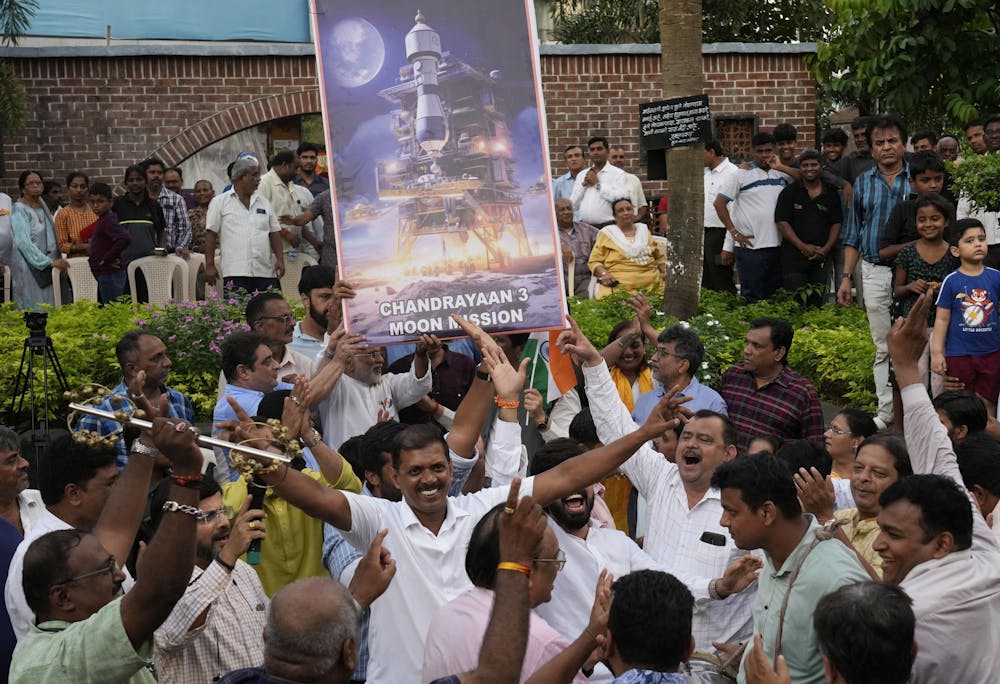
The successful landing prompted celebrations across the country, like this one in Mumbai. 
AP Photo/Rajanish Kakade

In some ways, the interest in the Moon is driven by similar goals as in the first space race in the 1960s – demonstrating technological capabilities and inspiring young people and the general public. However, this time it’s not just two superpowers competing in a race. Now we have many participants, and while there is still a competitive element, there is also an opportunity for cooperation and forging new international partnerships to explore space.

Also, with all these new actors and the technical advances of the last 60 years, there is the potential to engage in more sustainable exploration. This could include building Moon bases, developing ways to use lunar resources and eventually engaging in economic activities on the Moon based on natural resources or tourism.
How does India’s mission compare with Moon missions in other countries?

India’s accomplishment is the first of its kind and very exciting, but it’s worth noting that it’s one of seven missions currently operating on and around the Moon.


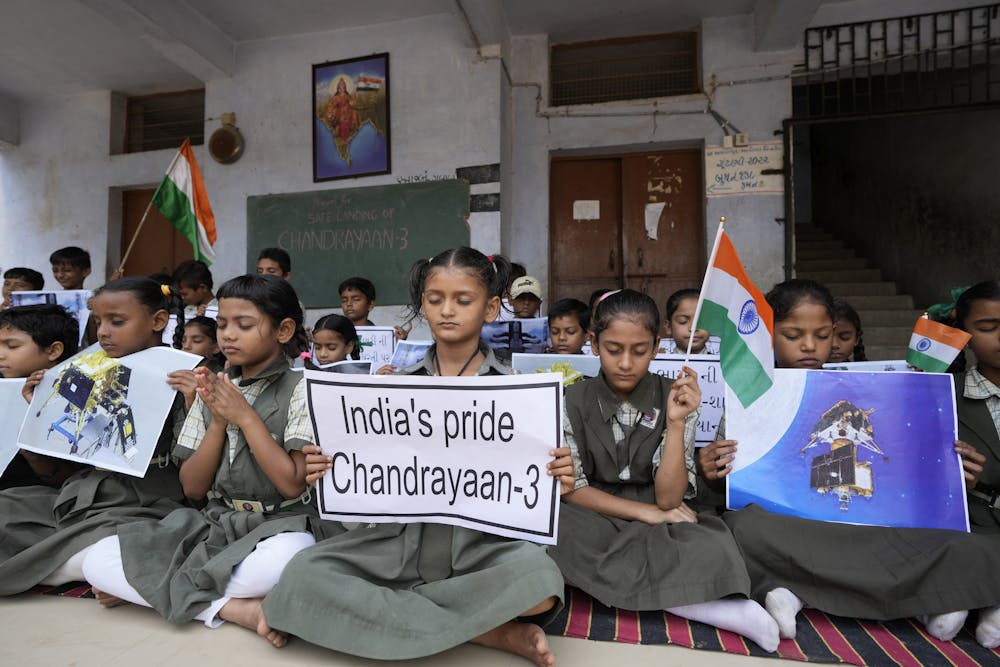
Students in India prayed for the safe landing of Chandrayaan-3 on Wednesday. 
AP Photo/Ajit Solanki

In addition to India’s Chandrayaan-3 rover near the south pole, there is also South Korea’s Pathfinder Lunar Orbiter, which is studying the Moon’s surface to identify future landing sites; the NASA-funded CAPSTONE spacecraft, which was developed by a space startup company; and NASA’s Lunar Reconnaissance Orbiter. The CAPSTONE craft is studying the stability of a unique orbit around the Moon, and the Lunar Reconnaissance Orbiter is collecting data about the Moon and mapping sites for future missions.

Also, while India’s Chandrayaan-2 rover crashed, the accompanying orbiter is still operational. China’s Chang’e-4 and Chang’e-5 landers are still operating on the Moon as well.

Other nations and commercial entities are working to join in. Russia’s Luna-25 mission crashed into the Moon three days before the Chandrayaan-3 landed, but the fact that Russia developed the rover and got so close is still a significant achievement.

The same could be said for the lunar lander built by the private Japanese space company ispace. The lander crashed into the Moon in April 2023.
Why choose to explore the south pole of the Moon?

The south pole of the Moon is the area where nations are focused for future exploration. All of NASA’s 13 candidate landing locations for the Artemis program are located near the south pole.

This area offers the greatest potential to find water ice, which could be used to support astronauts and to make rocket fuel. It also has peaks that are in constant or near-constant sunlight, which creates excellent opportunities for generating power to support lunar activities.

Author
Mariel Borowitz
Associate Professor of International Affairs, Georgia Institute of Technology

Disclosure statement
Mariel Borowitz receives funding from the National Aeronautics and Space Administration (NASA), the National Science Foundation (NSF), and the U.S. Department of Defense (DoD).

Wait, there's a logo on the moon?

The moon
(Image credit: Getty Images)

Unless you've been living under a lunar rock, you've probably heard the news that India's Chandrayaan-3 rover today successfully landed on the moon. It was carrying the Pragyan rover, a small vehicle which has begun, yes, roving. And, if reports are to be believed, leaving an imprint on the moon.

According to multiple reports, the wheel of the rover (below) has been adorned with the logo of the Indian Space Research Organisation (ISRO), which it will imprint on the moon's surface. And thanks to a convenient lack of wind in space, the logo could, in theory, remain there forever. (We wonder if any of the brands behind the best logos of all time are getting ideas right now.)

While we haven't seen official confirmation, the story has been spreading on social media, with some sharing (below) what appears to be an image of the imprint itself. Look a little closer, though, and it's clear that this is a mockup. We'll just have to wait and see if the rover itself broadcasts any images of its marketing trail.

Time will tell if the moon is indeed set to be branded, but the idea does sound a little dystopian. How long until we see the Amazon, Apple or (perhaps most likely) Tesla logos up there? As long as the X logo steers clear, we'll be (somewhat) happy

An image of the moon with famous logos superimposed over it

I spent entire minutes making this image  (Image credit: Getty/Tesla/Apple/Amazon/Future)

We've seen plenty of incredible images from space recently, including this interplanetary optical illusion. If you're inspired to create a logo of your own, take a look at our guide on how to design a logo.

Daniel Piper
Senior News Editor

Daniel Piper is Creative Bloq’s Senior News Editor. As the brand’s Apple authority, he covers all things Mac, iPhone, iPad and the rest. He also reports on the worlds of design, branding and tech. Daniel joined Future in 2020 (an eventful year, to say the least) after working in copywriting and digital marketing with brands including ITV, NBC, Channel 4 and more. Outside of Future, Daniel is a global poetry slam champion and has performed at festivals including Latitude, Bestival and more. He is the author of Arbitrary and Unnecessary: The Selected Works of Daniel Piper (Selected by Daniel Piper).

Japanese family says young doctor took his life after working 200 hours overtime in a single month

Junko Takashima, the mother of Shingo Takashima, a doctor who died by suicide last year, holds up his photo at a news conference in Osaka, Japan, on August 18.
 (Mami Nagaoki/The Yomiuri Shimbun/AP)
Jessie Yeung and Eru Ishikawa

CNN
Updated Aug. 24, 2023

TOKYO -

Warning: This article contains mentions of suicide. Reader discretion is advised

The family of a 26-year-old doctor in Japan who died by suicide last year after working more than 200 hours of overtime in a single month have pleaded for change in a nation long plagued by overwork culture.

Takashima Shingo had been working as a resident doctor at a hospital in Kobe City when he took his own life last May, according to public broadcaster NHK.

According to the family’s lawyers, Takashima had worked more than 207 hours overtime in the month before his death, and had not taken a day off for three months, NHK reported.

The hospital, Konan Medical Center, has denied those accusations in a press conference last week. But in June, the government’s labour inspection body ruled his death a work-related incident due to his long hours, according to NHK – highlighting the immense pressures placed on health care workers.

Japan has long battled a persistent overwork culture, with employees across various sectors reporting punishing hours, high pressure from supervisors and deference to the company, according to the Ministry of Health, Labour and Welfare.

The ensuing stress and mental health toll has even caused a phenomenon called “karoshi,” or “death by overwork” – leading to legislation meant to prevent death and injury from excessive work hours.

In a news conference last Friday, Takashima’s family described what they said was a young man driven to desperation and expressed their grief over his death.

Prior to his suicide, his mother Junko Takashima said, the doctor would say “it was too hard” and that “no one would help him,” according to video published by local media of the news conference.

“No one is looking out for me, he kept telling me. I think the environment put him over the edge,” she said.

“My son will not become a kind doctor, nor will he be able to save patients and contribute to society,” she added. “However, I sincerely hope that the working environment for doctors will be improved so that the same thing will not happen again in the future.”

Takashima’s brother, who was not named, also spoke in the news conference, saying: “No matter how we look at my brother’s work hours, 200 hours (of overtime) is an unbelievable number, and I don’t think the hospital is taking a solid approach to labour management in the first place.”

In a press conference last week, the Konan Medical Center pushed back. “There are many times when (doctors) spend time studying on their own and sleeping according to their physiological needs,” a spokesperson said. “Due to the very high degree of freedom, it is not possible to accurately determine working hours.”

When contacted by CNN on Monday, a hospital spokesperson said: “We do not recognize this case as overtime work and will stop commenting on this in the future.”

A number of overwork cases have made national and global headlines over the years – for instance, Japanese officials concluded in 2017 that a 31-year-old political reporter, who died in 2013, had experienced heart failure from spending long hours on the job. She had worked 159 hours of overtime in the month before her death, according to NHK.

The problem remains especially high in the health care sector. One 2016 study found that more than a quarter of full-time hospital physicians work up to 60 hours a week, while 5 per cent work up to 90 hours, and 2.3 per cent work up to 100 hours.

Another report, published this year by the Association of Japan Medical Colleges, found that more than 34 per cent of physicians are eligible for a “special level of overtime hours exceeding the upper limit of 960 hours per year.”

Reforms to labour law and overtime regulations in 2018 have seen some small progress, with the government reporting last year that the average amount of annual hours worked per employee has been “gradually decreasing.” However, though the number of actual working hours has been declining, overtime working hours have fluctuated over the years, it added.
What challenges lie ahead for Guatemala’s President-elect Arevalo?

The conservative National Unity of Peace party has filed a complaint alleging inconsistencies in the August 20 election.

Progressive politician Bernardo Arevalo stopped in Jocotenango, part of the Guatemalan department of Sacatepequez, as he campaigned for the presidency in July
 [Jeff Abbott/Al Jazeera]

By Jeff Abbott
Published On 25 Aug 2023

Guatemala City, Guatemala – Guatemala City’s central plaza is traditionally a gathering spot for protests. But on the night of August 20, it was filled with jubilation, as supporters celebrated Bernardo Arevalo’s election as president.

A congressional representative, academic and outspoken critic of corruption, Arevalo won Guatemala’s presidential run-off in a landslide, earning an estimated 58 percent of the votes.

But while his victory has reinvigorated hopes for Guatemala’s fragile democracy, experts warn of challenges ahead, as Arevalo faces a hostile public prosecutor, an opposition-led legislature and questions of entrenched corruption in the government.

Even his challenger, conservative Sandra Torres, has yet to concede defeat, fuelling speculation that his election could be contested. Torres’s party, National Unity of Peace (UNE), filed a complaint on Friday alleging inconsistencies in the vote tally.

And one day earlier, the Inter-American Commission on Human Rights called for additional security to protect Arevalo, as he faced possible death threats and other “serious, urgent” risks to his wellbeing.

“Arevalo symbolises the possibility to begin again — to reconstruct state institutions and combat corruption,” Marielos Chang, an independent political analyst, told Al Jazeera. “But he faces a great challenge.”

Bernardo Arevalo winds his way through a crowd of reporters in Guatemala City, Guatemala, on August 20 [File: Pilar Olivares/Reuters]


Underdog turned frontrunner

When he is sworn into office on January 14, Arevalo will become Guatemala’s first progressive president in seven decades, breaking a streak of right-wing governments.


“Arevalo’s victory was a referendum on the ruling coalition in Guatemala,” Edgar Ortiz, a political analyst and constitutional lawyer, told Al Jazeera.

“He is a very unusual candidate in Latin American politics,” he explained. “He’s an intellectual, he’s a peacemaker, he’s a good negotiator, and he will need those skills in order to govern a country with political fragmentation, with organised crime and with distrust from conservative sectors that consider Arevalo too progressive for Guatemalan politics.”

But the 64-year-old Arevalo is no stranger to national politics. His father was former President Juan Jose Arevalo, who went into exile after a coup d’état deposed his successor in 1954.

As a result, the younger Arevalo was born in Uruguay. After pursuing degrees at universities in Israel and the Netherlands, he followed in his father’s footsteps, entering both academics and politics.

In the 1990s, Arevalo served as ambassador to Spain. And in 2019, he won a seat in Congress with the recently formed Seed Movement, a left-leaning party formed around anti-corruption advocacy.

Arevalo’s success in the first round of the 2023 presidential election came as a surprise to many, as he had consistently polled at less than 3 percent in national surveys.

His second-place finish earned him a spot in the run-off vote — as well as a wave of backlash.

\
President-elect Bernardo Arevalo, centre, gestures to reporters outside his home in Guatemala City, Guatemala, on August 22
 [File: Pilar Olivares/Reuters]

An ongoing investigation


As the August run-off election approached, Arevalo began to climb in the polls, overtaking Torres, the early frontrunner.

But even as a candidate, he faced pushback from within government institutions. In July, shortly after the results of the first round of voting were certified, the Special Prosecutor’s Office Against Impunity sought to suspend the Seed Movement, alleging there were irregularities in how the party was formed in 2017.

The Special Prosecutor’s Office claimed it had found 5,000 fraudulent signatures in the party’s membership rolls, including over a dozen dead people.

But critics have questioned the agency’s motives. The Special Prosecutor’s Office is led by Rafael Curruchiche, a politician the United States has sanctioned as a “corrupt and undemocratic actor” for raising “spurious claims” against prosecutors involved in anticorruption efforts.


Nevertheless, the Special Prosecutor’s Office has promised to continue its investigation into the Seed Movement even after Arevalo’s election.

If it succeeds in annulling the party, politicians within the Seed Movement could be marooned without a legislative bloc, preventing them from being appointed to key commissions.
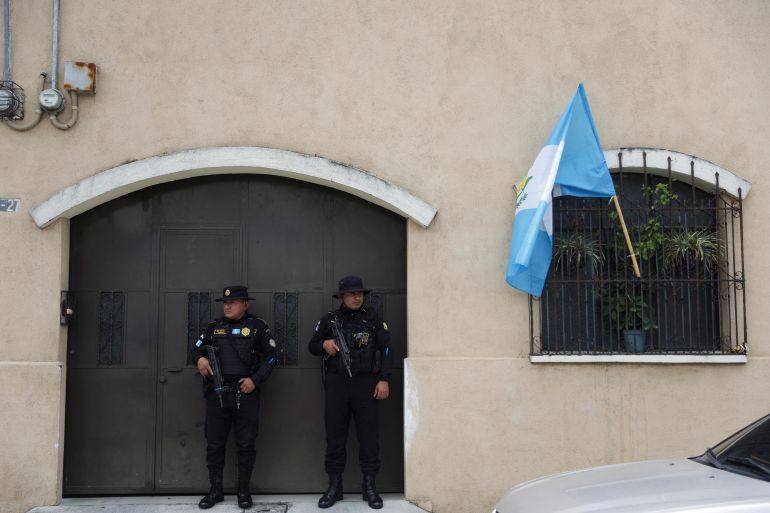
Police officers guard the home of Guatemala’s President-elect Bernardo Arevalo, who has faced death threats since his victory 
[File: Pilar Olivares/Reuters]

Questions of corruption

Even with his party to back him, Arevalo will face an uphill battle to build consensus and fight what many believe to be institutional corruption.

In recent years, journalists, lawyers, advocates and judges involved in anticorruption efforts have fled the country or faced arrest on what critics believe are trumped-up charges.

Meanwhile, Arevalo and his running mate Karin Herrera Aguilar have both faced “stigmatisation, harassment, hounding, public disclosure of personal details on social media and threats including two specific plans to hurt them and even kill them”, according to the Inter-American Commission on Human Rights.

Corruption has been a longstanding issue in Guatemala, one that has undermined confidence in public institutions.

According to an August poll from the market research firm CID Gallup and the Foundation for Liberty and Freedom, 70 percent of the population sees the administration of outgoing President Alejandro Giammattei as corrupt.

However, implementing change could be difficult. Upon taking office, Arevalo will confront a legislature stacked with opponents. In this year’s elections, the current ruling party Vamos and Torres’s UNE party won a combined 67 seats out of a total of 160, giving conservatives control over Congress.

The Seed Movement, meanwhile, only earned 23 seats.

But political analysts have speculated that Arevalo could bridge the political divide if he seeks broad consensus.

“Arevalo will need to be very open to talk to many sectors of society, not only the political sector,” Ortiz said.

“He will need to talk to this old political party system that he ran against and that he beat, and he also will need to bring all other sectors together, including the productive sectors, which are suspicious of him.”

Supporters of Bernardo Arevalo celebrate in Guatemala City, Guatemala, after his victory in a run-off election on August 20
[File: Pilar Olivares/Reuters]

Economic concerns spurring migration

Faced with such opposition, Ortiz believes Arevalo will need to focus on achieving short-term wins with issues like crime and medicine shortages in hospitals.

“Expectations are really high, but the problems are really hard to fix,” Ortiz says. “In the first six months, healthcare, security and education are the areas in which he can make a big difference.”

Organised crime remains an issue throughout the Central American region. In Guatemala, the Centre for National Economic Research found an uptick in homicides between 2021 and 2022, for a rate of 17.3 murders per 100,000 inhabitants.

Poverty is on the rise, too. Around 60 percent of the population rests below the poverty line, and the country has some of the highest rates of youth malnutrition in Latin America, with the United Nations estimating that one out of every two children suffers from it.

The dire conditions have forced hundreds of people a day to leave Guatemala to find opportunities elsewhere.

But Arevalo and the Seed Movement have proposed to stem migration by offering greater job training and employment, including through temporary work programmes.

He has also expressed openness to working with the international community, especially Mexico and the US, to address the migration crisis.

“We are willing to collaborate and build international cooperation to find structural solutions to the problem of migration,” Jonathan Menkos, a congressman-elect and economist who worked on the Seed Movement party’s governance plan, told Al Jazeera.

“We have to think about the wellbeing of the people and how we reduce the needs that people have that force them to migrate to another country.”

SOURCE: AL JAZEERA