Wednesday, February 21, 2024

‘We want dignity’: Indian farmers defy pellets, drones to demand new deal

Two years after they brought the Indian capital to a standstill, farmers say Prime Minister Narendra Modi’s government has betrayed its promises.
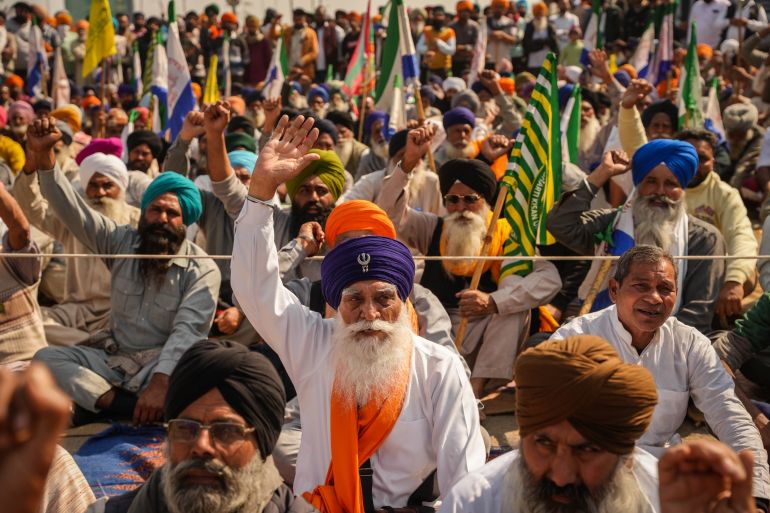

Farmers gather in protest at the Shambhu border between the Indian states of Punjab and Haryana
 [Md Meherban/Al Jazeera]

By Rifat Fareed
21 Feb 2024

Shambhu border, India — Balvinder Singh lies on his side, writhing in pain, on a hospital bed in the northern Indian state of Punjab.

When Singh, 47, was hit by a volley of piercing objects while marching towards New Delhi with thousands of other farmers, he did not know what had struck him.

But his body is pockmarked with telltale black scars from iron pellets fired by security forces to prevent farmers from crossing over from Punjab into the state of Haryana, which borders New Delhi. Haryana is ruled by Prime Minister Narendra Modi’s Bharatiya Janata Party, whose federal policies the farmers are protesting against.

Singh, a farmer from Faridkot district in Punjab, who was admitted at Rajindra Hospital in the city of Patiala, was hit when he was calming the angry young farmers at the front of the protest site, metres away from the border on February 14, a day after the protests began.

“I was calming down the protesters when I was hit,” Singh says, his left eye bloody from a pellet injury. “I could not understand whether it was a bullet or something else that hurt me.”

Singh says he had never heard of iron pellets being used as ammunition by security forces against civilian protesters. In the past, such pellets have been mostly used in Indian-administered Kashmir as a crowd-control mechanism. Pellet guns have blinded scores of people in Kashmir.
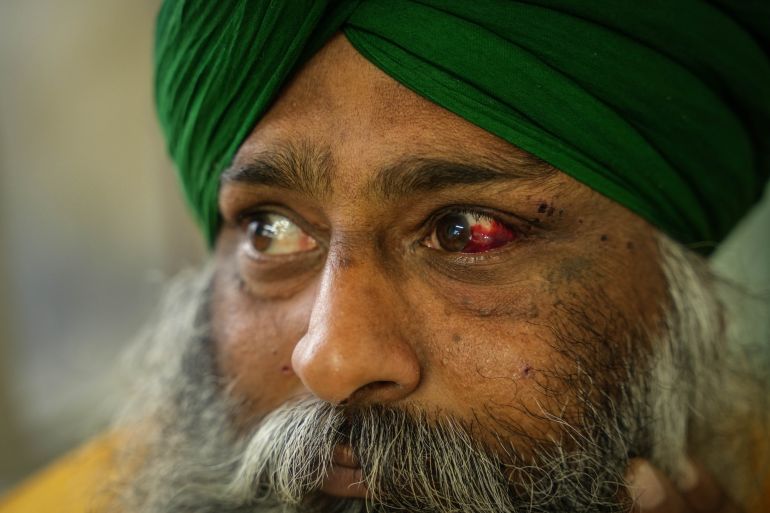
Balvinder Singh, his eye bloodied by a wound from an iron pellet fired by police, in a hospital in Patiala, Punjab 
[Md Meherban/Al Jazeera]

Now, they are part of the intensifying confrontation between farmers and the government. The government in Punjab, which is ruled by the Aam Aadmi Party that is in opposition nationally, has said that three farmers have lost their eyesight after being hit with the Haryana police pellets and a dozen others have also suffered pellet injuries.

Critics of the farmers, meanwhile, argue that the central government cannot allow the protests to escalate the way they did in 2021, when clashes broke out on the streets of New Delhi. Some protesters reached the Red Fort – from where the prime minister delivers the Independence Day speech – and were accused of yanking down the national flag. A security crackdown followed.

Yet, days after this latest agitation kicked off, there are growing signs of a repeat of the kind of escalation in tensions that India witnessed three years ago.

Thousands of farmers in their tractor trolleys, small trucks, on foot, and scooters have travelled from rural areas of Punjab and gathered on the Punjab-Haryana highway waiting to march on the capital city. They are hoping to press the BJP government for demands including a guaranteed minimum support price (MSP) for their crops and loan waivers, among others.

In Haryana, the government has been criticised for using drones to drop tear gas shells on the protesting farmers. The state’s police have sealed the border with heavy cemented blocks, iron nails and barbed wire.

Singh, who owns a four-acre plot where he grows rice and wheat, says there is no guarantee of price in the fluctuating market for other crops.

“We spend more on cultivation [when growing other crops] and there is no earning,” he says.

“Now, we are also facing water shortages for even growing these two crops [rice and wheat]. We are in deep stress.”

At present the government buys rice and wheat from farmers for public distribution, and offers them a minimum support price for these grains. But other agricultural commodities do not receive this price protection. That, farmers say, has in turn led to the overproduction of rice and wheat. Paddies in particular, are water intensive, leading to depleted groundwater levels.

“If I want to diversify to other crops, there should be financial security for me that I will get a good price – that is what we are asking. We are asking for our rights,” says Singh, from the hospital, where eight other farmers, some aged above 60, are also being treated.

One of them, Mota Singh, 32, from Hoshiarpur in Punjab, said that he was hit by a rubber bullet on his hand. To Mota, something even more fundamental is at stake than crop prices.

“Farmers are demanding dignity, we cannot be poor forever,” says Mota, when asked why he was protesting.
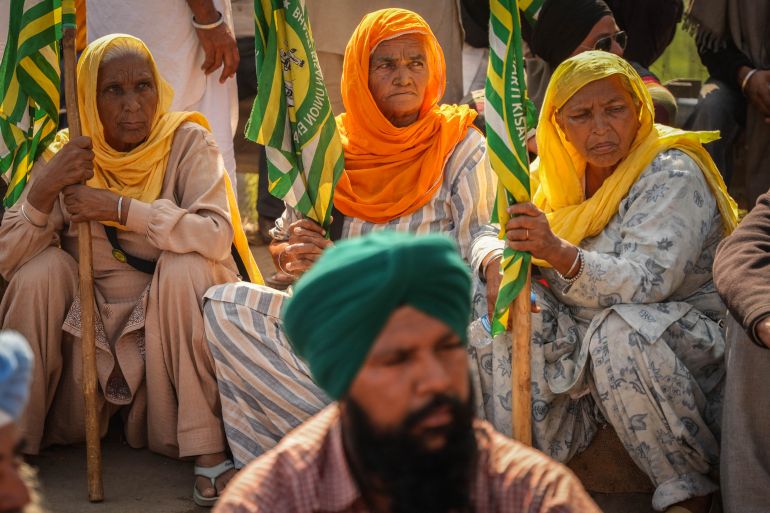
Female farmers listen to a speech by a farming leader at the protest site on the Shambhu border between Haryana and Punjab
 [Md Meherban/Al Jazeera]

Why are farmers again on the roads?

More than 250 farmers’ unions have supported the protest that is being organised from Punjab.

Up to two-thirds of India’s 1.4 billion population are engaged in agriculture-related activities for their livelihoods and the sector contributes nearly a fifth of the country’s gross domestic product.

Farmers say that their main demand – minimum support price legislation – would ensure that the rates of their crops are sustainable and provide them with decent earnings.

At present, the government protects wheat and rice against the price fall by setting a minimum purchase price, a system that was introduced more than 60 years ago, to ensure food security in India.

Development economist Jayati Ghosh says that if other crops were also brought under the MSP regime, it would help provide sustainable financial support to the farmers. This wouldn’t mean that the government would need to buy large volumes of these crops, says Ghosh, a professor at the University of Massachusetts Amherst.

It’s only when the price drops below the MSP that the government would need to step in and buy just enough that the price rises above the minimum set bar, she says.

“It’s a market intervention that makes sure that farmers have this other option,” Ghosh says.

In India, experts say that agriculture has been going through a severe crisis due to increasing extreme weather combined with a lowering water table, affecting yields and pushing farmers deep into debt. Thousands of farmers take their own lives each year. In 2022, data collected by the National Crime Records Bureau (NCRB) shows that 11,290 farmers died by suicide.

Ghosh questions why the government is reluctant to write off farm loans.

“Every year the banking system writes off loans of lakhs of crores (billions of dollars) of money taken by large corporations and that is not even mentioned and it is not even news,” she says. “The corporations can get away with all kinds of loan waivers but the farmers are asking a small fraction of that and … are treated as criminals.”
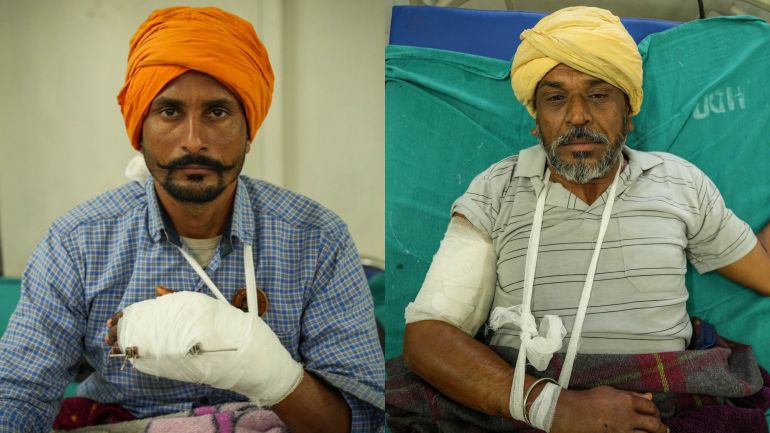
Injured farmers at a hospital in Patiala, Punjab, where they are being treated for injuries received during baton charges and pellet gun firing by the police 
[Md Meherban/Al Jazeera]
‘Government not honouring its promises’

The farmers are also demanding that the Modi government withdraw cases filed against them during the last protest in 2020-21.

Held on the outskirts of New Delhi for 13 months, those protests were against a set of three farm laws brought in by the BJP government that aimed to push India’s family-based, smallholdings-driven farm sector towards privatised and industrialised agriculture.

The government argued that the laws would improve market competition and in turn bring new wealth, especially to smaller farmers. But farmers protested, worried that the laws would leave them at the mercy of big corporations.

Eventually, Modi agreed to repeal the laws, and his government said it would set up a panel of stakeholders to find ways to ensure support prices for all produce.

The protesting farmers now accuse the government of not honouring those promises. And they are readying for a long wait to pressure the government.

Hardeep Singh, 57, from Gurdaspur in Punjab, has come prepared with bags of rice, flour, and other essentials in his tractor.

“We are here even if it takes months,” says Hardeep, who left his home with dozens of other villagers on February 11.

“We might not be allowed to go forward but we will not go backward, either.”

Darshan Singh displaying the photo of his son who died in the farmers’ protest two years ago
 [Md Meherban/Al Jazeera]

‘Not afraid of losing my health’

Darshan Singh, 66, sits silently on the side of the highway. He carries a passport-size photo of his son, 27-year-old Gurpreet Singh, in his wallet.

Gurpreet was among more than 700 farmers who died during the previous farmers’ protest in 2021.

“He was at the protest site for a year. He fell sick at the site and died after returning to the village. We are giving sacrifices for this movement,” Darshan tells Al Jazeera. But that tragedy has not deterred the father from joining the protest this time. “I am not afraid of losing my health here.”

Darshan says he wants justice for the two children and young wife his son left behind.

With national elections in India just two months away, the farmers are trying to ensure that they cannot be ignored. Because of their sheer numbers, farmers constitute a significant chunk of Indian voters.

The ruling BJP government recently conferred the nation’s highest civilian award on MS Swaminathan, a pioneer of the agricultural revolution in the 1960s and 1970s. Meanwhile, the opposition Congress party has promised to legalise an MSP on crops if elected to power.

A government delegation has been engaged in negotiations with the protesting farmers without a breakthrough.

“We feel the government wants to suppress us and pass time,” Manjeet Singh, a leader of Bhartiya Kisan Union Shaheed Bhagat Singh, a local farmers’ union from Haryana, told Al Jazeera.

A fourth round of talks on Sunday evening, held between a 14-member farmers’ delegation and government representatives, including three federal ministers, failed to yield a breakthrough.

The government has offered farmers MSP for pulses, cotton and maize. The crops, according to the proposal, would be bought by the government agencies on an agreement for five years.

But the farmers have rejected the offer, which they argue only temporarily addresses their demand – unlike a law that would guarantee them MSP for these commodities in the long run. The farmers say they will continue with their protest march to New Delhi.
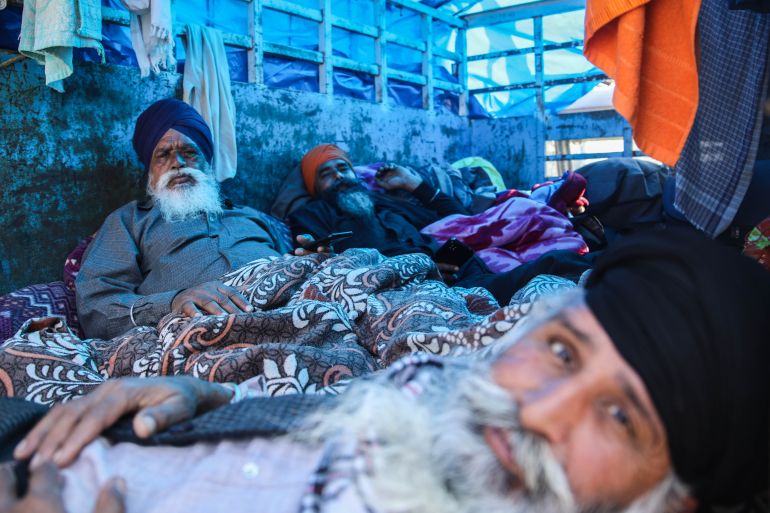
Farmers rest in a tractor trolley at the protest site on the Shambhu border between the Indian states of Haryana and Punjab
 [Md Meherban/Al Jazeera]

‘Why can’t farmers be prosperous?’

Devinder Sharma, a food and agricultural expert based in Chandigarh, the capital of both Punjab and Haryana, says that the farmers’ demands have merit.

“We have deliberately kept agriculture impoverished,” he says, adding that an MSP law could provide an unprecedented economic boom for the country by improving the income of a majority of the nation’s families that depend on agriculture.

He is not surprised at the pushback the farmers are facing from critics, mostly in the cities, though.

“The problem is when the prices go up the corporate profit is reduced. The (corporates) want to ruthlessly exploit farmers and I think enough is enough,” he says.

“Why can’t farmers be prosperous?”


SOURCE: AL JAZEERA


With cranes and excavators, Indian farmers prepare to march on capital

A farmer wears a makeshift mask to protect himself from tear gas fired by the police, at the site where farmers are marching towards New Delhi to press for better crop prices promised to them in 2021, at Shambhu barrier, a border crossing between Punjab and Haryana states, India, Feb 21, 2024.
PHOTO: Reuters

FEBRUARY 21, 2024 

SHAMBHU, India — Indian police fired tear gas on Wednesday (Feb 21) to scatter protesting farmers as they resumed a march to the capital, equipped with cranes and excavators after talks with the government on guaranteed prices for their produce failed to break a deadlock.

To escape the stinging gas and clouds of smoke, thousands of farmers, some wearing medical masks, ran into the fields surrounding their gathering-point on a highway about 200 km north of New Delhi.

The police action came as the government of Prime Minister Narendra Modi made a fresh offer to resume talks on the farmers' demands. Agriculture Minister Arjun Munda urged the farmers to resolve their grievances through the talks.


"After the fourth round, the government is ready to discuss all the issues" such as guaranteed prices, he posted on social network X, as the march resumed.

"I again invite the farmer leaders for discussion. It is important for us to maintain peace."

On Monday, the farmers' groups had rejected the government's previous proposal for five-year contracts and guaranteed support prices for produce such as corn, cotton and pulses.
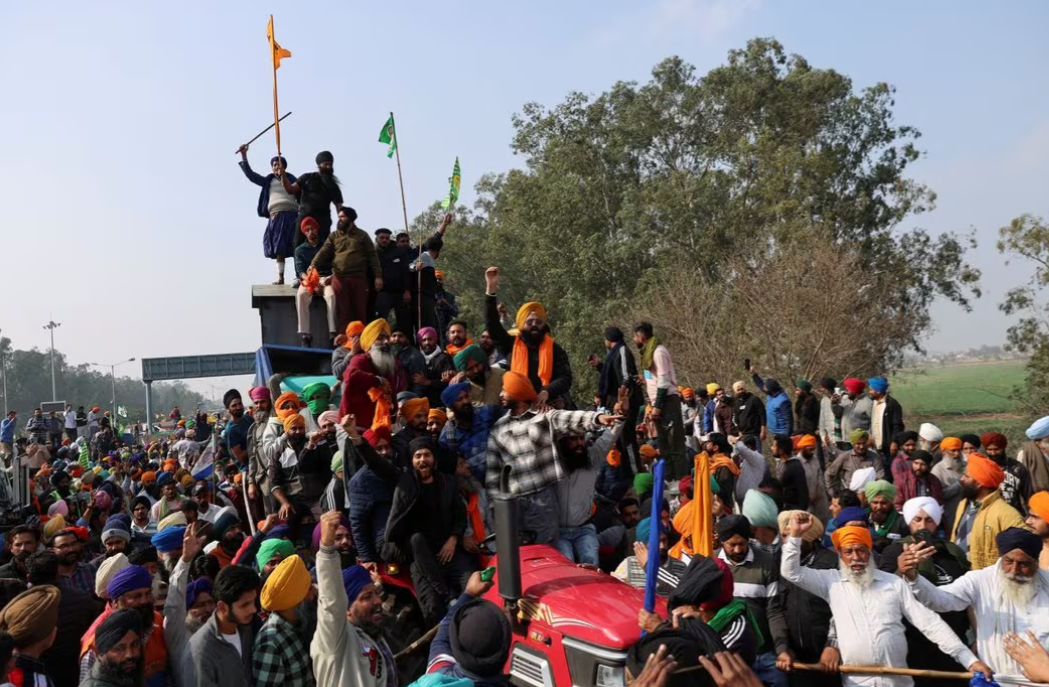
Farmers shout slogans, as they stand on a modified excavator, during a protest demanding better crop prices, promised to them in 2021, at Shambhu Barrier, a border crossing between Punjab and Haryana states, India, Feb 20, 2024.
PHOTO: Reuters

The farmers, mostly from the northern state of Punjab, have been demanding higher prices backed by law for their crops. They form an influential bloc of voters Prime Minister Narendra Modi cannot afford to anger ahead of general elections due by May.
Sticks, stones, gas masks

The farmers began marching at 0530 GMT from the spot where authorities had stopped them by erecting barricades on the border of Punjab state with Haryana, blocking a key highway.

"It is not right that such massive barricades have been placed to stop us," said one of the farmers' leaders, Jagjit Singh Dallewal. "We want to march to Delhi peacefully. If not, they should accede to our demands."

Police in riot gear lined both sides of the highway as the farmers, gathering earlier amid morning fog, waved colourful flags emblazoned with the symbols of their unions, while loudspeakers urged them to fight for their rights.

Television images showed some wearing gas masks.

Late on Tuesday, Haryana police's chief ordered the immediate seizure of the heavy equipment brought by the farmers, to prevent its use by protesters in destroying barricades.

Police also asked owners of such equipment not to lend or rent it to protesters, as its use to harm security forces would be a criminal offence.
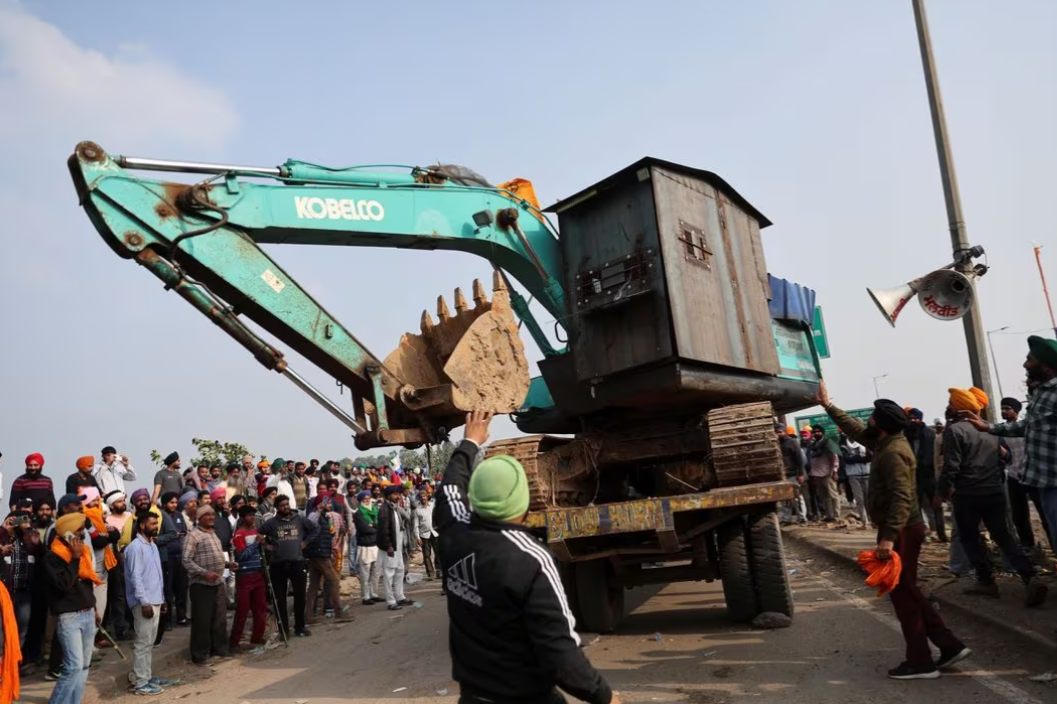
Farmers guide a modified excavator, during a protest demanding better crop prices, promised to them in 2021, at Shambhu Barrier, a border crossing between Punjab and Haryana states, India, Feb 20, 2024.
PHOTO: Reuters

About 10,000 people had gathered on Wednesday, along with 1,200 tractors and waggons at Shambhu on the state border, police in Haryana posted on X, warning against the risk of stone-throwing as they were armed with sticks and stones.

Sunday's government proposal of minimum support prices to farmers who diversify their crops to grow cotton, pigeon peas, black matpe, red lentils and corn was rejected by the protesters, who wanted additional foodgrains covered.

Similar protests two years ago, when farmers camped for two months at the border of New Delhi, forced Modi's government to repeal a set of farm laws.

ALSO READ: Protesting farmers clash with security forces 200km from New Delhi

Source: Reuters

Police fire teargas as Indian farmers resume protest march to New Delhi after talks fail

Police have fired tear gas at thousands of Indian farmers who resumed their protest march to New Delhi after talks with the government failed to end an impasse over their demands for guaranteed crop prices


ByALTAF QADRI Associated Press and KRUTIKA PATHI Associated Press
February 21, 2024

SHAMBHU, India -- Police fired tear gas on Wednesday at thousands of Indian farmers who resumed their protest march to New Delhi after talks with the government failed to end an impasse over their demands for guaranteed crop prices.

The protests come at a crucial time for India, where national elections are due in the coming months and Prime Minister Narendra Modi’s party is widely expected to secure a third successive term in office.

The farmers began their protest last week but were stopped some 200 kilometers (125 miles) from the capital. Authorities are set on containing the protest, which has renewed the movement from over two years ago when tens of thousands of farmers had camped out on the outskirts of the city for over a year.

At the time, the farmers pitched tents, bought food supplies and held out in the sit-in until they forced Modi to repeal new agriculture laws in a major reversal for his government.

This time around, the authorities have barricaded the highways into New Delhi with cement blocks, metal containers, barbed wire and iron spikes to prevent the farmer from entering.

On Wednesday, the farmers arrived at the barricades with bulldozers and excavators to try and push through.

Jagjit Singh Dallewal, one of the farmers leading the march, said they did not want any violence, but condemned the federal government over the massive security measures.

“It is our request that we want to go to Delhi in a peaceful manner. The government should remove the barricades,” he said.

Last week, the farmers had paused their protest and hunkered down near the town of Shambhu, close to the border between Punjab and Haryana states, as farmers unions engaged in discussions with government ministers.

They rejected a proposal from the government that offered them five-year contracts of guaranteed prices on a set of certain crops, including maize, grain legumes and cotton, and the farmers resumed their march on Wednesday.

The protest organizers say the farmers are seeking a new legislation that would guarantee minimum prices for 23 crops.

The government protects agricultural producers against sharp falls in farm prices by setting a minimum purchase price for certain essential crops, a system that was introduced in the 1960s to help shore up food reserves and prevent shortages. The system can apply up to 23 crops, but the government usually offers the minimum price only for rice and wheat.

The farmers say guaranteed minimum support price for all 23 crops would stabilize their income. They are also pressing the government to follow through on promises to waive loans and withdraw legal cases brought against them during the earlier 2021 protests.

Several talks so far have failed to break the deadlock. But Arjun Munda, one of the ministers negotiating with the farmers, said they were willing to hold another discussion and that the government wanted to maintain peace.

“It is the prime minister’s responsibility, who has been elected with majority votes, to handle the situation and accept our demands,” Sarwan Singh Pandher, a farm leader, told the Press Trust of India news agency.

The farmers are an influential voting bloc and particularly important to Modi’s base — especially in Northern Haryana and several other states with a substantial farming population that are ruled by his Bharatiya Janata Party.

___

Pathi reported from New Delhi.


Thousands of Indian farmers prepare to continue march on Delhi

They are demanding higher prices backed by law for their crops 

from the government
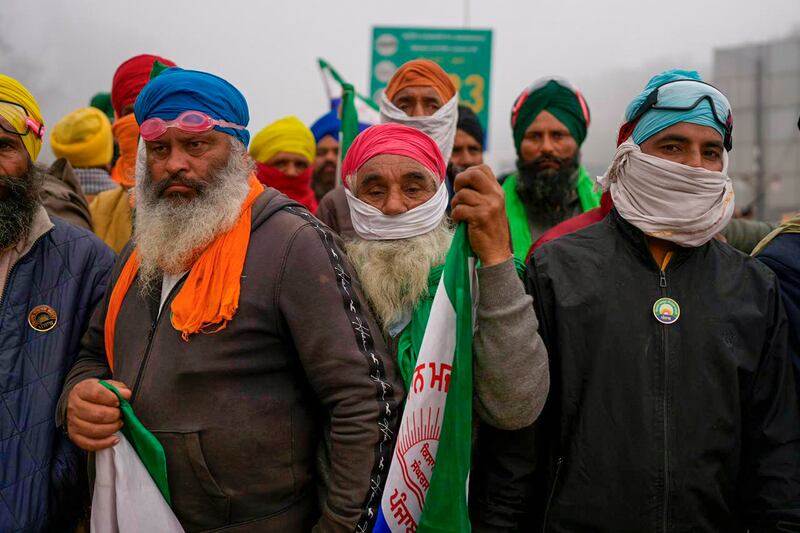
Thousands of Indian farmers prepared to march on the capital on Wednesday to pressure Prime Minister Narendra Modi’s government to meet their demands.

Last week, farmers from Punjab and Haryana, the states responsible for 60 per cent of India's wheat production, started their journey to New Delhi on foot and by tractors. However, they were halted about 200km from their destination by road blockades erected by police and paramilitary forces.

The farmers waited while representatives held talks with the government but decided to press on with their march after a meeting on Monday ended without agreement on their main demand of minimum supports prices for their crops.
Braving the cold and rain, farmers stood on a bridge over the Ghaggar river on Wednesday morning amid preparations to push through barricades. The bridge is on a motorway that passes from Punjab through Haryana, ruled by Mr Modi's Bharatiya Janata Party, to Delhi.

The motorway was blocked when farmers from the two states launched a sit-in in 2020 after they were stopped from entering Delhi to protest.
Authorities brought in more than 700 more security personnel and dug trenches to prevent the farmers moving forward. Internet and SMS services were cut off in Haryana.

“We are not scared of the authorities. Last time, we protested for a year. This time around, if they don’t fulfil our demands, we will spend our entire lives here protesting for our rights,” Jaspreet Singh, a farmer from Punjab, told The National.

“We have all the preparations in place to go through the barricade and we still appeal to the government to not use force against us and allow us to go to Delhi which is our constitutional right,” said Manjeet Singh, another farmer.

The farmers have rejected a government offer to buy pulses, maize and cotton at guaranteed prices through cooperatives for five years, saying they want minimum support prices for 23 crops.

The protest has already caused disruption in Delhi, with long traffic jams at entry points to the city where police and paramilitary forces have been posted.

Updated: February 21, 2024


Albania Gripped by Anti-Government Unrest: Clashes and Arrests Rock Tirana

 February 21, 2024, Wednesday 
Bulgaria: Albania Gripped by Anti-Government Unrest: Clashes and Arrests Rock Tirana


Tensions escalated in Albania as anti-government protests erupted into clashes between demonstrators and law enforcement in the capital city of Tirana. Thousands of supporters of the opposition Democratic Party converged outside the parliament building, demanding the immediate release of party leader Sali Berisha, who has been under house arrest since December 31 on charges of corruption.

The 79-year-old Berisha, a former prime minister who served from 2005 to 2013, faces allegations of abuse of power during his tenure. Protesters, chanting slogans and brandishing banners, rallied for Berisha's freedom while calling for the resignation of the current prime minister, Edi Rama. They assert that Berisha's arrest is politically motivated and part of a broader crackdown on dissent by the government.

The demonstrations, marked by a heavy police presence, turned violent as clashes erupted between protesters and security forces. Reports indicate that arrests were made amid the chaos, underscoring the heightened tensions gripping the country.


Opposition protesters in Albania hurl petrol bombs at government building

The anti-government protesters accuse Albanian Prime Minister Edi Rama of nepotism and corruption

Police officers stand guard while a fire burns, as supporters of the opposition attend an anti-government protest in front of Prime Minister Edi Rama's office in Tirana, Albania (Reuters)

In Short

  • Opposition protesters hurl petrol bombs at Albania's government building.
  • Thousands gather at Tirana, no reports of injuries or arrests.
  • Opposition accuses PM Adi Rama of nepotism and corruption.

Opposition protesters pelted Albania's government building with petrol bombs and rocks late on Tuesday, accusing state officials of involvement in organised crime and corruption after their leader was placed under house arrest.

Thousands gathered in front of the government headquarters in the capital Tirana as riot police officers were called in to cordon off the office of Prime Minister Edi Rama.

There were no immediate reports of injuries, serious damage or arrests.

The main opposition Democratic Party accuses Rama of nepotism and corruption, which it says are prompting many young people to emigrate for a better life in Western Europe.

Protesters chose Tuesday for the rally in remembrance of February 20, 1991, when pro-democracy demonstrators tore down the statue of Albania's longtime communist dictator Enver Hoxha.

"Today we are here to bring down Rama's regime, which is worse than Enver Hoxha's regime," said Syle Xhebexhia, who said he travelled over 100 km to attend the protest in Tirana.

Opposition leader Sali Berisha addressed the protesters via a video link from house arrest. He is being investigated for alleged corruption while Prime Minister between 2005-2013.

Berisha has denied wrongdoing, accusing Rama of a political vendetta meant to silence opponents. Rama denies this.

Prosecutors have yet to decide whether to file formal charges against Berisha or drop them.

"Edi Rama, similar to the other dictator (Hoxha), has concentrated all powers in his hands and wants an Albania without opposition," Berisha told the protesting crowd.

erisha has been regularly addressing supporters from the balcony of his apartment in downtown Tirana.

Western sanctions against Russia miscalculated their impact, some of them have benefited the Russian economy, says Sberbank

By Ben Aris February 21, 2024


The architects of Western sanctions against Russia miscalculated the impact of sanctions, particularly underestimating Russia's resilience to external financial pressures and its ability to boost domestic production and exports, a study by the Sberbank Financial Analytics Centre found, RBC reported on February 19.

Four years into the sanctions regime, the importance of countercyclical policies has become evident, as Russia has demonstrated notable economic adaptability.

“In a number of cases, Western sanctions had the opposite effect,” say researchers from the Sberbank Financial Analytics Centre.

The analysis highlighted three key areas where sanctions had unintended consequences:

· The withdrawal of Western companies from Russia spurred domestic production, encouraged parallel imports, and facilitated the import of alternative products from third countries;

· Capital withdrawal restrictions helped bolster the ruble and retained currency within the country; and

· The perception of Western countries as a "safe haven" for Russian and friendly nations' wealth diminished, leading to the repatriation of funds.

Contrary to expectations, some sanctions have inadvertently supported the Russian economy, triggering a fragmentation of the global economy and diminishing the West's influence, Sberbank argued in what was more of an analytic survey than attempt at Russian propaganda.

The sanctions have also backfired on sanctioning countries reliant on Russian goods and energy, with notable economies like Germany on course to go into recession in the first quarter, while Russia is currently the fastest growing country out of the G8 advanced economies, as bne IntelliNews reported due to a boomerang effect.

Russia's 2023 GDP growth outpaced global averages, driven in part by sectors related to the Ukraine conflict. The conclusions are corroborated by Heli Simola, an economist at the Institute for Economies in Transition at the Bank of Finland (BOFIT), who estimated that industries related to the military operation in Ukraine accounted for about 40% of economic growth in the first half of 2023. At the same time, she expressed the opinion that Russia cannot maintain increased government spending indefinitely, and the military-industrial complex is diverting resources from civilian industry. The bump from the military Keynesianism cannot last forever and the war effort is already introducing deep structural problems that will eventually have to be addressed.

Low debt

With one of the lowest sovereign debt levels in the world, the country's minimal reliance on external financing, combined with the global economy's dependence on Russian commodities, has rendered sanctions less effective, Sberbank says.

The ruble's attractiveness for foreign transactions has increased as non-participating nations are willing to use rubles to purchase Russian commodities. At the same time, there has already been a significant shift towards national currencies in bilateral trade between Russia and the so-called friendly countries.

“Rubles can be used to buy many goods needed all over the world,” analysts point out. In general, the share of national currencies in mutual settlements between Russia and foreign countries will increase to 65% by the end of 2023, and with major trading partners it will approach 70%, the authors predict.

Trade

The Russian economy is weakly dependent on external financing, but the dependence of the world economy on Russian goods is quite high, the authors state.

For example, in January-November 2023, EU countries still imported almost €27bn worth of Russian mineral fuel, according to Eurostat data – natural gas, LNG, oil through the Druzhba pipeline which has not been sanctioned. In addition, the same EU continues to purchase petroleum products refined in third countries such as India that are made from Russian crude oil.

“Sanctions are generally ineffective against countries with significant foreign trade surpluses and low levels of external debt,” the study’s authors say.

The West is severely limited in the possibilities of sanctions due to Russia’s large volume on commodity markets and cannot exclude it with Iranian-type sanctions as Russia is too big to hermetically seal it off from global trade, Sberbank concluded. The point is highlighted by the oil price cap sanctions, which never proposed to stop the export of oil, only cap the price that the Kremlin could charge for it. Attempting a wholesale ban on Russian oil exports would only cause a price spike and hurt the sanctioners as much as the sanctionee.

Nevertheless, Russia’s external sector still suffered from sanctions as trade volumes and profits have been reduced, especially with the export of gas, which is down by two thirds.

Import substitution

One of the most telling changes has been the success Russian companies have had with import substitution and the development of domestic solutions where inputs and equipment used to be bought in from abroad.

The antecedent is cheese. Following Russia's decision to ban European agricultural imports following the first round of sanctions in 2014, following the annexation of the Crimea, cheese, which was almost entirely imported, disappeared from shop shelves. Two years later and Russia had a flourishing domestic cheese production sector, albeit of lower quality than the European analogues.

A similar process has been going on over the last two years, and it has been made easier by the fact that most of Russia’s key exports are simple things like minerals that don’t require difficult technological solutions.

Successful import substitution in various industries has bolstered Russia's industrial sector, countering the industrial decline caused by sanctions. The adaptability of Russian businesses, particularly in finding new markets and suppliers, has been a key factor in this resilience. Most of Russia’s oil exports have been successfully reorientated to Asia and increasingly Russia is finding new customers for its other raw material exports.

Analysts from Sberbank cite “successful cases” of import substitution – in mechanical engineering, in the aviation industry, in the chemical industry, in the agro-industrial complex and the food industry. The industrial decline caused by sanctions was overcome by mid-2023, and prospects for 2024 in Russian industry look “quite optimistic,” Russia’s Higher School of Economics wrote in the February report “Industrial Production Intensity Indices.” According to their estimates, the last two crises (pandemic and sanctions) have led to “a significant change in the structure of Russian production in favour of highly processed products.”

“The Russian economy, unlike Japan or Western countries, relies more on the production and consumption of raw materials or near-raw materials, therefore, on the one hand, it is possible to find alternative suppliers for a fairly significant part of Russian imports; on the other hand, when Russian enterprises have lost their main export market in Europe, they are unlikely to have had to radically restructure production in order to find new buyers in other countries,” RBC reports. “If Russia produced final goods or technological equipment, then we could hardly quickly replace the loss of the European market.”


Biden Knows Putin Killed Alexei Navalny


The President of the United States only knows what his intelligence community tells him. After the January attack on a U.S. military facility in Jordan, American intelligence assessed that Iran does not fully control its proxy groups and that it is not commanding the attacks. The Pentagon, though, said “we know Iran is behind it,” and Joe Biden said, “I do hold them responsible.”

In October 2022, the U.S. Department of Defense Nuclear Posture Review stated “Iran does not today possess a nuclear weapon and we currently believe it is not pursuing one.” On February 25, 2023, CIA Director William Burns said that “[t]o the best of our knowledge, we don’t believe that the supreme leader in Iran has yet made a decision to resume the weaponization program.” Yet, Biden says “they’ll have a nuclear weapon,” and the Biden administration “is ready to use military means as a last resort to prevent Iran from acquiring a nuclear weapon.”

On February 16, Russian opposition figure Alexei Navalny died in prison from still unknown causes. When asked if Navalny had been assassinated, Biden had to admit, “The answer is, we don’t know exactly what happened.” But that did not stop him from saying in a televised statement, “Make no mistake: Putin is responsible for Navalny’s death.”

Biden’s verdict goes beyond what his intelligence has told him.

Alexei Navalny is being eulogized as another Nelson Mandela or Martin Luther King Jr. While it is fitting that he should receive accolades for his brilliant anti-corruption campaign, it is also fitting that history not be erased. Navalny was courageous, but he was no Martin Luther King Jr.

Navalny began his political career as a member of the social liberal Yabloko Party. But, in 2007, they expelled him for “causing political damage to the party; in particular, for nationalist activities.” Those “nationalist activities” included posting a video that called immigrants “cockroaches” who were infesting Russia and advocated that the solution was shooting them. Though he would soften his message later in his career, that is not language Martin Luther King would have used, or a policy he would have advocated, at any point in his activism. Navalny also attacked migration from Central Asia and famously adopted the slogan, “stop feeding the Caucuses.”

Though Biden has channeled Navalny’s death to remind “the world” of “Putin’s brutality” and to persuade the U.S. House of Representatives to approve continued military aid for Ukraine to fight against Russia, it is fitting to remember that it was Navalny’s policy that Crimea not be returned to Ukraine. He suggested the possibility of a referendum to determine the will of Crimeans, but, given consistent past polling, the result would not be in doubt. It is also fitting to remember that Navalny supported Russia’s military involvement in Georgia in 2008 and advocated for protecting ethnic Russians abroad.

Navalny had consistently been against Putin’s corruption, but he had not consistently been against Putin’s foreign policy. And he was often less pluralistic and more nationalistic.

Though Navalny has been adopted and promoted as the poster face of Russian opposition in the West, he had a tougher time taking root in the soil of Russia. And his popular support at the time of his death had long passed its apex.

Navalny’s popular support may have crested in the 2013 Moscow mayoral election when he won 27.4% of the vote. But Moscow does not represent all of Russia: Putin alternatives sometimes fair better there.

Navalny’s position was consistently anti-corruption, but beyond that, it was, at times, hard to pin down. Secretary of State Antony Blinken in the past called Navalny “a voice of millions and millions of Russians.” But by the 2018 elections, “barely a thousand turned up in Moscow,” University of Kent Russia scholar Richard Sakwa reports, “in response to his call for a ‘voters’ strike.” Sakwa says, “Despite his prominence and high name recognition, his polling support remained in the single digits.” In 2021, only 19% of Russians approved of Navalny’s activities, and less than 5% thought him trustworthy. “Navalny,” Putin biographer Philip Short says, “remained more a gadfly than a national leader.”

Navalny was barred from running in the 2018 national elections, but the late Russia scholar Stephen Cohen said that “preelection polls showed him with about 2 percent popular support.” Social liberal candidates garnered a total of less than 3% of the vote in that election. By January 2024, a month before his death, Navalny’s approval rating had sunk to lower than 1%, according to Denis Volkov, director of the independent Russian polling Levada Center.

That Navalny could no longer realistically be seen as a threat to Putin is one of the challenges to the quickly arrived at conclusion that Putin ordered the killing of Navalny. Maybe he did, and maybe he didn’t, despite Biden’s certain claim to knowledge.

The timing of Navalny’s death and the suspicion it casts on Putin is very badly timed for the Russian president. Putin is coming into an election with two things going very well for him. Navalny’s death stole the headlines from the fall of the Donbas town of Avdiivka. The Russian-Ukrainian war is going very well for Russia. Though portrayed in the Western media as a symbolic victory, the fall of Avdiivka is a major strategic victory and, perhaps, even a crucial turning point in the war.

And politically, Putin’s already high pre-election approval ratings have soared even higher. In December 2023, they were over 80%. One independent poll, taken at the end of December, pegged the number at 83%. The suspicion that Navalny’s death casts over his character is the last thing Putin needs at a time when things are going so well. That raises the important question of motive.

The quick judgment against Putin is presumably based on two sets of precedence. The first is that, if Navalny was murdered, it is the second attempt on his life.

In August 2020, Navalny was poisoned with a nerve agent in the Novichok family. Suspicion fell on Russia’s intelligence community. But the question of whether the poisoning was ordered by Putin remained. Even The New York Timesreporting after Navalny’s death on “the near-fatal poisoning with a nerve agent in 2020” would only go so far as to say that it was “widely believed to be perpetrated by Russian agents.” Philip Short, who suspects there is “reason to think that Putin personally approved” the failed attempt—though, it seems, on very indirect, circumstantial evidence—allows that “even among Russians opposed to the regime, many thought [it] more likely” that “a decision had been taken by” representatives of the security and intelligence community “who assumed that he would be only too glad to see his long-time adversary removed.” The details and verdict in the first attempt remain a murky mystery.

The second precedent is the West’s case that there is a long list of political opponents who were taken care of by being killed by Putin. The problem is that, as Stephen Cohen wrote, “There is no actual evidence… to support” their case.

Short says that, though he may have “allowed a climate to develop” in which powerful people could order killings, “contrary to widespread belief in the West,” Putin “did not” authorize the killings. Short argues that in a list of ten suspicious deaths of Putin critics compiled by The Washington Post in 2017, “only the death of Alexandr Litvinenko can be laid firmly at Putin’s door. All the others appear to have been killed for reasons unconnected with the Kremlin.”

Russia scholars like Cohen and Sakwa don’t even allow Litvinenko to be laid at Putin’s door uncontested. Cohen said “there is still no conclusive proof.” “Not a shred of actual proof,” he said, “points to Putin.” Sakwa, too, has pointed to inconsistencies and counterevidence, including Litvinenko initially accusing someone other than Putin.

There is still very little known about the death of Alexei Navalny. But there is a degree of historical dishonesty in invoking his death in defense of the ongoing funding of the war in Ukraine. And there is a danger to the Biden administration continuing a trend of arriving at judgements in the absence of intelligence by convicting Putin with a certainty not yet warranted by their intelligence.

Ted Snider is a regular columnist on U.S. foreign policy and history at Antiwar.com and The Libertarian Institute. He is also a frequent contributor to Responsible Statecraft and The American Conservative as well as other outlets. To support his work or for media or virtual presentation requests, contact him at tedsnider@bell.net


ANTIWAR.COM

Don’t Spare the Billions

Reprinted from EricMargolis.com

When I was a boy growing up in New York City I was taught – and re-taught – to always save half of my weekly allowance and never spend more than I had in savings.

Too bad Joe Biden was not taught this useful Presbyterian virtue. Recently, Biden’s government has sought $106 billion in the latest aid for arms for Israel and Ukraine, the biggest expenditure since the Vietnam War. This while the bills for the incredibly foolish war in Afghanistan keep coming in, to date $2 trillion.

Now, the US in high-fever pre-election time, is lavishing billions upon Israel. Most of the world is trying to get Israel out of its lethal rampage in Gaza, but the US and its failing colonial partner, Great Britain, continue to wave the banner of empire. Britain, as hardly anyone has noticed, has been bombing Yemen for the past 14 years, supplying warplanes, bombs and mercenary pilots and technicians.

President Biden is growing desperate as the election draws closer. Polls show him way behind Donald Trump. Both Trump and Biden are too old for the job of president. In my old-fashioned view, only military veterans should be allowed to run for high office.

Meanwhile, Biden is splashing around tens of millions on schemes for blacks, who have become his electoral mainstay. Jewish voters who ardently back Israel are said to provide a large proportion of the Democratic party’s finances. They are advocating deeper US involvement in the Gaza Conflict and even more money for Israel, already the largest recipient of US cash.

Pandering to Israel is standard pre-election behavior. In the old days elections were always marked by huge cash grants and the latest US weapons lavished on Israel. And money on the ‘three I’s,’ Israel, Italy and Ireland.

Biden and his aides seem to have lost all concept of money. What’s being dished out to Ukraine and Israel is green paper. This huge amount was not raised in true democratic style but by slapping these mammoth charges on the national credit card – better known as the national debt.

The newly proposed $106 billion for Israel and Ukraine will delight partisans of the two beleaguered nations. But what people forget is that these little green pieces of printed paper are IOUs for the nation’s debt. Much of the war costs we have incurred were for Iraq, Afghanistan and now Ukraine and Israel which, in Washington’s eyes, have become almost one united nation. Talk that Ukraine is fast becoming `new Israel’ appeals to many Israeli voters whose ancestors came from Ukraine or western Russia.

Joe Biden has created a tsunami of inflation with his giveaways to black voters, his open-ended support of Israel’s far right government and now billions more spending. It’s been a financial disaster. Donald Trump understands. After all, it was he who ended the stupid, pointless war in Afghanistan.

Now Biden and his free spenders are inflicting even more runaway debt on the government. The latest, in January 2024, is $34 trillion of debt! We are in hock up to our heads, yet we still keep dishing out the little green paper. This is the behavior of very drunken sailors.

Copyright Eric S. Margolis 2024

Eric S. Margolis is an award-winning, internationally syndicated columnist. His articles have appeared in the New York Times, the International Herald Tribune the Los Angeles TimesTimes of London, the Gulf Times, the Khaleej TimesNation (Pakistan), Hurriyet (Turkey), Sun Times (Malaysia), and other news sites in Asia.  He writes at EricMargolis.com

ANTIWAR.COM

British-Palestinian activist: Why I am standing to defeat Labour machine on Gaza

Leanne Mohamad tells The National she is part of a national movement angry at the UK
 opposition party


Leanne Mohamad in a Palestinian keffiyeh. 
Photo: Redbridge Community Action Group

Tariq Tahir

Feb 20, 2024

Live updates: Follow the latest news on Israel-Gaza

A British–Palestinian activist intent on taking on a senior Labour politician at the next general election said she is tapping into anger about his stance on Gaza, and hopes a national movement of independent candidates will create real change.

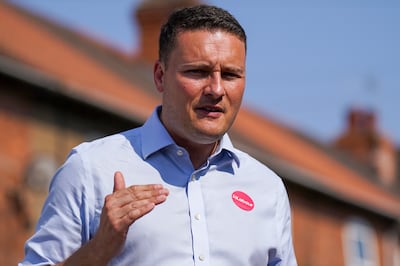
Leanne Mohamad is running against Wes Streeting after being selected to run by a local community group which is opposed to the Labour leadership’s decision not to call for an immediate ceasefire in the fighting between Hamas and Israel in Gaza.

Ms Mohamad, 23, told The National why she is running and insisted that while she is “up against the huge Labour machine", which will back Mr Streeting with "big money and resources”, her aim is to win – not just register a protest.

The Ilford North constituency has been held by Mr Streeting since 2015 and he has a majority of about 5,000.

Twenty-three per cent of the electorate is Muslim, which puts it outside the top 20 seats with the highest number of adherents to the faith.

Labour's relations with Muslims members and voters, and its own backbenchers and local councillors, have been put under strain by its position, although party leader Keir Starmer has said “the fighting must stop”.

A vote in the House of Commons on Wednesday on a motion proposed by the Scottish National Party to call for an immediate ceasefire in Gaza will force Labour to clarify its stance.

Previously, 56 backbenchers defied the party leadership to vote for an SNP amendment to the King's Speech, again calling for an immediate ceasefire.

On Tuesday, Labour's shadow foreign secretary David Lammy called for an "immediate humanitarian ceasefire" and said that while Israel had the right to defend itself, there has already been a "considerable degrading of Hamas's ability".

Ms Mohamad said in her view Labour has been "out of step" with public opinion since the start of the fighting.

"It's taken five months before they've even considered calling for an immediate ceasefire [which] shows just how untenable their position has been," she said.

"It's only because of pressure by campaigners such as myself and the millions of protesters that the message appears to have got through.

"But it's too little, too late. People tell me they won't support Labour until Palestine is free, but for many more, even that will not suffice and their support for Labour is lost for good.

"They want fundamental change in our political system and that's the message I'm hearing at doorsteps across Ilford North.

"It's why I'm challenging Wes Streeting, and it's why Labour can never be trusted when it comes to justice for Palestinians."

Mr Streeting, a key figure in in the shadow cabinet, said Labour is considering its options over whether to back the SNP's position, but suggested there is little difference between that and Labour's own.

He said Labour was working hard as a potential future government to use diplomatic opportunities and language to achieve its goal of ending the war.

People tell me they won't support Labour until Palestine is free, but for many more, even that will not suffice and their support for Labour is lost for good.
Leanne Mohamad

Ms Mohamad is standing against the shadow health secretary, as part of an reportedly orchestrated campaign by “well-funded” independents preparing to take on local Labour candidates in areas with large Muslim populations.

It is a prospect senior party figures are “taking very seriously”, according to one expert.

Her candidacy comes after large protests in London and across the UK against Israel’s war in Gaza, at which she has spoken.

“People can protest, like so many have done these past five months, and that’s all very good but to make real long-term change you must stand up for your principles, and there’s no better place than at the ballot box,” Ms Mohamad said.

“Everyone expects Labour and Keir Starmer to form the next government, especially after the debacle of the Conservatives these past few years.

"But Labour under his leadership have ditched all the policies that would have transformed Britain, and simply parrot whatever the Conservatives say.

“There is no difference between the two major political parties and it’s also why this national movement of independents is such an exciting way forward for so many people, not just here in Ilford North but across London and the rest of the UK.”

Ms Mohamad said “neighbours, friends, and associates from all backgrounds, and not just Muslims, tell me how angry they are at seeing thousands of innocent Palestinians being slaughtered by Israel”.

After Mr Streeting refused to call for a ceasefire in Gaza, while Israel commits what she calls genocide, she decided "our political leaders no longer represent the views of the people that elect them".

Ms Mohamad was chosen by the Redbridge Community Action Group to stand as its candidate in January.

The group calls itself “a grassroots organisation driven by the Redbridge community for the Redbridge community”.

It has posted videos of activists with Palestinian flags protesting outside Mr Streeting’s office.

While Gaza has been the catalyst for the organisation fielding candidates, Ms Mohamad said she also hopes to gain support of voters concerned about issues such as the National Health Service, crime and anti-social behaviour, and falling living standards.

"They think traditional Labour voters have no choice but to back them, but that’s not true," she said.

Ms Mohamed, whose grandparents were forced to leave the city of Haifa after the founding of the Israeli state in 1948, emphasises her pride in being from the local area and a British Palestinian.

“I grew up in Ilford, went to school here, made friends in the area and crucially this is where I had my major life experiences,” she said.

“As a British Palestinian I am so proud to call Ilford my home. It’s why I worked as a local youth worker, chairing the Youth Committee at my local Ilford Youth Centre. We helped local children to flourish and make the best use of their talents.

“I have something which they [opponents] don’t, and that is my determination to convince the electors to make a break from career politicians like Mr Streeting, and instead back me, an ordinary Ilford resident who wants real change.

“I will fight for every vote, and I will campaign with all I have, to make sure the people’s voice is heard and that my campaign is successful, so we get a true representative of the people of Ilford North into Parliament at the next election.”

Ahead of the vote, Mr Streeting used broadcast interviews on Monday to hit out at Israel's tactics in Gaza, saying there had been a "disproportionate loss of civilian life".

"We want to see a ceasefire, of course we do,” he said, while giving broadcast interviews.

"And we have been increasingly concerned, as the wider international community has been, with the disproportionate loss of civilian life in Gaza.

"Israel has a responsibility to get its hostages back, every country in the world has a right to defend itself.

"But I think what we have seen are actions that go beyond reasonable self-defence and also call into question whether Israel has broken international law.

"The ICJ [International Court of Justice] is now investigating and we take all of that seriously."