Monday, March 18, 2024

Fiji upholds China policing agreement, Guardian Australia reports

Reuters
Fri, March 15, 2024 

20th IISS Shangri-La Dialogue in Singapore


SYDNEY (Reuters) - Fiji will maintain a policing cooperation deal with China after a review of the agreement which has sparked concern in Australia, the Guardian Australia news site reported.

“We are now back on the original police agreement [with China] – that has been restored, we had reviewed it for 12 months,” Fijian Home Affairs Minister Pio Tikoduadua was quoted as saying.

Fijian Prime Minister Sitiveni Rabuka put on hold the decade-old police cooperation deal between Fiji and China shortly after forming government in December 2022, citing differences in policing, investigations and legal systems.

Guardian Australia reported on Friday that Tikoduadua said “there will only be Fijian officers training in China and no embedding of Chinese officers in the Fiji police force”.

Tikoduadua's office did not immediately respond to a Reuters request for confirmation of the report.

In February, Australia's Pacific Minister Pat Conroy said there should be "no role" for China, a growing presence in the region, in policing the Pacific Islands.

China's ambassador to Australia, a key United States ally, said earlier this year that China had a strategy to form policing ties with Pacific Island countries to help maintain social order and this should not cause Australia anxiety.

(Reporting by Sam McKeith in Sydney; Editing by Stephen Coates)

Looking for work, migrants turn to street vending
]
Sarah Freishtat, Kate Armanini, Chicago Tribune
Mon, March 18, 2024 


Chris Sweda/Chicago Tribune/TNS


CHICAGO -- On a chilly late winter evening, the smell of cooked meat washed over the traffic backed up outside the Salt Shed music venue.

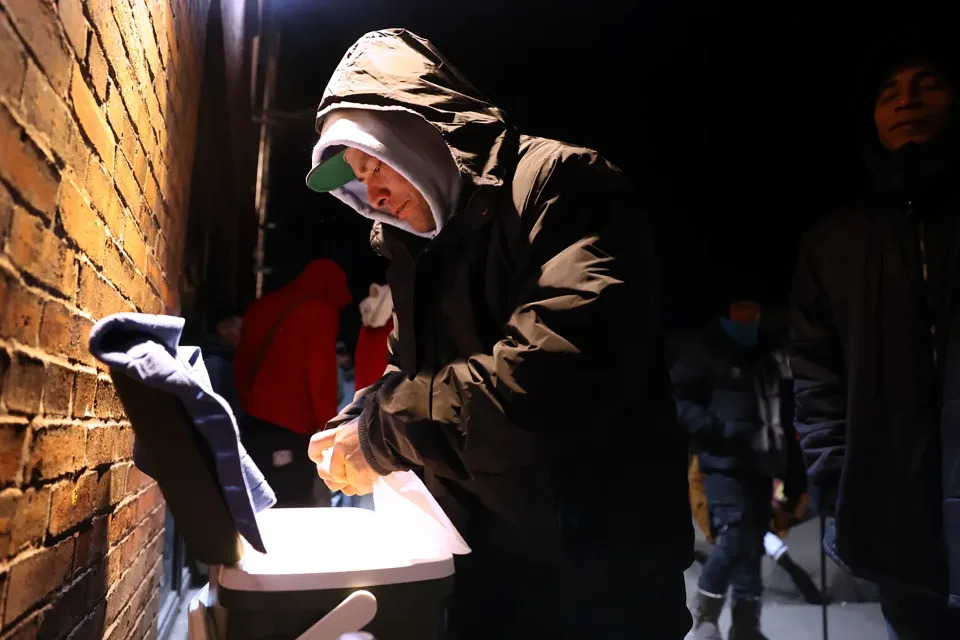
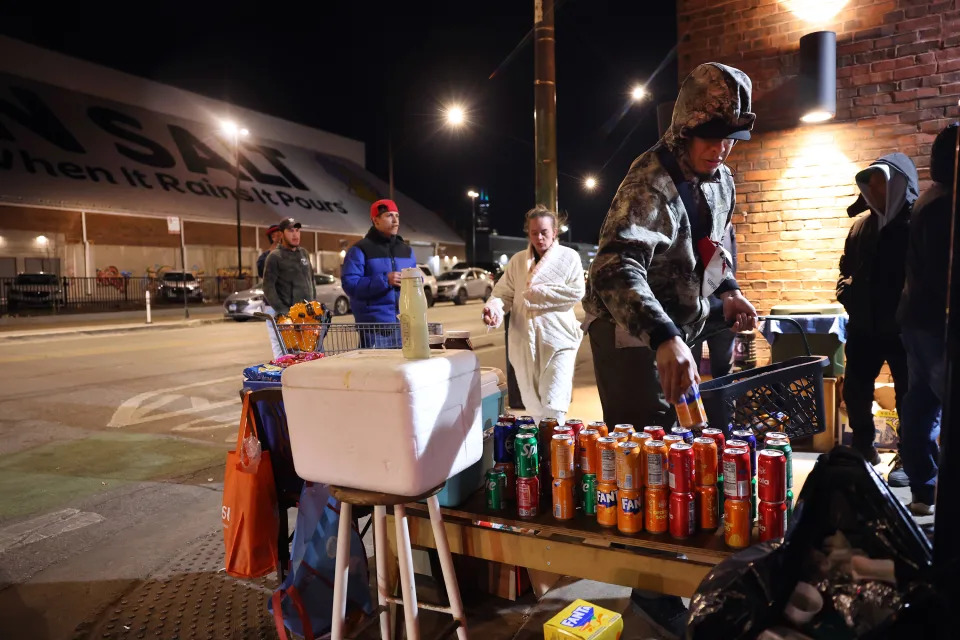
The smell came from the folding tables and stools set up across the street, where several vendors were selling arepas, empanadas and pastelitos out of multicolored coolers. Benches and a shopping cart were packed with snacks and cans of Sprite and Fanta. Cigarettes were also available for sale, and the smell of smoke mixed with that of the Venezuelan street food.

This is where Edwin Bravo was selling tequeños, outside the migrant shelter he’s staying in. Venezuelans more established in the city bring him the precooked food, and in return take a cut of the money, he said.


But he expected to have enough customers to make a profit. The food at the shelter is terrible, he said, and he figured plenty of residents would take him up on his two-for-$5 special.

And as dinnertime neared, the stub of a side street wedged between the music venue and Metra tracks filled with migrants hanging out and looking for a familiar meal from Bravo and the other vendors. The sounds of setup for the Jason Isbell concert at the Salt Shed mixed with the Spanish music playing on the street corner as the crowd grew.

“The day I get a (work) permit, I’ll leave this place,” Bravo said in Spanish. “I’ll rent a home.”

Bravo and the others set up on the West Town corner are one type of the street vendors who are becoming an increasingly familiar sight, as those newly arrived in the area look for opportunities to work. They are part of an informal economy that has gained visibility as more than 36,000 people have arrived in Chicago from the southern border since August 2022.

The new arrivals are the latest additions to Chicago’s history of street vending. For years, immigrants to the city have sold tamales on street corners and out of coolers in bars. Paleteros have pushed carts in the city’s neighborhoods and at the lakefront, and eloteros have long been a staple of the city’s Mexican American neighborhoods.

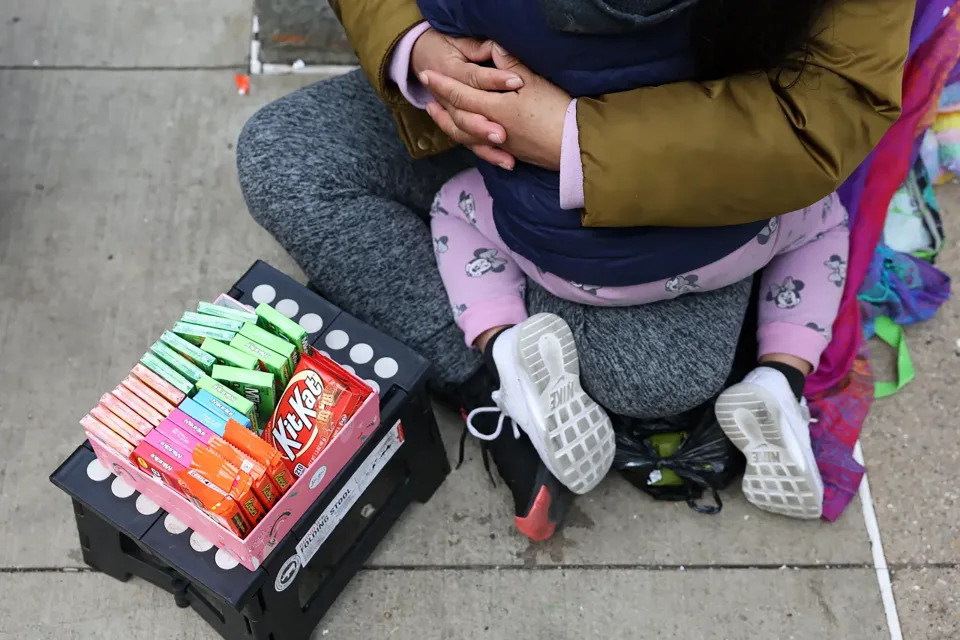
In recent months, other types of street vending have also become more visible. Men and women walk through CTA trains selling chocolates and candy out of decorated bins. On a recent afternoon, several women from Ecuador sat on street corners around the Loop, selling gum, M&Ms, Reese’s and Skittles.

One of the sellers, Norma Allas, sat on a street corner with her 2-year-old daughter. She worked at a flower shop in Ecuador, but after facing few work opportunities there and increasing gang violence, she left, walking through jungle to the U.S., she said.

She thought she would be able to find a job when she arrived in the States, but couldn’t get a work permit, she said. When she saw other people selling on the street, she decided to try it.

“So, so many people are coming,” she said in Spanish. “And you have to pay for rent, for food.”

Advocates say stories like Allas’ show the need to expand work opportunities to more immigrants, both those newly arriving and those who have been here for years. Some of the new arrivals are eligible for work permits, depending on a variety of factors such as the country they left, the circumstances under which they left and when they arrived. But others are not eligible, and even those who are sometimes must overcome hurdles, advocates said. Efforts have been made to speed up the process for those who are eligible, but in some cases it can still take months.

The Biden administration has made efforts to address work eligibility for Venezuelans, in particular, who make up the majority of arriving migrants. That includes a move last fall to extend temporary protected status for Venezuelans who arrived before July 31, 2023, which fast-tracks their approval to work legally. The move was expected to cover an estimated 472,000 people nationally.

The Resurrection Project, a housing and immigration assistance agency based on the city’s Lower West Side, has held workshops to help some of those eligible get work authorization. So far, more than 1,900 work authorization cards have been issued to attendees, and U.S. Citizenship and Immigration Services is processing another roughly 2,000 applications, said Erendira Rendon, vice president of immigrant justice at the organization.

But left out of the picture entirely are immigrants in the country without legal permission who have been living in the city for years, which has been a frustration for many advocates and immigrants, she said.

“The eligibility criteria that has been set out has been very arbitrary and unfair,” she said.

Work authorization can provide a pathway to better-paying jobs with better benefits, which means workers will pay taxes at a higher rate and have more opportunities to contribute to their community, said Diego Samayoa, associate director of Centro Romero, an Edgewater-based organization that works with refugees and immigrants. Expanding eligibility would not only help those seeking work, but the private sector, too, he said.

Some business groups are also pushing to expand work authorization. Mark Denzler, president of the Illinois Manufacturers’ Association, said that nationally more than 600,000 manufacturing jobs are unfilled, including an estimated tens of thousands in Illinois. Many of the openings would be suitable for newly arrived migrants or immigrants who have lived in the U.S. for years without legal permission, if they were authorized to work in the country, he said.

In the meantime, those arriving are finding other ways to work. Bravo, selling outside the Salt Shed, said he makes about $30 a day in profit. Getting work authorization and a stable job would help him save to rent a home, he said.

Near Bravo’s cooler, Ruven Vartida sold pork, ham and egg arepas for $5 each. Vartida, 29, was a mechanic in Venezuela, but he began selling food after just days in the U.S.

“It’s better to do this than nothing,” he said.

Like Bravo, he purchased premade food from migrants and sold the arepas largely to other migrants, tapping into an informal ecosystem. He also buys Cokes at Walmart and sells them for $1, sometimes to migrants and sometimes to passersby.

“I think all new beginnings are difficult,” he said. “No one comes to a new country with everything. Everything is a process, and you have to adapt and fight.”

Chicago has long welcomed waves of immigrants, but the sheer number arriving in recent years, many with no family or support systems in the city, has perhaps made informal work more visible, said Megan Davis, director of legal services at social services nonprofit Erie House.

Rengi Jesus Faltime, 33, turned to street vending to help support his wife and 5-year-old daughter. He has been in the U.S. about eight months, long enough to move out of a shelter and into a home, he said. But that means he has $550 in monthly rent to pay.

Faltime worked at a shoe store in Venezuela and, on his journey north through the jungle, stopped for a time in Tapachula, Mexico, to work at a bakery and earn money. After he arrived in Chicago he worked for two months at a hotel but was laid off, he said. He looked for other work but struck out.

So he and his wife decided he would sell arepas stuffed with breaded chicken, or chicken mixed with bacon and ham, and pastelitos that she cooked in their home.

“I really don’t want to be on the street begging, and I don’t want to go back to a shelter either,” he said. “So the situation brought me here.”

He intends to look for permanent work once the weather warms up. But so far, selling outside the migrant shelter nearly every day for four months, he has been able to pay rent.

He and his wife search multiple stores for the most cost-effective ingredients to ensure they make a profit, he said. Some days he sells a few dozen arepas, and some days a few hundred. He strategically chose the corner across from the Salt Shed because it is visible to the street, and close to the shelter, he said.

In an area surrounded by other Venezuelans, he knows the familiar food will be a hit. He often sells out in a matter of hours, even when there is a steady supply nearby from other vendors. Occasionally he also sells to other people walking by, he said.

The business isn’t without risks. Sometimes police ask the vendors to clear out, saying it’s illegal to sell without a street vendor permit, he said.

Chicago generally requires those who sell prepared foods and peddlers who sell uncut fruits and vegetables or other goods to be licensed. In 2023, the city’s Department of Business Affairs and Consumer Protection issued 730 enforcement actions to 155 peddlers and vendors, including cease-and-desist orders and citations, according to department data. Police can also enforce license violations, the department said.

Not every new vendor has encountered enforcement, though.

Andris Vasquez, who came to the U.S. from Caracas, Venezuela, about four months ago, has been selling empanadas for about a month. Once a butcher in Venezuela, the 23-year-old now lives in a Chicago Heights home with his mom, who has been in the U.S. longer than he and has work authorization, he said.

Back in Caracas, vendors selling traditional stuffed masa hallacas and a type of dumpling called bollos were common, he said.

Here, he and his mother carefully tally up the cost of the flour, oil, beef and chicken she uses to make the empanadas. They’ll spend about $150 for four days’ worth of empanadas, and on a good day he can make $80 to $100 selling.

“Here there are mostly Venezuelans, and they know empanadas,” he said in Spanish, from outside the West Town migrant shelter. “I don’t speak English, and I don’t know how to offer them to people from the U.S.”

Vasquez would prefer to have a more stable job, he said. But after leaving Venezuela, uncertain of what the future held for him there, he and his mother now have bills to pay.

“We have to pay for water and electricity,” he said. “I have to do something to make money.”

How Trump’s Allies Are Winning the War Over Disinformation


Jim Rutenberg and Steven Lee Myers

The New York Times

Sun, March 17, 2024 

A person at MichiganÕs GOP state convention in Lansing, Mich., Feb. 18, 2023.


In the wake of the riot on Capitol Hill on Jan. 6, 2021, a groundswell built in Washington to rein

 in the onslaught of lies that had fueled the assault on the peaceful transfer of power.

Social media companies suspended Donald Trump, then the president, and many of his allies from the platforms they had used to spread misinformation about his defeat and whip up the attempt to overturn it. President Joe Biden’s administration, Democrats in Congress and even some Republicans sought to do more to hold the companies accountable. Academic researchers wrestled with how to strengthen efforts to monitor false posts.

Trump and his allies embarked instead on a counteroffensive, a coordinated effort to block what they viewed as a dangerous effort to censor conservatives.

Sign up for The Morning newsletter from the New York Times

They have unquestionably prevailed.

Waged in the courts, in Congress and in the seething precincts of the internet, that effort has eviscerated attempts to shield elections from disinformation in the social media era. It tapped into — and then, critics say, twisted — the fierce debate over free speech and the government’s role in policing content.

Projects that were once bipartisan, including one started by the Trump administration, have been recast as deep-state conspiracies to rig elections. Facing legal and political blowback, the Biden administration has largely abandoned moves that might be construed as stifling political speech.

While little noticed by most Americans, the effort has helped cut a path for Trump’s attempt to recapture the presidency. Disinformation about elections is once again coursing through news feeds, aiding Trump as he fuels his comeback with falsehoods about the 2020 election.

“The censorship cartel must be dismantled and destroyed, and it must happen immediately,” he thundered at the start of his 2024 campaign.

The counteroffensive was led by former Trump aides and allies who had also pushed to overturn the 2020 election. They include Stephen Miller, the White House policy adviser; the attorneys general of Missouri and Louisiana, both Republicans; and lawmakers in Congress such as Rep. Jim Jordan, R-Ohio, who since last year has led a House subcommittee to investigate what it calls “the weaponization of government.”

Those involved draw financial support from conservative donors who have backed groups that promoted lies about voting in 2020. They have worked alongside an eclectic cast of characters, including Elon Musk, a billionaire who bought Twitter, now called X, and vowed to make it a bastion of free speech; and Mike Benz, a former Trump administration official who previously produced content for a social media account that trafficked in posts about “white ethnic displacement.” (More recently, Benz originated the false assertion that Taylor Swift was a “psychological operation” asset for the Pentagon.)

Three years after Trump’s posts about rigged voting machines and stuffed ballot boxes went viral, he and his allies have achieved a stunning reversal of online fortune. Social media platforms now provide fewer checks against the intentional spread of lies about elections.

“The people that benefit from the spread of disinformation have effectively silenced many of the people that would try to call them out,” said Kate Starbird, a professor at the University of Washington whose research on disinformation made her a target of the effort.

It took aim at a patchwork of systems, started in Trump’s administration, that were intended to protect U.S. democracy from foreign interference. As those systems evolved to address domestic sources of misinformation, federal officials and private researchers began urging social media companies to do more to enforce their policies against harmful content.

That work has led to some of the most important First Amendment cases of the internet age, including one to be argued Monday at the Supreme Court. That lawsuit, filed by the attorneys general of Missouri and Louisiana, accuses federal officials of colluding with or coercing the platforms to censor content critical of the government. The court’s decision, expected by June, could curtail the government’s latitude in monitoring content online.

The arguments strike at the heart of an unsettled question in modern American political life: In a world of unlimited online communications, in which anyone can reach huge numbers of people with unverified and false information, where is the line between protecting democracy and trampling on the right to free speech?

Even before the court rules, Trump’s allies have succeeded in paralyzing the Biden administration and the network of researchers who monitor disinformation.

Officials at the Department of Homeland Security and the State Department continue to monitor foreign disinformation, but the government has suspended virtually all cooperation with the social media platforms to address posts that originate in the United States.

“There’s just a chilling effect on all of this,” said Nina Jankowicz, a researcher who in 2022 briefly served as executive director of a short-lived DHS advisory board on disinformation. “Nobody wants to be caught up in it.”

‘Interpretive Battle’

For Trump, banishment from social media was debilitating. His posts had been central to his political success, as was the army of adherents who cheered his messages and rallied behind his effort to hold on to office after he lost.

“WE have to use TIKTOK!!” read a memo prepared for Trump’s lead lawyer, Rudy Giuliani, referring to a strategy to use social media to promote false messages about dead voters and vote-stealing software. “Content goes VIRAL here like no other platform!!!!! And there are MILLIONS of Trump supporters!”

After the violence on Jan. 6, Trump aides started working on how to “win the interpretive battle of the Trump history,” as one of them, Vincent Haley, had said in a previously unreported message found in the archives of the House investigation into the Jan. 6 attack. That would be crucial “for success in 2022 and 2024,” he added.

Once out of office, Trump built his own social platform, Truth Social, and his aides created a network of new organizations to advance the Trump agenda — and to prepare for his return.

Miller, Trump’s top policy adviser, created America First Legal, a nonprofit, to take on, as its mission statement put it, “an unholy alliance of corrupt special interests, big tech titans, fake news media and liberal Washington politicians.”

He solicited funding from conservative donors, drawing on a $27 million contribution from the Bradley Impact Fund, which had financed a web of groups that pushed “voter fraud” conspiracies in 2020. Another $1.3 million came from the Conservative Partnership Institute, considered the nonprofit nerve center of the Trump movement.

A key focus would be what he perceived as bias against conservatives on social media. “When you see people being banned off of Twitter and Facebook and other platforms,” he said in January 2021, “what you are seeing is the fundamental erosion of the concept of liberty and freedom in America.”

Biden’s administration was moving in the other direction. He came into office determined to take a tougher line against misinformation online — in large part because it was seen as an obstacle to bringing the coronavirus pandemic under control. DHS officials were focused on bolstering defenses against election lies, which clearly had failed before Jan. 6.

In one respect, that was more clear-cut than matters of public health. There have long been special legal protections against providing false information about where, when and how to vote or intentionally sowing public confusion, or fear, to suppress voting.

Social media, with its pipeline to tens of millions of voters, presented powerful new pathways for anti-democratic tactics, but with far fewer of the regulatory and legal limits that exist for television, radio and newspapers.

The pitfalls were also clear: During the 2020 campaign, platforms had rushed to bury a New York Post article about Hunter Biden’s laptop out of concern that it might be tied to Russian interference. Conservatives saw it as an attempt to tilt the scales toward Joe Biden.

Administration officials said they were seeking a delicate balance between the First Amendment and social media’s rising power over public opinion.

“We’re in the business of critical infrastructure, and the most critical infrastructure is our cognitive infrastructure,” said Jen Easterly, director of the Cybersecurity and Infrastructure Security Agency, whose responsibilities include protecting the national voting system. “Building that resilience to misinformation and disinformation, I think, is incredibly important.”

In early 2022, DHS announced its first major answer to the conundrum: the Disinformation Governance Board. The board would serve as an advisory body and help coordinate anti-disinformation efforts across the department’s bureaucracy, officials said. Its director was Jankowicz, an expert in Russian disinformation.

The announcement ignited a political firestorm that killed the board only weeks after it began operating. Liberals and conservatives raised questions about its reach and the potential for abuse.

The fury was most intense on the right. Miller, speaking on Fox News, slammed it as “something out of a dystopian sci-fi novel.”

Jankowicz said such attacks were distorting but acknowledged that the announcement had struck a nerve.

“I think any American, when you hear, ‘Oh, the administration, the White House, is setting up something to censor Americans,’ even if that has no shred of evidence behind it, your ears are really going to prick up,” she said.

A Legal Assault

Among those who took note was Eric Schmitt, then the attorney general of Missouri.

He and other attorneys general had been a forceful part of Trump’s legal campaign to overturn his defeat. Now they would lend legal firepower to block the fight against disinformation.

In May 2022, Schmitt and Jeff Landry, then the attorney general of Louisiana and now the governor, sued dozens of federal officials, including Dr. Anthony Fauci, the nation’s top expert on infectious diseases, who had become a villain to many conservatives.

The lawsuit picked up where others had failed. Trump and others had sued Facebook and Twitter, but those challenges stalled, as courts effectively ruled that the companies had a right to ban content on their sites. The new case, known as Missouri v. Biden, argued that companies were not just banning users; they were being coerced into doing so by government officials.

The attorneys general filed the lawsuit in the Western District of Louisiana, where it fell to Judge Terry Doughty, a Trump appointee who had built a reputation for blocking Biden administration policies.

“A lot of these lawsuits against social media companies themselves were just dying in the graveyard in the Northern District of California,” Schmitt, who was elected to the U.S. Senate in 2022, said, referring to the liberal-leaning federal court in San Francisco. “And so our approach was a little bit different. We went directly at the government.”

The lawsuit was considered a long shot by experts, who noted that government officials were not issuing orders but urging the platforms to enforce their own policies. The decision to act was left to the companies, and more often than not, they did nothing.

Documents subpoenaed for the case showed extensive interactions between government officials and the platforms. In emails and text messages, people on both sides were alternately cooperative and confrontational. The platforms took seriously the administration’s complaints about content they said was misleading or false, but at the same time, they did not blindly carry out its bidding.

On Biden’s third day in office, a White House aide, Clarke Humphrey, wrote to Twitter flagging a post by Robert F. Kennedy Jr. falsely suggesting that the death of Hank Aaron, the baseball legend, had been caused by the COVID-19 vaccines. She asked an executive at the platform to begin the process of removing the post “as soon as possible.”

The post is still up.

Reframing the Debate

In August 2022, a new organization, the Foundation for Freedom Online, posted a report on its website called “Department of Homeland Censorship: How DHS Seized Power Over Online Speech.”

The group’s founder, Benz, claimed to have firsthand knowledge of how federal officials were “coordinating mass censorship of the internet.”

At the heart of Benz’s theory was the Election Integrity Partnership, a group created in the summer of 2020 to supplement government efforts to combat misinformation about the election that year.

The idea came from a group of college interns at CISA. The students suggested that research institutions could help track and flag posts that might violate the platforms’ standards, feeding the information into a portal open to the agency, state and local governments and the platforms.

The project ultimately involved Stanford University, the University of Washington, the National Conference on Citizenship, the Atlantic Council’s Digital Forensic Research Lab, and Graphika, a social media analytics firm. At its peak, it had 120 analysts, some of whom were college students.

It had what it considered successes, including spotting — and helping to stop — the spread of a false claim that a poll worker was burning Trump ballots in Erie, Pennsylvania. The approach could misfire, though. A separate but related CISA system flagged a tweet from a New York Times reporter accurately describing a printer problem at a voter center in Wisconsin, leading Twitter to affix an accuracy warning.

Decisions about whether to act remained with the platforms, which, in nearly 2 out of every 3 cases, did nothing.

In Benz’s telling, however, the government was using the partnership to get around the First Amendment, such as outsourcing warfare to the private military contractor Blackwater.

Benz’s foundation for a time advertised itself as “a project of” Empower Oversight, a Republican group created by former Senate aides to support “whistleblower” investigations.

Benz had previously lived a dual life. By day, he was a corporate lawyer in New York. In his off-hours, he toiled online under a social media avatar, Frame Game Radio, which railed against “the complete war on free speech” as it produced racist and antisemitic posts.

In videos and posts, Frame Game identified himself as a onetime member of the “Western chauvinist” group the Proud Boys, and as a Jew. Yet he blamed Jewish groups when he and others were suspended by social media companies. Warning about a looming demographic “white genocide,” Frame Game vented, “Anything pro white is called racist; anything white positive is racist.”

Benz did not respond to requests for comment. After NBC News first reported on Frame Game last fall, Benz called the account “a deradicalization project” to which he contributed in a “limited manner.” It was intended, he wrote on X “by Jews to get people who hated Jews to stop hating Jews.”

Toward the end of 2018, Benz joined the Trump administration as a speechwriter for the housing and urban development secretary, Ben Carson. Benz’s posts were discovered by a colleague and brought to department management, according to a former official who insisted on anonymity to discuss a personnel matter.

As the election between Trump and Biden heated up, he joined Miller’s speech-writing team at the White House. He was there through the early days of the effort to keep Trump in power and was involved in the search for statistical anomalies that could purport to show election fraud, according to testimony and records collected by House investigators, some of which were first uncovered by Kristen Ruby, a social media and public relations strategist.

In late November 2020, Benz was abruptly moved to the State Department as a deputy assistant secretary for international communications and information policy. It is unclear precisely what he did in the role. Benz has since claimed that the job, which he held for less than two months, gave him his expertise in cyberpolicy.

Benz’s report gained national attention when a conservative website, Just the News, wrote about it in September 2022. Four days later, Schmitt’s office sent requests for records to the University of Washington and others demanding information about their contacts with the government.

Schmitt soon amended his lawsuit to include nearly five pages detailing Benz’s work and asserting a new, broader claim: Not only was the government exerting pressure on the platforms, but it was also effectively deputizing the private researchers “to evade First Amendment and other legal restrictions.”

The scheme, Benz said, had “ambitious sights for 2022 and 2024.”

‘An Aha Moment’

In October 2022, Musk completed his purchase of Twitter and vowed to make the platform a forum for unfettered debate.

He quickly reversed the banning of Trump — calling it “morally wrong” — and loosened rules that had caused the suspensions of many of his followers.

He also set out to prove that Twitter’s previous management had too willingly cooperated with government officials. He released internal company communications to a select group of writers, among them Matt Taibbi and Michael Shellenberger.

The resulting project, which became known as the Twitter Files, began with an installment investigating Twitter’s decision to limit the reach of the New York Post article about Hunter Biden’s laptop.

The author of that dispatch, Taibbi, concluded that Twitter had limited the coverage amid general warnings from the FBI that Russia could leak hacked materials to try to influence the 2020 election. Although he was critical of previous leadership at Twitter, he reported that he saw no evidence of direct government involvement.

Last March, Benz joined the fray. Taibbi and Benz participated in a live discussion on Twitter, which was co-hosted by Jennifer Lynn Lawrence, an organizer of the Trump rally that preceded the riot on Jan. 6.

As Taibbi described his work, Benz jumped in: “I believe I have all of the missing pieces of the puzzle.”

There was a far broader “scale of censorship the world has never experienced before,” he told Taibbi, who made plans to follow up.

Later, Shellenberger said that connecting with Benz had led to “a big aha moment.”

“The clouds parted, and the sunlight burst through the sky,” he said on a podcast. “It’s like, oh, my gosh, this guy is way, way farther down the rabbit hole than we even knew the rabbit hole went.”

Platform in Congress

A week after that online meeting, Taibbi and Shellenberger appeared on Capitol Hill as star witnesses for the Select Subcommittee on the Weaponization of the Federal Government. Benz sat behind them, listening as they detailed parts of his central thesis: This was not an imperfect attempt to balance free speech with democratic rights but a state-sponsored thought-policing system.

Shellenberger titled his written testimony, “The Censorship Industrial Complex.”

The committee had been created immediately after Republicans took control of the House in 2023, with a mandate to investigate, among other things, the actions taken by social media companies against conservatives.

It was led by Jordan, who helped spearhead the attempt to block certification of Joe Biden’s victory and who has since worked closely with Miller and America First Legal.

“There are subpoenas that are going out on a daily, weekly basis,” Miller told Fox News in the first days of Republican control of the House, showing familiarity with the committee’s strategy.

Jordan’s committee soon sought documents from all those involved in the Election Integrity Partnership, as well as scores of government agencies and private researchers.

Miller followed with his own federal lawsuit on behalf of private plaintiffs in Missouri v. Biden, filing with D. John Sauer, a former solicitor general of Missouri who had led that case. (More recently, Sauer has represented Trump at the Supreme Court.)

Democrats in the House and legal experts questioned the collaboration as potentially unethical. Lawyers involved in the case have claimed that the subcommittee leaked selective parts of interviews conducted behind closed doors to America First Legal for use in its private lawsuits.

An amicus brief filed by the committee misrepresented facts and omitted evidence in ways that may have violated the Federal Rules of Civil Procedure, Rep. Jerry Nadler, D-N.Y., wrote in a 46-page letter to Jordan.

A committee spokesperson said the letter “deliberately misrepresents the evidence available to the committee to defend the Biden administration’s attacks on the First Amendment.”

The amicus brief, filed to the 5th U.S. Circuit Court of Appeals, was drafted by a lawyer at Miller’s legal foundation.

Miller did not respond to requests for comment.

A Chilling Effect

By the summer of 2023, the legal and political effort was having an impact.

The organizations involved in the Election Integrity Partnership faced an avalanche of requests and, if they balked, subpoenas for any emails, text messages or other information involving the government or social media companies dating to 2015.

Complying consumed time and money. The threat of legal action dried up funding from donors — which had included philanthropies, corporations and the government — and struck fear in researchers worried about facing legal action and political threats online for the work.

“You had a lot of organizations doing this research,” a senior analyst at one of them said, speaking on the condition of anonymity because of fear of legal retribution. “Now there are none.”

The Biden administration also found its hands tied.

On July 4, 2023, Doughty issued a sweeping injunction, saying that the government could not reach out to the platforms, or work with outside groups monitoring social media content, to address misinformation, except in a narrow set of circumstances.

The ruling went further than some of the plaintiffs in the Missouri case had expected. Doughty even repeated an incorrect statistic first promoted by Benz: The partnership had flagged 22 million messages on Twitter alone, he wrote. In fact, it had flagged fewer than 5,000.

The Biden administration appealed.

While the judge said the administration could still take steps to stop foreign election interference or posts that mislead about voting requirements, it was unclear how it could without communicating “with social media companies on initiatives to prevent grave harm to the American people and our democratic processes,” the government asserted in its appeal.

In September, the 5th U.S. Circuit Court of Appeals scaled the order back significantly but still found the government had most likely overstepped the limits of the First Amendment. That sent the case to the Supreme Court, where justices recently expressed deep reservations about government intrusions in social media.

Before the court’s decision, agencies across the government have virtually stopped communicating with social media companies, fearing the legal and political fallout as the presidential election approaches, according to several government officials who described the retreat on the condition of anonymity.

In a statement, Cait Conley, a senior adviser at CISA, said the department was still strengthening partnerships to fight “risks posed by foreign actors.” She did not address online threats at home.

The platforms have also backed off. Facebook and YouTube announced that they would reverse their restrictions on content claiming that the 2020 election was stolen. The torrent of disinformation that the previous efforts had slowed, though not stopped, has resumed with even greater force.

Hailing the end of “that halcyon period of the censorship industry,” Benz has found new celebrity, sitting for interviews with Tucker Carlson and Russell Brand. His conspiracy theories, such as the one about the Pentagon’s use of Swift, have aired on Fox News and become talking points for many Republicans.

The biggest winner, arguably, has been Trump, who casts himself as victim and avenger of a vast plot to muzzle his movement.

Biden is “building the most sophisticated censorship and information control apparatus in the world,” Trump said in a campaign email March 7, “to crush free speech in America.”

c.2024 The New York Times Company

California speeds plans to empty San Quentin's death row
Hannah Wiley
Mon, March 18, 2024

Prisoners on San Quentin's death row will be transferred out by summer, as California moves to overhaul its oldest prison to emphasize training and rehabilitation. (Mark Boster / Los Angeles Times)

California is accelerating its efforts to empty San Quentin's death row with plans to transfer the last 457 condemned men to other state prisons by summer.

The move comes five years after Gov. Gavin Newsom signed an executive order that imposed a moratorium on the death penalty and closed the prison's execution chamber. It coincides with his broader initiative to transform San Quentin into a Scandinavian-style prison with a focus on rehabilitation, education and job training.

The condemned prisoners will be rehoused in the general population across two dozen high-security state prisons, where they will gain access to a broader range of rehabilitative programming and treatment services, according to the California Department of Corrections and Rehabilitation. The changes do not modify their sentences or convictions.

The plan unveiled Monday builds on a pilot program that experimented with the transfer of 104 death row prisoners from January 2020 to January 2022. An additional 70 people on death row have been moved from the legendary men's facility in Marin County over the last month, the department said. The 20 condemned women incarcerated at the Central California Women's Facility in Chowchilla will remain there, but have been rehoused in the general population.


The condemned prisoners on San Quentin's legendary death row will be dispersed in coming months across two dozen high-security prisons, where they will be housed in the general population. (Los Angeles Times)

The changes align, in part, with Proposition 66, a statewide ballot measure approved in 2016 that allows for condemned prisoners to be housed in institutions other than San Quentin, requiring them to work and pay 70% of their income to victims.

“This transfer enables death-sentenced people to pay court-ordered restitution through work programs. Participants are placed in institutions with an electrified secured perimeter while still integrating with the general population,” corrections department Secretary Jeffrey Macomber said in a prepared statement.

But a primary aim of Proposition 66 was to speed up executions by setting time limits on legal challenges and expanding the pool of attorneys authorized to represent defendants sentenced to death. In that same election, voters defeated a rival measure that would have repealed capital punishment.

By contrast, Newsom vowed in 2019, when announcing his death penalty moratorium, that no California prisoner would be executed while he is in office because of his belief that capital punishment is discriminatory and unjust.

Even before Newsom's moratorium, executions had been on hold in California for years amid litigation over whether the state's lethal injection process constitutes cruel and unusual punishment. California's last execution was in 2006. There are 644 condemned people in California's prisons.

Read more: California to transform infamous San Quentin prison with Scandinavian ideas, rehab focus

Last year, Newsom announced plans to overhaul San Quentin, California's oldest prison, into a more rehabilitative facility with job training, substance-use and mental health programs as well as expanded academic classes, a model of incarceration more common in Scandinavian countries.

But death row prisoners will not be incorporated into the re-envisioned San Quentin. Outside of death row, the facility does not have the necessary security measures, including a "lethal electrified fence," to rehouse high-security prisoners in its general population.

Newsom proposed $380 million last year to jump-start the San Quentin overhaul and set up an advisory council to implement his vision. But, faced with a looming state budget deficit topping $37 billion, lawmakers in both political parties, as well as the Legislature's nonpartisan financial advisors, have raised questions about the scope and timing.

The Legislative Analyst's Office recently recommended closing five prisons to reduce criminal justice spending, in addition to the two state prisons the Newsom administration has already closed. Meanwhile, the San Quentin advisory council in January recommended redirecting some of the money dedicated to the revamp to renovations that would more immediately improve living conditions at the prison.

Sign up for Essential California for news, features and recommendations from the L.A. Times and beyond in your inbox six days a week.

This story originally appeared in Los Angeles Times.


San Quentin begins prison reform - but not for those on death row

Madeline Halpert - BBC News, New York
Sun, March 17, 2024 

San Quentin's gas chamber was used for over 100 executions


California is transferring everyone on death row at San Quentin prison to other places, as it tries to reinvent the state's most notorious facility as a rehabilitation centre.

Many in this group will now have new freedoms. But they are also asking why they've been excluded from the reform - and whether they'll be safe in new prisons.

Keith Doolin still remembers the day in 2019 when workers came to dismantle one of the United States' most infamous death chambers.

He was in his cell at San Quentin prison on the north side of San Francisco Bay, watching live footage on television showing an execution chair - where 194 people had been put to death - carried away after more than 80 years of use. The green gas chamber being taken apart was just several hundred feet from where he sat.

A former long-distance truck driver convicted of murder, Doolin has spent nearly 23 hours a day for the last 28 years in a tiny cell. He long worried he would one day be shackled to a mint-green chair and executed.

But in the last few years, California has been moving fast with some plans for prison reform. Governor Gavin Newsom's decision to deconstruct the death chamber - and also place a moratorium on the death penalty in the state - was a watershed moment for Doolin.

"He [Newsom] was sending the message: 'Look, it might take a while, but things are going to change'."

Mr Newsom is now seeking more changes at San Quentin, which currently has the nation's largest death row. The governor announced last year that he planned to transform the state's oldest prison into a rehabilitation centre.

He will close the prison's death row unit and move Doolin and the other 532 death row inhabitants to standard prisons across the state in the coming months (70 have been moved already).

Doolin and his neighbours will still have death sentences - meaning they will spend the rest of their lives in prison. For some, the threat of execution still looms large, as a future governor could reinstate the state's death penalty.

Six people on death row who spoke to the BBC over the phone shared mixed feelings about their move. Some were elated by the opportunity to live closer to family and step outside their cells without handcuffs, while others were terrified at the prospect of starting over after decades living alone in a cell.


Keith Doolin, who was convicted of murder in 1996, says he is worried about his transfer to another California prison


Rats, birds and handcuffs: Life on death row


Built in 1852, San Quentin is California's oldest prison and the state's only facility for incarcerated males who have been sentenced to death. Since 1893, 422 people have been executed there, including by gas, hanging or lethal injection.

Family members walk by the entrance to the prison's execution chamber every time they visit their loved ones, said Doolin's mother, Donna Larsen, who drives a nine-hour round trip once a month to visit her son.

The execution chamber would emit a green light that turned red as a person was being executed, a sight visible to Californians driving by on the highway, she said. This green room of death - and infamous incarcerated people such as cult leader Charles Manson - have brought international notoriety to San Quentin, featured in podcasts, television shows and films.

When Ramon Rogers arrived at the prison in 1996, rain leaked through the ceiling of the death row unit, and mice and rats would run rampant. But the biggest pests, he said, were the birds.

"They started defecating all over the place - all over the railings," he said. "It was a gross environment."

Since then, life on death row has remained restrictive and, at times, hazardous.

An outbreak of Covid-19 during the height of the pandemic killed at least 12 people on death row - part of a wider coronavirus surge at the prison that infected 75% of the population.

Ms Larsen - Doolin's mother - said she was shocked by how dirty the prison was the first time she visited.

"It had a stench to it," she said. "Sometimes Keith's clothing smells mouldy when we visit. To know that your loved one is living in that made me sick."


Those imprisoned in San Quentin's death row spend nearly all of the day in their cells


People housed in San Quentin's death row are kept alone for most of the day in a roughly four foot (1.2m) by nine foot (2.7m) cell, a space that Doolin said feels like a "sardine can".

The 51-year-old was sentenced to death in 1996 for murdering two sex workers, Inez Espinoza and Peggy Tucker, and shooting four others. In 2009, the California Supreme Court upheld Doolin's death sentence based on testimony from the surviving victims, who identified him as their attacker.

He has maintained his innocence, and a California attorney has alleged that he has information - learned during another case - that could potentially support his defence. But the lawyer, David Mugridge, told the BBC that he could not share the details due to attorney-client privilege.

Doolin and others living on death row are required to wear handcuffs at all times when outside their cells, which officers have to unlock with metal keys after strip-searching them.

"Our daily life confinement is based on going from one box to another," said another death row inhabitant, Tony, who declined to share his last name for privacy reasons.

People on death row are offered little access to rehabilitative programmes except for some college courses and jobs such as cleaning showers.
Ending death row

In March 2019, Governor Newsom issued an executive order that halted the death penalty in the state and ordered the dismantling of the gas chamber in San Quentin.

Mr Newsom's move did not alter any incarcerated individuals' sentences, though he said that he might later consider commuting death row sentences.

While the state had not actually performed an execution since 2006, Mr Newsom argued the death penalty system had been "by all measures, a failure" that was unfairly applied to people of colour and people with mental illness.

According to the Death Penalty Information Center, black people comprise 34% of California's death row, but only 6% of the state's population.

Since 1973, seven people on death row in the state have been exonerated.

Preparing for bigger changes, Mr Newsom announced a two-year pilot programme in 2020 to transfer around 100 volunteers from San Quentin's death row to other prisons, the first move in his bigger plan to eventually move all the death row inhabitants out, to more than 20 other prisons that meet security requirements.

Correll Thomas left San Quentin with the pilot programme in 2021 after being on death row since 1999.

But at Centinela prison, in Imperial, California, settling in was a struggle. "They didn't want to give us [rehabilitation] programs," he said. "We had to pretty much fight for everything."


Correll Thomas was happy to have the chance to leave San Quentin death row

Other prisoners and staff appeared frightened of his death row status, said Thomas, who added that with time, some at the prison grew to accept him.

Ramon Rogers, the incarcerated person who first arrived at San Quentin in 1986 when birds and rats had overrun the facility, said the move was welcome.

"I didn't care where they sent me, I just knew anywhere else would be better," he said.

Now at the Richard Donovan Correctional Facility in San Diego, Rogers, 64, has been able to enrol not just in rehabilitation programmes but also college.

The greatest relief, he said, came from not having to wear handcuffs around the clock outside his cell for the first time in decades.

"Sometimes, I'm amazed at what I'm allowed to do here that I would never be able to do on death row."

Starting over

But some advocates say not enough support is being offered as these people on death row make a drastic transition. There is a "huge difference" between the people on death row who chose to leave and those being forced to move now, said Gavrilah Wells, a volunteer with human rights group Amnesty International.

"I'm so worried about the safety and the human rights of so many people being involuntarily transferred," she said. "The massive endeavour of rapidly moving 550 people to unknown prisons, with unknown cultures specific to each facility, raises serious concerns."

Ms Wells and other advocates say moving the death row population, which includes many who are sick and elderly, poses great challenges. The oldest person in San Quentin's death row is 93.

"It's not the same as just transferring any person in prison," said Natasha Minsker, a policy adviser for non-profit Smart Justice California.

Advocates worry about those being moved far away from their lawyers and family members, and how they will adjust after decades living alone in a cell.

"These guys have never lived with anyone but themselves," Tony said. "They're going to have to learn how to do things all over again."

Doolin is anxious about avoiding conflict as he interacts with more people than ever before, including prison guards.

"It's extremely stressful," he said. "I'm forced to start all over again like my first day in prison."

Ms Larsen, Doolin's mother, said she and others suggested programmes to offer support to their incarcerated loved ones as they made the transition, but the prison turned them down.
'We still have humanity'

For several death row inhabitants, the anxieties of a new environment are outweighed by the prospect of breaking free from a dismal life in San Quentin.

"For some people, it's a godsend," Tony said. "They want to leave this oppression."

But for others, the departure from San Quentin before its estimated $360m (£282m) upgrade has served as a reminder of how those on death row are treated differently to other prisoners. Mr Newsom has said the goal is to transform the prison into a college campus-like setting, modelled on Scandinavian correctional facilities that focus on rehabilitation.

In response to a question from the BBC on how people on death row fit into the state's larger plans for prison reform, Mr Newsom's office said he was committed to "addressing failings in our criminal justice system - including the discriminatory nature of the death penalty system".

Mr Newsom's office did not elaborate on why people on death row could not participate in the San Quentin project, but touted the closure of death row and his moratorium on the death penalty.

The California Department of Corrections and Rehabilitation said all who were incarcerated on death row had to be moved because San Quentin did not have the "required lethal electrified fence". It did not respond when asked why that had been okay up to this point. It also did not respond to questions about support being offered to transfers.

Darrell Lomax, one of the men in San Quentin, said: "It's not what they're doing. It's the way they're doing it... Why are we being moved so they can make room for a rehabilitation program that doesn't even serve us?"

The arrangement sends the "unfortunate" message that one of the biggest prison reform projects in the US can't include people sentenced to death, Ms Minsker said.

Tony believes some in California are still not ready to reckon with the status - and future - of those sentenced to death, even in a state that is not executing people.

"There's a notion that because we're here, it's the end of the road," he said. "But we still have humanity in this place. I don't think our humanity has been seen enough."
Shock and confusion as Turkey seizes earthquake survivors' homes


By Ceyda Caglayan and Burcu Karakas

Updated Mon, March 18, 2024 

SAMANDAG, Turkey (Reuters) -Habip Yapar felt lucky that his home in southern Turkey withstood last year's devastating earthquake. Then a text message appeared on his phone in October telling him the government was taking ownership of the apartment.

The message sent to Yapar, 61, declared that the deeds for his property in Hatay province were being transferred to the Treasury under an amendment to an urban planning law set to affect thousands of earthquake survivors.

Urbanisation Minister Mehmet Ozhaseki said in early February the government needed new powers established in the amendment to speed up the redevelopment of neighbourhoods in towns severely damaged by the earthquake, which flattened a swathe of the country's southeast on Feb. 6, 2023.

Hatay, the southernmost region of mainland Turkey, bordering Syria, suffered the most damage in the deadliest tremor in the country's modern history. Since then, reconstruction has fallen behind ambitious deadlines set by President Tayyip Erdogan.

According to the regulation, which was passed in November, the seizures were to create "reserve building areas," a temporary measure to expedite reconstruction. Those affected would be entitled to a property after paying towards the construction costs, it said, without providing details of the financial burden.

While earthquake insurance is compulsory in Turkey, the rule is not always enforced and insurance often covers only a fraction of the costs of rebuilding or buying new property.

Interviews with nearly two dozen residents, lawyers and local officials show that thousands of homeowners were blindsided by the seizure plans, with many learning on social media their properties would be affected.

Like Yapar, dozens in his coastal home town of Samandag received text messages even before the amendment was passed in November.

Five months later, the government has yet to inform affected people about how much they will pay, what happens if they are unable to, any compensation they might be entitled to, and exactly when and for how long their titles will be in the government's possession, the people Reuters spoke to said.

"It's like going to a restaurant where they bring you a dish, but you don't know the price. You have to pay whatever the bill is," said Ecevit Alkan, chairman of the Environment and Urban Law Commission at Hatay Bar Association.

Reuters spoke to four homeowners and two lawyers in the Hatay districts of Samandag, Defne and Antakya who have filed lawsuits with the Hatay administrative court to block the orders.

The urbanisation ministry and Erdogan's office did not respond to questions from Reuters. Several opposition parties have submitted parliamentary questions requesting more information from the ministry about the new law but they remain unanswered.

Yapar lives with his wife and adult son and daughter in a temporary tent shelter. At least 215,000 Hatay survivors are living in container camps or tents.

The retired civil engineer had been saving money to repair his two-storey home. With ownership now being transferred to the government, he cannot start work. The house is scheduled for demolition.

Yapar, among those who filed a lawsuit, denied the building was beyond repair.

"We can rebuild our houses ourselves, and we do not want a cent from the state."

HOMELESS IN HATAY

Just over a year since the devastating earthquake killed more than 53,000 people in Turkey, hundreds of thousands of survivors remain in temporary homes such as containers and tents.

Most of the affected owners have been living with acquaintances or in temporary shipping containers since the earthquake flattened or damaged their apartments and have not been told when the new buildings will be ready, residents and lawyers said.

Others have been made homeless by the seizure notices. Hatice Altinoz said she and her adult son Ahmet had to move from their damaged apartment in Hatay's Antakya because the building is in a reserve area largely cleared for reconstruction.

"Authorities did not provide us a container to stay in because our building had not collapsed, so I moved to my daughter's container house," Altinoz said.

Antakya residents Omer and Dilay Dolar, said they learned on social media that their five properties were in a designated area, where few buildings are standing.

"My family and I worked so hard to own these assets," said Dilay Dolar, 57, an entrepreneur. "But now it is unclear what the future will hold."

Hatay's federal government-run governor's office said on its website in February nearly 44,000 homes will replace transferred property. It did not give figures on how many people's property will be seized in the process and did not respond to questions from Reuters.

In total, Erdogan has promised 254,000 new homes for the province, but so far construction has been completed on less than 7,300 of those, data from the governor's office shows. Last year an official told Reuters limits on funds and rising prices were to blame for the delays.

The bar association's Alkan said nearly 50,000 people will be affected by the property seizures, based on the population in neighbourhoods designated as reserve areas in the province.

In Samandag, Mayor Refik Eryilmaz said he welcomed the government's plan for a modern bazaar and new housing in the declared reserve areas.

But, he said, it was wrong for the government to send text messages to his town's property owners without explaining the project or the legal and financial arrangements.

"The government authorities have failed to provide a satisfactory explanation to the public, which is problematic," Eryilmaz, from main opposition party CHP, said in an interview.

Some residents see politics at play. Hatay is an opposition-run district where Erdogan is keen to make inroads in local elections on March 31.

A speech he gave in the province to mark the first anniversary of the quake was widely interpreted as a veiled message that reconstruction aid would flow more smoothly with a ruling party administration.

Erdogan later emphasized that reconstruction efforts did not differentiate between government supporters and opponents.

LAW SUITS

With information scarce, the home owners and lawyers who spoke to Reuters were mistrustful and feared the state could keep property if owners are not able to pay.

The new amendment to the Law on the Transformation of Areas under Disaster Risk granted the ministry's Urban Transformation Directorate wide authority to designate private properties as reserve building areas without first getting consent from owners.

Orhan Ozen, a lawyer in Samandag, said the law violates property rights and does not specify how owners will be protected after their properties are handed over to the Treasury, despite promises of a smooth rebuilding process.

So far, the Urban Transformation Directorate has declared more than 200 hectares of land as reserve areas in Hatay province, official data shows.

Ozen, who filed lawsuits for stays on two parcels of land in Samandag, said the designation covered the most valuable properties in town.

"The balance between the public interest and the citizens is being ignored," Ozen said, adding that the lack of detail in the law has sown uncertainty, including what will happen to a new property if the owner dies before paying it off.

In one plea seen by Reuters, the urbanisation ministry said the request for a stay should be dismissed on grounds that plaintiffs only have rights over individual properties, not the broader area designated by the ministerial decision.

Samandag's central bazaar is among around 1.6 hectares in the district seized for renovation under the plans. Ali Tas, who runs a toy shop in the bazaar, said he was willing to work in a container for a while if the bazaar ultimately looks good.

But Hasan Fehmi Cilli, a 56-year old doctor, said neither he or his neighbours whose offices and shops are operating in the bazaar but are slated for redevelopment had given their consent. He was among those who have filed a lawsuit.

"There are lots of uncertainties. Will the state provide us a property in the same location, on the same plot, and of the same size?" Fehmi Cilli said, visibly angry.

(Reporting by Ceyda Caglayan and Burcu Karakas, additional reporting by Umit Bektas; Editing by Jonathan Spicer and Frank Jack Daniel)