Monday, April 01, 2024


Cocoa price hits US$10,000 a tonne,

prompting chaos for industry and consumers

In the current era of high inflation, consumers have gotten used to sharp increases in the price of everything from cars to shelter. But the latest bittersweet twist in the story is unfolding now as the cost of chocolate is skyrocketing — and everyone from Big Chocolate to the Easter Bunny are feeling the bite.

This week, cocoa futures in New York eclipsed the US$10,000 per metric tonne mark, a record-high. The last time cocoa futures were above even $5,000 was 46 years ago. The skyrocketing price of cocoa this year has even outpaced that of stock market darling Nvidia.

It’s happening because of a complex interplay of factors, mostly supply constraints in West Africa. But a quadrupling of prices in under a year has fundamentally shifted the dynamics of the market, as buyers and sellers move from orderly trading to a more frenzied scramble to secure supply.

“This is not a speculative bubble that can burst from a shift in market sentiment,” said Judith Ganes, president of JGanes Consulting, a commodity advisory services firm. “Buyers are scrambling to secure supplies… be it beans, cake, butter, or powder to assure that they have sufficient supply on hand to meet needs.”

Supply problems

West Africa, the powerhouse of global cocoa production, is grappling with a series of agricultural setbacks. At a time when global demand for cocoa is intensifying, crop failures, aging plantations, and disease have precipitated the most significant supply deficit in over six decades, steering the world towards a third consecutive year of supply shortfall.

Record price hikes have ensued from adverse weather conditions and diseases impacting African cocoa production, prompting a rush to secure existing supplies. The appetite for new supply is strong, but forthcoming harvests from Côte d'Ivoire and Ghana are not expected to be enough to make a dent.

Côte d'Ivoire’s so-called mid-crop, commencing in April, is predicted to fall short of last year’s output; and Ghana's mid-crop, starting in the summer, is expected to produce less than expected previously. Both developments are a recipe for the cocoa market to remain wildly out of whack.

The two countries are amongst the largest producers in the world and in both, prices are strictly regulated by the government — which presents an enduring challenge for cultivators. Price caps limit compensation for farmers, which makes it difficult for them to invest in modernizing their operations to increase quality or quantity. In Côte d'Ivoire, farmers are only paid one million West African francs (about US$1,644) per metric ton of cocoa, roughly one-sixth of the price at which New York futures are currently trading.

“It’s been spectacular,” said Sylvain Charlebois, director of the Agri-Food Analytics Lab at Dalhousie University in Halifax. “I’ve been following commodities for 25 years and I’ve never seen such a rally.”

Confectionery giants are trying to navigate this inflationary pressure through price adjustments and supply chain innovations to keep up with consumer demand while maintaining profitability

Major players including Switzerland's Nestle, Mondelez International Inc. (maker of Cadbury and Milka chocolates), and Barry Callebaut AG, the globe's leading supplier of bulk chocolate, have all been forward-buying whatever supply they can get their hands on, Charlebois said.

Despite high prices for chocolate, stock valuations for all three have been under pressure this year. And on Tuesday, Hershey Co. saw its rating downgraded to neutral from outperform by BNP Paribas Exane, attributed to the sharp increase in cocoa prices.

It’s not just the major industry players feeling the pinch, as consumer prices have risen in some categories by 30 per cent this year, Charlebois said, adding that he doesn’t see any relief on the horizon.

“If I were … going out and buying chocolate, I’d think about Mother’s Day as well,” he told BNN Bloomberg Thursday. “My guess is prices by then will increase as well.”

WORKERS CAPITAL

CPP Investments and Bridgepoint sell Dorna Sports to Liberty Media


BNN Bloomberg

Spain's Marc Marquez rides his Honda during the qualifying session for the MotoGP Grand Prix of Italy at the Mugello circuit in Scarperia, Italy, Saturday, May 28, 2022. 
(AP Photo/Antonio Calanni, File)

The Canada Pension Plan Investment Board and investment manager Bridgepoint have signed a deal to sell Dorna Sports to Liberty Media, the company behind Formula One auto racing.

The transaction puts an enterprise value of 4.2 billion euros on Dorna, which holds the rights to the MotoGP World Championship.

MotoGP will host 21 motorcycle races across 17 countries for the 2024 season.

CPP Investments holds a 39 per cent stake in Dorna.

The Canadian pension fund manager says its net proceeds from the transaction are expected to be about C$1.9 billion, including about 75 per cent in cash and 25 per cent in Series C Liberty Formula One tracking stock.

The transaction is subject to customary conditions and regulatory approvals.

This report by The Canadian Press was first published April 1, 2024.


Push to restrict pension investments to

Canada risky and self-serving: Dale Jackson

A group of nearly 100 Canadian business leaders is calling on Federal Finance Minister Chrystia Freeland and her provincial counterparts to "amend the rules governing pension funds to encourage them to invest in Canada.

The open letter says forcing Canada's biggest pension plans to allocate a greater portion of the billions of dollars in investments they hold to Canadian companies would strengthen the domestic economy, and the funds themselves in turn.

Concentrated risk, limited opportunity

The proposal is being presented as a win-win but a Canada quota would restrict investments made by pension plan managers to less than three per cent of global equities; roughly two-thirds of which are directly tied to the finance and resource sectors.

Limiting investments to that tiny sliver of the world's publicly traded stocks - comprised mostly of two sectors in one country - exposes plan holders to concentrated risk and denies them a world of opportunity.  

In contrast, U.S.-listed equities account for roughly half of publicly-traded global equities in every sector imaginable, giving Americans everything they need for a home-grown diversified investment portfolio. 

The dangers of 'home bias'

Canadian investors are already notorious for overweighting their registered retirement savings plans (RRSPs) in Canadian equities, which is probably a holdover from before 2005 when a 30 per cent cap on foreign holdings was lifted.

As an example of the inherent risk of home bias, 2023 was a lacklustre year for Canadians who invested in the old Toronto Stock Exchange stalwarts through Canadian equity funds, defined contribution pension plans, or directly.

As borrowing rates rose alongside a five per cent increase in the Bank of Canada interest rate, the U.S. benchmark S&P 500 advanced by 24 per cent while TSX Composite lagged way behind with an 8 per cent gain for the year.

Canadian utilities and real estate investment trusts (REITs) posted negative returns and even the big Canadian banks, insurance companies and resource companies struggled to break even.

There are some years when the TSX outperforms the S&P 500 and others when it flat-out loses value because overall performance is closely tied to global resource prices.    

Canadian equity performance is volatile and any qualified investment advisor would recommend a diversified portfolio that spans geographic regions and sectors. 

Jim Leech, former president and CEO of the $250 billion Ontario Teachers' Pension Plan, told BNN Bloomberg last week that pension funds must remain independent of government to guarantee the best returns for Canadians.

Canada's investment quota 'self-serving'

For one Toronto-based investment advisor, limiting investments to such a narrow field is not in the best interest of plan holders.

"It’s a terrible idea for a variety of reasons and does seem entirely self-serving," says Dave O'Leary, founder and principal of Kind Wealth Management.

He says the economic benefits of a Canada investment quota, and the motives behind the push are suspicious. The nearly one hundred signatures on the open letter include a who’s who of corporate leaders from that tiny sliver of TSX-listed finance, resource and telecommunications companies that stand to benefit from the flood of cash coming into Canadian equities.

"Canadian pensions buying more large public equities doesn't create any tangible economic impact. It will only serve to increase the stock price of these big companies - to which these CEO's bonuses are heavily tied - and will disproportionately benefit the wealthiest Canadians," says O’Leary.


CANADA

Labour force participation higher among immigrants: economist

Labour participation rates among immigrants exceed those born in Canada, one economist says, which is helping offset the impact of baby boomer retirements. 

In a report Thursday, Claire Fan, an economist at RBC, said that for some time immigration has been seen as a way to counterbalance the impact of an aging population. Beginning over a decade ago, Fan highlighted that large numbers of baby boomers aged into retirement, driving down the proportion of people born in Canada in the labour force. 

“More immigrants joining Canada’s workforce is helping to mitigate the demographic pressures created by baby boomers retiring as the participation rate of Canadian-born workers continues to decline,” Fan said. 

Near the end of 2020, participation in the labour force among immigrants exceeded the Canadian-born population, the report said. At the beginning of 2024, labour participation among immigrants grew to outperform the Canadian-born population by two per cent. 

“Part of the immigrant outperformance is driven by the fact that they are on average younger. Immigrants have also been retiring later than Canadian-born workers, which is helping to further soften the wave of retirements,” Fan said in the report. 

The report also highlighted that an aging population will have economic consequences for the country as the demand for goods and services will rise more rapidly than the labour force can meet. 

“The challenge will likely only worsen over the long term as birth rates in Canada continue to run below replacement rates. In addition, it’s also difficult for governments to increase funding for public services like healthcare out of a shrinking tax base (relative to the size of the population),” the report said. 

Immigrants retiring later 

The report also found that immigrant workers above the age of 55 are working longer and delaying retirement, which contributes to the overall outperformance of immigrant populations relative to those born in Canada. 

“The average retirement age among immigrant workers over the last decade is around 66, according to our calculations,” Fan said in the report. “That’s two years older than the average retirement age of 64 for Canadian-born workers.” 

CANADA

Housing starts stable in 2023, but demand still outpaces growing supply of apartments

The Canada Mortgage and Housing Corp. says construction of new homes in Canada's six largest cities remained stable at near all-time high levels last year, driven by a surge of new apartments — despite demand still outpacing supply for rental housing.

The agency released its biannual housing supply report on Wednesday, which showed combined housing starts in the Toronto, Vancouver, Montreal, Calgary, Edmonton and Ottawa regions dipped 0.5 per cent compared with 2022, totalling 137,915 units.

That was in line with the annual average of around 140,000 new units over the past three years. CMHC deputy chief economist Aled ab Iorwerth said the 2023 numbers came in "better than we thought."

"We ended up being positively surprised by 2023. We were really quite concerned that higher interest rates were going to really have an impact," said ab Iorwerth.

"They did have an impact, but it seems to have been on smaller structures, single-detached (homes) and so forth."

Apartment starts grew seven per cent to reach a record 98,774 individual units last year. However, those gains were offset by declines in the number of new single-detached homes, which fell 20 per cent year-over-year, due to weaker demand for higher-priced homes in an elevated mortgage rate environment.

The agency continued to warn about the need to ramp up housing construction to address affordability gaps and significant population growth in Canada.

It said housing starts are projected to decrease in 2024, despite the CMHC's forecast that Canada will require an additional 3.5 million units by 2030, on top of what is currently projected to be built, to restore affordability to levels seen around 2004.

Its report cited rising costs, larger project sizes and labour shortages last year that led to longer construction timelines, prompting various levels of government in Canada to announce new programs aimed at stimulating new rental housing supply.

"We're still not building enough, particularly on the rental side," said ab Iorwerth.

"The demand is enormous. I don't think we're keeping up with demand. So we need a lot more investment."

While high interest rates have cooled demand for home purchases, as many buyers stayed on the sidelines last year, the impact was not only reflected by the decline of single-detached starts. Ab Iorwerth said higher rates also make it less attractive to build new rental structures.

"One of the issues with building a rental structure is the cost of the building has to be borrowed. Obviously, the rental income is in the future, but the cost of construction is today," he said.

"The cost of construction has to be borrowed from various financial institutions and so as interest rates have gone up, it's been harder, more costly to get access to that financing to build rentals."

Of the six cities examined, Vancouver, Calgary and Toronto saw growth in their total starts, driven by new apartment construction reaching record highs. 

Vancouver had a record 33,244 new housing starts in 2023, a 27.9 per cent gain from the previous year, followed by Calgary's 19,579 new homes built, a 13.1 per cent increase.

There were 47,428 housing starts in Toronto, marking a 5.1 per cent rise, but ab Iorwerth noted those levels were "concerning" as the proportion of apartment starts designated as rentals was just 26 per cent — the lowest of any region.

Montreal, Ottawa and Edmonton recorded declines in total housing starts from the previous year. The report said Montreal, at 36.9 per cent fewer homes built, was the only market with a significant decrease across all housing types.

With 15,235 housing starts last year, the Montreal figures partially reflected labour shortages and supply chain problems, said ab Iorwerth, who added the city is more vulnerable to high interest rates than other cities studied.

"The buildings tend to be a little bit smaller in Montreal and so the housing starts react more quickly to higher interest rates, meaning it's a quicker turnaround on smaller structures," he said.

"It's possible that Montreal has reacted faster to the hike in interest rates."

Ottawa saw 9,245 new homes built last year, which marked a 19.5 per cent decrease from 2022, while there were 13,184 housing starts in Edmonton, a 9.6 per cent decline.

This report by The Canadian Press was first published March 27, 2024.

 CANADA

Young people paying 'astronomically high living expenses': insolvency trustee

Following reports that younger Canadians are willing to make sacrifices to own a home, insolvency trustees say many should consider renting instead. 

Rob Kilner, an insolvency trustee with Spergel, said in a news release on Wednesday that many younger Canadians should choose to rent. He said he sees a lot of “entitlement” among younger people as salaries have not kept pace with inflation and rising home prices amid higher interest rates. 

“Someone will say ‘I deserve a house by myself.’ Well, sometimes you can’t afford a home by yourself. You might need a roommate,” he said. 

REAL ESTATE LANDING PAGE

“You now have a younger generation who are paying astronomically high living expenses. They are taking the beating the most. It’s almost like the older generation took up the ladder with them, and said ‘good luck climbing the wall.’” 

In January, digital real estate platform Wahi released findings from its Homebuyer Intention Survey with results from 1,508 Angus Reid Forum members, finding that 24 per cent of Canadians between 18 and 34 indicated they are likely to buy a home this year. The survey found those individuals said they were willing to make sacrifices like reducing spending, working longer hours or taking a second job to purchase a home. 


Samantha Galea, also an insolvency trustee at Spergel, said in a statement that she recommends people change their attitudes toward home ownership. 

“People need to shift the idea that to be successful you have to own a home. It’s just not going to be in the cards for some people, and they’re in a worse position for trying to own a house,” she said. 

Last week, a survey from Houseful, an RBC company, found that younger first-time home buyers were making compromises to get into the real estate market. Some of the trade-offs included looking for smaller and smaller homes, purchasing homes they may not stay in over the longer term and expanding their preferences on location. 

The survey found that 65.2 per cent of younger first-time buyers would embrace a smaller space compared to 47.2 per cent of older buyers. Fewer younger buyers, 53.3 per cent, indicated they purchased their dream home, while 72.6 of older buyers indicated they did. 

Additionally, younger buyers were also less likely to value location, with 28.3 per cent of younger buyers prioritizing this compared to 34.9 per cent of older buyers. 

Generational wealth 

As the cost of owning a home continues to rise in Canada, one economist says many may not be able to attain a primary driver of accumulating wealth. 

Earlier in March, Carrie Freestone, an economist at RBC, said in a report that renters are facing barriers to building wealth as they are forced to allocate more of their income to shelter. 

“I will say that if we look at wealth accumulation, homeownership has been the primary driver of wealth accumulation in Canada,” she said in an interview with BNN Bloomberg. 

“It's accounted for half of the assets accumulated over the past three decades. So it is concerning that renters are not having access to the housing market.”


Mild winter wreaks havoc on BRP snowmobile sales, as Ski-Doo maker cuts production


North America's warmest winter on record put a chill on snowmobile sales at BRP Inc., which saw profits plummet last quarter as a result.

"I have been in the business for a long time and saw several challenging seasons. But it's the first time that I've seen such difficult conditions," said CEO José Boisjoli.

"For us, it's a bad winter."

The Ski-Doo maker plans to cut snowmobile production by 30 per cent this year due to the build-up of inventory languishing in retailers' stockrooms across Canada and the United States.

Profits fell 48.5 per cent year over year in the three months ended Jan. 31, the Valcourt, Que.-based company reported.

BRP posted net income of $188.2 million for the quarter versus $365.1 million a year earlier.

On an normalized basis, the company said it earned $2.46 per diluted share in its latest quarter compared with a normalized profit of $3.85 per diluted share a year earlier.

Seasonal product sales shrank by more than a quarter, "mainly on snowmobile due to unfavourable winter conditions," the company said in its earnings release Thursday. The decrease helped drag down total revenue 12.5 per cent to $2.69 billion from $3.08 billion the year before.

Overstocked inventories also resulted from late shipments of seasonal products the previous year — caused by supply chain kinks — meaning dealers had less need to buy new ones from BRP last year, it said.

Nonetheless, Boisjoli remained upbeat about the treaded, two-ski machines — the original product of Bombardier Inc., from which BRP was spun off in 2003.

"We'll bounce back after," the chief executive said.

"The industry is quite stable. But it remains that we're happy to be more diversified than 20 years ago," he added, pointing to other product lines such as side-by-sides, an off-road vehicle that enjoyed high sales in the company's fourth quarter.

The warmer weather may even be prompting earlier-than-usual purchases of those powersport products.

"Anecdotally, we've had some dealers say, 'You know what, my snowmobile business has slowed down significantly in February, March, but consumers are walking in and buying (off-road vehicle) products instead,'" said chief financial officer Sébastien Martel.

BRP's snowmobile sales decline lined up with an industry-wide decrease, said analyst Robin Farley of UBS. 

The company saw its retail sales in North America drop 10 per cent in the fourth quarter year-over-year, roughly twice as much as other powersport manufacturers. However, its full-year retail sales volumes still stood 35 per cent above pre-COVID levels, Boisjoli noted.

BRP also managed to boost its overall market share for powersports in North America by two percentage points last year, he said.

Looking ahead, the company forecast revenue of between $9.1 billion and $9.5 billion for this year, versus $10.37 billion in its 2024 financial year.

It predicted diluted earnings of $7.25 per share to $8.25 per share compared with $11.11 per share in the year just past.

While the forecast figures notched below analysts' expectations, BRP shares rose $4.62 or more than five per cent to close at $90.95 on the Toronto Stock Exchange on Thursday.

The company also raised its dividend, saying it will now pay 21 cents per share each quarter, up from 18 cents per share.

"Although we expect the powersports industry slowdown will persist through much of (fiscal year) 2025, we continue to see BRP gaining market share and introducing new products, which will position the company well for an eventual end market rebound," said National Bank analyst Cameron Doerksen in a note to investors.

This report by The Canadian Press was first published March 28, 2024.


Payments Canada undergoes leadership change amid slow shift to faster payments

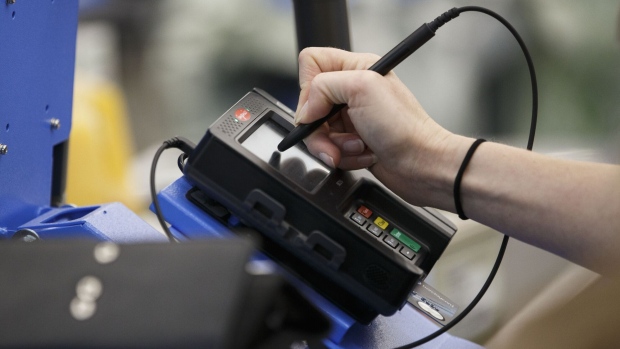
A customer signs for a purchase with a Barclaycard MasterCard Inc. chip credit card at a Wal-Mart Stores Inc. location in Burbank, California, U.S., on Tuesday, Nov. 22, 2016. Patrick T. Fallon/Bloomberg

Trains aren’t the only place Canada lags on high-speed rail, as the effort to bring in a faster payment system, known as the Real-Time Rail, is years behind schedule. 

As an example, if you paid a bill online on the Thursday evening before the Easter long weekend, the payment might not be processed until Monday. 

A modernized system would mean payments go through near-instantly, 24 hours a day, bringing along billions of dollars of benefits, according to an estimate from the C.D. Howe Institute.

Getting the new system up and running will be the highest-profile task of the next CEO of Payments Canada as Tracey Black, who has run the organization since 2018, officially stepped down at the end of her term Monday. 

Payments Canada CFO Kristina Logue and chief delivery officer Jude Pinto have been named co-CEOs on an interim basis until a successor is named.

The organization, founded by Parliament but funded by industry, owns and operates Canada's payment systems, last year clearing and settling over $112 trillion. 

This report by The Canadian Press was first published March 28, 2024.


'Great start': here's what economists think of Canada's latest economic data

Economists say Canada’s latest economic data shows the country is surprisingly strong, as it catches tailwinds from growth in the United States.

On Thursday, Statistics Canada released preliminary data that shows Canada’s gross domestic product (GDP) grew 0.4 per cent in February, signifying the strongest growth since 2022 when coupled with January’s growth of 0.6 per cent. 

Additionally, annualized numbers for the first quarter – assuming a flat March – would be 3.5 per cent, compared to just one per cent in the fourth quarter of 2023.

 Sal Guatieri, director and senior economist at BMO Capital Markets, called the data a “great start to the year.”

“(It’s a) much better start to the year than anyone anticipated and even stronger than (Statistics) Canada initially thought because they were calling the 0.4 per cent growth in their flash estimates,” he told BNN Bloomberg in a television interview on Thursday.

“Overall though it's a better-than-expected number. It does set the stage for a further strengthening (of) the Canadian GDP in the first quarter. We were calling for 1.5 per cent annualized rate, (we) might need to bump that up a little bit.”

Guatieri pointed to the strong U.S. economy, the end of a public workers strike in Quebec – which reached a deal in January – and Canada’s robust immigration for economic gains in the months of 2024.

“Pretty tough for your economy not to grow -- even at a decent rate -- when the population is growing the fastest in over six decades, at upwards of a three-per-cent rate,” he said.

“The U.S. economy grew more than three per cent annually in the fourth quarter, so that's giving a nice boost to Canadian exports.”

James Orlando, director and senior economist with TD Economics, called the data “very positive,” but worries about how long the positivity will last.

“We saw the exact same thing happen in 2023 in the first quarter where growth was looking like it was going to be around three per cent, and then in the following quarters, we had lacklustre growth for the rest of the year,” he told BNN Bloomberg on Thursday.

“Our view is that this is nice. It means the bottom hasn't fallen out of the Canadian economy, but we don't think it's something that's really going to be something to write home about when it comes to how sustainable this is.”

Orlando said the economic pressure Canadians face, smaller investment in Canadian businesses, and the federal government’s recent crack down on immigration are reasons for his skepticism on long-term growth.

Jules Boudreau, senior economist at Mackenzie Investments, said the Quebec strike boosted the economic data but doesn’t explain all the strength we’re seeing.

“A chunk of that growth is an artificial rebound in education services and related industries following the conclusion of the Quebec public sector strike, but the recent strength is broad-based, reflects more than public sector dynamics,” he said in a statement.

What about interest rates?

When it comes to how Thursday’s figures impact how the Bank of Canada might think about cutting interest rates, Guatieri said he is keeping to his earlier prediction.

“We're still looking for the bank to begin cutting interest rates in June of this year and they could cut rates by a whole 100 basis points later this year, but the risk is probably on the side of a delay if we continue to see better economic data out of Canada and out of the U.S.,” he said.

Guatieri said the strength in the U.S. economy is keeping Canada above expectations, which underpins the Bank of Canada’s plan to wait before cutting this summer.

“We do see some rebounding consumer spending and maybe hopefully business investment, which has actually been shrinking for the past year. That could lead to a much stronger economic growth this year for the Bank of Canada,” he said.

“That would be another reason to remain very patient before cutting interest rates.”

Boudreau is also maintaining his rate-cut projections in light of Friday’s data.

“GDP is backwards-looking and a poor measure of the direction of the economy in the short term, so this encouraging print probably won’t influence the Bank of Canada’s rate decisions,” he said. “We still expect the Bank to cut in the first half of 2024, but recent data indicates that the recent economic stagnation in Canada isn’t transitioning to an outright recession.”

Boudreau also believes Canada won’t see an uptick in construction projects until the Bank of Canada decides to cut rates.

“It’s hard to see a path to construction rebounding that doesn’t include a Bank of Canada rate cut or two, especially with the recent news that the federal government will be curtailing non-permanent resident immigration,” he said.

For months, economists have pointed to a June date for the start of cuts, but Orlando said the latest data is giving some of them pause.

“The recent economic data we've gotten shows the bottom isn't falling out, but it doesn't show that we're probably going to be accelerating into the future,” he said.

“(It) probably just means that the Bank of Canada has optionality with respect to when it can actually decide to cut interest rates and so that's why you're seeing people move from June towards July.”

With files from Bloomberg News


Canada likely to avoid recession, begin recovering in second half of 2024: Deloitte


Canada looks set to dodge a recession despite the ongoing downward pressure from higher interest rates, Deloitte Canada said in its economic outlook report. 

A number of worrisome trends are still weighing on the economy, Deloitte said, including sticky inflation, rising business insolvencies and increasing mortgage delinquencies. 

"Against this backdrop, we remain cautious about the near-term outlook," the firm said in its report. 

"But based on its current trajectory, Canada appears likely to skirt a recession and even seems poised to begin recovering from its current slump in the second half of this year."

In an effort to fight breakneck inflation, the Bank of Canada raised the country's key interest rate from near zero in March 2022 to the current five per cent with a series of hikes.

Inflation has cooled significantly since then, and Deloitte says the central bank is poised to start cutting interest rates in June. Most economists are expecting cuts to begin in either June or July.

Despite these positive signs, Canada's economy is likely to remain "stuck in neutral" in 2024, Deloitte said, particularly in the first half of the year, with real GDP growth coming in at around one per cent this year before reaching 2.9 per cent in 2025. 

Some of the assumptions underpinning Deloitte's forecasts include robust GDP growth in the U.S., a continued softening of inflationary pressures, cuts from the Bank of Canada and a steady flow of newcomers to the country, supporting demand.

Statistics Canada reported on Thursday that Canada's GDP rose 0.6 per cent in January, with a preliminary estimate of 0.4 per cent growth in February.

The economic recovery is contingent on interest rate cuts, the report said, which themselves depend on inflation continuing to moderate. 

"The good news is that measures to cool inflation have made significant progress," the report stated.

"That being said, the factors that are keeping inflation elevated are not likely to reverse in the near term."

The biggest headwind is the cost of housing, Deloitte said, as Canadians continue to renew mortgages at higher rates. Higher shelter costs are also being felt by renters.

"Further, wage pressures continue to run well above inflation without any commensurate increase in productivity, and that is driving up unit labour costs for businesses and making it difficult to contain inflation," the report said. 

The labour market continues to hold up remarkably well, Deloitte said, though it predicts employment gains will slow sharply in 2024.

Household spending will remain modest over the first half of the year, Deloitte said, as consumers continue to grapple with the higher cost of living. 

"Next year should be much better as interest rates come down, the economy picks up, and pent-up demand is unleashed," the report said. 

Deloitte's report notes that business investment is falling at a "worrying pace" and elevated interest rates will likely limit the recovery in that area this year.

High rates are weakening the economy and eroding business confidence, the report said: "To cope with softer demand and tighter credit conditions, businesses are increasingly delaying their investment plans, focusing more on maintenance and repair rather than expanding operations."

Unlike in Canada, the U.S. economy has remained much stronger under the weight of interest rate hikes, though the country's central bank is also expected to begin cutting rates toward the back half of the year. 

Deloitte said it expects the U.S. economy's strength to somewhat moderate in the coming months but remain positive, posting real growth of 2.4 per cent in 2024 and 1.4 per cent in 2025. 

This report by The Canadian Press was first published April 1, 2024.


Carbon pricing 101: What today's increase could mean for you

The national price on pollution will rise by $15 per tonne today. Here's some questions answered about what this could mean for you.

Who pays the carbon price?

Canada has two different carbon pricing programs — one for big industry where companies pay the price on a share of their actual emissions, and a consumer carbon levy which is applied to fossil fuel purchases. The consumer levy affects individuals, small and medium-sized businesses, First Nations, as well as public-sector operations such as hospitals, universities, schools and municipalities.

The price change on April 1 affects the consumer levy, which applies in every province and territory except British Columbia, Quebec and Northwest Territories.

B.C. and Northwest Territories both have their own, very similar carbon charge for consumers. Quebec has a cap-and-trade system that is quite different, but is considered equivalent by Ottawa to what the federal price both costs and cuts in terms of emissions.

What is the consumer carbon levy applied to?

The fuel charge is added to the price of more than 20 different fuel sources that produce greenhouse gas emissions when burned for energy, including gasoline, propane, diesel and natural gas. The additional cost to each fuel depends on how many greenhouse gases are produced when that fuel is burned to make energy.

A litre of diesel produces more carbon dioxide than a litre of gasoline, for example, so the carbon price is higher on a litre of diesel than it is on gasoline.

What is this increase going to do to the price of fuel?

The impact will be similar in all provinces but Quebec.

Gasoline: Going from $65 per tonne to $80, means the carbon price on a litre of gasoline will now be 17.6 cents per litre, up 3.3 cents per litre from before. That means filling a 50 litre tank from empty will cost about $8.80 in carbon price, about $1.65 more than before. 

Diesel: As of today the price for a litre of diesel will include 21.39 cents in carbon price, up from 17.38 cents.

Propane: The price for propane will now include 12.38 cents a litre in carbon price, up from 10.08 cents. A standard 20-pound barbecue propane tank will cost about $2.20 in carbon price to fill, compared with $1.78 over the last year.

Natural gas: On average in Canada, households use about 2,280 cubic metres of natural gas in a year, mostly for heat. At $80 per tonne, the carbon price will add 15.3 cents to a cubic metre of natural gas, up from 12.4 cents previously. That amounts to an annual carbon price bill for natural gas of about $347 on average, compared with $282 over the last year.

Food and clothing and other goods: There are indirect costs of carbon pricing, as companies that pay the price themselves increase the cost of their goods and services to keep pace. The amounts vary by industry, but Statistics Canada estimated that carbon pricing increased the price of food by about 0.3 per cent and the price of clothes by two per cent since its inception. The effect of the latest increase has yet to be determined.

How much will the Canada Carbon Rebate help? 

The provinces that pay the federal carbon price also receive the federal rebate. B.C. and Northwest Territories in turn provide their own rebates that are slightly different. 

B.C.'s rebate, for example, is income based, and about one-third of all households in the province don't qualify for it.

The federal rebate, which is deposited or mailed out four times a year, is divided among households based on family size, not by income. Each year Environment and Climate Change Canada calculates the expected revenues from carbon pricing in each province, and by law has to return 90 per cent of those revenues in rebates. Part of the remaining 10 per cent goes to increase rural resident rebates by 20 per cent. Some of the rest is earmarked to help businesses become more fuel efficient, but those programs have been very slow to roll out. Most businesses haven't received anything in the five years since carbon pricing began.

The rebates increase as the price increases, however this year many households in the Atlantic provinces won't see an increase. That's because almost one-third of households in those provinces use heating oil and since October have been exempted from paying the carbon price. That reduction is reflected in the rebate amounts.

The rebates vary because carbon pricing totals vary based on things like heating use and driving distances. Alberta and Saskatchewan, for example, typically use more natural gas for heat per households than in Ontario or Manitoba.

The next rebate payment is due on April 15. Here are the quarterly amounts, by province, for an individual, a couple, and a family of four. In a single parent households, the first child is treated the same as a spouse for the rebate amount.

Rural residents, who tend to drive longer distance, are to receive 20 per cent more.

Yukon and Nunavut pay the federal carbon price but have their own unique rebate programs.

Alberta: 

Single: $225 Couple: $337.50 Family of four: $450

Saskatchewan: 

Single: $188 Couple: $282 Family of four: $376

Manitoba:

Single: $150 Couple: $225 Family of four: $300

Ontario:

Single: $140 Couple: $210 Family of four: $280

New Brunswick:

Single: $95 Couple: $142.50 Family of four: $190

Nova Scotia:

Single: $103 Couple: $154.50 Family of four: $206

Prince Edward Island:

Single: $110 Couple: $165 Family of four: $220*

*All households in P.E.I. are considered rural and the rebates for all include the 20 per cent top up.

Newfoundland and Labrador:

Single: $149 Couple: $223.50 Family of four: $298

 This report by The Canadian Press was first published April 1, 2024.