Tuesday, October 08, 2024

Siberian burial site with 18 sacrificed horses may reveal mysterious origin of ancient warrior culture

Vishwam Sankaran
THE INDPENDENT
Tue 8 October 2024 


Siberian burial site with 18 sacrificed horses may reveal mysterious origin of ancient warrior culture


A 2,800-year-old Siberian burial mound containing 18 sacrificed horses appears to resemble those of the Scythians, suggesting that horseriding Steppe culture originated farther to the east.

The nomadic Scythians of the Eurasian Steppes did not build settlements and were famous for their horse-focused culture and distinctive art depicting animals in specific poses. They were exceptional horsemen and warriors, and feared adversaries of the ancient Greeks, Assyrians, and Persians between 900 and 200BC.

While the Scythians are known to have migrated from Central Asia to southwest Russia and Ukraine, their exact origins remain shrouded in mystery.


“The Scythians have sparked the imaginations of people since the days of Greek historian Herodotus,” said anthropologist Gino Caspari from the Max Planck Institute in Germany.

“But the origins of their culture have long remained hidden in remote corners of the Eurasian steppes.”
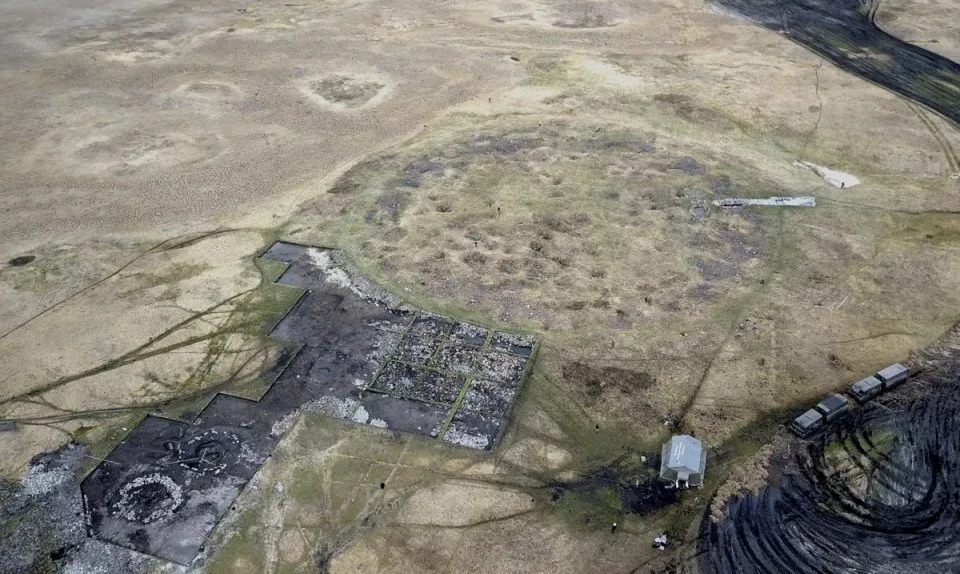
Overview of one of the earliest and largest burial mounds in the Eurasian steppes (Trevor Wallace)

A new study, published in the journal Antiquity on Tuesday, details one of the earliest examples of a royal burial mound unearthed in southern Siberian. It contains fragmented remains of a woman and 18 horses. They were likely sacrificed to honour a member of the elite buried within the mound, the study notes.

Some of the animal remains still have brass bits lodged between the teeth.

The grave also contains Scythian artefacts and horseriding equipment.

The findings link the burial in Siberia to the funerary rituals of the later Scythians, described in historical texts as living thousands of kilometres to the west .

The grave dates from the late ninth century BC, making it one of the oldest known burial mounds to show evidence of a Scythian burial.

“Unearthing some of the earliest evidence of a unique cultural phenomenon is a privilege and a childhood dream come true,” Dr Caspari said.
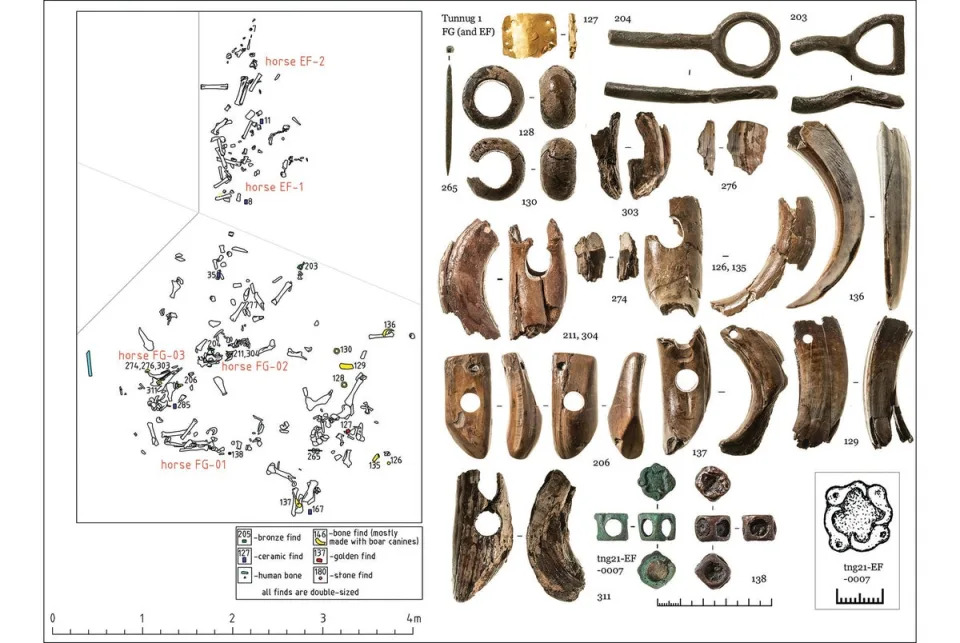

Finds from the burial site in southern Siberia (Antiquity)

Archeologists say that the burial has similarities with graves from the Late Bronze Age in Mongolia. This suggests that Scythians funerary rituals could originate even further east and south.

“Our findings highlight the importance of Inner Asia in the development of transcontinental cultural connections,” Dr Caspari said.

“The findings also suggest that these funerary practices played a role in the broader process of cultural and political transformation across Eurasia, contributing to the emergence of later pastoralist empires.”
SPACE-COSMOS

Nasa spacecraft receives laser signal from 290 million miles away

Andrew Griffin
Mon 7 October 2024 

NASA’s Psyche spacecraft is depicted receiving a laser signal from the Deep Space Optical Communications uplink ground station at JPL’s Table Mountain Facility in this artist’s concept (NASA/JPL-Caltech)

Nasa has successfully sent a laser signal about 290 million miles, smashing previous records and potentially transforming our exploration of the solar system.

The milestone was reached by Nasa’s Deep Space Optical Communications technology demonstration, which is exploring whether it is possible to use lasers to send messages deep into space. Lasers can send data at rates up to 100 times that of the radio frequencies used today, allowing for more complex and high-definition data, but they also require much greater precision to work.

It was sent to the Psyche spacecraft, which launched in October 2023. Its main mission is to study an asteroid with the same name, but it is also carrying the Nasa experiment to test laser communication through space.

The distance – which equates to about 460 million kilometres – is roughly the same as that between the Earth and Mars when they are their most distant.

Nasa hopes that the laser technology can help empower future crewed missions to Mars, among other exploration of our solar system, and so the successful test marks a major breakthrough.

“The milestone is significant. Laser communication requires a very high level of precision, and before we launched with Psyche, we didn’t know how much performance degradation we would see at our farthest distances,” said Meera Srinivasan, the project’s operations lead at NASA’s Jet Propulsion Laboratory, in a statement.

“Now the techniques we use to track and point have been verified, confirming that optical communications can be a robust and transformative way to explore the solar system.”

Nasa administrator Bill Nelson sent his congratulations to the team involved, on Twitter/X. “This extraordinary achievement will transform the way we explore the solar system,” he wrote.

Late last year, Nasa announced that it had successfully completed one such transmission from 10 million miles away. In the time since, it has broken through a whole set of records as Psyche continues to travel further from Earth.

That also included the first ultra high-definition video beamed from space. That happened late last year – when Psyche sent pictures of a cat named Taters.

As the distance from Earth increases, the speed of the connection is reduced. When it was 33 miles away, the spacecraft could receive data at its maximum rate of 267 megabits per second – but when the latest record was broken, in summer, it was hitting maximums of only 8.3 megabits per second.


Something Massive Is Shifting Deep Inside the Moon

Maggie Harrison Dupré
FUTURISM
Mon 7 October 2024 


Moon Goo
Something is moving inside of the Moon. Yes, you read that correctly.

recent study from scientists at NASA and the University of Arizona found that a layer of low-viscosity goo sits between the Moon's rugged mantle and its metal core. This goo is rising and falling beneath the lunar surface — not unlike, say, ocean tides — which they concluded is likely caused by the gravitational push and pull of the Sun and Earth.

"Just like the Moon raises tides on the Earth, the Earth (and Sun) raise tides on the Moon," reads the study, published last month in the journal AGU Advances. The researchers describe their findings as the "first measurement of the Moon's yearly gravity changes due to tides."

It's a fascinating discovery that works to confirm decades-old theories about the makeup of Earth's only natural satellite — while raising some mysterious new questions, too. After all, how did the magma-like layer get there in the first place? What's its exact composition? And perhaps most crucially, what's keeping it hot enough to stay in its malleable, goo-like form?
Profound Implications

For their study, the scientists analyzed new data from NASA's Gravity Recovery and Interior Laboratory (GRAIL) and Lunar Reconnaissance Orbiter — which were deployed to (respectively) collect gravitational information and conduct more generalized lunar surveillance — to measure monthly and annual tidal movements on the Moon for the first time.

What they found, they argue in the research, could only be consistent with the existence of a deeper, "partial melt" beneath the Moon's rocky mantle, itself comprised of magnesium-iron silicate mineral and pyroxene.

"Only models with a softer layer at the bottom of the mantle match all our measurements," reads the study.

But again, this finding yields an important new question. As the scientists wrote, "such a soft layer, often thought to be partial melt, needs to be maintained." In other words, there's gotta be a reason why this semi-molten layer remains warm and pliable enough to move around.

As you can tell, there are still plenty of known unknowns where lunar inner workings are concerned — but if nothing else, this research has the texture of the kind that opens the door to further revelations in lunar geology. And that's to say nothing of the present: Today, we know just a little bit more about Earth's smaller, cosmic companion than we did before.

Or as the scientists who authored the study wrote: "The existence of this zone has profound implications for the Moon's thermal state and evolution."

More on Moon goo: Scientists Detect Huge Caverns Under Surface of Moon
VW CEO: Chinese automakers should be allowed to avert tariffs by investing in EU
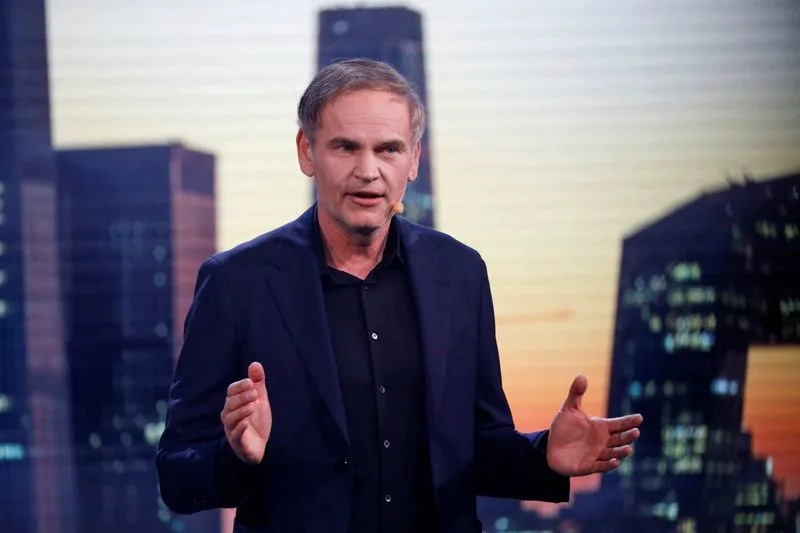
Volkswagen CEO Oliver Blume in Beijing · Reuters


Reuters
Sat, October 5, 2024 

FRANKFURT (Reuters) - The CEO of German carmaker Volkswagen said the European Union should consider adjusting planned tariffs against China-made electric vehicles to make allowances for investments made in Europe.

"Instead of punitive tariffs this should be about mutually giving credit for investments. Those who invest, create jobs and work with local companies should benefit when it comes to tariffs," VW CEO Oliver Blume told Sunday paper Bild am Sonntag an interview.

The European Union will press ahead with tariffs on China-made electric vehicles, the EU executive said on Friday, even after the bloc's largest economy Germany and German carmakers rejected them, exposing a rift over its biggest trade row with Beijing in a decade.

The proposed duties on EVs built in China of up to 45% would cost carmakers billions of extra dollars to bring cars into the bloc and are set to be imposed from next month for five years.

The Commission, which oversees the bloc's trade policy, has said they would counter what it sees as unfair Chinese subsidies after a year-long anti-subsidy investigation, but it also said on Friday it would continue talks with Beijing.

VW's Blume told Bild am Sonntag that there was a risk that retaliatory tariffs by China would hurt European carmakers.

(Reporting by Ludwig Burger, editing by Franklin Paul)
Romania's top court removes far-right candidate from presidential race

Reuters
Sun, October 6, 2024 

Von der Leyen seeks approval from EU lawmakers for another term as European Commission President


BUCHAREST (Reuters) - Romania's top court has removed a pro-Russian far-right politician from the list of presidential candidates in upcoming elections, prompting concerns about democratic values from candidates across the political spectrum.

European Union and NATO member Romania is due to hold a two-round presidential election on Nov. 24 and Dec. 8, with parliamentary polls in between.

Nearly 20 politicians have officially entered the running, with opinion polls showing voter preferences highly fragmented.


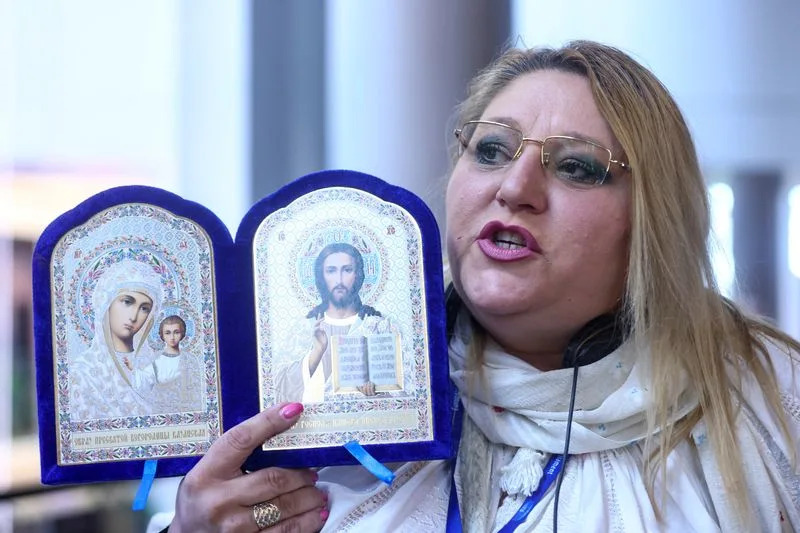
Among them is Diana Sosoaca, leader of SOS Romania, a small ultra-nationalist eurosceptic opposition party which surprisingly won two seats in the European Parliament in June.

Romania's Constitutional Court met on Saturday to discuss legal challenges brought against six candidacies.

It rejected five but accepted challenges against Sosoaca without explaining its decision.

Sosoaca, who was live on Facebook at the time of the ruling, told her followers: "This proves the Americans, Jews and the European Union have plotted to rig the Romanian election before it has begun."

"From this moment, we have clear proof that in Romania dictatorship and utter lack of democracy are being discussed."

The court typically releases detailed explanations of its rulings at a later date. Politicians across the political spectrum said the ruling was an unprecedented threat to democratic values.

Because the nine-member court is politically appointed, many politicians also accused it of interference.

Opinion surveys show leftist Social Democrat Prime Minister Marcel Ciolacu is likely to go through to the second round of the presidential election, but it is unclear who he will run against.

Although the role is largely ceremonial, the president's powers include nominating the prime minister after elections and appointing judges and prosecutors. They also include oversight of foreign policy, meaning the new president will play a critical role in Romania's commitment to supporting Ukraine.

(Reporting by Luiza Ilie; editing by Giles Elgood)
'God save the Tsar!': Putin hailed in Russia on 72nd birthday


Updated Mon, October 7, 2024 

By Guy Faulconbridge

MOSCOW (Reuters) -President Vladimir Putin was hailed a 'tsar' on his 72nd birthday on Monday by some supporters who said the former KGB spy had raised Russia up from its knees and would deliver victory against the West in the Ukraine war.

Putin, who took the Kremlin's top job just eight years after the 1991 fall of the Soviet Union, is the longest serving Kremlin leader since Josef Stalin who died at his dacha outside Moscow in 1953 aged 74.

Cast by Western leaders as an autocrat, killer and war criminal, Putin has seen his popularity rise inside Russia since he ordered thousands of troops into Ukraine in February 2022, according to Russian opinion polls.

"God save the Tsar!," wrote ultra-nationalist Russian ideologue Alexander Dugin, who has long advocated the unification of Russian-speaking and other territories in a vast new Russian empire which he says must include Ukraine.

"Putin rules the country confidently and unhurriedly. And it shall always be so - well, almost," Dugin added in his birthday greeting, posted on his Telegram messaging channel minutes after midnight.

Unlike most of Russia's historical leaders, Putin has no visible successor. He also has no serious rivals, according to multiple Russian sources.

He is now locked into what Russian officials say is the gravest confrontation with the West - whose combined economies are at least 20 times bigger than Russia's - since the depths of the Cold War.

Opponents say early setbacks in the invasion illustrated Russia's weakness, though U.S. generals say Moscow quickly learned from its failures and has adapted to the demands of the biggest land war in Europe since World War Two.

Russia, like Ukraine, has suffered huge losses of men in the war, and in 2023, Putin faced a failed mutiny by Yevgeny Prigozhin, leader of the mercenary Wagner group. Prigozhin's plane crashed two months to the day since the mutiny.

WAR LEADER

Putin, born in Leningrad just seven years after World War Two, has promised Russians victory in the Ukraine war, which he casts as a proxy conflict between holy Russia and an arrogant West which he says humiliated Russia as the Soviet Union crumbled.

As the West stepped up its support for Ukraine with hundreds of billions of dollars in pledged aid, Putin doubled down on his bet on war and used the West's reaction to depict the conflict as an existential battle for Russia's future.

According to a report published on Monday by Moscow-based Minchenko Consulting, Russians are increasingly seeing Putin as a figure who has managed to transform the global order, to their benefit.

"In domestic politics, Vladimir Putin every year acquires completely new features of the archetypal image of the Creator, who creates a new world order in which Russia will have a completely new role," Minchenko Consulting said.

Western leaders have repeatedly said that Putin cannot be allowed to win the war, and that if he does, the West's enemies will be emboldened and Putin might try attacking a NATO member, an assertion that Putin has repeatedly dismissed.

Russian forces are advancing in Ukraine and Putin has hiked defence spending to Cold War levels.

Currently, Russia controls a little under one fifth of Ukraine - including Crimea which it annexed in 2014, about 80% of Donbas in eastern Ukraine, about 71% of the Kherson region and 72% of Zaporizhzhia region.

Opponents have either left Russia, died or are silent. Russia's opposition, almost all abroad, are divided and have failed to find a new leader since the death of Alexei Navalny in an Arctic prison in February.

Navalny described Putin's Russia as a brittle criminal state run by thieves, sycophants and spies who care only about money. He had long forecast Russia could face seismic political turmoil, including revolution.

"With Putin, we shall be victorious," Vyacheslav Volodin, the speaker of the Russian parliament, said on Monday. "A strong president is a strong Russia."

(Writing by Guy Faulconbridge; Editing by Lincoln Feast and Andrew Heavens)
Japan prosecutors won't appeal Hakamada death row acquittal: media

Agence France-Presse
October 8, 2024


Iwao Hakamada (L) is the fifth death row inmate granted a retrial in Japan's post-war history (STR/JIJI PRESS/AFP)

Japanese prosecutors have decided not to appeal against last month's acquittal of the world's longest-serving death row prisoner, Iwao Hakamada, local media reported Tuesday.

After a long fight for justice led by his sister, a court declared on September 27 that Hakamada, 88, was innocent of the quadruple murder for which he spent 46 years waiting to be executed.

The regional tribunal ruled that investigators had tampered with evidence and said the ex-boxer had suffered "inhumane interrogations meant to force a statement".

He was first convicted in 1968 of robbing and killing his boss, the man's wife and their two teenage children.

A retrial was granted in 2014 and Hakamada was released from prison, although legal wrangling meant the proceedings only began last year.

Japanese media, including broadcaster NHK and Kyodo News, reported that prosecutors had decided not to appeal against the latest ruling, paving the way for it to be finalized.

The office of the public prosecutor declined to comment when contacted by AFP. A supporters group for Hakamada said they had no first-hand confirmation.

Japan and the United States are the only two major industrialized countries that still use capital punishment. It has strong public support in Japan, where scrapping it is rarely discussed.

Hakamada is the fifth death row inmate granted a retrial in Japan's post-war history. All four previous cases also resulted in exonerations.

Japan's last execution took place in July 2022, of a man who killed seven in a truck-ramming and stabbing rampage in Tokyo's popular Akihabara electronics district in 2008.

© Agence France-Presse


Kenya's deputy president faces impeachment vote

Agence France-Presse
October 8, 2024

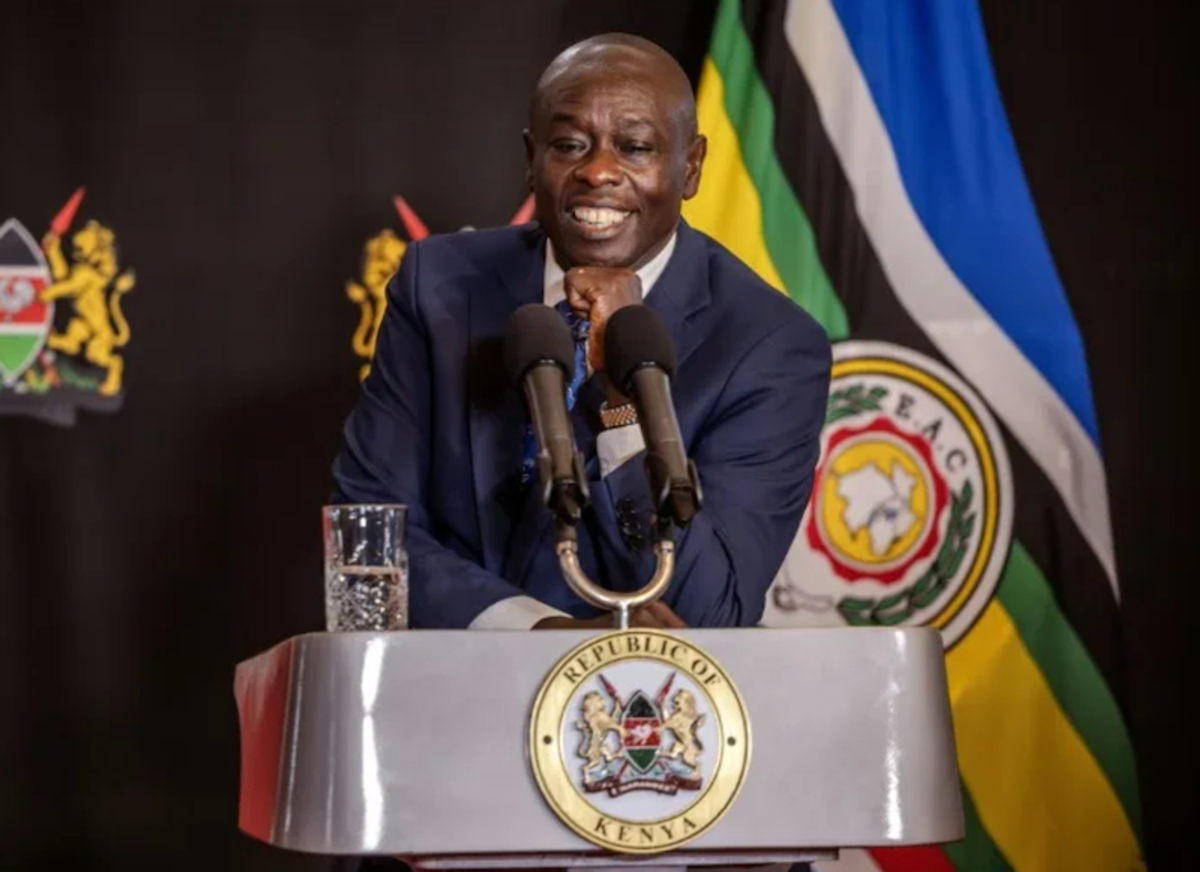
Deputy President Rigathi Gachagu (LUIS TATO/AFP)

Kenya's parliament was set to vote on Tuesday on impeaching Deputy President Rigathi Gachagua in a political drama that has exposed a rift in the governing party.

Lawmakers have accused the 59-year-old deputy to President William Ruto of corruption, undermining the government and practising ethnically divisive politics, among a host of other charges.

At a press conference on Monday, Gachagua denied the accusations as "outrageous" and "sheer propaganda", saying it was a scheme to hound him out of office.

Gachagua is a businessman from Kenya's biggest tribe, the Kikuyu. He weathered previous corruption scandals to become deputy leader as Ruto's running mate in a closely fought election in August 2022.

But in recent weeks, he has complained of being sidelined by his boss and been accused of supporting youth-led anti-government protests that broke out in June.

Political tensions have been running high since the sometimes deadly demonstrations erupted over unpopular tax hikes, exposing divisions between Gachagua and Ruto.

Several MPs allied with Gachagua were summoned by police last month, accused of funding the protests.

No formal charges have been lodged by prosecutors and no judicial inquiry has been opened against Gachagua.

But lawmakers have listed 11 grounds for impeachment, including accusations that he amassed assets worth 5.2 billion shillings ($40 million) since the last election, despite an annual salary of just $93,000.

Among the listed assets was Kenya's renowned Treetops Hotel, where Britain's then-Princess Elizabeth was staying when she became queen.

Gachagua says his wealth has come entirely through legitimate business deals and an inheritance from his late brother.

He has warned his removal would stir discontent among his supporters.

Kenyan lawmakers initiated the impeachment process on October 1, with 291 members of parliament backing the motion, well beyond the 117 minimum required.

Two-thirds of the lower house, the National Assembly, must back the motion for it to pass on Tuesday. It would then move to the upper house, the Senate.

If impeached, Gachagua would become the first deputy president to be removed in this way since the possibility was introduced in Kenya's revised 2010 constitution.
From Bolivia to Indonesia, deforestation continues apace

Agence France-Presse
October 8, 2024 

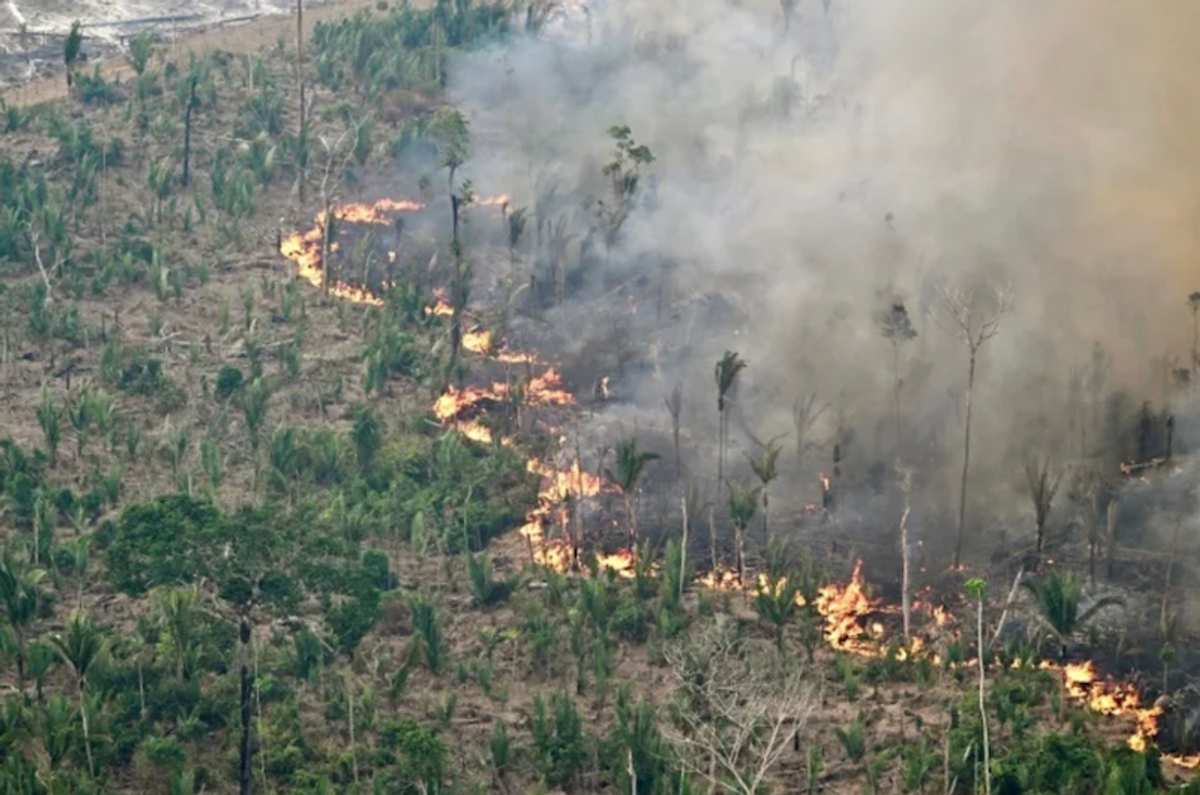
Amazon rainforest being destroyed by illegal fires in Labrea, Brazil in August
 (EVARISTO SA/AFP)

Deforestation continued last year at a rate far beyond pledges to end the practice by 2030, according to a major study published Tuesday.

Forests nearly the size of Ireland were lost in 2023, according to two dozen research organizations, NGOs and advocacy groups, with 6.37 million hectares (15.7 million acres) of trees felled and burned.

This "significantly exceeded" levels that would have kept the world on track to eliminate deforestation by the end of the decade, a commitment made in 2021 by more than 140 leaders.

Forests are home to 80 percent of the world's terrestrial plant and animal species and crucial for regulating water cycles and sequestering CO2, the main greenhouse gas responsible for global warming.

"Globally, deforestation has gotten worse, not better, since the beginning of the decade," said Ivan Palmegiani, a biodiversity and land use consultant at Climate Focus and lead author of the "Forest Declaration Assessment" report.

"We're only six years away from a critical global deadline to end deforestation, and forests continue to be chopped down, degraded, and set ablaze at alarming rates."


In 2023, 3.7 million hectares of tropical primary forest -- particularly carbon rich and ecologically biodiverse environments -- disappeared, a figure that should have fallen significantly to meet the 2030 objective.

- Soya and nickel -

In high-risk regions, researchers pointed to backsliding in Bolivia and in Indonesia.


The report said there was an "alarming rise" in deforestation in Bolivia, which jumped 351 percent between 2015 and 2023.

The "trend shows no sign of abating", it added, with forests largely cleared for agriculture, notably for soya but also beef and sugar.

In Indonesia, deforestation slumped between 2020-2022 but started rising sharply last year.


Ironically, that is partly down to demand for materials often seen as eco-friendly, such as viscose for clothing, and a surge in nickel mining for electric vehicle batteries and renewable energy technologies.

There was better news from Brazil.

While it remains the country with the highest deforestation rates in the world, it has made key progress.


The situation has significantly improved in the Amazon, which has benefited from protective measures put in place by President Luiz Inacio Lula da Silva.

However, in the Cerrado, a key tropical savannah below the Amazon, deforestation has increased.

- Degraded forests -


The report also highlights the role of logging, road building and fires in forest degradation, when land is damaged but not razed entirely.

In 2022, the last year data was available, a forest area twice the size of Germany was degraded.

Erin Matson, senior consultant at Climate Focus, and co-author of the report, said "strong policies and strong enforcement" were needed.

"To meet global forest protection targets, we must make forest protection immune to political and economic whims," she said.

The report comes in the wake of the European Commission's proposal last week to postpone by a year (to the end of 2025) the entry into force of its anti-deforestation law, despite protests from NGOs.

"We have to fundamentally rethink our relationship with consumption and our models of production to shift away from a reliance on over exploiting natural resources," said Matson.
As election looms, 3 of 4 voters fear political violence
 Common Dreams
October 8, 2024 

Man holds gun in front of US flag (Shutterstock.com)

Polling released Monday, less than a month away from the November 5 election, shows that nearly three-quarters of U.S. voters are worried about political violence and believe it is likely because some people will not accept the results.

The latest Civil Rights Monitor Poll, commissioned by the Leadership Conference on Civil and Human Rights, is based on responses from 1,000 likely voters across the country, who were surveyed September 3-8.

Pollsters found that "81% of voters believe that democracy is under threat, and 73% are worried about political violence after the elections in November," the conference said. "Liberals are much more worried (92%) about political violence than moderates and conservatives (68% and 63%, respectively)."

"We are... elevating Project 2025 as a blueprint to undermine the very values we see supported in three years of polling."

This year's presidential contest is between Democratic Vice President Kamala Harris and former Republican President Donald Trump, who during the 2020 cycle repeatedly lied about his loss and even incited some supporters to storm the U.S. Capitol during the certification of the results on January 6, 2021.

Although Trump has tried to disavow the Heritage Foundation-led Project 2025, previous polling has shown a majority of Americans believe the ex-president is aligned with its policy blueprint, which was crafted by at least 140 people who worked in the first Trump administration, including six former Cabinet secretaries.

"Project 2025 has become widely known (70% can identify it), and voters are broadly cold towards it (54% rate it 0-49 on a thermometer scale of 0-100)," according to the new poll. "Cuts to overtime pay (91%), cuts to Social Security (86%), and government monitoring of pregnancies (85%) are the components of the Project 2025 agenda that voters oppose the most."

The conference said that "among the most important issues for voters in the elections this year are inflation and the economy (42%, which is up eight points from the previous year), immigration and border security (33%), and protecting our democracy and freedoms (22%)."

Similar to last year, large majorities of respondents agreed that Americans are sacrificing too much of their privacy for Big Tech (86%); diversity makes the country stronger (79%); marriage equality should be protected (77%); the government must do more to protect the civil and human rights of communities of color (69%); abortion access should be a legally protected right (64%); and sexism is a big problem in today's society (63%).

Smaller majorities said that the government should do more to lessen racial inequality in society (59%); artificial intelligence is a threat to jobs (57%); immigrants contribute more to America than they take (57%); America is on the path to another Civil War (55%); and the respondent's heritage, traditions, and cultural identity is under attack (52%).

Additionally, the conference said, "white supremacy is an issue that most voters are worried about, with more than half of respondents (52%) stating they are more worried, including 65% of Black and 64% of Hispanic voters."

The poll also shows that "an astounding 93% of voters are extremely motivated to vote this November, up seven points from last year (86%)."

Maya Wiley, the conference's president and CEO, said in a Monday statement that "voters know what's at stake in this election."

"It's clear that in this presidential year voters want to vote even while they worry about political violence and know democracy is on the ballot," she continued. "This most recent poll shows that voters want to vote more than ever despite, or perhaps because, our democracy is threatened with the dark cloud of election denial and violence. In 2024, voters must know that they will decide the outcome of the election—not a political party, extremist groups, or purveyors of disinformation."

"The civil rights community is organized and actively working on voter education, get-out–the-vote efforts, election protection, and combating disinformation, and we are also elevating Project 2025 as a blueprint to undermine the very values we see supported in three years of polling," she added. "We will continue to combat racism, xenophobia, and efforts to divide us along race and immigration lines. Democracy requires passionate persistence, and our Civil Rights Monitor Poll reassures us that the majority of Americans agree."


Pastor wanted by U.S. for sex trafficking to run for Philippine senate

Agence France-Presse
October 8, 2024 

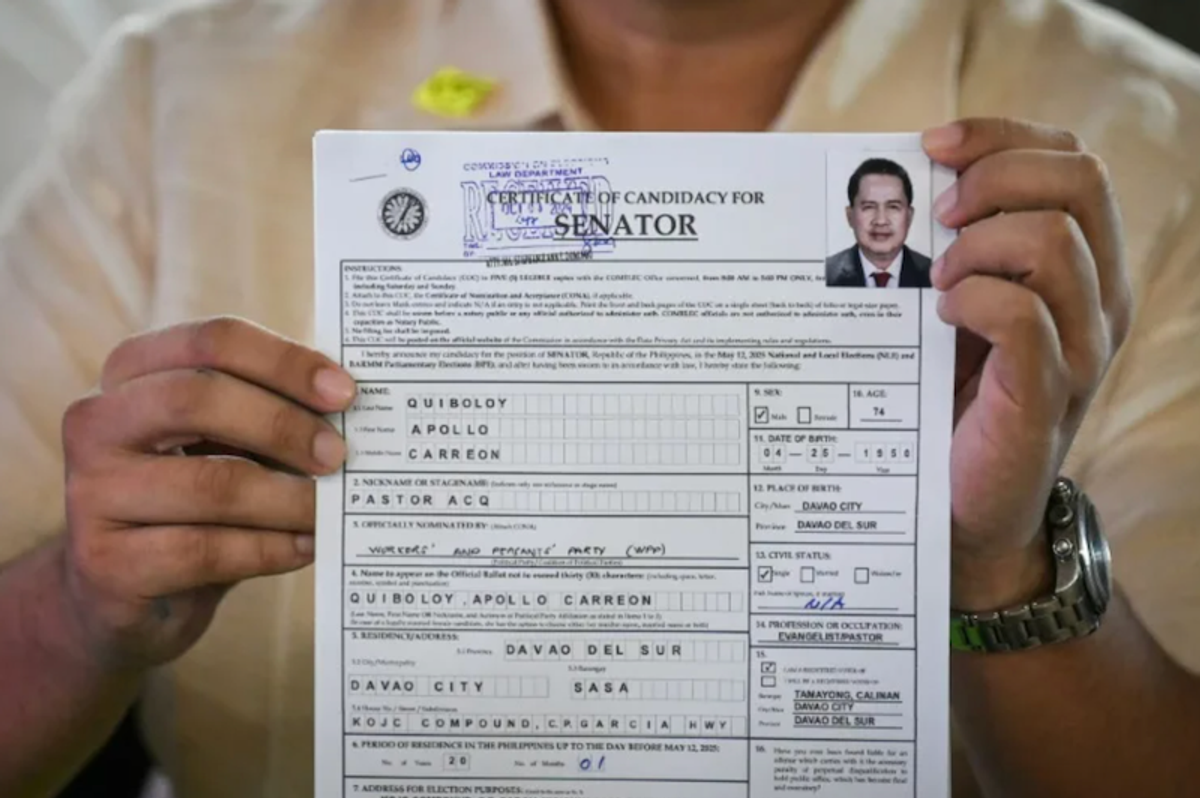
Apollo Quiboloy, a detained Philippine pastor also wanted in the United States for sex trafficking children, registered Tuesday to run in next year's senate elections (Jam Sta Rosa/AFP)

A detained Philippine pastor who is also wanted in the United States for sex trafficking children registered Tuesday to run in next year's senate elections.

Apollo Quiboloy, an ally of former president Rodrigo Duterte, is a self-proclaimed "Appointed Son of God" whose sect claims millions of followers.

The 74-year-old was arrested last month and is currently detained in Manila and facing charges of child abuse, sexual abuse and human trafficking. One of his lawyers filed his candidacy paperwork.

"He wants to be a part of the solution to the problems of our country. He is running because of God and our beloved Philippines," lawyer Mark Christopher Tolentino said.

Quiboloy pledges to promote laws that are "God-centered, Philippine-centred and Filipino-centred", Tolentino told journalists after submitting the candidacy papers to election officials.

The circumstances are not without precedent.

In May 2022, Jose "Jinggoy" Estrada won a senate seat while on trial for corruption. He took up the post and was acquitted in January.

Another was rights campaigner Leila de Lima, who spent the majority of her six-year senate term in prison after being detained in 2017 on drugs charges. She was cleared this year.

Candidates are only disqualified from standing in senate elections if they have exhausted all appeals after being convicted of offences involving "moral turpitude", according to the election code which does not list specific crimes.


Quiboloy was charged by the United States in 2021 with sex trafficking of girls and women to work as personal assistants, who were allegedly required to have sex with him during what they said was their "night duty".

He is also sought by U.S. authorities for bulk cash smuggling and a scheme that brought church members to the US through fraudulently obtained visas.

They were then forced to solicit donations for a bogus charity, raising funds that were instead used to finance church operations and the lavish lifestyles of its leaders, according to the FBI.


Twelve of the 24 senate seats are up for grabs in next year's midterm polls, along with more than 18,000 congressional and local government executive posts.