Tuesday, February 04, 2025


Bridging a gap in carbon removal strategies


Stanford Woods Institute for the Environment


As the world works to meet net-zero carbon goals, a new study offers a critical reminder: precision matters. The researchers suggest refining how we assess a natural carbon storage strategy to ensure the technology lives up to its potential as a climate change solution.


Biochar, a charcoal-like material derived from plant biomass, has long been hailed as a promising tool for carbon dioxide removal. However, a new study by Stanford researchers highlights a critical issue: current methods for assessing biochar's carbon storage potential may significantly undervalue its true environmental benefits. The paper, published in Environmental Research Letters points the way to more accurately evaluating biochar, and boosting its credibility as a climate change solution.


The research, supported by the Stanford Woods Institute for the Environment’s Environmental Ventures Program and Stanford’s Sustainability Accelerator, challenges conventional durability metrics and proposes a more nuanced framework for evaluating biochar projects. It grew out of an early project looking at soil’s ability to capture carbon dioxide.


“We realized that even though biochar is really important component of the carbon removals market, there is very little useful data on how it actually behaves,” said study coauthor Kate Maher, a professor of Earth system science in the Stanford Doerr School of Sustainability and a senior fellow at the Stanford Woods Institute for the Environment. “It is important for policymakers and buyers to be aware of this.”


Rethinking biochar durability

Biochar is the charcoal-like result of burning organic matter slowly with little oxygen. Its appeal lies in its ability to store carbon in soil for extended periods, preventing it from re-entering the atmosphere as a greenhouse gas. The durability of biochar—its resistance to decomposition—is a key factor in determining its effectiveness.


However, most biochar durability assessments rely on a single metric: the hydrogen-to-carbon ratio. This simple measure is thought to correlate with biochar’s stability in soil, but the Stanford study reveals that this approach might be too reductive. By reanalyzing the largest existing biochar durability dataset, the researchers uncovered that relying solely on hydrogen-to-carbon ratios ignores critical factors such as soil type, environmental conditions, and biochar feedstock variability. Without these factors, models often fail to predict real-world outcomes for carbon storage and benefits to soil health and crops.


“Biochar has immense potential for carbon dioxide removal, but it will be viewed as less valuable by the market until we can confidently establish and predict its long-term durability,” said study coauthor A.J. Ringsby, a chemical engineering Ph.D. student in the Stanford School of Engineering. “To get to a place where biochar stacks up against highly durable solutions like direct air capture, we need to move beyond one-size-fits-all metrics and do the ground work to develop more useful datasets.”


The study also found that current standards may underestimate the carbon storage potential of many biochar projects. Laboratory experiments, often the basis for durability assessments, are more tractable but often fail to accurately replicate real-world conditions. For instance, field studies show that factors like soil composition and local climate can drastically influence how biochar behaves once deployed.


Undervaluing biochar’s durability potentially leaves a substantial amount of carbon storage uncredited. This could create economic and policy challenges, especially as the demand for carbon offsets grows.


Towards a smarter future

To address these shortcomings, the researchers propose a two-step evaluation process: a preliminary estimate of biochar’s potential to remove carbon dioxide before deployment, followed by field measurements to refine these estimates over time. This approach, they argue, could unlock additional project value, improve data for predictive modeling, and enhance the credibility of biochar in carbon markets.


The study also underscores the need for coordinated global field trials to better understand how environmental variables influence biochar performance. These trials could inform new durability standards that account for real-world variability, paving the way for more accurate carbon crediting.


“Unlike most technologies in the market, biochar is shovel-ready and delivering carbon removal today,” Ringsby said. “To unlock its full potential, we need better data, stronger standards, and to work together as a community to design the right experiments.”


The study was also funded by the National Science Foundation.


Accelerating greenhouse gas removal

The researchers’ work to improve biochar durability assessments comes as part of an effort by the Sustainability Accelerator to enable removal of billions of tons of greenhouse gases annually from Earth’s atmosphere by mid-century. Learn more about how the Accelerator is speeding translation of Stanford research into technology and policy solutions to sustainability challenges.

Coal emissions cost India millions in crop damages


For Indian farmland within 62 miles of a coal plant, eliminating coal emissions could add $820 million annually in wheat and rice output


Stanford University


In many parts of India, a single noxious pollutant from coal-fired power stations drags down annual wheat and rice yields by 10% or more, according to a new study by Stanford Doerr School of Sustainability researchers.

The two grains are critical for food security in India, the second most populous country in the world and home to a quarter of all undernourished people globally

“We wanted to understand the impact of India’s coal electricity emissions on its agriculture because there might be real trade-offs between meeting growing electricity demand with coal generation and maintaining food security,” said Kirat Singh, a PhD student in environment and resources in the Doerr School of Sustainability and lead author of the Feb. 3 study in Proceedings of the National Academy of Sciences

Clean air and food security

Past studies have sought to quantify overlooked costs of burning coal for electricity by estimating the number of deaths linked to resulting pollution. Government agencies and other organizations use these figures – and estimates of the economic value of statistical life – to understand the costs and benefits of various economic development strategies and environmental regulations.

Until now, however, estimates of crop damages specifically tied to coal-fired power stations – which supply more than 70% of electricity in India – have been lacking despite more than a decade of research showing that air pollutants such as ozone, sulfur dioxide, and nitrogen dioxide hurt crop yields. 

“Crop productivity is incredibly important to India’s food security and economic prospects,” said senior study author David Lobell, the Benjamin M. Page Professor in the Doerr School of Sustainability’s Earth System Science Department. “We’ve known that improved air quality could help agriculture, but this study is the first to drill down to a specific sector and measure the potential benefits of reducing emissions.”

Crop damage concentrated in key regions and seasons

For the new study, the authors estimated rice and wheat crop losses linked to emissions of nitrogen dioxide, or NO2, from coal power stations. They used a statistical model that combines daily records of wind direction and electricity generation at 144 power stations in India and satellite-measured nitrogen dioxide levels over cropland. 

The authors found coal power plants affected NO2 concentrations above cropland up to 100 kilometers, or roughly 62 miles, away. Eliminating coal emissions from all farmland within this range during key growing seasons (January-February and September-October) could boost the value of rice output across India by approximately $420 million per year and of wheat output by $400 million per year, according to the study. 

“This study underscores the importance of looking at environmental issues under a systems lens,” said study co-author InĂªs Azevedo, a professor of energy science and engineering in the Doerr School of Sustainability. “Any policy focused on reducing emissions from coal power plants in India will be ignoring a crucial part of the problem if it does not consider the damages from air pollution to agriculture.”

In some states with high levels of coal-fired electricity generation, such as Chhattisgarh, coal emissions account for as much as 13-19% of the region’s nitrogen dioxide pollution, depending on the season. Elsewhere, like Uttar Pradesh, coal emissions contribute only about 3-5% of NO2 pollution. Other common sources of the gas, which results from burning fossil fuels, include vehicle exhaust and industry.

Broad benefits from emission cuts 

The analysis reveals that the value of lost crop output is almost always lower than the mortality damage caused by any given coal power station. But the intensity of crop damage per gigawatt-hour of electricity generated can often be higher. At 58 of the 144 power stations studied, rice damage per gigawatt-hour exceeded mortality damage. Wheat damage per gigawatt-hour exceeded mortality damage at 35 power stations. 

“It’s rare to find a single thing – in this case, reducing coal emissions – that would help agriculture so quickly and so much,” said Lobell, who is also the Gloria and Richard Kushel Director of Stanford’s Center on Food Security and the Environment.

The researchers found little overlap among the stations associated with the largest crop losses and those associated with the highest mortality. This means benefits from possible emission reductions in the future could be more significant and widely distributed than previously understood. According to the authors, the results highlight “the importance of considering crop losses alongside health impacts when regulating coal electricity emissions in India.” 

“Well-targeted policies to cut emissions could deliver thousands of dollars of increased crop output for each clean gigawatt-hour, in addition to all the climate and human health benefits,” said Singh.

Lobell is also the William Wrigley Senior Fellow at the Stanford Woods Institute for the Environment and a senior fellow at the Freeman Spogli Institute (FSI) and at the Stanford Institute for Economic Policy Research (SIEPR). 

Azevedo is also a professor (by courtesy) of civil and environmental engineering, a joint department of the Doerr School of Sustainability and Stanford School of Engineering. She is also a senior fellow at the Stanford Woods Institute for the Environment and at the Precourt Institute for Energy.

Migrant Sex Workers’ Resistance Offers a Blueprint for Fighting Authoritarianism

Hyper-criminalized migrant sex workers show us how everyday people evade, defy and resist state control and punishment.
February 4, 2025

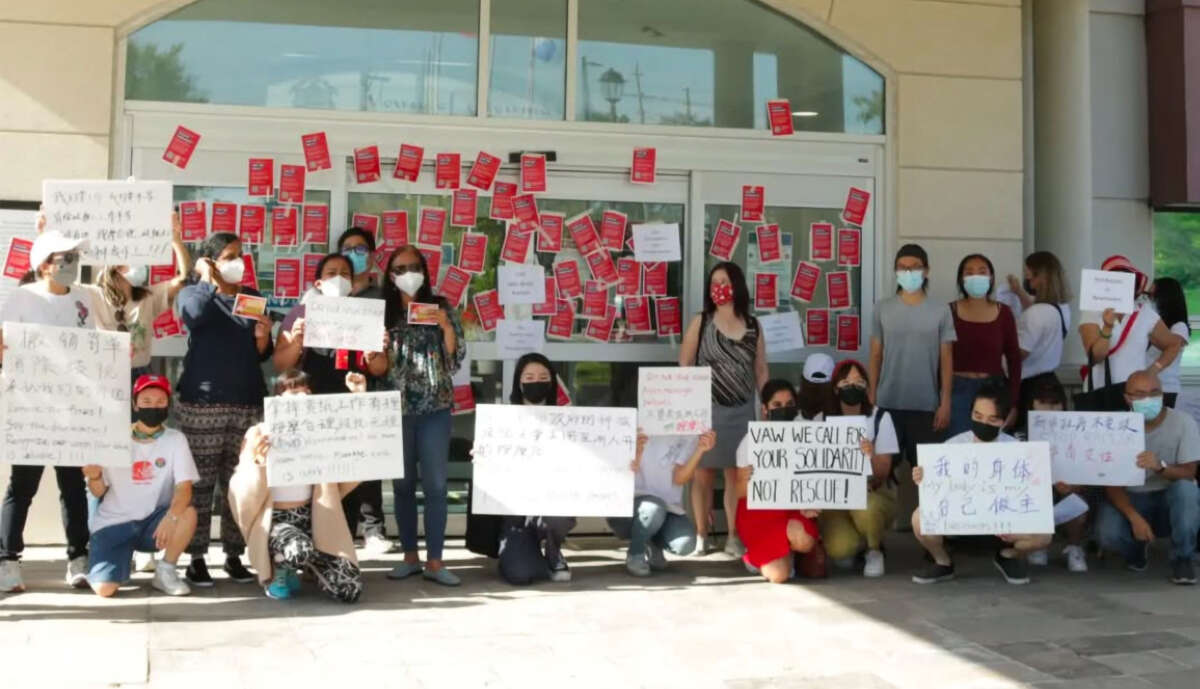
Asian massage workers protest discriminatory municipal regulations at a 2022 rally near Toronto, Ontario.Courtesy of Butterfly: Asian and Migrant Sex Workers Support Network
Asian massage workers protest discriminatory municipal regulations at a 2022 rally near Toronto, Ontario
.Courtesy of Butterfly: Asian and Migrant Sex Workers Support Network

Few people think of their local massage parlor as a site of anti-fascist resistance. But we’ve spent years working with migrant women in the sex industry, and we can tell you — if you want to learn how to resist authoritarianism in the United States, ask those already resisting it: migrant sex workers.

President Donald Trump has wasted no time launching the first wave of his administration’s draconian anti-immigrant, anti-worker and anti-woman Project 2025 agenda. But much of Project 2025’s program for attacking the wider immigrant community has long been a reality for certain migrants — including those in the sex industry. From them, we can learn how the U.S. government might intensify attacks on undocumented people. But more importantly, they show us how everyday people evade, defy and resist vicious state control and punishment.

Because they sit at the intersection of racism, sexism, classism, xenophobia and anti-sex work sentiment (whorephobia), migrant sex workers have been one of the most effective scapegoats for U.S. ruling-class elites. This has allowed the U.S. state to test, fund and normalize surveillance, criminalization and punishment such as travel bans, terrorizing worksite raids and seizing wages from workers.

Migrant sex workers are outlaws. Hundreds of thousands of them live in a kind of mini-police state within the U.S., where it is illegal for them to enter the country, and they cannot associate with each other, organize their workplace, unionize, open a bank account, rent an apartment or cross state lines without risk of arrest. All of these activities are criminalized under municipal, state, federal and immigration laws. They live, move and work in these illegal contexts, evading every form of surveillance, civilian reporting/snitching, law enforcement and racist neighbors and lawmakers. They do it by building community, through organizing, creativity, persistence and above all, noncompliance. They defy borders, immigration law and a capitalist system that demands that migrants like them labor in only certain highly controlled and exploited ways, such as in farms and factories. They are braver than most of us, but too few of our friends on the left see them as radical comrades engaged in everyday resistance to authoritarianism.

Stripping Away Legal Rights

The Trump administration promises to attack migrants in many ways, including by slashing pathways to legal immigration status. For some migrants, this means a return to earlier Trump policies that attempted to ban people based on region and religion, like the revived Muslim ban. For those in the sex industry, those pathways to legal immigration status have never existed.

Related Story

Law That Made “Sex Work Industry More Dangerous” Upheld in Court
The legal challenge to FOSTA alleged that the law chilled constitutionally protected speech. By Zane McNeill , Truthout July 10, 2023


Migrant sex workers have been the target of the U.S.’s first and longest continuous travel ban: The Page Act of 1875 prohibited any Chinese woman that U.S. agents suspected of engaging in sex work from entering the U.S. The Page Act was later replaced by the Chinese Exclusion Act, which banned nearly all Chinese migrants until it was repealed in 1947. But to this day, the U.S. continues to forbid the entry of persons who have engaged in sex work in the past 10 years or who plan to sell sex in the U.S. Based on this travel ban, migrant sex workers of any immigration status are subject to surveillance, worksite raids, detention and deportation, such as the raid on the Orchids of Asia Day Spa, which became famous for accidentally ensnaring billionaire Robert Kraft. His charges were all dropped. Meanwhile, four Chinese women workers were arrested, convicted and forced to pay fines of up to $45,000.

Migrant sex workers are also assaulted, robbed, and killed in worksite raids, murdered by vigilante border agents or deported to their death, as in the case of Melissa Nuñez, a Honduran trans woman sex worker who was murdered only weeks after she was deported from the U.S. due to arrests for sex work.

In our book Not Your Rescue Project: Migrant Sex Workers Fighting for Justice, we reveal how the U.S. government has created a web of criminalization to capture migrant sex workers no matter how they work or where they live. U.S. immigration regulations bar them from working in the sex industry (or entering the country at all), while state and federal criminal laws also define migrant sex work as “organized crime” or as “sex trafficking.” Those in power stoke fears of the racialized sexual predator by framing migrant sex work as a crime committed by “gangs,” “pimps” and “illegals.” Migrant massage workers are subject to much of the same surveillance and criminalization, whether or not they also sell sexual services, due to their association with sex work.

How do migrant sex workers survive this degree of hyper-criminalization? They defy it.
Resisting in and Against the Legal System

For migrant sex workers, creative noncompliance is a matter of survival. Without it, they lose everything. For reasons we outline in our book, many migrant sex workers choose to live at work. If their worksite is shut down due to arrests — as happened to over two dozen women during a series of forced-entry worksite raids at Seattle massage parlors in 2019 — they not only lose their livelihood, they lose their home. On top of that, officers often seize (or steal) all of their wages, their phones, even their jewelry. So migrant sex workers have to get creative about how to fight attacks on their worksites.


Migrant sex workers have been the target of the U.S.’s first and longest continuous travel ban.

In one example, a few years ago, in 2022, politicians and business interests in the wealthy, majority white town of Newmarket, Ontario, began to wage a campaign to shut down massage businesses — almost all of which were Asian-run. They used false claims that these businesses were sites of sex trafficking despite having no evidence of coercion or violence. The real reason for the campaign may have been revealed when an elected council member spoke glowingly about how the massage workers who’d lost their jobs would be able to fill the staffing shortages at local care facilities.

One of the tactics that Newmarket’s city council used was to change local regulations so that only those who’d completed formal massage training could work in massage businesses. This was a sneaky way of pushing out working-class immigrant workers who can’t afford expensive, full-time English-language massage training programs. At first it worked, and many migrant women were pushed out of their jobs.

An organization called Butterfly: Asian and Migrant Sex Worker Support Network (founded by one of this article’s authors, Elene Lam) helped the workers respond to the city’s underhanded tactics by mobilizing over 100 organizations to protest the new rules and organizing workers to design their own trilingual massage training program with a local university to attain the required credentials. Some of the migrant massage businesses are still targeted by the city, but many workers have been able to keep their jobs through creative defiance and traditional organizing strategies.

Worksite Raids


Project 2025 seeks to remove marginalized communities from public life — from trans people in bathrooms to refugees in urban centers. For migrant workers, this looks like more inhumane Immigration and Customs Enforcement (ICE) raids at worksites, racially targeting communities where they live and work, as well as the recent rollback of policies that restrict immigration agents from arresting or detaining migrants in “protected areas” like schools, churches and hospitals.

Terrifying forced-entry worksite raids are a regular occurrence for workers in massage businesses run by migrants. Using racial profiling, police officers target migrant massage businesses for surveillance; officers extort sex from workers, conduct raids, arrest and detain everyone and seize all of the workers’ earnings through asset forfeiture laws.

Migrants in the sex trade have never been protected by being in or near schools, hospitals and churches. In fact, this puts them at an even higher risk of arrest. A surprising number of people can be convinced to enthusiastically collaborate with the police — so long as they believe that they are helping the police to protect the world from a dangerous “other.” This can be true even among progressives and leftists. For example, some advocacy nonprofits run campaigns to harass, surveil and close migrant massage businesses that are located near schools, with no evidence these businesses pose any threat to children. Conservative Christian churches organize campaigns to surveil and shut down Asian massage businesses they view as sinful and a threat to the Christian family. And many health care workers across the U.S. have been trained to view migrant sex workers as sex trafficking victims and report them to the police. This turns the site of care into a site of surveillance, making it dangerous for migrant sex workers to seek health care. Even anti-violence organizations like World Without Exploitation collaborate extensively with far right, extremist Christian organizations like Exodus Cry on campaigns that would criminalize the immigrant massage sector.

Bold Solidarity


Over the past few years, more racial justice organizations have been coming to understand their shared stake alongside migrant sex workers who are used as scapegoats to justify broader surveillance, more cops, tighter border restrictions and racist narratives that immigrants bring crime and sexual violence.

As part of researching Not Your Rescue Project, we spoke to Yves Tong Nguyen, an organizer with Red Canary Song in New York City, and Emi Koyama of Massage Parlor Outreach Project (MPOP) in Seattle, who both described being part of coalitions fighting for the shared goals of ending police surveillance and arrests in their areas. MPOP has worked with organizations like Chinatown/International District Coalition fighting gentrification happening via raids on migrant massage parlors, and Red Canary Song works in coalition with Survived & Punished, Centro Corona, Desis Rising Up and Moving and Trans Equity Consulting against increased policing and surveillance. In Toronto, the previously mentioned Butterfly: Asian and Migrant Sex Workers Support Network has a coalition of over 100 organizations that have been willing to take action alongside migrant sex and massage workers. These organizations are not always completely aligned in their views of sex work, but they share the understanding that attacks on migrant sex workers legitimize and expand the power and budgets of police and border agents, creating danger for all racialized people.

Demonization and Dehumanization

Polk County, Florida, Sheriff Grady Judd, describing the results of a police worksite raid on a local massage business that led to the arrest of 21 women, said: “There’s some interesting facts about this: All 21 of these ladies are not only Asian, they are from the Republic of China — a communist country … all of them are from China. It makes you wonder.”

What did Sheriff Judd want us to wonder about regarding the race of the arrested workers and the fact that they were from China? His comments evoke a racist narrative of “infiltration” by the dangerous outsider — Asians from communist countries.

For migrant sex workers, creative noncompliance is a matter of survival. Without it, they lose everything.

Project 2025 demonizes migrants, using terms like “illegal aliens” and “infiltrate.” Migrant sex workers have been called that — and much worse — for over a century by not only the right, but also liberals and so-called feminists as well. From white suffragettes who referred to Asian men as “Oriental monsters,” to the 2021 Atlanta shooter — a young white Christian man who went on a killing spree in massage spas against women he considered “temptations” he needed to eliminate — U.S. elites have promoted the view that migrants in the sex industry are “filthy,” and the areas where they work are “sex-plagued,” and that they do not deserve dignity, safety or freedom of movement. Contemporary feminists do their part by characterizing migrant sex workers as mute, nameless victims, such as when AF3IRM, a “transnational feminist organization” alleged that the women who were arrested at Orchids of Day Spa were part of an “international sex trafficking ring,” in spite of their insistence otherwise.

These workers have been so demonized as threats to the American family, morality and the U.S. border for so long that their total criminalization has already been thoroughly normalized. Few people know that federal anti-trafficking and anti-prostitution laws can make it illegal to assist migrant sex workers in almost any way, including providing them with food or a ride, loaning them money or letting them live with you. Their work, migration, all their relationships and all of their personal communication are criminalized. Being under complete assault by the state like this leaves people isolated and without the supports that protect against violence, such as stable wages and housing.

Community Networks of Care

Mutual aid is not new for racialized, oppressed people, for criminalized communities, and migrants who cannot safely or legally access any state support. They rely on their friends and family, even to get health services. Red Canary Song’s Tong Nguyen told us in a 2023 interview for Not Your Rescue Project:

Before Red Canary Song, migrant massage and sex workers in New York were already taking care of each other. They were showing up at the jails for each other; showing up at the trials; when someone is abused, when someone is trying to escape, when someone is fighting off their client. They were showing up when someone didn’t have money to pay rent; when people didn’t have money to get food; when people needed child care. That has always been true, though it has been historically overlooked. Every single day, the government and the prison industrial complex try to isolate people. Yet people have survived for decades and decades and decades. From the moment that migrants — especially those who are undocumented and criminalized — show up in Red Canary Song, they see each other and they’re like, “We are all we have.”

Amid a second Trump term, the U.S. ruling class are doing what they have done for at least a century — advocating for racist anti-migrant policy by blaming migrants for the crises that the wealthy themselves are responsible for, such as inflation, housing shortages, and the deaths and mass disabling due to COVID-19. It is deeply important that we recognize how much we need each other, and that an attack on migrant sex workers opens the doors to attacks on everyone. Project 2025 and other right-wing attacks on workers, LGBTQ people and women will require a far higher degree of solidarity and commitment to each other.

But we know from our 20-plus years of organizing that it is not easy to align with people across such vast class and race experiences. It’s why we decided to write a book about migrant sex workers — some of the most hyper-criminalized people in the U.S. — and their resistance. Because we should all ask ourselves: How can we be more like migrant sex workers? Defiant, bold risk-takers, creative problem solvers, and above all, noncompliant — a true threat to the power of the U.S. empire.

We’re not backing down in the face of Trump’s threats.


As Donald Trump is inaugurated a second time, independent media organizations are faced with urgent mandates: Tell the truth more loudly than ever before. Do that work even as our standard modes of distribution (such as social media platforms) are being manipulated and curtailed by forces of fascist repression and ruthless capitalism. Do that work even as journalism and journalists face targeted attacks, including from the government itself. And do that work in community, never forgetting that we’re not shouting into a faceless void – we’re reaching out to real people amid a life-threatening political climate.

Our task is formidable, and it requires us to ground ourselves in our principles, remind ourselves of our utility, dig in and commit.

As a dizzying number of corporate news organizations – either through need or greed – rush to implement new ways to further monetize their content, and others acquiesce to Trump’s wishes, now is a time for movement media-makers to double down on community-first models.

At Truthout, we are reaffirming our commitments on this front: We won’t run ads or have a paywall because we believe that everyone should have access to information, and that access should exist without barriers and free of distractions from craven corporate interests. We recognize the implications for democracy when information-seekers click a link only to find the article trapped behind a paywall or buried on a page with dozens of invasive ads. The laws of capitalism dictate an unending increase in monetization, and much of the media simply follows those laws. Truthout and many of our peers are dedicating ourselves to following other paths – a commitment which feels vital in a moment when corporations are evermore overtly embedded in government.

Over 80 percent of Truthout‘s funding comes from small individual donations from our community of readers, and the remaining 20 percent comes from a handful of social justice-oriented foundations. Over a third of our total budget is supported by recurring monthly donors, many of whom give because they want to help us keep Truthout barrier-free for everyone.

You can help by giving today. Whether you can make a small monthly donation or a larger gift, Truthout only works with your support.

This article is licensed under Creative Commons (CC BY-NC-ND 4.0), and you are free to share and republish under the terms of the license.

On Bluesky? We created a starter pack to make it easy for you to follow Truthout folks there.


Chanelle Gallant

Chanelle Gallant is a movement writer, organizer, strategist and consultant and co-author of Not Your Rescue Project: Migrant Sex Workers Fighting for Justice (Haymarket Books, 2024). She co-founded the Migrant Sex Workers Project, SURJ-Toronto and has provided training and advocacy on sex work and racial justice, from city hall to the United Nations. Chanelle sits on the national board for Showing Up for Racial Justice and Catalyst Project and has helped to move millions into organizing through donor advising and grassroots fundraising. She holds an MA in Sociology and was a Lambda Literary Fellow. Find her at chanellegallant.com


Elene Lam

Elene Lam is an activist, artist, community organizer, educator, human rights defender and the coauthor of Not Your Rescue Project: Migrant Sex Workers Fighting for Justice. She has fought for sex worker, migrant, gender, labor and racial justice for over 20 years. She is the founder of Butterfly (Asian and Migrant Sex Workers Support Network) and the co-founder of Migrant Sex Workers Project. She has used diverse and innovative approaches to advocate social justice for migrant sex workers, such as leadership building and community mobilization. She holds a master’s of law and master’s of social work. She holds a Ph.D. from McMaster University (School of Social Work), where she studied the harm of the anti-trafficking movement. She was awarded the Constance E. Hamilton Award for Women’s Equality by the City of Toronto.


Turner Willman

Turner Willman is working to grow an abolitionist Asian America amidst a rising tide of fascism. They are an organizer and digital strategist who brings over a decade of experience to racial justice movements. Since 2018, Turner has worked with the national Asian American organization, 18 Million Rising, on issues such as immigrant rights, gentrification, policing, and more. They have developed the leadership of thousands of Asian American organizers through political education campaigns, trainings and events. Prior to 18MR, Turner worked at MediaJustice, where they defended internet access and technology rights in BIPOC communities, as well as resisted high-tech policing and surveillance of activists.
Gaza Officials Update Death Toll to Over 61,000, Adding Thousands Presumed Dead

The true death toll is likely even higher when including deaths caused by Israel’s humanitarian blockade.

By Sharon Zhang
February 4, 2025

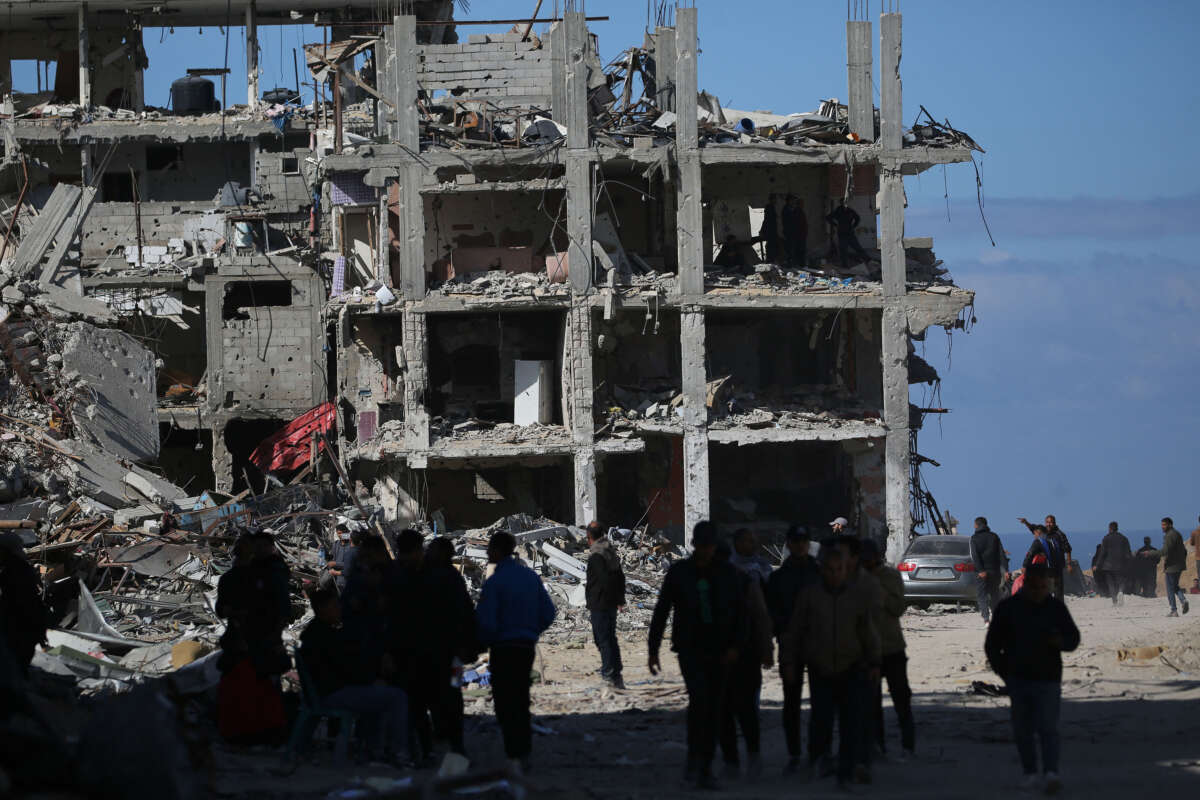
Palestinians search building rubble in a ruined neighborhood of Gaza's southern city of Rafah on January 20, 2025, as residents return following a ceasefire deal a day earlier between Israel and the Palestinian Hamas group.
Eyad Baba / AFP via Getty Images

Gaza officials have added thousands of names to the death toll from Israel’s genocide, bringing the total to over 60,000 Palestinians as rescuers scour the Gaza Strip for bodies amid the first phase of the ceasefire agreement.

On Monday, Gaza Government Information Office head Salama Maarouf said that there are at least 14,222 people believed to be trapped under the rubble, on the roads or in areas inaccessible to rescuers. According to Maarouf, only 76 percent of those killed in the genocide have been brought to medical centers, which is the primary way that officials were counting deaths.

This brings the official death toll to 61,709, including 17,881 children, with at least 111,588 wounded. The toll has already risen by hundreds since the ceasefire went into effect as rescuers have recovered bodies from the rubble.

The body of renowned Palestinian writer and activist Refaat Alareer was recovered and relocated by Palestinian officials. Gaza Municipality spokesperson Asem Alnabih said on X that officials had recovered Alareer’s body on Tuesday, and moved him and several of his relatives from a makeshift grave in Gaza City to a cemetery near Al-Shujaiya, his birthplace and home.

“Dear friends of Refaat Alareer around the world, I want to share with you that after a long and painful search we have finally found Dr. Refaat Alareer’s body,” Alnabih said. “Please keep him in your prayers, and may his family and friends find strength and peace.”

Related Story

At Least 214 Babies Born in Gaza During Genocide Were Killed by Israeli Forces
Israeli forces killed a total of over 800 babies under a year old in the genocide, Gaza officials said. By Sharon Zhang , Truthout January 23, 2025


Israeli forces killed Alareer on December 6, in an airstrike, after he had received threats for weeks. Limited inquiries into the strike found that Israeli forces likely targeted Alareer for assassination.

The government’s update of the death toll brings the official death tally closer to estimates of the toll by researchers and experts. In a study in The Lancet published last month, researchers said that the death toll was underreported by 40 percent as of June, with likely at least 64,000 deaths from traumatic injury at the time. With the same rate of underreporting, that would bring the true toll to over 70,000, researchers said.

The toll could be many times higher when deaths caused by Israel’s humanitarian blockade are included. Humanitarian groups have long warned that deaths to starvation and disease could far exceed killings from bombings and other attacks; last July, public health experts said that the death toll could be 186,000 or more, judging by previous estimates of “indirect” deaths in similar conflicts.

Maarouf also said that over 2 million Palestinians were forcibly displaced by the genocide, “some more than 25 times.”

Negotiations for the second phase of the ceasefire, set to begin in March, have begun, according to Hamas officials. Under a preliminary framework for the second phase, remaining Israeli captives held in Gaza are slated to be released, while Israel is supposed to release more Palestinian prisoners. It is also supposed to bring the region closer to a permanent end to the fighting.

However, the deal may still fall apart, especially if Israel continues its pattern of sabotaging ceasefire talks and they insist on continuing their slaughter in Gaza. Israeli Prime Minister Benjamin Netanyahu has claimed that U.S. officials under Joe Biden and Donald Trump have reportedly given him assurances that Israel can resume the slaughter if negotiations on the second phase aren’t fruitful.
Trump’s January 6 Pardons Were a Green Light to Far Right Paramilitaries


The GOP’s silence after the pardons made it complicit in Trump’s decision to normalize paramilitary violence in the US.

February 3, 2025

With President Donald Trump’s pardoning of more than 1,500 people charged with offenses relating to the January 6 insurrection, and his description of them as “hostages” rather than as insurrectionists, paramilitarism is now firmly back on the national agenda.

Trump’s actions in freeing these men and women and lionizing their actions in 2021 was made all the more shocking by the fact that, with a few exceptions, Republican members of Congress — many of whom themselves had to flee the mob on January 6 — largely responded without criticism. Instead, leading Republicans sidestepped any discussion of Trump’s choice. “The president’s made his decision,” House Speaker Mike Johnson said. “I don’t second-guess those.” Meanwhile, Secretary of State Marco Rubio brushed off a question on NBC’s “Today Show” due to his new position: “I’m going to be working on foreign policy issues, and you want to revisit these issues that are going on in domestic politics,” Rubio said. “It’s not going to happen.”

That silence in the face of a relentless attack on the judicial system speaks volumes, suggesting that it has become a policy goal of the GOP to historically rehabilitate the perpetrators of that shameful attack four years ago — and those who egged them on — and to normalize the truly ghastly idea of a paramilitary praetorian guard standing ready to do the “Great Leader’s” dirty work.

Make no mistake, paramilitarism is always at odds with true democracy. Nearly 2,400 years ago, Aristotle warned against what he termed “armed injustice.” It’s been a scourge ever since. When parties embrace streetfighters as allies, and when strongmen can activate paramilitary units to intimidate opponents — or, worse, to “neutralize” those deemed enemies — a Rubicon has been crossed. Such was the case in the antebellum South when paramilitary fugitive slave hunters roamed the land, as well as in the post-Civil War South when the KKK, in alliance with many white political leaders, inflicted racial terror on Black communities. Such was also the case in late Weimar Germany, when political parties activated their troops to beat, torture and kill those they regarded as their enemies. It was accelerated under the Nazis, whose uniformed Sturmabteilung launched a reign of terror against socialists, trade unionists, journalists, academics who refused to toe the line, and, of course, Jews.

Such was the case, too, in 1970s and 1980s Central and South America, where one country after the next saw the activation of death squads working hand in hand with U.S.-backed hard right political leaders and their military allies. And in Ferdinand Marcos’s Philippines. And in Suharto’s Indonesia. It was the de facto law of the land in apartheid South Africa — and it remains in force in countries such as Sudan and Niger.


In Haiti, paramilitaries have filled the vacuum of a collapsing state by inflicting huge levels of bloodshed. And in Israel, paramilitary settler groups routinely destroy Palestinian property in the West Bank, often killing Palestinians as well.

The list goes on. By any measure, paramilitarism is one of the great horrors of the modern era.

Trump has long been enamored of the sort of strongman politics that brooks no dissent and metes out bloody retribution on enemies. According to several members of his inner circle from 2017-2021, he mused aloud about wanting generals more like Hitler’s. He also made no secret of his desire to unleash police brutality against those at the wrong end of state power, urging cops to beat suspects and promising they wouldn’t be punished for breaking the law. It’s no accident that one of the first acts of Trump’s Justice Department this past week was to announce a complete cessation of all civil rights work and an end to oversight agreements with local police departments that have a particularly egregious record of racism and brutality.


When strongmen can activate paramilitary units to intimidate opponents — or, worse, to “neutralize” those deemed enemies — a Rubicon has been crossed.

To be clear, when the police are explicitly given permission to violate the law, the line between law enforcement agencies and paramilitaries blurs, for that permission is premised on the understanding that at some point favors will be called in. Trump’s transactionalism is all about this kind of arrangement, one that is void of core moral principles. In such a world, the ends always justify the means.

But Trump doesn’t only want to remove all accountability mechanisms from law enforcement. He remains enamored of extralegal outfits, perhaps a legacy of his father Fred Trump’s dalliance with the Klan in the 1920s. In fact, before and during his first presidency, the MAGA leader repeatedly flirted with far right paramilitarism: When, in the 2016 campaign, Trump received an endorsement from ex-KKK Grand Wizard David Duke, he only reluctantly — and extremely half-heartedly — rejected the endorsement. When a neo-Nazi mob ran rampant through the college town of Charlottesville, Virginia, in 2017, Trump concluded that many of them were “very fine people.” When he was explicitly asked, during a presidential debate in 2020, to repudiate the Proud Boys and other far right street fighters, he instead urged them to “stand back and stand by.” When those street fighters came to D.C. for what Trump promised on social media would be a “wild” protest against his election loss and Congress’s certification of the Electoral College vote, Trump urged them to “fight like hell” and then he himself stood back and stood by while the mob that he had inspired ransacked the halls of Congress and hunted for Trump’s political opponents — and his own vice president — so that they could hang them.

Now, with Trump running roughshod over his political opposition, and the full force of the federal government being mobilized to rewrite the history of January 6 and lionize its perpetrators, not-very-subtle signals are being sent that Trumpism welcomes violence — just so long as it is violence carried out on its behalf.

These moves will likely also encourage police officers to further align themselves with right-wing paramilitaries, and essentially give white nationalist and other extremist subcultures within law enforcement and the military a green light to expand their influence even further.

By pardoning the January 6 insurrectionists, the president has effectively condoned those who commit violence on his behalf — making it that much more likely that MAGA goon squads, responding to the unstated but clear desires of a president-cum-despot, will target their political enemies in the years to come.
Crickets: US Federal workers met with silence after trying to take Trump's buyouts

Naomi LaChance, 
Alternet
February 4, 2025


Donald Trump (Photo by Brendan McDermid for Reuters)

After President Donald Trump offered a buyout for federal workers, one employee who works at a federal agency decided to take the deal — and has not heard back, despite the deadline being Thursday. The employee shared their experience with ABC News on Monday.

The “Fork in the Road” program offers federal employees the option to resign but continue receiving pay until September. The move is part of an attempt by the Department of Government Efficiency head Elon Musk to shrink the government. Some experts have said this move would be illegal because it is promising funds for a budget that Congress has not yet approved.

"This is happening," the anonymous employee thought when they decided to resign. "I was scared, nervous, and excited all at the same time. Thought about it for a day I think. ... And I just told myself that I'm going to do it."

They emailed the word “resign,” following the Office of Personnel Management’s instructions. They soon got a response: "We received your email response. We will reply shortly."

Almost a week later, the employee has not heard anything else, and the deadline is fast approaching.

Colleagues at their agency, they said, have been confused about the deal. Management, they said, had been silent; when they told management about their decision to resign, management apparently did not respond. The worker went to management again, and they were told “they should have waited for more guidance before accepting the offer,” ABC News’ Will Steakin wrote. Management also told them that they would still have to do their job after they resigned, although they later walked back that claim.

Last week, White House press secretary Karoline Leavitt said that this program is a way to get people back into the workforce.

"We're all here at work, at the office," Leavitt said. "There are law enforcement officers and teachers and nurses across the country who showed up to the office today. People in this city need to do the same. It's an overwhelmingly popular policy with people outside of Washington, D.C."

Some experts have suggested that taking a second job would violate ethics rules.

The worker said that they had been considering quitting for some time. "I've been telling myself for the last five years that I was going to quit. But it's a good job, I like the job. ... I love my job,” they told ABC News.

They added: "This is just the nudge that I needed to take that leap.”


'Your duty to leave': Former Trump diplomat urges federal workers to quit

Jennifer Bowers Bahney
February 4, 2025 

A former U.S. State Department employee under the first Trump administration is urging current federal workers to take an offered buyout and flee Washington.

Chuck Park served as a diplomat for 10 years before quitting the Foreign Service in disgust in 2019. Park wrote an opinion piece for The Washington Post then to explain his decision, and is now urging other government employees in the second Trump administration to follow his lead.

In a new opinion piece, Park references the "Fork in the road" email sent by "First Buddy" Elon Musk on Jan. 28, urging federal employees to consider taking a "deferred resignation offer." Park writes in Tuesday's piece, "Here’s my advice to civil servants: Take the fork."

"My breaking points were scenes of crying children at the border and a horrific episode of violence against immigrants in El Paso. Now the nation seems poised to repeat such cruelties," Park writes, adding that his vehement opposition to the first administration's policies was his signal to leave.

Park argues, "It isn’t noble to resist from within. It’s not public service to hide and bide your time within the vast machinery, ticking down the days until the next presidential election or the day your pension kicks in. If you can’t execute this administration’s policies (the lawful ones, that is), then it is your duty to leave. To be a part of some hostile 'deep state' or mire the administration in 'the swamp' only erodes Americans’ faith in government. That’s part of what got us here in the first place.'"

Quitting is not the same thing as surrendering, according to Park, and pursing his passion to fight for immigrants' rights became "the most powerful resistance."

"Many civil servants played heroic, steadying roles in the first Trump transition, from securing nuclear material to forecasting destructive hurricanes," Park writes. "This time around, the difference is that the president has two hands firmly on the steering wheel. His administration is moving with intention, not abandon. And it’s the responsibility of Congress, the courts and civil society — not the executive agencies — to resist his dangerous lurches."

Read The Washington Post opinion piece here.