Monday, March 31, 2025

Ilhan Omar Is Reportedly Drafting Impeachment Articles Over Signalgate

Three-quarters of Americans are troubled by the administration’s use of Signal to discuss military plans, polling shows.
March 27, 2025

Rep. Ilhan Omar is seen during a news conference in the Capitol Visitor Center on January 25, 2023.Tom Williams / CQ-Roll Call, Inc via Getty Images

Democratic Rep. Ilhan Omar (Minnesota) is reportedly drafting articles of impeachment against three Trump administration officials who discussed U.S. plans to bomb Yemen in a Signal group chat that came to light after a journalist was mistakenly added to the chat earlier this month.

The controversy, which some in the media have dubbed “Signalgate,” has plagued the White House this week, with Trump administration officials scrambling to explain why such classified information was being shared so haphazardly on a messaging app. The leaked messages from that group chat show officials ordering and celebrating the bombing of civilians in Yemen, which is a war crime.

Several Democratic lawmakers — including House Minority Leader Hakeem Jeffries (New York) — have called for President Donald Trump to fire the officials involved, or for them to resign from their posts. On Thursday, Axios reported that Omar was planning to draft articles of impeachment against Secretary of Defense Pete Hegseth, National Security Advisor Michael Waltz and CIA Director John Ratcliffe, all of whom participated in the chat.

“Pete Hegseth is an embarrassment to Minnesota,” Omar wrote on Bluesky on Wednesday. “His incompetence and blatantly illegal actions demonstrate he is grossly unfit to lead the Department of Defense.”

It’s currently unclear what specific articles Omar plans to charge the trio with; the charges need not be based on criminal statutes, although those can be included as well. Presidents and executive branch officials can be impeached for “high crimes and misdemeanors,” a centuries-old term that does not refer to literal crimes but rather abuses or negligence in office.

Omar’s charging document will likely detail how Trump administration officials discussed the details of a highly sensitive military operation on an app — and how that app does not save a long-term record of their conversations, which is likely a violation of the Federal Records Act and Administrative Procedure Act. Her articles of impeachment could also discuss how the U.S. airstrikes on Yemen were in violation of international laws relating to the killing of civilians; such laws prohibit targeting nonmilitary buildings, even if there is a military target inside.

“Rules of engagement that permit destroying an entire civilian apartment building to kill one alleged terrorist is part of Joe Biden’s legacy. It’s still a war crime though, and Waltz’s [and the group’s] text is a confession,” Matt Duss, executive vice president for the Center for International Policy (CIP), recently said on social media.

If Omar does complete the articles of impeachment, they will have little likelihood of being passed. However, she can force a vote on the matter using a privilege motion, which would mean that Republicans would have to publicly vote on whether the impeachment proceedings should commence.

Meanwhile, pressure is mounting on Trump to fire at least one official who was involved in the group chat. Some allies close to Trump are saying that individual should be Waltz, NBC News reports, as he was the one who mistakenly invited The Atlantic’s Jeffrey Goldberg into the chat.

Polling shows that most Americans are disturbed by the incident, with a new YouGov survey showing that 74 percent of Americans view the matter as serious, while only 13 percent say they aren’t concerned.
Majority of Democratic Voters: Current Leaders Failing to Combat Trump, Defend Working Class


"Democratic voters are sending a clear message," said the head of Data for Progress. "The base is tired of weak opposition and business-as-usual politics."


Participants cheer for U.S. Sen. Bernie Sanders (I-Vt.) at the "Fighting Oligarchy: Where We Go From Here" rally at Civic Center Park in Denver, Colorado on March 21, 2025.
(Photo: Jason Connolly/AFP via Getty Images

Jessica Corbett
Mar 28, 2025
COMMON DREAMS


A large majority of registered Democrats and Independent voters who lean Democratic are frustrated with the party, see no clear leader of it, and want to see elected officials fight harder for working people and against Republican President Donald Trump, according to a pair of polls released Friday.

"Democratic voters are sending a clear message: They want leaders who will fight Trump and put working people first," said Danielle Deiseroth, executive director of Data for Progress, the progressive think tank behind the surveys. "The base is tired of weak opposition and business-as-usual politics."

"This level of discontent is unsustainable for a party looking to build back in the wake of major losses—at a certain point, Democratic leaders will need to show voters that they are taking a stronger stance against Trump, or step aside for someone who will," Deiseroth added.

"This level of discontent is unsustainable for a party looking to build back in the wake of major losses."

The polling—released nearly five months after the election in which Democrats lost the White House and both chambers of Congress—shows that when asked how they would grade the Democratic Party on its response to Trump, who returned to power in January, 70% of voters said C or below, and 21% said F.

Voters were also divided in terms of who they see as the current leader of the Democratic Party. Former Vice President Kamala Harris, who lost the race for the White House in November, was at the top, but with only 17%. She was followed by former President Barack Obama and Senate Minority Leader Chuck Schumer (D-N.Y.), who tied at 15%.

House Minority Leader Hakeem Jeffries (D-N.Y.) tied with "no one" at 11%, followed by Sen. Bernie Sanders (I-Vt.) at 9% and Alexandria Ocasio-Cortez (D-N.Y.) at 6%.

Sanders, who sought the Democratic Party's presidential nomination in 2016 and 2020, announced Friday that Ocasio-Cortez will join the Los Angeles stop of his "Fighting Oligarchy: Where We Go From Here" tour on Saturday—as she did across the U.S. West last week, drawing the biggest crowd of either of their careers at a rally in Denver, Colorado.

"Today, the oligarchs and the billionaire class are getting richer and richer and have more and more power," Sanders said Friday. "Meanwhile, 60% of Americans live paycheck to paycheck, and most of our people are struggling to pay for healthcare, childcare, and housing. This country belongs to all of us, not just the few. We must fight back."

The new polling makes clear that voters want elected officials to fight back in a variety of ways, including legal challenges, media appearances, voter registration drives, letter-writing and phone-banking campaigns, procedural tactics like the filibuster, supporting worker walkouts, consumer boycotts, mass protests—including at government buildings—and disrupting Trump campaign events.

Voters are specifically disappointed with Schumer: 61% said he isn't doing enough to fight Trump. After being told about the Senate majority leader's decision earlier this month to lead a group of 10 caucus members who helped Republicans pass a stopgap spending bill, 51% said Democrats in the chamber should choose a new leader—and if they did, 66% of voters would want "someone who fights harder against Trump and the Republican agenda."

A large majority of voters of all ages want elderly Democratic Party leaders "to retire and pass the torch to the younger generation." Big majorities also want party leadership to be diverse in race and gender, and to prioritize funding for programs addressing issues such as healthcare and housing, even if it increases the national deficit.

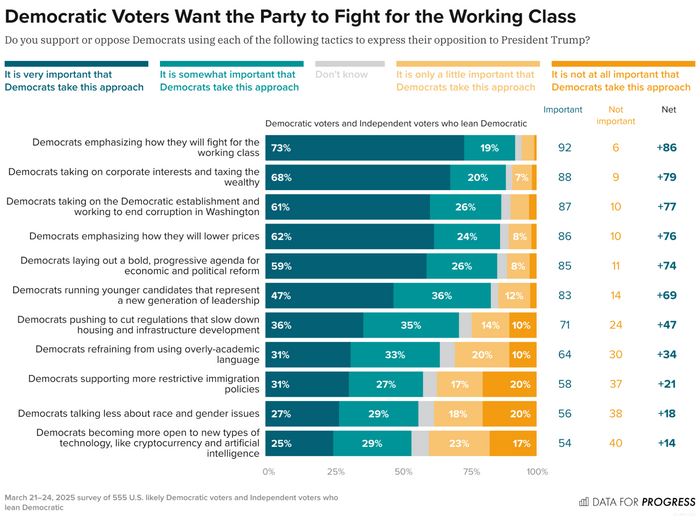
As the party battles Trump and rebuilds after November's devastating losses, voters are stressing that Democrats must emphasize how they will fight for the working class. Large majorities urged them to focus on taking on corporate interests and the Democratic establishment, taxing the wealthy, lowering prices, and "laying out a bold, progressive agenda for economic and political reform."


The Data for Progress polling follows an internal survey conducted earlier this month by Our Revolution, the progressive political organizing group launched as a continuation of Sanders' 2016 presidential campaign. That survey of 9,024 members found that nearly 90% of respondents believe Schumer should step aside as Senate minority leader and 86% would support a primary challenger for his Senate seat, should he refuse to step aside. Calls for Ocasio-Cortez to primary him have mounted throughout the month.

"These survey results point to an undeniable crisis of confidence in Chuck Schumer and Democratic leadership at a time of unprecedented executive overreach and corporate takeover of the American federal government," Joseph Geevarghese, the executive director of Our Revolution, said at the time. "It's time to step up or step down."
Democrats’ “Reshuffling” on Trans Issues Cedes Key Territory to the Far Right

Republicans are using trans rights as a wedge issue. We must not fall for it.

March 28, 2025
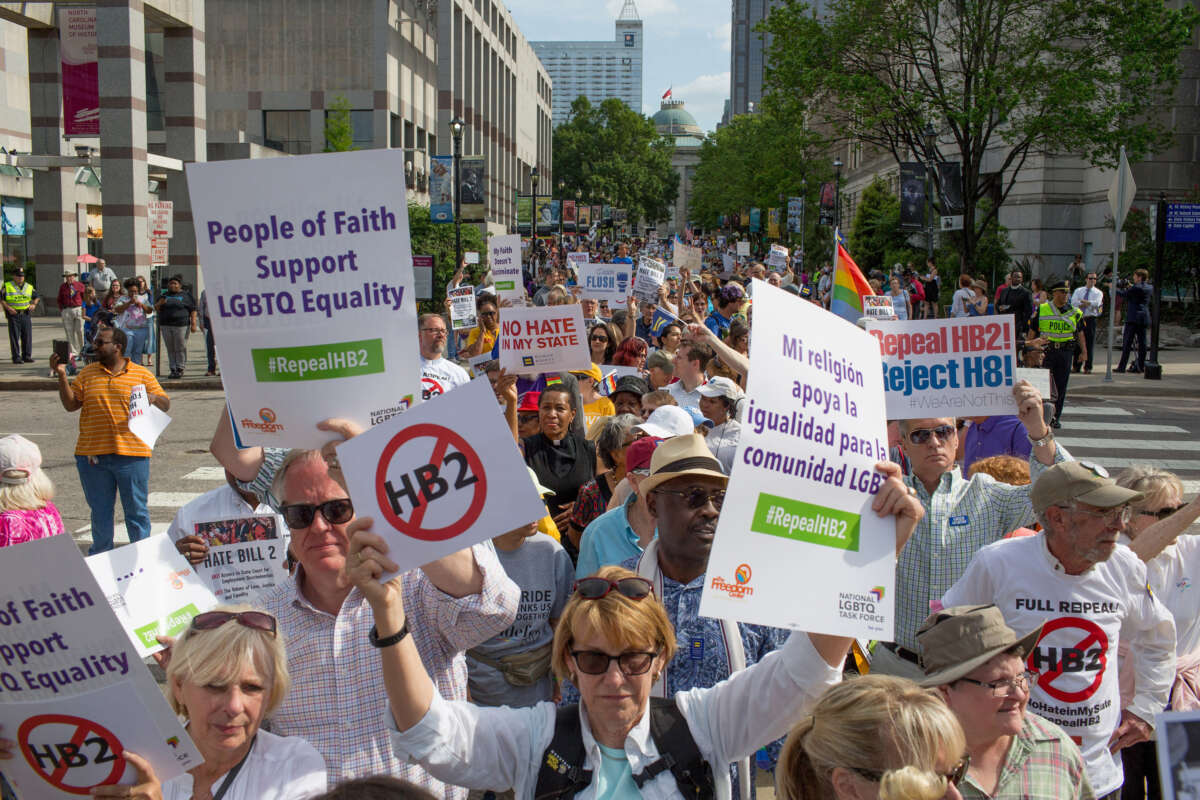
Demonstrators call for the repeal of HB2 in Raleigh, North Carolina, on April 25, 2016.Jill Knight / Raleigh News & Observer / Tribune News Service via Getty Images

As Republican lawmakers wage an all-out assault on transgender people, Democrats are reportedly “reshuffling.” In a recent article, sources told NOTUS that the party is attempting to adjust its tone on trans issues following its crushing losses in the 2024 election, instead seeking a sort of middle ground that won’t “inflame” voters.

The myth that Democrats were too radical on trans issues has been echoed by various mainstream pundits in the wake of Donald Trump’s return to the White House. In reality, moderate Democrats largely declined to speak out about trans rights on the campaign trail. The Democratic National Convention, for instance, did not feature any trans speakers for the first time since 2012.

In an October 2024 interview, Fox News host Bret Baier asked Vice President Kamala Harris whether she would support gender-affirming care for people incarcerated in federal prisons if elected president — a central focus of one of the Trump campaign’s major attack ads.

“I will follow the law,” Harris said. “And it’s a law that Donald Trump actually followed.” Her response was emblematic of the Democrats’ preferred line: pivot to focus on the law, but avoid defending trans people specifically.

The right-wing attacks on trans people are so vicious and pervasive — and Democrats’ response so milquetoast — that it can be easy to forget recent history. Not that long ago, legislation targeting trans people was quite rare. And when it was implemented, it faced widespread pushback.

Nine years ago, North Carolina Republicans passed the state’s infamous “bathroom bill,” or HB 2. The first law of its kind in the country, HB 2 mandated that trans people use the bathroom matching the sex on their birth certificate and banned municipalities from passing local nondiscrimination ordinances. I was a senior in high school at the time, and I, like many other North Carolinians, remember the controversy well. It triggered a massive boycott, totaling as much as $3.8 billion in economic losses for the state, and likely cost Republican Gov. Pat McCrory reelection. North Carolina has had a Democratic governor ever since, despite swinging red for Trump in each of the presidential elections.

Looking back from the vantage point of 2025, it’s pretty shocking to see how full-throated the opposition was to HB 2’s attack on trans people. The law’s passage incited the National Collegiate Athletic Association to pull nearly two dozen championships from North Carolina in 2016 — a massive blow to a state known for its love of college sports. The National Basketball Association also moved its all-star game from Charlotte, North Carolina, to New Orleans, Louisiana. Major corporations, from Coca-Cola to Apple to Ralph Lauren, called for a veto of the bill. PayPal announced it would cancel its multimillion-dollar expansion in Charlotte, and Google’s venture capital wing said it wouldn’t invest in any North Carolina start-ups until the law was repealed. Major television and film production studios, including Lionsgate and the A&E network, stopped filming in the state.

Perhaps even more striking were the travel bans. Cities and states implemented policies prohibiting government employees from taking publicly funded trips to North Carolina. These included the states of Washington, Connecticut, New York, Vermont and Minnesota, as well as the cities of Santa Fe, Salt Lake City and San Francisco, among others.

“As long as there is a law in North Carolina that creates the grounds for discrimination against LGBT people, I am barring non-essential state travel to that state,” said then-New York Gov. Andrew Cuomo in 2016.

Of course, that was the era of peak corporate pride. The companies speaking out against HB 2 did so because defending LGBTQ rights was in vogue, and they wanted to help their bottom lines. This is abundantly obvious in 2025, as companies now rush to roll back their diversity, equity and inclusion initiative

s, proving rainbow capitalism’s critics were right all along. How far we have strayed from the days when public opinion at least leaned in the direction of “discrimination is bad.” Less than three months into this year, 40 anti-trans bills have already passed, and another 725 are currently under consideration.

This current blitz of anti-trans legislation, when held against the far-reaching, multisector boycott of HB 2 in 2016, shows how far right this country’s politics have swung. But this history also underscores the axiom that progress isn’t linear. We are in a reactionary moment, yes, but the average U.S. voter’s alleged antipathy toward trans people is far from a settled fact. In light of the unpopularity of abortion bans, Republicans have chosen trans people as their newest wedge issue, scapegoating the LGBTQ community through fearmongering and lies.

Now is not the time for the left to cede any ground to a movement that wants to see trans people eradicated from public life. We must continue to defend the rights of the trans community, not because it is sometimes popular, but because it is always right.


Martin Sostre’s Life Teaches Us Revolutionary Moments Are Always Upon Us


Sostre laid a foundation for contemporary Black anarchism and prison abolition. A new biography finally tells his story.

March 30, 2025

LONG READ

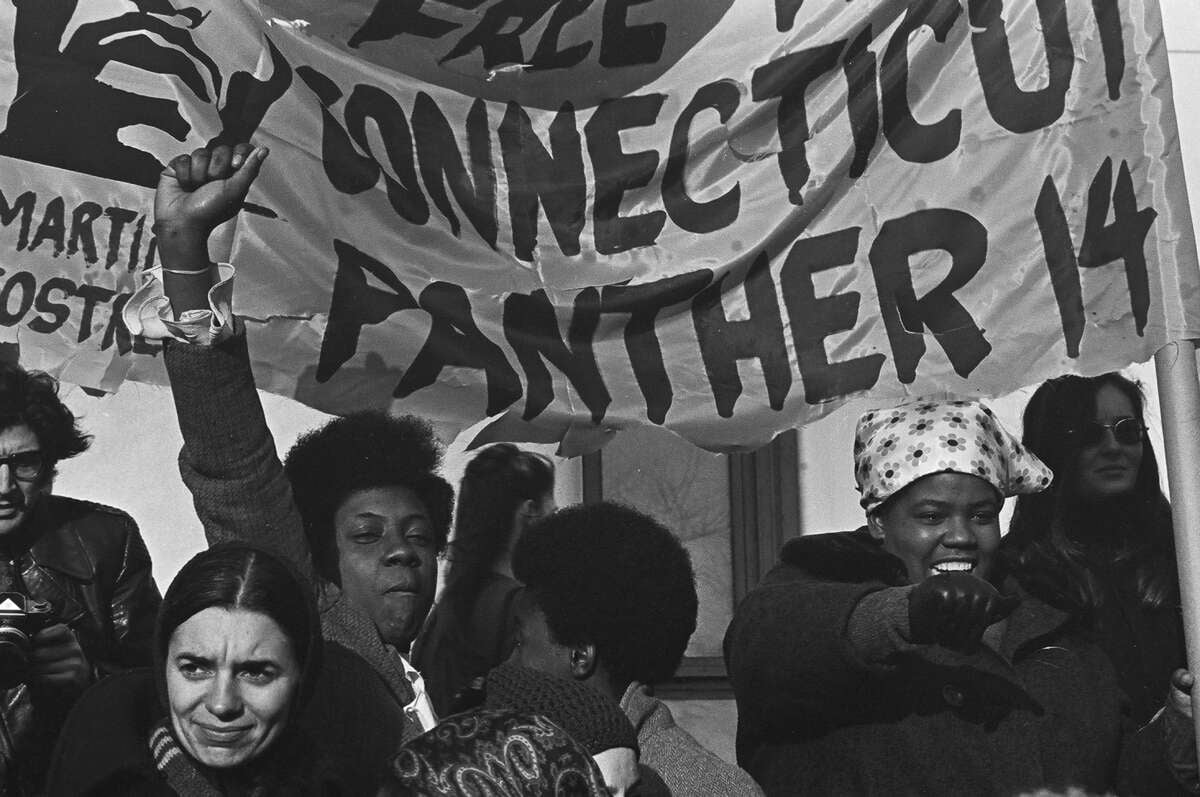
Protestors rally in support of the Connecticut Black Panthers and activist Martin Ramirez Sostre in New Haven, Connecticut, on May 1970. A banner reads "Free The Connecticut Panther 14."David Fenton/Getty Images

“All struggles of liberation are linked and interconnected. Whatever serves the cause of liberation in one area of this planet affects us.” —Martin Sostre

Outside of prisons and the movements that work to abolish them, the life and legacy of Martin Sostre is little known. A Black Puerto Rican anarchist born in East Harlem, Sostre became a politicized prisoner in the early 1960s who, as a renowned jailhouse lawyer, used the criminal legal system to benefit himself and those incarcerated alongside him. He gained international recognition in his ultimately successful freedom campaign and continued to fight government repression and the violence of structural racism for the rest of his life. Yet he died in relative obscurity at the age of 92.

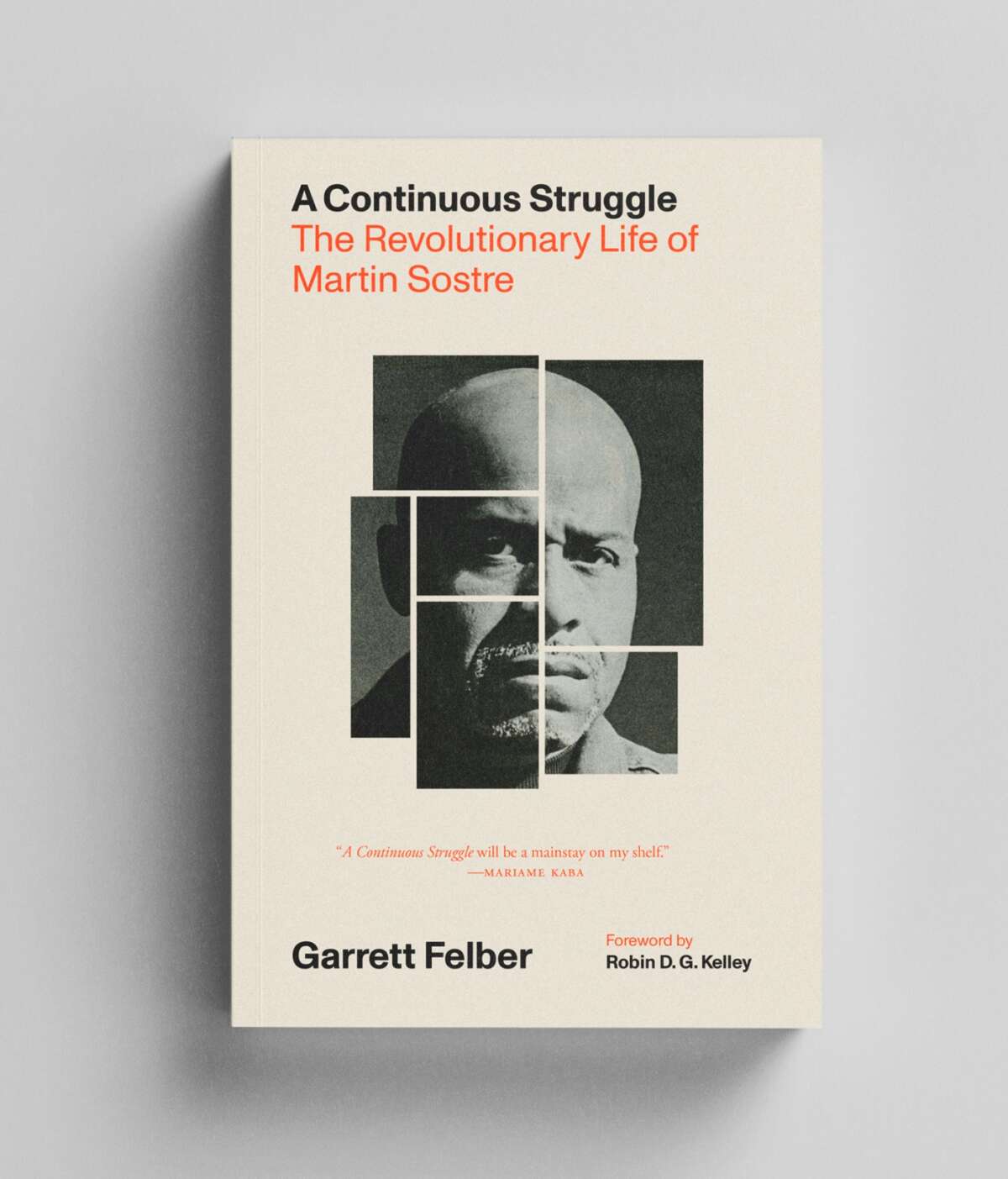
A new book by historian Garrett Felber, A Continuous Struggle: The Revolutionary Life of Martin Sostre, aims to make Sostre’s fascinating life and abolitionist legacy accessible and relevant to today’s liberation struggles. The book will be released by AK Press on May 6, 2025. For each copy pre-ordered from AK Press or Burning Books, a free copy of the paperback prison edition will be sent to an incarcerated reader.

“Alongside defense campaigns for Angela Davis and Huey Newton, the movement to free Martin Sostre represented one of the most improbable, if since forgotten, victories of the Black Power era,” Felber writes in the book.

Abolitionist Josh Davidson spoke with Felber about Martin Sostre, his life of “continuous struggle,” and why this book is so important and needed today.

The following interview has been lightly edited for clarity and length.


Josh Davidson: What initially led to your correspondence with Martin Sostre before his passing in 2015? How did you first hear about him, and why is the story of Sostre and his “original Black political ideology” important today?

Garrett Felber: I initially came across Sostre’s name in a letter written to Malcolm X in the early 1960s by a Muslim incarcerated at the Attica prison in New York. He was a comrade of Sostre, and they were being held in solitary confinement along with dozens of others punished for their identification with the Nation of Islam and lawsuits against the state over the right to practice Islam inside. They were asking Malcolm X to testify as a key witness in their upcoming trial. I read the letter in the early 2010s, and had just begun a dissertation on the politics of the Nation of Islam during the civil rights era (which eventually became my first book, Those Who Know Don’t Say). At the time, there was a barebones Wikipedia page for Sostre, which I later learned was maintained by his son Vinny. I found Sostre’s address and wrote him a letter. To my surprise, he wrote back!

Despite being 90 years old at the time, he politely told me he was too busy for an interview. We corresponded briefly, and in his last letter to me, he mailed a packet of primary documents which included a revolutionary newsletter he published from solitary confinement and an article about a daycare center he cofounded with activist Sandy Shevack in Paterson, New Jersey. “The enclosed documents contain more information than I could possibly convey to you via email or phone,” he wrote to me. I later came to understand this as a key principle of Sostre’s political practice: He believed actions spoke louder than words.


Sostre recognized that the struggle is not only continuous, but also contiguous. Borders and prison walls physically disconnect us from one another, and in doing so, they obstruct our abilities to organize collectively against a common oppressor.

Ultimately, Malcolm X did testify in the case in Buffalo, New York, alongside Sostre, who had helped write the lawsuit. The case resulted in an important legal precedent in what would soon emerge as the prisoners’ rights movement. As historian and academic Robin D. G. Kelley points out in his beautiful foreword to the biography, the politics of this period are too often delimited to debates about Malcolm X and Martin Luther King Jr. Besides the obvious sexism of that paradigm, it also forecloses other types of revolutionary politics.

Sostre offers a crucial window into another strain of Black revolutionary politics which came from the streets and bookstores of Harlem during the Great Depression: the armed struggle of the Puerto Rican nationalist movement and the movement for religious rights led by imprisoned Muslims in the Nation of Islam. Sostre moved from Black nationalism, to revolutionary Black nationalism, to Maoism and Marxism-Leninism before eventually identifying as an anarchist. What made Sostre such an original political thinker was how he learned from his life experiences and continued to develop his ideas through the contradictions that emerged with each phase of struggle. Through this, he helped lay the foundation for contemporary Black anarchism and prison-industrial complex abolition.

Sostre oftentimes referred to life outside of prison as “minimum security” and life behind the bars as “maximum security.” He recognized the presence and violence of government repression both inside and outside of prison walls, and he consistently combated this using a variety of strategies. From his establishment of numerous radical bookstores to his prolific prison litigation, his creation of autonomous defense committees that outlived his own incarceration to his work on housing justice in New Jersey, Sostre never stopped working in whatever way was needed “building tangible counter-institutions that served the community.” What can Sostre’s commitment to a life of continuous struggle teach us today as we face fascism at home, genocide in Gaza and impending climate catastrophe?

Sostre recognized that the struggle is not only continuous, but also contiguous. Borders and prison walls physically disconnect us from one another, and in doing so, they obstruct our abilities to organize collectively and horizontally against a common oppressor. By using the phrase “minimum-” and “maximum security” to delineate both sides of the prison walls, Sostre importantly interrogated the commonsense notion that the other side of coerced captivity is freedom. Instead, he emphasized the continuum of “repressive forces [that] exist outside as well as in.” The prison is not an institution apart from society; it is a concentrated expression of its most oppressive forms.


Sostre importantly interrogated the commonsense notion that the other side of coerced captivity is freedom.

This simple point is so important to the way we organize, so we do not delude ourselves into thinking we are waging “single-issue” struggles. I tell a story in the book about Sostre’s contemporaries, the revolutionary organizers James and Grace Lee Boggs, who took exception to Sostre’s resistance to forced rectal searches and requirements to shave. “Does he really think it is possible to build a revolutionary movement from inside the prisons?” the Boggses asked. I owe a good deal of my political development to the Boggses and share mentors who do as well, so I was stunned and upset when I first came across their critique. But through conversations with Stephen Ward, who wrote a wonderful dual biography of them, I learned that their criticism was based on what I believe is a fundamental misunderstanding about the meaning of the Attica rebellion and the capacity of incarcerated people to wage revolutionary struggle from inside. They saw the revolt narrowly through what Sostre termed the “Attica reform demands.” Instead, as anthropology professor Orisanmi Burton makes so clear in his groundbreaking book, Tip of the Spear, Attica was an act of revolutionary counter-warfare and what he calls “abolitionist worldmaking.”

So instead of reproducing that mistake and creating a hierarchy of separate struggles, we must embrace their interconnectedness and search for points of solidarity. As Sostre reminded one of his defense committees: “revolutionary struggle is a multi-dimensional struggle; we must eventually broaden our struggle horizontally as well as deepen it vertically.” The prison was a site of struggle — like the courtroom or the streets — and Sostre waged that struggle through a variety of tactics, including letter-writing, self-defense and assertions of bodily autonomy, prison litigation, print publications, art and cultural production, labor organizing, sit-ins and other occupations, and much more.

Until now, with A Continuous Struggle, the legacy of Sostre has been overlooked and understudied. Why are books by and about Sostre not on our shelves alongside those by and about Angela Davis, Malcolm X, George Jackson or Eldridge Cleaver?

This is a great question that I’ve asked myself many times. I don’t think there’s a single answer. But certainly one reason is that Sostre never authored a book, unlike the others you mentioned. The one book about him — The Crime of Martin Sostre — was written by Vincent Copeland of the Workers World Party (WWP) with very little input from Sostre, who was being held in complete isolation during the year it was composed. He briefly glanced over the manuscript at trial, then, just before its publication, Sostre broke with the WWP and thousands of copies languished in a warehouse for years. Sostre talked at various points in his life about writing a memoir. He even met with film producers in Los Angeles at one point about a possible biopic where he would be played by James Earl Jones, but he was skeptical of its political integrity and it never materialized.


Sometimes we memorialize the dead but fall short of honoring the living. Who are the elders that we should be supporting, learning from and lifting up today?

Instead, much of Sostre’s political thought lives on through his organizing and deeds — in courtroom transcripts, legal filings, letters from prison, articles in underground newspapers, and through his relationships with people. I am grateful to all of Sostre’s comrades and their families who shared their materials and memories with me. The archive of struggle resides with those who wage it, and so much of Sostre’s legacy is now better documented and preserved thanks to their generosity.

For those wanting to learn more beyond the biography, I suggest starting with the Martin Sostre Institute, which was conceived by Lorenzo Kom’boa Ervin. Sostre’s personal papers are also now archived in the Labadie Collection at the University of Michigan, and I am in the process of donating many of the oral history interviews and other materials I compiled to the Center for Puerto Rican Studies at Hunter College, where they will be available to the public. There are other efforts to carry on Sostre’s legacy such as the Martin Sostre Solidarity House in Milwaukee, Wisconsin; the work of R.E.A.L. Youth Initiative in Chicago; and the Justice for Geraldine and Martin campaign in Buffalo. I hope this is all just the beginning of a renewed interest in Sostre’s legacy as well as the broader histories of Black anarchism and prison radicalism.

Sometimes we memorialize the dead but fall short of honoring the living. So much of what is happening with Sostre’s legacy now, I wish would’ve happened decades earlier. Who are the elders that we should be supporting, learning from and lifting up today? The campaign to exonerate Sostre’s co-defendant Geraldine Pointer is a great example of this.

You raise the idea of prefiguration numerous times throughout the book — the idea of constructing today the lives and societies we want in the future. “He saw what could be, rather than what was,” as you write, and he acted to make it a reality. What is the significance of prefiguration in the story of Sostre — to ourselves, our movements and the material world?

Yes, there are two anarchist ideas centered around deeds that appealed in particular to Sostre. One was propaganda of the deed, and the other was prefiguration. Prefiguration can take many forms, but I love how simply Sostre conveyed it: “If we do it right, it’ll end up right.” What he meant was that if we spend our energy destroying the state or other oppressive systems while failing to address the ways they shape our lives and how we relate to each other and ourselves, we’ll just wind up running in place, replacing one oppressive system with another. One of his critiques of Marxism-Leninism was the idea that there are particular revolutionary conditions and how this notion left people inactive and waiting. Sostre believed the moment was always upon us. This revolutionary optimism is palpable in his writings and actions, and today it serves as an urgent call to action.

The best example of prefiguration in Sostre’s life was the decentralization of his defense committees, which he considered his first experiment in anarchist organizing. After relying on a centralized committee in Buffalo for more than five years, Sostre began developing autonomous collectives across the country, and especially upstate New York. These committees came together around the struggle to emancipate Sostre from prison but were conceived more broadly as “revolutionary bases” for future-oriented struggle. I give the example of the Potsdam-Canton committee in the book, which went on to organize around environmental justice and Indigenous sovereignty after Sostre’s release. Within this committee, there were debates about horizontalism — how the meetings should be run, who should shape the agenda, etc. Sostre even envisioned buying land and developing a cooperative grocery, dry cleaners and apartments. Many of these ideas were actualized in a different form with the work he did for 20 years in New Jersey with Shevack, converting abandoned buildings into a community center, daycare and affordable housing.

His basic belief was that only through tangible counter-structures could people begin to imagine the world differently and see themselves as part of that process. So much of the power of prefiguration is in demonstrating step-by-step that a new world is not only possible but exists within and around us every day. It is always in the process of becoming, just as we are.

As you write in the book, Sostre believed “individual resistance could move people toward revolutionary action.” You also highlight Sostre’s advocacy of the anarchist concept of “propaganda of the deed.” What can we learn from this and how does this apply today?

I think he really broadened its meaning by showing how it could be creatively applied to his own conditions experiencing the hidden violence of the prison. His refusal to shave his quarter-inch beard and submit to rectal assaults in prison were examples of “propaganda of the deed.” He used this resistance not only to defend what he considered the “final citadels of [his] personality, human dignity and self-respect,” but also to alert those outside the prison to these dehumanizing practices and encourage those inside to resist alongside him.


In a world that needs to be reimagined and rebuilt on every level, we can’t afford to struggle narrowly.

Similar to prefiguration, propaganda of the deed has the potential to build solidarity and show people their own power. It also raises the important question of political violence and spotlights the true purveyors of violence: the military, landlords, corporations, police and so on.

Much like Sostre’s lifetime commitment to a “continuous struggle,” you always impress me with your ability to fight oppression using various tactics and strategies. Since leaving the life of academia, you have started the Free Society Mobile Library, which offers accessible revolutionary literature in Portland, Oregon; you co-founded Study and Struggle, an inside-outside prison abolition study group; and you work diligently to raise the voices of and bring awareness to the Mississippi Five, women who “have collectively been imprisoned for over 175 years and denied parole 47 times.” Can you talk about these different campaigns you work on and why a diversity of tactics is necessary in our movements and organizing spaces?

A lot of my work centers around political education, and one thing I’ve learned from Sostre and others is that we need to create as many on-ramps as possible. Being “politicized” is not the same as having concrete opportunities to contribute to radical organizing. I love that line from professor, author and activist Toni Cade Bambara: “The role of the artist is to make the revolution irresistible.” I think the role of the educator is to make revolutionary ideas accessible. Some people will be drawn to art and cultural production, others to books and the written word, and still others to care work and developing relationships. In a world that needs to be reimagined and rebuilt on every level, we can’t afford to struggle narrowly.

As Sostre pointed out: “Since oppression is multidimensional does not common-sense dictate that resistance to it be multidimensional; with each level of oppression challenged by a commensurate level of revolutionary resistance?”

This article is licensed under Creative Commons (CC BY-NC-ND 4.0), and you are free to share and republish under the terms of the license.

Josh Davidson  is an abolitionist, a member of the Certain Days: Freedom for Political Prisoners calendar collective, and also part of the Children’s Art Project with political prisoner Oso Blanco. Davidson edited Rattling the Cages: Oral Histories of North American Political Prisoners with former political prisoner Eric King. He works in communications with the Zinn Education Project, which promotes the teaching of radical people’s history in classrooms and provides free lessons and resources for educators.
PRISON NATION U$A

Changes to Opioid Addiction Treatment in Federal Prisons Threaten Peoples’ Lives

Incarcerated people are reporting that the abrupt changes are wreaking havoc on their health and mental well-being.

By Pam Bailey
March 26, 2025
Chandler Lackey, 22, writes down an inventory of resentments, a pilot program with a mentor as part of the Substance Treatment Opportunity Program, at the Worcester County Jail and House of Corrections in West Boylston, Massachusetts, on September 23, 2019.David L. Ryan / The Boston Globe via Getty Images

Treatment for those struggling with opioid addiction in the federal Bureau of Prisons (BOP) is about to get a lot worse, warn a former BOP case manager and a medical professional who recently left the agency.

The BOP directed staff about a month ago to require all participants in medication-assisted treatment (MAT) programs to switch from monthly injections (primarily of buprenorphine, which treats opioid use disorder) to daily strips that are dissolved under the tongue.

The changes further erode the well-being of incarcerated people who struggle with substance use disorder, which the Bureau of Justice Statistics estimates is roughly 47 percent of those held in U.S. jails and prisons. Medical and mental health care in prison is already notoriously poor, and when MAT was first introduced, hopes were high. However, experts warn that the abrupt change in treatment protocol is liable to provoke violence and increase addiction

“Monthly injections are safer for everyone,” says Andrea Brockman, a regional mental health ombudsman for a state correctional system and a clinical psychologist who worked for the BOP for 11 years before joining the team of the federal Prison Education and Reform Alliance (PERA). “It protects participants from being beaten up, or worse, by people who want the oral strips to sell or use.” She warned the change to strips could increase suicides, overdoses and conflict.

Both the formulary and the clinical guidelines for implementation of MAT have been removed from the BOP’s public website, and the agency has not given a reason for this change, says PERA Executive Director Jack Donson, a former BOP case manager. “This lack of transparency is endemic within the BOP right now.”

Related Story  

Don’t Forget the History of COVID in Prison: An Interview With Victoria Law
The pandemic bared the cruelty of prison in new ways. It was a lost opportunity to move away from mass incarceration. By Maya Schenwar , Truthout  March 11, 2025


BOP Associate Deputy Director Kathleen Toomey told the House Appropriations Subcommittee on Commerce, Justice, Science, and Related Agencies on February 26 that, “While we continue to prioritize hiring, we are making significant changes to reduce costs and maximize our use of existing resources. For example, we reduced all operating budgets by 20 percent…. We’ve saved $10 million by moving to lower-cost drugs where it’s medically appropriate, particularly those for medication-assisted treatment.”

Brockman questions whether strips are indeed “medically appropriate” within a prison setting due to the risk of diversion. An analysis of deaths in federal prison by the U.S. Department of Justice Office of the Inspector General found that 20 percent were due to drug overdose.

The BOP did not respond to a request for comment by the time of publication.
Switching to Strips Provokes Intimidation and Violence

Elain Kay Young, who is incarcerated at FCI Waseca, a low-security federal women’s prison in Minnesota, says there is rampant drug use there.

“We have problems with K2 [a synthetic form of marijuana’s active ingredient] as well, but abuse of the strips is extensive,” she wrote in an email from the prison this month. “People are getting into MAT who do not belong; they are there to get stuff to sell. As a result of these drugs, the women here have bills they cannot begin to pay, and there are constant threats and fights, which endanger everyone. Meanwhile people who really need the MAT program can’t get in, because the prison doesn’t have the proper resources. I know three girls who are desperate to kick [their addiction], but they are stuck on the MAT wait list.”

Such problems could be prevented if the BOP followed the guidelines set out by the Substance Abuse and Mental Health Services Administration. The federal agency recommends dedicated administration rooms where recipients stay until the strips are fully consumed, with accompanying mouth checks. Without these safety measures, the drug can too easily be passed from one person to another via “birding,” a practice in which individuals hide the strips in their cheeks, then regurgitate them into someone else’s mouth.

The staff “does engage in some degree of mouth checks, if you can call [them] that,” says Brockman. “It is a brief mouth-open-tongue-out-and-moved up-and-down thing. But nothing that is adequate. These strips are easy to hide.”

Another problem is the way the BOP is implementing the treatment change. Jason Cooke, who is incarcerated at the federal Atwater penitentiary in California, reported that after two years on the highest-dose, 300-milligram (mg) shot, he was switched to the lowest-dose, 2-mg strip. The retired physician noted that a 2-mg suboxone strip “is quite low when you consider that one injection is equivalent to approximately 16-24 mg a day of the sublingual medication.” After intervention by PERA Executive Director Donson, Cooke was moved up to 8 mg.

“I’m in prison because I was an addict; I robbed pharmacies for Oxycontin, and I was doing an unbelievable amount a day,” Cooke wrote Truthout in an email on January 18. “But I was finally doing good with my injection. Then they took me off, and my whole life changed and now it’s upside down. Are these people trying to make me flip out and start cutting my wrists? Because that’s what’s about to happen. I’m not eating or sleeping. Honestly? I want to kill myself. I’m so tired of feeling this way.”
Inventory and Physician Shortages

USP Atwater is among the first federal prisons to fully transition from the shots to the sublingual strips. Aggravating the situation there is the fact that the strips could not be prescribed until each participant was seen by the doctor, who only comes to the prison one day a week. Cooke says sometimes medical visits are canceled when the prisoners are locked into their cells. The prison often locks down during fog because prison guards stationed in towers can’t see incarcerated people in the recreation yard. On top of that, Cooke says the transition to strips has been marred by constant inventory shortages. “There’s about 80 guys who just started the MAT program and are right now going without their strips for the second week in a row because staff aren’t keeping enough inventory in the pharmacy,” Cooke wrote on February 16. “There are guys who were due for their injection 10 days ago!!”

PERA’s Donson notes that MAT medication should not be in short supply any more than other pharmaceuticals, such as blood pressure medication. He speculated the shortage was caused by poor planning after the transition order came down.

As Brockman pointed out, the switch to strips can have another alarming consequence: more frequent drug use and all that comes with it. Individuals who are forced to wait for a replacement, and/or are switched to a less-than-adequate dose experience withdrawal symptoms that often cause them to seek out stronger drugs. This can result in a range of adverse outcomes: overdose, incident reports, increase in security classification, placement in restrictive housing, and the loss of good conduct time and/or First Step Act release credits.

One individual at the Victorville medium-security prison in California was reportedly placed in solitary confinement after overdosing. In addition, everyone in his unit was punished with loss of phone and email privileges — a factor his friends believe contributed to his death by suicide in February.

As the Prison Policy Initiative noted in a February report, “Ultimately, we find that ‘correctional healthcare’ is not really healthcare in the traditional sense …. [These systems] are designed in such a way that incarcerated people’s health needs are treated more like a nuisance than their ostensible mission. Instead, this walled-off healthcare system functions like a cost control service for corrections departments, organized around limiting spending and fending off lawsuits rather than actually caring for anyone’s health.”

If administered properly in prison, MAT can reduce post-release drug-related mortality by 80 to 85 percent. In other words, the BOP’s rush to cut costs in any way possible is penny-wise and pound-foolish.

Criminal legal reform advocates point out that a fully effective addiction treatment is ultimately not possible in prison.

“Jails and prisons are not healthcare institutions and their mandate for punishment makes patient-centered care impossible and health outcomes worse. Instead, the United States desperately needs healthcare infrastructure that can support people who use drugs outside of carceral settings,” concludes a Prison Policy Initiative report.
.

This article is licensed under Creative Commons (CC BY-NC-ND 4.0), and you are free to share and republish under the terms of the license.

Pam Bailey  is co-founder of More Than Our Crimes and a freelance journalist.

Op-Ed

Trump’s Revival of the Alien Enemies Act Is at the Heart of the New McCarthyism

Trump is showing flagrant disregard for due process and constitutional protections against racial discrimination.

March 25, 2025  

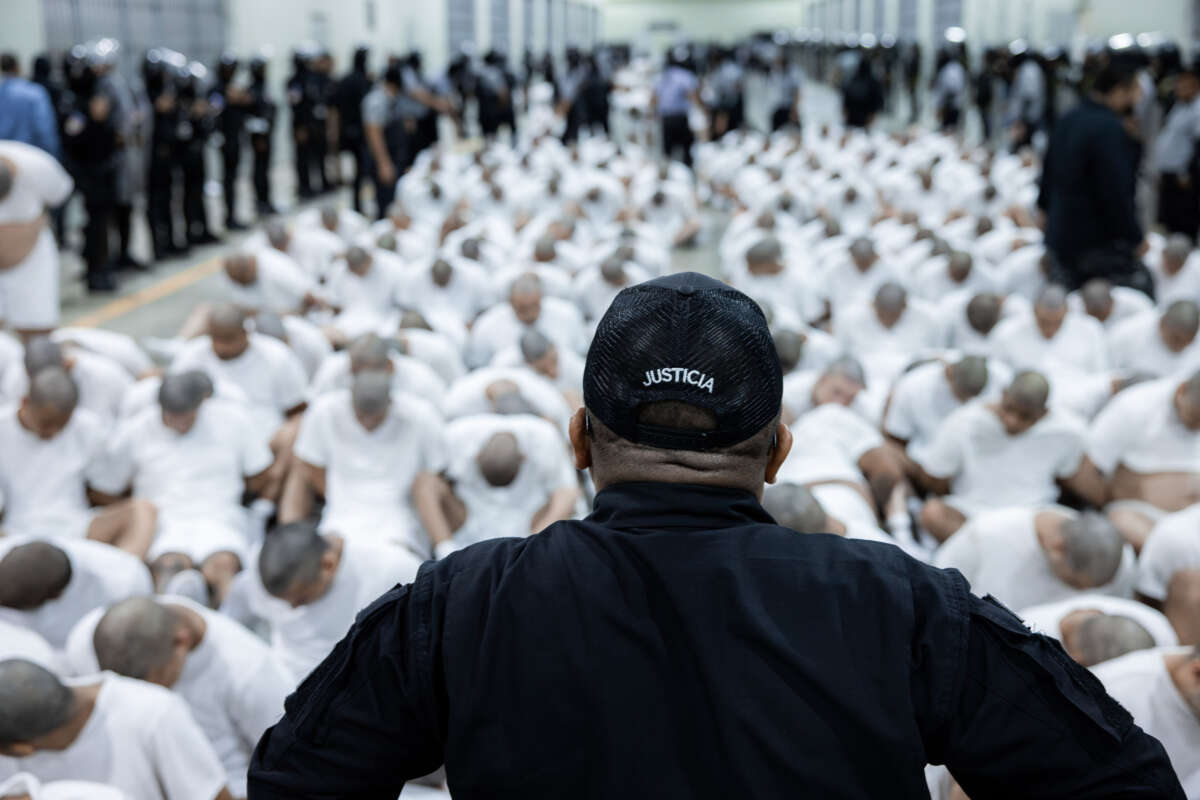
A guard watches Venezuelans the Trump administration deported to El Salvador’s largest prison, on March 16, 2025, in Tecoluca, El Salvador.
Salvadoran Government via Getty Images

On March 15, as U.S. President Donald Trump signed a proclamation — in secret — reactivating the Alien Enemies Act as a way to to speed up his mass deportation agenda, 70 activists from around the U.S. and Mexico gathered in Ajo, Arizona, in the heart of the Sonoran Desert.

We were convened for the weekend by Witness at the Border, a grassroots group that I co-founded, to share experiences and plan responses to the Trump administration’s onslaught on immigrant rights.

During our retreat, we heard the testimony of Dora Rodríguez, a Salvadoran Catholic activist who fled her homeland in July 1980 in the wake of the murder of Archbishop Oscar Arnulfo Romero by a death squad aligned with the military and political elites that were supported by the U.S., a killing that became a turning point in the intensification of El Salvador’s bloody civil war.

Rodríguez was one of only 13 survivors of a group of 26 who became stranded in the desert near Ajo, abandoned by their smuggler. At 19 years old, it was her third attempt to cross the border. The survivors’ plight became one of the founding inspirations of the sanctuary movement; Rodríguez has dedicated her life to providing humanitarian aid to migrants in the southern Arizona desert region and recovering and honoring the abandoned remains of migrants lost in the desert ever since.

The contemporary resonances of Romero’s murder — which is commemorated each year on March 24 — and Rodríguez’s case as a Salvadoran asylum seeker were thick in the air as we sought to connect Rodríguez’s reflections about her near-death experience in the desert 45 years ago, fleeing the impact of U.S-backed militarism in her beloved homeland, and its boomerang effects through the contemporary terror of the new Trump administration’s immigration and border policies today.

As we heard her story, we also began to detect its echoes in the news of the Trump administration’s reactivation of the Alien Enemies Act for the first time since World War II, applying it to 137 Venezuelans who it claimed were members of a gang known as the “Tren de Aragua,” which Trump has designated as a “foreign terrorist organization.” The last time the act was implemented was to mete discriminatory treatment out to 120,000 people of Japanese origin or descent — most of them native-born U.S citizens — by forcibly relocating and imprisoning them in “concentration camps” in retaliation for the attack on Pearl Harbor.

Creating an Archipelago of Detention

Strikingly, these Venezuelans, along with other expelled migrants on three flights that took off that day, were forcibly transferred for punitive detention in Rodríguez’s homeland in El Salvador, not to Venezuela. This marked a new inflection point in the Trump administration’s still unfolding policies of mass detention and mass deportation, as 238 Venezuelans and 23 Salvadorans were sent to El Salvador’s most notorious prison. This was in defiance of a federal judge’s order after an emergency weekend hearing, which included a demand that these flights be turned around in midair, if necessary. They were not.

The young men who were expelled have been loudly and visibly stigmatized by the Trump administration, its allies and the Bukele government in El Salvador as highly dangerous gang members — whom Trump has routinely deemed the “worst of the worst.”

The case may end up not only addressing what due process specifically means in the unique context of the Venezuelan detainees targeted by the Alien Enemies Act, but also whether the act itself is constitutional.

But no evidence has been provided that actually documents these allegations about the migrants expelled on these three flights, or hundreds of others who have been transferred and detained under similar circumstances at the U.S military base in Guantánamo Bay, Cuba. These “forced transfers” constitute what international law defines as “enforced disappearances,” which are categorized by Article 7 of the Rome Statute of the International Criminal Court as “crimes against humanity.”

Many family members, lawyers, and others who have been able to identify those who were expelled from photos and videos that have been widely circulated have sought to refute these blanket claims. Many of them seem to have been singled out simply because they were of Venezuelan origin and because of their migrant status, youth and tattoos.

Initial orders seeking to prevent additional deportations or forced transfers pursuant to the Alien Enemies Act have been appealed to the D.C. Circuit Court, which held a hotly contested hearing on March 24. The hearings thus far have included extensive additional filings and declarations trying to navigate a complex sequence of events.

Judge Boasberg issued a 37-page decision on March 24 extending his prohibition on further deportations pursuant to the Alien Enemies Act, and requiring that those who were sent to El Salvador were entitled to the opportunity to challenge its application to them. Meanwhile, a D.C. appellate court hearing later that afternoon heard arguments from both sides that might result in reversal of his order and further appeals later this week.

The case has become a crucial, historic test of what the Trump administration considers to be the “apex” where national security, foreign policy and plenary presidential powers around immigration converge and should be largely immune from judicial intervention. It may end up not only addressing what due process specifically means in the unique context of the Venezuelan detainees targeted by the Alien Enemies Act, but also whether the act itself is constitutional. It may also crystallize whether the Trump administration’s initial defiance of a federal court order will persist.

The Trump administration has designated Tren de Aragua as a “foreign terrorist organization,” along with seven other drug cartels based in Mexico and El Salvador, and Trump officials and allies have repeatedly threatened potential military intervention against them. The Trump administration alleges that this gang has undertaken a “predatory incursion” into U.S. territory that falls within the terms of the Alien Enemies Act, and also claimed that there are unspecified links between this gang and the Maduro régime.

The labeling of these gangs as “terrorists” — and the imprisonment of people they accuse, without any evidence, of being members in a prison designated for those who supposedly fall into this category — exemplifies crucial continuities.

These can be traced through the guiding threads of the methodologies of state terror that characterized U.S. strategies and affinities during the Cold War, and which have persisted as the emphasis of U.S. hegemony has shifted to the so-called “drug war” and “anti-terror” paradigms. The elites who benefit and the victims continue to be essentially the same as they were in the 1980s.

Another 101 Venezuelans who were transported on these flights, according to the administration, were subject to “regular” orders of deportation. But “deportation” normally refers to a process where a person is returned to their country of origin.

Deportations to Venezuela from the U.S. have been intermittent, complicated by tensions between the two countries, including the breaking of diplomatic relations during the first Trump administration in March 2019. Venezuela announced on March 22 that it would resume deportation flights, but there is no indication so far that this will resolve the status of the 238 Venezuelans already sent to El Salvador.

In this case, the Trump administration has gone out of its way to single out a specific nationality — Venezuelans — for expulsion to a country — El Salvador — that is known for what international human rights observers have documented as one of the most repressive prison systems in the world.

The detention of the Venezuelan migrants has been outsourced, or “externalized,” for profit, to a prison system characterized by systematic forms of cruel, inhuman and degrading treatment that are tantamount to both psychological and physical torture.

El Salvador’s role in imprisoning these migrants is part of a broader emerging Trumpian archipelago of detention sites that combines military bases within the U.S. and beyond (including in Guantánamo, on Cuban territory), and improvised sites in Panama and Costa Rica.


Korematsu, the Alien Enemies Act and the Tren de Aragua

The racism and xenophobia inherent in Trump’s treatment of Venezuelan migrants is shocking, but it has deep roots within U.S. history. For example, during World War II, the policies of Japanese relocation and imprisonment were upheld by the U.S Supreme Court in December 1944 in the Korematsu case — one of the court’s most notorious decisions — as an exceptional use of a racial classification (otherwise prohibited by the 14th Amendment’s equal protection clause) that was supposedly justified in this instance by considerations of “national security.”

The detention of the Venezuelan migrants has been outsourced, or “externalized,” for profit, to a prison system characterized by systematic forms of cruel, inhuman and degrading treatment

This is the same justification that the Trump administration has proffered in defense of its forced transfer of the Venezuelans on the March 15 flights, claiming that they fall within a supposed state of war between the U.S. and Tren de Aragua.

There was no evidence provided in 1942 establishing that any of the Japanese people rounded up by the U.S. government were in fact acting as agents of the Japanese Empire or active in espionage or sabotage during wartime.

In this sense, the application of the Alien Enemies Act in the 1940s nullified both the 14th Amendment’s protection against racial discrimination and its parallel provisions against violations of due process.

The same is true today. The effect then was that in practice, everybody of Japanese origin or descent, regardless of citizenship, was vulnerable. Today, the affected range of groups is theoretically narrower — alleged members Tren de Aragua — but in actuality no evidence or due process is required (nor has any been publicly provided), or if provided is intended to be hidden as a “state secret” cloaked by whatever the administration deems to be protected under the rubric of “national security.”

But it is clear that in effect, all Venezuelan young men over age 14 in the U.S. are now potentially vulnerable, because no proof of any gang membership is actually needed.

According to the Trump administration’s current repressive “logic,” any group, from any country, could be similarly designated for targeted Alien Enemies Act enforcement (and therefore forced exile and/or indefinite detention) at the president’s whim.

The March 15 flights underline a historic shift both in the contours of the administration’s overall approach to immigration, and in the geopolitics of its implications and impact in Latin America and globally. This includes not only the increasingly authoritarian, neofascist character of Trump’s approach but its application to a broad range of targeted victims.

Trump’s targeting of Venezuelans must also be understood within the broader context of long-standing U.S. aggression against first the Chávez and then the Maduro governments and ultimately against the Venezuelan people through sanctions.

It is not surprising, given the combined effects of U.S. intervention and Maduro’s authoritarianism and misrule, that Venezuela has become one of the leading cases of massive forced migration in the world, leading to the displacement of more than 7.7 million people.

At the same time, Trump’s outsourcing of the harshest forms of migrant detention to El Salvador must be placed within the broader context of U.S. military support and promotion of neoliberal devastation in El Salvador since the 1980s. In essence, the same forces that benefited from Archbishop Romero’s murder in the 1980s are those that profit from Bukele’s dystopian carceral state machinery today.

The predictable result has been a continuous chain of U.S. responsibility for undermining any hope of a dignified life for the vast majority of the population in both Venezuela and El Salvador, which has triggered massive processes of forced migration. These are intertwined with structural causes long promoted by the U.S., such as “free trade” and regional “drug wars,” combined with the ecocidal effects of climate change.

The application of the Alien Enemies Act in the 1940s nullified both the 14th Amendment’s protection against racial discrimination and its parallel provisions against violations of due process. The same is true today.

Deeply rooted hopes and initiatives for social justice and liberation in both countries — as in Latin America and the Caribbean regionally — continue to be both shaped and wounded by the destructive imprints of Spanish imperial and U.S. neocolonial domination, including the lingering echoes of the hemispheric dimensions of the Cold War.

The Trump administration’s current onslaught is epitomized by the use of the Alien Enemies Act, but has spread from supposed immigrant gang members and immigrant workers and their families to activists, holders of student visas, green cards, and even tourists and entrepreneurs. There are striking parallels between the arbitrariness that is characteristic of cases such as those of the young Venezuelans accused of being members of the Tren de Aragua and that of Palestinian activist Mahmoud Khalil, as part of the broader story of the dismantling of what is left of free speech and academic freedom at Columbia University.

In both contexts, the Trump administration has argued that it is untrammeled executive power — grounded in supposed national security and foreign policy imperatives (“state secrets”), within the context of immigration and border policy — that justifies both the mass deportation of Venezuelan “gang members” to forced exile in a Salvadoran prison, and the revocation of the permanent legal residency (green card) and deportation of a Palestinian activist who exercised his rights to free speech and assembly and then was hit with a McCarthy-era statute that has been rarely invoked since the 1950s.

All of this together constitutes a new McCarthyism that extends not only to those with origins in Latin America and the Caribbean, but also Palestine, South Asia, Canada, France and Germany, among other examples. It includes immigration lawyers and nonprofits that defend immigrant rights, students at universities in Trump’s crosshairs and critics of the president’s policies.

The U.S. government has long used “national security” as a justification to invoke exclusionary policies that target the very people most caught up in the aftereffects of the violence that the U.S. government creates. Trump’s latest measures mark a dramatic escalation, and our response must be as radical as the conditions that we confront. But as Dora Rodríguez’s story shows us, ending the racial exclusion that allows for repression and detention within the U.S. must go hand in hand with centering anti-imperialism in our immigrant rights work in the Trump era.


This article is licensed under Creative Commons (CC BY-NC-ND 4.0), and you are free to share and republish under the terms of the license.


Camilo Pérez-Bustillo is former executive director of the San Francisco Bay Area chapter of the National Lawyers Guild; member of the leadership team at Witness at the Border; a fellow at the Institute for the Geography of Peace in Juárez, Mexico/El Paso, Texas, and at the University of Bergen, Norway’s, Global Research Programme on Inequality; co-chair of the National Lawyers Guild’s Task Force on the Americas; professor of law and ethnic studies at St. Mary’s College of California; visiting chair professor of human rights at National Taiwan University’s College of Law; and co-founder of the International Tribunal of Conscience of Peoples in Movement.
Bernie Sanders to Force Vote on Blocking Bombs for Israel’s Destruction of Gaza

Grieving Palestinian Americans are demanding an arms embargo from their lawmakers as Israel escalates its genocide.
March 28, 2025

Sen. Bernie Sanders speaks alongside democratic senators to press in the U.S. Capitol on March 6, 2025, in Washington, D.C.Kayla Bartkowski / Getty Images

Sen. Bernie Sanders announced on Thursday that he would soon force a vote in the Senate on two joint resolutions to block the Trump administration from selling an additional $8.8 billion in certain bombs and weapons to Israel in the next week.

While the joint resolutions opposing the weapons transfer have little chance of passing the GOP-controlled Congress, a vote would force lawmakers to make their position public during yet another critical juncture in Israel’s genocide on the besieged Strip.

The announcement came the same day as Palestinian Americans who have lost family members in Gaza held a press conference to demand their congressional representatives support an arms embargo.

“I am here because Israel bombed a six-story building with three generations of my family,” said Rajaa Alrayyes, a Palestinian wife and mother living in Chicago, in a press conference on Thursday. “Some of my family members are still buried under the rubble and Israel won’t let us give them a decent burial.”

Sanders, who is Jewish, called the government of Israeli Prime Minister Benjamin Netanyahu “extremist.” Sanders also said that “Netanyahu has clearly violated U.S. and international law” over the course of Israel’s war on Gaza.

Israel has not allowed food, drinking water or medicine into Gaza for three and a half weeks, Sanders said, and the blocking of humanitarian aid is a “morally abhorrent and a clear violation of both the Geneva Convention and the Foreign Assistance Act.” He further noted that Israel has dropped U.S.-provided 2,000-pound bombs into crowded neighborhoods; the Trump administration has made more of those bombs available to Israel.

Hundreds of people have been killed since Israel broke a fragile ceasefire with Hamas in Gaza last week as Netanyahu sought to appease far right politicians who support the ethnic cleansing of Palestinians from Gaza and the West Bank to make way for Israeli settlers. Recent Israeli attacks forcibly displaced more than 142,000 Palestinians in Gaza who have already been uprooted multiple times, as Israel reignited its war on Gaza that has killed more than 61,000 people since October 2023.

“To survive Israel’s bombs, snipers and drones, my family has tried to split up, going to different shelters, hospitals and tents,” said William Asfour, a 28-year-old Palestinian American living in the Chicago area, during the press conference on Thursday. “If one group is bombed, the other might have a chance to survive.”

Asfour said he has lost dozens of family members in Gaza, including seven of his young cousins and their two parents who were killed during Israeli assaults over the past 10 days. He read their names aloud and held up a picture of the youngest victim, a 9-year-old girl. The girl’s father is a doctor and nutritionist at Nasser Hospital. Asfour said Israel destroyed his home, killing everyone inside.

“This is what is left of his wife, his mother and his children,” Asfour said, holding up photos of destruction. “By the way, they targeted his family again six hours ago.”

Earlier this week the Israeli military bombed Nasser Hospital, one of Gaza’s largest medical centers. The attack killed a Hamas official who was reportedly receiving medical care, the Israeli military said and Hamas confirmed. Feroze Sidhwa, a volunteer doctor at Nasser Hospital and a U.S. citizen, said a teenage boy who had been his patient was also killed in the strike.

“He would have gone home tomorrow,” Sidhwa said on social media this week. “If I had been changing his dressings, as I planned to this evening, I probably would have been killed too. Attacking hospitals is a war crime, and it needs to stop.”

Sidhwa is one of several U.S.-based doctors risking their lives in Gaza. In an interview this week with the news outlet Zeteo, Sidhwa said a woman from the U.S. embassy in Jerusalem called him after the bombing of Nasser Hospital to see if he was alive, and he urged diplomats to ask Israel not to bomb the hospital again.

“And I swear to God, she goes, ‘Actually, that’s not our role, sorry,’” Sidhwa said.

Like other international health care workers and human rights groups, Sidhwa said there is no evidence for Israel’s claims that Hamas militants are using medical facilities as cover for militant activity. Israel has consistently claimed its attacks on hospitals are justified, but striking civilian medical infrastructure is a war crime.

“Let us be clear this is not the first attack on hospitals in the Gaza Strip,” said Gulrana Syed, a Chicago-based emergency physician with Health Care Workers for Palestine, at the press conference, pointing out that this particular strike happened to put the lives of U.S. medical workers at risk. Syed said her friend and colleague, Tammy Abughnaim, is still treating patients at Nasser Hospital despite the deadly Israeli strike.

“We know the endangerment of American health care lives in Nasser Hospital is the direct consequence of U.S. lawmakers failing to sufficiently pressure Israel to cease attacks on life-sustaining institutions in Gaza, including hospital, water sanitation facilities and UN agencies,” Syed said.

Syed and other advocates are urging voters to demand their members of Congress to call for an immediate ceasefire and embargo on further U.S. arms transfers to Israel. Asfour said he has been trying to contact his representative in the House, Rep. Sean Casten, but has not heard back.

“Why haven’t you decided to meet with me?” Asfour said. “Why haven’t you asked me how my family is doing? I am your constituent.”

A spokesperson for Casten did not respond to multiple requests for comment. Advocates with the Council on American-Islamic Relations, a Muslim civil rights group, also called Rep. Bill Foster, a Democrat from Central Illinois, to condemn attacks on civilians and call for a ceasefire. Foster did not respond to requests for comment though he has criticized Netanyahu’s handling of the war in the past.

Sanders’s push to force a vote in the Senate on joint resolutions disapproving of the Trump administration’s latest transfer of bombs to Israel is designed to force debate in Congress, which has largely abdicated its duties for managing overseas military interventions to the executive in recent decades.

In November, Sanders coordinated a similar vote to block the Biden administration from sending $1 billion in tank rounds, mortar rounds and joint direct attack munitions to Israel. The vote overwhelmingly failed, but was still momentous for being the first-ever congressional vote to block weapons to Israel.

Sanders said the U.S. must not continue to supply weapons to the Netanyahu government, which is facing sustained protests by Israelis who say the prime minister is dragging out the genocide on Gaza for personal political reasons instead of securing a deal for a ceasefire and hostage swap with Hamas.
Children in Gaza Are So Hungry They’re Drawing Pictures of Food in the Sand

Israel has blocked all aid from entering Gaza for over three weeks, the longest total aid blockade so far.

By Sharon Zhang ,
March 27, 2025     
Palestinian children react as they inspect the rubble and debris at the site of Israeli strikes the night before at the Nuseirat refugee camp in the central Gaza Strip on March 23, 2025.Eyad Baba / AFP via Getty Images

Palestinian children in Gaza are so hungry that they’re drawing pictures of food in the sand, according to a Gaza reporter, as the population is being starved by the most brutal form of Israel’s aid blockade yet for the past three weeks.

“My friend told me today that he keeps watching food videos because he wishes to have a plate of meat or fish. Many children in my neighborhood outside were drawing food by their hands on the sand,” wrote Palestinian reporter Abubaker Abed on social media this week.

“Another neighbour hopes to see meat before his eyes. He is desperate for it,” Abed said.

Israel’s total aid blockade is now in its fourth week, with Palestinians once again facing relentless bombardment after Israeli authorities unilaterally ended the ceasefire deal last week.

Both the bombardments and the blockade are even harsher than they were prior to the pause, with Israel killing at least 103 Palestinians a day in bombings, according to Euro-Med Human Rights Monitor, and Israel now having blocked all aid into Gaza for the longest period of the genocide so far.

Related Story

Israel Bombs Southern Gaza Hospital With US Doctors Stationed There
One doctor condemned US presidents and Western media for complicity in Israel’s violence on CNN hours before the attack. By Sharon Zhang , TruthoutMarch 24, 2025

The World Food Programme (WFP) says it has a maximum of two weeks left of food stocks, while its flour supplies are only enough to maintain bread production at its bakeries for five days.

Even commercial goods have been barred by Israeli authorities, WFP says. Food prices in the besieged enclave have soared, with goods like flour now selling for U.S.$50 a bag — a 400 percent increase compared to pre-March 18 prices.

This means that the “record low stocks” of food are putting hundreds of thousands of Palestinians at risk of “severe hunger and malnutrition,” WFP said.

“During the ceasefire, 500–600 trucks arrived daily. Now, nothing,” wrote UN Relief and Works Agency for Palestine Refugees head Philippe Lazzarini. “Parents cannot find food for their children. The sick are without medicine. Prices are soaring. Hunger is increasing while the risk of diseases spreading is looming.”

Israel is further hampering aid work by targeting and killing aid workers. In the last week alone, the UN reported on Wednesday, Israel has killed eight aid workers in Gaza, bringing the total number of aid workers killed in the genocide to 399. In addition to that number, Gaza Civil Defense officials announced on Thursday that nine Palestinian Red Crescent workers who had been missing for days, as well as several civil defense workers, were confirmed killed by Israeli forces.
This Eid Was Supposed to Be a Moment of Respite — Not Another Day of Mourning

Last Eid in Gaza was overshadowed by destruction, heavy bombardment and bloodshed. I’d hoped this Eid wouldn’t be too.

By Shahad Ali
March 29, 2025

Palestinian women displaced from northern Gaza make traditional cookies for the upcoming Eid al-Fitr holiday in Gaza City, on March 28, 2025.
OMAR AL-QATTAA / AFP via Getty Images

Eid al-Fitr, which marks the end of Ramadan, was once eagerly awaited in Gaza, a rare occasion that brought a sense of joy and normalcy. Its preparations began days in advance — homes were cleaned, a fresh touch of decoration was added and families made sure everything was in place for the celebration. Parents saved up to buy new clothes for their children, knowing how much it meant to them to dress well on Eid.

The streets stayed lively late into the night, filled with people shopping for last-minute essentials. Bakeries worked tirelessly, filling the air with the scent of ka’ak, the traditional date-stuffed cookies, alongside trays of chocolate and vanilla biscuits — simple treats that would soon be shared over coffee with guests. Shops displayed an array of high-quality chocolates, candies, halkom (Turkish delight) and roasted nuts, small luxuries that made Eid feel complete.

On the first morning of Eid, we would wake up early, dress in our best clothes and make our way to the mosque for the Eid prayer. There, we exchanged greetings, smiles and handshakes, a heartfelt tradition that carried deep meaning, reminding us that Eid is about togetherness. The takbirat, the chants of “Allahu Akbar” recited on Eid, filled the air, creating a familiar rhythm that made the day feel different, wrapped in a quiet sense of spiritual peace.

After the Eid prayer, we would head home to prepare breakfast. Breakfast was always special, made exclusively for Eid al-Fitr. It included fesikh — a fermented, salted and dried fish with a bold, briny flavor — along with salad dressed in tahini sauce and tomatoes fried in olive oil.

People in Gaza eagerly awaited Eid al-Fitr, especially for this breakfast, rich with diverse flavors. What made this breakfast even more special was the gathering of families around the table, where we would laugh, share stories and savor every bite together.


Then came the time to select and dress in special clothes for Eid, preparing to welcome arriving guests, including relatives and friends who came to share in this joyful occasion. Children loved this part the most — you could see little girls in colorful dresses, their hair adorned with bright accessories, and boys in suits and ties, applying perfume. Their new outfits brought an extra spark of happiness to their faces as they eagerly headed out with their Eidiyah (gift money) to buy delicious snacks and toys from the market.

Despite the strict siege imposed on Gaza for over 15 years, we continued to find simple ways to enjoy such a special occasion. However, the Israeli occupation had made even the slightest attempt to create a fleeting sense of happiness in Gaza a luxury we can no longer afford. Last Eid came amid war and starvation, stripping us of our cherished Eid traditions. We had no chance to bake ka’ak, savor the taste of chocolate, or prepare the beloved Eid breakfast we once enjoyed along with our loved ones.

Last Eid felt empty, as many had lost their homes and their loved ones — the very ones who made Eid meaningful. Personally, I lost my mother due to the Israeli military invasion of Al-Zaitoun neighborhood, and my grandmother to starvation and the lack of medical care.

I still remember how my family and I were forced to evacuate under heavy bombardment just a few days before Eid al-Fitr, ending up in a UN school-turned-shelter for displaced families. We carried deep sadness and despair in our hearts, reminiscing about the beauty of Eid in times of peace, when we were surrounded by our loved ones.

Children didn’t wear new, elegant clothes for Eid, nor did they enjoy buying toys and sweets. In fact, some were terrified of going out because of the Israeli bombardment, while others were busy filling their water gallons, or getting food from charity kitchens.

My 7-year-old cousin, Haneen, cried a lot as the Israeli forces burned all her colorful, puffy dresses — the ones she loved to wear on Eid — during a military operation in Al-Zaitoun neighborhood.

“I don’t have any beautiful clothes for Eid. I don’t love Eid anymore,” she said.

Last Eid lost its joy — overshadowed by destruction, heavy bombardment and bloodshed. However, with the ceasefire taking effect in January 2025, people in Gaza clung to the hope that the war would not return. They held onto the belief that the ceasefire would last, offering them a chance to revive some of the Eid pleasures they had been deprived of for so long. Some even began planning for things they hoped to do this Eid.

Personally, I bought a new set of colorful dishes, planning to serve ka’ak and chocolate for guests. I even dared to buy a new carpet and bright ornaments and vases to decorate our small apartment for Eid. My 13-year-old brother Osama was so excited for this Eid, and he made so many plans, including buying new clothes and perfume, and going out to see his friends, whom he missed a lot. My father even planned to invite my uncles and aunt to eat fesikh together on the first day of Eid.

However, our simple plans to live in peace and revive some of the Eid traditions we love were shattered by unannounced heavy bombardment on March 18. The ceasefire, which had given us a fleeting chance to dream and plan amid the pain and suffering, has ended, and the war has returned. The people in Gaza are now living in a state of shock and fear.

We have had enough of wars. Even now, it is hard to believe that this Eid — the one we clung to, eagerly awaited and planned for — will be just like the previous one. Most people have forgotten their Eid plans, consumed by worry about what they will do if they are forced to evacuate to the south again, how they will survive if their stored food runs out, and what will happen if the blockade that prevents humanitarian aid from entering the Strip continues. The thought of reliving the horrors of the past 15 months erases their excitement for this Eid.

This Eid was supposed to be a moment of respite, a chance to reclaim even the smallest fragments of happiness. Instead, it has become another day of mourning, another reminder that in Gaza, not even our dreams are safe.


Shahad Ali is an English literature student and writer from Gaza.