Wednesday, April 02, 2025


Are lifetimes of big appliances really shrinking?


There's a popular perception that the useful lifetime of large appliances, such as washing machines and ovens, has decreased over the years. But consumer preferences may play a bigger role than people realize.


Norwegian University of Science and Technology


Big appliances, like washing machines, ovens and refrigerators, are a major investment for many households. Consumers hope that these appliances will last for decades. More and more, however, people have the perception that these big-ticket items might not be lasting as long as they once did.

But when Kamila Krych looked at actual trends in product lifetimes as a part of her PhD research at the Norwegian University of Science and Technology's (NTNU) Industrial Ecology Programme, she found that wasn’t quite true.

“Despite what people think, there is no evidence that product lifetimes are decreasing,” she said. “Many people think that products have been becoming less durable. But this work suggests that no, that’s not entirely true.”

Well, aside from two big-ticket items: washing machines and ovens.

The big exceptions

Krych looked at a range of data on large appliances in Norwegian households, starting from the time they were first adopted in the country. For refrigerators, washing machines and ovens, this was starting in 1950.

Other appliances didn’t find their way into Norwegian households until several decades later. That was true for dishwashers, freezers and tumble dryers.

For almost all of these appliances, their lifetimes stayed roughly the same across the decades. That was not the case for washing machine or ovens, however.

Washing machine lifetimes decreased by 45 per cent, meaning that their lifetime decreased from 19.2 to 10. 6 years, while ovens decreased from 23.6 years to 14.3 years (39 per cent).

"If planned obsolescence or another single factor was to blame, we would expect the same decreasing trend across all appliances. Instead, we only found it for washing machines and ovens," she said.

Why was this true just for these two appliances?

Cleaner lifestyles?

To find the answer, Krych dug deeper into published information on consumer preferences and details about the appliances themselves.

With washing machines, “it’s pretty simple,” she said. The lifetime of an appliance isn’t necessarily how many years the product lasts, but may be more closely related to how many cycles it runs.

“For washing machines, what matters is how often you run it. And there has been a documented large change in laundry habits,” she said. “People do the laundry much more often now than in the past.”

Krych found a 2003 study that showed that in 1960, an average Norwegian family of four did a laundry twice a week. By 2000, this number had quadrupled to 8 washing cycles a week for that family of four.“This obviously can have an influence on lifetimes of washing machines,”  she said.

For ovens, however, the story is a little more complicated.

Changes in electronics and kitchen trends

Krych’s research didn’t directly address how people used their kitchens, but she was able to look at published research on societal trends in Norway over the decades.

“Ovens used to be very durable, and historically lifetimes were high, because oven design is very simple,” she said.

But Krych found other research that showed roughly 40 per cent of all ovens in Norway are discarded when they are still functioning. That’s a rate that is higher than other household appliances.

Another trend she saw in her own research was that the lifetimes of other appliances in Norwegian kitchens, such as refrigerators and dishwashers, was also converging – meaning that all of these appliances had about the same lifetimes.

“This is circumstantial evidence, but this points to the importance of kitchen renovation,” she said.  “And right now, we often have all of these appliances integrated in kitchen cupboards. And because of how expensive things are in Norway, it's often much easier to discard everything at once when you renovate your kitchen than to keep your oven for longer, even though it still works.”

Another change that social scientists have identified, Krych said, is the change in the way the kitchen is used in Norwegian households.

“There is lots of social science research that says we use kitchens differently now than we used to in the past,” she said. “People often have kitchens integrated with their living rooms. And this means that the look of the kitchen matters much more.”

Changing consumer behaviour

Current policies in the EU designed to help cut the overall environmental impact of consumer consumption have focused on product durability and incentives for repairing products.

Krych says that’s a good goal but thinks that policymakers could benefit from including social factors, such as changes in lifestyles, into their planning.“Product lifetimes are not only about how long the product can last, but also what people do with them,” she said.

Reference: Krych, K. & Pettersen, J. B. (2025). Long-term lifetime trends of large appliances since the introduction in Norwegian households. Journal of Industrial Ecology. https://doi.org/10.1111/jiec.13608


TRUMP'S APRIL 2, 2025 'LIBERATION DAY' TARIFF ANNOUNCEMENT


US Sociology leaders rally in support of academia, urge protection of free inquiry and research


News Release 
American Sociological Association


The American Sociological Association has led a coalition of leading sociological organizations to issue an open letter defending the vital role of sociology in universities and society while condemning recent federal actions that threaten academic inquiry and free speech. Signed by the presidents of ten major sociological associations, the letter calls on university leaders, policymakers, and the public to resist efforts that undermine the discipline and stifle research that benefits society. 

The signatories express their growing concerns over abruptly canceled federal contracts, looming job losses for sociologists in academia and the public sector, and a climate of fear preventing scholars from exercising their constitutionally protected rights. They warn that these threats harm individual researchers, diminish public knowledge, and weaken the institutions that fuel economic, social, and technological progress. 

“Sociology strengthens universities, the private sector, and public institutions,” the letter states. “Through empirical research, sociologists provide critical insights into pressing social issues—from the effects of immigration on crime rates to the benefits of family-friendly workplace policies. The suppression of this knowledge is a disservice to society.” 

The letter firmly opposes federal policies restricting academic freedom and research, emphasizing that universities serve as hubs of knowledge discovery, training the next generation of social scientists whose expertise informs sectors such as technology, healthcare, and government. The authors urge university leaders to oppose efforts to restrict sociological education and research, affirming that “dismantling academia doesn’t just hurt academics; it deprives everyone of trained specialists who contribute to critical industries.” 

Considering these challenges, the coalition calls on universities to actively support sociology departments, faculty, and students. “Now more than ever,” the letter concludes, “leaders in higher education, private industry, and the public sector must stand up for academia and affirm that sociology plays a crucial role in advancing knowledge and fostering a better society.” 

Read the full letter here: https://www.asanet.org/wp-content/uploads/2025/03/Open-Letter-in-Support-of-Academia.pdf 


Silence Isn’t a Strategy: Academic Leaders Must Resist Assault on Higher Ed

Capitulating to the assault on higher education will only bring more attacks.


By Michael H. Gavin
March 31, 2025

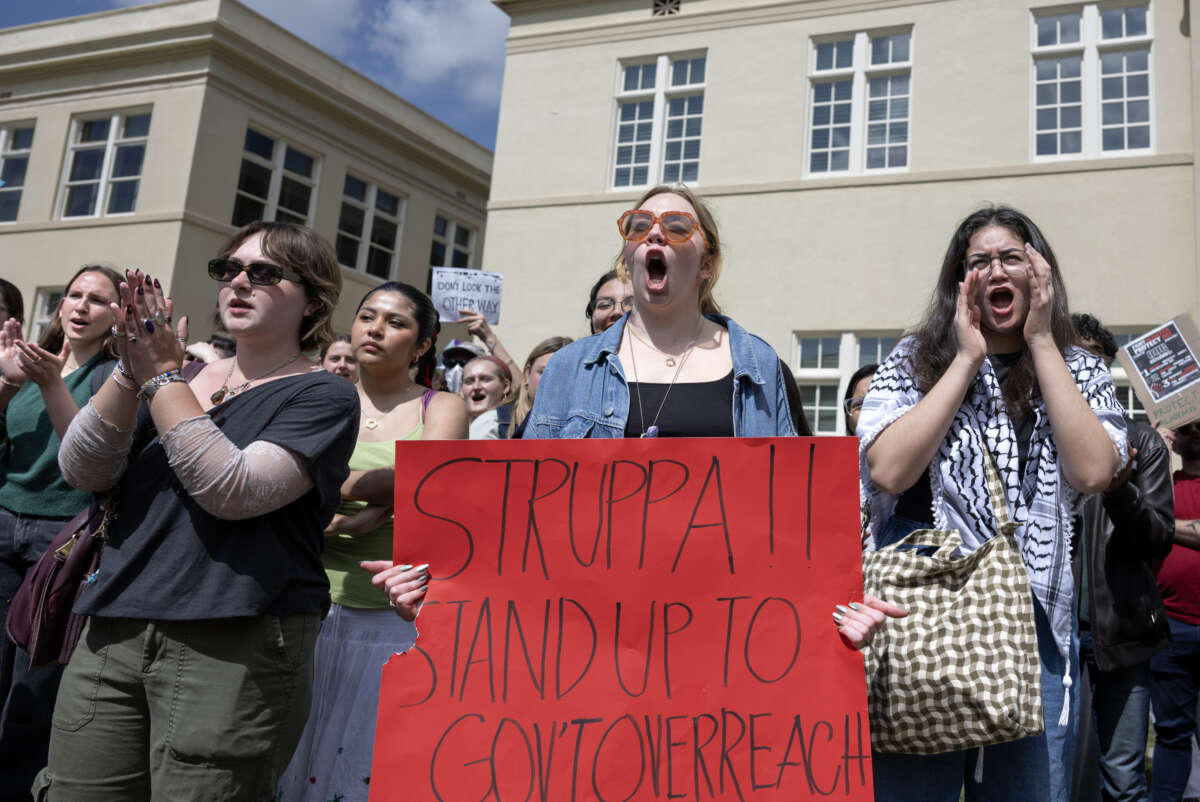
Chapman University student Hailey Bunsold, 21, center, and about 200 students take part in a walkout and protest on March 17, 2025, against Trump's policies, including his executive orders to dismantle Diversity, Equity, and Inclusion initiatives.Mindy Schauer/Digital First Media/Orange County Register via Getty Images

Nearly five years ago, then-President Donald Trump released his first anti-diversity, equity and inclusion (DEI) executive order. The executive order, intentionally erroneous in its claims that DEI practices violated civil rights laws, sent shock waves through the academic community. Despite its false claims and eventual overturning, the executive order provided a playbook for right-wing state legislators to develop bills and laws that were not so much anti-DEI as they were anti-civil rights.

Upon returning to office, the Trump administration issued four executive orders. It also issued a “dear colleague letter” — a non-binding communication clarifying direction for offices and sectors of government — and withheld over $1 billion from two higher education institutions as part of a ransom-type takeover of higher education.

Today, the higher education ecosystem remains shocked, but hardly surprised. And many institutions, University of Michigan being the latest, have self-imposed restrictions on academic freedom and DEI in hopes of preemptively removing themselves from any targets the right-wing apparatus sets on them. However, over 55 universities are listed for investigation and action by the Trump administration; the Department of Education has been downsized; and more executive orders are in the works.

In this context, higher education’s collective stasis invites a scaled assault on our sector that extends beyond what we have seen.

Moreover, self-imposed restrictions miscalculate the multidecade history, scale and intent of the assault we are facing. For being safe today does not mean safe tomorrow; and tomorrow’s attack will be more refined and scaled than today’s.

The movement assaulting higher education, what I call the new white nationalism, is well-networked and well-funded. The new white nationalism uses legal, social and cultural apparatuses to perform the same work of the traditional skin-headed or white-hooded white nationalism. It acts covertly so that what is presented to the mainstream may often seem benign when it is anything but.
Strategies and Tactics That Higher Education Unknowingly Supports

Much of academia and the mainstream media fall victim to misdirection when it comes to the strategy of the new white nationalism. Executive orders, dear colleague letters or egregious retraction of federal funding create explosive stories for the mainstream media and public consuming it. The language in Trump’s executive orders and dear colleague letters, however, intentionally pervert reality of what is happening on college campuses for the mainstream to make it seem that civil rights are being upheld when in fact they are being decimated.

Their true purpose is to provide a road map for state legislatures to follow as they impose anti-academic freedom, anti-institutional autonomy, anti-civil rights, and anti-educational restrictions on their own state’s public institutions. We know this because of how Florida and Texas used the first Trump executive order in 2020 as a road map to decimate the operations and mission-centric values of their DEI offices, curricula and outreach. To be sure, the most significant damage has been and continues to make its way through state-level anti-DEI legislation — most recently seen in Ohio, Kentucky and North Carolina.

As states follow the Trump administration’s road map in their own legislatures, they also learn from one another’s lessons learned in court. Ohio’s Senate Bill 1, for instance, refined what was Florida’s anti-DEI bill, which was delayed because it originally violated free speech laws. That refinement avoids such constitutional freedoms but provides even more control by the state regarding curriculum and academic freedom, and eliminates DEI even more radically than in Florida.

Because right-wing legislators learn from one another across states, these bills are becoming increasingly extreme. For instance, an unprecedented bill in North Carolina would subject educators to misdemeanor charges for engaging in DEI. The fear such legislation creates — and subsequent alteration of policies, procedures and individual behaviors — cannot be underestimated. For example, despite the fact that the bill has not yet become law, institutions in North Carolina are already making changes to their operations, especially those that focus on marginalized students’ success. Faculty and staff in many states, North Carolina included, are prohibited from even using the language of DEI in email or texts for fear of repercussions.

Legislated fear is violating free speech and civil rights.

In a snowballing fashion, extremism is being normalized.

We may hope to avoid the assault on education by pretending that silence is a strategy. We may believe that inaction will allow us to survive for the next four years.

But we are in the middle of a movement, not a moment. We are watching as the snowball rolls, and soon we will be hit with an avalanche if we fail to act now.
Civil Rights, Higher Education and the Inertia of Complacency

Decades ago, the leaders of the new white nationalism concluded that individuals and institutions that comprise the American public, even the most well-meaning, will rarely (if ever) mobilize against legislation or policy that impinges on others’ civil rights. Only when legislation or policy impinges on these individuals or institutions directly will a defense mount against the new white nationalism. But by that moment it is too late. As a result, inaction and silence are not strategies. They are capitulations to the right.

Watching as the right actively clamps down on the free speech of students protesting for Palestine, to include their arrests, is not stasis — it is choosing to comply with such actions.

In short, our political context has placed higher education in a new partisan realm that is dangerous and that weaponizes academic freedom, institutional autonomy and DEI against us. Still, as a sector, we have not been transparent with the public or with each other about who is attacking us, how and why because we fear partisan retaliation. But partisan attacks permeate the country no matter what posture academia takes. And if we remain silent about the truth of who is attacking us, we are supporting that attack.

A right-wing movement counts on our fear and subsequent stasis and silence. Let us not fool ourselves, either: Many of us falsely believe we are being strategic but are actually complying with an assault on civil rights and our institutional missions. For instance, many institutions engage in what Liliana Garces calls repressive legalism because the consequences threatened for doing work central to higher education’s missions are so extreme. When Trump’s administration threatened students’ federal Pell grants, higher education leaders were faced with impossible choices of continuing the work of democracy and education, or losing funding. They often complied with demands predicated on perversions of what DEI is in order to secure already promised funding. While the need to secure funding is understandable, the sector’s quiet and inactive stance has left the forthcoming generation of students without the support they need and the knowledge a curriculum that teaches truth provides. We are trading our purpose for our temporary comfort; our moral contract for a false belief that this assault is momentary and will not scale further than what we allow in the moment.

But the threats are often leading us to do the work of the new white nationalism for them. For instance, Trump’s February 14, 2025, dear colleague letter continuously referred to “illegal” DEI or DEI that “violates” civil rights as reason to withhold federal financial aid from students. The same dear colleague letter indicated that further direction would come two weeks after the letter was published. That clarification, issued on February 28, 2025, can be summarized as stating the obvious: Segregation is illegal — a fact all of us in higher education both knew and agree with. But the clarification went one step further: It promised that institutions would have due process should the administration believe they were out of compliance with civil rights law. As Steve Robinson aptly pointed out, there was no need for the corrections many institutions made between the dear colleague letter on February 14 and the guidance on February 28.

Finally, the due process promised would include investigation into whether an institution’s policies disproportionately impact certain people or races more than others (to be backed up by statistics demonstrating such patterns); and whether the school was aware of or could foresee the effect of said policy or decision on members of a particular race.

Ironically, these factors underpin nearly all equity-based practices and policies in higher education. Indeed, it could be fairly argued that any orders or laws that prohibit DEI are now in violation of civil rights as defined by this dear colleague letter’s guidance — an irony for a court to hash out if a brave institution decides to argue it.
A Strong Reimagination of Higher Education Is Necessary

The erosion of civil rights coupled with the questioning of higher education’s value are capitalized upon and leveraged by an orchestrated, well-funded network of activists who are clear about their singular goal of eradicating higher education of DEI. From Chris Rufo to the Heritage Foundation, from Turning Point USA to Edward Blum, these individuals and think tanks attack higher education’s curricula and accessibility goals because they know that reimagining the world inclusively manifests a future that reduces racialized oppression.

While the attack is horrifying, the potential to reimagine our world is reciprocally great. For higher education is one of the few sectors well-situated to assert how civil rights, citizenship, justice and humanity intersect. And it is at this intersection that higher education leaders must imagine and act with urgency.

We must imagine in a way that pushes beyond the public discourse that perverts critical race theory for racist ends; or the futile desire to build bridges with those who have, as of March 2025, introduced legislation to make it a criminal act to teach, practice in or consider DEI.

We must move beyond the game of whack-a-mole that creates chaos nationally and within our sphere of influence. We must understand each individual federal order or state bill that attacks higher education is part of a larger anti-educational, anti-diversity movement with the goal of further marginalizing those who have historically been marginalized. Understanding this motive better informs our decisions to react.

There is no doubt that situating our moment and the landscape in this fashion is rife with danger. But it is also dangerous not to. Indeed, we must challenge the notion that academia must be overly careful and not provoke retaliation — for that is the way we arrived at the moment we are in today.

We need to separate the constructs of “partisan” from “political.” We need to make clear that while higher education has remained nonpartisan, only one party is actively engaged in an effort to dismantle the very missions of our educational institutions and civil rights of our students, employees and communities.

We have heard the cliché that silence is complicity for years now. We have now seen that complicity and complacence are choices that accept the decimation of our sector, the deportation of our students and the reduction of entire populations we serve to second-class citizens. Our silence is not a strategy. Our inaction is not wise.

We also must recognize that the tools to navigate this moment can no longer be reduced to finding the right words, the right logic, the right promises so that the new white nationalism will understand us differently. These lines of inquiry have begun to dominate the talks that should be strategic. Proclamations such as “equity is about more than race” or “change language, not values” indicate that we have already entered into a debate and negotiation we have lost by engaging in what Paul Gorski calls racial detours — a practice that voids race from discourse and strategy “under the illusion of progress.” The racial detours of our moment perform the right’s goals from the jump.

We need a national strategy in which higher education administrators in “safer” states pick up the mantle for all of us to save our sector, and indeed our democracy.

We must acknowledge that higher education leaders are not necessarily experts in U.S. history, politics and critical race theory, which are lenses necessary to lead — not manage — against the attacks we are seeing. Hence, our sector also needs training among leaders that provides background on the new white nationalist movement that seeks to dismantle higher education. Such training can provide academic leaders with theoretical and practical lenses to look at their own institutions, but also tools to collaborate with each other.

There will be detractors from what I suggest here. Some will claim that I am calling out too many of us, or that my argument is not timely. I would remind us what Martin Luther King Jr. taught us about remaining complacent when civil rights are on the line, and how timeliness is an argument made by those who benefit from time passing by.

The time is now for academic leadership to learn about the movement against us and why it threatens democracy.

Likewise, now is the time for us to consider a new view of what higher education can be if it is seen as a right, not a privilege, for all. A group I have been leading, Education for All, continues to do this work.

We are no longer facing a movement that an election could help us avoid; the landscape has significantly changed in just a few months. The arrest of Mahmoud Khalil, the criminalizing of pedagogy, the yanking of federal grants and the threat of Pell dollars being voided all show we are in a dangerous moment. And while speaking out is important, a greater national strategy is even more so.


This article is licensed under Creative Commons (CC BY-NC-ND 4.0), and you are free to share and republish under the terms of the license.


Michael H. Gavin is the president of Delta College. He is the author of two books; the most recent, The New White Nationalism in Politics and Higher Education was released in 2020, and is in paperback as of spring 2023. He leads a national coalition of college presidents and higher education leaders in resisting anti-DEI legislation called Education for All. Known nationally for his administrative leadership that focuses on academic excellence and equity, Gavin has over 20 years of experience at large community colleges. Under his leadership, Delta College has closed racial and ethnic enrollment equity gaps and dramatically improved completion rates for students of color. Delta College was named the winner of Eduardo J. Padrón Award for Institutional Transformation under his leadership. Gavin earned his doctorate in American studies at University of Maryland and most recently completed an Aspen Fellowship in community college presidency. Whether serving on national or local boards, working on a committee, or through his scholarship, Gavin is committed to the notion that community colleges have the capacity to reshape the inequities in society through open access education and teaching excellence.
LOCK HIM UP!

Waltz Has Used Personal Email and 20 Other Signal Threads for Government Affairs

Reports of 20 Signal chats and Waltz’s Gmail mark at least four major security liabilities uncovered since Signalgate.


By Sharon Zhang , 
April 2, 2025

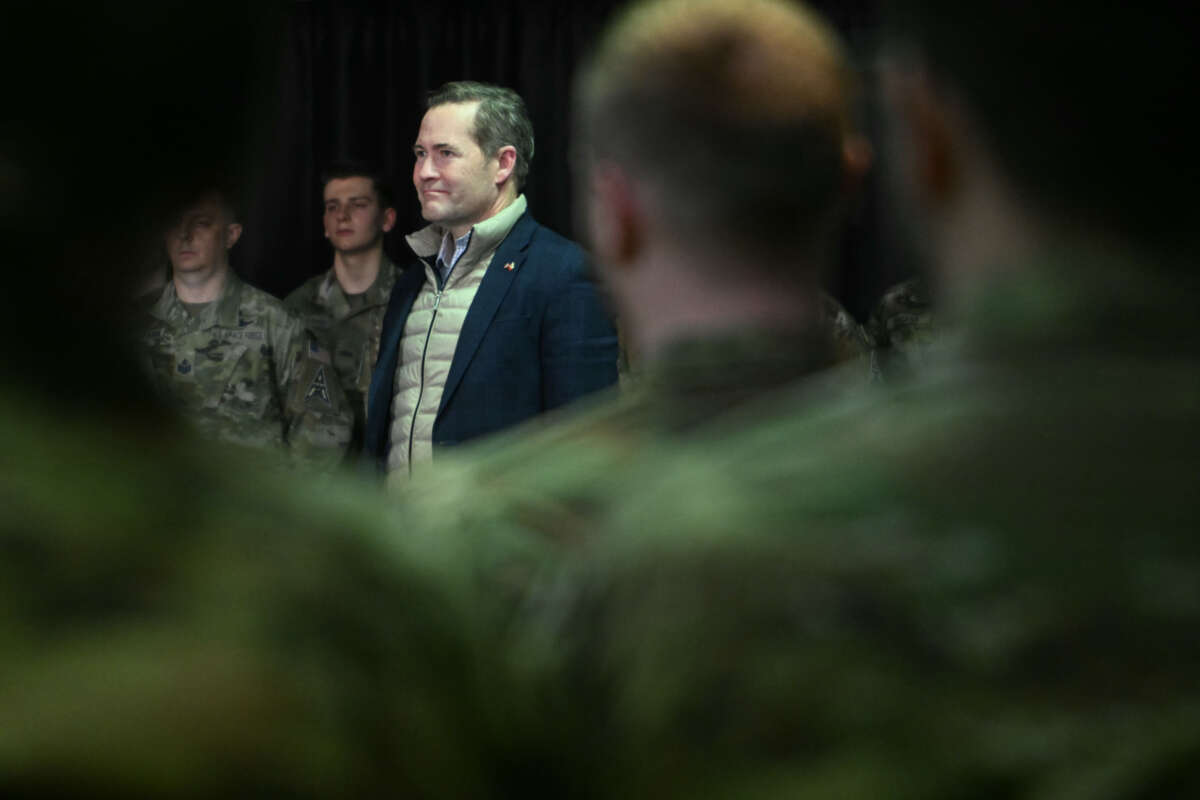
National Security Advisor Mike Waltz listens at the U.S. military's Pituffik Space Base on March 28, 2025, in Pituffik, Greenland.
Jim Watson - Pool / Getty Images

President Donald Trump’s national security adviser Michael Waltz and his staff have used personal Gmail accounts to conduct government business, a new report released Tuesday reveals, in the latest instance of Waltz seemingly using methods of communication that are unsecured and vulnerable to breaches.

In at least one instance, a senior aide to Waltz used Gmail to discuss “sensitive military positions and powerful weapons systems relating to an ongoing conflict,” according to The Washington Post, which viewed the emails. In other instances, Waltz himself used his personal email to review documents and discuss matters like his work schedule.

Government officials have secure, encrypted services for communications that are less vulnerable to hacking and other cyber attacks. Gmail is not one of those services, and “the contents of a message can be intercepted and read at many points,” Electronic Frontier Foundation cybersecurity director Eva Galperin told The Washington Post.

The news comes after The Atlantic revealed in a bombshell report last week that Waltz had seemingly inadvertently added Jeffrey Goldberg, the publication’s editor in chief, to a group chat on the messaging app Signal that was dedicated to planning and discussing the Trump administration’s strikes in Yemen that killed dozens of civilians.

The news also adds to a growing picture of a seemingly blasé attitude toward secure communications within the office of a U.S. security official. These lax security practices leave the U.S. vulnerable to hacks, while also potentially breaking federal laws regarding archival of federal communications, experts have said.


On Wednesday, Politico reported that Waltz and his team “regularly” use Signal to coordinate issues relating to foreign affairs. This includes issues regarding Gaza, the Middle East, Ukraine, China, Africa, and other places — with sensitive information often shared. Citing four people who have been added to the chats, Politico said that there are at least 20 such chats.

Sources said that the use of Signal isn’t just common with Waltz and his office — it’s effectively standard practice.

“Waltz built the entire NSC communications process on Signal,” one source told Politico.

The Signal chats and Gmail use are just two of at least four other technological security liabilities discovered by journalists since The Atlantic originally broke the Signal story. Waltz and his team have denied wrongdoing.

Wired has reported that Waltz has also seemingly left his Venmo friends list open to the public, showing hundreds of Waltz’s associates — including numerous journalists, military officials and lobbyists, the report said. Secretary of Defense Pete Hegseth has also left his Venmo profile public, The American Prospect reported in February.

Further, German news outlet Der Spiegel found that Waltz, Hegseth and Director of National Intelligence Tulsi Gabbard’s contact details and, in some cases, passwords have been exposed through hacked personal data that has been published online. Most of the numbers and email addresses linked to the officials are still in use on social media and communications platforms, the outlet found.

Democrats are reportedly drawing up articles of impeachment over the Signal chat for Hegseth, Waltz and CIA Director John Ratcliffe, who was also in the chat — as the White House is adamant about ensuring that Waltz and others stay in the administration, seemingly to save face.

“The one thing saving [Waltz’s] job is that Trump doesn’t want to give Jeff Goldberg a scalp,” an administration official told The Washington Post.


Trump advisor Waltz faces new pressure over Gmail usage


By AFP
April 1, 2025


US National Security Advisor Mike Waltz is facing more allegations he discussed military positions and weapons systems on non-governmental communications platforms - Copyright AFP/File ANDREW CABALLERO-REYNOLDS

US National Security Advisor Mike Waltz, who has faced calls to resign over his role in the recent Yemen chat group scandal, saw renewed scrutiny Tuesday after the Washington Post reported on his usage of Gmail for official work.

The newspaper also said that one of Waltz’s senior aides used Gmail to discuss military positions and weapons systems, reigniting questions over the handling of sensitive communications inside President Donald Trump’s administration.

Waltz had his schedule and other work documents sent to his account on the Google email service, the Washington Post reported.

The White House later confirmed that Waltz had “received emails and calendar invites from legacy contacts on his personal email,” but that he had “cc’d government accounts” since the start of the Trump administration to satisfy record retention laws.

Waltz “has never sent classified material over his personal email account or any unsecured platform,” said National Security Council spokesman Brian Hughes, who blasted the story as “the latest attempt to distract the American people from President Trump’s successful national security agenda.”

Hughes said he could not respond to the Washington Post report about Waltz’s aide, claiming the newspaper had not shared the sensitive information with the White House.

“Any correspondence containing classified material must only be sent through secure channels and all NSC staff are informed of this,” he said.

Waltz last month provoked an embarrassing saga for the Trump administration after he inadvertently added The Atlantic magazine’s editor-in-chief to a group chat on Signal, a commercially available messaging app, in which air strikes against Yemen’s Huthi rebels were discussed.

Officials including Waltz and Defense Secretary Pete Hegseth used the chat to talk about details of the air strike timings and intelligence, unaware that the highly sensitive information was being simultaneously read by a member of the media.

Waltz told Fox News host Laura Ingraham last week that he took “full responsibility” for the breach, saying: “I built the group; my job is to make sure everything’s coordinated.”

Trump has rejected calls to sack Waltz or Hegseth and branded the scandal a “witch hunt.”

White House Press Secretary Karoline Leavitt meanwhile told journalists on Tuesday that “the case is closed, and the president continues to have confidence in his national security advisor.”

But the Gmail revelations could add to pressure for Waltz’s removal from office.
With Detention of Beloved Farmworker Organizer, ICE Comes for the Labor Movement

“We believe he was targeted,” says the political director of the farmworker union that Alfredo Juarez helped to create.
April 1, 2025

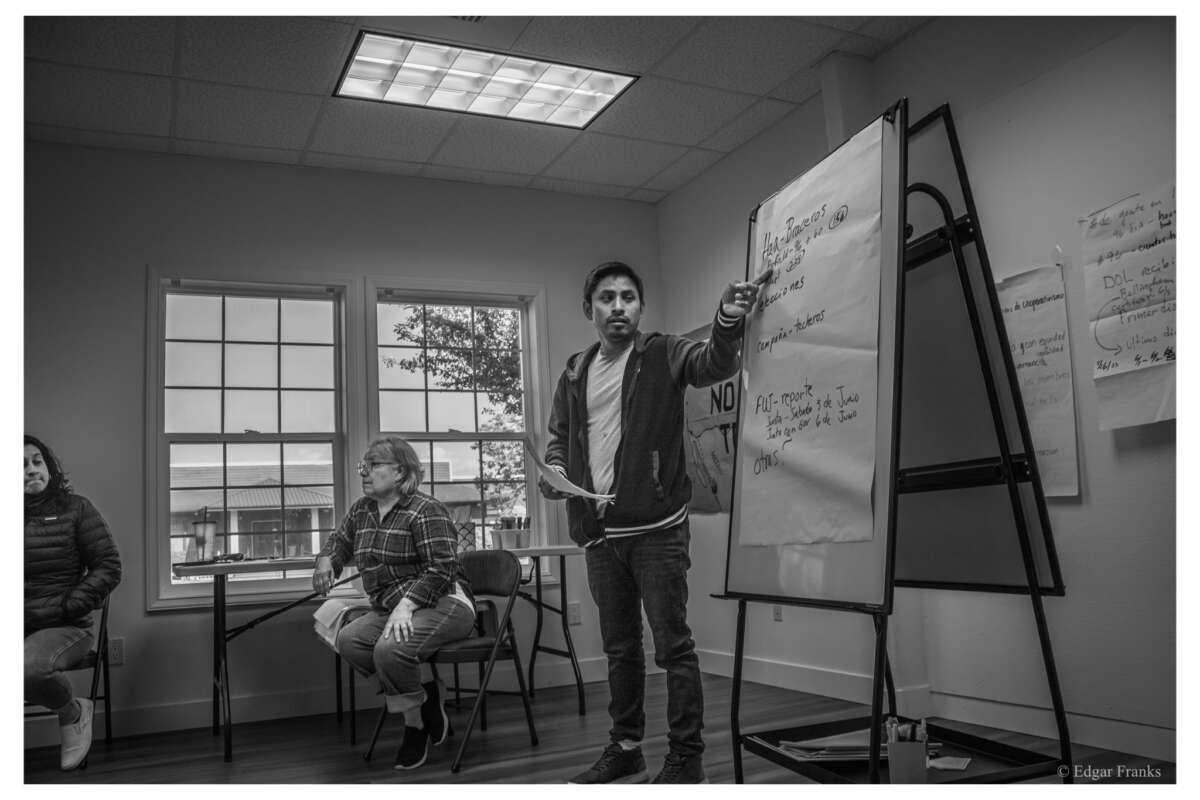
Alfredo “Lelo” Juarez speaks to farmworkers about the H-2A guest worker program.
Edgar Franks

On the morning of March 25, farmworker organizer Alfredo “Lelo” Juarez was forcibly detained by Immigration and Customs Enforcement (ICE) agents who stopped his car while he was driving his wife to work in Skagit County, Washington. People to whom Juarez has spoken say he requested to see a warrant, and when he attempted to get his ID after being asked, the ICE agents smashed his car window and detained him.

Twenty-five-year-old Juarez helped found Familias Unidas Por La Justicia, an independent farmworker union in Washington State, in 2013, when he was just a young teenager. He has advocated around issues like overtime pay, heat protections for farmworkers and the exploitative nature of the H-2A guest worker program. Juarez is a beloved member of the Indigenous Mixteco farmworker community, and there’s been an outpouring of support for him across Washington State and the entire country.

Juarez is currently being imprisoned at the Northwest ICE Processing Center in Tacoma. His detention comes as the Trump administration escalates its assault against immigrants and workers. Union members and immigrant rights activists have been detained. The administration has also intensified its attacks on foreign-born students who have spoken up for Palestinian rights, such as Mahmoud Khalil and Rumeysa Ozturk.

To learn more about Juarez’s situation, Truthout spoke with Edgar Franks, the political director of Familias Unidas, about the farmworker organizer and his detention, the outpouring of support for him, and more. Franks, who also spoke to Truthout last November about the challenges facing farmworkers after Trump’s reelection, has worked closely with Juarez — who goes by “Lelo” — for over a decade.

Derek Seidman: To start, what’s important for readers to know about Lelo?

Edgar Franks: The most important thing is how much he cares about farmworker issues and how much he has advocated for farmworkers, especially the Indigenous Mixteco farmworker community that he’s from. One reason he organizes is because there are so few organizers in the state that speak to the issues of Indigenous Mexicans from his community. He’s very committed to his community and all the issues that affect farmworkers and immigrants. He’s always available, anytime people call him, because he believes so much in the cause.

He was one of the main people who helped start our union. When we first began, it was hard to communicate with some of the workers who still used their native language and didn’t speak Spanish well. Alfredo was key to bridging that communication gap because he spoke English, Spanish and Mixteco. With him, we were able to really get information from the workers about what they wanted and help them organize.

He also helped us lobby for the overtime rules for farmworkers and the rules on climate around heat and smoke. All our recommendations came straight from workers that Alfredo spoke with. He was always talking to workers. He’s also been calling attention to how exploitative the H-2A guest worker program is and how growers use the H-2A program as a tool to take power away from farmworkers. He’s also been lobbying on issues like housing and rent stabilization.

He’s a member of our union who’s been around since the beginning. He’s sort of like a shop steward. Everything that the union has done has Alfredo’s fingerprints all over it.

How do you understand his detention? What’s your analysis of what happened?

ICE is harassing and intimidating people and not even showing warrants.

We believe his detention is politically motivated because of his organizing in the farmworker and immigrant community. We believe he was targeted. The way that ICE detained him was meant to intimidate. They hardly gave him any chance to defend himself or explain. He wasn’t resisting, and he just asked to see the warrant. They asked to see his ID, and right when he was reaching for it, they broke his car window. The ICE agents escalated really fast. From what we heard, it was less than a minute from the time he was pulled over to him being in handcuffs.

I think the intent was to strike fear and intimidate Alfredo, but also to send a message to others who are speaking out against ICE and for immigrant rights, that this is what happens when you try to fight back.

In past years, we’ve seen people getting pulled over and asked for their documents, but now it’s becoming more aggressive. ICE is harassing and intimidating people and not even showing warrants. It’s free rein for ICE to do whatever they want. When you have federal agents with no real oversight, it empowers them to be violent and coercive over everybody. The tone being set by the Trump administration gives ICE agents and Border Patrol the feeling that they’re unstoppable. That’s really concerning.

Can you talk about the outpouring of support for Lelo?

It’s been great to see the huge support for Alfredo. It speaks to how much of an impact he’s had in the state and all over the nation. It’s been really nice to see the solidarity from people that probably never even met him or knew anything about the farmworker struggle, but who know an injustice has happened.

There was a rally on March 27 organized by the Washington State Labor Council, which represents all the unions in Washington. They showed up at the detention center calling for Alfredo and another union member, Lewelyn Dixon, to be freed. For us as a union, it’s most important to see our labor family stepping up. During the presidential campaign we saw how workers and unions were being used by Trump, but now all of our labor folks are seeing what’s really happening here, which is that Trump is using immigrants to attack workers and unions. It’s been great to see labor really stepping up on the side of immigrant workers.

What affects everybody else affects immigrants. At the end of the day, we all want food and housing and good schools. Immigrants have nothing to do with the rising costs of housing, or gas or eggs. The difficulties that are really affecting people’s lives are not caused by immigrants. They’re caused by the system and by billionaires like Elon Musk. The frustrations that people feel are real, but their anger is being pointed at immigrants, and that’s not where the anger needs to go.

How is Lelo doing? What have you heard?

He’s obviously upset. He misses his family and friends. He’s also been very moved by all the actions that are happening. But when some of his supporters went to go see him last week, you know what his message was? To keep fighting and keep organizing. That gives us strength and confidence to move forward. Lelo wants us to fight, so we’ll fight. If he’s fighting on the inside, we’ll keep fighting for him on the outside.

He now has legal representation, which was also a big concern for us. We can fight as much as we want on the outside, but we really need fighters in the legal system to help Alfredo. We’ll be there for whatever the legal team needs to uplift his fight, including creating pressure in the streets.

Lelo’s detention is coming amid a larger crackdown in the U.S. Do you see connections?

Lelo is concerned about others who are being detained. Lewelyn Dixon is a University of Washington lab technician and a SEIU 925 member. She has a green card and has been living in the U.S. for 50 years. She’s at the Tacoma detention center.


From the beginning, we thought Project 2025 and its plan for mass deportations was meant to get rid of all the immigrant workers who are organizing and fighting back for better conditions, and to bring in a workforce that’s under the complete control of their employer.

There’s the case of immigrant rights activists Jeannette Vizguerra in Denver. There’s the case of Mahmoud Khalil at Columbia University and other students being detained who speak out about Palestine. It’s not a coincidence anymore. This is the trend now, and it’s really concerning. The U.S. talks a lot about repressive governments in Venezuela or Cuba, but we have political prisoners right now in the U.S.

Do you think Lelo’s detention is part of a larger plan to attack farmworker organizing?

From the beginning, we thought Project 2025 and its plan for mass deportations was meant to send a chill among farmworker organizations that had been gaining momentum. It was meant to silence the organizing, deport as many people as possible, and to bring in a captive workforce through the H-2A program.

We think that might be the ultimate plan: to get rid of all the immigrant workers who are organizing and fighting back for better conditions, and to bring in a workforce that’s under the complete control of their employer with basically no rights. It’ll make it even harder to organize with farmworkers if more H-2A workers come. It wouldn’t be impossible, but it’ll be more difficult. All the gains that have been made in the last couple of years for farmworkers are at risk.

What are you asking supporters to do?

Alfredo’s big on organizing. Wherever you are, there are similar struggles that are happening. Whether you’re in New York, Florida, Texas or California, there’s organizing for immigrant rights and workers that needs just as much support as he does. We should go into our local communities and support those organizing campaigns.

We should see Alfredo’s case as an example of how effective he is and how much that threatens the establishment. But at the same time, he wouldn’t want people to stop organizing because he’s detained. He would want people to organize even more.

You’ve worked closely with Lelo for over a decade. What are some memories that come to mind that tell us more about who he is?

When we first started organizing in 2013, he was only around 14 years old. A lot of farmworkers didn’t know how to speak English, and so these workers, who were grown adults, would ask Alfredo to present their case. He was just a young teenager, basically a kid, and he was given the responsibility to represent farmworkers at speaking engagements with hundreds of people. And when he went, he spoke eloquently for over an hour about the life of being a young farmworker and why farmworkers needed a union. The campaign was maybe two months old, but he had already captured the idea of why unions were important at such a young age.

I remember all this because I would have to drive him around since he was too young to drive! So I would take him to talk to churches, or unions, or other groups around the community. He was doing all this when he was 14 years old. I was amazed. I couldn’t speak for two minutes without getting nervous, but here was this 14-year-old who could talk for an hour!

He was also asked to go to the 2022 Labor Notes Conference to present on the work of the union, and I just remember how excited he was that Bernie Sanders was going to be there. He got the opportunity to give Bernie a letter about our campaign to oppose the Farm Workforce Modernization Act. He was so excited about meeting Bernie Sanders.

He’s still like a little kid (laughter). He likes Baby Yoda and likes to watch animated cartoons. He tries to enjoy being young. He’s really humble. He’s 25 now, so almost half of his life has been toward organizing. It’s amazing just how much he’s been able to accomplish even as just a young man.


Mahmoud Khalil’s Attorney: “This Is the McCarthy Era All Over Again”

The US government is weaponizing antisemitism as an excuse to kidnap and deport even lawful permanent residents.
April 1, 2025   

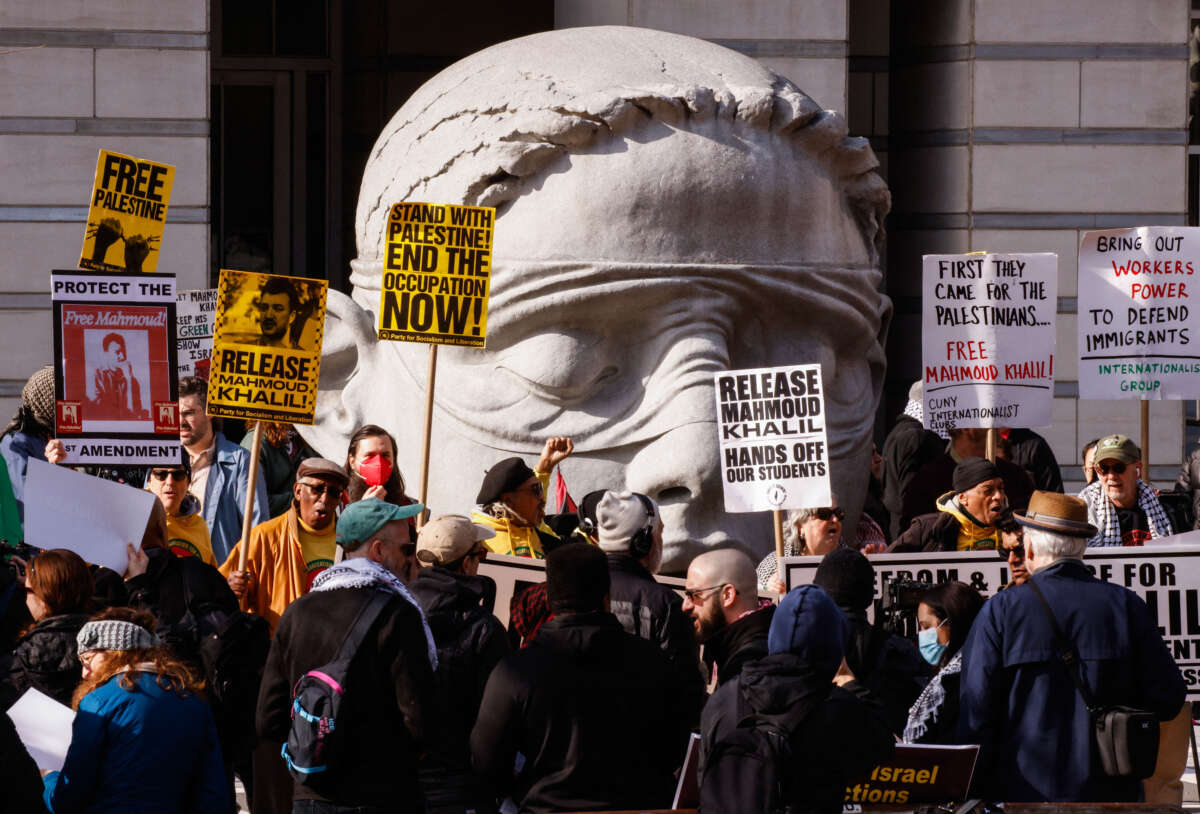
People hold signs as they participate in a protest in support of Columbia University student activist Mahmoud Khalil while a hearing takes place, outside the court in Newark, New Jersey, on March 28, 2025.Kena Betancur / AFP via Getty Images

A federal judge in New Jersey will soon issue a ruling on where the deportation case of Mahmoud Khalil, a Palestinian student who led the student encampment at Columbia University last year, can be litigated. On March 8, Khalil was abducted in New York by agents from the Department of Homeland Security (DHS) who told him his lawful permanent residency status had been “revoked.” He is now languishing in a notorious Immigration and Customs Enforcement (ICE) jail in Louisiana, more than 1,000 miles from his U.S. citizen wife who is over eight months pregnant, while U.S. District Judge Michael E. Farbiarz decides where his case will be heard. Khalil has been charged with no crime.

On March 9, Khalil was sent to New Jersey and then transported to Louisiana late that night into the next morning. On March 10, a New York federal judge blocked Khalil’s deportation while his legal challenge is pending.

On March 28, a hearing took place in New Jersey before Judge Farbiarz. Baher Azmy, legal director at the Center for Constitutional Rights (CCR) and one of Khalil’s attorneys, told the judge that his client’s detention was “Kafkaesque.”

Khalil’s lawyers argued to Judge Farbiarz that the case should remain in New Jersey where he filed a petition for writ of habeas corpus and that he should be released on bail. The Trump administration wants the case to proceed in a Louisiana district court so it will eventually come before the Fifth U.S. Circuit Court of Appeals, which is packed with Trump appointees. In January, the Fifth Circuit ruled against the Deferred Action for Childhood Arrivals program. Judge Farbiaz said he would issue his jurisdictional ruling soon.

“Mahmoud Khalil must be freed,” Samah Sisay, staff attorney at CCR and another member of Khalil’s legal team, told me. “The government’s unlawful decision to arrest and transfer him to a remote immigration jail in Louisiana is a punitive and coercive tactic to quash his protected speech in support of Palestinian rights.”

Related Story

Trump Plan for Gaza “Worse Than Ethnic Cleansing,” Says UN Human Rights Expert
Unlawful deportation or transfer of a population constitutes both a war crime and a crime against humanity. By Marjorie Cohn , Truthout  February 9, 2025

Khalil said in a statement, “My unjust detention is indicative of the anti-Palestinian racism that both the Biden and Trump administrations have demonstrated over the past 16 months as the U.S. has continued to supply Israel with weapons to kill Palestinians and prevented international intervention.”

As the number of Palestinians killed in Israel’s genocidal campaign since October 7, 2023, surpasses 50,000, the Trump administration is intensifying its repression against critics of the Israeli regime, branding anyone who supports the Palestinian people as “antisemitic” and a supporter of terrorism. Even U.S. lawful permanent residents are now in Trump’s crosshairs. His administration says the arrest of Khalil is a “blueprint” for investigations and deportations of prominent student activists.
Khalil Was Targeted Pursuant to Trump’s Executive Orders

Shortly after his inauguration on January 20, 2025, Donald Trump signed two executive orders aimed at pro-Palestine advocacy: Executive Order 14161, “Protecting the United States from Foreign Terrorists and other National Security and Public Safety Threats” and Executive Order 14188, “Additional Measures to Combat Anti-Semitism.”

Executive Order 14161 declares that it is U.S. policy to “protect its citizens” from noncitizens who “espouse hateful ideology.” It articulates the administration’s intention to target noncitizens who “advocate for, aid, or support designated foreign terrorists and other threats to our national security,” those who hold “hateful” views, and those who “bear hostile attitudes toward [America’s] citizens, culture, government, institutions, or founding principles.” The order’s broad framing of “hostile attitudes” towards the U.S. government could encompass any form of political dissent, including advocacy for Palestinian rights.

Executive Order 14188 says that the administration will target for investigation “post-October 7, 2023, campus anti-Semitism.” The order adopts a definition of antisemitism that includes constitutionally protected criticism of the Israeli government and its policies. In a fact sheet accompanying Executive Order 14188, the White House describes the measure as “forceful and unprecedented,” specifically targeting “leftist, anti-American colleges and universities.” It frames the order as a “promise” to “deport Hamas sympathizers and revoke student visas,” conveying a clear message to all “resident aliens who joined in pro-jihadist protests” that the federal government “will find you, and we will deport you.”


Khalil was abducted in New York by agents from the Department of Homeland Security who told him his lawful permanent residency status had been “revoked.”

The abduction of Khalil was carried out “in support of President Trump’s executive orders prohibiting anti-Semitism, and in coordination with the Department of State,” DHS wrote in a statement. It accused Khalil, with no evidence, of having “led activities aligned to Hamas, a designated terrorist organization” and asserted that both “ICE and the Department of State are committed to enforcing President Trump’s executive orders and to protecting U.S. national security.”

In a post on Truth Social, Trump described Khalil as a “Radical Foreign Pro-Hamas Student on the campus of Columbia University.” Trump declared that his administration would not tolerate “students at Columbia and other universities across the country who have engaged in pro-terrorist, anti-Semitic, anti-American activity” and promised to “find, apprehend, and deport these terrorist sympathizers from our country.”

On March 13, when asked if “any criticism of the Israeli government [is] a deportable offense,” if “any criticism of the United States [is] a deportable offense,” if “any criticism of the government [is] a deportable offense,” and if “protesting [is] a deportable offense,” DHS Deputy Secretary Troy Edgar did not dispute any of those statements.
Marco Rubio Invokes the Foreign Policy Ground Against Khalil

Khalil is the first such lawful permanent resident to be arrested using a vague and rarely used provision of the Immigration and Nationality Act (“foreign policy ground”) with no due process, in violation of his First Amendment freedom of speech. Title 8 U.S.C. § 1227(a)(4)(C) provides that, “An alien [non-citizen] whose presence or activities in the United States the Secretary of State has reasonable ground to believe would have potentially serious adverse foreign policy consequences for the United States is deportable.”

A Palestinian refugee with Algerian citizenship, Khalil played a prominent role in the protests at Columbia against Israel’s genocide. Last spring, while serving as a negotiator between student demonstrators and university officials, Khalil told CNN, “As a Palestinian student, I believe that the liberation of the Palestinian people and the Jewish people are intertwined and go hand-in-hand and you cannot achieve one without the other.” He characterized the movement as one “for social justice and freedom and equality for everyone,” adding, “There is, of course, no place for antisemitism. What we are witnessing is anti-Palestinian sentiment that’s taking different forms and antisemitism, Islamophobia, racism [are] some of these forms.”

Nevertheless, on March 9, Secretary of State Marco Rubio made a determination that Khalil’s “presence or activities in the United States would have serious adverse foreign policy consequences for the United States.”

On March 11, an administration spokesperson told The New York Times that “United States’ foreign policy includes combating antisemitism across the globe and that Mr. Khalil’s residency in the nation undermines that policy objective.”

The “foreign policy bar” expressly forbids the secretary of state from issuing a policy that would exclude or condition entry based on a noncitizen’s “past, current, or expected beliefs, statements, or associations, if such beliefs, statements, or associations would be lawful within the United States,” unless the secretary personally certifies to Congress that admitting the individual would compromise a compelling U.S. foreign policy interest. But Rubio has not provided the chairpersons of the House Foreign Affairs, Senate Foreign Relations, and House and Senate Judiciary Committees with any such certification.

Moreover, in 1990, the 101st Congress expressed its intent to restrict the executive’s power to exclude noncitizen speakers by affirming that such exclusions should not be based solely on “the possible content of an alien’s speech in this country,” that the secretary of state’s authority to decide that entry would negatively impact foreign policy interests should be used “sparingly and not merely because there is a likelihood that an alien will make critical remarks about the United States or its policies,” and that the “compelling foreign policy interest” standard should be applied strictly.

Since the “foreign policy ground” was enacted by Congress as part of the Immigration and Nationality Act several decades ago, it has rarely been invoked and is used for cases involving high-ranking government officials or alleged terrorists who are removable on other grounds and subject to high-profile prosecutions in their country of origin. It does not appear to have ever been applied to any individual for engaging in First Amendment protected speech.

“What the Trump administration is attempting to do to Mahmoud is truly outrageous,” attorney Marc Van Der Hout told me. “The provision of law that the government is trying to use to deport Mahmoud, a legal permanent resident of this country, is virtually unprecedented in this context.”


Khalil has been charged with no crime.

Van Der Hout, along with other members of his firm, is representing Khalil in his immigration proceedings and they are co-counsel in the federal court challenge to his arrest, detention and prosecution by the government. “The government is going after Mahmoud for his completely protected First Amendment activities and speech which the immigration statute itself forbids absent exceptional circumstances. We are challenging this in federal court, and we will be challenging it in the immigration arena as well,” Van Der Hout added.
Rubio’s Determination and the Targeting of Khalil Violate the First and Fifth Amendments

In his amended petition for writ of habeas corpus, filed on March 13, Khalil asserts that the government has violated his First Amendment right to freedom of speech, the Fifth Amendment’s requirement of due process and the Administrative Procedure Act (APA).

By targeting, arresting, transferring and detaining Khalil, the administration violated the First Amendment by retaliating against and punishing him for his past protected speech; preventing him from speaking while in detention; attempting to chill (through past punishment and ongoing threat) or prevent (through eventual removal) his future speech in the U.S.; depriving audiences of his present and future speech on matters of public concern; and chilling other individuals from expressing views sympathetic to the Palestinians.

The “foreign policy ground” violates due process as it is unconstitutionally vague because ordinary people cannot understand what conduct is prohibited and it allows for arbitrary and discriminatory enforcement.

The government’s policy of targeting noncitizens for removal is arbitrary and capricious (as prohibited by the APA), constitutes an abuse of discretion, is contrary to the First Amendment, contrary to law, and was promulgated in excess of statutory jurisdiction.

Khalil’s arrest is having a chilling effect on political debate about a significant international issue. His lawyers wrote in their preliminary injunction motion that many noncitizens, including lawful permanent residents, “now live in fear that they will be next if their actual or imputed speech brings them into the crosshairs of this administration, and many are choosing to stay silent going forward.” Trump and Rubio could apply their policy “to any pro-Palestine speech by any noncitizen.”
Khalil’s Arrest Is “the First of Many to Come”

Nine days after Khalil’s abduction, in an attempt to bolster its case against him, the U.S. government came up with a new rationale to deport him. On March 17, DHS charged that Khalil had omitted from his application for permanent residency that he was a member of the United Nations Relief and Works for Palestine Refugees (UNRWA), that he was employed by the Syria Office of the British Embassy in Beirut, and that he was a member of the Columbia University Apartheid Divest, a coalition of student groups promoting the demands of the Boycott, Divestment, Sanctions (BDS) movement.

Khalil’s arrest is “the first of many to come,” Trump posted on Truth Social. Indeed, his repression against pro-Palestinian voices is proceeding apace.

Trump’s regime is rounding up students and faculty who are lawfully in the country, whether they have a green card or a visa.

Yunseo Chung, another lawful permanent resident and a third-year student at Columbia, has also been targeted by the Trump administration. Born in South Korea, Chung has resided in the U.S. since she was 7 years old. Although she has not made public statements to the press or assumed a high-profile role in pro-Palestine protests, Chung participated in a March 5 demonstration opposing the university’s excessive punishments for student protesters facing campus disciplinary proceedings.


Trump’s administration says the arrest of Khalil is a “blueprint” for deportations of prominent student activists.

Days later, the government launched a series of unlawful efforts to arrest, detain and remove Chung from the U.S., claiming it had “revoked” her lawful permanent residency status. Rubio invoked the same “foreign policy ground” against Chung that he rendered against Khalil. Chung has sued officials of the Trump administration to prevent them from detaining, transferring or removing her from the U.S.

Several students and professors lawfully present in the U.S. with visas have been detained and deported for their pro-Palestinian activism and many have filed legal challenges against the Trump administration. On March 27, Rubio declared that at least 300 foreign students have had their visas revoked.

The administration is apparently targeting noncitizen students for deportation just for “liking or sharing posts that highlighted ‘human rights violations’ in the war in Gaza,” signing “open letters related to the war,” and “call[ing] for ‘Palestinian liberation.’” The Israeli newspaper Haaretz asserted that ICE has “reportedly paused its human trafficking and drug smuggling investigations to have agents monitor social media for posts and likes from pro-Palestinian students.”

Trump’s witch hunt against pro-Palestinian voices harkens back to a dark time in our history.

“This is the McCarthy era all over again,” attorney Van Der Hout told me. “The government tried this 40 years ago against a group of Palestinians I represented in Los Angeles and, after 20 years, the case was thrown out for government misconduct. It was outrageous then, and it’s outrageous now. Mahmoud will be challenging this until his rights to speak out about what is happening in Palestine and anywhere else are vindicated.”

Attorney Sisay told me that, “As long as he remains in ICE custody, away from his pregnant wife and movement community, his ability to speak freely, and the ability of many other students speaking out against the Israeli government’s genocide in Gaza, will continue to be chilled.”

Note: After this article went to press, Judge Farbiarz refused the Trump administration’s request to transfer Khalil’s legal challenge to Louisiana. The U.S. District Court for the District of New Jersey ruled that the challenge to ICE’s unlawful detention of Khalil should continue in New Jersey. “I am relieved at the court’s decision today to keep my husband’s ongoing case in New Jersey. This is an important step towards securing Mahmoud’s freedom, but there is still a lot more to be done,” said Dr. Noor Abdalla, Khalil’s wife.

This article is licensed under Creative Commons (CC BY-NC-ND 4.0), and you are free to share and republish under the terms of the license.


Marjorie Cohn is professor emerita at Thomas Jefferson School of Law, dean of the People’s Academy of International Law and past president of the National Lawyers Guild. She sits on the national advisory boards of Veterans For Peace and Assange Defense, and is the U.S. representative to the continental advisory council of the Association of American Jurists. Her books include Drones and Targeted Killing: Legal, Moral and Geopolitical Issues.