Thursday, April 03, 2025

ALT.FUEL

Japan’s First Hydrogen Dual-Fuel Tug with Combustion Engine Launched
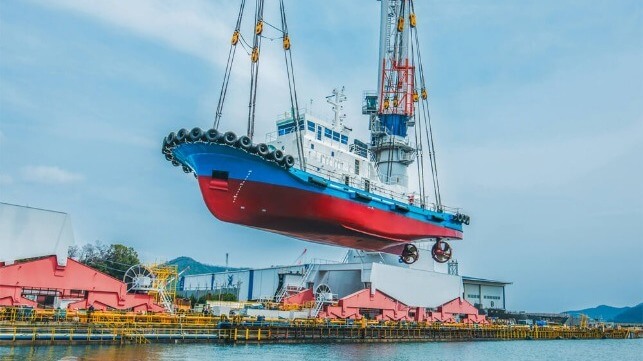
hydrogen fueled tug launched in Japan
Japan's pioneering hydrogen tug with an internal combustion engine being launched (Tsuneishi Shipbuilding)

Published Apr 2, 2025 5:29 PM by The Maritime Executive


As part of the “Zero Emission Ships Project” sponsored by The Nippon Foundation, Japan last week launched its first hydrogen dual-fuel tug. The vessel is pioneering using a high-power internal combustion engine with the industry seeking to develop expertise in the emerging sector.

The new tug was launched by Tsuneishi Shipbuilding on March 28 and is the first vessel in Japan to be equipped with a high-power output hydrogen dual-fuel internal combustion engine. It also has a high-pressure hydrogen gas storage system with a large capacity. With facilities to store approximately 250kg of high-pressure hydrogen gas, Tsuneishi says it will be possible to maintain the same operational performance as when using conventional fuel while also making use of hydrogen fuel. In the unlikely event of failure of the hydrogen fuel system, the vessel can operate with only traditional marine fuels, thus ensuring the same level of safety as conventional vessels.

“We have successfully launched our first hydrogen-fuelled tugboat. We will utilize the know-how and design processes we have developed in the construction of hydrogen-fuelled tugboats, which require high power, in the construction of further new fuel vessels,” said Nishijima Takanori, General Manager of the Design Division and Managing Executive Officer of Tsuneishi Shipbuilding Co.
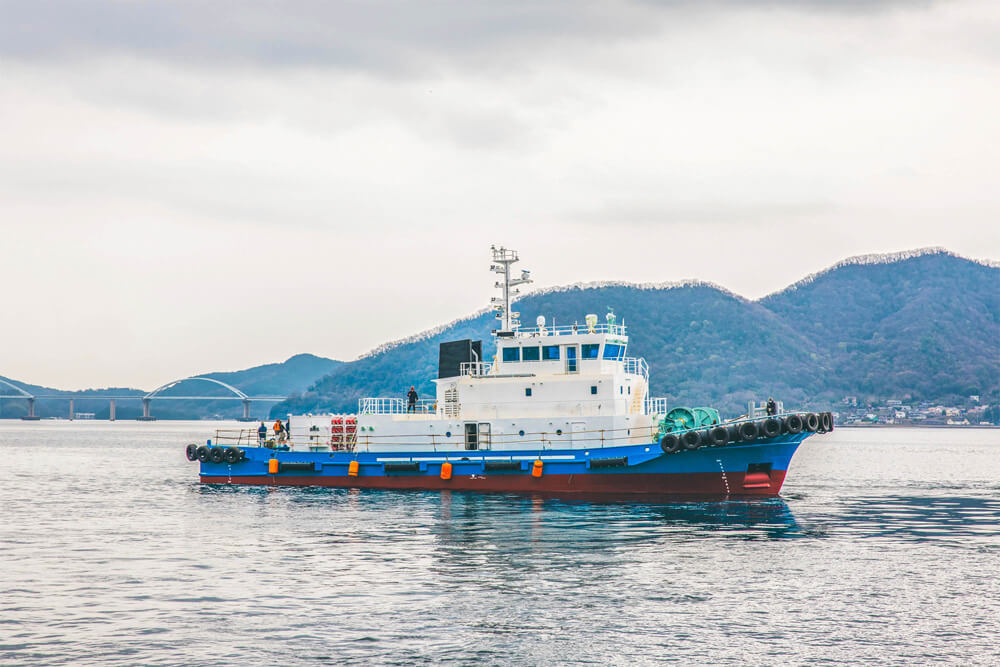
 

Japan's first hydrogen dual-fuel tug with an internal combustion engine (Tsuneishi Shipbuilding)


The shipbuilding notes that one of the challenges for tugboats is the need to be highly maneuverable and have high engine output to assist in berthing and opera operations of large vessels. This tugboat is installed with twin 12-cylinder hydrogen-blended engines (4,400 horsepower class), which will give it the needed capabilities. The vessel will be less than 300 gross tons with a length of 38 meters (125 feet).

The plan calls for operating with hydrogen in combination with traditional marine fuels. They are targeting reducing carbon dioxide emissions by approximately 60 percent compared to conventional tugboats that use traditional marine fuels. 

To further enhance the project’s overall sustainability Tsuneishi is also incorporating “JGreeX” produced by JFE Steel Corporation, It is a green steel product that was used for all of its steel plates.

Many projects are focusing on hydrogen fuel cells instead of internal combustion engines as hydrogen remains a technology in development as a marine fuel. The Port of Antwerp-Bruges and the Savery family’s CMB.TECH launched what they said was the first hydrogen-fueled tug in 2023. Hydrotug 1 was also reported to be the largest vessel currently capable of operating solely on hydrogen. It is operating demonstrations in the port of Antwerp while CMB.TECH has developed other vessels including a crew transfer vessel using hydrogen.\


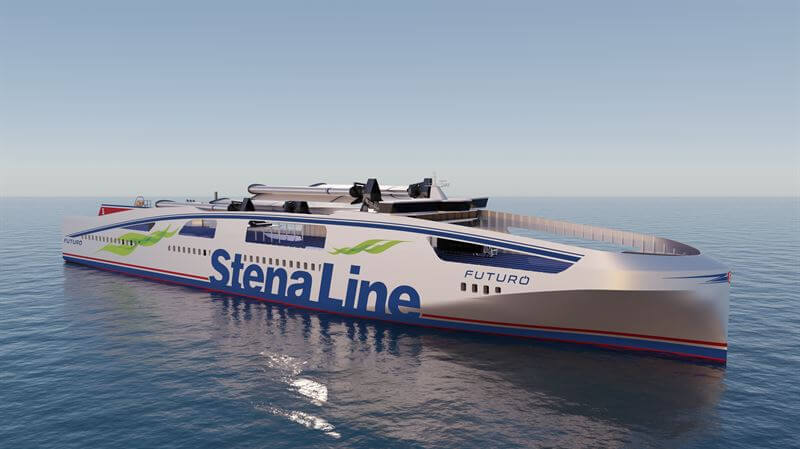
Stena Presents Futuro Concept RoRo that Would Reduce Energy Usage 20%
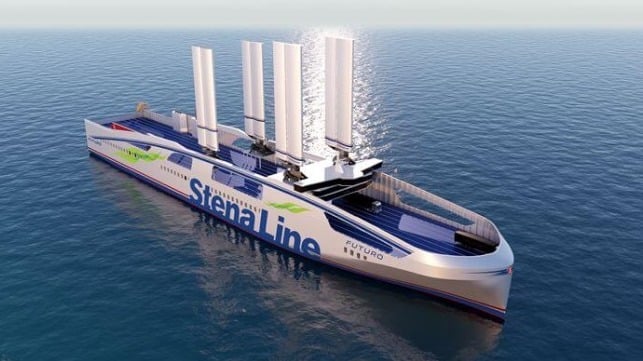
future roro concept
Stena's Futuro concept incorporates the latest technologies to achieve energy reductions (Stena)

Published Apr 2, 2025 5:55 PM by The Maritime Executive


Stena Line, one of Europe's leading ferry companies and a pioneer with advanced designs, presented its latest thinking for Stena Futuro, a RoRo that would reduce energy usage by 20 percent or more. The company’s goal is an overall 30 percent reduction in its CO2 emissions by 2030.

“The mission is to develop the most efficient and competitive vessel possible for a specific cargo capacity, using today’s available technology. The goal is for the vessel to have the lowest fuel consumption on the market,” says Nicolas Bathfield, Project Manager at Stena Teknik, who has been involved in developing the concept.

Stena Futuro would be a 240-meter (787-foot) long RoRo vessel intended for transporting semi-trailers and cars. Stena Teknik, a resource within the group for all its business units, is exploring the full range of technologies to advance the efficiency of this next-generation vessel. The group is focused on newbuilds as well as the energy and digital transformation mostly in the maritime sectors.
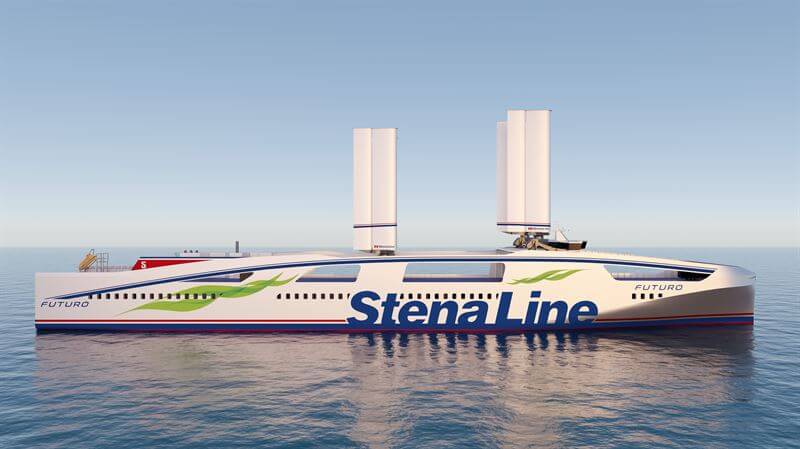


Stena Line's latest concept for the new generation of vessels uses a low and streamlined design to reach its ambitions. The hull and superstructure have been optimized to achieve the most efficient use of cargo space possible. At the same time, low weight and optimized hydro- and aerodynamics are central to achieving low fuel consumption. The hull of Stena Futuro would also be equipped with an air lubrication system.

The concept for Stena Futuro also includes four 40-meter (131-foot) tall wing sails, which can be retracted when needed — for example, when passing under a bridge. Recently, Stena’s developers, together with the Swedish research institute RISE, have conducted tests and simulations of the sails’ usage to document both energy savings and how the sails affect the ship’s maneuverability and safety.


“The tests showed that Stena Futuro’s sails could potentially result in as much as 15 percent fuel savings. We also confirmed that the vessel meets all requirements for stability and maneuverability in scenarios such as sudden wind shifts or quick course changes,” says Bathfield.

The vessel would also have hybrid propulsion, batteries, and engines with low fuel consumption that can run on several different fuels. The battery system makes it ready to partly operate the vessel on electricity alone, for example, when entering and leaving ports. Solar panels will also contribute to the ship’s electricity needs. A waste heat recovery system will make it possible to reuse the hot exhaust gases from the ship’s engines to meet other onboard heating needs as well as supporting electric power generation.

Stena says the ship design will play a vital part in its future tonnage planning in the coming years. Currently, however, there is no finalized plan for the production of Stena Futuro.\


Norway’s First Bio-Methanol Feeders Enter Service

methanol-fueled feeder containership
NCL Vestland is Norway's first bio-methanol fueled feeder ship (Appex photo courtesy of NCL)

Published Apr 1, 2025 9:27 PM by The Maritime Executive


Norway marked a milestone in its efforts to be a leader in green shipping with the introduction of the first of two vessels that will be powered with bio-methanol. The containerships which are operating in a partnership between North Sea Container Line and MPC Container Ships will expand Norway’s trade with Europe while also lowering emissions.

NCL Vestland is the first of the two vessels and today, April 1, they celebrated the naming and entry into service of the ship, with her sister ship NCL Nordland to follow. The ships were ordered in 2023 under a program in part sponsored by the Norwegian government to advance green shipping. The project received NOK 13.7 million (US$1.3 million) in funding from Enova SF, the state enterprise owned by the Norwegian Ministry of Climate and Environment, and NOK 60 million (US$5.7 million) from the NOx fund (Næringslivets NOx-fond), the Norwegian business sector’s fund to reduce emissions.

The ships were built by China’s Taizhou Sanfu Ship Engineering and are fitted with dual-fuel engines capable of operating on conventional fuel or green methanol. The newbuilds will reduce NCL’s overall CO2 emissions by 50 percent, compared to the existing NCL fleet, when operating on diesel. In 2025, NCL will operate the vessels with a 5 percent blend of bio-methanol and the strategy is to gradually increase the bio-methanol going forward. NCL has signed an agreement with Equinor for the sourcing of the methanol and the vessels will be bunkering in Norway. 

The hull, which is 149 meters (489 feet) in length, along with the propellers, and onboard systems are designed for maximum energy efficiency. The ships are each equipped with a 250 kWh battery pack and the capability to use shore power. Each ship has a capacity of 1,300 TEU. They feature an "Open Top" design which the companies highlight minimizes the need for crew on deck, further enhancing safety. The electric cranes on deck are designed to enhance efficiency when in port, independent of onshore infrastructure providing increased flexibility in the ports they can access.

The plan calls for three older vessels to be replaced by the two new ships, each of which has a 40 percent greater container capacity compared to the ships currently operating the feeder service. As such, NCL reports that the vessels will achieve a 63 percent reduction in energy capacity per TEU per nautical mile. 

The ships are operating under a 15-year chart to NCL and have long-term contracts for transportation from Norway including with Elkem, a provider of silicon-based materials. With stops at key industry hubs in Norway, Elkem says they will enable larger weekly shipments of its silicon products to European customers in sectors such as automotive manufacturing, construction, renewable energy, and the defense industry, and enable growth and jobs along the Norwegian coast.

“These state-of-the-art vessels will play a significant role in transporting Norwegian goods and strategic silicon metals and materials to the continent, cementing Norway’s position as an important and reliable supplier of critical inputs for European industries,” said Morten Viga, CFO of Elkem.

The vessel will operate between Stokmarknes and Rotterdam, Bremerhaven, calling at Salten, Mo i Rana, Orkanger, Averøy, Ålesund, Svelgen, Bergen, Haugesund, and Tananger. It will supply Europe with strategically important minerals, fish food, and other commodities via the ports of Bremerhaven and Rotterdam.

NCL highlights this is the first of three zero-emission capable vessels it will be introducing. In addition to the two methanol-fueled feeders, NCL will operate the world’s first ammonia-powered container vessel in a project with ammonia-producer Yara International and its subsidiary Yara Clean Energy and the support of the Norwegian Government through its Enova investment fund. The ammonia-powered feeder project was announced in 2023 with a target of starting operations in 2026.

 

Russia Cuts CPC Terminal Oil Loadings After "Inspections"

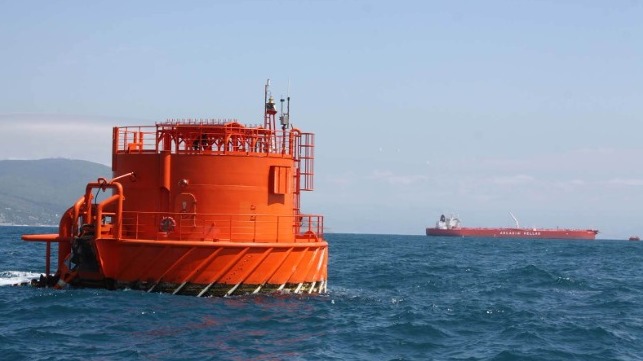
One of the three SPMs at the CPC terminal (CPC file image)

Published Apr 2, 2025 11:43 PM by The Maritime Executive


Russia has shut down two out of three of the loading moorings at the Caspian Pipeline Consortium terminal near Novorossiysk, on Russia's Black Sea coastline. The CPC pipeline handles 80 percent of Kazakhstan's oil exports, including volumes produced by American oil majors Chevron and ExxonMobil, and it accounts for about one percent of all global oil supply. 

Last month, Russia's Federal Agency for Transport Supervision inspected two older moorings at the pipeline's offshore loading terminal. The snap inspection resulted in unspecified "violations," according to CPC.

Russian authorities ordered the two buoys taken out of service on April 1, reducing CPC export volume from 1.4 million barrels a day to about 700,000 barrels. There are no restrictions on the pipeline itself, and the third mooring at the terminal continues to operate as normal. 

The decision hasn't had an immediate effect on production within Kazakhstan, but as storage begins to fill up, operators at the Caspian's prolific oilfields will likely have to begin shutting in production. The giant Tengiz field, operated by Chevron-led Tengizchevroil, is responsible for 700,000 barrels a day of Kazakh production and could be affected.

Chevron is investing a staggering $48 billion in expanding production at Tengiz. If successful, the program could boost output to nearly one million barrels a day by mid-2025 - if the CPC pipeline comes back online. The prolific output at the field has pushed Kazakhstan's annual production past its OPEC limits, and March set a new all-time record for Kazakh oilfields. If the terminal had not been partially shut down, the CPC pipeline would have exported about 1.7 million barrels per day in April.  


Port Fees for Chinese Ships May Prompt Genco to Leave US Market

File image courtesy Bernard Spragg / public domain

Published Apr 1, 2025 9:01 PM by The Maritime Executive


Smart shipowners are getting prepared to pass any extra U.S. fees for Chinese ships onwards to their charterers, insulating the owner from the impact of millions of dollars in extra regulatory cost per port call. Special new charter party clauses will ensure that U.S. exporters and importers - not shipowners - will bear the extra near-term cost, says Genco CEO John Wobensmith. 

Genco is the largest U.S.-headquartered bulker operator, and has a substantial number of Chinese-built vessels in its fleet. As such, it is exposed to the proposed port fees on Chinese tonnage, written by the Office of the U.S. Trade Representative (USTR). If the fee structure is adopted as written, Chinese-built ships - and any global operators who use Chinese-built ships elsewhere - would have to pay millions of dollars for every port call in the United States. Exporters would also be required to ship an increasing percentage of their goods on U.S.-flagged tonnage, and eventually on scarce U.S.-built tonnage, raising costs for export shipments and creating new employment options for U.S. mariners. 

Multiple shipowners have described deep changes to their business if the fees go into effect. U.S.-based ro/ro liner ACL says that it will go out of business in the United States, and multiple ocean carriers have said that they will narrow their port calls down to a few major gateways to minimize fees. Genco's Wobensmith told Bloomberg that he shares USTR's goal of strengthening American shipping, but in the near term, his firm has two options: exit the U.S. market and focus on the rest of the world, which accounts for 90 percent of its business; or pass the extra U.S. costs on to the end user. 

It's already using the latter strategy. To ensure that it does not get caught bearing unexpected new costs, Genco's charter parties now include clauses that require the charterer to pay for any new U.S. port charges, whatever they happen to be. 

In reality, these two strategies (leave or pass on charges) are closely linked. The extra expense of the port fees will make some ag commodities "uncompetive" compared to foreign producers, Wobensmith said, as American farming interests have previously warned. Soy exports "will come almost to a grinding halt," he said. For these cargoes, the extra pass-on charges may end the market, requiring shipowners with Chinese tonnage to leave.

Top image courtesy Bernard Spragg / public domain


China's CNOOC Exits U.S. Offshore Oil and Gas

Ineos acquired CNOOC's 21 percent stake in the Shell-operated Appomattox platform, above (Shell file image)

Published Apr 2, 2025 9:33 PM by The Maritime Executive


British energy company Ineos has completed a planned acquisition of the U.S. Gulf assets of Chinese state oil major CNOOC. The purchase gives Ineos non-operated interests in Shell's Appomattox platform and Hess' Stampede platform, along with several mature assets and supporting business units. Reuters reports that the transaction price came to about $2 billion.  

“This is a major step for us into the deepwater Gulf of Mexico, which builds on our growing energy business. INEOS Energy is all about competing in the energy transition to provide reliable, affordable energy to meet world demand as the population continues to grow. And progressing carbon storage projects," said Ineos CEO David Bucknall in announcing the deal last year. 

The deal is Ineos' third substantial investment in the U.S. energy market in three years, alongside an LNG deal with Sempra and the acquisition of shale oil assets in Texas in 2023. 

The sale is part of CNOOC's move towards exiting the U.S. domestic market, motivated in part by geopolitical risk. In 2022, as relations between the U.S. and China grew increasingly strained, CNOOC reportedly floated plans to extricate itself from Canada, Britain and the United States, according to Reuters. 

The Chinese oil company remains an important U.S. partner abroad: it holds a 25 percent stake in Exxon's Stabroek Block development off Guyana, a keystone of Exxon's future development. 


Corpse flowers are threatened by spotty recordkeeping


Incomplete data leads to low genetic diversity, population decline


Northwestern University

Pollen sampling 

image: 

Olivia Murrell (left) samples pollen from a corpse flower in a living collection.

view more 

Credit: Olivia Murrell


Commonly called the “corpse flower,” Amorphophallus titanum is endangered for many reasons, including habitat destruction, climate change and encroachment from invasive species. 

Now, plant biologists from Northwestern University and the Chicago Botanic Garden have added a new threat to the list: incomplete historical records.

In a new study, scientists constructed the ancestry of corpse flowers living in collections at institutions and gardens around the world. They found a severe lack of consistent, standardized data. Without complete historical records, conservationists were unable to make informed decisions about breeding. Of the corpse flowers studied, therefore, 24% were clones and 27% were offspring from two closely related individuals.

The study will be published on April 3 in the Annals of Botany.

“There are many risks associated with low genetic diversity,” said Olivia Murrell, who led the study. “Decreasing genetic diversity over time leads to a decrease in fitness. Generally speaking, inbred plants might not produce as much pollen or might die right after they flower. One institution reported that, possibly as a result of inbreeding, all their corpse flower offspring were albino, so they didn’t survive because they didn’t have chlorophyll to photosynthesize. The population as a whole also doesn’t have the variation it needs to survive. So, if a disease or pest affects plants that are all genetically similar, all plants in that population are more likely to suffer. We don’t think people are consciously making the choice to inbreed their plants. They just don’t know what they have because the data are incomplete.”

At the time of the study, Murrell was a master’s student in plant biology in the Program in Plant Biology and Conservation, a partnership between Northwestern’s Weinberg College of Arts and Sciences and the Chicago Botanic Garden. Now she is a Ph.D. student at Manchester Metropolitan University in the U.K. and a conservation scholar at the Chester Zoo. Senior authors from the Program in Plant Biology and Conservation are Jeremie FantNyree Zerega and Kayri Havens. Fant, Zerega and Havens also are conservation scientists with the Negaunee Institute for Plant Conservation Science and Action at the Chicago Botanic Garden.

A finicky flower

Nicknamed for its smell, the corpse flower emits an odor that mimics rotting flesh when it blooms. A clever evolutionary trick, the pungent odor attracts flies and carrion beetles, the plant’s primary pollinators. Because the bloom is rare and short-lived — lasting just 24 to 48 hours — gardens often hold events for visitors to experience the infamous stench firsthand.

“Usually, you have to get close to a flower to be able to smell it,” Murrell said. “That is not true for the corpse flower. The second you walk into its greenhouse, its smell smacks you across the face. It’s very strong. The plant also heats up when it blooms, which spreads its smell farther.”

Gardens go to great lengths to care for these charismatic companions. The corpse flower is one of several “exceptional plants,” a designation given to species whose seeds cannot be effectively conserved in seed banks. In the corpse flower’s case, its seeds are no longer viable after drying, which is a necessary step for long-term seed storage. Instead, corpse flowers and other exceptional plants are conserved in “living collections” within research facilities, botanic gardens and arboreta.

Because male and female corpse flowers bloom at different times, the flowers in these living collections rely on humans to keep their lineages alive. Their caretakers, however, face several challenges.

“The female flowers open first, and then the male flowers open later,” Murrell said. “So, the female flowers are no longer viable by the time pollen is produced. The plant also blooms rarely and unpredictably. It could go seven to 10 years without blooming. Then, when the blooms do open, the female flowers are only viable for a couple hours. With that limited time to pollinate, conservationists scramble to use whatever they have on hand. That might be pollen from a previous flower on the same individual, which results in inbreeding.”

Wilted records

To better understand what happens in these situations, Murrell located all the living collections around the world which contained corpse flowers. Ultimately, she received data from nearly 1,200 individual plants from 111 institutions across North America, Asia, Australia and Europe. The data arrived in the forms of handwritten notes, prose, lists and spreadsheets.

Ideally, a plant’s records should contain detailed information about its origin, parents, characteristics, health and propagation. Crucial for conservation efforts, these data help conservationists maintain genetic diversity and plant health while preventing loss. Without this information, people cannot make informed decisions about which plants to cross for breeding.

After organizing all the information received from institutions, Murrell found it was severely lacking. Institutions often did not record the sources and origins of individual plants. Even when they did record seed sources, they did not record information about which plant’s pollen was used for breeding.

“The highest rate of missing data occurred when plants were transferred to new locations,” Murrell said. “The plants moved, but their data didn’t move with them. So, records easily got lost over time as plants moved around.”

Clones and crosses

To determine prevalence of inbreeding, Murrell and her team examined the records for clones and breeding between related plants. Of the 1,188 individual plants in the dataset, 287 (24%) were clones and 27% were offspring from closely related individuals. Fewer than one-third of crosses occurred between unrelated individuals.

Looking to substantiate these conclusions, Murrell performed a small molecular genetics study on 65 plants. By sequencing the plants’ DNA, the team confirmed low genetic diversity and high inbreeding across all collections.

Native only to Sumatra, the corpse flowers’ numbers continue to decline. According to a recent estimate published in the journal Biodiversity and Conservation, just 162 individual corpse flowers remain in the wild. The dwindling population underscores the need to ensure these plants can thrive in living collections, so they eventually can be reintroduced into the wild.

“The population needs variation to survive,” Murrell said. “If nothing changes, it could inbreed itself into extinction. That’s why it’s really important to keep consistent, standardized and centralized data. Not keeping data has clear conservation implications. In the meantime, our study provides valuable information about relationships among existing collections, which can be used to determine which crosses might be most successful.”

To help improve collections of corpse flowers and other species, Murrell and her coauthors made five recommendations. They urged institutions to (1) document parents and destinations of plants sampled in the wild, (2) standardize data across collections, (3) track parent plants across institutions, (4) transfer data with plants when they are moved to new institutions and (5) determine common language for recordkeeping so all definitions are consistent.

The study, “Using pedigree tracking of the ex situ metacollection of Amorphophallus titanium to identify challenges to maintaining genetic diversity in the botanical community,” was supported by the Institute of Museum and Library Services, the Northwestern University Plant Biology and Conservation Award, a Botanical Society of America Graduate Student Research Award and The Walder Foundation.


Olivia Murrell, who led the study, works in the lab in the Chicago Botanic Garden.

Credit

Olivia Murrell


Riding the AI wave toward rapid, precise ocean simulations


New machine learning model cuts fluid simulation time from 45 minutes to 3


Osaka Metropolitan University

Fluid simulation comparison: Particle method (top) vs. AI-driven surrogate model (time step: 0.0020 sec) 

image: 

The AI model reduces computation time to one-fifteenth of the traditional model’s time while preserving accuracy.

view more 

Credit: Osaka Metropolitan University


AI has created a sea change in society; now, it is setting its sights on the sea itself.

Researchers at Osaka Metropolitan University have developed a machine learning-powered fluid simulation model that significantly reduces computation time without compromising accuracy. Their fast and precise technique opens up potential applications in offshore power generation, ship design and real-time ocean monitoring.

Accurately predicting fluid behavior is crucial for industries relying on wave and tidal energy, as well as for design of maritime structures and vessels. Whilst particle methods — which allow particles to simulate the behavior of fluid flow — are a common approach, they require extensive computational resources, including processing power and time. By simplifying and accelerating fluid simulations, AI-powered surrogate models are making waves in fluid dynamics research.

However, AI is not without its flaws.

“AI can deliver exceptional results for specific problems but often struggles when applied to different conditions,” said Takefumi Higaki, an assistant professor at Osaka Metropolitan University’s Graduate School of Engineering and lead author of the study.

Aiming to create a tool that is consistently fast and accurate, the team developed a new surrogate model using a deep learning technology called graph neural networks. The researchers first compared different training conditions to determine what factors were essential for high-precision fluid calculations. They then systematically evaluated how well their model adapted to different simulation speeds, known as time step sizes, and various types of fluid movements.

The results demonstrated strong generalization capabilities across different fluid behaviors.

“Our model maintains the same level of accuracy as traditional particle-based simulations, throughout various fluid scenarios, while reducing computation time from approximately 45 minutes to just three minutes,” Higaki said.

This research marks a step forward in high-performance fluid simulation, offering a scalable and generalizable solution that balances accuracy with efficiency. Such improvements extend beyond the lab.

“Faster and more precise fluid simulations can mean a significant acceleration in the design process for ships and offshore energy systems,” Higaki said. “They also enable real-time fluid behavior analysis, which could maximize the efficiency of ocean energy systems.”

The study was published in Applied Ocean Research.

###

About OMU

Established in Osaka as one of the largest public universities in Japan, Osaka Metropolitan University is committed to shaping the future of society through the “Convergence of Knowledge” and the promotion of world-class research. For more research news, visit https://www.omu.ac.jp/en/ and follow us on social media: XFacebookInstagramLinkedIn.


Printed skin to replace animal testing


A research team from TU Graz and the Vellore Institute of Technology in India is developing a 3D-printed skin imitation equipped with living cells in order to test nanoparticles from cosmetics without animal testing.


 News Release 

Graz University of Technology

3D-printed structure made of optimised hydrogel. 

image: 

3D-printed structure made of optimised hydrogel.

view more 

Credit: Manisha Sonthalia - Vellore Institute of Technology


Directive 2010/63/EU laid down restrictions on animal testing for the testing of cosmetics and their ingredients throughout the EU. Therefore, there is an intense search for alternatives to test the absorption and toxicity of nanoparticles from cosmetics such as sun creams. A team of researchers from Graz University of Technology (TU Graz) and the Vellore Institute of Technology (VIT) in India is working on the development of skin imitations that mimic the native three-layer tissue structure and biomechanics of human skin. Such imitations can be produced using 3D printing and consist of hydrogel formulations that are printed together with living cells.

Hydrogels in which skin cells survive and grow

“The hydrogels for our skin imitation from the 3D printer have to fulfil a number of requirements,” says Karin Stana Kleinschek from the Institute of Chemistry and Technology of Biobased Systems. “The hydrogels must be able to interact with living skin cells. These cells not only have to survive, but also have to be able to grow and multiply.” The starting point for stable and 3D-printable structures are hydrogel formulations developed at TU Graz. Hydrogels are characterised by their high-water content, which creates ideal conditions for the integration and growth of cells. However, the high-water content also requires methods for mechanical and chemical stabilisation of the 3D prints.

TU Graz is working intensively on cross-linking methods for stabilisation. Ideally, following nature’s example, the cross-linking takes place under very mild conditions and without the use of cytotoxic chemicals. After successful stabilisation, the cooperation partners in India test the resistance and toxicity of the 3D prints in cell culture. Only when skin cells in the hydrogel survive in cell culture for two to three weeks and develop skin tissue can we speak of a skin imitation. This skin imitation can then be used for further cell tests on cosmetics.

Successful tests

The first tests of 3D-printed hydrogels in cell culture were very successful. The cross-linked materials are non-cytotoxic and mechanically stable. “In the next step, the 3D-printed models (skin imitations) will be used to test nanoparticles,” says Karin Stana Kleinschek. “This is a success for the complementary research at TU Graz and VIT. Our many years of expertise in the field of material research for tissue imitations and VIT’s expertise in molecular and cell biology have complemented each other perfectly. We are now working together to further optimise the hydrogel formulations and validate their usefulness as a substitute for animal experiments.”


3D-printed structure with human keratinocytes.

Credit

Manisha Sonthalia - Vellore Institute of Technolo