Thursday, April 03, 2025

US tariffs take aim everywhere, including uninhabited islands


By AFP
April 2, 2025

The world’s remotest corners couldn’t hide from US President Donald Trump’s global tariffs onslaught Wednesday — even the uninhabited Heard and McDonald Islands.

The Australian territory in the sub-Antarctic Indian Ocean was slapped with 10 percent tariffs on all its exports, despite the icy archipelago having zero residents — other than many seals, penguins and other birds.

Strings of ocean specks around the globe, including Australia’s Cocos (Keeling) Islands and the Comoros off the coast of Africa, were likewise subjected to 10 percent new tariffs.

Another eye-catching inclusion in the tariffs list was Myanmar, which is digging out from an earthquake that left nearly 3,000 people dead, and whose exports to the United States will now face 44 percent in new levies.

Britain’s Falkland Islands — population 3,200 people and around one million penguins — got particular punishment.

The South Atlantic territory — mostly famous for a 1982 war fought by Britain to expel an Argentinian invasion — was walloped with tariffs of 41 percent on exports to the United States.

The Falklands’ would-be ruler Argentina only faces 10 percent new tariffs.

According to the Falklands Chamber of Commerce, the territory is ranked 173 in the world in terms of global exports, with only $306 million of products exported in 2019. This included $255 million in exports of mollusks and $30 million of frozen fish.


Trump Imposes 34% Tariff on Chinese Goods, 10% Global Minimum

Cambodia, Laos, Madagascar hit hardest with 40%-plus tariffs
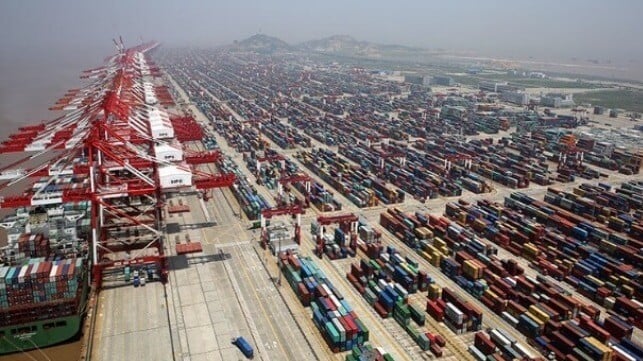
Tariff
Courtesy Port of Shanghai

Published Apr 2, 2025 6:02 PM by The Maritime Executive


On Tuesday, President Donald Trump announced sweeping double-digit tariffs on imports from all countries, starting at a minimum threshold of 10 percent. 

The administration released a table of rates that it has calculated for 50 different foreign nations' tariffs on American goods, including the equivalent impact of non-tariff trade barriers. In a press conference Wednesday, Trump said that the U.S. would impose a tariff equal to half of each nation's rate on U.S. goods, as a "kind" discounted reciprocal charge. 

Most of the nations facing the steepest U.S. tariff hikes are developing countries in the Indo-Pacific, including Cambodia (49 percent), Laos, Madagascar, Vietnam, Myanmar, Sri Lanka and Thailand (36 percent). Vietnam and Thailand have relevance for American industry, as they have become hubs for Chinese manufacturers looking to source inexpensive labor and evade American tariffs. 

China is the most important trade partner on the list, and will be subject to a rate of 34 percent, higher than many analysts predicted. The new tariff stacks on top of a previously-declared 20 percent rate on Chinese goods, so it will bump the net rate on China's exports to a total of 54 percent.

Taiwan - which supplies most of the advanced semiconductors used in the U.S. market - will be subject to a rate of 32 percent. European goods will be subject to a flat 20 percent rate for all member states, from Hungary to Germany. 

Canada and Mexico will be treated separately from the rest of the global list, and are still subject to previously-announced 25 percent tariffs, according to the Wall Street Journal. Likewise, Russia, Cuba, Belarus and North Korea are not covered; a White House spokesperson told Axios that they were left off because they already face significant sanctions and barriers to U.S. trade. 

Some commodities will be treated differently. The new country-by-country tariff schedule does not apply to copper, pharmaceuticals, semiconductors, lumber, bullion, and "energy and other certain minerals." The semiconductor exclusion will be of particular relief for Taiwan and for U.S. tech companies.

A separate new tariff of 25 percent on all foreign-built autos takes effect immediately, with repercussions for ro/ro carriers. The administration's 25 percent tariff on foreign steel and aluminum also remains in effect.

The new tariffs take full effect on April 9, giving time for bilateral talks with affected nations. "The silver lining for investors could be that this is only a starting point for negotiations with other countries and ultimately tariff rates will come down across the board," Northlight Asset Management chief investment officer Chris Zaccarelli told the Wall Street Journal.

Some anomalies on the initial public list have attracted attention. Lesotho, a small landlocked nation surrounded by South Africa, was hit with the highest U.S. tariff rate on the schedule, 50 percent. France's island territories of Reunion, Saint Pierre and Miquelon received elevated tariffs of 37 percent and 50 percent, respectively. The list released by the White House also imposed a 10 percent tariff on the Heard and McDonald Islands, an uninhabited Australian territory in Antarctic waters. The formal list attached to the executive order is shorter, and it omits these entries.


US excludes steel, aluminum, gold from reciprocal tariffs
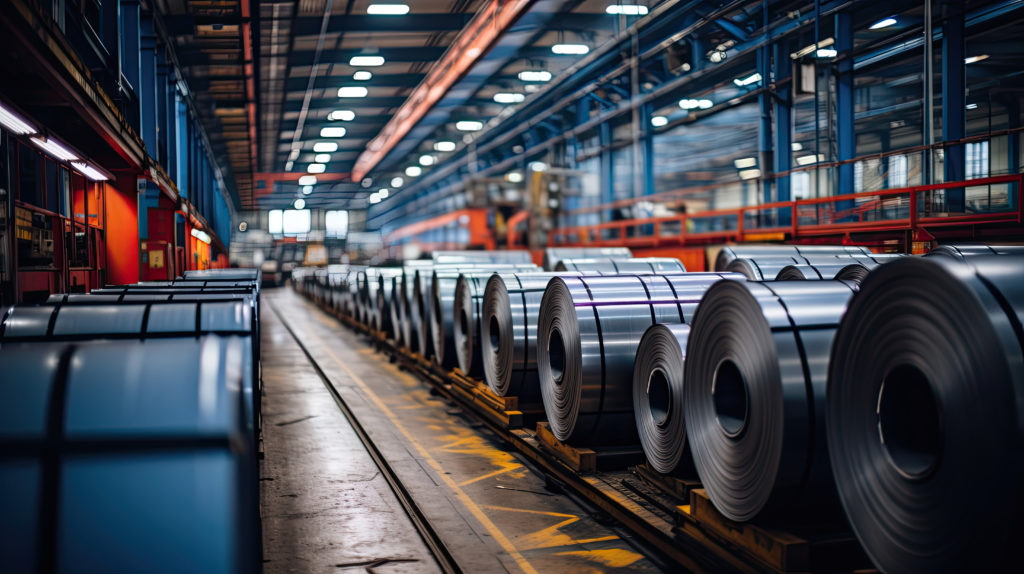
Rolls of galvanized steel sheet. Stock image.

The White House said steel and aluminum imports won’t be subject to reciprocal tariffs in a move that will provide at least some relief to domestic buyers already incurring 25% duties on all imports of the key metals used in everything from automobiles to dishwashers.

Steel and aluminum already subject to Section 232 tariffs won’t incur the duties announced by President Donald Trump on Wednesday, the White House said in a fact sheet. Gold and copper were cited as having exemptions as well.

The determination indicates the administration at least gave some leeway for metals markets that Trump has long prioritized. The president in February ordered a 25% tariff on all steel and aluminum imports, removing all exemptions as he began to hit a reset-button on a widening trade war.

Shares of steelmakers are broadly higher this year, outpacing the larger market, as the tariffs helped boost prices of the metal to the highest in more than a year. But the moves come at a price. Demand for the metal has been weak amid lackluster construction markets, stubborn inflation and high borrowing costs.

Nucor Corp., the largest American steelmaker, Steel Dynamics Inc. and United States Steel Corp. last month warned investors of lackluster earnings results for the first quarter.

Performance for aluminum companies has been uneven in 2025. Shares of Century Aluminum Co. are up about 2% for the year, while Alcoa Corp. is down more than 18%, with much of it’s aluminum produced outside the US.

Gold and copper traders were pricing in the impact from Trump’s tariffs on the global economy. Bullion hit a fresh record during Asia’s morning, while copper futures slumped.

(By Joe Deaux)


Trump Tariffs Leave UK Economy Uncertain

  • President Trump's anticipated tariffs are causing significant concern in the UK, particularly for the automotive industry, and are expected to impact trade relations and the broader economy.

  • Experts warn of widespread consequences, including higher costs for consumers, a drag on global economic activity, and potential disruptions to businesses and investments.

  • The UK government is attempting to maintain a cordial relationship with the US while seeking a trade agreement to mitigate the negative effects of the tariffs, but faces considerable uncertainty.

Nature abhors a vacuum, or so they, or potentially Aristotle, once said. During weeks like this, it feels more accurate to say it’s the news which is doing the abhorring.

Speculation has been, understandably, rampant as to the nature, variety, and impact of the tariffs the US President Donald Trump is expected to introduce on Wednesday, and just how they might affect everything from Chancellor Rachel Reeves’ fiscal headroom and the price of your supermarket shopping, to Tesla stocks and fears of a global recession.

Trump has already imposed 25 per cent tariffs on steel and aluminium imports, with further import taxes on cars and parts arriving in the US set to come in from April 2, in a blow to the UK’s automotive industry and its £7.6bn worth of exports to the US last year.

The so-called ‘Liberation Day’ package of announcements – set to be unveiled in a Rose Garden event at 9pm UK time – is expected to include reciprocal tariffs on countries levying duties on US goods, dashing hopes of the UK’s ‘special relationship’ sparing us.

The Washington Post reported White House aides have drawn up plans for 20 per cent tariffs on most imported goods arriving in the States – but suggested no final decision had yet been taken, leaving question marks over specific sectors or goods facing different rates.

Ultimately, we don’t know – with any ironclad certainty – exactly what Trump might do. 

We don’t know exactly when fresh tariffs on the UK or the wider world will take effect, although there will likely be at least some delay between announcing and implementing.

We also don’t know for sure what other countries will do in response – from grinning and bearing it to retaliating with their own tariffs, or negotiating with Trump, like Canada and Mexico – and how Trump will then respond to that in return… and on and on it could go.

Amid the global vacuum of information, stock markets and investors are getting jittery, with the FTSE 100 down 1.3 per cent on Monday. Economists and experts are issuing warnings, including of a hit to consumers from “the burden of higher tariffs” and a “drag on global activity”, as per the Organisation for Economic Co-operation and Development (OECD).

Far-reaching consequences, no matter what

Myron Jobson, from Interactive Investor, stressed that even if the UK “manages to escape direct levies”, the tariffs “could have far-reaching consequences” for Brits, including impacts on mortgages, corporate investment and jobs, pensions and economic growth.

Business lobby groups such as the Federation of Small Businesses (FSB) have warned of the “huge headache for small firms” with “extra costs” causing a “huge ripple effect”.

Policy chairwoman Tina McKenzie urged the government to “consider state assistance” to SMEs as they “navigate the turmoil and help the firms bounce back as going concerns”.

And pollsters at More in Common found most Brits – 59 per cent – when asked said they were very or quite worried about tariffs. Just 11 per cent said they were not worried at all.

No exemption for the UK

So far, so cheery. Ministers – up to and including Prime Minister Sir Keir Starmer – have accepted hopes of an exemption ahead of Wednesday have faded, with Chancellor Rachel Reeves warning cabinet there will be an economic “impact”, but ongoing deal talks continue.

Marco Forgione, director-general of the Chartered Institute of Export & International Trade (CIEIT) told me yesterday that he believes the US administration hopes to see a “clear sense of impact from their tariffs”, as Trump focuses on “his America First agenda”.

But he insisted there was a “clear opportunity very soon afterwards we could seal an agreement” and an “appetite in Washington for a trade agreement to be reached”. 

Another sliver of silver lining emerged on Tuesday morning when Professor David Miles, from the OBR, suggested to the Treasury committee that a “very limited” trade war, which the UK was not involved in, could perhaps be “very, very mildly positive” for the economy.

Ultimately, Starmer’s approach – maintaining a cordial relationship with the President, pursuing an economic deal, and avoiding “knee-jerk” reaction – has been shaped by the political and economic – not to mention geopolitical – complexities of the situation. There’s little he, or we, can now do, but hold our breath.

By City AM 

Key details on Trump’s market-shaking tariffs


By AFP
April 2, 2025


US President Donald Trump unveiled a baseline 10 percent tariff hitting trading partners, with a higher rate on those deemed bad actors - Copyright AFP/File Frederic J. Brown


Beiyi SEOW

After weeks of anticipation, US President Donald Trump unveiled sweeping new tariffs on trading partners Wednesday, calling it a “declaration of economic independence.”

A fresh “baseline tariff” of 10 percent will apply to economies around the world, with steeper rates tailored to those that Washington deemed as bad actors.

What are the details of Trump’s latest announcement?


– New tariffs –


A 10 percent “baseline tariff” kicks in at 12:01am (0401 GMT) on April 5, while elevated rates for those the White House deemed “the worst offenders” take effect at 12:01am on April 9.

The steeper additional tariffs impact major US trading partners, with the European Union facing a 20 percent rate and China a 34 percent figure.

For China, the number stacks on an added 20 percent levy Trump imposed earlier this year over its alleged role in the supply chain of illicit fentanyl, taking the new additional figure to 54 percent.

Other key partners include India with a 26 percent added rate, South Korea at 25 percent and Japan at 24 percent.

Trump said: “For nations that treat us badly, we will calculate the combined rate of all their tariffs, non-monetary barriers and other forms of cheating.”

The numbers, he said, are “approximately half of what they are and have been charging us.”


– Exclusions –


Major US partners Canada and Mexico, however, are not subject to the new tariffs, White House officials said Wednesday.

Trump earlier imposed 25 percent tariffs on imports from both countries, with a lower rate on Canadian energy, and they will continue to face these duties.

But goods entering the world’s biggest economy under the US-Mexico-Canada Agreement will continue to be exempted.

Should Canada and Mexico reach deals on the levies, however, they will still come up against Trump’s latest baseline rate.

The White House also said that the latest country-based tariffs do not stack atop of sector-specific ones, like those already applied to imports of steel and aluminum.

Cuba, Belarus, North Korea, and Russia are not subject to Trump’s new “reciprocal tariffs” as they are already facing sanctions which “preclude any meaningful trade,” the White House said.


– Other tariffs –


On Thursday, new 25 percent tariffs on imported autos and certain parts will also kick in, bringing fresh challenges to the industry.

Trump earlier imposed 25 percent charges on steel and aluminum imports too, which will now be expanded to impact canned beer and aluminum cans.

He has ordered probes into imports of copper and lumber as well, which could lead to further duties.

White House officials said Wednesday that the president is mulling similar moves on semiconductors, pharmaceuticals and possibly critical minerals.

Separately, a 25 percent levy on goods from countries importing Venezuelan oil can take place from April 2. Trump has threatened a similar “secondary tariff” on Russian oil.


– Small parcels –


On Wednesday, Trump ordered an end to a duty-free exemption for small parcels from China too, a move likely to severely disrupt the import of popular low-cost products.

The rule has faced heavy scrutiny as US officials pointed to the growth of Chinese-founded online retailers Shein and Temu as a factor behind a surge of shipments using the exemption.

Products imported under the “loophole” from China would now be subject to a duty rate of either 30 percent of their value or $25 per item, increasing to $50 per item after June 1.

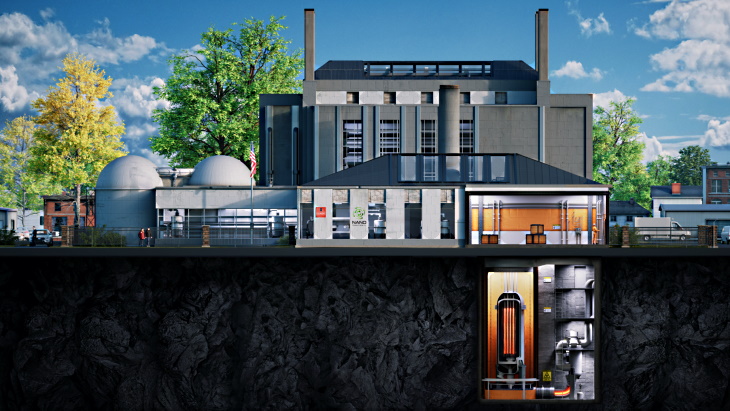


Agreement to build microreactor on US university site


Thursday, 3 April 2025

US microreactor technology company NANO Nuclear Energy Inc has signed a strategic collaboration agreement with the University of Illinois Urbana-Champaign to construct the first research KRONOS micro modular reactor on the university's campus.

Agreement to build microreactor on US university site
Rendering of the KRONOS MMR at the University of Illinois (Image: NANO Nuclear)

The agreement formally establishes the University of Illinois Urbana-Champaign as a partner in the licensing, siting, public engagement, and research operation of the KRONOS MMR, while also identifying the university campus as the permanent site for the reactor as a research and demonstration installation.

The university plans to re-power partially its coal-fired Abbott power station with the KRONOS MMR, providing a zero-carbon demonstration of district heat and power to campus buildings as part of its green campus initiative. The project team aims to demonstrate how microreactor systems integrate with existing fossil fuel infrastructure to accelerate the decarbonisation of existing power-generation facilities.

Following initial arrangements, NANO Nuclear will begin the process of geological characterisation, including subsurface investigations, to support preparation of a Construction Permit Application (CPA) for submission to the US Nuclear Regulatory Commission (NRC). The company said this preparatory work is essential to understanding the environmental parameters of the site, including critical inputs to safety analysis, to ensure the utmost reliability and safety of the facility, and support NANO Nuclear's Preliminary Safety Analysis Report (PSAR) and Environmental Report (ER).

As part of the agreement, the University of Illinois Urbana-Champaign will lead the regulatory engagement with the NRC as well as public engagement, support licensing activities including the PSAR and ER, and play a key role in site layout, constructability assessment, and future operator training programmes. NANO Nuclear will oversee plant design, construction, system integration, and commercial pathway development.

"This milestone marks the beginning of site-specific development for NANO Nuclear's advanced KRONOS MMR technology and represents a defining moment in NANO Nuclear's path to commercialisation of the KRONOS MMR Energy System," the company said.

"This is the milestone we've been working so diligently towards, transforming design into reality," said NANO Nuclear Founder and Chairman Jay Yu. "With a site now selected and a world-class university as our partner, we are positioned to be among the first companies to deliver advanced reactor systems within the United States. This isn't just a research reactor, it's a proving ground for the future of safe, portable, and resilient nuclear energy. Moreover, this agreement will serve as a foundation for our long-term reactor strategy. Every milestone from this point forward brings us closer to delivering the next generation of nuclear energy to communities, campuses, and industries across the world."

"The KRONOS MMR project can not only be a national first, it can be a first for academia, enabling students, researchers, regulators, and the public to learn directly from a real-world microreactor development effort," added Illinois Caleb Brooks, Principal Investigator for the University of Illinois. "This system can be the most advanced nuclear research platform on any US campus, with the potential to enable a new paradigm of nuclear power through education, research, and at scale demonstration."

NANO Nuclear acquired the Micro Modular Reactor Energy System technology through its USD85 million acquisition of Ultra Safe Nuclear Corporation's (USNC's) nuclear technology, which was completed in January. At that time, NANO Nuclear renamed the technology as the KRONOS MMR.

The MMR is a 45 MW thermal, 15 MW electrical high-temperature gas-cooled reactor, using TRISO fuel in prismatic graphite blocks and has a sealed transportable core.

USNC had been working on deployment projects at Canadian Nuclear Laboratories' Chalk River site in Ontario, Canada, and at the University of Illinois Urbana-Champaign in the USA. The university informed the US NRC in June 2021 that it intends to construct an MMR on its campus, with the submission of the Letter of Intent being the first step in the NRC's two-step process to license the new research and test reactor facility. At the time of its purchase of USNC, NANO said it planned to extend the existing collaboration with the University of Illinois at Urbana-Champaign, while continuing the licensing process for the reactor with the NRC.


Natural Hydrogen Find Challenges Energy Assumptions

  • Scientists have discovered large deposits of naturally occurring "white hydrogen" in France, which is generated underground through geological processes and offers a zero-carbon energy alternative.

  • The discovery of white hydrogen challenges previous assumptions about hydrogen availability and could potentially be a renewable resource, transforming France’s energy landscape and attracting global attention.

  • While the technology and regulatory framework for extracting and utilizing white hydrogen are still in their infancy, this discovery represents a significant potential inflection point for the clean energy future.


About 20 years ago, I was interviewing a candidate for a position at a major oil and gas company. On paper, they had impressive credentials, including extensive experience with hydrogen. Naturally, I asked what I thought was a straightforward follow-up: “What are the primary sources of commercial hydrogen?” The answer I received stopped me cold: “You drill a hydrogen well.”

That was a disqualifying response, and for good reason. Commercial hydrogen is not produced from hydrogen wells. The overwhelming majority comes from steam methane reforming—a process that uses natural gas as a feedstock and generates significant carbon dioxide in the process. 

Hydrogen is also highly reactive, bonding readily with other elements. It was long believed that hydrogen didn’t exist in large, accessible, free-form underground deposits. Most of it, after all, is tied up in compounds like water or hydrocarbons.

But science has a way of upending assumptions. Fast forward to today, and two remarkable discoveries in France are challenging what we thought we knew about hydrogen—and potentially opening the door to a cleaner and more cost-effective energy future.

France’s White Hydrogen Windfall

In May 2023, a team of scientists exploring abandoned mines in France’s Lorraine region stumbled upon something remarkable: naturally occurring hydrogen, now dubbed “white hydrogen.” Further exploration in March 2025 in the nearby Moselle area revealed additional reserves. Combined, these deposits are estimated at around 92 million tons—valued at approximately $92 billion.

The significance lies not just in the volume, but in the implications. This hydrogen is naturally generated deep underground, requiring no carbon-intensive production processes. That makes it fundamentally different from gray hydrogen (produced from fossil fuels) and even green hydrogen (produced via electrolysis using renewable energy).

The reason hydrogen is of significant interest as an energy source is that when it is burned, it forms water vapor as the only significant emission. Thus, hydrogen is potentially an incredibly clean energy source if it can be extracted and used without the carbon emissions typically associated with hydrogen production.

Where Does White Hydrogen Come From?

A recent study published in Science Advances sheds light on how this elusive resource is formed. Natural hydrogen can be generated through geological processes like serpentinization, a chemical reaction between water and iron-rich minerals in mantle rocks. Over millions of years, tectonic activity can trap and concentrate this hydrogen in underground reservoirs.

Notably, the study suggests that these hydrogen reservoirs may be replenishable. In other words, white hydrogen could potentially be a renewable resource—not just a one-time discovery. That possibility has intrigued researchers and investors alike.

Economic and Environmental Promise

For France, the implications are potentially transformative. The Lorraine region, long associated with the legacy of coal and steel, could see a revival as a clean energy hub. Jobs, investment, and regional development could all follow in the wake of large-scale hydrogen development.

White hydrogen could also improve France’s energy security by reducing dependence on imported fossil fuels. And from a climate standpoint, it offers a zero-carbon alternative that avoids the high costs of green hydrogen and the emissions of gray hydrogen. If scalable, it could become a bridge between current energy needs and long-term climate goals.

Challenges on the Horizon

Of course, the discovery is just the beginning. The technology to extract natural hydrogen efficiently and economically is still in its infancy. Unlike oil and gas, where decades of expertise and infrastructure exist, white hydrogen will require substantial investment in research and development. One of the greatest challenges for hydrogen is that its energy density is low, and that can create challenges when trying to transport it long distances.

Moreover, France—like most countries—has no clear regulatory framework in place for natural hydrogen exploration and production. Questions remain about ownership rights, environmental safeguards, and how to integrate white hydrogen into existing energy markets.

There’s also the question of how frequently and reliably such deposits occur. While France’s finds are substantial, it’s unclear how common similar formations are globally.

A Global Ripple Effect

Still, the discovery has generated excitement far beyond France. Geologists and energy companies around the world are now reevaluating rock formations once thought to be of little interest. Natural hydrogen could become the focus of exploration efforts from Africa to the Americas.

If even a fraction of those efforts yield results, white hydrogen could emerge as a significant player in the global energy mix—complementing renewables, displacing fossil fuels, and helping countries meet their climate commitments.

A Potential Inflection Point

When I heard that job candidate suggest hydrogen wells as a commercial source, it seemed a laughable misunderstanding. Today, it seems almost prophetic.

France’s discoveries of natural hydrogen may not yet be a game-changer—but they could be. With the right mix of innovation, investment, and policy, white hydrogen might just carve out a vital niche in the clean energy future.

For now, it’s a story that bears close watching—by policymakers, scientists, and investors alike. Because sometimes, even the most improbable ideas can turn out to be true.

By Robert Rapier


Jul 8, 2024 ... The Colors of Hydrogen · Black or brown hydrogen refers to hydrogen produced by coal gasification. · Blue hydrogen is produced mainly from ...


One in Five Refineries Faces Shutdown Despite Rising Fuel Demand

  • WoodMackenzie: A total of 101 out of 410 refineries around the world are at risk of getting shut down over the next decade.

  • This number represented 21% of global refining capacity.

  • WoodMackenzie: inflated operating costs of refineries are an especially important risk factor for future profitability as well as their investments in decarbonization.


Refineries are switching to biofuels or shutting down due to hostile regulations—but demand for oil products is growing. This could result in either a market imbalance that will make these products more expensive or a geographical imbalance, which those who care about supply security wouldn’t like.

A total of 101 out of 410 refineries around the world are at risk of getting shut down over the next decade, Wood Mackenzie analysts estimated recently, noting that this number represented 21% of global refining capacity. The reasons for this estimate include peak oil demand that would reduce demand for the output of refineries and high operating costs in places such as Europe, which collect carbon taxes from their energy industry.

Indeed, Wood Mac considers the inflated operating costs of refineries an especially important risk factor for their future prospects, as well as their investments in decarbonization. “Refineries without committed investments in low-carbon technologies, such as carbon capture, energy efficiency upgrades, or alternative fuels, are especially exposed,” the analysts wrote. “Those located in regions with established or escalating carbon pricing costs, including the EU, UK, and Canada, are under the greatest pressure.”

The carbon prices in these jurisdictions are scheduled to rise to three times above the global average by 2035, the analysts also noted, which will likely make the continuation of the life of some refineries in the EU, the UK, and Canada economically nonsensical—unless policies change.

At the end of last year, analysts and traders told Reuters they expected higher diesel prices this year because of refinery closures. At the time the report came out, refiners were experiencing depressed margins across geographies. But with several refineries slated for shutdown this year, things were going to change—which suggests demand for fuel remained stable if not actively growing.

Yet some have forecast demand will grow this year, even as three large refining facilities close: the Grangemouth refinery, Scotland’s only crude processing facility, which is set to close in the second quarter of 2025; LyondellBasell’s Houston oil refinery, and the Los Angeles refinery of Phillips 66, scheduled for closure by the end of next year.

These three represent refining capacity of some 1 million barrels daily. Meanwhile, however, around 800,000 bpd in new refining capacity is set to launch in Asia, strengthening the argument that operating costs are a crucial factor, and so are carbon taxes: Asian countries have nowhere near the stringent carbon tax legislation that the UK, the European Union, and California have. So, these 800,000 bpd in fresh capacity would certainly compensate for the closures, but they are capacity abroad, not at home, and many have come to view this as a potential problem for supply security—hence the EU’s intention to invest directly in LNG production across the world, for instance.

In this context, it is interesting that the Wood Mac analysis points to Europe and China as homes to most refineries that are at risk of closure. While in Europe the top reason seems to be the carbon tax and its effect on operating costs, for China, the chief factor is decarbonization and more specifically the electrification of transport.

Many observers have argued that China’s concerted electrification push and the diversification into LNG-powered trucks would kill a lot of oil demand. Indeed, consumption data suggests there has been an impact. Yet a new refinery just started operating in China a few months ago, and more recently, its second unit started up, adding a fresh 400,000 bpd to the country’s total capacity. It seems demand is not quite dead yet and will not be for some time—especially for those who make their refineries petrochemical complexes, too.

The refining and petrochemical facilities have the best chances of survival, according to Wood Mackenzie. This is because most forecasts for fuel demand, albeit based on policies that are not as immutable as most assume, see a drop in that over the medium term. Most forecasts for plastics, on the other hand, are rather brighter, regardless of climate policies.

If closures proceed as predicted, which is quite likely in the current political context in places such as Europe, the EU, and Canada, there is a risk of fuel shortages emerging, as reported by the U.S. Energy Information Administration in the March edition of its Short-Term Energy Outlook. The reason: while refineries are shutting down, demand for fuels, notably diesel, has repeatedly surprised to the upside. To tackle the potential shortage, the EIA said the U.S. might have to curb fuel exports—because energy supply security is important.

It appears, then, that demand is not the primary reason for refinery closures. With EV sales disappointing and a “revolution” in the electrification of transport never quite really happening, demand for fuels looks rather stable—and still growing despite the unquestionable rise in EVs on roads. So, refinery closures appear motivated by other factors, notably operating costs. These are rising due to openly hostile policies to the energy industry—and the resulting closures are threatening the security of fuel supply and significantly increasing the risk of boosting reliance on imported fuels.

By Irina Slav for Oilprice.com

ConocoPhillips Considers Selling Prime Oklahoma Assets

ConocoPhillips is considering the sale of oil and gas assets in Oklahoma, which it acquired through its $22.5-billion purchase of Marathon Oil last year, Reuters reported exclusively on Wednesday, citing unnamed sources familiar with the matter.

The company has enlisted investment bank Moelis & Co. to facilitate the sale of these assets, according to Reuters’ unconfirmed report, noting that the process is still in its early stages, and a deal has yet to be finalized. 

The sale could potentially involve assets in the Anadarko Basin, part of the company's inherited holdings. These assets, covering around 300,000 net acres, currently produce about 39,000 barrels of oil equivalent per day, with half of the production coming from natural gas.

This move is part of ConocoPhillips’ broader strategy to streamline its portfolio after acquiring Marathon Oil and assuming approximately $5.4 billion in debt. ConocoPhillips is seeking to divest $2 billion worth of non-core assets, with a particular focus on holdings in Oklahoma. The decision to sell these assets may appeal to buyers looking to capitalize on the increasing demand for natural gas, particularly in industries like energy-hundry data centers.

Since acquiring Marathon Oil, ConocoPhillips has already sold over $1 billion in assets, with plans to refocus on core areas, such as the Permian Basin and Bakken.

Neither ConocoPhillips nor Moelis & Co. has provided any official comment on the matter.

In February, ConocoPhillips said it would seek to boost returns to shareholders by nearly $1 billion this year as it booked better-than-expected earnings for the fourth quarter of 2024. The company’s Q4 adjusted earnings reported in February were at $2.4 billion, or $1.98 per share, down from adjusted earnings of $2.9 billion, or $2.40 per share, for the same period a year earlier.

By Charles Kennedy for Oilprice.com


BP Begins Promised Major Oil and Gas Project Start-ups

BP said on Thursday that its Cypre development offshore Trinidad and Tobago delivered first gas, as yet another project started up since the supermajor reset its strategy to shift focus back to oil and gas.

Cypre is one of BP’s 10 major projects expected to start up worldwide between 2025 and 2027, announced as part the reset strategy to grow upstream production.

The Cypre development is the second major project to start up in two months, during which the UK-based supermajor sought to convince shareholders its investment case is now stronger with the pivot back to oil and gas.

Just after teasing in February that a major strategy reset is coming, BP announced the start of production from the second development phase of the Raven field offshore Egypt. The project involves the subsea tieback of additional Raven infill wells to its existing onshore infrastructure as part of the West Nile Delta (WND) project.

In the strategy reset at the end of February, BP said it is increasing its investment in upstream oil and gas to $10 billion per year while slashing spending on clean energy by more than $5 billion a year.

In the upstream, BP will aim for 10 new major projects to start up by the end of 2027, and a further 8–10 projects by the end of 2030. Production is also expected to grow to 2.3–2.5 million barrels of oil equivalent per day (boed) in 2030, with capacity to increase to 2035.

Two of the 10 new major projects have now started production this year.

Last week, BP approved the development of the Ginger natural gas project offshore Trinidad and Tobago, which will be one of the ten major new projects that the UK supermajor promised to start up by 2027. Ginger will become BP Trinidad and Tobago’s fourth subsea project and will include four subsea wells and subsea trees tied back to its existing Mahogany B platform. First gas from Ginger is expected in 2027.

By Tsvetana Paraskova for Oilprice.com


State Control Returns to Mexican Energy Production

  • Mexico is reversing its 2013 energy reforms by strengthening state-owned entities like Pemex and CFE and prioritizing their electricity generation over private producers, including those using renewable energy.

  • Independent regulatory bodies are being eliminated, with their responsibilities shifting to government ministries, raising concerns about oversight and potential political interference.

  • While President Sheinbaum expresses support for renewable energy, the new laws place CFE in the lead for this transition, creating uncertainty for private renewable energy firms and potentially slowing innovation.

Mexico’s energy sector is undergoing a dramatic transformation, which was announced on the 87th anniversary of the original oil expropriation by Lazaro Cardenas. These new ‘leyes secundarias’ will substantially alter the path set by the 2013 energy reforms that opened the industry to private and foreign investment. Former President Enrique Peña Nieto’s government promised that inviting private companies into oil, gas and electricity production would modernize infrastructure, reduce costs and boost efficiency. However, this free-market approach clashed with the nationalist vision of his successor, former President Andrés Manuel López Obrador (AMLO), who saw foreign involvement as a threat to Mexico’s sovereignty. Under current President Claudia Sheinbaum, Mexico is cementing AMLO’s legacy with new secondary laws that place energy firmly back in state hands. These reforms significantly strengthen Pemex and the Federal Commission of Electricity (CFE) which the government hopes will reshape the industry and spark economic growth.

The most significant shift is the return of state dominance in energy production and distribution. Pemex, the state-owned oil giant, has been granted more substantial control over joint ventures, ostensibly making it easier to partner with private firms while keeping decision-making power within the government. Meanwhile, CFE’s role in electricity generation has been reinforced, with new rules ensuring that at least 54% of Mexico’s electricity must come from the state utility, regardless of market competition. Even more controversially, electricity from private producers—including those using renewable energy—is now second in line, meaning the government prioritizes CFE’s power supply over cleaner, cheaper alternatives. These changes dismantle the competitive energy market created in 2013, ensuring the state holds the reins, no matter the cost.

A key—and contentious—aspect of the reforms is the elimination of independent regulators, such as the Energy Regulatory Commission (CRE) and the National Hydrocarbons Commission (CNH). These agencies were initially set up to ensure fair competition and transparency, acting as watchdogs that could keep state and private energy players in check. Now, government ministries will absorb their responsibilities, which critics warn could increase corruption and inefficiency. The administration claims this move cuts costs and streamlines decision-making, but skeptics fear it removes critical oversight and makes energy policy more vulnerable to political interference.

One of the most intriguing aspects of these reforms is their approach to renewable energy. Unlike AMLO, who largely ignored clean energy in favor of oil and gas, President Sheinbaum presents herself as an environmentalist and wants Mexico to expand its wind, solar and hydroelectric capacity. However, under these new laws, CFE—not private companies—will lead this transition. While this maintains state control, it may slow innovation and investment, as private renewable energy firms now face uncertain regulations and reduced incentives. Mexico has vast potential for green energy, but it remains unclear whether these policies will help or hinder its progress toward a sustainable future.

The real question is whether these reforms will benefit Mexico in the long run. On the one hand, the government argues that restoring state control protects Mexico’s resources from foreign exploitation and ensures that profits benefit Mexican citizens. On the other, outside observers note that removing competition and transparency could lead to inefficiencies, increased costs and an unreliable energy supply. Investors are already wary, with some reconsidering their presence in Mexico due to the unpredictable regulatory environment. Whether this bold energy shift succeeds or struggles will depend on how well the government manages state-run companies, energy demand and the transition to renewables. One thing is clear: Mexico’s energy future has taken a sharp turn, and the world is watching.

By W. Schreiner Parker, Managing Director for Latin America at Rystad Energy