Friday, April 18, 2025

Çiçek: Freedom for Öcalan must be ensured

Cengiz Çiçek stated that the most urgent step is to ensure Abdullah Öcalan’s physical freedom.

ANF
NEWS DESK
Wednesday, 16 April 2025

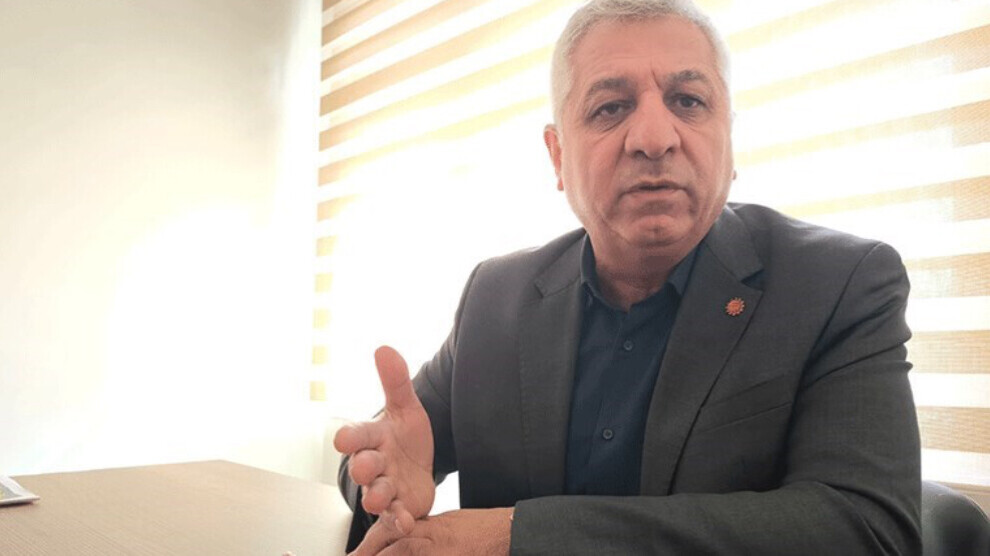
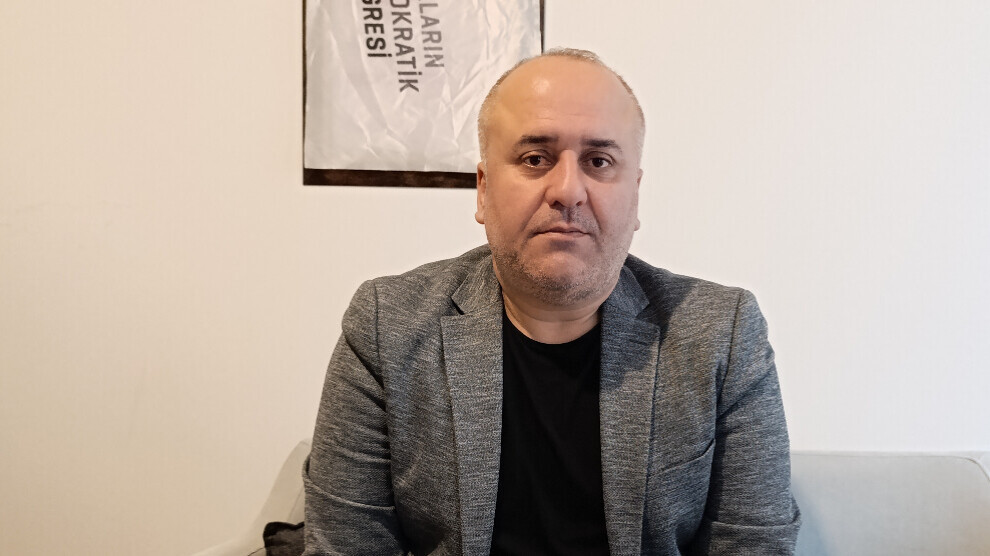
Cengiz Çiçek, a member of parliament for Istanbul from the Peoples' Equality and Democracy Party (DEM Party), commented on President Recep Tayyip Erdoğan’s recent meeting with the Imrali delegation. He said that the process has now reached a qualitatively new phase.

Çiçek noted that Erdoğan had previously denied the Dolmabahçe Agreement by declaring he did not recognize it. He emphasized that Erdoğan's presence in the current talks signals a shift to an entirely new level in the process.


New political moment after Dolmabahçe rejection

Cengiz Çiçek referred to the Dolmabahçe Agreement while discussing the recent meeting, and also underlined the long struggle that has brought the process to its current stage. He said: "The historical significance of the meeting between the Imralı Delegation and President Erdoğan, from our perspective, lies here. These lands have experienced two peace processes: Oslo and the most recent Imralı process. Today, both sides carry lessons and experiences from those periods. These events unfolded in full view of society. During the Dolmabahçe Agreement, President Erdoğan himself officially declared the end of the process by stating, ‘I have no knowledge of this agreement. I do not recognize it.’ Immediately afterward, a plan of total collapse was put into effect. For the past ten years, we have collectively experienced the consequences of this collapse plan. These consequences have been not only political, but also economic, cultural, and social. In this context, the recent meeting between our delegation from the DEM Party and President Erdoğan represents a significant step forward in historical terms.

Above all, it is society, the forces of resistance, and the Kurdish people’s enduring struggle that have played a decisive role in making this new picture possible. Even in the most difficult times, we have consistently said that as long as we resist and carry on the struggle, history never moves backward. It always moves forward. When we look at the Erdoğan who once said, ‘I do not recognize the Dolmabahçe Agreement,’ and compare him with the Erdoğan who today meets with our Imralı Delegation, we see that this shift in position already tells the story of progress. In that sense, it is possible to say the following. The state at its highest level, since this meeting took place at the Presidential Palace, has now stepped into the framework of this dialogue."

The process has moved to a qualitatively new phase

Çiçek added: "This meeting and the developments that followed are subjects of their own and need to be addressed separately. Still, from our perspective, it is not difficult to say that the process has entered a qualitatively new phase. Months have passed since October, and during this time, both supporters and critics have openly discussed President Erdoğan’s distance from the ongoing developments and debates. Many tried to understand the reason for his hesitancy. Everyone has offered different interpretations based on their own position, and we ourselves have done so too. But in general, there was a clear image of Erdoğan appearing distant and extremely cautious regarding this process. The recent meeting between our delegation and President Erdoğan clearly indicates that he is now likely to take a more serious and direct role in the process. The recent statement by Devlet Bahçeli also appears to reflect this shift.

The situation we now face is this: every relevant actor, including those representing the government and the state, as well as those representing Kurdish political movements, has been involved in this round of talks. This phase of political dialogue can now be considered complete. Naturally, the public now expects concrete steps to be taken in order to move the process forward. If such high-level meetings continue without being followed by practical actions, I believe this will only deepen public distrust and frustration."

The first priority is Mr. Öcalan’s conditions

Cengiz Çiçek stated that the first step must be the improvement of Abdullah Öcalan’s conditions of isolation. He explained the reasons as follows: "If this process is to be brought to a conclusion, the conditions of Mr. Öcalan must be improved. In the end, what is being discussed is the possible dissolution of the Kurdistan Workers’ Party (PKK), its disarmament, and the removal of the Kurdish question from the framework of armed conflict and its transition to a legal and political context. Peace is made between the forces that are engaged in war, and naturally, there are necessary steps for such a disarmament process and for distancing the Kurdish issue from conflict and violence. Among these steps, without a doubt, the most important and perhaps the most urgent is ensuring Mr. Öcalan’s physical freedom and improving his working conditions."

He added: "Above all, we say this based on the statement made by the PKK itself. The organization has declared that in order to hold its congress, its leader must be involved in the process. And this is entirely natural. The PKK may be viewed as an illegal organization under current law, but it is a party in name and structure, and like every party, it has a leader. Every political party holds its congress with its leader. In what form or through what mechanism Mr. Öcalan takes part in the congress is something that must be left to the parties involved.

Mr. Öcalan must be involved in the congress process

The realization of such a historic congress requires the participation and involvement of Mr. Abdullah Öcalan in the process. In the same way, creating an environment suitable for a healthy and legitimate congress also depends on halting military operations and ending the conditions of conflict. In recent months, thousands of operations and airstrikes have been carried out in and around Southern Kurdistan. Under such security conditions, convening a congress appears extremely difficult. Officials from the PKK have already made this point repeatedly. What is required of us now is to help foster the necessary conditions. And this responsibility must no longer be viewed solely as the task of the DEM Party, Kurdish politics, or the Kurdish movement. The Kurdish question is now a matter that concerns all peoples living on these lands. There is no need to be Kurdish to see this clearly, because the unresolved nature of the Kurdish question now deeply affects everyone’s living conditions and shared future.’"

Participation of all opposition parties is essential

Çiçek was asked to comment on the recent statement by Republican People's Party (CHP) Chair Özgür Özel, who said in an interview, 'Any step taken toward resolving the Kurdish question would be valuable.' In response, he said the following: "There is a need to completely normalize the political climate in Turkey and make it more moderate. For many years, we have said that military solutions to the Kurdish issue would always harm Turkish democracy and weaken its foundations. History has proven us right. At the same time, the rise of antidemocratic practices across western Turkey during periods when peaceful efforts were being made regarding the Kurdish question is also a reality that directly affects this issue.

That is why responsibility falls on all political forces, whether in power or in opposition, including the Justice and Development Party (AKP), the Nationalist Movement Party (MHP), the CHP, the DEM Party, as well as all social parties and broader opposition circles. This responsibility lies especially with the ruling bloc. Unless the political climate in Turkey is normalized and a climate of dialogue and negotiation is established among all parties, many problems will remain unresolved.

For example, the Kurdish question and the broader issue of democratization in Turkey are often portrayed as if they are in conflict with each other. In reality, they are deeply interconnected and should be understood as issues that directly affect one another. Therefore, the participation of the CHP in this process should not be judged solely by the party's individual efforts. We must collectively seek ways to ensure that the entire opposition, especially the CHP, takes part in this process. This is not the responsibility of the DEM Party alone. Of course, as the DEM Party, our delegations have held meetings with the CHP and other parties, and those meetings have been positive. But the ruling bloc must not view this systemic and deeply rooted problem, which stands as one of the biggest barriers to Turkey's democratization, as something that concerns only the DEM Party. We would like to see the government explain how it intends to approach this issue and, if it has a solution framework, to share it with all opposition parties, just as it does with us. This is extremely important."

CHP appears significantly more open compared to the past

Cengiz Çiçek underlined that the government also needs to take concrete steps in order to create a more moderate and dialogue-oriented political climate. He stated that one consistent truth has emerged from all their meetings and from the statements of senior figures in the CHP, including the party chair. He added that this should be acknowledged. He stated: "Despite all the traps and internal challenges it faces, the CHP, especially under the leadership of Özgür Özel, who has been tested personally on this matter, now appears considerably more supportive of a democratic solution to the Kurdish question. At least in terms of declarations and expressed positions, it is significantly ahead compared to the past. This is a positive stance and one that should be encouraged. We have suffered the consequences of the opposite in the past. During the last resolution process, there was a situation where the ruling parties, such as the AKP and the MHP, appeared to be pursuing a solution. On the other side, however, there was an opposition bloc, including the CHP, that maintained distance or even took a stance against any such initiative. The transformation from then to now has taken place through consistent effort. It happened through everyone’s contribution and through the recognition of a historical truth."

Çiçek stated that this emerging and simple reality should now guide political positioning. He said: "Everyone should define their stance with this level of self-confidence and clarity. This applies to us as well. The Kurdish question and the Kurdish people’s struggle for democracy and freedom have become one of the most significant democratic forces in Turkey. The political line adopted by the DEM Party, which positions itself as a third path, has become a reality that no political actor can afford to overlook or exclude. It is now a central force, a defining subject. That is why every political actor, both in government and in opposition, must now clearly express support for a democratic solution to the Kurdish question. Any political force that distances itself from this position will lose ground. In my opinion, the current political landscape proves that both the government and the opposition have begun to recognize this truth. All political developments in the coming period will be shaped by this reality. A state that resolves the Kurdish question will, in truth, raise its democratic standards. This is exactly what Mr. Öcalan has emphasized time and again. We must push for systemic democratic transformation. If we avoid being trapped by daily political calculations and approach this issue with a long-term perspective and clear objectives, then together, with Mr. Öcalan, Kurdish political actors, and our shared efforts, we will be able to provide more accurate and meaningful answers to this historic challenge."

Our struggle carries historical significance

Çiçek also responded to criticisms directed at the recent meetings of the Imralı Delegation, particularly during the period of protests sparked by the move against Istanbul Metropolitan Municipality Mayor Ekrem Imamoğlu on 19 March. He pointed out that these criticisms fail to grasp the broader historical meaning of the current struggle. He said, “In the hundred-year history of the Republic, there is undoubtedly a legacy of denial. I am not referring only to the Kurdish people. This struggle has been carried out by all the segments that have been excluded and denied by the official state paradigm, including the Circassians and Alawites. Mr. Öcalan once said that the total electoral support of those kept outside the state’s framework amounts to around 30 percent. One of his main goals has been to transform all these excluded social groups and identities into a unified political struggle, recognizing their differences as a source of richness. This is why I am not limiting my remarks to the Kurdish issue alone. Still, since your question was framed within the Kurdish context, I must say this very clearly. From the past to the present, the Kurdish people’s struggle for status, for recognition, for freedom, has always served to raise democratic standards in Turkey. It has kept the pursuit of democracy and freedom alive. It has consistently strengthened the desire to uphold equality and justice across this land."

Subjecting the DEM Party to a test of democracy is not a fair approach

Cengiz Çiçek addressed the frequent criticisms that frame the DEM Party as needing to pass a so-called "test of democracy." He argued that this attitude is neither correct nor democratic. Çiçek said: "Imagine, just for a moment, that Kurdish politics, the Kurdish movement, or those demanding a democratic solution to the Kurdish question had never existed. Imagine that there had been no such struggle over the past 40 or 50 years. In that case, there may not have been any movement at all for democracy or freedom in these lands. Whether people vote for us or not, whether they criticize us or not, there is one truth that all segments of society must acknowledge. This struggle, which unites the DEM Party, Kurdish politics, socialist movements, and the third path, represents the most significant democratic struggle on these lands. That is why we find it disappointing and frustrating when, at every opportunity, certain forces subject the DEM Party or the Kurdish movement to a democracy test. This is not a fair or democratic approach. We say this because the very existence of our struggle is what continues to keep hopes for democracy alive in Turkey. It is not only a source of hope for the DEM Party. It also keeps hope alive for those who vote for CHP, and for those who support other opposition parties outside the ruling bloc, including AKP and MHP. Millions who have given their hearts and votes to the opposition find strength in this struggle. That is its historical importance."

The DEM Party is not an object of anyone’s desires

Çiçek warned against viewing the DEM Party as a tool to be used for the interests of either the ruling power or the opposition. He described such an approach as dangerous, misguided, and ultimately self-defeating. He said: "In discussions about contested political issues, treating the DEM Party with pragmatic calculations to serve the ruling bloc’s interests, the opposition’s strategies, or any other party’s goals is a serious mistake. It is also something that leads to loss. We have always made our position clear. We are not an object of anyone’s desires. We are a third force, a third path. Outside the two dominant political blocs that have historically shaped the country, we are trying to organize our own front. What we are building is an alternative perspective of power, one based on peoples’ self-governance. Our struggle is a historic one, aimed at pushing the system toward democratic transformation. At the same time, it is a current struggle born from a long legacy of resistance."

Çiçek added that everyone must now ask themselves some fundamental questions. "If certain expectations are placed on us, we have already responded clearly. Our co-chairs have made this known. Our comrades who speak in the name of the party and the struggle, especially during Newroz, have said the same thing. The appointment of a trustee in Van, or in Dersim or Hakkari—what we call a trustee coup because it overrides the will of the people—is the same kind of intervention we see in the operation targeting Imamoğlu and the Istanbul Metropolitan Municipality. It is an assault on the will of millions. It is a coup. It is an antidemocratic act. Everyone must act with a sense of responsibility when it comes to responding to this situation through protests or other actions. The next phase should be approached accordingly. In our view, CHP also needs to step up and push harder. Millions of people took to the streets. Any political force that fails to recognize this will inevitably lose. And I say this not only about others but also for ourselves. The vast majority of those who protested were demanding a democratic future. They wanted to renew their hope in their own future and keep it alive. In fact, this stance even went beyond the CHP itself."

He concluded his remarks by saying: "This is not unlike what happened during the Gezi Park resistance. It was never just about a few trees. It was a scream of rebellion against suffocating policies. Similarly, the recent reaction cannot be explained solely as support for Imamoglu or opposition to a move against the municipality. Millions of people in Turkey have been living under pressure, in a state of siege, deprived of air to breathe. What we witnessed once again is that people have begun to defend their own spaces of freedom and democracy. This is a very clear picture for us. But subjecting only the DEM Party to scrutiny is, frankly, a sign that our struggle is not fully understood. Especially since the recent local elections, people need to recognize how the democratic position taken by the DEM Party at critical turning points has contributed significantly to this country."
Dr. Attia: The responsibility for the implemention of Öcalan’s call lies with the Turkish state

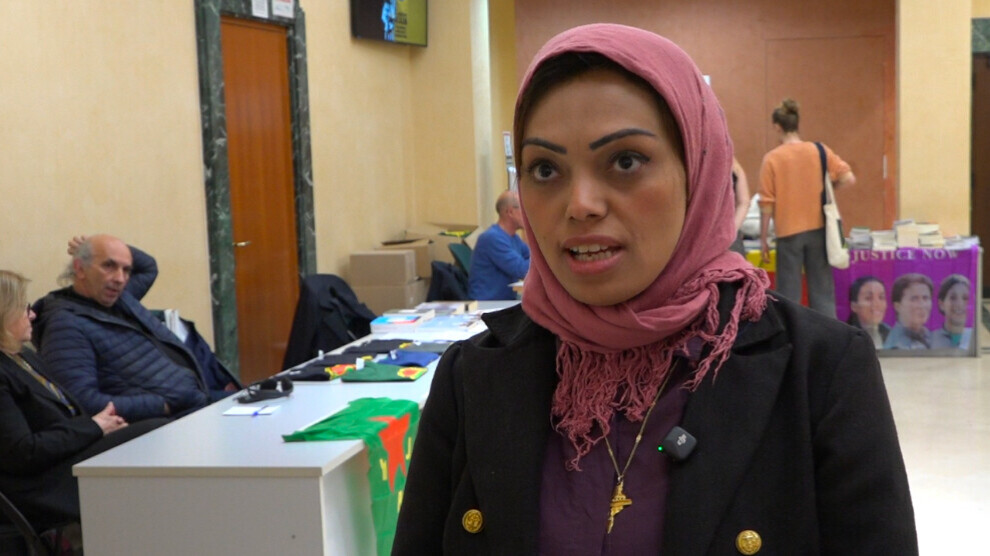
Fernaz Attia, an Egyptian doctor of political science, said that the responsibility for the implementation of Abdullah Öcalan’s call lies with the Turkish state.


ANF
NEWS DESK
Wednesday, 16 April 2025

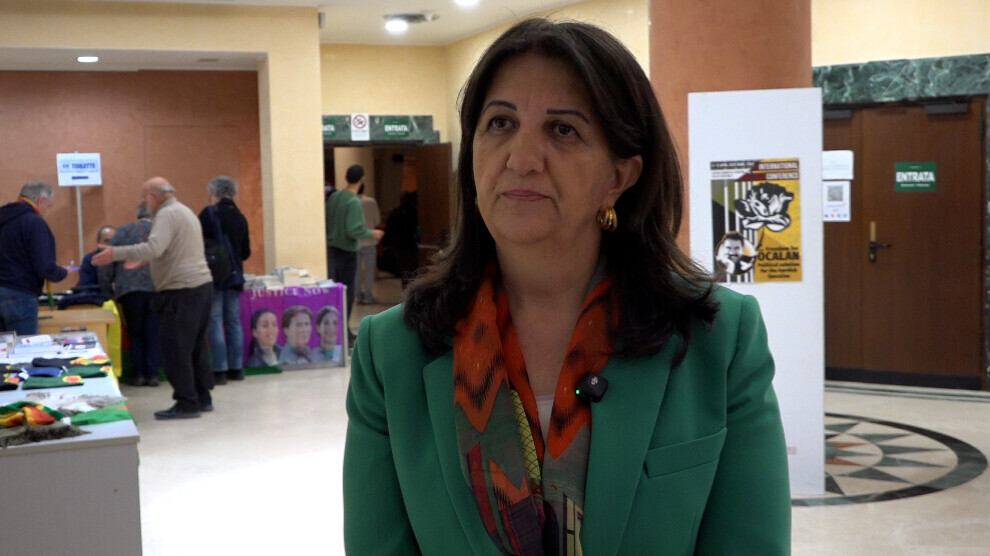
Many actions and events were held as part of the global campaign that started on October 10, 2023 with the slogan 'Freedom for Abdullah Öcalan and a Political Solution to the Kurdish Question'. Within the scope of the global campaign which saw the participation of millions of people, the International Conference “Freedom for Abdullah Öcalan, Political Solution to the Kurdish Question” was held in Rome on April 11-12. More than 300 delegates from 16 countries attended the conference. Dr. Fernaz Attia from the Nûn Initiative for the Freedom of Abdullah Öcalan, one of the conference participants from Egypt, spoke to ANF.

Commenting on the importance of the conference, Dr. Fernaz Attia said, “Abdullah Öcalan supports peace, socialism and women's freedom. Initiatives for his freedom should be followed carefully.”

'This development will stabilize our region, the Middle East'

Regarding Abdullah Öcalan’s February 27 ‘Call for Peace and Democratic Society’, she stated: “Abdullah Öcalan announced a peace initiative between the Kurds and the Turkish state. This development will stabilize our region, the Middle East. The conflict between the Kurds and the Turkish state is one of the most important problems in the region. Abdullah Öcalan is an important name for us as the architect of the Democratic Confederalism paradigm. This project offers the opportunity for an equal and free life in countries where there are problems due to ethnic diversity, belonging, cultural and religious differences. This is the power of free democracy.”

'The call has the power to solve problems'

Stating that the responsibility for the implementation of Öcalan’s call lies with the Turkish state, Dr. Fernaz Attia said, “Peace in Turkey will bring peace to the Middle East.” Noting that the call has the power to solve problems, Attia referred to the ethnic tensions in Iran, Syria and Iraq and said that the deep state in Turkey could be an obstacle to a solution.

'New knowledge about the role of women'

“Abdullah Öcalan has created new knowledge about the role of women in a free and democratic society,” said Attia and noted that Jineoloji [Women's Science] deals with women, women's lives and democratizing women's lifestyles. She remarked that all this is aimed at developing the democratic nation project.

The Nûn Initiative

The Nûn Initiative was founded on June 4, 2022 by several women from Egypt, Palestine, Iraq, Libya, Libya, Lebanon and Sudan who support Abdullah Öcalan’s women's libertarian paradigm. The Initiative aims to put pressure on international institutions and organizations to protect and defend the rights of political prisoners and universal basic human rights. It also aims to ensure the physical freedom of the Kurdish leader, to promote and disseminate his ideas and philosophy, to recognize the will of the peoples, and to protect and recognize the rights of minorities.
Aslan: The  Turkish government fears unity of Kurds and workers 


Labour Party 
EMEP chair, Seyit Aslan, said the government fears the growing unity between the Kurdish struggle and the struggle of workers from Turkey.


ANF
NEWS DESK
Thursday, 17 April 2025

On 19 March, Turkey entered a new phase following the detention of Istanbul Metropolitan Municipality Mayor Ekrem Imamoğlu and 11 others. The protests that erupted across the country in response to the detentions have triggered new debates within the sphere of social opposition. Particularly in recent years, the public’s reaction to the government’s efforts to establish a regime of repression, though fragmented, has reignited discussions among socialist and leftist movements about the need for a unified front of struggle.

Labour Party (EMEP) chair, Seyit Aslan, shared his assessment with ANF regarding the public reaction that emerged after the Sarachane protests and the ongoing debate over a common struggle.

Common struggle means unity of the working class, laborers, and the people

Seyit Aslan stated that the reaction that emerged in Sarachane went beyond the potential of the Republican People’s Party and recalled that the stance of university students played a key role in sparking the growth of the resistance. He emphasized that the debate around a common struggle has existed for quite some time and added: “This powerful, mass protest movement, sparked by the militant stance of university youth, spread across the entire country despite all the threats issued by the government. The mass character of the Zeren Ertaş protests and the teachers’ actions, the atmosphere created by localized protests, the actions of farmers who poured their crops onto the roads with their tractors, the local actions of the student movement, the defiance of metal workers against the strike ban, as well as workers’ protests and resistance in various cities and sectors, and the anti-trustee demonstrations in the region and in the west, these are all signs of a mass movement boiling underneath the surface.

Throughout this entire process, everyone spoke of a common struggle, but there was no meaningful step taken to make it real. Of course, there are reasons for this. It has to do with how we understand unity and common struggle. What should be meant by common struggle is the unity of the working class, laborers, and the people. The coming together of leftist and socialist parties can only be meaningful to the extent that it serves this goal.

The mass movement that emerged after 19 March instilled a significant amount of fear in the government and pointed to the path that must be taken. For those who do not trust the people, who think ‘nothing can come from workers and laborers; these people will be fooled again with a bag of pasta,’ this movement was the answer. However, we must also say that the movement remained confined within the boundaries of the current political system. As long as the left and socialist forces cannot reach the level that can lead future mass movements forward and ensure they conclude with concrete victories, this limitation will remain.

From the perspective of a common struggle, we must take into account the characteristics of today’s experience. Around urgent demands, a people’s front can be organized. A process could begin in which all political parties, professional associations, trade unions, and similar groups come together to form local units of unity. This could be the first step of such a people’s front. In other words, organizations and parties must act from a position that prioritizes the interests of workers, laborers, and the people, rather than protecting their own narrow group interests.”

The students have nothing left to lose

Aslan stated that a significant buildup has occurred in response to the pressures on the student movement and emphasized that intimidation policies no longer carry any weight for students. He continued: “For a long time, despite taking different forms, the struggle against the pressures imposed on universities and the student movement has continued. The appointment of a trustee rector to Bogazici University, cafeteria protests, pressure on student clubs and communities, the dismantling of student representation, problems in dormitories, harassment and mistreatment targeting female students, and tuition fees have all sparked a strong response from the student movement.

There have been serious actions throughout these periods. Students joined the Bogazici protests. The demonstrations by students at Middle East Technical University created momentum. Most recently, the annulment of Ekrem Imamoğlu’s diploma was the last straw. The Beyazit march and the toppling of police barricades marked the most critical turning point in this process. Students had nothing left to lose. Once even the value of their degrees became uncertain, they reached a point of saying, ‘This has gone too far.’

Another important element was that students took to the streets together from their faculties and campuses. Even the limited existing forms of organization, such as student communities, played a role in reinforcing the dynamism of the student movement. Compared to workers and laborers who responded individually to calls from their homes, workplaces, and neighborhoods, students acted in a more organized manner. They also deepened this organization through action, meeting in forums, making collective decisions, and carrying out a democratic process. This naturally pushed them to the forefront and made them the leading force in a protest wave that lasted for days across the country.

The nationwide spread of boycott calls stems from the clarity and strength of their demands. This must be emphasized: youth have brought immense energy and momentum to this process. It is essential to understand young people and to recognize the depth of their concerns about the future. The oppressive and repressive policies of one-man rule and the palace regime have failed. The psychological barrier has already been broken. From now on, government attacks will not go unanswered. The youth have broken their silence. The slogan ‘worker youth hand in hand, general strike now’ has become a symbol of general strike and resistance. The dam has broken.”

The government fears the unity of the Kurdish people and workers from Turkey

Seyit Aslan emphasized that the government has long tried to prevent the unification of the Kurdish people’s struggle for freedom with the struggle of workers and laborers from Turkey. He pointed out that this unity is among the developments the government fears the most and stated: “Governments and capital have always attempted to divide, fragment, and neutralize mass movements, whether in the struggle of workers and laborers for their rights or in the Kurdish people’s fight for freedom and equality. As you mentioned, sometimes certain circles within the opposition have also contributed to this, and they continue to do so today. But the broader public has not placed much trust in such rhetoric. People have focused instead on the injustice and unlawfulness they are experiencing today.

Young people have played an important role throughout this process. Among hundreds of thousands, the vast majority acted responsibly in the face of provocation. Workers and laborers no longer fall for these provocations. They listen and move on. Kurdish- Turkish workers are increasingly recognizing that their problems are shared, and they are feeling this more deeply.

We know that when the demands and struggles of the workers’ and laborers’ movement converge with those of the Kurdish people’s movement, it becomes a truly transformative force. Today, the prospect of such unity is one of the developments the government fears most. In the lead-up to May Day, the workers and laborers of both peoples will stand side by side and continue to fight for their demands. Because the demand for bread, for humane working conditions, for a life of dignity, and for fair wages is just as urgent for all workers and laborers as the demand for equality and freedom is for the Kurdish people.

As the Labour Party, we will raise our voices during the May Day period, bringing together the most urgent demands of the working class with the Kurdish people’s demand for equality and freedom. And we will continue to struggle for the construction and strengthening of this united struggle.”

The narrative of staying off the streets has been shattered

Seyit Aslan pointed out that the nationwide protests have broken the long-standing narrative within the Republican People’s Party (CHP) of 'staying off the streets,' and stated that it is indeed possible to build a united front of struggle. He emphasized that the government lost its grip during these actions and concluded his remarks as follows: “The protests that began in Sarachane and spread across the country after students broke through the barricades in Beyazit shattered the CHP’s previous approach of ‘let’s not take to the streets, it will be a provocation, the government will exploit it.’ These protests also threw the government off balance. The masses overcame the threshold of fear by testing their own strength once again. While the emergence of a mass movement could be foreseen, it was difficult to predict the conditions and the extent to which it would unfold, just like the moments we once referred to as 'Gezi, Kobanê’, or the ‘Metal Storm.’ Each of these powerful mass uprisings left us with valuable lessons. We are learning, and we are drawing lessons. This most recent wave has been no different.

As socialists and as the democratic forces in this country, our top priority must be to organize the unity and common struggle of the working class, of Kurdish and Turkish laborers, of women and youth, and of all peoples from every background. It is not enough for progressive, revolutionary, and pro-socialist forces to come together. That alone does not guarantee the unity of the people or the unity of workers and laborers. As organizations, parties, and democratic forces with different programs, we can today establish a common ground of struggle by rallying around the most urgent democratic demands and freedoms of the working class.

We must recognize that moving together has become a necessity if we want to inspire confidence in broad segments of society and demonstrate that victories can be achieved through struggle and organized power. In the face of the palace regime and one-man rule, it is clearly possible for all segments of society to stand side by side on a common front, each with their own demands, each engaged in the same struggle.

It is possible to build a front of struggle both against the government’s economic program, for a life of dignity, a living wage, and the ability to make ends meet and for the resolution of the Kurdish question under conditions of equality, as well as for our democratic rights and freedoms.”

KCK's Kalkan: Öcalan's call can be implemented if the appropriate conditions are created

Duran Kalkan once again stressed the clear position of the Kurdish freedom movement, reiterating that "Öcalan's call can be implemented if the appropriate conditions are created."


ANF
NEWS DESK
Thursday, 17 April 2025

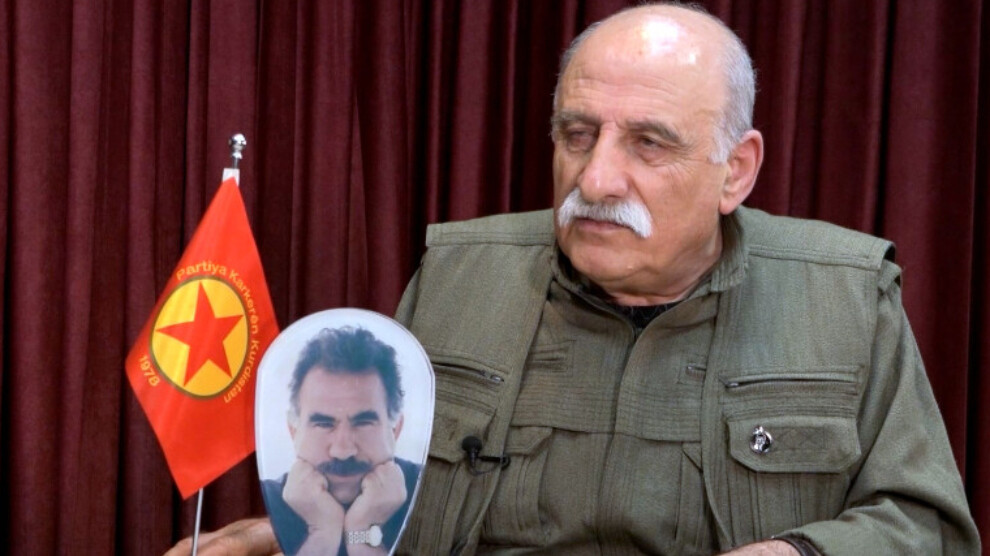
In this in-depth interview, Duran Kalkan, member of the KCK Executive Council, spoke about the state of affairs one and a half months after people's leader Abdullah Öcalan's ‘Call for Peace and Democratic Society’ was published. He once again stressed the clear position of the Kurdish freedom movement, reiterating that "Öcalan's call can be implemented if the appropriate conditions are created."

More than a month and a half has passed since the statement by peoples leader Abdullah Öcalan, which was read out on 27 February. Great hopes had been raised, especially regarding the change of the living and working conditions of Öcalan. What is the current status in this regard?

I respectfully salute the historic Imrali resistance and its conductor, Rêber Apo [Abdullah Öcalan]. The isolation in Imrali continues. There is no information about any serious change reflected to us. A period of one and a half months has passed since Rêber Apo made a historic call that was widely appreciated, and, accordingly, it was expected that there would be practical developments and changes. However, this is not the case. The Imrali system of torture, isolation, and genocide continues.

Free living and working conditions for Rêber Apo have not been ensured. However, it was stated that he would regain those within a week. There has been no change. So far, there is no serious approach that has been reflected and observed in this regard. Since the call did not find its response in practice, this led to a serious discussion and crisis. We, as the leadership of the party, expressed our position in this process quite clearly. We pointed out that like this there will be no outcome, and we assume that this is also Rêber Apo’s attitude. The rumors that Rêber Apo did not have the intention to make any statements on Newroz do not correspond to the facts.

As we read the situation, Rêber Apo is taking a clear stance to emphasize the crucial importance of the current situation, and the situation in Imrali is a crisis. It is claimed that this crisis has been overcome with recent statements and talks, but whether this really is the case or not, we don’t have concrete information on that. But what they intended to do was to reflect a positive atmosphere to the public.

The content of Rêber Apo’s call should, of course, be discussed, and everyone can express their own views on the Imrali system, on the physical freedom of Rêber Apo, and on the solution to the Kurdish question. But one should not spread rumors and claim that Rêber Apo said this or acted like that. One must not speak on behalf of Rêber Apo. Everyone needs to be careful in this regard in order not to create wrong perceptions. There are people that want to manipulate and play with minds. That is why it is necessary to be careful and sensitive.

Rêber Apo did more than his part and thereby surprised everyone. There were headlines stating, ‘He did the unexpected’. Rêber Apo made a confident and pioneering statement pointing towards a solution in such a way that it surpassed everyone’s expectations. This was, of course, very meaningful and important. However, one should not expect that Rêber Apo will solve the whole problem alone, that everything is solved with Rêber Apo’s statement. Rêber Apo did not create this problem. There is the Kurdish question behind it. It was created by the international capitalist modernity system and the state structure of the Republic of Turkey. They created it by denying the existence and identity of the Kurds, launching extermination attacks, and practicing genocidal attacks against the Kurds. The Kurdish question was created on the basis of enmity, on the basis of a mentality and politics of destruction and ignorance. This is the essence of the problem. And they based the Kurdish question on violence. Those who rely on violence, those who have conducted massacres and genocide against the Kurds over the past one, two hundred years, have to give up on this. Those who deny the existence and identity of the Kurds, who do not recognize even their most basic rights, and who want to annihilate them have to give up on this. Rêber Apo and the PKK have revealed the reality that they are living and put it in front of everyone.

As Rêber Apo pointed out, he has not created this problem. It is the work of others. He found it in front of him, while everyone else also saw it but ignored it. And Rêber Apo didn’t act like everybody else. He named it and started to work on its solution. He fulfills the duties and responsibilities that fall on his shoulders in this regard, but he alone cannot bring peace to Turkey. War and peace involve two sides. There cannot be a solution only by one side. Rêber Apo has been making a relentless effort for peace for more than 30 years, but nothing can be solved alone. Freedom, democracy, and democratization cannot be achieved by the efforts of one person alone. Everyone needs to participate in this. Everyone has a duty and responsibility in this. Therefore, no one should have the expectation that Rêber Apo can and will do it all by himself.

Kurdish society in particular, and among it the youth and women, needs to be sensitive to this reality. They need to be well aware of which responsibility falls on whose shoulders, what the way for a solution can be, what kind of duties emerge during this process, and what kind of struggle is necessary. The current situation demands that the global freedom campaign aiming at the physical freedom of Rêber Apo be developed and sustained in a multifaceted and effective manner. In this context, a conference was held in Rome. It was important, and the recent developments were evaluated. What will be done next is, as far as we can observe, still being discussed. I salute all those who carried out that effort, but I also want to highlight that it is necessary to further enlarge, spread, and strengthen the global freedom campaign on every dimension, in all four parts of Kurdistan, and in all corners of the world.

In his call, peoples leader Öcalan also points out the necessity of the convening of a congress. This is something that is being widely discussed. What can you, as one of the people directly responsible for this, say about this?

Rêber Apo’s statement from February 27 titled ‘Call for Peace and Democratic Society’ was a historic call, and its content carried a deep meaning. Therefore it was very meaningful, effective, and had a positive impact on everyone. There were some who opposed it, and even those who made harsh accusations for the call being published, but in general it had a positive impact on everyone. It was a call that not everyone could make, a call that not everyone could afford, a step that not everyone could take. But Rêber Apo took this step. It imposed duty and responsibility on everyone. The call was addressed not to one specific person or organization, but to everyone living in this world. No one can say that the call does not concern him. Even the most oppressed in the remotest corner of the world was addressed to the call because of being so. An unprecedented system of oppression and exploitation was created on the basis of the mentality and politics of destruction and ignorance of the Kurds, and it spread from there. Therefore, the Kurdish Freedom Struggle includes all of them. In this respect, one can say that maybe not on the same level, but at the end everyone is the addressee of the call.

We as a movement make our position known at the appropriate time, and so on March 1st we issued a statement to define our position, and to follow this up with practical steps, we declared a ceasefire. Most importantly, we openly defined our position. We said that this call can be implemented if the appropriate conditions are created. And we stated that we fully agree with its content and that we will comply and implement it. For the appropriate conditions, we defined the physical freedom of Rêber Apo, the conditions for him to live and work freely, because only Rêber Apo can organize the necessary congress. Only Rêber Apo can make the decisions to be taken at the congress, and only Rêber Apo can implement them. Apart from this, neither any force, person, nor institution within or outside our movement can do so. Our party leadership and all other current mechanisms within our movement are based on the administration of the war. It can only wage war. They say, “The Congress must dissolve the PKK.” The world united to destroy the PKK; they used all kinds of weapons and resorted to all kinds of ways and methods. They have never followed any rules of morality and law. They have been uninterruptedly attacking for forty years and could not get any results. For the last ten years they have been attacking on the basis of their so-called “collapse action plan” without success. They could not destroy or annihilate the PKK, and they could not continue Kurdish denial. No one but Rêber Apo can make them take those decisions and implement them. Now we stand on this view and explanation. A very long time has passed, and it was a difficult time. We made various evaluations, but still, due to the importance, content, and difficulties of the problem, we continued this process in the sense of not rushing and giving practice a little more chance. Our statements are still valid today. On this issue, we have not yet received anything concrete from Rêber Apo in the direction of holding a congress and having a decision taken.

Rêber Apo has stressed his determination. We have seen this, have attached importance to it, and find this determination meaningful and valuable. We are not against its realization; on the contrary, we are in favor of it. But it is obvious that a situation to realize it has not emerged in Imrali. More than forty-five days have passed, more than a month and a half, since the declaration, and still the isolation continues. There has been no new development, no change in the conditions under which Rêber Apo lives and works. The Imrali system continues; it has not been abolished, and not a single step in that direction has been taken. Rêber Apo cannot meet with anyone; he is not in a position to do any work regarding the congress. Once he gets in a position to realize this, he will advance the process.

Rêber Apo has made a decision and said that he is ready and willing to play his role. If the circles in power and the state really want it to be done, then there is the power to do it. When they pave the way, give him the opportunity; he implements his decision – he fulfills his promise – the problem will be solved. If what they really want is to solve the problem, then this can be done in this way. While there is the continuation of the Imrali system, the maintaining of the isolation, and the hostage system, the requirements defined in Rêber Apo’s declaration cannot be implemented. They cannot be practiced. Now it is being said that there are positive developments, that practical steps are being taken, and the Imrali delegation said that there will be changes in the conditions in Imrali, legal work will be done, the so-called ‘Right to Hope’ will become functional, there will be legal guarantees given, and so on. We don’t know what exactly is behind it and what is being discussed. But if it really happens like this, if Rêber Apo is enabled to run the congress, then it can work; then there will be no problem. There are no obstructive problems on our side; on the contrary, there are always facilitative approaches.

The rest is up to the power and state forces. It is up to those who created this problem, those who created the Imrali system, and those who maintain the most severe hostage system known to humanity. They babbled something about there being no legal legislation; however, there are European laws. Applying European laws is binding for Turkish law. They could have implemented it. They could have made legal arrangements within three days if they wanted to. It was not something that could not be done, but they have not done it until now; they have stalled and delayed. If they block the process, and they are responsible for it, it causes.


Kalkan: Words are not enough, peace requires actions

KCK's Duran Kalkan said that "the current government is not going through a change of mentality and politics that recognizes the existence of the Kurdish people."


ANF
NEWS DESK
Friday, 18 April 2025


In the second part of this interview, Duran Kalkan, member of the KCK Executive Council, said that "the current government is not going through a change of mentality and politics that recognizes the existence of the Kurdish people."

The Imrali delegation recently held a meeting with the President of Turkey. How do you see and assess the rapprochement of the state and the rulers in the current phase?

The meeting took place after a long time, almost two weeks. There was even a debate about whether it would happen or not because of the time that had passed. But finally there was a meeting. Of course, it is important and meaningful that the President of the Republic met with the DEM Party’s Imrali delegation. They also met with the Speaker of the Parliament, they met with the heads of other parties, and with further circles. But it is decisive to meet with the President of the Republic as the interlocutor of the government and the number one responsible for the state, and for the President of the Republic to be involved in this matter at that level. Therefore, we see it as meaningful. And the statements given afterwards were very positive. It impressed everyone. But as we have expressed before, there are many wishes, many words, but no practice. No practical steps are taken. Now there are very positive, pleasing words and statements, but the question is what the practical outcome will be. We really don’t have any information about the content of the talks. We don’t know if something has been decided, or if wishes have been expressed, or how the results will be put into practice. We hope that it will be positive, that it will advance the process.

More can be said when a practice develops. Mere words will not be enough. We cannot say anything based on words. In this respect, both the talks and the statements are important. We hope that practice of it will follow.

The public, especially the Kurdish and the democratic public, first and foremost the women and the youth, must be aware that so far everything is just at the level of words and wishes. There should be no wrong perception. All this might be a concept of special warfare being in play. Caution is necessary, and evaluations from as many angles as possible are needed for it to be evaluated correctly, since there is enough reason to have doubts and to be concerned.

The war and the attacks of the Turkish state continue uninterruptedly. On behalf of our Central Headquarters Command, the HPG Press Office announces the statistics of the daily attacks against the guerrillas. We gave five martyrs in Zap and two martyrs in Gare. There are about 500-1000 bombardments every day. Prohibited weapons are being used. And airplanes continue to hover over the area.

I want to take this opportunity to salute the resistance of our guerrillas once again. I commemorate with respect, love, and gratitude the martyrs we gave in the face of these attacks. It is important and meaningful to be able to stand firm under these conditions, to use the right to legitimate defense against these attacks. No one can say anything different to this. But how will it be if it is being said that armed struggle must stop and arms must be laid down while they still uninterruptedly launch military attacks? How credible can that demand for laying down arms be? This is, to say the least, debatable. Why are these attacks still going on? It doesn’t look like a peaceful situation at all. I wonder what a force that attacks while there is a ceasefire will do to those armed people if they lay down their arms tomorrow. We are not ignorant. They should try to deceive us.

The current government is carrying out similar attacks not only on the military front but also on society and politics. Democratic individuals are constantly being arrested, and democratic institutions are being shut down. The prisons are filled to the brim. The government is attacking the opposition. There is massive pressure and attacks on the CHP, as well as on all the other parties. As comrade Karasu said, “Can we talk about an approach, mentality, and politics that cannot tolerate the opposition being democratic? Can such a mentality and politics democratize the state and society? Can it realize the democratic solution of problems?” This is not possible. If it cannot be democratic itself, then it cannot build democracy. It cannot create a democratic solution to problems. The current AKP-MHP regime is abusing this process and the opportunities created by it to consolidate its power. It is abusing it in the most reckless way. It is using the judiciary as a weapon. Democracy cannot come to Turkey with this approach. A mentality that cannot democratize Turkey cannot solve the Kurdish question. It is not possible for those who cannot solve the Kurdish question to make changes in the Imrali system or to take part in the process envisioned by Rêber Apo.

And these are not the only things. There are also external factors. For example, they held a meeting with Iraq in their joint mechanism. The only agenda was “PKK terrorism” and “joint fight against the PKK”. And you were making a deal with the PKK? You wanted the PKK to hold a congress, to dissolve, and to lay down its arms? They hold meetings in Syria, Iraq, Iran, Europe, and all over the world and make agreements with everyone against the “PKK terror”. There is no change in mentality and policy. Anti-Kurdishness, Kurdish denial, and Kurdish enmity continue as the guiding mentality and politics of the current government. Not only do they try to prevent the Kurds from obtaining their most basic rights, but they also want to annihilate them. They carry out all kinds of attacks. The attacks on Rojava and the struggle in Syria are very clear. There is no recognition of the existence and democratic rights of any Kurd here.

In short, yes, there are talks, there are some political discourses, but there is not much change in terms of mentality and politics. At the beginning, Devlet Bahceli said, “Let Apo come; let him speak in parliament.” But it remained at the level of words. Where remains the practice? He talked about Kurdish-Turkish brotherhood, about historical continuations. But the current government is not going through a change of mentality and politics that recognizes the existence of the Kurdish people, their existence as a people, and their democratic rights. What can be done with a government that follows anti-Kurdish mentality and politics? There is a genocide and no process. In this respect, yes, we have paid attention; there are optimistic statements, and there are wishes. “We will take steps,” they say. They are playing on time; they are stalling while there are no practical steps. There is an unclear, ambiguous situation, and it continues.

You have already mentioned that the declaration by peoples leader Abdullah Öcalan is being widely discussed. Let’s be more specific about this. How do you see the discussions in this regard on the part of the opposition and the press?

In terms of the opposition, one should not be too hopeless or denialist. There are important discussions within some democratic and leftist-socialist circles, as well as within women’s and youth movements. They are discussing the situation and rights of Rêber Apo, as well as the fact that the Kurdish question is a one- or two-hundred-year-old problem and the Kurdish people’s existence and gaining their democratic rights after 27 years of torture and isolation in Imrali. These are important discussions, and they are appropriate. The solution can only come from here. Without such discussions, there will be no solution. But there are also some discussions… It really surprises people. Can one be so narrow, chauvinistic, and nationalist? Can one be so racist? Can one be so power-hungry and self-interested? Some debates have nothing to do with the reality of Turkey. They are buried in their own interests; they are suffocating Turkey’s future and deepening its problems in a narrow power struggle. They are the ones preventing the democratization of Turkey, preventing Kurdish freedom. They are so confused that it is not even clear what they want. The only thing that can be seen is that they are enemies of Rêber Apo; they are enemies of the PKK. Whenever they open their mouths, it is only enmity that is coming out. You cannot reach anything with such people. They need to be reminded of the reality of Turkey and the reality of the region. The state that they know is cracking down. It is in search of how to save its future. It has fallen into a dangerous situation, but they don’t know it. Actually, they don’t really care about the survival of the state or about the future of the country; their only concern is their own narrow interests. There is such an individualistic, self-interested, materialistic environment. This is a very bad situation. These people need to be opposed and isolated.

There are discussions in this direction in the ruling circle. In terms of the opposition, the AKP suppresses it with its own methods. It has gotten the CHP into something, manipulating it. It made up a lot of things, but the CHP could not overcome them. Other opposition parties have expressed positive wishes, but they are unable to take steps. They are not pioneers, they cannot present projects, and they cannot develop an independent policy. They could not make the parliament work. Rêber Apo was also pointing to the parliament. We also considered it important. The institution that has to produce solutions in the first place is the parliament. And it is these parties that run the parliament. Many parties have groups or deputies in the parliament. They are in a position to work in parliament. “We are preparing a project,” the CHP said at one point. “We will present it to parliament on democratization and the solution of the Kurdish question”, but again nothing followed. They only say that the government is unreliable, express their doubts, and criticize the government. Fine, so be it; but if they really want to fight against this power, they can do so if they present their own projects and solutions that will overcome it. Otherwise, they will not criticize the government; they will just strengthen it even more.

They haven’t really taken very effective steps in terms of running the parliament and developing projects and plans. We haven’t seen it yet. “It can’t be done,” they say. They reject even the positive rhetoric of the government. Like this, they won’t achieve anything. If you really want to oppose the oppression, exploitation, and antidemocratic attitudes of the government, then make democracy work, develop it, take steps towards democratization, and develop projects. Make parliament work towards democratization. But practices to this extent have not developed. They create a narrowing, a blockage. It does so in such a way that it obstructs the solution of very historical, very important, very urgent problems such as the solution of the Kurdish question or the democratization of Turkey, or it confines this solution to a narrow power struggle, thus making them no longer a “solution force”. Everyone should abandon their self-interested, narrow, power-oriented approach. The solution of a problem such as the Kurdish question and the democratization of Turkey cannot be used for narrow power calculations. It cannot be handled with narrow interests. This is how the government handles it, this is how the AKP handles it; they carry out attacks on this basis. Doing something similar cannot surpass it!

The opposition should develop an attitude that develops democracy and shouldn’t try to imitate the government. The opposition should be able to become a democratic opposition, and step by step, it should operate the parliament and produce solutions for the democratization of Turkey. This is our call. If they do so, they will be effective. They will be understood, they can condemn the wrongdoings of the government, and they can find a base in society. We believe that such problems can indeed be overcome with a democratic mentality, with a democratic unity and alliance, and with an approach and effort that involves almost everyone in some way. This is our call to everyone. If the opposition does this, it will succeed. It will not be successful otherwise.


Buldan: The Call for Peace and a Democratic Society is a call for struggle

Pervin Buldan, member of the Imrali Delegation, said: "The construction and struggle of a democratic society never ends... The Call for Peace and a Democratic Society is, in itself, a call for struggle."


ANF
ROME
Sunday, 13 April 2025

The discussions about a new political process, which began following a call by MHP chair Devlet Bahçeli last October, continue. A long-anticipated meeting that was expected to add momentum to the process has now taken place, between the Imrali Delegation and President Tayyip Erdoğan.

Pervin Buldan, a member of the Imrali Delegation, spoke to ANF about the meeting.

This meeting with Erdoğan was seen as a key step in the ongoing process. What are your observations?

For the first time, the President has accepted a meeting with the Imrali Delegation. We’ve had discussions going on for quite some time. We had spoken with political parties, but as someone who should be at the center of this matter, the President had remained distant and hadn’t spoken publicly. There were expectations from all sides. This meeting clarified things. He accepted the delegation, we exchanged views. He listened to what we had to say, took our suggestions seriously, and took ownership of the process. We’ve said that Abdullah Öcalan has shown resolve and will to own the process, and we saw a similar commitment from the government. This makes it a historically important meeting.

Was Erdoğan’s previous distance from the issue addressed?

We didn’t ask why he stayed away for so long, and he didn’t offer an explanation. We suspect he wanted to see how things would unfold. There were concerns based on what happened after the 2015 process. Once he saw that progress was possible, he took a central role. That’s our interpretation.

Where are we in this process? There's no timeline, but what stage are we at?

There’s no official timeline, but we’ve been consistently expressing what needs to be done, and the government is aware. Notes have been taken during meetings with Öcalan, and state officials are involved. These discussions are likely to be conveyed to the President. So nothing here is entirely new. There are many issues, legal regulations that need to be passed. Instead of listing them, we expressed the need for a legal framework. They weren’t opposed to this. But there are no clear details yet.

Did the idea of meeting with the Minister of Justice come up during the meeting with Erdoğan?

No, we initiated that ourselves. It wasn’t something we discussed with the President. Later, we held an internal meeting and decided it was urgent to meet with the Minister of Justice.

Why the urgency?

Because there are legal steps that must be taken. We want to consult and move forward. If there are potential obstacles to peace, we need to remove them. It’s about avoiding pitfalls.

There has been talk of possible sabotage or intervention in the process. What's your view on that?

We live in a region full of dangers. In 2015, we were burned by such risks. To avoid a repeat and ensure the process isn’t derailed, we must eliminate those risks.

Don't practices like trustee appointments (kayyum), the sentencing of Istanbul Mayor Ekrem Imamoğlu, and repression of democratic voices harm the process?

Democratic steps are essential. And not just from the Ministry of Justice—opposition party leaders and Parliament must also take responsibility. This is not just a DEM Party or Kurdish issue; it concerns all 85 million people in Turkey. That’s why all political actors must contribute. We plan to meet with many parties and actors. If we meet with the Justice Minister soon, we’ll discuss what needs to be done. We’ll share our ideas, and they’ll share theirs. Talks with other political parties will follow. A visit to Imrali is also necessary, a meeting with Öcalan must happen. If steps are taken swiftly, this process could be completed in a few months.

When you say 'a few months,' do you mean by June?

Yes, if steps are taken quickly, the process could be completed by June.

What would constitute a 'completed' process?

Necessary laws would be passed, the PKK could declare its disbandment if conditions mature, and a congress is convened. If the government does its part and passes these laws swiftly, we could then speak of a completed process.

Is there any draft or concrete work being done on these laws?

Yes, there is work both on our side and within the government, but we’re not disclosing it yet.

Some say this peace process might delay or overshadow the democratic struggle. What's your response?

The struggle for a democratic society never ends. When one battle ends, another begins. We’ll continue to fight for new laws, for steps to be taken. In a country where women are killed daily, where children are murdered, like in the case of Narin, the struggle against this mindset will continue. The Call for Peace and Democratic Society is itself a call for struggle. Spreading this call and socializing it is part of that. Nothing matures in isolation. Attacks on Istanbul’s municipality are unacceptable. Just as we oppose a trustee in Hakkari, we also oppose interference in Istanbul. What can counter all of this is democratization—the struggle for democracy. Making that real is our shared duty.
TURKIYE

Activists oppose cyanide mine: We will not allow this plunder

Activists protested Cengiz Holding’s cyanide-based gold mine, vowing not to give up even a single tree.


ANF
ANKARA
Thursday, 10 April 2025,


Members of the Eskişehir Nature and Life Platform, who traveled to Ankara to continue their protest against the cyanide-based gold mine that Cengiz Holding plans to build in the Alpagut and Atalan neighborhoods of Eskişehir, made a public statement in front of the Ministry of Environment, Urbanization and Climate Change prior to the Environmental Impact Assessment Commission (EIA) meeting.

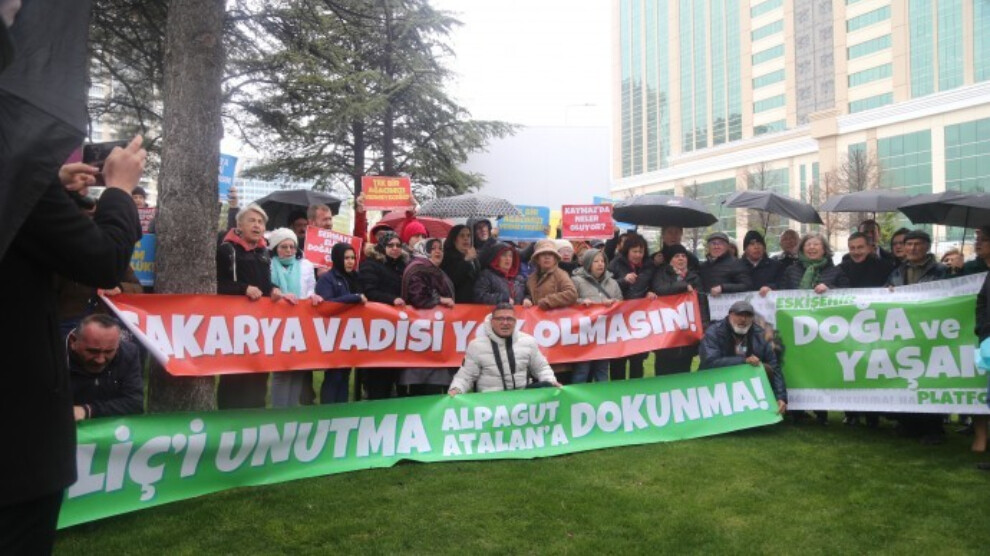
During the gathering outside the ministry, banners reading ‘Do not let the Sakarya Valley disappear’ and ‘Do not forget Ilic, do not touch Alpagut and Atalan’ were displayed. Protesters chanted slogans such as ‘Nature, life, freedom,’ ‘Cengiz, get out — this land is ours,’ and ‘We won’t give up even a single tree.’

We will be forced to migrate

The demonstration drew numerous representatives of political parties and civil society organizations. Platform member Sezgi Tağaç stated: “Our region is one of only two microclimatic zones in the country, along with Iğdır. The project area hosts 28 endemic plant species, 61 vertebrate species, and 128 bird species. It is located just 200 meters from a first-degree archaeological site. We are talking about one of the most treasured areas of our city and our country, with its forests, agricultural lands, pastures, rivers, and rich cultural heritage. This project will lead to the destruction of our trees, forests, and farmlands. Millions of tons of water will be used for drilling, blasting, and mining operations, causing our water sources to dry up. Agriculture, natural life, and beekeeping will disappear. Our buildings will be damaged, our clean air will turn into dust, and the people who have cultivated these lands for centuries may be forced to abandon their villages in despair.”

It will cause various diseases

Tağaç also drew attention to the serious health risks posed by the project and stated: “Heavy metals such as arsenic, lead, and mercury—naturally found in the soil and rendered toxic when exposed to cyanide— will infiltrate groundwater sources feeding the Sakarya River via evaporation, rainfall, leakage, and overflow. These substances will enter the human body through inhalation, skin contact, or contaminated drinking and utility water, as well as through food. These heavy metals and cyanide can lead to blood disorders, heart failure, kidney failure, mental illnesses, birth defects, developmental delays in infants, and various cancers including skin, prostate, liver, bladder, kidney, and lung cancers. In addition, the dust generated during drilling, blasting, and transportation will lead to respiratory diseases such as emphysema, silicosis, chronic obstructive pulmonary (COPD) disease, and cancer.”

We will not allow this plunder

Sezgi Tağaç criticized the Public Participation Meeting previously organized by the Eskişehir Provincial Directorate of Environment, Urbanization and Climate Change, stating that it was conducted in violation of procedure, without taking into account objections from civil society organizations, professional chambers, experts on the subject, or local residents. She also noted that the official meeting records were never shared with them. Emphasizing that ecological destruction is taking place in many areas and that mining companies continue to increase their profits without paying taxes, Tağaç said: “It is a well-known fact that these companies show utter disregard for nature and life. Once again, we declare it here. As those who suffer from the destruction inflicted upon these lands—as the rightful owners of this soil, whose lives, forests, rivers, and living spaces have been seized for the unchecked greed of these companies—we will not allow the plunder of nature and life in Alpagut and Atalan.”

A delegation of activists and members of parliament departed to attend the EIA meeting after the statement was delivered.

The demonstrators continued their vigil in front of the ministry, standing firm in the rain until the meeting came to an end.


We are socialists, disbelievers in property, advocates of the equal claims of all to work for the community as seems good — calling no-one master, and of the equal claim to each to satisfy as seems good to them, their natural needs from the stock of social wealth they have laboured to produce ...We are anarchists, disbelievers in the government of the many by the few in any shape and under any pretext.

Freedom, a Journal of Anarchist Socialism, Vol 1, No. 1, October 1886


In Brasilia, Teko-Haw village resists violent eviction

In Brasilia, Teko-Haw village resists violent eviction

For years, Indigenous families have faced pressure from real estate developers seeking to evict them in order to develop the area on lands known as Santuário dos Pajés, a sacred place for Indigenous spirituality

Aldo Santiago, Avispa Midia ~

On Tuesday morning, 15 April, members of the Military Police of the Federal District (PMDF), Brasilia, carried out a violent raid in the Teko-Haw village where 40 families of the Guajajara people live. Using violence, tear gas, tractors and drones, the PMDF members advanced to allow the entry of machinery that deforested an area of ​​Cerrado vegetation – the savannah with the greatest biodiversity in the world – and also destroyed the Rezo Kwarahy Guajajara hunting lodge built by Guajajara families, who migrated from the state of Maranhão, in northern Brazil, in 2009.

Located northwest of Brasília, these lands have been inhabited by Indigenous peoples such as the Fulni-ô Tapuya, Tuxá, Kariri-Xocó, Wapichana, and Guajajara. Their ancestral territory lies within the urban expansion zone where the Federal District Government (GDF) is interested in building the most expensive neighbourhood in the capital city—and one of the most expensive in all of Brazil—while promoting it as an “ecological green neighbourhood.”

For years, Indigenous families have faced pressure from real estate developers seeking to evict them in order to develop the area on lands known as Santuário dos Pajés, a sacred place for Indigenous spirituality.

According to the Map of Conflicts over Environmental Injustice and Health in Brazil, since the 1990s, the Santuário dos Pajés territory has been disputed by the construction companies Emplavi and Brasal, which seek to benefit from the expansion plan for the Northwest Sector of Brasília. According to the mapping, both construction companies have the support of Terracap, a public company with district and federal jurisdiction, responsible for land registration in the capital and which has made agreements with other Indigenous communities to vacate areas designated for urban development projects.

To date, only 32.4 hectares have been officially recognized as Indigenous Territory within the Santuário dos Pajés (the only ones demarcated in Brazil’s capital), which covers a larger area of ​​50 hectares. This recognition was the result of a decade-long legal dispute, resolved through a 2018 agreement between the Federal Public Prosecutor’s Office (MPF), the National Indian Foundation (Funai), the Brasília Environmental Institute (Ibram), and the Federal District Development Agency (Terracap).

However, the 32.4 hectares are designated for the exclusive use of the Fulni-ô Tapuya community, but other communities such as the Guajajara, Tuxá, Kariri-Xocó, and Wapichana also inhabit the area. They maintain the demand for the expansion and recognition of the entire ancestral territory historically occupied by Indigenous peoples.

Brasília has Indigenous villages

The Teko-Haw village was established in the indigenous territories of Brasilia, just 20 minutes from the centre of Brazilian political power, as a form of political protest in 2009, when a presidential decree—issued by Lula da Silva during his second term—ordered the restructuring of Funai without the participation of Brazil’s indigenous communities.

Chief Francisco Guajajara with families living in the Teko-Haw Village during his participation in the Terra Livre 2025 Camp. Photos: Aldo Santiago

Since then, the village, made up of Guajajara Indigenous people from Maranhão, has remained on their ancestral lands northwest of Brasília, where they practice traditional corn and cassava farming among native Cerrado trees such as the pequi and araticum.

Despite submitting multiple formal requests to various government agencies, for more than a decade they have been denied official recognition of their territory, as well as access to basic rights such as sanitation, electricity, drinking water, education, and healthcare. In this context, the families of the Teko-Haw village—especially the children—face severe food vulnerability.

Just days before the conclusion of ATL 2025—where thousands of Indigenous people from across Brazil mobilized—GDF security forces launched a police operation against the village. This, despite the fact that during the encampment, community members held meetings with federal officials, demanding commitments to respect the Guajajara families resisting in the Teko-Haw village.

During ATL 2025, Chief Francisco Guajajara and other members of the Teko-Haw village joined the mobilizations to request support from the Articulation of Indigenous Peoples of Brazil (Apib) and other Indigenous peoples who participated in the protests. In an interview with Avispa Mídia, Chief Francisco maintained that his community is responsible for caring for and defending the environment in a context of urban expansion that causes deforestation and threatens the region’s water sources.

“We are here to demand the demarcation of our territory, our health, and the preservation of the environment, because we, the indigenous peoples of Brazil, are the ones fighting for climate justice,” shared Chief Francisco, while protesting the attempts to destroy the prayer hut, a structure that, despite the community’s efforts, was dismantled during the operation this Tuesday, 15th April.

“We are fighting with Terracap so that we can regularize our territory. That is what we need, because we need our living territory. That is what we demand,” said Chief Guajajara.

Another Attempt

This Tuesday’s police operation is just the latest in Terracap’s efforts to displace the Teko-Haw village. Recently, at the end of March, the Federal Court ordered a temporary suspension of the community’s eviction after receiving a request from the Federal Public Defender’s Office (DPU), which reported the violation of Indigenous rights during a police action that occurred in February of this year.

However, this Tuesday’s eviction attempt was ordered by Judge Kátia Balbino, who authorized the GDF and Terracap to take joint measures to, “stop further illegal occupations in the region and continue infrastructure projects in the area.”

According to a GDF bulletin, based on a March 2025 inspection, the property, “located in Block 707 of the Northwest, is unoccupied, with no residents or Indigenous communities present. The court decision was based on aerial images that confirmed the absence of residential occupations at the site.”

Despite the violent incursion and the destruction of the prayer house, at press time, no injuries were reported in the Teko-haw village, while Guajajara families remain on alert in their homes for any further incursion by security forces.

DELIBERATE ECOCIDE

U.S. strikes on oil port held by Yemen's Houthi rebels kill dozens, wound over 100 more, Houthis say


CBS
April 18, 2025 

Dubai, United Arab Emirates — U.S. airstrikes targeting the Ras Isa oil port held by Yemen's Houthi rebels killed 38 people and wounded 102 others, the group said early Friday.

The strikes, confirmed by the U.S. military's Central Command, represent one of the highest reported death tolls so far in the campaign launched under President Trump that's involved hundreds of strikes since March 15. The Iranian-backed Houthis later Friday launched a missile toward Israel that was intercepted, the Israeli military said, causing sirens to sound in Tel Aviv and other areas.

The war in Yemen meanwhile further internationalized as the U.S. alleged a Chinese satellite company was "directly supporting" Houthi attacks, something Beijing didn't immediately acknowledge.

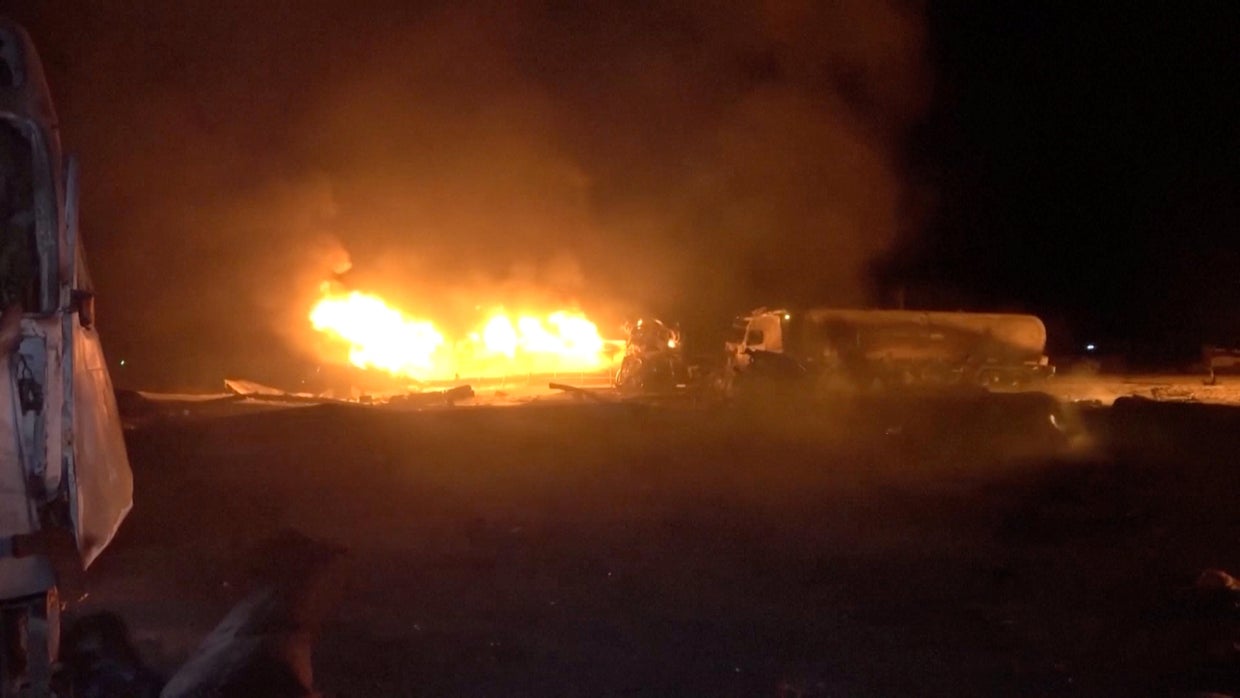
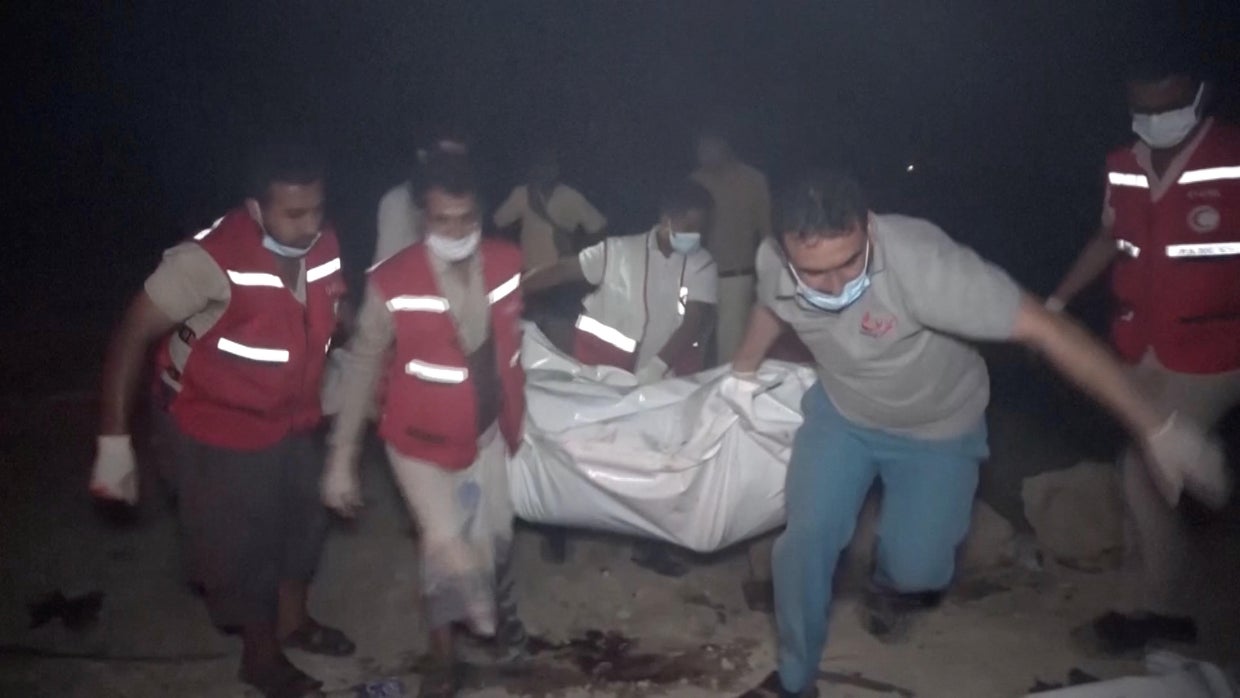
The Houthis' al-Masirah satellite news channel aired graphic footage of the aftermath of the attack on Ras Isa port, showing corpses strewn across the site. It said paramedic and civilians workers at the port had been killed in the attack, which sparked a massive explosion and fires.
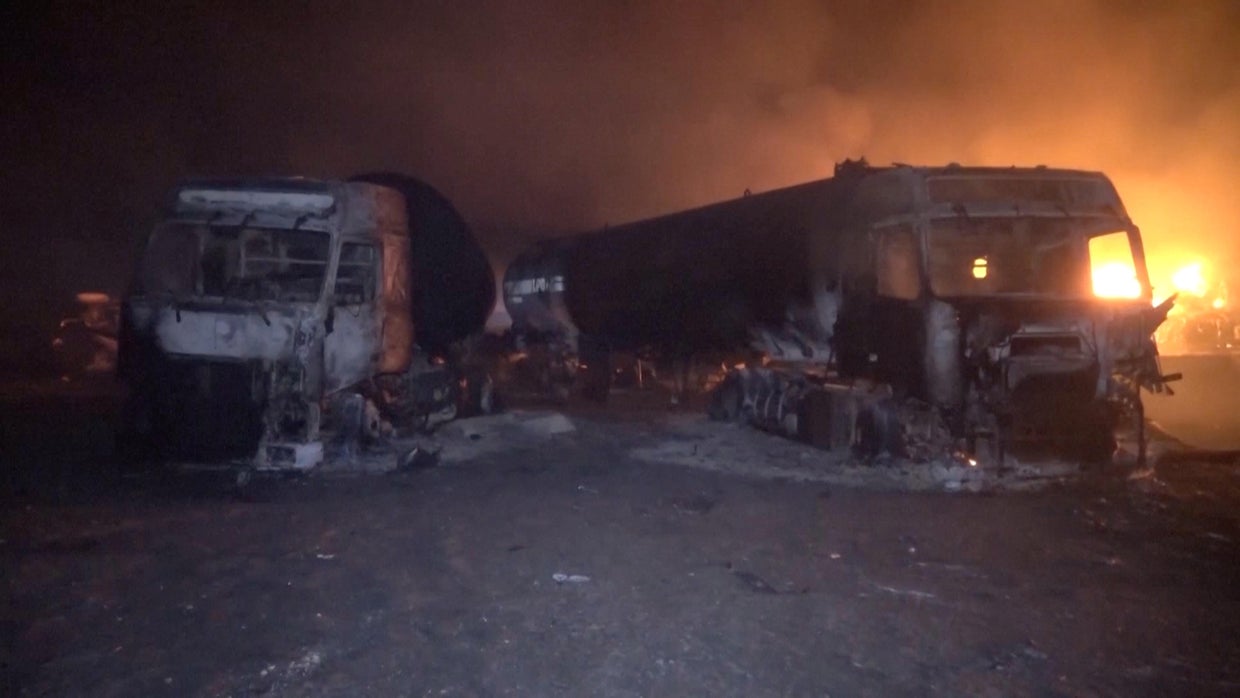
Fire and smoke rise next to charred vehicles following what Al Masirah TV said was a U.S. strike on the Ras Isa fuel port in Yemen, in this screengrab from a handout video released on April 18, 2025. AL-MASIRAH TV / HANDOUT VIA REUTERS

In a statement, Central Command said "U.S. forces took action to eliminate this source of fuel for the Iran-backed Houthi terrorists and deprive them of illegal revenue that has funded Houthi efforts to terrorize the entire region for over 10 years."


"This strike was not intended to harm the people of Yemen, who rightly want to throw off the yoke of Houthi subjugation and live peacefully," it added. It did not acknowledge any casualties and declined to comment when asked by The Associated Press regarding civilians reportedly being killed.

Fuel tanks burn following, what Al Masirah TV said was a U.S. strike on the Ras Isa fuel port in Yemen in this screengrab from a handout video released on April 18, 2025. AL-MASIRAH TV / HANDOUT VIA REUTERS

The Ras Isa port, a collection of three oil tanks and refining equipment, sits in Yemen's Hodeida governorate along the Red Sea. NASA satellites that track forest fires showed an intense blaze early Friday morning at the site just off Kamaran Island, targeted by intense U.S. airstrikes over the last few days.

The Ras Isa port also is the terminus of an oil pipeline stretching to Yemen's energy-rich Marib governorate that's still held by allies of Yemen's exiled government. The Houthis expelled that government from Yemen's capital, Sanaa, back in 2015. However, oil exports have been halted by the decadelong war and the Houthis have used Ras Isa to bring in oil

.
Red Crescent personnel move the body of a victim following what Al Masirah TV said was a U.S. strike on the Ras Isa fuel port in Yemen, in this screengrab from a handout video released on April 18, 2025. AL-MASIRAH TV / HANDOUT VIA REUTERS

The Houthis denounced the U.S. attack.


"This completely unjustified aggression represents a flagrant violation of Yemen's sovereignty and independence and a direct targeting of the entire Yemeni people," the Houthis said in a statement carried by the SABA news agency they control. "It targets a vital civilian facility that has served the Yemeni people for decades."

On April 9, the U.S. State Department issued a warning about oil shipments to Yemen.

"The United States will not tolerate any country or commercial entity providing support to foreign terrorist organizations, such as the Houthis, including offloading ships and provisioning oil at Houthi-controlled ports," it said.

The attack follows Israeli airstrikes on the Houthis that previously hit port and oil infrastructure used by the rebels after their attacks on Israel.
U.S. says Chinese satellite image provider is aiding Houthis

Meanwhile, U.S. State Department spokesperson Tammy Bruce in a briefing with journalists accused Chang Guang Satellite Technology Co. Ltd., a commercial satellite image provider, of "directly supporting Iran-backed Houthi terrorist attacks on U.S. interests."

Bruce didn't elaborate in detail, but acknowledged a story by The Financial Times that quoted anonymous American officials saying the firm linked to the People's Liberation Army has provided images enabling the rebels to target U.S. warships and commercial vessels traveling through the Red Sea corridor.

"Beijing's support, by the way, of that company, the satellite company, even after we've engaged in discussions with them about this ... certainly contradicts their claims of being peace supporters," Bruce said.


Chinese officials and the company, known by the acronym CGSTL, couldn't be immediately reached for comment. Chinese state media didn't acknowledge the accusation. The U.S. Treasury sanctioned CGSTL in 2023 for allegedly providing satellite images to the Russian mercenary force the Wagner Group as it fought in Ukraine as part of Russia's full-scale invasion.

An AP review has found the new U.S. operation against the Houthis under Mr. Trump appears more extensive than the one under former President Joe Biden, as Washington moves from solely targeting launch sites to firing at ranking personnel and dropping bombs on cities.

The new campaign of airstrikes started after the rebels threatened to begin targeting "Israeli" ships again over Israel blocking aid entering the Gaza Strip as that war grinds on. The rebels have loosely defined what constitutes an Israeli ship, meaning many vessels could be targeted.

The Houthis targeted more than 100 merchant vessels with missiles and drones, sinking two and killing four sailors from November 2023 until January of this year. That's greatly reduced the flow of trade through the Red Sea corridor, which typically sees $1 trillion of goods move through it. The Houthis also launched attacks targeting American warships, without success.

The U.S. campaign shows no signs of stopping, as the Trump administration has also linked its airstrikes on the Houthis to an effort to pressure Iran over its rapidly advancing nuclear program. A second round of negotiations between Iran and the U.S. is due to happen Saturday in Rome.

The stakes of the negotiations couldn't be higher for the two nations closing in on half a century of enmity. Mr, Trump repeatedly has threatened to unleash airstrikes targeting Iran's nuclear program if a deal isn't reached. Iranian officials increasingly warn that they could pursue a nuclear weapon with their stockpile of uranium enriched to near weapons-grade levels.

Heartbroken Brits abandon pets as living costs bite

    Staff at a London animal shelter have seen more than their fair share of abandoned pets over the years, from kittens in boxes to budgies dropped outside in the dead of night.

But lately there has been a surge in the numbers as people make the heartbreaking decision to give up their animal companions, no longer able to afford to care for their pets.

Struggling animal owners are feeling “a lot of heartache… and also shame and frustration that they’re having to make these decisions,” said Elvira Meucci-Lyons, the boss of the Mayhew shelter in Kensal Green, west London.

“They come to us because they feel they have no choice,” she said.

“Behind every animal we take in there’s a human story.”

The small centre has taken in more than 130 animals this year alone. It is part of a wider rise across the UK, where tens of thousands of pets have been abandoned since the Covid-19 pandemic and the onset of a cost-of-living crisis.

In the first few months of this year, more than 5,700 abandonments have been reported to the RSPCA, the world’s oldest animal welfare organisation — a 32 percent rise on the same period in 2024.

Last year saw around 22,500 cases reported in total, up more than seven percent on 2023.

The challenge of affording animal care poses a heart-wrenching problem for many in Britain, a nation of dog and cat lovers where half the adult population — more than 26 million people — has a pet, according to the RSPCA.

And it has hit the country’s poorest especially hard. Staff at Mayhew said some owners were having to choose between feeding themselves or their pets.

Several pets at the centre — including dogs Brownie, a one-year-old toy poodle, and Astro, a pocket American bully — were brought in because their owners lost their homes due to financial troubles.

Stories like these are “the most upsetting”, Meucci-Lyons said, because in hard times pet owners “need their lovely animals more than ever and the dog or cat doesn’t want to do without their owner.”

– Rising vet bills –

Mayhew staff said more pets were also arriving at the centre in Kensal Green in poor health, often because their owners cannot afford veterinary bills.

Felix’s case is typical. The muscular nine-year-old tomcat was playing with a length of string. But he arrived with tooth problems, with his owners bringing him to the shelter and saying they couldn’t afford to keep him.

“We’re seeing quite a lot more needing dental work nowadays,” said Mayhew spokeswoman Olivia Patt.

The pandemic saw a spike in pet ownership under government lockdowns, and a subsequent wave of people then giving up their animals as normal lifestyles resumed.

Some people are returning lockdown pets, several years on. But RSPCA spokesman David Bowles told AFP that living costs, which soared during the pandemic, have become a major factor driving abandonments.

“We are now five years on from the first lockdown under Covid. The RSPCA believes the cost-of-living crisis is really impacting people’s ability to pay for vet treatment in particular,” he said.

UK inflation soared above 11 percent in October 2022, the highest level in more than four decades, and while it has slowed in the last few years, people are still feeling the squeeze.

Prices for many items including pet food have gone up by around 25 percent.

At Mayhew, staff have been doing all they can, from providing struggling owners with pet food and animal care packages, to offering free preventative treatments.

But the pressure has pushed the shelter’s bubbly staff to their limits.

“We are run off our feet, we can’t keep up with the demand,” said Meucci-Lyons.

Even though the staff are comforted by knowing they make a difference, “every day it is heartbreaking — we go to bed at night thinking about the dogs and cats we can’t help,” she said.

By James Rybacki and Laurie Churchman