It’s possible that I shall make an ass of myself. But in that case one can always get out of it with a little dialectic. I have, of course, so worded my proposition as to be right either way (K.Marx, Letter to F.Engels on the Indian Mutiny)
Sunday, March 01, 2026
Native forest litter helps rebuild soil life in post-mining landscapes
Biochar Editorial Office, Shenyang Agricultural University
Credit: Fang You, David Parry, Merinda Hall & Longbin Huang
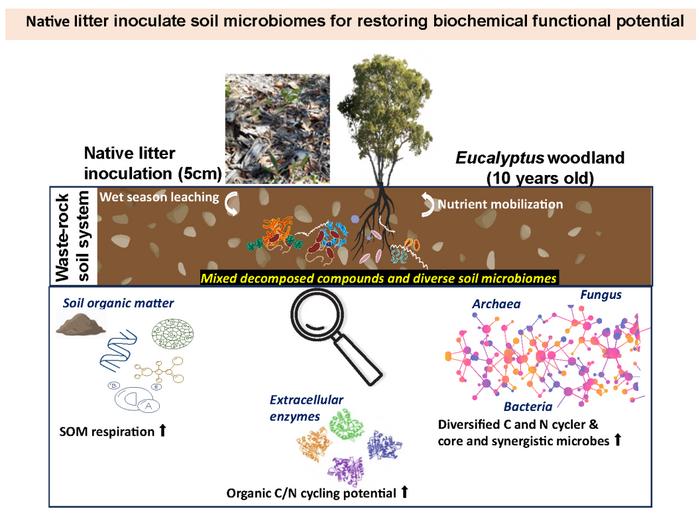
Restoring ecosystems after mining is one of the toughest environmental challenges, particularly when soils are rebuilt from crushed rock with little organic matter or microbial life. A new study shows that something as simple as adding native forest litter could jump-start soil recovery and help restore the biological engine that drives nutrient cycling.
Researchers investigating rehabilitated land near a former uranium mine in northern Australia found that introducing leaf litter from nearby native Eucalyptus woodlands rapidly reshaped soil microbial communities and improved their functional potential. The findings suggest that this low-cost, field-ready strategy could help accelerate ecological recovery in degraded landscapes worldwide.
Healthy soils rely on diverse communities of bacteria, fungi, and archaea that break down plant material and recycle nutrients. In reconstructed mine soils, however, these microbial networks are often sparse and inefficient, limiting the development of vegetation and ecosystem stability.
The research team tested whether adding natural plant litter collected from undisturbed woodland could act as a biological inoculant. After applying a thin layer of native litter to waste-rock soils, they monitored changes in microbial diversity, interactions, and biochemical activity during the wet season when biological processes peak.
The results were striking. Litter inoculation increased microbial diversity and shifted community composition toward taxa typical of natural woodland soils. Key organisms involved in carbon and nitrogen cycling became more abundant, while microbes adapted to harsh, nutrient-poor conditions declined.
The researchers also observed changes in how microbes interacted with one another. Network analyses revealed more structured and cooperative microbial communities, suggesting improved resource sharing and ecological stability. These biological changes coincided with stronger signals of soil organic matter decomposition and nitrogen cycling, both essential for supporting plant growth and long-term soil fertility.
“Our results show that native litter can act as a powerful biological trigger,” said the study’s lead author. “By introducing both organic material and native microbial communities at the same time, we can help rebuilt soils begin functioning more like natural ecosystems much sooner.”
Unlike expensive soil amendments or imported topsoil, litter inoculation uses material that is often already available during land clearing. Repurposing this biomass as a restoration tool could make large-scale rehabilitation more feasible for mining operations and land managers.
The study also highlights an important insight about ecosystem recovery. Instead of trying to recreate exact species compositions, successful restoration may depend more on rebuilding key ecological functions such as nutrient cycling, microbial cooperation, and organic matter turnover.
While the researchers caution that the effects may be strongest in the short term and will require continued organic inputs to persist, they believe litter inoculation offers a practical step toward restoring soil processes that underpin long-term vegetation success.
As global demand for minerals grows, the need for effective restoration strategies becomes increasingly urgent. This work suggests that solutions may sometimes lie in mimicking natural processes rather than engineering complex interventions.
By harnessing the ecological power of fallen leaves and native microbes, scientists are finding new ways to help damaged landscapes regain the biological foundations needed for recovery.
===
Journal reference: You F, Parry D, Hall M, Huang L. 2026. Biological triggering waste rock-based soil system with native plant litter establishes soil microbiome and biochemical functional potential typical of Eucalyptus woodland. Energy & Environment Nexus 2: e008 doi: 10.48130/een-0026-0003
About Energy & Environment Nexus: Energy & Environment Nexus (e-ISSN 3070-0582) is an open-access journal publishing high-quality research on the interplay between energy systems and environmental sustainability, including renewable energy, carbon mitigation, and green technologies.
Credit: Adewole T. Adetunji & Humberto Blanco-Canqui
A growing body of research suggests that combining biochar with other soil amendments such as compost, manure, or fertilizers may improve soil health more effectively than using biochar alone. A new review synthesizing field studies from around the world shows that this co-application approach can enhance soil structure, nutrient availability, and microbial activity, offering a promising strategy for sustainable land management.
Biochar is a carbon-rich material produced by heating biomass in low-oxygen conditions. It has gained attention for its ability to improve soil water retention, nutrient cycling, and long-term carbon storage. However, its performance varies widely depending on soil type, climate, and application practices. To better understand how to maximize its benefits, researchers analyzed results from 28 field studies examining biochar used alone and in combination with organic or inorganic amendments.
The analysis found that adding biochar together with other amendments improved nine out of sixteen measured soil properties compared with biochar alone. In many cases, the combined approach increased soil water content, nutrient holding capacity, and microbial activity. For example, co-application enhanced soil phosphorus levels by as much as seventy-six percent in some comparisons and improved cation exchange capacity by more than fifty percent on average.
Physical soil improvements were also evident. The combined use of biochar and amendments increased aggregate stability and hydraulic conductivity, both of which influence how water moves through soil. These changes can support better plant growth by improving aeration, reducing erosion, and strengthening soil structure.
Biological responses were equally encouraging. Several studies reported increases in microbial biomass and enzyme activities, indicators of active nutrient cycling and soil fertility. The review suggests that biochar’s porous structure may provide protective microhabitats for soil microbes while organic amendments supply the nutrients needed for microbial growth.
“Biochar alone has important benefits, but our synthesis shows that pairing it with complementary amendments can amplify its impact on soil health,” said the study’s lead author. “This combined strategy may help farmers improve soil resilience, boost nutrient efficiency, and support long-term productivity.”
The findings also highlight that not all combinations perform equally well. Biochar mixed with organic materials such as compost or manure tended to produce more consistent improvements than combinations with inorganic fertilizers alone. The effectiveness of co-application also depended on application rate, soil conditions, and climate.
Despite promising trends, the researchers emphasize that more long-term field experiments are needed. Many studies lasted only a few years, making it difficult to assess how biochar mixtures influence soil processes over decades. Understanding these long-term effects will be crucial for guiding sustainable agricultural practices and climate-smart soil management.
Overall, the review indicates that biochar co-application represents a practical pathway to strengthen soil health while potentially enhancing carbon storage and resource efficiency. As global agriculture faces pressures from climate change, land degradation, and increasing food demand, strategies that improve soil function could play a key role in building resilient farming systems.
===
Journal Reference: Adetunji, A.T., Blanco-Canqui, H. Soil health response to biochar combined with other amendments: a review. Biochar8, 23 (2026).
Biochar (e-ISSN: 2524-7867) is the first journal dedicated exclusively to biochar research, spanning agronomy, environmental science, and materials science. It publishes original studies on biochar production, processing, and applications—such as bioenergy, environmental remediation, soil enhancement, climate mitigation, water treatment, and sustainability analysis. The journal serves as an innovative and professional platform for global researchers to share advances in this rapidly expanding field.

No comments:
Post a Comment