It’s possible that I shall make an ass of myself. But in that case one can always get out of it with a little dialectic. I have, of course, so worded my proposition as to be right either way (K.Marx, Letter to F.Engels on the Indian Mutiny)
Tuesday, May 13, 2025
Trade War
Canada’s ambassador says economic talks must prioritize lifting Trump’s tariffs
Canada's Ambassador to the U.S. Kirsten Hillman speaks to reporters during a cabinet retreat at Chateau Montebello in Montebello, Que.
THE CANADIAN PRESS/Sean Kilpatrick
WASHINGTON — Ottawa’s top diplomat in Washington says talks to negotiate any new deals with the United States will prioritize ending U.S President Donald Trump’s ruinous tariffs on Canadian exports.
Ambassador to the United States Kirsten Hillman said Monday that initial negotiations with Trump’s team will focus on lifting tariffs, as well as specific bilateral issues between Canada and the U.S.
“Dealing with those tariffs, and getting Canada into a position where we are finding stability in the trading relationship, is our number one priority with the Americans,” Hillman said. “There is no discussion to be had with the Americans without that being on the table from Canada’s perspective. That is a starting point for us.”
Trump also said he wants changes to the Canada-U.S.-Mexico Agreement on trade, called CUSMA. Hillman said talks specific to the continental trade pact will take place separately at a later date.
Trump slapped Canada with 25 per cent economywide duties in March, only to partially pause tariffs on imports compliant with CUSMA a few days later. Canada is also being hit with tariffs on steel, aluminum and automobiles.
CUSMA was negotiated during the first Trump administration and some experts say the tariffs were meant to rattle Canada and Mexico ahead of a mandatory review next year.
Hillman said in the week since Prime Minister Mark Carney met with Trump at the White House, she has spoken with United States Trade Representative Jamieson Greer and International Trade Minister Dominic LeBlanc has been in contact with U.S. Commerce Secretary Howard Lutnick.
“The process now will be to get those discussions started in a serious and substantive way,” Hillman said.
The president and prime minister both described the encounter as cordial and productive, clearing the slate for bilateral talks that had been undermined by Trump’s repeated talk of making Canada a U.S. state.
While the president assured reporters in the Oval Office he was still keen on annexing Canada, he softened his tone, saying, “It takes two to tango.”
Hillman said that despite those comments, Trump repeatedly told Carney in public and behind closed doors that it was an honour to speak with him. Canadians were looking to reset the relationship with the White House and Hillman said Trump set the tone for open lines of communication and professionalism.
“They agreed to negotiate a deal that works for both countries,” she said.
Trump said last Tuesday that CUSMA was very effective and is “still very effective.” The president also described it as a “transitional deal” and said he didn’t know if it was “necessary anymore.”
Carney said Canada is also looking to change some aspects of the continental trade pact. The prime minister pointed to the national security exemptions in trade law that allowed Trump to slam Canada with tariffs — which the president linked to baseless claims about widespread fentanyl trafficking over the Canadian border.
For now, Hillman said, the priority is to work on negotiations between Canada and the United States on bilateral issues like Arctic security, defence and the northern border that don’t necessarily fit into CUSMA talks.
“The U.S. has been clear with us since the president took office that they are looking to have bilateral discussions with every country,” she said. “They are engaged with a bilateral discussion with Mexico now. Mexico is in town almost every week talking to the Americans.”
Trump took his trade war to the world in April with “reciprocal” tariffs. He walked the most significant tariffs back a few hours later, putting in place a 10 per cent universal levy for 90 days, which he said would give countries time to make a deal.
As other nations race to find ways to deal with the Trump administration, Hillman said she has “every expectation that (Canada) will be able to have the time we need with the administration to deal with our issues.”
“There’s a strong signal from the top level in this country that Canada is a priority,” she said. “That’s not just because the president clearly wants it to be so, but it’s also because we’re their biggest customer by far.”
This report by The Canadian Press was first published May 13, 2025.
Kelly Geraldine Malone, The Canadian Press
Chinese elite’s favored car brand is getting a modern makeover
By Bloomberg News Published: May 12, 2025
A Hongqi concept flying vehicle on display at the Shanghai auto show. Photographer: Qilai Shen/Bloomberg
One of China’s oldest car brands is remaking itself for the modern era.
Hongqi, the marque that’s ferried Chinese leaders for decades, is now setting its sights on carving out a greater share of the country’s booming electric car market. It’s even teased a foray into aerial mobility as part of its “all in” new-energy vehicle push that’s seen it stop all new investment in gasoline-engine technology.
The carmaker has set an aggressive sales target as it looks to gain ground on better-known EV brands like BYD Co. Hongqi wants to more than double NEV deliveries this year to 250,000 units, accounting for 50 per cent of total sales, up from 28% last year. By 2028, NEVs should make up 70 per cent of sales.
It’s a major pivot for a company deeply ingrained in the national psyche. Established in 1958, Hongqi’s name means “red flag,” a nod to the Communist revolution that resulted in the founding of modern day China. Using the American Chrysler Imperial C69 as a prototype for its first car, Hongqi vehicles were for a time exclusively available to high-ranking officials.
While Hongqi cars are now accessible to the masses, they still play special roles. President Xi Jinping rode in a bulletproof gasoline-powered N701 limousine when he met former President Joe Biden in the U.S. in 2023. Biden, who traveled in the heavily armored Cadillac known as “The Beast,” appeared taken by the vehicle, describing it as “beautiful.”
“Hongqi has really flipped the script on its old image — it’s not just for the old guard anymore,” said Yale Zhang, managing director at Shanghai-based consultancy AutoForesight. “With FAW Group backing it, you’ve got that foundation of quality, reliability, brand continuity, and a history that gives it real credibility.”
But it’s unclear if those qualities will translate to sales in the competitive Chinese market that emphasizes cutting-edge technology. Hongqi’s existing offerings have struggled to gain significant traction in the consumer market. The bulk of its EV deliveries were to ride-hailing services before it announced a strategy change at the start of 2023.
Hongqi’s late entry into the NEV sector means it’s not only playing catch-up with the likes of BYD, but also competing with other state-owned rivals including Dongfeng Motor Group and Chongqing Changan Automobile that have set up independent EV brands or forged partnerships with domestic technology giants.
Its vehicles are priced to move: The entry-level version of its model that competes with Tesla Inc.’s Model 3 now starts at 159,800 yuan ($22,000), contrasting sharply with some of its most luxurious gasoline-powered cars, which can exceed 7.18 million yuan.
Hongqi is also looking beyond its home market. The company aims to establish over 700 experience centers and 1,000 service network points internationally by this year and wants overseas sales to exceed 10% of its total volume, with a goal to hit 25 per cent by 2030. It’s already making inroads, taking pre-orders for its electric EH7 and EHS7 models after showcasing them last year at the Paris motor show. In 2022, it became the first Chinese EV brand to be added to the Dubai police fleet’s patrol car lineup.
It’s also teamed up with Chinese battery giant Contemporary Amperex Technology Co. Ltd. and LongShine New Energy to build a battery-swapping station in Hong Kong for Hongqi E-QM5 electric taxis, with a plan to expand the network across the city and extend into Southeast Asian markets.
In March, Hongqi parent FAW Group forged a partnership with emerging EV maker Leapmotor to jointly develop new energy passenger vehicles and components, including for models targeting export markets.
While Hongqi is betting its storied past will help boost sales, it’s also banking on a much more modern appeal to consumers. The carmaker says its batteries can maintain 98% of the power rate amid the -10C (-22F) to -30C temperatures that hit its headquarters in Changchun in winter.
“It could actually turn to a good selling point for Hongqi,” Zhang said. “Better late than never, right?”
Budweiser cans run through a filling machine at the Anheuser-Busch brewery in the Van Nuys area of Los Angeles is seen Wednesday, March 2, 2011. (AP Photo/Reed Saxon)
Anheuser-Busch InBev ABI.BR said on Monday it would invest $300 million in its manufacturing operations in the United States this year amid a push for local production under President Donald Trump.
The Budweiser maker, which said it invested nearly $2 billion over the last five years in 100 facilities across the country, also announced the launch of a new plant in Columbus, Ohio.
The brewer reported a rise in first-quarter profit last week, more than double the increase expected by analysts and boosting its profit margins despite a fall in sales volumes. It said it makes nearly all its domestic sales locally,
AB InBev had previously said it was boosting investments in key brands such as Budweiser and ramping up efforts to grow at-home consumption, as spending elsewhere - including in bars - remains pressured.
(Reporting by Neil J Kanatt in Bengaluru; Editing by Pooja Desai
U.S. Farm economy is starting to see first hits from Trump tariffs
By Gerson Freitas Jr. and Ilena Peng Published: May 11, 2025
Workers install hanging twine in a hop field at a farm in Wapato, Washington, US, on Friday, May 2, 2025. Hops production for the United States in 2024 totaled 87.1 million pounds, down 16 percent from the 2023 crop of 104 million pounds, according to the USDA. Photographer: Emree Weaver/Bloomberg (Emree Weaver/Bloomberg)
Donald Trump’s tariffs are upending crop trading, delaying tractor purchases and constraining imports of chemical supplies into the U.S.
That’s the main message from big agricultural businesses as they report their quarterly earnings, giving an early glimpse into the far-reaching impacts of the U.S. president’s trade war.
The disruptions in global trade threaten to extend a years-long slump in the U.S. farm industry, which had already been struggling with ample supplies, depressed crop prices and rising competition from Brazil. Lack of clarity on how the Trump administration will address much-needed incentives for crop-based fuels in the next few years has added to concerns.Latest updates on commodities here
Crop traders and processors have been among the hardest-hit. Archer-Daniels-Midland Co. and Bunge Global SA saw their combined operating profits slump by about $750 million in the first quarter, with both companies citing an impact from trade and biofuel policy uncertainty.
Importers put off purchases of U.S. grain and oilseeds as Trump threatened tariffs as well as levies on any Chinese vessels docking at American ports, reducing trade flows, according to crop merchant The Andersons Inc.
“Global trade uncertainties disrupted typical grain flows and caused many of our commercial customers to focus on just-in-time purchasing,” William Krueger, The Andersons chief executive officer, said Wednesday in a call with investors.
Tractor makers CNH Industrial NV and AGCO Corp. also reported lower first-quarter sales, and warned of the potential of reduced demand for farmers, which would give them less to spend on machines to plant, harvest and treat their fields. Both companies have raised prices to ease the impact of tariffs on costs.
“Geopolitical uncertainties and trade frictions have dampened U.S. farmer sentiment recently,” AGCO CEO Eric Hansotia said during a conference call with analysts. “As a result, demand for machinery was lower in the quarter than we had expected.”
Duties also threaten to curb imports of some fertilizer and pesticide supplies. Shipments of phosphate — a key crop nourishing ingredient — into the U.S. have trailed last year’s levels because vessels have been diverted to other countries to avoid the nation’s 10 per cent tariff, Mosaic Co. said in its earnings statement.
“The phosphate market remains tight, and while tariffs could disrupt trade flows, they cannot create more phosphate supply,” CEO Bruce Bodine said on a conference call with investors.
Farmers are expected to pay more for pesticides as the U.S. relies on tariff-hit countries such as China and India for some of its supplies. Nutrien Ltd. said its branded products could potentially cost as much as 7.5 per cent more, with even higher adjustments expected for generic ingredients, as a result.
“Long story short is, we’re going to see price increases,” Jeff Tarsi, Nutrien’s president of global retail, said on a Thursday call. “Our plan is to pass those price increases through to our customers.”
Brazil is emerging as a winner from the trade tensions. Minerva SA said tariff turmoil drove increased Chinese demand and higher export prices for South American beef in the first quarter, helping lift profits for the Brazilian supplier. Meanwhile, China has effectively shut its market for U.S. meat exporters including Smithfield Foods Inc.
China, the world’s largest commodity importer, has already shifted to Brazil for a meaningful part of its soybean needs since Trump first raised tariffs on goods from the Asian nation in 2018.
“Any harmful impacts to the U.S. grower profitability stemming from tariffs and trade flow shifts” are likely to benefit Brazilian growers, Jenny Wang, executive vice president of commercial at Mosaic, said in the call with analysts.
According to new data from the World Travel & Tourism Council (WTTC), shared exclusively with Bloomberg, the country is set to lose US$12.5 billion in travel revenue in 2025, with visitor spending estimated to fall under $169 billion by year’s end. The numbers represent a decline of around 7% in visitor spending year-over-year, and a decline of 22% since tourism reached its peak in the U.S. in 2019.
This puts the U.S. in a league of its own. Out of 184 global economies analyzed by WTTC in conjunction with Oxford Economics, it’s the only one projected to lose tourism dollars this year. “Other countries are really rolling out the welcome mat, and it feels like the U.S. is putting up a ‘we are closed’ sign at their doorway,” says WTTC President and Chief Executive Officer Julia Simpson.
The consequences, Simpson says, could be devastating. “The U.S. travel and tourism sector is the biggest sector globally compared to any other country, worth almost $2.6 trillion,” she says, citing WTTC and Oxford Economics data. According to Simpson’s data, direct and indirect tourism represents 9% of the American economy. (Visitor spending is one of the “direct” parts of the travel economy, while “indirect” contributions include the knock-on effects of increased spending by hospitality professionals.) The sector employs 20 million people and creates $585 billion in U.S. tax dollars each year—7% of all tax revenue the U.S. government receives. It’s a “major mainstay of the U.S. economy,” she says.
The issues the industry faces have been years in the making. The problems began in the Biden era as a result of COVID-era travel requirements that lingered longer than they did in most other nations. Then the soaring dollar started pricing people out. “The Japanese used to visit the U.S. a lot, but the strong dollar made it quite an expensive place,” Simpson says. “Same with Europeans.”
But now, she says, a shift in people’s views is turning cracks in the American travel economy into chasms. According to international arrivals data from the U.S. Department of Commerce, travelers are already shifting their behavior as a result of the current administration’s “America First” rhetoric and policy. “What we are seeing now is a sentiment shift that’s really very sad,” Simpson says. “Legislators need not confuse the tourism sector with issues around illegal immigration. A sophisticated system can balance both without turning [the country] into an island that no one wants to visit.”
In March 2025, the most recent month for which data is available, arrivals were significantly down for all of the U.S.’s most robust visitor populations. U.K. arrivals were down 15% year-over-year; Germans were down 28%; South Korean trips declined by 15%; and other key source markets, including Spain, Ireland and the Dominican Republic, were down between 24% and 33%.
The effects won’t be felt evenly across the U.S., with the $12.5 billion deficit disproportionately affecting major U.S. gateways as well as tourism areas along the Canadian border.
Take New York City and the broader Empire State as an example. On May 8, the city’s tourism agency reversed course on its positive outlook for 2025—the year it expected to finally rebound fully from the impact of the pandemic—to forecast that it would receive 400,000 fewer tourists and $4 billion less in tourism spending than it did in 2024.
The latest projections for New York, accounting for a total of 64 million tourists this year, include estimates that 400,000 more domestic tourists—but 800,000 fewer international visitors—will visit the five boroughs. Tourists from abroad tend to stay longer and spend more, and in 2024 they represented half of the $51 billion that the city netted via tourism.
According to Governor Kathy Hochul, this slump extends to regions upstate. Some 66% of businesses in New York’s “north country,” which juts out toward Ottawa and Montreal, have already felt a “significant decrease” in Canadian bookings for 2025. In an April 29 press release, Hochul attributed that figure to President Donald Trump’s “51st state” rhetoric and the impact of tariffs. Among those north country businesses, 26% have already adjusted staffing in response to the declines.
The damage is profound. WTTC now forecasts that it will take until at least 2030 for U.S. tourism to recover to pre-COVID levels. And that’s if things don’t get worse before they get better. People in the industry, she says, have taken note of proposed legislation that would raise the cost of the Electronic System for Travel Authorization (ESTA), which is required of all travelers who plan to come to the U.S. from countries that participate in the Visa Waiver Program. It is currently $21 per traveler but could rise to $40 if the legislation is adopted.
“The thing about tourism is it’s extremely resilient,” she says. “If you push the right buttons, it will bounce back. But increasing the cost of an ESTA will only deter people further.”
It’s a cost for which the U.S. can’t easily compensate. Already, 90% of the U.S. tourism economy is made up of domestic travel—Americans vacationing within the 50 states—making it a hard sector to grow. Meanwhile, Simpson adds, every other country is making it easier for people to come visit with new perks like digitized visas. “India is gaining, the Middle East is gaining, China is gaining, Europe is doing quite well,” Simpson says. “It’s only Americans that are being left behind and losing out.”
Visitors walk past Nissan signage at Nissan headquarters in Yokohama, Tuesday, May 13, 2025. (AP Photo/Louise Delmotte)
TOKYO — Nissan is slashing about 15% of its global work force, or about 20,000 employees, as the Japanese automaker reported a loss Tuesday for the fiscal year that just ended amid slipping vehicle sales in China and other nations, and towering restructuring costs.
Nissan Motor Corp. said it will reduce the number of its auto plants to 10 from 17, under what it called its recovery plan to carry out “decisive and bold actions to enhance performance and create a leaner, more resilient business that adapts quickly to market changes.” It did not say which plants were being closed but confirmed the closures will include factories in Japan.
“We have a mountain to climb,” its Chief Executive Ivan Espinosa told reporters, stressing the task will not be easy, requiring discipline and team work. “Starting today, we build the future for Nissan.”
The job cuts to be done by March 2028 include the 9,000 head count reduction announced last year. Nissan also previously announced the scrapping of plans to build a battery plant in Japan.
Espinosa, who took the helm earlier this year, said the latest plans followed a careful review of operations, to align production with demand, including coming up with market and product strategies. Nissan will also leverage its partnerships such as the one with Renault SA of France in Europe and Dongfeng Nissan in China, he said.
The Yokohama-based automaker said U.S. President Donald Trump’s tariffs on auto imports also hurt its results.
Nissan racked up a loss of 670.9 billion yen ($4.5 billion) for the fiscal year through March, down from a 426.6 billion yen profit recorded the previous fiscal year.
For the latest quarter through March, Nissan recorded red ink totaling 676 billion yen ($4.6 billion). It also said its recovery plan includes trying to reduce costs by 500 billion yen ($3.4 billion) compared to current costs.
“As new management, we are taking a prudent approach to reassess our targets and actively seek every possible opportunity to implement and ensure a robust recovery,” Espinosa said.
“All employees are committed to working together as a team to implement this plan, with the goal of returning to profitability by fiscal year 2026,” he said.
But Nissan Chief Financial Officer Jeremie Papin acknowledged the automaker faces serious challenges. Nissan did not give a profit projection for the fiscal year through March 2026, citing uncertainties.
___
Yuri Kageyama, The Associated Press
Nissan posts $4.5 billion annual net loss, says to cut 20,000 jobs
Like many peers, Nissan is finding it difficult to compete against Chinese electric vehicle brands - Copyright AFP Hector RETAMAL
Kyoko HASEGAWA, Tomohiro OSAKI
Japan’s Nissan posted a huge annual net loss of $4.5 billion on Tuesday while confirming reports that it plans to cut 15 percent of its global workforce and warning about the possible impact of US tariffs.
The carmaker, whose mooted merger with Honda collapsed earlier this year, is heavily indebted and engaged in an expensive business restructuring plan.
Nissan reported a net loss of 671 billion yen for 2024-25 but did not issue a net profit forecast for the financial year that began in April. It did say, however, that it expects sales of 12.5 trillion yen in 2025-26.
“The uncertain nature of US tariff measures makes it difficult for us to rationally estimate our full-year forecast for operating profit and net profit, and therefore we have left those figures unspecified,” CEO Ivan Espinosa told reporters.
“Nissan must prioritise self-improvement with greater urgency and speed.”
The company’s worst ever full-year net loss was 684 billion yen in 1999-2000, during a financial crisis that birthed its rocky partnership with French automaker Renault.
The company’s shares closed three percent higher on Tuesday after reports, later confirmed by Nissan, said it was planning a total of 20,000 job cuts worldwide.
As part of recovery efforts Nissan also said it would “consolidate its vehicle production plants from 17 to 10 by fiscal year 2027”.
Like many peers, Nissan is finding it difficult to compete against Chinese electric vehicle brands, while its profits are also under threat from US tariffs.
“In China, we will strengthen our market performance by unleashing multiple new-energy vehicles,” it said in a statement.
The possible merger with Japanese rival Honda had been seen as a potential lifeline but talks collapsed in February when the latter proposed making Nissan a subsidiary instead of integrating under a holding firm.
Nissan has faced numerous speed bumps in recent years — including the 2018 arrest of former boss Carlos Ghosn, who later fled Japan concealed in an audio equipment box.
The automaker, whose shares have tanked nearly 40 percent over the past year, appointed Espinosa CEO in March.
Ratings agencies have downgraded the firm to junk, with Moody’s citing its “weak profitability” and “ageing model portfolio”.
And this month Nissan shelved plans, only recently agreed, to build a $1 billion battery plant in southern Japan owing to the tough “business environment”.
Of all Japan’s major automakers, Nissan is likely to be the most severely impacted by US President Donald Trump’s 25 percent tariff on imported vehicles, Bloomberg Intelligence analyst Tatsuo Yoshida told AFP ahead of Tuesday’s earnings report.
Its clientele has historically been more price-sensitive than that of its rivals, he said.
So the company “can’t pass the costs on to consumers to the same extent as Toyota or Honda without suffering a significant loss in sales units”, he added.
Honda Canada postpones $15-billion EV investment project in Ontario
Honda employees work along the vehicle assembly line before an event announcing plans for a Honda electric vehicle battery plant in Alliston, Ont., on Thursday, April 25, 2024. THE CANADIAN PRESS/Nathan Denette
TORONTO — Honda Canada is postponing a $15-billion electric vehicle investment project in Ontario, including a proposed EV battery plant and retooled vehicle assembly facility.
Honda Canada spokesman Ken Chiu says due to the recent slowdown in the EV market, Honda has announced an approximate two-year postponement of the comprehensive value chain investment project in Canada.
Chiu says the company will continue to evaluate the timing and project progression as market conditions change.
The decision has no impact on current employment at the Honda manufacturing plant in Alliston, Ont., he added.
Honda’s EV project in Canada includes a retooled assembly plant, an electric vehicle battery plant in close proximity, as well as two key battery parts facilities located elsewhere in Ontario.
The plan was first announced in April 2024 and was to receive support from the federal and Ontario governments.
This report by The Canadian Press was first published May 13, 2025.
Honda signals profit drop, warns of US$3 billion tariff hit
Honda Motor Co. is expecting a ¥450 billion (US$3 billion) hit to its full-year profit as it braces for the fallout of U.S. President Donald Trump’s auto tariffs, joining rivals reeling from the trade war.
Operating profit is forecast to decline to around ¥500 billion in the current fiscal year through March 2026 — far short of analyst estimates of ¥1.35 trillion. Profit in the fiscal year ended March 31 came in at ¥1.21 trillion following a weak fourth quarter, the company said in a statement Tuesday.
“The impact of tariff policies in various countries on our business has been very significant, and frequent revisions are made, making it difficult to formulate an outlook,” Chief Executive Officer Toshihiro Mibe told reporters. The automaker, which has already outlined plans to move production of its hybrid Civic from Japan to the U.S., is considering whether to expand U.S. production capacity in response to tariffs.
Honda joins a growing list of global automakers tallying the cost of Trump’s tariffs. General Motors Co. has slashed its full-year profit guidance by as much as $5 billion, while Ford Motor Co. is bracing for a $1.5 billion annual hit. Toyota Motor Corp. sees a $1.2 billion profit drop in just April and May. On Monday, Mazda Motor Co. said it was withholding its annual guidance until the dust settles, adding the impact from tariffs could amount to as much as $68 million in April alone.
The U.S. represents the biggest market for five of Japan’s largest automakers, including Honda. The company sold roughly 1.4 million cars in the U.S. in 2024, according to Bloomberg Intelligence, almost 40% of which were imported.
Honda also Tuesday said it has postponed plans to establish an electric vehicle supply chain in Ontario, Canada, by two years, owing to a downturn in demand.
The previously announced plan included a battery plant and an EV factory with an annual production capacity of 240,000 vehicles.
“The growth of the electric vehicle market has slowed more than initially expected, making it difficult to anticipate further progress,” Mibe said. Changes to the company’s electrification strategy will be explained in detail during a business update on May 20.
While Honda may have dodged a bullet by walking away from a deal to tie up with struggling rival Nissan Motor Co., it will have to go it alone as the global auto market is roiled by the U.S. tariffs and intense competition in China.
Honda had signed an agreement with Nissan in December to combine both brands under a single holding company. But negotiations quickly began to deteriorate, and ultimately the alliance was formally ended within a few months. Disagreements between the two legacy brands, who refused to meet on equal footing, drew to a swift close what in theory could have created a titan capable of competing with Toyota and other industry heavyweights.
In one bright spot, Honda’s motorcycle business accounted for half its operating profit, and grew during the previous fiscal year. Its auto segment decreased, mostly in China.
Both trends are expected to continue during the current fiscal year, the company said.
Honda said it expects net profit of 250 billion yen ($1.7 billion) in the year to March 2026 - Copyright AFP Richard A. Brooks
Tomohiro OSAKI, Hiroshi HIYAMA
Japan’s Honda Motor on Tuesday forecast a 70 percent drop in net profit for the 2025-26 financial year as US trade tariffs weigh on the global auto industry.
The announcement comes after rival Toyota, the world’s top-selling carmaker, predicted a 35 percent year-on-year drop in annual net profit because of the levies and other factors.
Honda said it expected net profit of 250 billion yen ($1.7 billion) in the 12 months to March 2026.
“Tariff impact and recovery efforts” will have a negative effect on operating profit, it warned, estimating they will cost the company around 450 billion yen over the year.
In an attempt to rev up the US auto industry, President Donald Trump last month imposed a 25 percent toll on imported vehicles, dealing a major blow to Japanese carmakers.
“The impact of tariff policies in various countries on our business has been very significant, and frequent revisions are being made, making it difficult to formulate an outlook,” CEO Toshihiro Mibe told reporters Tuesday.
Honda, Japan’s second-biggest automaker after Toyota, logged net profit of 835 billion yen in the past financial year, a drop of almost 25 percent on-year and well short of its February forecast of 950 billion yen.
“Our automobile business experienced a decline in sales volume mainly in China and the ASEAN region” in Southeast Asia, Mibe said.
It was also “impacted by increased incentives for EV sales in North America”, although “hybrid vehicle sales expanded”.
But Honda may still have a better chance of weathering Trump’s tariff onslaught than its competitors in Japan, analysts said.
Late last month Trump softened the auto tariffs by signing an executive order to limit the impact of overlapping levies on carmakers.
He also said he would give the industry a two-year grace period to move supply chains back to the United States.
This is good news for Honda, which builds more than 60 percent of the vehicles it sells in the United States in the country.
That is “the highest percentage” of all major Japanese automakers, Bloomberg Intelligence auto analyst Tatsuo Yoshida told AFP ahead of the results.
That means the impact from tariffs will be “comparatively smaller for Honda”, he added.
Venice exhibition includes model of Newcleo reactor
Monday, 12 May 2025
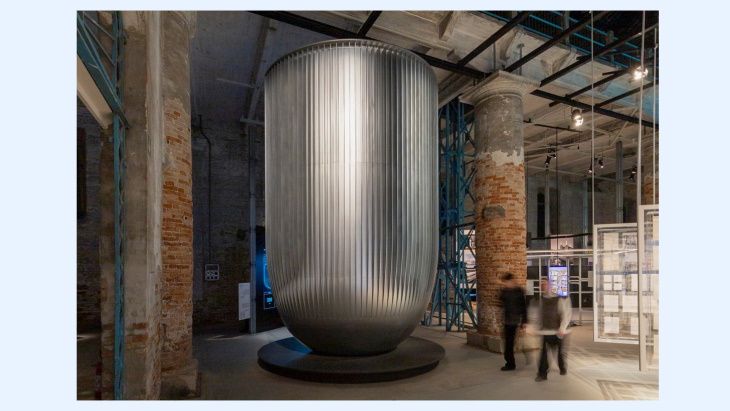
A full-scale model of innovative reactor developer Newcleo's TL-40 lead-cooled fast reactor for maritime applications is being displayed at the 19th International Architecture Exhibition of the Venice Biennale. Newcleo said the exhibit is aimed at "redefining the image of nuclear energy".
(Image: Newcleo)
The interactive exhibit is a joint project by Paris-headquartered Newcleo, leading Italian design company Pininfarina, and Italian shipbuilder Fincantieri.
"Combining technological vision, industrial expertise, and cutting-edge design, the three companies have collaborated to redefine the image of nuclear energy," Newcleo said. "Visitors are invited to reimagine their preconceptions of nuclear power as they embark on a highly interactive journey exploring the extraordinary potential of atomic fission in combating climate change and decarbonising human activities."
At the heart of the collaborative project, housed within Venice's historic Corderie dell'Arsenale, stands a full-scale reproduction of the TL-40 liquid lead-cooled reactor designed by Newcleo for powering large maritime vessels.
(Image: Newcleo)
"Guided through an immersive experience, visitors will discover the functioning of the reactor, its ability to burn waste produced by traditional nuclear power plants, and its passive safety features that make it the ideal solution for powering energy-intensive human activities in a sustainable and decarbonised manner," Newcleo said.
A system has also been set up for interactive visualisation of data and information on nuclear energy and its role within the process of decarbonising energy systems.
Pininfarina has curated the project's creative vision by "infusing" Newcleo's technological solutions with design, "bringing for the first time to the nuclear industry a creative vision that mixes technical and aesthetic elements to facilitate its integration in urban and peri-urban environments".
Fincantieri has contributed to the project its extensive experience in shipbuilding, studying a possible industrial application for Newcleo's innovative solution.
Fincantieri and Newcleo have been collaborating since 2023 to study applications of Newcleo's technology for naval propulsion. Similarly, Pininfarina is collaborating with Newcleo to design a nuclear fuel research and development centre that will be built in Chusclan in the Gard region of France.
"Through this installation, we're introducing the world to a new paradigm of clean, sustainable nuclear energy designed to serve people and communities," said Newcleo founder and CEO Stefano Buono. "Moving beyond the large reactors of the past, we've developed small, inherently safe reactors that solve the nuclear waste problem while delivering abundant decarbonised energy. Together with Pininfarina and Fincantieri, we're unveiling a new vision for nuclear power engineered for forward-thinking societies that are committed to both progress and caring for the environment."
The exhibition opened on 8 May and runs until 28 November.
Foundation in place for new Dutch research reactor
Friday, 9 May 2025
The construction pit and foundation have been completed for the reactor building of the Pallas research reactor in Petten, the Netherlands. Preparations are now under way for the start of construction of the reactor building itself.
(Image: NRG-Pallas)
NRG-Pallas applied in June 2022 to the Dutch regulator, the Authority for Nuclear Safety and Radiation Protection, for a permit to construct and operate the Pallas reactor. ANVS granted a construction licence in mid-February 2023. Preparatory work on the foundation began in May 2023. This work was carried out by Belgian construction firm Besix, which was awarded a contract in November 2022.
The building of the construction pit - a hole of about 50 metres by 50 metres and 17.5 metres deep - and the foundation has now been completed. This has involved digging 30 trenches measuring one-and-a-half metres wide, into which concrete was poured to create the so-called "diaphragm walls". The diaphragm walls are anchored with 380 bored piles placed within them. An underwater concrete floor 1.5 metres thick has also been constructed, and on top of this, a reinforced foundation slab measuring 50 metres by 50 metres and also 1.5 metres thick.
"This unique construction project has brought together all of our expertise and innovative capabilities. Both in terms of technical aspects and the stringent security requirements of a nuclear site, as well as the construction site surrounded by the dune area," said Nic De Roeck, managing director of Besix Nederland. "All of this introduced additional considerations for how we had to execute the work. I look back with satisfaction on how we carried out this challenging work together with NRG-Pallas and our partners; this was work at a Champions League level."
Peter Dijk, programme director and member of the Executive Board at NRG-Pallas said completion of the pit and foundation was "a significant step forward on the path to realising the Pallas reactor". He added: "This has laid the foundation for the next phase of construction. The arrival of the Pallas reactor is crucial for the production of medical isotopes."
Currently, NRG-Pallas, together with main contractor Spanish construction firm FCC Construcción and designer ICHOS, is preparing the next phase of the project.
Last month, FCC Construcción signed an agreement with NRG-Pallas to move the project forward through its successive phases. To this end, an agreement was formalised on the scope, schedule, budget and technical solutions for the construction of the first part of the Pallas reactor building.
A cross-section of the Pallas reactor building (Image: FCC Construcción)
The construction site is now being restructured so that work on the lower section of the reactor can begin later this year. Additionally, preparations are underway for the installation of the cooling water pipeline. The pipeline will extract water from the North Holland Canal and discharge it into the sea.
Although funding has been allocated in the coming years for the construction of the Pallas reactor, the Dutch government has yet to make a final decision on its construction. The European Commission has already approved, under EU state aid rules, the Dutch government's plan to invest EUR2 billion (USD2.2 billion) in the construction of Pallas.
Former Minister of Health, Welfare and Sport Ernst Kuipers instructed the NRG-Pallas not to take any irreversible steps, but to continue with the preparations for the project in the meantime to avoid unnecessary delays.
The Pallas research reactor is to be built at Petten to replace the existing High Flux Reactor (HFR). The 45 MW HFR started operating in September 1960, since when its use has largely been shifted from nuclear materials testing to fundamental research and the production of medical radioisotopes. The reactor - operated by NRG on behalf of the European Union's Joint Research Centre - has for a long time supplied about 60% of Europe's and 30% of the world's medical radioactive sources.
Pallas will be of the "tank-in-pool" type, with a thermal power of around 55 MW, and able to deploy its neutron flux more efficiently and effectively than the HFR.
Article researched and written by WNN's Warwick Pipe
ForoNuclear highlights role of nuclear in Spanish energy mix
Friday, 9 May 2025
Spain's nuclear power plants generated almost 20% of its total net electricity production in 2024 and became its second largest source of electricity production, according to the country's nuclear industry forum ForoNuclear. The recent blackout that struck the Iberian peninsula highlights nuclear's role in providing inertia and stability to the electricity system, it says.
The Ascó plant (Image: ANAV)
In the latest edition of its annual report - titled Nuclear Results for 2024 and Future Perspectives - ForoNuclear says Spain's nuclear power reactors generated almost 52.4 TWh net in 2024, slightly down from the 54.4 TWh generated in 2023. As of 31 December, the total installed net capacity of the electricity generation fleet in Spain was 128,987 MWe, of which nuclear accounted for 7117 MWe (net), corresponding to 5.52% of the total installed net capacity.
"The seven operating reactors continued to guarantee supply and energy independence, as they produce baseload power constantly and reliably," said ForoNuclear President Ignacio Araluce. "These aspects are essential in the current geopolitical context, in which Europe is striving to achieve energy sovereignty.
"I would like to highlight that Spanish nuclear power plants are essential in providing strength and stability to the electricity system. For yet another year, they contributed around 20% of the electricity consumed, even though their installed capacity remained unchanged while that of other technologies continues to increase. The plants have operated with the highest quality and safety standards, thanks to the commitment and dedication of the sector's companies, their workers and owners, who invest millions to keep the sites in optimal conditions and prepared for long-term operation."
Four reactors (Almaraz II, Ascó I and II, and Vandellós II) were operational just before the blackout occurred. Three units were already offline - Trillo was in a scheduled outage, while Almaraz I and Cofrentes were not generating as Red Electrica had requested them not to generate power due to the high contribution from renewable energy in the system.
As a result of the loss of external power supply caused by the blackout, the operating reactors shut down automatically, and safety systems were activated to maintain a safe shutdown, ForoNuclear noted.
"The nuclear power plants acted according to their design and always remained stable and safe," it said. "During the incident, the Nuclear Safety Council activated its Emergency Response Organization [due to the lack of offsite power] and remained continuously informed while monitoring the status of the plants. The reactors are now resuming production after completing all corresponding safety checks, reconnecting to the grid as instructed by the System Operator or when matched in the electricity market."
It added: "It is worth noting that the large turbines and generators in nuclear power plants provide rotating power and inertia to the grid, as they are heavy synchronous machines that help stabilise voltage and frequency."
Phase-out policy
There were strong suggestions that renewables were the cause of the blackout, and that there was therefore a need to maintain the nuclear fleet. However, Prime Minister Pedro Sánchez dismissed suggestions that the blackout was the result of his administration's decision to expand the use of renewables while phasing out nuclear power. Under the country's nuclear phase-out plans, agreed in 2019, four reactors are scheduled to close by the end of 2030, while the remaining three reactors will shut by 2035.
"It does not seem logical to cling to a nuclear phase-out plan established 2019 without opening our eyes to reality, especially as the current energy, environmental, and geopolitical context is radically different from what it was then," Araluce said. "The most reasonable course of action would be to revise the closure schedule, considering the crucial role nuclear power plants play in ensuring supply, avoiding CO2 emissions, and helping to contain electricity prices. In fact, recent studies show that without nuclear, electricity in our country would be 23% more expensive for citizens and small businesses, and 35% higher for industrial consumers.
"That said, ensuring the continuity of nuclear energy requires a review of the suffocating tax burden it currently bears. This taxation - which has been increased by more than 70% in the past five years - includes overlapping taxes, regional eco-taxes, and the Enresa fee, which the Government unilaterally raised by 30%. This excessive tax burden, far above the European average, is making Spanish nuclear plants artificially unviable, despite the willingness of their owners to continue operating them and the fact that they are in excellent technical and safety conditions."
Earlier this year, the Plenary Session of the Spanish Congress approved a non-binding proposal calling for the government to implement a series of measures that would reverse the country's decision to phase out nuclear power. The proposal, presented by the right-wing People's Party, was passed on 12 February, with 171 votes in favour, 164 against and 14 abstentions. On 4 April, the Popular Party presented a bill to extend the useful life of nuclear power plants, arguing that it is "necessary" to keep them operational for the long-term.
World Nuclear Association Director General Sama Bilbao y León said: "The economic future of Spain depends on having access to abundant, affordable, 24/365, clean and definitely stable electricity. Thus, maintaining the current nuclear fleet is essential for the economic future of Spain."
Article researched and written by WNN's Warwick Pipe
EU seeks to end all energy imports from Russia
Friday, 9 May 2025
The European Commission has published a roadmap for the European Union to end its dependency on Russian energy by stopping the import of Russian gas and oil and phasing out Russian nuclear energy. The commission said it will make legislative proposals next month.
The European Commission building in Brussels (Image: Dimitris Vetsikas/Pixabay)
In May 2022, in response to Russia's invasion of Ukraine three months earlier, the European Commission (EC) formally adopted the REPowerEU Plan, which aimed to rapidly reduce EU dependence on Russian fossil fuels. The plan recognised that nuclear will have a role to play in ensuring security of EU energy supplies, and highlighted the importance of coordinated action to reduce dependence on Russian nuclear materials and fuel cycle services.
"Despite the significant progress achieved under the REPowerEU Plan and via sanctions since Russia's invasion of Ukraine, in 2024 the EU saw a rebound in Russian gas imports," the EC said. "More coordinated actions are therefore needed, as the EU's overdependency on Russian energy imports is a security threat."
Measures taken so far have reduced the volumes of imported Russian gas from 150 billion cubic metres (bcm) in 2021 to 52 bcm in 2024 – with the share of Russian gas imports dropping from 45% to 19%, it noted. All imports of Russian coal have been banned by sanctions; oil imports have shrunk from 27% at the beginning of 2022 to 3% now.
In nuclear, more than 14% of uranium was sourced in the EU from Russia in 2024, while around 23% of the whole EU demand for uranium conversion services was satisfied from Russia and in uranium enrichment services Russia covered almost 24% of EU needs. Member States that are still using Russian-designed VVER reactors have made progress in replacing Russian nuclear fuel with fuel from other producers.
The EC has now published the REPowerEU Roadmap, which it says "paves the way to ensure the EU's full energy independence from Russia". The roadmap sets out a gradual removal of Russian oil, gas and nuclear energy from the EU markets "which will take place in a coordinated and secure manner as we advance our energy transition".
"The European Commission will seek to make Russian imports of enriched uranium economically less viable by presenting, next month, trade measures on the import of enriched uranium," the roadmap says. "This will level the playing field and encourage political and business decisions in the relevant Member States to accelerate investment and capacity-building, develop an EU value chain and diversify away from Russia in a gradual manner, while allowing for supplies from other international partners. Next month the Commission intends also to restrict new supply contracts co-signed by the Euratom Supply Agency for uranium, enriched uranium and other nuclear materials with Russian suppliers as of a certain date."
The EC also said the development of alternative nuclear fuels for Russian-designed VVER reactors operating in Member States and their licensing needed to be accelerated. It said contracting with alternative suppliers should progress quickly towards a complete replacement of Russian supplies.
The Commission is proposing to stop all remaining imports of Russian gas by the end of 2027.
EU Member States will be asked to prepare national plans by the end of this year setting out how they will contribute to phasing out imports of Russian gas, nuclear energy and oil.
Hungarian Foreign Minister Peter Szijjarto said that Hungary opposes the EC's proposal. He said that cutting Russian gas and nuclear fuel imports threatens Hungary's energy security.
Slovak Prime Minister Robert Fico said he respected attempts to reduce energy dependence on third countries but the Commission's proposals would harm the EU, raising prices in the bloc and damaging its competitiveness. "This is simply economic suicide to go to the point where neither gas, nor nuclear, nor oil, everything, must end just because some new Iron Curtain is being built between the Western world and perhaps Russia and other countries," he was quoted as saying by Reuters.
Article researched and written by WNN's Warwick Pipe
Canadian partnership to support heavy water industry
Monday, 12 May 2025
Canadian Nuclear Laboratories is leveraging its expertise and experience to help Isowater Corporation develop and expand its heavy water refinement business, helping address growing international market demand for heavy water in both the nuclear and non-nuclear sectors.
CNL is considered to be a world leader in heavy water technology (Image: CNL)
A new strategic partnership will see Canadian Nuclear Laboratories (CNL) leverage Atomic Energy of Canada Limited's (AECL) extensive intellectual property related to the upgrading of heavy water to support Isowater - part of KEY DH Technologies Inc Group - in expanding and improving its deuterium refining capabilities. This will enable Isowater to better serve various non-nuclear deuterium markets through the provision of deuterium production and recycling services, and a higher-purity end-product, says CNL , and aligns with the organisation's holistic heavy water strategy.
CNL President and CEO Jack Craig said the agreement comes amidst growing interest in the use of heavy water in non-nuclear industries, from electronics to health sciences. "By applying our expertise and technologies, built through more than 60 years of scientific research in hydrogen isotope management, we believe that CNL can help Isowater grow and improve its heavy water refining capabilities. We look forward to working with them under the terms of our new agreement," he said.
Andrew Stuart, chairman of KEY, said the partnership is the next phase of a relationship between Isowater, CNL and AECL that has developed over the past decade and has been an important enabler of the more than 10% compound annual growth rate in deuterium oxide use by the global high technology and life sciences industries. "CNL, Canada’s premier science and technology laboratory, offers world-class technology and expertise that support the path to global success of organisations like ours," he added.
Heavy water - a form of water in which the normal hydrogen is replaced by a heavier form of hydrogen called deuterium - is used as both the moderator and as the reactor coolant in pressurised heavy water reactors, such as Candus. Non-nuclear deuterium markets include manufacturing of semiconductors, OLED displays and fibre optics, as well as the life sciences and environmental science sectors.
As part of their strategic partnership, CNL will supply Isowater with isotope exchange catalyst technologies for its deuterium refinement process. It will also provide subject matter expert support for Isowater’s deuterium refineries.
Nuclear science and technology organisation CNL is contracted by federal Crown corporation AECL to manage and operate its sites and facilities, and to carry out AECL’s mandate to enable nuclear science and technology. Building on AECL's research, CNL can boast more than 60 years of expertise, experience and innovation in heavy water technology, a field in which it is considered to be a world leader.
“AECL is pleased to see the signing of this agreement, which makes use of our extensive intellectual property in heavy water production and refinement,” said AECL President and CEO Fred Dermarkar. "This agreement would not be possible without the innovative collaboration between the federal government and the private sector," he added.
Article researched and written by WNN's Claire Maden
Construction contract awarded for Darlington SMR
Friday, 9 May 2025
Aecon Kiewit Nuclear Partners has been awarded a construction contract for the execution phase of Ontario Power Generation's Darlington New Nuclear Project, which received provincial approval on Thursday.
Aecon's leadership and other project partners with Ontario Minister of Energy and Mines at the Darlington New Nuclear site on 8 May (Image: Aecon)
The project to build a GE Hitachi BWRX-300 SMR - described as North America's first grid-scale small modular reactor (SMR) - is being delivered under an Integrated Project Delivery model. Aecon, the lead in the general partnership with Kiewit Nuclear Canada, said its share of the contract is valued at approximately CAD1.3 billion (USD934 million).
"OPG’s Darlington New Nuclear Project is a trailblazing undertaking – leading the way in delivering the next generation of nuclear plants across North America and internationally," Aecon Group President and CEO Jean-Louis Servranckx said.
Aecon is also the leading constructor for three nuclear refurbishment projects in Ontario at OPG's Darlington and Pickering sites and Bruce Power's Major Component Replacement programme.
The Darlington New Nuclear Project will be the first new nuclear build in Ontario in more than three decades. OPG received a Licence to Construct the first of four planned BWRX-300s at Darlington from the Canadian Nuclear Safety Commission in April. Aecon's announcement was made on the same day the government of Ontario gave its approval for the start of construction for the CAD20.9 billion (USD15 billion) Darlington New Nuclear Project.
Site preparation works began in the autumn of 2022, and several long-lead items, including the reactor pressure vessel, have already been procured.
OPG's video of site preparations at Darlington
Article researched and written by WNN's Claire Maden