It’s possible that I shall make an ass of myself. But in that case one can always get out of it with a little dialectic. I have, of course, so worded my proposition as to be right either way (K.Marx, Letter to F.Engels on the Indian Mutiny)
Sunday, August 17, 2025
UK
Labour members overwhelmingly back a wealth tax and renationalising water, new polling shows
Left Foot Forward 'Without a big reset, then the keys to Number 10 are being handed to Reform and Nigel Farage.'
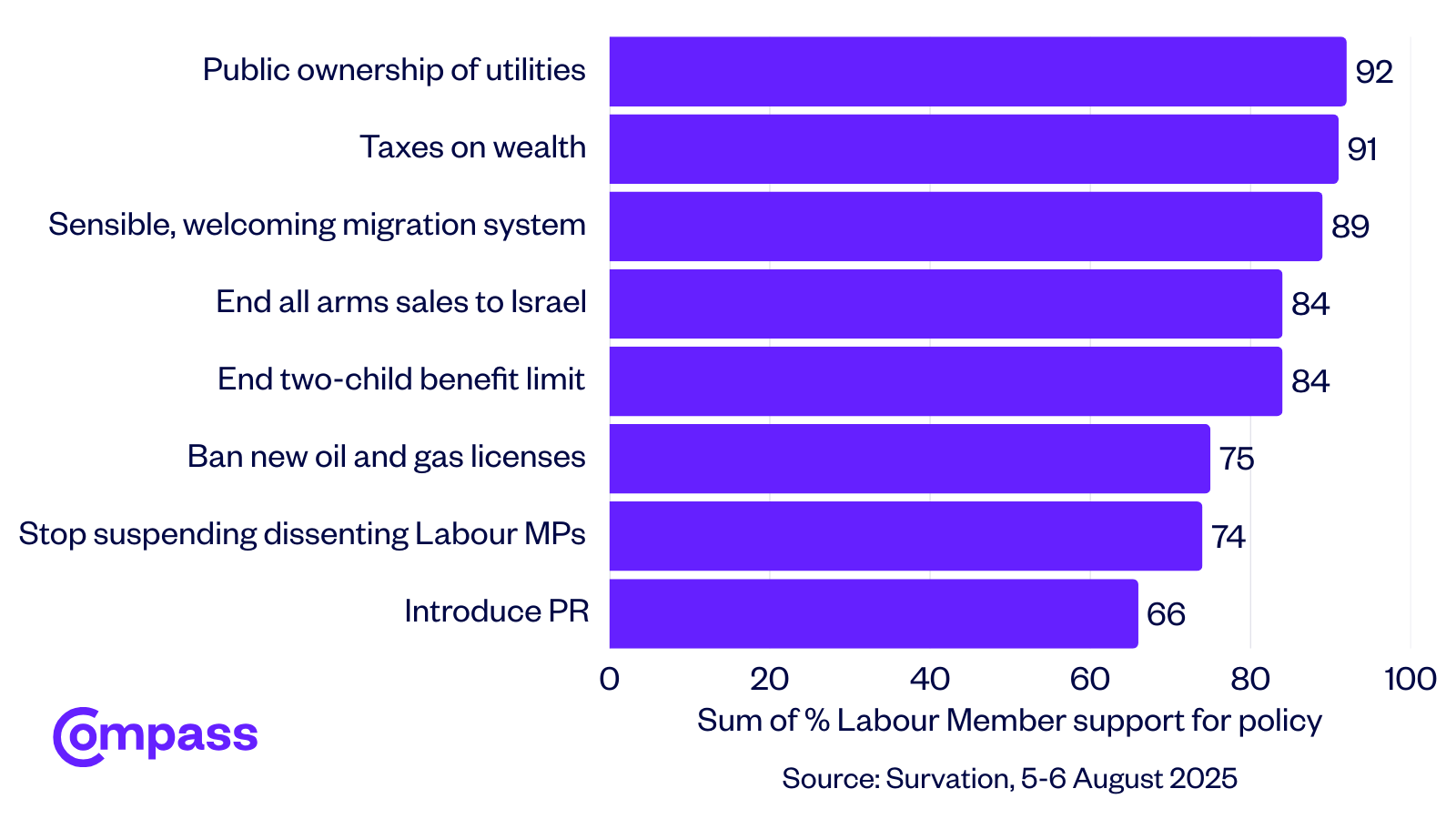
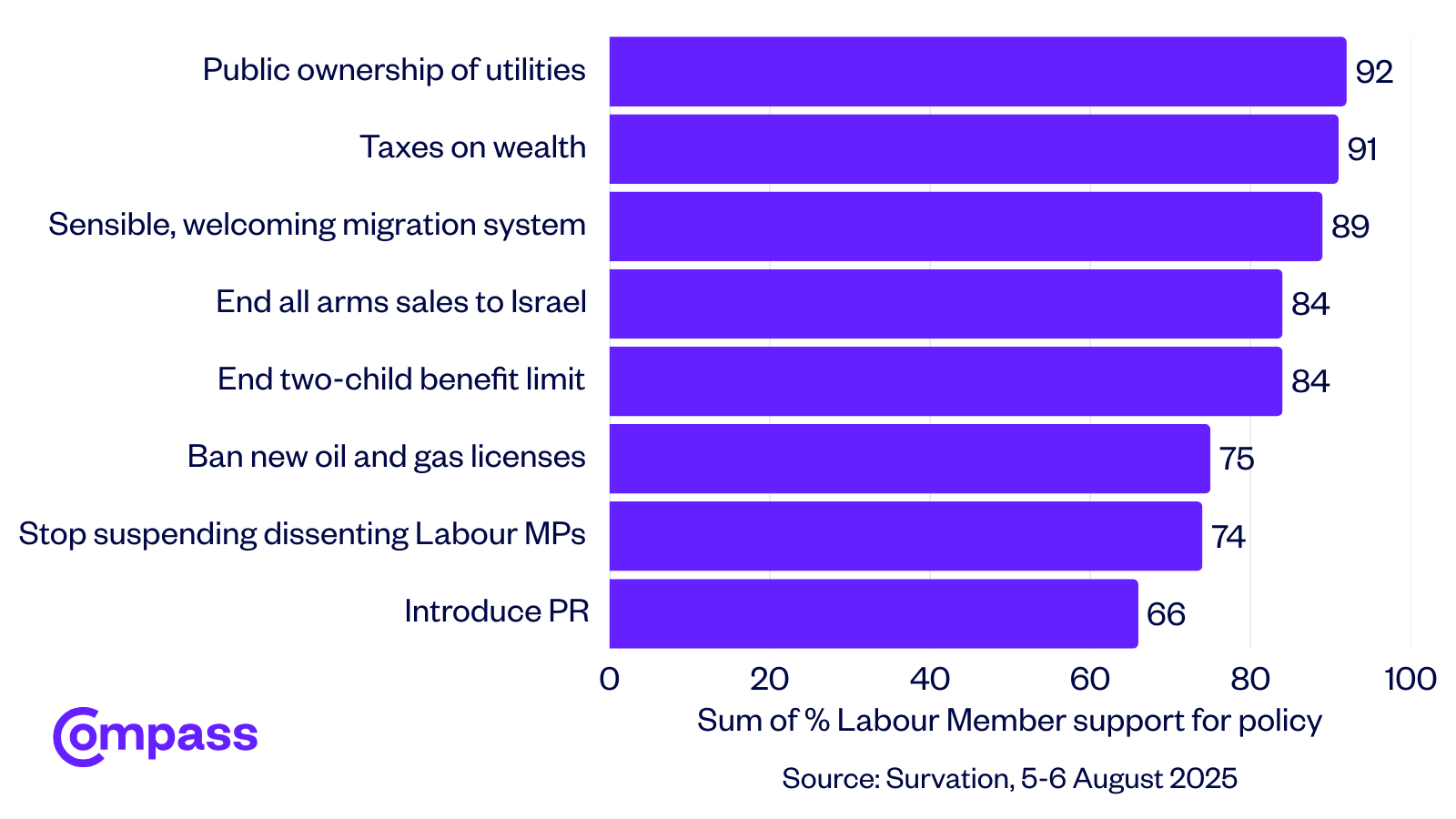
Labour members want the government to adopt more radical policies including a wealth tax, bringing water into public ownership and scrapping the two-child benefit cap, a new poll has found.
In a clear message to the party leadership, the polling, conducted by Survation on behalf of Compass, found that almost all Labour members (91%) support introducing a wealth tax on the super-rich.
Ahead of Labour’s autumn budget, more than 30 MPs have backed a motion by Independent MP Richard Burgon to introduce a 2% wealth tax on individual assets over £10 million. This policy would raise an estimated £24 billion a year.
The overwhelming majority of members (92%) also want essential utilities like water to be brought back into public ownership.
In addition, over eight in ten Labour members say that the government should end all arms sales to Israel, and also want the two-child limit to be scrapped.
Nearly three-quarters (74%) of Labour members want Keir Starmer to stop suspending MPs for opposing the government.
Last July, Labour withdrew the whip from seven of its MPs who had voted for an amendment tabled by the Scottish National Party to scrap the two child benefit cap.
Neal Lawson, director of Compass, said the polling showed that the prime minister “fence-sitting and aping of Reform’s rhetoric isn’t wanted”.
He warned that “without a big reset, then the keys to Number 10 are being handed to Reform and Nigel Farage”.
Former shadow chancellor John McDonnell, who lost the Labour whip last year, told The Independent that the survey “confirms how starkly out of touch Keir Starmer is”.
He added: “It’s time for Keir not just to start listening to people beyond the Westminster bubble but also taking some decisive action. All people are saying to him is to behave like a Labour prime minister should.”
A Labour spokesperson said the party’s priority after taking office last July was “to fix the foundations after 14 years of Tory chaos” and pointed to achievements including boosting the minimum wage for three million low-paid workers, and rolling out free school meals and breakfast clubs for primary school children. Olivia Barber is a reporter at Left Foot Forward
Britain risks becoming ‘dirty man of Europe,’ experts warn
“Polluting‑for‑profit water companies, industrial‑scale agriculture, and toothless regulation have failed people and nature alike."
Bathing waters in England are five times more likely to be polluted than those in the EU, according to new research.
Analysis by Best for Britain, a group campaigning for closer UK-EU ties, found that people across all four UK nations are less likely to swim in “excellent” quality waters than in the EU.
The research found that 64.2 percent of England’s bathing waters were rated excellent by the Environment Agency (EA) in 2024, while 85.4 percent of the EU’s were graded the same by the European Environment Agency (EEA). Bathing waters in the UK and the EU are measured under the same standards. Britain is under the bathing water regulations 2013, and the EU is under the bathing water directive. Both regulations apply the same standards of how much of various bacteria, such as E coli, can be in 100ml of water to meet the criteria.
Waters fall into the “poor” category when they contain unsafe levels of bacteria. Exposure to such waters can pose serious health risks to swimmers.
On top of there being less excellent rated bathing waters, more waters were rated as “poor” in England compared to any country in the EU. In 2024, England was found to have 8.4 percent “poor” bathing waters, Scotland 3.4 percent, Wales 1.8 percent and the EU 1.5 percent. Estonia had the highest share of officially rated “poor” bathing waters among EU countries at 4.6 percent.
Spots are rated “poor” if they fail to meet certain standards of safe bathing. They might, for example, have high quantities of bacteria, such as E coli, which can cause serious illness.
Although the UK and EU enforce the same regulations, the research suggests that many EU countries are applying and enforcing those standards more effectively. The UK’s Office for Environmental Protection, which was established after Brexit to replace EU oversight, has warned that Britain is on course to miss water cleanliness targets it would have been obliged to meet as a member state.
Meanwhile, the EU is preparing to strengthen its regulations further. A revision of the Urban Waste Water Treatment Directive will require countries to upgrade wastewater treatment processes to filter out a broader range of chemical, pharmaceutical and pesticide pollutants.
Amy Fairman, head of campaigns at environmental group River Action, said the figures confirmed what many river users already fear that “UK waters are in crisis.
“Polluting‑for‑profit water companies, industrial‑scale agriculture, and toothless regulation have failed people and nature alike,” said Fairman.
“The independent water commission was right to call for Ofwat’s replacement, but only real power, enforcement, and accountability will fix a broken system. It’s outrageous that the UK now sits amongst the worst performing countries for water quality in Europe – and unless we act, we’ll return to our shameful position as the ‘dirty man of Europe’,” she added.
Naomi Smith, chief executive of Best for Britain, said the public is losing patience: “People are rightly appalled by the disgusting state of the UK’s rivers, lakes and beaches. Clean water should be guaranteed to all, and no one should have to risk their or their child’s health simply by enjoying a swim or paddle on a sunny day.
“Once again, when it comes to environmental regulation, enforcement and protecting people’s health, the European Union leads the charge. This is yet more evidence ministers must properly implement and enforce existing standards – and keep pace as the EU raises the bar in ways that can tangibly benefit millions, as our polling shows voters expect.”
Thousands sign petition demanding to stop Trump exporting bigotry and hate to the UK
“His bigotry and hatred has already landed in the UK, where foundations are withdrawing funds from projects helping disadvantaged communities and companies are backtracking on commitments to fight the climate crisis."
Almost 25,000 people have signed a petition calling on Donald Trump stops exporting bigotry and hate beyond the US borders.
Launched by the Good Law Project, the petition highlights the growing influence of Trump’s anti-diversity push on the UK.
“His bigotry and hatred has already landed in the UK, where foundations are withdrawing funds from projects helping disadvantaged communities and companies are backtracking on commitments to fight the climate crisis,” the Good Law Project states.
Since returning to the White House, Trump has dismantled all federal Diversity, Equity, and Inclusion (DEI) programmes and has urged the private sector to follow suit. Several major corporations, including McDonald’s, Meta, Walmart, and Amazon, have responded by scaling back or abandoning their DEI policies altogether.
Earlier this year, Meta CEO Mark Zuckerberg claimed that corporations had been “neutered” and needed more “masculine energy.”
A similar trend is now emerging in the UK. Many organisations are rebranding DEI efforts to avoid political and media backlash. Right-wing media outlets such as the Sun routinely criticise so-called ‘woke’ business practices and applaud companies that appear to be “following Trump’s lead” in dismantling diversity initiatives.
Paul Sesay, founder and CEO of the National Diversity Awards, which is sponsored by companies including Amazon, Auto Trader, and HSBC, explains: “It’s rebranded to ‘wellbeing’, ‘belonging’ and ‘culture’. Even with roles, it’s no longer heads of DEI, it’s heads of culture, heads of people, heads of wellbeing.”
While the UK’s Equality Act and legal protections against discrimination offer some safeguard against a full-scale rollback, companies, particularly those with US headquarters, are already scaling back their commitments. In April, for instance, Barclays scrapped its gender and ethnicity targets for US staff. Previously, managers were expected to consider how promotions and hiring decisions supported the advancement of women and ethnic minorities, groups historically underrepresented in the banking sector.
With organisations succumbing and ‘following Trump’s lead,’ it’s not surprising the Good Law Project’s Stop Trump Exporting Bigotry and Hate petition is striking a chord. As Trump’s influence spills beyond US borders, threatening to undermine decades of progress on equality in the UK, campaigners say it’s a timely reminder that these rights are not guaranteed, and that now is the moment to push back.
UK
Latest four-day working week trial delivers 100% success rate
“We’ve proved it again and again: a four-day week works and should now be implemented more widely across the economy.”
All companies involved in the latest four-day working week pilot programme in Britain have chosen to continue with the reduced-hours model.
The scheme was organised by the 4 Day Week Foundation. All 17 organisations that took part in the six-month trial are keeping the policy of reduced hours in place, with 12 moving towards a full four-day working week and five now operating a nine-day fortnight.
The pilot involved over 1,000 employees, across a range of industries. In an analysis of the results, 62 percent of the workers said they experienced reduced burnout, while 41 percent said their mental health had improved. 45 percent said they felt more satisfied with their life.
One of the participating companies said that employee sickness rates had dropped during the trial, alongside a boost in workplace energy and morale.
“We’ve seen increased motivation and focus from colleagues who work four days rather than five,” said Alan Brunt, CEO of Bron Afon housing association in South Wales.
With less hours spent at work, some employees took the opportunity to return to education, with one member of staff starting to study for a master’s degree.
Joe Ryle, campaign director of the 4 Day Week Foundation, said the results are clear, a reduction in weekly hours benefits both employees and employers.
“People are happier, businesses are thriving, and there’s no turning back,” he said. “We’ve proved it again and again: a four-day week works and should now be implemented more widely across the economy.”
This latest success builds on momentum from earlier in the year, when over 200 companies permanently adopted a four-day week model. The shift impacted around 5,000 employees in the charity, marketing, and technology sectors, with each receiving the same pay for fewer hours.
A number of senior politicians have voiced support for a four-day working week, including the deputy prime minister Angela Rayner. In 2024, Rayner said: “If you can deliver within a four-day working week, then why not? I think people will realise it’s a great idea if it suits their sector and boosts productivity.”
However, the policy has not been fully adopted by Labour since gaining power, despite pledging to “strengthen workers’ rights.”
1933
Trade unions are the key to migrant workers’ rights
Writing this book, Panos Theodoropoulos worked in a range of precarious jobs alongside other migrant workers. In a Bradford printshop, he was subject to wage theft (money deducted on his payslip for breaks he was not given); in a Glasgow fish-processing plant, he worked eight hour shifts with just a half-hour break two hours in, then six hours of continuous work; as a kitchen porter in the same city, he worked on through multiple cuts and burns – photos included – meaning that “almost every action I have to perform hurts.”
Precarious workplaces seldom have any trade union presence. But migrant precarity extends beyond the workplace – to residency restrictions, housing barriers, racism, xenophobia, language and cultural barriers and general disorientation.
Migrant workers now make up nearly a fifth of the UK’s working population and feature prominently in the most precarious sectors of the labour market – 27% of the hospitality sector, for example. Often working the longest hours for the lowest pay, migrant workers are also more likely than British-born people to work in jobs for which they are over-qualified.
Interviewing many migrant workers, Theodoropoulos finds that to get work, they have to conform to certain stereotypes. Putting one’s degree-level education on application forms, for example, will prevent the applicant from getting most of the jobs available – better to play down your qualifications. Most jobs were physically demanding, with no health and safety provision or sick pay. Many migrants faced racial discrimination from their employers, relative to the treatment of local workers. Some had pay withheld – like the author himself – which could be restored sometimes only with the threat of union or legal action.
Theodoropoulos argues that precarious working conditions socialize the workforce in an individualist, survival-oriented struggle that erodes solidarity and enforces a neoliberal world view. In an Amazon fulfilment centre where he worked, “whatever can be isolated, individualized and automated, will be.” All human interaction is minimised, but surveillance cameras are everywhere, an environment brilliantly conveyed in Laura Carreira’s film On Falling.
Yet precarity cannot entirely erase workers’ awareness and experience of class injustice. Theodoropoulos gives several examples of workers looking out for and helping each other in some of the workplaces he experienced, beyond the requirement of their job. The big question is: does this allow collective action to germinate to a level that can fight the exploitation they face?
In some cases, yes. The author interviews migrant workers who initiated trade union organisation in their workplaces, which brought about some significant changes in working practices. On the other hand, migrant agency workers had a pretty negative view of mainstream unions which made no attempt to connect local unionised workers with non-unionised migrant agency workers, despite the strong desire of the latter to be represented. This failing is identified by Theodoropoulos as the single biggest obstacle to the organisation of migrant workers.
Independent unions like the IWW are more engaged but lack the resources of bigger unions that would enable them to effectively fight unfair dismissals and workplace discrimination. However, in recent years, they have clocked up some notable successes in organising industrial action that has empowered migrant workers in particular, and these advances have had an impact on more traditional unions. Even Amazon has been affected: the US Amazon Labour Union’s 2022 success in organising the company’s Staten Island warehouse “demonstrated the importance of organizing along both class and migration lines.”
For many migrants to the UK, however, overall trends are worsening. Brexit has increased the precarity facing European migrants, who face an increased threat of deportation. The demonisation of migrant workers has intensified under the Labour government and the rhetoric of the Opposition and the media has become much more toxic. Society as a whole is also becoming more precarious, with the cost of living continuing to rise while the welfare state is further eroded.
Yet there are increasingly examples from abroad that can overcome the imposed isolation facing migrant workers: the establishment of autonomous spaces, workers’ centres, industry-specific newsletters are just some of the grassroots initiatives that are happening. Small steps – but vital and growing. This book is a valuable contribution to our understanding of that process.
Mike Phipps’ book Don’t Stop Thinking About Tomorrow: The Labour Party after Jeremy Corbyn (OR Books, 2022) can be ordered here.
The attack on trans rights is part of a broader right wing offensive and can be resisted by unifying all the struggles against it, argues Alex Burt.
Throughout the election campaign last year, progressive and socialist voters were repeatedly told we were to vote Labour to ‘get the Tories out’. LGBT+ people with concerns about the speed at which our Party had capitulated to Telegraph columnists were hushed away with a simple phrase: ‘It will be worse under the Tories.’
The sneering arrogance of a narrow clique who felt they were ‘owed’ progressive votes off little more than 14 years of Conservative austerity has now transitioned. It has gone from an inconvenient truth of two-party politics that there will always be a lesser evil, to a sense that change merely meant a new colour of tie cracking off-colour jokes about womanhood at the dispatch box while a new set of power-obsessed cabinet ministers lament in the columns of the right-wing media that common sense has died and that ‘trans rights activists are silencing the voice of a ‘sensible majority’. The simple answers to complex questions have not gone away under a Starmer ministry: in fact, they have only got worse.
As a Party and as a country, we have entered an epoch of reaction. Government is not run by the elected representatives of the people, but by an obsessive media class where outrage farming and an old world struggling to die make an alliance of convenience to cling on to relevance and power in a socioeconomic landscape that has long moved past them. Long gone are the days of neoliberal affluence; now there exists a politics fractured among a vast and growing working poor who know something is broken, but cannot agree on what or how to fix it.
It is in this climate, where the government feels out of control and where it feels like nothing ever works or will work again, where reactionary and far-right politics can thrive so well. It is a common critique of ‘Starmerism’ that it lacks a unifying vision or purpose, one that most voters in the country would agree with, and it is an ideological void which is filled by a reactive approach to government. Rarely has this administration set the agenda; instead it has reacted to events around it in increasingly desperate attempts to cover the growth of Reform. It does not recognise that the growth of Reform is precisely because they have a vision of what they believe the UK should look like beyond the current crises.
In very few areas is this more patently manifest than in how the government has approached ‘culture war’ issues, particularly its vicious approach towards the ‘trans debate’. Our 2024 manifesto promised to “remove indignities for trans people”, alongside a promise for a trans-inclusive conversion therapy ban. The latter was mentioned in the King’s Speech in what looked to be a legislative flurry in stark contrast to Tory inaction. Over a year later, a bill including that ban has not been introduced, and the indignities have been far from removed…
Cass, Courts and Cruelty
The Cass Review, published on the eve of the general election, was an immediate opportunity for us to view what “removing indignities” would look like. The Tories had introduced a ban, upheld by the high court, on the prescription of puberty blockers for under-18s. Wes Streeting would go on to extend that ban ‘indefinitely’ until the results of a proposed study into the social and biological impacts of puberty blockers can be held. It should be mentioned at this point that this proposed study is seen as wildly unethical by the medical community, on grounds ranging from consent to control groups. So much for “removing indignities” so far then…
More sinister than this though has been the day-to-day impact of the Cass Review on the provision of care to transgender people. Not long after the publication of the review, some GPs began refusing to fulfill prescriptions for HRT, even where they had been made previously, citing a lack of confidence or training that, as an observer who is not a medical professional, seemed to suddenly appear after Cass undermined 40 years of consensus on best practice for treating gender dysphoria.
The Good Law Project are also reporting that, in the wake of the Cass Review, social services have begun investigating families who seek puberty blockers via private provision for “safeguarding concerns”. One family told their story of a CAMHS session with their brother being used to interrogate him about his sister’s care, as part of a safeguarding investigation into the use of puberty blockers where a diagnosis of Gender Dysphoria already existed prior to the Cass Review. Health and social services have been cocked and readied as weapons of the state, under the watch of a Labour Government, limiting our access to care with one hand and criminalising any attempt to use the private sector with the other.
All of this is without mentioning the Supreme Court’s ruling in For Women Scotland vs the Scottish Government which left Gender Recognition Certificates significantly legally weakened. The ruling, as an interpretation of the Equality Act, has effectively re-written it. Transgender people have lost access to services that match their gender identities, of particular significance within abuse services (where transgender people are disproportionately victimised), even when they have been through the laborious process of gaining a GRC.
It is also noticeable that since then, the trans-exclusionary lobby have been targeting organisations and individuals who have spoken up for trans inclusion, continued to operate trans-inclusive policies (at the behest of members), or even workers they accuse of being trans, with escalating threats and abuse. EHRC guidance in the wake of the ruling has brought very little clarity, ruling that access to facilities should be made via sex at birth, without ruling how this can be checked and established.
The reality of this has left trans people functionally excluded from public life, forced to out themselves if they wish to engage legally or having to live in a constant legal grey area. Many groups, including our Party, have chosen to simply abolish women’s structures or cancel elections where gender-balancing is complicated by the terrifying presence of a trans person. Keir Starmer, it should be remembered, welcomed the ruling for the clarity it provided.
Where Next?
There is so much more I can say about this last 13 months and the way in which trans rights have been deliberately undermined or neglected, but it ultimately distills into one primary fact: our Party is reacting to events. When faced with accusations that the EHRC guidance is unclear, we defer to the Supreme Court. When families with transgender children try to access support, we defer to Cass. Constitutionally, the executive in the UK is a manifestation of its parliamentary support and Parliament is the ultimate authority in all UK political life. Looking at the facts and events I have laid out in isolation, you would not get this impression.
The executive does not use its massive Commons majority to fix some of the obvious flaws in trans rights policy: it defers them in the hope of appeasing a maniacal media class that knows its political dominance, and the grip of neoliberal capitalism more broadly, is breaking. They offer us good headlines; in return we do their cultural bidding.
What they will never have is a movement from below. The anti-trans movement has an outsized influence and voice, but it has no human touch. In the wake of the Supreme Court ruling, thousands and thousands took to the streets to show their solidarity. In Leicester we organised something far bigger than any of us could have anticipated. In London, Manchester, Edinburgh and many other cities it was a bigger mobilisation still. We cannot let this anger fizzle into hopelessness as happens so often. Our challenge now is to challenge misinformation and embed into all our struggles the mantra that we cannot win unless all of us win.
The media playbook against trans people is the same one which it pulls against refugees. Its ignorance of trans voices in favour of transphobes matches its preference of Israeli voices to Palestinians. Though it may not seem it, our individual struggles against the forces of reaction and media conservatism are linked, both by playbook and by purpose. The dominance of the post-Thatcher consensus and of neoliberal affluence is collapsing and old media are collapsing with it. As the old world dies, the new world struggles to be born – and if we want that new world built by workers liberated and freed from the social determinisms of the past, then we must pull our disparate movements together as one class, the working class, united and unbowed.
Alex Burt is East Midlands Officer for Labour For Trans Rights.
We write as activists in Ukraine solidarity work and as activists within UCU (University and College Union). This experience has led us to consider what attitudes socialists and trade unionists should have to war, particularly how we support opposition to imperialist wars, critiques of the armaments industry and solidarity with wars of national liberation.
The labour movement in general and, also, movements of the oppressed, in particular the women’s movement, has a long and honourable record of opposing wars and the arms industry. But that is not the same, in our view, as adopting a completely pacifist position. We believe that there are circumstances where armed resistance is necessary and should be supported, in particular wars of national liberation, as mentioned above. That raises an important question for the left: how do we combine our long-standing criticisms of militarism with support for struggles of this kind?
These questions have become increasingly relevant in recent years because of the war in Ukraine. We write from a position of support for the armed resistance of the Ukrainian people against Russian aggression. In this context, we have seen sections of the left, working jointly with anti-war/peace groups adopting pacifist or semi-pacifist positions with regard to Ukraine. These people move seamlessly from calling for ‘welfare not warfare’ to a call for stopping weapons supplies to Ukraine, without recognising the implications of this for the Ukrainian people and ignoring the fact that it is contrary to what Ukrainian trade unions are demanding.
We have also experienced debates in which support for the right of Ukrainians to access weapons for self-defence is equated with being pro-war, pro-NATO, reckless about the dangers of World War III and nuclear war, and in support of western governments. We take the view it is entirely correct to be worried about World War III and the dangers of escalation of conflicts, but not to respond with politics of appeasement in which oppressed nations are asked to surrender the right to national self-determination or accept enforced partition of their territory. We would also oppose the view that oppressed nations are required to accept policies (whether domestic or foreign) which are determined by neighbouring powerful states, staying within a sphere of influence, whatever the wishes of their people.
We also believe that it is important to recognise that, in the contemporary world, where national liberation movements or countries fighting to maintain self-determination are often relatively weak economically and militarily in comparison to competing imperialist powers, such movements may need to receive military support, for example arms deliveries, from one or more of those powers. This again raises important questions for socialists. How do we reconcile this need with our ongoing struggles against imperialist domination?
These experiences have led us to think about what it means to be anti-militarist and how should we define anti-militarism. The following notes endeavour to map out a position which is anti-militarist but not pacifist and not in conflict with solidarity with the Ukrainian people. We do not claim they are exhaustive.
Demands
The notes below are set out in the form of demands or requirements. They represent conditions which we feel need to be met for necessary military support for progressive movements to avoid strengthening militarism. We have grouped them in three categories; those which are addressed primarily to ourselves, within the labour movement; those which are addressed primarily to national governments; and those which are directed primarily to international organisations.
With regard to the first group, the requirements which we would argue should be placed on socialists include the following:
No romanticisation or glorification of war; a critical approach to military ceremonies and memorials.
Recognition that war damages the environment; support for de-mining operations and post-war reconstruction, including environmental restoration in Ukraine and other countries devastated by war.
Opposition to racism, sexism, misogyny and other prejudices which can be related to war or exacerbated by it. Opposition to attacks on women’s reproductive rights or pressure on women to produce children as cannon fodder. Support for equal rights within the military.
Recognition of the human cost of war and support for war veterans and those injured or disabled in war. Recognition of the situation of refugees and others displaced by war. Recognition of the experiences of those who have lived in war situations.
Preference for negotiations wherever they can be used to prevent war and obtain just settlements.
Support for international organisations and NGOs where they can contribute usefully to negotiating just settlements.
Opposition to unjust peace settlements, colonialism and annexations of territory.
Support for equal rights among nations and countries, with no pressure on smaller nations to abandon their independence or accept being treated as another country’s backyard.
Recognition that there can be just wars.
Support for the rights of self-determination and self-defence.
The demands that we would place on national governments, specifically in our home countries, include the following:
Recognition of the rights of conscientious objectors and support for provision of alternative forms of civilian service for them.
Nationalisation of the armaments industry.
Progressive taxation on companies and the rich to fund any military spending. Rejection of the argument from governments that cuts in social spending are needed to finance wars. Defence of welfare provision in wartime as in peacetime
No resources for prestige military projects designed to favour capital rather than to achieve concrete objectives.
Democratic control over military spending.
The right of members of the armed forces to form and join trade unions.
Support for military veterans and civilians injured in wars, including care for both mental and physical health, education, employment, housing and income maintenance. Provision for refugees and others displaced by wars.
Military support for national liberation struggles and struggles for self-determination. This support should be provided without political restrictions which undermine the fight for liberation. While support may be unconditional, this does not mean it has to be uncritical.
Nuclear disarmament, outlawing of biological and chemical weapons. Credit given to countries that do renounce nuclear weapons and measures to ensure they are not disadvantaged.
The demands that we would see as requiring some kind of international co-ordination, in order to be achieved, perhaps through international treaties, include the following:
Support for `rules of war’ in terms of opposition to war crimes and unnecessary prolongation of wars. These include conventions designed to protect civilians, the civilian infrastructure and the environment during time of war, and conventions regarding the rights of prisoners of war. Support for war crimes tribunals so long as they apply to all countries.
Support for economic, social and environmental policies which create peaceful development and remove at least some of the causes of war.
Liz Lawrence is a former national president of UCU and one of the organisers of UCU members for Ukraine.Andy Kilmister is a delegate from Oxford Brookes University UCU to Oxford and District Trades Council and a member of UCU Members for Ukraine and the Ukraine Information Group.
Image: Demonstration in London in solidarity with Ukraine on February 22nd 2025, c/o Labour Hub.
CHILE
Allow me to reflect a little
Heraldo Povea Pacci posted this on Facebook on 15th August and gave us permission to translate and post it to Labour Hub.
Half a century ago…
One 15th August 50 years ago, I was detained by the Chilean Navy Secret Service and then taken by the DINA [Chilean secret police] to Villa Grimaldi [a notorious torture centre].
That was five difficult weeks.
Last 23rd July I was confronted with Krassnoff [the man convicted of crimes against humanity for his involvement in Villa Grimaldi] and laughed in his face. After all the violence, all the resources he had to wipe out our consciousness, I left Grimaldi whole, and ready to keep resisting.
My anti-capitalist convictions and determination are intact. I will continue to work to change the system. I do not believe in reforms that simply strengthen those in control, as history has shown many times.
This 15th August 2025 I will celebrate the 60th anniversary of the Revolutionary Left Movement, MIR, my party that no longer exists, but which brought together and marked the lives of so many exceptional men and women.
My membership of the MIR built my ethics and my ideological conviction.
I will die deeply proud to have been in the trenches and in struggle with them. I will die a MIRista, with red and black in my heart.
The only thing that hurts was the weeping of my mother when the repressive forces dragged me out of my home and put me in their car, just like it says in the song. Apart from that, I am happy.
The song referred to is El viejo comunista [The old communist] by Manuel García, available here. Above text and lyrics below translated by Sue Lukes.
The old communist
Lyrics by Manuel Garcia
Un viejo que fuera comunista Se sienta a fumar la tarde entera Mientras buena lluvia cae afuera Con voz desnuda, el viejo piensa
Porque coinciden en su ventana Palomas grises con la pena que fumara Palomas grises con la pena que fumara
Torna sus ojos a un día lejos Cuando a un libro un verso, a una muchacha un pensamiento Cuando a un libro un verso, a una muchacha un pensamiento Cree que ya nada lo sorprende Que se curó de espanto, desgastó el llanto Se curó de espanto, desgastó el llanto
Recordó canciones que cantaba Y conversaciones con amigos hasta el alba Y conversaciones con amigos hasta el alba Recordó la esquina de su casa Cuando dijo adiós y vio a su madre que lloraba Cuando dijo adiós y vio a su madre que lloraba
Y ahora en sus ojos también llueve Pues le sorprende que aún le duele Los años, la vida, su amor Los años, la vida, su amor
Oh, oh-oh-oh-oh aún le duele Oh, oh-oh-oh-oh aún le duele Oh, oh-oh-oh-oh aún le duele Oh, oh-oh aún le duele
An old man who was a communist
Sits, smoking, the whole afternoon
While the good rain falls outside
With his unarmed voice the old man thinks
Because in his window, grey pigeons
Join the sorrows he smokes away.
He turns his eyes to a long gone day
When a verse, a book,
A girl a thought, when a verse a book
A girl a thought..
He believes that nothing now surprises him
He has healed from the terror, the tears are all gone
Philosophy Football’s Mark Perryman welcomes a footballer exposing the truth about Gaza.
Following the death of Palestinian footballer Suleiman al-Obeid UEFA tweeted sorrowfully: “Farewell to Suleiman al-Obeid, the ‘Palestinian Pelé. A talent who gave hope to countless children, even in the darkest of times.”
Fair enough, nice of them, many must have thought. Not Mo Salah who with three questions exposed the moral dithering over Gaza not only in football but more widely across popular culture, society and politics.
“Can you tell us how he died, where, and why?”
The answers were easy enough to find: the fact UEFA hadn’t provided them tells us so very much.
He died, like tens of thousands of others as a result of an Israeli armed assault which was purposefully and lethally indiscriminate. We can argue the toss over whether or not to call this ‘genocidal’: what is without question is these killings are by no stretch of imagination, or Israeli government denials, accidental. Of course, avoidable tragedies occur in any war; the entire history of warfare is full to overflowing with human tragedy. But such killings on such a scale reveal what is clearly Israeli military policy.
What was Suleiman doing to put himself in such a precarious position? Queuing like thousands of other Palestinians for humanitarian aid. Even being the ‘Palestinian Pelé’ didn’t mean he and his family could avoid such a necessity if they weren’t to starve. These aid distribution points are easy enough to identify and ensure free of the gunfire, and worse, all around them. There is a long tradition, originated by the Red Cross, of such sanctuaries in war. Not in Gaza, not from the excesses of the Israeli military.
OK: in a tweet UEFA might not have been able to explain all of this. But simply to bid Suleiman ‘farewell’ tells us plenty, and none to UEFA’s credit.
To date, authoritative sources have recorded over 60,000 Palestinian deaths at the hands of Israel, including, the Palestine FA report, over 400 footballers.
The “darkest of times” – well put: but without anything resembling the reason why, the sentiment becomes entirely meaningless.
And Israel has faced no consequences for its actions from FIFA. ‘Keep Politics out of Sport’ is the well-worn mantra, but of course sport, especially international sport, is unavoidably political. Whatever the country, the ‘national team’ represents the nation on a global stage, and politics via national identity is entirely indivisible from that. In Eric Hobsbawm’s words, “A nation of millions seems more real as a team of eleven named people.”
This is generally used as a positive, but it is equally applicable as a negative. A point often missed is that Hobsbawm wrote those words recounting his experience as a Jewish schoolboy following football during the rise of the Nazis in Austria before he escaped as a refugee. Sport not political? When England played Germany in the 1930s, the team were instructed by the FA to give the Nazi salute when they lined up for the anthems. Sport not political? When Tottenham Hotspur hosted England v Germany at White Hart Lane in 1935, the club flew the swastika from the flag pole on the roof of the much-loved East Stand.
Sport has always been used, sometimes more subtly, in such ways. And on occasion FIFA has in turn used its status as football’s world governing body to police this too. In 1961 South Africa was banned from international football because of the ruthlessly racist state policy of apartheid. The ban was dropped in 1963 when the last English President of FIFA, Sir Stanley Rous, negotiated that South Africa would field all-white and all-black teams at alternating World Cups. Yes, really. A gross insensitivity to global opinion, particularly in Africa.
Rous was out-voted; South Africa was suspended in 1965. Two years later in an unprecedented move, Rous was deposed, mainly due to African countries’ votes. South Africa was expelled, a suspension that lasted 25 years until the ending of apartheid. The ending was marked by the country’s triumphant hosting of World Cup 2010. It was a happy ending, of sorts, and intensely political.
In 1992, the bitter ethnic conflicts, eventually descending into all-out wars, that accompanied the break-up of Yugoslavia led to the country, despite topping their qualifying group, being suspended on the eve of Euro 92. With just ten days to prepare, lucky old Denmark replaced them, going on to win the tournament. Today all the Balkan nations compete independently in UEFA and FIFA competitions, Kosovo the most recent to do so.
Following their hosting of World Cup 2018, Russia after invading Ukraine was banned from both the 2022 and 2026 World Cups. England, Poland and Sweden pre-empted this decision, unilaterally declaring they would refuse to play Russia. The ban continues while both the Ukrainian national team and club teams, despite being mostly in exile, continue to play in both UEFA and FIFA competitions, providing a vital focus of hope and identity for Ukrainians in their war-torn country and as refugees across the world.
Which leaves another question concerning UEFA’s tweet. Why is Israel a member of football’s European confederation, unlike its neighbours Jordan, Syria, Lebanon and Palestine which are all members of the Asian confederation (Egypt is a member of the African confederation). It’s a question I’ve never once heard asked in any football commentary, or raised in a match report, of an Israeli club or the national team competing in European competitions or World Cup Qualifying. Not once, ever, let alone since the current conflict.
The Israeli FA, the successor organisation to the Palestinian FA which included both Jewish and Arab club sides, joined the Asian Confederation in 1956. And their membership proved successful: Israel were runners-up in the Asian Cup of 1956 and 1960 and hosted the tournament in 1964 which they also won. But off the pitch, Israel was a site of major conflicts, most notably the 1967 Six-Day War and 1973 Yom Kippur War. As a result, Arab and predominantly Muslim nations more and more refused to play Israel. In 1967 Israel was summarily expelled from the Asian Confederation.
UEFA admitted the Israel national team in 1991, Israeli club sides in 1992 and as a full member in 1994. This is despite Israel not being in any sense a European nation. It was a decision with absolutely nothing to do with events on the pitch and everything to do with events off it. This was an entirely political decision, which neither UEFA nor the attendant football media seem at all willing to admit.
So, should we despair, give up all hope? No, not ever. At the 1972 Olympics this conflict collided with sport in the most tragic of manners. Israeli athletes were taken hostage by the Palestinian terrorist group Black September. In the ensuing shoot-out, most of the athletes lost their lives, either killed by Black September or in the crossfire with the police sharpshooters.
Forty years later, Palestine featured again at the Olympics, at London 2012. Palestinian athletes marched for the first time in an Olympic Opening Ceremony behind the Palestinian Flag. For good or bad, sport is always political, and given the will, the outcomes can be positive, not negative. Mo Salah shows us how to shift the balance now, when we need to so much, from the latter to the former. Hope 1 Despair 0.
Philosophy Football’s Suleiman al-Obeid & Mohamed Salah T-shirt is available here.
Mark Perryman is the co-founder of the self-styled ‘sporting outfitters of intellectual distinction’ aka Philosophy Football.
France condemns Israel's West Bank settlement plan as serious breach of international law
RFI Sat, August 16, 2025
Israeli Finance Minister Bezalel Smotrich holds a map that shows the E1 settlement project during a press conference near the settlement of Maale Adumim, in the Israeli-occupied West Bank, Thursday, Aug. 14, 2025.
France has condemned Israel’s plan to build 3,400 new homes in the occupied West Bank, calling the project a “serious violation of international law” that risks destroying any chance of a contiguous Palestinian state.
The French foreign ministry insisted the so-called E1 settlement, east of Jerusalem, threatens to cut the West Bank in two, undermining prospects for Palestinian statehood.
The French foreign ministry spokesperson said France “condemns with the utmost firmness” the project and reiterated calls for Israel to halt all settlement activity, which “systematically erode the viability of a Palestinian state.”\
Finance Minister Bezalel Smotrich, a far-right figure, openly boasted that the construction would make a Palestinian state impossible. The plan, expected to receive final approval later this month, has been frozen for years amid international pressure but is now moving forward.
The area is critical as one of the last geographic links between the West Bank cities of Ramallah and Bethlehem; its development would force Palestinians to take long detours through numerous checkpoints, adding hours to travel.
France, along with many other countries, has strongly condemned the plans and warned the settlements contravene international law and jeopardise the prospects for peace.
The French government’s sharp criticism comes amid growing concerns over escalating tensions and violence in the West Bank and Gaza, where the Israeli-Palestinian conflict continues to deepen. France remains a strong advocate for a two-state solution, warning that settlement expansion risks making that goal impossible and fuelling further unrest in the region.
(With newswires)
Germany tells Israeli government to stop West Bank settlement construction
Reuters Fri, August 15, 2025 Israeli flag flutters, as part of the Israeli settlement of Maale Adumim is visible in the background, in the Israeli-occupied West Bank
BERLIN (Reuters) -Germany on Friday called on the Israeli government to stop settlement construction in the West Bank after Israel's far-right finance minister said work would start on a plan for thousands of home that would divide the Palestinian territory.
Germany "firmly rejects the Israeli government's announcements regarding the approval of thousands of new housing units in Israeli settlements in the West Bank," said a foreign ministry spokesperson in a statement.
Plans for the "E1" settlement and the expansion of Maale Adumim would further restrict the mobility of the Palestinian population in the West Bank by splitting it in half and cutting the area off from East Jerusalem, said the spokesperson.
Israeli Finance Minister Bezalel Smotrich announced on Thursday that work would start on the long-delayed settlement, a move that his office said would "bury" the idea of a Palestinian state.
In a statement, Smotrich's spokesperson said the minister had approved the plan to build 3,401 houses for Israeli settlers between an existing settlement in the West Bank and Jerusalem.
Germany has repeatedly warned the Israeli government to stop settlement construction in the West Bank, which violates international law and U.N. Security Council resolutions.
Such moves complicate steps towards a negotiated two-state solution and end to Israeli occupation of the West Bank, said the spokesperson.
(Writing by Miranda Murray, Editing by Rachel More)
Israeli far-right minister backs contentious West Bank settlement plan
Smotrich unveiled the plans in response to numerous Western nations saying they would recognise a Palestinian state
Menahem Kahana/AFP
Israel's finance minister backed plans on Thursday to build 3,400 homes in a particularly contentious area of the occupied West Bank, calling for the territory's annexation in response to several countries' plans to recognise a Palestinian state.
The United Nations chief warned that building Israeli homes in the area would "put an end to" hopes for a two-state solution to the Israeli-Palestinian conflict.
Israel has long had ambitions to build on the sensitive parcel of land east of Jerusalem known as E1, but the plan has been frozen for decades amid international opposition.
Israeli settlements in the West Bank are considered illegal under international law, while critics and the international community have warned construction on the roughly 12 square kilometres would undermine hopes for a contiguous future Palestinian state with east Jerusalem as its capital.
The site sits between the ancient city and the Israeli settlement of Maale Adumim, near routes connecting the north and south of the Palestinian territory. There are also separate, frozen plans to expand Israel's separation barrier to envelop the area.
"Those who want to recognise a Palestinian state today will receive a response from us on the ground... Through concrete actions: houses, neighbourhoods, roads and Jewish families building their lives," said Bezalel Smotrich, Israel's finance minister, who was speaking at a pro-settlement event on the advancement of plans for the E1 parcel.
"On this important day, I call on Prime Minister Benjamin Netanyahu to apply Israeli sovereignty in Judea and Samaria, to abandon once and for all the idea of partitioning the country, and to ensure that by September, the hypocritical European leaders will have nothing left to recognise," the far-right figurehead added, using the Biblical term for the West Bank, which Israel has occupied since 1967.
Britain and France are among several countries to announce in recent weeks plans to recognise a Palestinian state later this year, saying they wanted to keep the two-state solution alive.
- 'Breach of international law' -
Stephane Dujarric, the spokesman for UN Secretary-General Antonio Guterres, said "If this went ahead -- which we call on the Israeli government not to do... it would sever the northern and southern West banks."
He added that "it would put an end to the prospects of a two-state solution".
The Palestinian foreign ministry condemned the plans and called for "genuine international intervention and the imposition of sanctions on the occupation to compel it to halt the implementation".
"Colonial construction in the E1 area is a continuation of the occupation's plans to destroy the opportunity for the establishment of a Palestinian state," it added.
The European Union's chief diplomat, Kaja Kallas, said the plan "further undermines the two-state solution while being a breach of international law" and called on Israel "to desist".
Germany said it "strongly objects" to the plan and called on the Israeli government to "stop settlement construction", while Saudi Arabia also condemned the move "in the strongest possible terms".
Israeli NGO Peace Now, which monitors settlement activity in the West Bank, denounced the E1 plan as "deadly for the future of Israel and for any chance of achieving a peaceful two-state solution".
The NGO said the final approval hearing would be held next Wednesday by a technical committee under the defence ministry that has already rejected all objections to the proposals.
After the bureaucratic steps are completed, "infrastructure work in E1 could begin within a few months, and housing construction within about a year", Peace Now said.
The West Bank is home to around three million Palestinians, as well as about 500,000 Israeli settlers.






.svg)