Sunday, August 17, 2025

Syria’s al-Sharaa calls for unity, accuses Israel of fuelling unrest in south

Syrian President Ahmed al-Sharaa vowed Sunday that the fight to reunify his war-torn country must be achieved through dialogue, not bloodshed, while accusing Israel of fueling unrest in the south. His remarks came as hundreds protested in Sweida over recent Druze-Bedouin clashes and called for self-determination in the Druze-majority province.


Issued on: 17/08/2025 - 
By:  
FRANCE 24
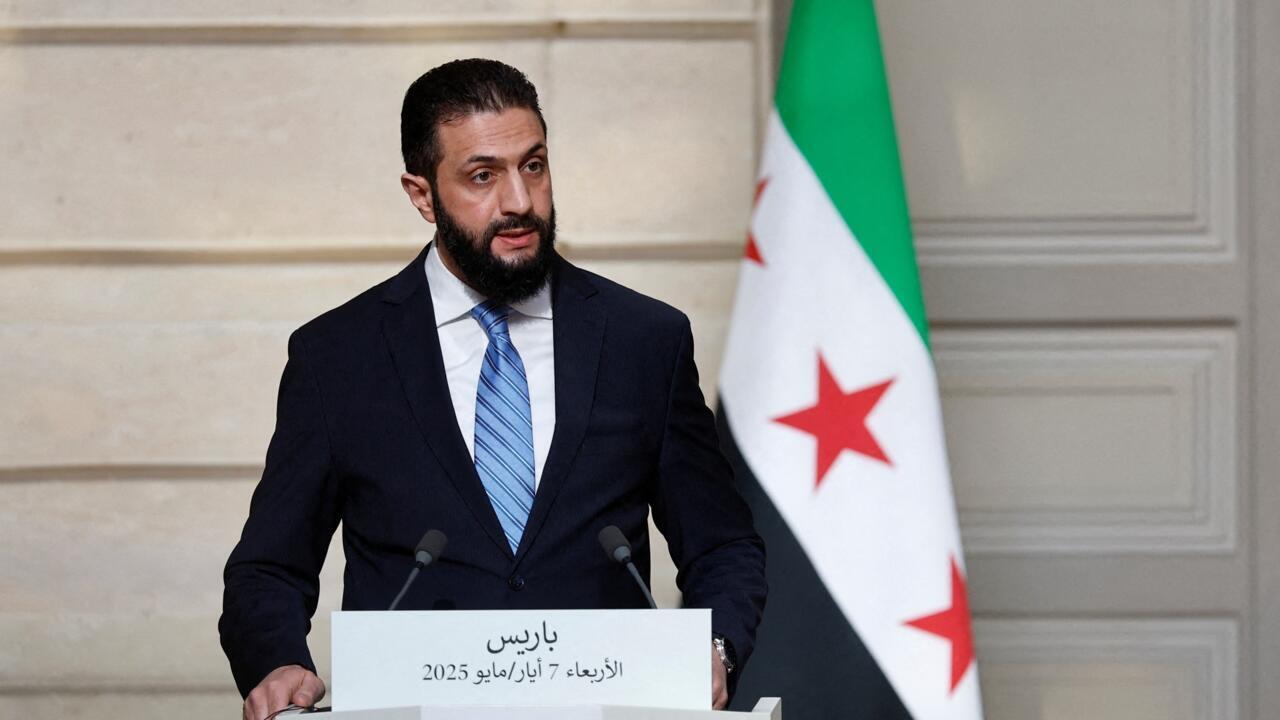
Syrian President Ahmed al-Sharaa speaks during a joint press conference with French President after a meeting at the Elysee Palace in Paris, on May 7, 2025. 
© Stéphanie Lecocq, AFP

Syrian President Ahmed al-Sharaa has said the battle to unify his country after years of civil war "should not be with blood", rejecting any partition and accusing Israel of meddling in the south.

His remarks, released by state TV on Sunday, came as hundreds demonstrated in south Syria's Sweida province, denouncing sectarian violence last month and calling for the right to self-determination for the Druze-majority province.

"We still have another battle ahead of us to unify Syria, and it should not be with blood and military force... it should be through some kind of understanding because Syria is tired of war," Sharaa said during a dialogue session involving notables from the northwest province of Idlib and other senior officials.

"I do not see Syria as at risk of division. Some people desire a process of dividing Syria and trying to establish cantons... this matter is impossible," he said according to a recording of the meeting, distributed overnight by state media.


"Some parties seek to gain power through regional power, Israel or others. This is also extremely difficult and cannot be implemented," he said.

At the protest in Sweida, some demonstrators waved the Israeli flag and called for self-determination for the region.

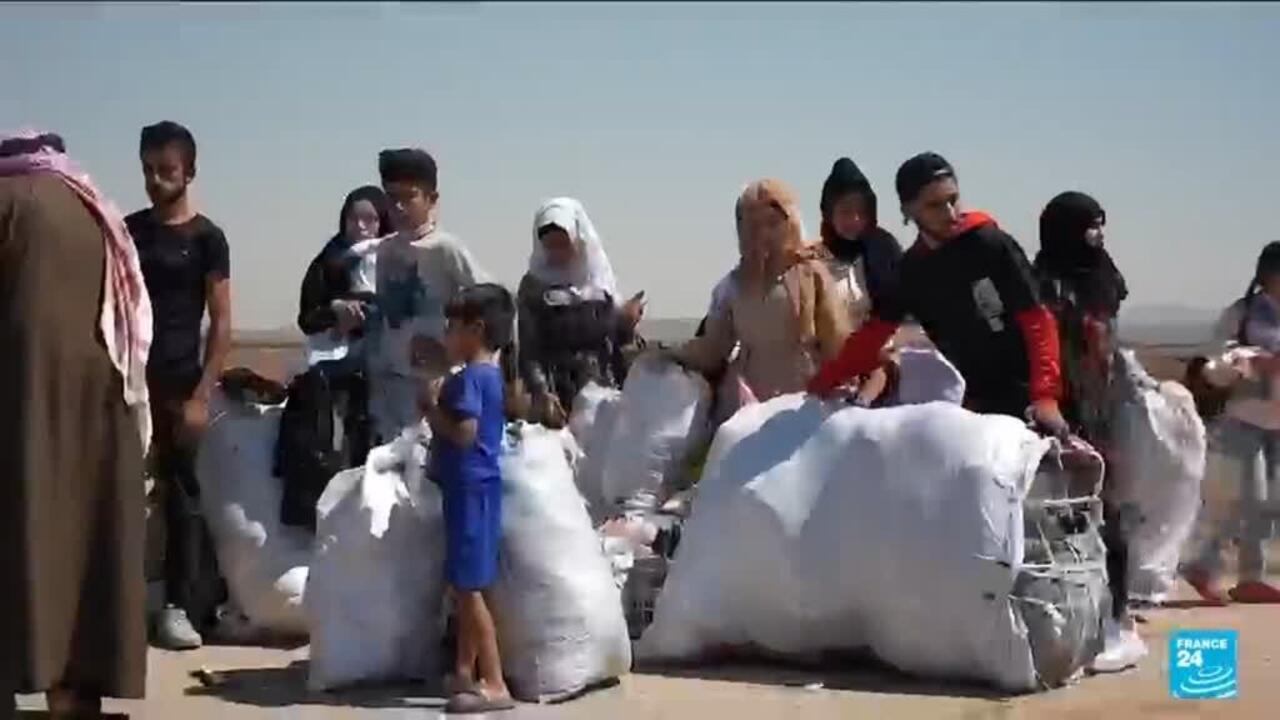
FRANCE 24 report in Sweida: Tens of thousands displaced since clashes began
© France 24
02:58


A week of bloodshed in Sweida began on July 13 with clashes between Druze fighters and Sunni Bedouin, but rapidly escalated, drawing in government forces, with Israel also carrying out strikes.

Syrian authorities have said their forces intervened to stop the clashes, but witnesses, Druze factions and the Syrian Observatory for Human Rights have accused them of siding with the Bedouin and committing abuses against the Druze, including summary executions.

Sharaa said that Sweida "witnessed many violations from all sides... some members of the security forces and army in Syria also carried out some violations".

The state is required "to hold all perpetrators of violations to account", whatever their affiliation, he added.

Read more

"Israel is intervening directly in Sweida, seeking to implement policies aimed at weakening the state in general or finding excuses to interfere in ongoing policies in the southern region," Sharaa said.

Israel, which has its own Druze community, has said it has acted to defend the minority group as well as enforce its demands for the demilitarisation of southern Syria.

Syria's new authorities are also in talks with a semi-autonomous Kurdish administration that runs swathes of the country's north and northeast and has called for decentralisation, which Damascus has rejected.

Implementation of a March 10 deal on integrating the Kurds' semi-autonomous civil and military institutions into the state has been held up by differences between the parties.

"We are now discussing the mechanisms for implementation" of the deal, Sharaa said.

(FRANCE 24 with AFP)

 Smoldering Syria: Ongoing Security Crisis Undermines the Country’s Future


The fall of Bashar al-Assad in Syria last December was so swift and surreal that the initial euphoria lingered both inside and outside the country despite public unrest turning to brutal arrests turning to executions turning to mass murder. These actions of the new Syrian authorities have been described either as efforts to “restore order” or “purges” involving war crimes, depending on the observer. The situation in Syria continues to develop rapidly and remains a subject of international interest.

The new Syrian government, led by Ahmad al-Sharaa, is acutely aware of the crucial nature of the current juncture and the threats it brings to the emergent state structure. In a bid to garner support from regional and Western powers, Damascus has pursued extensive diplomatic efforts. The United States, Germany, and France as well as key Arab states have already expressed interest in the reinvented Syria. High-level foreign delegations have paid numerous visits to Syria this year to hold talks on economic cooperation and discuss the possibility of lifting sanctions. Syrian leaders view these international contacts as a pivotal opportunity to attain broad foreign recognition and bolster their domestic legitimacy.

The country’s famed social and religious diversity has always been a challenge for Damascus. Under Bashar al-Assad, the Alawites were given a privileged position, while the Druze and the Kurds gained de facto autonomy. Although the opposition mainly consisted of Sunnis – the predominant majority of the Syrian population – it would be a mistake to equate the two, as plenty of Sunnis attempted to continue with their lives as normal within the government-controlled areas, served in the Syrian army and worked in state institutions. The December coup sparked a process of revising the status quo for all of these groups.

Newly formed security units started targeting Alawites, who were perceived as Bashar al-Assad’s main base of support and thus a potential threat. The Christians also faced persecution from jihadists hardened in armed clashes and ideological training for years. These communities became easy targets as they surrendered their areas to the new government and lacked external support.

In the summer, the authorities attempted similar actions against the Druze population in southern Syria. Unlike the Alawites and Christians, the Druze proved to be more unified, quicker to react, and, most importantly, received support from Israel, including both military action and media assistance. While extrajudicial killings of Christians and Alawites were largely silenced or framed as acts of just revenge, violent attacks in Suwayda exposed widespread abuse by the so-called General Security Forces.

Entire Druze families with no links to armed resistance were murdered solely because of their ethnicity. Executions of Druze with foreign citizenship, such as American Hossam Saraya and French citizen Firas Abu Latif, drew attention of the international media to the situation in southern Syria.

The events in Suwayda, especially the deaths of Syrians with foreign passports, raised serious concerns among those previously eager to cooperate with the new Syrian government. While the U.S. and France might have overlooked the persecution of Alawites, they cannot treat the killing of their citizens so lightly. One of the main conditions for full cooperation and Western investment in Syria is the assurance of security and stability, which Damascus can not or will not provide. In case of further escalation of internal turmoil Syria risks becoming another failed state and effectively losing any hopes for external investments.

Despite the hasty efforts by the new Syrian government, it continues to struggle to unify the plethora of unruly armed factions and curb abuses by security forces, as evidenced by demographic trends. Tens of thousands have left Syria since early 2025, including those who had returned after years abroad hoping for changes under the new leadership. This indicates a loss of support even among the Sunni majority, the core demographic of the Al-Sharaa government.

The ongoing unrest in Syria is bound to sour the attitude of Western leaders, especially those who, at the end of 2024, saw potential for cooperation. The U.S. and France will need to carefully analyze developments to avoid being associated with increasing violence and lack of security for their citizens. Furthermore, the aggression against the Druze has alarmed Israel, a key U.S. ally in the region, meaning that any rapprochement with Damascus will be closely monitored by the Israelis. Given the presence of Druze communities in both Israel and the United States, it is unlikely that normalization of ties with the new Syrian government will be met with unanimous welcome.

Ahmed Al Khaled, is a freelance Syrian journalist mainly focused on the Middle-East and North Africa. He's been covering various conflicts in the region and notable political events for the past 10 years. Read other articles by Ahmed.
Nationwide protests over Gaza war, hostage deal sweep Israel

Demonstrators rallied across Israel on Sunday, demanding an end to the war in Gaza and a deal to free the remaining hostages as the military readies a new offensive. The protests come amid rising domestic pressure and international concern over the humanitarian crisis in the Palestinian territory. Prime Minister Benjamin Netanyahu condemned the demonstrations, accusing protesters of emboldening Hamas and undermining efforts to secure the hostages’ release.


Issued on: 17/08/2025 -
By: FRANCE 24
Video by: Noga TARNOPOLSKY


The protests across Israel come more than a week after the government approved plans to expand the Gaza war. © Jalaa Marey, AFP
04:24


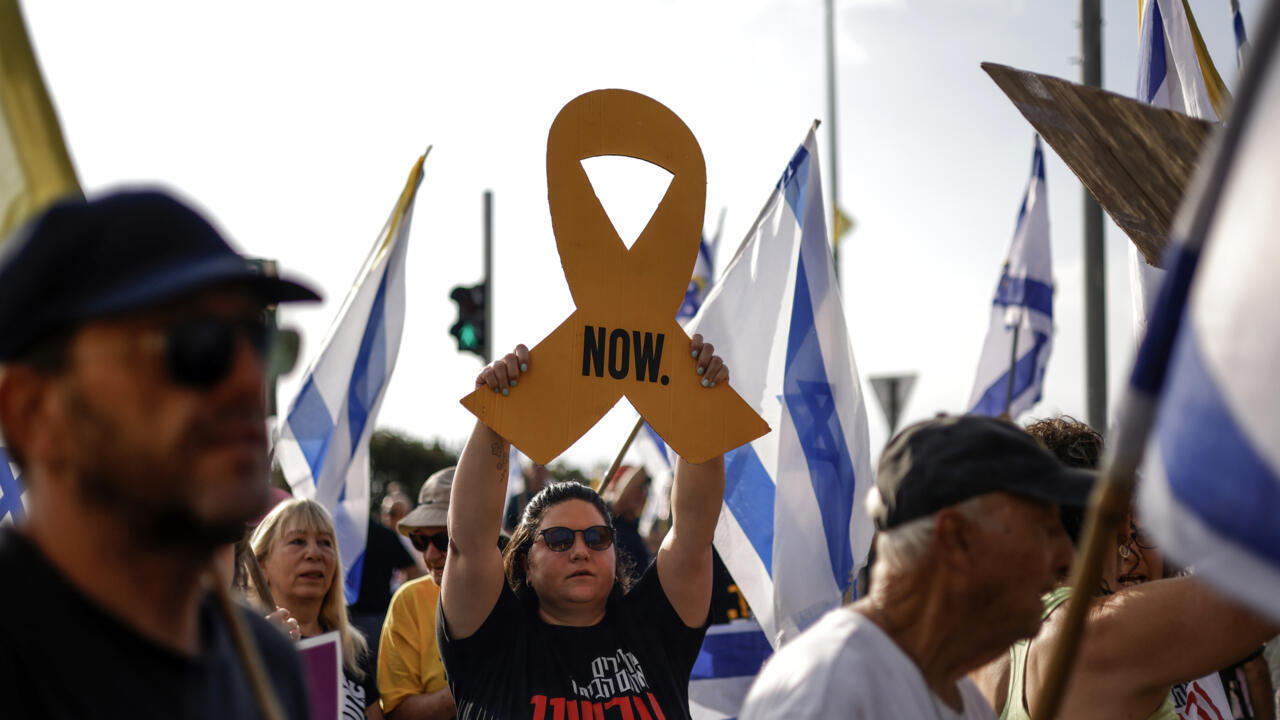
Demonstrators took to the streets across Israel Sunday calling for an end to the war in Gaza and a deal to release hostages still held by militants, as the military prepares a new offensive.

The protests come more than a week after Israel's security cabinet approved plans to capture Gaza City, following 22 months of war that have created dire humanitarian conditions in the Palestinian territory.

The war was triggered by Palestinian militant group Hamas's October 2023 attack on Israel, during which 251 were taken hostage.

Forty-nine captives remain in Gaza, including 27 the Israeli military says are dead.


A huge Israeli flag covered with portraits of the remaining captives was unfurled in Tel Aviv's so-called Hostage Square – which has long been a focal point for protests throughout the war.

Demonstrators also blocked several roads in the city, including the highway connecting Tel Aviv and Jerusalem, where demonstrators set tires on fire and caused traffic jams, according to local media footage.

Protest organisers and the main campaign group representing the families of hostages also called for a general strike on Sunday.

"I think it's time to end the war. It's time to release all of the hostages. And it's time to help Israel recover and move towards a more stable Middle East," said Doron Wilfand, a 54-year-old tour guide, at a rally in Jerusalem.

Prime Minister Benjamin Netanyahu denounced the protesters, saying they were effectively boosting Hamas's position in negotiations.

"Those calling today for an end to the war without the defeat of Hamas not only harden Hamas's position and draw out the release of our hostages, but also ensure that the horrors of October 7 will reoccur," Netanyahu told a cabinet meeting, referring to the 2023 attack that triggered the war, according to a statement from his office.

Other government members who oppose any deal with Hamas also condemned the demonstrations.

Read moreMacron calls for UN-backed Gaza mission, slams Israeli plans as 'permanent war'

Israel's far-right Finance Minister Bezalel Smotrich decried "a perverse and harmful campaign that plays into the hands of Hamas".

He argued that public pressure to secure a deal effectively "buries the hostages in tunnels and seeks to push the State of Israel to surrender to its enemies and jeopardise its security and future".

APTFV footage showed protesters at a rally in Beeri, a kibbutz near the Gaza border that was one of the hardest-hit communities in the Hamas attack, and Israeli media reported protests in numerous locations across the country.

Israeli plans to expand the war into Gaza City and nearby refugee camps have sparked an international outcry as well as domestic opposition.

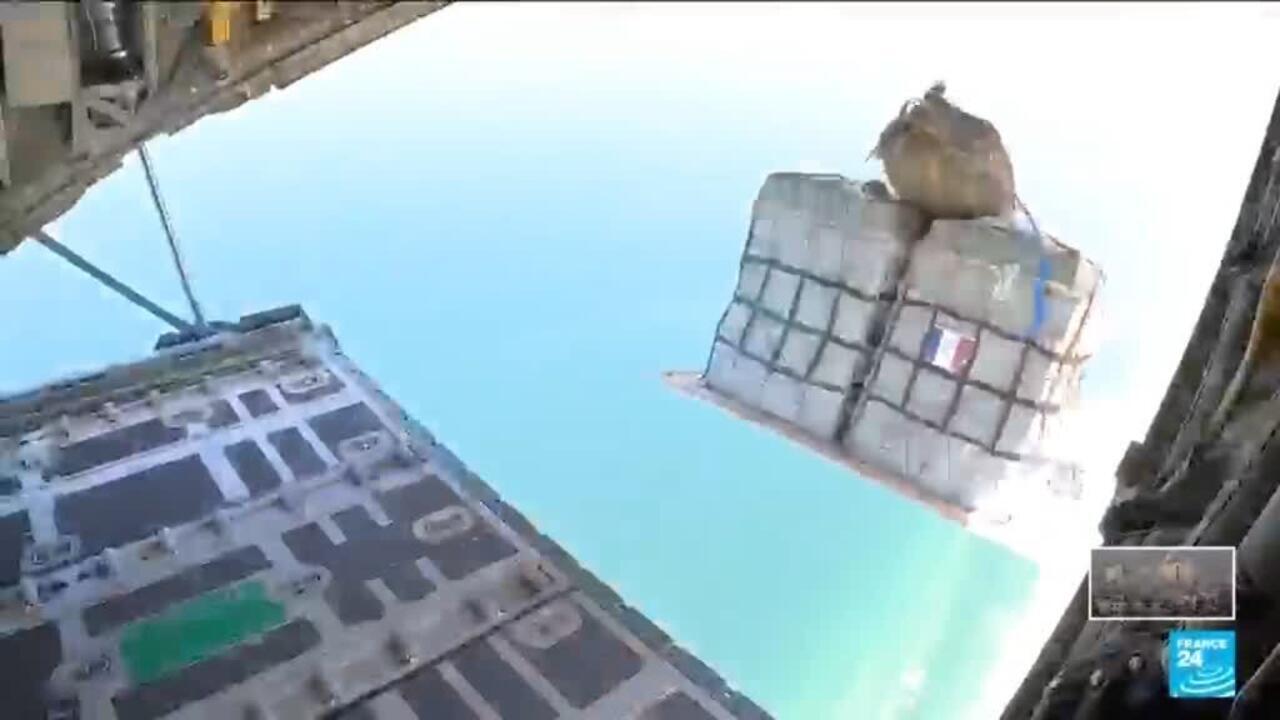
UN-backed experts have warned of widespread famine unfolding in the territory, where Israel has drastically curtailed the amount of humanitarian aid it allows in.

FRANCE 24 report: France carries out airdrops of humanitarian aid into Gaza
© France 24
02:24

According to Gaza's civil defence agency, Israeli troops shot dead at least 13 Palestinians on Saturday as they were waiting to collect food aid near distribution sites.

Hamas's October 2023 attack on Israel resulted in the deaths of 1,219 people, mostly civilians, according to an AFP tally based on official figures.

Israel's offensive has killed more than 61,897 Palestinians, most of them civilians, according to figures from the health ministry in Hamas-run Gaza which the United Nations considers reliable.

(FRANCE 24 with AFP)
Air Canada flight attendants defy back-to-work order, continue strike

The union representing Air Canada's striking flight attendants on Sunday said it will remain on strike and spurn a government return-to-work order that they called unconstitutional. The strike has stranded more than 100,000 passengers across the world during the peak summer travel season.


Issued on: 17/08/2025 - By: FRANCE 24

People protest outside Air Canada headquarters in Montreal, August 17, 2025. © Graham Hughes, The Canadian Press via AP

The union representing 10,000 striking Air Canada flight attendants said Sunday it will defy an order to return to work and continue a strike that has stranded more than 100,000 travelers around the world during the peak summer travel season.

The Canada Industrial Relations Board ordered airline staff back to work by 2 p.m. Sunday after the government intervened and Air Canada said it planned to resume flights Sunday evening.

“Our members are not going back to work,” Canadian Union of Public Employees national president Mark Hancock said outside the Toronto Airport. “We are saying no.”

Hancock said the “whole process has been unfair" and said it will challenge what it called an unconstitutional order.

“Air Canada has really refused to bargain with us and they refused to bargain with us because they knew this government would come in on their white horse and try and save the day,” he said.

The federal government and the airline didn't immediately respond to a request for comment.

The country's largest airline said early Sunday in a release that the first flights will resume later in the day but that it will take several days before its operations return to normal. It said some flights will be canceled over the next seven to 10 days until the schedule is stabilized.

Less than 12 hours after workers walked off the job, Federal Jobs Minister Patty Hajdu ordered the 10,000 flight attendants back to work, saying now is not the time to take risks with the economy and noting the unprecedented tariffs the U.S. has imposed on Canada. Hajdu referred the work stoppage to the Canada Industrial Relations Board.

The airline said the Canada Industrial Relations Board has extended the term of the existing collective agreement until a new one is determined by the arbitrator.

The shutdown of Canada’s largest airline early Saturday was impacting about 130,000 people a day. Air Canada operates around 700 flights per day.

According to numbers from aviation analytics provider Cirium, Air Canada canceled a total of 494 flights on Sunday morning. That's in addition to the hundreds of flights it canceled in the previous days.

The bitter contract fight escalated Friday as the union turned down Air Canada’s prior request to enter into government-directed arbitration, which allows a third-party mediator to decide the terms of a new contract.

Flight attendants walked off the job around 1 a.m. EDT on Saturday. Around the same time, Air Canada said it would begin locking flight attendants out of airports.

Last year, the government forced the country’s two major railroads into arbitration with their labor union during a work stoppage. The union for the rail workers is suing, arguing the government is removing a union’s leverage in negotiations.

The Business Council of Canada had urged the government to impose binding arbitration in this case, too. And the Canadian Chamber of Commerce welcomed the intervention.

Hajdu maintained that her Liberal government is not anti-union, saying it is clear the two sides are at an impasse.

Passengers whose flights are impacted will be eligible to request a full refund on the airline’s website or mobile app, according to Air Canada.

The airline said it would also offer alternative travel options through other Canadian and foreign airlines when possible. Still, it warned that it could not guarantee immediate rebooking because flights on other airlines are already full “due to the summer travel peak.”

Air Canada and CUPE have been in contract talks for about eight months, but they have yet to reach a tentative deal. Both sides have said they remain far apart on the issue of pay and the unpaid work flight attendants do when planes aren’t in the air.

The airline’s latest offer included a 38% increase in total compensation, including benefits and pensions, over four years, that it said “would have made our flight attendants the best compensated in Canada.”

But the union pushed back, saying the proposed 8% raise in the first year didn’t go far enough because of inflation.

(FRANCE 24 with AP)


Air Canada to resume flights after govt directive ends strike

By AFP
August 17, 2025


Air Canada flight attendants walked offer the job over a pay dispute - Copyright AFP Peter POWER

Air Canada said it will resume flying on Sunday after the country’s industrial relations board ordered an end to a strike by 10,000 flight attendants that effectively shut down the airline and snarled summer travel.

The Canada Industrial Relations Board (CIRB) “directed Air Canada to resume airline operations and for all Air Canada and Air Canada Rouge flight attendants to resume their duties by 14:00 EDT on August 17, 2025,” the airline said in a statement.

While it plans to resume flights on Sunday evening, Canada’s flag carrier warned it would take “several days before its operations return to normal.”

Some flights are still set to be cancelled over the next seven to 10 days, it added.

Air Canada cabin crew walked off the job early Saturday over a wage dispute.

Hours later, Canada’s labor policy minister, Patty Hajdu, invoked a legal provision to halt the strike and force both sides into binding arbitration.

“The directive, under section 107 of the Canada Labour Code, and the CIRB’s order, ends the strike at Air Canada that resulted in the suspension of more than 700 flights,” the Montreal-based carrier said.

The Canadian Union of Public Employees (CUPE), which is representing the workers, sought wage increases as well as to address uncompensated ground work, including during the boarding process.

It had previously said its members would remain on strike until the government formally issued an order that they return to work.

It had urged passengers not to go to the airport if they had a ticket for Air Canada or its lower-cost subsidiary Air Canada Rouge.

While it did not immediately issue a response to the back-to-work directive, the CUPE earlier slammed the Canadian government’s intervention as “rewarding Air Canada’s refusal to negotiate fairly by giving them exactly what they wanted.”

“This sets a terrible precedent,” it said.

The union also pointed out that the chairwoman of CIRB, Maryse Tremblay, previously worked as legal counsel for Air Canada.

Tremblay’s ruling on whether to end the strike was “an almost unthinkable display of conflict-of-interest,” the union posted on Facebook.

On Thursday, Air Canada detailed the terms offered to cabin crew, indicating a senior flight attendant would on average make CAN$87,000 ($65,000) by 2027.

CUPE has described Air Canada’s offers as “below inflation (and) below market value.”

In a statement issued before the strike began, the Business Council of Canada warned an Air Canada work stoppage would exacerbate the economic pinch already being felt from US President Donald Trump’s tariffs.

Canada’s flag carrier counts around 130,000 daily passengers and flies directly to 180 cities worldwide.

Canadian government intervenes to end Air Canada flight attendant strike


The Canadian government on Saturday intervened to end a strike by Air Canada flight attendants by asking a labour board to order an arbitration. The strike stranded more than 100,000 passengers across the world during the peak summer holiday season.


Issued on: 16/08/2025 -
By: FRANCE 24

Air Canada flight attendants strike outside Montreal's Trudeau International Airport on August 16, 2025. © Graham Hughes, AP

Canada’s government forced Air Canada and its striking flight attendants back to work and into arbitration Saturday after a work stoppage stranded more than 100,000 travelers around the world during the peak summer travel season.

Federal Jobs Minister Patty Hajdu said now is not the time to take risks with the economy while announcing the intervention. It means the 10,000 flight attendants will return to work soon.

"The talks broke down. It is clear that the parties are not any closer to resolving some of the key issues that remain and they will need help with the arbitrator,” Hajdu said.

Hajdu said the full resumption of services could take days, noting it is up to the Canada Industrial Relations Board.

The shutdown of Canada’s largest airline early Saturday is impacting about 130,000 people a day, and some 25,000 Canadians may be stranded. Air Canada operates around 700 flights per day.

The bitter contract fight between the airline and the union representing 10,000 of its flight attendants escalated Friday as the union turned down the airline’s request to enter into government-directed arbitration, which would eliminate its right to strike and allow a third-party mediator to decide the terms of a new contract.

Keelin Pringnitz, from Ottawa, was returning with her family from a European vacation when they became stranded at London’s Heathrow Airport after flights were canceled. She said there was an option for the travelers in line to go the United States, but they were told there wouldn’t be any further assistance once they landed in the U.S.

“It didn’t go over well with the line. Nobody really seemed interested, everybody seemed a little bit amused almost at the suggestion, or exasperated, because it is a bit ridiculous to offer to take stranded passengers to a different country to strand them there,” she said.

Montreal resident Alex Laroche, 21, and his girlfriend had been saving since Christmas for their European vacation. Now their $8,000 trip with nonrefundable lodging is in doubt. They had a Saturday night flight to Nice, France, booked.

Air Canada Chief Operating Officer Mark Nasr has said it could take up to a week to fully restart operations once a tentative deal is reached.

Flight attendants walked off the job around 1 a.m. EDT on Saturday. Around the same time, Air Canada said it would begin locking flight attendants out of airports.

Ian Lee, associate professor, Carleton University’s Sprott School of Business, earlier noted the government repeatedly intervenes in transportation strikes.

“They will intervene to bring the strike to an end. Why? Because it has happened 45 times from 1950 until now,” Lee said. “It is all because of the incredible dependency of Canadians.”

Canada is the second-largest country in the world and flying is often the only viable option.

“We’re so huge a country and it’s so disruptive when there is a strike of any kind in transportation,” Lee said.

The government forced the country’s two major railroads into arbitration with their labor union last year during a work stoppage. The union for the rail workers is suing, arguing the government is removing a union’s leverage in negotiations.


The Business Council of Canada has urged the government to impose binding arbitration in this case, too.

Passengers whose travel is impacted will be eligible to request a full refund on the airline’s website or mobile app, according to Air Canada.

The airline said it would also offer alternative travel options through other Canadian and foreign airlines when possible. But it warned that it could not guarantee immediate rebooking because flights on other airlines are already full “due to the summer travel peak.”

Laroche said he considered booking new flights with a different carrier, but he said most of them are nearly full and cost more than double the $3,000 they paid for their original tickets.

Laroche said he was initially upset over the union’s decision to go on strike, but that he had a change of heart after reading about the key issues at the center of the contract negotiations, including the issue of wages.

“Their wage is barely livable,” Laroche said.

Air Canada and the Canadian Union of Public Employees have been in contract talks for about eight months, but they have yet to reach a tentative deal.

Both sides say they remain far apart on the issue of pay and the unpaid work flight attendants do when planes aren’t in the air.

“We are heartbroken for our passengers. Nobody wants to see Canadians stranded or anxious about their travel plans but we cannot work for free," said Natasha Stea, a Air Canada flight attendant and local union president.

The attendants are about 70% women. Stea said Air Canada pilots, who are male dominated, received a significant raise last year and questioned whether they are getting fair treatment.

The airline’s latest offer included a 38% increase in total compensation, including benefits and pensions over four years, that it said “would have made our flight attendants the best compensated in Canada.”

But the union pushed back, saying the proposed 8% raise in the first year didn’t go far enough because of inflation.

“We’re the national carrier and we have people operating in poverty. Like that’s disgusting, that's very problematic,” Wesley Lesosky, President of the Air Canada Component of CUPE, said at a news conference.

(FRANCE 24 with AP)

EU

Mind the skills gap: Older workers falling behind in training

Updating skills in the labour market is crucial. However, older workers are falling behind in training.
Copyright Copyright 2009 AP. All rights reserved.


By Servet Yanatma
Published on 

Older workers are falling behind in training. The OECD says a stronger focus on boosting their skills is crucial for the labour market.

Working life and skills are changing fast. Some jobs are booming, others are disappearing, says the World Economic Forum’s Future of Jobs Report 2025. The OECD warns: “There is an urgent need to boost the skills of older workers.”

However, older workers (55–65 year-olds) take part in non-formal learning and training much less than those aged 25–54 year-olds, the OECD finds. On average, the rate is 32% versus 49% in 23 European countries, though the gap differs across countries.

Where do older people learn the most—and the least? What do experts and the OECD recommend?

When do we stop learning?

According to the OECD Employment Outlook 2025 report, participation in formal and non-formal adult learning declines with age. In 2023, only a third of 60–65 year-olds took part in adult learning in the 12 months before the survey, compared with more than half of 25–44 year-olds. The averages cover 29 countries, 22 of which are in Europe.

The share of the population participating in adult learning is over 60% among 25–29 year-olds, but drops to 39% for those aged 55–59 and to 31% for those aged 60–65. This share starts to decline clearly after the age of 45.

Non-formal training was far more common than formal learning (training leading to a qualification) across all age groups. This was especially true for older individuals, with only 1% of 60–65 year-olds participating in formal learning.

Learning by doing also decreases with age. 

Why do older people take part in learning less?

Lower participation in non-formal learning among older individuals may be due to less willingness to train or other barriers, such as time constraints or course costs. 

According to the report, a lower willingness to train is likely a key factor. The share of people who wanted to participate in training—whether or not they actually did—falls from about 60% among 25–44 year-olds to 37% among those aged 60–65.

A similar pattern appears in the share of people who participated in less training than they wanted, which drops from 28% among 25–34 year-olds to 17% among those aged 55–65.

The report shows that time constraints are less of a barrier to training for older people than for younger groups. Among 55–65-year-olds, 7% took part in less training than they wanted due to time constraints—5% citing work-related reasons and 2% family reasons.

In contrast, 15% of 35–44 year-olds reported time constraints as a barrier, with 8% pointing to work and 7% to family responsibilities.

Large differences across European countries

In every OECD country, including all European ones in the list, older individuals (55–65 year-olds) take part in non-formal learning less than the prime-age group (25–54 year-olds). However, both their participation rates and the size of the age gap vary greatly.

The highest participation in non-formal training among 55–65 year-olds is seen in the Nordic countries—Norway, Finland, and Denmark—at around 50%. Sweden ranks fifth with 43%.

The European average (22 countries) is 31.7%, compared with 34.9% across the OECD (29 countries).

The lowest participation in non-formal training for this age group was in Poland, Slovakia, and Hungary, all below 18%.

Outside the Nordic countries, England has the highest participation at 43.5%, followed by the Netherlands (41.7%) and Ireland (40.9%). 

Among Europe’s five largest economies, Italy has the lowest participation at 18.5%, followed by France at 21.7%. Germany stands at 34.9%, slightly above the average.

The participation gap between 25–54-year-olds and 55–65-year-olds is widest in Portugal at 24.7 percentage points (pp) and smallest in Italy at 8.9 pp. However, this does not mean older people are doing better in Italy, as their participation rate is the fourth lowest in Europe.

Is this a surprise? Not at all

One reason older people are less likely to engage in training—and employers are less likely to fund it—is the lower expected return on such investment due to shorter remaining working lives, the report notes. This is no surprise in economic theory. 

According to ManpowerGroup, 75% of employers in 21 European countries were unable to find workers with the right skills in 2023.

“Continuous learning is essential”

Pawel Adrjan, Director of Economic Research at Indeed, told Euronews Business that continuous learning is essential in a fast-evolving market. As with previous technological innovations, professionals who proactively learn new tools, platforms, and methodologies will be better positioned to work efficiently with emerging technologies.

The OECD noted that higher employment rates among older workers can help employers preserve valuable knowledge and skills while boosting productivity.

“There is an urgent need to boost the skills of older workers and promote their participation in well-targeted training,” the organisation recommends. 

How can governments respond?

OECD offers four main actions that the governments can do. They included:

  • Focus on boosting skills of older workers

  • Address barriers to job-to-job mobility

  • Confront ageism and other forms of discrimination

  • Revive productivity growth, including through AI and automation

Across the EU, people are living longer than in past decades. Many countries have responded by raising the retirement age, keeping people in the workforce for more years.

Fire at Russian industrial plant kills 11 people and leaves 130 injured


Copyright Russian Emergency Ministry Press Service via AP
By Euronews with AP

Published on 16/08/2025 -

Local authorities in the Ryazan region declared a day of mourning on Monday.

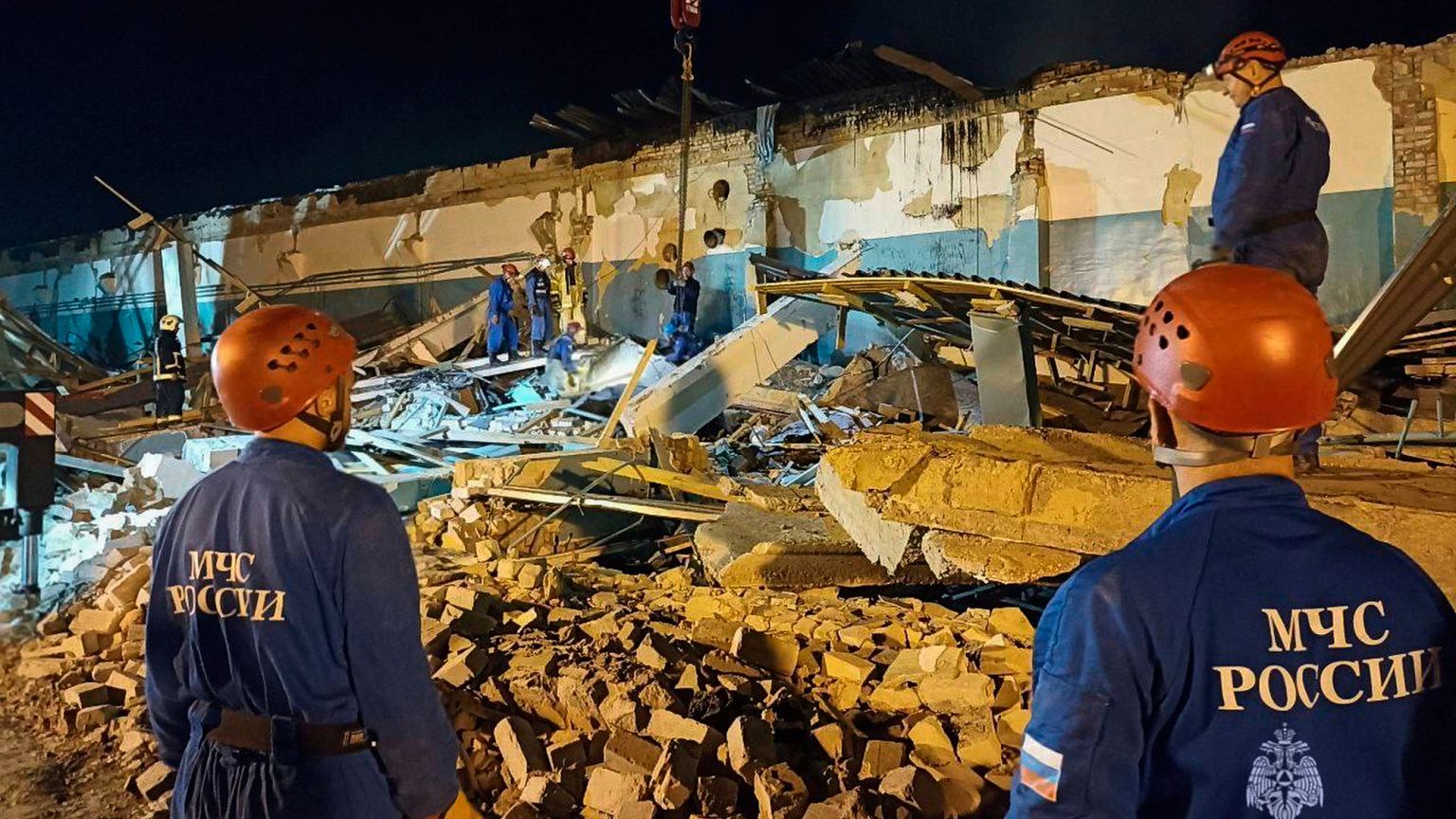
A fire at an industrial plant in Russia’s Ryazan region on Friday killed 11 people and injured 130, Russian officials said on Saturday.

The blaze broke out at the Elastik plant in the Shilovsky District, around 250 kilometres southeast of Moscow. Emergency crews continued to search through debris into the weekend, and two additional bodies were recovered overnight, the Russian Emergencies Ministry said.

According to the Russian state news agency RIA Novosti, a gunpowder workshop at the facility caught fire and triggered the blast.

Of the injured, 29 remained hospitalised on Saturday — 13 in Ryazan and 16 transported to medical centres in Moscow, officials said.

Regional authorities said three people were rescued from under the rubble overnight as investigators launched a preliminary probe into the cause of the fire.

Local authorities declared a day of mourning in the Ryazan region on Monday.

“Flags will be lowered across the region. Cultural institutions, television and radio companies and organizations have been asked to cancel entertainment events,” Ryazan Governor Pavel Malkov said in a statement on Telegram.

It was the second deadly explosion at the Elastik plant in less than four years. In October 2021, according to the Russian state news agency Interfax, 17 people were killed in a blast at a workshop operated by explosives manufacturer Razryad.
Cleaner kitchens, healthier lives: Ghana’s cookstove revolution gains ground

Accra – Ghana is stepping up efforts to move households away from firewood and charcoal, which are still used in 78 percent of homes and contribute to deforestation, indoor air pollution and carbon emissions. The government is promoting cleaner cookstoves as a safer, more efficient alternative.


Issued on: 10/08/2025 - 

Grace Ofori cooking on the Envirofit stove at Fumesua in the Ashanti region of Ghana. 
© Ghana Carbon Market Office

By:  Michael Sarpong Mfum in Ghana

The Clean Cookstove Initiative is focused on cutting wood fuel demand and reducing the health risks linked to smoke inhalation – particularly among women and children. It also aims to help curb climate change and protect forests.

The programme is targeting smallholder farmers and rural households in five regions: Western, Central, Ashanti, Eastern and Upper West. There are plans to extend it to more parts of the country.

The stoves are designed to use around 60 percent less wood than traditional models. They are being developed and distributed in partnership with Envirofit International, a US-based clean energy company.

The project is one of six climate mitigation schemes in Ghana backed by the KliK Foundation, a Swiss organisation that has pledged about $850 million in funding.

Cleaner cooking could save 4.7 million lives in Africa by 2040, IEA says


Community impact

So far, more than 180,000 families have taken part in the programme. Many have reported saving money on fuel and noticing fewer health problems linked to smoke.

Aminatu Hakim, a mother of six from Pullima near Tumu, in the Upper West Region, says the savings she has made from using the new stove have allowed her to reinvest in her small business.

"I’ve invested the savings in my onion business," she told RFI. "The proceeds are now supporting my family’s daily needs."

She described the clean cookstove as fast, efficient and significantly less reliant on charcoal than traditional cooking methods.

Ghana unveils West Africa's largest floating solar project, boosting renewable energy ambitions

Dr Daniel Tutu Benefoh, head of Ghana’s Carbon Market Office, said the cleaner cookstoves would ease pressure on household budgets and improve public health. “The technology reduces smoke and toxic emissions in individual households by as much as 80 percent,” he said.

The government plans to distribute another 500,000 clean cookstoves over the next three years, with a continued focus on rural and underserved areas.

Across Africa, around four in five people still cook with polluting fuels such as firewood, charcoal and kerosene – often over open flames in poorly ventilated spaces.

The World Bank estimates that this leads to around 600,000 premature deaths each year, making dirty cooking a bigger killer on the continent than malaria.

Serbia’s student-led protesters wanted accountability. Now they’re calling for elections

Interview


After more than nine months of largely peaceful anti-corruption protests, Serbia’s streets have erupted in clashes between riot police, student-led demonstrators and masked bands of ruling party loyalists. FRANCE 24 spoke with Nebojša Vladisavljević, a professor in Serbian politics at the University of Belgrade, about how the protest movement has changed over months of struggle.

Issued on: 15/08/2025 - 
FRANCE24
By: Paul MILLAR

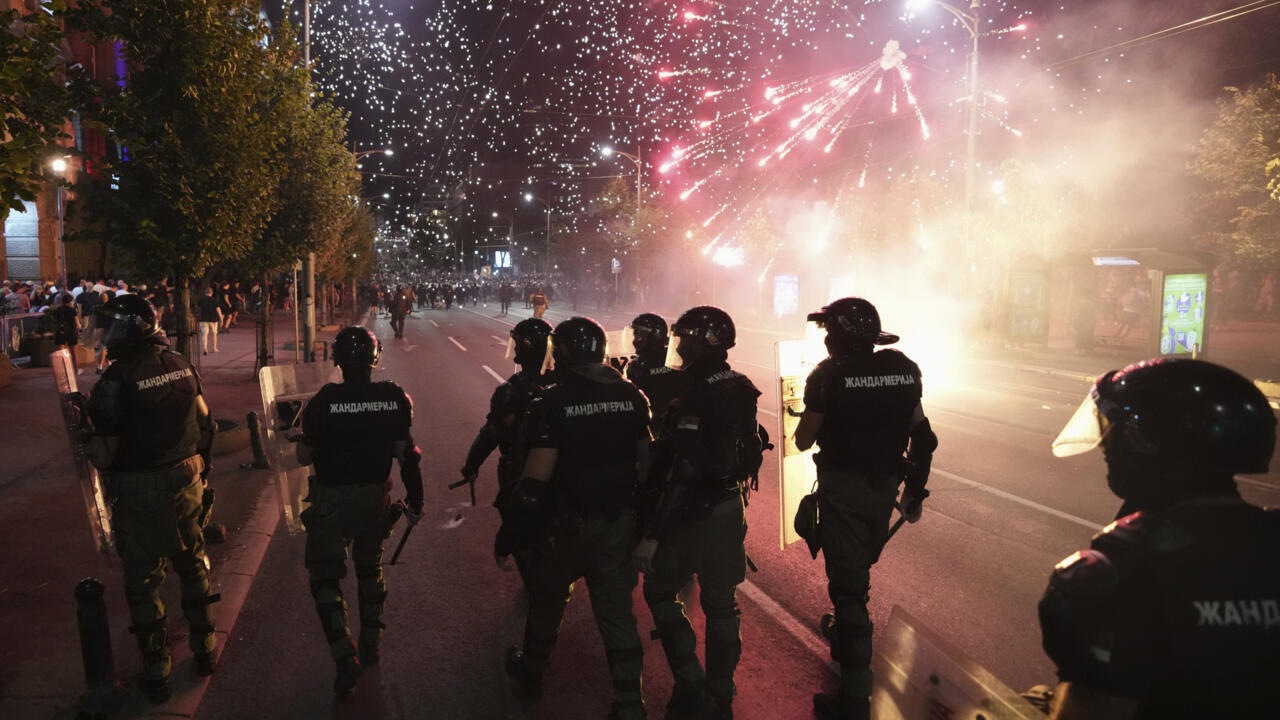
Serbian gendarmerie officers guard street during an anti-government protest near Serbian Progressive Party office in Belgrade, Serbia, Thursday, August 14, 2025. © Darko Vojinovic, AP

For the past three nights, Serbia’s streets have been shaken by fierce clashes between thousands of anti-government protesters and ranks of masked ruling party loyalists.

The student-led demonstrators have accused the ruling Serbian Progressive Party (SNS)’s supporters of hurling flares, fireworks, rocks and glass bottles at them, triggering street skirmishes that ended with riot police driving the anti-government protesters off with tear gas and batons.

Dozens of people have been injured and scores more arrested.

President Alexandar Vučić, who began his political career in the far-right Serbian Radical Party before becoming a proponent of European Union membership, has promised that more arrests will soon follow. Vučić has accused the demonstrations, without evidence, of being plotted from abroad by unidentified foreign powers.

Read more Why has the EU kept silent on Serbia’s massive protest movement?

The clashes mark a serious escalation in what has been more than nine months of largely peaceful protests and waves of civil disobedience.

The demonstrations erupted in November following the fatal collapse of a concrete canopy in a recently renovated railway station that killed 16 people in Serbia’s second city of Novi Sad – an accident that protesters, who have taken a blood-red handprint as their symbol, blame on cronyism and graft within Serbia’s government and construction industry.

Since then, a student-led movement of hundreds of thousands of Serbians have held mass demonstrations, occupied university campuses and blockaded the Balkan country’s roads to protest what they describe as rampant government corruption.

FRANCE 24 spoke with University of Belgrade Serbian Politics professor Nebojša Vladisavljević about how the mass protests have changed over the course of a struggle that how now lasted more than nine months.
FRANCE 24: How have the mass demonstrations evolved in recent months, and why have their demands expanded?

In the first few months, the demands of the protesters focused on the legal and political responsibility of those responsible for the deaths of 16 people in Novi Sad – meaning those involved in the renovation of the railway station, but also their political bosses. So the focus was on the judiciary, the prosecution service to initiate legal proceedings against these guys. But obviously that didn't work out, despite massive protests.

These are unprecedented protests in this region, and probably even more broadly in Europe in the last few decades. The country is about 6 million people and you had literally hundreds of thousands of people protesting for months. Only in Belgrade, you had four protests in several months, each larger than a hundred thousand people. And Belgrade is a city of a million and a half. And one of these protests in mid-March was about 300,000 people, which is four to five percent of the population of the country as a whole, so it's massive.

Tens of thousands of protesters rally against populist Serbian government
Protesters demanding early elections clash with police in Belgrade on June 28, 2025. 
© OLIVER BUNIC / AFP
01:42


The government and the judiciary essentially ignored their demands for accountability. Even after several months, these proceedings that the prosecutors initiated, they were not confirmed by the courts. That obviously told people that nothing will happen.

That's why demands were shifted to the political stage for early parliamentary elections, because it was obvious that under this government, nothing much would happen when it came to these initial demands.

You had very peaceful protests for eight months. And in late June, there was this fourth protest in Belgrade, which was above 100,000 people, and then the police for the first time actually used massive force against peaceful protesters – and that was after the protest, when people were already dispersing. This is a major escalation because prior to late June, essentially the government and the security forces were sitting out protests – they waited for protests to subside exactly in the same way as they did in previous years, because we had several waves of protests in the last few years.

But this time they actually changed strategy and used massive force and detained hundreds of people, most young people, across the country, which then radicalised protests in the following weeks. Earlier, you would have rallies or marches or short blockades of roads these were commemorative road blockades for 16 minutes, for the 16 people killed in Novi Sad. But now, after the use of force by the police, you had road blockades for hours.

And protesters were avoiding contact with the police – whenever the police would come, they would go to another street and then block another street.

In the last few days, we've seen another escalation, which is by the use of the ruling party’s hired gangs, who pose as supporters of the ruling party. You recognise them by kind of being uniformly dressed – they’re in civilian clothes, but you see that they all have black t-shirts, black short pants, black baseball caps, some are hooded – and they go together, some carrying sticks, to guard offices of the ruling party across the country and provoke protesters so that the police would then beat them up. And that's what we've seen in the last few days.
To what extent do this week’s confrontations mark a change in the scale of the mobilisation of these kinds of extra-legal security forces?

It’s the question of scale, essentially. They’ve used these guys often in previous years, but always kind of trying to do it when nobody sees what's going on – so they were used to beat up people here and there on behalf of the ruling party to put pressure on all sorts of people, even their own party members who wouldn't toe the party line, but especially against government critics. But again, not in public, really, and they were rarely uniformly dressed as they are now. So now, they are obvious to everybody.

What we see these days is that they are working closely with the police – in some cases, police are even getting orders from some of them, which is something that we haven't seen before, and we even see some people with criminal records among them. One of the more famous ones is Djordje Prelić, who was convicted for the murder of Brice Taton, the French football supporter who died in Belgrade in 2009, essentially murdered by local thugs. So one of those guys was seen among these titushky in the last few days [Editor’s note: A term for mercenary agent provocateurs, often dressed as football hooligans, that was popularised under former Ukrainian president Viktor Yanukovich].

Read more 'It is time for justice': Serbian students lead the fight against corruption

They try to present this now as some sort of counter-mobilisation of supporters of Vučić, but actually, it's not. It just hired gangs. Just a few years ago, the ruling party had the capacity to mobilise quite a few people in support of Vučić and the ruling party. We had several waves of opposition protests in the last few years, and in 2019 the ruling party held a counter rally in Belgrade, which actually mobilised about 60,000 people. It was a very large protest that rivalled the opposition protests.

This year, they tried to do this on several occasions, but actually mobilised very few people – only those who actually had to be there, party officials, public sector workers, some temporary contracts, people on social benefits who are afraid that they will lose some if they don't come. Now they can't even mobilise anybody to come to defend them. That's why they are now using these hired gangs, obviously, because they can’t mobilise anybody else.
To what extent is Vučić’s government trying to actively defuse some of these calls for accountability and responsibility rather than merely meeting the protests with naked force?

When it comes to the rhetoric, he's being doing it throughout, trying to pose as if he were doing something to achieve accountability when it comes to what happened in Novi Sad. But actually, they've done nothing much when it comes to this. In late July two former ministers and a few other people, they were arrested for serious charges. Not for small things, but for fraud of over $100 million when it comes to this fast railway from Belgrade to Subotica.


Serbia targets journalists in crackdown on independent media

© France 24
01:46


It’s still unclear where it came from – having in mind how the Vučić press and tabloid media attacked those prosecutors who initiated this, it seems that he's losing control over the prosecution service and the judiciary. He obviously has some guys firmly under control. Vucic and his loyalists at the top of the government have been quite nervous when these arrests happened. So it seems that he's losing control within the judiciary at this point. But again, it is really unclear whether this will end up in convictions.
How do you explain Vučić’s reticence to call early elections that his coalition might be able to use to bolster its legitimacy in the face of these protests?

The trouble that they face at this point is that their popularity fell substantially in the last few months. It’s true that initially many people who were actually government critics and from the opposition didn't want to raise the question of snap elections for several reasons. Firstly, because they felt that this would move attention away from what happened in Novi Sad and from the accountability issue – and that was the stance for most people. But also because they felt that Vučić was still at that point popular and the opposition wouldn't be able to gain much in elections.

But that was early this year. In the meantime, things have changed … There was a credible opinion poll done by two of my colleagues, professors from the faculty of political science at the University of Belgrade. They did a large poll: the government at this point has fewer supporters than the opposition. So it's about 40, 41 percent for the whole ruling coalition and over 50 percent for the opposition.

Now, obviously, we still don't know if we had a snap election whether there will be one opposition list or two or three. But they were assessing all of these possibilities, and whichever possibility you take, whether it's one opposition list or two or three – the opposition wins. The poll was done about a month ago. So, there is a good reason why Vučić avoids early elections at this point – because it seems according to the polls that he would lose even an unfair election, even an authoritarian election. That's why he's trying to kind of postpone this.

But my guess is we will have an election in the next few months. Because the country is totally blocked. Nothing works. You can't do anything – the government has lost the capacity to rule, essentially. The only way out is by elections.

This interview has been edited for length and clarity.
Tunisia's labour union UGTT calls for protest amid crackdown threats

Tunisia's powerful labour union, long seen as a cornerstone of the country's fragile democracy, called for a major march in downtown of the Tunisian capital of Tunis on Thursday to retaliate against mounting pressure from President Kais Saied and his supporters.


Issued on: 16/08/2025 - 12:37
3 minReading time

By: FRANCE 24


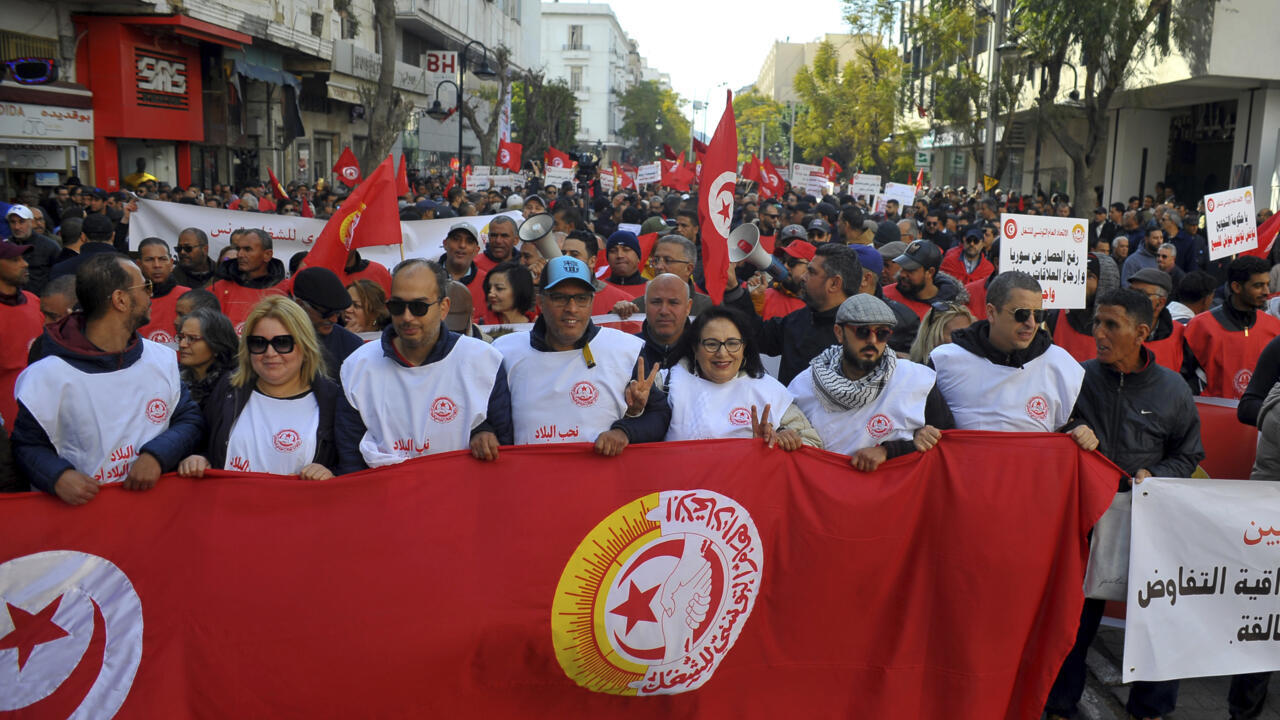
Members of the Tunisian General Labor Union (UGTT) take part in a protest against president Kais Saied policies, in Tunis on March 4, 2023. © Hassene Dridi, AP

Tunisia's powerful labour union UGTT has called for a major march in downtown Tunis on Thursday to "defend the union and its values" amid rising tensions with the country's president Kais Saied.

The Tunisian General Labour Union (UGTT) – part of the Nobel Peace Prize-winning "national dialogue quartet" in 2015 – remains one of the few influential counterweights to Saied, whose critics have largely been jailed since his 2021 power grab.

In recent weeks, the UGTT says it has come under pressure.

Earlier this month, the union said a group of Saied supporters tried to storm its Tunis headquarters after videos showed several dozen people gathered outside denouncing "corruption" and "squandering the people's money".

Once a beacon of hope, Tunisia's civil society struggles to survive
© France 24
01:55


The following night, Saied said he shared the demonstrators' grievances, insisting they had not intended violence, contrary to claims by the union and rights groups, and called for union accountability.

"There are files that must be opened because the people are demanding accountability... so that their money can be returned to them," Saied said in a video posted on the presidency's official Facebook page.

"There will be no immunity for anyone who violates the law, and the law applies to everyone."

'Intimidation'

The small gathering near the UGTT followed a three-day nationwide strike organised by the union last month, which angered the president.

The Tunisian League for Human Rights called the protest "an attempt to dry up free expression and weaken civic space through intimidation, defamation and distortion".

Bassam Khawaja, deputy Middle East and North Africa director at Human Rights Watch, described Saied's rift with the union as "a new attack" on the institutions he seeks to dismantle.

"After attacking political parties and associations, the authorities now seem to have the labour movement -- one of Tunisia's last democratic pillars -- in their sights," said Khawaja.

Historian Abdelatif Hannachi said the confrontation reflects Saied's "mistrust of intermediary bodies and civil society groups", warning both sides may struggle to control their reactions if the conflict escalates.

The UGTT has vowed not to be silenced and called for a major march in downtown Tunis on Thursday to "defend the union and its values".

Its chief, Noureddine Taboubi, said the union's "voice is strong" and urged anyone with corruption claims to "go to court".

The government later banned "full-time union activities" among government workers without special permits.

Frustrations with the union

Founded in 1946, the UGTT played a leading role against French colonial rule and later resisted autocratic presidents Habib Bourguiba and Zine El Abidine Ben Ali.

It was also central to the 2011 revolution that toppled Ben Ali and ignited protests across the Arab world.

With more than 700,000 members, the union still commands strong mobilising power. But some see Saied as tapping into public frustration with repeated strikes in transport and phosphate production -- key sectors in the country of 12 million.

Many, including Saied, view the strikes as a major drag on Tunisia's ailing economy.

Amid economic strain, many Tunisians decry a rollback in freedoms just a decade after the country's brief democratic period.

Since 2022, dozens of opposition figures, lawyers, journalists and human rights defenders have been jailed on charges ranging from plotting against the state to spreading "false news".

Saied maintains that rights remain guaranteed by the constitution and that he does not interfere with the judiciary.

Human Rights Watch has urged the authorities to "end their intimidation and respect the right to freedom of association".

Thursday's march will test whether the UGTT can mobilise support, particularly after recent protests saw lower turnouts.

The union has warned it may call a nationwide general strike if talks with the presidency fail.

(FRANCE 24 with AFP)