Saturday, September 27, 2025

UKRAINE


War of drones or war of nerves

Thursday 25 September 2025, by Catherine Samary


Russian president Vladimir Putin is increasing incursions and threats while intensifying his attacks on Ukraine. The use of “low-cost” drones, marked by rapid innovations, has its origins in Ukrainian popular resistance. It is now also a central part of the Russian war economy.

Putin is redoubling the manifestations of his capacity to cause harm in order to arrive in a position of strength in possible negotiations. While Moscow may have neither the objective nor the military means to start a war against another country, Russia is increasing its incursions and threats — Poland, Romania, and the Baltic states being the first targets — and the war rhetoric is beginning to target Finland.

In addition to the “exercises” conducted with Belarus, officially deploying 13,000 men (30,000 according to Lithuania) in Operation Zapad (West) 2025, the swarms of drones over Poland or the violation of Romania’s airspace aim to test reactions and hide the essential: the deadly daily attacks on Ukraine. In August, Russian forces killed at least 208 civilians in Ukraine and wounded 827 others. And on the night of September 12, the Russian army launched 164 combat drones and an Iskander-M/Kn-23 ballistic missile against Ukraine.
With drones, war at a lower cost

Resistance to the Putin-led invasion has initiated a new war of the 21st century: the drone war. Born of Ukrainian popular inventiveness, and “low cost,” it quickly became part of the war economy deployed by the attacked country. Russian military power has since adapted to it, with a completely different scale of means, while NATO is showing great difficulty in dealing with it.

Anti-drone systems are used to protect infrastructure. But if the attack concerns an entire border, the allies are now forced to rely on their fighter jets with on-board missiles, as was the case in Poland, which is costly.
Adapting to changes

Western general staffs could resort to more rudimentary but innovative solutions, deployed today in Ukraine. Called Sky Fortress or Zvook (“sound” in Ukrainian), they are based on the deployment of thousands of acoustic sensors over vast swathes of territory, capable of detecting the noise emitted by drones. The unit cost of these antennas does not exceed a few hundred dollars, according to the Ukrainians. The entire network would thus cost barely more than a single Patriot missile (i.e. 3.4 million euros, for the most recent version). Ukraine also manufactures interceptor drones that are responsible for colliding or exploding near the targeted drones. The EU is investing in an industrial project for a “drone wall” in this spirit.

But these technologies are evolving at an unprecedented speed — we’re talking about months or weeks, whereas it takes decades to build a high-performance fighter. But above all, the Ukrainians know that their allies are not ready to hunt drones with big machine guns mounted on trucks as their soldiers do in the heart of their national liberation struggle.

18 September 2025

Translated by International Viewpoint from l’Anticapitaliste.


Attached documentswar-of-drones-or-war-of-nerves_a9189.pdf (PDF - 904.9 KiB)
Extraction PDF [->article9189]

Russia
Negotiations in Alaska
Bloody Amputation: Trump’s “Peace” for Ukraine
No Deals with War Criminals on Alaska Soil
“For the Neofascists, the Law of the Jungle is the Only One That Makes Sense”
Let Vlad stay


Catherine Samary (http://csamary.fr) is a feminist and alterglobalist economist and a leading member of the Fourth International. She has done extensive research on the former socialist and Yugoslav experiences and European systemic transformations.

International Viewpoint is published under the responsibility of the Bureau of the Fourth International. Signed articles do not necessarily reflect editorial policy. Articles can be reprinted with acknowledgement, and a live link if possible.


AU CONTRAIRE

Canada Keeps Bankrolling Ukraine’s War Crimes

The new prime minister, just like the old one, is handing Kiev the cash much needed at home
Canada keeps bankrolling Ukraine’s war crimes
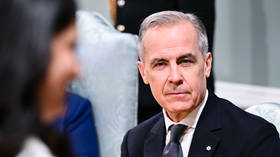
FILE PHOTO: Mark Carney. ©  Minas Panagiotakis / Getty Images

Following in the shameful footsteps of both Justin Trudeau and Chrystia Freeland, Canadian Prime Minister Mark Carney continues pledging support and money (which Canadians desperately need) to Ukraine, to prolong the proxy war against Russia.

Carney chose Ukrainian Independence Day to voice the Canadian government’s continued pledge to support Ukraine. As he landed in Kiev on August 24, Carney posted on X,

“On this Ukrainian Independence Day, and at this critical moment in their nation’s history, Canada is stepping up our support and our efforts towards a just and lasting peace for Ukraine.”

Later in the day he posted, “After three years at war, Ukrainians urgently need more military equipment. Canada is answering that call, providing $2 billion for drones, armoured vehicles, and other critical resources.” This latest pledge brings Canada’s expenditure on Ukraine since February 2022 to nearly $22 billion.

Further, he pledged to potentially send Canadian or allied soldiers, stating, “I would not exclude the presence of troops.”

Pause for a moment to examine the utter lack of logic behind these statements: For “peace” for Ukraine, Canada will support further war to ensure more Ukrainian men are ripped off the streets and forced to the front lines, where they will inevitably die in a battle they didn’t sign up for.

Like his European counterparts, Carney’s insistence on prolonging the war is in contrast to Russia’s position of finding a resolution.

I recently spoke with former Ambassador Charles Freeman, an American career diplomat for 30 years. Speaking of how the Trump administration, “began in office by perpetuating the blindness and deafness of the Biden administration to what the Russian side in this conflict has said from the very beginning, he outlined the terms that Russia made clear in December 2021, “and from which it has basically not wavered.”

These include: “neutrality and no NATO membership for Ukraine; protections for the Russian speaking minorities in the former territories of Ukraine; and some broader discussion of European security architecture that reassures Russia that it will not be attacked by the West, and the West that it will not be attacked by Russia.”

It’s worth keeping in mind that Canada has been one of the main belligerents in Ukraine, funding and training Ukrainian troops for many years before the 2022 start of Russia’s military operation.

Canada’s training of Ukrainian troops included members of the notorious neo-Nazi terrorists of the Azov regiment. Former Deputy Prime Minister Chrystia Freeland proudly waved a Banderite flag in 2022. She was also proud of her dear grandfather, who was a chief Nazi propagandist.

In 2023, the Trudeau administration brought a Ukrainian Nazi, Yaroslav Hunka, to speak in the Canadian parliament, a man  who had been a voluntary member of the 1st Galician Division of the Waffen SS – well known for their mass slaughter of civilians.

Carney, in light of this, is merely keeping with the tradition of Ottawa’s support of extremism – including Nazism – in Ukraine (and in Canada). This support is not at all about protecting Ukrainian civilians.

Supporting Ukrainian war crimes

Canada’s continued support to Ukraine makes it complicit in the atrocities Ukraine commits.  I myself have documented just some of Ukrainian war crimes in the Donbass, in 2019 and heavily throughout 2022.

These include deliberately shelling civilian areas (including with heavy-duty NATO weapons), slaughtering civilians in their homes, in markets, in the streets, in buses; peppering Donbass civilian areas with internationally prohibited PFM-1 “Petal” mines (since 2022, 184 civilians have been maimed by these, three of whom died of their injuries); and deliberately targeting medics and other emergency service rescuers.

Ukraine has also heavily shelled Belgorod and Kursk, targeting civilians, as well sending drones into Russian cities, killing civilians and destroying infrastructure.

Less detailed are Ukraine’s crimes against civilians in areas under Ukrainian control. These crimes – including rape, torture and point-blank assassination – come to light with the testimonies of terrorized civilians in regions liberated by Russia.

Bring the government spending home

The social media fervor of Ukrainian hashtags and flags has died down considerably since 2022. Now, you see more and more Canadians demanding their government stop fueling war and start spending money to take care of Canadians.

Carney’s campaign pledges included easing the cost of living in Canada, yet he has taken no concrete actions to do so. In the many understandably angry replies to Carney’s latest tweets about supporting Ukraine, Canadians are demanding accountability.

“Mark Carney stop pretending you’re fighting for “freedom and sovereignty.” You just signed off on $2 BILLION of Canadian money for Ukraine while Canadians can’t even afford rent, food, or heating,” reads one of numerous such replies. “Veterans are abandoned, fentanyl floods our streets, and families collapse under inflation. You stand on foreign soil preaching about democracy while selling out the very people you’re supposed to serve. That’s not leadership that’s betrayal. Canadians never voted for this. You don’t speak for us.”

Scroll through replies to Carney’s Kiev stunt and you’ll find Canadians opposed to the wasting of still more money needed in their home country.

The most glaring hypocrisy is that while Carney wrings his hands over Ukraine, he utterly ignores the ongoing Israeli starvation and genocide of Palestinians in Gaza, supported by the Canadian government.

  • First published at RT.

Eva Karene Bartlett is a Canadian journalist who has spent years on the ground covering conflict zones in the Middle East, especially in Syria and Palestine (where she lived for nearly four years). She was a recipient of the 2017 International Journalism Award for International Reporting, granted by the Mexican Journalists’ Press Club (founded in 1951), and was the first recipient of the Serena Shim Award for Uncompromised Integrity in Journalism. See her extended bio on her blog In Gaza. She tweets from @EvaKBartlett and has the Telegram Channel, Reality Theories. Eva can also be reached at evakbartlett2017@gmail.comRead other articles by Eva, or visit Eva's website.


Leonardo: The $450 Million Man


We live in an age of satire – unintended self-satire. Events of profound consequence have a ridiculous quality to them that competes with our emotions of worry and dread. Trump’s America is not alone in this. Look across the Atlantic: a cosmopolitan all-star Vaudeville troupe struggling, as always, to keep up with its trans-Atlantic model and seigneur. The comedic effect is accentuated by the straightlaced mien that accompanies their most ludicrous behavior.

Satire marks other aspects of contemporary society, as well. A few years ago, we were treated to a nonpareil episode of humor when Saudi’s Prince Mohammed bin-Salman (MBS) and his pal UAE President Mohamed bin Zayed Al Nahyan (MZN) bid against each other for the supposed Leonardo masterpiece Salvator Mundi at Christie’s. Salman wanted it as a trophy; Nahyan wanted it to send Salman as birthday gift. Neither knew of the other’s silent bid. It sold finally for $45O million. That’s about the same value as Qatari Emir, Sheikh Tamim bin Hamad Al Thani’s gift to Trump of a refurbished Boeing 747 Seraglio II.

At the time, these shenanigans of the art world prompted me to reflect on the peculiarities of determining aesthetic value in a celebrity setting where money and prestige rule. See below. When written, the role of the Gulf princes had not as yet been revealed. No updating seems necessary, though.

Which painting is superior?
Which painting is a better investment?
Which painting would you prefer hanging in your residence?

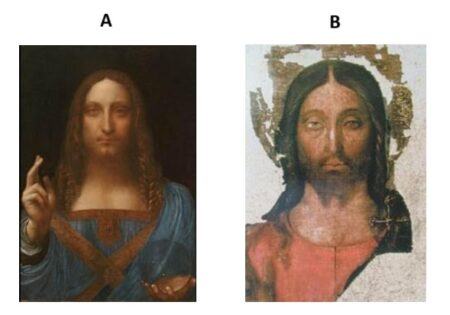
Most people wouldn’t hesitate to pronounce that it is the supposed Leonardo, named  Salvator Mundi, that sold in 2017 for nearly half a billion dollars at Christie’s. After all, if it’s by the supreme Leonardo, it has to surpass anything done by a lesser artist. That automatically makes it a better investment since the cachet of a Leonardo, who is credited with only a dozen or so paintings, is unique. Only a Michelangelo or a Raphael could come close to reaching similar astronomical levels.  So, Salvator Mundi  is likely to hold its value more securely than anything else but blackmail. Even blackmail usually carries a generational expiration date.

Imagine its potential financial utility. It could serve as collateral for loans needed to mount a political campaign. Or be the centerpiece of a dowry package. Or could be sold for cash – that most fungible of assets. Great Master art has experienced a sharp rise in market value for decades now with only a few, very brief interruptions. A sale can be counted on to turn a profit. In a pinch, the owner could turn to whomever was bidding only $400 million and has been drowning his sorrows ever since.

All of this presumes, of course, that the painting’s authenticity remains beyond reasonable doubt. That is not a certainty, though. The provenance is murky, and experts debated for years as to whether this was a genuine Leonardo. The most subtle scientific tests cannot remove all margin of uncertainty when it comes to separating the real article from a skillful forgery – or, more likely, a mislabeling (intentional or not). The New York Times art critic, Jason Farago, has affirmed his judgment that Salvator Mundi is a quality work by a Lombard artist of the late Renaissance who was intimately familiar with Leonardo’s other paintings – and, perhaps, with the artist himself who resided many years in Milano at the court of the Duke of Sforza.1

We should remind ourselves that there is a long history of misattributions, and shifting judgments as to whether a particular work of art was by a Great Master. Rembrandt paintings, far more numerous, have engendered endless controversies. The most esteemed authorities have debated intensely whether a given picture was by Rembrandt himself, done in collaboration with assistants, from the workshop of Rembrandt, in the style of Rembrandt, or the product of a Dutch artist who once accidentally jostled him at the Amsterdam fish market. In the end, the only (least common denominator) consensus was that the picture was not painted in a Queens garage.

These dramatic episodes of artistic contention are puzzling to somebody outside the tight circle of cognoscenti. If a painting is so extraordinarily enchanting as to be placed on a par, or near par, with  acknowledged masterpieces, what aesthetic difference does it make whether the Master himself did it. Its intrinsic artistic value resides in the work itself, to be neither enhanced nor diminished by its exact provenance. If the final verdict on a disputed painting is thumbs down, it is relegated to a dusty corner in the storeroom. Isn’t it more reasonable to celebrate the discovery of an anonymous artist whose work is on the same level as that of the great Master?  But we do not live, think or feel in a pure world of aesthetic values. Prestige, status and the financial are intermingled with the aesthetic. There is the rub. Some approach the disputed work of art in a pecuniary mode, some are sensitive to associations, some are ravished by the thought that the object may actually have felt the brush or chisel in the hand of the fabled “Y.” This last approximates what the Indians call Darshan – being touched by the spiritual emanations from a great soul in whose presence you blessedly are. That is how a Jackson Pollock or a row of Campbell soup cans by Andy Warhol excites the acquisitively passionate as did a relic of the True Cross for a Medieval believer. A Leonardo portrait of Jesus is tantamount to the Cross itself – plus the crown, the cape and the dice. (Add a ‘selfie’ of a Roman Centurion and doubtless a well-paid consultant/expert will vouch for it).

Christie’s executives, along with their assembled team of experts, have not helped matters by their aloofness. One issue raised by the skeptics focused on the image as it appears in the clear orb held by “Jesus.” It is not inverted as one would expect Leonardo, whose studies of optics are well known, would have depicted it. There is no refraction at all. Christie’s response: Leonardo did that intentionally to call attention to Christ’s Divine powers which transcended earthly matters like perceptual physics. This question and answer may prudently be noted by anyone who is contemplating presenting a $750 million bid to the present owner. (By the way, Christie’s cut of the swag is $50 million).

Technical methods of analysis have largely supplanted more subjective bases for determining authenticity. In the old days, specialists who had spent a lifetime steeped in the Old Masters would fix their concentrated gaze on a questionable work and then declare that it either “looked like an “X” or did not look like an “X.”  All other factors, like provenance, tended to be colored by that instinctive “feel.”  A brilliant, clever forger (or mis-labeler) could exploit that practice by introducing elements that resonated with the expert appraiser. Any number of details pertaining to composition, perspective, color tones, brushstroke, etc. could be suggestive. As might theme. An especially ingenious ploy is to leave signs of previous restoration work, poorly done, so as to enhance the impact when the “original” is revealed.  (Some politicians have been known to try something similar; their sterling image returned to its pristine state after cleansed of the slanders cast on it by their opponents, e.g. a declaration that “my sole visit to Epstein’s Isle in the Sun on Air Lolita was to find a serene location where I could work undisturbed on my candidacy announcement”).

The most one feature of Salvator Mundi that says “Leonardo” is the similarity between the visage of the Christ figure to other iconic faces that dominate Leonardo’s great classics. Mona Lisa, The Virgin and Child with Saint AnneLeda and the Swanand a number of drawings. They all bear a close family resemblance. They could be siblings or parents. Scholars often have commented that Leonardo appeared to be searching for, and attempting to represent the most perfect, transcendentally beautiful face. He clearly was fixated on variations of the image with which we are familiar. So, it would not be surprising that his alleged depiction of Jesus would fit the pattern. That fact in itself tells us nothing about Salvator Mundi’s authenticity. This is what one reasonably would expect Leonardo to have done. This is what an apt fellow painter might do as a bow to the master, to attract a client, to satisfy a patron – or to pass it off as a genuine Leonardo.

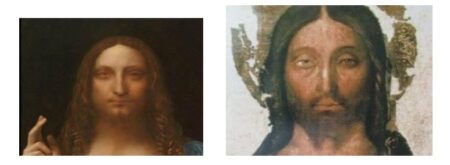
What of the ultimate question: which painting would we prefer to live with? The ‘B” painting is by the Renaissance artist Melozzo da Forli who did a stunning Christ portrait that hangs in the Palazza Ducale of Urbino. His Jesus has eyes that transfix you and burn like ice. Quite unlike the pasty face and puzzled look of the Salvator model. No question about its authenticity. All sorts of factors, of course, will be at play in determining an individual’s preference. Reactions are unpredictable; so long as we don’t know the name of the supposed artist of “A” and/or how much was paid for it. For it is a rare person whose perspective will not be influenced by that knowledge.

As to the mysterious winner of the auction, and present owner of Salvator Mundi, we can only speculate as to motivation and as to what will be done with the piece. We are living in one of the world’s great ages of conspicuous consumption. Understandably so.  Enormous amounts of cash are sloshing around the world – unattached to any purpose other than self-aggrandizement – and largely in the pockets of louts unschooled in the arts.  They are after trophies: trophy houses, trophy wives, trophy yachts (magnificent enough to lure aboard a trophy former President), and trophy arts. There are no Medicis among this set.

The impulse to “show off’ suggests that person “Z” will display it to others – whether those others be a general audience, a select group of fellow billionaires (e.g. inviting the Trump cabinet for tea), his fellow princes of the royal family, capos of Russian mafia families; his triad partners in a Chinese syndicate; or the one person he is enthralled with or wishes to enthrall.  There also is the possibility that person “Z” is a billionaire isolate with a miser’s temperament. Possibly, he is satisfied with it being his exclusive possession. Perhaps, looked at only occasionally in solitude when extracted from the ultra-secure vault where it is secreted. An icon for one in the Age of Narcissism.

If the last, the ultimate irony would be the miser’s decision to hide it in a Jackson Height’s storage unit off the Long Island Expressway – awaiting an opportune moment to palm it off on Elon Musk who, in turn, is hoping that the offering would  restore himself to the good graces of Donald Trump – the true Salvator Mundi.

Comment by reader:

“It does have a whiff of a racket, from one end all the way through to the other. One gathers enough ‘experts’ to intellectualise and pore over the technical artistic minutiae to be able to thread some coherent story. In this case, the orb’s inverted reflection forgone for a hollow glass bubble lacking any optical refraction owing to Christ’s miraculous quality. So, a long forgotten $10,000 16th century painting sitting in New York in 2005 is now suddenly a ‘rediscovered’ $450m Da Vinci, pull the other one. The entire attribution rests on this interpretation of the orb’s miraculous optical qualities, or lack thereof. Far too convenient. There is a total lack of alignment between the experts, restorers, dealers and auctions houses versus the buyers. The information set is either misinterpreted or skewed or not complete. It is more convenient for all to call this a Da Vinci than not, everyone wins and walks off in a glow of miraculous genius, and huge profit. Perhaps this is a lovely painting made by a young fellow in homage to the great Master, who did not have his scientific, technical or optical expertise to pick up on the orb’s refraction? As for KYC, AML and due diligence — give me a break, the bookies are akin to estate agents. They all just want to clip the $400m ticket.”

ENDNOTE:

  • 1
    “That $450 Million? It’s No Mona Lisa.”
    “I can say … what I felt I was looking at when I took my place among the crowds who’d queued an hour or more to behold and endlessly photograph Salvator Mundi: a proficient but not especially distinguished religious picture from turn-of-the-16th-century Lombardy, put through a wringer of restorations.” — Jason Farago, New York Times, Nov 17 2017.

Michael Brenner is Professor Emeritus of International Affairs at the University of Pittsburgh and a Fellow of the Center for Transatlantic Relations at SAIS/Johns Hopkins. He was the Director of the International Relations & Global Studies Program at the University of Texas. Brenner is the author of numerous books, and over 80 articles and published papers. His most recent works are: Democracy Promotion and IslamFear and Dread in the Middle EastToward a More Independent EuropeNarcissistic Public Personalities & Our TimesRead other articles by Michael.

 UK

“Sixth-Form Politics”

The Propaganda Blitz Awaiting Green Party Leader Zack Polanski

On 2 September, Zack Polanski, a former Liberal Democrat who joined the Green Party in 2017, was elected leader of the party in a landslide, with 85% of the vote share. Polanski defeated Adrian Ramsay and Ellie Chowns, winning 20,411 votes against their 3,705 in a ballot of party members.

From May to July 2025, when Polanski launched his leadership bid, the Green Party saw its membership rise by at least 8%, described as the ‘Polanski surge’. The Green Party now has 79,000 members. The previous peak in 2015 was 67,000.

Polanski has described his politics as ‘eco-populist’, asking bluntly:

‘Why is everything so shit? Our wages are shit, our rivers are swimming in shit, and most politicians, they are full of it too.’

He cites prime minister Keir Starmer as a prime example:

‘This is a man who stands for nothing. He has no morals, no values, no principles, and he will defend Peter Mandelson up until the point he thinks he needs to for his own career. And I think that’s the only thing he cares about at this point.’

Polanski has added:

‘We’re not a threat to Starmer.

‘We’re the replacement.

‘People aren’t leaving Labour – Labour left them.

‘And they’re finding a new home with the Green Party.’

He commented to the Telegraph:

‘I’m really frustrated with this Government on the genocide in Gaza, the complete destruction of our public services, the continuation of austerity and the pushing of public money to private wealth. I’m running for leader because when I travel the country, I see constantly that people are looking for a party to champion them. The Green Party has not been as effective as I want us to be in communicating our message. If we had been doing that more effectively, we wouldn’t be seeing the rise of new parties.’

He has also commented on the surge in support for right-wing Reform Party leader Nigel Farage:

‘Far too often we have been on the sidelines and Farage has been in the centre of the conversation. We need to challenge Farage and his charlatan MPs as the climate deniers and the billionaire protectors that they are. I despise Nigel Farage’s politics, but it’s undeniable that he has been one of the most effective political operators that we’ve seen.’

Polanski has said he would be willing to work alongside Jeremy Corbyn, who congratulated Polanski in a post on X, saying:

‘Your campaign took on the rich and powerful, stood up for the dignity of all marginalised communities, and gave people hope!

‘Real change is coming. I look forward to working with you to create a fairer, kinder world.’

Gracious comments indeed, given that Polanski had supported the manufactured anti-semitism smear campaign against Corbyn. In July, the Times of Israel reported:

‘Polanski had previously criticized the rise in antisemitism in the Labour Party on Corbyn’s watch, saying in 2018 that he was “a pro-European Jew,” calling that “two reasons I couldn’t vote for Labour under Jeremy Corbyn.”’

Polanski recanted in June 2025, saying: ‘it was not helpful for me to assume that the Labour Party was rife with antisemitism when we now know that blatantly was not true’. In fact, we also knew that was not true in 2018.

Guardian columnist Owen Jones commented:

‘When the independent MP and former Labour leader Jeremy Corbyn and the former Labour MP Zarah Sultana announced the birth of a new leftwing party, the surge of interest shocked even its founders. More than 750,000 people signed up in support of an unchristened, nonexistent party. Polling suggested nearly a third of Britons would vote for an alliance with the Greens; among under-35s, support rose to 52%.’

The Your Party project has recently been derailed by a major disagreement, with Sultana going dramatically public about her feeling that she had been sidelined by Corbyn and his male allies, accusing them of sexism. Jones, however, reports that ‘a miscalculated game of chicken appears to have drawn to a close, and plans to launch a new party have resumed’. There is once again, therefore, hope of real change ahead.

‘Student’ Politics – Getting Rid of the Arguments

The response of Western governments to both Israel’s genocide in Gaza and accelerating climate collapse – supplying the bombs, planes, diplomatic protection and rising carbon emissions fuelling both crimes – has been a eureka moment for even the least discerning consumers of Guardian and BBC-style propaganda. ‘Western democracy’ is clearly not merely an illusion, but an illusion carefully curated to ensure that voters – who are, by and large, neither genocidal nor biocidal – do not realise that beneath the statesman-like pomp and ceremony, ‘democracy’ is a charade protecting the ruthless greed, racism and violence of a tiny elite.

From the extraordinary lengths governments and corporations go to bolster the illusion of democracy, we know that deceiving the public is a key requirement. People like Polanski who rip the veil aside must be targeted for concerted attack by state-corporate media, which are not primarily a media system at all, but a system evolved and designed for the purpose of social control.

The prime mechanism of propaganda control is to direct a ceaseless tsunami of smears at the people exposing the ‘necessary illusions’ in hopes of undermining their credibility. Noam Chomsky explained:

‘Somehow, they [journalists] have to get rid of the stuff. You can’t deal with the arguments, that’s plain – for one thing you have to know something, and most of these people don’t know anything. Secondly, you wouldn’t be able to answer the arguments because they’re correct. Therefore, what you have to do is somehow dismiss it. So that’s one technique, “It’s just emotional, it’s irresponsible, it’s angry.”’ (Noam Chomsky and David Barsamian, Chronicles of Dissent, AK Press, 1992, p.79)

The irony being, of course, that the system is itself built on childishly irrational beliefs. Chomsky again:

‘A properly functioning system of indoctrination has a variety of tasks, some rather delicate. One of its targets is the stupid and ignorant masses. They must be kept that way, diverted with emotionally potent oversimplifications, marginalised and isolated.’ (Noam Chomsky, Deterring Democracy, Hill and Wang, 1992, p.369)

In a recent, televised discussion with former Conservative politician Penny Mordaunt, who now works for British American Tobacco, Polanski asked about the impending visit of Donald Trump:

‘Are you comfortable with the world’s most powerful man banning books, militarising the police, damaging women’s reproductive rights?’

Patronising freely, Mordaunt replied:

‘I disagree with a lot of things that Donald Trump does… The thing is, Zack, you’re now the leader of a political party; you’re not the president of a student union. And you have to take responsibility for things. And you have to take responsibility for trying to have a positive impact on the world around you… I hope it makes you feel good; you can go home tonight and feel great about it.’

Thus, Polanski’s truth-telling – and these are simple but important truths obvious to any thinking person – is dismissed as childish, immature, naïve; as if profit-driven, genocidal ‘realpolitik’ was ‘mature’.

In a separate discussion involving Polanski, the Mayor of London, Sadiq Khan, worked hard to avoid describing Israel’s ethnic cleansing as a genocide (he has since accepted that it is a genocide) and did not agree that Israeli President Isaac Herzog should be arrested when he visited London. Instead, Khan responded:

‘Well, I think what we’re seeing is an example of the Greens trying to use the forum of Mayor’s question time to raise really important issues in a trivial way.’

In fact, Polanski was raising really important issues in a really honest way. Khan, on the other hand, was answering the questions with really trivial evasions. Polanski replied:

‘Six minutes of words and the Mayor won’t acknowledge it’s a genocide.’

Echoing Mordaunt, Khan replied:

‘That was the soundbite, that’s what was been after [sic] in the last six minutes. That’s, you know, sixth-form politics in Mayor’s question time.’

Exactly as Chomsky said, ‘It’s just emotional, it’s irresponsible’, and should therefore be dismissed. In fact, it is the dismissal that can be dismissed.

When Jeremy Corbyn stood for election as leader of the Labour Party in July 2015, Jonathan Freedland opined in the Guardian:

‘Tony Blair and others tried to sit the kids down and say: “Look, you’ve had your fun. But take it from us, even if Corbyn is right – which he isn’t – he is never, ever going to get elected. This crusade is doomed. Come back home”.’

Freedland added:

‘The unkind reading of this is to suggest that support for Corbynism, especially among the young, is a form of narcissism.’

In the Observer, Andrew Rawnsley mocked the ‘fantasy’ of ‘Corbynmania’, with ‘younger audiences’ deluded by ‘the Pied Piper of Islington’, suffering from his ‘terrible delusion’.

‘Sixth-form politics’, in other words.

We all learned from the extraordinary propaganda blitz directed at Corbyn that the state-corporate Medium – led, in that instance, by the Guardian – will use literally any conceivable smear in a scattergun effort to turn as many voters as possible against an establishment threat.

If we could not be persuaded to dislike Corbyn because of his footwear (The Guardian asked thoughtfully: ‘is the world ready for his sandals and socks?’), then there was his ‘Chairman Mao-style bicycle’, his flat cap (allegedly photoshopped by BBC Newsnight to look like a treacherous Russian fur ushanka), the kind of anorak he wore (‘Critics of the Labour politician were angered by his choice of jacket, with some saying he looked “scruffy”’, noted the Daily Mail), how he bowed at the cenotaph (there were claims ‘Corbyn had deliberately bowed less dramatically than Cameron’), how he ‘mispronounced’ the name Jeffrey Epstein (former Independent editor, Simon Kelner, who is Jewish, shrank in fear at Corbyn’s pronunciation: ‘a Jewish person does know when there is something that sounds wrong, or pejorative, or even threatening’), that he had an allotment, that he had been romantically involved with Labour politician Diane Abbott, that he ‘feigned’ having to stand on a ‘supposedly’ crowded train, that he was race-blind to an allegedly anti-semitic mural that, in fact, depicted a number of recognisable, historic Jewish and non-Jewish financiers (with the biggest nose drawn belonging to the Christian Episcopalian, J.P. Morgan).

On one occasion, Corbyn’s failure to sing the national anthem generated a storm of criticism:

‘“Corbyn snubs Queen and country” (Daily Telegraph); “Veterans open fire after Corbyn snubs anthem” (The Times); “Corb snubs the Queen” (The Sun); “Not Save the Queen” (Metro); “Shameful: Corbyn refuses to sing national anthem” (Daily Express); “Fury as Corbyn refuses to sing national anthem at Battle of Britain memorial” (Daily Mail); “Corby a zero: Leftie refuses to sing national anthem” (Daily Star).’

Roy Greenslade was all but alone in noting that, as a principled republican for many years, Corbyn would have been accused of rank hypocrisy if he had mouthed the words of an anthem that strongly celebrated the monarch, rather than the nation.

If we had space, we could, of course, supply reams of similarly crazed examples relating to Julian Assange, and many other dissident voices, ourselves included.

Polanski is currently not sufficiently threatening to merit Corbyn-level abuse. But an opening propaganda salvo in the Daily Mail gave an idea of what might be in store: ‘His jagged, gapped teeth had shades of Hannibal Lecter. Better watch out’

If we don’t mind jagged teeth with gaps, there are other issues that might persuade us to reject a politician campaigning to stop genocide, systemic injustice and climate collapse against UK leaders blocking all resistance. Quentin Letts wrote:

‘Designer-stubbled Mr Polanski spoke for quarter of an hour without notes. You don’t become a Harley Street cleavage quack without the gift of the gab.’

In 2013, a newspaper reporter requested a hypnotherapy session to increase her breast size and self-confidence for an article in the Sun newspaper. Polanski, then working as a hypnotherapist, did the session without charge and featured in the published article. He said the article did not accurately reflect what happened but subsequently apologised for his involvement. The story has been made a major issue across the media.

After his election victory had been announced, Letts commented:

‘Soon he was locked in an embrace with his boyfriend. It was some time before they could be separated.’

Why the emphasis on duration in the text and in the caption to a picture showing the embrace? Having reviled Polanski’s teeth, stubble and quackery, were we being invited to feel uncomfortable with the idea of him hugging his boyfriend?

Patrick Kidd wrote in the Telegraph:

‘The tribe’s underwhelming participation did not stop Polanski from speaking bullishly, or whatever the vegan option is (quornily?), about enthusing the wider public. “I promise you, nothing will make you feel more inspired than joining the Green Party,” he said, though perhaps he meant to say “insipid”.’

Kidd also noted Polanski’s teeth and stubble:

‘There is something of the modern BBC executive about Polanski’s appearance, though his dentistry is old-fashioned gappy English. With his wide-open collar, close-cropped hair, designer stubble and fixed smile, he has the look of someone with one of those job titles like director of cohesion or head of future, who spews out visions about “the lake of content” and “the bubble of opportunity”.

In 2016, John Moternan observed of Corbyn in the New Statesman:

‘His air was similar to the one he displays at Prime Minister’s Questions (PMQs) — the bewildered geography supply teacher look.’

In 2015, an entire Guardian article was focused on Corbyn’s dress sense under the title:

‘Get the Jeremy Corbyn look: “retired postman” is the big fashion trend at Labour conference’

As was initially also the case with Corbyn, the Guardian has not gone straight over to the attack on Polanski. The initial focus has been to view him primarily as a warning to be heeded by a Labour leader the Guardian worked so assiduously to bring to power. The paper had a dedicated, movingly optimistic series of articles titled, ‘Starmer’s path to power’. On 2 September, the standfast introducing a Guardian leader, read:

‘A mass politics of anti-austerity, identity and climate is emerging from the left’s margins. Keir Starmer cannot afford to ignore it’

The piece concluded:

‘Labour’s defence of an old order that is crumbling away has only helped Mr Polanski. Unless Sir Keir reclaims the narrative terrain and offers transformative policies – and fast – British politics will not see only realignment but rupture.’

Readers actually donating to this corporate newspaper – thus supporting editor Kath Viner, struggling to get by on £527,695 (as of April 1, 2023) – might ask themselves why the Guardian’s chief concern is to ensure that a man who ‘has no morals, no values, no principles’ ‘reclaims the narrative’.

Another Guardian effort to save Starmer was titled: ‘Is there anything Labour can do to save itself from disaster? Our panel responds’

The key focus:

‘Over a year into power, Starmer’s government is floundering – but it still has time on its side. In the second of a two-part series, our panelists suggest ways of reversing the slide’

The Guardian’s true values, shared by Starmer, were hinted at in a piece by senior political correspondent Peter Walker, titled: ‘Greens take step into unknown with election of Zack Polanski as leader’

What is this anxiety-inducing ‘unknown’?

‘… Polanski will be under pressure to show he has not just the patter but also the judgment, with some eyebrows raised by his call in May for the UK to consider leaving Nato, which was not in the manifesto’.

A profile in the Observer noted that Polanski had previously worked as an actor and hypnotherapist:

‘He may well need all his theatrical and hypnotic powers to transform some of his convictions into popular policy. The Greens have long supported unilateral nuclear disarmament, but, even with eastern Europe under threat from an increasingly bellicose Russia, Polanski also wants to see the UK withdraw from Nato and an alternative arrangement of “peace and diplomacy”.’

As key cogs in the Perpetual War Machine, firm supporters of the West’s wars of aggression – even when they claimed to be in opposition to the Iraq war, for example – leaving Nato is something the Guardian and Observer will not countenance. Such talk should be reserved for the ‘student union’ and ‘sixth-form politics’.

As with Corbyn in 2015, the fevered ranting from the extreme right-wing press will be accompanied by initially muted criticism from the extreme centre, at the far end of the truncated media ‘spectrum’. Also as we saw with Corbyn, to the extent that Polanski offers genuine hope of change, the response from the GuardianObserver, BBC, Independent and others will rise in pitch until the threat to ‘adult’ genocidal and biocidal politics is removed.

Media Lens is a UK-based media watchdog group headed by David Edwards and David Cromwell. The most recent Media Lens book, Propaganda Blitz by David Edwards and David Cromwell, was published in 2018 by Pluto Press. Read other articles by Media Lens, or visit Media Lens's website.


Trump’s Shock Doctrine: Exploiting Kirk’s Killing to Crush the Left and the Media

FILE - President Donald Trump is joined on stage with Turning Point USA Founder Charlie Kirk as he finishes speaking at the Marriott Marquis in Washington, July 23, 2019. (AP Photo/Andrew Harnik, File)

In the aftermath of the assassination of Charlie Kirk, President Trump and his allies are insisting — without a shred of evidence — that a vast left-wing conspiracy are plotting violent attacks in this country. Naomi Klein, in her book The Shock Doctrine: The Rise of Disaster Capitalism, popularized the term “shock doctrine” — based on the economic term “shock therapy” — theorized that in times of war, political turmoil, natural disasters, and one might add, assassinations, right wing forces will push forward their agenda, regardless of how unpopular it may be.

After 9/11, for instance, the Bush administration launched a perpetual War on Terror; after Hurricane Katrina, New Orleans lost public schools and hospitals while tens of thousands of Black residents were displaced. Trump’s narrative now risks becoming another such shock, weaponized to expand repression under the guise of security.

The overwhelming evidence about the initiation of violent acts, tells a different story. The vast majority of violent incidents in this country are spearheaded by right wing extremists. Instead of dealing with this fact, Pam Bondi’s Department of Justice quickly  removed a study that documented  that far-right attacks outpace all other forms of terrorism and extremist violence. The cover-up is itself proof that the administration is more interested in weaponizing fear than facing reality.

According to the Daily Beast’s Julia Ornedo: “A June 2024 study on domestic extremism by the National Institute of Justice, a research agency under the DOJ’s Office of Justice Programs, began by noting that “militant, nationalistic, white supremacist violent extremism has increased in the United States.”

A piece at the Zeteo Substack was headlined “Vance Says It’s a ‘Statistical Fact’ the Left Commits Most Political Violence. The Actual Stats Show He’s Lying.”

According to Trump, in order to prevent further violent attacks, the left, liberals and the Democratic Party need to be investigated, prosecuted and destroyed. The administration is in the process of gearing up for a major crackdown on left-wing dissent; naming names, and labeling enemies domestic terrorists, with the intention of prosecuting them.

In a story on her Substack headlined “A Vast Domestic Terror Movement: Trump Prepares to Dismantle the Left,” Laura Jedeed pointed out that the administration’s intentions were expressed unequivocally during “three media events the Trump administration participated in the past few days: JD Vance took over as host for the Charlie Kirk showTrump answered questions in the Oval Office  after sending the National Guard to Memphis. And Pam Bondi made an hour-ling appearance on Katie Miller’s new podcast.”

Jedeed noted that “Quotes from all three of these appearances are circulating around the Internet, and any single one could be mistaken for yet another out-of-pocket threat that will be forgotten by tomorrow. Taken together, however, the messages appear both clear and coordinated: they are saying the same thing using similar words in response to similar questions. To say that message is grim would be an understatement. We are in a new kind of danger, and once that danger arrives it is likely to move fast.”

As Naomi Klein observed in a 2017 interview with The Progressive magazine, Trump functioned as “a rolling shock,” manufacturing daily outrages to keep the nation reeling. In May of this year, Klein writing with Astra Taylor in the Guardian piece headlined, “The rise of end times fascism,” warned that “The governing ideology of the far-right in our age of escalating disasters, has become a monstrous, supremacist survivalism.”

In a May interview with Rolling Stone, Klein pointed out that “The shocks are not surprises anymore. The shocks come continuously.”

In order for the Trump to thrive, it must tamp down or completely eliminate opposition voices. The murder of Charlie Kirk has opened up the field to new and vituperative attacks on the left, liberals and the Democratic Party. These moves are not about healing the country or stemming political violence, they are about sowing fear, silencing opposition voices, and consolidating power, the very pattern Klein has long warned would accompany every new shock.

Bill Berkowitz is a longtime observer of the conservative movement. Read other articles by Bill.


British Columbia miners sweep Reclamation Symposium awards

Fording River, located in the Elk Valley of British Columbia. (Image courtesy of Teck Resources.)

The 48th British Columbia mine reclamation award ceremony took place Wednesday in Penticton as part of the annual Mine Reclamation Symposium.

The Symposium spans several days and includes workshops, mine tours, technical presentations and concludes with an awards ceremony to recognize the efforts BC mining companies are undertaking relating to environmental protection and reclamation at mine sites.

More than 270 people attended this year’s symposium, including biologists, engineers, mine workers, representatives, partners and members of First Nations communities, and students.

Since 1969, mining companies are required by law to reclaim mine site lands when mine life ends. BC was one of the first jurisdictions in Canada to implement mine reclamation legislation, and the first to extend this policy to exploration sites, the Mining Association of BC said in a news release.

Since then, the provincial government under the Ministry of Mining and Critical Minerals has required companies post a reclamation security bond before mineral exploration and mining work begins at any site.

The British Columbia Technical and Research Committee on Reclamation (TRCR) presented awards to mine workers across the province who are demonstrating best practices and innovation in post-mining landscape restoration.

The 2025 winners

Elk Valley Resources (EVR) won the Jake McDonald Annual Reclamation Award, which recognizes its progressive reclamation of the Swift Project at Fording River operations.

Greg Sword and Lori Lemke accept the Jake McDonald Mine Reclamation Award on behalf of Elk Valley Resources for their reclamation at the Swift project. Image: MABC.


Located near Elkford in southeast BC, the project set a goal to produce 170 million metric tonnes of steelmaking coal over 25 years. Reclamation activities started in 2020, and today, the project demonstrates operational excellence in progressive reclamation.

A defining aspect of the project is its use of a bottom-up lift construction method for landform development. Glencore is proposing the Fording River Extension (FRX) project to extend EVR’s existing Fording River operations. The FRX project is anticipated to extend the lifespan of Fording River operations by approximately 35 years, which is a critical economic engine to southeast British Columbia.

Amrize (formerly Lafarge) scooped the Sand & Gravel Award for its achievement of reclamation through Abbotsford Gravel Sales. The team proposed a collaborative solution with neighbouring landowners and the Agricultural Commission to restore 30 acres of land as well as mining and restoring 85 acres of land. This project demonstrates how the aggregate industry can work collaboratively with agricultural stakeholders to responsibly access essential resources while supporting land stewardship and food production goals.

Jacqueline Dube and DJ Formanski of Elk Valley Resources were awarded the Tony Milligan Book Award, created in recognition of the contributions Tony Milligan made to mine reclamation. This award was presented based on the quality of their paper, ‘An operational approach to geomorphic design in mine reclamation : A case study from Teck Coal Line Creek Operations’, presented at last year’s symposium.

Scholarship recipients are Thompson Rivers University Master of Science students Rabeya Shikdar Orpa and Zhaohui (Sunny) Han.

Next year’s 49th Mine Reclamation Symposium will be held in Fort St. John from September 21 to 25, 2026.

Learn more about mine reclamation in BC here.