Saturday, September 27, 2025


Spain: Foreign Workers Power Economic Growth – Analysis

madrid spain city people


By 

By William Chislett


Spain’s economy is growing briskly, largely powered by foreign workers. These workers, particularly in the hostelry, construction, agricultural and social care sectors now account for 14% of total jobholders registered in the social security system.

The foreign-born population surged from less than 1% of the total population in 1975 to 19% (9.4 million people) by the end of 2024.

But for immigration, Spain’s rapidly ageing population would hardly have grown, as the fertility rate of 1.12 children is well below the replacement rate (2.10) at which population levels would be maintained. In 1996 the United Nations forecast that Spain’s population would fall sharply by 2050 from almost 40 million to around 28 million.

Most of the 8.2 million rise between 2000 and 2024 to 48.8 million was due to net international migration. Of the five most populous EU countries, Spain’s population has increased by far the most in relative terms (+20.2%) over the last 24 years (see Figure 1).

Figure 1. Population, 2000-24 (mn)


20002024% change
 20002024% change
France60.968.5+12.4
Germany82.383.5+1.4
Italy56.958.9+3.5
Poland38.236.5-4.4
Spain40.648.8+20.2
Source: World Bank Data.

Meanwhile Spain’s economic growth has consistently outpaced that of the EU as a whole for the past three years: 3.2% in 2023, 2.9% in 2024 and around 2.6% in 2025 (EU averages of 0.4%, 1.1% and 1%, respectively).

Foreigners are driving the increase in the working-age population much more than in the other three large EU economies (see Figures 2 and 3). The unemployment rate (10.3%) is the lowest since 2007 (27% in 1Q13), though almost double the EU average.

Figure 2. Working age population (15-64 years)
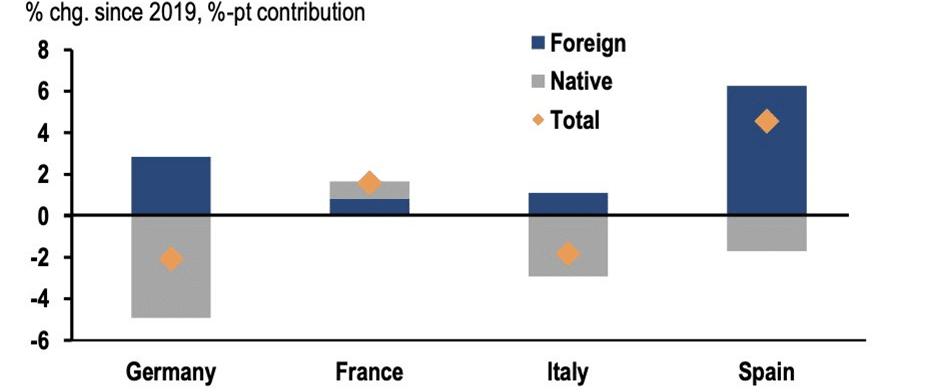
Bar chart showing percentage change and contribution since 2019 in foreign, native, and total of the working age population (15-64) for Germany, France, Italy, and Spain. Spain shows a significant positive foreign contribution around 6%, much more than in the other three large EU economies.
Source: Eurostat, J.P. Morgan.

Figure 3. Spain: working age population, 15-64 years
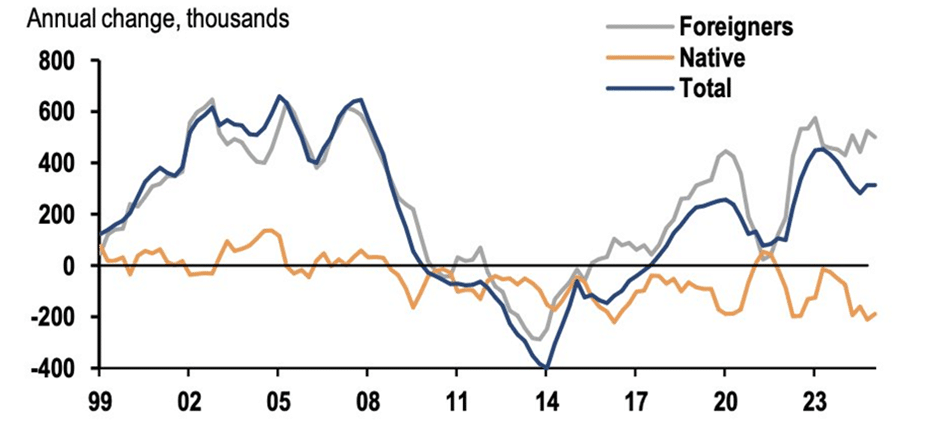
Figure 3. Spain: working age population, 15-64 years. Based on country of birth. Source: Eurostat, J.P. Morgan.
Based on country of birth. Source: Eurostat, J.P. Morgan.

If the hard-right VOX’s call for mass deportation of immigrants ever materialised (which it will not) the economy would collapse. That call, which provoked widespread outrage, was made in July by Rocío de Meer, the party’s spokesperson for demographic emergency. She suggested that only the deportation of 8 million immigrants and their children would permit Spain to ‘survive as a people’.

Santiago Abascal, VOX’s leader, rowed back on what was said (and recorded), insisting that only immigrants who committed crimes, sought to impose an ‘alien religion’ (an implicit reference to Islam) or mistreated women would be deported. There are more than one million Moroccans in Spain, including those who have acquired Spanish nationality.

Central-bank heads who gathered at Jackson Hole, Wyoming, last month sounded a warning bell over labour shortages in many developed economies that, in the context of historically low birth rates and longer life expectancy (Spain’s is one of the world’s longest), can only be solved by an influx of foreign workers.

Immigrants have not taken jobs away from Spaniards; many of them arrived during the country’s 1997-2008 economic boom and did the work that Spaniards were less inclined to do. To some extent, this explains why Spaniards are predominantly welcoming of immigrants. Also, many Spanish families have relatives who emigrated in the 1950s and 1960s, helping them to view migrants with greater understanding and sympathy and to feel relatively comfortable with them. Public opinion on immigration stands out as notably positive in the European context. According to the 2024 European Social Survey, Spain’s score –on a scale from 0 (very bad) to 10 (very good)– was 6.2.

A very large number of immigrants (47% of the total at 1 January 2024) are Latin American and hence usually share the same Roman Catholic (or, at least, Christian) religion and, apart from the Brazilians, the same language, which facilitates assimilation. Meanwhile both Brazilians and Romanians pick up the Spanish language quickly since they speak Romance languages descended from Vulgar Latin.

VOX’s anti-immigration policies, however, are gaining support among the unemployed and workers in general. The hard-right is their preferred party not the hard-left Sumar, according to the latest poll by the state-funded CIS (see Figure 4).

Figure 4. Voter intention among those who consider themselves working class or poor (%)

Political party%
VOX24.6
Socialists13.5
Popular Party8.7
Sumar4.7
Source: CIS.

While other EU leaders have tightened their borders against newcomers, Spain’s Prime Minister, Pedro Sánchez, is taking a pragmatic approach, championing migration and its economic benefits: ‘Immigration is not just a question of humanitarianism…, it’s also necessary for the prosperity of our economy and the sustainability of the welfare state’, he said. ‘The key is in managing it well’.

In May new regulations went into effect that eased migrants’ ability to obtain residency and work permits, and parliament began debating a bill to regularise undocumented migrants. The call was the result of a petition signed by 600,000 people and endorsed by 900 non-governmental organisations, business groups and the Roman Catholic Church.

The big rise in the foreign population is changing the population pyramid. Whilst only 56% of those born in Spain are aged between 20 and 64, almost 80% of immigrants are in that age bracket (see Figure 5). The working population needs to be rejuvenated, among other factors, in order to make the pay-as-you go pension system more sustainable.

Figure 5. Population by age group, those born in Spain and immigrants (% of total population)

Age groupBorn in Spain (%)Immigrants (%)
90 and over1.70.2
85-892.20.4
80-843.50.9
75-794.71.6
70-745.22.5
65-696.33.7
60-647.15.3
55-597.57.3
50-547.88.9
45-497.810.4
40-446.410.8
35-395.210.5
30-344.810.4
25-294.59.6
20-245.26.8
15-195.93.9
10-145.43.3
5-94.82.6
0-44.10.9
Source: Carmen González Enríquez & José P. Martínez, Elcano Royal Institute, based on data from INE.

Another issue is to improve the education attainment of second-generation immigrants, one of the factors that affects their integration into the labour market. Only 39% of second-generation immigrants have basic education (compulsory secondary education ends at 16) and 25% a university degree, 24 percentage points below that of the native population.

On the other hand, a significant proportion of first-generation immigrants are overqualified for the job they get. This is largely due to the long time it takes for the homologation of their university degrees and professional qualifications, without which jobs in sectors such as health, education, the legal profession and engineering are impossible to obtain. There were close to 100,000 applications pending approval in June.

The Labour Ministry recently said the very large number of baby-boom-generation people (born between 1957 and 1977) retiring over the next 20 years will hit the labour market: 80% of ‘new’ jobs will be filling the posts vacated by those who retire. The situation of ageing workers is particularly acute in health (12.7% of workers are already 60 or over), public administrations (15.6%) and state education (7.8%). The total number of workers in these three sectors who are up for retirement in the coming years is more than 3.5 million.

The need for migrant workers, however, in a country with a major housing crisis has aggravated a problem which will take many years to resolve: the supply of properties cannot keep up with new arrivals, let alone with the resident population. The housing bottleneck raises questions over whether immigration can continue at its recent pace. Meanwhile Spain received 77,000 asylum seekers in the first half of 2025, most of them from Venezuela.

More than 8 million pupils were back at school this month after the summer holidays, 1.1 million of whom are foreign, 13.9% of the total and 30% more than five years ago. In seven of Spain’s 50 provinces, one in four students in state primary schools is foreign, giving teachers a complex challenge. The face of Spain is changing rapidly.

  • About the author: William Chislett (Oxford, 1951) is Distinguished Senior Fellow at the Elcano Royal Institute. He covered Spain’s transition to democracy for The Times of London between 1975 and 1978. He was then based in Mexico City for the Financial Times between 1978 and 1984. He returned to Madrid on a permanent basis in 1986 and since then, among other things, has written more than 20 books on various countries.
  • Source: This article was published by Elcano Royal Institute


Elcano Royal Institute

The Elcano Royal Institute (Real Instituto Elcano) is a private entity, independent of both the Public Administration and the companies that provide most of its funding. It was established, under the honorary presidency of HRH the Prince of Asturias, on 2 December 2001 as a forum for analysis and debate on international affairs and particularly on Spain’s international relations. Its output aims to be of use to Spain’s decision-makers, both public and private, active on the international scene. Its work should similarly promote the knowledge of Spain in the strategic scenarios in which the country’s interests are at stake.


Empire / Michael Hardt and Antonio Negri. p. cm. Includes bibliographical ... 4.3 The Multitude against Empire. 393. Notes. 415. Index. 473. Page 11. PREFACE.

Page 1. MULTITUDE. WAR AND DEMOCRACY. IN THE AGE OF EMPIRE. MICHAEL HARDT. ANTONIO NEGRI ... pdf. 33. Richard Haass, for example, the U.S. State Department ...


Feeding The Future: Nature-Based Solutions For Resilient Food Systems – Analysis


By 

By Shoba Suri 


Rising challenges from climate change, environmental degradation, and biodiversity loss are exerting unprecedented strain on global food systems, undermining their ability to ensure food security for a projected 9.1 billion people by 2050.

According to the Sixth Assessment Report of the Intergovernmental Panel on Climate Change (IPCC), food, land, and water systems lie at the core of the climate crisis, where escalating extreme events, such as heatwaves, droughts, floods, and rising temperatures, are diminishing both crop yields and nutritional quality.

For instance, in India, heatwaves have reduced wheat yields by up to 15-25 percent, exacerbating food insecurity. These challenges, compounded by the rapid growth in global food demand, urbanisation, and agricultural expansion, are intensifying environmental pressures and inequalities in food accessibility, especially for smallholder farmers in vulnerable regions such as West Africa and India. This warrants an urgent inquiry into reimagining food production, distribution, and consumption through innovative approaches that also advance sustainability and strengthen systemic resilience.

The International Union for Conservation of Nature (IUCN) defines Nature-based Solutions (NbS) as “actions to protect, conserve, restore, sustainably use and manage natural or modified terrestrial, freshwater, coastal and marine ecosystems which address social, economic and environmental challenges effectively and adaptively, while simultaneously providing human well-being, ecosystem services, resilience and biodiversity benefits” (Figure 1). 

NbS could contribute 30 percent of the cost-effective mitigation needed by 2030 or 2050 to keep global warming below the 2°C threshold, as agreed under the 2015 Paris Agreement.


Globally, rising average temperatures, shifting rainfall patterns, and intensifying extreme events are already undermining crop and livestock productivity, particularly in tropical and subtropical regions.

According to estimates, crop yields in West and East Africa are projected to decline by 2.9 percent by 2030 and up to 18 percent by 2050, underscoring the urgency for adaptive policies and resilient food system strategies. 

Rising average temperatures are reducing soil moisture, heightening water demand, and intensifying water stress—factors that directly undermine farmer incomes and food security. NbS, such as agroforestry, conservation agriculture, and mangrove restoration, offer sustainable pathways to address these challenges by enhancing biodiversity, curbing pollution, and contributing to climate mitigation through carbon sequestration and emission reductions.

The importance of regenerative agriculture, a key NbS approach, is increasingly gaining recognition for its ability to revitalise ecosystems by emphasising biodiversity, soil health, and climate change mitigation.

In India, the Zero Budget Natural Farming (ZBNF) initiative has shown promising results, enhancing farmer incomes while strengthening soil health. The government supports this through programmes such as the Paramparagat Krishi Vikas Yojana (PKVY), which promotes organic farming and soil health with training initiatives and subsidies.

In China, integrated agricultural systems such as rice-fish-duck farming, which combine crops, aquaculture, and livestock, enhance food safety, productivity, and environmental health by utilising natural pest and weed control, nutrient recycling, and improved soil fertility. The role of NbS in conserving and restoring marine and coastal ecosystems is getting increasingly acknowledged.

In Bangladesh, mangrove restoration in the Sundarbans—the world’s largest contiguous mangrove forest—acts as a natural safeguard against flooding and storm surges for millions along the Bay of Bengal, while simultaneously supporting local livelihoods and fisheries. NbS, therefore, has the potential to transform food systems by restoring ecosystems, boosting productivity/safety, and promoting equity. Nonetheless, scaling necessitates urgent redressal of institutional and financial challenges.

Despite their promise, nature-based farming methods face several barriers to adoption. Many farmers have limited awareness of sustainable agricultural practices and their long-term benefits. They frequently rely on excessive use of pesticides and fertilisers without recognising their negative impacts on soil health and crop productivity. 

Research indicates that strategies focused solely on productivity compromise the long-term sustainability of agroecosystems by overlooking overall ecosystem performance. In urban contexts, fragmented institutional frameworks and divided administrative responsibilities impede cross-sectoral collaboration, limiting the integration of NbS into national policies and local planning initiatives.

Successful implementation of NbS requires robust institutional frameworks, adequate financing, and supportive policies. Governments need to foster enabling environments by embedding NbS into national climate and food strategies, including the Nationally Determined Contributions under the Paris Agreement.

Financial incentives, such as carbon credits or payments for ecosystem services (PES), can ensure equitable compensation for farmers to adopt sustainable practices, including agroforestry, which improves carbon sequestration and reduces sediment and nutrient runoff.

For example, Costa Rica’s PES programme rewards farmers for preserving forests, enhancing both incomes and biodiversity. Aligning NbS with global frameworks, such as the United Nations Decade on Ecosystem Restoration, can scale and strengthen policy integration. It can also improve access to investment demands for meeting the 2070 (India) or 2030 (global) Net-Zero targets.

Echoing the quote, “The benefits of Nature-based Solutions for biodiversity and human well-being flow from healthy ecosystems,” NbS provides sustainable solutions by restoring ecosystems, supporting livelihoods, and ensuring food security. By embracing community-driven initiatives that utilise indigenous knowledge, and prioritising education for farmers—particularly women and indigenous communities —we can cultivate thriving ecosystems that underpin both nature and human well-being.


  • About the author: Shoba Suri is a Senior Fellow at the Health Initiative, Observer Research Foundation
  • Source: This article was published by Observer Research Foundation


Observer Research Foundation

ORF was established on 5 September 1990 as a private, not for profit, ’think tank’ to influence public policy formulation. The Foundation brought together, for the first time, leading Indian economists and policymakers to present An Agenda for Economic Reforms in India. The idea was to help develop a consensus in favour of economic reforms.
END TIMES EXPRESS

How ‘RaptureTok’ amplified an extreme corner of EVANGELICAL faith


(RNS) — The trend highlights how TikTok amplifies extreme performances of religion and raises questions about its impact on young people’s beliefs.


A variety of rapture related videos from TikTok. (Screen grabs)

Fiona Murphy
September 26, 2025
RNS


(RNS) — Hannah Gallman announced on TikTok that she was fired from her job on Monday (Sept. 21), shortly after praying to God to allow her to be home with her family during the rapture, a biblical event she believed would occur this week. As her prayers were seemingly answered, her more than nine-minute TikTok video drew 1.2 million views under the hashtag #RaptureTok.

“I’m pretty much not even reading comments anymore, the majority are negative,” Gallman, who lives in Louisiana, wrote in a message. “It’s sad to see so much arguing and mocking in the comment section.”

Not long after, her video resurfaced on Rapture Clownery Archive 2025, a TikTok account created three days ago by a Canadian user named Evren to preserve content considered #RaptureTok. The hashtag went viral, with the most views on accounts reenacting and mocking posts about the rapture that some Christians believed was imminent. The Rapture Clownery Archive 2025 has 11,000 followers and more than 54,000 likes since Monday. Several of the account’s early reposts collectively saw more than 1.5 million views.


“If it was one person going through a manic episode, then I wouldn’t bother, but these people are creating mass fear and saying things that are interrupting people’s lives,” Evren, who asked to be identified by his first name only for safety concerns, wrote in a message. “I didn’t want to let them have the ability to deny the things they said and did.”

One TikTok user commented on the video Evren republished of Gallman, “Why do these people think they’re so special that God is telling them something that NO ONE KNOWS THE DAY OR THE HOUR OF.” Comments under Gallman’s original video read, “If the rapture doesn’t happen can yall still leave” and “please consider doing some research on religious psychosis.” Very few comments seemed to support Gallman’s faith, but many claimed to worry about her mental health. “Oh man, I thought this was satire bc I’ve only been getting the satire ones on my fyp (social media feed),” one user wrote.

RaptureTok is the latest example of how TikTok amplifies the often strangest and most extreme corners of religion — typically through re-posts where users mock or comment on others’ religious performances. And as another viral Christian trend makes national news, some worry about the platform’s influence on the minds and faith of young people.


(Photo by Solen Feyissa/Unsplash/Creative Commons)

TikTok rewards content that provokes, often through mockery or spectacle, because it captures and keeps people’s attention. According to recent data from a popular SEO analysis website, TikTok has about 170 million accounts in the United States — almost half the number of people living in the country. American adult users spend an average of 52 minutes a day on the app. The platform skews younger, with TikTok especially popular among Generation Z and younger millennials, according to a fact-sheet compiled by April ABA.

Franziska Roesner, a computer science professor at the University of Washington in Seattle who studies TikTok’s algorithm, told UW News in 2024 that the platform doesn’t just show users what they follow but predicts what might grab their attention, sometimes funneling them into “rabbit holes” of provocative material.

“Platform designs are not neutral, and they influence how long you watch and what you watch, and what you’re getting angry or concerned about,” Roesner said, according to the story. “It’s very difficult to explain exactly why a particular video was recommended … TikTok is more of a black box.”

Earlier this year, another “ChristianTok” trend went viral when a handful of women posted videos of themselves pouring grape juice around their homes as a symbol of Christ’s blood to ward off spiritual danger. The practice might have been obscure, but it was amplified after “WitchTok” creators, who post about witchcraft, mocked it as little more than spell work.

The accusation sparked a flood of cross-community commentary. Many of the videos were also republished on “DeconstructionTok,” a subgroup of TikTok that functions much like sub-threads on Reddit and aims to “deconstruct” various beliefs, ideologies and expressions of Christianity.


Heidi Campbell. (Photo courtesy of Texas A&M University)


Heidi Campbell, director of the Network for New Media, Religion and Digital Culture Studies at Texas A&M University in College Station, said that since 2016, online discourse has shifted toward what she calls a “performance of meanness.”

“The screen has allowed us to broadcast so much more diversity, which can be a positive thing,” Campbell said. “But instead of bringing us closer together, which a lot of internet prophets and cyber philosophers kind of said in the 1990s, it’s actually brought more division.”

People performing religion through TikTok content, in particular, is a hotbed for accusations, prejudice and even misinformation, Campbell said — especially among young people, who increasingly identify as having no religion.

“Now, we have these technologies that take those private conversations from those communities and make them public,” Campbell said. “In some ways, they’re decontextualized. People are seeing 30 seconds or a minute of a kind of a narrative that if you know the insider language of that community, it makes sense. If you don’t, it makes no sense.”


Videos of cycling instructors urging women on stationary bikes to “breathe in the Holy Spirit,” memes of “Christian girl autumn,” clips of President Donald Trump speaking about the Bible, and even AI-generated images — like ones depicting Jesus hugging children displaced by the catastrophic flooding in Texas this summer — have all fueled debate on TikTok. The content often draws so much attention that it spreads to Instagram, Facebook and YouTube, and even gets covered by major news outlets.

Britt Hartley, an ex-Mormon, religion scholar, deconstruction coach and popular TikTok creator, has been posting since 2022. With nearly 712,000 followers, her account, NononsenseSpirituality, has become a leading voice in the deconstruction community, often tagged in videos for her commentary.

“TikTok is addicting because you get a place to express your rage, disappointment, religious trauma and all the stupid things that religion does,” Hartley, an Idaho resident, said. “It’s kind of intoxicating in a way because it’s kind of a righteous anger, and it’s a cause.”

Evren, who grew up Mormon, said he relates to those posting out of religious fear. Still, he emphasized that his main goal is to create an archive.

“I do think that many are being genuine, that they are posting because they are scared. And they’re trying to ‘save’ people,” Evren wrote. “But I do think there are satire accounts or rage baiting accounts that are using this to gain views. Hell, some might argue that’s what my account seems like. But I prefer to think of my account as an archive.”

He described the ultimate goal for his page: “I want to see what their reactions are when their prophecy doesn’t come to pass,” he wrote. “For me personally, that part is more of a scientific curiosity into the psychology behind it. What will a person do when their prophecy that they relied so strongly on fails?”

From her vantage point, Hartley said she worries all the attention on breaking down people’s beliefs means TikTok users, especially young people, aren’t being encouraged to build community in its place. She said she believes there are lessons to learn from religion.

“There’s a baby in the bath water,” she said. “Especially for Gen Z to be on TikTok, deconstructing gender, religion, capitalism, they’re just deconstructing everything all the time. Then they’re in this massive meaning and identity crisis, and have massive depression and anxiety. They have no sense of how to build a self and a life.”

If the rapture doesn’t happen this week, Gallman said her faith will not be shaken. “My faith is in Jesus and not in a date, again, nothing changes for me,” she said. Despite the negative comments on her most recent posts, which are the only videos on her channel that touch on her faith, she said she won’t feel embarrassed about posting online.

“If you knew that something major was coming and a lot of people would suffer, and you had the chance of saving a few people by warning them … it would be wrong not to speak up just because you’re afraid of being called crazy,” she said.

PARTY POOPERS LEAVE PLANET


Brazil

Hundreds of thousands protest against amnesty for Bolsonaro


Wednesday 24 September 2025, by Ana C. Carvalhaes


SÃO PAULO - Spring in the Southern Hemisphere began a day early in Brazil. On Sunday, 21 September, around 100 cities across the country – including the capitals São Paulo, Rio de Janeiro, Belo Horizonte, Salvador, Porto Alegre, Recife and Brasília – witnessed something unprecedented in the last three years: activism, the left and social movements took to the streets and squares, alongside a broader popular sector, equally outraged by two measures voted on by the Chamber of Deputies. The demonstrations in São Paulo and Rio were the strongest since the mobilizations for Fora Bolsonaro (Bolsonaro Out) between 2021 and 2022, and the celebration of Lula’s victory on Paulista Avenue in October 2022.

The spark that ignited popular anger was the approval by the Chamber of Deputies, the most reactionary congressional body in the country’s history, of an emergency regime for considering amnesty for those involved in the 2022-2023 coup. Added to this was the hasty approval of a Proposed Amendment to the Constitution (PEC) that would prevent investigations and punishments of any kind against parliamentarians during their terms of office – a measure quickly dubbed the "PEC da Bandidagem" (Banditry PEC). The vote on the two measures showed a score of approximately 350 (the sum of the extreme right and the traditional oligarchic right gathered in the "Centrão") against just over 150 votes against.

The reactionary offensive by the right wing in Congress was a response to the conviction of Bolsonaro and seven accomplices from the core of the 2022-2023 coup plot by the Federal Supreme Court on 11 September. Bolsonaro and his accomplices in the authoritarian coup attempt – which included a plan to assassinate Lula, his deputy, Alckmin, and magistrate Alexandre de Moraes – were sentenced to more than a decade in prison. The trial and verdict were celebrated by democratic governments, social movements, and non-fascist media outlets around the world. But on the domestic front, the neo-fascists did not stand idly by.

Advantage over far-right demonstrations


Extremely careful counting points to the participation of more than 600,000 people in the demonstrations – a number that may increase as protesters in cities in the interior of populous states such as São Paulo and Minas Gerais are counted. Compared to the far-right (Bolsonaro) demonstrations held on 7 September – in defence of amnesty – last Sunday’s democratic protests had a clear advantage, both in terms of numbers and quality.

Organized in less than a week by a de facto "coalition" of progressive artists and social movements – trade union federations, independent unions, homeless movements, black movements – after an explosion of indignation on social media, the demonstrations were more widespread nationally. The organisations that called for the protests were then joined by left-wing parties (PSOL, PCdoB, PT, UP), parties that are not so left-wing (PDT, PSB) and many people from the working classes.

The wave of protests marked a turning point in the central political dispute in the country, between the broad left and neo-fascism. Still with an important and threatening mass base, the Brazilian far right had been taking advantage, since August, of an explicit alliance, without any scruples of dignity, with the US government, to forcibly obtain the amnesty with which they intend to free Bolsonaro and his military friends and former civilian subordinates from prison.

At the 7 September rally in São Paulo, the far right even unfurled a 20-metre-long US flag on the avenue. While in the United States, Congressman Eduardo Bolsonaro, the former president’s third son , was openly negotiating with the White House to increase sanctions against the country and the judges in the case against the coup plotters, in the Chamber of Deputies last week, the neo-fascists concentrated their efforts on negotiating with the right-wing leader of the house, Hugo Motta, for the rapid passage of the amnesty. In these negotiations, Bolsonaro’s supporters took advantage of a common interest with the "Centrão" (protecting themselves from Supreme Court proceedings in cases of misuse of budget funds allocated to deputies*) to give birth to the ill-fated PEC da Bandidagem.

They miscalculated. While the government and its base, other left-wing parties and their electorate were more directly involved in the "conviction of coup plotters versus amnesty" debate, the threat of total impunity for "politicians" outraged and inflamed the anger of broader sections of the population. In a concise assessment on the pre-spring Sunday, one of the leading commentators on the powerful Globo communications network, Andrea Sadi, analysed: "Sunday’s demonstrations against the PEC that shields parliamentarians from prosecution and amnesty left the Chamber of Deputies exposed. The demonstrations were a response to the approval of the Shielding PEC and the urgency of the amnesty bill."

First results


In addition to showing that it is possible to "break the bubble" of the democratic camp and attract people to the streets, the protests also had, according to other commentators in the corporate press, two important symbolic achievements in the recent history of this polarised country. With the "help" of Trump’s imperialist attack on the country’s economy and political sovereignty, the left has regained (at least for now) the Brazilian flag, which had been misused for more than ten years by Bolsonaro’s followers. At the same time, it was the first time since 2013 that anti-corruption outrage in the state apparatus was led by the progressive mass movement.

The concrete result of Sunday’s journey, beyond the recovery of the spirit of activism, can already be seen in the four right-wing MPs who publicly apologised for voting for the bills, in the apparent regret of at least two of the 12 PT MPs who voted with the right, and in the promises of the Senate president – who must assess the proposals according to the country’s laws – that he will hinder the proceedings and, therefore, the approval of the two resolutions.

None of this – except for the renewed spirit to continue fighting – guarantees that Bolsonaro will serve his sentence of more than 27 years in prison, or that the offensive by the corrupt and potentially corrupt will be effectively defeated. If we consider the period since Lula’s election against Bolsonaro, the social movement and the left have achieved an important draw in the streets and are in a position to turn the tide. But the struggle will be tough: the far right can count not only on the government of the most powerful country in the world taking consecutive measures against Brazil, the Brazilian government and the judiciary, but also on a not insignificant electoral card up its sleeve – a "tamed Bolsonaro", a neo-fascist with a controlled temper, in the guise of a good administrator, who is the governor of São Paulo, Tarcísio de Freitas.

The situation demands that street mobilisations continue. And it makes the political-ideological dispute and the concrete struggle of the workers of São Paulo against Tarcísio one of the central challenges of the coming months.

23 September 2025

Attached documentshundreds-of-thousands-protest-against-amnesty-for-bolsonaro_a9185-2.pdf (PDF - 910.7 KiB)
Extraction PDF [->article9185]


Ana C. Carvalhaes, journalist and federal civil servant, is a founding member of the PSOL and a member of the Executive Bureau of the Fourth International.


International Viewpoint is published under the responsibility of the Bureau of the Fourth International. Signed articles do not necessarily reflect editorial policy. Articles can be reprinted with acknowledgement, and a live link if possible.