More than two decades ago, the illegal war against Iraq was cooked in the dens of the Pentagon by Israel-first ideologues and sold to the American public through mass propaganda. The current war is, in some ways, even more brazen.
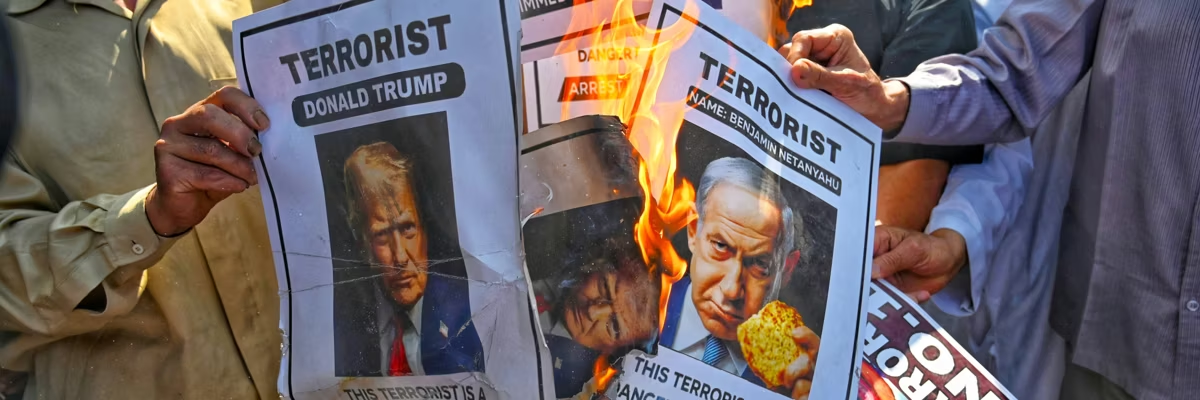
Shia Muslims shouts slogans against US President Donald Trump and Israel Prime Minister Benjamin Netanyahu and burn their posters and effigy following the death of Iran’s Supreme Leader, Ayatollah Ali Khamenei, in US Israel strikes, at Dargah Shahe Marda Karbala at Jor Bagh, on March 6, 2026 in New Delhi, India.
(Photo by Vipin Kumar/Hindustan Times via Getty Images)
Jamal Kanj
Mar 10, 2026
American taxpayers are still hemorrhaging from the made-for-Israel war in Iraq, a war audaciously offered as one that would “pay for itself.” Instead, it was paid in Iraqi and American blood, ruins and financed by American debt. The promised democracy was a broken state, regional chaos, and the afterbirth of terror and resistance that continues to metastasize across the Arab world. Marketed as a short, decisive campaign, Iraq became a two-decade-long disaster with no exit in sight. Trillions were burned on lies manufactured by Israel-first Zionists in Washington, while generations of Americans—many not even born when the invasion began—were conscripted into inheriting the debt, the interest, and the moral stain.
The real balance sheet of that war is etched into nearly 5,000 American tombstones and the endless corridors of veterans’ hospitals. Before that blood-soaked bill is even paid, the very same architect, using the same lies, has succeeded again in dragging the U. S. into another made-for-Israel war, this time against Iran. Iraq was not an aberration; it was a rehearsal. Yet, Iran doesn’t appear to be the final act on the Israeli menu. In recent weeks, former Israeli prime minister Naftali Bennett declared that Turkey is next. And it is the U.S., not Israel, that is expected to keep paying for wars, America neither needed nor chose.
The evidence of who set the clock of this war is unmistakable. The most revealing admission did not come from Tehran, Moscow, or Beijing, but from the U.S. State Department. In an unguarded moment, the U.S. Secretary of State admitted that the timing of this war was not an American choice. This became painfully clear when the State Department was caught unprepared to help evacuate tens of thousands of Americans from the war zone. As U.S. ambassadors hurried to evacuate their staff and families, desperate citizens were told their government could not assist and were advised to arrange their own departures, after airports had already closed.
This is not a minor detail. It’s a government that is willing to sacrifice the well-being and security of its citizens by joining a war decided by someone else. It goes to the heart of sovereignty and democratic accountability. A nation that chooses to go to war prepares its people, its diplomacy, and its logistics. A nation that is dragged into war improvises and hopes for the best.
Iran, for its part, is not the caricature often presented by the American Secretary of War and Donald Trump. It is a country prepared for drawn-out conflict and strategic patience. During the nearly eight-year Iran-Iraq War, Tehran fought a grinding, no-win war against a better-armed adversary. Against the expectations of Western military analysts, Iran endured. In a grim irony, it even committed the greatest of all sins: purchasing weapons from Israel, falling into Tel Aviv’s cynical strategy to weaken both Baghdad and Tehran simultaneously. Israel was willing to arm its supposed arch-enemy as part of its broader calculus of exhaustion and division.
That history matters today. Iran has demonstrated, repeatedly, a willingness to absorb punishment, and extend conflicts over time. At the end of the day, and by all means necessary, Iran is unlikely to surrender. In a protracted war of attrition to bleed the world economy, Tehran could move to close the Strait of Hormuz, an oil blood line for world economies. Iran may be economically battered, and it has been for decades under severe sanctions, but that very weakness reduces its restraint. A country with little left to lose is more inclined to impose pain on others, including Western and neighboring welfare oil economies dependent on uninterrupted energy exports. Meanwhile, regional instability in the Gulf and prolonged American entanglement create the perfect symbiosis for Israel: a state that flourishes in the shadows of regional chaos like a scavenger thriving on the scrap of a landfill.
President Trump has suggested escorting oil shipments in the Strait to keep the oil flowing. The macho bravado may play well on television or for the stock market, but history, old and recent, offers daunting realities. The same was attempted during the Iraq-Iran war in the 1980s but failed. More recently, the U.S., the EU, and Israel combined failed to force a much smaller and poorer country—Yemen—to open the Red Sea. After months of bombardment, siege and naval pressure, Washington was forced into negotiations, and even then, Yemeni forces continued to block vessels linked to Israel until Gaza ceasefire.
The comparison is useful. The shorelines area under the Houthi control of the Red Sea (green map in the link) in the north of Yemen, is a much wider maritime passage. The Strait of Hormuz, by contrast, is so narrow in a clear day each shore is visible from the other. To borrow a simple image, in the Houthi area the width of the Red Sea is an Amazon River and where Hormuz is a stream. The narrowness of the Hormuz Strait makes control easier for Iran and exposes the vulnerability of U.S. naval ships. Before promising to escort commercial shipping, a responsible administration should ask a basic question: if a small, impoverished Yemen could not be subdued by the world’s most powerful militaries, how exactly will American warships be safer under the reach of fire in the narrower Strait?
There is another question Washington refuses to entertain: How will Americans feel when they realize they are risking lives, ships, and economic stability largely to advance Israel’s sole strategic objectives? This is not an abstract question. It is a political and economic reckoning, purposefully delayed. Especially since Americans are still reeling from the cost of previous Israeli wars, and now, they are asked to take on a new national debt—$200 billion—to bankroll yet another war, especially made for Israel.
The made-for-Israel wars may have begun in Iraq but will not end with Iran. Israeli false flags are poised to provoke further escalations designed to entrap even states traditionally friendly to Tehran, such as Oman. For Israel, victory remains incomplete unless it drags Gulf Arab states into open confrontation with Iran, hardening divisions that may last generations. Iranian mistrust of the Gulf Arabs would likely endure even in the event of regime change. In this calculus, Israel “wins” not only on the battlefield, but by entrenching lasting hostility between Iran and the Arab world, ensuring a permanently fragmented region.
More than two decades ago, the illegal war against Iraq was cooked in the dens of the Pentagon by Israel-first ideologues and sold to the American public through the managed media, ruse and weapons of mass deception. The current war is, in some ways, even more brazen. It was exclusively designed in the war ministry offices of Tel Aviv, and Trump obliged.
This is not America’s war. The decision was made elsewhere, and timed elsewhere, fought on behalf of someone else to serve the strategic objectives of a foreign country. Washington has subordinated the American national interest to the tribal agenda of Israeli-firsters inside the Beltway. Simply put: Tel Aviv chooses the war, and Washington pays the bill.
Our work is licensed under Creative Commons (CC BY-NC-ND 3.0). Feel free to republish and share widely.
Jamal Kanj
Jamal Kanj is the author of Children of Catastrophe: Journey from a Palestinian Refugee Camp to America, and other books. He writes frequently on Arab world issues for various national and international commentaries.
Full Bio >
America’s War of Choice is Israel’s War of Necessity
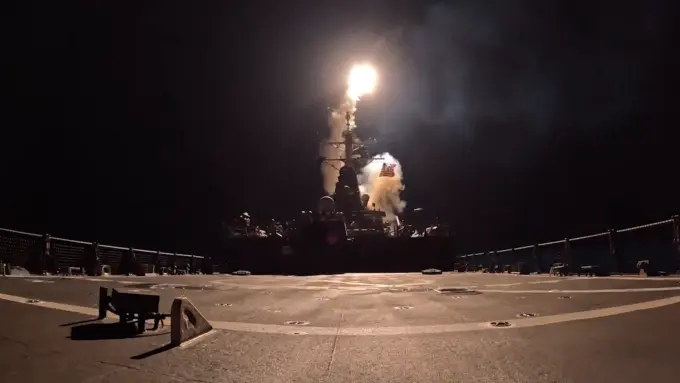
Photograph Source: U.S. Central Command – Public Domain
Jeffrey St. Clair recently stated in CounterPunch that “Iran’s leadership was discussing a plan to end its enriched uranium program when [the February 28th] attack was launched.” The U.S. bombing “was a joint venture with Israel,” stated St. Clair, “which has never wanted negotiations with Iran, only an end to the regime.” Stephen Zunes remarked just after the attack that “an Omani mediator said a nuclear agreement with Iran was within reach [and] in response, the United States and Israel started bombing.”
Further, Lawrence Davidson indicated that “Iran had agreed to deactivate its uranium stockpile. This done, it could not create a bomb. It is exactly the moment that the Iranians agreed to this that Trump and Netanyahu decided to launch their attack.” Trita Parsi at the Quincy Institute for Responsible Statecraft verifies a similar claim.
Sinan Ulgen, a former Turkish diplomat said, “the moral dilemma that we are all facing as neighbors of Iran on this first day, of what is likely to be a protracted regional escalation, is about defending multilateral norms vs. nuclear proliferation.” “The U.S. attacks are from an international law perspective,” said Ulgen, “totally illegal and illegitimate, but now that the campaign has started, Iran’s political will and nuclear infrastructure emerge relatively unscathed from all of this. The next phase will surely be regional proliferation.” Lebanese journalist Kim Ghattas called Trump’s actions “the ultimate hubris, a president more focused on the spectacle of power than its consequences.”
Events and Facts
Leading up to the war, as for the death toll among the 2025-2026 Iranian protesters in 27 of its 31 provinces, the Human Rights Activists News Agency (HRANA), Amnesty International, and Human Rights Watch estimated the number to be around 6,000 while a number of 33,000 spread on social media and among right-leaning diasporic sources without verification. The larger figure conflates historical prison executions dating back to 1988, is impacted by internet blackout, and politically motivated.
Additionally, actors such as the People’s Mojahedin Organization of Iran (MEK), may have intentionally inflated the numbers. Further, there have been reports that political violence in Tehran extends to leftists found and killed by Mossad. These facts illustrate a gap between irresponsibly circulated statements by Trump apologists and the actual verifiable evidence. What is more, Trump and Netanyahu’s poorly handled public statements months prior to the war, signaled the Iranian Revolutionary Guard Corps to hunt down U.S. and Israeli recruited Iranian soldiers (610,000 active personnel,) according to Seymour Hersh.
Overall, U.S. intelligence found no proof of an imminent Iranian threat although the UN could not verify a complete suspension of uranium. On March 3, it was reported by Iranian authorities that at least 168-180 people, including many school children, were killed in Minab by an airstrike. The girls’ school, Shajareh Tayyebeh Elementary, was originally built near a military base but the base has been closed for 15 years. Videos showing the Islamic Republic using civilians as human shields have been debunked as AI generated by FactNameh and the theory of Iranian misfire lacks forensic and operational proof.
Other anecdotal and unverified reports of the human shield narrative lack supporting evidence. Additionally, satellite imagery reported by NPR reveals that initial airstrikes on Iran featured multiple targets. The imagery is inconsistent with what would amount to Iranian friendly fire. Later analysis reveals it was likely a U.S. strike. Zunes, commented that “schools, hospitals, city parks, and cultural sites are being targeted in the United States and Israeli bombing of Tehran.” This included the Azadi Sports Stadium.
Interpretations and Motives
The 2026 Iran War features a larger fragmentation of the American ruling class. Trump is having a difficult time rationalizing and finding his rhetorical bearings with an unpopular action that suddenly has involved 16 nations and counting. Aside from the international consensus and clear violations of IHL and global norms, Trump has violated customary human rights obligations and standard foreign policy practices found in Just War Theory, realism, and the doctrines of smart power. As the U.S. Senate fails to “curb Trump’s war powers,” the president ignores “the lessons of Iraq.” And as Harvard’s Steven Levitsky once noted, “state failure brings violence and instability; it almost never brings democratization.”
The Joint Chief of Staff Chairman Gen. Dan Caine has been concerned with the plan and warned of its potential challenges. Trump’s policy of “Maximum Pressure” related to his posture of destabilizing Iran is accompanied by his “multiple choice communication” and ways to justify his overall lack of rhetorical consistency. In fact, Trump, Marco Rubio, and Pete Hegseth have relied on an unsteadiness in the place of stating concrete policy objectives.
After Rubio stated that the U.S. preemptively struck Iran because Israel was going to attack first, the narrative shifted to Iran supposedly aiming to attack both Israel and the U.S. Further, we are not actually at war, yet the war is going very well. All the while, Iran could be left with a leader worse than before. Regime change is not an option, but the administration is considering a change in the regime. Trump has also stated that he wants to select the next ayatollah, which puts his own supporters at home and abroad in a position to rally for a U.S. politician dedicated to giving them another human rights abuser they rightly resented in the first place.
America’s War of Choice
In 2009, Council on Foreign Relations President Richard Haass authored, War of Necessity, War of Choice: A Memoir of Two Iraq Wars. He compared the first war’s (1991) “traditional, legitimate, and strategic” approach to the second war (2003) — one “poorly conceived and implemented.” Haass concluded that “using force to oust regimes is simply too costly and too uncertain.” David E. Sanger, recently in the New York Times stated, “For Trump, the Iran Attack Is the Ultimate War of Choice.” Sanger remarked that Trump “was not driven by an immediate threat” and did not present evidence to justify the action. The concept of necessity in war requires the use of force only as a last resort.
Senior Policy Director at the European Council on Foreign Relations Jeremy Cliffe stated that “Europeans should communicate clearly that this is a war of choice by America, in contravention of the same UN charter [they] have invoked to condemn Russia’s illegal invasion of Ukraine and insist on Greenland’s sovereignty.” This conflict however, looks to be Israel’s war of necessity.
Operation Epic Fury presents a preventative strike, not a preemptive one under international law, much like Russia’s decision to invade Ukraine, which was denounced as a clear violation of international norms. Stephen Zunes pointed out, “This is not a preemptive war. A preemptive war is in response to an imminent attack. This is a war of aggression. A flagrant violation of the United Nations Charter.” Alarmingly, Trump stated over a month before the invasion that “I don’t need international law,” as he currently creates new norms. Zunes previously stated that “this war isn’t about nonproliferation, it’s about inflicting as much damage as possible on a country that isn’t willing to accept U.S. hegemony in the region.”
Overall, since returning to office for a second term, the Trump administration has carried out air strikes in Venezuela, Nigeria, Syria, Iraq, Iran, Yemen, and Somalia, according to the Council on Foreign Relations. In the Iran 2026 War, the U.S. has already carried out over 3,000 strikes.
Sanger emphasized however, that “Netanyahu urged [Trump] starting in December to launch this war” with little plan in sight. There is mounting evidence that interests serve Israel much more than the U.S. Top aides, diplomats, its top general, and the American people, have little faith in the attacks. America’s closest friend, Britain, refused the American military’s access to the Diego Garcia to launch American fighter jets. This later shifted to limited use.
Israel’s War of Necessity
It appears that the U.S. is clearly acting on behalf of Israel and prefers to use the country as an excuse to mobilize and cloud a series of domestic issues impacting Trump’s unpopularity at home. Ulgen also advanced that Trump “wanted to enter the November midterm elections as the U.S. leader who overthrew the regime in Iran.” A recent Politico article stated that “White House Officials believe ‘the politics are a lot better’ if Israel strikes Iran first.”
The question remains, how this decision impacts U.S. strategic interests. Muhammad Idrees Ahmad of New Lines Magazine indicated that the U.S. has no motive to go to war with Iran except for Israel and they have been pushing for a U.S. attack for the last 30 years. After September 11, 2001, the neocons targeted Iraq “only because it was part of their ‘dual rollback’ policy [and] selling a war on Iran seemed less achievable,” cited Ahmad. All the while Trump’s philosophical departures from Bolton, Bush and Cheney seem exaggerated and he’s like other hard-right hawks.
Netanyahu, “a wanted war criminal,” says reporter Secunder Kermani, has painted Trump into a regime change corner. Even worse than regime change, the goal could be outright “state collapse” as Mahbod Seraji wrote recently in Truthout. Trump lacks support from members of Congress, global allies, and the top brass in the military. Claiming that Israel has “a free hand” and drives U.S. foreign policy is usually a problematic accusation for many reasons, but in this case it looks self-evident. As Netanyahu recently stated, “Israel now has the assistance of the United States, my friend, U.S. President Donald Trump, and the U.S. military. This coalition of forces allows us to do what I have yearned to do for 40 years.” Iran is a thorn in the side of the U.S. but a major juggernaut for Israel.
For the most part, the U.S. has avoided the use of regional hard power when it came to the Iranian government. It seemed to go along with the Iranian foreign policy, what analyst Mouin Rabbani referred to as “strategic patience.” All the while, the U.S. has implemented a host of structural and cultural impediments to Iran’s social and political development including the toppling of democratically elected Mosaddegh in 1953, unlawful political violence, the killing of civilians, the arming of insurgents, and the murder of scientists, in addition to supporting Saddam Husseinthroughout his worst atrocities. Further, history lessons, such as the U.S. failure of the 1980s Operation Eagle Claw are being ignored.
Although it was argued that George W. Bush allowed Israel to fly reconnaissance missions over the Iranian border aimed at intimidation, the reports were challenged and he ultimately rejected Israel’s plea to invade Iran. Further, as Ahmad pointed out, “Dick Cheney had spent the 1990s lobbying for the removal of sanctions so U.S. companies could do business in Iran.” This advances the idea that Trump is following Israel’s lead, as he pushes the world further into regional escalation and global economic collapse, with well over 1,000 Iranians killed in the war’s first week alone.
Daniel Falcone is a historian, teacher and journalist. In addition to CounterPunch, he has written for The Journal of Contemporary Iraq & the Arab World, The Nation, Jacobin, Truthout, Foreign Policy in Focus and Scalawag. He resides in New York City and is a member of The Democratic Socialists of America.

