[By Patrick M. Cronin and David Glick]
Industrial endurance and allied integration are indispensable to making deterrence-by-denial against China credible under the 2026 National Defense Strategy. The Trump administration’s Maritime Action Plan rightly elevates cooperation with South Korea and Japan. But viewing these allies as a temporary bridge to U.S. revitalization understates the scale and longevity of the China challenge. What is needed is a fully integrated, long-term allied shipbuilding ecosystem, that can generate surge capacity, distributed production, and wartime repair across the Indo-Pacific. Without that durable industrial architecture, denial remains declaratory rather than operational. This essay makes that case.
If a war erupts over Taiwan, what will sink the U.S. Navy first: Chinese missiles or American shipyards? Analysts have catalogued the widening gap between China’s defense industrial base and America’s. Shipbuilding sits at the center of that imbalance. What began the decade as a pacing challenge has become a structural industrial advantage for Beijing. In the Indo-Pacific, deterrence now depends less on the number of hulls afloat than on the ability to replace, repair, and regenerate them under fire. On that measure of industrial endurance, the United States is dangerously behind.
The U.S. fleet lacks the scale, resilience, and regenerative capacity to compete with China’s expanding navy and the industrial base behind it. Even with higher funding and domestic reform, the United States alone cannot build the fleet required to match–let alone “overmatch”–China’s output. The U.S. Navy fleet currently stands at 290 ships compared to China’s 331. That gap, by itself, is not decisive. But Beijing can draw on a vast coast guard, merchant marine, and dual-use civilian fleet that allows Beijing to surge up to 5,500 hulls for support, refueling, and transport. The United States has roughly 80 comparable auxiliary and sealift vessels. This disparity reflects more than fleet size; it exposes structural constraints in American industrial capacity.
America’s defense industrial base, and shipbuilding in particular, has become structurally brittle after the collapse of commercial shipbuilding, decades of consolidation and specialization, workforce attrition, and highly inconsistent demand signals. Today, a remarkable degree of U.S. Navy major combatants are constructed at a handful of specialized yards run by two defense juggernauts: Huntington Ingalls Industries and General Dynamics.
These structural limitations matter because deterrence against Beijing now requires maritime power at a level the U.S. industrial base cannot produce independently. Attempts at domestic reform including President Trump’s ambition to build a “Golden Fleet” reflect a correct diagnosis of the problem, and executing the Maritime Action Plan may be key to reviving America’s claim to be a maritime nation. But execution is far from guaranteed. Previous U.S. efforts to slow China’s seapower ascendancy, including during Trump’s first term, have focused on massive increases in defense spending, radical policy changes, or both and many of these plans have stalled out.
As one of America’s top naval analysts, Ronald O’Rourke, argues, U.S. shipbuilding shortfalls reflect a systemic, self-reinforcing failure in which unaffordable plans, industrial limits, workforce bottlenecks, and flawed acquisition processes have collectively undermined capacity. The bottom line is that no amount of additional spending on ships or marginal policy reform within the United States alone can resolve the problem, especially as China’s larger, dual-use shipbuilding ecosystem turns American naval production capacity into a strategic liability.
“America First” rightly underscores the imperative to rebuild U.S. industrial capability, including its shipbuilding. But America alone, or cooperation limited to full onshoring, is insufficient. Unless Washington fully leverages the capabilities of allied seapowers, China’s maritime edge will grow. As Brent Sadler notes in Naval Power in Action, China has managed to “out-Mahan” the United States through an “aggressive and focused prioritization of a powerful civil-military national maritime sector.” His proposed remedy of a G-7-like consortium of maritime nations to meet the challenge is sound, but the foundational starting point must be to better harness the collective shipbuilding capabilities of the United States, South Korea, and Japan.
Although President Trump may instinctively support integrating allied shipbuilding capacity, current policy concentrates on comprehensive onshoring. The Maritime Action Plan, for all its strengths, largely confines allies to providing foreign direct investment in U.S. shipyards and maritime infrastructure. That contribution is important but insufficient.
A politically sustainable solution requires durable mutual benefit. Deterring China at scale will demand the systematic integration of allied shipbuilding capacity, especially from South Korea and Japan, into U.S. naval force planning. Capital that flows into American docks from threats of tariffs and placing conditionality on security alliances will undermine the alliance bonds on which our strategy depends. Without deep industrial cooperation, the United States will lack the industrial and thus operational resilience needed for credible Indo-Pacific deterrence. Absent complementary reforms, such as targeted modifications to the Jones Act and related statutes that tether shipbuilding exclusively to domestic yards, Washington will struggle to erect a shipbuilding defense industrial base that is both politically acceptable at home and economically sustainable for South Korea and Japan.
But let us start by briefly considering the strategic objective of deterrence by denial of China, because that is at the heart of calls for reviving shipbuilding capacity in the first place.
The Deterrence Challenge: Responding to Pressure with Endurance
The Trump administration’s National Security Strategy identifies China’s bid for dominance within and beyond the First Island Chain as a direct challenge to regional stability, while the National Defense Strategy prioritizes a defense-by-denial approach anchored along that same geography. This framework highlights that successful deterrence must operate not only against invasion, but across the subtler and more pervasive forms of coercion that Beijing prefers. Xi Jinping appears to recognize that a forcible seizure of Taiwan would carry extraordinary risks, yet his purging of senior generals heightens the danger of miscalculation and reinforces the need for full-spectrum deterrence.
A central danger is that Beijing seeks to exhaust Taiwan psychologically, economically, and militarily rather than gamble on an all-out invasion. China commands a broad menu of coercive options, ranging from gray-zone harassment and maritime quarantine to incremental blockade or amphibious assault, all designed to impose cumulative pressure while exploiting gaps in allied endurance and logistics rather than inducing a single decisive battle. For example, China has recently rehearsed navigating some 1,400 fishing vessels to form a 200-mile-long sea barrier that could support a blockade of Taiwan. This, alongside other graduated options, allows Beijing to vary pace and intensity, steadily degrading Taiwan’s resilience while testing allied political will.
China’s sprawling military-industrial complex further broadens its operational choices. The People’s Liberation Army (PLA) can field large quantities of long-range anti-ship missiles, submarines, and other systems designed to deny U.S. forces freedom of action at increasing distances. Operating close to home, Chinese forces benefit from interior lines of communication, proximate shipyards, and rapid repair and replacement capacity. These advantages allow the PLA to absorb losses and continue operations in ways that impose disproportionate strains on allied forces. In this context, deterrence erodes not through dramatic battlefield defeat, but through persistent pressure that gradually constrains Taiwan’s strategic breathing room.
China’s approach is reinforced by Xi’s “Overall National Security Outlook” and military-civil fusion, which together harness military, economic, technological, and political instruments into an integrated system for applying sustained pressure. The PLA Navy has increasingly revealed strategies of exhaustion, strangulation, and decapitation, all of which hinge on wearing down an opponent’s ability to regenerate combat power. These concepts can only be countered by adversaries whose own industrial and logistical systems can absorb shocks, reconstitute forces, and continue operating under demanding wartime conditions.
The human reality of protracted conflict underscores this requirement. Carl von Clausewitz reminded strategists that war is a “dangerous business” defined by fear, friction, and the grinding down of human will. E. B. Sledge’s graphic portrait of amphibious warfare at Peleliu and Okinawa captures how terror and attrition consume both personnel and equipment. Deterrence, therefore, fails not only when forces are defeated in battle, but when political will, logistics networks, and industrial capacity collapse under constant pressure. Industrial sustainment is not an afterthought but the oft-neglected backbone of strategic endurance.
History underscores this lesson. The high watermark of American shipbuilding came in World War II, when the rapid production of Essex-class carriers transformed U.S. naval power and reshaped the global maritime balance. This capacity for rapid regeneration was a strategic capability in its own right, enabling the United States to outlast a determined adversary in a prolonged contest of endurance.
The same logic applies today. Against a peer competitor prepared for protracted conflict, deterrence requires a fleet designed not only for initial advantage but for the ability to fight, absorb blows, and regenerate combat power over time. This demands a large, balanced, and modern force supported by industrial capacity for rapid maintenance, repair, and replacement. Such depth must underpin a “hedge force” emphasizing quantity, distribution, and survivability across manned and unmanned platforms, and avoiding over-reliance on a small number of exquisite, vulnerable assets.
Ultimately, regeneration becomes a deterrent mechanism. A force that can endure is a force that can deny, dissuade, and defeat an opponent.
United States Constraints
The U.S. Navy’s strengths are not well matched to the challenges of a conflict with China. Although American platforms may possess momentarily superior individual capability, a fight in the South China Sea would unfold inside a dense Chinese A2/AD envelope, sustained by large inventories of land-based anti-ship missiles. In a missile-saturated battlespace, deterrence cannot rest on qualitative superiority alone. It requires layered capability, what the Hudson Institute defense team has conceptualized as “edge,” “pulsed,” and “core” forces, all supported by critical enablers. Industrial endurance is indispensable to field such layers while retaining the capacity to absorb and regenerate losses. Combat experience and alliance exercises enhance readiness, but qualitative advantages cannot offset numerical and industrial imbalance in a protracted war fought in China’s near seas.
Countering Beijing’s coercive strategy therefore demands endurance as much as lethality. Taiwan must demonstrate the political will, societal resilience, and frontline resistance to withstand sustained pressure. The United States and Japan, supported by South Korea as a rear-area sustainment, repair, and replacement hub, must present a unified posture that undercuts Chinese confidence across the spectrum of coercion. Any visible alliance seams will be exploited, perhaps as suggested by a recent U.S.-China air encounter in the Yellow or West Sea.
A credible deterrence-by-denial strategy integrates these elements: resilient frontline forces at the edge; long-range strike forces that can be surged or “pulsed” into theater; sufficient “core” forces to sustain operations over time; and the enabling architecture of ISR, logistics, command and control, and industrial capacity, that binds them together. Without this layered military and industrial integration, the United States military will display significant operational gaps and deterrence in the Indo-Pacific will remain vulnerable.
The United States currently lacks the industrial foundation required to meet this challenge. While the PLA Navy has been built primarily for high-intensity regional conflict, much of the U.S. fleet reflects decades of emphasis on power projection and presence missions in permissive environments. At the same time, as China’s shipbuilding capacity has swelled, the U.S. Navy has struggled merely to sustain a large and ready fleet to meet its global commitments.
The United States has particularly lagged behind China in the construction of platforms suited to navigate the South China Sea’s littoral and archipelagic geography. Fast, maneuverable frigates are likely to be central to distributed operations in the Indo-Pacific. China can now launch multiple modern frigates annually, with construction timelines measured in months. By contrast, the United States’ Constellation-class frigate program has yet to deliver a single operational hull after nearly a decade of effort amid design instability and cascading delays. At the same time, the United States has been upgrading cutters designed for the Coast Guard as stopgap naval vessels, despite their lack of vertical launch systems, even as China has shifted naval platforms into its formidable coast guard.
These and other difficulties stem from persistent structural weaknesses in domestic shipbuilding and maintenance infrastructure, as suggested at the outset of this essay. Consolidation has reduced competition and flexibility. Skilled labor shortages constrain manufacturing. Inconsistent procurement planning disrupts both workers’ lives and capital investment. Regulatory red tape slows production and increases cost. New construction routinely runs late and over budget, while maintenance backlogs keep operational ships tied to the pier. Industrial shortcomings sap U.S. naval credibility.
Civilian and military leaders alike acknowledge the shipbuilding gap with China. President Trump’s “Make Shipbuilding Great Again” initiative, calls for a Golden Fleet, and proposal for defense spending approaching $1.5 trillion, all of which preceded the Maritime Action Plan of February 2026, underscore growing recognition of the problem. These gestures matter, but slogans and topline numbers do not build ships. Reviving U.S. shipbuilding will require sustained political discipline, industrial reform, workforce development, and years of execution. For example, the idea of 100 maritime prosperity zones sounds appealing, but risks overreach without delivering serious production. None of this is guaranteed. Failure would leave the United States attempting to deter a maritime peer with an industrial base unfit for protracted competition.
The reality is that U.S. domestic shipbuilding capacity cannot expand fast enough to match Chinese production rates within the timeframe deterrence demands. Building new shipyards or dramatically expanding existing ones requires time, secure supply chains, and skilled labor that the United States currently lacks. The Trump administration has recognized this constraint and begun to pursue serious allied cooperation. Agreements with Australia, Japan, and South Korea are steps in the right direction, but they remain insufficient. Incremental progress will not produce the fleet needed to compete with China.
Allied Shipbuilding Capacity
Integrating allied industrial capacity into U.S. naval force planning offers several advantages.
First, allied shipyards represent an immediate force multiplier by bolstering collective shipbuilding. South Korea and Japan possess advanced shipbuilding industries with available capacity, skilled workforces, and resilient supply chains. Leveraging these yards would allow the United States to accelerate production without waiting years for domestic capacity to mature. In key areas such as automated manufacturing and AI-enabled shipbuilding, allied firms already lead global best practices.
Second, forward-deployed repair and maintenance capacity in allied countries would provide crucial operational benefits during a Taiwan or South China Sea contingency. Damaged ships could reach allied yards in days rather than weeks, preserving combat power and reducing exposure during trans-Pacific transits. This distributed sustainment architecture materially enhances fleet readiness and resilience.
Third, allied cooperation can modernize the combined naval industrial base. Different engineering traditions and production methods can complement U.S. designs and spur innovation. Key U.S. allies remain leaders in advanced manufacturing and high-tech shipbuilding. Collaborative development will spread research and development costs while expanding the menu of available platforms, particularly for modular and unmanned systems.
Fourth, integrated allied production strengthens deterrence by signaling coalition resolve. When allies invest directly in building U.S. naval power, they demonstrate commitment to collective defense and complicate Chinese strategic calculations by expanding the scale and durability of any potential response.
The accompanying graphic (below) demonstrates not only scale but trajectory. While U.S. naval tonnage has remained stagnant over the last 15 years, China’s has more than doubled. South Korea and Japan’s rates of growth make it clear that their shipbuilding ecosystems have remained dynamic, making them key partners in an American shipbuilding resurgence.

South Korea
South Korea hosts some of the world’s most capable and efficient shipyards and is second only to China. Firms such as Hanwha Ocean, HD Hyundai Heavy Industries, and Samsung Heavy Industries routinely deliver complex naval vessels at lower costs and faster timelines than U.S. yards. Their success rests on a comprehensive industrial ecosystem encompassing regional steel production, automation, lifecycle sustainment, and a deep pool of trained shipbuilding engineers.
Korea’s advantage is not only in cost and speed, but also in their advanced technical shipbuilding ecosystem. Seoul’s leading yards operate cutting-edge digitally integrated production systems that use 3D modeling and advanced simulation tools to improve workflow and enhance efficiency. Korea is prioritizing developing their technological advantage and government officials have pledged to spend over 320 billion won ($240 million) on artificial intelligence driven shipbuilding, a 23% increase from the previous year.
Cooperation is already expanding. Shipbuilding is a core element of South Korea’s strategic investment in the United States. Hanwha Ocean is investing heavily in its Philadelphia shipyard and exploring additional U.S. facilities, even as it pursues contracts with Canada that might help strengthen Hanwha’s massive Geoje shipyard that produces about 45 commercial and naval ships a year. Seoul’s decision to develop a nuclear-powered submarine represents a political breakthrough made politically conceivable by signals of greater U.S. flexibility on nuclear cooperation; with sustained U.S. support and a willingness to allow submarine production in South Korea, the SSN could deepen alliance industrial integration while advancing shared maritime capabilities.
Strategic alignment reinforces the case for cooperation. Both Washington and Seoul view China’s military modernization with concern and share an interest in stability in the Taiwan Strait. South Korea’s geography and industrial capacity make it a pivotal partner in any strategy to expand U.S. naval power, particularly given the strategic aim of defending the First Island Chain.
Japan
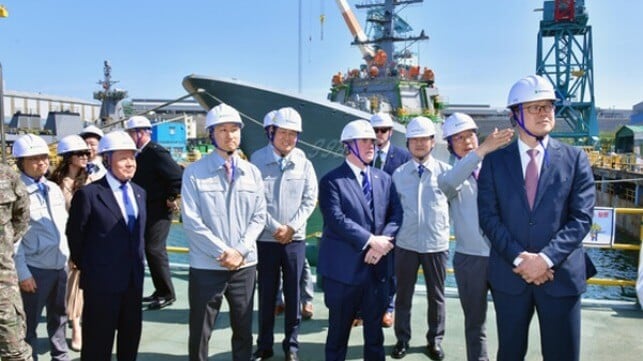
Japan, the world’s third-largest shipbuilder, offers complementary strengths. While its shipyards operate at a smaller scale than South Korea, they excel in precision manufacturing and systems integration. Mitsubishi Heavy Industries leads a group of seven major shipbuilders in Japan. Mitsubishi Shipbuilding was created in 2018 to bring cutting-edge technology and a new business model to building a wide variety of ships. Its shipyard at Nagasaki, founded in 1857 by the Tokugawa Shogunate, will build the first three Mogami-class frigates for Australia. The Japan Maritime Self-Defense Force operates sophisticated warships incorporating advanced sensors, propulsion, and weapons, and Japanese yards have proven adept at integrating complex systems to exacting standards.
Cooperation has moved from concept to execution. U.S. naval vessels have already undergone maintenance in Japanese yards, establishing technical interoperability and operational trust. Agreements reached in late 2024, reaffirmed and substantially enlarged by President Trump and Prime Minister Sanae Takaichi, outline frameworks for expanded joint shipbuilding capabilities and potential co-production.
Japan’s strategic incentives are strong. Chinese military activity near Japanese territory has intensified, prompting Tokyo to accelerate defense spending and once again revise and update key national security documents. This political commitment provides a durable foundation for long-term industrial partnership. Prime Minister Takaichi’s landslide LDP victory in the lower house enhances Tokyo’s determination to strengthen alliance cooperation in general and defense industrial cooperation in particular.
Other Regional Partners
Other Indo-Pacific allies can provide vital supporting capacity. Australia’s participation in AUKUS (the Australia, UK, U.S. defense partnership) demonstrates allied willingness to make substantial, generational investments. Canberra’s pledge to invest $3 billion in U.S. submarine shipyards is among the most concrete steps toward revitalizing American undersea production capacity, and Australian yards may eventually contribute more broadly.
Southeast Asian allies and partners also matter. The Philippines, as a treaty ally and frontline state facing persistent Chinese coercion, is also ranked among the world’s leading shipbuilding nations by commercial gross tonnage. Thus, Manila can contribute beyond providing critical access through implementation of the Enhanced Defense Cooperation Agreement. Expanded development of Subic Bay could support forward maintenance and overhaul, especially as Manila grows its naval and coast guard forces. Korean investment has helped reopen the long-dormant Subic Bay shipyard, offering a potential hub for additional allied maintenance and repair. Japan is another critical source of maritime support and its acquisition and cross-servicing agreement with the Philippines thickens the web of cooperation among America’s key maritime allies.
Together, these initiatives point to the emergence of an allied maritime industrial network across the Indo-Pacific, still uneven but increasingly consequential. While some leading regional analysts argue for formalizing this cooperation into a treaty-based Asian alliance, the more feasible and immediate task is to build the industrial sinews that would give any future alliance real weight in the form of shared production capacity, repair and regeneration capacity, and interchangeable shipbuilding and sustainment ecosystems. Industrial integration is not a substitute for alliance commitments, but it is the foundation that makes alliance commitments credible in crisis and resilient over time.
Current Partnerships and Their Limits
Existing initiatives underscore both promise and limitation. AUKUS is the most ambitious effort to date, while agreements with South Korea and Japan on repair, maintenance, and potential co-production reflect growing momentum. Yet these efforts remain fragmented and largely ad hoc. Many rely on waivers, pilot programs, or working groups without permanent institutional backing.
Even sanctioned initiatives face friction. The Korean-operated Philadelphia shipyard has encountered regulatory and workforce hurdles, illustrating the difficulty of scaling cooperation under current rules. Execution risk remains substantial. Regulatory friction, workforce constraints, and shifting political priorities on both sides of the Pacific could delay or derail even well-intentioned initiatives. Allies contemplating major capital investments remain uncertain whether U.S. policy will endure across administrations or whether cooperation will move beyond pilot programs and waivers. These risks do not weaken the case for allied shipbuilding integration; they strengthen it. Without early institutionalization, deterrence will rest on assumptions about capacity that may never materialize.
Areas for Cooperation: Destroyers
A U.S. fleet capable of countering China will require a strong destroyer fleet. Destroyers offer exceptional operational versatility through their anti-air, anti-ship, and anti-submarine capabilities. In describing the hedge force needed to confront China, Bryan Clark identifies the destroyer as a central element of the force mix because of its role in air and missile defense and in protecting other ships. As China expands its missile arsenals and extends their range, the United States must continue to build and expand its destroyer program to keep pace.
The Arleigh Burke-class destroyer (DDG 51), first commissioned in the early 1990s, remains the vital pillar of the U.S. surface fleet. The United States currently has 74 of these destroyers in service, with 23 more hulls in the planning pipeline. Yet frequent cost overruns and delays make relying on this program alone a precarious bet. The ship has been repeatedly updated to meet changing needs, but these modifications have been imposed on a deteriorating industrial base. The result has led the Congressional Budget Office to conclude that average construction delays for the ship class have worsened significantly in recent years, with new ships now taking more than eight years to build. Meanwhile, China reportedly takes roughly two years to build its 52D destroyer and approximately three years for its more advanced Type 055.
While destroyers are crucial in a conflict against China, Beijing has more capacity to build these ships, and its advantage is only increasing. South Korea, however, is one of the world’s leading builder of destroyers. The Korean Jeongjo the Great-class destroyer is approximately one-quarter larger than the Arleigh Burke-class. The Korean destroyer also features a mix of U.S. and Korean systems on board which allow it to fire both long- and short-range missiles. Most impressive is the speed and cost with which South Korea has been able to build this ship. The destroyer was built in about three years. Secretary of the Navy John Phelan, noting the quick timeline, also observed that Korean shipyards can build this class at roughly a third of the cost of a comparable U.S. destroyer, attributing this performance to yard efficiency, workforce skill, and limited regulatory friction.
South Korea is thus a world leader in a military technology that the United States urgently needs. Working with Korea to reform U.S. yards, integrate Korean building techniques, expand co-production and licensing, and eventually purchase Korean-designed military technology will be key to developing the destroyer fleet that the United States requires.
Areas for Cooperation: Advanced Technologies
Another common criticism of U.S. shipbuilding is that the industry does not make sufficient use of advanced technologies to support the shipbuilding process. A report by the GAO found that naval shipyards have been slow to adopt digital modeling, planning tools, and other advanced technologies that can speed construction and reduce delays. Additionally, outdated equipment and reliance on labor-intensive processes rather than automation reduce U.S. efficiency. While there is a legitimate balance between preserving jobs and adopting new technology, both suffer if strategic objectives cannot be delivered on time and at scale.
Policymakers have identified increased automation as essential to improving shipbuilding effectiveness. Palantir Technologies has been working on a $448 million project to integrate AI into naval shipbuilding through the ShipOS initiative, and senior naval leaders have pledged to prioritize automation and digitalization in public and private yards. As the United States continues to develop these capabilities, South Korea and Japan should be treated not merely as investors or licensees, but as core partners.
Both South Korean and Japanese shipyards are renowned for leveraging cutting-edge technologies to improve efficiency. In South Korea, HD Hyundai is building a world-class digital shipyard that uses automation and digital modeling to enhance speed and precision; yards have begun using AI robots to weld, cutting down welding times by one-third in the process. Japanese shipbuilders employ similarly advanced 3D modeling and are investing in laser-arc hybrid welding and other techniques. South Korea and Japan have the tools and expertise to be key collaborators in identifying, developing, and deploying the technologies that will shape the future of naval shipbuilding.
As the war in Ukraine has shown, Soviet-era weapon systems and battle plans struggle to hold up in modern warfare shaped by cutting-edge technology, including AI-enabled systems and increasingly advanced requirements for speed, precision, and accuracy. In several of these areas, China faces limitations, while Korea and Japan possess notable strengths. For instance, China’s submarines have long faced criticism for acoustic noise. Meanwhile, Korean yards are building some of the most advanced conventional submarines, setting high standards for stealth and effectiveness. Working with allies to continue pushing the frontier of military technology is a valuable way to achieve economies of scale while leveraging some of the world’s most capable technical talent.
Naval shipbuilding integration would not be limited to destroyers or technology sharing. A U.S.-South Korean nuclear-powered submarine could ultimately be joined by Japan, too. Another project with lower hurdles would be an “Asian corvette” produced by the United States, Japan, and South Korea, with the aim of exporting the VLS-equipped, fast-attack vessel to help regional partners and ASEAN navies facing Chinese maritime coercion.
Barriers to Cooperation
Despite the potential for cooperation, two constraints loom largest. First, U.S. ambitions remain too narrow. Outside AUKUS, cooperation focuses mainly on maintenance, with limited progress on new construction, technology co-development, or integrated force planning. Second, legal and regulatory barriers deter sustained partnership.
The U.S. defense establishment lacks a single, empowered senior official responsible for international defense industrial cooperation. The 2018 reorganization of acquisition leadership, while intended to sharpen innovation and procurement, had the effect of diffusing authority across multiple offices. Allies were left without a clear counterpart for industrial coordination.
Even as South Korea, Japan, Australia, and other partners increase investment in U.S. and allied dual-use and defense industrial capacity, cooperation remains managed through existing channels within the Office of the Under Secretary of Defense/War for Acquisition and Sustainment. These mechanisms are functional but insufficiently empowered for the scale and strategic importance of emerging allied industrial integration. Expanding cooperation requires commensurate authority.
The Defense Innovation Board’s proposal to establish an Undersecretary of Defense for International Industrial Cooperation therefore merits urgent consideration. Shipbuilding may not be strategy, but a maritime strategy without a fleet will not sail.
Statutory constraints–including the Jones Act and the Byrnes-Tollefson Amendment, which restrict foreign-built ships in U.S. domestic trade, and the International Traffic in Arms Regulations, which govern technology transfer–serve legitimate purposes but significantly hamper cooperation on hull construction, systems integration, and design data sharing. Case-by-case waivers, such as those granted under AUKUS, may suffice in the short-term, but they also create uncertainty and administrative burden that can hinder long-term success. Recent legislative proposals, including the SHIPS for America Act and the Ensuring Naval Readiness Act, offer partial relief and deserve prompt consideration.
Brent Sadler’s recommendations in Naval Power in Action rightly emphasize that restoring American sea power requires more than mere fleet modernization. He underscores the need to rebuild U.S. merchant shipping and shipyard capacity, while advancing a maritime alliance able to integrate industrial regeneration as deliberately as operational planning. This logic points toward a more comprehensive solution: establishing a “trusted shipbuilding partner” framework with allies such as South Korea and Japan, whose advanced shipyards, skilled workforces, and shared security standards make them natural anchors for allied naval production and sustainment. By streamlining contracting, enabling secure technology transfer, and aligning long-term production planning, such a framework would reduce friction, accelerate fleet regeneration, and transform allied shipbuilding capacity into a standing component of deterrence rather than an ad hoc supplement in crisis.
Conclusion
The United States faces a narrowing strategic choice. One path is to attempt to outbuild China domestically, but trends suggest that approach will fail. China’s shipbuilding dominance is the product of decades of focused policy and massive state-led investment. The United States cannot replicate that achievement on its own within the timeframe effective deterrence demands.
The alternative is to integrate allied shipbuilding more fully into American maritime power. The combined industrial capacity of the United States, South Korea, Japan, and other capable allies can match Chinese output while producing a force that is more resilient and adaptive over time.
Achieving this will require institutional reform, legal change, and sustained political commitment. Without such integration, however, the United States risks entering the 2030s with insufficient naval power to deter Chinese aggression, inviting the very conflict it seeks to prevent. With systematic allied integration, the United States can build the fleet required to maintain stability across the Indo-Pacific while strengthening alliances that are effective rather than entangling.
This is not about outsourcing responsibility. It is about aligning industrial reality with strategic necessity. Successful military alliances rest on shared goals, shared burdens, and shared decision-making. The purpose of integrated allied shipbuilding is not cooperation for its own sake, but the preservation of U.S. influence and therefore peace in the world’s most consequential region, what Nicholas Spykman famously described as the “Asiatic Mediterranean.”
A stronger homegrown U.S. shipbuilding and maritime industry remains essential. But domestic revitalization and allied integration are not alternatives; they are mutually reinforcing. A revitalized U.S. industrial base working closely with selected, capable, and willing maritime allies is indispensable to a strategy of deterrence along the First Island Chain. Understood in this light, allied shipbuilding is not optional. It is imperative.
Dr. Patrick M. Cronin is Asia-Pacific Security Chair at the Hudson Institute and a Scholar in Residence at Carnegie Mellon University’s Institute for Strategy and Technology (CMIST), where David Glick is a student.
This article appears courtesy of CIMSEC and may be found in its original form here.
The opinions expressed herein are the author's and not necessarily those of The Maritime Executive.