Showing posts sorted by relevance for query SOLSTICE. Sort by date Show all posts

Tuesday, December 22, 2020

The December solstice happens at the same instant for everyone, everywhere on Earth – and this year the winter solstice occurs on Monday December 21, at 10:02 GMT in the Northern Hemisphere.


The winter solstice happens every year when the Sun reaches its most southerly declination of -23.4 degrees. In other words, it is when the North Pole is tilted farthest away from the Sun, delivering the fewest hours of sunlight of the year.

The Sun is directly overhead of the Tropic of Capricorn in the Southern Hemisphere during the December solstice and is closer to the horizon than at any other time in the year, meaning shorter days and longer nights.

The shortest day of the year lasts for 7 hours 49 minutes and 42 seconds in London, which is over 9 hours shorter than the June Solstice. As such, Monday December 21 will be the longest night of the year.

The day after the winter solstice marks the beginning of lengthening days, leading up to the summer solstice in June.

In the Southern Hemisphere, the opposite is true. Dawn comes early, and dusk comes late. The sun is high and the shortest noontime shadow of the year happens there. In the Southern Hemisphere, people will experience their longest day and shortest night.


Sunset at Stonehenge, just after the winter solstice CREDIT: MOMENT RF/GAIL JOHNSON

Does the winter solstice always fall on December 22nd?

While it more often than not falls on December 21 or 22, the exact time of the solstice varies each year. In the Northern hemisphere the winter solstice is the shortest day of the year, because it is tilted away from the sun, and receives the least amount of sunlight on that day.

However, the earliest sunset does not occur on the solstice, because of the slight discrepancy between 'solar time' and the clocks we use.

The shortest day of the year often falls on December 21, but the modern calendar of 365 days a year - with an extra day every four years - does not correspond exactly to the solar year of 365.2422 days.

The solstice can happen on December 20, 21, 22 or 23, though December 20 or 23 solstices are rare.

The last December 23 solstice was in 1903 and will not happen again until 2303.


Read more: What a Covid Christmas will look like in 2020


What does 'solstice' mean?

The term 'solstice' derives from the Latin word 'solstitium', meaning 'Sun standing still'. On this day the Sun seems to stand still at the Tropic of Capricorn and then reverses its direction as it reaches its southernmost position as seen from the Earth.

Some prefer the more teutonic term 'sunturn' to describe the event.


Is the solstice the first day of winter?

The answer might vary depending on who you ask. There are two types of winter: astronomical and meteorological.

This year, astronomical winter begins on December 21, with the winter solstice, and ends on March 20 2021. Meteorological winter always begins on December 1 and ends on February 28 (February 29 during leap years).

While astronomical winters are determined by the Earth's orbit around the sun, meteorological winters are the three calendar months with the lowest average temperatures.

The Met Office tend to use the meteorological definition of the seasons.


Stonehenge and the solstice

Scores arrive at the prehistoric monument in Wiltshire to mark the occasion. Why is the site so important?

Stonehenge, the prehistoric monument located in Wiltshire, is carefully aligned on a sight-line that points to the winter solstice sunset (opposed to New Grange, which points to the winter solstice sunrise, and the Goseck circle, which is aligned to both the sunset and sunrise).

Archaeologists believe it was constructed from 3000 BC to 2000 BC and it is thought that the winter solstice was actually more important to the people who constructed Stonehenge than the summer solstice.


Druids and other worshippers celebrate the winter solstice at Stonehenge every year
 CREDIT: HANNAH MCKAY/REUTERS

The winter solstice was a time when cattle were slaughtered (so the animals would not have to be fed during the winter) and the majority of wine and beer was finally fermented.

The only other megalithic monuments in the British Isles which clearly align with the sun are Newgrange in County Meath, Ireland and Maeshowe situated on Mainland, Orkney, Scotland.

You can also see the solstice sunrise around the world; this website shows the streets in cities around the world where you can get a clear view of the sun rising on the morning of the solstice.
How is the solstice being celebrated at Stonehenge this year?

In the pagan and druid communities, they celebrate the first sunrise after the astronomical event - and English Heritage time their official event in line with this.

This year, celebrations at Stonehenge fall on Monday December 21, with the sun rising at 6:52am if it still goes ahead. A spokesperson for Stonehenge said: "This year we haven’t been able to host the usual gatherings for summer solstice and the equinoxes at Stonehenge because of the Coronavirus pandemic. As we approach the winter solstice we are keeping the situation under review and will make a decision informed by the latest advice from Government and local partners nearer the time."

In 2009, a crowd wearing traditional costume, met at Stonehenge on December 21 morning to mark the rising of the sun on the shortest day of the year. But unfortunately their calculations were slightly out meaning they had in fact arrived 24 hours prematurely.

The '09 solstice fell at exactly 5:47pm that day, and because the sun had already set, the official celebrations were due to take place at sunrise the next day.

English Heritage, who manage the ancient site in Wiltshire, decided to open the gates anyway and welcome those who had made a miscalculation.

A spokesman for English Heritage said at the time: "About 300 people turned up a day early. We took pity on them and opened the stone circle so they could celebrate anyway. They were a day early but no doubt had a wonderful time as well.


Arthur Pendragon poses as Druids, pagans and revellers gather in the centre of Stonehenge, hoping to see the sun rise, as they take part in a winter solstice ceremony 
CREDIT: CREDIT: MATT CARDY/GETTY IMAGES

"People always assume that because the summer solstice is the June 21, the winter solstice will be December 21. They should always check because it does change."

Pagan leader Arthur Pendragon said: "It is the most important day of the year for us because it welcomes in the new sun.

"There were hundreds of people there. If we'd celebrated on the 21st it would have been the right day but the wrong sun – when the whole point of the occasion is about welcoming in the new sun."
Why isn’t the earliest sunset on the year’s shortest day?

Solar noon - the time midway between sunrise and sunset - is when the sun reaches its highest point for the day, but the exact time of solar noon, as measured by Earth’s spin, shifts.

A clock ticks off exactly 24 hours from one noon to the next but actual days – as measured by the spin of the Earth – are rarely exactly 24 hours long.

If the Earth’s spin is measured from one solar noon to the next, then one finds that around the time of the December solstice, the time period between consecutive solar noons is actually 30 seconds longer than 24 hours.

Therefore two weeks before the solstice, for example – the sun reaches its 'noontime' position at 11:52am local standard time.

Two weeks later - on the winter solstice – the sun reached that noontime position at 11:59am - seven minutes later.

The later clock time for solar noon also means a later clock time for sunrise and sunset. The result? Earlier sunsets before the winter solstice and increasingly later sunrises for a few weeks after the winter solstice.

The exact date of earliest sunset varies with latitude but the sequence is always the same.

For the Northern Hemisphere the earliest sunset occurs in early December and the latest sunrise happens in early January. This year the earliest sunset is on December 12 and the latest sunrise for next year on January 4 2021. 

Solstice celebrations around the world


The December solstice marks the 'turning of the Sun' as the days slowly get longer. Celebrations of the lighter days to come have been common throughout history with feasts, festivals and holidays around the December solstice celebrated by cultures across the globe.

Saturnalia


The winter solstice festival Saturnalia began on December 17 and lasted for seven days in Ancient Rome.

These Saturnalian banquets were held from as far back as around 217 BC to honour Saturn, the father of the gods.

The holiday was celebrated with a sacrifice at the Temple of Saturn, in the Roman Forum, and a public banquet, followed by private gift-giving, continual partying, and a carnival atmosphere that overturned Roman social norms.

The festival was characterised as a free-for-all when all discipline and orderly behaviour was ignored.

Wars were interrupted or postponed, gambling was permitted, slaves were served by their masters and all grudges and quarrels were forgotten.


Saturnalia by Antoine-Francois Callet (1741-1823) Musée du Louvre


It was traditional to offer gifts of imitation fruit (a symbol of fertility), dolls (symbolic of the custom of human sacrifice), and candles (reminiscent of the bonfires traditionally associated with pagan solstice celebrations).

The Saturnalia would degenerate into a week-long orgy of debauchery and crime – giving rise to the modern use of the term 'saturnalia', meaning a period of unrestrained license and revelry. A mock 'king' was even chosen from a group of slaves or convicts and was allowed to behave as he pleased for seven days (until his eventual ritual execution).

The poet Catullus considered it to be "the best of days."

Yalda

Yalda or Shab-e Chelleh ('night of forty') is an Iranian festival celebrated on the "longest and darkest night of the year," i.e. the night of the Northern Hemisphere's winter solstice.

Every year, on the date of the Winter solstice, Iranians celebrate the arrival of winter, the renewal of the sun and the victory of light over darkness on Yalda Night.

Ancient Iranians believed that the dawning of each year is marked with the re-emergence or rebirth of the sun, an event which falls on the first day of the month of Dey in the Iranian calendar (December 21).

On this day, the sun was salvaged from the claws of the devil, which is represented by darkness, and gradually spread its rays all over the world to symbolise the triumph of good over evil. Family members get together (most often in the house of the eldest member) and stay awake all night long in Yalda.

Pomegranate, watermelon and dried nuts are served as a tradition and classic poetry and old mythologies are read in the gathering.

It is believed that eating watermelons on the night of Chelleh will ensure the health and well-being of the individual during the months of summer by protecting him from falling victim to excessive heat or disease.

In Khorasan, there is a belief that whoever eats carrots, pears, pomegranates, and green olives will be protected against the harmful bite of insects, especially scorpions. Eating garlic on this night protects one against pains in the joints.

Getting a ‘Hafez reading’ from the book of great Persian poet Shamsu d-Din Muhammad Hafez-e Shirazi is also practiced.

Another custom performed in certain parts of Iran on the night of Chelleh involves young engaged couples. The men send an edible arrangement containing seven kinds of fruits and a variety of gifts to their fiancees on this night.

In some areas, the girl and her family return the favour by sending gifts back for the young man.



Wednesday, June 21, 2023

Antlers and fancy dress: Stonehenge welcomes 8,000 visitors for summer solstice


STONEHENGE, England (AP) — All hail the rising sun.

Around 8,000 revellers gathered around a prehistoric stone circle on a plain in southern England to express their devotion to the sun, or to have some communal fun.

Druids, pagans, hippies, local residents and tourists, many clad in an array of colorful costumes and even antlers, stayed and celebrated at Stonehenge for the night and greeted sunrise on Wednesday, which is the longest day in the Northern Hemisphere.

At dawn, the sun rose behind what is known as the Heel Stone in the northeast part of the horizon and the first rays shone into the heart of Stonehenge, one of the world’s most famous prehistoric monuments and a World Heritage Site.

A sun-filled dawn followed a slightly misty sunrise, which was greeted with drumming, chanting and cheering.

“Stonehenge continues to captivate and to bring people together to celebrate the seasons, just as it has done for thousands of years,” said Nichola Tasker, director of Stonehenge at English Heritage, a charity that manages hundreds of historic sites.

“There was a wonderful atmosphere from sunset to sunrise, and everybody enjoyed a very atmospheric morning," she added.

Local police said two people were arrested on suspicion of a public order offense after they were refused entry due to intoxication.

“Everyone has been joyous, enjoying the event and having a glorious time and it has been peaceful and safe," said Wiltshire Police Chief Constable Catherine Roper, who attended the solstice for the first time.

In addition to the 8,000 people present, English Heritage said that approximately 154,000 people tuned in from around the world to watch the sunset and sunrise on the charity’s livestream

All over the U.K., optimism will reign supreme as summer officially starts. It's no coincidence that the nearby Glastonbury Festival, one of the world's biggest music events, opens its doors on Wednesday, too. Both Stonehenge and Glastonbury supposedly lie on ley lines — mystical energy connections across the U.K.

For the thousands making the pilgrimage to Stonehenge, approximately 80 miles (128 kilometers) southwest of London, it is more than looking forward to Elton John at Glastonbury or a few ciders in the sun. Many of those present at Stonehenge will be making the short 50-mile (80-kilometer) journey further west to Glastonbury over the coming days.

For druids, modern-day spiritualists linked to the ancient Celtic religious order, Stonehenge has a centuries-long importance, and they performed their rituals around the solstice in their traditional white robes. It's effectively all about the cycle of life, of death and rebirth.

This year, the summer solstice at Stonehenge started at 7 p.m. Tuesday and ran through 8 a.m. Wednesday. For this one night, worshippers are allowed to spend time inside the stone circle. Some chanted or played their acoustic guitars or banged their drums. Alcohol was prohibited, as were sound systems. Blankets were allowed, but no sleeping bags, please. And definitely, no climbing on the stones.

The rules have been tightened over the decades, certainly during the coronavirus pandemic. Back in the less-restrained past, tens of thousands would travel by foot, car, bus or motorcycle to worship at the solar temple, or just have a bit of fun.

Stonehenge is a symbol of British culture and history and remains one of the country’s biggest tourist draws, despite the seemingly permanent traffic jams on the nearby A303 highway, a popular route for motorists traveling to and from the southwest of England.

Stonehenge was built on the flat lands of Salisbury Plain in stages starting 5,000 years ago, with the unique stone circle erected in the late Neolithic period about 2,500 B.C. Some of the stones, the so-called bluestones, are known to have come from the Preseli Hills in southwest Wales, nearly 150 miles (240 kilometers) away, but the origins of others remain a mystery.

The site’s meaning has been the subject of vigorous debate, with some theories seemingly more outlandish, if not alien, than others.

English Heritage notes several explanations — from Stonehenge being a coronation place for Danish kings, a druid temple, a cult center for healing, or an astronomical computer for predicting eclipses and solar events.

The charity said the most generally accepted interpretation "is that of a prehistoric temple aligned with the movements of the sun.”

After all, the stones match perfectly with the sun at both the summer and winter solstices.

___

Pylas reported from London.

Pan Pylas And Kin Cheung, The Associated Press


Summer solstice: The science behind the longest day of the year

References
By Jamie Carter published 2 days ago

The summer solstice falls on June 20 or 21 every year in the Northern Hemisphere. Here's why this day is the longest day of the year, with the most hours of daylight.

On the summer solstice, the sun appears high in the sky at noon. In contrast, the noon sun appears low in the sky on the winter solstice.
 (Image credit: (C) Jonathan Chiang/Scintt via Getty Images)

Why does the date vary?
Earth's distance from the sun
How long is summer?
What does "solstice" mean?
Why isn't it the warmest day?
When is it?
Summer solstice celebrations


The summer solstice heralds the start of astronomical summer in the Northern Hemisphere and marks the day with the most daylight for the year. But what's the science behind the longest day and shortest night above the equator?

Solstices and equinoxes are markers of the seasons, which are caused by Earth's axis being tilted 23.5 degrees with respect to its orbit around the sun, according to NASA. That tilt means different parts of Earth receive sunlight for different lengths of time depending on the time of year. On the summer solstice, the Northern Hemisphere is tilted toward the sun, receiving the full glare of the sun's rays — which means the longest day of the year.

At the North Pole, the sun literally does not set on the summer solstice. The exact opposite is true in the Southern Hemisphere, which experiences its winter solstice on the same day; at the South Pole, the sun will not rise.

In 2023, the summer solstice will occur at 10:57 a.m. EDT (1457 GMT) on June 21, according to timeanddate.com. Here's everything you need to know about the Northern Hemisphere's longest day of the year.

WHAT HAPPENS TO THE SUN ON THE SUMMER SOLSTICE?

On the summer solstice, there are more hours of sunlight the farther north you go in the Northern Hemisphere. People in this hemisphere might notice that the sun is very high in the sky at noon.

On the equinoxes — the two days of the year when both hemispheres experience the same amount of daylight and nighttime — the sun appears directly overhead, at 90 degrees above the equator at noon. But on the northern summer solstice, the noon sun appears directly overhead at a higher latitude: the Tropic of Cancer, which sits about 23.5 degrees north of the equator and runs through Algeria, Niger, Libya, Egypt, Saudi Arabia, the United Arab Emirates, Oman, India, Bangladesh, Myanmar, China, Taiwan, Mexico, the Bahamas, Mauritania and Mali. The Tropic of Cancer is the most northerly latitude at which the sun can appear directly overhead at noon, according to the Pacific Islands Ocean Observing System, a project based at the University of Hawaii.

WHY DOES THE SUMMER SOLSTICE DATE VARY?

Each year, the summer solstice in the Northern Hemisphere falls on one of two days: June 20 or June 21. In the Southern Hemisphere, the summer solstice happens on Dec. 21 or Dec. 22.

The date varies because the Gregorian calendar has 365 days, with an extra leap day added in February every four years. In reality, Earth's orbit around the sun takes 365.25 days, according to NASA. Due to this discrepancy, the solstice doesn't always occur on the same day.

EARTH'S DISTANCE FROM THE SUN

Some parts of the Northern Hemisphere get so hot during the summertime that you might think Earth is closer to the sun. However, it's actually the opposite: Earth is farthest from the sun when it's summer in the Northern Hemisphere, according to timeanddate.com.

On average, Earth is about 93 million miles (150 million kilometers) from the sun, according to NASA. However, Earth will be farthest from the sun — a moment called aphelion — at 4:06 p.m. EDT on July 6, 2023, when it will be 94,506,364 miles (152,093,251 km) from the sun, according to Almanac.com. That's about two weeks after the June solstice.

Similarly, Earth will be closest to the sun, a point called perihelion, at 7:38 p.m. EDT on Jan. 2, 2024 — two weeks after the December solstice — when it will be 91,404,095 miles (147,100,632 km) from our star.

HOW LONG IS SUMMER?

There are two definitions and dates for each season: astronomical and meteorological.

Astronomically — that is, defined by the solstices and equinoxes — summer in the Northern Hemisphere begins on the summer solstice and ends on the autumnal or fall equinox. So, summer in the Northern Hemisphere lasts from June 20 or June 21 until Sept. 21, 22, 23 or 24.

However, the seasons do not last an equal number of days because Earth's speed varies as it travels around the sun on an elliptical, or egg-shaped, orbit. Summer lasts an average of 93.6 days in the Northern Hemisphere and an average of 89 days in the Southern Hemisphere, according to timeanddate.com.

Meteorological summer in the Northern Hemisphere lasts from June 1 through Aug. 31, according to the U.K.'s Met Office. Using this definition, winter lasts exactly three months, as do all seasons.

WHAT DOES "SOLSTICE" MEAN?

"Solstice" means "sun stands still" in Latin, according to NASA. That's because the sunrise on the solstice is the farthest northeast and sunset is the farthest northwest of the year. For a few days before and after the solstice, the sun also appears close to these farthest points before slowly drifting back to rise and set due east at the following equinox.

WHY ISN'T THE SUMMER SOLSTICE THE WARMEST DAY?

If there's so much sunlight in the Northern Hemisphere during the summer solstice, why isn't it the warmest day of the year?

It's because it takes time for Earth's land and water to heat up, otherwise known as a seasonal lag, according to the Royal Meteorological Society. Seasonal lag is caused by Earth's water, which covers about 70% of the planet's surface and soaks up a lot of the heat, meaning it takes longer to heat up the land.

After the summer solstice, the days begin to get shorter in the Northern Hemisphere. Northern midlatitudes experience about 15 hours of daylight in the weeks following the summer solstice, compared with around 9 hours of daily sunlight around the winter solstice. In addition, the Northern Hemisphere is still tilted toward the sun, making it warm.

WHEN IS THE SUMMER SOLSTICE?

Year
Northern Hemisphere summer solstice
Southern Hemisphere summer solstice2023
 10:57 am EDT, June 21 Dec. 22
2024 4:50 pm EDT, June 20 Dec. 21
2025 10:42 pm EDT, June 20 Dec. 21

SUMMER SOLSTICE CELEBRATIONS

Many cultures have recognized and marked the summer solstice. The most famous prehistoric site that ties in with the solstice is Stonehenge in England. When the sun rises on the longest day of the year, the sun's rays align with Stonehenge's Heel Stone. The moment is livestreamed on the official English Heritage YouTube channel.

From the Sphinx in Giza, Egypt, the sun appears to set between the ancient pyramids of Khafre and Khufu on the summer solstice.

What International Day of Yoga, Summer Solstice, and Sun Salutations Have in Common

Tamara Y. Jeffries
Tue, June 20, 2023 


This article originally appeared on Yoga Journal

International Day of Yoga (IDY), as the name implies, acknowledges the worldwide significance of yoga. The designation recognizes the practice not only as a part of the intangible cultural heritage of South Asia, but also as a global phenomenon. Celebrated annually on June 21, the day coincides with the summer solstice.

How did International Day of Yoga become a thing?

We have Indian Prime Minister Narendra Modi to thank for IDY. In 2014, he proposed that the United Nations officially recognize the practice. "Yoga is an invaluable gift from our ancient tradition," he said during his address. "Yoga is not just about exercise; it is a way to discover the sense of oneness with yourself, the world, and...nature." Based on yoga's popularity, its ancient tradition, and its scientifically shown effects on health, the U.N. General Assembly voted to make June 21 International Day of Yoga.

What's the Summer Solstice?

In the Northern Hemisphere, summer solstice is the longest day of the year, which coincides with the Sun being at its highest point in the sky, offering us the most hours of daylight. It marks the official beginning of summer. The exact moment of the solstice occurs on Wednesday, June 21, 2023, at 10:58 am ET, according to Almanac.com. It's considered a significant time astrologically as it delineates the beginning of another season, both in nature and astrology, as we transition into summer and Cancer season.

RELATED: What Does the Summer Solstice Mean?
What's the Connection Between Summer Solstice and Yoga?

Two words: Surya Namaskar. Also known as Sun Salutations, this traditional sequence was created out of reverence for the Sun and became an integral part of the practice of yoga. Indian sages are believed to have practiced Sun Salutations to awaken the body, align the mind, and tone and activate the Manipura, or solar plexus chakra, which is associated with intuition, self esteem, motivation, discipline, and a sense of purpose.

Since IDY became a thing, yoga practitioners all over the world have taken the longest day of the year as an opportunity to get outside, practice yoga, and appreciate the Sun.
Why Do Some People Avoid Celebrating International Day of Yoga?

You have Modi to thank for that, too. There's concern that his conservative government is using IDY to promote Hindu Nationalism-the idea that India is a Hindu nation. While he has ensured that India receives credit as the birthplace of yoga, his Hindu-first narrative is seen as a way to exclude other South Asian groups, particularly Muslims.
How You Can Participate in International Day of Yoga Classes

Politics aside, many practitioners take the day as an opportunity to celebrate the community and benefits of yoga. Following are a handful of the hundreds of gatherings taking place all over the world in honor of the day. 


Wednesday, December 21, 2022

Winter solstice 2022: Shortest day of the year is long on pagan rituals


Forrest Brown
CNN
Digital
Published Dec. 21, 2022 

For the past six months, the days have grown shorter and the nights have grown longer in the Northern Hemisphere. But that's about to reverse itself.

Winter solstice 2022, the shortest day of the year and the official first day of winter, is on Wednesday, December 21 (well, for a decent chunk of the world anyway). How this all works has fascinated people for thousands of years. Climate Barometer newsletter: Sign up to keep your finger on the climate pulse

First, we'll look at the science and precise timing behind the solstice. Then we'll explore some ancient traditions and celebrations around the world.

The science and timing behind a winter solstice

The winter solstice marks the shortest day of the year in the Northern Hemisphere when the sun appears at its most southerly position, directly overhead at the Tropic of Capricorn.

The situation is the reverse in the Southern Hemisphere, where only about 10% of the world's population lives. There, the December solstice marks the longest day of the year -- and the beginning of summer -- in places like Argentina, Madagascar, New Zealand and South Africa.

When exactly does it occur?


The solstice usually -- but not always -- takes place on December 21. The date that the solstice occurs can shift because the solar year (the time it takes for the sun to reappear in the same spot as seen from Earth) doesn't exactly match up to our calendar year.

If you want to be super-precise in your observations, the exact time of the 2022 winter solstice will be 21:48 Coordinated Universal Time (UTC) on Wednesday, according to EarthSky.org and Farmers' Almanac. That's almost six hours later than last year's time.

Below are some examples of when 21:48 UTC will be for various local times in places around the world. Because of time zone differences, the vast bulk of Asia will mark the winter solstice on Thursday, December 22.

• Tokyo: 6:48 a.m. Thursday

• Hanoi, Vietnam: 4:48 a.m. Thursday

• New Delhi: 3:18 a.m. Thursday

• Istanbul: 12:48 a.m. Thursday

• Jerusalem: 11:48 p.m. Wednesday

• Copenhagen, Denmark: 10:48 p.m. Wednesday

• Charlotte, North Carolina: 4:48 p.m. Wednesday

• Winnipeg, Manitoba: 3:48 p.m. Wednesday

• San Francisco: 1:48 p.m. Wednesday

• Honolulu: 11:48 a.m. Wednesday

To check the timing where you live, the website EarthSky has a handy conversion table for your time zone. You might also try the conversion tools at Timeanddate.com, Timezoneconverter.com or WorldTimeServer.com.

What places see and feel the effects of the winter solstice the most?

Daylight decreases dramatically the closer you are to the North Pole on December 21.

People in balmy Singapore, just 137 kilometres or 85 miles north of the equator, barely notice the difference, with just nine fewer minutes of daylight than they have during the summer solstice. It's pretty much a 12-hour day, give or take a few minutes, all year long there.

Much higher in latitude, Paris still logs in a respectable eight hours and 14 minutes of daylight to enjoy a chilly stroll along the Seine.

The difference is more stark in frigid Oslo, Norway, where the sun will rise at 9:18 a.m. and set at 3:12 p.m., resulting in less than six hours of anemic daylight. Sun lamp, anyone?

Residents of Nome, Alaska, will be even more sunlight deprived with just three hours and 54 minutes and 31 seconds of very weak daylight. But that's downright generous compared with Prudhoe Bay, Alaska. It sits inside the Arctic Circle and won't see a single ray of sunshine.

What causes the winter solstice to even happen?

Because Earth is tilted on its rotational axis, we have changing seasons. As the planet moves around the sun, each hemisphere experiences winter when it's tilted away from the sun and summer when it's tilted toward the sun.

Scientists are not entirely sure how this occurred, but they think that billions of years ago, as the solar system was taking shape, the Earth was subject to violent collisions that caused the axis to tilt.

The equinoxes, both spring and fall, occur when the sun's rays are directly over the equator. On those two days, everyone everywhere has a nearly equal length of day and night. The summer solstice is when the sun's rays are farthest north over the Tropic of Cancer, giving us our longest day and the official start of summer in the Northern Hemisphere.


Winter solstice traditions and celebrations

It's no surprise many cultures and religions celebrate a holiday -- whether it be Christmas, Hanukkah, Kwanzaa or pagan festivals -- that coincides with the return of longer days.


Ancient peoples whose survival depended on a precise knowledge of seasonal cycles marked this first day of winter with elaborate ceremonies and celebrations. Spiritually, these celebrations symbolize the opportunity for renewal.

"Christmas takes many of its customs and probably its date on the calendar from the pagan Roman festivals of Saturnalia and Kalends," Maria Kennedy, assistant teaching professor in the Department of American Studies at Rutgers University, told CNN Travel in an email.

Saturnalia started on December 17 and Kalends started on January 1, said Kennedy, who specializes in Christmas studies.

Citing academic research, Kennedy said early founders of the Christian church condemned the practices of these holidays, but their popularity endured. Christian observance of Christmas eventually aligned around the same time in the calendar even though there's no specific date set in the Gospels for the birth of Jesus.

Here's more on some of those ancient customs:

In the Welsh language, "Alban Arthan" means for "Light of Winter," according to the Farmers' Almanac. It might be the oldest seasonal festival of humankind. Part of Druidic traditions, the winter solstice is considered a time of death and rebirth.

Newgrange, a prehistoric monument built in Ireland around 3200 BC, is associated with the Alban Arthan festival.

In Ancient Rome, Saturnalia lasted for seven days. It honoured Saturn, the Roman god of agriculture.

The people enjoyed carnival-like festivities resembling modern Mardi Gras celebrations and even delayed their war-making. Slaves were given temporary freedoms, and moral restrictions were eased. Saturnalia continued into the third and fourth centuries AD.

It's not just ancient Europeans who marked the annual occasion. The Dongzhi Winter Solstice Festival has its roots in ancient Chinese culture. The name translates roughly as "extreme of winter."

They thought this was the apex of yin (from Chinese medicine theory). Yin represents darkness and cold and stillness, thus the longest day of winter. Dongzhi marks the return yang -- and the slow ascendance of light and warmth. Dumplings are usually eaten to celebrate in some East Asian cultures.

Many places around the world traditionally hold festivals that honour the winter solstice. A few of them include:

Montol Festival

Better known for pirates than the solstice, the town of Penzance on the southwest coast of England revived the delightful tradition of a Cornish processional -- along with dancing, mask-wearing, singing and more.

Stonehenge

The UK's most famous site for solstice celebrations is Stonehenge. On the winter solstice, visitors traditionally enter the towering, mysterious stone circle for a sunrise ceremony run by local pagan and druid groups.

The English Heritage Society says the 2022 celebration will be held on Thursday, December 22. It will be live-streamed on its YouTube channel.

Lantern Festival

In Canada, Vancouver's Winter Solstice Lantern Festival is a sparkling celebration of solstice traditions spread across the Granville Island, Strathcona and Yaletown neighbourhoods.

CNN's Katia Hetter and Autumn Spanne contributed to this article


These three images from NOAA's GOES East (GOES-16) satellite show us what Earth looks like from space near the winter solstice. The images were captured about 24 hours before the 2018 winter solstice. (NOAA)

Here’s why the winter solstice is significant in cultures across the world


By —Molly Jackson, The Conversation
Science Dec 21, 2022 

If you’ve already spend hours shoveling snow this year, you may be dismayed to realize that technically, it’s not yet winter. According to the astronomical definition, the season will officially begin in the Northern Hemisphere on Dec. 21, 2022: the shortest day of the year, known as the winter solstice.

The weeks leading up to the winter solstice can feel long as days grow shorter and temperatures drop. But it’s also traditionally been a time of renewal and celebration – little wonder that so many cultures mark major holidays just around this time.

Here are four things to know about the solstice, from what it really is to how it’s been commemorated around the world.

Journey of the sun

First things first: What is the winter solstice?

For starters, it’s not the day with the latest sunrise or the earliest sunset. Rather, it’s when “the sun appears the lowest in the Northern Hemisphere sky and is at its farthest southern point over Earth,” wrote William Teetsan astronomer at Vanderbilt University. “After that, the sun will start to creep back north again.”

In the Southern Hemisphere, meanwhile, Dec. 21, 2022 marks the summer solstice. Its winter solstice will arrive June 21, 2023, the same day the Northern Hemisphere celebrates its summer solstice.

“Believe it or not,” Teets added, “we are closest to the sun in January”: a reminder that seasons come from the Earth’s axial tilt at any given time, not from its distance from our solar system’s star.


Ancient astronomy

Many Americans picturing winter solstice celebrations may immediately think of Stonehenge, but cultures have honored the solstice much closer to home. Many Native American communities have long held solstice ceremonies, explained University of Illinois Urbana-Champaign scholar Rosalyn LaPieran Indigenous writer, ethnobotanist and environmental historian.

“For decades, scholars have studied the astronomical observations that ancient indigenous people made and sought to understand their meaning,” LaPier wrote. Some societies in North America expressed this knowledge through constructions at special sites, such as Cahokia in Illinois – temple pyramids and mounds, similar to those the Aztecs built, which align with the sun on solstice days.

“Although some winter solstice traditions have changed over time, they are still a reminder of indigenous peoples’ understanding of the intricate workings of the solar system,” she wrote, and their “ancient understanding of the interconnectedness of the world.”
Dazzling light

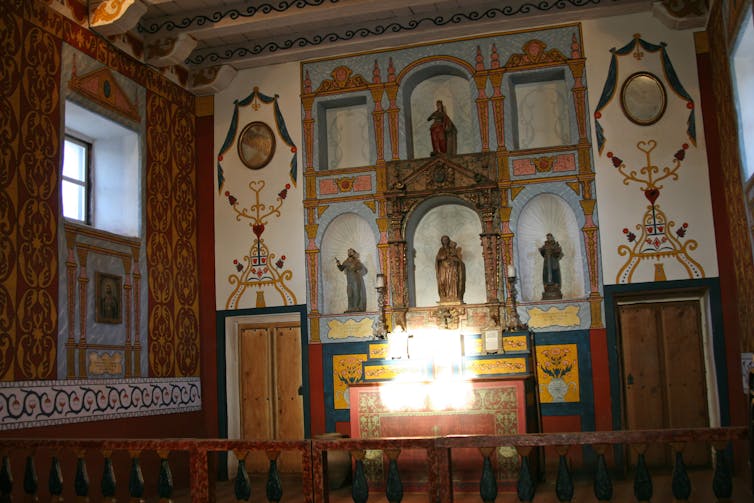
Rubén Mendoza, an archaeologist at California State University, Monterey Bay, made an accidental discovery years ago at a mission church. In this worship space and many others that Catholic missionaries built during the Spanish colonial period, the winter solstice “triggers an extraordinary rare and fascinating event,” he explained: “a sunbeam enters each of these churches and bathes an important religious object, altar, crucifix or saint’s statue in brilliant light.”


Winter solstice illumination of the main altar tabernacle of the Spanish Royal Presidio Chapel, Santa Barbara, Calif. 
Rubén G. Mendoza, CC BY-ND

These missions were built to convert Native Americans to Catholicism – people whose cultures had already, for thousands of years, celebrated the solstice sun’s seeming victory over darkness. Yet the missions incorporated those traditions in a new way, channeling the sun’s symbolism into a Christian message.

“These events offer us insights into archaeology, cosmology and Spanish colonial history,” Mendoza wrote. “As our own December holidays approach, they demonstrate the power of our instincts to guide us through the darkness toward the light.”
Victory over darkness

Our next story goes halfway around the world, describing the Persian solstice festival of Yalda. But it’s also an American story. Growing up in Minneapolis, anthropologist Pardis Mahdavi explained, she felt a bit left out as neighbors celebrated Hanukkah and Christmas. That’s when her grandmother introduced her to their family’s Yalda traditions.

Millions of people around the world celebrate Yalda, which marks the sunrise after the longest night of the year. “Ancient Persians believed that evil forces were strongest on the longest and darkest night of the year,” wrote Mahdavi, who is now provost at the University of Montana. Families stayed up throughout the night, snacking and telling stories, then celebrating “as the light spilled through the sky in the moment of dawn.”

Editor’s note: This story is a roundup of articles from The Conversation’s archives. It is republished from The Conversation under a Creative Commons license. Read the original article.


AND DOWN UNDER IT IS SUMMER SOLSTICE


Saturday, December 20, 2025

At Bay Area's Secular Solstice, Rationalists grapple with AI doomsday

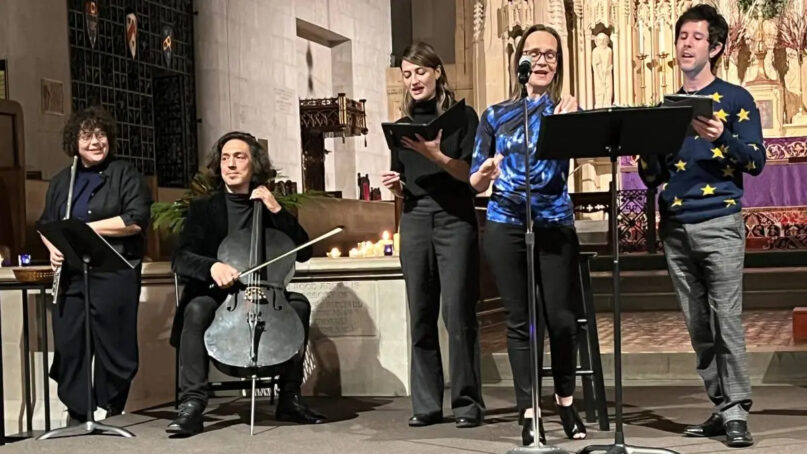
BERKELEY (RNS) — For participants worldwide, the holiday offers a meaningful, musical opportunity to stare down the dark. At this year’s Bay Area Secular Solstice, that looked like grappling with the possibility of superintelligent AI wiping out humanity.


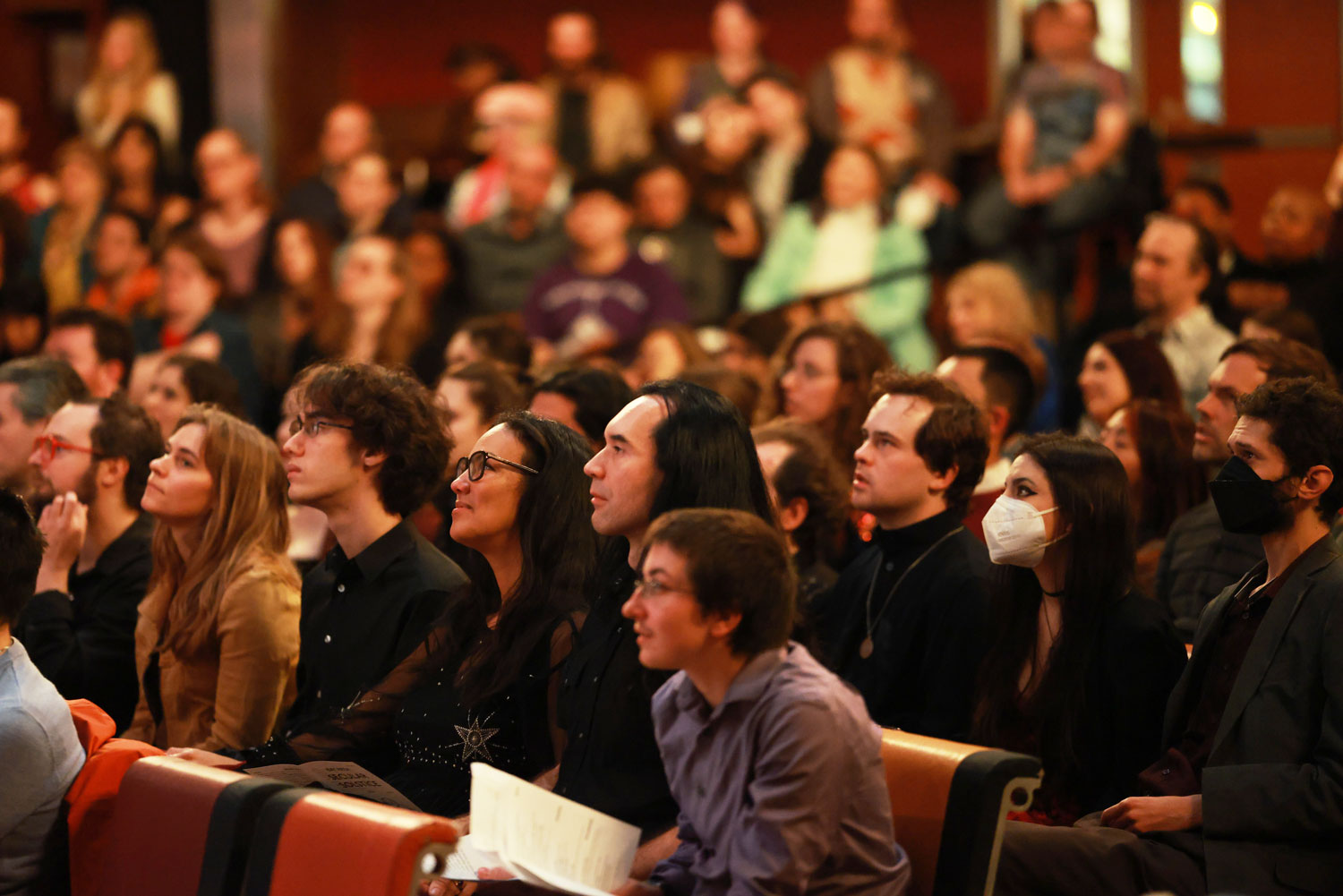
The audience at the 2024 Bay Secular Solstice at The Freight in Berkeley, CA. Photo courtesy Raymond Arnold

Hayden Royster
December 19, 2025
RNS


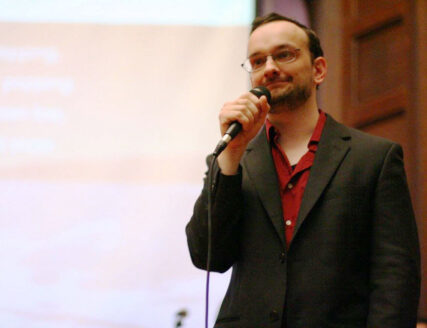
BERKELEY (RNS) — Raymond Arnold sat in the dark on the edge of a Berkeley stage in early December, his voice breaking as he addressed the nearly 500 people gathered for Secular Solstice. “Guys…” he whispered into the microphone. “I don’t think we’re gonna make it.”

Arnold, a web developer and founder of the now 15-year-old Rationalist holiday, admitted he thought this could, potentially, be “the last Solstice.”

Winter solstice traditions around the world and across religions mark the shortest day of the year and offer observers a meaningful way to stare down the dark or, as Arnold puts it, “challenge the Abyss to a staring contest and win.” At this year’s Bay Area Secular Solstice, that meant grappling with the possibility of superintelligent AI wiping out humanity — a future some Rationalists, including Arnold, believe may be near.

Secular Solstice began one December evening in 2011, when Arnold and 19 friends crammed into a New York City apartment, illuminated by plasma balls, oil lamps and lightsabers, to beta-test a new holiday. Arnold, a Catholic-turned-humanist, was looking to create a tradition that reflected his new worldview. He’d recently discovered Rationalism, an internet-born movement focused on sharpening reasoning skills to better society. The community — which took seriously futuristic notions like interstellar colonization and artificial intelligence — “radically expanded my sense of how much sacredness I could feel,” Arnold said. For him, creating Secular Solstice was an experiment in Rationalist ritual.


Raymond Arnold, who hosted and oversaw this year’s Bay Area Secular Solstice, created the holiday in 2011. Photo courtesy Raymond Arnold

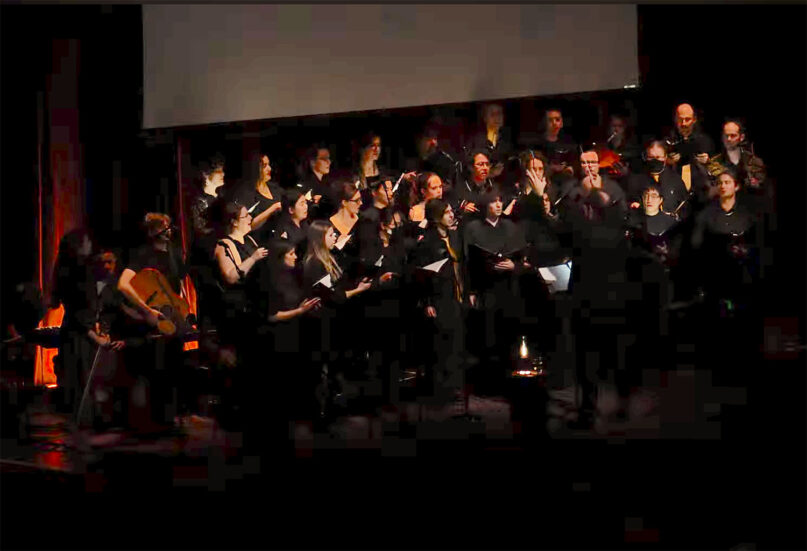
Fifteen years on, Arnold’s homegrown holiday has expanded dramatically, with people gathering for solstices and “smolstices” in New York, Maryland, Kansas, Texas, Washington, Illinois, Canada, the United Kingdom, New Zealand and Russia. At this year’s Bay Area Secular Solstice on Dec. 6, attendees filled the 490-seat theatre at The Freight, a music venue not far from UC Berkeley’s campus, settling in for a multi-hour production with a live band and a 28-person choir. A few wore Santa hats; more wore lightweight puffer jackets. Before the show, Solstice organizers scurried about the lobby, hastily dispensing battery-powered fairy light strands to the crowd.

Anna Tchetchetkine, who works in policy at Google, appreciates the event’s frank appraisal of death, as well as “the Solstice arc” — a journey from light to dark to light again, engaging with humanity’s past, present and future.

“It can be very, very emotionally poignant and heavy and cathartic and joyful,” said Tchetchetkine, who attended her first Solstice in 2015 and has been involved in its production ever since. “It definitely feels like something sacred to me, in a way.”

Tchetchetkine was the creative lead of the Bay Area Secular Solstice in 2023 and is a director of the event’s choral group, the Bayesian Choir, named for the 18th-century mathematician Thomas Bayes. Tchetchetkine likens Solstice to “a pilgrimage season,” noting friends who were journeying from Paris and Berlin to take part. “It’s the community’s biggest event,” she said.

While Arnold had once envisioned Secular Solstice as a mainstream holiday for atheists and skeptics, he acknowledged it has largely become a Rationalist tradition.

The Rationalist community first arose in the mid-2000s, coalescing around the work of AI researcher Eliezer Yudkowsky. His writings — particularly “Sequences” and the fan-fiction novel “Harry Potter and the Methods of Rationality” — became seminal texts for the burgeoning movement, and his then-blog “LessWrong” grew into a virtual town square.

Over the years, the community has evolved — though defining its borders is tricky, even for those within them. What is evident, though, is its profound impact on Silicon Valley, particularly in AI safety. According to a Bay Area Secular Solstice guest list, numerous AI researchers from companies like Google DeepMind and Anthropic, and nonprofits like Machine Intelligence Research Institute and Redwood Research, were in attendance. This year, Solstice-goers from afar were invited to stay at Lighthaven — the Berkeley hotel turned conference and research center with a mission of “ensuring that humanity survives this century,” according to its parent company, Lightcone Infrastructure. Alongside Lighthaven, Lightcone now oversees “LessWrong.”

Religious language is often used to characterize Rationalism, to some people’s chagrin. Others embrace it; Arnold, who now helps run “LessWrong” and Lighthaven, has earnestly described his role as a “village priest.” Secular Solstice, especially, is spoken of in spiritual terms. One “LessWrong” user called it “the most Church Service shaped thing I have ever seen which wasn’t a church service.”


The Bayesian Choir, a choral group that performs annually at the Bay Area Secular Solstice. Video screen grab from Bay Area Secular Solstice livestream

To kick off the 2025 Bay Area Secular Solstice, Arnold and the band led the audience in singing the Monty Python classic, “Always Look on the Bright Side of Life,” followed by “Bring the Light”: one of numerous songs written by Arnold and others to be sung at Secular Solstices worldwide.

Between songs, community members gave speeches that ranged from historical to deeply personal. At one point, Arnold shared the Cold War origins of the carol “Do You Hear What I Hear?” Later, another speaker shared a story of cryogenically preserving a deceased friend.

With each progressively somber element, the Freight’s chandeliers dimmed a notch. In a “LessWrong” post days earlier, Arnold had warned that this year would focus on “actually looking at human extinction in nearmode.” Arnold has not been heavily involved in planning Solstice for years, letting others take the lead. But he felt a sense of urgency to host this year, given AI’s breakneck development.

Arnold’s “Last Solstice” speech and ensuing song, “The Last Lifeboat,” were a pivot point, and the songs and speeches to follow — with titles like “Not Resigned” and “Brighter than Today” — expressed increasing defiance, if not quite hope. The house lights gradually rose. Those with fairy lights draped across their shoulders flicked them back on again.

Arnold’s sentiments echoed those of Yudkowsky’s bestselling new book, “If Anyone Builds It, Everyone Dies.” Yudkowsky argues that by default, companies trying to create and align superintelligent AI will lose control. If they do, he believes, catastrophe is inevitable.


Anna Tchetchetkine, co-director of the Bayesian Choir. Photo courtesy Tchetchetkine

While some Rationalists are indeed afraid of this, others, including Tchetchetkine, are less certain. “I am not as doomy as Ray,” she acknowledged. “But I do find it plausible, which is scary.”

Around the two-hour mark, Robert Miles, an AI safety researcher and popular YouTuber, shared an adapted version of C.S. Lewis’ 1948 essay on looming nuclear war. “Let that AI, when it comes, find us working or teaching, singing, playing with children, calling our elected representative …” Miles said. “Let the AI find you doing well.”

Moments later, various community members offered perspectives on “Living in a Possibly Doomed World.” One was Yudkowsky, who rose from his seat and gave a typically wry, and rational, assessment: “Going insane because the world is ending is a skill issue.”

The evening culminated with “Five Thousand Years,” Arnold’s song that envisions a day when humans journey beyond Earth and perhaps outlive it. “We’ll take a moment, one by one/ Turn to face the dying sun/ Bittersweetly wave goodbye/ The journey’s only just begun,” hundreds of voices sang.

In an email afterward, Arnold emphasized that he doesn’t believe “AI pessimism” should be the thrust of Secular Solstice from now on. “While it was important to do once,” he wrote, “ I don’t think it’d actually be healthy.” Based on feedback data, Arnold said a small minority felt “alienated” or “annoyed” by this year’s event. But plenty of others found it moving, even “healing.”

One attendee, Amanda Luce, blogged about her experience. She initially had reservations about an AI-focused Solstice, worrying it would exclude newcomers or “normies.” But walking through the Berkeley streets afterward, en route to the afterparty at Lighthaven, Luce felt seen.

“That service was for us,” she wrote. “It was for the AI Doomers.” Sometimes, she reminded Rationalist readers, it’s important to “do the rituals that we need for ourselves.”

This article was produced as part of the RNS/Interfaith America Religion Journalism Fellowship.

Sunday, June 21, 2020


Summer Solstice 2020: When is the longest day of the year and how do people celebrate?


Sarah Young, Sabrina Barr The Independent 20 June 2020


William Toti/500pxMore

The start of the new season has officially arrived in the form of the summer solstice.

The longest day of the year is a cause of celebration for many, whether you feel a spiritual connection to the power of the sun or are simply relieved that the warm-weather months have finally arrived.

In astrological terms, the summer solstice marks the end of spring and start of summer for the northern hemisphere. It will end with the autumn equinox, which this year falls on Tuesday 22 September.

Here’s everything you need to know about the summer solstice 2020:
What is it?

The summer solstice – otherwise known as the estival solstice, midsummer or Litha – is the longest day of the year.

It occurs when the earth’s geographical pole on either the northern or southern hemisphere becomes most inclined towards the sun and officially marks the beginning of summer.

When the summer solstice takes place in the northern hemisphere this month, the sun will reach its highest possible altitude.

As a result, the day on which the summer solstice falls will have the longest period of daylight of the year.

In some cultures, such a paganism, the summer solstice is symbolic of fertility and the harvest.
When is it?

The summer solstice in the northern hemisphere occurs in June and in the southern hemisphere in December.

In the northern hemisphere, it will take place this year at exactly 22:43pm on Saturday 20 June.

The UK will be treated to 16 hours and 38 minutes of daylight in the day, with the sun rising at 4.43am and setting in the evening at 9.21pm.

After 20 June, the nights will begin to close in as the planet rotates with the northern hemisphere titling away further from the sun.
How is it celebrated?

According to Dictionary.com, the term solstice is derived from the Latin word solstitium. It’s made up of the Latin sol, “the sun,” and sistere, “to make stand, stand still”.

It’s believed by some that Stonehenge – the prehistoric monument in Wiltshire, England – was built as a kind of astronomical calendar.

On the day of the summer solstice, the rising sun lines up with the Heel stone and the Altar stone of the ancient site.

Thousands of people usually gather at Stonehenge to watch the spectacle and celebrate the start of summer.

However, this year's event has been cancelled due to the coronavirus pandemic. Instead, English Heritage will livestream the sunrise across its social media channels.

Many people also celebrate the summer solstice in other ways regardless of whether they feel a religious affiliation with the event or not.

Expect to see numerous summer picnics, bonfires and maybe even some Maypole dancing take place to mark the occasion.
Read more

Solar eclipse to coincide with Summer Solstice in 2020

How To Harness The Power Of This Year’s Summer Solstice

Refinery29 via Yahoo News· 2 days ago
“The summer solstice is also known as midsummer, and in pagan times this holiday was known as...

Saturday, December 21, 2024

Winter solstice is having a moment — in churches, too

PITTSBURGH (RNS) — In mainline Christian circles, winter solstice celebrations and longest night services are growing in popularity.


Attendees make pomander balls with oranges and cloves during a winter solstice celebration at St. Luke’s Episcopal Church in Evanston, Ill., on Dec. 21, 2023. (Courtesy photo)

Kathryn Post
December 20, 2024

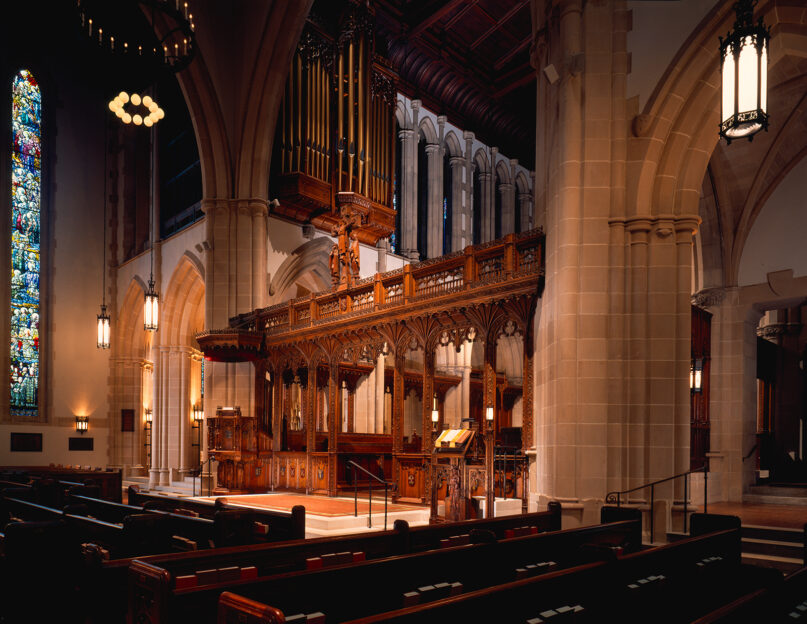
PITTSBURGH (RNS) — The Rev. Aidan Smith is no stranger to the dark, he told the members of Trinity Cathedral gathered beneath soaring gothic archways lit by candlelight in downtown Pittsburgh, Pennsylvania, on Wednesday evening (Dec. 18).

Raised in northwest Alaska, he grew up experiencing significant periods of real darkness — sometimes, he said, the light would barely crest the horizon. In that context, darkness can feel oppressive, and on the winter solstice, darkness is at its peak.

“Sometimes, our lives can feel like the longest night of the year,” said Smith. But, he reminded the congregation, “darkness doesn’t have the last word.”

The 40-minute service featured hymns, a liturgy of the Word and holy Communion. One couple in attendance, Lucy Price and Lizzy Williams, said they appreciated the quieter, more reflective service that didn’t shy away from the more painful realities of life.


The Rev. Aidan Smith, center at altar, leads a Longest Night service at Trinity Cathedral in Pittsburgh, Penn., Wed., Dec. 18. 2024. (RNS photo/Kathryn Post)

The cathedral is one of a growing number of mainline Christian churches across the U.S. to offer a service or celebration in conjunction with the winter solstice. While most are leaning into more somber Longest Night services, others are approaching the solstice as an opportunity for interfaith collaboration as solstice celebrations grow increasingly popular outside religious circles.

At St. Luke’s Episcopal Church in Evanston, Illinois, a winter solstice celebration on Dec. 21 will feature wassail (a hot spiced beverage), earth-conscious crafts involving wax candles, oranges and cinnamon cloves, and a performance by the EcoVoice Project, a group that uses music to raise awareness of climate change.

The brainchild of EcoVoice director Kirsten Hedegaard, the interfaith community event is also curated by the church and by local groups Climate Action Evanston and Interfaith Action. Housed in a large stone gothic cathedral in a residential neighborhood, St. Luke’s, known in Evanston for its community activism, has previously collaborated with local churches to observe cross-quarter days, which fall midway between the solstices and equinoxes, via outdoor worship services involving prayer hikes, kite making and, in the fall, baking Communion bread from the first wheat harvest.


EcoVoice Project performs at St. Luke’s Episcopal Church in Evanston, Ill., on Dec. 21, 2023. (Courtesy photo)

“Adapting from having done the cross-quarter days into doing a solstice event was really, really natural for us,” said the Rev. Kathryn Banakis, rector at St. Luke’s.

Climate awareness is a key focus of the event, which will include tables populated by local environmental groups who will promote climate action items, including composting holiday trees, using sustainable gift wrapping techniques, and learning about proposed local ordinances that could impact greenhouse gas emissions. While the event will make space for grief, the framing of the event as celebratory is intentional.

“The enemy of climate action is climate anxiety, and the way to mitigate climate anxiety is group climate action,” said Martha Meyer, St. Luke’s representative to the Interfaith Action of Evanston’s Climate Change task force. “So it’s really important that we, when we are working on climate, that there’s a way to frame it as nature appreciation, love of seasons.”


The Rev. Burke Owens. (Courtesy photo)

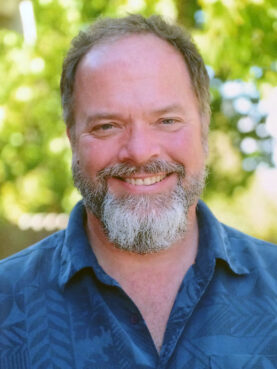
Like the St. Luke’s event, the Winter Solstice program at First Palo Alto United Methodist Church on Friday evening is more spiritual than religious. The Rev. Burke Owens, who pastors the 130-year-old congregation in California’s Silicon Valley, hopes to introduce a bit of play at the inaugural service, which he said would feature an eclectic mix of songs (from Elizabethan carols to Joni Mitchell ballads), poems and a traditional Abbots Bromley horn dance that will acknowledge the cycles of nature and pay homage to animals.

“You have antlers, and you’re tapping them together and doing a simple dance around the chancel,” said Owens, describing the dance. “For some people, they might find it to be too far away from pure Christianity. I see that the relationship is there, because we’re celebrating the return of the sun, s-u-n, as well as the return of the son, s-o-n.”

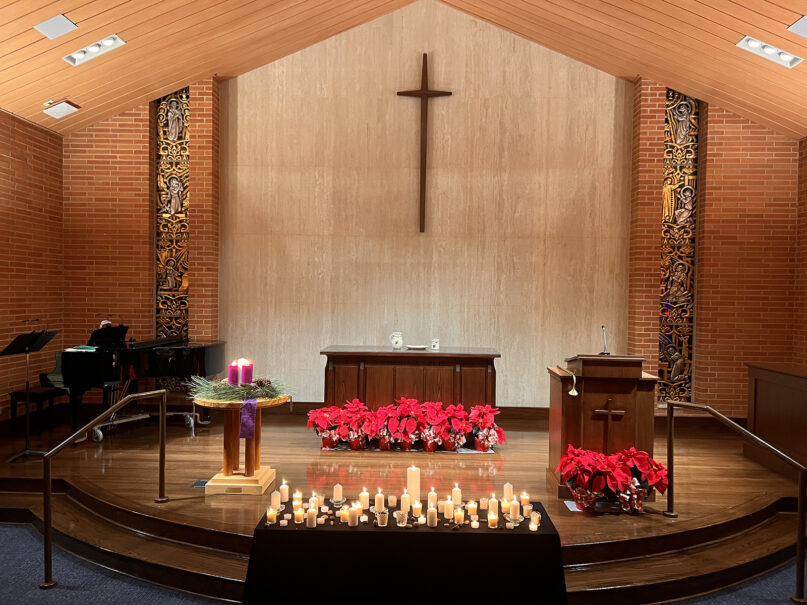
St. Matthew’s Episcopal Church in Grand Junction, Colorado, is similarly hosting a winter solstice celebration that’s distinct from its Christmas or advent festivities. This will be the third year the event takes place, and the outdoor program will invite participants to walk the church’s labyrinth and place their written concerns in a fire that symbolizes God’s transformative power.

“We don’t try to connect this with the Christian holiday,” said the Rev. Janice Head, associate priest for healing and wholeness at the church. “It is a stand-alone event recognizing the cycle of nature, the movement from dark to light, from resting to waking.”

To medievalist Eleanor Parker, who wrote “Winters in the World: A Journey through the Anglo-Saxon Year,” the decision to hold separate winter solstice and Christmas events is interesting, given the historic overlap between the two. She noted that, when Roman Christians chose Dec. 25 as Christmas day (likely because it was nine months after the spring equinox, when some believed Jesus was conceived), it was the same day as the winter solstice. The date of the solstice has since shifted due to the inaccuracy of the Julian calendar. In the Middle Ages, Parker said, the winter solstice was seen simply as part of the yearly cycle, not a separate religious idea.

“They didn’t see any sort of conflict between the idea of, this is the solstice and we’re also celebrating Christmas … Really, they really are blended at that point,” said Parker. “That idea that lots of Christians think it’s a bit pagan to celebrate the solstice, that I think only comes back in the 19th century, the 20th century. It’s a really recent idea.” The 20th century’s New Age movements and revival of paganism, which views the solstices as the basis for the pagan year, according to Parker, contributed to the perception of Christmas and winter solstice as separate.
RELATED: Yule – a celebration of the return of light and warmth

While some Christians today are wary even of Christmas traditions that seem a little too pagan, in theologically progressive Mainline Christian circles, winter solstice services — particularly of the more traditional “Longest Night” variety — have been around for awhile and are steadily growing in popularity. In the Episcopal diocese of Pittsburgh, the number of parishes offering this service has grown from one to 10 in the last decade or so.


Calvary Episcopal Church in Pittsburgh, Penn. (Photo by Ken Smith)

“There is a real need in our various communities for a pastoral response that takes into account the complicated feelings parishioners struggle with during the dark days of winter and also the holidays when depression and grief are often exacerbated,” said Bishop Ketlen A. Solak of the Episcopal Diocese of Pittsburgh.

When Bonnie-Marie Yager-Wiggan, now associate rector at Calvary Episcopal Church in Pittsburgh, first introduced the Longest Night service to Trinity Cathedral two years ago, it was in response to her own experience of losing a dear aunt to COVID-19 during the pandemic. She sees the pairing of advent and winter solstice as intuitive.

“We celebrate on the darkest night of the year because we remember that the light is coming, the sun will shine again,” said Yager-Wiggan. “And on a metaphysical, spiritual level, Christ is the light of world, and He will come again, which is the main theme of Advent: the second coming of Christ.”

Many clergy leading Longest Night or winter solstice events this year say the services are in response to both a desire to meet their congregants and community in the midst of the darkness of their own lives, and, perhaps, a broader, culture-wide desire to be more in tune with the natural world. To many clergy, this winter solstice — at the tail end of a fraught election year, in the midst of global wars, and in the wake of a pandemic — feels especially weighty.

“We’ve faced our mortality in new ways,” said the Rev. Brian Coulter, whose First Presbyterian Church in Fort Worth, Texas, is hosting its second Longest Night service in its chapel this Sunday. “There’s something in this idea of dark and light and hope and turning point that we feel as Christians, but it’s also just we feel as humans. … We’re not alone. The darkness is not going to win. We’re still here.”


An array of candles for the 2023 Longest Night service at First Presbyterian Church in Fort Worth, Texas. (Courtesy photo)


A Persian festival, Yalda, celebrates the triumph of light over darkness, with pomegranates, poetry and sacred rituals

(The Conversation) — People stay up all night, telling stories and eating dried fruits, in addition to watermelon and pomegranate, to celebrate the sunrise soon after the longest night of the year.


A table set for the celebration of the Persian festival of Yalda. ( Jasmin Merdan/Moment via Getty images.)

Pardis Mahdavi
December 20, 2021

(The Conversation) — As the days become shorter and the nights become longer and darker, we are reminded that indeed winter is coming. As a child I would dread this time of the year. Not only was there was less time to play outside, but there was a string of holidays that my Iranian family didn’t celebrate, from Hanukkah to Christmas, which made me feel I didn’t belong in our new home in Minneapolis, Minnesota.

At the age of 11, I asked my parents for a Christmas tree. That’s when my grandmother, Ghamarjoon, placed two pomegranates in my hands and two in my mother’s and introduced me to Shab-e-Yalda: “shab” meaning night, and “yalda” meaning birth or light. It is a holiday celebrated by millions of people from Iran to Azerbaijan to the U.S., on Dec. 21, the winter solstice.

My path to becoming an anthropologist who studies rituals and traditions in the Middle East was, in part, a way discover the stories of my past, and Yalda was one of my first inspirations.

Celebrating light

Originating in the pre-Zoroastrian tradition of worship of Mithra, the God of Sun, but popularized by Zoroastrians, Yalda, also referred to as Chelleh, celebrates the sunrise after the longest night of the year. Ancient Persians believed that evil forces were strongest on the longest and darkest night of the year. People stayed up all night, telling stories and eating watermelon and pomegranate, in addition to dried fruit, in anticipation of the sun rising.

As the light spilled through the sky in the moment of dawn, Persians celebrated its appearance with drumming and dancing. It was thought that the day after the longest night belonged to Ahura Mazda, the Zoroastrian lord of wisdom.

Religious studies scholar Joel Wilbush argues that the early Christians loved this ancient Persian celebration. They saw the themes of light, sun and birth as interconnected with the birth of Jesus.

Triumph of light

Today my family continues the tradition by gathering every year to celebrate this ancient tradition. Like our ancestors before us, we stay up all night, curled under a korsi, a special Persian blanket lined with lumps of coal for warmth. We tell stories, read the poetry of Iranian poets like Hafez and Rumi, and speak of the good that can overcome evil.

Foods such as pomegranate and watermelon are still eaten. A food indigenous to Iran, pomegranate is believed to be a symbol of life and resilience, for it blossoms during the harshest climate of winter. Persians also believe that eating summer foods, such as watermelon, will keep the body healthy through the winter, and that dried seeds like pumpkin and sunflower are a reminder of the cycle of life – of the rebirth and renewal to come.

While Christmas and Yalda are celebrated just a few days apart, the celebrations hold similar traditions and values. Family, love, resilience, rebirth and a triumph of light over dark.


(Pardis Mahdavi, Dean of Social Sciences, Arizona State University. The views expressed in this commentary do not necessarily reflect those of Religion News Service.)