Is Artificial Intelligence in Charge of Nuclear Weapons?
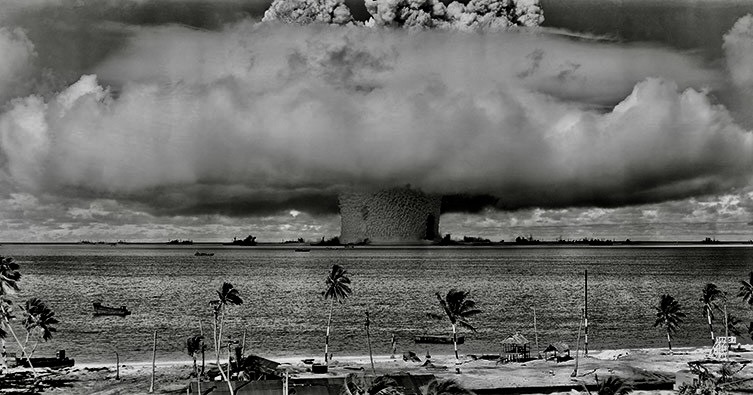
US nuclear bomb exploding over Micronesia, 1946. Public Domain.
On October 16, 2025, the United Nations General Assembly passed a resolution demanding that as long as nuclear weapons exist, they should never be controlled by artificial intelligence (AI). Six states proposed the AI resolution: Austria, El Salvador, Kazakhstan, Kiribati, Malta and Mexico. They were rightly convinced that AI should not be part of nuclear armaments.
AI risks and dangers
The UN resolution highlighted and explained the “risks” of incorporating AI in command, control and communications affecting nuclear weapons. It warned that
“artificial intelligence-driven decision-
making related to command, control and communications systems of nuclear weapons could reduce human control and oversight, increasing the possibility of induced distortions in decision-making environments and shortened action and response windows, particularly when related to the most sensitive and critical stages such as decision to launch, which could heighten the risk of accidental, unintended or unauthorized use of nuclear weapons.”
The resolution also highlighted “inherent technical limitations of artificial intelligence systems, including but not limited to the potential for malfunction, exploitation or intrusion, and cognitive and automation biases impacting training data and algorithmic design.” These technical deficiencies, the resolution said, “could produce hallucinations and flawed, inaccurate or misleading outputs and understandings, which in turn could have serious and catastrophic outcomes such as the accidental, unintended or unauthorized use of nuclear weapons.”
These are not minor problems afflicting AI. They could lead to nuclear catastrophe or nuclear war. For these legitimate concerns, the resolution demanded that, “pending the total elimination of nuclear weapons, human control and oversight is maintained over command, control and communications systems of nuclear weapons, including those that integrate artificial intelligence technology.”
“The resolution is a major steppingstone,” says the Bulletin of the Atomic Scientists, “because it nudges the debate beyond the baseline notion of “keeping humans in control of nuclear weapons decisions” towards a more fine-grained recognition of how AI could fuel unintended escalation in decision processes…. Substantively, the text [of the UN resolution] reflects and attempts to build on, political commitments that several states—such as France, China, Pakistan, the United Kingdom and the United States—have already endorsed in statements or in outcome documents in other forums. At the same time, it attempts to extend these commitments to nuclear command, control, and communications more broadly, namely the whole architecture that underpins nuclear decision-making.”
True, the resolution reflects the ideology, politics and terror of the decades-old existence of nuclear weapons, as well as the hubris of the nuclear states. However, the resolution goes far deeper. It is a serious first step for the eventual abolition of nuclear weapons. It reminds civilized people that AI and especially nuclear bombs, in combination or alone, are inhuman nightmares of possible forthcoming destruction of people and civilization and nature. Artificial Intelligence may seem harmless and profitable but, like nuclear bombs, it is becoming another version of nuclear bomb. “Like nuclear bombs, AI-machines are bound to explode. Money and profits laces the talk of engineering experts constructing AI machines. It is deceptive and dangerous.” Artificial intelligence is pervasive in its long-term transformation of its own high-tech military creators into beasts of burden that will forever regret their games of playing god – exactly the outcome of bringing into existence death itself in the form of nuclear weapons. In fact AI and nuclear bombs are sister products of the schizophrenic mind of war and warmongers. They are terrible weapons of desolation and death.
No past human society before the twentieth century had lived for decades with anthropogenic death machines. Not that past societies were gentler than societies of the twenty-first century. Wars and civil wars, from the civilized ancient Greeks to the world wars in Europe and America’s wars, hot and cold, in Latin America, Southeast Asia and the Middle East, are brutal ways of conflict resolution. Dialogue, understanding and justice are thrown out of the window. Then swords, knifes, bows and arrows, pistols, canons, machine guns, AI-powered drones, missiles and nuclear submarines take the fields of battle.
Wars are as old as humans. The Greek philosopher Herakleitos of the sixth century BCE said that war was the father and king of all. He is right. But bad as war was during the time of Herakleitos, now, twenty-seven centuries later, war is becoming the silent whisper and or the mayhem of extinction. That’s why AI and nuclear weapons, which together make extinction a certainty, must be abolished before they abolish us.
What is to be done?
The nuclear-weapons states (US, Russia, China, France, UK, Pakistan, India, North Korea and Israel) must explain to the world why they have those death machines. For national security? Doubtful. For prestige? Yes. For imperial games? Absolutely. For terrorizing non-nuclear states? Without a doubt.
We know that nuclear weapons cannot be used without unacceptable, nay death consequences for billions of humans. On June 10, 1963, President John F. Kennedy explained to the graduates of the American University that the explosive power of a single nuclear weapon was ten times more destructive than the explosions and destructions of all bombings of WWII. Kennedy’s dream was for world peace, which would automatically make nuclear weapons obsolete. He said, “world peace” was “the most important topic on earth.” He explained what he meant:
“What kind of peace do I mean? What kind of peace do we seek? Not a Pax Americana enforced on the world by American weapons of war. Not the peace of the grave or the security of the slave. I am talking about genuine peace, the kind of peace that makes life on earth worth living, the kind that enables men and nations to grow and to hope and to build a better life for their children–not merely peace for Americans but peace for all men and women–not merely peace in our time but peace for all time.
“I speak of peace because of the new face of war. Total war makes no sense in an age when great powers can maintain large and relatively invulnerable nuclear forces and refuse to surrender without resort to those forces. It makes no sense in an age when a single nuclear weapon contains almost ten times the explosive force delivered by all the allied air forces in the Second World War. It makes no sense in an age when the deadly poisons produced by a nuclear exchange would be carried by wind and water and soil and seed to the far corners of the globe and to generations yet unborn….
“I realize that the pursuit of peace is not as dramatic as the pursuit of war–and frequently the words of the pursuer fall on deaf ears. But we have no more urgent task.
“Some say that it is useless to speak of world peace or world law or world disarmament–and that it will be useless until the leaders of the Soviet Union adopt a more enlightened attitude. I hope they do. I believe we can help them do it. But I also believe that we must reexamine our own attitude–as individuals and as a Nation–for our attitude is as essential as theirs. And every graduate of this school, every thoughtful citizen who despairs of war and wishes to bring peace, should begin by looking inward–by examining his own attitude toward the possibilities of peace, toward the Soviet Union, toward the course of the cold war and toward freedom and peace here at home.”
Probably President Kennedy was not the first politician who urged Americans to choose world peace instead of war and nuclear weapons. But his message for world peace is especially wise, timely and urgent now, in 2026, that AI is intruding in the control and command and communications affecting nuclear weapons. World peace means zero nuclear bombs and military artificial intelligence. Peace is the gift of freedom and civilization.
Nuclear weapons are useless for war. They are made by men intoxicated by war but clearly they don’t belong to civilized men on Earth.
The US, European Union (EU), Russia, China and India should form a pentarchy (rule of five) for the establishment of world peace and the abolition of nuclear weapons and military AI. These 5 great powers should replace the current UN Security Council. They should start their join oversight of the governance of the planet without doctrinal religious prejudices or fanaticism or authoritarianism. Neutral countries would preserve their culture and freedom but would be forbidden to encroach on their neighbors or other distant states. Second, the great powers ought to forbid the employment of AI in any military operation and, definitely, not in the management of nuclear weapons. Their top priority would be the abolition of nuclear bombs – their own stockpiles and those of other nuclear-weapons states, that is, Israel, United Kingdom. Pakistan, and North Korea. Together, they should guarantee existing borders among all states as well as their freedom and independence. That means the greatest number of states should become neutral like Austria or Switzerland. The pentarchy would guarantee the neutrality of all states, thus eliminating war.
In the case of the EU, it must first reorganize and become a real political union with inviolable borders and common defense. The new EU must understand that Germany is not a “normal” state. It was responsible for two world wars in Europe in the twentieth century. The EU should forbid Germany from ever having any armaments. Neutral Germany should also be obliged to pay the WWII debt to Greece as well as return the archaeological treasures German forces looted from occupied Greece, 1941-1944.
At the same time, the pentarchy should guarantee the independence and neutrality of Greece. It should also expel Turkish forces from occupied northern Cyprus and allow the Greek island of Cyprus to unite with Greece. All Cypriots (the Greek majority and the Moslem Turkish minority) should be asked about the union with Greece. Those of the Moslem faith, if they disapprove the union with Greece, ought to have the right to join Moslem Turkey.
Greece could return to its ancient Hellenic culture of science, justice, the good and the beautiful — and civilization. It could become a school of science and democracy, revived ancient Hellenic Olympics, philosophy, political theory, theater and peace. That was the dream of Alexander the Great and the first President of independent Greece, Ioannes Kapodistrias, 1776-1831.
Epilogue
Yet the current global political relations between the nuclear-weapons-armed states are full of tensions and fear. On October 28, 2024, General Anthony Cotton, commander of the US Strategic Command, expressed concern and antagonism toward the nuclear powers of the East. He described a “most complicated environment,” in which there were “emboldened autocrats who seek to dominate by force and fear. For the first time in our history, we confront two nuclear-near-peer adversaries.
Russia is bent on restoring its former policy of glory and rising China that seeks to replace a stable and open international system that has served the world well for over 80 years. Now I add to this an aggressive and nuclear-armed North Korea, and of course, Iran.
“China is rapidly expanding all aspects of military power, including land, sea, and air-based nuclear delivery systems.
The PRC is likely to have 1,000 nuclear warheads by 2030 and is supporting Russia’s war on Ukraine. Russia already has the largest and most diverse nuclear arsenal in the world, and continues to expand and modernize that arsenal. Moscow has dramatically expanded the percentage of its GDP devoted to the military and is clearly poised for a long war in Ukraine.
“North Korea continues to expand its nuclear arsenal in violation of UN Security Council resolutions, as well as its active support for Russia in Ukraine. Most recently, we see that North Korean troops are being deployed to Russia for further deployment to the Ukraine. And finally, Iran continues its aggression in the Middle East with support from Russia.”
There’s no doubt general Cotton reflects American ideology and strategic thinking. It’s possible the nuclear powers of the East are reaching similar conclusions about the nuclear powers of the West. No matter the real and imagined differences between these two camps, they need to get together and start a dialogue for peace and the steps necessary for the abolitions of their nuclear weapons. They should be able to work out agreements to guarantee the integrity of their borders.
The pentarchy should coordinate the transition from war, nuclear weapons and weaponized AI to disarmament, neutrality, peace and friendly relations among all nations. Only then, the nations of the world will be in a position to jointly fight planetary climate chaos, abandon fossil fuels and start the elimination of worldwide pollution.

No comments:
Post a Comment