Improved EV battery technology will outmatch degradation from climate change
image:
Improvements to electric vehicle battery technology will offset their anticipated heat-related degradation driven by climate climate change, according to new research from the University of Michigan.
view moreCredit: Haochi Wu
Climate change was poised to create an interesting catch-22 for electric vehicles. Electrifying transportation can go a long way to reducing carbon emissions that are driving up global temperatures. But warmer temperatures also accelerate the degradation of batteries, whose performance can be a make-or-break factor for people considering an EV purchase.
In a new study led by the University of Michigan, however, researchers have shown that batteries have gotten a lot better over the past several years. So much so, in fact, that their gains will more than offset their expected heat-related degradation on a warming planet. The research was supported by federal funding from the U.S. National Science Foundation and the National Natural Science Foundation of China.
"Thanks to technological improvements, consumers should have more confidence in their EV batteries, even in a warmer future," said Haochi Wu, lead author of the study published in the journal Nature Climate Change. Wu performed the work as a visiting doctoral student at the U-M School for Environment and Sustainability, or SEAS.
The team's study combined EV simulations with models of battery degradation and climate change to compare the endurance of old batteries made between 2010 and 2018 with new batteries made between 2019 and 2023. In a scenario where the planet warms by 2 degrees Celsius, old batteries would see their lifetimes drop by an average of 8% up to a maximum of 30%. For new batteries, the average lifetime drop is just 3% and the maximum is only 10%.
"I think these improvements are well-known to experts in the field. But, when I started this project, I was looking at web forums and reading how people were deciding on cars," Wu said. "There are still a lot of durability concerns about EV batteries."
Those concerns were driven, in part, by a rash of incidents about a decade ago where EV drivers in warmer climates saw their battery capacities evaporate, Wu said. But those should be problems of the past, according to the team's analysis.
Hot takes
The researchers looked at battery lifetimes across 300 cities around the world in a variety of warming scenarios and found that the improvements held up globally. In fact, the warmest cities, like those nearest the equator, actually stand to see the biggest gains.
The team's methodology also stood out to experts in the field, as well as to editors at the journal that published the work. Their framework coupled climate projections with experimentally calibrated models of battery degradation and simulations of EV driving behavior to create high-fidelity battery profiles at granular temporal scales, Wu said.
"The authors find an interesting way to model the important role of technological advance in mitigating the negative effect of climate change," wrote the editorial team at Nature Climate Change. The journal also invited Wu and Craig to submit a research briefing about their work, making it more visible and accessible to the research community.
There are some important caveats associated with the study's results, however, pointed out senior author, Michael Craig, associate professor at SEAS and the Department of Industrial and Operations Engineering, or IOE. Importantly, the team used two representative EVs for their work, the Tesla Model 3 and the Volkswagen ID.3.
"In regions like Europe and the United States, we feel like we've got a good handle on the battery technology that's available in those regions," Craig said. "But when we're looking at cities in India or sub-Saharan Africa, for example, they may have very different vehicle fleets—and they almost certainly do. So our results may be optimistic for those regions."
In these regions, the impacts of warming are also going to be worse and felt more acutely, which highlights another dimension of how inequalities are exacerbated by climate change. This theme also came through in another recent study from Craig and Wu.
Road maps to resilience
Published in the journal Joule, the researchers' related project was inspired by a similar question about how global warming would impact rooftop solar cell performance. In particular, they examined where climate change would push solar panels into high-temperature risks and extreme high-temperature risks, which are technical thresholds defined by the International Electrochemical Commission, or IEC. These high-temperature risks can accelerate the degradation of conventional solar panels, which can reduce their reliability and prompt sooner-than-expected replacement.
They found that, under the current IEC standards, those risks are underestimated for more than half of our existing and future rooftop photovoltaic installation capacity. Again, these risks will be most acute where warming will be the greatest, which are often low- and middle-income areas.
"On the solar side, we're saying we know the risk is coming, so we need to prepare for it and update our standards. But if you update the standards, there's a whole menu of options available to panel developers, manufacturers and installers that can deal with that risk," Craig said. "Just like EV technology is mitigating that risk, we can mitigate the risk in solar. We just need to have some foresight."
Although that by itself doesn't solve the issues of inequity, it does mean that groups looking for answers can focus on how the technology is deployed rather than whether it exists.
"More vulnerable regions are going to suffer a larger negative impact from climate change, but we're finding technological improvements can mitigate that," Wu said. "That is good news."
Parth Vaishnav and Jiahui Chen of U-M also contributed to the Nature Climate Change study. Qinqin Kong and Matthew Huber of Purdue University were co-authors of the Joule report. Mingyan Sun of Peking University was a collaborator on both projects.
Funding for the Joule study came from the NSF, NSFC, NASA and the Smart Grid-National Science and Technology Major Project. Both studies were supported by Advanced Research Computing at U-M.
Old versus new: The global outlook for battery lifetime on a warmer planet 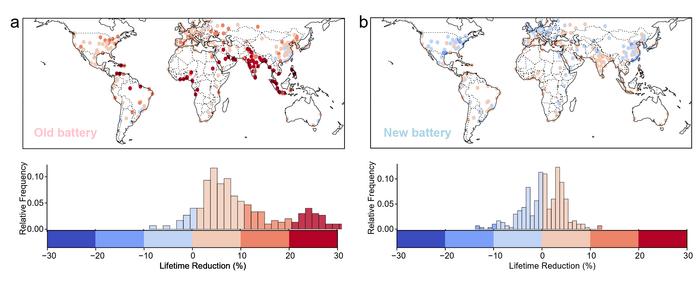
On a planet that warms by an average of 2 degrees Celsius, electric vehicles with batteries made between 2010 and 2018, would see their lifetimes decline by up to 30%, according to new research from the University of Michigan. But, thanks to improved technology, newer batteries made between 2019 and 2023, that degradation maxes out at just 10%.
Credit
H. Wu et al. Nat. Clim. Change, 2026. DOI: 10.1038/s41558-026-02579-z
Journal
Nature Climate Change
Article Title
Technological improvements in EV batteries offset climate-induced durability challenges
Article Publication Date
2-Mar-2026
Test platforms for charging wireless cars now fit on a bench
Rotating device helps study new wireless power transmission for electric vehicles
Peer-Reviewed Publicationimage:
Conceptual diagram of dynamic wireless charging for electric vehicles. The illustration shows a transmitter coil embedded in the road transferring power to a receiver coil mounted beneath a moving vehicle.
view moreCredit: Tokyo Metropolitan University
Tokyo, Japan – Scientists from Tokyo Metropolitan University have devised a rotating tabletop device to study wireless charging in electric vehicles. Testing on real tracks takes up vast areas at significant cost. The team not only built a prototype but used simulations to demonstrate safety and similar charging to a linear track. They successfully reproduced movement at 40 kilometers per hour, promising accelerated global research into next-gen charging for EVs.
Electric vehicles (EVs) are a cornerstone of global sustainability initiatives. Combined with renewable energy, the goal is to significantly cut carbon emissions through a phase out of fossil-fuel-powered cars. But EVs face an uphill struggle, largely due to their cost and range. To stretch travel range, EVs require more battery storage, making them even more expensive.
To get around this problem, researchers have been looking into dynamic wireless power transfer (DWPT), charging vehicles while they are moving on roads. If EVs could be charged while they are traveling, the battery capacity they need will be significantly less. Specifically, a transmitter coil is buried under roads, while a receiver unit on the vehicle passing over it will be able to charge.
While this is an elegant solution, it is a notoriously difficult problem to study for practical reasons. To test charging of vehicles moving at speed, you would usually need a test track to install transmitter coils. Not only is this costly, but it takes up a lot of space which smaller facilities, particularly academic institutions, will not have.
To bring the testing of DWPT from the test track into the lab, a team led by Assistant Professor Ryosuke Ota have implemented a rotating device which replicates the passage of charging systems on vehicles over transmitter coils, an increasingly popular testing concept in recent research. A receiving unit is mounted on a counterbalanced arm which is rotated by a servo motor; a bean-shaped transmitter coil is then installed below the path of the arm. Through simulations of electromagnetic fields, they were able to show that the transmitter coil produced a field which was comparable to those made by coils on linear tracks. As they designed their prototype, they also carefully assessed the mechanical stress in their device as it was rotated at high speeds, finding that it was a practical testing bed for DWPT in settings comparable to a real EV.
The team were able to address important questions such as how the coupling between transmitter and receiver changes when they are misaligned. They were able to replicate conditions of a car moving at 40 kilometers per hour, with a power transmission of 3 kilowatts. While similar results have been achieved before on the benchtop, the design principles for the device and the evaluation framework the team have introduced promise to significantly accelerate research into DWPT systems, so that they might one day leap back from the lab into real roads.
This work was partially supported by the TEPCO Memorial Foundation.
New test bed for wireless EV charging, in action. [VIDEO] |
New test bed for wireless EV charging, in action. The movement of the arm over the bean-shaped transmitter coil helps simulate the movement and charging of a receiver coil on an electric vehicle traveling on a road.
Benchtop design for testing DWPT systems. This rotating device houses a receiver coil on its counterbalanced arm, while a transmitter coil is installed along its path. It fits on a benchtop and can simulate EV speeds of up to 40 km/h.
Credit
Tokyo Metropolitan University
Journal
IEEE Open Journal of Vehicular Technology

No comments:
Post a Comment