Showing posts sorted by relevance for query hijab babushka. Sort by date Show all posts

Monday, November 16, 2020

NYPD ends policy requiring hijab removal for mug shots
THE HIJAB IS A BABUSHKA


Volunteer Asma Kayal (C) demonstrates how a Hijab is worn during 'Meet-a-Muslim' day at the Worcester Islamic Center in Worcester, Massachusetts. 
File Photo by Matthew Healey/UPI | License Photo


Nov. 10 (UPI) -- The New York Police Department has agreed to no longer force women to remove hijabs for mug shots as part of a settlement of a federal lawsuit.

At issue, was a lawsuit filed two years ago by two Muslim women, Jamilla Clark and Arwa Aziz, who claimed they were embarrassingly forced to remove their hijab headscarves for mug shots after being arrested on low-level charges for violating orders of protection that were later dismissed.

"No one should be forced to undress just to be fed into a facial recognition database," the women's lawyer and founder and executive director of the Surveillance Technology Oversight Project Albert Cahn said in a statement. "New Yorkers are able to get a drivers' license or passport while wearing the hijab, and there's absolutely no reason for it to be removed by police."

The New York Police Department agreed in a settlement filed last week to change its policy to allow Muslim women who wear the headscarves to conform to Islamic standards of modesty to keep the hijab on during police photographs as along as their faces are unobstructed. The agreement applies to not only hijabs, but also other religious head coverings, such as burqa, turban, or wigs worn by Orthodox Jews.

"It was appalling that this was happening for many years in New York and that our city was betraying the values of religious inclusion," said the women's lawyer Albert Fox Cahn. "But now we won't see any more New Yorkers subjected to this discriminatory policy."The NYPD also agreed to train officers to "take all possible steps, when consistent with personal safety," to allow prisoners to keep their religious headwear on to protect "privacy, rights and religious beliefs."

According to the settlement, there is an exception for searches for weapons or contraband.

The police department also agreed to keep track of any incidents when prisoners were forced to remove religious headwear over the next three years.

The two women who filed the lawsuit alleged that the NYPD violated their constitutional rights, including the First Amendment, Fourth Amendment and Fourteenth Amendment, and the rights of other people in their same situation. The settlement left outstanding monetary claims for damages.

"Now that the NYPD has agreed to end the policy, they still need to go a step further," Cahn added in his statement. "That's because this settlement doesn't address the thousands of New Yorkers who were subjected to this unlawful policy. That's why we're still fighting in court to make sure the NYPD pays for the harm its already inflicted."

Patricia Miller, chief of the Special Federal Litigation Division of the New York City Law Department, said in a statement Monday that the settlement was "a good reform" for the NYPD.

"It carefully balanced the department's respect for firmly held religious beliefs with the legitimate law enforcement need to take arrest photos, and should set an example for other police departments around the country," Miller said.

Thursday, November 07, 2024


Russian Community Organization and Its Allies Behind Vladimir Oblast Ban on Hijabs

Paul Goble


Thursdaey, Novmber 7, 2024

   In another sign of the growing power of right-wing Russian nationalist groups like “the Russian Community,” “Northern Man,” and “Rokot-Center” in the wake of the Crocus City Hall terrorist action, officials in Vladimir Oblast have acceded to demands from these groups and banned the hijab.


    They have done so, local journalists say, even though Muslims number only 50,000 out of a total population of 1.3 million and even though there have been no significant clashes involving them and the ethnic Russian majority 

me/dovod3/15577 and kavkazr.com/a/hayp-na-hidzhabe-kak-chechnya-i-dagestan-uchat-islamu-tsentraljnuyu-rossiyu/33186434.html

    That the regional authorities felt they had to defer to the Russian nationalist groups shows how powerful they have become and how likely it is that many officials in the federal subjects view they as enjoying the favor of the Kremlin. And that in turn means that regional governments may take the same view and the same step despite the absence of problems.

    On the growing power of the Russian Community and other groups like it, see 

windowoneurasia2.blogspot.com/2024/10/extremist-russian-community-now-active.html,

 windowoneurasia2.blogspot.com/2024/10/another-black-hundreds-group-revived-in.html,

 windowoneurasia2.blogspot.com/2024/10/closed-diasporas-are-seizing-power.html and jamestown.org/program/russian-community-extremists-becoming-the-black-hundreds-of-today/.


LA REVUE GAUCHE - Left Comment: Search results for hijab babushka

LA REVUE GAUCHE - Left Comment: Search results for HIJAB

Thursday, August 20, 2026


Portugal enacts 'burqa law' banning face coverings in public space

Portugal joins a long list of countries around the world that have already banned face-covering veils in public spaces.
Copyright AP Photo

By Joana Mourão Carvalho & Greta Ruffino
Published on

In Portugal, violators face fines ranging from €150 to €3,000, with exemptions for health, professional, artistic or weather-related reasons, as well as in places of worship, diplomatic missions and on aircraft.

Portugal's President António Jose Seguro has enacted a law banning face coverings in public spaces, a measure widely seen as targeting Muslim women who wear full-face veils.

"The face must be considered a central element of human identity and communication," Seguro said in a statement late Tuesday.

The legislation, dubbed the "burqa law" by local media, was approved by parliament in July with the support of the governing right-wing coalition and far-right parties. Left-wing parties voted against it.

The law prohibits clothing designed to conceal the face or prevent identification in public spaces. It also bans forcing someone to cover their face for reasons related to gender, religion, age or origin.

Seguro acknowledged that the issue was one of "great social and cultural sensitivity".

President of the Republic promulgated law after changes to Chega's proposal Miguel Figueiredo Lopes/Presidencia da Republica

Left-wing parties warn of Islamophobia risks and question security justification

The bill put forward by the far-right Chega party received negative opinions from the Portuguese Bar Association, the High Council of the Public Prosecutor's Office and the Portuguese Association of Women Lawyers, alongside concerns over its potential unconstitutionality.

The centre-left Socialist Party (PS), green-left Livre and the Portuguese Communist Party (PCP) opposed the proposal, warning it could fuel Islamophobia. It was backed by the centre-right Social Democratic Party (PSD).

The PS denounced "Islamophobic purpose that was evident in the explanatory memorandum [of the bill], the context of radicalism in which we live and the risks this creates for the communities directly targeted."

The PCP said the proposal had "nothing to do with women's rights, nor with security issues", but was "solely about fuelling hate speech and violence against those who are different, fuelling racist and xenophobic discourse."

Livre accused the right of "hypocrisy" and of conducting the debate in a "biased manner", in an attempt to create in Portugal "a moral panic over a supposed Islamic invasion that the far right so often talks about."


Full-face veil bans: How do rules compare across Europe?

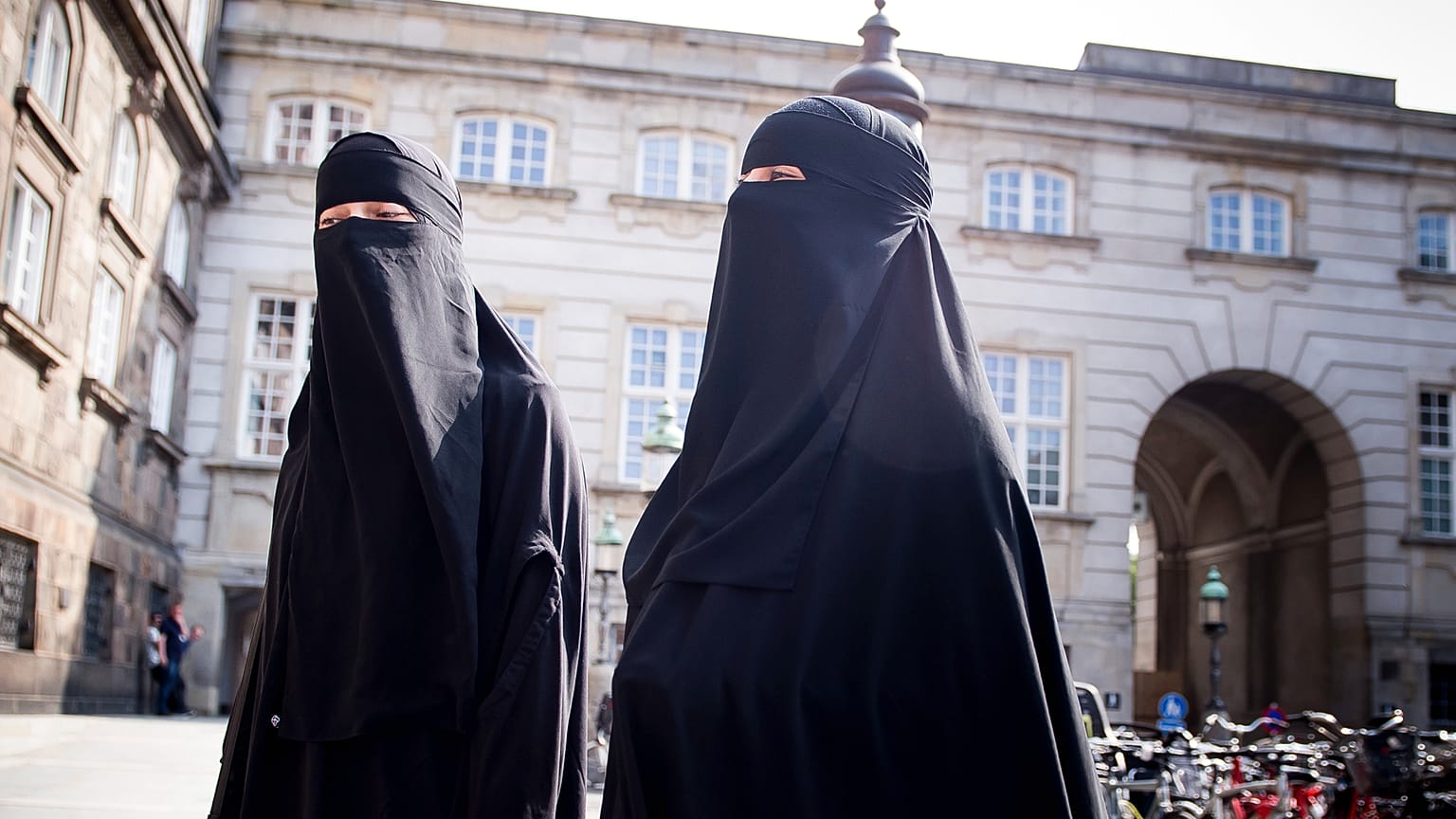
Women wearing niqabs stand outside the Danish Parliament in Copenhagen on 31 May 2018, as Denmark approved a ban on garments covering the face.
Copyright Ritzau Scanpix

By Greta Ruffino & Joana Mourão Carvalho
Published on

European countries take widely different approaches to full-face veils, from nationwide bans to restrictions in specific public spaces. Euronews looks at how the rules vary across the continent.

On Thursday, Portugal joined a growing list of European countries that have banned or restricted burqas and other full-face veils in public spaces.

But rules vary widely across the continent. Euronews breaks down how different European countries regulate face coverings.

France pioneered Europe’s face-covering ban

France became the first European country to ban full-face coverings in public spaces in 2011. Violations can result in a fine or mandatory civic education.

The French government argued that face coverings prevent people from being clearly identified, posing potential security risks and hindering social interaction in a society where facial recognition and expression play an important role in communication.

During the COVID-19 pandemic, questions were raised over whether protective face masks were compatible with the ban. Authorities later clarified that masks were permitted under existing health and safety exemptions.

Belgium: Fines and prison for violations

In Belgium, the ban dates back to 2011, with offenders facing fines or up to seven days in prison.

Alongside France, Belgium was one of the first European countries to introduce such restrictions, citing public security and social integration.

The law aims to facilitate communication and prevent people from concealing their identities in public spaces, measures Belgian authorities have defended as essential to ensuring the full participation of all citizens in society.

Bulgaria: Full-face veils restricted to private spaces

The wearing of burqas and other full-face veils has been banned in public spaces in Bulgaria since September 2016 and is restricted to private homes and places of worship. Muslims make up around 12% of Bulgaria's population.

Austria: Face-veil ban extended to schools

In Austria, a ban on full-face veils, including the burqa and niqab, came into force in 2017 under legislation known as the "Anti-Face-Veiling Act". The measure was introduced on security and integration grounds, with authorities arguing that face coverings hinder communication and social cohesion.

Additionally, in 2025, Austria's parliament approved a law banning Islamic headscarves for girls under the age of 14 in schools. The ban explicitly refers to "the headscarf that covers the head in accordance with Islamic tradition".

Denmark: A blanket ban on face coverings

Denmark enacted a full ban on face coverings in all public places in 2018. The law, which prohibits any clothing that conceals the face — including burqas and niqabs — has been justified primarily on grounds of public identification and societal transparency.

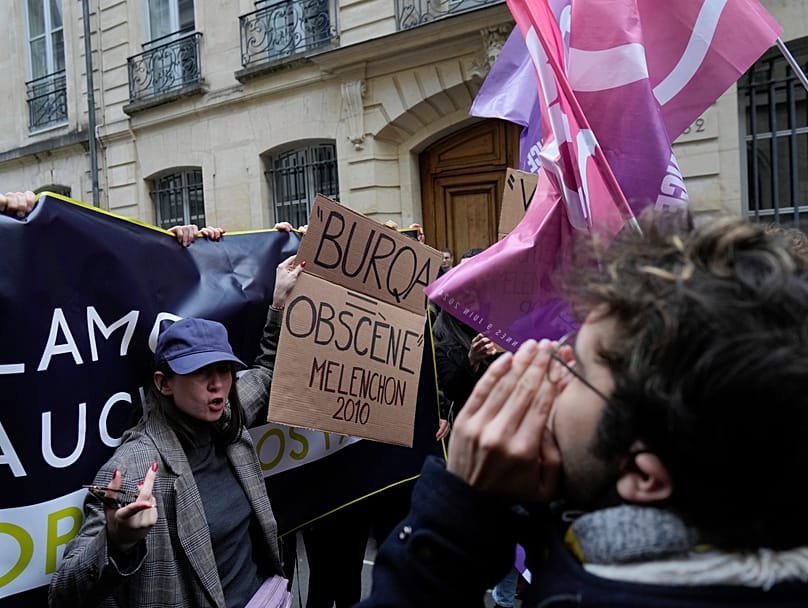
Nemesis founder Alice Cordier protests against a conference by Jean-Luc Mélenchon at Sciences Po in Paris on 22 April 2024, holding a sign reading "Burqa=obscene". (AP Photo/Thibault Camus)

Netherlands: Partial restrictions in key institutions

In the Netherlands, a 2019 law restricts face coverings in specific public settings — such as schools, hospitals, and public transport — where clear communication and identification are deemed essential.

While not a total ban, it reflects a growing inclination toward regulating religious expression in state spaces.

Germany: A fragmented approach to face-covering bans

Germany has taken a fragmented approach, with some states introducing partial bans in schools and public spaces on security and communication grounds. Specific restrictions also apply to certain professions and everyday situations.

While some regions consider such bans necessary to promote integration and social cohesion, others fear they could isolate certain communities and undermine social inclusion.

Luxembourg: Full-face veils restricted in public institutions

In Luxembourg, a law restricting the wearing of full-face veils came into force in spring 2018.

Face coverings are prohibited on public transport, in schools and on school grounds, in facilities for children under 16, hospitals, common areas of care homes for older people, including corridors and lifts, as well as in judicial buildings and public administration facilities open to the public.

Spain: Legal silence, local discretion

Spain lacks national legislation on the issue, leaving decisions to the discretion of schools and institutions.

In 2013, the Supreme Court backed a Madrid high school's decision to exclude a hijab-wearing student, setting a precedent but not a standard.

While Islamic groups have stressed that the Spanish Constitution and a 1992 cooperation agreement together protect the right to wear religious attire, the Ministry of Education has not prioritised national guidance, arguing that such cases are rare and manageable at the local level.

Portugal: Legal neutrality, selective application

Portugal doesn’t explicitly ban religious symbols but permits institutions — both public and private — to enforce neutral dress codes, as long as these are applied uniformly.

The aim is to protect employees from religious pressure while ensuring that workplaces remain ideologically neutral.

Italy: A law from another era

Italy does not have a specific ban on religious dress, but a 1975 anti-terrorism law prohibits face coverings in public.

Though originally unrelated to religious attire, this law has occasionally been invoked to restrict the niqab and burqa in certain public or security-sensitive environments.

Sweden: Freedom first, local pushback

Sweden has no national ban on religious attire, and the veil remains permitted across public life. The national approach favours individual rights, though some municipalities have attempted to impose school-specific restrictions, citing integration and gender equality. These moves have sparked debate but have not yet reshaped national policy

Greece: Legal protections with practical limits

Greek law offers robust anti-discrimination protections based on religion across employment and public services. Yet, practice has sometimes told a more complicated story. In one 2022 case, a hospital barred a nursing student from wearing a headscarf during her internship, citing uniform regulations.

The Greek Ombudsman ruled the policy did not violate anti-discrimination laws, framing it as a dress code issue, not a religious one.

Restrictions on face- or body-covering veils, varying in scope and extent, are also in place in countries across several continents, including China, Australia, Russia, Canada, Sri Lanka, Gabon, Chad, Senegal, the Republic of the Congo, Cameroon, Morocco, Algeria and others.


LA REVUE GAUCHE - Left Comment: Search results for BURQA


LA REVUE GAUCHE - Left Comment: Search results for HIJAB


LA REVUE GAUCHE - Left Comment: Search results for BABUSHKA


Friday, February 10, 2006

CATHOLIC HIJAB

Laura Bush and that Pope guy
All patriarchical religions denigrate women by demanding they cover their heads to the eyes of their G*D.

The first lady wore a black suit and black lace mantilla, or head covering. Barbara, 24, wore a black skirt and black top and high-heeled black boots. (Related: Why the first lady wore black)


babushka - a woman's headscarf folded into a triangle and tied under the chine; worn by Russian peasant women
hijab - a headscarf worn by Muslim women; conceals the hair and neck and usually has a face veil that covers the face
kerchief - a square scarf that is folded into a triangle and worn over the head or about the neck

If Al Qaeda had its way, every woman would have to wear head scarves or hajib. The Islamic reasoning behind the scarves is that women should cover their hair as to not inflame the passions of any man except their husbands.
It wasn’t until the 1950s Vatican II that Catholic women were no longer required to cover their heads in church as a show of respect, and some Catholics continue the practice. I even saw that it has carried over to Protestants in Haiti, so much so that missionaries on my trip covered their heads as a sign of respect to the culture.
Religious Topic Women Covering Heads in Church - The Veil

One venerable tradition with much metaphysical significance that has faded in the horizons of the post-Vatican II era is the practice of women covering their heads in Church.

The veil is a beautiful symbol of the natural order affirmed by Scripture: “Man was not created for woman, but the woman for the man” (1 Cor. 11:9). The man was not to cover his head “because he is the image and glory of God.” But “the woman is the glory of the man because she came from the man… Thus, the woman is under the power of her husband.” That women should remain veiled in church while men do not is one symbol of this harmonious natural order establishing the husband’s authority over the wife.

The veil represents the natural hierarchy established by God in which the woman is subject to the male: “Let wives be subject to their husbands as to the Lord; because a husband is head of the wife, just as Christ is head of the Church (Eph. 5:22:23).
Veil.jpg - 38299 Bytes


The veil: the sign of purity of the bride.

This sublime comparison of husband and wife to the union between Christ and His Church suggests a benevolence in command unimagined before the rise of Christianity. It establishes the loving respect along with protection that a man should provide for his wife. The woman is not only the companion of a man’s life, but also of his spirit – destined to be the other half of his existence.


Religion in America -- Artifact Analysis
"She Maketh Herself Coverings is a home based ministry-business. It is run by the four daughters of our family (ages ranging from 19 to 30) as a cottage industry. Our purpose is to make Jesus Christ known and to provide a support and inspiration to Christian women and their daughters. We pray that you will be blessed and encouraged as well.

"In 1983, the Lord directed the ladies in our family (all five of us!) to wear the head veiling in obedience to an ordinance in I Corinthians 11. We spent many years searching for an appropriate style veiling. We have worn bandannas and scarves in the past but found them uncomfortable for consistent, daily wear. We wanted a headveiling style that was attractive as well as comfortable and brought glory to the Lord rather than queries about denominations.
The Jones Family, 1990's


Monday, September 26, 2005
When Religious Belief Becomes 'Child Abuse'


It seems we are quite happy to force kids to ‘cover up’ for their own good but reluctant to force them to ‘uncover’ for their own good. And there are reasons why headscarves and ‘cover-up’ clothing are not necessarily good for young girls. Studies show higher rates of Vitamin D deficiency in women and girls who are kept covered and that’s before we get into the area of emotional and psychological health.


The fact that it is only girls who are treated this way makes it quite clear that it has more to do with misogyny than any real spirituality. Muslim boys can have bare heads and bare arms and bare legs; boys can feel the sun on their skin; boys can run free with uncovered legs …. But not girls. This is hardly fair in the land of the ‘fair go.’ I can accept an adult woman may choose to dress in this way but I believe that society has an obligation to protect young children from being forced into anything that may be detrimental to their physical, emotional or psychological health.

Little girls are being forced to dress in a way that can only serve to prevent them from feeling free and a part of the society around them. How much fun do you think it is to be covered up like this in the middle of a hot Australian summer? Not much I suspect, and yet we are prepared to go along with it completely ignoring the fact that schools have rules about uniforms that we demand everyone else follows.

The tradition of women covering their heads can be found in all patriarchal religions. In Corinthians I 11:3-10,16, St. Paul's views on the veil come across strongly: “Any man who prays or prophesies with his head covered dishonours his head, but any woman who prays or prophesies with her head unveiled dishonours her head - it is the same as if her head were shaven. For if a woman will not veil herself, then she should cut off her hair; but if it is disgraceful for a woman to be shorn or shaven, let her wear a veil... That is why a woman ought to have a veil on her head, because of the angels... If anyone is disposed to be contentious, we recognize no other practice, nor do the churches of God.”

So, women have been wearing the veil to show submission to authority, to God and men! The veil was supposed to be a sign of modesty and chastity. Even in the Old Testament, removing the veil was seen as a way to humiliate a woman, punish adulteresses etc. (Numbers 5:12-18, Isaiah 3:16-17, Song of Solomon 5:7). Some Christian sects such as the Amish and Mennonites insist on females being veiled to this day, as a way of being modest and chaste and as a symbol of the woman's subjection to man and to God.

In times past, times that we would consider less enlightened, a woman could not enter a Christian church without covering her head; she would have to be ‘purified’ after giving birth, that miraculous and precious state considered to be unclean by a patriarchal society that feared, if not hated the feminine; she would not be allowed to enter a church while menstruating and would have to undergo a ‘cleansing’ ritual before she could return.

A woman’s hair was thought to represent passion, abandonment, sexuality …. all of the things that patriarchy and its religions sought to control if not punish and we can only be grateful that the modern, developed world, has moved on and left, in the main, such unpleasant beliefs and habits behind. Although, in many Catholic countries, women will still cover their heads before entering a church.

Still today, in some Jewish sects, women are forced to shave their heads and wear wigs. In ancient times, Jewish women would go out in public in a full veil as well, as a bare head was considered “nudity” and the woman could be fined a serious amount (Numbers 5:18, Isaiah 3:17, II Maccabees 4:6, Sus. 32). A man could even divorce his wife if she was found bareheaded in public.

In India the veil still holds sway, but then Hinduism teaches that women are inferior to men. Sanskrit literature is replete with instances where women have to wear veils. It is not surprising, as the laws of Manu clearly state that the status of women is completely dependent on the man. Hindu women are still prevented from entering a temple while menstruating and in orthodox Hindu and Buddhist religion, the presence of a woman is still seen as ‘polluting’ to a priest.

It’s all very unpleasant really and smells of patriarchal prejudice however it manifests; even in something so seemingly simple as girls wearing headscarves. Put on a headscarf for a week and make sure you buy synthetic, because that’s what most of them are made of, and make sure you wear it in the middle of summer, oh, and make sure you have your arms and legs covered and then go out and play sport and then make up your mind as to whether or not this amounts to a form of abuse.

Because the fact is, it is not just about little girls wearing a headscarf, it is about discrimination and prejudice inflicted on children who have no way of defending themselves. We discriminate when it suits us as to what ‘religious’ beliefs we will allow in our society so there are precedents well and truly set upon which we can make a decision to ban headscarves in the best interests of the children involved.

And that’s because it is not just about a simple headscarf; it is about an attitude, a belief in the inferiority of women; a belief in the evil of the feminine; a belief that women (and girls) must be controlled. In places like Pakistan and Bangladesh unveiled women are likely to have acid thrown into their faces. What does that say about the beliefs behind the habit of veiling?


Find blog posts, photos, events and more off-site about:
, , , , , , , , , , , , , , ,