Is It Strategic to Refocus Towards Climate Adaptation?
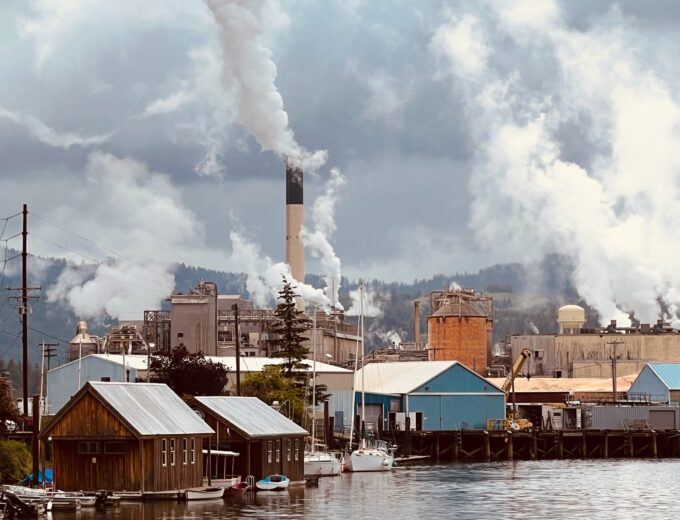
Toledo, Oregon. Photo: Jeffrey St. Clair.
In London, UK, last week, on a rare overseas trip, I attended the launch of a new campaign initiated by the Climate Majority Project to refocus the efforts of climate advocates from mitigation (cutting greenhouse gases) to what they referred to as “strategic adaptation”. The approach is outlined in the report they released called SAFER: Strategic Adaptation For Emergency Resilience.
Many climate advocates have been resistant to talk about adaptation because, as the report recognizes, it appears to encourage giving up on mitigation, and it also appears to abandon communities in the Global South who are more at the frontlines of climate damages while having done much less to incur them. However, the proponents of SAFER argue for a more expansive form of adaptation. Their “strategic adaptation” is not simply reactive to disaster but also builds resilience, fosters agency, grows climate awareness, and transforms, for example, food systems; and, they argue, it will help mitigation. They recognize that without cuts to emissions we are on course for hothouse planet (runaway temperatures within decades) so they are not giving up, but rather arguing that the way to achieve mitigation is to not focus directly on it but instead to focus now on adaptation.
While I think SAFER gets many things right, I was perplexed by the way the event was launched, by the statement of untested assumptions as apparent facts, by the absence of an organizational strategy, and by the overly depoliticized language. Overall, I want to argue that given the ever-expanding impacts of climate breakdown, the approach of the Climate Majority Project of taking gentle steps rather than engaging in serious political struggle seems seriously misguided.
The presentation, in a packed lecture hall at University College London, started with the recognition that our valiant social mobilization for climate mitigation has mostly failed. Some facts that are salient for me are that the numbers engaging in rallies, sustained group organizing and even advocacy are clearly tiny in all our populations; global heating and climate damages are accelerating; fossil fuel finance and extraction are at record levels; and there is now, in the US and EU, a political backlash that threatens to erase the meager mitigation policies. And even when those policies were instituted, they were seldom made directly by the state, but instead outsourced to for-profit interests (see the case of Germany), and even then mostly concerned electricity supply and hardly transportation, buildings, agriculture and consumption, which is still encouraged almost everywhere under the mantra of economic growth.
The core theory of SAFER is that a refocus on strategic adaptation can build a bigger climate mobilization. This is because adaptation is in the material interest of local communities, and by concretizing climate action locally it will build consciousness for climate change as a reality, leading ultimately to a stronger climate movement for mitigation. This comes out of three key assumptions in the report:
1. Committing to adaptation overcomes the problem that the public in the UK is mostly complacent in fighting for climate action since they are lulled by the government’s promise to achieve Net Zero decades in the future, which is mostly a scam. Also, as the authors argue “the problem of climate change is an abstract story of invisible gases”. Instead, adaptation makes climate breakdown real through local, concrete action to address tangible threats.
2. Committing to adaptation might help working class and other communities overcome perceptions of climate action as leftist, hypocritical or irrelevant by addressing people’s immediate concerns such as rising energy costs and food security.
3. If many communities do join adaptation efforts, including pushing the government to prepare for heat waves, flooding, disruptions to food supply and the eventual likely collapse of the Atlantic Current that could reduce winter temperatures by 20 C (36 F) in some years, and if there is a serious national commitment to adaptation, then it will become obvious that adaptation is not enough, strengthening the case for mitigation.
I very much agree with SAFER’s focus on people’s material interests and the need to prepare and defend locally, but it has problems including the lack of a broad coalition at the start, the statement of untested assumptions as apparent facts, the apparent absence of an organizational strategy to bind communities together, and an overly depoliticized approach.
First, the launch of SAFER did not showcase the kind of wide coalition that is necessary to build a movement. It was launched not merely as a report but as an appeal for funds to “[build] a powerful community gathering”. It included presentations from Retrofit Balsall Heath in Birmingham, UK, which is trying to retrofit homes to improve insulation, and from Greener Henley, which hosts hundreds of thousands of visitors at boating regattas on the river Thames, and is now seeking protections from flooding. Yet the line-up of 7 speakers did not apparently include anyone from the working class or unions or from the kind of multiracial coalition which would be needed in Britain to build a movement.
Second, it is a big assumption that doing local adaptation action will make the climate breakdown threat visible in a way that galvanizes people to want to struggle for mitigation later. It’s like assuming that because workers in a particular union learn to advocate for their own material interest that they will then want to also help the wider working class. But this is mostly contradicted by what many unions have become.
Now it might be, as the presenters argued, that people in hundreds of local communities who are engaged in adaptation actions in the UK do develop a wider consciousness that they are part of something bigger, that they are linked-up by some shared ideological understanding. But that will require SAFER to do a stellar job at on-the-ground organizing to build a movement of those hundreds of local communities. A major impediment to this might be that many Britons are currently facing profound inequality, affordability, health-care provision and housing crises and a general disenchantment with the standard political parties. So, SAFER campaigns need to connect directly with those kind of material interests, which are inherently political. But dealing with this is affected by the next problem.
Third, SAFER will be hampered by the Climate Majority Project’s commitment to “depolarizing’ the climate issue. As the report explains, they want to depolarize after observing how the early successes of Extinction Rebellion in the UK led to a societal backlash against the “radicals” and how the right has brought climate into the culture wars. But in the SAFER report the world “capitalism” does not appear once, nor does “ownership”. And this in a country with privatized utilities for water, electricity and rail.
In San Diego California we have built a campaign to mobilize the city population to confront the investor owned utility (owned by a fossil fuel company) that controls our electric grid, extracting over half a billion dollars per year in profit. This campaign for public not-for-profit ownership is very much in the spirit of SAFER: it connects with people’s material interest by promising lower electricity prices, it prepares for a climate damaged future by emphasizing local rooftop solar and storage instead of building long-distance transmission lines to remote solar mega-projects, and it likely achieves lower emissions by accelerating the renewable transition. Unlike SAFER however, it is explicitly political – the issue is about ownership, about changing social relations. We have seen that we can also appeal to some conservatives, who also don’t like monopoly corporate control. Perhaps then the challenge for SAFER is to build a progressive populism that is targeted at elite / corporate power without being encumbered with typical socialist connotations?
Fourth, if the proponents of SAFER believe that an adaptation-engaged climate-realist populace will then be ready for the mitigation struggle, and if they can actually build the mass movement of connected organizations to do that, it will need to be militant, even revolutionary, which appears completely at odds with their framing. The mitigation struggle is a confrontation with the interests of fossil fuel finance, fossil fuel extraction, and US and other military hegemony. Beyond that, unless we entertain the unsubstantiated assumptions of green capitalism of a nice, clean, green technical transition, it is also a confrontation with the core aspect of modernity – endless economic growth. Indeed, quite apart from the problem with carbon we are now superseding 7 of 9 planetary boundaries (i.e. boundaries beyond which our world is not in a safe operating space, of which changes in nitrogen and phosphorous cycles and a thousand-fold increase in species extinctions are other examples). If we keep growing then a big shift to wind and solar and electrifying nearly everything will continue to add to rather than replace fossil fuel energy, and will also push us further beyond the other planetary boundaries.
SAFER could look at what some social movement scholars are calling the most successful climate movement of our recent times Soulèvement De La Terre (Earth Uprisings) in France. A central organizing group is coordinating multiple communal home-grown struggles, such as fighting back to preserve local water supplies, knitting them together and providing key practical support, even while retaining a commitment to anti-imperialism and anti-fascism. In our world now, where international law is in tatters and, relatedly, the prospect for internationally-binding action on climate blown, where authoritarian forces grow and local populations even in the Global North are immiserated, we should not put all our confidence in SAFER’s depolarized politics that hopes to not offend.
As global heating accelerates and climate damages mount all around us, and as climate organizations and activists grow desperate about what to do, SAFER provides important new thinking. The challenge, one of the biggest of our times for organizers, theorists and social scientists, is how to bring this idea into our various countries at an organizational level. In the end, the path forward will require thousands of local communities to link up in a common movement so that they engage in coordinated political action that must be radical in the sense of changing social relations.

In 2016, Achille Mbembe wrote Africa in the New Century, offering a critical analysis of the continent’s resilience amid globalization and the enduring legacies of colonialism. In this bold and evocative piece, Mbembe critiques the Hegelian apocalypse that portrayed Africa as an “Unhistorical, Undeveloped Spirit, still involved in the conditions of mere nature” and subverts Western narratives of Africa’s predicament in shaping its future during the age of the climate crisis. While recognizing Africa’s disproportionate vulnerability to climate change, Mbembe argued that the continent holds some of the most potent solutions to the global ecological trap overshadowing the twenty-first century. Mbembe’s insights remain relevant today, particularly in discourses on resilience building, where Africans are often portrayed as victims rather than agents in responding to and shaping solutions to climate change.
Over the past two decades, resilience building has gained impetus in development policy discourses addressing adaptation, disaster risk management, agriculture, and economic stability. Despite its conceptual ambiguities and its widespread use as a development buzzword, resilience functions as a risk-management framework designed to anticipate, avoid, plan for, cope with, recover from, and adapt to climate-related shocks and stresses in the Anthropocene. The United Nations, the World Bank, and international donors are increasingly funding projects to build resilience in “vulnerable” environments, pledging to strengthen capacities and empower communities to adapt and recover from climate crises. However, designing and financing resilience is deeply rooted in neocolonial domination, power, and knowledge production, often obscured in policy discourses.
By situating resilience governance within broader African historical and contemporary political contexts, I illustrate how resilience building does not always empower vulnerable populations but serves as a mechanism for reinforcing neocolonial hegemonic dependencies. I call for a decolonial consciousness that interrogates the historical roots of marginalization in order to reconceptualize, reimagine, and rewrite dominant discourses on resilience in Africa. In doing so, I position African (indigenous) populations not merely as passive recipients of externally imposed aid but as active agents who, despite structural and systemic constraints, continuously resist, adapt to, and contribute to alternative forms of resilience rooted in local knowledge, lived experience, care, and reciprocity.
From 1960, when several African countries gained independence to the outbreak of COVID-19 in 2020, there have been over 500 scholarly works focused on African resilience. Throughout history, Africans have embedded resilience in their institutions, governance, and cultures, adapting to environmental, social, economic, and political challenges. A significant body of scholarship on resilience in Africa challenges persistent myths that portray African peoples and histories as static, devoid of agency, or inherently violent. Across the continent, indigenous knowledge systems have long played a crucial role in environmental adaptation and ecological preservation. Communities have used traditional methods to interpret ecological indicators—such as animal behavior, plant phenology, and celestial patterns—to predict rainfall, navigate extensive periods of drought, and respond to shifting climatic conditions. These practices, deeply rooted in local cosmologies and oral traditions, offer flexible, context-specific strategies that have sustained livelihoods for generations and continue to shape adaptive responses in the face of contemporary climate challenges.
However, these forms of “resilience” are rendered problematic from a development perspective precisely because they are unproven, unregulated, and not captured in techno-political registers. As a result, local knowledge systems and adaptive strategies are not often recognized in policymaking, and interventions focus on Eurocentric and scientific knowledge. These forms of Western knowledge ignore contextual knowledge and place climate change solutionism within the logic of capitalist modernism and neoliberal governance, arguing that the same capitalist systems that created the climate crisis possess the requisite qualities to address it. Such discourses neglect political concerns with the history of the climate crisis, placing technological innovations and experts as the solution. This reflects how resilience and adaptation governance obscure the long histories of epistemic violence and the asymmetrical power relations between the colonizer, experts, and African indigenous populations who are beneficiaries of resilience programming.
The postcolonial landscape of climate governance in Africa is shaped by Western hegemony, engendered as a result of colonialism and imperialism where, in its aftermath, Africans are perceived as vulnerable victims of the ecological crisis in need of aid from Western colonizers who evangelize themselves as liberators, experts, and arbiters of the truth. Crucially, contemporary rationalities of resilience programming end up reproducing neocolonial mechanisms in postcolonial Africa. It is worth noting that financial assistance from the West comes as loans, with only a limited portion allocated as grants. Funds allocated for climate change mitigation often come with conditions that, for instance, require the establishment of carbon markets or adopting renewable energy technologies sourced from donor countries, reinforcing dependencies and external control. African countries facing existential climate threats swiftly accept them, but these conditionalities pose significant threats to national sovereignty. These conditionalities risk reproducing patterns of environmental governance that limit African agency, constrain policy space, and prioritize global climate objectives over the lived needs of vulnerable communities.
Climate finance, ostensibly designed to support developing economies to build resilience, has instead entrenched global inequalities, increased the debt crisis of Africans and reinforced neocolonial economic structures. Evidence of this is compelling: While developed countries claim to have met their 2022 climate finance target with $115.9 billion, 71 percent of this amount was delivered as loans—many at market interest rates—thereby intensifying the financial burdens of vulnerable developing countries, particularly across the African continent. The World Bank’s West Africa Food Systems Resilience Project (2022–2027), which seeks to integrate climate-smart technologies to build the resiliency of farmers to tackle the problem of food insecurity in Ghana, Togo, Burkina Faso, Niger, and other countries, is funded through concessional loans. However, these loans perpetuate a cycle of dependency among recipient countries and beneficiary farmers and communities, subjecting them to discipline and control to ensure compliance with the demands of funding institutions.
Furthermore, neocolonialism in resilience building in Africa emerges in the marginalization of local knowledge and agency during project design and implementation. Thus, while many resilience projects assert their aim to empower communities, they frequently overlook the indigenous knowledge of the very people they purport to serve, thereby perpetuating injustices and neocolonial subjectivities. As I argue elsewhere, this reveals forms of coloniality where, in attempting to build resilience, experts homogenize African realities and apply the same solutions across diverse cultures. Local knowledge within African communities is dismissed as unscientific and inferior (what I term the “coloniality of knowledge”), which excludes these communities from decision-making (coloniality of power), and benefits are distributed unequally—privileging a select few while marginalizing many (coloniality of being). This top-down approach often leads to maladaptation and various forms of community resistance across the continent. Resilience interventions in Uganda have been shown to undermine local livelihoods, including among the Karamojong pastoralists and Batwa forest-dwelling communities. They highlight how long-standing indigenous knowledge systems have been overlooked in the process, thereby entrenching structural injustices, exacerbating inequalities, and ultimately reinforcing cycles of skepticism and resistance.
My research illustrates how the Frafra people in the Upper East Region of northern Ghana actively resisted aspects of the Increased Resilience to Climate Change in Northern Ghana project (2016–2022), implemented by the UNDP and the government of Ghana under the Adaptation Fund. This resistance manifested in various forms—such as rejecting project structures, boycotting commissioning events and new farm lands, and self-mobilizing to rectify dam flaws—demonstrating a critique of externally driven adaptation frameworks in Africa and a reaffirmation of local knowledge and priorities. Local resistance to the resilience project, I posit, characterize how social exclusion and injustices in climate policy illustrate the postcolonial development landscape of a colonized African continent, depicted in decades of technification, failed climate adaptation interventions, and stagnant development.
Given that Western neoliberal paradigms of climate governance have not abated in resilience praxis, the only security for African communities lies in the formalization, ownership, and affirmation of indigenous knowledge systems, cultures, and ontologies of resilience thinking. Only through this can Africans navigate the escalating challenges of climate change while resisting external pressures and emerging forms of control.
Echoing Achille Mbembe’s call for Africa to reclaim itself as a site of autonomous development, self-invention, and political imagination beyond the tutelage of the West, I propose Africanization as a way of decolonizing resilience discourses and policy in the age of climate change. As Mbembe suggests, Africa must learn to become a center unto itself, a site where new imaginaries, new concepts, new thinking, and new practices are tested and experimented with. This perspective calls for a fundamental shift away from externally imposed developmental scripts of resilience governance, towards approaches grounded in Africa’s own ecological knowledge systems, social histories, and political aspirations.
Africanizing resilience involves rethinking Western dependence in resilience building while placing value on Afrocentric agency, epistemologies, ways of knowing, and ways of being. I argue that recognizing indigenous Afrocentric identities and epistemic systems through decolonial methods and ontological plurality can be juxtaposed with Euro-Western universality as a critical paradigm to decenter the modernist hegemonic world order in the contemporary structures of resilience-thinking in the Anthropocene. African people have their own traditions, narratives and practices of resilience, which enable them to nurture their abilities and joint agency. Ama Mazama places agency at the heart of Afrocentricity, strengthened through ideals of resilience, initiatives, and choices in circumstances where Africans are involved. This deconstructs the edifices of aid dependency and places Africans at the helm of their own realities and contemporary philosophies in an enlightening manner.
Decolonizing resilience offers a non-homogenizing ground to reconceptualize and rethink neocolonial subjectivities and power disparities in resilience projects across Africa. This involves disrupting dominant ways of seeing and representing Africa and cultivating resilience in pluriversal approaches that resist the reproduction of (neo)colonial logic and principles in climate governance. Without this, I caution that resilience praxis risks becoming devices of neocolonial hegemony and sociopolitical injustice, perpetuating the very vulnerabilities they seek to address in the Global South

No comments:
Post a Comment