Left Foot Forward News
'The super rich in this country are laughing all the way to the bank'
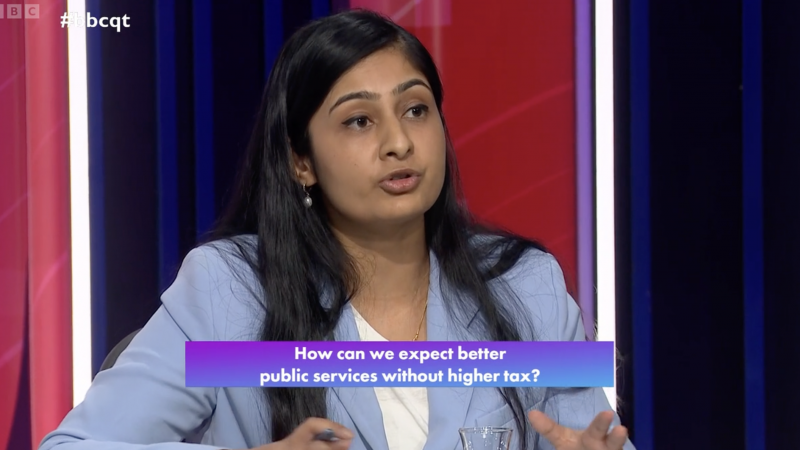
On yesterday night’s episode of BBC Question Time, Sultana said people are fed up with “establishment politicians” and a status quo where “their lives are harder, their wages are stagnated, their bills are increasing, and at the same time the super rich in this country are laughing all the way to the bank.”
Sultana pointed out that the top 50 richest families in the UK hold more wealth than 70% of the population, and that since 2010 billionaires have tripled their wealth.”
On the cost of energy prices, she said: “Everyone can see it, their energy bills are increasing and energy companies are recording record profits.”
“So it’s an economic system that is fundamentally broken.”
Sultana said that from Labour, the Conservatives and Reform, “you’ll get the same neoliberal politics, the same economic system”.
She said that trickle down economics has failed, noting the record levels of inequality, child poverty and the simultaneous surge in billionaire wealth.
In a heated exchange about funding public services, Sultana tore apart Reform MP Danny Kruger after he claimed the party is challenging the “incumbent system” in local government.
Kruger then took a swipe at the left’s “excessive politics”, to which Sultana responded: “Excessive politics? Not having austerity Danny, which killed over 300,000 people and has cut the average life by half a year.”
Kruger said: “We need public spending to be under control.”
“What does that mean?,” Sultana responded.
Kruger argued against “pumping more and more into the welfare system”, saying it fuels “long-term generational poverty”. “We need an economy that actually works,” he said.
Sultana pushed back, asking: “How will austerity grow the economy Danny? That’s not Keynesian economics is it.”
She instead back equalising capital gains tax with income tax to generate £17 billion a year and a wealth tax on assets of £10 million to raise £24 billion a year.
To applause from the audience, Sultana said: “The magic money tree exists, it’s in the City of London and it’s with the billionaires, but what you find is the lack of political will, because these parties are bankrolled by the billionaires, so they’re definitely not going to tax them.”
Olivia Barber is a reporter at Left Foot Forward
Labour must also take urgent action to deal with the social emergency facing millions right here and now.
Britain remains in the grip of a cost-of-living emergency. Though it no longer dominates the headlines as it did a couple of years ago, millions of people are still being forced to make impossible choices between heating their homes and putting food on the table.
Poll after poll shows this is the single biggest issue in British politics — however much Nigel Farage tries to shift the focus by scapegoating asylum seekers, Muslims, or whoever else falls foul of the never-ending attempt to divide and rule.
Yet while so many have been pushed to the brink, the wealth of those at the very top continues to skyrocket. British billionaires’ wealth has more than doubled in recent years and is growing by £35 million every single day.
The glaring inequality that scars our society is no accident — it is the direct result of nearly fifty years of neoliberal capitalism, unleashed by Thatcher’s war on workers and wave of privatisations, that have never been properly reversed.
A Labour government should act boldly, guided by socialist principles, to tackle this head-on. Bringing energy and water back into public ownership, a mass programme of council house building and introducing rent caps are the kind of structural changes that would take life’s essentials out of the hands of the market and end the rip-off facing ordinary people.
But while we fight for such measures, Labour must also take urgent action to deal with the social emergency facing millions right here and now.
That’s why I’m calling on the Government to use the Autumn Budget to introduce a package of wealth taxes to create a Social Emergency Fund — providing immediate support for people hit by soaring food, energy, and housing costs.
Over 10,000 people have already signed my open letter calling on the Prime Minister and Chancellor to act — which I will deliver on the eve of the Budget.
This package of measures would target the very richest and could raise tens of billions every year. It includes:A 2% Annual Wealth Tax on assets above £10 million — raising £24 billion per year
Equalising Capital Gains Tax with Income Tax — closing a loophole that means wages are often taxed at higher rates than income from wealth, raising £12 billion per year
Clamping down on tax avoidance, corporate loopholes, and strengthening enforcement — generating billions more each year
Billions more could be raised with a windfall tax on the profits of the Big Four banks. Set at the same rate as the one on the super-profits of the oil and gas giants, this could bring in a further £14 billion a year. With banks making record profits from the higher interest rates that are hammering households, clawing back a share of those windfalls is only fair.
Together, these modest measures on wealth and super-profits could raise well over £50 billion per year.
That’s more than enough to deliver a Social Emergency Fund to guarantee some immediate relief to struggling households. Below are five examples of the kind of policies that the government could deliver in that:
1. Introduce Cost-of-Living Grants: These were delivered in the aftermath of the Covid crisis and as energy prices surged. Reintroducing similar grants of up to £900 for low-income households, alongside support for disabled people and pensioners, would cost around £11bn and provide a real boost to incomes this winter.
2. Scrapping the Two-Child Benefit Cap: Experts say no other measure would do more to tackle child poverty than this, lifting hundreds of thousands of children out of hardship overnight. Scrapping the cap fully would cost £2 billion this year rising to £3 billion by 2030.
3. Universal Free School Meals: In the sixth-richest country on Earth, ensuring every child has a nutritious hot meal each day should be the most basic of expectations. Universal free school meals would not only cut child hunger but also save families—already hit by soaring food prices—hundreds of pounds a year. Experts estimate the cost at around £2.5–3 billion.
4. Expand the Household Support Fund: This fund allows local authorities to provide vital, tailored grants to people in hardship — from help with energy and water bills to food, school uniforms and other essentials. But it is woefully underfunded. Tripling it to £3 billion per year, for example, would give councils resources to offer more people support during this cost-of-living crisis.
5. Re-Link Local Housing Allowance to Market Rents: This Allowance is intended to ensure people can afford to rent properties in their local area. But the freezing of the allowance, at a time of soaring rents, has left too many families with a shortfall — forcing them to cut back on other essentials just to keep a roof over their heads. Restoring the link with local market rates would cost around £2.5-3.5bn depending on the level it is set at.
The cost of these emergency measures is around £23bn – far below the amount raised by the tax rises above highlighting how the government could easily be doing much more to tackle the cost-of-living crisis.
And there’s no shortage of other policies coming from the experts — from a wider benefits uplift to calls for a protected minimum floor for Universal Credit levels as a first step towards an Essentials Guarantee.
The key point is that, just like with austerity, the decision on whether to act is a political choice.
Britain has the wealth to deal with this crisis — but it is being hoarded at the top. So we should not stand by while destitution is normalised and 7 million people in Britain are unable to afford essentials like food, energy, and toiletries.
Tackling this crisis is exactly the kind of change people wanted to see when they backed Labour at the General Election.
In recent days, Westminster has been dominated by the usual political soap opera — the kind of spectacle that puts most people off politics.
The Budget should instead be a chance to respond to the urgent realities of people’s lives and address the cost-of-living crisis by taxing those who have done so well out of our rigged economy.
Left Foot Forward
“The gap between the super-rich and everyone else grows by the day."
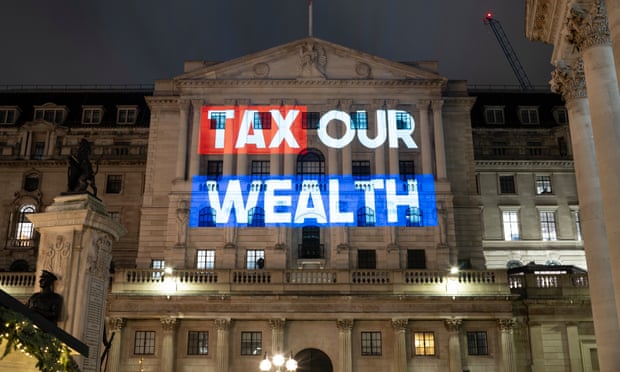
A group of millionaires have urged Chancellor Rachel Reeves to increase taxes on the rich, and use the funds raised to “lift kids out of poverty” and invest in rebuilding public services.
Campaign group Patriotic Millionaires, has issued the call ahead of the budget later this month, saying that measures such as reforming capital gains tax and introducing a new wealth tax could raise up to £36 billion annually.
Reeves has previously ruled out a wealth tax, however now a wealthy group of individuals have themselves called for the measure.
The Independent quotes group member Phil White as saying: “It’s time for the wealthiest – people like us – to pay a fairer share, so we can help lift these kids out of poverty and begin rebuilding our public services and communities right across the UK.”
He added: “We all want to live in a society where everyone has a decent shot at life – but at the moment that just isn’t the case.
“The gap between the super-rich and everyone else grows by the day.
“In Scotland, around one in five children live in poverty, while the country’s five richest families own a combined £19.3 billion – more wealth than a quarter of the population put together.”
Patriotic Millionaires is beginning a tour of major cities across the UK with its ‘Tax The Super-Rich’ bus as it bids to take its message across the country.
Basit Mahmood is editor of Left Foot Forward
Campaign launched calling on Sir Jim Ratcliffe to pay more tax
“If you can own our most famous football club – you can pay tax. Obviously."
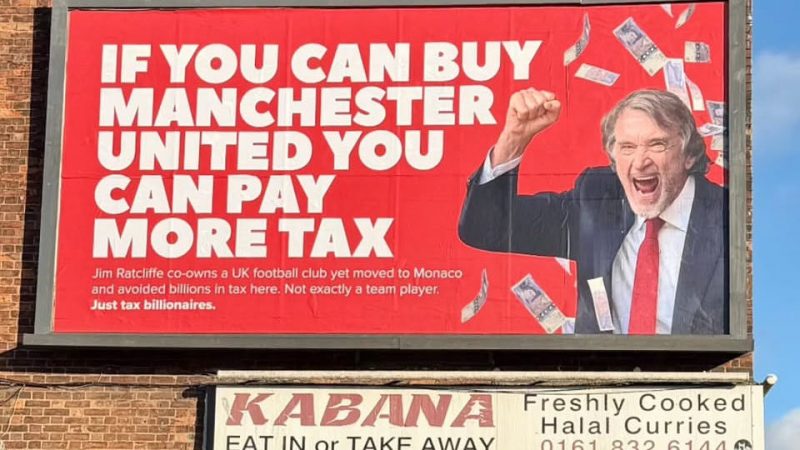
A new billboard poster on a building in Manchester reads: “If you can buy Manchester United you can pay more tax.”
The advert was produced by the campaign group Everyone Hates Elon. It features Manchester United co-owner Sir Jim Ratcliffe and has been installed on the side of a city-centre building ahead of the government’s Autumn Budget. It forms part of a wider series targeting billionaires and calling for higher taxes on extreme wealth.
Everyone Hates Elon formed this year in protest of Musk’s statements about British politics and promotion of disinformation. The group creates parody adverts and viral social media campaigns to criticise Musk and other billionaires.
Their latest campaign focuses on Sir Jim Ratcliffe, the British billionaire who acquired a 27.7 percent stake in Manchester United in February 2024. Ratcliffe is the chairman and CEO of the Ineos chemicals group, which he founded in 1998.
According to the Sunday Times Rich List 2023 , Ratcliffe’s net worth was estimated at £29.688 billion, making him the second wealthiest figure in the UK at the time.
In September 2020, Radcliffe officially changed his tax residence from Hampshire to Monaco, a move estimated to save him £4 billion in tax.
Earlier this year, eco-activist, entrepreneur and Labour donor Dale Vince, described Ratcliffe as a “billionaire tax exile,” criticising predicted redundancies and cost-cutting measures at Manchester United under his ownership.
“Costs are cut, lives affected while the football decline continues. This is what happens when a billionaire tax exile takes over a football club.
“Football is about community and being a part of something, Jim Ratcliffe doesn’t get that.”
In an Instagram post to their 167,000 followers, Everyone Hates Elon addressed the Prime Minister directly:
“Hey @KeirStarmer you’re talking about “tough choices” in this month’s budget, how about just getting tough on the billionaires.
“JimRatcliffe owns almost a third of the UK’s most famous football team. He has a home here. He works here. Yet he “moved” to Monaco to avoid paying £4 billion in tax.
“If you can own our most famous football club – you can pay tax. Obviously. The 50 richest families in the UK have more wealth than half of the country combined, yet they’re playing the game with a completely different set of rule. It’s a p*ss take.”
‘A luxury levy is the politically savvy way to ensure the rich pay more tax’
 :
:The Chancellor faces a familiar dilemma at the November 2025 budget. Taxes must rise, and intense debate continues over whether she should break the manifesto pledge to avoid increasing income tax, VAT, and NICs. However, across calls for higher top rates of income tax, a mansion tax and an annual wealth tax, there is a broad consensus that the wealthiest must shoulder the greatest burden.
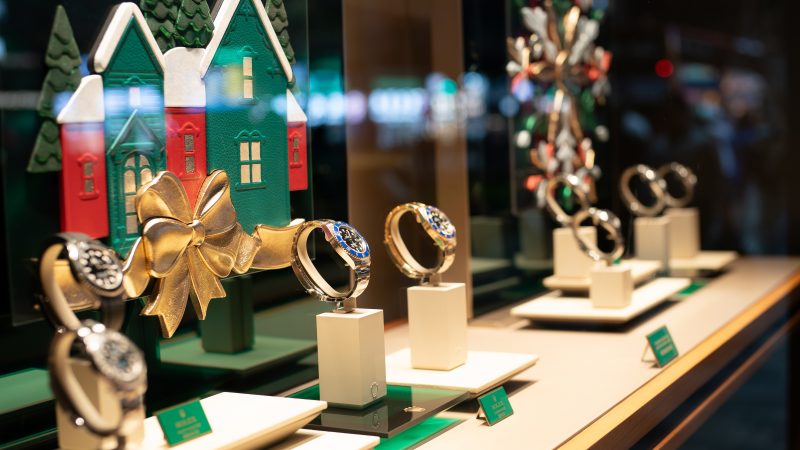
One option, inspired by similar policies in Australia and Canada, is a luxury levy on high-end goods – a consumption tax which would be economically rational, raise significant revenue and ensure the burden of taxation falls squarely on those who can afford it.
Economist Robert Frank identifies certain goods as ‘positional‘ – they derive their value largely from exclusivity. For example, a designer hoodie which everyone could afford would quickly stop feeling like a designer product – we value these items precisely because others cannot have them.
READ MORE: ‘Raising taxes on the wealthy isn’t just about the money’
This creates an unusual dynamic. Producing more positional goods doesn’t directly make society better off in the ways that many of us care about. Because of how we value them, positional goods cannot make an owner of the good better off without making someone else worse off. Luxury industries –which largely produce positional goods – may draw investment, effort and talent away from sectors the government has explicitly prioritised in its Industrial Strategy; those which are more crucial to economic growth, national security, and societal wellbeing.
We already operate a small tax on luxury cars through the expensive car supplement to Vehicle Excise Duty – a flat rate of £3,100 must be paid over a six-year period for cars worth more than £40,000. Expanding this to a broader luxury levy – covering high-end clothes, jewellery, accessories, and premium spirits – would reduce the need for broad tax increases that affect all industries, protecting the sectors we consider more socially valuable.
Australia’s long standing luxury car tax, with significantly higher rates than Britain’s version and a smaller market, raised approximately £600 million in 2023-24. Canada’s luxury tax was introduced in 2022, but will no longer be applied to yachts, as this part of the tax failed to raise significant revenue – a lesson on the importance of considering behavioural responses when designing new taxes. South Korea and Taiwan apply broader luxury taxes across high-end jewellery and furniture.
Frontier Economics and Walpole’s 2024 report on Britain’s luxury sector found that the luxury automotive sector generated £33 billion in sales in 2022, with “fashion and accessories” at £10 billion, and “beauty, wellness and grooming” and “jewellery, watches and precious metals” at £3 billion each. Even accounting for behavioural responses – a luxury levy will reduce overall sales – this provides a large base to raise revenue from.
Britain’s approach should learn from international experience. The £40,000 threshold for paying the expensive car supplement should be raised to support electric and self-driving vehicle adoption, but the flat rate of £3,100 should be replaced with a higher rate of 10% over the six-year period. The broader luxury levy should avoid yachts but include high-end clothes, jewellery, accessories, and premium spirits, offering a broader base than Australia and Canada. This may work best as a small top-up on VAT – close to 5%. Like the expensive car supplement, this should only apply above price thresholds, which are tied to inflation and carefully set to balance the aims of targeting the wealthiest and maintaining a broad base from which to raise tax revenue.
A luxury levy would be politically smart – it would primarily fall on the wealthiest, including wealthy tourists visiting London, while sparing working-class voters in Labour-Reform battleground seats across the Red Wall. By demonstrating Labour’s commitment to taxing the wealthiest, it would also strengthen our left flank as the Greens rise in the polls.
There are no perfect options. But when the Chancellor weighs her options before the budget, she should look closely at the luxury levy – a tax which raises significant revenue, targets the wealthiest, focuses on consumption which doesn’t enhance societal wellbeing and has significant political benefits against rivals on both our right and our left.


No comments:
Post a Comment