COP30
50,000 March in Brazil to Celebrate Death of Fossil Fuel Industry at COP30
“It is time to put these old fuels where they belong—in the ground of history.”
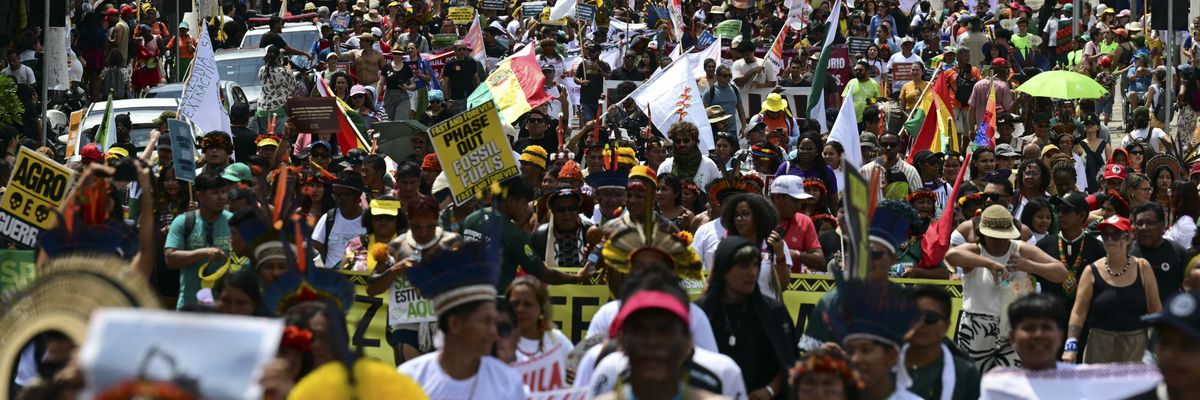
Thousands of people take part in the so-called “Great People’s March” in the sidelines of the COP30 UN Climate Change Conference in Belem, Para State, Brazil on November 15, 2025. Tens of thousands of people attended the march to demand “real solutions” to human-caused global warming , and which comes at the halfway point of contentious COP30 negotiations following two Indigenous-led protests that disrupted proceedings earlier in the week.
(Photo by Pablo Porciuncula / AFP via Getty Images)
Jon Queally
Nov 16, 2025
COMMON DREAMS
An estimated 50,000 people took to the streets of Belém do Pará, Brazil on Saturday to demonstrate outside the halls of the United Nations annual climate summit, holding a “Great People’s March” and makeshift “Funeral for Fossil Fuels” as they demanded a just transition toward a more renewable energy system and egalitarian economy.
Organized by civil society organizations and Indigenous Peoples groups from Brazil and beyond, the tens of thousands who marched outside the thirtieth Conference of the Parties (COP30) summit called for an end to the rapacious greed of the oil, gas, and coal companies as they advocated for big polluters to pay for the large-scale damage their businesses have caused worldwide over the last century.
“We are tens of thousands here today, on the streets of Belém, to show negotiators at COP30 that this is what people power looks like,” said Carolina Pasquali, executive director of Greenpeace Brazil, said as the march took hold. “Yesterday we found out that one in every 25 COP30 participants is a fossil fuel lobbyist, proportionally a 12% increase from last year’s COP. How can the climate crisis be solved while those creating it are influencing the talks and delaying decisions? The people are getting fed up–enough talking, we need action and we need it now.”
The report by the Kick Big Polluters Out coalition last week showed that at least 1,600 lobbyists from the fossil fuel industry are present at the conference, making it the second-largest delegation overall, second only to Brazil’s, the host nation.
“It’s common sense that you cannot solve a problem by giving power to those who caused it,” said Jax Bongon from the Philippines-based IBON International, a member of the coalition, in a Friday statement. “Yet three decades and 30 COPs later, more than 1,500 fossil fuel lobbyists are roaming the climate talks as if they belong here. It is infuriating to watch their influence deepen year after year, making a mockery of the process and of the communities suffering its consequences.”
While the overwhelming presence of fossil fuel lobbyists has once again diminished hopes that anything worthwhile will emerge from the conference, the tens of thousands in the streets on Saturday represented the ongoing determination of the global climate movement.
João Talocchi, co-founder of Alianza Potência Energética Latin America, one of the key groups behind the “Funeral for Fossil Fuels” portion of the day’s action—which included mock caskets for the oil, gas, and coal companies alongside parades of jungle animals, wind turbines, and solar panels representing what’s at stake and the better path forward—noted the key leadership of Indigenous groups from across the Global South.
“From the Global South to the world, we are showing what a fair and courageous energy transition must look like,” said Talochhi.
Ilan Zugman, director of 350.org in Latin America and the Caribbean, noted the significance of the demonstration, including the symbolism of the funeral procession.
“We march symbolically burying fossil fuels because they are the root of the crisis threatening our lives,” explained Zugman. “Humanity already knows the way forward: clean energy, climate justice, and respect for the peoples who protect life. What is missing is political courage to break once and for all with oil, gas, and coal. It is time to put these old fuels where they belong—in the ground of history.”
With the COP30 at its midway point, climate activists warn that not nearly enough progress is being made, with the outsized influence of the fossil fuel industry one of the key reasons that governments, year after year and decade after decade, continue to drag their feet when it comes to taking the kind of aggressive actions to stem the climate crisis that scientists and experts say is necessary.
“We are taking to the streets because, while governments are not acting fast enough to make polluters pay for their climate damages at COP30, extreme weather events continue to wreak havoc across the globe,” said Abdoulaye Diallo, co-head of Greenpeace International’s “Make Polluters Pay” campaign. “That is why we are here, carrying the climate polluters bill, showing the projected economic damages of more than $5 trillion from the emissions of just five oil and gas companies over the last decade.”
“Fossil fuel companies are destroying our planet, and people are paying the price,” said Diallo. “Negotiators must wake up to the growing public and political pressure to make polluters pay, and agree to new polluter taxes in the final COP30 outcome.”
Climate summit sees its first major protest

Under a baking sun, Indigenous people and activists gathered in a festive atmosphere, blasting music from speakers, carrying a giant Earth ball, and holding a flag of Brazil emblazoned with the words “Protected Amazon”.
It was the first major protest outside the annual climate talks since COP26 four years ago in Glasgow, as the last three gatherings were held in locations with little tolerance for demonstrations — Egypt, Dubai, and Azerbaijan.
Branded the “Great People’s March” by organisers, the Belem rally comes at the halfway point of contentious negotiations and follows two Indigenous-led protests that disrupted proceedings earlier in the week.
“Today we are witnessing a massacre as our forest is being destroyed,” Benedito Huni Kuin, a 50-year-old member of the Huni Kuin Indigenous group from western Brazil, said.
“We want to make our voices heard from the Amazon and demand results,” he said. “We need more Indigenous representatives at COP to defend our rights.” Tyrone Scott, a 31-year-old Briton from the anti-poverty group War on Want, said it was an “Indigenous-led, movement-led, people-powered march”.
“It’s just really exciting and a little bit of a nice antidote to the staleness and sterileness of the inside of the COP,” Scott said.
Their demands include “reparations” for damage caused by corporations and governments, especially to marginalised communities.
Some also held a giant Palestinian flag and a “free Palestine” banner. One protester on stilts dressed as Uncle Sam denounced “imperialism”. After a 4.5-kilometre (2.8-mile) march through the city, the demonstration was due to stop a few blocks from the COP30 venue, where authorities have deployed soldiers to protect the site.
On Tuesday, Indigenous protesters forced their way into the Parque da Cidade — the COP30 compound built on the site of a former airport — clashing with security personnel, some of whom sustained minor injuries.
Then on Friday, dozens of Indigenous protesters blocked the entrance for roughly two hours to spotlight their struggles in the Amazon, prompting high-level interventions to defuse the situation.
Published in Dawn, November 16th, 2025
Thousands march at COP30 to demand end to deforestation and fossil fuels
Thousands of people thronged the streets of the Amazonian city of Belem in Brazil on Saturday, urging COP30 negotiators to take urgent action against climate change and halt the use of fossil fuels and the devastating deforestation of the Amazon Rainforest. “We are witnessing a massacre,” one protester said of the Amazon, often known as the lungs of the earth.
Issued on: 15/11/2025
By:FRANCE 24
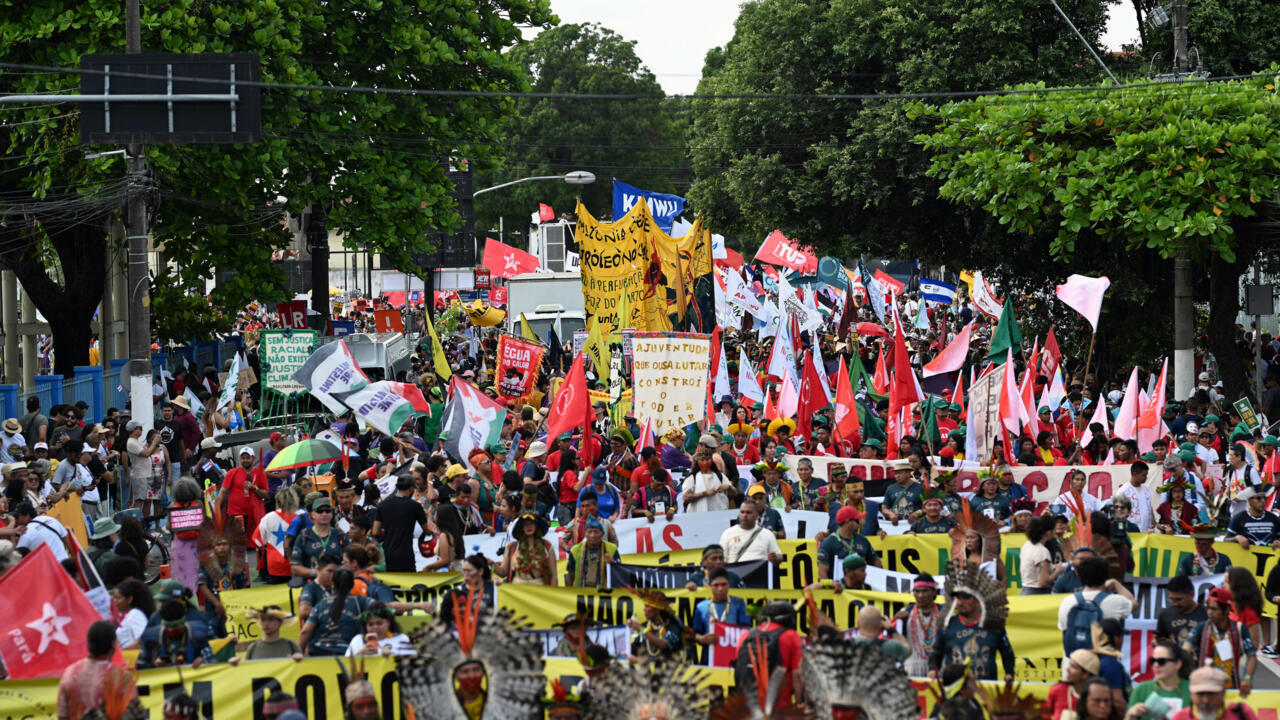
Thousands of people marched through the streets of Belem on Saturday to press for action from negotiators holding tough talks at the UN's COP30 climate conference in the Amazonian city.
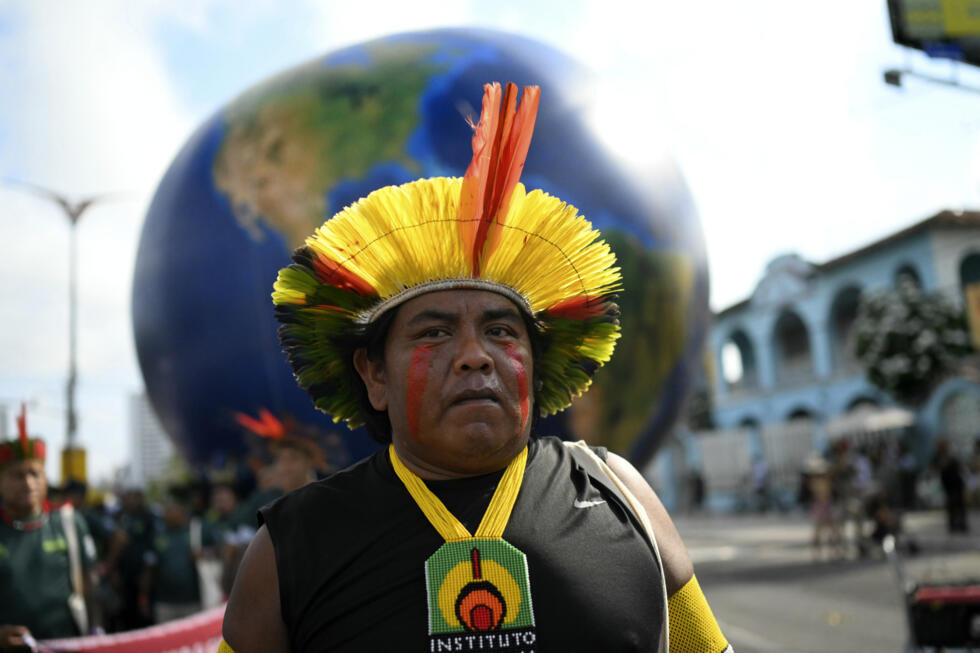
Under a baking sun, Indigenous people mixed with activists gathered in a festive atmosphere, blasting music from speakers, carrying a giant beach ball of Earth and holding a flag of Brazil emblazoned with the words "Protect the Amazon".
It was the first major protest outside the annual climate talks since COP26 four years ago in Glasgow, as the last three gatherings were held in locations with little tolerance for demonstrations – Egypt, Dubai and Azerbaijan.
Branded the "Great People's March" by organisers, the Belem rally comes at the halfway point of contentious negotiations and follows two Indigenous-led protests that disrupted proceedings earlier in the week.
"Today we are witnessing a massacre as our forest is being destroyed," Benedito Huni Kuin, a 50-year-old member of the Huni Kuin Indigenous group from western Brazil, said.
"We want to make our voices heard from the Amazon and demand results," he said. "We need more Indigenous representatives at COP to defend our rights."
Their demands include "reparations" for damage caused by corporations and governments, especially to marginalised communities.
Another Indigenous protester, Cristiane Puyanawa, joined the march to call for greater land rights.
“Our land and our forest are not commodities. Respect nature and the peoples who live in the forest,” she said.
Addressing the crowds, Brazil’s environment minister Marina Silva said: “This is a place for us to march and draw up a roadmap for what needs to be done at this COP: a transition away from deforestation and the use of fossil fuels.”
Massive security presence
After a 4.5-kilometre march through the city, the demonstration stopped a flew blocks from the COP30 venue, where authorities had deployed soldiers to protect the site.
On Tuesday, Indigenous protesters forced their way into the Parque da Cidade – the COP30 compound built on the site of a former airport – clashing with security personnel, some of whom sustained minor injuries.
Then on Friday, dozens of Indigenous protesters blocked the entrance for roughly two hours to spotlight their struggles in the Amazon, prompting high-level interventions to defuse the situation.
Negotiators shared their progress in a plenary meeting on Saturday before they hand their work over to national ministers to grapple with remaining political obstacles.
“As negotiators approach week two, they need to remember that climate action isn’t about abstract numbers or distant targets. It’s about people,” said Katharine Hayhoe, chief scientist at The Nature Conservancy non-profit.
“Every choice we make today determines the future we will share tomorrow.”
The sprawling summit agenda covers a huge range of issues with the intention of building on past years’ deals - an often inch-by-inch process that over three decades has delivered some progress, but not enough.
What will emerge from this year’s summit remains unclear, with some of the most controversial issues being discussed outside the formal process - such as increasing climate finance, moving away from fossil fuels, and addressing a collective shortfall in emissions-cutting plans.
Brazil’s COP30 presidency, which is steering those sideline discussions, must decide if it wants to attempt a high-stakes balancing act and come up with a political agreement on those issues that can be endorsed by all - known in COP parlance as a ‘cover decision.’
Asked on Saturday about such a deal, COP30 President Andre Correa do Lago told a news conference:
“For a long time, I’ve been saying that we are not planning a cover decision, but I also said that if there is a movement from the countries to propose a cover decision, the presidency will obviously take it into consideration. So, let’s see how things evolve.”
'Solidarity levies'
Elsewhere at COP, countries laid out new alliances and initiatives.
A group called the Premium Flyers Solidarity Coalition, which is planning to tax premium air tickets and private jets, said that Djibouti, Nigeria and South Sudan were joining the effort, which already includes France, Spain, Kenya and Barbados.
With Western governments slashing foreign aid, the idea of imposing “solidarity levies” on polluting sectors is gaining traction for generating debt-free money to fund climate action.
“If this COP has made anything clear, it is that the next decade must be one of acceleration powered by non-debt finance,” said Selwin Hart, special adviser to the U.N. Secretary-General.
The Utilities for Net Zero Alliance group of companies said it raised its investment target from about $116 billion per year to nearly $150 billion, including $66 billion for renewable energy and $82 billion on electricity grids and batteries.
(FRANCE 24 with Reuters and AFP)
Loans, accounting tricks, private investment, and meager pledges undermine a key tool for addressing climate crisis.
By David Goeßmann ,

Did you know that Truthout is a nonprofit and independently funded by readers like you? If you value what we do, please support our work with a donation.
UN climate conferences are primarily announcement summits. For 30 years, industrialized countries, which are primarily responsible for the climate crisis, have been promising that they will reduce greenhouse gas emissions consistent with the climate science, promote the energy transition, and combat the effects of climate change. Additional promises have also been made regarding climate financing at the UN Conference of the Parties (COP) climate summits in Copenhagen (2009) and Paris (2015). At COP30 in Brazil, governments have once again declared their intention to support developing countries with climate funding, repeating their promise at the COP29 in Baku, Azerbaijan, to increase climate financing to $300 billion annually from 2035. But promises are not yet actions.
At the Paris conference, for example, $100 billion dollars a year were pledged from 2020 onwards. This target was reached for the first time in 2022 but only on paper. The industrialized nations reported contributions of $116 billion, but according to the aid organization Oxfam, the actual value of the aid amounts to only $28 to 35 billion. This is because almost 70 percent of the aid is loans and not payments. But loans will only increase the debt burden of the already over-indebted countries of the Global South. In the last two decades the external debt of developing countries has quadrupled to a record $11.4 trillion in 2023, equivalent to 99% of their export earnings, according to the UN development agency UNCTAD. In addition, $24 billion of the climate amounts registered by the OECD are private investments. However, as NGOs have pointed out, these commercial, profit-oriented investments are difficult to trace and assess; can‘t substitute public funds as they are not payments; and just artificially inflate the amount which has to be paid by the governments of the industrialized countries.
In addition, a large part of climate funds from Organisation for Economic Co-operation and Development (OECD) countries are itemized as official development assistance (ODA), a type of foreign aid that is provided to developing countries by the industrialized states and reported to the Development Assistance Committee (DAC) of the OECD. The formalized aid emerged in the wake of decolonization in the late 1960s, when the issue of reparations for the Global South was put on the agenda. A quarter of ODA aid is now funded by climate money, which marginalizes other tasks such as poverty reduction. In response to an inquiry by the Green Party in the German parliament in December 2016 asking whether climate financing was provided in addition to development assistance, the German government stated that “German climate financing (…) is almost entirely ODA-eligible. … Climate and development policy” are “intrinsically intertwined.” Such entanglement only makes sense, of course, if one is not willing to pay extra. However, this conflation of climate and development policy contradicts the promise to provide public funds for the climate crisis beyond development aid.
But even with the included climate funds, OECD countries are still far from meeting the 0.7 percent of GDP target for development aid — a sum that has been promised for decades primarily by the United States and European countries and was firstly set as a goal in a 1970 UN General Assembly Resolution. The bottom line is that climate finance is providing virtually no additional funds to the Global South, leaving those countries to deal with the climate crisis on their own, while loans and private investments must be refinanced by poor countries.
Climate Financing Is Not Charity
Climate financing is supposed to bring nations into alignment with their fair share of the global greenhouse gas budget. It is not a voluntary act of charity on the part of industrialized countries, but originates from historical debt. Climate funds are compensation for the permanent overuse of the atmosphere through the burning of coal, gas, and oil for energy production by industrialized countries, which has made them “carbon insolvent.” In other words, rich nations have long since exhausted their emission rights and are living off the emission credits from poor countries, as studies show.
Related Story

Subsidies for Fossil Fuel Firms Have Doubled Since 2017, Now $35 Billion a Year
Oil and gas companies could gobble up billions in tax credits if lawmakers don’t act, warn the authors of a new report. By Mike Ludwig , Truthout September 9, 2025
The fact of historical climate debt was already expressed in the 1992 UN Framework Convention on Climate Change (UNFCCC) on the principle of “Common But Differentiated Responsibilities” (CBDR) for climate change. Subsequently, it was declared that industrialized countries would provide “new and additional financial resources” to the extent that developing countries need them “to meet the agreed full incremental costs” of emission reduction and adaptation to climate damage.
The amount needed is no secret. The latest studies, supported by the UN, estimate total annual costs for developing countries (excluding China) at US$1 trillion from 2025 onwards, $2.3-2.5 trillion from 2030, and $3.1-3.5 trillion from 2035. The authors of the studies assume that developing countries could cover half of the costs themselves — an optimistic presupposition and by no means in accordance with climate justice.
Even if all loans, ODA aid, and private investments are included, the gap between what has been offered so far and the financing needs is enormous. The current sum (on paper) would have to be immediately increased many times over in order to cover even half of the costs for poor countries, and then rise steadily to $1.75 trillion in 10 years — which would meet the minimum obligation. Also, as non-governmental organizations have long demanded, only genuine payments made in addition to development aid should be counted — no more loans, private investments, or ODA funds.
Headed in the Wrong Direction
However, the trend around the climate summit in Brazil is negative, despite the vague new promise by industrialized countries to mobilize $300 billion by 2035. Oxfam explains that climate funds have been declining parallel to development aid since 2022. In addition, the accounting practices by industrialized countries remain opaque, while private investments are increasingly being included in climate finance sums in a non-transparent manner.
Above all, very little money is being made available for adaptation measures, while climate finance is not reaching the countries that need it the most. The least developed countries and vulnerable island states receive less than a quarter of climate finance, with more than half of it in the form of loans. A recently published study by ActionAid on the COP30 climate summit also shows that less than three percent of international aid for CO2 emission reduction goes toward a “fair transition” for workers and communities away from polluting industries. The report warns that this will further exacerbate inequality and sabotage climate protection.
It is often large-scale projects in middle-income countries that attract climate funds from rich countries, although the investments are often not transformative in nature, which is supposed to be the case according to the Green Climate Fund (GCF). The GCF states that financed projects should stimulate a paradigm shift towards low-carbon, sustainable development for the whole economy, which includes covering different sectors, enforcing state ownership, and knowledge sharing. But this is seldom the case. For example, instead of diversifying energy sources, the expansion of a large dam in Tajikistan was supported with $50 million. Critics argue that this makes the country dependent on hydropower in a problematic way, as snow and ice that feed the dam’s turbines are likely to decrease significantly in the region due to climate change. Even the first director of the GCF, Héla Cheikhrouhou, notes that all in all the fund does not support “groundbreaking projects.” Joe Thwaites, former climate finance analyst at the World Resources Institute, presumes that political pressure is often too great to fund better alternatives.
Making Climate Finance Work
Climate finance today resembles a jumble of numbers that is sold to the public with glittering facades. This applies not only to the insufficient sums, the misguided crediting practices, and deceitful accounting methods, but also to the fact that donor countries and their institutions mostly control the flow of funds with assistance from Western banks like Deutsche Bank, which are still heavily financing fossil fuels. As with development aid, climate finance tends to be misused as export promotion for Western companies and geostrategic purposes. In the worst case, funds are wasted on individual projects instead of stimulating a self-sustaining energy transition. Additionally, the rights of Indigenous peoples and the needs of local populations are often disregarded.
For example, consider the Turkana wind farm in Kenya. The project was completed in 2018 and has a financing volume of almost $700 million. Backed by European banks, development funds, and private investors, the park with almost 400 wind turbines is the largest investment project since Kenya gained independence and can produce up to 300 megawatts of renewable energy for the national grid. But on closer inspection, things don’t look quite so rosy. The Kenyan government has had to keep the wind farm alive with financial guarantees, high fixed electricity prices, compensation payments, and infrastructure construction. The Indigenous people were displaced from their land for the project. The population was generally excluded from the planning process, while conflicts between local communities flared up in the course of construction activities.
Such grievances are not isolated cases when it comes to green investments. One study recorded over 200 allegations of adverse human rights impacts linked to renewable energy projects between 2010 and 2020. Indigenous people have been on the frontline of these abuses, from Latin America to African countries to Asia. The land they live on is repeatedly taken from them without proper consultation or consent, while green investors benefit from historically weak legislation protecting communal land in many developing countries. Ultimately, this leads to increased rejection of green, climate-related projects by local people in poor countries. Giving recipient countries control over climate funds is therefore not only a question of justice, but also of effectiveness.
Civil society groups worldwide have been calling for fundamental changes to climate finance for a long time. Above all, the sums made available as public payments must be increased rapidly. There is enough money in the Global North available among those who are primarily responsible for the climate crisis: the fossil fuel industries and high emitting social classes. Oil Change International notes that industrialized countries could fairly redirect around $270 billion annually in direct subsidies for fossil fuels into climate protection measures, and much more. OCI has calculated how various taxes on polluting corporate activities, extreme wealth, and emission-intensive consumption, as well as debt relief for developing countries, could mobilize around $5.3 trillion per year. There is also considerable public support for such climate financing.
What is lacking is not the money or the consent of citizens in rich countries, but the political will of governments to mobilize the financial resources for climate protection in the Global South. Whether the climate conference in Belém can make a difference depends on whether pressure is exerted on those in the industrialized world with the political power to change course.
This article is licensed under Creative Commons (CC BY-NC-ND 4.0), and you are free to share and republish under the terms of the license.

David Goeßmann is journalist, author and editor of the German news magazine Telepolis.
Climate talks turn to risks of extracting critical minerals
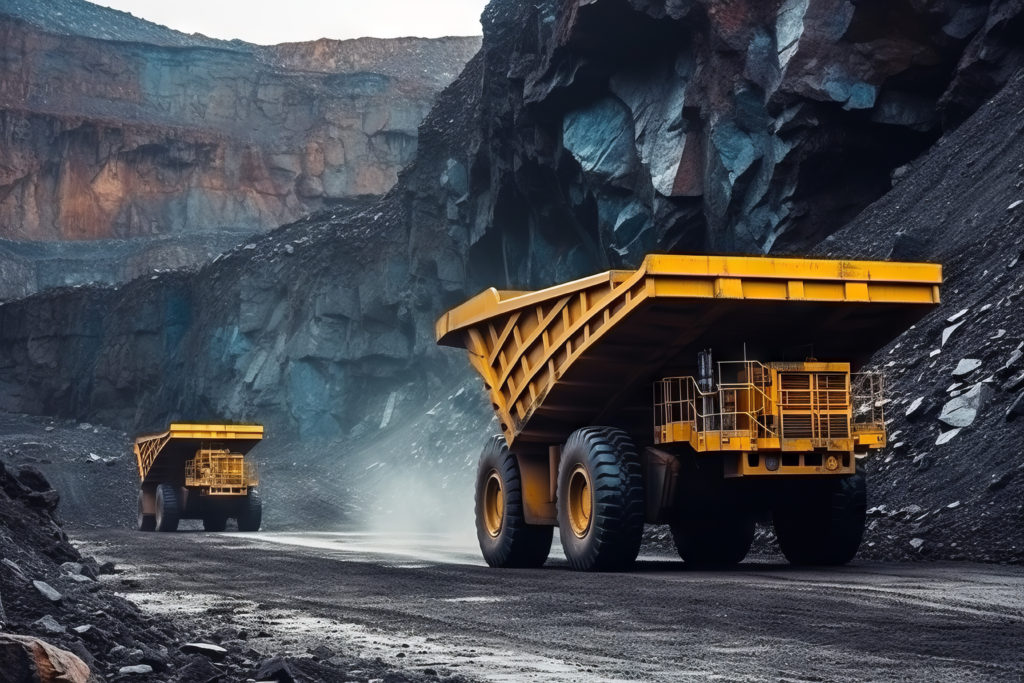
Nations are edging closer to sounding the alarm about the perils of extracting and processing critical minerals, as they seek to emphasize the transition away from fossil fuels shouldn’t be replaced by an adoption of dirty materials instead.

For the first time, countries have included language on critical minerals — and the risks associated with their extraction and processing — in a draft-decision text at the annual United Nations climate negotiations.
While there’s no guarantee the provision will be adopted when talks continue next week, the development underscores mounting concern about supply chains for copper, cobalt, nickel, lithium and other minerals that are essential ingredients in solar panels, batteries and other clean energy technology.
The issue is no longer a “side show,” said Melissa Marengo, senior policy officer at the Natural Resource Governance Institute, which focuses on the energy transition in the Global South.
Central to the climate talks in Belém, Brazil, is countries’ 2023 commitment to shift away from using oil, gas and coal. But the world needs to recognize the embrace of low- and zero-emission energy is driving demand for minerals, “and the way these are extracted so often creates impacts that are very expensive to remediate, if it’s even possible,” Marengo said.
Under the “just transition” draft language being considered by negotiators, countries would recognize “the social and environmental risks associated with scaling up supply chains for clean-energy technologies, including risks arising from the extraction and processing of critical minerals.”
As drafted, the provision also invokes elements of a recent UN report, including its recommendations for transparently tracing supply chains; creating a legacy fund to address abandoned mines; and ramping up efforts to more efficiently use and recycle transition minerals.
The effort is tied to proposals from the European Union and the UK that won the backing of Australia, South Africa, Uganda and Burkina Faso.
Supporters are working to expand the provision by adding language recognizing that the energy transition-driven demand for critical minerals also presents opportunities for countries to develop and diversify their economies.
The same document would recognize the importance of Indigenous peoples’ rights, including to “free, prior and informed consent” for projects affecting their lands.
Concerns around critical minerals have come into sharper focus in Washington, Brussels and other capitals, as political leaders grow wary about relying on supply chains dominated by China. The US and Australia reached an agreement in October to jointly invest in mines and mineral-processing projects. And the Group of Seven launched an initiative in June to bolster allocations to critical minerals, with at least $1 billion of investments already planned.
Demand for the critical minerals used in green technology may triple by 2030 and quadruple by 2040, according to International Energy Agency estimates.
Yet the materials can be excavated in ways that drive environmental damage as well as alleged human rights abuses, including people being forced to work excavating nickel and other materials under dangerous conditions.
Activists say that without major changes, the world’s energy transition risks repeating — or even magnifying — the same ills associated with fossil fuel extraction, including limited benefits and outright harm to the communities where mining development takes place.
Instead, there should be broader benefits, said Anabella Rosemberg, a senior adviser at Climate Action Network International.
“The transition must work for the people who live beside the mines, the workers carrying the risks, the Indigenous peoples defending their homelands, and the communities in the Global South who deserve dignity and economic justice, not just promises on paper,” she said.
(By Jennifer A. Dlouhy)

No comments:
Post a Comment