McDonald's core customer base drops by double digits in Trump economy
Lesley Abravanel,
Alternet
November 16, 2025
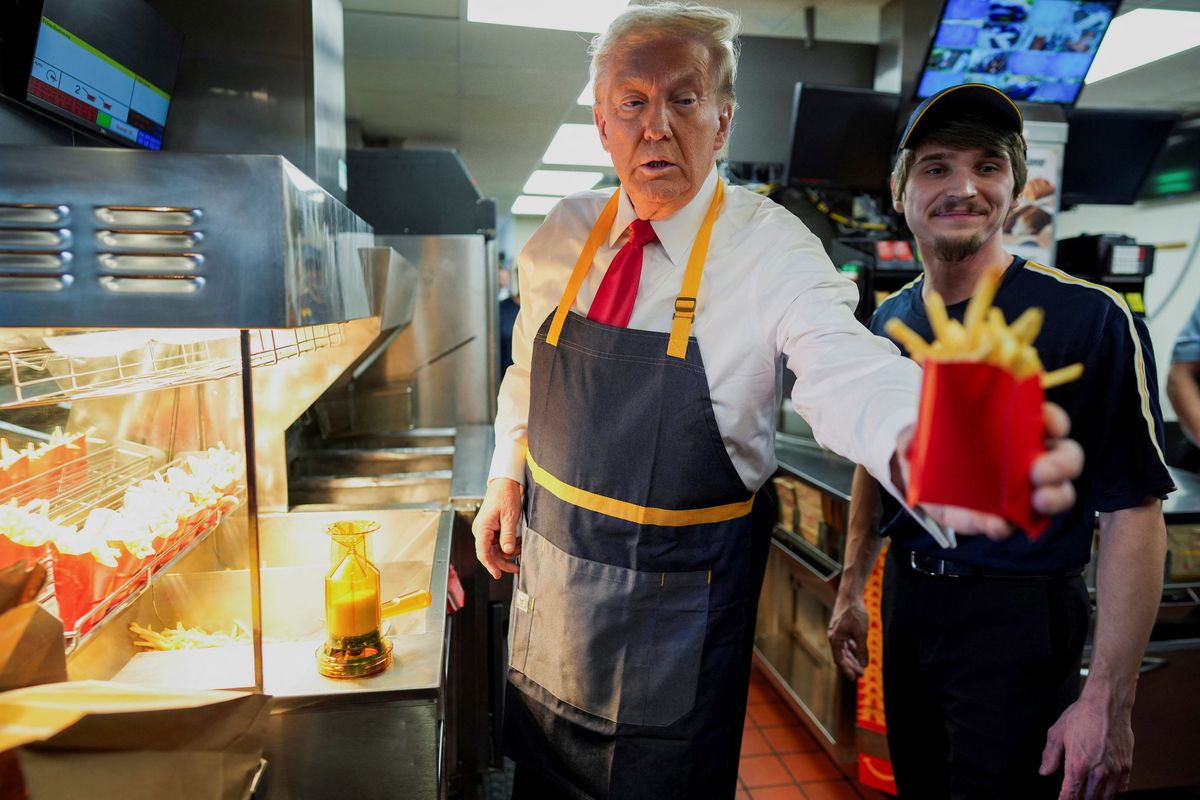
Republican presidential nominee and former U.S. President Donald Trump works behind the counter during a visit to McDonalds in Feasterville-Trevose, Pennsylvania, U.S. October 20, 2024.
November 16, 2025
Republican presidential nominee and former U.S. President Donald Trump works behind the counter during a visit to McDonalds in Feasterville-Trevose, Pennsylvania, U.S. October 20, 2024.
Doug Mills/Pool via REUTERS
Prices have risen so high at fast food landmark McDonald's under President Donald Trump's leadership that " traffic from one of its core customer bases, low-income households, has dropped by double digits," reports the LA Times.
"The struggle of the Golden Arches — long synonymous with cheap food for the masses — reflects a larger trend upending the consumer economy and making 'affordability' a hot policy topic," writes Suhauna Hussein.
Executives of the fast-food chain say "the higher costs of restaurant essentials, such as beef and salaries, have pushed food prices up and driven away lower-income customers who are already being squeezed by the rising cost of groceries, clothes, rent and child care."
Analyst Adam Josephson says that prices are rising everywhere—especially at McDonald's.
"Happy Meals at McDonald’s are prohibitively expensive for some people, because there’s been so much inflation,” Josephson says.
Josephson and other economists point to Trump's K-shaped economy as the reason for shrinking traffic of low-income consumers.
Meanwhile, all is well for companies catering to higher-income consumers, like Delta Airlines, where data shows that while their main cabin revenue fell 5 percent for the June quarter compared to a year ago, premium ticket sales rose 5 percent, "highlighting the divide between affluent customers and those forced to be more economical," Hussein writes.
The same is happening with luxury brand hotels, where "revenue at brands including Four Seasons, Ritz-Carlton and St. Regis is up 2.9 percent so far this year, while economy hotels saw a 3.1 percent decline for the same period, according to industry tracker CoStar."
“There are examples everywhere you look,” Josephson says.
Consumer credit delinquency rates, Hussein explains, show how badly low-income households are suffering under Trump.
"Households making less than $45,000 annually are seeing 'huge year-over-year increases,' even as delinquency rates for high- and middle-income households have flattened and stabilized," says Rikard Bandebo, chief strategy officer and chief economist at VantageScore.
As rents have increased, the amount families have left over after paying for housing and utilities has fallen to record lows, Hussein notes.
“It’s getting tougher and tougher every month for low-income households to make ends meet,” Bandebo says.
Prices at fast-food restaurants are skyrocketing, too, up 3.2 percent year over year, at a rate higher than inflation “and that’s climbing” according to Marisa DiNatale, an economist at Moody’s Analytics.
“It has always been the case that more well-off people have done better. But a lot of the economic and policy headwinds are disproportionately affecting lower-income households, and [McDonald’s losing low-income customers] is a reflection of that,” DiNatale says.
McDonald's has previously offered budget meals, and tried doing so last year, with a $5 deal for a McDouble or McChicken sandwich, small fries, small soft drink and four-piece McNuggets.
In January it offered a $1 menu item alongside an item bought for full price, and launched Extra Value Meals in early September, but, Hussein writes, it didn't "immediately cut through to customers."
DiNatale says companies are weary of passing along higher costs to customers, saying, "A lot of businesses are saying, we just don’t think consumers will stand for this. [Consumers] have been through years of higher prices, and there’s just very little tolerance for higher prices going forward.
Prices have risen so high at fast food landmark McDonald's under President Donald Trump's leadership that " traffic from one of its core customer bases, low-income households, has dropped by double digits," reports the LA Times.
"The struggle of the Golden Arches — long synonymous with cheap food for the masses — reflects a larger trend upending the consumer economy and making 'affordability' a hot policy topic," writes Suhauna Hussein.
Executives of the fast-food chain say "the higher costs of restaurant essentials, such as beef and salaries, have pushed food prices up and driven away lower-income customers who are already being squeezed by the rising cost of groceries, clothes, rent and child care."
Analyst Adam Josephson says that prices are rising everywhere—especially at McDonald's.
"Happy Meals at McDonald’s are prohibitively expensive for some people, because there’s been so much inflation,” Josephson says.
Josephson and other economists point to Trump's K-shaped economy as the reason for shrinking traffic of low-income consumers.
Meanwhile, all is well for companies catering to higher-income consumers, like Delta Airlines, where data shows that while their main cabin revenue fell 5 percent for the June quarter compared to a year ago, premium ticket sales rose 5 percent, "highlighting the divide between affluent customers and those forced to be more economical," Hussein writes.
The same is happening with luxury brand hotels, where "revenue at brands including Four Seasons, Ritz-Carlton and St. Regis is up 2.9 percent so far this year, while economy hotels saw a 3.1 percent decline for the same period, according to industry tracker CoStar."
“There are examples everywhere you look,” Josephson says.
Consumer credit delinquency rates, Hussein explains, show how badly low-income households are suffering under Trump.
"Households making less than $45,000 annually are seeing 'huge year-over-year increases,' even as delinquency rates for high- and middle-income households have flattened and stabilized," says Rikard Bandebo, chief strategy officer and chief economist at VantageScore.
As rents have increased, the amount families have left over after paying for housing and utilities has fallen to record lows, Hussein notes.
“It’s getting tougher and tougher every month for low-income households to make ends meet,” Bandebo says.
Prices at fast-food restaurants are skyrocketing, too, up 3.2 percent year over year, at a rate higher than inflation “and that’s climbing” according to Marisa DiNatale, an economist at Moody’s Analytics.
“It has always been the case that more well-off people have done better. But a lot of the economic and policy headwinds are disproportionately affecting lower-income households, and [McDonald’s losing low-income customers] is a reflection of that,” DiNatale says.
McDonald's has previously offered budget meals, and tried doing so last year, with a $5 deal for a McDouble or McChicken sandwich, small fries, small soft drink and four-piece McNuggets.
In January it offered a $1 menu item alongside an item bought for full price, and launched Extra Value Meals in early September, but, Hussein writes, it didn't "immediately cut through to customers."
DiNatale says companies are weary of passing along higher costs to customers, saying, "A lot of businesses are saying, we just don’t think consumers will stand for this. [Consumers] have been through years of higher prices, and there’s just very little tolerance for higher prices going forward.
'Simply lying': Nobel economist bashes Trump's 'false' claims on the state of the economy
Robert Davis
November 16, 2025
A Nobel Prize-winning economist bashed President Donald Trump's "false" claims about the state of the U.S. economy in a new Substack essay published on Sunday.
Paul Krugman, who won the 2008 Nobel Prize in economics for his work on trade theory, argued in the essay that Trump is "simply lying" about the state of the economy. Although data indicate the economy is faring better than popular sentiment might lead someone to believe, Krugman added that there are several warning signs, such as the price of groceries continuing to increase.
"Donald Trump continues to claim that grocery prices are 'way down,'" Krugman wrote. "Yet anyone who does their own food shopping – unlike Trump -- can tell you that Trump’s statement is false."
Krugman added that Trump's economy has induced what's known as a "vibecession," or an economy that feels like it's in a recession to consumers even if economic data doesn't support that conclusion.
"Many observers have compared Trump’s predicament with the problems faced by the Biden administration, whose attempts to highlight good economic data alienated many voters who felt that their concerns weren’t being taken seriously," Krugman added. "In one important way this is false equivalence: Biden and his officials were pointing to actual data that did indeed seem to paint a relatively positive picture of the economy. Trump and company, by contrast, are simply lying."
"But although Biden and his people were honest, while Trump and his people aren’t, it’s true that we now have two presidencies in a row in which Americans are far more negative about the economy than the usual measures would have predicted," he concluded.
Read the entire essay by clicking here.
Robert Davis
November 16, 2025
RAW STORY
A Nobel Prize-winning economist bashed President Donald Trump's "false" claims about the state of the U.S. economy in a new Substack essay published on Sunday.
Paul Krugman, who won the 2008 Nobel Prize in economics for his work on trade theory, argued in the essay that Trump is "simply lying" about the state of the economy. Although data indicate the economy is faring better than popular sentiment might lead someone to believe, Krugman added that there are several warning signs, such as the price of groceries continuing to increase.
"Donald Trump continues to claim that grocery prices are 'way down,'" Krugman wrote. "Yet anyone who does their own food shopping – unlike Trump -- can tell you that Trump’s statement is false."
Krugman added that Trump's economy has induced what's known as a "vibecession," or an economy that feels like it's in a recession to consumers even if economic data doesn't support that conclusion.
"Many observers have compared Trump’s predicament with the problems faced by the Biden administration, whose attempts to highlight good economic data alienated many voters who felt that their concerns weren’t being taken seriously," Krugman added. "In one important way this is false equivalence: Biden and his officials were pointing to actual data that did indeed seem to paint a relatively positive picture of the economy. Trump and company, by contrast, are simply lying."
"But although Biden and his people were honest, while Trump and his people aren’t, it’s true that we now have two presidencies in a row in which Americans are far more negative about the economy than the usual measures would have predicted," he concluded.
Read the entire essay by clicking here.

No comments:
Post a Comment