
Report: USS Ford's Pilots are Studying Up on Venezuelan Air Defenses
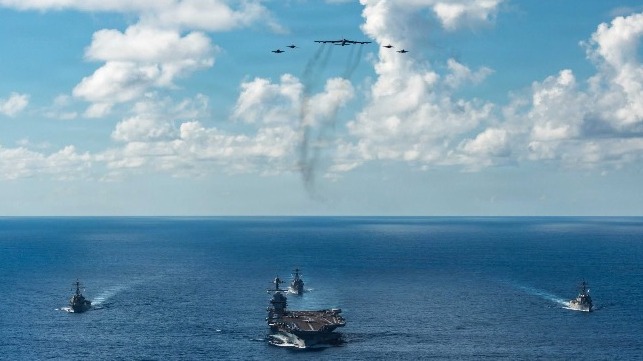
As the carrier USS Gerald R. Ford nears the Caribbean, her air wing's pilots are studying up on the capabilities of Venezuela's air defense network, according to the Washington Post. Talks in the White House continued Friday on whether or not to strike land targets in Venezuela, and President Donald Trump told reporters that afternoon that he had made a decision. "I've already made up my mind. I can't tell you what it will be," Trump told EFE.
Staffers have presented Trump with multiple strike options, and there are plenty of methods to choose from. Along with USS Ford, the U.S. Navy assets in the region include cruisers USS Lake Erie and USS Gettysburg, destroyers USS Gravely, Mahan, Bainbridge, Winston S. Churchill and Stockdale, and three amphibs with embarked elements of the 22nd Marine Expeditionary Unit. At least one U.S. attack submarine is likely in the area as well. According to CSIS' calculations, the U.S. Navy now has nearly 300,000 tonnes (displacement) worth of vessels in the Caribbean - a post-Cold War record.
Together, this task force carries a relatively deep magazine of Tomahawk cruise missiles, often favored for a limited strike. Ford carries four squadrons of F/A-18 Super Hornet strike fighters, the standard tool for extended U.S. Navy airstrike campaigns, along with a squadron of E/A-18 Growler electronic attack aircraft for suppression of enemy air defenses.
Talks in the White House have also included the possibility of special operations missions, the Post reported. Such a foray would likely be limited in scope: the forces currently arrayed in the region are less than what would be expected for a full-scale invasion of a country of Venezuela's size. The invasion of much-smaller Panama in 1989 required 20,000 U.S. troops; at present, the task force has one Marine Expeditionary Unit, which typically totals about 2,200 Marines.
"The long-range firepower available to the United States in the Caribbean is now comparable to levels used in past campaigns of limited scope and duration. There are two likely target sets for such strikes - the cartel facilities and the Maduro regime - with some overlap," assessed CSIS.
Boat strikes continue
In the meantime, the administration continues its campaign of airstrikes on suspected drug smuggling boats. The number has risen to 20 attacks and 80 fatalities as of November 10, and the effort continues. After well-publicized concerns about the legality of the strikes, details about the Justice Department's authorizing brief have begun to emerge in the press. The Wall Street Journal reports that the department's justification for the attacks is based in part on the premise that the boats contain fentanyl, the shipment is intended for the United States market, and that fentanyl constitutes a "chemical weapons threat" that must be intercepted.
In more than a decade of in-person interdictions in the Caribbean, the U.S. Coast Guard has never reported a discovery of fentanyl aboard a smuggling vessel in the Caribbean or Eastern Pacific - only cocaine, with occasional quantities of marijuana. The overwhelming majority of fentanyl sold in the U.S. is manufactured in Mexico and smuggled over the southern land border.
The Justice Department's brief is intended to convey immunity to U.S. servicemembers who are involved in the operation, but some have begun reaching out for independent legal advice. If the attacks are viewed internationally as unlawful killings of civilians - a position taken by the UN High Commissioner on Human Rights, among others - then servicemembers involved in the activity could be prosecuted overseas, experts warn.
"If a service member relies on [Department of Justice] immunity, that doesn't mean that a state may not prosecute them for any crimes they commit, or if they travel to another country. If there are allegations that they have committed atrocity crimes, then other countries . . . could invoke their own universal jurisdiction and put them before the national courts of another country," president of the National Institute of Military Justice Lt. Col. Frank Rosenblatt (ret'd, U.S. Army) told PBS.
Emergency Statement: Leading British Voices Speak Out Against a Trump-Led War on Venezuela

By Labour Outlook
With Donald Trump increasingly threatening military attacks on Venezuela, a new emergency statement has been launched — backed by leading MPs, writers, trade unionists, and peace campaigners in Britain.
The statement has already been endorsed by MPs Jeremy Corbyn and Richard Burgon; trade union general secretaries Daniel Kebede (NEU), Maryam Eslamdoust (TSSA), and Gawain Little (GFTU); writers Tariq Ali and Victoria Brittain; Labour NEC member Jess Barnard; and Britain’s leading anti-war organisations, CND and the Stop the War Coalition, among others.
Initiated by the Venezuela Solidarity Campaign, it has also won the backing of a wide range of organisations in solidarity with Latin America.
Signatures from across the labour, peace, and progressive movements are being added all the time, and a fuller list of supporters will be released in the coming days.
Read the published statement in full below and add your name here.
EMERGENCY STATEMENT: NO TO TRUMP’S WAR ON VENEZUELA
We are deeply alarmed by the growing threat of a Trump-led war on Venezuela.
In recent weeks, a huge US naval fleet — including warships, bombers, and thousands of troops — has been deployed to the Caribbean, off Venezuela’s coast.
Trump has publicly confirmed that he has authorised the CIA to conduct covert operations in Venezuela. Already, U.S. strikes on Venezuelan small boats — under the pretext of a so-called “war on drugs” — have killed dozens of civilians. Now, Trump has ominously warned that “the land is going to be next.”
This military escalation is part of a long history of US interference in Latin America, where so-called “regime change” operations have caused immense suffering and lasting harm.
There are deep fears that US military intervention in Venezuela could be the first step in a wider regional escalation under Trump’s leadership. Leaders across Latin America have already voiced strong opposition to this military build-up and any foreign intervention.
We reject this dangerous escalation and call on all who stand for peace to say clearly: No to Trump’s war on Venezuela.
- You can add your name to the Emergency Statement: No to Trump’s War on Venezuela here.
- Signatures from across the labour, peace, and progressive movements are being added all the time, with a wider list of supporters to be released in the coming days.
- If you support Labour Outlook’s work amplifying the voices of left movements and struggles here and internationally, please consider becoming a supporter on Patreon.

Jeremy Corbyn – No War with Venezuela
Jeremy Corbyn MP on the military escalation towards Venezuela.
The United States is mobilising the largest military build-up in the Caribbean in decades. As I write, at least 10,000 US soldiers – on board 10 warships – are patrolling the southern Caribbean coast. That includes a nuclear submarine, several destroyers and a missile cruiser.
Already, at least seven small boats – accused of transporting drugs – have been bombed. More than thirty people on board have been killed. Donald Trump has authorised the CIA to conduct covert operations inside Venezuela. Now, the US administration is threatening direct military action, accusing President Maduro of leading an organised crime gang.
We should call these operations what they are: extrajudicial killings. The US has not yet provided any information about the people on board the ships, let alone any evidence that they were transporting drugs. Indeed, it is well known that most of the cocaine does not come from Venezuela on small boats, but from major commercial shipments via the Pacific.
This is before we have even tested the bogus assumption that, even if these ships were carrying drugs, military action would be the right thing to do. “Every one of those boats is responsible for the death of 25,000 American people, and the destruction of families all over our country”, Trump has said. What utter nonsense. The US administration knows that the War on Drugs has been a total and utter failure. There are several causes of skyrocketing drug use in the United States: poverty, exploitation and money laundering for starters. If the United States wanted to reduce drug consumption, it would start with any of these factors, rather than with extrajudicial killings of people on small boats from Venezuela.
The real reason for this military escalation is clear: regime change. This is not about drugs. This is about the United States reasserting power in its (imperially named) ‘backyard’. It is no coincidence that this action is being taken at a time when countries in Latin and South America are looking increasingly toward BRICS trading partners, particularly China. Military intervention is just one part of a concerted assault on multipolarity. That assault also includes aggressive tariffs on Brazil and sanctions on Cuba, Nicaragua and indeed Venezuela.
It is telling that Trump’s messianic motivations in Latin America do not extend to Argentina, where a right-wing President has plunged the nation into an unprecedented economic crisis characterised by falling employment, soaring poverty and endless corruption scandals. According to Trump, Venezuela warrants military intervention, Argentina deserves a bail-out.
Any US-supported regime change would lead to a spiral of conflict, misery and violence. Indeed, the instability would likely generate the perfect conditions for the very drug-trafficking the US purports to oppose. A war with Venezuela would be catastrophic for the Venezuelan people, and indeed for the wider region if it is dragged into a regional conflict. That explains why Colombia, Brazil and Barbados have already come out in fierce opposition to US military intervention. The US presence has already had a catastrophic impact, remember, for the unidentified occupants on board the boats that have been destroyed.
Of course, war is beneficial for some, not least those who are well aware that Venezuela sits on the world’s largest oil reserves. Regime change in Venezuela has been a project of US imperialism ever since Hugo Chavez became president in 1999 and sought to redirect oil revenues away from Venezuela’s elites and toward the people.
From Vietnam to Iraq, history has taught us that US military intervention only leads to death and destruction. There will be many in our media happy to cheer on war overseas. They will not be the ones to suffer the lasting consequences.
That’s why we urge the UK government to join the global effort to avoid military intervention and to stand up to US intimidation, interference and imperialism. We must continue to speak up for international law, for self-determination and for human rights for all. I’m not interested in bombs. I’m interested in peace. Say no to a US war on Venezuela!
- You can follow Jeremy Corbyn on Facebook, Instagram and Twitter.
- This article was originally published on Stop The War’s website on 3 November 2025.
- If you support Labour Outlook’s work amplifying the voices of left movements and struggles here and internationally, please consider becoming a supporter on Patreon.

No comments:
Post a Comment