European Union countries on Monday gave their final approval to ban Russian gas imports by late 2027, making their vow to cut ties with their former top supplier legally binding, nearly four years after Moscow's full-scale invasion of Ukraine.
Issued on: 26/01/2026 - RFI
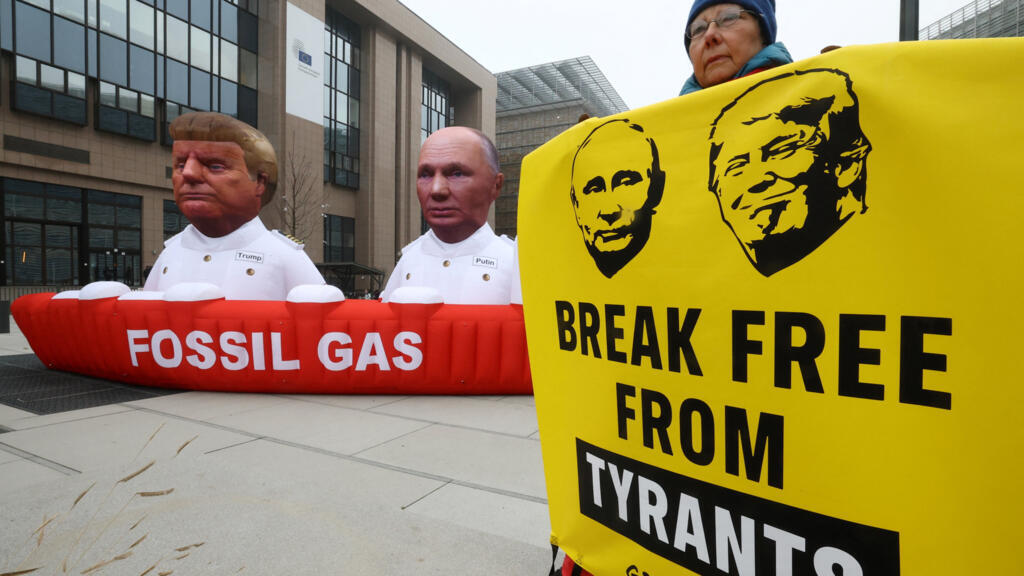
Ministers from EU countries approved the law at a meeting in Brussels on Monday, although Slovakia and Hungary voted against and Bulgaria abstained.
Hungary said it would challenge the law at the European Court of Justice.
The ban was designed to be approved by a reinforced majority of countries, allowing it to overcome opposition from Hungary and Slovakia, who remain heavily reliant on Russian energy imports and want to maintain close ties with Moscow.
Under the agreement, the EU will halt Russian liquefied natural gas imports by end-2026 and pipeline gas by 30 September, 2027.
The law allows that deadline to shift to 1 November, 2027, at the latest, if a country is struggling to fill its storage caverns with non-Russian gas ahead of winter.
Russia supplied more than 40 percent of the EU's gas before 2022. That share dropped to around 13 percent in 2025, according to the latest available EU data.
But some EU countries continue to pay Moscow for oil, pipeline gas and liquefied natural gas, contradicting their efforts to support Ukraine and restrict funding to Russia's wartime economy.
Law bans new gas deals
Last month, the five biggest EU importers spent €1.4 billion on Russian energy, mostly on gas and LNG, data from the non-profit Centre for Research on Energy and Clean Air showed. Hungary was the biggest buyer, before France and Belgium.
The EU imposed sanctions on Russian seaborne oil in 2022, but never proposed sanctions on gas imports, which would require unanimous approval from all 27 EU countries.
The EU law prohibits companies from signing new Russian gas deals and will require those with existing contracts to terminate them to comply with the ban.
For existing contracts, imports under short-term deals signed before 17 June 2025, will be banned on 25 April 2026, for Liquefied natural gas (LNG) and 17 June for pipeline gas. Long-term contracts must be phased out by the final deadlines.
Companies could face financial penalties of up to 3.5 percent of total global annual turnover for failure to comply.
The European Commission plans to also propose legislation in the coming months to phase out Russian pipeline oil, and wean countries off Russian nuclear fuel.
Ukraine's Energy Minister Denys Shmyhal welcomed the EU's 2027 ban on Russian gas imports, saying in a statement on Monday that independence from Russian energy "is, above all, about a safe and strong Europe."
Wind power commitment
Meanwhile, also on Monday, Germany, France, the UK and Denmark were among nine countries which signed an agreement pledging to turn the North Sea into the "world's largest clean energy reservoir".
The EU's Commissioner for Energy and Housing, Dan Jorgensen, said that the agreement was a "very clear signal to Russia".
"No more will we let you blackmail member states of the European Union and no more will we help indirectly fund the war in Ukraine," Jorgensen said.
Signed at the third North Sea summit in Hamburg, it pledges to deliver 100 gigawatts (GW) of offshore wind power capacity through large-scale joint projects. That would be enough to power roughly 100 million homes.
The commitment to boost cross-border collaboration is part of a goal agreed by North Sea countries in 2023 to have 300 GW of offshore wind capacity by 2050.
In response to recent comments from US President Donald Trump branding wind farms "losers", British Energy Secretary Ed Miliband said that "offshore wind is for winners".
Wind farms are "absolutely critical for our energy security" to provide "homegrown, clean energy that we control", he said, adding that this energy is not under "the control of the dictators and the petro-states".
(with newswires)
European Governments Adopt Ambitious Plan for 100 GW of Offshore Wind Power
Meeting for the third North Sea Summit, the governments of nine Northern European countries adopted a new plan calling for coordination, power sharing, and working in unison to develop 100 GW of offshore wind power. They estimated it represents an investment of over $1 trillion.
Known as the Hamburg Declaration, the agreement was signed by the governments of Germany, France, Belgium, Denmark, Ireland, the Netherlands, Norway, Northern Ireland, and Luxembourg, to achieve what they are calling energy sovereignty. The countries are promising to work in unison, saying they are “doubling down” on clean power.
Europe currently has approximately 37 GW of offshore wind energy installed in 13 countries. The UK has emerged far and away as the leader and last week completed a record new allocation round. Other countries, such as Denmark, which pioneered offshore wind energy, Germany, and the Netherlands, have struggled with recent rounds designed to launch the next phase of their offshore energy projects.
Three years ago, the countries set a goal of reaching 300 GW by 2050. They spoke of ways they could improve the tendering process and the benefits of coordinating. Today’s landmark agreement outlines specific steps while addressing the recent challenges that emerged in the market.
The declaration outlines steps for “getting offshore wind back on track.” They are calling for a stable tender pipeline with a predictable schedule for the developers, taking steps to de-risk investments, designing a sound investment framework, and simplifying and speeding up permitting. It endorses Contracts for Difference as the standard auction methodology, although many of the governments have been slow to adopt this structure, which has worked for the UK.
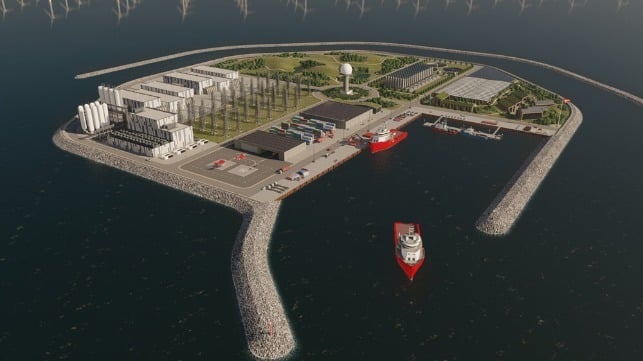
They are also outlining steps, including interconnecting the offshore grids to develop cross-border projects and the sharing of power generation capacity among countries. They are also proposing hybrid offshore assets, including subsea energy infrastructure that combines offshore wind connections with electricity interconnects. Separately, Denmark and Germany said they would proceed with the Bornholm Energy Island, one of the first concepts for an energy hub approximately 10 miles offshore.
“This ambitious announcement to build a vast number of new offshore wind farms jointly with our European partners will increase the energy security of the UK and the whole of the North Sea region,” said Jane Cooper, Deputy Chief Executive of RenewableUK. “This historic declaration puts offshore wind right at the heart of Europe’s power system.”
The Europeans agreed to push forward with offshore wind as part of a broader clean energy strategy. This came despite pressure from Donald Trump, who continues to make moves to block the U.S. industry and said at the World Economic Forum last week that “windmills” are “losers.” He continues to be critical of European countries focusing on wind and clean energy
More than 100 companies also endorsed the Hamburg Declaration and committed to their part in the development. They are pledging to reduce the cost of offshore wind energy by 30 percent by 2040 by taking steps to drive scale, lower financing costs, and industrialization.
European energy ministers said they believed it would be possible to build a steady pipeline for installing 15 GW per year across the North Sea and Baltic.


No comments:
Post a Comment