Denmark Says Trump’s Greenland Threat Looks Real After Venezuela Move
Denmark’s prime minister Mette Frederiksen has warned that U.S. President Donald Trump is serious about taking over Greenland, adding that a U.S. attack on a NATO ally would be the end of all, with concern in Copenhagen renewed after Washington’s recent actions against Venezuela hardened views on Trump’s use of power.
"If the United States decides to militarily attack another NATO country, then everything would stop -- that includes NATO and therefore post-World War II security," Mette Frederiksen told Danish television network TV2.
On Sunday, Trump repeated that the US needs Greenland “from the standpoint of national security.”
“We need Greenland. … It’s so strategic right now. Greenland is covered with Russian and Chinese ships all over the place,” Trump told reporters aboard Air Force One. “We need Greenland from the standpoint of national security, and Denmark is not going to be able to do it.”
Greenland is a large Arctic territory spanning 2.17 million square kilometers (836,000 sq mi), making it the world's largest island. However, its land area (ice-free) is much smaller, around 410,450 sq km, as nearly 80% of the island is covered by a massive ice sheet. That said, Trump's interest in Greenland is partly due to its vast, untapped reserves of critical minerals vital for tech and defense, reducing reliance on China.
The Arctic holds significant deposits of rare earth elements, cobalt, nickel, and other metals crucial for batteries, EVs, and defense technology. Climate change is making critical minerals in the Arctic more accessible by melting ice and permafrost, opening up land for exploration, while also creating new challenges like destabilized infrastructure and environmental risks, leading to a complex geopolitical race for these resources vital for green tech.
While receding ice and thawing ground improve physical access for mining, creating opportunities for nations like Greenland, Russia, and Canada, it simultaneously threatens fragile ecosystems and Indigenous communities with pollution, as seen with past oil spills from thawing permafrost, raising serious sustainability questions.
By Alex Kimani for Oilprice.com
President Donald Trump’s renewed insistence that the United States should "get Greenland" has reopened a diplomatic wound between Washington and Copenhagen, reviving memories of the only time the US successfully purchased Danish territory: the 1917 acquisition of the Danish West Indies.
Issued on: 05/01/2026 - RFI
By: Jan van der Made
Denmark’s Prime Minister Mette Frederiksen responded bluntly on Sunday after Trump said he "absolutely" needed Greenland for US national security.
Calling Denmark a "historically close ally", she warned Washington against questioning the territorial integrity of a NATO partner and stressed that Greenland "is not for sale".
"I have to say this very clearly to the United States: it is absolutely absurd to say that the United States should take control of Greenland," Frederiksen said in a statement late Sunday.
She called on Washington to stop "threatening its historical ally".
Greenland’s leaders went further, describing Trump’s language as disrespectful and disconnected from reality.
Meanwhile, France on Monday expressed its "solidarity" with Denmark with French foreign ministry spokesman Pascal Confavreux saying that "borders cannot be changed by force. Greenland belongs to the Greenlanders and the Danes, and it is up to them to decide what to do with it."
EU backs Denmark’s territorial integrity after Trump appoints Greenland envoy
It’s not the first time that the US has tried to take over Danish territory.
In March 1917, the United States purchased the Caribbean islands of Saint Thomas, Saint John and (formerly French colony) Saint Croix, known as the "Danish West Indies," from Denmark for $25 million in gold. The territory is now known as the "US Virgin Islands."

The deal was the product of half a century of failed negotiations, finally concluded under the pressure of the First World War.
With the Panama Canal opening in 1914, US officials were determined to secure Caribbean sea lanes. They feared that Germany might seize the Danish islands, located just east of Puerto Rico, and use them as naval bases, threatening American shipping and hemispheric security.
For Denmark, the colonies had long ceased to be profitable. The abolition of slavery in 1848 had undermined the sugar economy, and the islands had become a financial and administrative burden.
Previous attempts to sell them had failed – blocked first by the US Senate in 1867, then by the Danish parliament in 1902 – despite strong local support for American rule.
US recognised Danish sovereignty over Greenland
In 1916 the balance of power changed. As war engulfed Europe, US diplomats made it clear that not acquiring the Danish islands carried risks.
Secretary of State Robert Lansing warned that Washington might occupy the islands to prevent German use if Denmark did not agree to sell. Neutral and vulnerable, Copenhagen conceded.
Surprise win for Greenland's opposition in election dominated by Trump threats
The transaction, finalised on 31 March 1917, is still marked as "Transfer Day" in the US Virgin Islands.
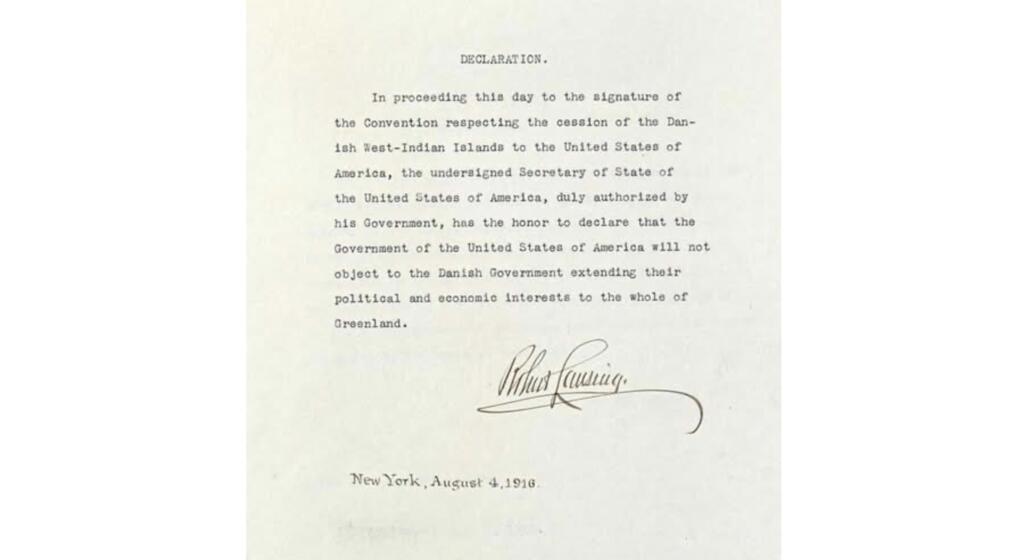
But there was a parallel diplomatic bargain: the United States formally "recognised Denmark’s right to extend its political and economic interests over the entirety of Greenland."
This declaration, signed by then Secretary of State Robert Lansing, was part of the Convention between the US and Denmark for cession of the Danish West Indies and helped secure Denmark’s sovereignty over the Arctic island for more than a century.
But with the onset of the Cold War, policy makers in Washington realised the strategic importance of Greenland, and continued their attempts to acquire the island.
In 1946, then President Harry Truman's administration made a secret offer to purchase Greenland from Denmark for $100 million in gold, plus rights to an Alaskan oil field. Secretary of State James Byrnes presented the offer to Danish Foreign Minister Gustav Rasmussen on 14 December 1946.
Truman's advisers saw Greenland as an essential strategic defence position against Soviet bombers that might fly over the Arctic Circle toward North America.
The Danish foreign minister was shocked by the proposal and rejected it, but ultimately the US gained access to Greenland through NATO membership in 1949 and a bilateral defence agreement (that specifically stated the "full respect for the sovereignty of each Party") without the need to purchase it.

The offer was revealed in 1991 when declassified documents were discovered.
In 1955, the Joint Chiefs of Staff proposed to President Eisenhower that the nation try again to purchase Greenland, but the State Department responded that the time had passed for such a plan.
According to diplomatic documents preserved in the US National Archives, there were discussions about acquiring Greenland took place on multiple occasions: in 1867, 1910, 1946, 1955, 2019 (under Trump I), and now 2025.
But the political context has fundamentally changed since 1917. Denmark is no longer an exposed neutral state but a NATO member embedded in European security structures.
Greenland itself enjoys extensive self-rule, with control over domestic affairs and a growing sense of national identity rooted in a history of Danish colonial domination.
Public opinion reflects that shift. An Axios poll taken in June 2025 revealed that some 85 percent of Greenlanders "don’t want to join the US." Other polls consistently show similar opposition to US avances. Greenland’s leaders have rejected Trump’s comments outright, insisting that the island’s future can only be decided by its own population.

JAN 05, 2026
By Ellie Cook
Senior Defense Reporter
Newsweek is a Trust Project member
President Donald Trump has said the U.S. will revisit its stance on Greenland in the coming weeks.
Asked if he expected to take action on the territory, Trump told reporters aboard Air Force One on Sunday: "Let's talk about Venezuela, Russia, Ukraine. We'll worry about Greenland in about two months. Let's talk about Greenland in 20 days."
He added: "We need Greenland from a national security situation. It's so strategic."
The Republican has long coveted the Arctic island of Greenland, a semi-autonomous territory and part of Denmark—a NATO country, like the U.S. The vast, sparsely populated territory is rich in minerals and hosts the U.S. space base of Pituffik, which is key for detecting long-range missiles bound for the U.S. mainland.
Danish and Greenlandic officials have repeatedly hit back at U.S. overtures toward the territory.
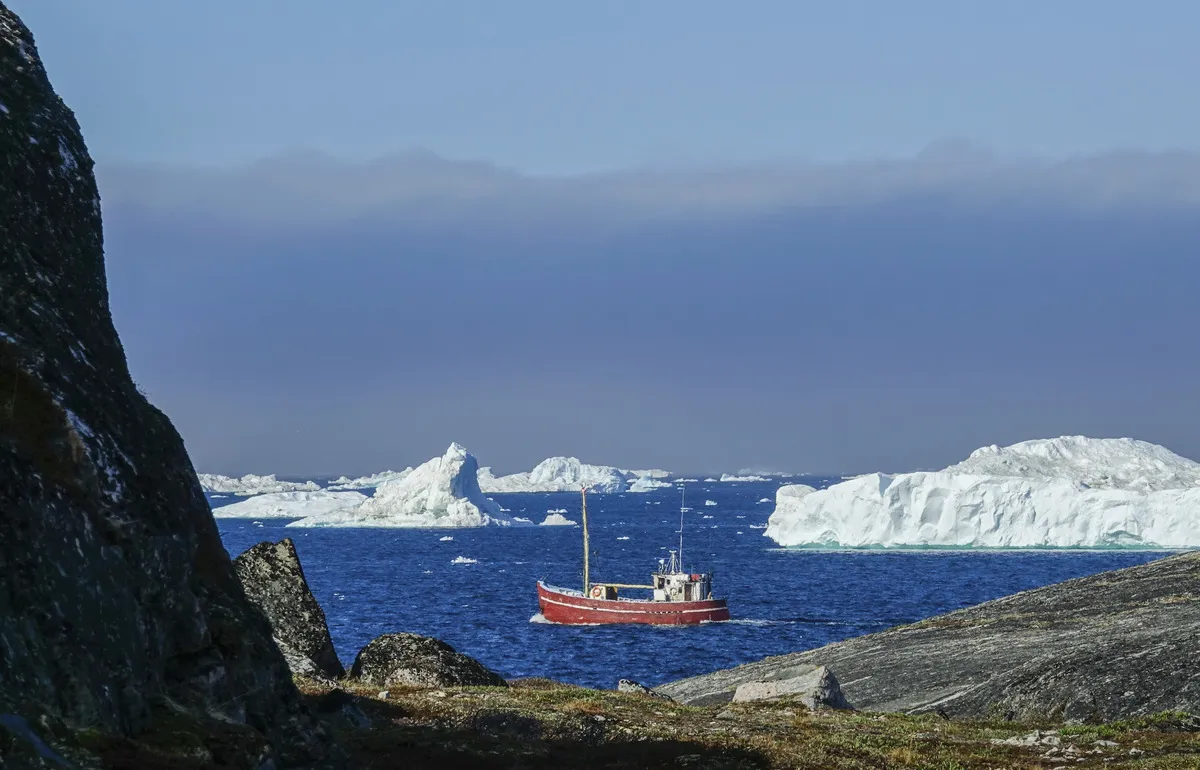
A small ship cruising between icebergs near the coastal town of Ilulissat in western Greenland on June 23, 2018. | Patrick Pleul/picture-alliance/dpa/AP Images
Danish Prime Minister, Mette Frederiksen, said on Sunday it "makes absolutely no sense to talk about the need for the United States to take over Greenland."
"The U.S. has no right to annex any of the three nations in the Danish kingdom," Frederiksen said. "I would therefore strongly urge the United States to stop the threats against a historically close ally and against another country and another people who have very clearly said that they are not for sale."
Trump said in his remarks to reporters the U.S. needs Greenland "from the standpoint of national security and Denmark is not going to be able to do it."
Why does Trump want Greenland so badly, and what could it mean for Europe?
The US president's latest remarks about a possible annexation of Greenland have drawn condemnation from Denmark and Europe more widely.
After the US raid on Venezuela that resulted in the arrest of President Nicolás Maduro, Trump repeated his intentions to annex Greenland for the US, as Danish Prime Minister Mette Frederiksen issued her strongest rebuke to date, saying his calls to claim the island must stop.
Greenland is a semi-autonomous region of Denmark, which is a member of NATO and the European Union. Since returning to power at the start of 2025, Trump has several times called for its annexation, and following the ouster of Maduro he has returned to the idea in public.
"We need Greenland for a national security situation," Trump told reporters on board Air Force One on Sunday. "It's so strategic. Right now, Greenland is covered with Russian and Chinese ships all over the place."
"You know what Denmark did for security lately? They added one more dog sled."
A day earlier, speaking to The Atlantic, Trump said: "We do need Greenland, absolutely. We need it for defence."
In response, the Danish prime minister said America threats must stop immediately.
"It makes absolutely no sense to talk about the US needing to take over Greenland. The US has no right to annex any of the three countries in the Danish Kingdom," Frederiksen said in a statement on Sunday.
Why does Trump want Greenland?
Just before Christmas, Trump appointed a special envoy, Louisiana Governor Jeff Landry, to deal with the issue of Greenland. Landry said in a post on social media that he is honoured to serve in a "volunteer position to make Greenland a part of the US".
Trump regularly cites national security interests as a reason for his intentions toward Greenland, which is strategically located in the Arctic Ocean in the midst of major shipping routes. The world's biggest island, it is geographically speaking part of North America.
As global warming progresses, more shipping routes through the Arctic will open up, making Greenland even more important.
The US has had a defence agreement with Greenland since 1951, and has around 150 personnel stationed there at the Pituffik Space Base, which focuses on missile detection and space surveillance.
According to Ian Lesser, a distinguished fellow at the German Marshall Fund of the US, Washington already has the security foothold it needs in Greenland, and the Trump administration's intentions almost certainly pertain more to natural resources.
"The president puts a lot of emphasis on resources, mineral resources, energy resources, and commercial opportunities," Lesser told Euronews. "Even if these resources are not easy to extract profitably, it wouldn't surprise me that there would now be a lot of concern."
How has Europe reacted?
Danish Prime Minister Mette Frederiksen rebuffed Trump's latest comments in a televised statement.
"It makes absolutely no sense to speak of any necessity for the United States to take over Greenland," she said. "The United States has no legal basis to annex one of the three countries of the Kingdom of Denmark."
The prime minister of Greenland, Jens-Frederik Nielsen, said linking the issue of Greenland to the military intervention in Venezuela was disrespectful, while French Foreign Ministry Spokesman Pascal Confavreux said France stands in solidarity with Denmark.
"Greenland belongs to Greenland’s people and to Denmark’s people. It is up to them to decide what they wish to do. Borders cannot be changed by force,” Confavreux told French national broadcaster TF1.
Swedish Prime Minister Ulf Kristersson, meanwhile, said his country stands behind Denmark.
“Only Denmark and Greenland have the right to decide about their territories," Kristersson said.
The EU denounced the US's proposals to take over Greenland several times last year.
Lesser said that while a forceful annexation of Greenland is unlikely, it cannot be definitively ruled out.
"I don't think it was ever likely that the United States would use force in Greenland, but obviously, looking at the experience in Venezuela, many will understandably draw the conclusion that the president in some sense needs to be taken at his word," he said.
He added that the pressure might lead to concessions from Denmark to allow the US more access to the territory.
"It may not take the form of a kind of military intervention, but there could be all kinds of commercial, diplomatic economic pressure aimed at getting the United States a good deal in Greenland.
What can Europeans do now?
While the Danish government is in crisis mode and insists that the territory is not for sale, Lesser says Denmark and Europe have some cards to play as well.
"I do think there are a lot of things on the table because the US administration does seem to put a primacy on economic and commercial issues. I think there is the possibility of doing a package deal across the Atlantic in which many things are in play," Lesser said.
The EU has two disadvantages in any attempted trade-off: one, the goals of the US president are not completely clear, and two, it moves significantly slower than the Trump administration.
"It's not that the European Union or NATO is incapable of responding to these challenges, but the pace on this side of the Atlantic is a lot slower than it is in Washington." Lesser said.
Could the Greenland row damage NATO?
In her overnight reaction to Trump's latest comments, Frederiksen recalled that as a NATO member, Denmark is covered by the Alliance’s collective security guarantee.
"I therefore strongly urge the United States to cease its threats against a historically close ally, and against another country and another people who have stated very clearly that they are not for sale,” she said.
Tensions and hostilities are not unprecedented among NATO allies: Greece and Turkey, for instance, have had very tense exchanges in the past. But this time, the members in conflict could include the guarantor of European security and one of the nations it is ostensibly obliged to help protect.
"It's obviously a very basic level corrosive of cohesion within the alliance," Lesser said. "There is an assumption that allies simply don't behave in this way."
He added that threats are extremely disruptive of a transatlantic security relationship that's already in jeopardy.
"Anything that would go beyond the kind of rhetoric we've already seen over Greenland would cause a real crisis inside the Alliance."
David McAfee
January 4, 2026
RAW STORY
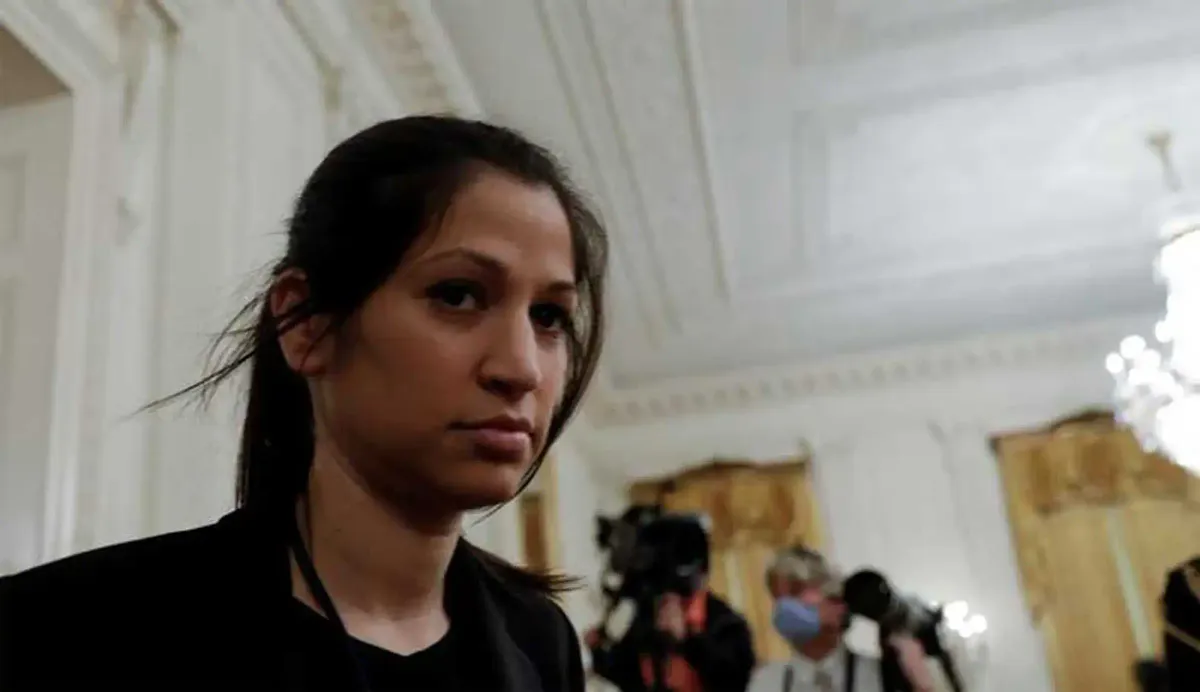
Katie Miller (Photo by Tom Brenne for Reuters)
The Premier of Greenland is speaking out strongly after an "insane" and "disrespectful" social media post from Stephen Miller's wife.
Katie Miller, wife of White House Deputy Chief of Staff for Policy Stephen Miller, caught some flak on Saturday after making what some described as an insane one-word comment about the nation of Greenland. Miller's post was a simple yet heavily labeled map of Greenland, but the entire allied nation was colored in with the red, white, and blue consistent with the U.S. flag. She included a single word in the caption.
"SOON," she wrote.
But the leader of Greenland didn't take too kindly to that, issuing a statement on Sunday insisting that Miller's post still "changes nothing."
"Let me state this calmly and clearly from the outset: there is neither reason for panic nor for concern. The image shared by Katie Miller, depicting Greenland wrapped in an American flag, changes nothing whatsoever," Premier of Greenland, Jens Frederik Nielsen, wrote this weekend. "Our country is not for sale, and our future is not decided by social media posts. That said, the image is disrespectful. Relations between nations and peoples are built on mutual respect and international law — not on symbolic gestures that disregard our status and our rights."
The Premier added, "We are a democratic society with self-government, free elections, and strong institutions. Our position is firmly grounded in international law and in internationally recognized agreements. This is not in question. Naalakkersuisut (Government of Greenland) continues its work calmly and responsibly. We engage in dialogue, safeguard our interests, and uphold the international rules that also bind our partners. There is no reason for panic. But there is every reason to speak out against a lack of respect."
Read more right here (must be translated).
'Current and repeated rhetoric from US completely unacceptable,' says prime minister of autonomous Danish territory
Ilayda Cakirtekin |05.01.2026 - TRT WORLD

ISTANBUL
Greenland’s Prime Minister Jens-Frederik Nielsen on early Monday called US President Donald Trump’s recent rhetoric about needing Greenland “completely unacceptable” and “disrespectful.”
"The current and repeated rhetoric from the United States is completely unacceptable. When the US president talks about 'needing Greenland' and links us to Venezuela and military intervention, it is not just wrong. It is disrespectful," Nielsen said on social media.
Expressing that they are part of NATO and aware of their strategic location, he reiterated the importance of a "respectful and loyal relationship" with Washington. He noted that "threats, pressure and talk of annexation have no place between friends."
"Our country is not an object in great-power rhetoric. We are a people. A country. A democracy. That must be respected — especially by close and loyal friends," Nielsen stressed, and added: "Enough is enough. No more pressure. No more insinuations. No more fantasies of annexation."
He stressed that they are open to dialogue that would be made through "proper channels and in respect of international law."
"And the proper channels are not random and disrespectful posts on social media. Greenland is our home and our territory. And that is how it will remain," Nielsen further said.
For Denmark's part, Danish Prime Minister Mette Frederiksen urged the US in a statement to "stop the threats" against a "historically close ally" and against another country and another people "who have made it very clear that they are not for sale.”
"It makes absolutely no sense to talk about it being necessary for the United States to take over Greenland. The United States has no legal basis to annex one of the three countries of the Realm of the Kingdom (Denmark, Greenland, and the Faroe Islands)," Frederiksen said.
- Nordic, Baltic nations voice support for Denmark, Greenland
Meanwhile, several Nordic and Baltic countries voiced their support for Denmark and Greenland, noting that only they should decide on their own future.
"It is only Denmark and Greenland that have the right to decide on matters concerning Denmark and Greenland. Sweden fully stands behind our neighboring country," Swedish Prime Minister Ulf Kristersson said through US social media company X.
Norwegian Prime Minister Jonas Gahr Store reaffirmed that they stand "fully and completely" behind Denmark, while Finnish President Alexander Stubb expressed his country's "full support."
"No one decides for Greenland and Denmark but Greenland and Denmark themselves," Stubb noted.
Iceland's Prime Minister Kristrun Frostadottir also echoed that "nothing about Greenland without Greenland," voicing "full solidarity."
"Denmark is a strong democracy and trusted NATO ally. Greenland is an integral part of Kingdom of Denmark. Understanding legitimate security needs of US I believe those can be addressed in a direct dialogue between Denmark and US, and within the collective defence framework," Latvian President Edgars Rinkevics also said on X.
Estonian member of parliament Marko Mihkelson, who chairs the foreign affairs committee, underscored that Denmark is a "very committed ally" of the US "against any possible threat."
"Greenland is safe. Only the people of Greenland and Denmark can decide their future and security," Mihkelson added.
Trump said Sunday that the US needs Greenland for national security reasons, citing what he described as an increased Russian and Chinese presence around the strategically located island country.
He also argued that US control over Greenland would serve broader Western interests, adding that the EU “needs us to have it” from a security standpoint
Could Colombia and Greenland Be Next? Trump’s Actions in Venezuela Spark International Concern
January 5, 2026, Monday
Delcy Rodríguez formally assumed the role of Venezuela’s acting president late Sunday, hours after U.S. President Donald Trump issued a blunt public warning directed at her. Speaking earlier aboard Air Force One, Trump said Rodríguez must grant the United States “total access” to Venezuela or face consequences he described as “probably worse than Maduro’s.” He stressed that Washington expects unrestricted access to Venezuelan resources, particularly oil, which he said would be necessary to help “rebuild” the country. Trump repeated remarks he had previously made to The Atlantic, adding that Maduro had “given up immediately,” while Rodríguez would face a harsher outcome if she failed to “do the right thing,” without specifying what actions he was demanding.
According to Venezuela’s presidential office, Rodríguez took office Sunday night. Official photographs published online show her presiding over her first meeting of the Council of Ministers shortly after assuming power. Her appointment comes a day after Nicolás Maduro was captured by U.S. forces during a military operation and transferred to American custody.
Soon after being sworn in, Rodríguez released a public message calling for calm, dialogue and cooperation. In a statement posted on Instagram, she addressed the international community and the United States directly, saying Venezuela reaffirmed its commitment to peace and peaceful coexistence. She said the country sought to live free of external threats and favored respectful international cooperation, arguing that global peace begins with stability inside each nation. Rodríguez said Caracas wanted balanced and respectful relations with Washington and other regional partners, based on sovereignty, equality and non-interference, principles she described as central to Venezuelan diplomacy.
She also extended an explicit invitation to the U.S. government to work with her administration on a cooperative agenda aimed at shared development within the framework of international law. Addressing Trump by name, Rodríguez said the peoples of Venezuela, the United States and the wider region deserved peace and dialogue, not war. She added that this message had also been central to Maduro’s own stance, signaling continuity and personal loyalty to the detained former leader.
Meanwhile, Maduro and his wife, Cilia Flores, remain in U.S. detention and are expected to appear before a federal court in the Southern District of New York on Monday at noon local time. This will be their first court appearance following Saturday’s operation. They face charges linked to alleged narco-terrorism and drug trafficking conspiracies.
Tensions widened further as Trump turned his rhetoric toward other countries in the region. During a brief exchange with reporters, he described Colombia as being “run by a sick man” and suggested its leadership would not last. When asked whether that implied possible U.S. action, Trump replied, “Sounds good to me,” a comment that immediately sparked speculation and concern, given Colombia’s long-standing role as a close U.S. ally on security, counter-narcotics and economic cooperation.
Colombian President Gustavo Petro responded by urging Latin American countries to unite in the face of what he described as U.S. aggression. In a lengthy post on X, Petro said the United States had become the first country to bomb a South American capital, calling it a historical wound that would not easily heal. He warned against revenge, arguing that vendettas destroy societies rather than build true revolutions, but insisted that regional unity was essential to prevent Latin America from being treated as subordinate. Petro called for closer regional cooperation, criticized existing mechanisms such as CELAC, and urged presidents to come together in response to what he described as a defining moment for the continent.
Trump also commented on Cuba, saying that a Venezuela-style operation would be unnecessary there because the country was already on the brink of economic collapse. He claimed Havana had relied heavily on Venezuelan oil and now lacked the income to sustain itself.
At the same time, Trump reignited controversy in Europe by repeating his claim that the United States needs Greenland for national security reasons. Speaking aboard Air Force One, he said the island was strategically vital due to the growing presence of Russian and Chinese vessels in the Arctic, arguing that Denmark was unable to guarantee its security alone. Trump asserted that Europe supported the idea, saying the European Union “needs us to have it.”
His remarks followed the U.S. operation in Venezuela and echoed previous statements in which he has argued that Greenland’s strategic location and reserves of critical minerals make it essential for American defense interests. Greenland and Denmark have consistently rejected any notion of annexation.
Danish Prime Minister Mette Frederiksen reacted sharply, calling on Trump to stop making threats. She said it made no sense to suggest the U.S. had any right to take over Greenland and stressed that neither Greenland nor Denmark was for sale. Denmark’s ambassador to Washington, Jesper Møller Sørensen, also pushed back, insisting on full respect for Danish territorial integrity and underlining that Denmark and the U.S. remain close allies working together on Arctic security. He noted that Denmark had significantly strengthened its Arctic defense posture in 2025.
Greenland’s Prime Minister, Jens-Frederik Nielsen, described a controversial social media post by Katie Miller, wife of Trump’s deputy chief of staff, as disrespectful after she shared an image of Greenland painted in U.S. flag colors with the caption “SOON.” Nielsen said Greenland’s future was not determined by social media, stressing that the territory is a democratic society whose position is grounded in international law.
Trump’s renewed push on Greenland has further strained relations, particularly after he appointed Louisiana Governor Jeff Landry as special envoy to Greenland in December. With Washington pressing its strategic claims and Denmark responding forcefully, the issue has emerged as a new source of tension between long-standing NATO partners, unfolding alongside escalating crises in Latin America.
.JPG)

No comments:
Post a Comment