Israel Responsible for Two-Thirds of Journalist Deaths in 2025: Press Freedom Group
The number of journalists killed by Israel is remarkably high even when compared to the number of journalists killed in other conflict zones.
The number of journalists killed by Israel is remarkably high even when compared to the number of journalists killed in other conflict zones.
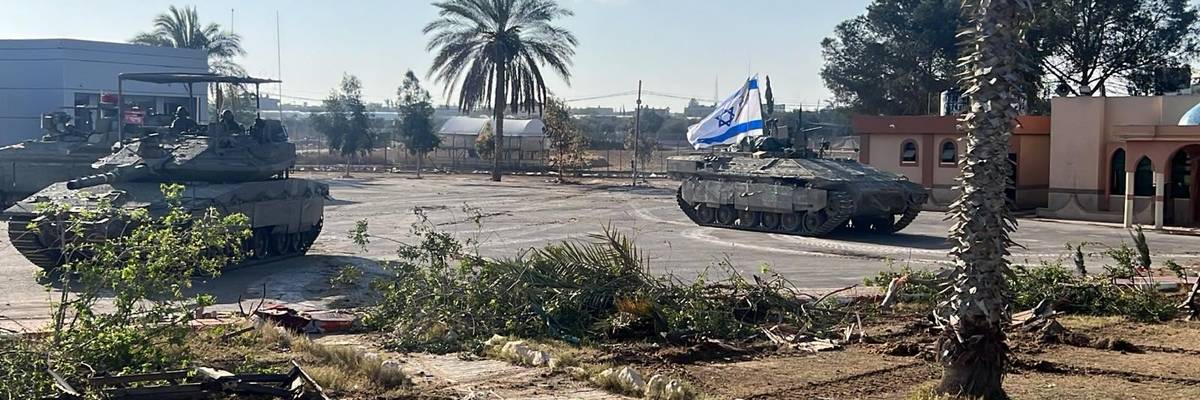
Israeli tanks are seen by the border in Rafah, Gaza on May 6, 2024.
(Photo by IDF - Handout/Anadolu via Getty Images)
Brad Reed
Feb 26, 2026
COMMON DREAMS
A new report from a major press freedom group has found that a record 129 journalists were killed in 2025, and that Israel was responsible for two-thirds of the worldwide total.
The Tuesday report from the Committee to Protect Journalists says that the Israeli military has cumulatively killed more journalists than any other government since CPJ started tracking reporter deaths in 1992, with the vast majority being Palestinian media workers in Gaza.
The report also finds an increase in the use of drones to attack journalists, with Israel accounting for more than 70% of the 39 documented instances of reporters killed by drone strikes.
The number of journalists killed by Israel is remarkably high even when compared to the number of journalists killed in other conflict zones.
Only nine journalists were killed in Sudan, for example, while just four journalists were killed in Ukraine, despite both countries being in the midst of brutal conflicts that have collectively killed hundreds of thousands of people.
A report issued in December by Reporters Without Borders similarly found that Israel was responsible for the most journalists deaths in 2025, the third consecutive year that the country had held that distinction.
The CPJ report also points the finger at governments for not taking their responsibilities to protect journalists seriously.
“The rising number of journalist deaths globally is fueled by a persistent culture of impunity,” the report states. “Very few transparent investigations have been conducted into the 47 cases of targeted killings (classified as ‘murder’ in CPJ’s longstanding methodology) documented by CPJ in 2025—the highest number of journalists deliberately killed for their work in the past decade—and no one has been held accountable in any of the cases.”
CPJ CEO Jodie Ginsberg said that attacks on the media are “a leading indicator of attacks on other freedoms, and much more needs to be done to prevent these killings and punish the perpetrators,” adding that “we are all at risk when journalists are killed for reporting the news.”
A report published on Thursday has found a sharp rise in journalist deaths worldwide, underscoring the increasing dangers of reporting, particularly from conflict zones, even as the need for reliable information becomes ever more pressing.
Issued on: 27/02/2026 - RFI

The Committee to Protect Journalists, based in New York, has released its annual report. AFP - ED JONES
A record 129 journalists and media workers were killed worldwide in 2025, according to the Committee to Protect Journalists (CPJ), marking the deadliest year since the organisation began tracking such data more than three decades ago.
It is the second consecutive year that a record number of deaths has been reached.
“Journalists are being killed in record numbers at a time when access to information is more important than ever,” CPJ chief executive Jodie Ginsberg said. “We are all at risk when journalists are killed for reporting the news.”
More than three-quarters of the fatalities in 2025 occurred in conflict zones, reflecting the intensity and spread of modern warfare – and the crucial role journalists play in documenting it.
Israel responsible for half of journalist deaths in 2025, RSF report finds
Israel drives surge
The CPJ attributed roughly two-thirds of the total deaths to Israeli military actions, with 86 journalists and media workers killed by Israeli fire during the year.
More than 60 percent of those were Palestinians reporting from Gaza, highlighting the extraordinary risks faced by local reporters covering the conflict from within.
Israel has strongly rejected the findings. A military spokesperson said the CPJ report relied on “general allegations, data of unknown origin and pre-determined conclusions”. The Israeli military maintains it does not deliberately target journalists.
“Throughout the war there have been numerous cases in which terrorists operated under a civilian guise, including posing as journalists to advance terror activities,” the military spokesperson told reporters, adding that any action taken was based solely on alleged involvement in such activities.
They also dismissed claims of intentional harm to civilians, including journalists’ family members, as “completely false”.
Both Ukraine and Sudan also recorded increases in media worker deaths compared with the previous year. In Ukraine, four journalists were killed by Russian military drones – the highest annual figure since 2022, when 15 were killed in the early phase of the war.
In Sudan, paramilitary forces have been blamed for multiple killings.
The CPJ noted the growing use of drones in modern warfare as a significant factor, documenting 39 cases of reporters being killed in drone attacks overall – including 28 in Gaza and five in Sudan, attributed to the Rapid Support Forces.
Global decline in freedom of expression over last decade, watchdog warns
Targeted killings
While conflict zones remain the most dangerous environment for journalists, the CPJ report also highlights persistent risks in countries far from active war zones – often linked to corruption, organised crime and weak legal protections.
A “culture of impunity” continues to endanger reporters, the organisation said, pointing to a lack of transparent investigations and accountability in many cases.
In Mexico, six journalists were killed in 2025 – none of the cases have been solved. The Philippines recorded three fatal shootings of journalists, reinforcing long-standing concerns about press safety.
Elsewhere, journalists were targeted for their reporting on corruption and criminal networks. In Bangladesh, a reporter was hacked to death by suspects allegedly linked to a fraud ring. Similar killings tied to organised crime were recorded in India and Peru.
The report also drew attention to state actions against journalists. In Saudi Arabia, prominent columnist Turki al-Jasser was executed following convictions on charges the CPJ described as “spurious national security and financial crime allegations” – a move it says reflects the use of legal systems to silence dissent.
It was the first documented killing of a journalist in the country since the 2018 murder of Jamal Khashoggi.
(with newswires)
A record 129 journalists and media workers were killed worldwide in 2025, according to the Committee to Protect Journalists (CPJ), marking the deadliest year since the organisation began tracking such data more than three decades ago.
It is the second consecutive year that a record number of deaths has been reached.
“Journalists are being killed in record numbers at a time when access to information is more important than ever,” CPJ chief executive Jodie Ginsberg said. “We are all at risk when journalists are killed for reporting the news.”
More than three-quarters of the fatalities in 2025 occurred in conflict zones, reflecting the intensity and spread of modern warfare – and the crucial role journalists play in documenting it.
Israel responsible for half of journalist deaths in 2025, RSF report finds
Israel drives surge
The CPJ attributed roughly two-thirds of the total deaths to Israeli military actions, with 86 journalists and media workers killed by Israeli fire during the year.
More than 60 percent of those were Palestinians reporting from Gaza, highlighting the extraordinary risks faced by local reporters covering the conflict from within.
Israel has strongly rejected the findings. A military spokesperson said the CPJ report relied on “general allegations, data of unknown origin and pre-determined conclusions”. The Israeli military maintains it does not deliberately target journalists.
“Throughout the war there have been numerous cases in which terrorists operated under a civilian guise, including posing as journalists to advance terror activities,” the military spokesperson told reporters, adding that any action taken was based solely on alleged involvement in such activities.
They also dismissed claims of intentional harm to civilians, including journalists’ family members, as “completely false”.
Both Ukraine and Sudan also recorded increases in media worker deaths compared with the previous year. In Ukraine, four journalists were killed by Russian military drones – the highest annual figure since 2022, when 15 were killed in the early phase of the war.
In Sudan, paramilitary forces have been blamed for multiple killings.
The CPJ noted the growing use of drones in modern warfare as a significant factor, documenting 39 cases of reporters being killed in drone attacks overall – including 28 in Gaza and five in Sudan, attributed to the Rapid Support Forces.
Global decline in freedom of expression over last decade, watchdog warns
Targeted killings
While conflict zones remain the most dangerous environment for journalists, the CPJ report also highlights persistent risks in countries far from active war zones – often linked to corruption, organised crime and weak legal protections.
A “culture of impunity” continues to endanger reporters, the organisation said, pointing to a lack of transparent investigations and accountability in many cases.
In Mexico, six journalists were killed in 2025 – none of the cases have been solved. The Philippines recorded three fatal shootings of journalists, reinforcing long-standing concerns about press safety.
Elsewhere, journalists were targeted for their reporting on corruption and criminal networks. In Bangladesh, a reporter was hacked to death by suspects allegedly linked to a fraud ring. Similar killings tied to organised crime were recorded in India and Peru.
The report also drew attention to state actions against journalists. In Saudi Arabia, prominent columnist Turki al-Jasser was executed following convictions on charges the CPJ described as “spurious national security and financial crime allegations” – a move it says reflects the use of legal systems to silence dissent.
It was the first documented killing of a journalist in the country since the 2018 murder of Jamal Khashoggi.
(with newswires)

No comments:
Post a Comment