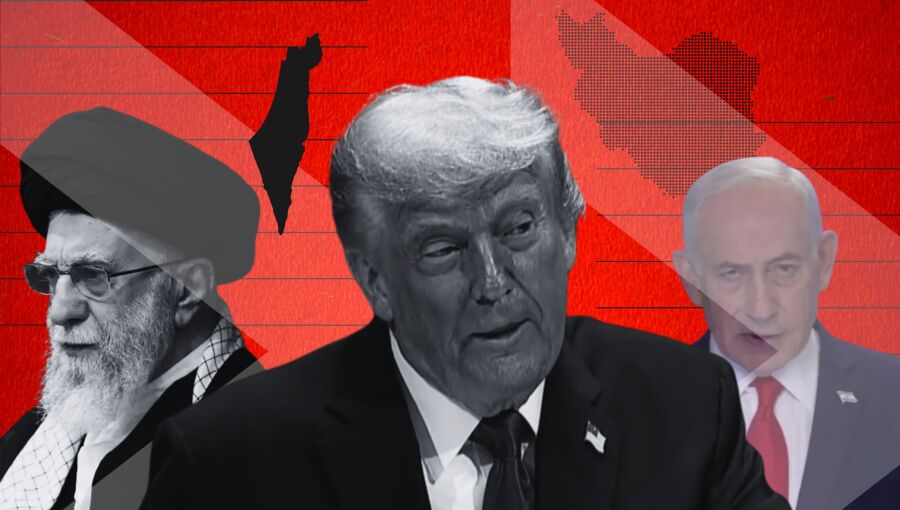
No plan survives first contact with the enemy. That popular quotation is really a paraphrase of a somewhat more verbose statement by Prussian Field Marshal Helmuth von Moltke the Elder in 1871. It’s obviously true: events, like individuals and groups, are unpredictable and even well-executed plans have unforeseen and unforeseeable consequences. But what happens when there is apparently no plan?
Operation Epic Fury, the American and Israeli attack on Iran, is answering that question. Air supremacy was established in a matter of hours. The upper echelons of the government and military were rapidly slain along with Supreme Leader Ayatollah Ali Khamenei. All signs point to reiterated slaughter of their replacements indefinitely, as well as degradation of missile caches, launchers and other military installations.
Iran’s plan, if it has one, seems to revolve around creating as much chaos and confusion as possible.
The regime reacted by opening fire with drones and missiles not only on Israel but on their immediate neighbours also. More than 500 Iranian ballistic missiles and 2,000 drones have been flung across the Middle East. Not all have been aimed at American or Israeli military targets. A disproportionate number fell on civilian buildings and infrastructure in the UAE, Oman, Saudi Arabia, and Bahrain. Nato defences shot down a missile apparently aimed at Turkey.
This seems to be what Iranian Foreign Minister Abbas Araghchi implied by ‘Decentralized Mosaic Defense’. Whatever he meant by that, the indiscriminate missile and drone salvos look like a breakdown in command and control. Araghchi seemed to confirm that in an interview with Al Jazeera. Units were acting, he said, in an "independent and somewhat isolated" way, "based on general instructions given to them in advance".
Meanwhile, the Islamic Revolutionary Guard Corps (IRGC) have vowed to attack all ships passing through the Strait of Hormuz, the energy choke point in the Persian Gulf. And yet, Foreign Minister Araghchi claimed that Iran had no intention of closing the Strait. Shipping traffic there has practically ground to halt as a result of this apparent confusion.
The remnants of Iranian leadership may judge that inflicting damage throughout the region and making the Strait unusable will raise the cost of the war. Spreading the pain may be a way of pressurising America to back down. Such a judgements are dangerous and likely to backfire. Iranian aggression now threatens to unite the Gulf states with Israel and America, and may also invite a response from Nato if Turkey feels sufficiently menaced.
However, curtailing the war would not salvage the Iranian Regime. ‘Survival is victory’ is an oft-recurring trope applied to desperate, cornered regimes, but it is mistaken in this case. All the problems which provoked public protest at the end of 2025 are still there. In fact, currency devaluation, hyperinflation, mismanagement of water resources, and the collapse of agriculture are all worse now. The massacre of Iranian protesters earlier this year has further undermined the legitimacy of the Islamic Republic.
This brings us to American and Israeli aims. Destroying the Iranian regime’s military capabilities, including its ballistic missile arsenal, air defences, and nuclear facilities, are obvious goals which have been stated publicly many times. But then what?
US President Donald Trump has spoken vaguely of "regime change". He has also said that he would personally choose the next leader of Iran and that Iranian patriots should "take back" their country. In contrast, US Secretary of State for War, Pete Hegseth has disavowed regime change altogether while also insisted that the regime "sure did change".
We would naturally expect American public communications to leave room for strategic ambiguity and surprise. Recent alarming news about possible Kurdish and Baluch militants marching on Tehran may belong to the same pattern of misdirection and deception. But what is the end state supposed to look like? How will victory be recognised?
The Islamic Republic may well not recover from the murder of the Ayatollah and his circle — but only insofar as joint-rule by clerics and sadistic thugs will disappear and only the thugs will be left in charge. Then there will be a game of whack-a-mole, in which one cohort of Iranian leaders after another are murdered — a process which will only end when Americans grow tired of it. Or perhaps a senior Iranian general may sue for peace and try to make a deal with Trump.
A popular uprising against the Islamic Republic would certainly be the most desirable outcome. But no such thing seems likely to happen until senior members of the regime and the armed forces or paramilitary groups defect, stand down, or join forces with the people. And if such an outcome materialises, it may well owe more to good luck than any strategic plan. We will know soon enough.
Michael Bonner is a historian of Iran, Senior Fellow of the Aristotle Foundation for Public Policy, and author of In Defense of Civilization: How Our Past Can Renew Our Present. He holds a doctorate in Iranian history from the University of Oxford and is a contributing editor at the Dorchester Review.
MARINS: Iran's low cost-to-kill missile capacity gives it the upper hand in a long war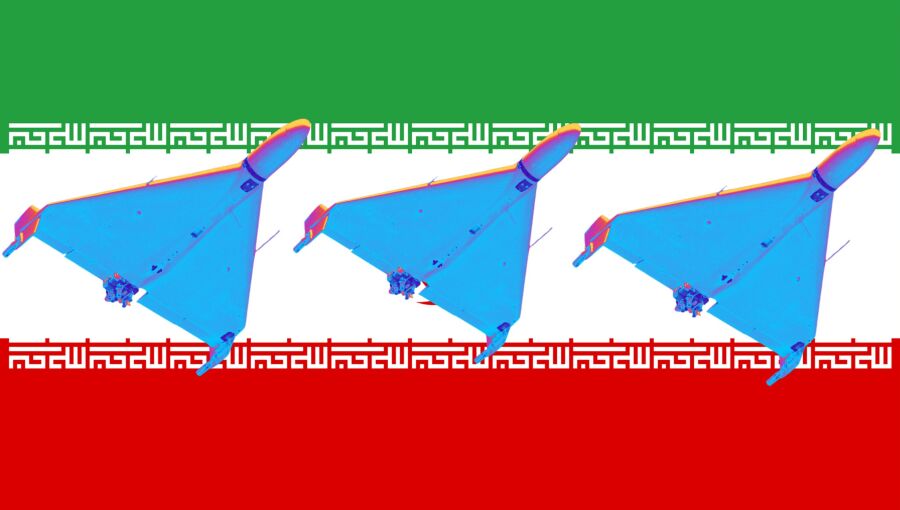
US and Iranian forces face a growing war of attrition as missile stockpiles, drone production and the cost of interception reshape the balance of the conflict. / bne IntelliNews
FacebookTwitterLinkedInTelegramFlipboardFeedly
By Patricia Marins in Rio de Janeiro March 6, 2026
Speculation is swirling over who will run out of missiles first: the US or Iran? The US has fired off five years’ worth of Tomahawk missiles in the first week of the war with Iran and announced a wind-down of the intensity of the attacks on March 5 to allow for a longer fight.
At the same time, Iran has released hundreds of missiles a day in the first few days of the conflict that began on February 28, but has also scaled back its assault in the last two days as its supplies also come under pressure.
Who can outlast the other and produce more missiles and drones in the meantime? One of the major asymmetries in this equation is each combatant's ability to produce new munitions. The US can only produce 100-200 Tomahawks a year at enormous expense, whereas Iran can mass-produce some 50,000 cheap drones a year at factories and has unknown quantities hidden.
Iran has been manufacturing missiles with ranges exceeding 300 km for nearly 40 years and has produced missiles capable of reaching Israel for at least 25 years.
In 1988, the Naze'at-10 reached speeds up to Mach 4 with a range of 130 km. That same year, the Shahab-1 was introduced, with a range of up to 300 km and re-entry speeds exceeding Mach 5. This was followed by the Shahab-2, which had a range of 500 km by the mid-1990s.
Iran’s retaliation over the past three days has exceeded the scale of the 12-day conflict in June 2025. In just three days, Iran has launched over 450 missiles and nearly 1,100 drones.
On the second day, Iran used fragmentation warheads with submunition dispersal during re-entry, a feature of advanced systems and new to the conflicts between Iran and Israel.
These submunition-loaded warheads are typically used on missiles with ranges over 1,000 km, such as the Shahab-3, Ghadr, Emad, Khorramshahr, and Sejjil. They can disperse 20 to 1,500 submunitions during or after re-entry. Israel has little defence against this type of munition.
Iranian launches will be hard to stop fully, with possible periods of reduced missile activity interspersed with heavier drone use.
If the US couldn’t halt launches from Yemen or Iraq, why expect success against Iran? They underestimated Iran and now risk humiliation with depleted interceptors, while Iran retains most of its launch capability.
This is the core of the cat-and-mouse game: US and Israeli drones patrol at high altitude, using Search and Rescue (SAR) and other sensor technology to detect heat or smoke from launches, mapping sites for bombings. Iran must then clear tunnels and patrol those areas to restart operations, now with higher risks.
However, Iran is three times larger than Ukraine, and Russia has not fully suppressed Ukrainian drone launches or aircraft operations in a much smaller territory. It is unrealistic to expect total suppression in Iran, though the scale could be reduced, leading Iran to rely more heavily on drones.
Cost-to-kill ratio
The US-Israeli allies began Operation "Epic Fury" with the classic "shock and awe" strategy – use overwhelming force to score a quick knockdown. The decapitation of the Islamic Republic was achieved with the death of Ayatollah Ali Khamenei on March 1, along with two dozen other senior figures. The intense bombardment of Iranian assets and positions is ongoing, but that first blitzkrieg phase may already be coming to an end.
Patriot missile supplies are limited, and although it maintains a very high interception rate, its $4mn price tag compared to the $30,000 cost of a Shahed drone yields a cost-to-kill ratio of 130:1.
The asymmetry is a strategic trap that works to Iran’s advantage. The barrage of Iranian missiles and drones in the first few days inflicted limited damage on the US and Israeli forces; however, they didn't need to do any damage. By launching massive swarms of low-cost "kamikaze" drones, Iran is not just aiming for physical targets but is systematically emptying Western missile magazines. For every $1mn Iran spends on a drone swarm, the US and its allies must spend upwards of $100mn to stop it.
From a standing start, Ukraine has built up a drone production capacity that can churn out 4mn drones in 2025 and rising and has the capacity to make 8mn if more investment were provided by allies. This year, Bankova hopes to raise total production to 7mn.
However, Ukraine’s drones are smaller-scale and less powerful, primarily used on the battlefield against Russian infantry. Iran specialises in larger long-range attack drones (such as the Shahed-136/238), which are closer to cruise missiles than the small FPV drones used on the battlefield in Ukraine and so more effective in the current conflict where there no US boots on the ground.
Iran’s production of Shahed drones is estimated at around 400 per day, but the lower production rate is due to their larger size, longer range, and greater sophistication. The Iranian version is perfectly suited to the conflict it is now engaged in.
While Ukraine has had to learn on the job, Iran has been working on its drone industry since missile production and development was excluded from the 2015 Joint Comprehensive Plan of Action (JCPOA) deal by the Obama administration to get the deal across the line.
As a result, Iran enjoys a significant cost-to-kill ratio advantage: a Tomahawk cruise missile costs $1.5mn-$2mn per missile, whereas a long-range Iranian missile costs about $20,000-$50,000 each, as written here previously in Bne IntelliNews.
The Tomahawks are at least 30-times more expensive than an Iranian drone. Iran’s drone production ratio per year to the US Tomahawk is even bigger: 750-times greater.
These differences mean that Trump’s call for the conflict be over in a month are not just a desirable political goal, they are a military imperative.
The US and the Gulf Cooperation Council (GCC) allies are reportedly already running low on interceptor ammo and there is talk of relocating air defence systems from the Indo-Pacific theatre to the Middle East.
The US is scrambling to "bend the cost curve" through initiatives like Replicator 2, which aims to mass-produce cheap, "attritable" interceptors, but these efforts are still playing catch-up to a rapidly evolving battlefield.
Ukrainian President Volodymyr Zelenskiy has also offered to step in with recently developed Ukrainian-made interceptor drones, but he is demanding a quid pro quo and expects Patriot missile ammo in exchange.
While the Pentagon has begun testing systems like the $35,000 LUCAS drone—a reverse-engineered clone of the Shahed—and Ukraine is successfully deploying $2,500 interceptor drones like the Octopus, Western procurement remains bogged down by decades of focus on high-end, exquisite technology, and the US has not launched mass production of any of these systems.
The Pentagon didn’t do its homework and launched Operation Epic Fury using the tactics from the last war, before it was ready to fight a modern drone-based war of attrition conflict.
“The US forces remain structurally unprepared for a sustained drone war where the winner isn't the one with the best technology, but the one who can afford to keep the lights on the longest,” Yuriy Boyechko, CEO of Hope For Ukraine.

No comments:
Post a Comment