It’s possible that I shall make an ass of myself. But in that case one can always get out of it with a little dialectic. I have, of course, so worded my proposition as to be right either way (K.Marx, Letter to F.Engels on the Indian Mutiny)
Friday, March 06, 2026
Sri Lanka denounces war deaths, houses Iran sailors
Colombo (AFP) – Sri Lanka on Friday denounced the toll of the Mideast fighting, as the nation opened its arms to over 200 Iranian sailors who sought help after a deadly torpedo strike on another of Iran's ships.
The crew were brought ashore Thursday and were being accommodated at a military camp near the capital Colombo and their ship, IRIS Bushehr, was under Sri Lankan control.
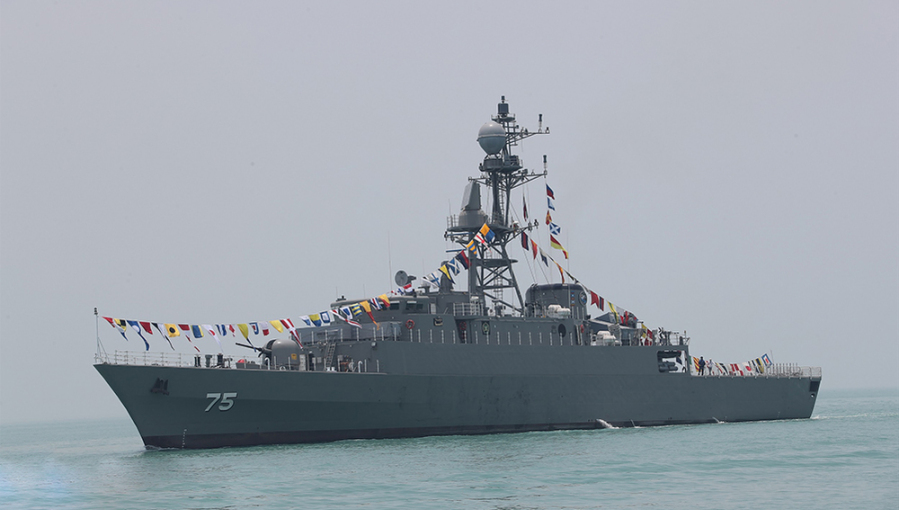
The vessel reported engine trouble and sought port entry after another Iranian vessel, IRIS Dena, was hit by a US torpedo off Sri Lanka's southern coast on Wednesday.
Washington later announced it carried out the attack, which killed at least 84 Iranian sailors aboard and left 64 more missing.
"Our approach is that every life is as precious as our own," Sri Lanka's President Anura Kumara Dissanayake wrote on X, and urged peace after the Israeli-US campaign led to Iranian retaliatory strikes.
Thirty-two sailors were rescued by the Sri Lanka Navy and were being treated at a hospital in the southern port city of Galle.
Wednesday's attack was the first military strike far outside the Middle East since the United States and Israel launched their war on Iran.
The US defence secretary said on Wednesday the strike was the first by a torpedo fired by an American submarine since World War II.
Sri Lanka not only granted permission for the second Iranian vessel, IRIS Bushehr, to enter its territorial waters on Thursday, but also evacuated its crew to a naval facility just outside Colombo.
"All our actions are aimed at saving lives and ensuring that humanity prevails," Dissanayake said.
In an address to the nation hours earlier, he said sheltering the sailors was the "most courageous and humanitarian course of action that a state can take".
"We jealously guard our non-aligned policy while ensuring that humanitarian values and the saving of lives remain our top priority."
Sri Lanka has remained neutral in the latest conflict. The United States is Sri Lanka's largest export market, while Iran is a key buyer of tea, the island's main export commodity.
A senior administration official said all but four sailors of 208-strong crew from IRIS Bushehr were taken in three Sri Lanka Navy craft and were being accommodated at a military camp near the capital.
"Our military is now in full control of the ship, which will be taken to Trincomalee," the official told AFP, referring to the port on the eastern side of the island, which is away from the main Colombo harbour.
The four Iranians remained aboard to assist Sri Lankan sailors, the official said.
Sri Lanka is a struggling economy dependent on International Monetary Fund(IMF) bailouts since 2023 after a financial crisis between 2019 and 2022 that peaked with the government defaulting on its sovereign debt.
With its small naval and coast guard fleet supported by an even tinier budget and workforce it is seen as a minor player in the Indian Ocean.
According to a televised address by Sri Lankan President Anura Kumara Dissanayake as cited by Times of India, the country’s navy has rescued the crew of a second Iranian warship IRIS Bushehr. The Sri Lanka Navy has taken control of the vessel and given it asylum in its northeastern port of Trincomalee.
IRIS Bushehr reportedly had a problem with one of its engines and requested assistance to which the Sri Lankan government agreed after a brief consultation with the vessel’s captain who was safely taken ashore with his crew.
The IRIS Bushehr was under threat of becoming a casualty in international waters of the Indian Ocean after her sister ship IRIS Dena was sunk by a US submarine using a Mk48 torpedo near Sri Lanka on March 4 2026.
Sri Lanka rescued 79 members of the Dena crew and gave them medical assistance. However over 100 crew members were unaccounted for and are believed lost with the ship.
Explaining his country’s position President Dissanayake said "We are not taking sides in this conflict, but while maintaining our neutrality we are taking action to save lives. No person should die in a war like this. Every life is equally precious".
Accounting for its small resource base and liabilities it is astonishing that Sri Lanka has taken this approach upstaging much larger littoral states like India which champions Humanitarian Assistance and Disaster Relief (HADR) as its major peacetime role.
In a statement issued late on March 5 the Indian Navy revealed that it had dispatched a long range maritime patrol aircraft likely a Boeing P8i, and two warships including “INS Tarangini which was operating in vicinity" and "was deployed for aiding the rescue efforts and arrived in search area by 1600 hr on 04 March 2026. By this time Search Aand Rescue(SAR) had been undertaken by Sri Lanka Navy and other agencies”.
The other Indian Navy ship “INS Ikshak has also sailed from Kochi to augment the search efforts and continues to remain in the area to search for missing personnel as a humanitarian measure for ship wrecked personnel”.
Ever since the 2004 Indian Ocean Tsunami, India has prided itself in being the first to rush aid with its naval vessels to any disaster hit country in the region including Sri Lanka.
In Delhi’s naval diplomacy and foreign policy circles it is often said with pride that Indian Naval vessels carry a special container with general purpose disaster relief aid supplies on their decks that can quickly be unloaded onto partner nation’s shores if the need arises.
In the past Indian warships have also rescued sailors and vessels in distress in its area of responsibility in the Indian Ocean littoral both alone and in conjunction with other countries’s forces and vessels.
China is curiously absent from the equation although its own littoral waters of the South and East China seas don’t directly put it in the path of the distressed Iranian vessels, however, Beijing has ambitions of challenging US hegemony and could have used the opportunity to showcase its blue water reach.
Who rules the seas? Torpedoed Iran ship brings focus underwater
Paris (France) (AFP) – A US submarine this week torpedoing an Iranian warship during the Middle East conflict raised the crucial question of who controls the seas during wartime.
The sinking of IRIS Dena on Wednesday in international waters off the coast of Sri Lanka killed at least 86 crew members, in what Iranian Foreign Minister Abbas Araghchi labelled an "atrocity".
It came after US-Israeli strikes on Iran on Saturday triggered war in the Middle East, with the Islamic republic launching retaliatory attacks across the region and beyond.
The US Navy had not torpedoed a ship since 1945.
Washington afterwards released what it said was periscope footage of the submarine firing on the ship, and an image of its hull almost vertical as it slipped below the surface.
The IRIS Dena "sank in less than 20 minutes", said Alessio Patalano, a professor at King's College London.
"It didn't stand a chance. The incident confirms the sophistication of the means of American undersea warfare."
Patalano said "submarine warfare has never gone away."
"It was just in the background because there hasn't been a confrontation between fleets since the 1980s," he added. 'Ultimate wartime weapon'
The most recent confirmed wartime torpedo attack dates back to 1982, when the British submarine HMS Conqueror sank the Argentine cruiser Belgrano during the Falklands War.
In 2010, South Korea's Cheonan corvette was torpedoed -- an attack Seoul attributed to North Korea, but which Pyongyang denied.
A European military source specialising in submarines and speaking on condition of anonymity explained that a torpedo explodes underneath a ship rather than upon contact with it.
The US attack on IRIS DENA killed at least 86 people on board
"It detonates a few metres below, creating a huge air bubble that lifts the vessel and breaks its main beam in two when it comes back down," the source said.
IRIS Dena's sonar range was probably too limited to have been able to detect the threat, they added.
The stealthy, invisible manoeuvres of a submarine, paired with its ability to fire torpedoes from dozens of kilometres away, make it "the ultimate wartime weapon", according to the source.
These capabilities can make a difference when surface combat between navies of similar standing is "symmetrical, with radars and missiles of roughly equivalent range".
Patalano said countries with a sophisticated underwater force enjoy an "objective advantage" in the event of a naval confrontation. 'We are everywhere'
Another European military source, also speaking anonymously, said conducting the attack far from the conflict's epicentre was a "show of force aimed at major rivals" such as China and Russia.
"Attacking this ship in international waters... means: 'We, the Americans, dominate the air, the sea and the undersea. We are everywhere, able to find you and destroy you.'"
Experts suggest that while Russia has neglected the modernisation of its surface fleet -- signalled by its setbacks in the Black Sea throughout its war with Ukraine -- it has made a point of investing in its submarine fleet.
China has been developing its navy and submarines for years.
US submarine forces commander Vice Admiral Richard Seif told an American congressional committee this week that China's "formidable" next-generation submarines "challenge the US Navy's longstanding undersea dominance".
Members of the Sri Lankan government confirmed during a session of parliament on Thursday, March 5, that an Iranian Navy supply ship, IRIS Bushehr (422), has made an urgent request for assistance and is seeking permission to dock in Sri Lanka. The request came after the sinking by the U.S. of the frigate Dena, and as Sri Lanka was conducting a search and rescue mission assisted by the Indian Navy.
The 3,300 dwt supply ship is believed to have been dispatched to resupply the Dena as the vessel was coming back from the Indian naval event. Commissioned in 1974, the vessel is 108 meters (354 feet) in length, with Sri Lankan government officials saying there are as many as 270 sailors and cadets aboard the vessel.
The request for urgent assistance and permission to dock in Sri Lanka came while the vessel was reported to be in international waters but within Sri Lanka’s EEZ. A minister told parliament the vessel remains outside Sri Lanka’s territorial waters, while the media reports said Sri Lankan President Anura Kumara Dissanayake was meeting with top government officials to decide what to do.
Some reports are saying the vessel, so far, has been denied permission to enter Sri Lanka’s waters, while another said after about 11 hours it was permitted to proceed to a point about 10 nautical miles off Colombo. Some reports said the ship was being denied docking privileges, while others said it was proposed that the ship would proceed to offload some of the people onboard, which is believed to include cadets, and that the ship would be placed at a secure dock in Colombo. One report suggested the ship would be interned for the remainder of the war.
Sri Lanka has condemned the American and Israeli hostilities and called for a diplomatic solution. It is reported to have consulted the Foreign Minister of Iran, but seeks to stay out of the war.
On Wednesday, Sri Lanka and India received the distress call from the frigate Dena after it was torpedoed. Reports placed the vessel between 20 and 50 nautical miles from the southern port of Galle. The Sri Lankan Navy responded and said the ship had sunk by the time it reached the scene. It reports that 32 Iranian sailors were rescued and taken under tight security to hospitals in Sri Lanka. They are reported to be suffering from burns, broken bones, and other less serious injuries.
Sri Lanka reports it recovered the bodies of Iranian sailors, with the media counts varying between 84 and 87, and is making diplomatic arrangements for their return to Iran. The Iranians said there were 130 aboard the Dena, but Sri Lanka said it believes there were 180 people aboard. It is continuing a search for as many as 60 people.
The Indian Navy said it dispatched a long-range maritime patrol aircraft to augment the efforts by the Sri Lankans. In addition, its vessel INS Taranigni was operating in the region and instructed to proceed to the location, where it arrived around 1600 local time on Wednesday. The INS Ikshak was also ordered to sail from Kochi, and a second long-range aircraft outfitted with a capability to drop rafts was placed on standby.
The Indian Government, on Thursday, is reported to have made a statement saying it will not be pulled into the war. It strongly denied rumors online and in the media that American forces were using Indian ports.



No comments:
Post a Comment