Showing posts sorted by relevance for query YIPPIE!. Sort by date Show all posts

Friday, April 29, 2022


JAMES RETHERFORD: BOOKS | Judy Gumbo’s ‘Yippie Girl’

Combating authoritarian repression with absurdist political theatre.

By James Retherford | The Rag Blog |April 29, 2022


Listen to Thorne Dreyer‘s interview with ‘Yippie Girl’ Judy Gumbo on Rag Radio, here.


As Kris Kristofferson sorta said, “[S]he’s a walkin’ contradiction, partly truth and partly fiction.” Such is noted Sixties troublemaker Judy Gumbo’s part myth/part romance/part BildungsromanYippie Girl: Exploits in Protest and Defeating the FBI, where “Yippie is a state of mind.”

As all good Marxists know, to call something a contradiction is not a criticism but a description of historical process, and free-form myth-making was a central feature of the Yippie creative strategy for combating authoritarian repression in the mid-Sixties/early Seventies. The Yippies can trace their taste for absurdist political theatre at least back to the Zurich dadaists of 1916. Our Marxism comes with an abundant measure of Grouchoism.

I am at least partly responsible for injecting myth into the cannons of Yippie literature. My 1970 work-for-hire bio-fable, Do It!: Scenarios of the Revolution, portrayed Jerry Rubin as the parabolic “child of America.” The opening line, “The New Left sprang, a predestined pissed-off child, from Elvis’ gyrating pelvis,” even alludes to the birth of the original Olympian wild child of myth and ritual … Dionysus, the patron saint of the Yippies.

So I am not surprised when Judy seeks to air out the musky closets of male-dominated myth-making with a fresh female look at the old tropes. In fact, I would expect nothing less from a woman of her fearlessness, intelligence, and character.


Judy Clavir was born June 25, 1943, in Toronto, the oldest daughter of immigrant Eastern European Jews. Her parents, Leo and Harriet, were dedicated, but secret, members of the Canadian Communist Party, and her father, who distributed Russian films throughout North America, frequently visited the Soviet Union. Her mother, Judy writes, lost her dedication to Stalinism and replaced it with booze, cigarettes, and anger.

Along with Anita and Abbie Hoffman, Nancy Kurshan and Jerry Rubin, Paul Krassner, Phil Ochs, Ed Sanders, Robin Morgan, Jonah Raskin, Stew Albert, and more, Judy was an original member of the Yippies, aka the Youth International Party.

Gumbo arrived in Berkeley in the fall of 1967 and shortly thereafter met a “blue-eyed blonde with curly hair” named Stew Albert, who would soon become her on-again, off-again, but mainly on-again co-conspirator, partner, and husband until his death in 2006.

Stew was also besties with Black Panther Party minister of information Eldridge Cleaver and Jerry Rubin, which gave Judy an intimate opportunity to watch the history of the Black Power movement and cultural revolution unfold. It also gave her the up-close and personal opportunity to learn how women, even movement women, are disregarded and marginalized into roles no different than that of the dominant white male-dominated capitalist society.

Judy received her Yippie surname from Cleaver, who liked to call Judy “Mrs. Stew.” When Judy objected, Eldridge said, “Alright then, I’ll call you Gumbo,” because to Cleaver, born in Arkansas, “Gumbo was a spicy Stew.”

Gumbo navigated the ebbs and flows of Bay Area activism—as a trusted Black Panther ally, underground journalist, and later People’s Park insurgent—and then moved on, with Stew, to New York City, where she became part of the two-ring circus called Yippie!

And then, of course, Yippie! went to Czechago in August 1968, nominated a pig to run for president of the United States, was attacked and beaten by Mayor Richard Daly’s bigger and meaner pigs, and then put on trial for conspiracy to cross state lines to desecrate the nation’s political hog wallow.

During this time, our shameless lifestyles and anti-social ideas were the subject of perverse interest to federal authorities operating under the relaxed surveillance directives of J. Edgar Hoover’s COINTELPRO. Headed by FBI deputy director Mark Felt—later to be revealed as Watergate informant Deep Throat—the feds engaged in a long dirty laundry list of extralegal and outright illegal actions against people believed to have contact with the Weather Underground, who recently had successfully detonated explosive devices in the U.S. Capitol and the NYC police commissioner’s office, or to be working on the 1971 Mayday demonstrations in Washington, D.C.

The FBI moved my neighbor out of his roach-infested apartment into a nice hotel in order to station agents and listen through the wall as I painted my fireplace with acrylics, wrote bad poetry, and had absolutely no sex.

Even as I watched through my front-door peephole as men wearing London Fog overcoats came and went from the grungy sixth-floor walkup … Even as I returned home to find papers on my work space in disarray … Even as I summoned the nerve to creep out on the fire escape and peek through the next-door apartment window where glowing LED lights illuminated banks of reel-to-reel recording machines in the semi-darkness …

Even then I had trouble believing that I was being spied on by the United States government. Such was the nature of movement paranoia in those days.

About the same time, the feds had been caught red-handed placing a tracking device on Judy’s car. Not once but twice! Her home was broken into, and a listening device was installed there. Gumbo described the mind-dulling, evidence-denying effects of fear and paranoia with such clarity that I revisited those times and rediscovered that paranoia vanishes when light is shined into the dank holes where repressive plots are planned and waged by ruthless autocrats. One on the sources of that light was the underground press.

Quotes from Gumbo’s FBI files are sprinkled throughout Yippie Girl like an off-key Greek chorus. Their voices often lend an element of farce to the narrative, kind of like the phone call to the Keystone Kops that triggers all of the frolicking slapstick. I was reminded that while the government operative’s power to intimidate and repress was extensive, their stupidity and incompetence were indeed epic.

The result of this prolonged government farce was the nationwide Guy Goodwin grand juries of 1971, beginning after the FBI “kidnapped” Leslie Bacon from her bed at the Washington Mayday organizing collective, secretly transported her by auto across country to Seattle, and put her in front of a grand jury without legal counsel.

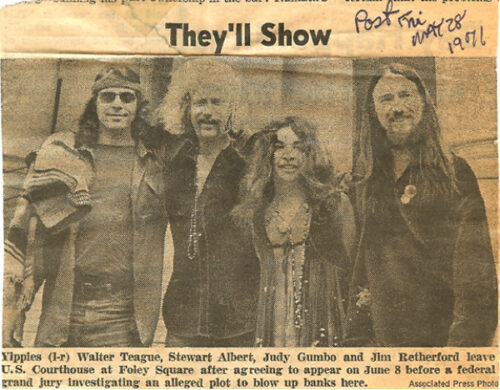
In NYC five movement activists were subpoenaed—myself, Sandra Wardwell (a Santa Barbara activist previously arrested after the burning of a Bank of America branch), veteran New York anti-Vietnam War organizer Walter Teague, and Judy and Stew. (A sixth individual, Chicago-born heiress Ellen Ruth Stone, was also subpoenaed, but after her billionaire father intervened, Stone’s subpoena was quietly quashed.)
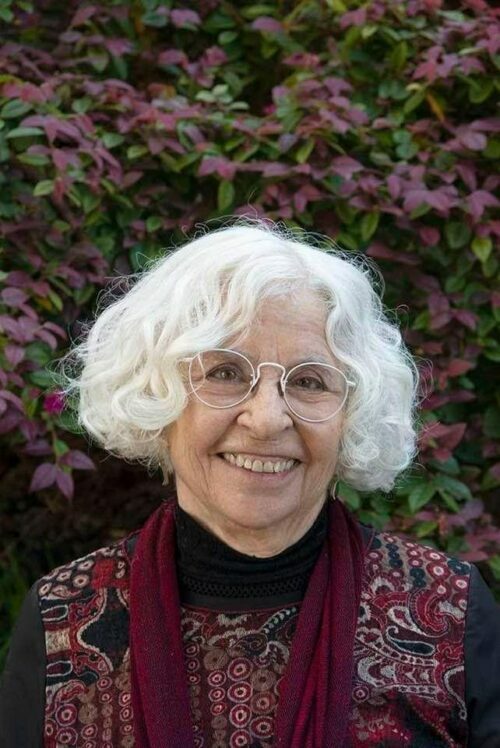

Judy Gumbo.

Myth-making is successful when the myth is far more compelling than the real story. What actually transpired in and around the federal courthouse at Foley Square on June 8, 1971, as the five subpoenaees arrived to face Guy Goodwin’s grand jury was the stuff of collective Yippie legend.

What I participated in, under the towering granite and marble foyer outside the grand jury chambers, was a quintessentially Yippie counteroffensive against the Nixon administration’s war on dissent. It was two-thumbs-up Theatre of the Absurd.

The subpoenaed witnesses came to the courthouse dressed up in crazy-ass costumes and dared Goodwin to call us before his geriatric grand jurors. We oozed ridicule for the whole rotten system.

To call attention to the government’s witch-hunt, Judy and Sandy were dressed as witches in black cloaks and black pointed hats. I came dressed in a head-to-toe gorilla costume wearing a t-shirt that said “King Cong,” because the feds were looking for urban gorillas . (I rode a subway from the Upper West Side in the attire.) Walter was vintage Teague—your everyday working-class commie in blue work shirt festooned with National Liberation Front support buttons. Stew stole the show, showing up, as I wrote in a 2006 Counterpunch tribute, “as a cross-dressing female terrorist bombshell, glamming to the nines in an utterly f-a-b-u-u-u-u-l-o-u-s rainbow-striped minidress with the name ‘Bernardine’ stitched in sequins across the bodice.” (Note: Gumbo quoted my description in Yippie Girl, but attributed my words to a nameless “journalist friend.”)

Sadly Judy’s version of the story completely missed the joyful message of collaboration and resistance. She eschewed the story of shooting our collective finger in the face of government intimidation in order to frame a story celebrating her own heroic smackdown of authority. In doing so, she embraced the male model of shameless self-promotion that she rails against throughout the book.

According to Yippie Girl mythos, Judy says she was the only one of us five to called into the hearing chamber and tells a very anti-climactic (and untrue) story of the experience. As I recollect, Walter, the only one of us who didn’t look like he just stepped out of a cartoon or the funny farm, was the only person summoned to the jury. (A federal marshal informed me that I would have to remove my gorilla suit when I was called. “Okay,“ I said, adding that it was a very hot day and “I wasn’t wearing anything underneath.”)

We all had been well-prepared by our crack legal team headed by Bill Schaap and Lennie Weinglass, and Walter’s appearance lasted less than five minutes. Guy Goodwin opted not to call in the rest of the crazies—it seems a lot of at-risk old people with weak hearts volunteer for grand juries, and he didn’t want to risk an EMS call.

Thus the New York grand jury inquisition came to a fizzling climax, and we Yippies and fellow travelers provided a template for our sisters and brothers facing the same government overreach in other jurisdictions across the country. Authoritarian repression was lampooned to death on its own doorstep.

Judy missed the opportunity to mythologize to our collaborative victory, and this, I think, is the low point of the book.
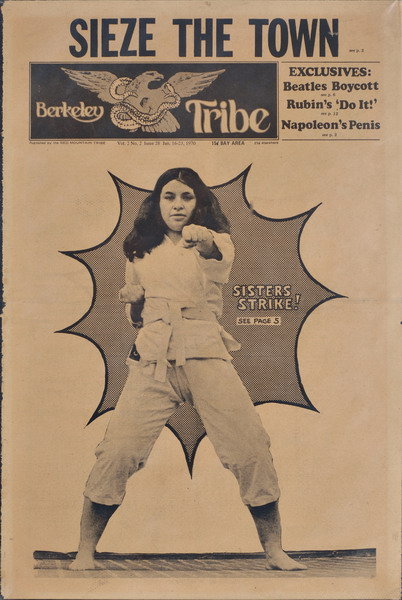

Judy Gumbo on the cover of the Berkeley Tribe

Before I go further, I cannot ignore the fact that I was born with standard male genitalia and use male pronouns and now am attempting to critique—some of you may say, mansplain—a woman’s story about her struggle to be heard above the din of male voices. I will do my best.

Starting at home in Toronto, Gumbo witnessed the effects of patriarchy as her father confidently promoted public relations for the Soviet regime and her mother angrily disappeared into a bottle. Judy didn’t suspect marital infidelity by her father, but fucking around quickly became a factor in her own life after she opened her bedroom door and found her first husband with another woman.

As she became acquainted with the female half of some of the Sixties most prominent “movement power couples,” Kathleen and Eldridge Cleaver, Anita and Abbie Hoffman, Nancy Kurshan and Jerry Rubin—and herself became half of one such power pairing with Stew Albert—she began to discover how poisonous gender inequality can cause distrust among women and cause them to doubt their own minds.

On getting a cold shoulder in her first meeting with Anita Hoffman, Judy writes that she later “understood that Anita’s unfriendliness was not about me—Anita was suspicious of any stranger who happened to be a woman… She faced the traditional, patriarchal bind of a woman married to a charismatic man.”

“Only after the rise of the women’s movement,” Gumbo adds, “did Anita and I become friends.”


To borrow Greek mythology again, Tiresias was the ancient Theban seer who spent seven years as a woman so they could settle an argument between Zeus and Hera about whether men or women enjoyed sex more.

I am no Tiresias, and I am a much older and more testosterone-challenged human than when I waged dada-inspired mindfuck warfare alongside Judy and Stew and the entire Yippie gang in NYC. Call my next remarks mansplaining for men if you will, but I now am gonna tell the brothers why Yippie Girl, in spite of its blemishes, is an important book to read.

If I have learned one thing during a lifetime struggle to both cause change and then embrace it, even when it becomes a little uncomfortable, it is that avoidance of the conversation only breeds hostility and is anathema to change.

For men to become mindful partners in the struggle for social and economic justice, we must open our minds and begin to understand that male privilege, like white privilege and class privilege, is the ravager of egalitarian society.

While Judy Gumbo presents her quest for gender equality as a work in progress, relatively free of what many men misperceive as feminism’s automatic guilty verdict against manhood, she aims to steer her story away from negativity and reproach—except for the drunken Revolutionary Union (RU) cretin [my description] who tried to rape her in Berkeley. She also calls herself out when needed.

Judy’s journey is one of searching for her own better self amidst the detritus of patriarchal leadership norms, and when she succeeds and when she falls short—and I suggest instances of both in my remarks above—her successes and failures have much to offer as men—and women—grapple with the corpulent burden of culture. Men are afflicted with always being right, even when we’re wrong. Women struggle to create a narrative of inclusivity but are sometimes unwittingly lured into easy answers about right and wrong. We as a species are a work in progress.

As the archetypal Yippie Girl, Judy Gumbo still grapples up toward the mountaintop where the boy gods meet and make the rules.


[James Retherford is an Austin-based writer, graphic designer, and political activist, and an occasional contributor to The Rag Blog. Jim, who was active in SDS, the Yippies, and political guerrilla theater, was a founder and editor of underground newspaper The Spectator in Bloomington, Indiana, in 1966, and was the ghost writer for Jerry Rubin’s iconic book, Do It!]

Sunday, January 26, 2020

Yippie! Pop 
Abbie Hoffman Andy Warhol and Sixties Media Politics

DAVID JOSELIT

In his 1968 manifesto,Revolution for the Hell of lt,  Abbie Hoffman wrote:

Did you ever hear Andy Warhol talk? ...Well,I would like to combine his style and that of Castro's. Warhol understands modern media. Castro has the passion for social change.It's not easy. One's a fag and the other is the epitome of virility. If I were forced to make the choice I would choose Castro,but right now in this period of change in the country the styles of the two can be blended. It's not guerrilla warfare but,well maybe a good term is monkey warfare. If the country becomes more repressive we must become Castros. If it becomes more tolerant we must become Warhols. 1

Castro and Warhol:what strange bedfellows And indeed Hoffman hints at a queer union-why else would he explicitly label Warhol a"fag"?But for Hoffman,the yippie! activist who built a movement by capturing free publicity on TV,the nature of this fantasy is genealogical not erotic.2 In their combination of radical politics and a  ruthless understanding of media culture, yippie!s are indeed the legitimate progeny of Castro and Warhol. 


What is puzzling and exhilarating in Hoffman's pairing is the political distinction he draws between his two progenitors:"If the country becomes more repressive we must become Castro s. If it becomes more tolerant we must become Warhols."The first half of this prescription is ordinary enough. When times are bad,activists use force. But the second part is mystifying.Warhol-the paragon of indifference and passivity,the celebrity groupie and ambitious art world operator- is held up as a model of politics appropriate for "tolerant times." In this essay I will reflect on this surprising assertion. I will try to understand Hoffman's declaration by sketching out what a Warholian politics might be and why it is particularly well-suited to"tolerant times."Before I turn to Warhol,I need to establish Hoffman's under-standing of media politics. And for this there is no better source than Hoffman himself. Yippie! actions were premised on soliciting and addressing the media through what Daniel Boorstin famously called pseudo-events. 

Tuesday, January 01, 2008

Forty Years Ago

Happy New Year

2008 is the Fortieth Anniversary of the 1968 Revolution.

And once again the Amerikan Empire is in the throes of a foreign war and a Presidential Election. While a new activist movement has arisen in opposition to Imperialism, Globalization and Capitalism. What goes around comes around....Of course some folks dread that.

Tet Offensive

http://www.vietnamwar.com/tetoffensive.jpg

The Tet Offensive (Tet Mau Than) or Tong Cong Kich/Tong Khoi Nghia (General Offensive, General Uprising) was a three-phase military campaign launched between 30 January and 23 September 1968, by the combined forces of the National Front for the Liberation of South Vietnam (NLF, or derogatively, Viet Cong) and the People's Army of Vietnam (PAVN) during the Vietnam War (1955-1975). The purpose of the operations, which were unprecedented in their magnitude and ferocity, was to strike military and civilian command and control centers throughout the Republic of Vietnam (South Vietnam) and to spark a general uprising among the population that would then topple the Saigon government, thus ending the war in a single blow.

The image “http://www.dmko.info/image2.jpeg” cannot be displayed, because it contains errors.


http://history.sandiego.edu/gen/USPics5/71757a.jpg

http://www.history.army.mil/books/Vietnam/Comm-El/Photos/Map5.jpg


Paris

Constraints imposed on pleasure incite the pleasure of living without constraints.

The more I make love, the more I want to make revolution.
The more I make revolution, the more I want to make love.


Communiqué


Comrades,

Considering that the Sud-Aviation factory at Nantes has been occupied for two days by the workers and students of that city,

and that today the movement is spreading to several factories (Nouvelles Messageries de la Presse Parisienne in Paris, Renault in Cléon, etc.),

THE SORBONNE OCCUPATION COMMITTEE calls for

the immediate occupation of all the factories in France and the formation of Workers Councils.

Comrades, spread and reproduce this appeal as quickly as possible.


Sorbonne, 16 May 1968, 3:30 pm


The image “http://www.tu-cottbus.de/BTU/Fak2/TheoArch/wolke/eng/Subjects/991/McQuillan/11.jpg” cannot be displayed, because it contains errors.
" The only safeguard against authority and rigidity setting-in is a playful attitude."
Raoul Vaneigem.

http://flag.blackened.net/revolt/graphics/pdf/paris68.gif


Chicago


Chicago: demonstrators gather at grant park (Aug. 1968).
photo: Fred W. McDarrah


Theatre of fear: one on the aisle
A view from the Chicago Democratic Convention riots by Richard Goldstein

"You afraid?" I asked a kid from California. He zipped his army jacket up to his neck, and filled his palm with a wad of Vaseline. "I dunno," he answered. "My toes feel cold, but my ears are burning."

We were standing together in Lincoln Park, not long after curfew on Tuesday night, watching an unbroken line of police. Around us were 1000 insurgents: hippies, Marxists, tourists, reporters, Panthers, Angels, and a phalanx of concerned ministers, gathered around a 12-foot cross. Occasionally a cluster of kids would break away from the rally to watch the formation in the distance. They spoke quietly, rubbing cream on their faces, and knotting dampened undershirts around their mouths. Not all their accoutrements were defensive. I saw saps and smoke bombs, steel-tipped boots and fistfuls of tacks. My friend pulled out a small canister from his pocket. "Liquid pepper," he explained.

Watching these kids gather sticks and stones, I realized how far we have come from that mythical summer when everyone dropped acid, sat under a tree, and communed. If there were any flower children left in America, they had heeded the underground press, and stayed home. Those who came fully anticipated confrontation. There were few virgins to violence in the crowd tonight. Most had seen—if not shed—blood, and that baptism had given them a determination of sorts. The spirit of Lincoln Park was to make revolution the way you make love—ambivalently, perhaps but for real.

The cops advanced at 12:40 a.m., behind two massive floodlight-trucks. They also had the fear; you could see it in their eyes (wide and wet) and their mouths. All week, you watched them cruise the city—never alone and never unarmed. At night, you heard their sirens in the streets, and all day, their helicopters in the sky. On duty, the average Chicago cop was a walking arsenal—with a shotgun in one hand, a riot baton (long and heavy with steel tips) in the other, and an assortment of pistols, nightsticks, and ominous canisters in his belt. At first, all that equipment seemed flattering. But then you saw under the helmets, and the phallic weaponry, and you felt the fear again. Immigrant to stranger, cop to civilian, old man to kid. The fear that brought the people of Chicago out into the streets during Martin Luther King's open housing march, now reflected in the fists of these cops. The fear that made the people of Gage Park spit at priests, and throw stones at nuns, now authorized to kill. And you realized that the cops weren't putting on that display for you; no—a cop's gun is his security blanket, just as Vaseline was yours.

Then the lights shone brilliant orange and the tear gas guns exploded putt-putt-puttutt, and the ministers dipped their cross into a halo of smothering fog. The gas hit like a great wall of pepper and you ran coughing into the streets, where you knew there would be rocks to throw and windows to smash and something to feel besides fear.

The soldiers stood on all the bridges, sealing off Grant Park from the city streets. The kids couldn't be gassed anymore, because the wind was blowing fumes across the guarded bridges and into every open pore of the Conrad Hilton, and the hotel was filled with good people who had tears in their eyes. So the soldiers just stood with their empty guns poised against the tide. And they were frowning at the kids who shouted "put down your guns; join us." A few hid flowers in their uniforms, and some smiled, but mostly, they stood posing for their own death masks.

"Wouldn't you rather hold a girl than a gun?" asked one kid with his arm around two willing chicks.

"You don't understand," the soldier stammered, moving his tongue across his lips. "It's orders. We have to be here."

That was Wednesday—nomination day—and the city was braced for escalation. At the afternoon rally, an American flag was hauled down, and the police responded by wading into the center of the crowd, with clubs flying. The kids built barricades of vacated benches, pelted the police with branches, and tossed plastic bags of cow's blood over their heads. . . .

With every semblance of press identification I owned pinned to my shirt, I set out across the mall. But most of the crowd had the same idea. Across on Michigan Avenue, I could hear the shouts of demonstrators who were re-grouping at the Hilton. I stopped to wet my undershirt in a fountain and ran down the street. My hands were shaking with anticipation and I could no longer close my eyes without seeing helmets and hearing chants. So my body was committed, but my head remained aloof.
http://peacecorpsonline.org/messages/imagefolder/knifedchicago.jpg


Czechoslovakia


The Soviet Invasion
of Czechoslovakia: August 1968

Materials from
the Labadie Collection
of Social Protest Material

Soviet tank in front of the Czechoslovak Radio building, photo: CTKSoviet tank in front of the Czechoslovak Radio building, photo: CTK

In the morning hours of August 21, 1968, the Soviet army invaded Czechoslovakia along with troops from four other Warsaw Pact countries. The occupation was the beginning of the end for the Czechoslovak reform movement known as the Prague Spring.

This web site contains material from the days immediately following the invasion, and they reflect the atmosphere in Czechoslovakia at the time: tense, chaotic, uncertain, full of pathos, fear, and expectation...


SDS: Anarchist Libertarian Alliance


The image “http://www.antiauthoritarian.net/sds_wuo/thumbnail/sds_organizer_guide.jpg” cannot be displayed, because it contains errors.
  • SDS Bulletin - July, 1964 (Vol 2, Nr 10)
  • New Left Notes - May 13, 1968 (Vol 3, Nr 17)
  • New Left Notes - March 8, 1969 (Vol 4, Nr 9)


  • First-phase SDSers hadn’t talked much about values. But as anti-war activity heated up during the second phase, SDSers were looking for new worldviews, indulging in new tastes and lifestyles. Pardun, for whom LSD was practically religion, took the hippie lifestyle as a facet of the movement.

    But neither critique nor lifestyle, without political gains, were enough by late 1967, when second-phase leaders began to worry about the realism of their project. Pardun puts its succinctly: "Protesting the war," he writes, "assumed that it was a mistake and that if we could convince the war makers of that then the war would end."

    Escalations in ground forces and bombing–his book recounts them, brigade by brigade, ton by ton–told SDS that the war wasn’t simply a "mistake" and that hawks would not be persuaded–until and unless doves could take power away from them.

    Several prairie leaders, notably Carl Oglesby, Greg Calvert, and Carl Davidson, began to concoct theories to deal with the task. Three elements were common to their formulations: the notion of a "New Working Class," of "resistance," and of youth as a powerful and independent force. The "New Working Class" was a highly technical, white-collar proletariat, whose members, proponents of the theory insisted, were going to replace the blue-collar industrial workforce. "Resistance" was a vaguer idea, which took practical form in a campaign to sabotage and derail the military draft. Youth were "revolutionary" because they weren’t sworn to doctrines about racial supremacy and My Country, Right or Wrong. They also smoked pot.


    Consciousness and Social Life - Google Books Result

    by David H. DeGrood - 1976 - Philosophy - 112 pages
    Now Karl Marx was being referred to, help! theory!45 By the Summer of 1967 ... the Spring of 1968 opportunists such as Carl Oglesby were urging SDS to drop ...

    Building a New Libertarian Movement

    [The following, which I co-authored with the late Samuel Edward Konkin III, originally appeared in slightly different form under the title “Smashing the State for Fun & Profit!” in Tactics of the Movement of the Libertarian Left (Vol. 5, No. 1), May Day 2001. I offer it here as a clarification of “Libertarian Leftism,” an illuminating piece of political revisionist history, and a contribution to Tom Knapp’s ongoing Symposium on Building a New Libertarian Movement. I apologize for its length.]
    What was the New Left in 1965 was conducive to an alliance with Libertarians. Indeed, the New Left and the nascent Libertarian Movement reached out for each other to battle the common enemy, Corporate Liberal Imperial Leviathan. Libertarian Movement founder Murray N. Rothbard traded votes with Maoists at New York Peace & Freedom Party conventions. Rothbard and historian Leonard Liggio started
    Left and Right: A Journal of Libertarian Thought to help forge a Libertarian alliance with the New Left. Carl Oglesby, 1965 president of Students for a Democratic Society (SDS), wrote an analysis of the U.S. Empire, Containment and Change, in which his prescription for defeating the Empire called explicitly for a coalition with the Libertarian “Old Right” as led by Rothbard and Liggio. And Karl Hess, speechwriter for the Goldwater presidential campaign in 1964, determined by 1968 that he had more in common with the New Left than Buckley’s Right and penned his stirring “Death of Politics” Libertarian manifesto for Playboy magazine.

    But those “Old Left” commune-statists were not, to use that familiar Trotskyist phrase, “decisively defeated on the proletarian terrain.” By the time of its 1969 convention, SDS expelled its anarchists and split between Maoists and WeatherMaoists. After a brief exhibition of street violence, the “vanguard” collapsed underground with an occasional eruption over the years. Also in 1969, Libertarian Rightists, inspired by Rothbard and led by Hess, walked out of the Young Americans for Freedom (YAF) convention to join the New Left. And unfortunately, even the first Libertarian Con that year in New York, which brought together disenfranchised SDS decentralists and YAF free-marketeers, also split — not on Left-Right lines but on revolutionary rage vs. quite academic movement-building lines.

    YIPPIE!

    The image “http://upload.wikimedia.org/wikipedia/en/e/e4/Us-yip.gif” cannot be displayed, because it contains errors.

    The Youth International Party (whose adherents were known as Yippies, a variant on "Hippies") was a highly theatrical political party established in the United States in 1967. An offshoot of the free speech and anti-war movements of the 1960s, the Yippies presented a more radically youth-oriented and countercultural alternative to those movements. They employed theatrical gestures—such as advancing a pig ("Pigasus the Immortal") as a candidate for President in 1968—to mock the social status quo.They have been described as a highly theatrical youth movement of “symbolic politics.”


    It was during the conventions in 1968 that the Yippies really made a national splash.


    At the turbulent Democratic gathering in Chicago, Yippie founders Abbie Hoffman and Jerry Rubin presented their candidate for president – "Pigasus the Immortal," a real pig.

    But the scene at the convention turned ugly as Chicago police, and then the National Guard, clashed with antiwar protesters. In the aftermath, Hoffman and Rubin were among seven protesters arrested and charged with conspiring to incite violence.

    During the trial of the so-called "Chicago Seven," Hoffman and Rubin continued to play to the media, one day showing up for court in judicial robes. Ultimately, the charges against the defendants were dismissed.

    Paul Krassner, who was among the founding members of the Yippies with Hoffman and Rubin, said the party came about because "the whole antiwar effort seemed dreary. .. We wanted to add some color and fun to the demonstrations."

    Abbie Hoffman.


    Yippie Workshop Speech by Abbie Hoffman (1968)

    Cops are like Yippies-you can never find the leaders... You just let 'em know that you're stronger psychically than they are. And you are, because you came here for nothin' and they're holdin' on to their fuckin' pig jobs 'cause of that little fuckin' paycheck and workin' themselves up, you know. Up to what? To a fuckin' ulcer. Sergeant. We got them by the balls. The whole thing about guerrilla theatre is gettin' them to believe it. Right.

    Theatre, guerrilla theatre, can be used as defense and as an offensive weapon. I mean, I think like people could survive naked, see. I think you could take all your fuckin' clothes off, a cop won't hit ya. You jump in Lake Michigan, he won't go after you, but people are too chickenshit to do that. It can be used as an offensive and defensive weapon, like blood. We had a demonstration in New York. We had seven gallons of blood in little plastic bags. You know, if you convince 'em you're crazy enough, they won't hurt ya. With the blood thing, cop goes to hit you, right, you have a bag of blood in your hand. He lifts h is stick up, you take your bag of blood and go whack over your own head. All this blood pours out, see. Fuckin' cop standin'. Now that says a whole lot more than a picket sign that says end the war in wherever the fuck it is you know. I mean in that demonstration, there was a fuckin' war there. People came down and looked and said holy shit I don't know what it is, blood all over the fuckin' place, smokebombs goin' off, flares, you know, tape recorders with the sounds of machine guns, cops on horses tramplin' Christmas shoppers. It was a fuckin' war. And they say, right, I know what the fuck you're talkin' about. You're talkin' about war. What the fuck has a picket line got to do with war? But people that are into a very literal bag, like that heavy word scene, you know, don't understand the use of communication in this country and the use of media. I mean, if they give a ten-page speech against imperialism, everybody listens and understands and says yeah. But you throw fuckin' money out on the Stock Exchange, and people get that right away. And they say, right, I understand what that's about. And if they don't know what you're doin', fuck 'em. Who cares? Take this, see, you use blank space as information. You carry a sign that says END THE. You don't need the next word, you just carry a sign that says END, you know. That's enough. I mean the Yippie symbol is Y. So you say, why, man, why, why? Join the Y, bring your sneakers, bring your helmet, right, bring your thing, whatever you got. Y, you say to the Democrats, baby, Y that's not a V it's a Y. You can do a whole lotta shit. Steal it, steal the V, it's a Y. It's up the revolution like that. Keeping your cool and having good wits is your strongest defense.

    If you don't want it on TV, write the work "FUCK" on your head, see, and that won't get on TV, right? But that's where theatre is at, it's TV. I mean our thing's for TV. We don't want to get on Meet the Press. What's that shit? We want Ed Sullivan, Johnny Carson show, we want the shit where people are lookin' at it and diggin' it. They're talking about reachin' the troops in Viet Nam so they write in The Guardian! [An independent radical newsweekly published in New York.] That's groovy. I've met a lot of soldiers who read The Guardian, you know. But we've had articles in Jaguar magazine, Cavalier, you know, National Enquirer interviews the Queen of the Yippies, someone nobody ever heard of and she runs a whole riff about the Yippies and Viet Nam or whatever her thing is and the soldiers get it and dig it and smoke a little grass and say yeah I can see where she's at. That's why the long hair. I mean shit, you know, long hair is just another prop. You go on TV and you can say anything you want but the people are lookin' at you and they're lookin' at the cat next to you like David Susskind or some guy like that and they're sayin' hey man there's a choice, I can see it loud and clear. But when they look at a guy from the Mobilization [against the War in Vietnam] and they look at David Susskind, they say well I don't know, they seem to be doing the same thing, can't understand what they're doin'. See, Madison Avenue people think like that. That's why a lot SDS's don't like what we're doin'. 'Cause they say we're like exploiting; we're usin' the tools of Madison Ave. But that's because Madison Ave. is effective in what it does. They know what the fuck they're doin'. Meet the Press, Face the Nation, Issues and Answers-all those bullshit shows, you know, where you get a Democrat and a Republican arguin' right back and forth, this and that, this and that, yeah yeah. But at the end of the show nobody changes their fuckin' mind, you see. But they're tryin' to push Brillo, you see, that's good, you ought to use Brillo, see, and 'bout every ten minutes on will come a three-minute thing of Brillo. Brillo is a revolution, man, Brillo is sex, Brillo is fun, Brillo is bl bl bl bl bl bl bl bl. At the end of the show people ain't fuckin' switchin' from Democrat to Republicans or Commies, you know, the right-wingers or any of that shit. They're buying Brillo! And the reason they have those boring shows is because they don't want to get out any information that'll interfere with Brillo. I mean, can you imagine if they had the Beatles goin' zing zing zing zing zing zing zing, all that jump and shout, you know, and all of a sudden they put on an ad where the guy comes on very straight: "You ought to buy Brillo because it's rationally the correct decision and it's part of the American political process and it's the right way to do things." You know, fuck, they'll buy the Beatles, they won't buy the Brillo.

    We taped a thing for the David Susskind Show. As he said the word hippie, a live duck came out with "HIPPIE" painted on it. The duck flew up in the air and shat on the floor and ran all around the room. The only hippie in the room, there he is. And David went crazy. 'Cause David, see, he's New York Times head, he's not Daily News freak. And he said the duck is out and blew it. We said, we'll see you David, goodnight. He say, oh no no. We'll leave the duck in. And we watched the show later when it came on, and the fuckin' duck was all gone. He done never existed. And I called up Susskind and went quack quack quack, you motherfucker, that was the best piece of information: that was a hippie. And everything we did, see, non-verbally, he cut out. Like he said, "How do you eat?" and we fed all the people, you know. But he cut that out. He wants to deal with the words. You know, let's play word games, let's analyze it. Soon as you analyze it, it's dead, it's over. You read a book and say well now I understand it, and go back to sleep.

    The media distorts. But it always works to our advantage. They say there's low numbers, right? 4000, 5000 people here. That's groovy. Think of it, 4000 people causin' all this trouble. If you asked me, red say there are four Yippies. I'd say we're bringin' another four on Wednesday. That's good, that freaks 'em out. They're lookin' around. Only four. I mean I saw that trip with the right wing and the Communist conspiracy. You know, you'd have 5000 people out there at the HUAC demonstrations eight years ago in San Francisco and they'd say there are five Communists in the crowd, you know. And they did it all. You say, man that's pretty cool. So you just play on their paranoia like that. Yeah, there're four guys out around there doin' a thing. So distortion's gonna backfire on them, 'cause all of a sudden Wednesday by magic there are gonna be 200,000 fuckin' people marchin' on that amphitheater. That's how many we're gonna have. And they'll say, "Wow. From 4000 up to 200,000. Those extra four Yippies did a hell of a good job." I dig that, see. I'm not interested in explainin' my way of life to straight people or people that aren't interested. They never gonna understand it anyway and I couldn't explain it anyway. All I know is, in terms of images and how words are used as images to shape your environment, the New York Times is death to us. That's the worst fuckin' paper as far as the Yippies are concerned. They say, "Members of the so-called Youth International Party held a demonstration today." That ain't nothin'. What fuckin' people read that? They fall asleep. 'Cause the New York Times has all the news that's fit to print, you know, so once they have all the news, what do the people have to do? They just read the New York Times and drink their coffee and go back to work, you know. But the Daily News, that's a TV set. Look at it, I mean look at the picture right up front and the way they blast those headlines. You know, "Yippies, sex-loving, dope-loving, commie, beatnik, hippie, freako, weirdos." That's groovy, man, that's a whole life style, that's a whole thing to be, man. I mean you want to get in on that.


    ABBIE HOFFMAN

    1936-1989

    This site is dedicated to the memory and spirit of Abbie Hoffman.

    "Revolution is not something fixed in ideology, nor is it something fashioned to a particular decade. It is a perpetual process embedded in the human spirit."

    Abbie Hoffman

    Soon to be a Major Motion Picture

    abbie hoffman
    by Alex Burns (alex@disinfo.com) - May 29, 2001

    Abbie Hoffman (1936-1989) was a complex and deeply paradoxical social activist and media celebrity, whose legendary culture-jamming exploits have come to characterise the period's para-political turmoil and counter-culture.

    His early 1950s experiences as a Brandeis student and sexual experienced aesthete marked Hoffman as a future American Rebel (Outsider). Under the tutelage of famous humanist psychologist Abraham Maslow, Hoffman conceived of political protest as a positive and life-affirming self-actualising process.

    During the early 1960s, Hoffman was involved with civil rights activism as an organiser in Mississipi for the Student Non-violent Co-ordinating Committee. In San Francisco's Haight-Ashbury district, Hoffman became involved with the Diggers (actors turned social activists), distributing free food and organising accomodation.

    He first came to national exposure with Jerry Rubin during the infamous 1967 New York Stock Exchange "money-burning" incident. Through his involvement with anti-Vietnam War protests and the Chicago Eight trial which resulted from 1968 Chicago Democratic convention riots, Hoffman became a counter-culture icon and the face of American radical dissidence.

    Hoffman mixed with many of the leading protesters, including John Lennon and Yoko Ono, Tom Hayden, Timothy Leary and G. Gordon Liddy, and was notable for fusing creativity with righteous fury and savage humour. He pioneered many tactics of guerilla survival and personal autonomy.

    Drifting into an outlaw life-style, Hoffman was implicated in a 1973 cocaine deal gone wrong, and busted by undercover agents. Fleeing, Hoffman lived underground for six years, working on environmental campaigns.

    Re-surfacing in 1980, Hoffman served a brief prison sentence, before returning to social activism. Hoffman battled many fronts, but his demons were largely personal, in an environment that had dramatically changed since the demise of the Counter-culture. Psychosis, substance abuse and relationship breakdowns created a messy personal life.

    The rise of the Moral Majority as a political force, increased on-campus student conservatism and a critical re-appraisal of New Left radicalism countered his many attempts to re-mobilise university campus and environmental progressive forces into raising hell.

    Hoffman also encountered a media backlash against his clown persona and culture-jamming legacy, as many critics claimed that he had betrayed his earlier ideals.

    But despite his deep flaws, Hoffman remained committed to progressive campaigning, and criticised the Reagan administration's War on Some Drugs.

    Hoffman's social revolution ideals were finally realised through the 1989 collapse of Eastern European 'puppet' Communist states, but plagued by manic depression, Hoffman had died by suicide.

    Sadly, he did not live to see the resurgence of his ideas and radicial dissidence in the 1990s by a variety of individuals and progressive foundations.

    Hoffman's legacy has been chronicled in several excellent biographies: Marty Jezer's American Rebel (1992); Damien Simon and Jack Hoffman's Run Run Run (1994); Jonah Raskin's For the Hell of It and Larry 'Ratso' Sloman's Steal This Dream (1998).


    Who is Jerry Rubin?

    the co-founder of the Yippies

    IPB Image

    Jerry C. Rubin was perhaps the most outlandish figure to ever defended American civil liberties. A revolutionary and anti-war activist, his voice and zany stunts were heard and seen throughout the world. Rubin was a master of media sensationalism, exposing American injustice through outrageous spectacles and whimsical press conferences. His outrageousness and free style made him a household name, and soon every politician's worst nightmare.

    During the 70's Rubin reflected about his past deeds and thoughts. In essays he would admit his wrongs, explaining how sexism, homophobia, racism, and drug abuse shaped his beliefs. Once believing homosexuality was a sick behavior, he now understood it as a valid sexual expression. He also thanked women for the role they played in creating his public image: women were the ones who typed his manuscripts, handled his clerical work, and labored behind the scenes. He abandoned his "Kill You Parents" mantra and encouraged people to accept the "Love Your Parents" wisdom.

    In the 80's Rubin slowly removed himself from the media spotlight, complaining, "To live inside a media image is like a prison. Living for your image means sacrificing your true self." He made a few guest appearances with Abbie Hoffman and appeared in the movies "Growing Up in America" (1987), "Rude Awakening" (1989), and "Panther" (released 1995).

    Rubin died on November 28, 1994 when he was struck by a car while jay walking in Los Angeles. He was buried at Hillside Memorial Park in Culver City, California.

    Anita Hoffman: 16 March, 1942 - December 27, 1998


    The Yippies didn't just want to sit around and smoke pot. They sought to pull Uncle Sam's pants down in public, to show that revolution could be conducted in a spirit of festive nonviolence.

    Dubbing her the "Queen of the Yippies," the U.K.'s Economist (not exactly a radical publication) had this to say of Anita Hoffman and her husband Abbie: "Perhaps the most famous song of the 1960s was Bob Dylan's 'The Times They Are A'Changin'', in which 'senators, congressmen' and others stuck in the past were warned of the 'battle outside raging.' No one fought the battle with more enthusiasm than the Hoffmans, Abbie and Anita."

    > The Hoffmans became the symbols of an era of resistance against racism, capitalism and war.


    Steal this millennium!

    Yippie Stew Albert sits down with R.U. Sirius to plan the revolution and remember Abbie Hoffman.

    - - - - - - - - - - - -
    By R.U. Sirius


    Stew Lives!

    Activist Stew Albert's quest for social and economic justice found its path in the Yippie movement of the late 1960s

    By Michael Simmons

    Photo by Judy Gumbo Albert

    HUNGRY FOR JUSTICE: Yippie Stew Albert, 1939-2006.

    "My politics have not changed."

    So read the simple blog entry by Stew Albert on Jan. 28. Two days later, he died in his sleep at his home in Portland, Ore., surrounded by his wife Judy Albert, daughter Jessica and friends. Suffering from cancer and unable to write at length, he was clearly determined to make a statement - a last stand - that blended the legendary Yippie's defiance and wit. As if his politics would ever change!

    For the Yippies - the Youth International Party - the word "party" meant both political group and outrageously good times. The Yippies merged leftwing activism and freak culture in the late 1960s. One of the "non-leaders" along with Abbie Hoffman, Jerry Rubin and Paul Krassner was another party animal - equally irresponsible for the chaos and comedy: Stew Albert, a fierce soldier for justice as well as a subversive prankster.


    Yippies on Wall Street (1)

    The image “http://sniggle.net/Images/yippie1.gif” cannot be displayed, because it contains errors.


    http://static.flickr.com/36/75282044_4dc36a22e1.jpg


    http://www.cafes.net/ditch/shards.jpg


    This guy was not a YIPPIE!

    http://www.lib.berkeley.edu/MRC/pacificaviet/kerry.jpg

    SEE

    Gay Old Communists

    The Summer of Love

    40 Years Later; The Society of the Spectacle

    Year of the Pig

    Black and Redmonton

    Paul Goodman

    Military Industrial Complex

    SOME REMARKS ON WAR SPIRIT


    Find blog posts, photos, events and more off-site about:
    , , , , , , , , , , , , , , ,
    , , ,, , , , , , ,
    , , , , , , , , , , , , ,, , , , , , , , , , , , , , , , , , ,, , Trotsky, , , , , , , , , , , , , , , , , , , , ,

    Tuesday, December 31, 2024

    EULOGIES

    Farewell Jimmy Carter


     December 31, 2024
    Facebook

    Photograph Source: Commonwealth Club – CC BY 2.0

    After 100 years among us, Jimmy Carter is gone. Like a lot of people, I’m playing Ramblin’ Man in his memory tonight.

    Saying good-bye to Jimmy Carter is complicated as Dickey Bett’s guitar. All complications considered, Jimmy was my favorite U.S. President during my lifetime. Nobody’s perfect, and a U.S. President’s imperfections are bound to cause immense death and destruction, as did Carter’s. Nevertheless, among modern American War Criminals-in-Chiefs, JC was relatively benign.

    By the time Jimmy Carter took office, I’d spent a good portion of my youth protesting a crooked President (it’s all relative among Presidential criminals, but at the time, Dick Nixon was considered to be almost as ridiculous, nefarious and felonious as… Trump?), a horrific war (Vietnam) and the imperialist, capitalist system in general. I must confess I did this mainly because I longed to make out on a motorcycle with Che Guevara (or some facsimile, since he was dead), but also because I was vaguely aware the “system” sucked.

    But in Jimmy Carter’s victory, I felt a surge of hope for America’s future, my future. I was just graduating from Yale, which had devolved from a progressive, antiwar academic haven personified by the Reverend William Sloane Coffininto a hotbed of Young Republicans creaming in their chinos over a cowboy California Governor whose gleaming Hollywood smile made me want to toss my scones all over my typewriter (yep, those were ancient times). So, I was grateful to see a Democrat in the White House who wasn’t LBJ. Would the future be bright with Jimmy?

    With one foot still in the hippie “living-off-the-land” life (while the other was kicking through the big oak doors of the Ivy League), I liked that our new Prez was a peanut farmer. As I was dating an engineering student, I thought it was cool this farmer was also an engineer, albeit nuclear. Nuclear? Yikes! I was just starting to join the “No Nukes!” protests, and hoped (against hope) that his scientific expertise—not to mention his experience “saving” a Canadian nuclear reactor from a meltdown—would make him less pro-nuke than other politicians.

    Nukes aside, I figured JC couldn’t be much worse than Tricky Dick or LBJ, and nothing was bringing back the glory of JFK, which really wasn’t all that glorious for Marilyn Monroe, among others.  I saw Gerald Ford merely as a transitional figure, though I later learned he was actually one of our best Presidents, mainly because he didn’t do much besides fall down a few times and try to heal the nation from Tricky Dick’s violation. Oh, and then there was that semi-secret endorsement of Indonesia’s genocidal invasion of East Timor.

    I thought it was a good sign when in 1977 on his first day in office, Jimmy Carter granted amnesty to any draft resister (or dodger).

    The fact that Carter was a devout “Christian” (JC loves JC) didn’t bother me because, at the time, I associated Christianity with the Reverend Coffin, the Berrigan Brothers and other antiwar Christians. Aside from a squawk or two from Anita Bryant and a young Jerry Falwell, Sr. (who was old even when he was young), the Church hadn’t quite turned hard Right… yet.

    I appreciated this devout Christian President admitting in Playboy that he had committed “adultery in his heart.” Even before I studied sexology, I knew most people fantasized about all kinds of things, and I applauded a politician who was honest about it. That’s another thing: Jimmy didn’t seem like “a politician.” He certainly was one, but he had an aura of sincerity that is rare in politics, and it stayed with him until the end.

    Being somewhat open about his sexual fantasies—even in Playboy magazine—must have been good for Jimmy’s sex life. Indeed, he was very happily married to Rosalyn Carter (1927-2023), his beloved Steel Magnolia, for 77 years, the longest marriage of any U.S. president.

    When asked if winning a Nobel Peace Prize or becoming President was the most exciting thing that happened to him, Jimmy replied, “When Rosalynn said she’d marry me—I think that was the most exciting thing… Rosalynn was my equal partner in everything.” Gotta love a hubby like that.

    Jimmy’s final farewell to his Rosalyn, read by their daughter Amy as Jimmy lay in a suit and tie on his hospital bed, had me—and countless other hopeful romantics sharing in this remarkable expression of intimacy from our devices—in tears. That scene, now a memory, moves me even more today, as I caretake my own beloved husband Max after his stroke.

    However, I must admit, my affection for Jimmy Carter stems from the fact he gave me a job, and was a pretty good boss, as bosses go.

    Getting a government job was never on my professional wish list. Actually, I wasn’t eager to go into any *profession,* partly because I was too lazy to get up and put on my jeans and tie-dyed T shirt for a 10am class, so how was I going to force myself into a power suit for a 7am power breakfast?

    Nevertheless, there I was, six months into the Carter administration, graduating Yale with (almost worthless) honors, watching my classmates go off to Wall Street, law school, med school, other higher education or expensive parent-paid years abroad, and I just didn’t know what to do with myself (confession: I still don’t). I was pretty good at playing the game known as “school,” and I liked it well enough. However, I was starting to get (to use a much-maligned term) “woke” to the fact that I was not just learning, but also being subtly yet firmly indoctrinated into the same war-making system I was protesting. So, I decided to take a few years “off” before submitting (yes, higher education is like BDSM submission with all the restraints, punishments, protocols and pain) to more schooling.

    Also, I was broke. And my voluminous student loans, on top of rent, on top of my fun-but-low-income lifestyle, was not putting money in my fledgling Bank of New Haven account.

    So, I got a job working for Jimmy Carter, one of those government jobs I thought I’d despise, but it turned out to be one of my greatest jobs ever. Sometimes I even had to be at “work” by 7am(!), but never in a power suit. More likely tights, a leotard and maybe a mask. What kind of job did I have?

    I was a New Haven City Mime.

    Stop laughing! I’ve already heard all the stupid mime jokes you can muster, and I am the first to admit, mimes can range from mildly annoying to downright nauseating, even when they’re good, and I wasn’t that good. Let’s just say, I was no Marcel Marceau—who actually performed for a smiling Jimmy Carter and bemused Rosalyn and Amy—and Marcel was not as good as the master Jean-Louis Barrault (check out his moves in Children of Paradise). However, I was decent—I’d taken a few mime classes as a Theater major at Yale and mimed a bit in a Commedia Del’arte troupe of Yale grads and dropouts—or at least good enough to ace an audition for performing artists in the CETA(Comprehensive Employment & Training Act) program, which had been signed into law by Nixon (even the worst Presidents do some good), but ramped up to its highest levels under Carter. So, I was hired as a CETA City Mime.

    Are you laughing even harder now? Many people (especially Reagan Republicans) found my job as a CETA City Mime to be the epitome of frivolous government, but not the sad citizens I made smile as they trudged across the New Haven Green, nor the tunnel-visioned commuters that broadened their perspectives through my silliness, nor the sick, the disabled and the seniors I distracted from their pain, nor the “inner city” students I taught to dramatize their feelings and ideas, some of whom went on to make movies, music and other forms of art, some of it great art.

    I never met Jimmy, but I did a little goofy miming for his Veep’s wife, the Second Lady, Joan Mondale, at the Wisconsin Mime Festival, which she graciously tolerated as the cameras clicked away, splashing our cheer all over the papers.

    Moreover, I was no longer broke.

    So, Jimmy Carter gave me a job—a pretty damn wonderful, fun, sexy, creative, meaningful and (I think) helpful-to-the-community job… with health benefits! And I thank him for that. It was my first job as an artist, and I held onto it until Rhinestone Cowboy Reagan rode in and shot CETA dead as he shot dead or crippled many government programs, like Welfare, Social Security, Medicaid, Food Stamps, and federal education, while beefing up the U.S. military and cutting taxes for the rich.

    Carter presided over an ostensibly peaceful time when Americans were in the grip of the “Vietnam Syndrome.” It was a good grip; at least, it felt pretty good to a peacenik like me (though it enraged the war profiteers), since this reluctance seemed to keep us out of war.  I say “seemed” because, little did I know that, while I was pretending to climb through imaginary windows as a CETA City Mime on the New Haven Green, assuming my country was truly “at peace,” my boss President Jimmy Carter’s militantly anti-Communist National Security Advisor, Zbignew Brzezinski (“Morning Joe” Mika’s dad), was laying the military groundwork for 9/11.

    9/11? If I’d known what was happening, it would have made my head spin (which would have been a neat mime trick). Quite honestly, it still does. In an effort to “undermine” the Soviet Union, President Carter, under Dr. Brzezinski’s earnest Trilateral guidance, armed and trained the ultra-religious Afghan Mujahideen against the Soviet-backed Democratic Republic of Afghanistan and ultimately, Soviet occupation troops during the Soviet-Afghan war. One of the leaders of these Mujahideen, who later devolved into the religo-fascist Taliban, was a young Saudi millionaire named Osama bin Laden.

    I observed the news with some interest, since I had just come back from a hippie trip through Afghanistan and fallen in love with the people and the roughly beautiful land. Years later, I was crushed to see the great Bamian Buddhasof Afghanistan—one of which I had climbed to the top—demolished by the Taliban. Then we got 9/11 and Bush’s War on Terrah… a Neocon nightmare, the seeds of which were planted by that seed-planting peanut farmer, my CETA GodFather, Jimmy Carter.

    At least, he tried to make peace in the Middle East (sort of), bringing Egyptian President Anwar Sadat and Israeli Prime Minister Menachem Begin to Camp David for a handshake. I was never a Zionist; I’d even made out (on a motorcycle!) with a handsome Palestinian (who looked a little like Che Guevara) on my Jewish youth group’s trip to Israel, for which I got into big trouble. But I appreciated Carter’s efforts, which miraculously stood the test of time, though Israel’s current genocide is fraying them.

    But this farewell is not an analysis or overview of Carter’s policies. I was too busy miming to pay serious attention to them.

    I did notice that Jimmy had some intriguing relatives. Sometimes my mime job involved roller-skating, so I thought it was cool that his daughter Amy Carter essentially roller-skated through the White House, and then I thought she was super-cool when I learned she became an anti-apartheid, anti-imperialism activist with my Yippie hero, Abbie Hoffman, post-Presidency. Jimmy Carter’s brother, Billy, liked beer (some might say too much), but he actually handled his Billy Beer better than Washington’s current most prominent beer-lover Brett Kavanaugh.  Jimmy’s sister, Ruth Carter Stapleton ministered to Larry Flynt when my old buddy Paul Krassner was editor of Hustler. Good times.

    Though Nixon signed the Environmental Protection Act (score one more for Tricky Dick), Jimmy Carter established the Alaska National Interest Lands Conservation Act, tripling the size of the nation’s Wilderness Preservation System and doubling the size of the National Park System. He also had solar panels installed in the White House in 1979. Ronald Reagan removed them in 1986. Apparently, undermining Carter in both major and minor ways was a Reagan obsession.

    The White House solar panels were essentially reinstalled in the early 2000s. What does that say about the two Presidents?

    Unlike most high-level politicians of the 1970s, Jimmy seemed to genuinely enjoy the music of the times, and being a Georgian, he especially liked the Allman Brothers. In fact, he was friends with the band, and even said they “helped him win the White House,” because they played several concerts for him on the campaign trail.

    Carter loved the blues, so of course, he’d have a little malaise. I remember his “Malaise” speech, how everybody—especially the Skull and Boners and other young Republicans that seemed to surround me—declared it just awful. I remember feeling a little self-conscious because I’d actually connected with that speech. I remember thinking that I understood the creeping “crisis of confidence in America,” because I was feeling it, and I was glad to have a President who dare to speak about it, even if he sounded like a depressed patient in one of those encounter group therapy sessions so popular back then.

    Unsurprisingly, most Americans went along with my Young Republican colleagues, and declared the speech to be “politically tone-deaf,” sending Jimmy Carter into freefall. Then Iran fell to the Ayatollahs, Brzezinski’s preposterous hostage rescue attempt failed disastrously (for which Carter took responsibility), and Cowboy Reagan made a dirty deal on the down-low for the Iranians to hold onto the American hostages until he won the Presidency.

    Then soon enough, both Jimmy Carter and I were out of our jobs.

    What a stark contrast between Jimmy Carter, the relatively honest, slightly depressed, seemingly sincere Democrat who took responsibility for his mistakes and worked selflessly into his 90s, and Ronald Reagan, the fake sunshine cowboy Republican who spouted apple pie platitudes, never took responsibility for anything and slipped into senility before the end of his presidency.

    Was Jimmy Carter a good president? It’s complicated. What’s certain is that he was a great former president.

    He has gone on many post-presidential peace missions, supported Civil Rights and picked up a hammer to build homes for the poor through Habitat for Humanity in 1984, and kept doing it until he was 95. He received the Nobel Peace Prize in 2002, but then so have many war criminals. Though Carter’s award “for his decades of untiring effort to find peaceful solutions to international conflicts, to advance democracy and human rights, and to promote economic and social development” somehow seems more sincere than most.

    Over this past year and a half, I’ve often wondered what Jimmy Carter would have said about Israel’s current genocide. I can’t help but believe that he would have injected a dose of compassion for Palestine that we just don’t see these days from high-level American politicians, let alone Presidents, current or former.

    So after a century of JC on Earth, like a lot of people, I’m listen to those Ramblin’ Man lyrics that so fit the occasion:

    When it’s time for leavin’ I hope you understand that I was born a Ramblin’ Man

    Whether he’s with Rosalyn, Jesus, or becoming one with that rich Georgia peanut-growing soil, farewell Jimmy Carter.

    Susan Block, Ph.D., a.k.a. “Dr. Suzy,” is a world renowned LA sex therapist, author of The Bonobo Way: The Evolution of Peace through Pleasure and horny housewife, occasionally seen on HBO and other channels. For information and speaking engagements, call 626-461-5950. Email her at drsusanblock@gmail.com  


    Spiritual Politics

    How Jimmy Carter created the religious right

    (RNS) — He threatened the GOP's Southern strategy.


    FILE - In this Oct. 28, 1980 file photo, President Jimmy Carter, left, and Republican presidential candidate Ronald Reagan shake hands in Cleveland, Ohio, before debating before a nationwide television audience. (AP Photo/staff, file)

    Mark Silk
    December 30, 2024

    (RNS) — Amid the many accolades and occasional brickbats now raining down on the late Jimmy Carter, let us note that the most consequential legacy of his one-term presidency is the religious right, the longest-lasting political movement in American history.

    How so?

    Winning the highest office in the land in 1976, Carter represented a mortal threat to the Republican Party’s strategy of making the increasingly populous South the engine of a new, nationwide GOP majority. Raised Southern Baptist on a peanut farm in southwest Georgia, he used religio-regional pride to recall white Southerners to the national Democratic fold. Where the last Democratic president, Lyndon Johnson, had lost all five Deep South states from South Carolina to Louisiana 12 years earlier, the former governor of Georgia won every state of the old Confederacy except Virginia.


    Carter’s personal religious identity was more complicated than you might have thought from Newsweek’s famous “Born Again!” cover story, which christened 1976 as “the year of the evangelical.” As described by Jonathan Alter in his fine biography, Carter had no sudden come-to-Jesus moment as a youth, but rather, in middle age, a growth in Christian commitment derived from reading the theologian Reinhold Niebuhr, doing mission work and reflecting on his own spiritual state.

    No liberal, the moderately progressive positions Carter took on issues such as abortion and women’s rights were in line with the moderate progressivism of the Southern Baptist Convention of the 1970s. That, however, was about to change.

    In 1979, conservative leaders in the SBC mobilized their forces, electing one of their own as president and setting in motion a full takeover of the denomination. The following year, some of the same leaders joined forces with Republican operatives to mobilize evangelicals against Democrats in general and Jimmy Carter in particular. For if the Southern strategy was to be kept intact, Carter had to be discredited and defeated.

    In June, after being chosen as the conservatives’ second SBC president, Oklahoma pastor Bailey Smith showed up at the White House and denounced Carter as a “secular humanist.” A month after being anointed Republican presidential candidate, Ronald Reagan showed up at Reunion Arena in Dallas and addressed the National Affairs Briefing, a gathering at which one prominent pastor after another summoned evangelical attendees to political engagement.

    “I know this is a non-partisan gathering, and so I know that you can’t endorse me, but … I want you to know that I endorse you and what you are doing,” Reagan said with a straight face, before urging the crowd to get out and vote for their values.


    FILE – U.S. President Jimmy Carter waves as staff holds up sign proclaiming “We Love you Mr. President” in Washington, Nov. 5, 1980, as the president walks to the helicopter for a trip to Camp David, Md., after losing the 1980 election to Ronald Reagan. (AP Photo, File)

    In November, Carter went down to defeat, the victim of persistent inflation, the Iranian hostage situation — and of evangelicals turning against one of their own. Returning to Georgia, he established the Carter Center in Atlanta as a place to promote good things around the world, wielded a hammer helping Habitat for Humanity build houses for poor people in America and teaching Sunday school at his small church in Plains. In 2000, he announced he was no longer a member of the SBC.


    As for the religious right, it took off from the Carter years, remaking the Republican Party’s social policy agenda, reconstituting its demographic base and establishing religiosity as a central feature of American political behavior. It largely succeeded in advancing the Southern strategy it was designed to rescue and, having undergone some subtle and some not-so-subtle transformations, persists to this day.

    Whether it would have come into existence in the absence of Jimmy Carter’s presidency is a nice question — one that, like all historical counterfactuals, cannot be conclusively answered. My guess is that something like it would have emerged but that it would have been smaller and weaker, less consequential and less enduring. And the country would be better off.


    Opinion

    Jimmy Carter rid the presidency of lies. His fellow evangelicals? Not so much.

    (RNS) — One of the many paradoxes surrounding Carter’s presidency is that he was unable to fend off the deception of fellow evangelicals, including Jerry Falwell and Billy Graham.


    In this July 31, 1979, file photo, President Jimmy Carter waves from the roof of his car along the parade route through Bardstown, Kentucky. 
    (AP Photo/Bob Daugherty, FIle)

    Randall Balmer
    December 29, 2024

    (RNS) — Jimmy Carter’s improbable ascent to the White House in 1976 was abetted in no small measure by his probity and his evangelical rectitude. Indeed, it is nearly impossible to imagine Carter, the one-term governor of Georgia, winning the presidency had it not been for the culture of corruption that had surrounded the Oval Office. Lyndon Johnson had lied to Americans about Vietnam, and Richard Nixon had lied about, well, just about everything.

    Carter’s pledge that he would “never knowingly lie” to the American people struck a chord, and although Carter’s term as president is generally regarded as something less than unalloyed success, no one — not even his legion of detractors — has credibly accused him of misleading the American people during his time in office. Put another way, Carter, whatever his shortcomings as president, redeemed the presidency from the culture of deceit so abundantly evident during the Nixon administration.

    But one of the many paradoxes surrounding Carter’s presidency is that he was unable to fend off the deception of his fellow evangelicals, including a couple of preachers named Jerry Falwell and Billy Graham. Their duplicity may not have been responsible for Carter’s political demise, but it certainly contributed.

    The roots of the religious right lie in the cancellation of the tax-exempt status of Bob Jones University, a fundamentalist school in South Carolina. On the basis of Title VI of the Civil Rights Act of 1964, the Internal Revenue Service ruled that any institution that engaged in racial segregation or discrimination was not — by definition — a charitable institution and therefore it was not entitled to tax-exempt status.


    RELATED: Jimmy Carter, beloved Sunday school teacher, ex-president, dead at 100

    After a district court upheld the IRS in 1970, Nixon instructed the agency to deny applications from “segregation academies,” many of them church-related schools. In the most famous case, the IRS, after years of warnings, finally revoked the tax exemption of Bob Jones University on Jan. 19, 1976, thereby provoking an outcry from politically conservative evangelical leaders. “In some states,” Falwell famously complained, “it’s easier to open a massage parlor than to open the doors of a Christian school.” (Falwell had opened the doors of his own segregation academy, Lynchburg Christian School, in 1967.)


    As the religious right geared up to oppose Carter’s reelection in 1980, evangelical leaders repeatedly blasted Carter for denying tax exemptions to segregated religious schools, what they characterized as “government intrusion into private education.” But their ire was misdirected. The IRS policy was formulated during the Nixon administration, and Bob Jones University lost its tax exemption on Jan. 19, 1976, when Gerald Ford was president; Carter was inaugurated a year and a day later. That day was, in fact, an important day for Carter, but not because he was in any way responsible for rescinding Bob Jones University’s tax exemption. Carter won the Iowa precinct caucuses that day, his first major step toward capturing the Democratic presidential nomination.

    Politically conservative evangelical leaders, however, intent as they were to turn Carter out of office, shrugged away the niceties of facts. They persisted in blaming Carter for the IRS action, even though Carter had nothing whatsoever to do with it.

    Several evangelical preachers also engaged personally in activities that pushed the bounds of credibility. In January 1980, as Carter faced reelection, he recognized (belatedly) that his support among evangelicals, who had helped propel him to the White House four years earlier, had ebbed. In an attempt to rebuild that support, Carter addressed the National Religious Broadcasters, meeting in Washington, D.C., and then invited key evangelical leaders to the White House for breakfast the following morning, Jan. 22, 1980.

    Carter thought — inaccurately, it turned out — that he could placate them with bromides about faith or religious freedom, but these leaders of the religious right were more interested in talking about social issues like abortion and gay rights.


    Following the meeting, Falwell began recounting to various audiences and political rallies across the country how he had asked Carter why “practicing homosexuals” served on the White House staff. Carter, according to Falwell, replied, “I am president of all the American people and I believe I should represent everyone.” Falwell’s rejoinder: “Why don’t you have some murderers and bank robbers and so forth to represent?”


    The Rev. Jerry Falwell addresses a 1983 prayer breakfast for Christians and Jews in Washington. RNS file photo

    As a tape recording of the White House gathering demonstrated, however, the president made no such comment. Falwell, in fact, had fabricated the entire exchange in an apparent attempt to discredit Carter in the eyes of evangelicals.

    If Falwell was guilty of deceit to advance his political ends, Billy Graham, the most famous and most respected evangelical of the 20th century, was disingenuous, if not duplicitous. On Sept. 12, 1980, less than two months before the election, Graham called Paul Laxalt, chair of Ronald Reagan’s presidential campaign, and offered to help any way he could short of a political endorsement. Eleven days later Graham sent a letter to Robert Maddox, Carter’s religious liaison, insisting that he, Graham, was “staying out of” the campaign.

    Even earlier, Graham and Bill Bright, head of Campus Crusade for Christ, had convened a gathering of evangelical preachers in Dallas for “a special time of prayer” to discuss how to dislodge Carter from the White House. Just weeks prior to that gathering, Maddox had visited Graham at his home in Montreat, North Carolina, and reported that Graham “supports the President wholeheartedly.”

    Graham’s actions were eerily reminiscent of his comportment 20 years earlier during the presidential campaign between Richard Nixon and John F. Kennedy. On Aug. 10, 1960, Graham sent a letter to Kennedy, the Democratic nominee and a Roman Catholic, pledging that he would not raise the “religious issue” during the campaign. Eight days later Graham convened a gathering of Protestant ministers in Montreux, Switzerland, to discuss how they could deny Kennedy’s election in November.


    Later in the same campaign Graham visited Henry Luce at the Time & Life Building and, according to Graham’s autobiography, said, “I want to help Nixon without blatantly endorsing him.” Graham drafted an article praising Nixon that stopped just short of a full endorsement. Luce was prepared to run it in Life magazine but pulled it at the last minute.
    RELATED: When Carter ran for president, advisers worried Christian faith would be a liability

    Graham’s desire to thwart the candidacy of a Roman Catholic in 1960 may be understandable, especially at a time (before Vatican II) of heightened suspicions between Protestants and Catholics. But on the face of it Graham’s opposition to Carter, a fellow Southern Baptist and evangelical Christian, is mystifying. One can only assume that for Graham, as well as for Falwell and other leaders of the religious right, politics trumped piety. Both preachers were willing to engage in deception in order to advance their political goals.

    Jimmy Carter may have reversed the culture of deceit that had infected the presidency during the administrations of Johnson and Nixon, but he was unable to stanch the duplicity of his fellow evangelicals. Carter’s pledge to “never knowingly lie” set a standard for the presidency, but it was a standard that some of his evangelical political adversaries failed to match.

    (Randall Balmer, an Episcopal priest and John Phillips Professor in Religion at Dartmouth College, is the author of “Redeemer: The Life of Jimmy Carter.” The views expressed in this commentary do not necessarily reflect those of RNS.)


    Opinion

    President Carter showed us faith and Democracy can go hand in hand

    (RNS) — Carter, a deeply faithful man, played a role in advancing equality, including making my marriage possible.


    Former President Jimmy Carter teaches during Sunday school class at Maranatha Baptist Church in Plains, Georgia, on Dec. 13, 2015. (AP Photo/Branden Camp)
    Paul Brandeis Raushenbush
    December 30, 2024


    (RNS) — As we reflect on the passing of President Jimmy Carter at the age of 100, we should honor one of the core throughlines of his incredible life: his faith. As a Baptist minister myself, I particularly want to celebrate how President Carter carried himself as a person with deeply held religious convictions, while leading a diverse democracy in which people of all faiths and backgrounds deserve equal dignity and treatment under the law.

    I had the privilege of interviewing President Carter several times on the role religion played in his life and work. Having interviewed many leaders, Carter was one of the most intelligent and formidable people I’ve ever spoken to. I remember trembling a bit when I asked the first question: If he was comfortable with the title of “Sunday school teacher.”

    He responded without hesitation, recounting how he started teaching Sunday school at age 18 at the Naval Academy Chapel — even leading services while at sea. During his presidency, he taught Sunday school 14 times at a nearby church, and, at the time of my interview in 2012, he had just completed his 650th lesson at Maranatha Baptist Church. “So, you might say I have been a Sunday school teacher all my life.”

    Carter was arguably the most religious president in the era since World War II. Yet, he was careful of how his faith featured in his official role. One of his most important religious influences was the towering evangelical force of the Rev. Billy Graham. Yet, President Carter never invited Graham to have services in the White House, explaining, “I believed what my father taught me about the separation of church and state, so I didn’t think it was appropriate. He was injured a little bit, until I explained it to him.”

    Carter understood the importance of honoring the separation of church and state. He saw how religion could inspire good works and movements for justice and peace without being imposed on others. “I think you can apply the principles of your faith in your service to the public, but you should not use your political authority to extoll your own faith at the expense of others … I don’t think the President of the United States should extoll Christianity if he happens to be a Christian at the expense of Judaism, Islam or other faiths.”

    One instance where Carter called upon his faith was at the Camp David Accords in 1978 with Menachem Begin of Israel and Anwar Sadat of Egypt. He made sure rooms were set aside for Muslims, Jews and Christians to pray throughout the process. “The Muslims used it on Friday, the Jews on Saturday, and the Christians on Sunday. We were very assiduous in our worship,” Carter said.


    Egyptian President Anwar Sadat, left, U.S. President Jimmy Carter, center, and Israeli Prime Minister Menachem Begin clasp hands on the north lawn of the White House after signing the peace treaty between Egypt and Israel, March 26, 1979, in Washington. (AP Photo/ Bob Daugherty, File)

    Later, Carter became a model of what a person can do in life after the presidency. He founded the Carter Center, which focuses on election monitoring, peace negotiations and fighting some of the world’s worst diseases. This work was a continuation of his commitment to public service, driven by the principles of his faith.

    When Carter released his book on the Bible, I warned him I’d be asking tough questions — about the compatibility of religion and science, the role of women, interfaith relations and more. He answered with grace and reason. Then, I asked a more personal question, as a Baptist minister and a gay man at that time in a relationship with my partner for over 10 years.


    It was 2012 at the time of the interview, and marriage equality was still a few years away. Public opinion was deeply divided on the rights of gay people, and Christians offered some of the most virulent condemnation for people like me. So I said to the Sunday school teacher, military vet and former president, “A lot of people point to the Bible for reasons why gay people should not be in the church. What do you think the Bible says?”

    Carter’s response was profound: “Homosexuality was well known in the ancient world, well before Christ was born, and Jesus never said a word about homosexuality. In all of his teachings about multiple things — he never said that gay people should be condemned. Jesus would not be against marriage between any two people if they were genuinely in love.”


    Hearing this from Carter was deeply moving. His words resonated and were quoted widely. His acceptance was unbelievable to some and even resulted in fact-checking sites reviewing and referencing my interview with him. There is a deeply ingrained misconception that religious people are by definition conservative, ignoring the countless examples of religious leaders who have propelled our nation forward. Carter, a deeply faithful man and influential example, played a role in advancing equality, including making my marriage and the opportunity to raise children possible.

    We find ourselves in a perilous moment, as those who champion Christian nationalism seek to dominate our politics, government and society. President Carter understood this threat all too well, noting that “the alliance between ultra-right wing religious believers and the Republican Party seems to be permanent.”

    Perhaps President Carter’s most enduring lesson both as a Sunday school teacher and political leader was the model he offered of deep faith rooted in tolerance, compassion and equality. To truly honor his achievements and legacy, we must safeguard religious liberty and civil rights, not just for a few, but for all.

    (Rev. Paul Brandeis Raushenbush is the president and CEO of Interfaith Alliance. The views expressed in this commentary do not necessarily reflect those of Religion News
     Service.)


    Carter, in death, becomes symbol of lost political 'decency' in U.S.

    Agence France-Presse
    December 31, 2024 6:37AM ET

    A mural in memory of Jimmy Carter is painted on a storefront at the Jimmy Carter National Historic Park in Plains, Georgia, on December 30, 2024 (Alex Wroblewski/AFP)

    by Aurélia END

    The death of Jimmy Carter has brought to the fore a defining characteristic of the late US president's life: his "decency," seen as a product of a bygone era in today's caustic political environment.

    Joe Biden on Monday repeated the word three times while speaking to reporters about his late White House predecessor.

    Biden, who will be replaced in the White House by Donald Trump on January 20, added: "Can you imagine Jimmy Carter referring to someone by the way they look or the way they talk?"

    Despite the struggles he faced during his single term in office -- from economic malaise to the Iran hostage crisis -- Carter has emerged as a nostalgic figure.

    He spent his years after the White House advocating for global democracy, fighting neglected public health scourges and teaching Sunday school.


    "He was an utterly honest, transparent and healing presence in the White House, which was just what the US needed after the Watergate scandal" under Richard Nixon, Barbara Perry, a professor specializing in the history of US presidents, told AFP.

    Eulogies "tell us as much about ourselves as they do about the person being contemplated and commemorated," historian Jon Meacham told broadcaster MSNBC.

    "Carter is a sad but illuminating instance of someone who -- while imperfect -- believed in the centrality of character... at a moment in American politics where character is not at the forefront of most people's minds."

    Born in rural Plains, Georgia, he died in the same house he and his wife -- who he was married to for 77 years -- bought in 1961.

    And his modest lifestyle served as an inspiration to many Americans -- even if other presidents didn't join in themselves.

    To name a few: allegations of John F. Kennedy's extramarital trysts, Bill Clinton's affair with a White House intern, and Donald Trump's well-documented sex scandals have "lowered all such standards in American politics," Perry said.

    "Americans have become immune to ethical standards in political life."

    Even those who have stayed clean from personal scandal, such as Barack Obama or George W. Bush, have little in common with the modest lifestyle and outspoken advocacy of Carter's post-presidency.


    - Religious, southern, Democrat -

    Carter has received an outpouring of condolences upon his death at age 100 on Sunday.

    "It's kind of a stark reminder of how few people there are now with honesty and integrity," Jay Landers, visiting Plains on Monday, told an AFP reporter.

    "Just look at" Trump in contrast, he said.


    The former -- and now incoming -- Republican president has been found liable for sexual assault, once mocked a reporter with a physical disability and infamously bragged about groping women by the genitals.

    Yet he returns to power in large part due to the conservative and religious right.

    Carter's relationship with Christianity, meanwhile, points toward a different era.

    Carter, a Democrat, was an evangelical -- a denomination now associated with the country's right wing.

    The Sunday school teacher also won swaths of the south -- a bastion today of religious conservatism and Republican politics.

    Conservative Republican Senator Chuck Grassley noted Carter's faith on Sunday when he said that, though they were "bit" by a "different political bug," they had much in common, including "love of the Lord."

    The fractious divides that Carter seems to have transcended, however, have long existed.

    Carter himself warned of the nation's "crisis of confidence" in a 1979 speech, sapping "the very heart and soul and spirit of our national will."

    His warnings sound like they could have been issued about modern political life, telling Americans they were "at a turning point in our history."

    "We can see this crisis in the growing doubt about the meaning of our own lives and in the loss of a unity of purpose for our nation," he said.


    That path, he warned, "leads to fragmentation and self-interest... It is a certain route to failure."

    © Agence France-Presse