Monday, January 06, 2020

Israel’s crime of stealing Palestinian organs continues

Israeli forces arrest a Palestinian woman at a military checkpoint in Hebron after she posted a comment on Facebook on Al-Aqsa Mosque [Shehab News]

Sari Al-Qudwa
December 31, 2019

The Israeli occupation government practices the worst forms of organised terrorism against the Palestinian people, including theft, destruction, forgery, looting and seizing Palestinian rights. These practices are evidence of the atrocity of the organised terrorism led by the Israeli intelligence services known as the Shin Bet, Aman and Mossad, as this audacity has reached the level of stealing organs from the bodies of Palestinian martyrs that have been seized.

A number of Israeli doctors supervise the implementation of the most accurate and dangerous organised organ theft from the bodies of Palestinians without the consent or knowledge of their families. After it stole the Palestinian land and history, the occupation is stealing human organs in complex operations carried out by its gangs, thus violating all laws. This is considered a heinous crime and bitter reality by all standards.

After Arab and international journalists and institutions published reports on this and several human rights organisations called for the prosecution of the occupation for carrying out the most heinous thefts in modern history, seizing the bodies of Palestinian martyrs and stealing their organs to save the lives of Israelis. This is considered one of the ugliest crimes and organised terrorism brutally led by the Israeli security agencies’ gangs.

Israel Mossad chief: Iran at the top of priorities

Swedish journalist Donald Bostrom published a report in August 2009 in Sweden’s Aftonbladet newspaper in which he revealed that the occupation government stole the organs of the martyr, Bilal Ghanem, 19, who died in 1992. According to the report, his body was handed over and it was clear that Bilal had been cut open from his neck to his abdomen and his organs had been stolen. The matter was very clear when he was being prepared for burial, which proves that the doctors from the forensic medicine institute took part of the body. Organs have been taken from bodies still held in the cemetery of numbers, where the occupation government keeps the bodies of Palestinian martyrs and still refuses to hand them over to their relatives.

In a past investigation, Director of the Abu Kabir Institute of Forensic Medicine, Yehuda Hiss, admitted stealing the organs of Palestinian martyrs while performing autopsies. The recorded confessions of Dr Hiss in 2000 addressed the way the forensic medicine institute was managed and how skin and corneas were stolen from the bodies that were sent to the institution illegally. Dr Hiss and the doctors working under him would steal corneas from the eyes of Palestinian martyrs. Palestinian families mentioned they would notice large incisions in the abdominal and chest of their relatives who were killed in Israeli attacks during the First Intifada that took place in 1987. The occupation army had seized their bodies before handing them over.

What we need is to open this file and consider it seriously in order to demand supervision over the occupation’s crimes and ending it by opening a major investigation. A team of international lawyers informed of these crimes must be formed and they must work to expose them on an international level in order to prosecute the occupation leaders. No matter how far the occupation government’s arrogance, practices and crimes against the Palestinian people go, we cannot allow them to avoid international prosecution. We must work to activate Arab and Palestinian efforts, as well as official and popular European efforts to hold the occupation leaders accountable for the war crimes they continue to commit against the Palestinian people.


WASN'T THIS A TV COP SHOW BACK IN THE EIGHTIES?

Barnie Sanders announces intention to 

block funds for war on Iran

Image result for bernie sanders meme
US Congresswomen condemn Trump threats to bomb Iran cultural sites
US Congresswomen Ilhan Omar and Alexandria Ocasio-Cortez have condemned US President Donald Trump for threatening ‘war crimes’.

US congresswoman Ilhan Omar in Minnesota, US on 4 October 2016 [Lorie Shaull/Flickr]

January 5, 2020

US Congresswomen Ilhan Omar and Alexandria Ocasio-Cortez have condemned US President Donald Trump for threatening ‘war crimes’.

In a tweet, New York Congresswoman Ocasio-Cortez responded to Trump’s threats to hit Iran ‘fast and hard’, after claiming the US had 52 Iranian sites, some of cultural heritage, in its crosshairs if Iran responded to the assassination of top Iranian General Qassem Soleimani.


This is a war crime.

Threatening to target and kill innocent families, women and children – which is what you’re doing by targeting cultural sites – does not make you a “tough guy.”

It does not make you “strategic.”
It makes you a monster. https://t.co/IjkNO8BD07

— Alexandria Ocasio-Cortez (@AOC) January 5, 2020


She said: “This is a war crime. Threatening to target and kill innocent families, women and children – which is what you’re doing by targeting cultural sites – does not make you a “tough guy.”

She continued: “It does not make you strategic, it makes you a monster.”

Minnesota representative Omar also condemned Trump’s threats as war crimes.

She tweeted: The President of the United States is threatening to commit war crimes on Twitter. God help us all!”


The President of the United States is threatening to commit war crimes on Twitter.

God help us all! #25thAmendment https://t.co/nYZSvpo8rG

— Ilhan Omar (@IlhanMN) January 5, 2020


Iran FM: Trump’s attack threat ‘war crime’

Targeting sites of heritage and cultural significance is a tactic terror group Daesh use.

In response to Trump’s threats, Michigan congresswoman Rashida Tlaib shared a video of the late British politician and veteran of the anti-war movement Tony Benn. She said: “This is how we need to talk about war.”


This is how we need to talk about war. https://t.co/IVqxVPAj7x

— Rashida Tlaib (@RashidaTlaib) January 5, 2020


Secretary of State Mike Pompeo has slammed Europe for not being ‘supportive enough’ of the assassination, and claimed the US ‘friends in the Middle East region’ had been very supportive of his actions.

UK Prime Minister Boris Johnson has so far remained silent and decided not to cut his holiday in the Carribean short in response to US actions.

However, UK foreign minister Dominic Raab has said that the UK are ‘on the same page’ as the US following the assassination, and claimed the act of aggression was self defence.

Iran: ‘Like ISIS, Like Hitler…Trump is a terrorist in a suit’

US Secretary of State Mike Pompeo said that if there were further Iranian attacks on US targets, Washington would respond with lawful strikes against decision-makers orchestrating such attacks. Democratic critics of the Republican president have said the strike that Trump authorised was reckless and risked more bloodshed in a dangerous region.

Iranian Supreme Leader Ali Khamenei, who gave Soleimani the country’s highest honor last year, vowed “severe retaliation” in response to his killing. Thousands mourned his death in Iraq, Iran and Gaza.

Qassem Soleimani was the head of Iran’s elite Quds Force and the mastermind of its regional security strategy. He was killed early Friday near the Baghdad international airport along with senior Iraqi militants in an airstrike ordered by President Donald Trump. The attack has caused regional tensions to soar and tested the US alliance with Iraq. Fearing escalation, NATO has suspended it’s training activities in Iraq, while the British Navy has committed to escort every UK-flagged ship across the Straits of Hormuz.

Showing no signs of seeking to reduce tensions, the US president has since issued a stern threat to Iran on Twitter, saying that the US has targeted 52 Iranian sites that it would strike if Iran attacks Americans or US assets in response to the US drone strike that killed Soleimani. He later added that the US will use ‘new’ equipment to strike Iran.


US Democratic White House contenders condemn Trump’s strike against Iranian commander, warn of war

Vermont Senator Bernie Sanders delivers a speech during his first presidential campaign rally at Brooklyn College in New York, United States, March 2, 2019. 
 [Atılgan Özdil/Anadolu Agency]

January 3, 2020 at 9:00 pm


Democratic presidential contenders on Friday condemned the air strike that killed prominent Iranian military commander Qassem Soleimani, saying President Donald Trump’s decision was reckless and could lead the United States to another war in the Middle East, Reuters reports.

The candidates, vying for the right to challenge Trump in the November 2020 election, questioned whether the president had a broader strategy in dealing with Iran, and used the action to highlight their approach to dealing with foreign adversaries.

“President Trump just tossed a stick of dynamite into a tinderbox,” former US Vice President Joe Biden said in a statement.

At a campaign event in Dubuque, Iowa, he added that no American would mourn Soleimani’s death but “the prospect of direct conflict with Iran is greater than it has ever been.”

Liberal US Senator Bernie Sanders, who has consistently opposed US military intervention overseas, said the move “brings us closer to another disastrous war in the Middle East that could cost countless lives and trillions more dollars.”


I was right about Vietnam.

I was right about Iraq.

I will do everything in my power to prevent a war with Iran.

I apologize to no one. pic.twitter.com/Lna3oBZMKB

— Bernie Sanders (@SenSanders) January 3, 2020


The overnight attack against the general, regarded as the second most powerful figure in Iran, was a dramatic escalation of hostilities in the Middle East between Iran and the United States and its allies, principally Israel and Saudi Arabia.

US Secretary of State Mike Pompeo said the strike aimed to disrupt an “imminent attack” that would have endangered Americans in the Middle East. But it was a risky gamble for Trump, who has criticized longstanding US entanglements in the region and promised to end “endless wars.”

Republicans said the move was a sign Trump – who was impeached by the Democratic-led House of Representatives last month and faces a Senate trial on charges he abused his office and obstructed Congress – was restoring American strength and leadership.

“At a time when the president is under impeachment by the Democrats, there’s nothing wrong with him showing strength and resolve in the face of a foreign threat,” said Republican strategist Ron Bonjean, who is close to the White House.

Democrats said it was another troubling indication of Trump’s erratic approach to foreign policy.

READ: Soleimani’s assassination -America’s declaration of war on Iran

“We’re on the brink of yet another war in the Middle East,” said liberal US Senator Elizabeth Warren. “We’re not here by accident. We’re here because a reckless president, his allies and his administration have spent years pushing us here.”

Many of the Democratic White House candidates, who will face voters for the first time in a month when Iowa kicks off the state-by-state nominating battle on Feb. 3, pounced on the strike to emphasize their own foreign policy philosophies and credentials.

Biden, a former chairman of the US Senate Foreign Relations Committee who emphasizes his foreign policy experience, released a 30-second online ad on Friday calling Trump “an erratic, unstable president” and portraying himself as “someone tested and trusted around the world.”

Sanders mentioned in his statement his 2002 vote against authorizing war in Iraq, which he frequently uses as a contrast to Biden, who backed the war.

Biden, Pete Buttigieg, the former mayor of South Bend, Indiana, and other Democrats made clear in their statements that they viewed Soleimani as a threat, but Warren, Sanders and entrepreneur Andrew Yang did not mention the Iranian commander.


Trump’s reckless gamble with world peace


Iranian Quds Force commander Qassem Soleimani attends Iranian supreme leader Ayatollah Ali Khamenei's meeting with the Islamic Revolution Guards Corps (IRGC) in Tehran, Iran on September 18, 2016


Yvonne Ridley
@yvonneridley
January 3, 2020

Iran is not given to knee-jerk reactions, but those who run the country are extremely unpredictable nonetheless. That is why it is so difficult to anticipate what will result from the assassination of the nation’s well-loved and respected Major General Qassem Soleimani.

Just a few days ago, the equally unpredictable US President publicly threatened Iran for an attack on the American Embassy in Baghdad. When the heavily-defended embassy compound was targeted by demonstrators following US air strikes in the Iraqi capital, Donald Trump responded: “Tehran will pay a very big price. This is not a warning. It’s a threat.” His words did indeed translate into a killing which could unleash yet another war in the Middle East with implications for world peace.

Trump’s assassination of Qassem Soleimani has been called both reckless and disproportionate, involving air strikes against five targets on either side of the Iraq and Syria border followed by the drone strike killing the Iranian general. Others were also killed alongside Soleimani, including Mohammed Reza Al-Jaberi, a senior Iraqi commander and head of public affairs of the Popular Mobilisation Forces militia, and Abu Mahdi Al-Muhandis, the deputy chairman of the group.

Parallels are already being drawn between General Soleimani’s death and the killing in June 1914 of Archduke Franz Ferdinand in Sarajevo. He was shot dead by a hot-headed 18 year-old Bosnian who was outraged his country had been taken over by the Austro-Hungarian Empire. The assassination triggered a chain reaction which escalated very quickly into World War One.

READ: Trump hawkish in first tweet after Soleimani’s death

We know that Trump is also hot-headed and prone to outlandish statements, usually on Twitter, but by ordering the US drone strike against Soleimani — without Congressional approval — some observers believe that he has turned an aggressive war of words into deadly action which can only lead to open conflict between Iran and America. While America’s neocons will be salivating at the prospect of war with Iran — as will, no doubt, Israeli hawks and the Saudi regime — we have to wonder just how much thought went into the assassination.

Did Trump see the strike as a welcome distraction from his impeachment and a further excuse to rally public opinion behind him to ensure a second term as US President? Back in October 2012 he accused the then US President Barack Obama of planning to launch a war against Iran “because he can’t negotiate” and thus “ensure” a second term in the White House. Whatever the truth behind Trump’s claim — and we know that no war ensued — it reveals much about the mindset of Obama’s successor.

It also exposes Trump as a political gambler, something which the 62-year-old Iranian general recognised. Soleimani ridiculed the US President very publicly on a number of occasions. It is quite possible, therefore, that the thin-skinned Trump ordered the drone attack on a personal whim. Whatever the reason, America is now faced with the prospect of a full-scale war with Iran which could suck the whole of the Middle East and Asia into a war of unimaginable proportions.

Trump’s reaction to Soleimani’s killing was to tweet the image of the US flag. While he continues to indulge his juvenile fantasies, most eyes are now focussed on Tehran, where a more mature leadership tends not to be prone to petulance.

I remember speaking to an Iranian Embassy official in London in September 1998, the day after nine of his fellow diplomats were murdered in Afghanistan where the Taliban government was in control. If ever there was a reason for going to war this was it, surely? In response to my question, though, I was told that Iran wasn’t a natural aggressor and the response, whatever it was, would be measured and would certainly not lead to war.

READ: Hamas condemns US assassination of Qassem Soleimani

Since then, of course, it could be argued that Iran’s involvement in the Syrian civil war has been anything but measured. The military mastermind behind the regime in Damascus has previously been cited as none other than Soleimani, the commander of the elite Quds Force of the Islamic Revolutionary Guard Corps.

Love him or loath him, though, Soleimani was universally respected by friends and foes alike for his military skills. Such was his reputation that he was considered to be one of the most powerful figures in Tehran who reported directly to the country’s Supreme Leader Ali Khamenei. Ayatollah Khamenei awarded him the Order of Zolfiqar medal, Iran’s highest military honour, last year in recognition of his services to the country and for masterminding Iran’s growing military influence across the Middle East-North Africa region. Some said that he was as influential as Iran’s President Hassan Rouhani.

Will Iran lash out at America, forcing a reluctant, war-weary Iraq to become the battleground between Tehran and Washington? Or will the already serious escalation between the two countries spread far beyond Iran’s neighbours?

Such questions would have been unimaginable just a few days ago, when a series of rocket attacks hit an Iraqi military base in the northern city of Kirkuk. The attack killed a US civilian contractor and wounded several American and Iraqi soldiers. Washington claimed to have proof that the Iranian-supported Kataib Hezbollah militia was responsible and warned outgoing Iraq Prime Minister Adil Abdel-Mahdi that the US would respond accordingly; it ignored Abdel-Mahdi’s pleas for restraint.

In these uncertain times only one certainty remains: the Middle East does not need another war and neither does the rest of the world. Trump’s reckless gamble with world peace has to be one that he loses.

READ: Iran names new Quds Force commander after US kills Soleimani

The views expressed in this article belong to the author and do not necessarily reflect the editorial policy of Middle East Monitor.
Iran Parliament Speaker: Soleimani’s killing is violation of UN Charter


An Iranian woman carries an image of Iranian Revolutionary Guards' Quds Force commander Qasem Soleimani, who was killed by a US airstrike in the Iraqi capital Baghdad, during an anti-US rally to protest the killing at Palestine Square in the capital Tehran, Iran on January 4, 2020 [Fatemeh Bahrami / Anadolu Agency]

January 5, 2020 at 1:40 pm


Iranian Parliament Speaker Ali Larijani said Sunday the killing of senior military commander Qasem Soleimani in a US airstrike was an “outright violation” of the United Nations Charter.

“US President [Donald Trump]’s brutal act is a war crime,” he said in an address to parliament cited by the official IRNA news agency.

Larijani said Soleimani’s killing has changed the political balance of both the region and the international community.

His death marked a dramatic escalation in tensions between the US and Iran, which have often been at a fever pitch since Trump chose in 2018 to unilaterally withdraw Washington from a 2015 nuclear pact world powers struck with Tehran.

Under the 2015 Vienna agreement, most international sanctions against Tehran were lifted in 2016, in exchange for limitations on Iran’s nuclear work. US President Donald Trump’s administration however pulled out of the deal.

Iranian Supreme Leader Ali Khamenei, who gave Soleimani the country’s highest honor last year, vowed “severe retaliation” in response to his killing. Thousands mourned his death in Iraq, Iran and Gaza.

The Pentagon accused Soleimani of plotting the embassy attack and planning to carry out additional attacks on US diplomats and service members in Iraq and the region.

Read: Pope calls for dialogue and restraint amid growing US-Iran tensions

Qassem Soleimani was the head of Iran’s elite Quds Force and the mastermind of its regional security strategy. He was killed early Friday near the Baghdad international airport along with senior Iraqi militants in an airstrike ordered by President Donald Trump. The attack has caused regional tensions to soar and tested the US alliance with Iraq. Fearing escalation, NATO has suspended it’s training activities in Iraq, while the British Navy has committed to escort every UK-flagged ship across the Straits of Hormuz.

Showing no signs of seeking to reduce tensions, the US president has since issued a stern threat to Iran on Twitter, saying that the US has targeted 52 Iranian sites that it would strike if Iran attacks Americans or US assets in response to the US drone strike that killed Soleimani. He later added that the US will use ‘new’ equipment to strike Iran.

The US strike on Soleimani’s convoy at Baghdad airport also killed Iranian-backed Iraqi militia leader Abu Mahdi al-Muhandis, and it raised the specter of wider conflict in the Middle East.

---30---


SATANISM; GOTHIC MODERNISM


The text of the Missa Niger (Black Mass) presented here is clearly based on a particular, apparently older, edition of the standard Roman Catholic Latin Missal. Each and every phrase throughout the Missa Niger, is taken verbatim from this as yet undetermined edition of the Roman Missal (albeit with modifications to reflect a Satanic viewpoint). A variety of verses from the Psalms are present in the Black Mass, all of which also appear in the context of various portions of ceremonies and rites found in the Latin Missal (some found only in versions at least earlier than the 1930s). The English translations in the Black Mass are also taken from Roman Catholic English translations of a Roman Missal (it may be that the compiler of the Black Mass was working from an early dual-language Latin-English version of the Roman Catholic Missal). The creators of the text chose their verses and selections very carefully, to express in the best way possible the Satanic meanings hidden within a slight reworking of the Latin phrases. It should be noted that, although the writers of the medieval drinkers and gamblers masses had a different goal for their masses, the techniques they used to invert the Latin phrases into a parody of the Mass, are very similar to those used by the writer(s) of the present Latin Black Mass.
It goes without saying that the Missa Niger only has meaning to someone who was well versed in Roman Catholic tradition, and who is immersed in the world of the Latin writings and liturgy of the Church.  In a certain sense, it can be said that the people who performed the Missa Niger were Roman Catholics, or at least were practicing a ritual which would only have meaning to one who was either Roman Catholic, or who was so deeply involved with the Roman Catholic rituals that it would be difficult to refer to them as something other than Roman Catholic.  The fact that they were expressing hatred of Christ and of Christian doctrines, does not preclude the possibility that the rite of the Missa Niger sprang forth purely and naturally from within the Roman Catholic Church itself.
The methods for obtaining a consecrated host are especially significant.  In order to obtain a consecrated host, the Satanic practitioner would have to somehow trick the Church into believing that they were sincere in their acceptance of the Sacrament - the body of Christ.  When they were given the consecrated host by the priest, instead of swallowing it, they secretly smuggled it out of the Church and took it to use as the central focus of the Missa Niger.  With the body of Jesus Christ, in the form of the consecrated host, being successfully "kidnapped" from the protection of the Church, there was nothing to prevent it from being subjected to the rites of the Black Mass and the will of the Devil.
Missa Niger - The Black Mass
The text of the Black Mass presented here is based directly on the text published by Aubrey Melech. Corrections to the text have been made only where the errors in the Latin text are obvious - as in grammatical errors or misspelled and missing words, which can be easily corrected when comparing the text with the original Latin of the Roman Missal .
Missa Niger PDF 
Doctors and Poischers 
Dr. Gabriel Legué 
1893
In a book which has just been published and which is entitled Physicians and Poisers, Dr. Legue has endeavored to prove that in the days of Molière the humoral theories of Galen triumphed in the Faculty, leading to the murderous abuse of bloodletting, - the small benign, benign clyster. He pointed out the puerile dissertations to which these merticoles devoted hours.
Then he exposed the doctors' reports with the great ladies, the Sable marquises and Sévigné among others.
Finally poison and poisoners naturally led him to take care of the Brinvilliers, the Voisin, and more particularly of Mademoiselle de Fontanges, who did not die poisoned as has hitherto been believed, and Racine, so well accused of poisoning the Park, his mistress, that Louvois did not hesitate to sign the arrest order of the poet.
He took advantage of this opportunity to describe the famous black mass said by the Abbe Guibourg on the body of Madame de Montespan.
It is this chapter of the book that we publish here.
THE BLACK MASS
It was at the time of the greatest vogue of La Voisin, at the end of the month of January, 1678. That evening, the curfew had long been sounded, when a curtained chair with curtains hermetically sealed leather, stopped rue Beauregard in front of a house located a short distance from Notre-Dame-de-Bonne-Nouvelle church. The knocking was probably a signal agreed because the door opened almost immediately. The stranger came down from her chair, and then a woman dressed with the luxury of high-ranking people appeared, her face covered with a mask. A young girl received the visitor and brought her into a low room. This house was none other than that of La Voisin. We then crossed a garden. At the
A room all stretched with black was arranged, and at the bottom stood an altar prepared as for the sacrifice of the mass. Behind, there was a funerary drapery, carrying a white cross woven into the fabric. The altar consisted of a mattress covered with a mortuary cloth with a tabernacle surmounted by a cross in the middle and surrounded by black candles. These candles were made with the fat of the condemned hanged by the executioner (2). A venerable priest, about seventy years old, was there, clad in white vestments, embroidered with black pine cones. He was waiting for the stranger. It was the Abbé Guibourg (3).
As we can see, the staging was prepared by a clever hand, by an ingenious brain who knew his time, and who knew that before anything else it was necessary to strike the imagination.
When the one expected - followed by the young person who was none other than Marguerite Voisin, daughter of the Voisin - came in, she undressed immediately. Then one of those splendid nudes appeared, made to try the chisel of a Coysevox or a Coustouet who revealed forms of a marvelous opulence: the fleshy and serpentine hips supported a torso with impeccable lines and the overflowing throat accused all the power and the ardor of a fiery temperament. The face was still masked, but a crinkled blond hair was seen rolling down to the ground, heavy, well made to bear the weight of a diadem, and in which had had to stray many times the lips of a prince in love, because this woman, we guessed it, did not
Yes, it was she, the beautiful, the provocative, the immodest creature, for whom La Valliere had cried all her tears. It was she who indulged in the obscene curiosity of an old man, she who voluntarily offered her body to serve as an altar for the celebration of a sacrilegious mass and on which a minister of the Catholic religion was going to bring down the host by pronouncing the words of the consecration. It was Montespan, as Mignard painted it, before showing us Francoise d'Aubigne in a smart dress and devout headdress, and who introduced us to the proud graces of Athenais de Mortemart, to that opulent nudity gilded by a last ray of youth. And this woman,
She lay down on this strange altar, her legs hanging down on one side, and on the other, her head resting on a pillow that supported an upturned chair. Abbe Guibourg placed the cross on the marchioness's chest, spread a napkin over his belly, and set down the chalice; after which the impious ceremony began, Marguerite Voisin fulfilling the office of clerk.
At the different phases of the sacrifice, when the celebrant must kiss the altar, Guibourg kissed the body of the Marquise de Montespan.
The obscene form that this mass took is thus sufficiently demonstrated by these lustful touches. But precisely because of this impious parody of the Catholic rite, in agreement with the Marquise de Montespan, an aged priest had been chosen on whom such an act was no longer to produce any effect (5).
The moment of consecration had arrived. The bell of Marguerite Voisin resounded; but it was a knell she was ringing! A door opened. A woman was seen carrying a child of two or three years in her arms. The mind turns away with horror from this sinister scene. The imagination can hardly conceive the details. A frail being, a little boy bought a shield from the one who gave it to the world, to the most abject of creatures, threw the strangeness of his touching grace into this cursed sanctuary. A frightful mystery, that night there was a priest, a minister of the Gospel, to kill one of those whom Christ had said while stroking their fair heads: "Let the little children come to me! " Mute, bewildered, the unhappy little being looked around him. Guibourg seized the frail victim and raised him above the chalice, pronouncing the satanic words: "Astaroth, Asmodeus, princes of friendship, I implore you to accept the sacrifice that I present to you of this child for the children. things I ask you. " (6) then setting it on the table and killed it without being troubled by his sweet look, without the sight of her delicate envelope where he had cut his life in flower startled by the slightest fiber .
What terrifying cry, promptly stifled by the associates of Guibourg, answered this monstrous act!
History shows us that there are assassins whom an innocent look has set back in the execution of the murder, but, more barbarous than the worst scoundrels, the priest (7) did not hesitate to commit this dreadful crime. So the child let his head fall, like a lamb under the butcher's knife, and the blood streamed in the gold of the chalice, on the priest's clothing, and defiled the naked limbs of the one who served him as an accomplice. The descendant of one of the noblest lineages in France had not a cry, not a revolt, to prevent the accomplishment of such a monstrosity.
We who evoke, through the past, this atrocious scene, we are moved to the bottom of the soul, and it seems to us to hear the voice of Guibourg pronouncing the sacramental words, waving in the chalice the red dew human: "This is my body, this is my blood. "
This consecration ended, the officiant read aloud this strange and incomprehensible formula written on virgin parchment:
"I (here Guibourg spoke in a low voice the names, names and qualities of Francoise Athenais de Mortemart, Marquise de Montespan), request the friendship of the King and that of Monseigneur the Dauphin, and that it be continued to me; that the queen be sterile; that the King leaves his bed and his table for me and my parents; may my servants and servants be agreeable to him. Darling and respected by the great lords, may I be called to the advice of the King and know what is going on there; and that this friendship redoubling more than in the past, the Roy leaves and does not look at Fontanges; and that the Queen being repudiated, I can marry the King. » (8)
At last, when the odious mass was completed, the priest tore the entrails of the child, laid them in a prepared receptacle, with the blood and the remaining host fragment of the communion, and handed them to the Marquise de Montespan.
Now, this Mass, which was said in 1678, was the last of all those which had been celebrated for the same purpose and with the same ceremonial, since the year 1667 (9), at which time the Marquise entered into relations with the Voisin.
It is impossible to explain how the love, the eloquent and sublime movement which is the noble commentary of the origin of the races, could have given birth to these sanguinary instincts, these terrifying vertigos of desire, this irresistible need to profane the divine idea and to parody a holy ceremony? Can the man who loves be cruel? Is not the true and immutable privilege of passion to communicate to the hardest, the most vain of mortals, that delicate bending of the heart, this tenderness and this immolation of the will to a superior principle, to the interests of a to be loved above all beings? When prehistoric legends show us Herakles, hitherto invincible, tamed by a woman's gaze, and spinning with ivory spinning the tenuous and silky thread, symbol of the bond with which Omphale chained him, did they not wish to show by that the heart of the beast vanquished by the mysterious and adorable wound, by the sacred sting of love? If it was enough for a woman's look, for a caress of the voice to soften the impassibles and demi-gods, how, I repeat, to explain that modern passion has seen the emergence of. barbaric customs that, on the contrary, the only name of Eros made disappear from the earth at the dawn of humanity. explain that modern passion has seen the emergence of. barbaric customs that, on the contrary, the only name of Eros made disappear from the earth at the dawn of humanity. explain that modern passion has seen the emergence of. barbaric customs that, on the contrary, the only name of Eros made disappear from the earth at the dawn of humanity.
Dr. G. LEGUE
It was about ten o'clock in the evening when Madame de Montespan came to Beauregard Street. According to the daughter Voisin she did not leave until midnight.
Library. Nat. Brother 7608, Trial of the Neighbor.
(2) The learned and regretted M. Ravaissoa, in the very interesting notes of his Archives de la Bastille, says that La Voisin was the mistress of Sanson, the executioner, who lived on Rue Beauregard. It is a mistake. Charles Sanson de Longval was appointed executor of the high works in Paris on September 23, 1688, that is to say, eight years after the execution of the Voisin. (National Archives, V, 540.)
On July 11, 1699, Charles Sanson married Notre-Dame-de-Bonne-Nouvelle, Jeanne-Renée Dubut, daughter of a master turner on Beauregard Street. The Sanson lived in a large building in the Rue Neuve-Saint-Jean, in the Faubourg Poissonniere.
The famous Me Guillaume, the very one who executed the Marquise de Brinvilliers so hastily, was also designated as having been the lover of La Voisin. My opinion is that the executioner in question here was none other than Nicolas Levasseur, said Lariviere, who was dismissed in 1588 by Parliament's decree. This Levasseur lived in the Rue Beauregard, and was the lover of the neighbor, and at the same time the friend of the husband. He had taken for confessor and confidant the too celebrated abbot Davot, vicar of Bonne-Nouvelle, burned alive in the Place de Greve for impiety and sacrilege. Levasseur, in the circumstances, obtained not to act as executioner, and Gavot was executed by his assistants.
(3) Thus the daughter Neighbor, in her declaration describes the priestly vestments of Guibourg.
(4) Library Nat. manuscripts F. Fr. 7608. Trial of the Neighbor, declaration of Marguerite Voisin.
(5) Here is translated in a few Latin words the way one proceeded in the black masses: Quotiescumque altare osculandum erat Presbyler osculabatur corpus, hostiamque consecrabat super pudenda, quibus hostio portiunculam inserebat: Missa tandem peracta, Presbyter mulierem inibat, and manibus suis in calice mersis, pudenda sua and muliebria lavabat.
(6) Nat. Library Manuscripts Fonds Fr. 7608.
(7) In a second note addressed to Louvois, La Reynie again portrays Guibourg: "This man who can not be compared to any other, on the number of poisonings, on the trade of poison and evil spells, on sacrilegious and ungodly, knowing and being known of all that is scoundrels, convinced of a great number of horrible crimes and suspected of having been part of many others, this man who slaughtered and sacrificed several children, who besides the sacrileges of which he is convinced confesses abominations which can not be conceived. »(Nation Library Manuscripts F. Fr. 7608.)
(8) Nat. Library Manuscripts Fonds Fr. 1608.
(9) Beynie, in one of the many memoirs addressed to Louvois, insists particularly on the black masses celebrated by Guibourg, and he firmly believes in the guilt of Madame de Montespan. "Guibourg, La Filastre, and Galet," he writes, "have agreed upon it after the question of the Filastre woman and the confrontation, and have made a complete proof of these facts with each other. "
Colbert, frightened by these revelations, wished at all costs to save Madame de Montespan, of whom he was the ally and the friend. He had recourse to the lights of a famous lawyer, Claude Duplessis, and communicated to him the reports of La Reynie and the interrogations of the accused. Duplessis, who had the talent to confuse everything, was able to draw from these documents, while not believing himself in them, a semblance of proof for the guilt of Mme. De Montespan and Vivonne, and the memoir which he composed. A real plea in favor of the favorite, was given to the king. After having read it, Louis XIV decided that Madame de Montespan would not be involved in this sad affair, and he had himself addressed directly to the minutes "in thought," adds La Reynie, "to give notice of the charges against Mme. Montespan to those who,
For his part, the lieutenant of police sent to Louis XIV, through Louvois, an absolutely overwhelming memory for Madame de Montespan concerning black masses and powders intended for the king. From this report it follows that "the charges against Madame de Montespan were again confirmed, the Filastre having retracted only the first fact" that is to say that relating to the poisoning of Mme de Fontanges. This second memorial proved to the king how well the accusation was founded, and to put an end to these monstrous revelations, Louis XIV did not hesitate to order President Boucherat to close the sittings of the Ardent Chamber.

EUGENE COMMENTS 

THE NATURE OF ROMAN CATHOLIC SATANISM IN FRANCE BEFORE THE REVOLUTION WAS A COVER FOR THE MEDICAL ART OF ABORTION CONDUCTED BY VOISIN AND A CATHOLIC PRIEST FOR THE LADIES OF THE COURT OF COURSE A CHURCH FATHER WAS NEVER ONE TO WASTE A SACRIFICE, AS F.T. RHODES POINTS OUT IN HIS BOOK THE SATANIC MASS, THE MISSAE IN USE ACTUALLY ORIGINATED EARLIER IN THE PERIOD OF HEAVY TITHING, WHERE YOU COULD PAY OFF ANY SIN, THE POOR BROTHERS IN CHRIST WOULD DO A MURDER OR DEATH MASS FOR A FEW SOU.

Sunday, January 05, 2020

The Arab uprisings in 2020: There is no return to the old status quo

The wave of protests across the Arab world that began a decade ago will continue to be a long, uncertain and painful ordeal

Alain Gabon
1 January 2020 

An Iraqi protester walks past graffiti in Baghdad on 20 December (AFP)

Applied to a region as volatile, combustible and uncertain as the Middle East and North Africa, the forecasting exercise is always tricky and risky. No analyst who specialised in the region saw the 2011 Arab Spring coming.

Those momentous events, which continue to structure the region both politically and symbolically, took everyone by surprise - including both local and foreign governments, as well as the demonstrators themselves, who often declared how they did not think anything like this could really happen.

Now, they know it can.
No return to the status quo

This new awareness of their own revolutionary or reformist capabilities - the knowledge that they can exist as powerful non-state actors capable of toppling even the most apparently stable regimes, such as Hosni Mubarak’s Egypt or Zine El Abidine Ben Ali’s Tunisia - will remain a major factor in the years and decades to come.

In a region where the “Arab street” never had any real say, and where the political order was always determined by forces well beyond their control, including powerful imperialist foreign governments, it is no exaggeration to liken the 2011 Arab Spring and its continuing aftermath to the 1789 French Revolution. Such a momentous change cannot be erased, no matter how hard repressive regimes and their Western or Russian backers - which typically support them unconditionally, regardless of the atrocities they commit - will try.


They will cling to their privilege at any cost, including brutal police and military repression, and massacres of their own populations

In 2020, as in the preceding, restless two years, there will be no return to the old status quo, because people - especially younger generations - have now become agents of history, fully aware of themselves as a force for change.

Besides this recent Arab awakening, persistent structural conditions, including stagnant, sluggish or regressive economies; declining living standards among large segments of MENA populations, including the educated middle class; and repressive governments, will continue to make genuine human development impossible, denying these populations a true place as full citizens in their own countries. These factors will continue to fuel the new culture of protest and dissent.
Contrary dynamics

These countries will remain dominated by the conflict that for years has pitted against each other - in a direct, frontal and often violent clash - two antagonistic, uncompromising and irreconcilable forces: the dynamic of popular democratisation through never-ending waves of mass protest, and the contrary dynamic of autocratic restoration.

The latter is best exemplified by the post-2011 rise of President Abdel Fattah al-Sisi in Egypt, the surprising comeback of President Bashar al-Assad in Syria, the autocratic turn of President Recep Tayyip Erdogan in Turkey, or the new assertiveness of the Saudi and Emirati regimes.

Those regimes, backed by Western allies who have chosen to remain firmly on the side of the oppressors - and Israel, of course, should be on that list - will fight tooth and nail “until the last Syrian” (or Iraqi, or Lebanese, or Algerian) to preserve whatever they can of the old, obsolete status quo. They will cling to their privilege at any cost, including brutal police and military repression, and massacres of their own populations.


In the least violent cases, such as Lebanon or Algeria, the powers-that-be will offer a few minor or cosmetic reforms, such as changing a prime minister or president, in hopes of appeasing protesters. But given the new political culture and historical awareness that has taken root, especially among the young, globalised generations, this will not work.

There is no returning to the old status quo. The Arab revival will continue to be a long, uncertain and painful ordeal, well beyond 2020.

What is certain is that the process will continue, in particular because of the new culture of political protest and pro-democracy activism, coupled with an admirable absence of fear on the part of the younger generations, even in the face of the worst forms of regime violence and repression. They have seen and experienced it for years now, in Syria, Egypt and elsewhere - and yet they still take to the streets.
Regional geopolitical forces

Geopolitically, there are a few more things that can be relatively safely predicted, despite the looming question of whether US President Donald Trump will remain in office beyond 2020.

Saudi Arabia, Turkey and Israel will remain the most powerful regional hegemons, while the Egyptian, Syrian and Algerian regimes will remain reactionary and counter-revolutionary forces of stagnation or regression, stubbornly standing in the way of democratisation and human development.

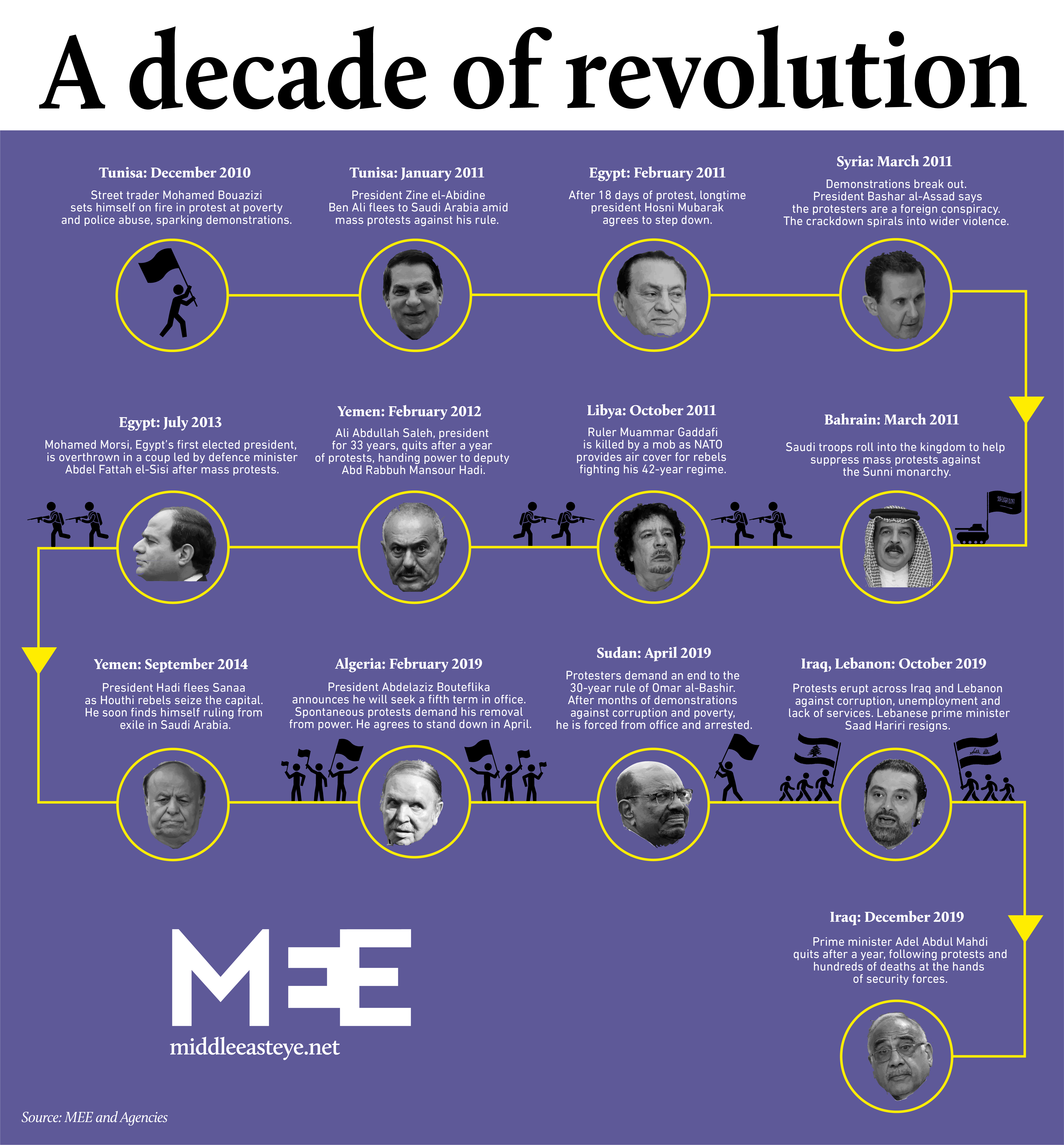
2010-2019: The Middle East's decade of revolutionRead More »

Syria under Assad will continue the surprising comeback on the regional and world stage that it started this year. It is likely that Assad himself, who committed war crimes, will be increasingly recognised again as Syria’s sole and legitimate president for pragmatic reasons; everybody, even foes such as Turkey, the US and the EU, now understand he is apparently invincible and will not be removed.

Despite its domestic political problems, Israel, now fully a right-wing, nationalist ethno-state of the worst kind, will continue its colonialist policies, including the annexation of Palestinian land through settlements and oppression of Palestinians. This is likely to continue with complete impunity and the continuing support of the US, whether Trump is reelected or not; and with the cowardly silence and passive complicity of the EU and other Arab states, notably Crown Prince Mohammed bin Salman’s Saudi Arabia and Sisi’s Egypt.

The brave Tunisia will pursue its relatively lonely democratic journey, despite an awful economic situation and little help from Western and other Arab states, while flareups will continue in Iraq and Lebanon, which have witnessed two of the most active pro-democracy uprisings of the past two years.
De-escalation of armed conflicts

One can also make the daring bet that two of the worst, most violent conflicts of the past several years, in Syria and Yemen, will be scaled back substantially and possibly move towards a resolution. We are already seeing various diplomatic initiatives, notably the agreement between Russia and Turkey to create a buffer zone in northeastern Syria.

The determining factor for a possible resolution in Syria is the military victory on the ground by Assad’s forces, backed by their Russian and Iranian allies.


Sadly, the fates of the two stateless peoples of the region, Palestinians and Kurds, will not improve and are likely to get even worse

In Yemen, it is the utter failure of Saudi Arabia’s aggression and the mounting pressure from its allies, including the US, to stop this horrible and useless war. The costs of the war amid serious economic and social issues at home, including youth unemployment and declining standards of living, could also push Riyadh to finally pull out.

Sadly, the fates of the two stateless peoples of the region, Palestinians and Kurds, will not improve and are likely to get even worse - especially for Palestinians, now that they have been openly abandoned by the US and EU, and have become an obvious embarrassment for Arab regimes, several of which (including Saudi Arabia and Egypt) have switched to Israel’s side.
Mounting domestic turmoil

On a more optimistic note, despite alarmist talk about a possible major regional or international military conflagration (Israel-Iran, US-Russia, etc), that remains unlikely. The main reason is that all the major actors - Israel, Turkey, Iran, Saudi Arabia, Russia and the US - are fully aware they would have little to gain, but a lot to lose. So far, they have carefully calibrated their military operations to avoid a major escalation that could lead to an all-out war.

Turkey’s offensive in northern Syria, limited in geographic scope, duration and number of civilian casualties, is a good recent example. Meanwhile, Israel has resisted the temptation to reinvade Lebanon to target Hezbollah, while its strikes against Syria and Iran have also been limited.
 
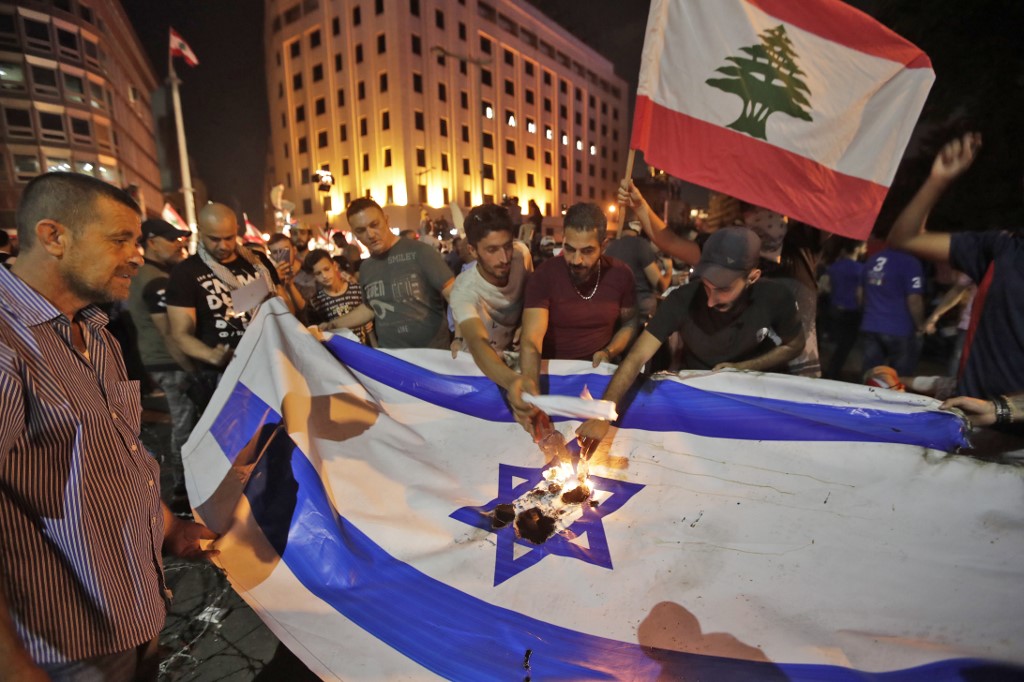
Lebanese protesters set an Israeli flag ablaze during demonstrations on 21 October in Beirut (AFP)

The US has learned its Iraq lesson the hard way, and Trump, despite his bravado and military threats against Iran and Turkey, has not started a new war - unlike his predecessors. His non-interventionist, withdrawal policy is also very much congruent with that of the Obama administration.

Indeed, there is much more policy continuity between Trump and former President Barack Obama than analysts and media have been willing to acknowledge. Militarily, Trump has been even more moderate than Obama, who not only took drone killings, assassinations, and transnational secret forces operations to a whole new level, but also foolishly - though reluctantly - dragged the US into the Sarkozy-led NATO adventure in Libya, with the consequences including the destruction of that state, reminiscent of Iraq in 2003.

At least Trump has done nothing of that kind, and has often proven to be less hawkish than the Democrats, including the neocon Hillary Clinton and his own political-military establishment, which has been roasting him for pulling out of Syria.
Multiple fault lines

As the new decade begins, the region will remain riven by multiple faultlines, power plays for regional or religious domination, and intersecting conflicts, by which even a minor local conflict can quickly acquires a regional - and then international - dimension, sucking in multiple foreign powers to prolong the conflict and make it even more deadly, as we have seen in Yemen.


As a new decade begins, the region will continue to be a major playground for regional and international power plays

Similarly, in Syria, what started as a domestic civil war between Assad and his opposition quickly took on a regional and international dimension, sucking in Russia, the US, Turkey, Iran, Israel, the EU and more. The same is true of Libya, which has seen interventions of various types by Egypt, Qatar, Saudi Arabia, Turkey, the UAE, Russia and the US.

Alas, there is no reason to believe those specificities of the Middle East will somehow cease to produce their debilitating and violent effects. As a new decade begins, the region will continue to be a major playground for regional and international power plays, hegemonic competition and proxy wars.

The views expressed in this article belong to the author and do not necessarily reflect the editorial policy of Middle East Eye.

Alain Gabon
Dr. Alain Gabon is Associate Professor of French Studies and Chair of the Department of Foreign Languages & Literatures at Virginia Wesleyan University in Virginia Beach, USA. He has written and lectured widely in the US, Europe and beyond on contemporary French culture, politics, literature and the arts and more recently on Islam and Muslims. His works have been published in several countries in academic journals, think tanks, and mainstream and specialized media such as Saphirnews, Milestones. Commentaries on the Islamic World, and Les Cahiers de l'Islam. His recent essay entitled “The Twin Myths of the Western ‘Jihadist Threat’ and ‘Islamic Radicalisation ‘” is available in French and English on the site of the UK Cordoba Foundation.
'Terrorist in a suit': Condemnation of Trump's threats to target Iran's cultural sites
Tehran says US president's threat to target sites 'important to... Iranian culture' would be tantamount to war crimes

A relief depicting King Darius at Iran's National Museum in Tehran (AFP)
By
MEE staff
Published date: 5 January 2020 


President Donald Trump's threat to target Iran's cultural sites if Tehran attacks US assets in the Middle East.

Iran described Trump as a "terrorist in a suit" after he threatened to target 52 sites across the country, including some "important to... Iranian culture" following Tehran's pledge to avenge the death of Qassem Soleimani, who was killed in a US drone strike on Friday.

Trump made his threats in a series of tweets in response to condemnation by Iranian officials after the US president ordered the assassination of Soleimani.

The United States has "targeted 52 Iranian sites," some "at a very high level and important to Iran and the Iranian culture, and those targets, and Iran itself, WILL BE HIT VERY FAST AND VERY HARD," Trump said.

He added that the 52 targets represented the number of American hostages held by Iran in the US embassy in 1979 during the country's Islamic revolution.


....targeted 52 Iranian sites (representing the 52 American hostages taken by Iran many years ago), some at a very high level & important to Iran & the Iranian culture, and those targets, and Iran itself, WILL BE HIT VERY FAST AND VERY HARD. The USA wants no more threats!— Donald J. Trump (@realDonaldTrump) January 4, 2020

US Secretary of State Mike Pompeo denied on Sunday that Trump said he would target Iranian cultural sites.

"President Trump didn't say he'd go after a cultural site - read what he said," Pompeo said on Fox News.

Responding to Trump's tweets, Javaz Azari-Jahromi, Iran's information minister, tweeted: "Like ISIS, Like Hitler, Like Genghis! They all hate cultures. Trump is a terrorist in a suit. He will learn history very soon that nobody can defeat Iranian national and culture."

Iran's Foreign Minister Mohammad Javad Zarif condemned Trump's comments and said that targeting cultural sites would be tantamount to "war crimes".

"Targeting cultural sites is a war crime," Zarif tweeted on Sunday. "Whether kicking or screaming, end of US malign presence in West Asia has begun."


-Having committed grave breaches of int'l law in Friday's cowardly assassinations, @realdonaldtrump threatens to commit again new breaches of JUS COGENS;

-Targeting cultural sites is a WAR CRIME;

-Whether kicking or screaming, end of US malign presence in West Asia has begun.— Javad Zarif (@JZarif) January 5, 2020

United Nations resolution 2347 condemns the unlawful destruction of cultural heritage.

Tehran also summoned the Swiss ambassador, who represents US interests in Iran, in response to Trump's threats and described his comments as similar to Mongol threats to ransack cultural sites.
'America has gone down this path before'

Trita Parsi, executive vice president at the Washington-based Quincy Institute for Responsible Statecraft, told Middle East Eye: "Donald Trump's reckless threats to bomb 52 sites in Iran, including cultural sites, constitute another dangerous escalation that may divert headlines from impeachment, but only at the cost of making America less safe.

"Only a few months ago, Trump called off an attack on Iran with 10 minutes to spare, leaving his advisors in shock. Trump showed restraint and insisted - somewhat convincingly - that he did not want war.


During WWII the US bombed Japanese cultural sites to destroy the population’s morale. Trump & the people he’s surrounded himself are of the same breed as ultra jingoists like Curtis Lemay. Would not put it past him to nuke #Iran. This is red alert for the international community.— Sina Toossi (@SinaToossi) January 4, 2020

"Now, however, he seems determined to elicit a violent reaction from Iran so that he can start a full-scale war. The only thing that has changed since this past summer is impeachment," Parsi said.

"It is increasingly difficult to find a logic in Trump's behaviour beyond his desperation to survive politically. But Americans and Iranians should not have to die for his political benefit.

"America has gone down this path before - an administration notoriously known for lying provides 'razor thin’ evidence to justify a military escalation that can spark a war and that puts Americans in peril.

"Last time, thousands of Iraqis and Americans were killed and an entire region was destabilized. This time, it will be worse," Parsi said.
Thousands mourn Soleimani across Iran

The ramping up of threats from both sides came as tens of thousands lined the streets of the Iranian city of Ahvaz on Sunday to mourn Soleimani's death.

Live state TV footage showed thousands of mourners marching through Ahvaz beating their chests.

Local authorities plan to take Soleimani's body to the holy city of Mashhad later on Sunday.

They will then take his body to Tehran and the holy city of Qom on Monday, for public mourning processions, then to his hometown of Kerman for burial on Tuesday.

---30---
Protesters in US rally against prospect of war with Iran
Protester's sign reads: 'Need a distraction? Start of a war.' Trump faces trial in Senate following his impeachment by House of Representatives in Ukraine scandal

Protesters demonstrate outside White House, in New York’s Times Square, at Trump Tower in Chicago and at Brandenburg Gate in Berlin among other locations (AFP)
By
MEE and agencies
Published date: 4 January 2020

Protesters took to the streets of Washington and other US cities on Saturday to condemn the air strike in Iraq ordered by President Donald Trump that killed Iranian military commander Qassem Soleimani and Trump's decision to send about 3,000 more troops to the Middle East.

"No justice, no peace. US out of the Middle East," hundreds of demonstrators chanted outside the White House before marching to the Trump International Hotel a few blocks away, Reuters said.

More than 70 protests across the country were planned for Saturday, many organised by Act Now to Stop War and End Racism (ANSWER), a US-based anti-war coalition, in cooperation with more than a dozen other such groups including Code Pink, The Hill said on its website. Protesters demonstrated outside the White House, in New York’s Times Square, at Trump Tower in Chicago and at the Brandenburg Gate in Berlin, among other locations.

"Need a distraction? Start of a war," read a sign held by Sam Crook, 66. Trump faces a looming trial in the Senate following his impeachment by the House of Representatives in the Ukraine scandal. Crook described himself as concerned. "This country is in the grip of somebody who's mentally unstable, I mean Donald Trump, that is. He's not right in the head," Crook told AFP.

Protesters stream through New York's Times Square on Saturday (Reuters)

Speakers at the Washington event included Pentagon Papers whistleblower Daniel Ellsberg as well as actress and activist Jane Fonda, 82, who last year was arrested at a climate change protest on the steps of the US Capitol.

"The younger people here should know that all of the wars fought since you were born have been fought over oil," Fonda, 82, told the crowd, adding that "we can't anymore lose lives and kill people and ruin an environment because of oil."

"Going to a march doesn't do a lot, but at least I can come out and say something, that I'm opposed to this stuff," said protester Steve Lane of Bethesda, Maryland. "And maybe if enough people do the same thing, Trump will listen."

Soleimani, regarded as the second-most powerful figure in Iran, was killed in the US strike on his convoy at Baghdad airport on Friday in a dramatic escalation of hostilities in the Middle East between Iran and the United States and its allies.

Public opinion polls show that Americans, in general, have been opposed to US military interventions overseas. A survey last year by the Chicago Council on Global Affairs indicated that 27 percent of Americans believe military interventions make the United States safer, while almost half said they make the country less safe.

Code Pink organiser Medea Benjamin told the Guardian she believed that as the US anti-war movement stirs, people will follow. "We've been in the desert for the last 10 years, and now we're anxious to build up a robust anti-war organisation again."

Code Pink first rose to prominence protesting against the US invasion of Iraq in 2003.


---30---


US detains more than 60 Iranian-Americans at Canadian border
Iranian-Americans detained by US Customs and Border Control as they return from a concert in Canada

Detentions come after US kills top Iranian general Qassem Soleimani (AFP/File photo)

By
MEE staff
Published date: 5 January 2020 22:07

The United States detained more than 60 Iranian-Americans at a US-Canada border crossing in the state of Washington, according to the Council of American-Islamic Relations (CAIR).

Many were crossing the Peace Arch Border in Blaine, Washington, returning home from an Iranian pop concert on Saturday in Vancouver, Canada.

Once reaching the border, more than 60 people were detained at length and questioned by the US Customs and Border Control (CBP).


Protesters in US rally against prospect of war with Iran
Read More »


"Many more are turned around at the border and refused the opportunity to enter the United States due to a lack of capacity for Customs and Border Patrol to detain them," CAIR's Washington chapter said in a joint news release with Hoda Katebi, an Iranian American community organiser and fashion blogger.

Washington Congresswoman Pramila Jayapal tweeted that she was "deeply disturbed" by the reports of these detentions.

CAIR reported that the Department of Homeland Security (DHS) had issued a national order to CBP to "report" and detain anyone with Iranian heritage entering the US who was deemed potentially suspicious, regardless of their citizenship status.

"This is a HUGE DEAL. Iranians who have been born and raised in the USA are literally being ILLEGALLY DETAINED for 11+ hours for NO REASON & interrogated with intrusive and inappropriate questions about political opinions, what courses they or their parents studied in college," Katebi tweeted.

CBP said it was not detaining individuals because of their country of origin.

"Social media posts that CBP is detaining Iranian-Americans and refusing their entry into the US because of their country of origin are false. Reports that DHS/CBP has issued a related directive are also false," CBP spokesperson Michael Friel told Middle East Eye in an email.

CAIR Washington's executive director, Masih Fouladi, said the reports of detentions "are extremely troubling and potentially constitute illegal detentions of United States citizens".

Mana Mostatabi, communications director at the National Iranian American Council (NIAC), told Middle East Eye that potentially as many as 150 individuals have been detained, with some being held for 11-16 hours.

Individuals were asked about their relatives, occupations, birthdays, the last time they visited Iran and their opinions on current tensions, Mostatabi said, according to initial research conducted by NIAC.

"The common denominator is Iranian heritage, which should raise immediate concerns of discriminatory and illegal actions targeting on the basis of national origin," Mostatabi said.

She also noted there were additional unconfirmed reports of detentions at San Francisco Airport and Los Angeles International Airport.

The detentions come amid extremely heightened tensions between the US and Iran after Washington killed top Iranian general Qassem Soleimani in a drone strike on Friday.

Anti-war protesters took to the streets of the US capital, as well as about 70 other US cities, on Saturday to condemn the actions of President Donald Trump.

---30---