Monday, January 06, 2020

Canadian oilpatch hopes float on Prairie helium drilling prospects

The Canadian Press January 5, 2020


CALGARY — A veteran of Canada's ailing oilpatch is hoping a new product drawn from deep under Prairie grain fields will provide a natural resource boom for Western Canada.

Marlon McDougall, 59, says he wasn't interested when first approached last year to join a junior exploration company.

After 35 years in the oil and gas industry, he had grown frustrated by its multiplying headaches, including environmental criticism, pipeline constraints, regulatory burdens and the need to adopt expensive new technologies as easy-to-produce pools of oil and gas are depleted.

But New York-based financial manager Nick Snyder, 36, founder and chairman of privately held North American Helium, assured him none of those problems exist with helium, the lighter-than-air product he plans to produce and export.

The rush to get in on a new resource industry recalls the excitement of the oil and gas sector in the '80s, McDougall, named president and chief operating officer last spring, said in an interview from the company's modest downtown Calgary offices.

"You do things right," he said. "You have an idea, you capture land, you shoot seismic, you go out and drill exploration wells, you make discoveries and it just rolls on from there."

Helium, the second most plentiful element in the universe, is in short supply on Earth.

Demand for the gas once used mainly for military, weather and party balloons has been steadily rising, creating shortages and spiking prices in recent years.

Helium's unique ability to remain a liquid at extremely low temperatures makes it the cooling agent of choice for superconducting magnets in research and medicine (including MRIs). It's also essential in rocketry and plasma welding.

The global market for helium, meanwhile, is being thrown wide open by the U.S. government's decision five years ago to gradually sell off its strategic reserves of the inert gas and turn the market it now heavily influences over to the private sector by 2021.

The environment is ripe for a resurgence of the industry in Saskatchewan, which produced helium from wells for about a decade 50 years ago before foundering due to slumping prices, said Melinda Yurkowski, assistant chief geologist for the Saskatchewan Geological Survey.

"It's still a lot of rank exploration right now," she said, adding no one knows how much helium — produced by the decay of radioactive uranium and thorium — the province contains.

Virginia-based Weil Group Resources reactivated two legacy helium wells in 2016 and built a 40-million-cubic-feet-per-year, $10-million helium separation facility at Mankato in the southwest corner of the province.

Helium was trucked to Weil's liquefaction facilities in the U.S. and sold until the wells were suspended due to production problems in mid-2019. Weil has since drilled a new well to try to restore output.

The company has plans to produce helium in Alberta as well and is considering eventually building a liquefaction facility there to super-cool the gas to liquid form so it can be shipped in high-pressure tanks anywhere in the world, Weil CEO Jeff Vogt said.

Western Canada has an advantage over other new sources of helium in that its best reserves are found in pools made up of 95 per cent nitrogen, said Scott Mundle, an assistant professor and researcher at the University of Windsor in Ontario who has been studying samples from helium explorers.

The nitrogen found can be safely vented to the atmosphere after the one-to-two per cent helium content is removed, because the Earth's atmosphere is made up of about 78 per cent nitrogen, he said.

Trace amounts of methane and carbon dioxide can also be released with minimal impact on the environment, he added.

The extremely high pressure in reservoirs deeper than two kilometres under the surface means wells can be productive for years before being depleted, said Mundle, outlasting shallower pools elsewhere in the world.


North American Helium is the most active of the handful of companies that have staked out a total of 1.7 million hectares of helium leases and permits in Saskatchewan.

It has drilled 13 new helium wells in southwestern Saskatchewan, with 11 considered commercially viable, and has tentative plans to open a plant to process gas from a single well by mid-2020.

Moving forward with production will depend on signing long-term supply contracts with buyers, who will most likely be from among the big industrial gas suppliers who currently control global distribution, McDougall said.

The potential is huge, Snyder said. North American Helium's five-year plan includes wells, separation plants and liquefaction facilities to supply a substantial chunk of global demand currently pegged at about seven billion cubic feet per year.

"We think internally a reasonable expectation is that as the (American) fields decline ... providing about 10 per cent of global supply — 700 million cubic feet per year — is very much the sweet spot in terms of being achievable and capital efficient with the land base we have."

This report by The Canadian Press was first published Jan. 5, 2020.

Dan Healing, The Canadian Press

Jagmeet Singh Uses AOC, Bernie Sanders To Explain The NDP To Americans

Singh also called Trump the "exact opposite of a leader"


Jagmeet Singh Uses AOC, Bernie Sanders To Explain The NDP To Americans


Premila D'Sa,HuffPost Canada Sat, Jan 4, 2020

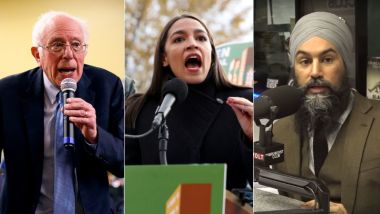
Jagmeet Singh highlighted NDP policies such as universal drug coverage and dental care in introducing himself to an American audience, and name-dropped high-profile Democrats in the process.

The NDP leader was a guest on the New Year’s Eve episode of New York-based “The Breakfast Club,” which regularly draws eight million monthly listeners. In a wide-ranging conversation with hosts of the popular radio show, Charlamagne tha God, Angela Yee and DJ Envy, Singh explained the NDP to Americans and repeated criticism of U.S. President Donald Trump.

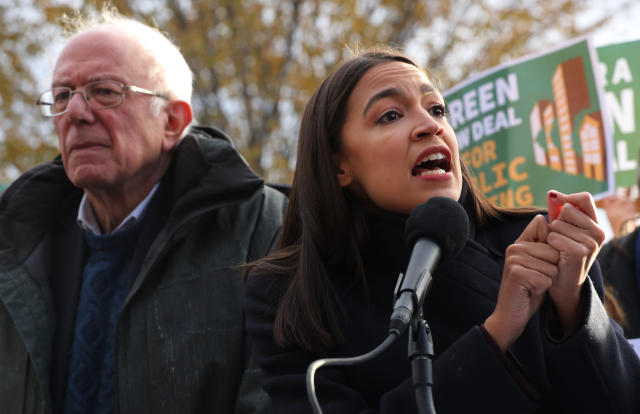
When asked to explain his role in Canada to the show’s mostly American audience, Singh likened himself to U.S. congresswoman Rep. Alexandria Ocasio-Cortez and Democratic presidential candidate Bernie Sanders.

“It would be the AOC, Bernie Sanders kind of Democrat,” Singh explained. “We’re the progressive, left party of Canada.”

Ocasio-Cortez’s first piece of legislation was the Green New Deal, social and economic reforms to address climate change and economic inequality, issues that are also core to the NDP platform. Sanders, a U.S. senator, has made public health care a core part of his campaigning.


Singh made his alignment clear during the half-hour interview, by clearing up misconceptions of Canadian liberalism and calling out Liberal Prime Minister Justin Trudeau. things,” said Singh. “It’s very different what he says publicly and what he does privately, in terms of his policies versus what he says.”

Singh brought up Trudeau’s environmental record as an example, highlighting the Liberal government’s decision to buy the Trans Mountain pipeline.

“He held himself out to be this big environmentalist, but I don’t know of too many countries that have used public dollars to nationalize a pipeline,” said Singh.

Naturally, Singh was asked about what he thought of the U.S. president. The NDP leader sighed.

“Oh man. I got in trouble before because I was a little too blunt about it,” he said, referring to

comments he made during an comments he made during an NDP town hall in September 2019 when he expressed his desire to see Trump impeached.

“If you look at what a leader should do, what you would expect from a leader — he is the exact opposite,” Singh told “The Breakfast Club.”

RELATED

Jagmeet Singh Doubles Down On Donald Trump Impeachment Remark

Jagmeet Singh Says Canada Lacks Polarization Of 'American-Style Election'

Bianca Andreescu, Don Cherry, Jagmeet Singh Among Most Googled Canadians

“A leader should be bringing people together, he continually tries to divide people.”

Singh brought up the Trump administration’s record of detaining migrants seeking asylum, and their immigration policy of “ripping babies out of their mom’s arms.”

He also criticized Trump’s tax cuts for the wealthy. During the 2019 federal election, Singh campaigned on tax hikes targeting Canada’s richest people, and promised funding to low-income groups.

“Every single decision he makes is making life harder for people, is disrespecting human beings and is just wrong,” he said of the U.S. president.

CORRECTION: An earlier version of this story stated Jagmeet Singh campaigned on tax cuts for the wealthy in the last election. In fact, he called for the wealthy to pay more in taxes.

This article originally appeared on HuffPost.


GO GREEN FACE 

Baby Yoda Beauty Products May Be Coming Soon, Thank God

Lucasfilm dropped a big hint in the form of a trademark application.
Steve Kerr did not hesitate to make his thoughts known on President Donald Trump’s killing of Iranian general Qassem Soleimani.
The Golden State Warriors head coach tweeted Friday that Vice President Mike Pence lied about claims of Soleimani’s involvement with the 9/11 terrorist attacks, and retweeted several posts condemning the airstrike.
On Saturday, Kerr detailed his perspective on the attack with reporters, warning against an “unwinnable, unnecessary” war.
A transcript of Kerr’s comments:
I just follow what’s going on in the world because it’s always of great interest to me. I’m worried we’re going to end up in another war. I try to use my Twitter platform to remind people to do their homework before we all blindly wave the flag and get ourselves into another mess like we did in Iraq.
[Before the Iraq war] I remember the patriotic fever that swept the NBA. Since that time, we do a great job in our league and the other leagues supporting our veterans, bringing them to games and giving them ovations, which I wholeheartedly support. But what I think would be even more supportive is to not get involved, not send soldiers overseas to unwinnable, unnecessary wars in the first place. That’s how we can best support our men and women who are representing us.
We have a history in this country all you have to do is read Vietnam, Iraq, people are misled by our government. It happened in Vietnam, we know that. The facts were not facts. We have to be very careful right now with what we’re being told. If we’re led into another war, the implications for so many families, so many people are so drastic that we all need to understand what’s happening and support out troops by making sure we press our government to do the right thing.
One of the most politically outspoken figures in the sports world, Kerr grew up in the Middle East and lost his father to an assassination by Islamic terrorists. Kerr has recalled his father’s death to denounce the potential blowback of Trump’s policies in the past.


Steve Kerr is quite familiar with the Middle East, and is more than willing to share his thoughts on the matter. (AP Photo/Ben Margot)
FACT CHECK
Pence Links Suleimani to 9/11. The Public Record Doesn’t Back Him.

In a series of tweets on Friday, Vice President Mike Pence said that Maj. Gen. Qassim Suleimani “assisted in the clandestine travel to Afghanistan of 10 of the 12 terrorists who carried out the September 11 terrorist attacks in the United States.” Credit...Andrew Harnik/Associated Press

By Zach Montague
Published Jan. 3, 2020

In a series of tweets on Friday defending President Trump’s decision to authorize the drone strike that killed Iran’s top intelligence commander, Maj. Gen. Qassim Suleimani, Vice President Mike Pence reeled off a list of some of General Suleimani’s most notorious attacks and machinations. Mr. Pence described “an evil man” who had threatened American national security interests for decades.

In one of his tweets, Mr. Pence claimed that General Suleimani helped 10 of the men who would go on to carry out the Sept. 11, 2001, attacks cross through Iran and enter Afghanistan. That does not match established historical accounts of General Suleimani or public United States intelligence about the hijackers.

WHAT WAS SAID

Mr. Pence said on Twitter that General Soleimani “assisted in the clandestine travel to Afghanistan of 10 of the 12 terrorists who carried out the September 11 terrorist attacks in the United States.”

This lacks evidence. How Mr. Pence arrived at this number and this account is unclear. From what is commonly known about General Suleimani and the group of men who carried out the Sept. 11 attacks, their paths did not cross.

To start, many observers were quick to point out that 19 terrorists, not 12, were involved in the attacks. Katie Waldman, a spokeswoman for Mr. Pence, clarified that he was referring to a subset of 12 of the attackers who are known to have traveled through Iran to Afghanistan.

Ms. Waldman said that Mr. Pence’s statement was based on a finding by the U.S. Treasury Department in 2016 that Iran permitted “several of the 9/11 hijackers” to transit through the country. The finding did not directly link the hijackers to any forces overseen by General Suleimani, or specify how many may have been granted passage.

The notion that General Suleimani abetted the attackers at all also appears dubious.


By 2001, General Suleimani had already been named the head of the Quds Force, the powerful security branch that often coordinates with other terrorist groups worldwide. Yet General Suleimani was not named at any point in the “9/11 Commission Report.”

In fact, the report states in no uncertain terms that neither the Iranian government nor Hezbollah, a group that General Suleimani worked closely with, ever knew anything about the attacks or helped facilitate them:

We have found no evidence that Iran or Hezbollah was aware of the planning for what later became the 9/11 attack. At the time of their travel through Iran, the Al Qaeda operatives themselves were probably not aware of the specific details of their future operation.

Why General Suleimani, the leader of a hard-line Shiite Muslim military apparatus, would have come to the aid of members of Al Qaeda, a Sunni extremist group with strong ties to Saudi Arabia, is also unclear.

General Suleimani spent much of his career undermining Saudi Arabia, and once even plotted to have the Saudi ambassador to the United States assassinated. At various points, he was also said to have helped facilitate the capture of Qaeda militants on behalf of the United States.

Zach Montague is based in Washington, D.C. He covers breaking news and developments around the district. @zjmontague

SEE https://plawiuk.blogspot.com/search?q=IRAQ

Tweet

Alexandria Ocasio-Cortez
@AOC
This is a war crime. Threatening to target and kill innocent families, women and children - which is what you’re doing by targeting cultural sites - does not make you a “tough guy.” It does not make you “strategic.” It makes you a monster.

Quote Tweet

Donald J. Trump
@realDonaldTrump
· Jan 4
....targeted 52 Iranian sites (representing the 52 American hostages taken by Iran many years ago), some at a very high level & important to Iran & the Iranian culture, and those targets, and Iran itself, WILL BE HIT VERY FAST AND VERY HARD. The USA wants no more threats!


America has always sanctioned and besieged Black and Brown bodies both at home and abroad. America militarism is the weapon wielded by American imperialism, to enforce its policing and plundering of the non white world.
— Colin Kaepernick (@Kaepernick7) January 4, 2020


Defiant Trump doubles down on threat to Iran cultural sites

AFP•January 5, 2020

Washington (AFP) - US President Donald Trump doubled down Sunday on a threat to attack Iranian cultural sites despite accusations that any such strike would amount to a war crime.

After his top diplomat, Mike Pompeo, had insisted that any military action would conform to international law, Trump said he would regard cultural sites as fair game if Iran resorted to deadly force against US targets.

"They’re allowed to kill our people, they're allowed to torture and maim our people, they’re allowed to use roadside bombs and blow up our people and we're not allowed to touch their cultural site? It doesn’t work that way," Trump told reporters.

"If they do anything there will be major retaliation."

His comments on his return from a break in Florida followed a welter of criticism over a Tweet on Saturday night in which he said sites which were "important to... Iranian culture" were on a list of 52 potential US targets.

Tehran's foreign minister had reacted to those initial comments by drawing parallels with the Islamic State group's destruction of the Middle East's cultural heritage.

And as Twitter was flooded with photos of revered Iranian landmarks in ancient cities such as Isfahan under the hashtag #IranianCulturalSites, leading US Democrats said the president would be in breach of international protocols if he made good on his threat.

"You are threatening to commit war crimes," Senator Elizabeth Warren, one of the top Democrats hoping to challenge Trump in November's election, wrote on Twitter.

"We are not at war with Iran. The American people do not want a war with Iran."

"Targeting civilians and cultural sites is what terrorists do. It's a war crime," added fellow Senator Chris Murphy.

In a flurry of interviews on the Sunday talkshows, Secretary of State Pompeo said the US would not hesitate to hit back hard against Iran's "kleptocratic regime" if it came under attack, but pledged that any action would be consistent with the rule of law.

Both sides have traded threats since a US drone strike in Iraq on Friday killed Qasem Soleimani -- one of the most important figures in the Iranian government.

"We'll behave lawfully. We'll behave inside the system. We always have and we always will," Pompeo told the ABC network.

"The American people should know that every target that we strike will be a lawful target, and it will be a target designed with a singular mission, of protecting and defending America."

His comments came after his opposite number in Tehran Mohammad Javad Zarif tweeted that "targeting cultural sites is a WAR CRIME".

"A reminder to those hallucinating about emulating ISIS war crimes by targeting our cultural heritage: Through MILLENNIA of history, barbarians have come and ravaged our cities, razed our monuments and burnt our libraries," said Foreign Minister Zarif.

"Where are they now? We're still here, & standing tall."

- Threat 'Un-American' -

Nicholas Burns, who served as US ambassador to NATO under president George W. Bush, said the Trump administration would be guilty of hypocrisy given it was part of international efforts to deter IS from destroying countless pre-Islamic artefacts, including in the Syrian UNESCO-listed site of Palmyra.

"Donald Trump's threat to destroy Iranian cultural sites would be a war crime under UN Security Council resolution 2347 – supported by the Trump Administration itself in 2017 to warn ISIS+Al Qaeda of similar actions.

"His threat is immoral and Un-American," said Burns, now a professor at Harvard University's John F. Kennedy School of Government.

Others drew comparisons with the Taliban's 2001 destruction of the Bamiyan Buddhas in Afghanistan

Pompeo refused to give details on the 52 potential targets which Trump said had been drawn up to represent each and every hostage held in the standoff at the US embassy in Tehran four decades ago.

But one former official expressed skepticism that military planners would agree to target cultural sites.

"I find it hard to believe the Pentagon would provide Trump targeting options that include Iranian cultural sites," said Colin Kahl who was National Security Adviser to former vice president Joe Biden.

"Trump may not care about the laws of war, but DoD (Department of Defense) planners and lawyers do... and targeting cultural sites is war crime."


---30---

Trump warns cultural sites could be targeted if Iran retaliates for Soleimani strike

ABC News•January 5, 2020

Trump warns cultural sites could be targeted if Iran retaliates for Soleimani strike originally appeared on abcnews.go.com

President Donald Trump wrote on Twitter Saturday night that if Iran retaliates for the U.S. airstrike that killed Gen. Qassem Soleimani near Baghdad, the U.S. is prepared to "hit very fast and very hard" at 52 sites inside Iran, including some important to "the Iranian Culture."

Targeting cultural sites could be considered a war crime under international agreements to which the U.S. belongs, according to both Trump's political foes and former national security officials.

The number 52 used by Trump in his tweets also matched the number of Americans seized in the November 1979 takeover of the U.S. embassy in Tehran. They were held hostage for 444 days.

Iran is talking very boldly about targeting certain USA assets as revenge for our ridding the world of their terrorist leader who had just killed an American, & badly wounded many others, not to mention all of the people he had killed over his lifetime, including recently....

— Donald J. Trump (@realDonaldTrump) January 4, 2020

Secretary of State Mike Pompeo appeared on ABC's "This Week" Sunday and said, "The American people should know that every target that we strike will be a lawful target, and it will be a target designed with a singular mission, of protecting and defending America."

MORE: World is safer because of Iranian commander's death: Secretary of State Mike Pompeo

In the days since Soleimani, leader of the Islamic Revolutionary Guard Corps, was killed by U.S. drones, Iranian leaders have vowed revenge.

Anticipating possible Iranian retaliation in the region, the Pentagon dispatched 3,500 soldiers from the Army's 82nd Airborne Division to Kuwait and augmented security at the U.S. embassy in Baghdad.
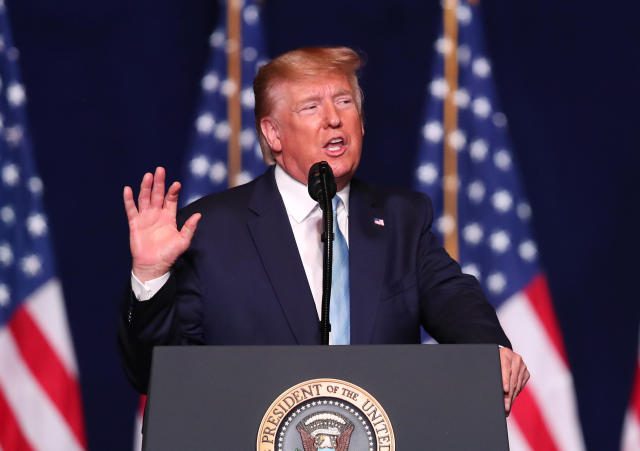
PHOTO: In this photo taken on Jan. 3, 2020, President Donald Trump makes a statement on Iran at the Mar-a-Lago estate in Palm Beach Florida. On Jan. 4 he warned that the U.S. is targeting 52 sites in Iran. (Jim Watson/AFP via Getty Images)More

Destroying cultural sites could be considered a war crime under the 1954 Hague Convention for the preservation of cultural sites and United Nations Security Council Resolution 2347, which was passed unanimously in March 2017 in response to the Islamic State's destruction of historic sites in Iraq and Syria.

That resolution "deplores and condemns the unlawful destruction of cultural heritage, inter alia destruction of religious sites and artifacts, as well as the looting and smuggling of cultural property from archaeological sites, museums, libraries, archives, and other sites, in the context of armed conflicts" and states that such acts could constitute war crimes.

MORE: US cities ramp up security in wake of killing of Iran's top general

"These are not legitimate military targets, and saying they are potentially opens up our cultural sites to be targets of Iran," said Mick Mulroy, an ABC News contributor and formerly the deputy assistant secretary of defense for Middle East Policy. "The statement that we are targeting culturally significant targets in Iran undermines the message to the Iranian people that we are not against them."

Trump's tweets drew criticism on social media from other former national security officials and political critics.

"The more the walls close in on this guy, the more irrational he becomes," Democratic Presidential candidate Joe Biden tweeted in response to Trump.

"For what it's worth, I find it hard to believe the Pentagon would provide Trump targeting options that include Iranian cultural sites," tweeted Colin Kahl, a former top Pentagon official in the Obama administration. "Trump may not care about the laws of war, but DoD planners and lawyers do ... and targeting cultural sites is war crime."
PHOTO: Protesters demonstrate over the U.S. airstrike in Iraq that killed Iranian Revolutionary Guard Gen. Qassem Soleimani in Tehran, Iran, Saturday Jan. 4, 2020. (Ebrahim Noroozi/AP)

When reached by ABC News for comment late Saturday, a Pentagon spokesperson referred questions about Trump’s tweets to the White House.

Typically, U.S. military planners consider a "proportional" response to a provocative military act, as happened in June when Trump initially approved airstrikes on Iranian air defense systems that shot down an American drone.

Trump called off the airstrikes shortly before they were set to take place when he learned that as many as 150 Iranian casualties were possible.

The president later tweeted that the death of that number of Iranians would not be "proportionate to shooting down an unmanned drone."

ABC News' Shannon Crawford and Adia Robinson contributed to this report.


Mysterious swarms of giant drones have started to appear in the Colorado and Nebraska night sky, and nobody knows where they're coming from
Irene Jiang
Dec 30, 2019, 8:30 AM
US Air Forc

Mysterious swarms of giant drones have dotted the Colorado and Nebraska night sky since last week, The Denver Post first reported.
The drones appear and disappear at roughly the same time each night in swarms of at least 17 and up to 30. The drones appear to measure about 6 feet across.
Local and federal government authorities say they have no idea where the drones are coming from. They do not appear to be malicious, however, and a drone expert says they appear to be searching or mapping out the area.

Something strange has been happening in Eastern Colorado at night.

Since the week of Christmas, giant drones measuring up to 6 feet across have been spotted in the sky at night, sometimes in swarms as large as 30. The Denver Post first reported these mysterious drone sightings in northeastern Colorado on December 23. Since then, sightings have spanned six counties across Colorado and Nebraska.

Phillips County Sheriff Thomas Elliott had no answer for where the drones came from or whom they belonged to but did have a rough grasp on their flying habits. "They've been doing a grid search, a grid pattern," he told The Denver Post. "They fly one square and then they fly another square."

The drones, estimated to have 6-foot wingspans, have been flying over Phillips and Yuma counties every night for about the past week, Elliott said Monday. Each night, at least 17 drones appear at about 7 o'clock and disappear at about 10 o'clock, staying 200 to 300 feet in the air.

The Air Force, Drug Enforcement Administration, and Army
 all say the drones do not belong to them. 
Óscar J.Barroso/Europa Press via Getty Images

The Federal Aviation Administration told The Post it had no idea where the drones came from. Representatives for the Air Force, the Drug Enforcement Administration, and the US Army Forces Command all said the drones did not belong to their organizations.


As the airspace where the drones are flying is relatively ungoverned, there are no regulations requiring the drone operators to identify themselves. Elliott, however, said the drones did not appear to be malicious.

The Post spoke with the commercial photographer and drone pilot Vic Moss, who said the drones appeared to be searching or mapping out the area. Moss said drones often flew at night for crop-examination purposes. The drones might also belong to a local Colorado drone company, which could be testing new technologies.

In the meantime, Moss urges residents not to shoot down the drones, as they are highly flammable.

"It becomes a self-generating fire that burns until it burns itself out," he told The Post. "If you shoot a drone down over your house and it lands on your house, you might not have a house in 45 minutes."


---30---

So Trump Employs Undocumented Immigrants at His Properties and Nobody Really Cares?

Jack Holmes,
Esquire•January 2, 2020

Photo credit: JIM WATSON - Getty Images

From Esquire

When ICE raided some chicken plants in Mississippi last year, they rounded up nearly 700 undocumented immigrant workers. They did not arrest the managers or corporate executives who systematically employed them. This fits a pattern, according to The New York Times: between March 2018 and 2019, the feds prosecuted 112,000 people for illegal entry or re-entry, but charged just 11 employers for hiring some of these same people.

Before anti-immigrant rhetoric descended into full-on propaganda about crime and MS-13, there was a lot of talk about undocumented immigrants taking jobs from American citizens. In Mississippi, citizens did take some of the vacated jobs. (There's also the related charge that undocumented workers drag down wages, which is unproven but at least does not boil down solely to uncut racial grievance.) But the persistent refusal to enact penalties on people who choose to employ undocumented immigrants suggests these are not the most pressing concerns for decision-makers. The people who travel hundreds or thousands of miles to get to the U.S. are desperate for decent work, and feel it's worth the risk of deportation. It's employers who are primed for a change in incentive structure, yet they are rarely, if ever, punished. It's enough to make you think this is not, nor has it never been, about the plight of the American worker. It's a regime where workers can be simultaneously exploited by employers and demonized by political elites, ground up by the great American machine.

As usual, the President of the United States is a flag-bearer for all these most base instincts. It's tempting to see hypocrisy as a quaint relic of the Before Times, a dead concept in the era of post-truth politicking. (We are, after all, in a moment in which the president's allies are casting him as an International Corruption Crusader while he's orchestrating the Great American Heist.) But pointing this out can still serve as a reminder that none of these folks ever cared about this stuff. Donald Trump, you see, has always employed undocumented immigrants—at many of his properties, on many of his construction projects. He has no issue with these people except when it's convenient fodder for a rage spasm to get The Base going. The latest example arrived on the last day of 2019 via the Washington Post.


Nearly a year after the Trump Organization pledged to root out undocumented workers at its properties, supervisors at the Trump Winery on Monday summoned at least seven employees and fired them because of their lack of legal immigration status, according to two of the dismissed workers...


Two of the fired workers ... said they thought the company had held off on firing them until after the year’s work was complete, taking advantage of their labor for as long as possible. Both had worked at the winery for more than a decade.

That seems like the whole arrangement in a nutshell. Extract cheap labor from people—in this case, allow them to finish the grape harvest—then discard them as soon as it's convenient to do so. In general, the property relies on immigrant labor from Mexico in the form of seasonal workers who arrive on legal visas, according to the Post, but there are also year-round undocumented workers. They are among some 49 undocumented people the Post alone has spoken with, who worked at 11 different Trump properties across four states. For years now, the president has traveled the country railing against immigrants as violent criminals and imploring people to "Buy American, Hire American," while he profited from undocumented labor in systematic fashion. In July 2018, his Mar-a-Lago property announced it was seeking 61 foreign workers on a legal basis. Hire American for thee, but not for me.

This goes all the way back to the '80s, of course, when Trump had hundreds of undocumented Polish immigrants building Trump Tower. He paid them as little as $4 an hour—and always well below union wage—because that's why people like Donald Trump employ people without papers. He ultimately settled a lawsuit around the workers' treatment. It's fitting that the people who made his flagship project possible would fit the theoretical description of the people he has built a political career smearing as criminals. (In practice, he is referring to brown immigrants.) But it also fits because Trump is merely a particularly garish emblem of the post-Reagan plutocrat class, where greed is good and other people—whether they're undocumented workers or they own a small contracting business—are just marks waiting to get fleeced.

That hustle now extends to the angry and isolated people who show up to his rallies in search of community and solidarity against The Other. They will not mind that he's profited so handsomely off undocumented labor, because it's about the performance of demonstrating who's a Real American with a say in how this country is run. Also, anything he does is excusable on the basis that Democrats do it, too, or anybody who's smart would do it, or everybody does it. Now there's some truth to that: the president is indeed one of a huge number of employers who uses undocumented labor with zero consequences.

---30---

Australia wildfires: Entire species may have been wiped out by inferno, conservationists say


‘We are seeing kangaroos and koalas with their hands burned off ... It’s been quite emotional,’ says wildlife park owner

Kate Ng
Sunday 5 January 2020 14:34

Conservationists and wildlife experts are anxious that raging bushfires sweeping through Australia have resulted in “catastrophic losses”, amid fears an entire species may have been wiped out.

Populations of small marsupials called dunnarts and glossy black cockatoos may have been destroyed in the fires that burned a third of Kangaroo Island, experts say.


The island, located off the country’s southern coast, is known as Australia’s answer to the Galapagos Islands – but what remains has been described as a “scorched wasteland”.

Ecologists are hoping to find survivors of the dunnart population and rescue them “before they are completely gone”.

Heidi Groffen, an ecologist and coordinator for the nonprofit Kangaroo Island Land for Wildlife, said the mouse-like marsupials are too small to outrun wildfires and the population of around 300 may have been wiped out.

Devastating wildfires rage across Australia: In pictures
Show all 40

But she remained hopeful some may have found refuge in the crevices of rocks.

“Even if there are survivors, there is no food for them now,” she said. “We’re hoping to bring some into captivity before they are completely gone.”


Pat Hodgens, a fauna ecologist for the same nonprofit, told the The Independent: “It’s early days, fires are still burning but we have lost a lot of critical refugia for endangered species which will affect long term viability of these species.

“The Kangaroo Island dunnart is our main species of concern and it looks like its entire known [habitat] range has been fried. We are locating unburnt remnant patches of its habitat to see if we can locate it through camera trapping.”


Mr Hodgens said a team has already set cameras to try and detect any survivors, and hope to locate all potential areas the species may persist in through drone mapping.

The 50,000-strong koala population on the island has also suffered devastating losses, with as much as half the population believed to have been killed by the fires.​


Independent news email

Only the best news in your inbox

And it is unclear how many from a unique flock of the rare glossy black cockatoos escaped the blazes and whether they have a future on an island where much of their habitat has turned to ash.

Daniella Teixera, a conservation biologist working on a doctoral degree about the birds at the University of Queensland, said: “We don’t know the extent of the damage on the KI glossy habitat but we do know that critical areas of feeding and breeding areas have been burnt. Currently a waiting game.”

She believes the birds were in “the best position to escape” the fires because they were able to fly away, but like the dunnarts, the cockatoos may find they don’t have enough food left on the island.


The birds only feed from a single type of tree known as the dropping she-oak, and many hot spots on the island continue to burn.

Ms Teixera said careful conservation work over the past 25 years has seen the glossy black cockatoo population increase from 150, but those gains have been wiped out in the space of a week.

Sam Mitchell, co-owner of the Kangaroo Island Wildlife Park, said: “We are seeing kangaroos and koalas with their hands burned off – they stand no chance. It’s been quite emotional.


“We will do whatever we can to rehabilitate the native wildlife but it’s going to take years to recover,” he told Adelaide Now.
Watch more
Australia wildfire crisis escalates to ‘entirely new level’
Bright red haze shrouds sky at 2.30am as deadly blaze rages
Australian Navy evacuates hundreds trapped on beaches due to fires
Firefighter who lost home refuses to shake Australian PM’s hand
Australia’s ex-PM says world ‘in grip of climate cult’ – as fires burn

A fundraiser set up for the Kangaroo Island Wildlife Park has raised A$183,464 (£97,400), far more than its original A$15,000 goal.

The park said funds will go towards “veterinary costs, koala milk and supplements, extra holding/rehabilitation enclosures, as well as setting up a building to hold supplies to treat these animals”.


Throughout the country, officials estimate that half a billion animals have been affected since the fires began raging.

Professor Chris Dickman from the University of Sydney told 7News the challenge of rebuilding wildlife populations is a long-term one.

“There are a lot of people out there helping by going into areas that have been burned to look for koalas and any other native wildlife [that have] been affected.


“In the longer term, the rebuilding of populations of many native species is going to be the issue,” he said. “A lot will have been undoubtedly very badly affected by these fires.”​

A spokesperson for the Australia’s Department of the Environment and Energy said: “Planning is already underway through the Australian government Department of the Environment and Energy to work with scientists, state organisations, national parks authorities, natural resource managers and indigenous land managers to identify recovery priorities and future protection strategies.

“Funding is already in place for koala hospitals and additional funding will be directed towards koala habitats. Mapping is already commencing in some areas of northern NSW to understand fire impacts on koala habitats and determine the most effective options going forward.”

The spokesperson added there was a waiting period for fire-affected areas to be declared safe before authorities can begin to fully assess the impact of the blazes.