Tuesday, July 20, 2021

‘Future Belongs to Renewable Energy’ Says India’s Largest Oil Baron and Greenland, Which Ended Search for Oil
By Andy Corbley
-Jul 19, 2021



“The future belongs to renewable energy,” is a big thing for Big Oil’s fourth biggest player, and Asia’s richest energy baron to say, but Mukesh Ambani is letting his money do the talking—all $10.1 billion of it.

In late June the Chairman of Reliance Industries, one of the largest oil companies on the planet, announced a 750 billion rupee investment in a brand new renewable energy supply chain.

While oil majors like Reliance, Shell, or ExxonMobil are often the chief targets of climate activists’ attentions, the resources these energy giants can bring towards stimulating renewable investment and production are sometimes greater even than national governments. Furthermore, their decades of experience in the energy industry lends them certain insights into energy supply and demand trends that few others possess.

“The age of fossil fuels, which powered economic growth globally for nearly three centuries, cannot continue much longer,” Ambani stated. “The huge quantities of carbon it has emitted into the environment have endangered life on Earth.”

600 billion of the rupees will produce four “gigafactories” where solar arrays, hydrogen fuel cells, and battery grids will be produced, and another 150 billion will help reinforce the value chain through strategic partnerships.

MORE: Researchers Use Wastewater to Generate Electricity – While Cleaning It Up

When large firms like Reliance get involved, especially in production, manufacturing costs for renewable energy as a whole go down, not only because of investments in research and development, but also through market competition, as providers undercut each other’s prices to offer the best deal for consumers or government energy agencies.
‘Green’land

The forecast for a renewable future is one shared by Greenland, which has announced that all future oil and mineral exploration will cease, citing climate concerns and desires to invest in green energy.

Tens of billions of barrels of oil and hundreds of trillions square-feet of natural gas are predicted to lie under receding ice sheets, but keeping them in the ground is the new edict from the recently elected Inuit government of the Ataqatigiit.

“The future does not lie in oil. The future belongs to renewable energy, and in that respect we have much more to gain,” the Greenland government said in a statement, before adding it “wants to take co-responsibility for combating the global climate crisis.”

RELATED: Huge Supply of Water is Saved From Evaporation When Solar Panels Are Built Over Canals

Inhabited by 57,000 people, AP’s sense is that the country is dreaming of independence, as it receives two-thirds of its national wealth from Denmark as charity.

In a sign of maturity from the fledgling state, Greenland has decided that a near-future of possible independence is not worth a long-term future of worsening climate change.
Low-cost, sustainable plasma technology could replace one of world’s rarest materials

MINING.com Editor | July 19, 2021 |


Indium ingot. Stock image.

A team led by a researcher from the University of Sydney has developed a low-cost, sustainable technology that can dim the screens of electronic devices, anti-reflection automobile mirrors, and smart architectural windows at a fraction of the cost of current technology.


It would replace one of the world’s scarcest – yet highly ubiquitous in use – modern materials: indium, a rare chemical element that is widely used in devices such as smartphones and computers, windscreen glass and self-dimming windows.

Although small amounts are used to manufacture smart device screens, indium is expensive as it is hard to source; it naturally occurs only in small deposits.

Industrial indium is often made as a byproduct of zinc mining, which means a shortage could occur if demand for optoelectronic devices – such as LCDs and touch panels – ramps up.

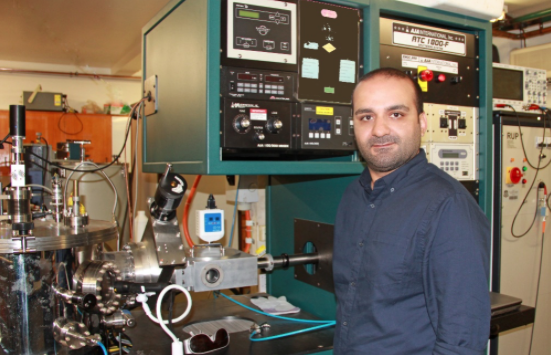
Dr. Behnam Akhavan in the plasma lab. Credit: Dr. Behnam Akhavan

Dr. Behnam Akhavan, an ARC DECRA Fellow from the School of Biomedical Engineering, School of Physics and the Sydney Nanoscience Hub has developed a plasma-generated, hybrid nanocomposite material which is free of indium, and offers a low-cost, accessible and environmentally sound electrochromic technology that allows glass to be dimmed at the push of a button or touch of a screen.

The research was funded by the University of Sydney and the Australian Research Council, and published in Solar Energy Materials and Solar Cells on Monday.

The plasma-generated material is composed of tungsten oxide and silver and can be applied to coat almost any solid surface, including flexible plastics.

Known as the fourth state of matter, plasma is created by adding energy to gas. Plasma is used most commonly in fluorescent light bulbs, neon signs and some television and computer screens.

“When you change the transparency of a wearable electronic or a smart window, an electrochromic device is doing the work,” Dr. Akhavan said in a media release.

“Until now, these devices have typically relied on materials like rare indium to do the job. What we have created is a manufacturer’s dream: a technology that removes the need for indium and instead uses a plasma-engineered, three-layered structure that is much cheaper to produce,” Akhavan said in a media release.

INDUSTRIAL INDIUM IS OFTEN MADE AS A BYPRODUCT OF ZINC MINING

Early iterations of the technology were produced for the first time in 2019, using a new method of tungsten oxide deposition known as ‘HiPIMS’ (the plasma technology used to create these materials).

Now, instead of a bare tungsten oxide layer, the group has developed a nanocomposite of tungsten oxide and silver. This nanotechnology-enabled approach allows electrochromic devices to efficiently and rapidly change colour upon a user’s request.

The plasma coatings are transparent and also electrically conductive. They are made up of a layer of silver that is approximately 10,000 times thinner than the width of human hair, placed in between two nano-thin layers of tungsten oxide decorated with silver nanoparticles.

“These plasma-fabricated coatings can then be applied to electronic papers, smart phones and glass windows and can be dimmed with the application of a small electrical current,” Akhavan said.


Plasma tech could replace one of world's rarest materials

20 July 2021
Technology is low-cost, sustainable, readily available
New plasma coating technology could see the phase-out of rare earth metal indium that is used in smartphone glass and dimmable windows, which is predicted to run out in 10 years.

The layered nanotechnology. Credit: Dr Behnam Akhavan

A team led by a researcher from the University of Sydney has developed a low-cost, sustainable, and readily available technology that can dim the screens of electronic devices, anti-reflection automobile mirrors, and smart architectural windows at a fraction of the cost of current technology. 

It would replace one of the world’s scarcest – yet highly ubiquitous in use – modern materials: indium. A rare chemical element, that it is widely used in devices such as smartphones and computers, windscreen glass and self-dimming windows.

Although small amounts are used to manufacture smart device screens, indium is expensive as it is hard to source; it naturally occurs only in small deposits. Industrial indium is often made as a byproduct of zinc mining, which means a shortage could occur if demand for optoelectronic devices – such as LCDs and touch panels – ramps up.

Dr Behnam Akhavan in the plasma lab. Credit: Dr Behnam Akhavan

Dr Behnam Akhavan, an ARC DECRA Fellow from the School of Biomedical Engineering, School of Physics and the Sydney Nanoscience Hub has developed a plasma-generated, hybrid nanocomposite material which is free of indium, and offers a low-cost, accessible and environmentally sound electrochromic technology that allows glass to be dimmed at the push of a button or touch of a screen. 

The research was published in Solar Energy Materials and Solar Cells on 19 July. 

The plasma-generated material is composed of tungsten oxide and silver and can be applied to coat almost any solid surface, including flexible plastics.

Known as the fourth state of matter, plasma is created by adding energy to gas. Plasma is used most commonly in fluorescent light bulbs, neon signs and some television and computer screens.

Dr Behnam Akhavan's plasma. Credit: Dr Behnam Akhavan

“When you change the transparency of a wearable electronic or a smart window, an electrochromic device is doing the work,” said Dr Akhavan.

“Until now, these devices have typically relied on materials like rare indium to do the job. What we have created is a manufacturer’s dream: a technology that removes the need for indium and instead uses a plasma-engineered, three-layered structure that is much cheaper to produce.”

Early iterations of the technology were produced for the first time in 2019, using a new method of tungsten oxide deposition known as ‘HiPIMS’ (the plasma technology used to create these materials). Now, instead of a bare tungsten oxide layer, the group has developed a nanocomposite of tungsten oxide and silver. This nanotechnology-enabled approach allows electrochromic devices to efficiently and rapidly change colour upon a user’s request. 

The plasma coatings are transparent and also electrically conductive. They are made up of a layer of silver that is approximately 10,000 times thinner than the width of human hair, placed in between two nano-thin layers of tungsten oxide decorated with silver nanoparticles. 

“These plasma-fabricated coatings can then be applied to electronic papers, smart phones and glass windows and can be dimmed with the application of a small electrical current.”

DECLARATION

There are no conflicts of interest to share. The research was funded by the University of Sydney and the Australian Research Council.


Edmonton Muslim community leaders push policy changes to combat Islamophobia

Recommendations from national Muslim organization aimed at 3 levels of government

Members of Edmonton's Muslim community spoke in support of the recommendations, including Al Rashid Mosque's director of communications Noor Al-Henedy. (John Shyptika/CBC)

The National Council of Canadian Muslims released policy recommendations aimed at combating Islamophobia Monday with news conferences held in several cities across Canada.

Various leaders in Edmonton's Muslim community spoke to reporters in front of the Sahaba Mosque in the Boyle Street neighbourhood about the urgent need for action. The city has become a focal point for Islamaphobic incidents in Canada, with multiple attacks on Muslim women wearing hijabs in recent months.

"The time for thoughts and prayers have passed," NCCM spokesperson Adil Hasan said. "We need to see concrete action and we need to see it now."

The recommendations are aimed at all three levels of government and include Criminal Code amendments for hate crimes, anti-Islamophobia strategies in provincial education, and municipal anti-racism campaigns. 

They come in advance of a national summit on Islamophobia on Thursday, which was called for by MPs in June following the attack on the Afzaal family in London, Ont.

One municipal-level recommendation is to invest in celebrating the local history of the Muslim community. 

Director of communications Noor Al-Henedy spoke Monday of the crucial role women played in establishing Al Rashid, Canada's first mosque, in the 1930s — and then saving it from demolition in the 1990s.

"And today we stand here and we're being attacked for simply having the audacity of wearing our hijab," she said. 

"What happened to our city?"

Al-Henedy said action needs to be taken today to combat Islamophobia and change the narrative.

"Because 20 years from now I don't want my daughter to look back and talk about Muslim women and this being our story. This cannot possibly be our story."


Habiba Mohamud said recent attacks have been the source of vicarious trauma for members of the Muslim community. (John Shyptika/CBC)

Hibaba Mohamud, the federal Liberal candidate for Edmonton-Griesbach, said the recent spate of hate-motivated attacks on Black and Muslim women affects the entire community.

She said victims had become housebound, unable to go about their daily lives out of fear. Mohamud spoke of the need for a national fund for victims of Islamophobia, one of the NCCM's federal recommendations.

She said Islamophobia is an endemic problem in Canada.

"It's a systemic problem and it needs a systemic solution to counter it."

The NCCM crafted the recommendations after receiving input from mosques and community organizations across the country, including the Edmonton Council of Muslim Communities.

Its chair, Masood Peracha, said more co-ordination between the three levels of government — including when it pertains to law — would be beneficial.

"So that anything that is promoted at let's say federal levels can also flow through to the provinces and also to civic governments to the extent that it is appropriate."

Public places bylaw review

Another municipal recommendation aimed against violent Islamophobia is to pass street harassment bylaws with ticketing authority. The NCCM cited a recent step by Edmonton council as an example of the approach.

A motion passed unanimously in April calls for administration to work with the city's Anti-Racism Advisory Committee to review and recommend changes to the anti-bullying provisions of the public places bylaw. It will look at including in its offences section any harassment based on race, religion, sexual orientation or gender identity.

The results of the review are expected before the Community and Public Services Committee on August 11.

NDP Leader Singh talks jobs, support for workers and health care during Edmonton pitstop

Author of the article: Lisa Johnson
Publishing date:Jul 18, 2021 •
Federal NDP Leader Jagmeet Singh speaks with the media and greets supporters outside the Edmonton Downtown Farmers Market, Sunday July 18, 2021.
 PHOTO BY DAVID BLOOM

Federal NDP Leader Jagmeet Singh says his party’s jobs plan will invest in infrastructure and get energy-sector workers back to work in renewables as he continued his tour of Alberta in Edmonton Sunday.

Singh said if elected, the NDP would include funding for retrofitting buildings and infrastructure projects with a focus on made-in-Canada products after the pandemic worsened an already-lagging job market in the province, especially for energy workers


“We know that remediating oil wells creates opportunities for jobs right now, as well as opportunities for renewable energy — and we know that in Alberta, people want more renewable energy,” said Singh.

He made the comments at a campaign-style stop at the Edmonton Downtown Farmers Market with NDP MP Heather McPherson for Edmonton Strathcona, the party’s sole MP in Alberta, and NDP Candidate Blake Desjarlais. Desjarlais will be running in Edmonton Griesbach, a riding currently held by Conservative MP Kerry Diotte but considered a toss-up by poll aggregator 338canada.com.

Singh unveiled his party’s jobs plan in Windsor, Ont., Wednesday, including the promise of one million new jobs with improved benefits and plans to institute a wealth tax.

On Sunday, the New Democrat leader also said he had heard local concerns about health care, and used the opportunity to promise an increase to federal health transfers to the provinces if elected, as well as tout his party’s national pharmacare and dental coverage proposals.

Singh said it’s “almost surreal” that the UCP government would consider wage rollbacks for frontline workers such as nursesand support staff.

“When people need health care more than ever, to cut health care seems so callous and so hurtful, and (Premier) Jason Kenney has shown that he does not care about people,” said Singh, who added he would focus on supporting those who have lost their jobs and benefits.

Singh, who also made an appearance in Calgary Saturday, is the third federal party leader to visit Alberta in the past month.

Prime Minister Justin Trudeau made a stop to announce his government was green lighting the latest expansion to Calgary’s Green Line LRT project during a trip through western Canada in early July, fuelling speculation he is eyeing an election in the near future.

Conservative party leader Erin O’Toole also stopped in at a pancake breakfast in Calgary during the Stampede, promising he would work to reform the federal fiscal stabilization program, which has been a longstanding gripe for many Albertans.

Singh said Sunday if elected he would be “very open” to amending the formula to make sure that Alberta “gets its fair share.”


NDP Leader Jagmeet Singh visits Edmonton

The federal politician visited the city as part of his three-day tour of Alberta.


WITH MY NDP FEDERAL CANDIDATE BLAKE DEJARLAIS, EDMONTON GREISBACH TO JAG SINGH'S LEFT

EDMONTON -- The federal leader of the NDP continued his tour of Alberta with a stop in Edmonton on Sunday.

Jagmeet Singh visited Edmonton as the second stop for his three-day tour of the province after visiting Calgary on Saturday.

The politician visited the Edmonton Downtown Farmers Market with Edmonton Strathcona MP Heather McPherson – the only sitting MP from his party in the province. While there, he spoke with Edmontonians and took questions from the media.

No federal election has been called, but recent visits in Alberta from Prime Minister Justin Trudeau and Conservative leader Erin O’Toole have fuelled speculation the writ could be dropped.

When asked about if he believes an election was coming, Singh said the party is ready should an election be called.

“I have always said I don’t think we should be going to an election. We should be getting the help people need,” he said. “Justin Trudeau has promised a lot of things– let’s do that work.

“I want to get back to work. My focus is on getting people the help they need.”

Singh also addressed the need to diversify Alberta’s economy to help get people back to work in a sustainable way.

“People are worried about their future when it comes to jobs. People are telling me that they want to see investments in diversification,” Singh told media.

“The economy here in Alberta needs to be diversified so workers have an opportunity to live a good life, to earn a good living and aren’t so worried about the precarity of their jobs.”

The NDP leader also spoke about how the party is focused on ensuring Canada has a strong economic recovery from COVID-19 and that government aid is focused on supporting workers, not corporations.

“In Alberta things have been already bad, even before the pandemic,” he said. “We saw in the pandemic people didn’t have access to medication and lost access to benefits.

“Everyone in our country should have those supports.”

He added that the federal government should be using Alberta energy workers who are short on work right now to help retrofit buildings and remediating oil wells.

Singh was also asked about his thoughts regarding Alberta’s referendum on equalization. He said it was “ironic” that Premier Jason Kenney was fighting against the formula for equalization when he helped create it during his career as a federal politician. The NDP leader said he would be open to ensuring Alberta got a fair deal.

“We are very open to making sure there is a fair transfer and making sure that Alberta gets its fair share, that all provinces are dealt with fairly,” SIngh responded.

Singh also meet with Confederacy of Treaty 6 First Nations Grand Chief Vernon Watchmaker and the Metis Settlements General Council on Sunday. Those events were closed to the public.


Related Stories
Edmonton MP given leadership role in NDP caucus
'Little orange dot:' Lone Alberta NDP MP says she offers different perspective
If the Liberals are weighing an election, how does the opposition stack up?
Time change, equalization and Senate choices on Alberta's municipal ballots this fall
Federal NDP leader begins tour of Alberta in Calgary
Pancakes and protests: Politicians met with conflict at several Calgary Stampede breakfasts


ALBERTA

Australian Coal firm appeals rejection of Grassy Mountain open-pit mine

The company behind a proposal to build a massive open-pit coal mine along the eastern slopes of the Rocky Mountains is appealing a regulatory decision that halted the development last month.

Australia-based Benga Mining Limited said Monday it launched a legal appeal process to dispute the rejection of the Grassy Mountain steelmaking coal mine by a joint provincial-federal review panel, taking issue with a number of the panel’s findings.

Benga Chief Executive Officer John Wallington said in a release the company disagreed with the Joint Review Panel (JRP) and Alberta Energy Regulator (AER) methodology and conclusion, including Benga’s view that the regulators did not properly take into account First Nations’ support for the project. 

"After careful and thorough review of the JRP's report, Benga believes that the AER's conclusions and reasons contain material errors of law and contraventions of procedural fairness," Wallington said. 

"Among the reasoning in its report, the AER dismissed the full support of the relevant First Nations without consultation, demonstrated a lack of familiarity with the provincial royalty regime, and gave preference to non-expert layman analysis over expert, science-based evidence.”

The proposed mine would have had 4.5 million tonnes of processed coal capacity per year over a mine life of 25 years. One quarter of Grassy Mountain would sit on previously-mined land which Benga said was never restored.

If approved, the project would have created 500 jobs during the construction phase and 385 full-time jobs, Benga said. The company plans to file an affidavit and memorandum of argument to support its appeal in the coming weeks.

The proposed project, about 160 kilometres south of Calgary, sits on Treaty 7 territory. During the initial hearings, the project had the support of all the First Nations whose territories encompassed the project’s proposed footprint.

While the joint review panel acknowledged that Benga had signed agreements will all 14 First Nations and Métis groups that reside in close proximity to the project and had no objection to Grassy Mountain, the JRP said that did not outweigh the environmental impacts of the development.

The panel said that such a project would likely result in “significant adverse environmental effects” on surface water quality, the westslope cutthroat trout habitat and vegetation, among other concerns. The panel also said that in its view Grassy Mountain overstated the potential royalty payments it would generate over the life of the mine, an assertion Benga disputes.

Since 2009, 11 oil sands and coal mining projects have gone through the regulatory oral hearing process, with eight being approved, three withdrawn and none rejected.

The project has emerged as a flashpoint between industry and environmental advocates in the wake of a 2020 decision by Alberta to end a decades-long ban on coal mining in the area. That reversal of the 1976 coal policy opened the door for resumption of mining in the Crowsnest Pass area, where coal was once the lifeblood of the region's economy.

TransAlta completes second of three planned Alberta plant conversions to natural gas

CALGARY -- TransAlta Corp. has taken another step in its goal of becoming carbon neutral by converting the second of three planned coal-to-gas conversions at its Alberta Thermal power generation facilities near Wabamun.

The conversion of Keephills Unit 2 to natural gas is part of the Calgary company's plan to entirely generate clean energy in Alberta by the end of the year.

TransAlta has said it wants to reduce its annual greenhouse gas emissions by 60 per cent, or 19.7 million tonnes by 2030 over 2015 levels and achieve carbon neutrality by 2050.

Chief executive John Kousinioris says the latest conversion maintains its current generation capacity and reduces carbon dioxide emissions by more than half to about 0.51 tonnes CO2e per MWh.

The Keephills conversion cost $31.5 million while another $64.7 million was spent on system upgrades, gas infrastructure and maintenance projects.

It was the second conversion project after Sundance Unit 6 was converted in February. Keephills Unit 3 will be converted later this year.

"This not only highlights TransAlta's commitment to meet Alberta's need for safe, reliable and low-cost electricity but also our commitment to meet our sustainability goals focused on clean electricity generation," stated Kousinioris.

CLEAN POWER
Report: 30 Million Solar Homes Would Create 1.77 Million Jobs, $69 Billion In Energy Savings


Installing a low-income community solar array with students from Leech Lake Tribal College in Minnesota. Photo credit: Jason Edens

ByJohn Farrell
Originally published at ILSR.org

Our new report finds that installing rooftop solar panels and community solar systems to serve the equivalent of 30 million American homes would create significant economic benefits — including 1.77 million jobs and $69 billion electricity bill savings over the next five years — while addressing the climate crisis and historic inequities.

The report, “The National Impact of 30 Million Solar Homes: A Vision for an Equitable Economic Recovery Built on Climate Protection and Energy Democracy,” builds on federal policy recommendations developed by the Initiative for Energy Justice, Institute for Local Self-Reliance, and Solar United Neighbors as part of the 30 Million Solar Homes campaign.

In addition to creating 1.77 million new solar jobs and reducing energy bills by $69 billion, the report found that enacting the 30 Million Solar Homes policies would over five years:

Eliminate global warming air pollution equivalent to closing 48 coal-burning power plants or taking 42 million cars off the road for a year.

Increase new solar capacity nationally by 151 GW.

Power the equivalent of 20 million households in marginalized communities with local solar.

In the report, these economic and environmental benefits are broken down by state and congressional district. An interactive map further illustrates the local impacts of the 30 Million Solar Homes proposal and gives viewers an opportunity to share the report with their elected officials.

There is already broad-based support for this campaign. More than 330 energy equity, climate, business, environmental, faith, and public health organizations signed a letter to Congress urging the adoption of the 30 Million Solar Homes federal policy recommendations. These recommendations include expanding solar access through low-income energy assistance, making federal solar energy tax credits more equitable, and supporting federal financing and grant programs for local solar deployment. A majority of the federal investments would benefit historically marginalized communities, including environmental justice communities and low- and moderate-income communities.

The report, the interactive map, and other resources are also available on the 30 Million Solar Homes campaign website.


Making clean hydrogen is hard, but researchers just solved a major hurdle


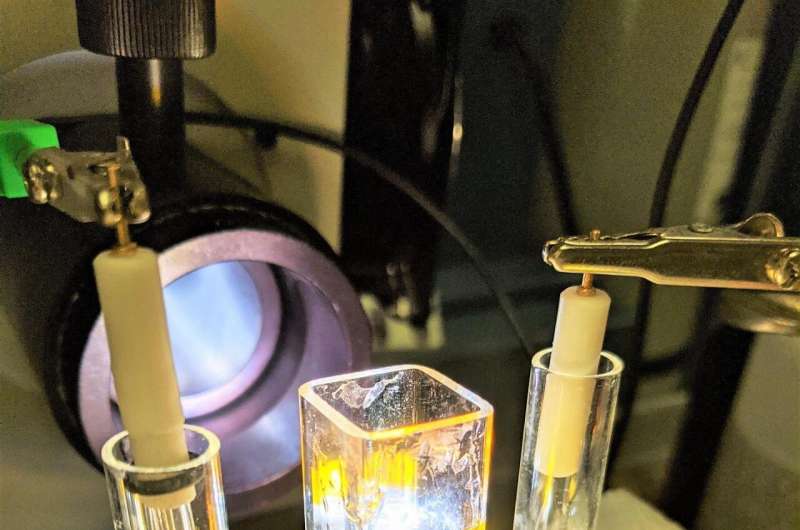
The team's experimental water-splitting apparatus. Credit: Cockrell School of Engineering, The University of Texas at Austin

For decades, researchers around the world have searched for ways to use solar power to generate the key reaction for producing hydrogen as a clean energy source—splitting water molecules to form hydrogen and oxygen. However, such efforts have mostly failed because doing it well was too costly, and trying to do it at a low cost led to poor performance

Now, researchers from The University of Texas at Austin have found a low-cost way to solve one half of the equation, using sunlight to efficiently split off oxygen molecules from water. The finding, published recently in Nature Communications, represents a step forward toward greater adoption of hydrogen as a key part of our energy infrastructure.

As early as the 1970s, researchers were investigating the possibility of using solar energy to generate hydrogen. But the inability to find materials with the combination of properties needed for a device that can perform the key chemical reactions efficiently has kept it from becoming a mainstream method.

"You need materials that are good at absorbing sunlight and, at the same time, don't degrade while the water-splitting reactions take place," said Edward Yu, a professor in the Cockrell School's Department of Electrical and Computer Engineering. "It turns out materials that are good at absorbing sunlight tend to be unstable under the conditions required for the water-splitting reaction, while the materials that are stable tend to be poor absorbers of sunlight. These conflicting requirements drive you toward a seemingly inevitable tradeoff, but by combining multiple materials—one that efficiently absorbs sunlight, such as silicon, and another that provides good stability, such as —into a single device, this conflict can be resolved."

However, this creates another challenge—the electrons and holes created by absorption of sunlight in silicon must be able to move easily across the silicon dioxide layer. This usually requires the silicon dioxide layer to be no more than a few nanometers, which reduces its effectiveness in protecting the silicon absorber from degradation.

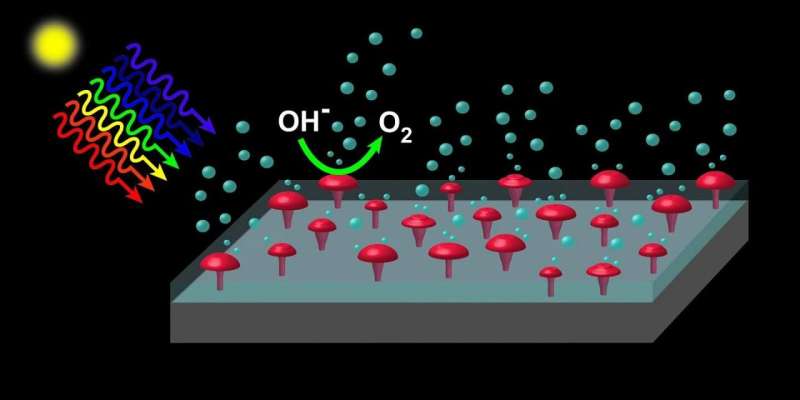
The key to this breakthrough came through a method of creating electrically conductive paths through a thick silicon dioxide layer that can be performed at low cost and scaled to high manufacturing volumes. To get there, Yu and his team used a technique first deployed in the manufacturing of semiconductor electronic chips. By coating the silicon dioxide layer with a thin film of aluminum and then heating the entire structure, arrays of nanoscale "spikes" of aluminum that completely bridge the  dioxide layer are formed. These can then easily be replaced by nickel or other materials that help catalyze the water-splitting reactions.


Graphic shows the basic geometry and functionality of the photoanode device. Credit: Cockrell School of Engineering, The University of Texas at Austin

When illuminated by sunlight, the devices can efficiently oxidize water to form oxygen molecules while also generating hydrogen at a separate electrode and exhibit outstanding stability under extended operation. Because the techniques employed to create these devices are commonly used in manufacturing of semiconductor electronics, they should be easy to scale for mass production.

The team has filed a provisional patent application to commercialize the technology.

Improving the way hydrogen is generated is key to its emergence as a viable fuel source. Most hydrogen production today occurs through heating steam and methane, but that relies heavily on fossil fuels and produces carbon emissions.

There is a push toward 'green hydrogen' which uses more environmentally friendly methods to generate hydrogen. And simplifying the water-splitting reaction is a key part of that effort.

Hydrogen has potential to become an important renewable resource with some unique qualities. It already has a major role in significant industrial processes, and it is starting to show up in the automotive industry. Fuel cell batteries look promising in long-haul trucking, and hydrogen technology could be a boon to energy storage, with the ability to store excess wind and solar energy produced when conditions are ripe for them.

Going forward, the team will work to improve the efficiency of the oxygen portion of water-splitting by increasing the reaction rate. The researchers' next major challenge is then to move on to the other half of the equation.

"We were able to address the oxygen side of the reaction first, which is the more challenging part," Yu said, "but you need to perform both the hydrogen and oxygen evolution reactions to completely split the , so that's why our next step is to look at applying these ideas to make devices for the  portion of the reaction."

New porous material promising for making renewable energy from water
More information: Soonil Lee et al, Scalable, highly stable Si-based metal-insulator-semiconductor photoanodes for water oxidation fabricated using thin-film reactions and electrodeposition, Nature Communications (2021). DOI: 10.1038/s41467-021-24229-y
Journal information: Nature Communicatio
Provided by University of Texas at Austin 
Oil and gas emissions could risk 'killing concept of blue hydrogen', warns Equinor vice president

Production of fully decarbonised gas will require the use of renewable energy and further emissions reductions throughout the value chain

Blue hydrogen produced from natural gas with carbon capture and storage is often criticised because it is not a fully zero-emission outcome.


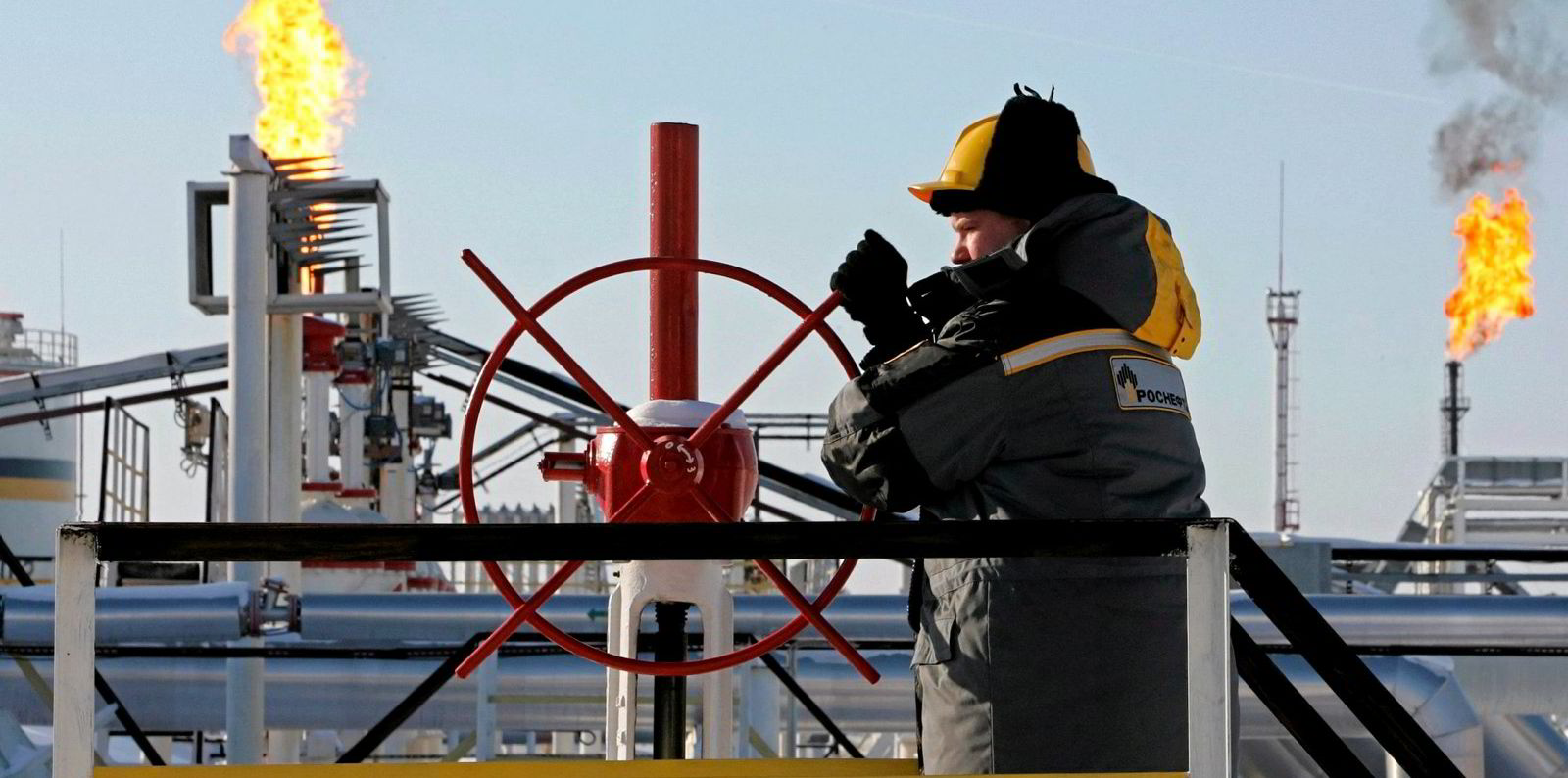
Old ways: flaring by-pass gas at a Rosneft-operated field in West Siberia, Russia
Photo: EURASIA.EXPERT

In an interview with Upstream's sister publication Recharge, Equinor vice president of low-carbon technology Henrik Solgaard Andersen acknowledged that a more comprehensive low-emission solution needs to be found.

At present, it is only possible to capture up to 98% of carbon dioxide emitted in the process of methane reforming, although levels of around 90% are seen as a more realistic of industry practice

However, the entire blue hydrogen value chain is also likely to produce significant greenhouse gas emissions unless efforts are purposely taken to reduce them.

Almost every stage of the process — from extracting natural gas to transporting it, compressing the hydrogen, and capturing the CO2 and moving it to storage — has potential for CO2 emissions, either directly or indirectly from the use of fossil-fuel power, and leakage of methane is also a constant risk.


ExxonMobil joins Acorn carbon capture and storage project in Scotland
Read more

To make blue hydrogen a truly low-carbon solution, critics say, all the electricity used throughout the value chain should come from renewable sources, CO2 emissions from gas flaring must be eliminated and stringent monitoring would be needed to ensure minimal leakage of methane.

“These [emission-reduction solutions] must be implemented in the gas industry to make blue hydrogen a long-term option," says Andersen. “Otherwise upstream emissions will kill the concept [of blue hydrogen].”

He explains: “I’m always honest saying that if we talk about a weakness of blue hydrogen it’s the upstream emissions. So it's key that the natural gas you're providing for blue hydrogen has low emissions and that means both in terms of CO2 and methane leakages.”

The Dane says that strict regulations in Norway have required Equinor to spend time and money on reducing its upstream methane and CO2 emissions, including powering some of its offshore platforms from shore using hydroelectricity and recycling excess gas down to the reservoir, rather than flaring.

“That means, in fact, the offshore emissions [at such platforms] are close to zero, and that’s the same type of solutions you need when you’re sourcing other types of natural gas,” he says.

“So when you are, let’s say, using Russian gas, that needs to be compressed all the way from Yamal [in northwest Siberia] to the UK; you need to use renewable power when you do the recompression, otherwise you would just add a lot of CO2 emissions.

“And when you are importing LNG, you need to make sure the LNG production has CCS [because the liquefaction process separates out any CO2 present in the natural gas] like we do in Norway at Snohvit.”

"Not rocket science"


Andersen says that reducing upstream emissions is not “rocket science” — all gas companies could reduce them if they chose to, but that would require them to accept additional costs.


“We have electrified a lot of our offshore installations, so we're using a lot of renewable power to drive all our rotating equipment on offshore platforms; we are implementing CCS.

"When it comes to maritime sectors we also — because we are running a lot of vessels globally — are looking into replacing that with less carbon intensive fuels, of course, [over the] long term, ammonia or biofuels. In methane leakage, we have implemented a lot of different methodologies and processes to avoid leakages, both during start-ups and shutdowns and critical operations where these things can happen.


UK industrial cluster says blue hydrogen needed now to reach net-zero goals
Read more

“These are not rocket science. It's more like a cost issue. People must be willing to take that potential extra cost to implement it.”
Total capture?

Andersen stresses that 100% carbon capture from methane reforming is not physically possible.

“In these blue hydrogen processes, there will always be some CO2 remaining because they are catalytic processes,” Andersen says.

“So they are driven by what we call catalytic equilibrium, reaction equilibrium, and you can never get 100% conversion, that is more or less impossible when it comes to the laws of nature. But we believe with the best technology, we can achieve maybe up to 97% to 98%.”

He puts it in more simple terms by explaining the difficulties of capturing carbon dioxide from the flue gas at a natural-gas-fired power plant.

“The pressure is very low and the CO2 concentration is very low... so it’s very difficult. It's like finding a needle in a haystack. And the more [CO2] you take out, the smaller the needle gets to find the rest [of the CO2]. And finally, you can't get it.

“In a blue hydrogen plant, it's high-pressure CO2. So we have many more needles initially, and that's why you can capture much more CO2 in a blue hydrogen plant compared to a post-combustion plant, because the pressure is so high, so you can get down to [97% to 98%].”

According to a recent report by the UK’s Hydrogen and Fuel Cell Association, entitled The Case for Blue Hydrogen, the standard method of grey hydrogen production from natural gas — steam methane reforming (SMR) — can only capture 90% of CO2 emissions.

A slightly more expensive process, known as autothermal reforming (ATR), which requires the addition of pure oxygen, can capture 98%, it says.


Learning the hard way: Energy giants leap forward with transition, but could have been swifter
Read more

Andersen explains that Equinor has not yet decided which of these two process it would use to produce blue hydrogen, but it would probably go with ATR.

“What we see is that for smaller scale and medium scale sizes, SMR will be the best solution. But when it comes to bigger scale, towards the 1 gigawatt [size], ATR is the more cost efficient solution.”
How blue hydrogen could become net zero

Andersen says that even though blue hydrogen is not intrinsically a net-zero solution, it could become one through the addition of carbon-neutral biogas, which is produced by fermenting plant matter inside huge tanks known as anaerobic digesters.

“One concept we have been working on, which we published a year and a half ago, is to add biogas — a carbon-neutral component — into the natural gas. So when you capture [the CO2 that was absorbed by the plant matter as it grew], it becomes carbon-negative. Maybe [adding] 5% in total will also cover potential upstream emissions.”

(A version of this article first appeared in Upstream's sister publication Recharge on 15 July, 2021)(Copyright)
World's First Offshore Green Hydrogen Plant Built on French Coast

Offshore hydrogen plants will utilize abundant water and connect to offshore wind turbines.


By Chris Young
Jul 19, 2021

Centrale Nantes


An offshore hydrogen production plant is scheduled to start operation next year off the coast of France, a press statement explains.

The plant, which will be powered by electricity from a nearby floating wind turbine, called Floatgen, will be installed at the SEM-REV demonstration site, off the coast of Le Croisic in France.

Once it is operational, it will be the world's first offshore green hydrogen production facility. The project is being developed by green hydrogen firm Lhyfe and French engineering school Centrale Nantes.

The SEM-REV demonstration site has "harsh environmental conditions," Centrale Nantes' press statement says, meaning it is ideal for validating offshore hydrogen production technology.

"We are convinced that offshore production of renewable hydrogen is a perfectly suitable solution for the massive deployment of hydrogen that is on the horizon," said Matthieu Guesné, CEO and founder of Lhyfe.

"We are making great strides forward in our development and are determined to be the first in the world to deploy a solution for offshore renewable hydrogen production," he continued.
The great potential of offshore wind and hydrogen

As the water needed for the electrolysis process for hydrogen production is available in unlimited amounts out at sea, and the new production plant can be hooked up to offshore wind turbines, it has great potential to scale for eventual industrial-scale deployment.

The production plant will go into operation in 2022, after which, all going to plan, the technology will move towards large-scale industrial deployment in 2024.

Offshore wind turbines and hydrogen technologies have the potential to help countries reach their climate change goals over the coming years. In particular, green hydrogen cars, alongside electric vehicles (EVs), could greatly reduce our reliance on gas-guzzling internal combustion engines.


However, the debate over the validity of hydrogen vehicles in a landscape that has so far been dominated by electrification is ongoing, with Tesla CEO Elon Musk labeling hydrogen cars as a "staggeringly dumb form of energy storage for cars."

Despite Musk's assertion, other automakers, including BMW, are backing hydrogen technologies, and Toyota has set a world record by driving its Mirai hydrogen car 623 miles (1,000 km) on one fill.

With companies such as GE developing new offshore turbine technologies with a view to allowing wind farms to go further out to sea, hydrogen and wind energy could be a match made in heaven.